Classrooms for the Future  Pennsylvania Department of Education Edward G. Rendell Governor Gerald L. Zahorchak Secretary http://www.youtube.com/watch?v=pQHX-SjgQvQ
Technology has transformed  our society into… A global marketplace with immediate and unlimited access to  Information 24/7 Newer and better services and goods  A culture that demands that we possess the skills and knowledge to use technology resourcefully as both a consumer and a worker
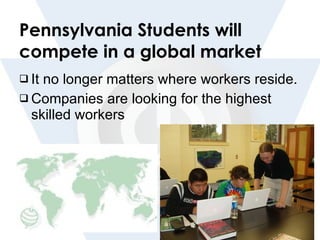
Pennsylvania Students will compete in a global market It no longer matters where workers reside. Companies are looking for the highest skilled workers
Change is constant Technological exploration and innovation facilitate constant changes to our world and how we inhabit it … we must now redesign education to reflect a new human paradigm.
Classrooms for the Future A bold step toward large-scale high school reform for the 21st Century Grantees commit to - Improve teaching and learning in English, math, science, and social studies  Assist us to prepare our students for tomorrow’s postsecondary and workforce opportunities Support models for future classrooms Promote leadership & advocacy for systemic change in organizational and instructional practices
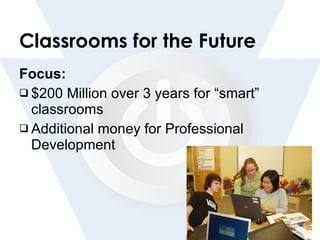
Classrooms for the Future Focus: $200 Million over 3 years for “smart” classrooms Additional money for Professional Development
Classrooms for the Future Goals: Improve teaching and learning in English, math, science, and social studies. Change classroom practice. Change student-teacher relationships. Increase student engagement. Students responsible for learning. Students developing 21st century skills. Increase Academic achievement.
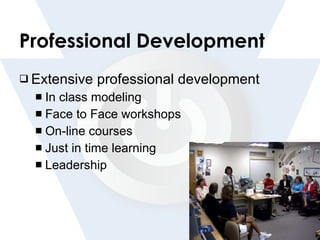
Professional Development Extensive professional development In class modeling Face to Face workshops On-line courses Just in time learning Leadership
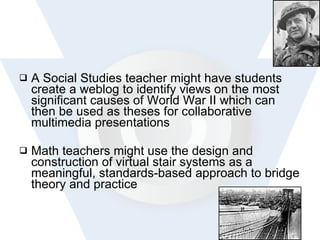
A Social Studies teacher might have students create a weblog to identify views on the most significant causes of World War II which can then be used as theses for collaborative multimedia presentations Math teachers might use the design and construction of virtual stair systems as a meaningful, standards-based approach to bridge theory and practice
English teachers might develop webquests with rubrics that support critical literacy and advanced research skills through producing digital movies, composing songs, or writing narrative essays on Langston Hughes’s poetry  Science teachers might lead students on a NASA eMission where they need to analyze jet propulsion forces and cargo load requirements to outmaneuver a meteorite
The Future Classroom For students, it can be about moving from passive listener to active learner through contextual immersion.  For example, students might  –
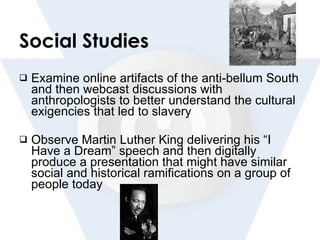
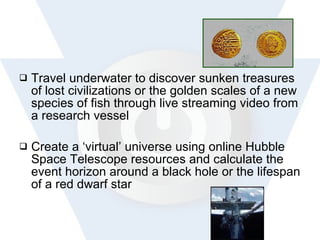
Social Studies Examine online artifacts of the anti-bellum South and then webcast discussions with anthropologists to better understand the cultural exigencies that led to slavery Observe Martin Luther King delivering his “I Have a Dream” speech and then digitally produce a presentation that might have similar social and historical ramifications on a group of people today
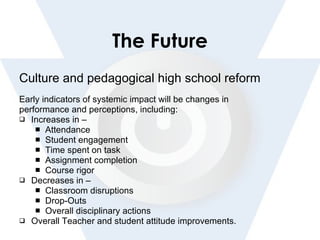
Travel underwater to discover sunken treasures of lost civilizations or the golden scales of a new species of fish through live streaming video from a research vessel Create a ‘virtual’ universe using online Hubble Space Telescope resources and calculate the event horizon around a black hole or the lifespan of a red dwarf star
The Future Culture and pedagogical high school reform  Early indicators of systemic impact will be changes in performance and perceptions, including: Increases in – Attendance Student engagement Time spent on task Assignment completion Course rigor Decreases in – Classroom disruptions Drop-Outs Overall disciplinary actions  Overall Teacher and student attitude improvements. 
So What?
Professional Development HASD is extending the PD Opportunities to teachers outside high school
Teaching in the 21st Century: The Need for Change Course is divided into 5 units District-based facilitator 30 Act 48 hours Possible financial reward for completing course Learn to teach your students using methods by which they will learn actively
Upon Completion of Course You will be able to: Identify the needs and preferences of the 21st Century learners Recognize the gap that exists between current instructional practices and the skill set needed by students for success in the 21st Century workplace Understand the role collegial collaboration plays in establishing a 21st Century classroom Establish more effective communication among stakeholders
Unit 1 Introduction This is where you learn the course management system and become more comfortable learning online
Unit 2 Rationale for 21st Century Change How do 21st Century students communicate? How do 21st Century students think differently? Why are 21st Century students disengaged? How is the 21st Century workplace different than the 20th Century workplace? What are the 21st Century skills needed by students?
Unit 3 21st Century Teacher What is the role of the teacher in a 21st Century classroom? What knowledge and skills are needed by the teacher to meet the needs of the 21st Century students? What are the perceived obstacles to 21st Century teaching?
Unit 4 Working Together to Accomplish the 21st Century Transformation What is the importance of a shared vision? How is the interaction between teachers different in the 21st Century? How do academic departments transform in the 21st Century? How do you communicate 21st Century approaches to stakeholders?
Unit 5 Culminating Activity
Format of Class Facilitated by district teacher Most of work is self-paced online Periodic meetings with cohort Culminating project to implement in your own classroom
I’m Interested Email Kammy Meet November 18  @ 3:00 for further information Make commitment to take course
Questions?

Hams presentation

  • 1.
    Classrooms for theFuture Pennsylvania Department of Education Edward G. Rendell Governor Gerald L. Zahorchak Secretary http://www.youtube.com/watch?v=pQHX-SjgQvQ
  • 2.
    Technology has transformed our society into… A global marketplace with immediate and unlimited access to Information 24/7 Newer and better services and goods A culture that demands that we possess the skills and knowledge to use technology resourcefully as both a consumer and a worker
  • 3.
    Pennsylvania Students willcompete in a global market It no longer matters where workers reside. Companies are looking for the highest skilled workers
  • 4.
    Change is constantTechnological exploration and innovation facilitate constant changes to our world and how we inhabit it … we must now redesign education to reflect a new human paradigm.
  • 5.
    Classrooms for theFuture A bold step toward large-scale high school reform for the 21st Century Grantees commit to - Improve teaching and learning in English, math, science, and social studies Assist us to prepare our students for tomorrow’s postsecondary and workforce opportunities Support models for future classrooms Promote leadership & advocacy for systemic change in organizational and instructional practices
  • 6.
    Classrooms for theFuture Focus: $200 Million over 3 years for “smart” classrooms Additional money for Professional Development
  • 7.
    Classrooms for theFuture Goals: Improve teaching and learning in English, math, science, and social studies. Change classroom practice. Change student-teacher relationships. Increase student engagement. Students responsible for learning. Students developing 21st century skills. Increase Academic achievement.
  • 8.
    Professional Development Extensiveprofessional development In class modeling Face to Face workshops On-line courses Just in time learning Leadership
  • 9.
    A Social Studiesteacher might have students create a weblog to identify views on the most significant causes of World War II which can then be used as theses for collaborative multimedia presentations Math teachers might use the design and construction of virtual stair systems as a meaningful, standards-based approach to bridge theory and practice
  • 10.
    English teachers mightdevelop webquests with rubrics that support critical literacy and advanced research skills through producing digital movies, composing songs, or writing narrative essays on Langston Hughes’s poetry Science teachers might lead students on a NASA eMission where they need to analyze jet propulsion forces and cargo load requirements to outmaneuver a meteorite
  • 11.
    The Future ClassroomFor students, it can be about moving from passive listener to active learner through contextual immersion. For example, students might –
  • 12.
    Social Studies Examineonline artifacts of the anti-bellum South and then webcast discussions with anthropologists to better understand the cultural exigencies that led to slavery Observe Martin Luther King delivering his “I Have a Dream” speech and then digitally produce a presentation that might have similar social and historical ramifications on a group of people today
  • 13.
    Travel underwater todiscover sunken treasures of lost civilizations or the golden scales of a new species of fish through live streaming video from a research vessel Create a ‘virtual’ universe using online Hubble Space Telescope resources and calculate the event horizon around a black hole or the lifespan of a red dwarf star
  • 14.
    The Future Cultureand pedagogical high school reform Early indicators of systemic impact will be changes in performance and perceptions, including: Increases in – Attendance Student engagement Time spent on task Assignment completion Course rigor Decreases in – Classroom disruptions Drop-Outs Overall disciplinary actions Overall Teacher and student attitude improvements. 
  • 15.
  • 16.
    Professional Development HASDis extending the PD Opportunities to teachers outside high school
  • 17.
    Teaching in the21st Century: The Need for Change Course is divided into 5 units District-based facilitator 30 Act 48 hours Possible financial reward for completing course Learn to teach your students using methods by which they will learn actively
  • 18.
    Upon Completion ofCourse You will be able to: Identify the needs and preferences of the 21st Century learners Recognize the gap that exists between current instructional practices and the skill set needed by students for success in the 21st Century workplace Understand the role collegial collaboration plays in establishing a 21st Century classroom Establish more effective communication among stakeholders
  • 19.
    Unit 1 IntroductionThis is where you learn the course management system and become more comfortable learning online
  • 20.
    Unit 2 Rationalefor 21st Century Change How do 21st Century students communicate? How do 21st Century students think differently? Why are 21st Century students disengaged? How is the 21st Century workplace different than the 20th Century workplace? What are the 21st Century skills needed by students?
  • 21.
    Unit 3 21stCentury Teacher What is the role of the teacher in a 21st Century classroom? What knowledge and skills are needed by the teacher to meet the needs of the 21st Century students? What are the perceived obstacles to 21st Century teaching?
  • 22.
    Unit 4 WorkingTogether to Accomplish the 21st Century Transformation What is the importance of a shared vision? How is the interaction between teachers different in the 21st Century? How do academic departments transform in the 21st Century? How do you communicate 21st Century approaches to stakeholders?
  • 23.
  • 24.
    Format of ClassFacilitated by district teacher Most of work is self-paced online Periodic meetings with cohort Culminating project to implement in your own classroom
  • 25.
    I’m Interested EmailKammy Meet November 18 @ 3:00 for further information Make commitment to take course
  • 26.