1
Haematopoiesis
2
Haematopoiesis
• This is the development of all blood cells from
multipotent stem cells, termed haematopoietic
stem cell (HSC), characterised by CD34, which
in adults occurs in the bone marrow.
3
Haematopoietic stem cell
• Stem cells have two essential properties
– self renewal
– potency.
• Self renewal of course means that they can
proliferate, indefinitely in the case of some.
• Potency means thay can generate a range (one
or many) differentiated cell types.
• Stem cells themselves are undifferentiated i.e.
have no specific functions other than division.
Haematopoietic stem cell
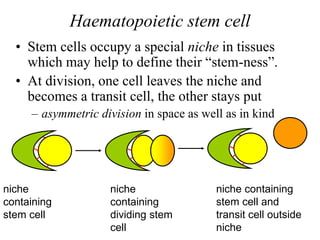
• Stem cells occupy a special niche in tissues
which may help to define their “stem-ness”.
• At division, one cell leaves the niche and
becomes a transit cell, the other stays put
– asymmetric division in space as well as in kind
niche
containing
stem cell
niche
containing
dividing stem
cell
niche containing
stem cell and
transit cell outside
niche
Haematopoietic stem cell
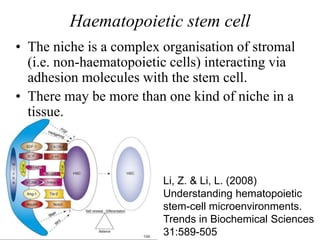
• The niche is a complex organisation of stromal
(i.e. non-haematopoietic cells) interacting via
adhesion molecules with the stem cell.
• There may be more than one kind of niche in a
tissue.
Li, Z. & Li, L. (2008)
Understanding hematopoietic
stem-cell microenvironments.
Trends in Biochemical Sciences
31:589-505
6
Haematopoietic stem cell
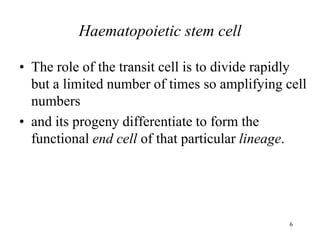
• The role of the transit cell is to divide rapidly
but a limited number of times so amplifying cell
numbers
• and its progeny differentiate to form the
functional end cell of that particular lineage.
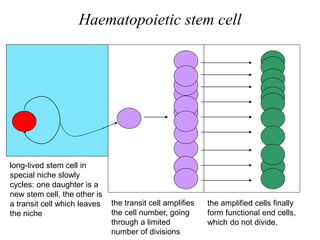
long-lived stem cell in
special niche slowly
cycles: one daughter is a
new stem cell, the other is
a transit cell which leaves
the niche
the transit cell amplifies
the cell number, going
through a limited
number of divisions
the amplified cells finally
form functional end cells,
which do not divide.
Haematopoietic stem cell
8
Haematopoiesis
• In haematopoiesis there is an intervening step
called a “progenitor cell”
– this is like a stem cell in that it is multipotent (tho’
less so than the HSC)
– it is unlike the stem cell in that it does not divide
indefinitely
– (a controversial issue).
9
Haematopoiesis
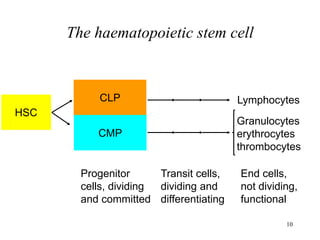
• There are 2 progenitor cells in
haematopoiesis:
• Common lymphoid progenitors (CLPs) which
give rise to all lymphoid cells.
• Common myeloid progenitors (CMPs) which
give rise to all other blood cells including
erythrocytes and platelets.
10
The haematopoietic stem cell
CLP
HSC
CMP
Lymphocytes
Granulocytes
erythrocytes
thrombocytes
Transit cells,
dividing and
differentiating
End cells,
not dividing,
functional
Progenitor
cells, dividing
and committed
11
Haematopoiesis
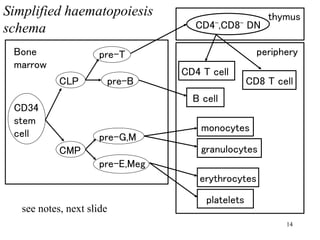
• B cells & LGLs mature from CLPs in the bone
marrow.
• Early T cell precursors derived from CLPs
migrate to the thymus where they complete their
maturation and then enter the periphery as CD4
or CD8 cells.
• A key step in the differentiation of B & T
lymphocytes is development of their antigen
receptors sIg and TCR.
12
Haematopoiesis
• CMPs give rise to either
– megakaryocyte (generates platelets)/erythrocyte
or
– granulocyte/macrophage progenitors.
• These latter differentiate within the bone marrow
to give rise to all the myeloid cells.
13
Haematopoiesis
What drives haematopoiesis?
• A range of proteins which drive growth and
differentiation which bind to specific receptors
on the developing cells.
• These are generated
– by the stromal cells of the primary lymphoid tissues,
& may be cell-surface expressed (juxtacrine);
– or (especially during infection/inflammation) by
activated leukocytes in other tissues (paracrine).
14
CD34
stem
cell
CMP
CLP
pre-T
pre-B
pre-G,M
pre-E,Meg
Bone
marrow
periphery
thymus
CD4-,CD8- DN
CD4 T cell
CD8 T cell
B cell
monocytes
granulocytes
erythrocytes
platelets
Simplified haematopoiesis
schema
see notes, next slide
15
Simplified haematopoiesis schema
• MANY INTERMEDIATE STEPS OMITTED.
• GROWTH FACTORS OMITTED.
• Dendritic cells omitted
– probably arise from both both CLP & CMP.
• LGL/NK cells omitted - parallel B cells.
• Periphery = circulation and all tissues except
1ry lymphoid.
• Communication between compartments via
circulation.
• Meg = megakaryocyte; DN = double negative.
16
Haematopoiesis
• The process of haematopoeisis is obviously
much more complex than presented here.
• Go to Haematopoiesis - less simple version
for a much fuller account of haematopoiesis.

haematopoiesis.ppt

  • 1.
  • 2.
    2 Haematopoiesis • This isthe development of all blood cells from multipotent stem cells, termed haematopoietic stem cell (HSC), characterised by CD34, which in adults occurs in the bone marrow.
  • 3.
    3 Haematopoietic stem cell •Stem cells have two essential properties – self renewal – potency. • Self renewal of course means that they can proliferate, indefinitely in the case of some. • Potency means thay can generate a range (one or many) differentiated cell types. • Stem cells themselves are undifferentiated i.e. have no specific functions other than division.
  • 4.
    Haematopoietic stem cell •Stem cells occupy a special niche in tissues which may help to define their “stem-ness”. • At division, one cell leaves the niche and becomes a transit cell, the other stays put – asymmetric division in space as well as in kind niche containing stem cell niche containing dividing stem cell niche containing stem cell and transit cell outside niche
  • 5.
    Haematopoietic stem cell •The niche is a complex organisation of stromal (i.e. non-haematopoietic cells) interacting via adhesion molecules with the stem cell. • There may be more than one kind of niche in a tissue. Li, Z. & Li, L. (2008) Understanding hematopoietic stem-cell microenvironments. Trends in Biochemical Sciences 31:589-505
  • 6.
    6 Haematopoietic stem cell •The role of the transit cell is to divide rapidly but a limited number of times so amplifying cell numbers • and its progeny differentiate to form the functional end cell of that particular lineage.
  • 7.
    long-lived stem cellin special niche slowly cycles: one daughter is a new stem cell, the other is a transit cell which leaves the niche the transit cell amplifies the cell number, going through a limited number of divisions the amplified cells finally form functional end cells, which do not divide. Haematopoietic stem cell
  • 8.
    8 Haematopoiesis • In haematopoiesisthere is an intervening step called a “progenitor cell” – this is like a stem cell in that it is multipotent (tho’ less so than the HSC) – it is unlike the stem cell in that it does not divide indefinitely – (a controversial issue).
  • 9.
    9 Haematopoiesis • There are2 progenitor cells in haematopoiesis: • Common lymphoid progenitors (CLPs) which give rise to all lymphoid cells. • Common myeloid progenitors (CMPs) which give rise to all other blood cells including erythrocytes and platelets.
  • 10.
    10 The haematopoietic stemcell CLP HSC CMP Lymphocytes Granulocytes erythrocytes thrombocytes Transit cells, dividing and differentiating End cells, not dividing, functional Progenitor cells, dividing and committed
  • 11.
    11 Haematopoiesis • B cells& LGLs mature from CLPs in the bone marrow. • Early T cell precursors derived from CLPs migrate to the thymus where they complete their maturation and then enter the periphery as CD4 or CD8 cells. • A key step in the differentiation of B & T lymphocytes is development of their antigen receptors sIg and TCR.
  • 12.
    12 Haematopoiesis • CMPs giverise to either – megakaryocyte (generates platelets)/erythrocyte or – granulocyte/macrophage progenitors. • These latter differentiate within the bone marrow to give rise to all the myeloid cells.
  • 13.
    13 Haematopoiesis What drives haematopoiesis? •A range of proteins which drive growth and differentiation which bind to specific receptors on the developing cells. • These are generated – by the stromal cells of the primary lymphoid tissues, & may be cell-surface expressed (juxtacrine); – or (especially during infection/inflammation) by activated leukocytes in other tissues (paracrine).
  • 14.
    14 CD34 stem cell CMP CLP pre-T pre-B pre-G,M pre-E,Meg Bone marrow periphery thymus CD4-,CD8- DN CD4 Tcell CD8 T cell B cell monocytes granulocytes erythrocytes platelets Simplified haematopoiesis schema see notes, next slide
  • 15.
    15 Simplified haematopoiesis schema •MANY INTERMEDIATE STEPS OMITTED. • GROWTH FACTORS OMITTED. • Dendritic cells omitted – probably arise from both both CLP & CMP. • LGL/NK cells omitted - parallel B cells. • Periphery = circulation and all tissues except 1ry lymphoid. • Communication between compartments via circulation. • Meg = megakaryocyte; DN = double negative.
  • 16.
    16 Haematopoiesis • The processof haematopoeisis is obviously much more complex than presented here. • Go to Haematopoiesis - less simple version for a much fuller account of haematopoiesis.