Haematological Malignancy
BY
ARUOMAREN AUSTIN IROGHAMA
Aetiology
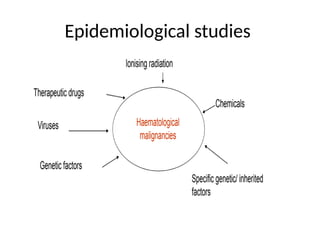
Epidemiological studies
• Large scale cause and effect studies – MRC -
difficult to conduct due to variety of possible
contributory factors : environmental, socio-
economic conditions and healthcare issues
• Number of patient years required for a conclusion
• A number of factors are considered to be
involved /causative in the aetiology of
haematological malignancies
Epidemiological studies
Ionising Radiation
• Atom bombs : Hiroshima and Nagasaki –
proven correlation between exposure to
radiation and carcinogenesis incidence CML,
ALL, AML and MM noted in survivors in short
and long term follow-up studies
• Risk of developing leukaemia – inversely related
to distance from hypocentre of explosion
Ionising Radiation
Nuclear power stations & reprocessing plants
• Interest focussed on Sellafield reprocessing
plant (1984 govt. enquiry) re. childhood ALL
cluster among those born in the area – not new
comers.
• link with fathers working in the industry – not
conclusive. Is this circumstantial as children of
survivors of Hiroshima have no increased risk
Environmental background radiation
• X-Rays : exposure to therapeutic X rays =
increased incidence of leukaemia and solid
tumours.
• Risk of leukaemogenisis increases if alkylating
agents used concurrently
• Prior to protective shielding for staff in X ray
depts (1940) increases leukaemia
• Exposure of foetuses to X ray in 1st trimester
increases incidence ALL
Environmental background radiation
• DOH study 2001 : Ionising Radiation and
Medical Reporting (IRMER) – clamp down on
unnecessary exposure – some X rays =radio-
intense
• Therapeutic radiotherapy :combined modality
treatment for HD – 30 fold in developing
leukaemia
• Radiotherapy of Ankylosing Spondilytis
patients correlates with leukamia
Chemicals
• Benzene + other petroleum derivatives – BM
hypoplasia, dysplasia, chromosomal abnormalities,
MDS and AML
• Armament waste : unusually high incidence of AML
and CML in Stadtallendorf in Germany –
environmental contamination with TNT (toluene
derivative – similar to benzene)
• Cigarettes: slight increase risk of AML due to
aromatic compounds in smoke
• Agricultural and rubber industry workers -
circumstantial links
Therapeutic drugs
• Alkylating agents = radiomimetic drugs ie. melphalan,
azothioprine, chlorambucil, nitosureas (BCNU), nitrogen
mustard - particularly if combined with radiotherapy
assoc. with 2o
AML
• Busulphan prevents DNA strands parting normally –
induces breaks/damage assoc. with lung & ovarian Ca
– Risks increase with exposure - linked with chromosomal
abnormalities
– Development of AML in RhA patients
• Epidophyllotoxins ie etoposide = powerful anti-
leukaemic agent but associated with AML after a latency
period of 1-5 years particularly M4 or M5 and 11q23
mutation
Viruses
• Considerable evidence for viral induction of leukaemia
• Oncogenic viruses
– either DNA viruses incl. adenoviruses, herpes viruses
– or RNA viruses including retroviruses
• Viruses are oncogenic via 3 mechanisms :
– Retrovirus contains an oncogene which it inserts into host
genome :RAPID TUMOUR DEVELOPMENT
– Insertion of viral DNA at a specific point in host DNA which
may affect replication = insertional mutagenesis: MAY BE
LATENT AND NEVER CAUSE NEOPLASIA
– HTLV-1 as above except insertion point varies –aberrant
viral protein may upregulate IL-2, IL-4, GM-CSF
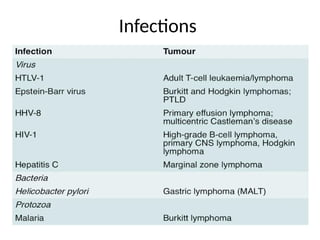
Infections
Genetic/inherited factors
• Primary genetic diseases and leukaemia:
• Downs syndrome 20-30 fold increase in ALL or
AML,
• Bloom’s syndrome, Fanconi anaemia, ataxia-
telangiectasia,
• Weak familial link - B-CLL, HD, NHL - predisposing
genes not known
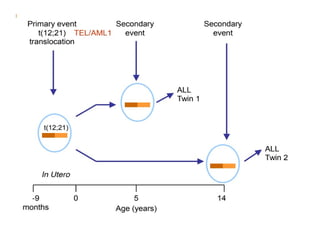
• Genetic alterations in utero – shown in studies on
ID twins : ALL with t(12;21)
Genetic abnormalities
• Whatever the cause - haematological
malignancies are associated with genetic
instability
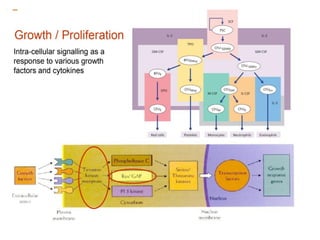
• Normally cell proliferation and differentiation is
balanced by programmed cell death =
homeostasis
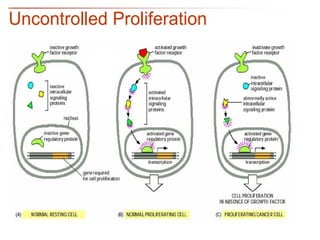
• Cancer = uncontrolled proliferation, lack of
differentiation and lack of apoptosis in clones of
malignantly transformed cells
NORMALITY vs ABNORMALITY at the
GENETIC LEVEL
• Within the normal human genome are highly conserved
genes called proto-oncogenes
– Proto = ancestral, from protos (protos) first
– Onco from onkos (onkos, denoting a tumour)
• Encode proteins - ie growth factors, growth factor
receptors, signal transducers, controllers of proliferation,
survival, differentiation and apoptosis
• Genetic alteration of proto-oncogenes may lead to
malignant transformation due to the generation of
abnormal proteins
• These abnormal genes = oncogenes ie. abnormal
counterparts of proto-oncogenes
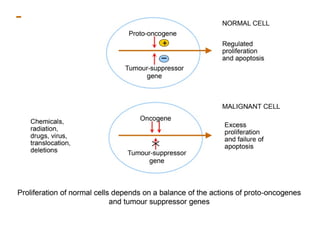
Oncogenes
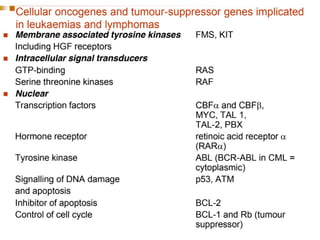
Tumour suppressor genes
• Mutations can occur in tumour suppressor genes
(anti-oncogenes) regulate proliferation – so
mutational inactivation may contribute to
tumourogenesis
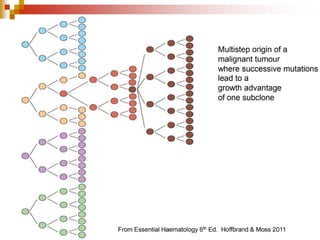
• Activation of oncogenes and/or loss of tumour
suppressor gene function may result in
perturbation in proliferation, differentiation and
apoptosis AND it is likely that multiple genetic
changes are probably required within a cell for
malignant transformation
• MULTI-HIT THEORY
Genetic changes involved with malignant
transformation : translocations and inversions
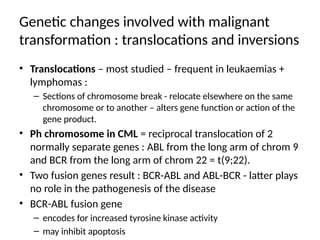
• Translocations – most studied – frequent in leukaemias +
lymphomas :
– Sections of chromosome break - relocate elsewhere on the same
chromosome or to another – alters gene function or action of the
gene product.
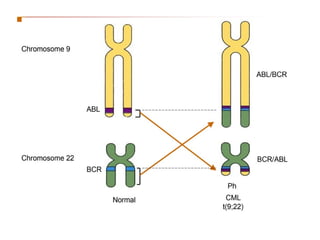
• Ph chromosome in CML = reciprocal translocation of 2
normally separate genes : ABL from the long arm of chrom 9
and BCR from the long arm of chrom 22 = t(9;22).
• Two fusion genes result : BCR-ABL and ABL-BCR - latter plays
no role in the pathogenesis of the disease
• BCR-ABL fusion gene
– encodes for increased tyrosine kinase activity
– may inhibit apoptosis
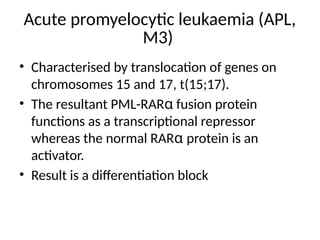
Acute promyelocytic leukaemia (APL,
M3)
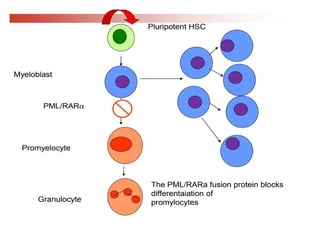
• Characterised by translocation of genes on
chromosomes 15 and 17, t(15;17).
• The resultant PML-RARα fusion protein
functions as a transcriptional repressor
whereas the normal RARα protein is an
activator.
• Result is a differentiation block
Acute promyelocytic leukaemia (APL, M3)
• Characterised by translocation of genes on
chromosomes 15 and 17, t(15;17).
• The resultant PML-RARα fusion protein
functions as a transcriptional repressor whereas
the normal RARα protein is an activator.
• Result is a differentiation block
• ATRA treatment selectively degrades the PML
RARα protein product so promoting normal
differentiation of cells and inducing remission.
Translocations involving the core binding
factor (CBF) genes
• CBF = heterodimeric transcription factor
important in regulating expression of many
genes ie IL-3 and GM-CSF
• The genes encoding the 2 components of CBF
(CBFα and CBFβ) are involved in a number of
chromosomal translocations in leukaemia e.g.
– t(8;21) in which CBFα gene (AML 1) is translocated
onto the ETO gene on chromosome 8
Inversions
• Inversions – AML inv(16)(p13.1q32) or t(16:16)
(p13.1q32), [M2 in FAB classification] results in
chimeric transcription factor which inhibits
normal maturation and development of
haematopoietic cells
– inv(3) (q21q26) are noted in a small proportion of
AML patients of M1, M2, M4, M6 and M7 sub-types.
• This inversion confers tri-lineage myelodysplasia
with notable abnormalities in the
megakaryocytic series
Deletion and Numeric Changes
• Deletion and Numeric Changes = loss or gain of part or
all of a chromosome.
– Chromosomal trisomy is associated with over expression of
genes.
– Deletions can result in cells resistant to normal growth control
mechanisms –often loss of a tumour suppressor gene
• Trisomy 8 is the most common numeric abnormality in
AML
• Trisomy 21 is associated with Downs
– predisposition to AML
• Partial /total loss of chromosomes 5,7 or Y and trisomy 8
= common in MDS
Point Mutations
Point Mutations in proto-oncogenes can cause
alteration in gene function
– ..AGCTCGG.. ..AGTTCGG
• Many human tumours have point mutations to
the ras family of genes, 20-30% in AML, 15-
20% in ALL, 20% in MDS
• The ras genes encode protein involved with the
transduction of receptor-mediated external
signals into the cell from the inner surface of
the plasma membrane
Point Mutations
• Oncogenic ras (due to single base
substitutions) may upregulate the proliferative
signal
– autonomous-autocrine proliferation.
• Approx. 20% of CML patients in transformation
have point mutations or deletions in the coding
sequence of the p53 tumour suppressor gene
Gene Amplification
Gene Amplification involves repeated replication
of short DNA segments – oncogene over-
expression seen in many tumours.
• Extra copies of the Ph+ chromosome in CML=
hallmark of disease progression from chronic to
acute phase.
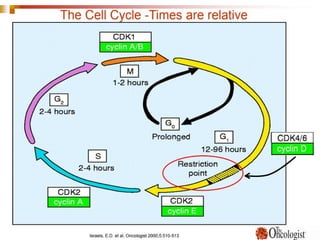
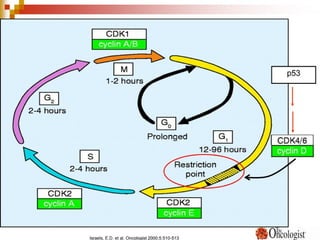
• The gene encoding cyclin D1 is over-expressed
by gene amplification mantle cell lymphoma -
cells are driven into cell cycle beyond G1 in the
absence of normal growth factor stimulation
Mutations in tumour suppressor genes
contribute to neoplasms
• The anti-oncogene/tumour suppressor gene p53
normally encodes a 53KDa transcription factor
control protein.
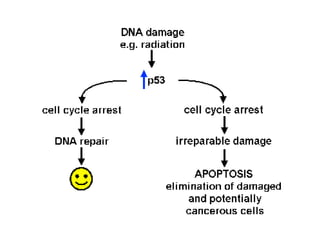
• Expression of p53 is induced in response to DNA
damage
• p53 mediates cell cycle block at G1/S boundary to
enable the cell to repair DNA prior to entry to the
DNA replicative phase
• If DNA repair fails then p53 initiates apoptosis via
increased expression of the BAX gene
Mutations in tumour suppressor genes
contribute to neoplasms
• P53 mutations seen in many
leukaemias/lymphomas - underlies the
inherent genetic instability of cancer cells via
perpetuation of acquired genetic changes.
Oncogenes as anti-apoptosis genes
• Some cancer cells are resistant to apoptosis – due in part
to the aberrant expression of genes controlling apoptosis
• eg. translocation of BCL-2 gene from chrom 14 to 18
t(14:18) in 85% the follicular lymphomas, diffuse
lymphoma and B-CLL
• Results in constitutive bcl-2 expression - protects cells
from apoptosis.
• Accumulation of long lived neoplastic cells
• Mutant bcl-2 - associated with poor prognosis.
• May protect cancer cells from apoptotic effects of anti-
cancer therapy
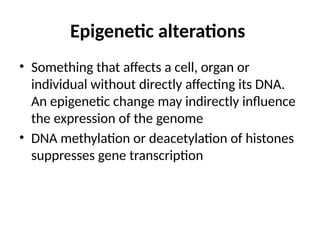
Epigenetic alterations
• Something that affects a cell, organ or
individual without directly affecting its DNA.
An epigenetic change may indirectly influence
the expression of the genome
• DNA methylation or deacetylation of histones
suppresses gene transcription
THANK YOU

haematological malignancy aethiology.pptx

  • 1.
  • 2.
  • 3.
    Epidemiological studies • Largescale cause and effect studies – MRC - difficult to conduct due to variety of possible contributory factors : environmental, socio- economic conditions and healthcare issues • Number of patient years required for a conclusion • A number of factors are considered to be involved /causative in the aetiology of haematological malignancies
  • 4.
  • 5.
    Ionising Radiation • Atombombs : Hiroshima and Nagasaki – proven correlation between exposure to radiation and carcinogenesis incidence CML, ALL, AML and MM noted in survivors in short and long term follow-up studies • Risk of developing leukaemia – inversely related to distance from hypocentre of explosion
  • 6.
    Ionising Radiation Nuclear powerstations & reprocessing plants • Interest focussed on Sellafield reprocessing plant (1984 govt. enquiry) re. childhood ALL cluster among those born in the area – not new comers. • link with fathers working in the industry – not conclusive. Is this circumstantial as children of survivors of Hiroshima have no increased risk
  • 7.
    Environmental background radiation •X-Rays : exposure to therapeutic X rays = increased incidence of leukaemia and solid tumours. • Risk of leukaemogenisis increases if alkylating agents used concurrently • Prior to protective shielding for staff in X ray depts (1940) increases leukaemia • Exposure of foetuses to X ray in 1st trimester increases incidence ALL
  • 8.
    Environmental background radiation •DOH study 2001 : Ionising Radiation and Medical Reporting (IRMER) – clamp down on unnecessary exposure – some X rays =radio- intense • Therapeutic radiotherapy :combined modality treatment for HD – 30 fold in developing leukaemia • Radiotherapy of Ankylosing Spondilytis patients correlates with leukamia
  • 9.
    Chemicals • Benzene +other petroleum derivatives – BM hypoplasia, dysplasia, chromosomal abnormalities, MDS and AML • Armament waste : unusually high incidence of AML and CML in Stadtallendorf in Germany – environmental contamination with TNT (toluene derivative – similar to benzene) • Cigarettes: slight increase risk of AML due to aromatic compounds in smoke • Agricultural and rubber industry workers - circumstantial links
  • 10.
    Therapeutic drugs • Alkylatingagents = radiomimetic drugs ie. melphalan, azothioprine, chlorambucil, nitosureas (BCNU), nitrogen mustard - particularly if combined with radiotherapy assoc. with 2o AML • Busulphan prevents DNA strands parting normally – induces breaks/damage assoc. with lung & ovarian Ca – Risks increase with exposure - linked with chromosomal abnormalities – Development of AML in RhA patients • Epidophyllotoxins ie etoposide = powerful anti- leukaemic agent but associated with AML after a latency period of 1-5 years particularly M4 or M5 and 11q23 mutation
  • 11.
    Viruses • Considerable evidencefor viral induction of leukaemia • Oncogenic viruses – either DNA viruses incl. adenoviruses, herpes viruses – or RNA viruses including retroviruses • Viruses are oncogenic via 3 mechanisms : – Retrovirus contains an oncogene which it inserts into host genome :RAPID TUMOUR DEVELOPMENT – Insertion of viral DNA at a specific point in host DNA which may affect replication = insertional mutagenesis: MAY BE LATENT AND NEVER CAUSE NEOPLASIA – HTLV-1 as above except insertion point varies –aberrant viral protein may upregulate IL-2, IL-4, GM-CSF
  • 12.
  • 13.
    Genetic/inherited factors • Primarygenetic diseases and leukaemia: • Downs syndrome 20-30 fold increase in ALL or AML, • Bloom’s syndrome, Fanconi anaemia, ataxia- telangiectasia, • Weak familial link - B-CLL, HD, NHL - predisposing genes not known • Genetic alterations in utero – shown in studies on ID twins : ALL with t(12;21)
  • 14.
    Genetic abnormalities • Whateverthe cause - haematological malignancies are associated with genetic instability • Normally cell proliferation and differentiation is balanced by programmed cell death = homeostasis • Cancer = uncontrolled proliferation, lack of differentiation and lack of apoptosis in clones of malignantly transformed cells
  • 15.
    NORMALITY vs ABNORMALITYat the GENETIC LEVEL • Within the normal human genome are highly conserved genes called proto-oncogenes – Proto = ancestral, from protos (protos) first – Onco from onkos (onkos, denoting a tumour) • Encode proteins - ie growth factors, growth factor receptors, signal transducers, controllers of proliferation, survival, differentiation and apoptosis • Genetic alteration of proto-oncogenes may lead to malignant transformation due to the generation of abnormal proteins • These abnormal genes = oncogenes ie. abnormal counterparts of proto-oncogenes
  • 17.
  • 18.
    Tumour suppressor genes •Mutations can occur in tumour suppressor genes (anti-oncogenes) regulate proliferation – so mutational inactivation may contribute to tumourogenesis • Activation of oncogenes and/or loss of tumour suppressor gene function may result in perturbation in proliferation, differentiation and apoptosis AND it is likely that multiple genetic changes are probably required within a cell for malignant transformation • MULTI-HIT THEORY
  • 20.
    Genetic changes involvedwith malignant transformation : translocations and inversions • Translocations – most studied – frequent in leukaemias + lymphomas : – Sections of chromosome break - relocate elsewhere on the same chromosome or to another – alters gene function or action of the gene product. • Ph chromosome in CML = reciprocal translocation of 2 normally separate genes : ABL from the long arm of chrom 9 and BCR from the long arm of chrom 22 = t(9;22). • Two fusion genes result : BCR-ABL and ABL-BCR - latter plays no role in the pathogenesis of the disease • BCR-ABL fusion gene – encodes for increased tyrosine kinase activity – may inhibit apoptosis
  • 24.
    Acute promyelocytic leukaemia(APL, M3) • Characterised by translocation of genes on chromosomes 15 and 17, t(15;17). • The resultant PML-RARα fusion protein functions as a transcriptional repressor whereas the normal RARα protein is an activator. • Result is a differentiation block
  • 26.
    Acute promyelocytic leukaemia(APL, M3) • Characterised by translocation of genes on chromosomes 15 and 17, t(15;17). • The resultant PML-RARα fusion protein functions as a transcriptional repressor whereas the normal RARα protein is an activator. • Result is a differentiation block • ATRA treatment selectively degrades the PML RARα protein product so promoting normal differentiation of cells and inducing remission.
  • 27.
    Translocations involving thecore binding factor (CBF) genes • CBF = heterodimeric transcription factor important in regulating expression of many genes ie IL-3 and GM-CSF • The genes encoding the 2 components of CBF (CBFα and CBFβ) are involved in a number of chromosomal translocations in leukaemia e.g. – t(8;21) in which CBFα gene (AML 1) is translocated onto the ETO gene on chromosome 8
  • 28.
    Inversions • Inversions –AML inv(16)(p13.1q32) or t(16:16) (p13.1q32), [M2 in FAB classification] results in chimeric transcription factor which inhibits normal maturation and development of haematopoietic cells – inv(3) (q21q26) are noted in a small proportion of AML patients of M1, M2, M4, M6 and M7 sub-types. • This inversion confers tri-lineage myelodysplasia with notable abnormalities in the megakaryocytic series
  • 29.
    Deletion and NumericChanges • Deletion and Numeric Changes = loss or gain of part or all of a chromosome. – Chromosomal trisomy is associated with over expression of genes. – Deletions can result in cells resistant to normal growth control mechanisms –often loss of a tumour suppressor gene • Trisomy 8 is the most common numeric abnormality in AML • Trisomy 21 is associated with Downs – predisposition to AML • Partial /total loss of chromosomes 5,7 or Y and trisomy 8 = common in MDS
  • 30.
    Point Mutations Point Mutationsin proto-oncogenes can cause alteration in gene function – ..AGCTCGG.. ..AGTTCGG • Many human tumours have point mutations to the ras family of genes, 20-30% in AML, 15- 20% in ALL, 20% in MDS • The ras genes encode protein involved with the transduction of receptor-mediated external signals into the cell from the inner surface of the plasma membrane
  • 31.
    Point Mutations • Oncogenicras (due to single base substitutions) may upregulate the proliferative signal – autonomous-autocrine proliferation. • Approx. 20% of CML patients in transformation have point mutations or deletions in the coding sequence of the p53 tumour suppressor gene
  • 32.
    Gene Amplification Gene Amplificationinvolves repeated replication of short DNA segments – oncogene over- expression seen in many tumours. • Extra copies of the Ph+ chromosome in CML= hallmark of disease progression from chronic to acute phase. • The gene encoding cyclin D1 is over-expressed by gene amplification mantle cell lymphoma - cells are driven into cell cycle beyond G1 in the absence of normal growth factor stimulation
  • 34.
    Mutations in tumoursuppressor genes contribute to neoplasms • The anti-oncogene/tumour suppressor gene p53 normally encodes a 53KDa transcription factor control protein. • Expression of p53 is induced in response to DNA damage • p53 mediates cell cycle block at G1/S boundary to enable the cell to repair DNA prior to entry to the DNA replicative phase • If DNA repair fails then p53 initiates apoptosis via increased expression of the BAX gene
  • 37.
    Mutations in tumoursuppressor genes contribute to neoplasms • P53 mutations seen in many leukaemias/lymphomas - underlies the inherent genetic instability of cancer cells via perpetuation of acquired genetic changes.
  • 38.
    Oncogenes as anti-apoptosisgenes • Some cancer cells are resistant to apoptosis – due in part to the aberrant expression of genes controlling apoptosis • eg. translocation of BCL-2 gene from chrom 14 to 18 t(14:18) in 85% the follicular lymphomas, diffuse lymphoma and B-CLL • Results in constitutive bcl-2 expression - protects cells from apoptosis. • Accumulation of long lived neoplastic cells • Mutant bcl-2 - associated with poor prognosis. • May protect cancer cells from apoptotic effects of anti- cancer therapy
  • 40.
    Epigenetic alterations • Somethingthat affects a cell, organ or individual without directly affecting its DNA. An epigenetic change may indirectly influence the expression of the genome • DNA methylation or deacetylation of histones suppresses gene transcription
  • 42.

Editor's Notes

  • #11 McNally et al, (2013) Cross-space-time clustering of childhood cancer in Great Britain: Evidence for a common aetiology. International Journal of Cancer
  • #12 HHV-8, human herpes virus 8; HIV, human immunodeficiency virus; HTLV-1, human T-lymphotropic virus type 1; MALT, mucosa-associated lymphoid tissue; PTLD, post-transplant lymphoproliferative disease.
  • #13 Tegg et al., (2010) Evidence for a common genetic aetiology in high-risk families with multiple haematological malignancy subtypes. BJH. 150:456-462