CLOUD TECHNOLOGIES AND
ADVANCEMENTS
• HADOOP
• Map reduce
Introduction to Hadoop Framework
• Hadoop is an Apache open source framework written in java that
allows distributed processing of large datasets across clusters of
computers using simple programming models.
• Hadoop is designed to scale up from single server to thousands of
machines, each offering local computation and storage.
• Hadoop runs applications using the MapReduce algorithm, where the
data is processed in parallel on different CPU nodes.
Hadoop = MapReduce + HDFS
( MapReduceProcessing ; HDFS
Storage )
Users of Hadoop:
Hadoop is running search on some of the Internet's largest sites:
o Amazon Web Services: Elastic MapReduce
o AOL: Variety of uses, e.g., behavioral analysis & targeting
o Ebay: Search optimization (532-node cluster)
o Facebook: Reporting/analytics, machine learning (1100 m.)
o LinkedIn: People You May Know (2x50 machines)
o Twitter: Store + process tweets, log files, other data Yahoo: >36,000 nodes;
biggest
cluster is 4,000 nodes
Hadoop Architecture
Hadoop has a Master Slave Architecture for both Storage & Processing.
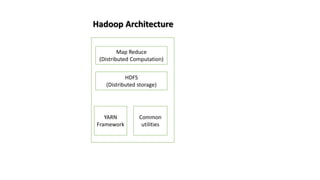
Hadoop framework includes following four modules:
Hadoop Common: These are Java libraries and provide file system and OS level
abstractions and contains the necessary Java files and scripts required to start
Hadoop.
Hadoop YARN: This is a framework for job scheduling and cluster resource
management.
Hadoop Distributed File System (HDFS): A distributed file system that provides
high-throughput access to application data.
HadoopMapReduce: This is system for parallel processing of large data sets.
Map Reduce
(Distributed Computation)
HDFS
(Distributed storage)
YARN
Framework
Common
utilities
Hadoop Architecture
• The Hadoop core is divided into two fundamental layers:
• MapReduce engine
• HDFS
• The MapReduce engine is the computation engine running
on top of HDFS as its data storage manager.
• HDFS: HDFS is a distributed file system inspired by
Google File System(GFS) that organizes files and stores
their data on a distributed computing system.
• HDFS Architecture: HDFS has a master/slave
architecture containing a single Name Node as the master
and a number of Data Nodes as workers (slaves).
HDFS
• To store a file in this architecture, HDFS splits the file into fixed-size
blocks (e.g., 64 MB) and stores them on workers (Data Nodes).
• The mapping of blocks to Data Nodes is determined by the Name
Node.
• The NameNode (master) also manages the file system’s metadata and
namespace.
• Namespace is the area maintaining the metadata, and metadata refers to
all the information stored by a file system that is needed for overall
management of all files.
HDFS- Features
Distributed file systems have special requirements
◻ Performance
◻ Scalability
◻ Concurrency Control
◻ Fault Tolerance
◻ Security Requirements
HDFS Fault Tolerance
Block replication:
• To reliably store data in HDFS, file blocks are replicated in this
system.
• HDFS stores a file as a set of blocks and each block is replicated and
distributed across the whole cluster.
• The replication factor is set by the user and is three by default.
• Replica placement: The placement of replicas is another factor to
fulfill the desired fault tolerance in HDFS.
• Storing replicas on different nodes (DataNodes) located in different
racks across the whole cluster.
• HDFS stores one replica in the same node the original data is stored.
• One replica on a different node but in the same rack .
• One replica on a different node in a different rack.
• Heartbeats and Blockreports are periodic messages sent to the
NameNode by each DataNode in a cluster.
HDFS High Throughput
• Applications run on HDFS typically have large data sets.
• Individual files are broken into large blocks to allow HDFS to
decrease the amount of metadata storage required per file.
• The list of blocks per file will shrink as the size of individual
blocks increases.
• By keeping large amounts of data sequentially within a block,
HDFS provides fast streaming reads of data.
HDFS- Read Operation
Reading a file :
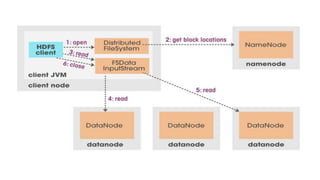
• To read a file in HDFS, a user sends an “open” request to the NameNode to
get the location of file blocks.
• For each file block, the NameNode returns the address of a set of DataNodes
containing replica information for the requested file.
• The number of addresses depends on the number of block replicas.
• The user calls the read function to connect to the closest DataNode
containing the first block of the file.
• Then the first block is streamed from the respective DataNode to the
user.
• The established connection is terminated and the same process is
repeated for all blocks of the requested file.
HDFS-Write Operation
Writing to a file:
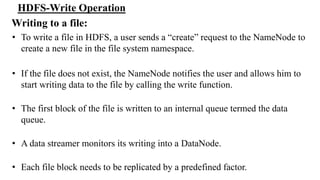
• To write a file in HDFS, a user sends a “create” request to the NameNode to
create a new file in the file system namespace.
• If the file does not exist, the NameNode notifies the user and allows him to
start writing data to the file by calling the write function.
• The first block of the file is written to an internal queue termed the data
queue.
• A data streamer monitors its writing into a DataNode.
• Each file block needs to be replicated by a predefined factor.
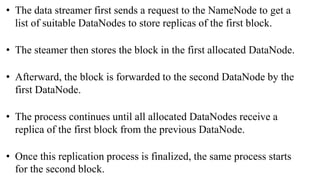
• The data streamer first sends a request to the NameNode to get a
list of suitable DataNodes to store replicas of the first block.
• The steamer then stores the block in the first allocated DataNode.
• Afterward, the block is forwarded to the second DataNode by the
first DataNode.
• The process continues until all allocated DataNodes receive a
replica of the first block from the previous DataNode.
• Once this replication process is finalized, the same process starts
for the second block.
Architecture of Mapreduce in Hadoop
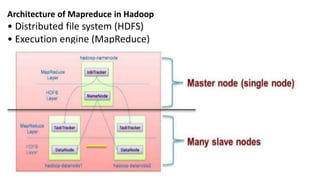
• Distributed file system (HDFS)
• Execution engine (MapReduce)
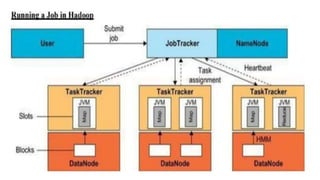
Running a Job in Hadoop
Three components contribute in running a job in
this system:
o a user node,
o a JobTracker, and
o severalTaskTrackers.
Properties of Hadoop Engine
• HDFS has a master/slave architecture containing a single
NameNode as the master and a number of DataNodes as workers
(slaves).
• Job Tracker is the master node (runs with the namenode)
o Receives the user’s job
o Decides on how many tasks will run (number of mappers)
o Decides on where to run each mapper (concept of locality)
• Task Tracker is the slave node (runs on each datanode)
o Receives the task from Job Tracker
o Runs the task until completion (either map or reduce task)
o Always in communication with the Job Tracker reporting
progress (heartbeats)
The data flow starts by calling the runJob(conf) function inside a user program
running on the user node, in which conf is an object containing some tuning
parameters for the MapReduce
• Job Submission: Each job is submitted from a user node to the JobTracker
node.
• Task assignment : The JobTracker creates one map task for each computed
input split
• Task execution : The control flow to execute a task (either map or reduce)
starts inside the TaskTracker by copying the job JAR file to its file system.
• Task running check : A task running check is performed by receiving periodic
heartbeat messages to the JobTracker from the TaskTrackers.
• Heartbeat:notifies the JobTracker that the sending TaskTracker is alive, and
whether the sending TaskTracker is ready to run a new task.
The Apache Hadoop project develops open-source software for reliable,
scalable, distributed computing, including:
• HadoopCore, our flagship sub-project, provides a distributed filesystem
(HDFS) and support for the MapReduce distributed computing metaphor.
• HBase builds on Hadoop Core to provide a scalable, distributed
database.
• Pig is a high-level data-flow language and execution framework for
parallel computation.It is built on top of Hadoop Core.
• ZooKeeperis a highly available and reliable coordination system.
Distributed applications use ZooKeeper to store and mediate updates for
critical shared state.
• Hive is a data warehouse infrastructure built on Hadoop Core that
provides data summarization, adhoc querying and analysis of datasets.

HADOOP.pptx

  • 1.
  • 2.
    Introduction to HadoopFramework • Hadoop is an Apache open source framework written in java that allows distributed processing of large datasets across clusters of computers using simple programming models. • Hadoop is designed to scale up from single server to thousands of machines, each offering local computation and storage. • Hadoop runs applications using the MapReduce algorithm, where the data is processed in parallel on different CPU nodes. Hadoop = MapReduce + HDFS ( MapReduceProcessing ; HDFS Storage )
  • 3.
    Users of Hadoop: Hadoopis running search on some of the Internet's largest sites: o Amazon Web Services: Elastic MapReduce o AOL: Variety of uses, e.g., behavioral analysis & targeting o Ebay: Search optimization (532-node cluster) o Facebook: Reporting/analytics, machine learning (1100 m.) o LinkedIn: People You May Know (2x50 machines) o Twitter: Store + process tweets, log files, other data Yahoo: >36,000 nodes; biggest cluster is 4,000 nodes
  • 4.
    Hadoop Architecture Hadoop hasa Master Slave Architecture for both Storage & Processing. Hadoop framework includes following four modules: Hadoop Common: These are Java libraries and provide file system and OS level abstractions and contains the necessary Java files and scripts required to start Hadoop. Hadoop YARN: This is a framework for job scheduling and cluster resource management. Hadoop Distributed File System (HDFS): A distributed file system that provides high-throughput access to application data. HadoopMapReduce: This is system for parallel processing of large data sets.
  • 5.
    Map Reduce (Distributed Computation) HDFS (Distributedstorage) YARN Framework Common utilities Hadoop Architecture
  • 6.
    • The Hadoopcore is divided into two fundamental layers: • MapReduce engine • HDFS • The MapReduce engine is the computation engine running on top of HDFS as its data storage manager. • HDFS: HDFS is a distributed file system inspired by Google File System(GFS) that organizes files and stores their data on a distributed computing system. • HDFS Architecture: HDFS has a master/slave architecture containing a single Name Node as the master and a number of Data Nodes as workers (slaves).
  • 7.
    HDFS • To storea file in this architecture, HDFS splits the file into fixed-size blocks (e.g., 64 MB) and stores them on workers (Data Nodes). • The mapping of blocks to Data Nodes is determined by the Name Node. • The NameNode (master) also manages the file system’s metadata and namespace. • Namespace is the area maintaining the metadata, and metadata refers to all the information stored by a file system that is needed for overall management of all files.
  • 8.
    HDFS- Features Distributed filesystems have special requirements ◻ Performance ◻ Scalability ◻ Concurrency Control ◻ Fault Tolerance ◻ Security Requirements
  • 9.
    HDFS Fault Tolerance Blockreplication: • To reliably store data in HDFS, file blocks are replicated in this system. • HDFS stores a file as a set of blocks and each block is replicated and distributed across the whole cluster. • The replication factor is set by the user and is three by default. • Replica placement: The placement of replicas is another factor to fulfill the desired fault tolerance in HDFS.
  • 10.
    • Storing replicason different nodes (DataNodes) located in different racks across the whole cluster. • HDFS stores one replica in the same node the original data is stored. • One replica on a different node but in the same rack . • One replica on a different node in a different rack. • Heartbeats and Blockreports are periodic messages sent to the NameNode by each DataNode in a cluster.
  • 11.
    HDFS High Throughput •Applications run on HDFS typically have large data sets. • Individual files are broken into large blocks to allow HDFS to decrease the amount of metadata storage required per file. • The list of blocks per file will shrink as the size of individual blocks increases. • By keeping large amounts of data sequentially within a block, HDFS provides fast streaming reads of data.
  • 12.
    HDFS- Read Operation Readinga file : • To read a file in HDFS, a user sends an “open” request to the NameNode to get the location of file blocks. • For each file block, the NameNode returns the address of a set of DataNodes containing replica information for the requested file. • The number of addresses depends on the number of block replicas.
  • 13.
    • The numberof addresses depends on the number of block replicas. • The user calls the read function to connect to the closest DataNode containing the first block of the file. • Then the first block is streamed from the respective DataNode to the user. • The established connection is terminated and the same process is repeated for all blocks of the requested file.
  • 15.
    HDFS-Write Operation Writing toa file: • To write a file in HDFS, a user sends a “create” request to the NameNode to create a new file in the file system namespace. • If the file does not exist, the NameNode notifies the user and allows him to start writing data to the file by calling the write function. • The first block of the file is written to an internal queue termed the data queue. • A data streamer monitors its writing into a DataNode. • Each file block needs to be replicated by a predefined factor.
  • 16.
    • The datastreamer first sends a request to the NameNode to get a list of suitable DataNodes to store replicas of the first block. • The steamer then stores the block in the first allocated DataNode. • Afterward, the block is forwarded to the second DataNode by the first DataNode. • The process continues until all allocated DataNodes receive a replica of the first block from the previous DataNode. • Once this replication process is finalized, the same process starts for the second block.
  • 18.
    Architecture of Mapreducein Hadoop • Distributed file system (HDFS) • Execution engine (MapReduce)
  • 19.
    Running a Jobin Hadoop Three components contribute in running a job in this system: o a user node, o a JobTracker, and o severalTaskTrackers.
  • 20.
    Properties of HadoopEngine • HDFS has a master/slave architecture containing a single NameNode as the master and a number of DataNodes as workers (slaves). • Job Tracker is the master node (runs with the namenode) o Receives the user’s job o Decides on how many tasks will run (number of mappers) o Decides on where to run each mapper (concept of locality) • Task Tracker is the slave node (runs on each datanode) o Receives the task from Job Tracker o Runs the task until completion (either map or reduce task) o Always in communication with the Job Tracker reporting progress (heartbeats)
  • 22.
    The data flowstarts by calling the runJob(conf) function inside a user program running on the user node, in which conf is an object containing some tuning parameters for the MapReduce • Job Submission: Each job is submitted from a user node to the JobTracker node. • Task assignment : The JobTracker creates one map task for each computed input split • Task execution : The control flow to execute a task (either map or reduce) starts inside the TaskTracker by copying the job JAR file to its file system. • Task running check : A task running check is performed by receiving periodic heartbeat messages to the JobTracker from the TaskTrackers. • Heartbeat:notifies the JobTracker that the sending TaskTracker is alive, and whether the sending TaskTracker is ready to run a new task.
  • 23.
    The Apache Hadoopproject develops open-source software for reliable, scalable, distributed computing, including: • HadoopCore, our flagship sub-project, provides a distributed filesystem (HDFS) and support for the MapReduce distributed computing metaphor. • HBase builds on Hadoop Core to provide a scalable, distributed database. • Pig is a high-level data-flow language and execution framework for parallel computation.It is built on top of Hadoop Core. • ZooKeeperis a highly available and reliable coordination system. Distributed applications use ZooKeeper to store and mediate updates for critical shared state. • Hive is a data warehouse infrastructure built on Hadoop Core that provides data summarization, adhoc querying and analysis of datasets.