Mandi Walls
Technical Community Manager for EMEA
@lnxchk
mandi@chef.io
#habitatsh
http://slack.habitat.sh/
Ian Henry @Eeyun___ Habitat Community lead
How Do We Run Applications?
• On a computer
• With an OS
• And some libraries
• And some configuration
• And some way to start it and stop it
We’ve been moving complexity
around rather than reducing it
case	node['platform_family']		
when	'freebsd'		
		false		
when	'arch',	'debian',	'rhel',	'fedora',	'amazon'		
		true		
when	'suse'		
		node['platform_version'].to_f	<	12.0	?	false	:	true		
end
Ugh.
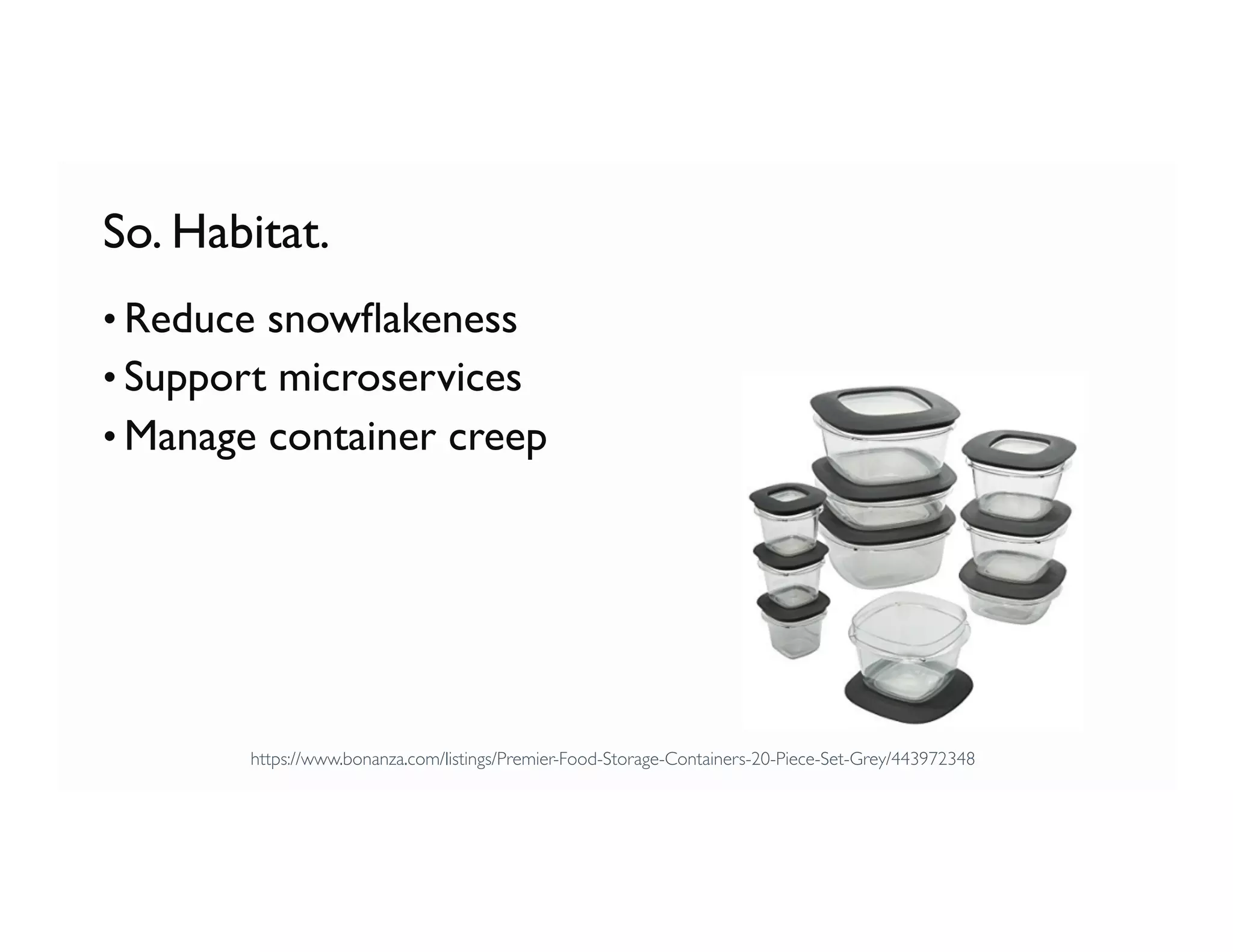
So. Habitat.
• Reduce snowflakeness
• Support microservices
• Manage container creep
https://www.bonanza.com/listings/Premier-Food-Storage-Containers-20-Piece-Set-Grey/443972348
Modern Applications Are Trending Toward
• Immutability
• Platform agnosticism
• Complexity reduction
• Scalability
https://amazingmusthaves.com/products/steel-insulated-food-containers/
What Habitat GetsYou
• Defer some decisions to runtime
• Do clean room builds
• Repeatable builds
• Distro agnostic packaging system
• Service runtime and discovery
• Configuration exposed via API
• Packages are signed by the system
Habitat Studio
• Provides a busy box clean
room for your app
• Plus a set of tools for
manipulating and running harts
Why a Studio?
• Declare explicit dependencies
• Ship exactly what you need
• Sign your packages and store artifacts
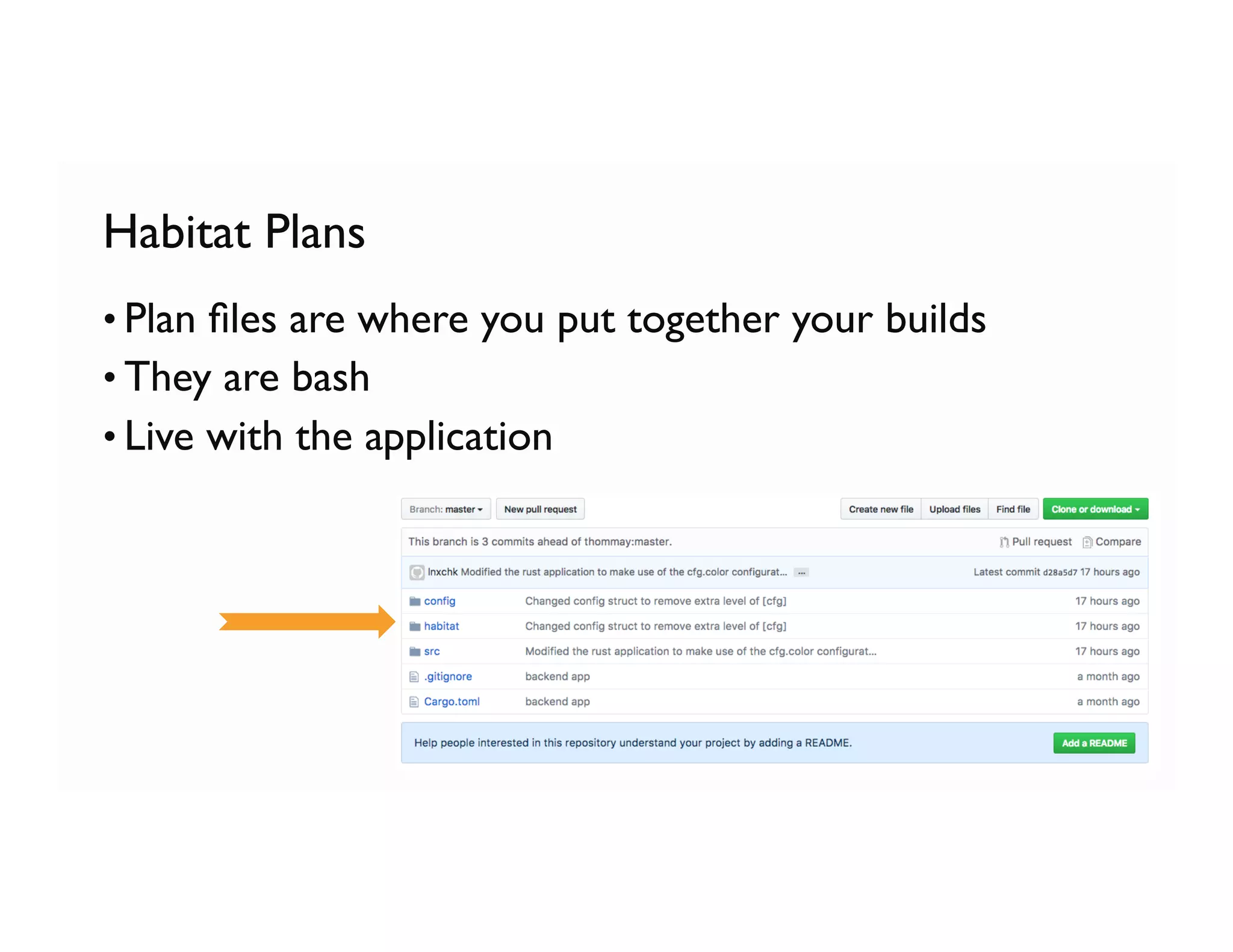
Habitat Plans
• Plan files are where you put together your builds
• They are bash
• Live with the application
What’s In A Plan?
pkg_name=container_sched_backend
pkg_origin=lnxchk
pkg_version="0.1.0"
pkg_build_deps=(core/rust)
pkg_deps=(core/glibc core/gcc core/gcc-libs)
pkg_bin_dirs=(bin)
bin="container_sched_backend"
pkg_exports=([out]=cfg.out)
do_build() {
cargo build
}
do_install() {
install -v -D "$PLAN_CONTEXT/../target/debug/$bin" 
"$pkg_prefix/bin/$bin"
}
pkg_svc_run="$bin"
Examples at
https://github.com/habitat-sh/core-plans/
What Gets Built?
• Everything. Sort of.
• Build your own apps from source
• Decide if you want upstream binaries or source for
things like runtime
  You don’t have to build Tomcat, but you can
• For COTS, use the binaries and skip steps
Configuration
• Can be manipulated at runtime
• Also travels with the app
• Provides variable substitution and templating using
handlebars http://handlebarsjs.com/
Application Configuration File:TOML
[myconfig]
out = "{{cfg.out}}"
color = "{{cfg.color}}"
{{~# if svc.me.leader ~}}
leader = true
{{ else }}
leader = false
{{/if ~}}
Set Defaults in Habitat – default.toml
leader	=	false	
out	=	"out"	
color	=	"green”	
	
[tomltable]	
var	=	“val”
The Depot
• You can share plans with the Depot, and other hab users
share theirs
• Has team namespacing
• The core plans are those built by the Habitat team
• https://app.habitat.sh/
• Private build services – Coming Soon!
  https://www.habitat.sh/blog/2017/05/Builder/
Caveat - Internet
• You can build your own stuff inside your own network,
sort of, when it’s all on one machine
• There will eventually be a private depot server
• For now, hab and its components need internet access
Build Output
• By default, it’s a hart – a compressed tarball with some
metadata and a signature
• You can export to other formats, like Docker containers
• The hart itself it runnable
Runtime
• The hab runtime includes management, service
discovery, other features
• The habs in your application create a mesh so they can
talk to each other
• You can even update your application via the mesh
without restarting every application manually
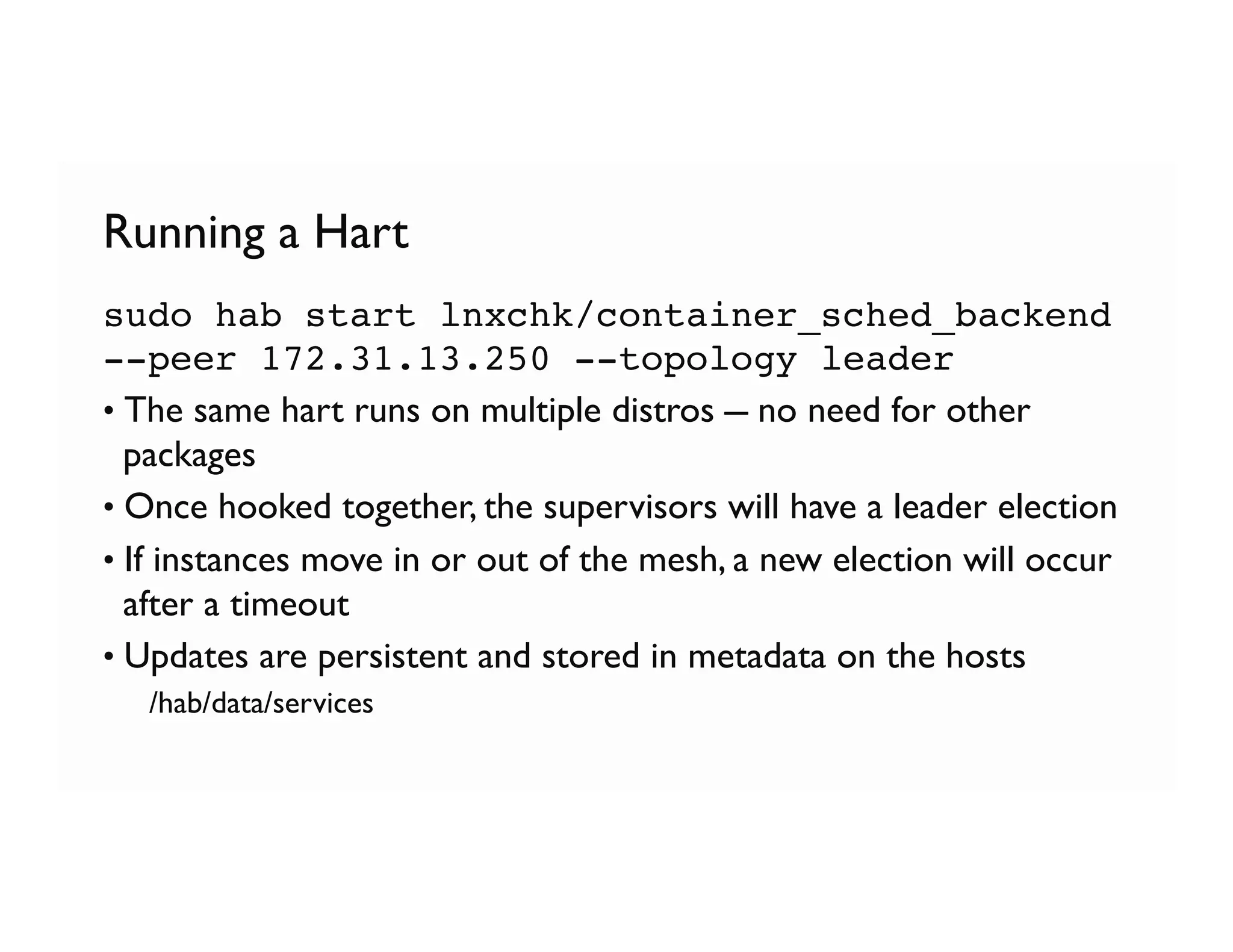
Running a Hart
sudo hab start lnxchk/container_sched_backend
--peer 172.31.13.250 --topology leader
• The same hart runs on multiple distros – no need for other
packages
• Once hooked together, the supervisors will have a leader election
• If instances move in or out of the mesh, a new election will occur
after a timeout
• Updates are persistent and stored in metadata on the hosts
  /hab/data/services
Updating Configuration at Runtime
• Update all or part of the configuration while the apps
are running
• Send the update to a member of the mesh and they will
all update
sudo hab config apply container_sched_backend.default 2
newconfig.toml
Supervisor Web Interface
• http://ip.add.re.ss:9631/services
• http://ip.add.re.ss:9631/census
Additional Features
• Healthchecks – can be customized for your app, and
travel in the hart
  https://www.habitat.sh/tutorials/sample-app/windows/add-health-
check-hook/
• Dynamic Updates – when a new version is uploaded to
the Depot in the “stable” channel, update running apps
  https://www.habitat.sh/tutorials/sample-app/windows/update-
app/
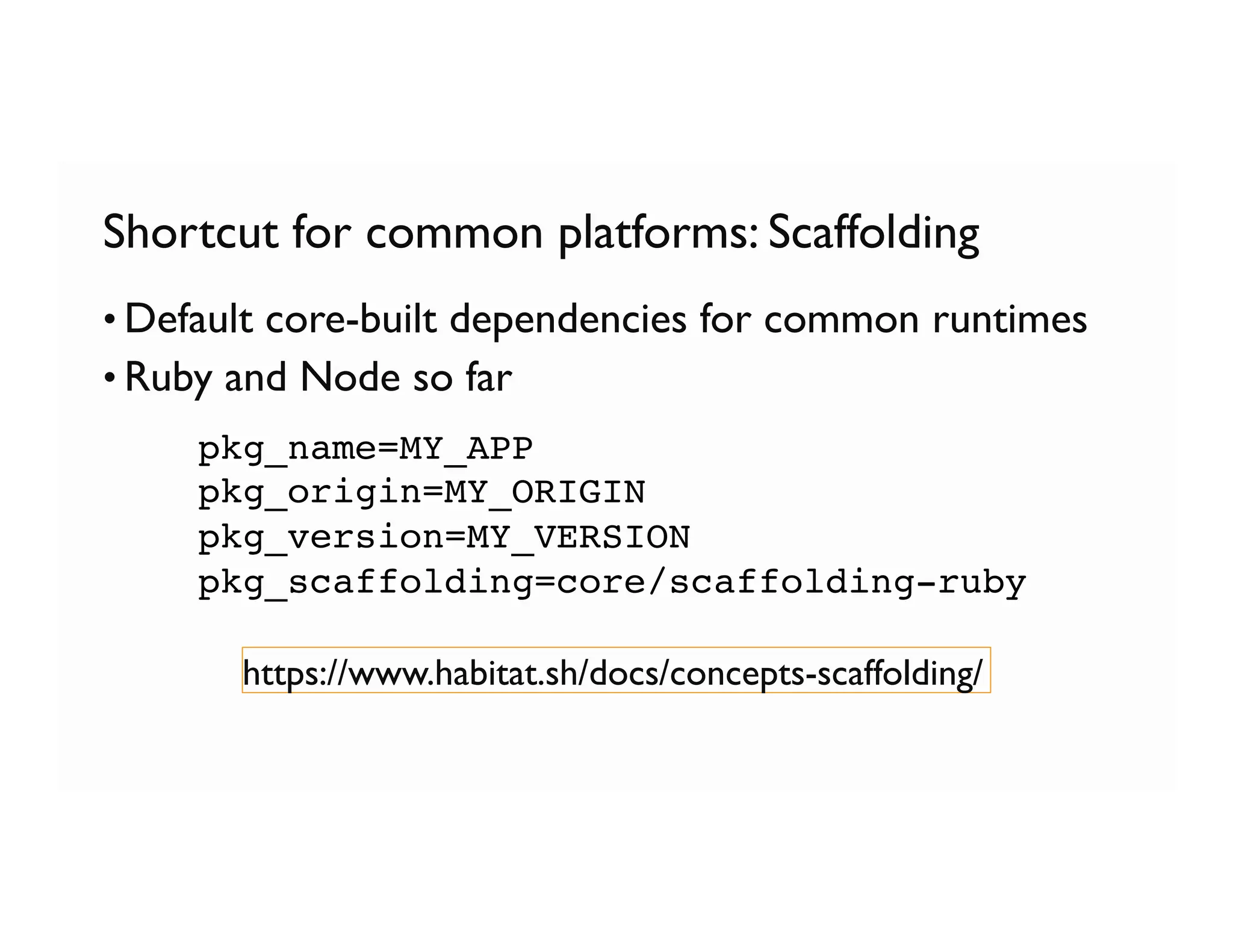
Shortcut for common platforms: Scaffolding
• Default core-built dependencies for common runtimes
• Ruby and Node so far
pkg_name=MY_APP
pkg_origin=MY_ORIGIN
pkg_version=MY_VERSION
pkg_scaffolding=core/scaffolding-ruby
https://www.habitat.sh/docs/concepts-scaffolding/
Join Us!
• On Slack!
  http://slack.habitat.sh
• Online! With Tutorials!
  https://www.habitat.sh/
• On Github!
  https://github.com/habitat-sh
• The sample app in this talk
  https://github.com/lnxchk/container_sched_backend
Try it out!
Share your story!
Get some swag!!
goo.gl/WrHQTU
Other References
• Summary on The New Stack
  https://thenewstack.io/chef-habitat-addresses-issues-moving-
containers-production
• OurYouTube Channel
  https://www.youtube.com/user/getchef
October 10 – 11, 2017
etc.venues Fenchurch St London
https://chef.io/summits
mandi@chef.io

Habitat at SRECon

  • 2.
    Mandi Walls Technical CommunityManager for EMEA @lnxchk mandi@chef.io #habitatsh http://slack.habitat.sh/ Ian Henry @Eeyun___ Habitat Community lead
  • 3.
    How Do WeRun Applications? • On a computer • With an OS • And some libraries • And some configuration • And some way to start it and stop it
  • 4.
    We’ve been movingcomplexity around rather than reducing it
  • 5.
  • 6.
    So. Habitat. • Reduce snowflakeness • Supportmicroservices • Manage container creep https://www.bonanza.com/listings/Premier-Food-Storage-Containers-20-Piece-Set-Grey/443972348
  • 7.
    Modern Applications AreTrending Toward • Immutability • Platform agnosticism • Complexity reduction • Scalability https://amazingmusthaves.com/products/steel-insulated-food-containers/
  • 8.
    What Habitat GetsYou • Defersome decisions to runtime • Do clean room builds • Repeatable builds • Distro agnostic packaging system • Service runtime and discovery • Configuration exposed via API • Packages are signed by the system
  • 9.
    Habitat Studio • Provides abusy box clean room for your app • Plus a set of tools for manipulating and running harts
  • 10.
    Why a Studio? • Declareexplicit dependencies • Ship exactly what you need • Sign your packages and store artifacts
  • 11.
    Habitat Plans • Plan filesare where you put together your builds • They are bash • Live with the application
  • 12.
    What’s In APlan? pkg_name=container_sched_backend pkg_origin=lnxchk pkg_version="0.1.0" pkg_build_deps=(core/rust) pkg_deps=(core/glibc core/gcc core/gcc-libs) pkg_bin_dirs=(bin) bin="container_sched_backend" pkg_exports=([out]=cfg.out) do_build() { cargo build } do_install() { install -v -D "$PLAN_CONTEXT/../target/debug/$bin" "$pkg_prefix/bin/$bin" } pkg_svc_run="$bin" Examples at https://github.com/habitat-sh/core-plans/
  • 13.
    What Gets Built? • Everything.Sort of. • Build your own apps from source • Decide if you want upstream binaries or source for things like runtime   You don’t have to build Tomcat, but you can • For COTS, use the binaries and skip steps
  • 14.
    Configuration • Can be manipulatedat runtime • Also travels with the app • Provides variable substitution and templating using handlebars http://handlebarsjs.com/
  • 15.
    Application Configuration File:TOML [myconfig] out= "{{cfg.out}}" color = "{{cfg.color}}" {{~# if svc.me.leader ~}} leader = true {{ else }} leader = false {{/if ~}}
  • 16.
    Set Defaults inHabitat – default.toml leader = false out = "out" color = "green” [tomltable] var = “val”
  • 17.
    The Depot • You canshare plans with the Depot, and other hab users share theirs • Has team namespacing • The core plans are those built by the Habitat team • https://app.habitat.sh/ • Private build services – Coming Soon!   https://www.habitat.sh/blog/2017/05/Builder/
  • 18.
    Caveat - Internet • Youcan build your own stuff inside your own network, sort of, when it’s all on one machine • There will eventually be a private depot server • For now, hab and its components need internet access
  • 19.
    Build Output • By default,it’s a hart – a compressed tarball with some metadata and a signature • You can export to other formats, like Docker containers • The hart itself it runnable
  • 20.
    Runtime • The hab runtimeincludes management, service discovery, other features • The habs in your application create a mesh so they can talk to each other • You can even update your application via the mesh without restarting every application manually
  • 21.
    Running a Hart sudohab start lnxchk/container_sched_backend --peer 172.31.13.250 --topology leader • The same hart runs on multiple distros – no need for other packages • Once hooked together, the supervisors will have a leader election • If instances move in or out of the mesh, a new election will occur after a timeout • Updates are persistent and stored in metadata on the hosts   /hab/data/services
  • 22.
    Updating Configuration atRuntime • Update all or part of the configuration while the apps are running • Send the update to a member of the mesh and they will all update sudo hab config apply container_sched_backend.default 2 newconfig.toml
  • 23.
  • 24.
    Additional Features • Healthchecks –can be customized for your app, and travel in the hart   https://www.habitat.sh/tutorials/sample-app/windows/add-health- check-hook/ • Dynamic Updates – when a new version is uploaded to the Depot in the “stable” channel, update running apps   https://www.habitat.sh/tutorials/sample-app/windows/update- app/
  • 25.
    Shortcut for commonplatforms: Scaffolding • Default core-built dependencies for common runtimes • Ruby and Node so far pkg_name=MY_APP pkg_origin=MY_ORIGIN pkg_version=MY_VERSION pkg_scaffolding=core/scaffolding-ruby https://www.habitat.sh/docs/concepts-scaffolding/
  • 26.
    Join Us! • On Slack!  http://slack.habitat.sh • Online! With Tutorials!   https://www.habitat.sh/ • On Github!   https://github.com/habitat-sh • The sample app in this talk   https://github.com/lnxchk/container_sched_backend Try it out! Share your story! Get some swag!! goo.gl/WrHQTU
  • 27.
    Other References • Summary onThe New Stack   https://thenewstack.io/chef-habitat-addresses-issues-moving- containers-production • OurYouTube Channel   https://www.youtube.com/user/getchef
  • 28.
    October 10 –11, 2017 etc.venues Fenchurch St London https://chef.io/summits mandi@chef.io