Habitat Mapping Camera System The Sea Scallop Project
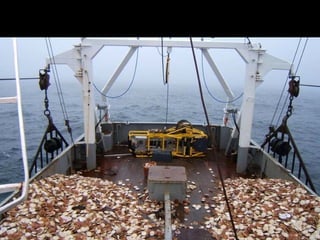
Commercial scallop fishermen, scientists and engineers working together
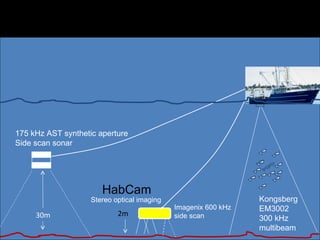
175 kHz AST synthetic aperture Side scan sonar Imagenix 600 kHz  side scan Stereo optical imaging 30m 2m Kongsberg EM3002 300 kHz multibeam HabCam The HabCam is towed 2 m (6’) above the seafloor and takes 5 images per second, with a 1 m (3’) field of view
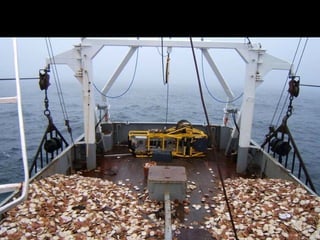
Fishermen have a wealth of at-sea experience and are essential to the success of cooperative research projects
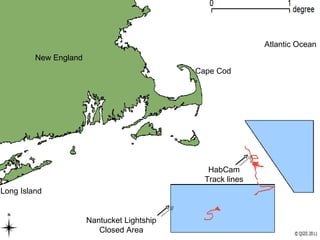
HabCam Track lines Long Island New England Atlantic Ocean Cape Cod Nantucket Lightship Closed Area
Scallops are counted and measured along the track-line to provide biomass estimates
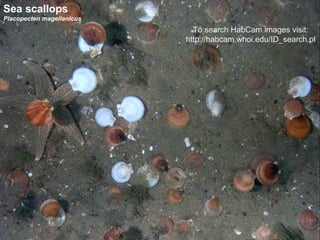
Sea scallops Placopecten magellanicus To search HabCam images visit: http://habcam.whoi.edu/ID_search.pl
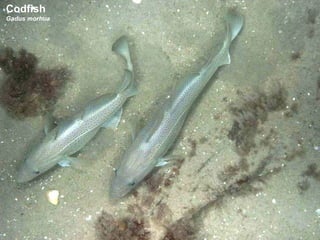
Codfish Gadus morhua
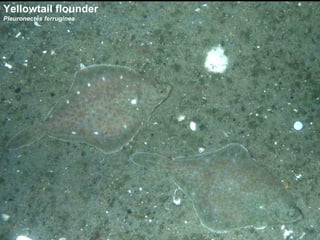
Yellowtail flounder Pleuronectes ferruginea
Barndoor skate Raja laevis
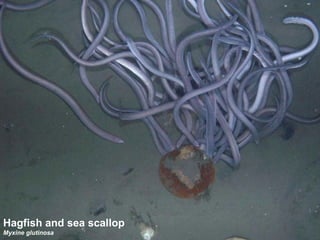
Hagfish and sea scallop Myxine glutinosa
Horse star Hippasteria phrygiana Deeplet sea anemone Bolocera tuediae
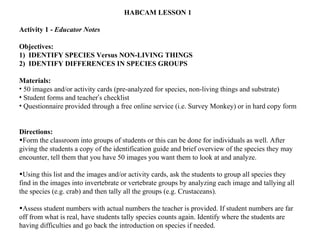
HABCAM LESSON 1  Activity 1 -  Educator Notes  Objectives: 1)  IDENTIFY SPECIES Versus NON-LIVING THINGS 2)  IDENTIFY DIFFERENCES IN SPECIES GROUPS Materials: 50 images and/or activity cards (pre-analyzed for species, non-living things and substrate) Student forms and teacher ’ s checklist Questionnaire provided through a free online service (i.e. Survey Monkey) or in hard copy form Directions: Form the classroom into groups of students or this can be done for individuals as well. After giving the students a copy of the identification guide and brief overview of the species they may encounter, tell them that you have 50 images you want them to look at and analyze.  Using this list and the images and/or activity cards, ask the students to group all species they find in the images into invertebrate or vertebrate groups by analyzing each image and tallying all the species (e.g. crab) and then tally all the groups (e.g. Crustaceans).  Assess student numbers with actual numbers the teacher is provided. If student numbers are far off from what is real, have students tally species counts again. Identify where the students are having difficulties and go back the introduction on species if needed.
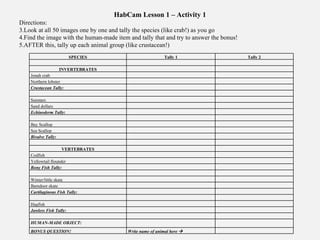
HabCam Lesson 1 – Activity 1 Directions: Look at all 50 images one by one and tally the species (like crab!) as you go Find the image with the human-made item and tally that and try to answer the bonus! AFTER this, tally up each animal group (like crustacean!)  SPECIES Tally 1 Tally 2 INVERTEBRATES Jonah crab Northern lobster Crustacean Tally: Sunstars Sand dollars Echinoderm Tally : Bay Scallop  Sea Scallop  Bivalve Tally : VERTEBRATES Codfish Yellowtail flounder Bony Fish Tally: Winter/little skate Barndoor skate Cartilaginous Fish Tally: Hagfish  Jawless Fish Tally: HUMAN-MADE OBJECT: BONUS QUESTION! Write name of animal here  
ACTIVITY 1 Possible Example Questions (grade dependent): 1.  Do you think that the items in the images are mostly living or non-living?  Which image has an example of a human-made thing in it? 2.  Why do you think that bivalves are named bivalves? Why do you call a bicycle a  BI -cycle?  Explain the fact that bivalves have two shells and what they are used for (e.g. use  scallop shells as props show how scallops can move by pumping water) 3.  Give an example of a character that suggests this animal is a crab? 4.  How are a fish and a crab different (e.g. endo vs. exoskeleton)?  how are they similar (they both live in the sea and they intake oxygen)? 5.  Which species do you think are more similar in appearance  1) a cod and a haddock or 2) a cod and a hagfish? Answer is a cod and a haddock as they are both in the Gadidae Family. Which do you think is the oldest animal?  A bony fish A   cartilaginous fish A jawless fish  (Answer is c, a jawless fish  http://www.nefsc.noaa.gov/faq/fishfaq1.html#q3 )
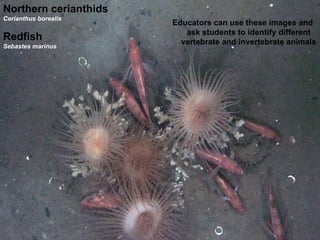
Northern cerianthids Cerianthus borealis Redfish Sebastes marinus  Educators can use these images and ask students to identify different vertebrate and invertebrate animals
Haddock and hagfish Melanogrammus aeglefinus Mating jonah crabs Cancer borealis
Chain dogfish Scyliorhinus retifer Thorny skate Amblyraja radiata
 
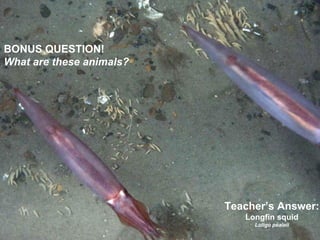
Teacher’s Answer: Longfin squid Loligo pealeii BONUS QUESTION! What are these animals?
Sand and gravel Cobble Assess the composition of the seafloor
HabCam Lesson 1 - Activity 2 Objective: IDENTIFY SUBSTRATE ON THE SEAFLOOR Directions: Ask the students to again assess each of the 50 images and now determine what the seafloor is mostly comprised of. Students can double check their species tallies as they perform  this activity. Use the sheet below as a guideline and circle which substrate type suits the images the best (just a sample of what the activity sheet would look like is provided): Sand  Sand/Gravel  Gravel  Cobble  Boulder Sand  Sand/Gravel  Gravel  Cobble  Boulder Image 1: Image 2: Sand  Sand/Gravel  Gravel  Cobble  Boulder Image 3:
Sea raven preying on redfish
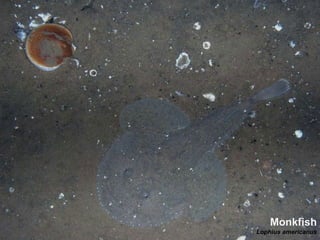
Monkfish Lophius americanus
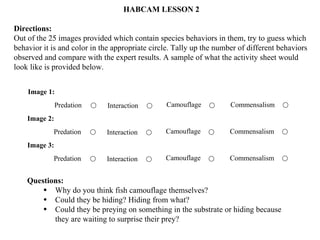
HABCAM LESSON 2 Directions: Out of the 25 images provided which contain species behaviors in them, try to guess which behavior it is and color in the appropriate circle. Tally up the number of different behaviors observed and compare with the expert results. A sample of what the activity sheet would look like is provided below. Questions:   Why do you think fish camouflage themselves? Could they be hiding? Hiding from what? Could they be preying on something in the substrate or hiding because they are waiting to surprise their prey?  Predation  Interaction  Camouflage  Commensalism  Image 1: Predation  Interaction  Camouflage  Commensalism  Image 2: Predation  Interaction  Camouflage  Commensalism  Image 3:
HabCam is generously funded by the Scallop Research Set-Aside program administered by the New England Fishery Management Council. The HabCam Group and Sea Scallop Research Team: Arnie’s Fisheries Captain and Crew of the Kathy Marie Woods Hole Oceanographic Institution Engineers and Scientists Independent Researchers For more information: http://habcam.whoi.edu/
Thank You for Watching!

Habcam outreach3

  • 1.
    Habitat Mapping CameraSystem The Sea Scallop Project
  • 2.
    Commercial scallop fishermen,scientists and engineers working together
  • 3.
    175 kHz ASTsynthetic aperture Side scan sonar Imagenix 600 kHz side scan Stereo optical imaging 30m 2m Kongsberg EM3002 300 kHz multibeam HabCam The HabCam is towed 2 m (6’) above the seafloor and takes 5 images per second, with a 1 m (3’) field of view
  • 4.
    Fishermen have awealth of at-sea experience and are essential to the success of cooperative research projects
  • 5.
    HabCam Track linesLong Island New England Atlantic Ocean Cape Cod Nantucket Lightship Closed Area
  • 6.
    Scallops are countedand measured along the track-line to provide biomass estimates
  • 7.
    Sea scallops Placopectenmagellanicus To search HabCam images visit: http://habcam.whoi.edu/ID_search.pl
  • 8.
  • 9.
  • 10.
  • 11.
    Hagfish and seascallop Myxine glutinosa
  • 12.
    Horse star Hippasteriaphrygiana Deeplet sea anemone Bolocera tuediae
  • 13.
    HABCAM LESSON 1 Activity 1 - Educator Notes Objectives: 1) IDENTIFY SPECIES Versus NON-LIVING THINGS 2) IDENTIFY DIFFERENCES IN SPECIES GROUPS Materials: 50 images and/or activity cards (pre-analyzed for species, non-living things and substrate) Student forms and teacher ’ s checklist Questionnaire provided through a free online service (i.e. Survey Monkey) or in hard copy form Directions: Form the classroom into groups of students or this can be done for individuals as well. After giving the students a copy of the identification guide and brief overview of the species they may encounter, tell them that you have 50 images you want them to look at and analyze. Using this list and the images and/or activity cards, ask the students to group all species they find in the images into invertebrate or vertebrate groups by analyzing each image and tallying all the species (e.g. crab) and then tally all the groups (e.g. Crustaceans). Assess student numbers with actual numbers the teacher is provided. If student numbers are far off from what is real, have students tally species counts again. Identify where the students are having difficulties and go back the introduction on species if needed.
  • 14.
    HabCam Lesson 1– Activity 1 Directions: Look at all 50 images one by one and tally the species (like crab!) as you go Find the image with the human-made item and tally that and try to answer the bonus! AFTER this, tally up each animal group (like crustacean!) SPECIES Tally 1 Tally 2 INVERTEBRATES Jonah crab Northern lobster Crustacean Tally: Sunstars Sand dollars Echinoderm Tally : Bay Scallop Sea Scallop Bivalve Tally : VERTEBRATES Codfish Yellowtail flounder Bony Fish Tally: Winter/little skate Barndoor skate Cartilaginous Fish Tally: Hagfish Jawless Fish Tally: HUMAN-MADE OBJECT: BONUS QUESTION! Write name of animal here 
  • 15.
    ACTIVITY 1 PossibleExample Questions (grade dependent): 1. Do you think that the items in the images are mostly living or non-living? Which image has an example of a human-made thing in it? 2. Why do you think that bivalves are named bivalves? Why do you call a bicycle a BI -cycle? Explain the fact that bivalves have two shells and what they are used for (e.g. use scallop shells as props show how scallops can move by pumping water) 3. Give an example of a character that suggests this animal is a crab? 4. How are a fish and a crab different (e.g. endo vs. exoskeleton)? how are they similar (they both live in the sea and they intake oxygen)? 5. Which species do you think are more similar in appearance 1) a cod and a haddock or 2) a cod and a hagfish? Answer is a cod and a haddock as they are both in the Gadidae Family. Which do you think is the oldest animal? A bony fish A cartilaginous fish A jawless fish (Answer is c, a jawless fish http://www.nefsc.noaa.gov/faq/fishfaq1.html#q3 )
  • 16.
    Northern cerianthids Cerianthusborealis Redfish Sebastes marinus Educators can use these images and ask students to identify different vertebrate and invertebrate animals
  • 17.
    Haddock and hagfishMelanogrammus aeglefinus Mating jonah crabs Cancer borealis
  • 18.
    Chain dogfish Scyliorhinusretifer Thorny skate Amblyraja radiata
  • 19.
  • 20.
    Teacher’s Answer: Longfinsquid Loligo pealeii BONUS QUESTION! What are these animals?
  • 21.
    Sand and gravelCobble Assess the composition of the seafloor
  • 22.
    HabCam Lesson 1- Activity 2 Objective: IDENTIFY SUBSTRATE ON THE SEAFLOOR Directions: Ask the students to again assess each of the 50 images and now determine what the seafloor is mostly comprised of. Students can double check their species tallies as they perform this activity. Use the sheet below as a guideline and circle which substrate type suits the images the best (just a sample of what the activity sheet would look like is provided): Sand Sand/Gravel Gravel Cobble Boulder Sand Sand/Gravel Gravel Cobble Boulder Image 1: Image 2: Sand Sand/Gravel Gravel Cobble Boulder Image 3:
  • 23.
  • 24.
  • 25.
    HABCAM LESSON 2Directions: Out of the 25 images provided which contain species behaviors in them, try to guess which behavior it is and color in the appropriate circle. Tally up the number of different behaviors observed and compare with the expert results. A sample of what the activity sheet would look like is provided below. Questions: Why do you think fish camouflage themselves? Could they be hiding? Hiding from what? Could they be preying on something in the substrate or hiding because they are waiting to surprise their prey? Predation Interaction Camouflage Commensalism Image 1: Predation Interaction Camouflage Commensalism Image 2: Predation Interaction Camouflage Commensalism Image 3:
  • 26.
    HabCam is generouslyfunded by the Scallop Research Set-Aside program administered by the New England Fishery Management Council. The HabCam Group and Sea Scallop Research Team: Arnie’s Fisheries Captain and Crew of the Kathy Marie Woods Hole Oceanographic Institution Engineers and Scientists Independent Researchers For more information: http://habcam.whoi.edu/
  • 27.
    Thank You forWatching!