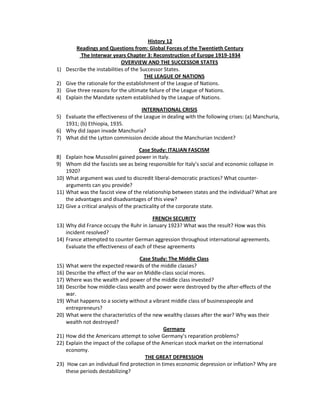
History 12
Readings and Questions from: Global Forces of the Twentieth Century
The Interwar yearsChapter 3: Reconstruction of Europe 1919-1934
OVERVIEW AND THE SUCCESSOR STATES
1. Describe the instabilities of the Successor States.
THE LEAGUE OF NATIONS
2. Give the rationale for the establishment of the League of Nations.
1. Give three reasons for the ultimate failure of the League of Nations.
2. Explain the Mandate system established by the League of Nations.
INTERNATIONAL CRISIS
3. Evaluate the effectiveness of the League in dealing with the following crises: (a) Manchuria,
1931; (b) Ethiopia, 1935.
4. What did the Lytton commission decide about the Manchurian Incident?
Case Study: ITALIAN FASCISM
5. Explain how Mussolini gained power in Italy.
6. Whom did the fascists see as being responsible for Italy’s social and economic collapse in
1920?
7. What argument was used to discredit liberal-democratic practices? What counter-arguments
can you provide?
8. What was the fascist view of the relationship between states and the individual? What are the
advantages and disadvantages of this view?
9. Give a critical analysis of the practicality of the fascist state.
FRENCH SECURITY
1. Why did France occupy the Ruhr in January 1923? What was the result? How was this
incident resolved?
2. France attempted to counter German aggression throughout international agreements.
Evaluate the effectiveness of each of these agreements
Case Study: The Middle Class
3. Describe the effect of the war on Middle-class social values and morality.
4. Where was the wealth and power of the middle class invested?
5. Describe how middle-class wealth and power were destroyed by the after-effects of the war.
6. What were the characteristics of the new wealthy classes after the war? Why was their wealth
not destroyed?
Germany
7. How did the Americans attempt to solve Germany’s reparation problems?
8. Explain the impact of the collapse of the American stock market on the international
economy.
THE GREAT DEPRESSION
9. How can an individual person find protection in times economic depression or inflation?
Why are these periods destabilizing?
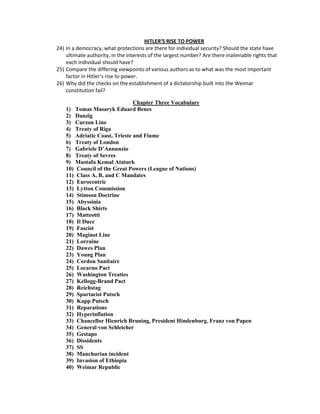
HITLER’S RISE TO POWER
10. In a democracy, what protections are there for individual security? Should the state have
ultimate authority, in the interests of the largest number? Are there inalienable rights that
each individual should have, if so what are they, if not what are the drawbacks to society?
11. Compare the differing viewpoints of various authors as to what was the most important factor
in Hitler’s rise to power.
1.
2.
3.
4.
5.
6.
7.
8.
9.
10.
11.
12.
13.
14.
15.
16.
17.
18.
19.
20.
21.
22.
23.
24.
25.
26.
27.
28.
29.
30.
31.
32.
33.
34.
35.
36.

Chapter 3: Vocabulary
Tomas Masaryk Eduard Benes
Danzig
Curzon Line
Treaty of Riga
Adriatic Coast, Trieste and Fiume
Treaty of London
Gabriele D’Annunzio
Treaty of Sevres
Mustafa Kemal Ataturk
Council of the Great Powers (League of Nations)
Class A, B, and C Mandates
Lytton Commission
Stimson Doctrine
Black Shirts
Matteotti
Il Duce
Fascist
Maginot Line
Lorraine
Dawes Plan
Young Plan
Cordon Sanitaire
Locarno Pact
Washington Treaties
Kellogg-Brand Pact
Reichstag
Spartacist Putsch
Kapp Putsch
Hyperinflation
Chancellor HienrichBruning, President Hindenburg. Franz von Papen
General von Schleicher
Gestapo
SS
Manchurian incident
Invasion of Ethiopia/Abyssinia
Weimar Republic

H12 Chapter 3 questions

  • 1.
    History 12 Readings andQuestions from: Global Forces of the Twentieth Century The Interwar yearsChapter 3: Reconstruction of Europe 1919-1934 OVERVIEW AND THE SUCCESSOR STATES 1. Describe the instabilities of the Successor States. THE LEAGUE OF NATIONS 2. Give the rationale for the establishment of the League of Nations. 1. Give three reasons for the ultimate failure of the League of Nations. 2. Explain the Mandate system established by the League of Nations. INTERNATIONAL CRISIS 3. Evaluate the effectiveness of the League in dealing with the following crises: (a) Manchuria, 1931; (b) Ethiopia, 1935. 4. What did the Lytton commission decide about the Manchurian Incident? Case Study: ITALIAN FASCISM 5. Explain how Mussolini gained power in Italy. 6. Whom did the fascists see as being responsible for Italy’s social and economic collapse in 1920? 7. What argument was used to discredit liberal-democratic practices? What counter-arguments can you provide? 8. What was the fascist view of the relationship between states and the individual? What are the advantages and disadvantages of this view? 9. Give a critical analysis of the practicality of the fascist state. FRENCH SECURITY 1. Why did France occupy the Ruhr in January 1923? What was the result? How was this incident resolved? 2. France attempted to counter German aggression throughout international agreements. Evaluate the effectiveness of each of these agreements Case Study: The Middle Class 3. Describe the effect of the war on Middle-class social values and morality. 4. Where was the wealth and power of the middle class invested? 5. Describe how middle-class wealth and power were destroyed by the after-effects of the war. 6. What were the characteristics of the new wealthy classes after the war? Why was their wealth not destroyed? Germany 7. How did the Americans attempt to solve Germany’s reparation problems? 8. Explain the impact of the collapse of the American stock market on the international economy. THE GREAT DEPRESSION 9. How can an individual person find protection in times economic depression or inflation? Why are these periods destabilizing? HITLER’S RISE TO POWER 10. In a democracy, what protections are there for individual security? Should the state have ultimate authority, in the interests of the largest number? Are there inalienable rights that each individual should have, if so what are they, if not what are the drawbacks to society? 11. Compare the differing viewpoints of various authors as to what was the most important factor in Hitler’s rise to power.
  • 2.
    1. 2. 3. 4. 5. 6. 7. 8. 9. 10. 11. 12. 13. 14. 15. 16. 17. 18. 19. 20. 21. 22. 23. 24. 25. 26. 27. 28. 29. 30. 31. 32. 33. 34. 35. 36. Chapter 3: Vocabulary TomasMasaryk Eduard Benes Danzig Curzon Line Treaty of Riga Adriatic Coast, Trieste and Fiume Treaty of London Gabriele D’Annunzio Treaty of Sevres Mustafa Kemal Ataturk Council of the Great Powers (League of Nations) Class A, B, and C Mandates Lytton Commission Stimson Doctrine Black Shirts Matteotti Il Duce Fascist Maginot Line Lorraine Dawes Plan Young Plan Cordon Sanitaire Locarno Pact Washington Treaties Kellogg-Brand Pact Reichstag Spartacist Putsch Kapp Putsch Hyperinflation Chancellor HienrichBruning, President Hindenburg. Franz von Papen General von Schleicher Gestapo SS Manchurian incident Invasion of Ethiopia/Abyssinia Weimar Republic