Guidelines for the production
                          of in-house self-access
                          materials
                          Lum Yoke Lin and Ray Brown


                          This article describes some practical guidelines evolved by staff in a large-
                          scale self-access      project  in Malaysia.     The guidelines     concern   the
                          production   of self-access materials in a situation where staff are often very
                          hard-pressed,     where both quantity and quality are required, and where
                          there is a felt need to give an in-house look to the materials. The writers
                          hope these guidelines       may be of sufficient    generality to interest those
                          developing    self-access materials in other parts of the world.


       The value of in-   A self-access project could rely on using only commercially-published
      house materials     materials, and indeed many do. But there are problems in following this
                          road. Firstly, it is likely to be costly in financial terms, for if copyright laws
                          are to be respected, and you are going to cut up and paste materials onto
                          learner cards, you will normally need to purchase three copies of every
                          publication you use - two for the cutting and pasting and one as a
                          reference copy. Secondly, commercial materials, even when they are
                          advertised as ‘self-study’, do not generally offer the guidance and
                          presentational clarity required of self-instructional materials, so the
                          mediation of a teacher is often indispensable. And thirdly, most
                          commercial materials in ELT tend to be Euro-centred or America-centred
                          and do not contain themes that are culturally familiar to learners in, say, an
                          Asian or African environment. For reasons such as these, and to a greater
                          or lesser extent, many self-access centres produce in-house materials.
                          However, as already stated, though the final product may be useful and
                          appropriate, there are problems in producing such materials, and in the
                          project we have been working on we have had to face some major ones:
                          - lack of time (on the part of a busy staff) for the writing of materials.
                          - the need to evolve an ‘in-house look’ so that the materials would have a
                              recognizable identity.
                          - the task of ensuring both quantity and quality. This implies aiding staff
                              to manage their time effectively, to set objectives, and to monitor the
                              quality of the product.
                          Through dealing with these problems over an extended period of time we
                          believe we have learnt a few lessons about the kind of in-house materials
                          that can be successfully produced within existing constraints, as well as
                          ways of ensuring quality control of those materials. However simple and
                          humble they may be, we would like to share these lessons with readers of
150                       ELT Journal Volume 48/2 April 1994 © Oxford University Press 1994


                                                                                    articles      welcome
this article. We present them under the headings of the three major
                           problems outlined above.

  Shortage of staff        Although the Self-Access Project in Malaysia has been supported by central
time for materials         educational authorities, it is the responsibility of teacher trainers in
           writing         individual colleges to produce their own self-access materials. These
                           teacher trainers, besides having their own often busy timetables, have to
                           perform many other duties, such as observing trainees in their teaching
                           practice, counselling, conducting extra-mural activities, preparing national
                           examinations and national syllabuses, and other non-academic duties.
                           Under such constraints the teacher trainer can produce only a limited
                           number of materials for the self-access centre and often, sad to say, his or her
                           full enthusiasm is not engaged in this work. The pull towards adapting
                           commercially-published materials is strong. Very seldom do writers have
                           the time to experiment with the exploitation of authentic materials.
                           However, authentic materials - a piece of written, audio, or video ‘text’ ,
                           a picture or a newspaper cutting - used as input for materials writing have
                           a great deal of potential. The secret lies in applying creativity and
                           ingenuity, and in finding time-saving ways of achieving that potential.
                           Source material can be exploited through a number of exercises of
                           different levels and types which develop different skills. This could save
                           time in the search for suitable source materials since the same piece is
                           ‘recycled’ a number of times. Because such a system would guide the
                           writer towards developing a choice of exercises or activity types - a
                           typology - ‘pencil-chewing   time’ could virtually be eliminated.
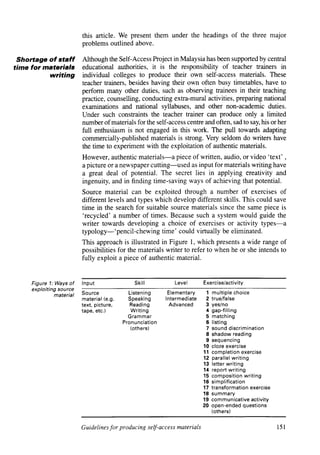
                           This approach is illustrated in Figure 1, which presents a wide range of
                           possibilities for the materials writer to refer to when he or she intends to
                           fully exploit a piece of authentic material.


      Figure 1: Ways of    Input                 Skill          Level       Exercise/activity
      exploiting source
                           Source             Listening      Elementary      1   multiple choice
                material
                           material (e.g.     Speaking      Intermediate     2   true/false
                           text, picture,      Reading        Advanced       3   yes/no
                           tape, etc.)         Writing                       4   gap-filling
                                              Grammar                        5   matching
                                            Pronunciation                    6   listing
                                               (others)                      7   sound discrimination
                                                                             8   shadow reading
                                                                             9   sequencing
                                                                            10   cloze exercise
                                                                            11   completion     exercise
                                                                            12   parallel writing
                                                                            13   letter writing
                                                                            14   report writing
                                                                            15   composition     writing
                                                                            16   simplification
                                                                            17   transformation     exercise
                                                                            18   summary
                                                                            19   communicative       activity
                                                                            20   open-ended questions
                                                                                 (others)


                           Guidelines for producing self-access materials                                       1.51


                                                                                                articles        welcome
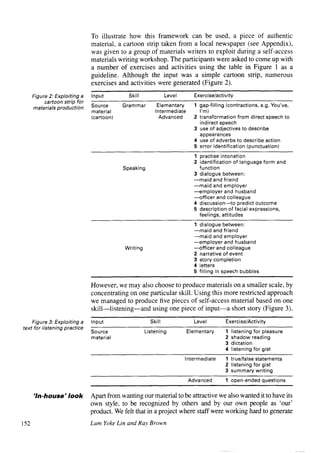
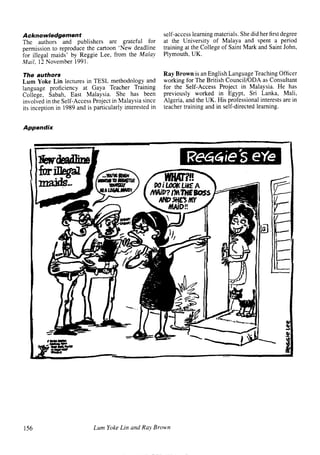
To illustrate how this framework can be used, a piece of authentic
                                material, a cartoon strip taken from a local newspaper (see Appendix),
                                was given to a group of materials writers to exploit during a self-access
                                materials writing workshop. The participants were asked to come up with
                                a number of exercises and activities using the table in Figure 1 as a
                                guideline. Although the input was a simple cartoon strip, numerous
                                exercises and activities were generated (Figure 2).

      Figure 2: Exploiting a    Input         Skill                Level       Exercise/activity
            cartoon strip for
                                Source      Grammar          Elementary        1 gap-filling (contractions,   e.g. You’ve,
      materials production
                                material                    Intermediate         I’m)
                                (cartoon)                     Advanced         2 transformation     from direct speech to
                                                                                 indirect speech
                                                                               3 use of adjectives to describe
                                                                                 appearances
                                                                               4 use of adverbs to describe action
                                                                               5 error identification   (punctuation)

                                                                               1 practise intonation
                                                                               2 identification    of language form and
                                            Speaking                               function
                                                                               3 dialogue between:
                                                                               - maid     and friend
                                                                               - maid     and employer
                                                                               - employer      and husband
                                                                               - officer    and colleague
                                                                               4 discussion - to     predict outcome
                                                                               5 description of facial expressions,
                                                                                   feelings, attitudes

                                                                               1 dialogue between:
                                                                               - maid    and friend
                                                                               - maid    and employer
                                                                               - employer    and husband
                                             Writing                           - officer  and colleague
                                                                               2 narrative of event
                                                                               3 story completion
                                                                               4 letters
                                                                               5 filling in speech bubbles


                                However, we may also choose to produce materials on a smaller scale, by
                                concentrating on one particular skill. Using this more restricted approach
                                we managed to produce five pieces of self-access material based on one
                                skill-listening-and   using one piece of input-a short story (Figure 3).

    Figure 3: Exploiting a      Input                    Skill                 Level           Exercise/Activity
text for listening practice
                                Source                 Listening           Elementary          1   listening for pleasure
                                material                                                       2   shadowreading
                                                                                               3   dictation
                                                                                               4   listening for gist

                                                                           Intermediate        1 true/false statements
                                                                                               2 listening for gist
                                                                                               3 summary writing

                                                                            Advanced           1 open-ended        questions


      ‘In-house’      look      Apart from wanting our material to be attractive we also wanted it to have its
                                own style, to be recognized by others and by our own people as ‘our’
                                product. We felt that in a project where staff were working hard to generate
152                             Lum Yoke Lin and Ray Brown


                                                                                                      articles         welcome
materials it was important that the materials should be ‘theirs’. We found
                        eventually that four features combined to make our materials identifiable:
                        1   statement of aims
                        2   provision of feedback
                        3   a single focus for each piece of material
                        4   keeping material short.

Statement     of aims   The purpose of stating the aim at the beginning and at the top of the page is
                        to enable learners to see very quickly what the material contains, and
                        whether or not it may relate to their needs. The aim could be stated in a
                        formal way, e.g.
                               This unit helps you to identify present tenses and the contexts in
                               which they are normally used.
                        But more and more we came to prefer an informal style, e.g.
                               How good are you at making words? Try this material and find out
                               how good you are at forming words from base words.
                        Or:
                               Do you have problems with prepositions? Are you uncertain which
                               preposition to use sometimes? If so, this material should help you.
                        Learners can check the level of the material                by referring      to its
                        classification number.

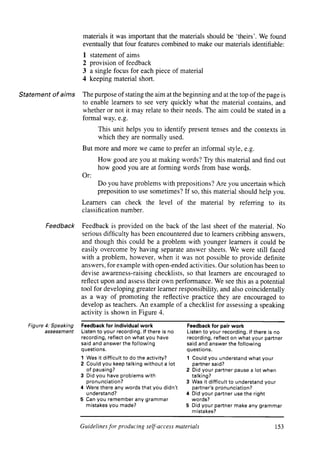
            Feedback    Feedback is provided on the back of the last sheet of the material. No
                         serious difficulty has been encountered due to learners cribbing answers,
                        and though this could be a problem with younger learners it could be
                        easily overcome by having separate answer sheets. We were still faced
                        with a problem, however, when it was not possible to provide definite
                        answers, for example with open-ended activities. Our solution has been to
                        devise awareness-raising checklists, so that learners are encouraged to
                        reflect upon and assess their own performance. We see this as a potential
                        tool for developing greater learner responsibility, and also coincidentally
                        as a way of promoting the reflective practice they are encouraged to
                        develop as teachers. An example of a checklist for assessing a speaking
                        activity is shown in Figure 4.

   Figure 4: Speaking   Feedback for individual work               Feedback for pair work
          assessment    Listen to your recording. If there is no   Listen to your recording. If there is no
                        recording, reflect on what you have        recording, reflect on what your partner
                        said and answer the following              said and answer the following
                        questions.                                 questions.
                        1 Was it difficult to do the activity?     1 Could you understand what your
                        2 Could you keep talking without a lot       partner said?
                          of pausing?                              2 Did your partner pause a lot when
                        3 Did you have problems with                 talking?
                          pronunciation?                           3 Was it difficult to understand your
                        4 Were there any words that you didn’t       partner’s pronunciation?
                          understand?                              4 Did your partner use the right
                        5 Can you remember any grammar               words?
                          mistakes you made?                       5 Did your partner make any grammar
                                                                     mistakes?


                        Guidelines for producing self-access materials                                   153


                                                                                          articles      welcome
A single focus   Usually each piece of material has just one focus. This enables a learner to
                       target a particular identifiable weakness. We are aware that there is a loss
                       of integration here and a loss of ‘communicative reality’, but self-access
                       work is only one means available to our learners and we do have other
                       materials, in the form of reading, audio, and video materials, which are
                       not discretely presented in this way: we remain convinced of the value of
                       single-focus material for self-access learners who have been trying to
                       identify their particular problems and who are keen to improve their
                       ability in specific points of language.

         Length and    Our material is generally short: two or three pages. This is to allow our
           timespan    trainees some discretion about the time they spend in the self-access
                       centre. Even if they only spend fifteen minutes, they can nevertheless do
                       something. Also, we believe that shorter material is better assimilated, as
                       it makes fewer demands on the student’s concentration span.


      Attractiveness   To enhance the appearance of our materials while still working within the
                       constraints of our budgets we have made use of:

                       - paper of different colours for different language areas, or for different
                           levels
                       - bold lettering and varying typefaces, when available
                       - careful layout
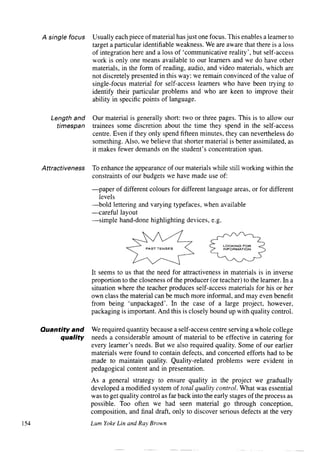
                       - simple hand-done highlighting devices, e.g.


                       It seems to us that the need for attractiveness in materials is in inverse
                       proportion to the closeness of the producer (or teacher) to the learner. In a
                       situation where the teacher produces self-access materials for his or her
                       own class the material can be much more informal, and may even benefit
                       from being ‘unpackaged’. In the case of a large project, however,
                       packaging is important. And this is closely bound up with quality control.

      Quantity and     We required quantity because a self-access centre serving a whole college
            quality    needs a considerable amount of material to be effective in catering for
                       every learner’s needs. But we also required quality. Some of our earlier
                       materials were found to contain defects, and concerted efforts had to be
                       made to maintain quality. Quality-related problems were evident in
                       pedagogical content and in presentation.
                       As a general strategy to ensure quality in the project we gradually
                       developed a modified system of total quality control. What was essential
                       was to get quality control as far back into the early stages of the process as
                       possible. Too often we had seen material go through conception,
                       composition, and final draft, only to discover serious defects at the very
154                    Lum Yoke Lin and Ray Brown


                                                                                articles     welcome
end of the process - many of them having crept in at the early stages. So
             the answer was to have quality control at different stages of the production
             process, starting from the very beginning. We found that, in general,
             materials production followed this route:
             1   choice of source material
             2   decision about what to use material for
             3   manipulation of material to suit intent
             4   writing and re-writing
             5   final presentation
             6   proof-reading
             We realized that quality control had to be implemented at each of these
             stages, initially by the writer and his or her peers, and later by a central
             quality control group. In our residential materials production workshops
             we now have a system of:
             1 Peer-group quality control in which peers from the same writing group
               vet material at stages 1 to 5.
             2 Inter-group quality control to monitor stages 1 to 5 already controlled
               by the peer-group.
             3 Final quality control by a limited and experienced group, followed by
               proof-reading: a very important but sometimes underestimated task.
             The material might be returned to the writer at any of these stages but
             hopefully and in practice, that tends to happen at the peer-group quality
             control stage. In this way, as a general rule, only good material reaches the
             final quality control stage. Time is saved; face is saved.
             To have good quality control we need to train the quality controllers. In
             the early stages there was a tendency to concentrate on trivia and offer
             alternatives that were no better than the original. This was time-wasting.
             So we saw a need to train the vetters which, in effect, meant everybody
             involved in the peer-groups. They were trained to see the writer’s point of
             view and not only their own, to be tolerant of styles and approaches that
             might not be to their own taste, while at the same time seeing every piece
             of material through the learner’s eyes to check that it was:
             - clear (aim and content)
             - appropriate    (to priorities, needs, levels)
             - correct   (in terms of explanations and answers)
             - well-presented     (all possibilities for attractiveness exploited)

Concluding   Each self-access centre is unique. It is not possible to reproduce a number
   remarks   of self-access centres according to a set model or template. Thus, in the
             project that we have been working on, all twenty-eight centres have their
             unique local problems and preferences, and this gives them their
             individual characters. What we have tried to convey in this article are
             guidelines of a generally applicable nature, which we hope will apply to
             other centres as well.

             Received   April 1992

             Guidelines for producing self-access materials                             155


                                                                             articles   welcome
Acknowledgement                                           self-access learning materials. She did her first degree
The authors and publishers       are grateful for         at the University of Malaya and spent a period
permission to reproduce the cartoon ‘New deadline         training at the College of Saint Mark and Saint John,
for illegal maids’ by Reggie Lee, from the Malay          Plymouth, UK.
Mail, 12 November 1991.

The authors                                               Ray Brown is an English Language Teaching Officer
Lum Yoke Lin lectures in TESL methodology and             working for The British Council/ODA as Consultant
language proficiency at Gaya Teacher Training             for the Self-Access Project in Malaysia. He has
College, Sabah, East Malaysia. She has been               previously worked in Egypt, Sri Lanka, Mali,
involved in the Self-Access Project in Malaysia since     Algeria, and the UK. His professional interests are in
its inception in 1989 and is particularly interested in   teacher training and in self-directed learning.


Appendix


156                          Lum Yoke Lin and Ray Brown


                                                                                           articles      welcome

Guideline for the production

  • 1.
    Guidelines for theproduction of in-house self-access materials Lum Yoke Lin and Ray Brown This article describes some practical guidelines evolved by staff in a large- scale self-access project in Malaysia. The guidelines concern the production of self-access materials in a situation where staff are often very hard-pressed, where both quantity and quality are required, and where there is a felt need to give an in-house look to the materials. The writers hope these guidelines may be of sufficient generality to interest those developing self-access materials in other parts of the world. The value of in- A self-access project could rely on using only commercially-published house materials materials, and indeed many do. But there are problems in following this road. Firstly, it is likely to be costly in financial terms, for if copyright laws are to be respected, and you are going to cut up and paste materials onto learner cards, you will normally need to purchase three copies of every publication you use - two for the cutting and pasting and one as a reference copy. Secondly, commercial materials, even when they are advertised as ‘self-study’, do not generally offer the guidance and presentational clarity required of self-instructional materials, so the mediation of a teacher is often indispensable. And thirdly, most commercial materials in ELT tend to be Euro-centred or America-centred and do not contain themes that are culturally familiar to learners in, say, an Asian or African environment. For reasons such as these, and to a greater or lesser extent, many self-access centres produce in-house materials. However, as already stated, though the final product may be useful and appropriate, there are problems in producing such materials, and in the project we have been working on we have had to face some major ones: - lack of time (on the part of a busy staff) for the writing of materials. - the need to evolve an ‘in-house look’ so that the materials would have a recognizable identity. - the task of ensuring both quantity and quality. This implies aiding staff to manage their time effectively, to set objectives, and to monitor the quality of the product. Through dealing with these problems over an extended period of time we believe we have learnt a few lessons about the kind of in-house materials that can be successfully produced within existing constraints, as well as ways of ensuring quality control of those materials. However simple and humble they may be, we would like to share these lessons with readers of 150 ELT Journal Volume 48/2 April 1994 © Oxford University Press 1994 articles welcome
  • 2.
    this article. Wepresent them under the headings of the three major problems outlined above. Shortage of staff Although the Self-Access Project in Malaysia has been supported by central time for materials educational authorities, it is the responsibility of teacher trainers in writing individual colleges to produce their own self-access materials. These teacher trainers, besides having their own often busy timetables, have to perform many other duties, such as observing trainees in their teaching practice, counselling, conducting extra-mural activities, preparing national examinations and national syllabuses, and other non-academic duties. Under such constraints the teacher trainer can produce only a limited number of materials for the self-access centre and often, sad to say, his or her full enthusiasm is not engaged in this work. The pull towards adapting commercially-published materials is strong. Very seldom do writers have the time to experiment with the exploitation of authentic materials. However, authentic materials - a piece of written, audio, or video ‘text’ , a picture or a newspaper cutting - used as input for materials writing have a great deal of potential. The secret lies in applying creativity and ingenuity, and in finding time-saving ways of achieving that potential. Source material can be exploited through a number of exercises of different levels and types which develop different skills. This could save time in the search for suitable source materials since the same piece is ‘recycled’ a number of times. Because such a system would guide the writer towards developing a choice of exercises or activity types - a typology - ‘pencil-chewing time’ could virtually be eliminated. This approach is illustrated in Figure 1, which presents a wide range of possibilities for the materials writer to refer to when he or she intends to fully exploit a piece of authentic material. Figure 1: Ways of Input Skill Level Exercise/activity exploiting source Source Listening Elementary 1 multiple choice material material (e.g. Speaking Intermediate 2 true/false text, picture, Reading Advanced 3 yes/no tape, etc.) Writing 4 gap-filling Grammar 5 matching Pronunciation 6 listing (others) 7 sound discrimination 8 shadow reading 9 sequencing 10 cloze exercise 11 completion exercise 12 parallel writing 13 letter writing 14 report writing 15 composition writing 16 simplification 17 transformation exercise 18 summary 19 communicative activity 20 open-ended questions (others) Guidelines for producing self-access materials 1.51 articles welcome
  • 3.
    To illustrate howthis framework can be used, a piece of authentic material, a cartoon strip taken from a local newspaper (see Appendix), was given to a group of materials writers to exploit during a self-access materials writing workshop. The participants were asked to come up with a number of exercises and activities using the table in Figure 1 as a guideline. Although the input was a simple cartoon strip, numerous exercises and activities were generated (Figure 2). Figure 2: Exploiting a Input Skill Level Exercise/activity cartoon strip for Source Grammar Elementary 1 gap-filling (contractions, e.g. You’ve, materials production material Intermediate I’m) (cartoon) Advanced 2 transformation from direct speech to indirect speech 3 use of adjectives to describe appearances 4 use of adverbs to describe action 5 error identification (punctuation) 1 practise intonation 2 identification of language form and Speaking function 3 dialogue between: - maid and friend - maid and employer - employer and husband - officer and colleague 4 discussion - to predict outcome 5 description of facial expressions, feelings, attitudes 1 dialogue between: - maid and friend - maid and employer - employer and husband Writing - officer and colleague 2 narrative of event 3 story completion 4 letters 5 filling in speech bubbles However, we may also choose to produce materials on a smaller scale, by concentrating on one particular skill. Using this more restricted approach we managed to produce five pieces of self-access material based on one skill-listening-and using one piece of input-a short story (Figure 3). Figure 3: Exploiting a Input Skill Level Exercise/Activity text for listening practice Source Listening Elementary 1 listening for pleasure material 2 shadowreading 3 dictation 4 listening for gist Intermediate 1 true/false statements 2 listening for gist 3 summary writing Advanced 1 open-ended questions ‘In-house’ look Apart from wanting our material to be attractive we also wanted it to have its own style, to be recognized by others and by our own people as ‘our’ product. We felt that in a project where staff were working hard to generate 152 Lum Yoke Lin and Ray Brown articles welcome
  • 4.
    materials it wasimportant that the materials should be ‘theirs’. We found eventually that four features combined to make our materials identifiable: 1 statement of aims 2 provision of feedback 3 a single focus for each piece of material 4 keeping material short. Statement of aims The purpose of stating the aim at the beginning and at the top of the page is to enable learners to see very quickly what the material contains, and whether or not it may relate to their needs. The aim could be stated in a formal way, e.g. This unit helps you to identify present tenses and the contexts in which they are normally used. But more and more we came to prefer an informal style, e.g. How good are you at making words? Try this material and find out how good you are at forming words from base words. Or: Do you have problems with prepositions? Are you uncertain which preposition to use sometimes? If so, this material should help you. Learners can check the level of the material by referring to its classification number. Feedback Feedback is provided on the back of the last sheet of the material. No serious difficulty has been encountered due to learners cribbing answers, and though this could be a problem with younger learners it could be easily overcome by having separate answer sheets. We were still faced with a problem, however, when it was not possible to provide definite answers, for example with open-ended activities. Our solution has been to devise awareness-raising checklists, so that learners are encouraged to reflect upon and assess their own performance. We see this as a potential tool for developing greater learner responsibility, and also coincidentally as a way of promoting the reflective practice they are encouraged to develop as teachers. An example of a checklist for assessing a speaking activity is shown in Figure 4. Figure 4: Speaking Feedback for individual work Feedback for pair work assessment Listen to your recording. If there is no Listen to your recording. If there is no recording, reflect on what you have recording, reflect on what your partner said and answer the following said and answer the following questions. questions. 1 Was it difficult to do the activity? 1 Could you understand what your 2 Could you keep talking without a lot partner said? of pausing? 2 Did your partner pause a lot when 3 Did you have problems with talking? pronunciation? 3 Was it difficult to understand your 4 Were there any words that you didn’t partner’s pronunciation? understand? 4 Did your partner use the right 5 Can you remember any grammar words? mistakes you made? 5 Did your partner make any grammar mistakes? Guidelines for producing self-access materials 153 articles welcome
  • 5.
    A single focus Usually each piece of material has just one focus. This enables a learner to target a particular identifiable weakness. We are aware that there is a loss of integration here and a loss of ‘communicative reality’, but self-access work is only one means available to our learners and we do have other materials, in the form of reading, audio, and video materials, which are not discretely presented in this way: we remain convinced of the value of single-focus material for self-access learners who have been trying to identify their particular problems and who are keen to improve their ability in specific points of language. Length and Our material is generally short: two or three pages. This is to allow our timespan trainees some discretion about the time they spend in the self-access centre. Even if they only spend fifteen minutes, they can nevertheless do something. Also, we believe that shorter material is better assimilated, as it makes fewer demands on the student’s concentration span. Attractiveness To enhance the appearance of our materials while still working within the constraints of our budgets we have made use of: - paper of different colours for different language areas, or for different levels - bold lettering and varying typefaces, when available - careful layout - simple hand-done highlighting devices, e.g. It seems to us that the need for attractiveness in materials is in inverse proportion to the closeness of the producer (or teacher) to the learner. In a situation where the teacher produces self-access materials for his or her own class the material can be much more informal, and may even benefit from being ‘unpackaged’. In the case of a large project, however, packaging is important. And this is closely bound up with quality control. Quantity and We required quantity because a self-access centre serving a whole college quality needs a considerable amount of material to be effective in catering for every learner’s needs. But we also required quality. Some of our earlier materials were found to contain defects, and concerted efforts had to be made to maintain quality. Quality-related problems were evident in pedagogical content and in presentation. As a general strategy to ensure quality in the project we gradually developed a modified system of total quality control. What was essential was to get quality control as far back into the early stages of the process as possible. Too often we had seen material go through conception, composition, and final draft, only to discover serious defects at the very 154 Lum Yoke Lin and Ray Brown articles welcome
  • 6.
    end of theprocess - many of them having crept in at the early stages. So the answer was to have quality control at different stages of the production process, starting from the very beginning. We found that, in general, materials production followed this route: 1 choice of source material 2 decision about what to use material for 3 manipulation of material to suit intent 4 writing and re-writing 5 final presentation 6 proof-reading We realized that quality control had to be implemented at each of these stages, initially by the writer and his or her peers, and later by a central quality control group. In our residential materials production workshops we now have a system of: 1 Peer-group quality control in which peers from the same writing group vet material at stages 1 to 5. 2 Inter-group quality control to monitor stages 1 to 5 already controlled by the peer-group. 3 Final quality control by a limited and experienced group, followed by proof-reading: a very important but sometimes underestimated task. The material might be returned to the writer at any of these stages but hopefully and in practice, that tends to happen at the peer-group quality control stage. In this way, as a general rule, only good material reaches the final quality control stage. Time is saved; face is saved. To have good quality control we need to train the quality controllers. In the early stages there was a tendency to concentrate on trivia and offer alternatives that were no better than the original. This was time-wasting. So we saw a need to train the vetters which, in effect, meant everybody involved in the peer-groups. They were trained to see the writer’s point of view and not only their own, to be tolerant of styles and approaches that might not be to their own taste, while at the same time seeing every piece of material through the learner’s eyes to check that it was: - clear (aim and content) - appropriate (to priorities, needs, levels) - correct (in terms of explanations and answers) - well-presented (all possibilities for attractiveness exploited) Concluding Each self-access centre is unique. It is not possible to reproduce a number remarks of self-access centres according to a set model or template. Thus, in the project that we have been working on, all twenty-eight centres have their unique local problems and preferences, and this gives them their individual characters. What we have tried to convey in this article are guidelines of a generally applicable nature, which we hope will apply to other centres as well. Received April 1992 Guidelines for producing self-access materials 155 articles welcome
  • 7.
    Acknowledgement self-access learning materials. She did her first degree The authors and publishers are grateful for at the University of Malaya and spent a period permission to reproduce the cartoon ‘New deadline training at the College of Saint Mark and Saint John, for illegal maids’ by Reggie Lee, from the Malay Plymouth, UK. Mail, 12 November 1991. The authors Ray Brown is an English Language Teaching Officer Lum Yoke Lin lectures in TESL methodology and working for The British Council/ODA as Consultant language proficiency at Gaya Teacher Training for the Self-Access Project in Malaysia. He has College, Sabah, East Malaysia. She has been previously worked in Egypt, Sri Lanka, Mali, involved in the Self-Access Project in Malaysia since Algeria, and the UK. His professional interests are in its inception in 1989 and is particularly interested in teacher training and in self-directed learning. Appendix 156 Lum Yoke Lin and Ray Brown articles welcome