2
Lesson objectives
Explain theIntercultural Communication Competence
• Personal strength
• Communication skills
• Psychological adjustment
• Cultural awareness
3.
3
Intercultural Communication
Competence
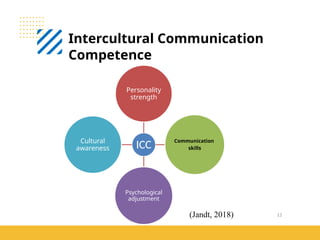
According toSpitzberg (2000), Intercultural Communication Competence
(ICC) is the ability to communicate effectively and appropriately with people
of other cultures.
There are four skill areas within ICC.
• Personality strength
• Communication skills
• Psychological adjustment
• Cultural awareness
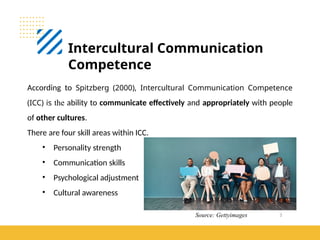
Source: Gettyimages
5
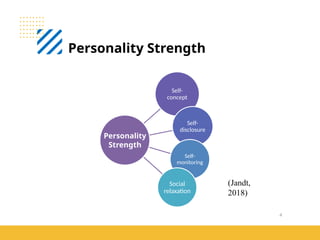
Personality Strength
(Jandt, 2018)
•Self-concept: how a person views the self
e.g. You view yourself as an optimistic or a pressimistic person.
• Self-disclosure: the willingness of individuals to openly and
appropriately reveal information about themselves to their counterparts.
e.g. How much of yourself you are willing to reveal to other people.
6.
6
Personality Strength
(Jandt, 2018)
•Self-monitoring: an expressive behavior using social comparison
information to control and modify one’s self-presentation.
e.g. You compare yourself with someone else to decide to use more or
less facial expression in communcation.
• Social relaxation: the ability to reveal little anxiety in communication
e.g. You tend to communicate in a more relaxing ways with family
members than with strangers.
8
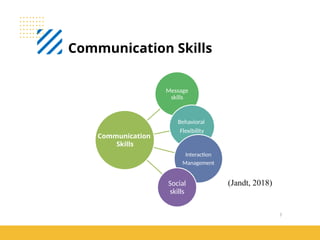
Communication skills
(Jandt, 2018)
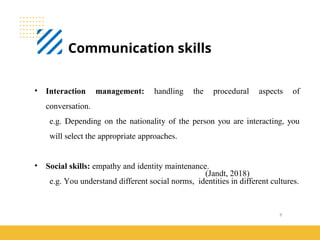
•Message skills: the ability to understand and use language and feedback.
• Behavioral flexibility: ability to select an appropriate behavior in diverse
context.
e.g. You adjust your communication strategies when talking to a kid and a
senior lecturer
9.
9
Communication skills
(Jandt, 2018)
•Interaction management: handling the procedural aspects of
conversation.
e.g. Depending on the nationality of the person you are interacting, you
will select the appropriate approaches.
• Social skills: empathy and identity maintenance.
e.g. You understand different social norms, identities in different cultures.
10.
10
Psychological Adjustment
(Jandt, 2018)
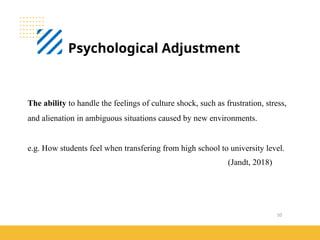
Theability to handle the feelings of culture shock, such as frustration, stress,
and alienation in ambiguous situations caused by new environments.
e.g. How students feel when transfering from high school to university level.
12
Cultural Awareness
(Jandt, 2018)
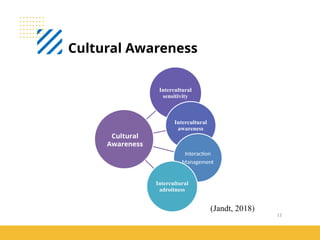
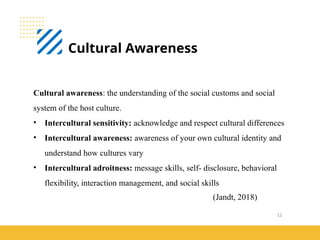
Culturalawareness: the understanding of the social customs and social
system of the host culture.
• Intercultural sensitivity: acknowledge and respect cultural differences
• Intercultural awareness: awareness of your own cultural identity and
understand how cultures vary
• Intercultural adroitness: message skills, self- disclosure, behavioral
flexibility, interaction management, and social skills