©WORKSHOP ON GST
GOODS AND
SERVICES TAX
AN OVERVIEW
BY SATYARTH PRAKASH DWIVEDI
WHAT IS GST?
Goods and Services tax popularly known as GST is a Value Added Tax which is levied
on Manufacture, Sale and Consumption of Goods and Services.
GST provides a continuous chain of credits at each stage right from the point of
production to the point of retail sale or provision of services as the case may be
(explained in an example later). Thereby taxing only the value added at each stage.
The supplier is permitted to take credit of the GST paid by him on the purchase of
goods and/or services at each stage and can set-off this credit against the GST
payable by him on the supply of goods and services to be made.
In this system of Credit and Set-off only the final consumer is made to borne the
burden of tax i.e. GST.
BY SATYARTH PRAKASH DWIVEDI
©WORKSHOP ON GST
WHAT IS CASCADING
EFFECT OF TAXES?
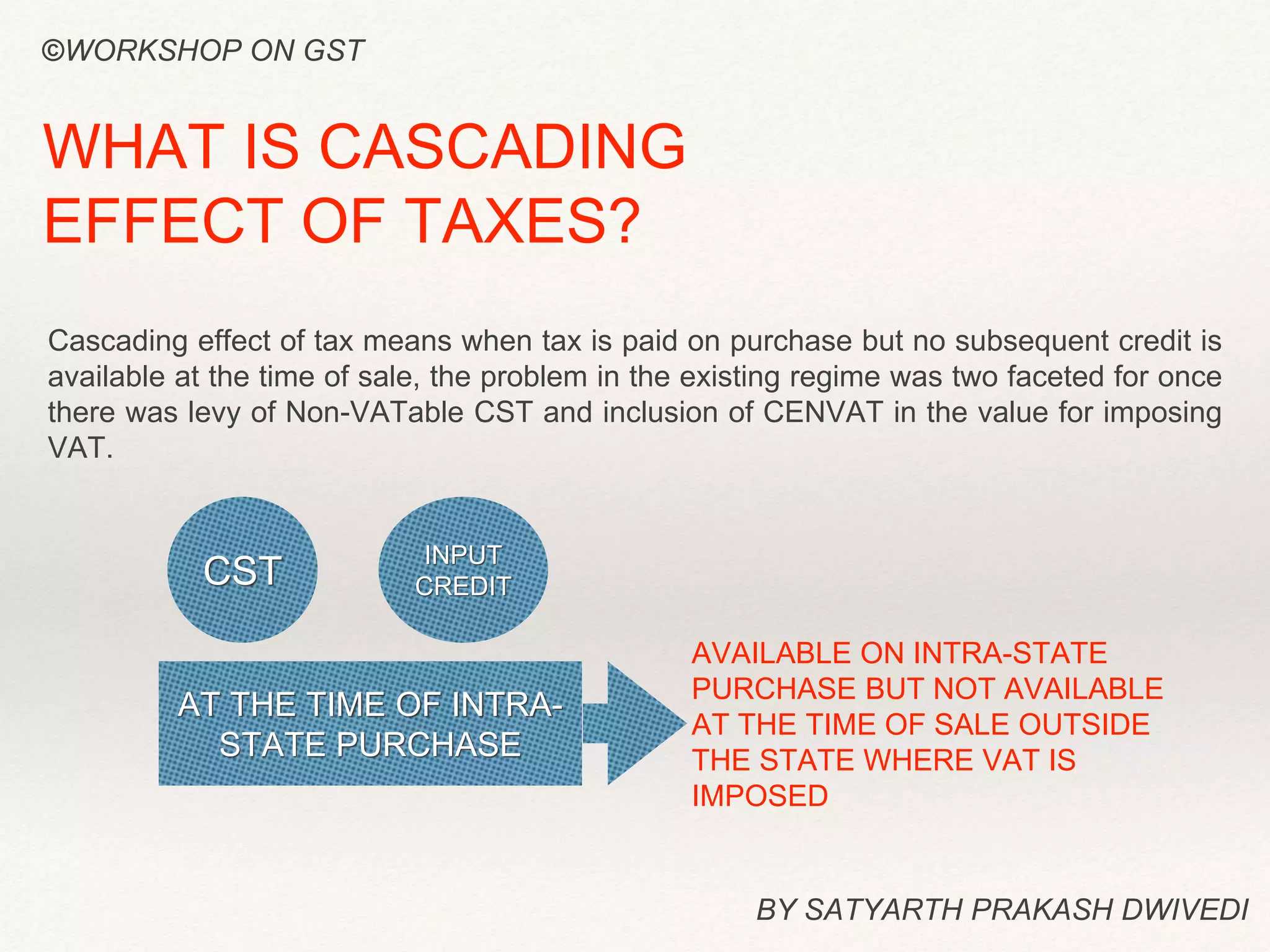
Cascading effect of tax means when tax is paid on purchase but no subsequent credit is
available at the time of sale, the problem in the existing regime was two faceted for once
there was levy of Non-VATable CST and inclusion of CENVAT in the value for imposing
VAT.
CST
INPUT
CREDIT
AT THE TIME OF INTRA-
STATE PURCHASE
AVAILABLE ON INTRA-STATE
PURCHASE BUT NOT AVAILABLE
AT THE TIME OF SALE OUTSIDE
THE STATE WHERE VAT IS
IMPOSED
BY SATYARTH PRAKASH DWIVEDI
©WORKSHOP ON GST
Lets understand this with the help of an example:
Suppose you go to a restaurant and have your favourite meal for Rs. 100 now what
was happening under the existing system was that if the bill shows the following
charges
Food Value @ Rs.100 on which VAT at 14% was charged
Service charge @Rs. 10 on which Service Tax @15% was charged.
An additional service tax @6% (abated) on value of food was charged.
Therefore the total tax paid by the final consumer was Rs. (14+1.5+6)= Rs. 21.5
Under this system tax was charged twice on the value of food and hence this
becomes the case of double taxation which is unfair to the consumer as well as
detrimental to the economy as it leads to inflation and price rise.
BY SATYARTH PRAKASH DWIVEDI
WHAT IS DOUBLE TAXATION
OF GOODS AND SERVICES?
©WORKSHOP ON GST
BY SATYARTH PRAKASH DWIVEDI
PROBLEMS IN THE EARLIER
TAX REGIME
Non inclusion of several local levies in State VAT such as luxury tax, entertainment tax etc.
Cascading of taxes as explained earlier.
No CENVAT after manufacturing stage.
Non-integration of VAT & Service Tax
Double taxation of transactions as both goods and services explained earlier.
©WORKSHOP ON GST
BY SATYARTH PRAKASH DWIVEDI
DUAL GST MODEL TO BE
IMPLEMENTED IN INDIA
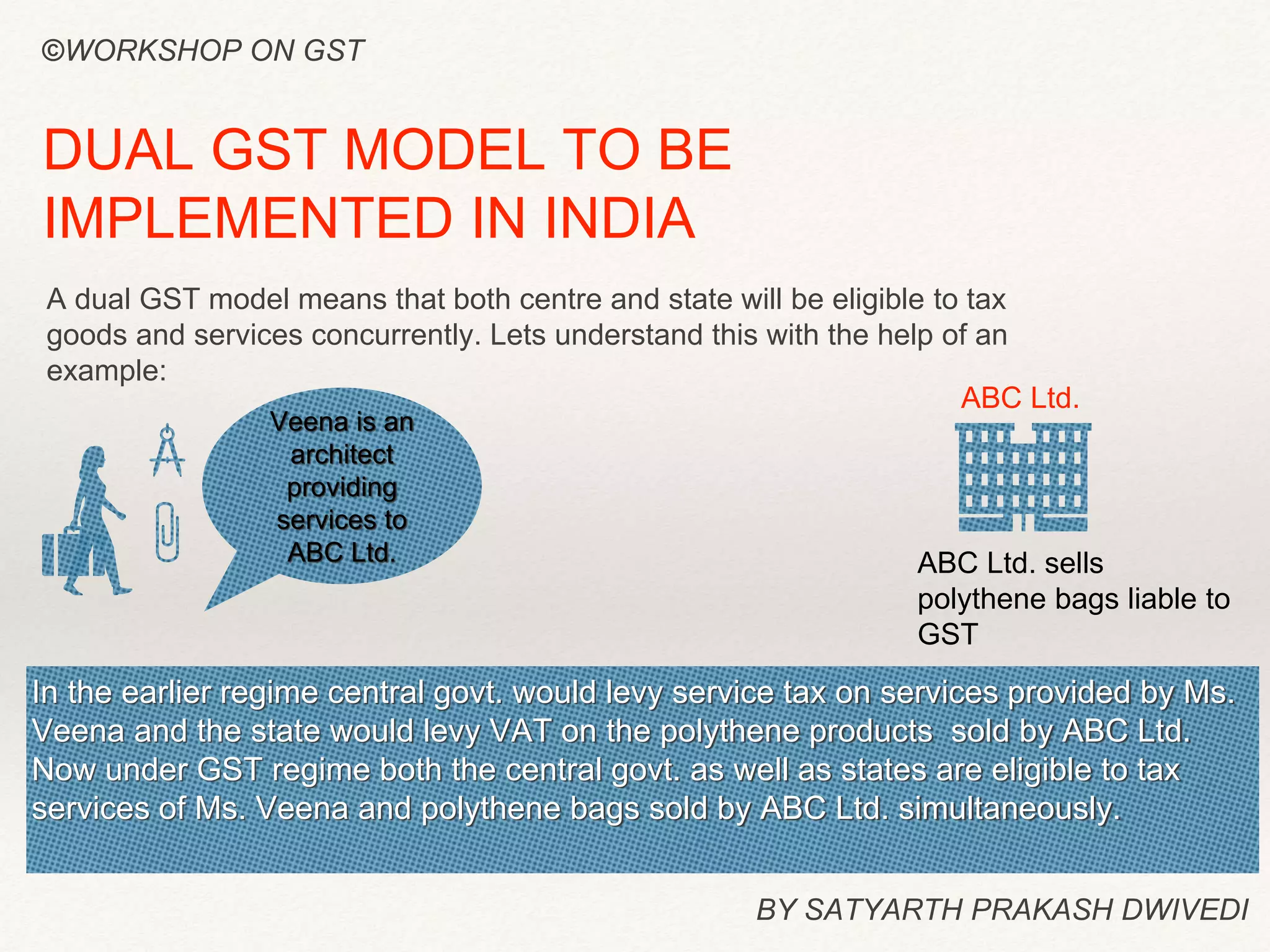
A dual GST model means that both centre and state will be eligible to tax
goods and services concurrently. Lets understand this with the help of an
example:
Veena is an
architect
providing
services to
ABC Ltd.
ABC Ltd.
ABC Ltd. sells
polythene bags liable to
GST
In the earlier regime central govt. would levy service tax on services provided by Ms.
Veena and the state would levy VAT on the polythene products sold by ABC Ltd.
Now under GST regime both the central govt. as well as states are eligible to tax
services of Ms. Veena and polythene bags sold by ABC Ltd. simultaneously.
©WORKSHOP ON GST
BY SATYARTH PRAKASH DWIVEDI
CGST, SGST, UGST and IGST
GST in India will be a destination based tax which is applicable on all transactions
involving supply of goods and/or services for a consideration subject to certain
exceptions.
The centre will charge CGST on any supply of goods or services.
The states will charge SGST on any supply of goods and/or services.
The union territories with a separate state legislature on Intra-state supply will charge
SGST on any supply of goods and/or services.
The union territories without a separate state legislature on Intra-state supply will
charge UTGST.
Apart from the above, Inter-state sale will be subjected to IGST i.e. integrated GST.
©WORKSHOP ON GST
BY SATYARTH PRAKASH DWIVEDI
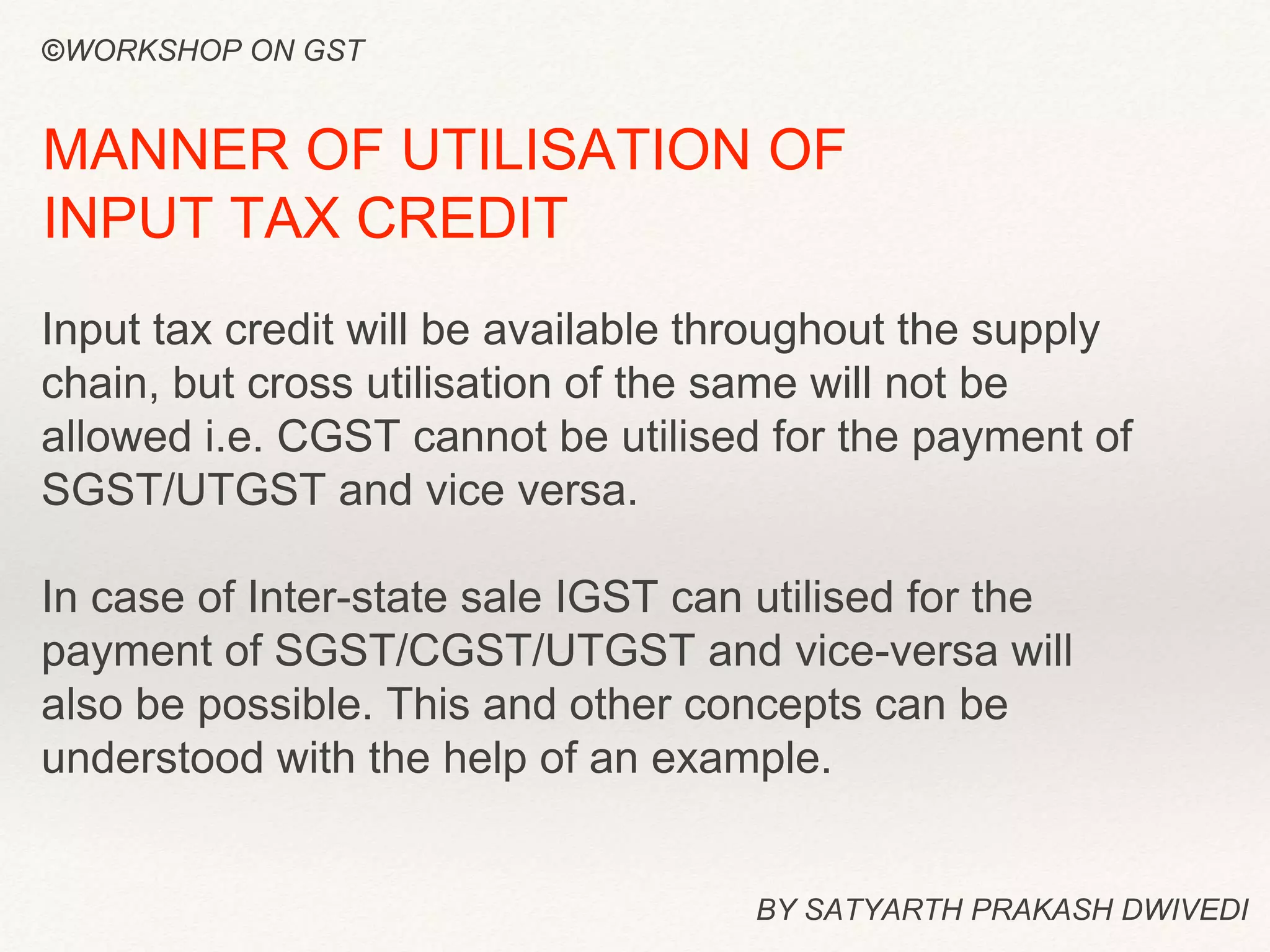
MANNER OF UTILISATION OF
INPUT TAX CREDIT
Input tax credit will be available throughout the supply
chain, but cross utilisation of the same will not be
allowed i.e. CGST cannot be utilised for the payment of
SGST/UTGST and vice versa.
In case of Inter-state sale IGST can utilised for the
payment of SGST/CGST/UTGST and vice-versa will
also be possible. This and other concepts can be
understood with the help of an example.
©WORKSHOP ON GST
BY SATYARTH PRAKASH DWIVEDI
UNDERSTANDING GST WITH AN EXAMPLE
INTRA-STATE SUPPLY(within the same state)
I. Supply of goods/services by A to B:
Amt.(Rs)
Value charged for supply of Goods/Services 10,000
Add: CGST @9% 900
Add: SGST@9% 900
Total price charged by A from B for local supply of
goods/services
11,800
CGST and SGST of Rs.900 each will be payable by A to the credit of Central Govt.
and State Govt. respectively. No input credit will be available as A is the First
Stage Supplier
©WORKSHOP ON GST
BY SATYARTH PRAKASH DWIVEDI
UNDERSTANDING GST WITH AN EXAMPLE
II. Supply of goods/services by B to C- Value addition @20%
Amt.(Rs)
Value charged for supply of Goods/Services @120% i.e. 10,000
x 120%
12,000
Add: CGST @9% 1080
Add: SGST@9% 1080
Total price charged by A from B for local supply of
goods/services
14,160
INTRA-STATE SUPPLY(within the same state)
©WORKSHOP ON GST
BY SATYARTH PRAKASH DWIVEDI
UNDERSTANDING GST WITH AN EXAMPLE
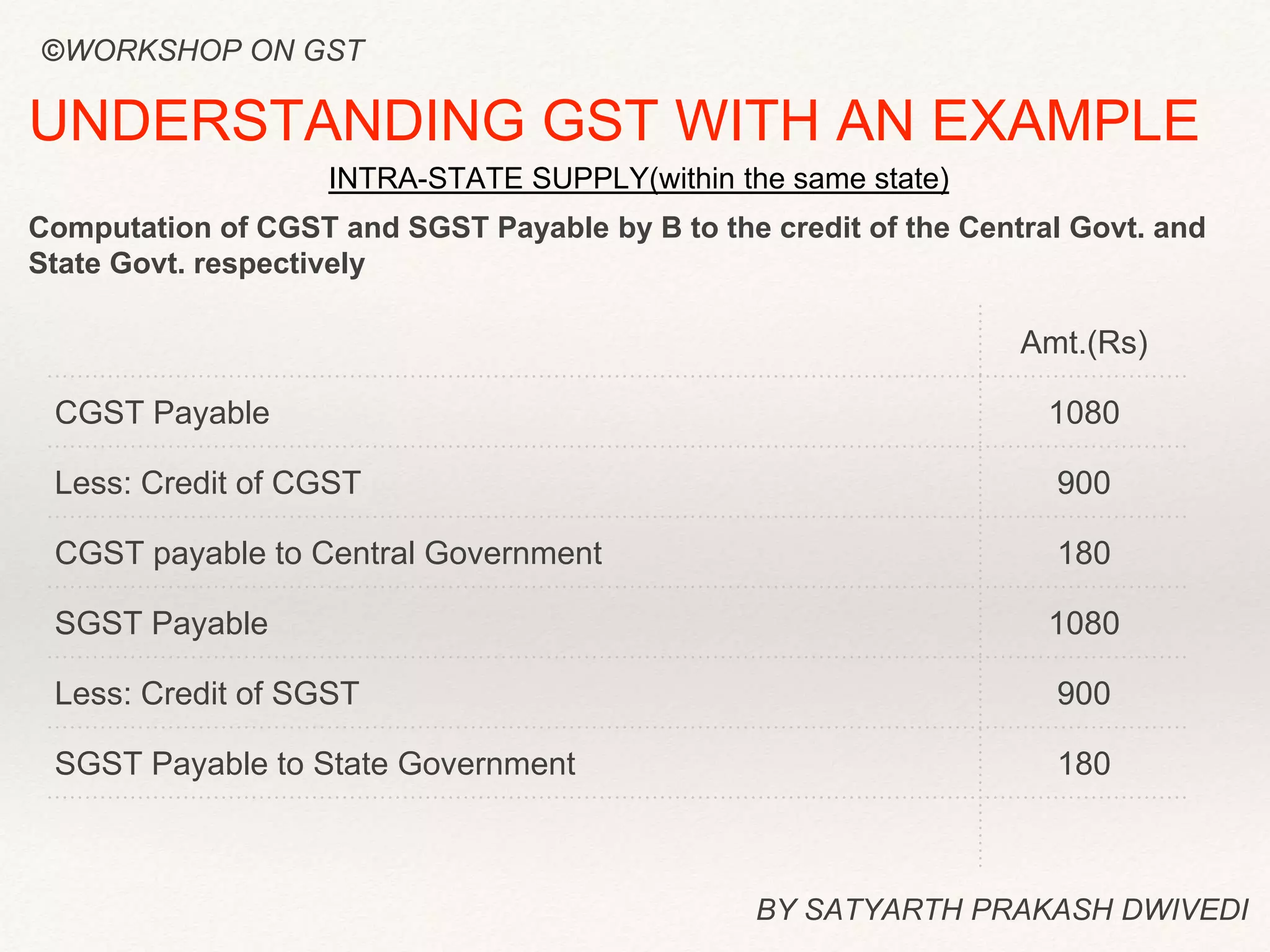
Computation of CGST and SGST Payable by B to the credit of the Central Govt. and
State Govt. respectively
Amt.(Rs)
CGST Payable 1080
Less: Credit of CGST 900
CGST payable to Central Government 180
SGST Payable 1080
Less: Credit of SGST 900
SGST Payable to State Government 180
INTRA-STATE SUPPLY(within the same state)
©WORKSHOP ON GST
BY SATYARTH PRAKASH DWIVEDI
UNDERSTANDING GST WITH AN EXAMPLE
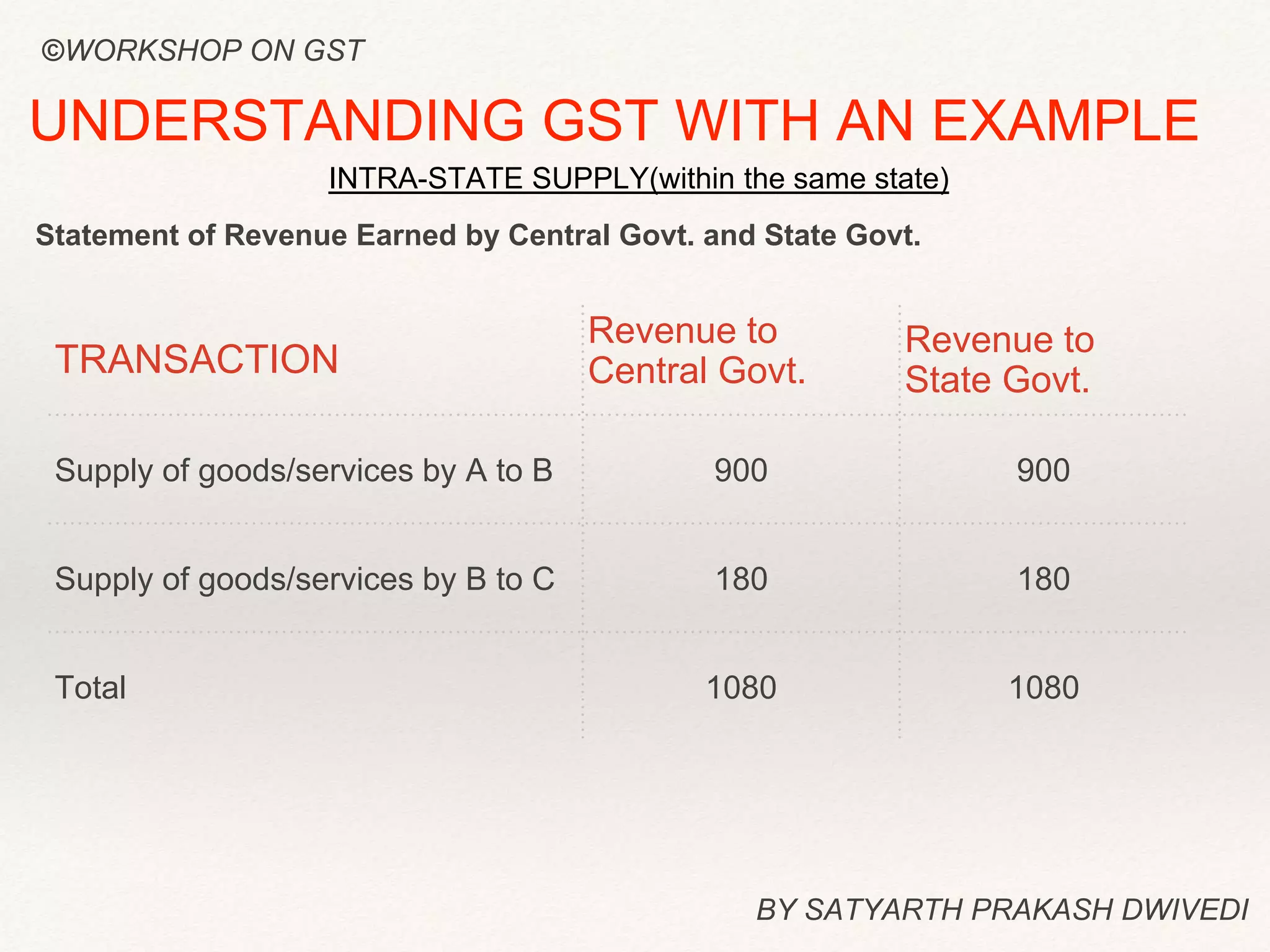
Statement of Revenue Earned by Central Govt. and State Govt.
TRANSACTION
Revenue to
Central Govt.
Revenue to
State Govt.
Supply of goods/services by A to B 900 900
Supply of goods/services by B to C 180 180
Total 1080 1080
INTRA-STATE SUPPLY(within the same state)
©WORKSHOP ON GST
BY SATYARTH PRAKASH DWIVEDI
UNDERSTANDING GST WITH AN EXAMPLE
INTER-STATE SUPPLY(State 1 to State 2)
I. Supply of goods/services by X of State 1 to A of State 1:
Amt.(Rs)
Value charged for supply of Goods/Services 10,000
Add: CGST @9% 900
Add: SGST@9% 900
Total price charged by A from B for local supply of
goods/services
11,800
CGST and SGST of Rs.900 each will be payable by X to the credit of Central Govt.
and State Govt. respectively. No input credit will be available as A is the First
Stage Supplier
©WORKSHOP ON GST
BY SATYARTH PRAKASH DWIVEDI
UNDERSTANDING GST WITH AN EXAMPLE
II. Supply of goods/services by A of State 1 to B of State 2- Value addition @20%
Amt.(Rs)
Value charged for supply of Goods/Services @120% i.e. 10,000
x 120%
12,000
Add: IGST@18% 2160
Total price charged by A from B for local supply of
goods/services
14,160
INTER-STATE SUPPLY(State 1 to State 2)
©WORKSHOP ON GST
BY SATYARTH PRAKASH DWIVEDI
UNDERSTANDING GST WITH AN EXAMPLE
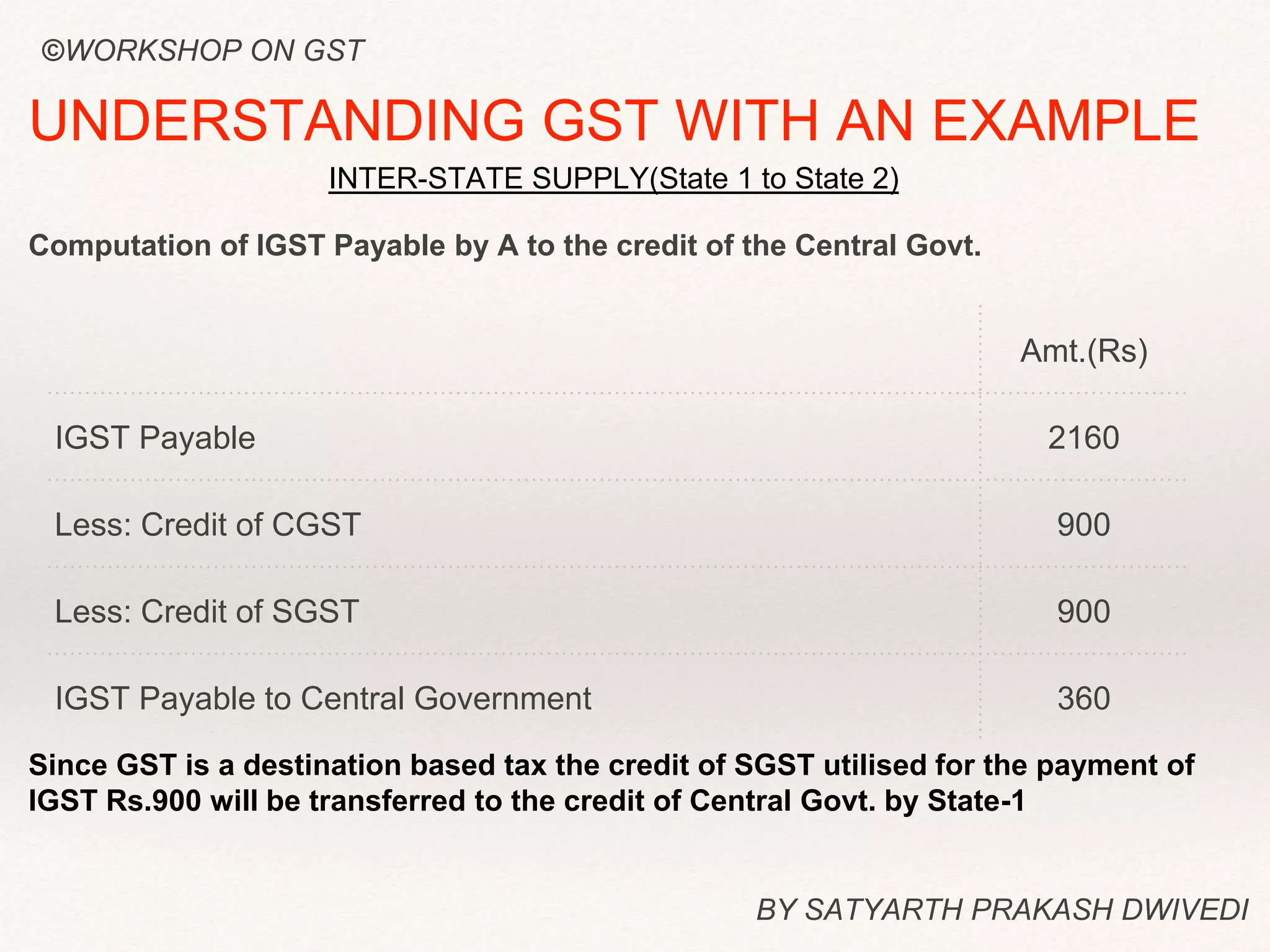
Computation of IGST Payable by A to the credit of the Central Govt.
Amt.(Rs)
IGST Payable 2160
Less: Credit of CGST 900
Less: Credit of SGST 900
IGST Payable to Central Government 360
Since GST is a destination based tax the credit of SGST utilised for the payment of
IGST Rs.900 will be transferred to the credit of Central Govt. by State-1
INTER-STATE SUPPLY(State 1 to State 2)
©WORKSHOP ON GST
BY SATYARTH PRAKASH DWIVEDI
UNDERSTANDING GST WITH AN EXAMPLE
III. Supply of goods/services by B of State-2 to C of State-2 -Value addition @ 20%(Intra-
State)
Amt.(Rs)
Value charged for supply of goods/services(Rs. 12,000 x 120%) 14,400
Add: CGST@9% 1296
Add: SGST@9% 1296
Total price charged by B from C for local supply of
goods/services
16,992
INTER-STATE SUPPLY(State 1 to State 2)
©WORKSHOP ON GST
Amt.(Rs)
CGST Payable 1296
Less: Credit of IGST 1296
CGST Payable to Central Government NIL
SGST Payable 1296
Less: Credit of IGST Rs.(2160-1296) 864
SGST Payable to State Government 432
BY SATYARTH PRAKASH DWIVEDI
UNDERSTANDING GST WITH AN EXAMPLE
Computation of CGST and SGST Payable by B to the credit of the Central Govt. and
State Govt. respectively
Since GST is a destination based tax the credit of IGST i.e. Rs.864 utilised for the
payment of SGST will be transferred to the credit of State-2 Govt. i.e. the importing
state by Central Govt.
INTER-STATE SUPPLY(State 1 to State 2)
©WORKSHOP ON GST
UNDERSTANDING GST WITH AN EXAMPLE
Statement of Revenue Earned by Central Govt. and State Govt.
TRANSACTION
Revenue to
Central Govt.
Revenue to
State Govt.-1
Revenue to
State Govt.-2
Supply of goods/services by X
to A
900 900
Supply of goods/services by A
of State-1 to B of State-2
360
Transfer of credit by State
Govt-1 to Central Govt.
900 (900)
Transfer of credit by Central
Govt. to State Govt.-2
(864) 864
Supply of goods/services by B
of State-2 to C of State-2
432
Total 1296 NIL 1296
BY SATYARTH PRAKASH DWIVEDI
INTER-STATE SUPPLY(State 1 to State 2)
©WORKSHOP ON GST
BY SATYARTH PRAKASH DWIVEDI
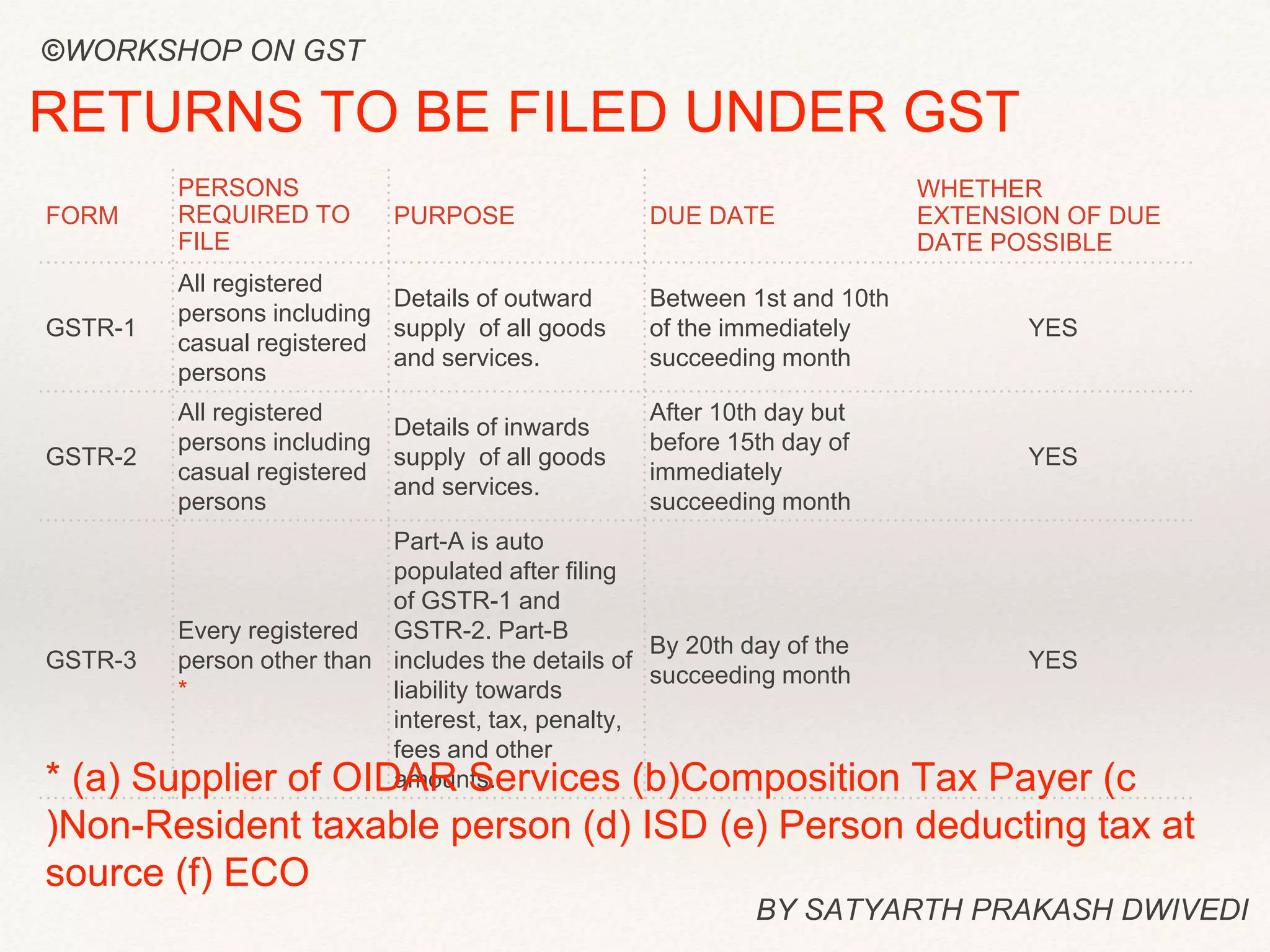
RETURNS TO BE FILED UNDER GST
FORM
PERSONS
REQUIRED TO
FILE
PURPOSE DUE DATE
WHETHER
EXTENSION OF DUE
DATE POSSIBLE
GSTR-1
All registered
persons including
casual registered
persons
Details of outward
supply of all goods
and services.
Between 1st and 10th
of the immediately
succeeding month
YES
GSTR-2
All registered
persons including
casual registered
persons
Details of inwards
supply of all goods
and services.
After 10th day but
before 15th day of
immediately
succeeding month
YES
GSTR-3
Every registered
person other than
*
Part-A is auto
populated after filing
of GSTR-1 and
GSTR-2. Part-B
includes the details of
liability towards
interest, tax, penalty,
fees and other
amounts.
By 20th day of the
succeeding month
YES
* (a) Supplier of OIDAR Services (b)Composition Tax Payer (c
)Non-Resident taxable person (d) ISD (e) Person deducting tax at
source (f) ECO
©WORKSHOP ON GST
BY SATYARTH PRAKASH DWIVEDI
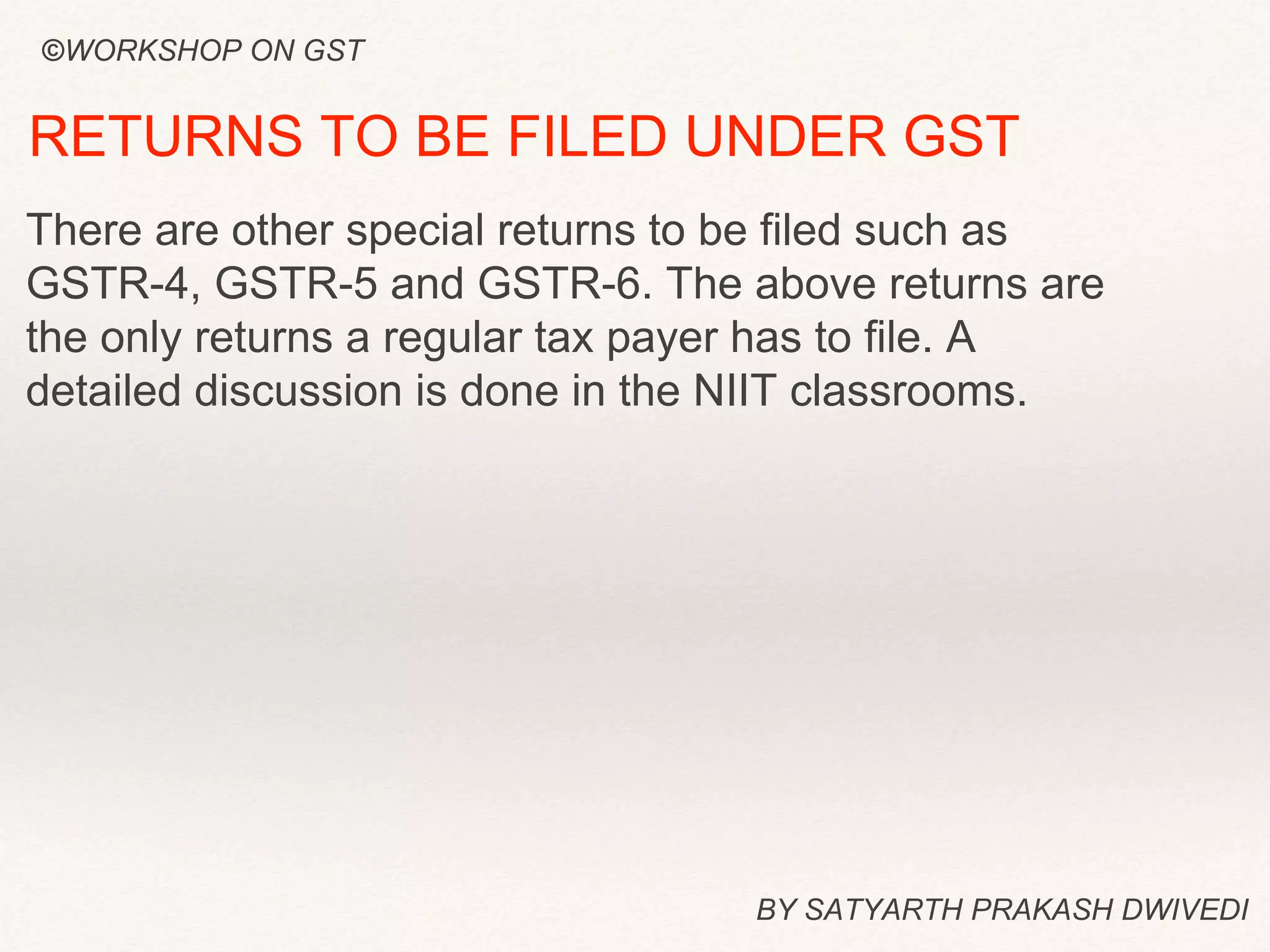
RETURNS TO BE FILED UNDER GST
There are other special returns to be filed such as
GSTR-4, GSTR-5 and GSTR-6. The above returns are
the only returns a regular tax payer has to file. A
detailed discussion is done in the NIIT classrooms.
©WORKSHOP ON GST
–Satyarth Prakash Dwivedi
9582016799
9140615260
satty90@gmail.com
Thank You Every One For Being Patient, patience
is a virtue.
BY SATYARTH PRAKASH DWIVEDI
©WORKSHOP ON GST

GST Workshop

  • 1.
    ©WORKSHOP ON GST GOODSAND SERVICES TAX AN OVERVIEW BY SATYARTH PRAKASH DWIVEDI
  • 2.
    WHAT IS GST? Goodsand Services tax popularly known as GST is a Value Added Tax which is levied on Manufacture, Sale and Consumption of Goods and Services. GST provides a continuous chain of credits at each stage right from the point of production to the point of retail sale or provision of services as the case may be (explained in an example later). Thereby taxing only the value added at each stage. The supplier is permitted to take credit of the GST paid by him on the purchase of goods and/or services at each stage and can set-off this credit against the GST payable by him on the supply of goods and services to be made. In this system of Credit and Set-off only the final consumer is made to borne the burden of tax i.e. GST. BY SATYARTH PRAKASH DWIVEDI ©WORKSHOP ON GST
  • 3.
    WHAT IS CASCADING EFFECTOF TAXES? Cascading effect of tax means when tax is paid on purchase but no subsequent credit is available at the time of sale, the problem in the existing regime was two faceted for once there was levy of Non-VATable CST and inclusion of CENVAT in the value for imposing VAT. CST INPUT CREDIT AT THE TIME OF INTRA- STATE PURCHASE AVAILABLE ON INTRA-STATE PURCHASE BUT NOT AVAILABLE AT THE TIME OF SALE OUTSIDE THE STATE WHERE VAT IS IMPOSED BY SATYARTH PRAKASH DWIVEDI ©WORKSHOP ON GST
  • 4.
    Lets understand thiswith the help of an example: Suppose you go to a restaurant and have your favourite meal for Rs. 100 now what was happening under the existing system was that if the bill shows the following charges Food Value @ Rs.100 on which VAT at 14% was charged Service charge @Rs. 10 on which Service Tax @15% was charged. An additional service tax @6% (abated) on value of food was charged. Therefore the total tax paid by the final consumer was Rs. (14+1.5+6)= Rs. 21.5 Under this system tax was charged twice on the value of food and hence this becomes the case of double taxation which is unfair to the consumer as well as detrimental to the economy as it leads to inflation and price rise. BY SATYARTH PRAKASH DWIVEDI WHAT IS DOUBLE TAXATION OF GOODS AND SERVICES? ©WORKSHOP ON GST
  • 5.
    BY SATYARTH PRAKASHDWIVEDI PROBLEMS IN THE EARLIER TAX REGIME Non inclusion of several local levies in State VAT such as luxury tax, entertainment tax etc. Cascading of taxes as explained earlier. No CENVAT after manufacturing stage. Non-integration of VAT & Service Tax Double taxation of transactions as both goods and services explained earlier. ©WORKSHOP ON GST
  • 6.
    BY SATYARTH PRAKASHDWIVEDI DUAL GST MODEL TO BE IMPLEMENTED IN INDIA A dual GST model means that both centre and state will be eligible to tax goods and services concurrently. Lets understand this with the help of an example: Veena is an architect providing services to ABC Ltd. ABC Ltd. ABC Ltd. sells polythene bags liable to GST In the earlier regime central govt. would levy service tax on services provided by Ms. Veena and the state would levy VAT on the polythene products sold by ABC Ltd. Now under GST regime both the central govt. as well as states are eligible to tax services of Ms. Veena and polythene bags sold by ABC Ltd. simultaneously. ©WORKSHOP ON GST
  • 7.
    BY SATYARTH PRAKASHDWIVEDI CGST, SGST, UGST and IGST GST in India will be a destination based tax which is applicable on all transactions involving supply of goods and/or services for a consideration subject to certain exceptions. The centre will charge CGST on any supply of goods or services. The states will charge SGST on any supply of goods and/or services. The union territories with a separate state legislature on Intra-state supply will charge SGST on any supply of goods and/or services. The union territories without a separate state legislature on Intra-state supply will charge UTGST. Apart from the above, Inter-state sale will be subjected to IGST i.e. integrated GST. ©WORKSHOP ON GST
  • 8.
    BY SATYARTH PRAKASHDWIVEDI MANNER OF UTILISATION OF INPUT TAX CREDIT Input tax credit will be available throughout the supply chain, but cross utilisation of the same will not be allowed i.e. CGST cannot be utilised for the payment of SGST/UTGST and vice versa. In case of Inter-state sale IGST can utilised for the payment of SGST/CGST/UTGST and vice-versa will also be possible. This and other concepts can be understood with the help of an example. ©WORKSHOP ON GST
  • 9.
    BY SATYARTH PRAKASHDWIVEDI UNDERSTANDING GST WITH AN EXAMPLE INTRA-STATE SUPPLY(within the same state) I. Supply of goods/services by A to B: Amt.(Rs) Value charged for supply of Goods/Services 10,000 Add: CGST @9% 900 Add: SGST@9% 900 Total price charged by A from B for local supply of goods/services 11,800 CGST and SGST of Rs.900 each will be payable by A to the credit of Central Govt. and State Govt. respectively. No input credit will be available as A is the First Stage Supplier ©WORKSHOP ON GST
  • 10.
    BY SATYARTH PRAKASHDWIVEDI UNDERSTANDING GST WITH AN EXAMPLE II. Supply of goods/services by B to C- Value addition @20% Amt.(Rs) Value charged for supply of Goods/Services @120% i.e. 10,000 x 120% 12,000 Add: CGST @9% 1080 Add: SGST@9% 1080 Total price charged by A from B for local supply of goods/services 14,160 INTRA-STATE SUPPLY(within the same state) ©WORKSHOP ON GST
  • 11.
    BY SATYARTH PRAKASHDWIVEDI UNDERSTANDING GST WITH AN EXAMPLE Computation of CGST and SGST Payable by B to the credit of the Central Govt. and State Govt. respectively Amt.(Rs) CGST Payable 1080 Less: Credit of CGST 900 CGST payable to Central Government 180 SGST Payable 1080 Less: Credit of SGST 900 SGST Payable to State Government 180 INTRA-STATE SUPPLY(within the same state) ©WORKSHOP ON GST
  • 12.
    BY SATYARTH PRAKASHDWIVEDI UNDERSTANDING GST WITH AN EXAMPLE Statement of Revenue Earned by Central Govt. and State Govt. TRANSACTION Revenue to Central Govt. Revenue to State Govt. Supply of goods/services by A to B 900 900 Supply of goods/services by B to C 180 180 Total 1080 1080 INTRA-STATE SUPPLY(within the same state) ©WORKSHOP ON GST
  • 13.
    BY SATYARTH PRAKASHDWIVEDI UNDERSTANDING GST WITH AN EXAMPLE INTER-STATE SUPPLY(State 1 to State 2) I. Supply of goods/services by X of State 1 to A of State 1: Amt.(Rs) Value charged for supply of Goods/Services 10,000 Add: CGST @9% 900 Add: SGST@9% 900 Total price charged by A from B for local supply of goods/services 11,800 CGST and SGST of Rs.900 each will be payable by X to the credit of Central Govt. and State Govt. respectively. No input credit will be available as A is the First Stage Supplier ©WORKSHOP ON GST
  • 14.
    BY SATYARTH PRAKASHDWIVEDI UNDERSTANDING GST WITH AN EXAMPLE II. Supply of goods/services by A of State 1 to B of State 2- Value addition @20% Amt.(Rs) Value charged for supply of Goods/Services @120% i.e. 10,000 x 120% 12,000 Add: IGST@18% 2160 Total price charged by A from B for local supply of goods/services 14,160 INTER-STATE SUPPLY(State 1 to State 2) ©WORKSHOP ON GST
  • 15.
    BY SATYARTH PRAKASHDWIVEDI UNDERSTANDING GST WITH AN EXAMPLE Computation of IGST Payable by A to the credit of the Central Govt. Amt.(Rs) IGST Payable 2160 Less: Credit of CGST 900 Less: Credit of SGST 900 IGST Payable to Central Government 360 Since GST is a destination based tax the credit of SGST utilised for the payment of IGST Rs.900 will be transferred to the credit of Central Govt. by State-1 INTER-STATE SUPPLY(State 1 to State 2) ©WORKSHOP ON GST
  • 16.
    BY SATYARTH PRAKASHDWIVEDI UNDERSTANDING GST WITH AN EXAMPLE III. Supply of goods/services by B of State-2 to C of State-2 -Value addition @ 20%(Intra- State) Amt.(Rs) Value charged for supply of goods/services(Rs. 12,000 x 120%) 14,400 Add: CGST@9% 1296 Add: SGST@9% 1296 Total price charged by B from C for local supply of goods/services 16,992 INTER-STATE SUPPLY(State 1 to State 2) ©WORKSHOP ON GST
  • 17.
    Amt.(Rs) CGST Payable 1296 Less:Credit of IGST 1296 CGST Payable to Central Government NIL SGST Payable 1296 Less: Credit of IGST Rs.(2160-1296) 864 SGST Payable to State Government 432 BY SATYARTH PRAKASH DWIVEDI UNDERSTANDING GST WITH AN EXAMPLE Computation of CGST and SGST Payable by B to the credit of the Central Govt. and State Govt. respectively Since GST is a destination based tax the credit of IGST i.e. Rs.864 utilised for the payment of SGST will be transferred to the credit of State-2 Govt. i.e. the importing state by Central Govt. INTER-STATE SUPPLY(State 1 to State 2) ©WORKSHOP ON GST
  • 18.
    UNDERSTANDING GST WITHAN EXAMPLE Statement of Revenue Earned by Central Govt. and State Govt. TRANSACTION Revenue to Central Govt. Revenue to State Govt.-1 Revenue to State Govt.-2 Supply of goods/services by X to A 900 900 Supply of goods/services by A of State-1 to B of State-2 360 Transfer of credit by State Govt-1 to Central Govt. 900 (900) Transfer of credit by Central Govt. to State Govt.-2 (864) 864 Supply of goods/services by B of State-2 to C of State-2 432 Total 1296 NIL 1296 BY SATYARTH PRAKASH DWIVEDI INTER-STATE SUPPLY(State 1 to State 2) ©WORKSHOP ON GST
  • 19.
    BY SATYARTH PRAKASHDWIVEDI RETURNS TO BE FILED UNDER GST FORM PERSONS REQUIRED TO FILE PURPOSE DUE DATE WHETHER EXTENSION OF DUE DATE POSSIBLE GSTR-1 All registered persons including casual registered persons Details of outward supply of all goods and services. Between 1st and 10th of the immediately succeeding month YES GSTR-2 All registered persons including casual registered persons Details of inwards supply of all goods and services. After 10th day but before 15th day of immediately succeeding month YES GSTR-3 Every registered person other than * Part-A is auto populated after filing of GSTR-1 and GSTR-2. Part-B includes the details of liability towards interest, tax, penalty, fees and other amounts. By 20th day of the succeeding month YES * (a) Supplier of OIDAR Services (b)Composition Tax Payer (c )Non-Resident taxable person (d) ISD (e) Person deducting tax at source (f) ECO ©WORKSHOP ON GST
  • 20.
    BY SATYARTH PRAKASHDWIVEDI RETURNS TO BE FILED UNDER GST There are other special returns to be filed such as GSTR-4, GSTR-5 and GSTR-6. The above returns are the only returns a regular tax payer has to file. A detailed discussion is done in the NIIT classrooms. ©WORKSHOP ON GST
  • 21.
    –Satyarth Prakash Dwivedi 9582016799 9140615260 satty90@gmail.com ThankYou Every One For Being Patient, patience is a virtue. BY SATYARTH PRAKASH DWIVEDI ©WORKSHOP ON GST