Green Supply Chain


                     1
What is Green Supply Chain?
   Green supply chain includes the whole
    process right from products designing up
    to its final retrieving
   covering those aspects such as green
    designing, green materials choosing,
    green supply process, green
   production, green packaging, green
    distribution, green consumption and
    green retrieving.


                                               2
Traditional Cost Avoidance
                    Emerging Value
creation
 1.   Historically, GSC mgt. focused on the
      upstream supply chain i.e.,
      Manufacturer encourages suppliers to
      adopt green practices, environmental
      management systems, and material
      content.
 3.    Now, GSC programs are moving from
      compliance to value creation in terms
      of raise in productivity, enhance
      relations, support innovation, enable
      growth
                                              3
Because……
   GSC improves operations by
    employing an environmental
    solution.
       Increases Agility
       Increases Adaptability
       Promotes Alignment


                                 4
   GSC best practices focus on the
    business result first.

       Focus on source reduction to reduce waste
       Evaluate the SC as a single life cycle
        optimisation by minimizing the “bad” inputs
        and outputs and maximizing the “good
        outputs”.
       Use green SC analysis as a catalyst for
        innovation
       Align GSC goals with business goals


                                                  5
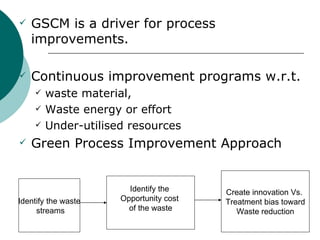
   GSCM is a driver for process
    improvements.

   Continuous improvement programs w.r.t.
       waste material,
       Waste energy or effort
       Under-utilised resources
   Green Process Improvement Approach


                       Identify the     Create innovation Vs.
Identify the waste   Opportunity cost   Treatment bias toward
     streams           of the waste        Waste reduction

                                                          6
A Case Study of
Wal- Mart’s “Green” SCM

       According to Supply Chain Management
       Review, Wal-Mart CEO Lee Scott
       committed the company to three
       ambitious goals:
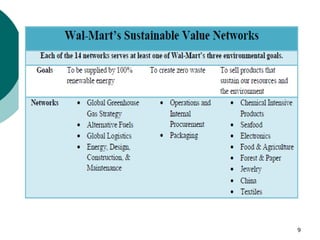
      To be supplied 100% by renewable
       energy
      To create zero waste, and
      To sell products that sustain Wal-Mart’s
       resources and the environment and to
       move towards integrated Corporate Social
       Responsibility (CSR)
                                              7
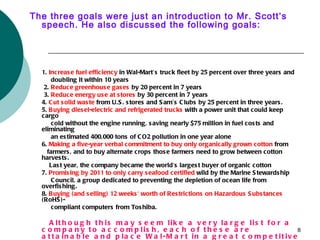
The three goals were just an introduction to Mr. Scott’s
  speech. He also discussed the following goals:


  1. Increas e fuel efficiency in Wal-Mart’s truck fleet by 25 percent over three years and
      doubling it within 10 years
   2. Reduce greenhous e gas es by 20 percent in 7 years
   3. Reduce energy us e at s tores by 30 percent in 7 years
  4. C ut s olid was te from U.S . s tores and S am’s C lubs by 25 percent in three years .
  5. B uying dies el-electric and refrigerated trucks with a power unit that could keep
  cargo
      cold without the engine running, s aving nearly $75 million in fuel cos ts and
  eliminating
      an es timated 400,000 tons of C O2 pollution in one year alone
  6. Making a five-year verbal commitment to buy only organically grown cotton from
    farmers , and to buy alternate crops thos e farmers need to grow between cotton
  harves ts .
     Las t year, the company became the world's larges t buyer of organic cotton
  7. Promis ing by 2011 to only carry s eafood certified wild by the Marine S tewards hip
      C ouncil, a group dedicated to preventing the depletion of ocean life from
  overfis hing.
  8. B uying (and s elling) 12 weeks ' worth of Res trictions on Hazardous S ubs tances
  (RoHS )-
      compliant computers from Tos hiba.

     A lt h o u g h t h is m a y s e e m lik e a v e r y la r g e lis t f o r a
  c o m p a n y t o a c c o m p lis h , e a c h o f t h e s e a r e                 8
  a t t a in a b le a n d p la c e W a l-M a r t in a g r e a t c o m p e t it iv e
9
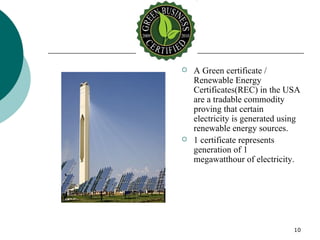
   A Green certificate /
    Renewable Energy
    Certificates(REC) in the USA
    are a tradable commodity
    proving that certain
    electricity is generated using
    renewable energy sources.
   1 certificate represents
    generation of 1
    megawatthour of electricity.


                                10
Class Presentation
      by
Darur Shailaja


                     11

GrSCM

  • 1.
  • 2.
    What is GreenSupply Chain?  Green supply chain includes the whole process right from products designing up to its final retrieving  covering those aspects such as green designing, green materials choosing, green supply process, green  production, green packaging, green distribution, green consumption and green retrieving. 2
  • 3.
    Traditional Cost Avoidance Emerging Value creation 1. Historically, GSC mgt. focused on the upstream supply chain i.e., Manufacturer encourages suppliers to adopt green practices, environmental management systems, and material content. 3. Now, GSC programs are moving from compliance to value creation in terms of raise in productivity, enhance relations, support innovation, enable growth 3
  • 4.
    Because……  GSC improves operations by employing an environmental solution.  Increases Agility  Increases Adaptability  Promotes Alignment 4
  • 5.
    GSC best practices focus on the business result first.  Focus on source reduction to reduce waste  Evaluate the SC as a single life cycle optimisation by minimizing the “bad” inputs and outputs and maximizing the “good outputs”.  Use green SC analysis as a catalyst for innovation  Align GSC goals with business goals 5
  • 6.
    GSCM is a driver for process improvements.  Continuous improvement programs w.r.t.  waste material,  Waste energy or effort  Under-utilised resources  Green Process Improvement Approach Identify the Create innovation Vs. Identify the waste Opportunity cost Treatment bias toward streams of the waste Waste reduction 6
  • 7.
    A Case Studyof Wal- Mart’s “Green” SCM According to Supply Chain Management Review, Wal-Mart CEO Lee Scott committed the company to three ambitious goals:  To be supplied 100% by renewable energy  To create zero waste, and  To sell products that sustain Wal-Mart’s resources and the environment and to move towards integrated Corporate Social Responsibility (CSR) 7
  • 8.
    The three goalswere just an introduction to Mr. Scott’s speech. He also discussed the following goals: 1. Increas e fuel efficiency in Wal-Mart’s truck fleet by 25 percent over three years and doubling it within 10 years 2. Reduce greenhous e gas es by 20 percent in 7 years 3. Reduce energy us e at s tores by 30 percent in 7 years 4. C ut s olid was te from U.S . s tores and S am’s C lubs by 25 percent in three years . 5. B uying dies el-electric and refrigerated trucks with a power unit that could keep cargo cold without the engine running, s aving nearly $75 million in fuel cos ts and eliminating an es timated 400,000 tons of C O2 pollution in one year alone 6. Making a five-year verbal commitment to buy only organically grown cotton from farmers , and to buy alternate crops thos e farmers need to grow between cotton harves ts . Las t year, the company became the world's larges t buyer of organic cotton 7. Promis ing by 2011 to only carry s eafood certified wild by the Marine S tewards hip C ouncil, a group dedicated to preventing the depletion of ocean life from overfis hing. 8. B uying (and s elling) 12 weeks ' worth of Res trictions on Hazardous S ubs tances (RoHS )- compliant computers from Tos hiba. A lt h o u g h t h is m a y s e e m lik e a v e r y la r g e lis t f o r a c o m p a n y t o a c c o m p lis h , e a c h o f t h e s e a r e 8 a t t a in a b le a n d p la c e W a l-M a r t in a g r e a t c o m p e t it iv e
  • 9.
  • 10.
    A Green certificate / Renewable Energy Certificates(REC) in the USA are a tradable commodity proving that certain electricity is generated using renewable energy sources.  1 certificate represents generation of 1 megawatthour of electricity. 10
  • 11.
    Class Presentation by Darur Shailaja 11