gRPC and Microservices
Jonathan Gomez
Golang Melbourne - June 2016 Go Hack Night
— Google open sourced in Feb 2015
— Transport: HTTP/2
— Wire format: Protocol Buffers v3 (Binary)
— Service definition: Protocol Buffers IDL
— Libraries in ~10 languages (native C, Go, Java)
— Microservices framework
What is gRPC for? (from official FAQ)
— Low latency, highly scalable, distributed systems
— Developing mobile clients which are communicating
to a cloud server
— Designing a new protocol that needs to be accurate,
efficient and language independent
— Layered design to enable extension e.g.
authentication, load balancing, logging and
monitoring etc
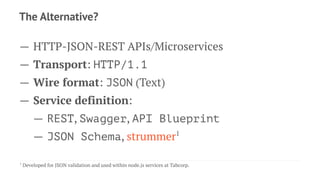
The Alternative?
— HTTP-JSON-REST APIs/Microservices
— Transport: HTTP/1.1
— Wire format: JSON (Text)
— Service definition:
— REST, Swagger, API Blueprint
— JSON Schema, strummer1
1
Developed for JSON validation and used within node.js services at Tabcorp.
HTTP/2 & Protobuf 101
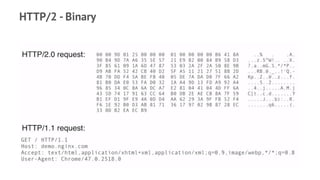
HTTP/2 - Binary
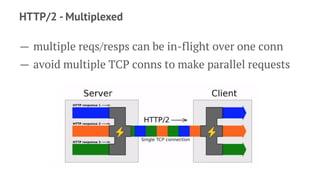
HTTP/2 - Multiplexed
— multiple reqs/resps can be in-flight over one conn
— avoid multiple TCP conns to make parallel requests
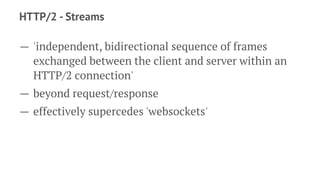
HTTP/2 - Streams
— 'independent, bidirectional sequence of frames
exchanged between the client and server within an
HTTP/2 connection'
— beyond request/response
— effectively supercedes 'websockets'
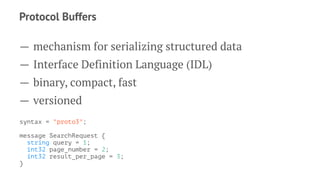
Protocol Buffers
— mechanism for serializing structured data
— Interface Definition Language (IDL)
— binary, compact, fast
— versioned
syntax = "proto3";
message SearchRequest {
string query = 1;
int32 page_number = 2;
int32 result_per_page = 3;
}
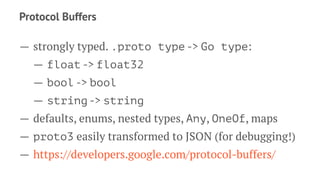
Protocol Buffers
— strongly typed. .proto type -> Go type:
— float -> float32
— bool -> bool
— string -> string
— defaults, enums, nested types, Any, OneOf, maps
— proto3 easily transformed to JSON (for debugging!)
— https://developers.google.com/protocol-buffers/
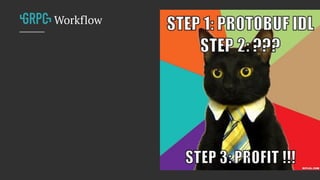
Workflow
Example
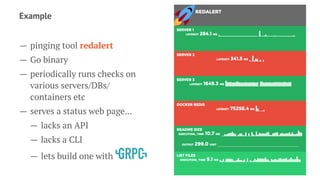
— pinging tool redalert
— Go binary
— periodically runs checks on
various servers/DBs/
containers etc
— serves a status web page...
— lacks an API
— lacks a CLI
— lets build one with
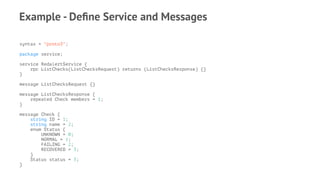
Example - Define Service and Messages
syntax = "proto3";
package service;
service RedalertService {
rpc ListChecks(ListChecksRequest) returns (ListChecksResponse) {}
}
message ListChecksRequest {}
message ListChecksResponse {
repeated Check members = 1;
}
message Check {
string ID = 1;
string name = 2;
enum Status {
UNKNOWN = 0;
NORMAL = 1;
FAILING = 2;
RECOVERED = 3;
}
Status status = 3;
}
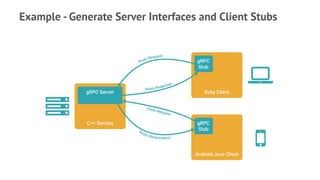
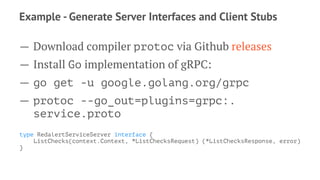
Example - Generate Server Interfaces and Client Stubs
— Download compiler protoc via Github releases
— Install Go implementation of gRPC:
— go get -u google.golang.org/grpc
— protoc --go_out=plugins=grpc:.
service.proto
type RedalertServiceServer interface {
ListChecks(context.Context, *ListChecksRequest) (*ListChecksResponse, error)
}
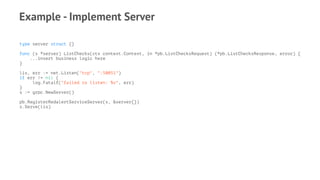
Example - Implement Server
type server struct {}
func (s *server) ListChecks(ctx context.Context, in *pb.ListChecksRequest) (*pb.ListChecksResponse, error) {
...insert business logic here
}
lis, err := net.Listen("tcp", ":50051")
if err != nil {
log.Fatalf("failed to listen: %v", err)
}
s := grpc.NewServer()
pb.RegisterRedalertServiceServer(s, &server{})
s.Serve(lis)
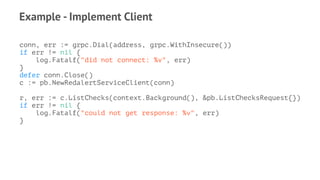
Example - Implement Client
conn, err := grpc.Dial(address, grpc.WithInsecure())
if err != nil {
log.Fatalf("did not connect: %v", err)
}
defer conn.Close()
c := pb.NewRedalertServiceClient(conn)
r, err := c.ListChecks(context.Background(), &pb.ListChecksRequest{})
if err != nil {
log.Fatalf("could not get response: %v", err)
}
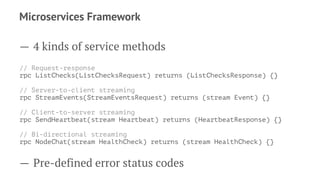
Microservices Framework
— 4 kinds of service methods
// Request-response
rpc ListChecks(ListChecksRequest) returns (ListChecksResponse) {}
// Server-to-client streaming
rpc StreamEvents(StreamEventsRequest) returns (stream Event) {}
// Client-to-server streaming
rpc SendHeartbeat(stream Heartbeat) returns (HeartbeatResponse) {}
// Bi-directional streaming
rpc NodeChat(stream HealthCheck) returns (stream HealthCheck) {}
— Pre-defined error status codes
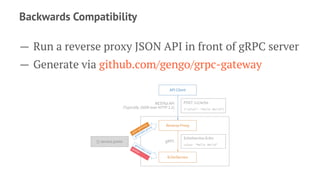
Backwards Compatibility
— Run a reverse proxy JSON API in front of gRPC server
— Generate via github.com/gengo/grpc-gateway
Advanced gRPC
— Context (e.g. propagating timeouts & cancellations)
— Interceptors
— Authentication
— Service discovery / client-side load balancing
— Extend common functionality via protobuf IDL
Key Benefits
— Focus on the service/API design
— Freedom to pick language which suits the problem
— Server-to-server friendly
— Server-to-mobile friendly
— Growing community. Square, CoreOS, Docker.
References
— http://www.grpc.io/
— https://developers.google.com/protocol-buffers/
— https://github.com/grpc/grpc-go
— gRPC with REST and Open APIs
— https://www.nginx.com/blog/http2-module-nginx/

gRPC and Microservices

  • 1.
    gRPC and Microservices JonathanGomez Golang Melbourne - June 2016 Go Hack Night
  • 2.
    — Google opensourced in Feb 2015 — Transport: HTTP/2 — Wire format: Protocol Buffers v3 (Binary) — Service definition: Protocol Buffers IDL — Libraries in ~10 languages (native C, Go, Java) — Microservices framework
  • 3.
    What is gRPCfor? (from official FAQ) — Low latency, highly scalable, distributed systems — Developing mobile clients which are communicating to a cloud server — Designing a new protocol that needs to be accurate, efficient and language independent — Layered design to enable extension e.g. authentication, load balancing, logging and monitoring etc
  • 4.
    The Alternative? — HTTP-JSON-RESTAPIs/Microservices — Transport: HTTP/1.1 — Wire format: JSON (Text) — Service definition: — REST, Swagger, API Blueprint — JSON Schema, strummer1 1 Developed for JSON validation and used within node.js services at Tabcorp.
  • 5.
  • 6.
  • 7.
    HTTP/2 - Multiplexed —multiple reqs/resps can be in-flight over one conn — avoid multiple TCP conns to make parallel requests
  • 8.
    HTTP/2 - Streams —'independent, bidirectional sequence of frames exchanged between the client and server within an HTTP/2 connection' — beyond request/response — effectively supercedes 'websockets'
  • 9.
    Protocol Buffers — mechanismfor serializing structured data — Interface Definition Language (IDL) — binary, compact, fast — versioned syntax = "proto3"; message SearchRequest { string query = 1; int32 page_number = 2; int32 result_per_page = 3; }
  • 10.
    Protocol Buffers — stronglytyped. .proto type -> Go type: — float -> float32 — bool -> bool — string -> string — defaults, enums, nested types, Any, OneOf, maps — proto3 easily transformed to JSON (for debugging!) — https://developers.google.com/protocol-buffers/
  • 11.
  • 12.
    Example — pinging toolredalert — Go binary — periodically runs checks on various servers/DBs/ containers etc — serves a status web page... — lacks an API — lacks a CLI — lets build one with
  • 13.
    Example - DefineService and Messages syntax = "proto3"; package service; service RedalertService { rpc ListChecks(ListChecksRequest) returns (ListChecksResponse) {} } message ListChecksRequest {} message ListChecksResponse { repeated Check members = 1; } message Check { string ID = 1; string name = 2; enum Status { UNKNOWN = 0; NORMAL = 1; FAILING = 2; RECOVERED = 3; } Status status = 3; }
  • 14.
    Example - GenerateServer Interfaces and Client Stubs
  • 15.
    Example - GenerateServer Interfaces and Client Stubs — Download compiler protoc via Github releases — Install Go implementation of gRPC: — go get -u google.golang.org/grpc — protoc --go_out=plugins=grpc:. service.proto type RedalertServiceServer interface { ListChecks(context.Context, *ListChecksRequest) (*ListChecksResponse, error) }
  • 16.
    Example - ImplementServer type server struct {} func (s *server) ListChecks(ctx context.Context, in *pb.ListChecksRequest) (*pb.ListChecksResponse, error) { ...insert business logic here } lis, err := net.Listen("tcp", ":50051") if err != nil { log.Fatalf("failed to listen: %v", err) } s := grpc.NewServer() pb.RegisterRedalertServiceServer(s, &server{}) s.Serve(lis)
  • 17.
    Example - ImplementClient conn, err := grpc.Dial(address, grpc.WithInsecure()) if err != nil { log.Fatalf("did not connect: %v", err) } defer conn.Close() c := pb.NewRedalertServiceClient(conn) r, err := c.ListChecks(context.Background(), &pb.ListChecksRequest{}) if err != nil { log.Fatalf("could not get response: %v", err) }
  • 18.
    Microservices Framework — 4kinds of service methods // Request-response rpc ListChecks(ListChecksRequest) returns (ListChecksResponse) {} // Server-to-client streaming rpc StreamEvents(StreamEventsRequest) returns (stream Event) {} // Client-to-server streaming rpc SendHeartbeat(stream Heartbeat) returns (HeartbeatResponse) {} // Bi-directional streaming rpc NodeChat(stream HealthCheck) returns (stream HealthCheck) {} — Pre-defined error status codes
  • 19.
    Backwards Compatibility — Runa reverse proxy JSON API in front of gRPC server — Generate via github.com/gengo/grpc-gateway
  • 20.
    Advanced gRPC — Context(e.g. propagating timeouts & cancellations) — Interceptors — Authentication — Service discovery / client-side load balancing — Extend common functionality via protobuf IDL
  • 21.
    Key Benefits — Focuson the service/API design — Freedom to pick language which suits the problem — Server-to-server friendly — Server-to-mobile friendly — Growing community. Square, CoreOS, Docker.
  • 22.
    References — http://www.grpc.io/ — https://developers.google.com/protocol-buffers/ —https://github.com/grpc/grpc-go — gRPC with REST and Open APIs — https://www.nginx.com/blog/http2-module-nginx/