Group 9
Presentation:
• Project reports
• Roles of the Project Manager
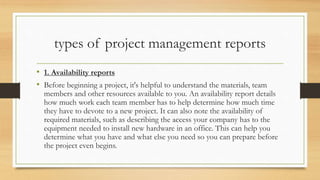
types of project management reports
• 1. Availability reports
• Before beginning a project, it's helpful to understand the materials, team
members and other resources available to you. An availability report details
how much work each team member has to help determine how much time
they have to devote to a new project. It can also note the availability of
required materials, such as describing the access your company has to the
equipment needed to install new hardware in an office. This can help you
determine what you have and what else you need so you can prepare before
the project even begins.
~
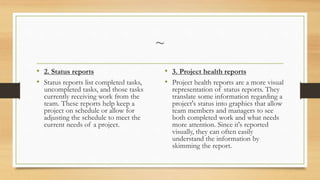
• 2. Status reports
• Status reports list completed tasks,
uncompleted tasks, and those tasks
currently receiving work from the
team. These reports help keep a
project on schedule or allow for
adjusting the schedule to meet the
current needs of a project.
• 3. Project health reports
• Project health reports are a more visual
representation of status reports. They
translate some information regarding a
project's status into graphics that allow
team members and managers to see
both completed work and what needs
more attention. Since it's reported
visually, they can often easily
understand the information by
skimming the report.
~
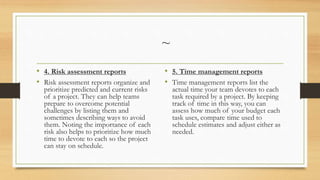
• 4. Risk assessment reports
• Risk assessment reports organize and
prioritize predicted and current risks
of a project. They can help teams
prepare to overcome potential
challenges by listing them and
sometimes describing ways to avoid
them. Noting the importance of each
risk also helps to prioritize how much
time to devote to each so the project
can stay on schedule.
• 5. Time management reports
• Time management reports list the
actual time your team devotes to each
task required by a project. By keeping
track of time in this way, you can
assess how much of your budget each
task uses, compare time used to
schedule estimates and adjust either as
needed.
• 6. Project baseline reports
• A project baseline report is a detailed
estimated schedule of tasks and the time
they need for completion. Often visualized
as a graph, these reports allow you to
overlay the actual timetables your team
uses over the course of a project, so you
can compare them to your estimate. By
tracking actual times against your original
estimate, you can understand how much
time various tasks need and how to better
estimate them.
• 7. Summary reports
• Summary reports are a combination of
other report types. What a summary
includes can vary by project, but they
often include information on budgets,
timelines and risks, so that managers and
stakeholders can understand the overall
status and future outlook for the project.
8. Variance reports
• Variance reports compare original estimates of metrics such as budget or
predicted profits from a project with the actual numbers the project required.
This helps managers and stakeholders better understand how much different
projects actually cost and how profitable they might be in the future.
How to write a project management report
1.Keep it concise. When writing a project report, it’s important to focus on vital information and keep the
document short. To make the report more accessible, you can consider using bulleted lists instead of long
paragraphs.
2.Use visual aids. Visual aids can be a great way to convey important information in an accessible way.
Consider using graphs and charts to display your team’s progress and other key information.
3.Include key information. When writing a project management report, it’s important to include all the
information your stakeholders might need. This can include current spending, expected budget, project status,
deadlines and schedules, a task breakdown and any other information requested by stakeholders.
4.Write in an accessible tone. In some cases, stakeholders may be unfamiliar with the technical jargon you and
your team use. Try to use accessible, everyday language and break information down into small segments.
5.Be transparent. If your project is running late or is over budget, it’s important to be transparent in your
reporting. This allows stakeholders to identify solutions quickly and get the project back on schedule.
6.Feature call to action. In some cases, your team may require action from one or more of the project
stakeholders in order to succeed. If so, make sure to include explicit calls to action or requests in your report.
Introduction
• The role of project manager is one of the key issues which has been
discussed by many researchers due its importance and direct effect to the
success or failure of a project. As the project manager is responsible for the
project success and failure, it is important for any project manager to have
certain skills to be able to guide the project.
Responsibilities of a project manager
1. Planning: achieving a certain goal by creating a roadmap beforehand.
2. Organizing: giving a structure to the project team, through assigning roles to team members with targets to be
achieved.
3. Leading: This responsibility includes coordination, meeting the deadlines, decision making, knowledge
management, and interpersonal skills.
4. Monitoring: which is done through three steps:
• Measure : progress
• Evaluate : causes of deviation
• Correct : appropriate corrections
5. Communicating: as per research mentioned by Bodepudi (2018), 90% of project manager’s time is spent in
communication.
6. Managing risk: through analyzing the projects and defining negative risks and their impact.
Roles of a project manager:
• There are three critical roles of a project manager:
1. Integrator: a project manager must insure the integration between project
activities, strategies and approaches.
2. Communicator: through communicating with the stakeholders to achieve
better relationships.
3. Leader: through motivating and inspiring the project’s team
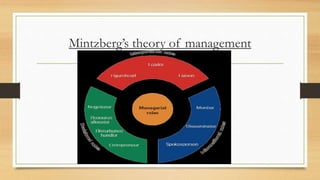
Mintzberg’s theory of management
Interpersonal roles:
• Figurehead :
• By performing ceremonial duties such as greeting visits, wedding parties, and lunch
invitations (Zartler, 2016). The project manager within this role is expected to become a
source of inspiration (MindTools, 2016). In order to build confidence within this area, the
project manager has to improve his image, reputation, and empathy (MindTools, 2016).
Both Zartler and MindTools agreed about the importance of cultivating humility and
empathy. This role helps the project manager to stay close to his staff and others around
him through sharing their private times which will impact on their mutual collaboration
and contributes in reducing any possible conflict during their work
Leader :
• it is about building strong relations with subordinates, motivation, and coaching.
Responsibilities are at the coronary heart of the manager-subordinate courting and consist
of motivating subordinates, structuring and overseeing their development, inspiring their
improvement and balancing effectiveness (Altamony, 2017). Also, leader roles include
providing leadership to the project manager’s team, department, and the entire
organization (MindTools, 2016). To achieve this role, it is important to improve the
leadership skills, where one of the most important skills is the emotional intelligence
(Zartler, 2016). Leadership is about respect, and listening (Gervais, 2020). Leadership is a
major key in the direct relation between the project manager and his subordinates which
shows his experience and capabilities to move forward throughout the project as one
team, reducing conflicts and collaborating as a member of team, which motivates
everyone to achieve more regardless the work pressure.
Liaison :
• which is to have the required contact and communication with external parties. It is about
making contacts outside the vertical chain of command (Zartler, 2016), and about
networking effectively on behalf of the project manager’s organization (MindTools,
2016). Liaison is about being giving rather than taking (Gervais, 2020). Gervais and
Zartler both agreed that not everyone is comfortable with networking, but networking
should be a decent liaison, where the project manager should attend small networking
events. Decent liaison is an effective tool to seek other respect and approval, since
everyone seeks for selfrespect and appreciates those who can express their requirements,
fears, troubles, and different issues in well selected words and times
Informational roles:
Monitor :
• it is about scanning the environment for new information to collect (Zartler, 2016),
monitoring the team in terms of productivity and well-being (MindTools, 2016),
understanding the details, keeping an eye on “the big picture ”, and keeping-up with
industry news (Gervais, 2020). Altamony (2017) added that monitoring is about seeking
internal and stakeholders’ problems which could affect the company. Monitoring is about
gathering information, data analysing, and productivity measurement. To monitor, it is
important to have monitoring tools, clear and understood by others, to provide actual
measurement and support your judgement, which in turn improves performance, clarify
shortage, and specify the solution.
Disseminator :
• which is about communicating potential useful information with other colleagues and
team (MindTools, 2016), or passing on privileged information directly to subordinates
(Zartler, 2016). It is important to understand what to share, how and with whom (Gervais,
2020). To be effective in this role, it is advised to improve writing skills, seek help of
other colleagues, or using proofreading. This role shows a professional attitude by the
project manager in having high communication skills through sharing information
properly with the related parties, written properly with no mistakes, and shared in a
timely manner.
Spokesperson :
• it is about public speaking. The project manager is responsible for transmitting
information about his organization and its goals to the people outside his organization .
The project manager should have presentation skills, and ability to overcome his fear of
public speaking. Also, spokesperson transmits facts about the company to stakeholders).
The project manager is the representative of his company to others, including the client,
consultant, suppliers, subcontractors, and stakeholders. This role is the major key in
transmitting the actual project’s progress and status to others in proper, clear and trustful
way.
Decisional roles:
Entrepreneur :
• it is how to improve the unit by initiating projects, how to create and control change
within the organization, and how to solve problems6, generate new ideas, and implement
them. This role is a creative behaviour of the project manager through applying proper
solutions to current and expected problems and seeking new ideas about people and
project management.
Disturbance handler :
• it is to help mediate disputes within the organization (MindTools, 2016), to handle team
conflicts to improve conflict resolution skills (Gervais, 2020), and to take corrective
motion while facing critical and surprising problems (Altamony, 2017). In order to apply
this role, the project manager should coach team members, especially those who have
high emotions (Gervais, 2020). To improve this skill, the project manager should have
proper skills in regards of conflict management either through training or direct coaching.
Resource allocator :
• it is about who gets what (Zartler, 2016), allocating funding and assigning staff
(MindTools, 2016). To apply this role, prioritization is the key (Zartler, 2016). The project
manager has to develop his skills in prioritization and budgeting to apply this role
(Gervais, 2020). The project manager should have the required skills to allocate his
different resources including staff, equipment, machinery, and funding as per the project
requirements, and matching the organization strategy within other projects.
Negotiator :
• it is within the team, department, and organization (MindTools, 2016). The project
manager has to focus on win-win situations (Gervais, 2020). The project manager has to
improve his negotiation skills, which comes by experience and real situations which
require flexibility, trust, knowledge, and strong influence towards others

grp 9.pptx

  • 1.
    Group 9 Presentation: • Projectreports • Roles of the Project Manager
  • 2.
    types of projectmanagement reports • 1. Availability reports • Before beginning a project, it's helpful to understand the materials, team members and other resources available to you. An availability report details how much work each team member has to help determine how much time they have to devote to a new project. It can also note the availability of required materials, such as describing the access your company has to the equipment needed to install new hardware in an office. This can help you determine what you have and what else you need so you can prepare before the project even begins.
  • 3.
    ~ • 2. Statusreports • Status reports list completed tasks, uncompleted tasks, and those tasks currently receiving work from the team. These reports help keep a project on schedule or allow for adjusting the schedule to meet the current needs of a project. • 3. Project health reports • Project health reports are a more visual representation of status reports. They translate some information regarding a project's status into graphics that allow team members and managers to see both completed work and what needs more attention. Since it's reported visually, they can often easily understand the information by skimming the report.
  • 4.
    ~ • 4. Riskassessment reports • Risk assessment reports organize and prioritize predicted and current risks of a project. They can help teams prepare to overcome potential challenges by listing them and sometimes describing ways to avoid them. Noting the importance of each risk also helps to prioritize how much time to devote to each so the project can stay on schedule. • 5. Time management reports • Time management reports list the actual time your team devotes to each task required by a project. By keeping track of time in this way, you can assess how much of your budget each task uses, compare time used to schedule estimates and adjust either as needed.
  • 5.
    • 6. Projectbaseline reports • A project baseline report is a detailed estimated schedule of tasks and the time they need for completion. Often visualized as a graph, these reports allow you to overlay the actual timetables your team uses over the course of a project, so you can compare them to your estimate. By tracking actual times against your original estimate, you can understand how much time various tasks need and how to better estimate them. • 7. Summary reports • Summary reports are a combination of other report types. What a summary includes can vary by project, but they often include information on budgets, timelines and risks, so that managers and stakeholders can understand the overall status and future outlook for the project.
  • 6.
    8. Variance reports •Variance reports compare original estimates of metrics such as budget or predicted profits from a project with the actual numbers the project required. This helps managers and stakeholders better understand how much different projects actually cost and how profitable they might be in the future.
  • 7.
    How to writea project management report 1.Keep it concise. When writing a project report, it’s important to focus on vital information and keep the document short. To make the report more accessible, you can consider using bulleted lists instead of long paragraphs. 2.Use visual aids. Visual aids can be a great way to convey important information in an accessible way. Consider using graphs and charts to display your team’s progress and other key information. 3.Include key information. When writing a project management report, it’s important to include all the information your stakeholders might need. This can include current spending, expected budget, project status, deadlines and schedules, a task breakdown and any other information requested by stakeholders. 4.Write in an accessible tone. In some cases, stakeholders may be unfamiliar with the technical jargon you and your team use. Try to use accessible, everyday language and break information down into small segments. 5.Be transparent. If your project is running late or is over budget, it’s important to be transparent in your reporting. This allows stakeholders to identify solutions quickly and get the project back on schedule. 6.Feature call to action. In some cases, your team may require action from one or more of the project stakeholders in order to succeed. If so, make sure to include explicit calls to action or requests in your report.
  • 8.
    Introduction • The roleof project manager is one of the key issues which has been discussed by many researchers due its importance and direct effect to the success or failure of a project. As the project manager is responsible for the project success and failure, it is important for any project manager to have certain skills to be able to guide the project.
  • 9.
    Responsibilities of aproject manager 1. Planning: achieving a certain goal by creating a roadmap beforehand. 2. Organizing: giving a structure to the project team, through assigning roles to team members with targets to be achieved. 3. Leading: This responsibility includes coordination, meeting the deadlines, decision making, knowledge management, and interpersonal skills. 4. Monitoring: which is done through three steps: • Measure : progress • Evaluate : causes of deviation • Correct : appropriate corrections 5. Communicating: as per research mentioned by Bodepudi (2018), 90% of project manager’s time is spent in communication. 6. Managing risk: through analyzing the projects and defining negative risks and their impact.
  • 10.
    Roles of aproject manager: • There are three critical roles of a project manager: 1. Integrator: a project manager must insure the integration between project activities, strategies and approaches. 2. Communicator: through communicating with the stakeholders to achieve better relationships. 3. Leader: through motivating and inspiring the project’s team
  • 11.
  • 12.
    Interpersonal roles: • Figurehead: • By performing ceremonial duties such as greeting visits, wedding parties, and lunch invitations (Zartler, 2016). The project manager within this role is expected to become a source of inspiration (MindTools, 2016). In order to build confidence within this area, the project manager has to improve his image, reputation, and empathy (MindTools, 2016). Both Zartler and MindTools agreed about the importance of cultivating humility and empathy. This role helps the project manager to stay close to his staff and others around him through sharing their private times which will impact on their mutual collaboration and contributes in reducing any possible conflict during their work
  • 13.
    Leader : • itis about building strong relations with subordinates, motivation, and coaching. Responsibilities are at the coronary heart of the manager-subordinate courting and consist of motivating subordinates, structuring and overseeing their development, inspiring their improvement and balancing effectiveness (Altamony, 2017). Also, leader roles include providing leadership to the project manager’s team, department, and the entire organization (MindTools, 2016). To achieve this role, it is important to improve the leadership skills, where one of the most important skills is the emotional intelligence (Zartler, 2016). Leadership is about respect, and listening (Gervais, 2020). Leadership is a major key in the direct relation between the project manager and his subordinates which shows his experience and capabilities to move forward throughout the project as one team, reducing conflicts and collaborating as a member of team, which motivates everyone to achieve more regardless the work pressure.
  • 14.
    Liaison : • whichis to have the required contact and communication with external parties. It is about making contacts outside the vertical chain of command (Zartler, 2016), and about networking effectively on behalf of the project manager’s organization (MindTools, 2016). Liaison is about being giving rather than taking (Gervais, 2020). Gervais and Zartler both agreed that not everyone is comfortable with networking, but networking should be a decent liaison, where the project manager should attend small networking events. Decent liaison is an effective tool to seek other respect and approval, since everyone seeks for selfrespect and appreciates those who can express their requirements, fears, troubles, and different issues in well selected words and times
  • 15.
    Informational roles: Monitor : •it is about scanning the environment for new information to collect (Zartler, 2016), monitoring the team in terms of productivity and well-being (MindTools, 2016), understanding the details, keeping an eye on “the big picture ”, and keeping-up with industry news (Gervais, 2020). Altamony (2017) added that monitoring is about seeking internal and stakeholders’ problems which could affect the company. Monitoring is about gathering information, data analysing, and productivity measurement. To monitor, it is important to have monitoring tools, clear and understood by others, to provide actual measurement and support your judgement, which in turn improves performance, clarify shortage, and specify the solution.
  • 16.
    Disseminator : • whichis about communicating potential useful information with other colleagues and team (MindTools, 2016), or passing on privileged information directly to subordinates (Zartler, 2016). It is important to understand what to share, how and with whom (Gervais, 2020). To be effective in this role, it is advised to improve writing skills, seek help of other colleagues, or using proofreading. This role shows a professional attitude by the project manager in having high communication skills through sharing information properly with the related parties, written properly with no mistakes, and shared in a timely manner.
  • 17.
    Spokesperson : • itis about public speaking. The project manager is responsible for transmitting information about his organization and its goals to the people outside his organization . The project manager should have presentation skills, and ability to overcome his fear of public speaking. Also, spokesperson transmits facts about the company to stakeholders). The project manager is the representative of his company to others, including the client, consultant, suppliers, subcontractors, and stakeholders. This role is the major key in transmitting the actual project’s progress and status to others in proper, clear and trustful way.
  • 18.
    Decisional roles: Entrepreneur : •it is how to improve the unit by initiating projects, how to create and control change within the organization, and how to solve problems6, generate new ideas, and implement them. This role is a creative behaviour of the project manager through applying proper solutions to current and expected problems and seeking new ideas about people and project management.
  • 19.
    Disturbance handler : •it is to help mediate disputes within the organization (MindTools, 2016), to handle team conflicts to improve conflict resolution skills (Gervais, 2020), and to take corrective motion while facing critical and surprising problems (Altamony, 2017). In order to apply this role, the project manager should coach team members, especially those who have high emotions (Gervais, 2020). To improve this skill, the project manager should have proper skills in regards of conflict management either through training or direct coaching.
  • 20.
    Resource allocator : •it is about who gets what (Zartler, 2016), allocating funding and assigning staff (MindTools, 2016). To apply this role, prioritization is the key (Zartler, 2016). The project manager has to develop his skills in prioritization and budgeting to apply this role (Gervais, 2020). The project manager should have the required skills to allocate his different resources including staff, equipment, machinery, and funding as per the project requirements, and matching the organization strategy within other projects.
  • 21.
    Negotiator : • itis within the team, department, and organization (MindTools, 2016). The project manager has to focus on win-win situations (Gervais, 2020). The project manager has to improve his negotiation skills, which comes by experience and real situations which require flexibility, trust, knowledge, and strong influence towards others