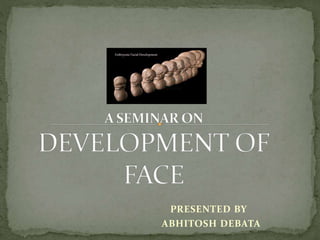
PRESENTED BY
ABHITOSH DEBATA
 INTRODUCTION
 DEFINITION
 EVENTS OF DEVELOPMENT
 EMBRYOLOGICAL DEVELOPMENT
 DEVELOPMENT OF BRANCHIAL (ARCHES ,
POUCHES AND CLEFTS)
 DEVELOPMENT OF FACE
 DEVELOPMENTALANOMALIES OF FACE
 CONCLUSION
 REFERENCES
 Anatomical structures are more diverse in the mouth
than in any other region. Human development is a
continuous process and does not stop at birth. An
individual spends about 9 months/ 38 weeks/266 days or
nearly 383040minutes of his life in his mother’s womb.
 The human face begins to form during the 4th week of
embryonic development. By the 6th week the external face
is completed. Between the 6th and 8th weeks the
development of the palate subdivides nasal and oral
cavities. This development continues into the 12th week
with completion of the soft palate.
 Embryology:
Science of the origin & development of the organism
from fertilization of the ovum to the end of the eighth
week.
 Development:
Development refers to all the naturally occurring
unidirectional changes in the life of an individual from
its existence as a single cell to its elloboration as a
multifunctional unit terminating in death. Thus it
encompasses the normal sequential events between
fertilization and death.
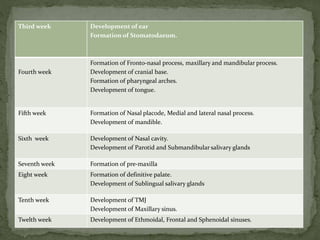
Third week Development of ear
Formation of Stomatodaeum.
Fourth week
Formation of Fronto-nasal process, maxillary and mandibular process.
Development of cranial base.
Formation of pharyngeal arches.
Development of tongue.
Fifth week Formation of Nasal placode, Medial and lateral nasal process.
Development of mandible.
Sixth week Development of Nasal cavity.
Development of Parotid and Submandibular salivary glands
Seventh week Formation of pre-maxilla
Eight week Formation of definitive palate.
Development of Sublingual salivary glands
Tenth week Development of TMJ
Development of Maxillary sinus.
Twelth week Development of Ethmoidal, Frontal and Sphenoidal sinuses.
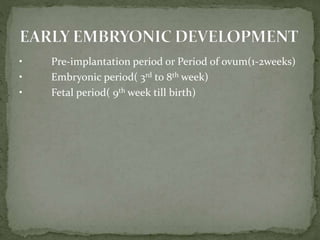
• Pre-implantation period or Period of ovum(1-2weeks)
• Embryonic period( 3rd to 8th week)
• Fetal period( 9th week till birth)
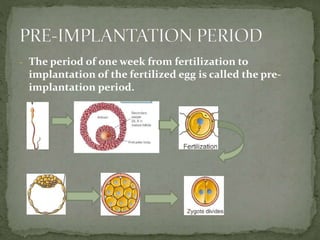
- The period of one week from fertilization to
implantation of the fertilized egg is called the pre-
implantation period.
-The period of embryo is divided into 3 stages
-PRESOMITE stage – an embryo in any stage of development before
the appearance of the first pair of somites (primitive
segments/metameres), which in humans usually occurs around 19
to 21 days after fertilization of the ovum.
-SOMITE stage - an embryo in any stage of development between
the formation of the first and the last pairs of somites, which in
humans occurs in the third and fourth weeks after fertilization of
the ovum.
-POSTSOMITE stage –
The developing embryo then gets attached to the uterine
endometrium, this is called Implantation.
After Implantation the endometrium is called Decidua.
The placenta is formed partly by embryonic structures and partly
from the decidua.
-Fertilization of ovum takes place in the ampulla of the
uterine tube.
When there are 16 cells the ovum is called a morula.
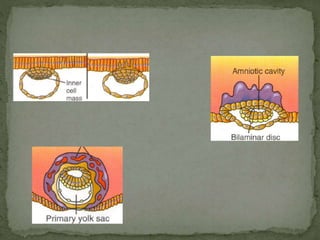
- - The cells of the inner cell mass rearrange to form the
embryonic disc having two germ cells namely
ECTODERM & ENDODERM and the third layer is
formed between the 2 layers i.e known as
MESODERM.
- In the Fetal period all major structures are already formed
in the fetus, but they continue to grow and develop.
 The last 7 months of fetal life are devoted to very rapid
growth and repositioning of body components, with
little further organogenesis or tissue differentiation.
By 3rd month sex of fetus is known. In the 4 months
human face is seen and in the Last 2 months of fetal
life fat is deposited subcutaneously
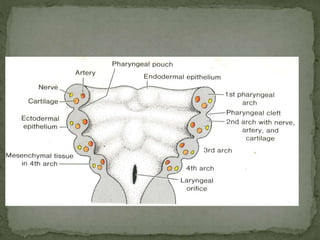
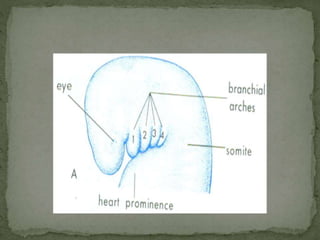
- Pharyngeal arches are rod like thickenings of mesoderm
present in the wall of the foregut.
- At first there are 6 arches. The 5th arch disappears and then
only 5 arches remain.
- In the interval between any two arches the endoderm
(lining of the pharynx) is pushed outwards to form a series
of pouches. These are called Pharyngeal pouches.
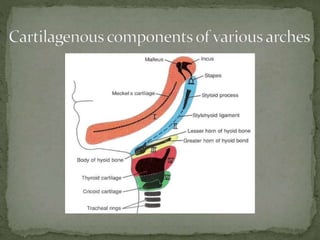
- Cartilage component :
 Adapt to form Bony, Cartilagenous or Ligamentous
structures
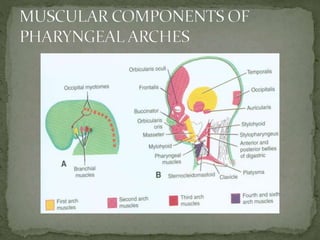
- Muscle component :
 Give rise to special visceral muscles composed of
striated muscle fibers.
- Vascular component :
 Provides necessary blood supply
- Nerve component :
 Enters mesoderm of the branchial arches and initiates
muscle development of mesoderm.
- Precursor of both the jaws:
Maxilla + Mandible
- Initially gives rise to a large mandibular
prominence.
- Gives rise to a small maxillary prominence
which extends cranioventrally.
Cartilage : MECKEL’S CARTILAGE
-Arises in 41st – 45th Day of intrauterine life.
-It provides a template for subsequent development of
the mandible.
Derivatives of Meckel’s cartilage-
-Mental Ossicle
-Head and neck of Malleus.
-Short crus of the Incus.
-Anterior Ligament of the Malleus.
-Sphenomandibular Ligament
COMPONENTS OF 1ST BRANCHIAL ARCH:
Musculature derived from 1st arch-
-Muscles of Mastication.
-Mylohyoid Muscle.
-Ant. Belly of Digastric.
-Tensor Tympani.
-Tensor Veli Palatini Muscles.
3. Arterial Component:
-Part of Maxillary and External Carotid Artery.
4. Nerve components:
-- Mandibular division of Trigeminal Nerve
( Vth Cranial Nerve)
-- Sensory component supplies
: Mandible and covering mucosa.
: Mandibular teeth including Gingiva.
: Mucosa of ant. 2/3 of Tongue.
: Floor of the mouth.
: Skin of the lower third of Face
COMPONENTS:
1. Cartilage : Reichert’s Cartilage
(45th – 48th I.U)
- Greater part of the third ear ossicle.
- Stapes .
- Styloid process of the temporal bone.
- Stylohyoid ligament.
- Lesser horn and
- Cranial part - Body of Hyoid.
- Segments of the facial canal.
2. Muscles :
- Stapedius
- Stylohyoid
- Post. Belly of Digastric.
- Muscles of facial expression.
- Levator Veli Palatini.
3. Nerve :
- Facial nerve.
- Special sensory component
- Chorda tympani nerve
(Ant 2/3rd of Tongue)
4. Artery :
- Stapedial artery
- Transient i.e. disappears during fetal life.
COMPONENTS:
1.MUSCLES –
STYLOPHAYNGEOUS MUSCLE
2.NERVE –
GLOSSOPHAYNGEAL NERVE
3.ARTERY-
PROXIMAL 1/3RD OF INTERNAL CAROTID ARTERY.
SMALL CONTRIBUTION OF COMMON CAROTID ARTERY.
4. SKELETON –
Greater horn
Lower body of hyoid
COMPONENTS:
1. MUSCLES-
Constrictor muscles of pharynx.
2. NERVE –
Superior laryngeal nerve
3. ARTERY –
Arch of aorta
Proximal part of subclavian
4. SKELETON –
Thyroid cartilage
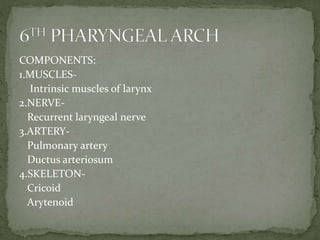
COMPONENTS:
1.MUSCLES-
Intrinsic muscles of larynx
2.NERVE-
Recurrent laryngeal nerve
3.ARTERY-
Pulmonary artery
Ductus arteriosum
4.SKELETON-
Cricoid
Arytenoid
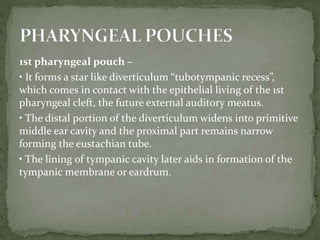
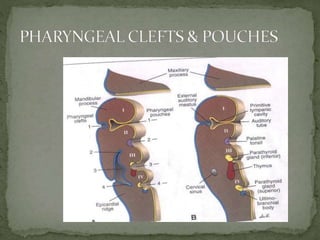
1st pharyngeal pouch –
• It forms a star like diverticulum “tubotympanic recess”,
which comes in contact with the epithelial living of the 1st
pharyngeal cleft, the future external auditory meatus.
• The distal portion of the diverticulum widens into primitive
middle ear cavity and the proximal part remains narrow
forming the eustachian tube.
• The lining of tympanic cavity later aids in formation of the
tympanic membrane or eardrum.
2nd pharyngeal pouch:
•The epithelium of the ventral part of this pouch
contributes to the formation of tonsil.
•Dorsal part takes part information of tubo tympanic
recess.
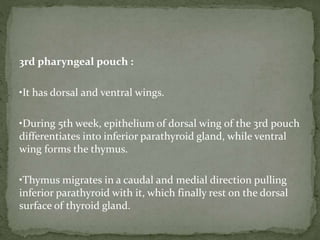
3rd pharyngeal pouch :
•It has dorsal and ventral wings.
•During 5th week, epithelium of dorsal wing of the 3rd pouch
differentiates into inferior parathyroid gland, while ventral
wing forms the thymus.
•Thymus migrates in a caudal and medial direction pulling
inferior parathyroid with it, which finally rest on the dorsal
surface of thyroid gland.
4th pharyngeal pouch:
•Epithelium of dorsal wing forms the superior parathyroid
gland.
5th pharyngeal pouch:
•Considered as a part of 4th pouch. It gives rise to
ultimobronchial body, which later forms parafollicular or “C”
cells of thyroid gland.
•These cells secrete calcitonin, hormone involved in calcium
regulation.
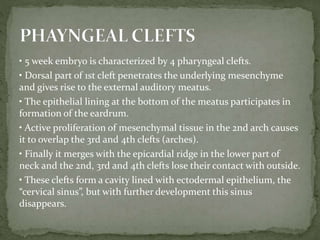
• 5 week embryo is characterized by 4 pharyngeal clefts.
• Dorsal part of 1st cleft penetrates the underlying mesenchyme
and gives rise to the external auditory meatus.
• The epithelial lining at the bottom of the meatus participates in
formation of the eardrum.
• Active proliferation of mesenchymal tissue in the 2nd arch causes
it to overlap the 3rd and 4th clefts (arches).
• Finally it merges with the epicardial ridge in the lower part of
neck and the 2nd, 3rd and 4th clefts lose their contact with outside.
• These clefts form a cavity lined with ectodermal epithelium, the
“cervical sinus”, but with further development this sinus
disappears.
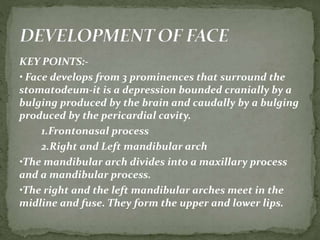
KEY POINTS:-
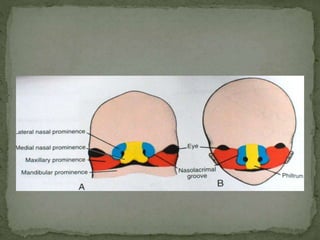
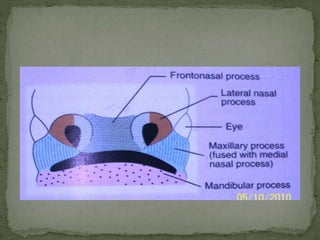
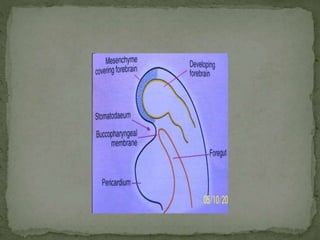
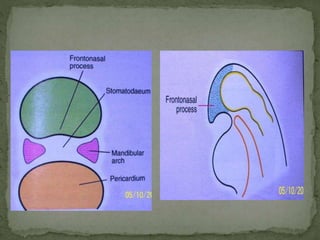
• Face develops from 3 prominences that surround the
stomatodeum-it is a depression bounded cranially by a
bulging produced by the brain and caudally by a bulging
produced by the pericardial cavity.
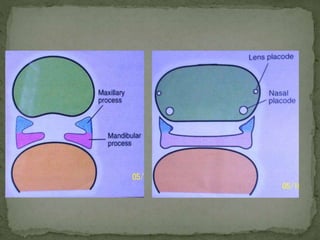
1.Frontonasal process
2.Right and Left mandibular arch
•The mandibular arch divides into a maxillary process
and a mandibular process.
•The right and the left mandibular arches meet in the
midline and fuse. They form the upper and lower lips.
• The cheek is formed by the fusion of posterior part of
maxillary and mandibular process.
• The nose is derived from the frontonasal process.
• The nasal cavity is formed by enlargement of the nasal
pits.
• Paranasal sinuses appear as outgrowths from the nasal
cavity.
• The palate is formed by fusion of 3 components i.e
right and left palatal processes and the primitive palate.
• The oral cavity is derived party from the
stomatodaeum(ectoderm) and partly from the
foregut(endoderm).
• The teeth are formed in relation to the dental lamina. An
enlargement of dental lamina for each tooth is formed which
is called the enamel organ. Ameloblasts form the enamel,
odontoblasts form the dentine and the mesenchyme that
invaginates into enamel organ forms the pulp.
• The ant. 2/3rd of the tongue is formed from the lingual
swellings and the tuberculum impar.
• The post.1/3rd of the tongue is formed by cranial part of
hypobranchial eminence.
• The salivary glands develop as outgrowths of buccal
epithelium.
• The palatine tonsil develops in relation to 2nd pharyngeal
pouch.
• The pharynx is derived from the foregut.
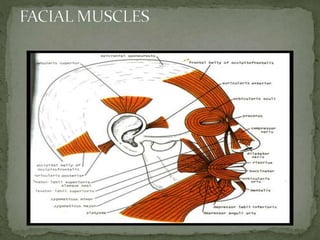
• Muscles of face develop from 2nd branchial arch and
are supplied by facial nerve.
• Eyes develop from three sources:
Neuroectoderm of the forebrain - retina,optic n.
Surface ectoderm of the head - lens
Mesoderm between these layers – eye muscle and
vascular tissues.
• External ear develops from Ext. ocoustic meatus,
middle ear develops from tubotympanic recess that is
derived from 1st pouch and internal ear is derived from
otic placode which is a thickening of surface ectoderm.
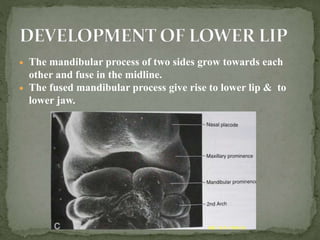
 The mandibular process of two sides grow towards each
other and fuse in the midline.
 The fused mandibular process give rise to lower lip & to
lower jaw.
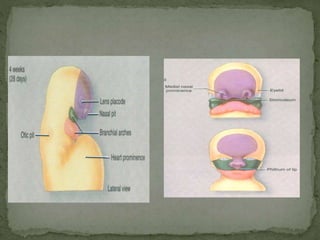
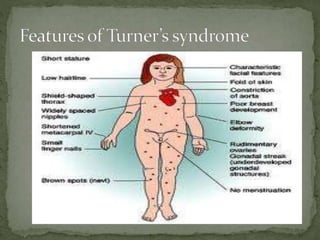
•Each mandibular process grows medially and fuses first with
the lateral nasal process and then with medial nasal process.
•The medial and lateral nasal processes fuse with each other n
the nasal pits(ext.nares) are cut off from stomatodaeum.
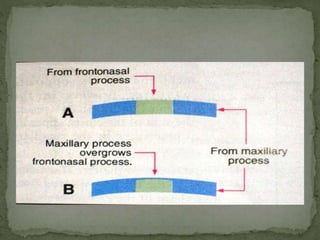
•The mesodermal basis of the lateral part of the lip is formed
from the maxillary process and the overlying skin is derived
from the ectoderm covering this process.
•The mesodermal basis of the median part of lip (philtrum) is
formed from frontonasal process.
•The skin of the entire upper lip is innervated by maxillary
nerves.
•The muscles of the face along with the lips are derived from
mesoderm of second bronchial arch, are supplied by the facial
nerve.
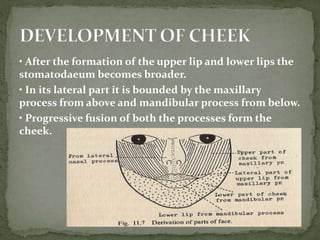
• After the formation of the upper lip and lower lips the
stomatodaeum becomes broader.
• In its lateral part it is bounded by the maxillary
process from above and mandibular process from below.
• Progressive fusion of both the processes form the
cheek.
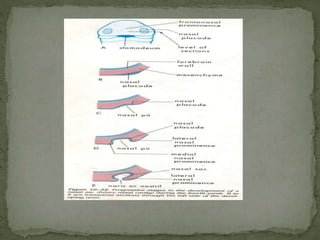
The nose is a complex of contributions from:
• Frontal prominence - The bridge.
• Medial nasal prominence - Median ridge and tip
• Lateral nasal prominence - The alae
• The cartilage of nasal capsule - the septum and
nasal conchae.
As the nose becomes prominent, the external nares
open up downwards instead of forwards.
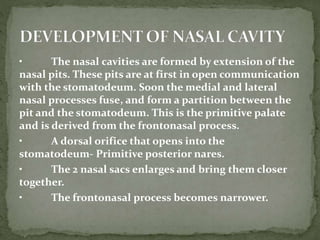
• The nasal cavities are formed by extension of the
nasal pits. These pits are at first in open communication
with the stomatodeum. Soon the medial and lateral
nasal processes fuse, and form a partition between the
pit and the stomatodeum. This is the primitive palate
and is derived from the frontonasal process.
• A dorsal orifice that opens into the
stomatodeum- Primitive posterior nares.
• The 2 nasal sacs enlarges and bring them closer
together.
• The frontonasal process becomes narrower.
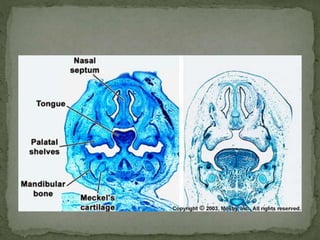
• The nasal cavities are separated from the mouth
by the development of palate. The narrowing of the
fronto-nasal process and the enlargement of nasal
cavities brings them closer together.
• The intervening tissues becomes much thinned
to form the nasal septum.
• The nasal pits now deepen to form the nasal sacs
which expand both dorsally and caudally. The nasal sac
has a ventral orifice that opens on the face is called the
Anterior nares.
• Paranasal sinuses develop during late fetal life.
• They form as outgrowths or diverticula of the
walls of the nasal cavities and become air filled
extensions of the nasal cavities in the adjacent bone.
- Frontal – 3 to 4 months of I.U
- Ethmoidal – 4 months of I.U
- Maxillary – Develops at 10 weeks of I.U
- Sphenoidal – 4 months of I.U
• Ear consists of 3 anatomical parts:
- Internal ear
- Middle ear
- External ear
-External ear:
External acoustic meatus:-
Develops by deepening of the dorsal end of the 1st
pharyngeal groove.
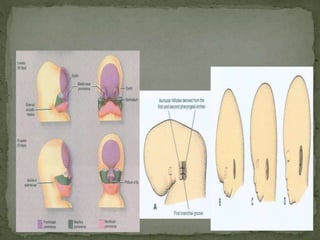
• Pinna or Auricle:
Six mesenchymal hillocks – Auricular hillocks develop
from the 1st and 2nd pharyngeal arch.
-Middle ear:
Develops from the tubotympanic recess i.e. derived
from the 1st pharyngeal pouch.
Tympanic cavity- Distal portion of the tubotympanic
recess expands.
Tympanic membrane: - Ectodermal lining from
-1ST pharyngeal groove
-Mesodermal lining from 1st and
2nd arch
-Endodermal lining from tubotympanic recess
Ear ossicles:
• 1st bone to attain ultimate size.
• Maleus and Incus develop from the 1st arch.
• Stapes develop from 2nd arch.
• Ossification begins in the 16th week and continues up
to the 25th week
-INTERNAL EAR:
• OTIC PLACODE
• Eyes develop from three sources:
Neuroectoderm of the forebrain - retina, optic nerve.
Surface ectoderm of the head- lens
Mesoderm between these layers - eye muscle and
vascular tissues
• 1st indication of eye formation is optic sulcus which is
formed in the 4th week.
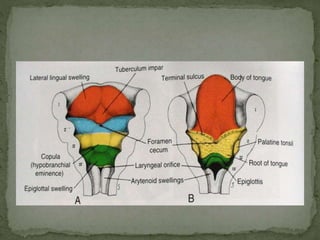
- Tongue develops in relation to P.A in floor of
developing mouth.
- The medial most part of M.A proliferate to form
Lingual swellings.
- They are partially separated from each other by
another swelling in midline called Tuberculum Impar.
- Immediately behind Tuberculum Impar the
epithelium proliferates to form a downgrowth from
(thyroglossal duct) which thyroid gland develops. This site is
marked by Foramen Caecum.
- Hypobranchial eminence- midline swelling in relation
to medial ends of 2nd, 3rd, & 4th arch. It has a cranial part
called Copula (2nd, 3rd ), & caudal part ( 4th) forming
epiglottis.
- Anterior two-thirds of tongue forms by fusion of –
2 lingual swellings & Tuberculum impar
- It is derived from Mandibular arch so supplied by
lingual nerve, branch of Mandibular nerve which is
post- trematic nerve of the 1st arch & chorda- tympani
which is pretrmatic nerve of the arch.
- Posterior one-thirds is formed from cranial part
of H.E (copula)
- The 2nd arch mesoderm buries below the surface,
3rd arch mesoderm grows over it to fuse with mesoderm
of 1st arch.
- Thus it is formed by 3rd arch mesoderm.
Supplied by glossopharyngeal nerve, of 3rd arch.
- The posterior most part is formed from 4th arch,
so it is supplied by superior laryngeal nerve of 4th arch.
- Musculature is derived from occipital myotomes,
supplied by hypoglossal nerve.
• Begins at 6th week- for primary palate
• From each Max. P, a plate like shelf grows medially, this
is called Palatine process.
• Palate forms from 3 components fusing with each other--
1) 2 Palatal processes, fuse in midline beginning from anterior
to posterior
2) Primitive palate from FNP, each palatal process fuses with
posterior margin of P.P
• The medial edge of P.P fuse with free lower edge of nasal
septum thus separating 2 nasal cavities from each other & from
mouth.
• At later stage mesoderm in palate undergoes
intramembranous ossification to form hard palate. Ossification
does not extend into posterior most portion which remains as
Soft palate.
• The part of palate derived from FNP is Premaxilla which
carries 4 incisors.
• The maxilla develops from a centre of ossification
in the mesenchyme of the 1st arch. The centre is in the
maxillary process. No arch cartilage or primary cartilage
exists in the maxillary process.
• Centre of ossification appears in the angle
between the division of the nerve, where the
anterosuperior dental nerve is given off from the infra
orbital nerve. From this centre bone formation spreads
backward below the orbit towards the developing
zygoma and forward towards the future incisor region.
• Ossification also spreads upward from this
forward extension to form the frontal process.
Ossification also spreads into the palatine process to
form the hard palate. A secondary cartilage, a zygomatic
or malar cartilage appears in the developing zygomatic
process and for a short time adds considerably to the
development of the maxilla.
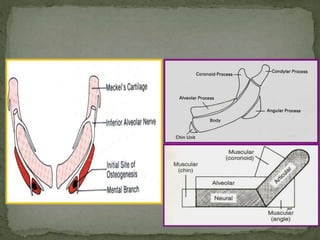
- On lateral aspect of Meckel’s cartilage (1st arch
cartilage) during 6th week of embryonic development, a
codensation of mesenchyme occurs in the angle formed by
division of Inferior Alveolar Nerve and its incisive and
mental branches
- At 7th week ,intra membraneous ossification begins in
this condensation forming the 1st bone of the mandible.
From this centre of ossification, bone formation spreads
rapidly, anteriorly to the midline and backwards towards the
point where the mandibular nerve divides into lingual and
IAN branches.
- Ramus of mandible develops by a rapid spread of
ossification backwards into mesenchyme of 1st arch,
diverging away from Meckel’s cartilage. The point of
divergence, is marked by lingula in adult mandible,
where Inf.Alveolar Nerve enters body of mandible.
- By 10th week, rudimentary mandible is formed
entirely by membraneous ossification with no direct
involvement of Meckel’s cartilage.
- Further growth is influenced by secondary
(growth) cartilage and development of muscular
attachments. The cartilages one condylar, coronoid and
symphyseal cartilages.
MECKEL’S CARTILAGE:-
- Dorsal end ossifies to form malleus & incus
- Its parts then transform into sphenomandibular
ligament & ant. Malleolar ligament
- Ventral end forms accessory endochondral
ossicles
- Then between 10th -14th weeks, secondary
accessory cartilages appear to form the head of condyle,
part of coronoid process and mental protruberance. By
24th week it disappears after conception.
Craniofacial voluntary muscles develop from somitomeres
and somites of the occipital and nostral cervical regions.
Myomeres of the somitomeres and myotomes of somites
form primitive muscles cells called myoblasts.
Myoblasts divide and fuse to form myotubes. Myotubes
become myocytes (muscle fibres).
Craniofacial muscles are derived segmentally from 7
somitomeres - 7 nostral somites ,4 ocular extrinsic
muscles(superior , medial , inferior rectus and inferior
oblique) derived from 1st two somitomores supplied by
Oculomotor.
Superior oblique ocular muscle- 3rd somitomere -Trochlear N
(4th CN).
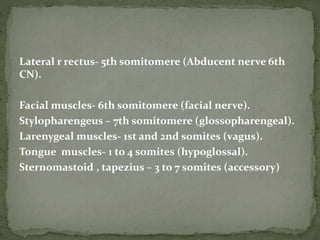
Lateral r rectus- 5th somitomere (Abducent nerve 6th
CN).
Facial muscles- 6th somitomere (facial nerve).
Stylopharengeus – 7th somitomere (glossopharengeal).
Larenygeal muscles- 1st and 2nd somites (vagus).
Tongue muscles- 1 to 4 somites (hypoglossal).
Sternomastoid , tapezius – 3 to 7 somites (accessory)
DEVELOPMENTAL
ANOMALIES OF THE FACE
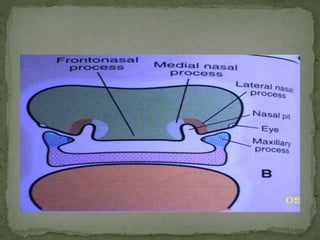
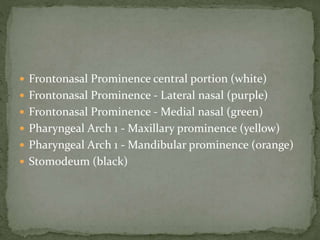
 Frontonasal Prominence central portion (white)
 Frontonasal Prominence - Lateral nasal (purple)
 Frontonasal Prominence - Medial nasal (green)
 Pharyngeal Arch 1 - Maxillary prominence (yellow)
 Pharyngeal Arch 1 - Mandibular prominence (orange)
 Stomodeum (black)
 Single or multifactorial
There are four clinically significant types of congenital
anomaly
 Malformation : A morphological defect of an organ, part of
an organ, or larger region of the body that results from an
intrinsically abnormal developmental process.
 Disruption :A morphological defect of an organ, part of an
organ, or a larger region of the body that results from the
extrinsic breakdown of, or an interference with, an
originally normal developmental process
 Deformation : An abnormal form, shape, or position of a
part of the body that results from mechanical forces
 Dysplasia : An abnormal organization of cells into tissue (s)
and its morphological result (s).
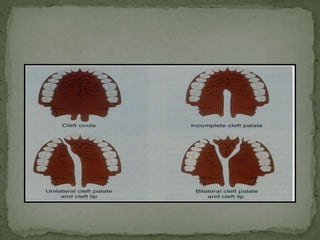
 Cleft palate - A congenital fissure in the roof of the
mouth, resulting from incomplete fusion of the palate
during embryonic development.
 Cleft lip - A congenital deformity characterized by a
vertical cleft or pair of clefts in the upper lip, with or
without involvement of the palate. Defective fusion of
the medial nasal process with the maxillary process
leads to cleft lip
 GENETIC OR ENVIRONMENTAL
 INCIDENCE
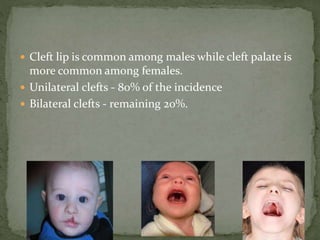
 Cleft lip is common among males while cleft palate is
more common among females.
 Unilateral clefts - 80% of the incidence
 Bilateral clefts - remaining 20%.
Most accepted.
GROUP I:- cleft of the soft palate only.
GROUP II:-Cleft of the hard and soft palate to the
incisive foramen.
GROUP III:-Complete unilateral cleft of the soft and
hard palate, and the lip and alveolar ridge on one side.
GROUP IV:-Complete bilateral cleft of the soft and hard
palate ,and the lip and alveolar ridge on both sides.
 DAVIS AND RITCHIE CLASSIFICATION(1922)
 Classification by Fogh Andersen (1942)
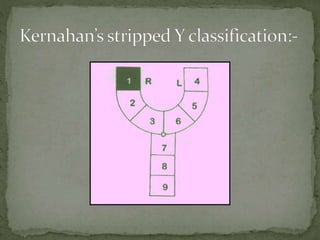
 Millard’s modification of stripped Y classification
 SCHUCHARDT AND PFEIFER’S SYMBOLIC
CLASSIFICATION
 Dental
 Esthetic
 Speech and Hearing
 Psychologic
 Congenitally missing teeth (most commonly the upper
laterals)
 Presence of natal or neonatal teeth
 Presence of supernumerary teeth
 Ectopically erupting teeth
 Anomalies of tooth morphology
 Enamel hypoplasia
 Microdontia
 Fused teeth
 Macrodontia
 Mobile and early shedding of teeth due to poor
periodontal support
 Posterior and anterior cross bite
 Protruding premaxilla
 Deep bite
 Spacingcrowding
 The clefts involving the lip can result in facial
disfigurement varing from mild to severe. The oro-
facial structures may be malformed and congenitally
missing. Deformities of nose can also occur. Thus
esthetics is greatly affected.
 Cleft lip and palate are sometimes associated with
disorders of the middle ear which may affect hearing.
The presence of hearing problems can cause
difficulties in language uptake and speech.
 Due to their abnormal facial appearance they have to
put up with staring, curiosity, pity, etc.,.
 They also face problems in obtaining jobs and making
friends.
 Studies have shown that these patients fare badly in
academics. This is usually as a result of hearing
impairment, speech problems and frequent absence
from school.
 Hereditary
 Environment.
Predisposing factors are
 increased maternal age.
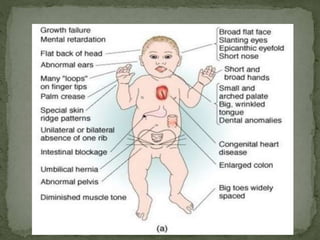
 racial
 decreased blood supply.
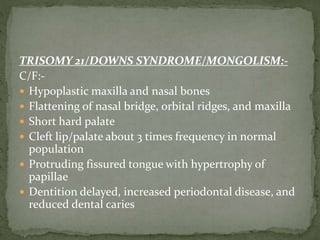
TURNER’S SYNDROME:-
Turner syndrome is caused by the absence of two
complete copies of the X chromosome in some or all the
cells.
 Multiple eye findings including cataract, blue sclera.
 Color Blindness
 Depressed Corners of mouth
 High arched palate
 Dental malocclusion
 Micrognathia
TRISOMY 21/DOWNS SYNDROME/MONGOLISM:-
C/F:-
 Hypoplastic maxilla and nasal bones
 Flattening of nasal bridge, orbital ridges, and maxilla
 Short hard palate
 Cleft lip/palate about 3 times frequency in normal
population
 Protruding fissured tongue with hypertrophy of
papillae
 Dentition delayed, increased periodontal disease, and
reduced dental caries
CROUZONS SYNDROME/CRANIOFACIAL
DYSOSTOSIS:-
C/F:-
 Premature closure, especially of coronal suture,
occasionally lambdoidal..
 Variable cranial form depending on order and rate
of progression of suture closure
 Optic nerve damage
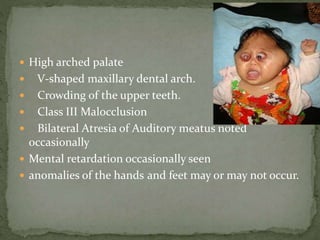
 High arched palate
 V-shaped maxillary dental arch.
 Crowding of the upper teeth.
 Class III Malocclusion
 Bilateral Atresia of Auditory meatus noted
occasionally
 Mental retardation occasionally seen
 anomalies of the hands and feet may or may not occur.
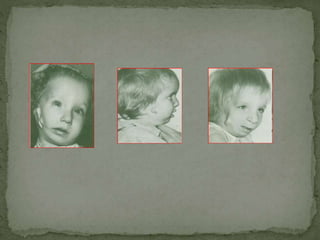
 craniofacial defect involving with neural crestal cells
include:
Treachers colins yndrome
Pierre Robin syndrome
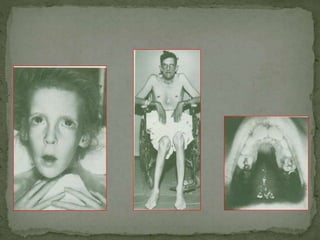
De george anomaly
Occuloauriculo vertbral spectrum(golden har syndrome)
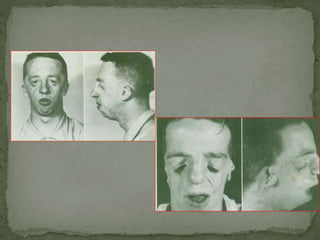
C/F:
 under development of the zygomatic bones,
mandibular hypoplasia, down slanting palpebral
fissures, maformed external ears
 Autosomal dominant trait with 60% cases
 Macrostomia
 Hypoplastic mandible with concave undersurface
 Hypoplastic zygomatic arches
 cleft palate
 Dental malocclusion common
 Pinna frequently deformed, crumpled forward, or
misplaced
 Absence of external auditory canal
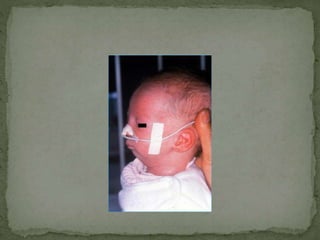
 Altered first arch structure
 Occur independently or in association with other
malformations
 Development of mandible most severely affected
 micrognathia, cleft palate and glossoptosis (posteriorly
placed tongue)
 Robin’s syndrome may be due to genetic or environmental
factors
 May also occur as a deformation
 The primary defect includes poor growth of the mandible
and as a result a posteriorly placed tongue that fails to drop
from between the palatal shelves preventing their fusion
Autosomal dominant trait
C/F_-
 prominent supraorbital ridges
 Long narrow face
 High arched palate
 Mandibular prognathism
 Myopia
 Blue sclerae
 Chest deformities
 Hyperextensibility of joints
 Hernias
 Muscular underdevelopment
Characterized by :
 have immunological deficiencies, hypocalcaemia and
poor prognosis
 Origin of the defect is caused by abnormal
development of neural crest cells that contribute to
formation of all affected structures
 In addition to genetic causes , alcohol and maternal
diabetes can produce such defect
 defects in the palate
 mild differences in facial features,
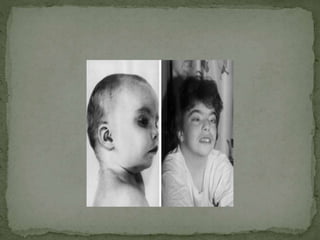
 craniofacial abnormalities involving the maxillary ,
temporal and zygomatic bones which are small and
flat
 Ear (anotia-no ear), eye(tumors and dermoid in eye
balls)
 Asymmetry -65% cases
 Other malformation-tetralogy of fallot (con.heart
disease) , malformations of kidney and intestine
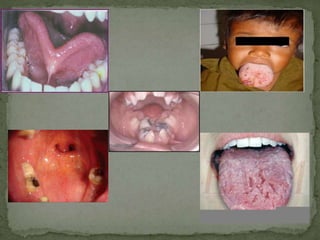
 Ankyloglossia
 Macroglossia
 Microglossia
 Aglossia
 Bifid tongue
 Fissured tongue
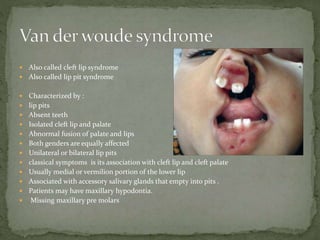
 Also called cleft lip syndrome
 Also called lip pit syndrome
 Characterized by :
 lip pits
 Absent teeth
 Isolated cleft lip and palate
 Abnormal fusion of palate and lips
 Both genders are equally affected
 Unilateral or bilateral lip pits
 classical symptoms is its association with cleft lip and cleft palate
 Usually medial or vermilion portion of the lower lip
 Associated with accessory salivary glands that empty into pits .
 Patients may have maxillary hypodontia.
 Missing maxillary pre molars
 Localized hyperplasia/ hypertrophy of minor
accessory glands
Aplasia :
 Development of xerostomia
 Found in cases of hemifacial microsomia
 treacher collin’s syndrome
Atresia
Aberrancy
 Macrostomia
 Microstomia
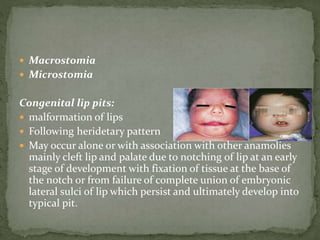
Congenital lip pits:
 malformation of lips
 Following heridetary pattern
 May occur alone or with association with other anamolies
mainly cleft lip and palate due to notching of lip at an early
stage of development with fixation of tissue at the base of
the notch or from failure of complete union of embryonic
lateral sulci of lip which persist and ultimately develop into
typical pit.
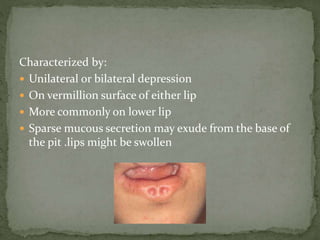
Characterized by:
 Unilateral or bilateral depression
 On vermillion surface of either lip
 More commonly on lower lip
 Sparse mucous secretion may exude from the base of
the pit .lips might be swollen
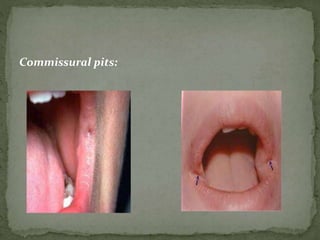
Commissural pits:
Congenital deafness
 Absence of the tympanic cavity and external meatus
 Abnormal development of membranes and bony labyrinth
 Malformation of auditory ossicles and ear drum
Caused by:
 Rubella virus
 Poliomyelitis
 Erythroblastosis fetalis
 Diabetes
 Hypothyroidism
 toxoplasmosis
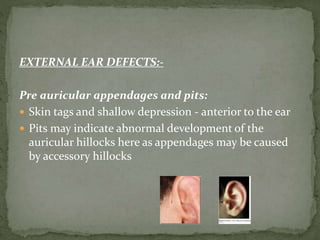
EXTERNAL EAR DEFECTS:-
Pre auricular appendages and pits:
 Skin tags and shallow depression - anterior to the ear
 Pits may indicate abnormal development of the
auricular hillocks here as appendages may be caused
by accessory hillocks
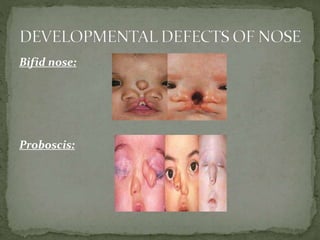
Bifid nose:
Proboscis:
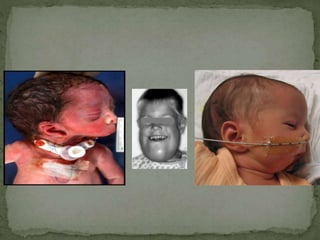
 AGNATHIA
 MICROGNATHIA
 MACROGNATHIA
C/F:
 Mandibular protrusion (when mandible is affected)
 "Gummy smile" (when maxilla is affected)
 Ramus of mandible forms a less steep angle with body of
mandible
 Mandibular prognathism caused by excessive condylar
growth
 Chin appears prominent
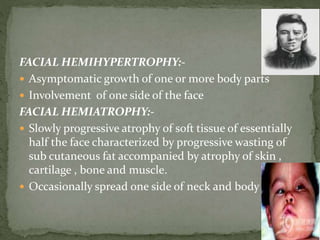
FACIAL HEMIHYPERTROPHY:-
 Asymptomatic growth of one or more body parts
 Involvement of one side of the face
FACIAL HEMIATROPHY:-
 Slowly progressive atrophy of soft tissue of essentially
half the face characterized by progressive wasting of
sub cutaneous fat accompanied by atrophy of skin ,
cartilage , bone and muscle.
 Occasionally spread one side of neck and body
Clinical features :
 commonly early sign is painless cleft near the midline of face or
forehead
 The marks the boundary between the normal and atrophic tissues
 Bluish hue may appear in the skin overlying atrophic fat
 Neurolgical disorders in 15 % cases may be accompanied by
pigmentation, pigmented facial naevi, contralateral jacksonian
epilepsy , trigeminal nerve , occular complications.
 More in female, more on left side
 Occurs mostly 1st and 2nd decade
Dental abnormalities:
 incomplete root formation
 Delayed eruption
 Severe facial asymmetry difficulty with mastication
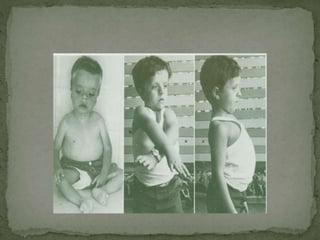
 In 1897 Marie and Sainton coined the name cleidocranial
dysostosis
 Autosomal dominant(A gene on one of the non-sex
chromosomes that is always expressed, even if only one
copy is present) with wide variability in expression.
C/F:
 shortness of stature.
 Brachycephaly(head is disproportionately wide) with
bossing of frontal, parietal, and occipital bones;
 Mineralization of sutures
 Late or incomplete development of accessory sinuses
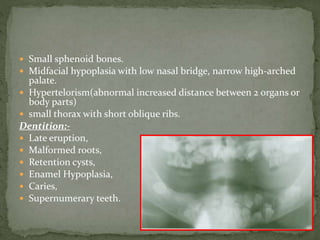
 Small sphenoid bones.
 Midfacial hypoplasia with low nasal bridge, narrow high-arched
palate.
 Hypertelorism(abnormal increased distance between 2 organs or
body parts)
 small thorax with short oblique ribs.
Dentition:-
 Late eruption,
 Malformed roots,
 Retention cysts,
 Enamel Hypoplasia,
 Caries,
 Supernumerary teeth.
Atresia (is a condition in which a body orifice or passage in
the body is abnormally closed or absent) of the cavity at the
external nares, at the posterior nasal aperture or in the cavity
 This may be unilateral or bilateral
 Congenital defect in the cribriform plate of ethmoid bone
may lead to communication between cranial cavity and
nose
 Nasal septum may not be in midline i.e., deflected to one
side
 Septum may be absent
 Nasal cavity may communicate with the mouth
 Teratogens are any agents from the environment that
can cause harm to the developing fetus.
 Many harmful agents cause damage only if exposure
occurs during a sensitive period of prenatal
development.
 Critical factors that influence the degree of harm a
teratogen will cause:
– The amount and length of exposure
– Individual differences in susceptibility
 Damage from teratogens is not always evident at birth
but may appear later in life.
 Impact of teratogens often depends on quality of
postnatal environment.
 About 45% or more pregnancies end in miscarriage,
that is, spontaneous abortion.
 Most miscarried fetuses have severe defects, such as
missing chromosomes, that make further development
impossible.
 Ninety percent of fetuses that survive the danger of
miscarriage are born normal
RISK FACTORS:-
 SMOKING
 ALCOHOL
 DIETARY DEFICIENCIES
 DISEASES viz. cytomegalovirus, herpes virus, parvovirus B19,
rubella virus (German measles), syphilis, toxoplasmosis,
Venezuelan equine encephalitis virus
 DRUGS viz
Aspirin
- pregnant women - blood disorders in offspring.
Thalidomide
- deformations of the eyes, nose, ears cleft plate, facial palsy and
fusing of fingers and toe , dislocations of the hip joint and
malformations of the heart and digestive and urinary tract
Illegal drugs
Marijuana:
prenatal exposure to marijuana leads to infants reduced
weight and size, short term changes in behaviour e.g.
increased startle and a high pitched cry.
Cocaine:
effect of maternal cocaine use - children tend to be
impulsive, highly distractable and difficult to control
and to have problems in language development as they
grow old.
 Father’s exposure to toxin viz Lead , Mercury ,
Radiation.
 Fetal alcohol syndrome
 Congenital facial paralysis:
Traumatic congenital facial nerve paralysis usually
resolves spontaneously and does not require surgery.
Cephalic disorders are congenital conditions that stem
from damage to, or abnormal development of, the
budding nervous system.
 ANENCEPHALY is a neural tube defect that occurs
when the cephalic (head) end of the neural tube fails
to close, usually between the 23rd and 26th days of
pregnancy, resulting in the absence of a major portion
of the brain, skull, and scalp.
 HYDRANENCEPHALY is a rare condition in which the
cerebral hemispheres are absent and replaced by sacs filled
with cerebrospinal fluid.
 INIENCEPHALY is a rare neural tube defect that combines
extreme retroflexion (backward bending) of the head with
severe defects of the spine.
 MEGALENCEPHALY, also called macrencephaly, is a
condition in which there is an abnormally large, heavy, and
usually malfunctioning brain.
 MICROCEPHALY is a neurological disorder in which the
circumference of the head is smaller than average for the
age and gender of the infant or child
The human face is a fascinating study of physiology and
psychology. The amount of information a human face
can relay is unending. Humans are capable of making
10,000 unique facial expressions! While the face is
complicated, it is also our most useful and most
underestimated tool for communication.

developmentoffaceppt2-140908090227-phpapp02.pptx

  • 1.
  • 2.
     INTRODUCTION  DEFINITION EVENTS OF DEVELOPMENT  EMBRYOLOGICAL DEVELOPMENT  DEVELOPMENT OF BRANCHIAL (ARCHES , POUCHES AND CLEFTS)  DEVELOPMENT OF FACE  DEVELOPMENTALANOMALIES OF FACE  CONCLUSION  REFERENCES
  • 3.
     Anatomical structuresare more diverse in the mouth than in any other region. Human development is a continuous process and does not stop at birth. An individual spends about 9 months/ 38 weeks/266 days or nearly 383040minutes of his life in his mother’s womb.  The human face begins to form during the 4th week of embryonic development. By the 6th week the external face is completed. Between the 6th and 8th weeks the development of the palate subdivides nasal and oral cavities. This development continues into the 12th week with completion of the soft palate.
  • 4.
     Embryology: Science ofthe origin & development of the organism from fertilization of the ovum to the end of the eighth week.  Development: Development refers to all the naturally occurring unidirectional changes in the life of an individual from its existence as a single cell to its elloboration as a multifunctional unit terminating in death. Thus it encompasses the normal sequential events between fertilization and death.
  • 5.
    Third week Developmentof ear Formation of Stomatodaeum. Fourth week Formation of Fronto-nasal process, maxillary and mandibular process. Development of cranial base. Formation of pharyngeal arches. Development of tongue. Fifth week Formation of Nasal placode, Medial and lateral nasal process. Development of mandible. Sixth week Development of Nasal cavity. Development of Parotid and Submandibular salivary glands Seventh week Formation of pre-maxilla Eight week Formation of definitive palate. Development of Sublingual salivary glands Tenth week Development of TMJ Development of Maxillary sinus. Twelth week Development of Ethmoidal, Frontal and Sphenoidal sinuses.
  • 6.
    • Pre-implantation periodor Period of ovum(1-2weeks) • Embryonic period( 3rd to 8th week) • Fetal period( 9th week till birth)
  • 7.
    - The periodof one week from fertilization to implantation of the fertilized egg is called the pre- implantation period.
  • 9.
    -The period ofembryo is divided into 3 stages -PRESOMITE stage – an embryo in any stage of development before the appearance of the first pair of somites (primitive segments/metameres), which in humans usually occurs around 19 to 21 days after fertilization of the ovum. -SOMITE stage - an embryo in any stage of development between the formation of the first and the last pairs of somites, which in humans occurs in the third and fourth weeks after fertilization of the ovum. -POSTSOMITE stage – The developing embryo then gets attached to the uterine endometrium, this is called Implantation. After Implantation the endometrium is called Decidua. The placenta is formed partly by embryonic structures and partly from the decidua.
  • 10.
    -Fertilization of ovumtakes place in the ampulla of the uterine tube. When there are 16 cells the ovum is called a morula. - - The cells of the inner cell mass rearrange to form the embryonic disc having two germ cells namely ECTODERM & ENDODERM and the third layer is formed between the 2 layers i.e known as MESODERM.
  • 14.
    - In theFetal period all major structures are already formed in the fetus, but they continue to grow and develop.  The last 7 months of fetal life are devoted to very rapid growth and repositioning of body components, with little further organogenesis or tissue differentiation. By 3rd month sex of fetus is known. In the 4 months human face is seen and in the Last 2 months of fetal life fat is deposited subcutaneously
  • 15.
    - Pharyngeal archesare rod like thickenings of mesoderm present in the wall of the foregut. - At first there are 6 arches. The 5th arch disappears and then only 5 arches remain. - In the interval between any two arches the endoderm (lining of the pharynx) is pushed outwards to form a series of pouches. These are called Pharyngeal pouches.
  • 16.
    - Cartilage component:  Adapt to form Bony, Cartilagenous or Ligamentous structures - Muscle component :  Give rise to special visceral muscles composed of striated muscle fibers. - Vascular component :  Provides necessary blood supply - Nerve component :  Enters mesoderm of the branchial arches and initiates muscle development of mesoderm.
  • 21.
    - Precursor ofboth the jaws: Maxilla + Mandible - Initially gives rise to a large mandibular prominence. - Gives rise to a small maxillary prominence which extends cranioventrally.
  • 22.
    Cartilage : MECKEL’SCARTILAGE -Arises in 41st – 45th Day of intrauterine life. -It provides a template for subsequent development of the mandible. Derivatives of Meckel’s cartilage- -Mental Ossicle -Head and neck of Malleus. -Short crus of the Incus. -Anterior Ligament of the Malleus. -Sphenomandibular Ligament COMPONENTS OF 1ST BRANCHIAL ARCH:
  • 23.
    Musculature derived from1st arch- -Muscles of Mastication. -Mylohyoid Muscle. -Ant. Belly of Digastric. -Tensor Tympani. -Tensor Veli Palatini Muscles. 3. Arterial Component: -Part of Maxillary and External Carotid Artery.
  • 24.
    4. Nerve components: --Mandibular division of Trigeminal Nerve ( Vth Cranial Nerve) -- Sensory component supplies : Mandible and covering mucosa. : Mandibular teeth including Gingiva. : Mucosa of ant. 2/3 of Tongue. : Floor of the mouth. : Skin of the lower third of Face
  • 25.
    COMPONENTS: 1. Cartilage :Reichert’s Cartilage (45th – 48th I.U) - Greater part of the third ear ossicle. - Stapes . - Styloid process of the temporal bone. - Stylohyoid ligament. - Lesser horn and - Cranial part - Body of Hyoid. - Segments of the facial canal.
  • 26.
    2. Muscles : -Stapedius - Stylohyoid - Post. Belly of Digastric. - Muscles of facial expression. - Levator Veli Palatini. 3. Nerve : - Facial nerve. - Special sensory component - Chorda tympani nerve (Ant 2/3rd of Tongue) 4. Artery : - Stapedial artery - Transient i.e. disappears during fetal life.
  • 27.
    COMPONENTS: 1.MUSCLES – STYLOPHAYNGEOUS MUSCLE 2.NERVE– GLOSSOPHAYNGEAL NERVE 3.ARTERY- PROXIMAL 1/3RD OF INTERNAL CAROTID ARTERY. SMALL CONTRIBUTION OF COMMON CAROTID ARTERY. 4. SKELETON – Greater horn Lower body of hyoid
  • 28.
    COMPONENTS: 1. MUSCLES- Constrictor musclesof pharynx. 2. NERVE – Superior laryngeal nerve 3. ARTERY – Arch of aorta Proximal part of subclavian 4. SKELETON – Thyroid cartilage
  • 29.
    COMPONENTS: 1.MUSCLES- Intrinsic muscles oflarynx 2.NERVE- Recurrent laryngeal nerve 3.ARTERY- Pulmonary artery Ductus arteriosum 4.SKELETON- Cricoid Arytenoid
  • 30.
    1st pharyngeal pouch– • It forms a star like diverticulum “tubotympanic recess”, which comes in contact with the epithelial living of the 1st pharyngeal cleft, the future external auditory meatus. • The distal portion of the diverticulum widens into primitive middle ear cavity and the proximal part remains narrow forming the eustachian tube. • The lining of tympanic cavity later aids in formation of the tympanic membrane or eardrum.
  • 31.
    2nd pharyngeal pouch: •Theepithelium of the ventral part of this pouch contributes to the formation of tonsil. •Dorsal part takes part information of tubo tympanic recess.
  • 32.
    3rd pharyngeal pouch: •It has dorsal and ventral wings. •During 5th week, epithelium of dorsal wing of the 3rd pouch differentiates into inferior parathyroid gland, while ventral wing forms the thymus. •Thymus migrates in a caudal and medial direction pulling inferior parathyroid with it, which finally rest on the dorsal surface of thyroid gland.
  • 33.
    4th pharyngeal pouch: •Epitheliumof dorsal wing forms the superior parathyroid gland. 5th pharyngeal pouch: •Considered as a part of 4th pouch. It gives rise to ultimobronchial body, which later forms parafollicular or “C” cells of thyroid gland. •These cells secrete calcitonin, hormone involved in calcium regulation.
  • 35.
    • 5 weekembryo is characterized by 4 pharyngeal clefts. • Dorsal part of 1st cleft penetrates the underlying mesenchyme and gives rise to the external auditory meatus. • The epithelial lining at the bottom of the meatus participates in formation of the eardrum. • Active proliferation of mesenchymal tissue in the 2nd arch causes it to overlap the 3rd and 4th clefts (arches). • Finally it merges with the epicardial ridge in the lower part of neck and the 2nd, 3rd and 4th clefts lose their contact with outside. • These clefts form a cavity lined with ectodermal epithelium, the “cervical sinus”, but with further development this sinus disappears.
  • 36.
    KEY POINTS:- • Facedevelops from 3 prominences that surround the stomatodeum-it is a depression bounded cranially by a bulging produced by the brain and caudally by a bulging produced by the pericardial cavity. 1.Frontonasal process 2.Right and Left mandibular arch •The mandibular arch divides into a maxillary process and a mandibular process. •The right and the left mandibular arches meet in the midline and fuse. They form the upper and lower lips.
  • 41.
    • The cheekis formed by the fusion of posterior part of maxillary and mandibular process. • The nose is derived from the frontonasal process. • The nasal cavity is formed by enlargement of the nasal pits. • Paranasal sinuses appear as outgrowths from the nasal cavity. • The palate is formed by fusion of 3 components i.e right and left palatal processes and the primitive palate. • The oral cavity is derived party from the stomatodaeum(ectoderm) and partly from the foregut(endoderm).
  • 42.
    • The teethare formed in relation to the dental lamina. An enlargement of dental lamina for each tooth is formed which is called the enamel organ. Ameloblasts form the enamel, odontoblasts form the dentine and the mesenchyme that invaginates into enamel organ forms the pulp. • The ant. 2/3rd of the tongue is formed from the lingual swellings and the tuberculum impar. • The post.1/3rd of the tongue is formed by cranial part of hypobranchial eminence. • The salivary glands develop as outgrowths of buccal epithelium. • The palatine tonsil develops in relation to 2nd pharyngeal pouch.
  • 43.
    • The pharynxis derived from the foregut. • Muscles of face develop from 2nd branchial arch and are supplied by facial nerve. • Eyes develop from three sources: Neuroectoderm of the forebrain - retina,optic n. Surface ectoderm of the head - lens Mesoderm between these layers – eye muscle and vascular tissues. • External ear develops from Ext. ocoustic meatus, middle ear develops from tubotympanic recess that is derived from 1st pouch and internal ear is derived from otic placode which is a thickening of surface ectoderm.
  • 44.
     The mandibularprocess of two sides grow towards each other and fuse in the midline.  The fused mandibular process give rise to lower lip & to lower jaw.
  • 45.
    •Each mandibular processgrows medially and fuses first with the lateral nasal process and then with medial nasal process. •The medial and lateral nasal processes fuse with each other n the nasal pits(ext.nares) are cut off from stomatodaeum. •The mesodermal basis of the lateral part of the lip is formed from the maxillary process and the overlying skin is derived from the ectoderm covering this process. •The mesodermal basis of the median part of lip (philtrum) is formed from frontonasal process. •The skin of the entire upper lip is innervated by maxillary nerves. •The muscles of the face along with the lips are derived from mesoderm of second bronchial arch, are supplied by the facial nerve.
  • 49.
    • After theformation of the upper lip and lower lips the stomatodaeum becomes broader. • In its lateral part it is bounded by the maxillary process from above and mandibular process from below. • Progressive fusion of both the processes form the cheek.
  • 50.
    The nose isa complex of contributions from: • Frontal prominence - The bridge. • Medial nasal prominence - Median ridge and tip • Lateral nasal prominence - The alae • The cartilage of nasal capsule - the septum and nasal conchae. As the nose becomes prominent, the external nares open up downwards instead of forwards.
  • 53.
    • The nasalcavities are formed by extension of the nasal pits. These pits are at first in open communication with the stomatodeum. Soon the medial and lateral nasal processes fuse, and form a partition between the pit and the stomatodeum. This is the primitive palate and is derived from the frontonasal process. • A dorsal orifice that opens into the stomatodeum- Primitive posterior nares. • The 2 nasal sacs enlarges and bring them closer together. • The frontonasal process becomes narrower.
  • 54.
    • The nasalcavities are separated from the mouth by the development of palate. The narrowing of the fronto-nasal process and the enlargement of nasal cavities brings them closer together. • The intervening tissues becomes much thinned to form the nasal septum. • The nasal pits now deepen to form the nasal sacs which expand both dorsally and caudally. The nasal sac has a ventral orifice that opens on the face is called the Anterior nares.
  • 55.
    • Paranasal sinusesdevelop during late fetal life. • They form as outgrowths or diverticula of the walls of the nasal cavities and become air filled extensions of the nasal cavities in the adjacent bone. - Frontal – 3 to 4 months of I.U - Ethmoidal – 4 months of I.U - Maxillary – Develops at 10 weeks of I.U - Sphenoidal – 4 months of I.U
  • 56.
    • Ear consistsof 3 anatomical parts: - Internal ear - Middle ear - External ear -External ear: External acoustic meatus:- Develops by deepening of the dorsal end of the 1st pharyngeal groove. • Pinna or Auricle: Six mesenchymal hillocks – Auricular hillocks develop from the 1st and 2nd pharyngeal arch.
  • 57.
    -Middle ear: Develops fromthe tubotympanic recess i.e. derived from the 1st pharyngeal pouch. Tympanic cavity- Distal portion of the tubotympanic recess expands. Tympanic membrane: - Ectodermal lining from -1ST pharyngeal groove -Mesodermal lining from 1st and 2nd arch -Endodermal lining from tubotympanic recess
  • 58.
    Ear ossicles: • 1stbone to attain ultimate size. • Maleus and Incus develop from the 1st arch. • Stapes develop from 2nd arch. • Ossification begins in the 16th week and continues up to the 25th week -INTERNAL EAR: • OTIC PLACODE
  • 60.
    • Eyes developfrom three sources: Neuroectoderm of the forebrain - retina, optic nerve. Surface ectoderm of the head- lens Mesoderm between these layers - eye muscle and vascular tissues • 1st indication of eye formation is optic sulcus which is formed in the 4th week.
  • 62.
    - Tongue developsin relation to P.A in floor of developing mouth. - The medial most part of M.A proliferate to form Lingual swellings. - They are partially separated from each other by another swelling in midline called Tuberculum Impar. - Immediately behind Tuberculum Impar the epithelium proliferates to form a downgrowth from (thyroglossal duct) which thyroid gland develops. This site is marked by Foramen Caecum. - Hypobranchial eminence- midline swelling in relation to medial ends of 2nd, 3rd, & 4th arch. It has a cranial part called Copula (2nd, 3rd ), & caudal part ( 4th) forming epiglottis.
  • 63.
    - Anterior two-thirdsof tongue forms by fusion of – 2 lingual swellings & Tuberculum impar - It is derived from Mandibular arch so supplied by lingual nerve, branch of Mandibular nerve which is post- trematic nerve of the 1st arch & chorda- tympani which is pretrmatic nerve of the arch. - Posterior one-thirds is formed from cranial part of H.E (copula) - The 2nd arch mesoderm buries below the surface, 3rd arch mesoderm grows over it to fuse with mesoderm of 1st arch. - Thus it is formed by 3rd arch mesoderm.
  • 64.
    Supplied by glossopharyngealnerve, of 3rd arch. - The posterior most part is formed from 4th arch, so it is supplied by superior laryngeal nerve of 4th arch. - Musculature is derived from occipital myotomes, supplied by hypoglossal nerve.
  • 66.
    • Begins at6th week- for primary palate • From each Max. P, a plate like shelf grows medially, this is called Palatine process. • Palate forms from 3 components fusing with each other-- 1) 2 Palatal processes, fuse in midline beginning from anterior to posterior 2) Primitive palate from FNP, each palatal process fuses with posterior margin of P.P • The medial edge of P.P fuse with free lower edge of nasal septum thus separating 2 nasal cavities from each other & from mouth. • At later stage mesoderm in palate undergoes intramembranous ossification to form hard palate. Ossification does not extend into posterior most portion which remains as Soft palate. • The part of palate derived from FNP is Premaxilla which carries 4 incisors.
  • 67.
    • The maxilladevelops from a centre of ossification in the mesenchyme of the 1st arch. The centre is in the maxillary process. No arch cartilage or primary cartilage exists in the maxillary process. • Centre of ossification appears in the angle between the division of the nerve, where the anterosuperior dental nerve is given off from the infra orbital nerve. From this centre bone formation spreads backward below the orbit towards the developing zygoma and forward towards the future incisor region.
  • 68.
    • Ossification alsospreads upward from this forward extension to form the frontal process. Ossification also spreads into the palatine process to form the hard palate. A secondary cartilage, a zygomatic or malar cartilage appears in the developing zygomatic process and for a short time adds considerably to the development of the maxilla.
  • 69.
    - On lateralaspect of Meckel’s cartilage (1st arch cartilage) during 6th week of embryonic development, a codensation of mesenchyme occurs in the angle formed by division of Inferior Alveolar Nerve and its incisive and mental branches - At 7th week ,intra membraneous ossification begins in this condensation forming the 1st bone of the mandible. From this centre of ossification, bone formation spreads rapidly, anteriorly to the midline and backwards towards the point where the mandibular nerve divides into lingual and IAN branches.
  • 70.
    - Ramus ofmandible develops by a rapid spread of ossification backwards into mesenchyme of 1st arch, diverging away from Meckel’s cartilage. The point of divergence, is marked by lingula in adult mandible, where Inf.Alveolar Nerve enters body of mandible. - By 10th week, rudimentary mandible is formed entirely by membraneous ossification with no direct involvement of Meckel’s cartilage. - Further growth is influenced by secondary (growth) cartilage and development of muscular attachments. The cartilages one condylar, coronoid and symphyseal cartilages.
  • 71.
    MECKEL’S CARTILAGE:- - Dorsalend ossifies to form malleus & incus - Its parts then transform into sphenomandibular ligament & ant. Malleolar ligament - Ventral end forms accessory endochondral ossicles - Then between 10th -14th weeks, secondary accessory cartilages appear to form the head of condyle, part of coronoid process and mental protruberance. By 24th week it disappears after conception.
  • 73.
    Craniofacial voluntary musclesdevelop from somitomeres and somites of the occipital and nostral cervical regions. Myomeres of the somitomeres and myotomes of somites form primitive muscles cells called myoblasts. Myoblasts divide and fuse to form myotubes. Myotubes become myocytes (muscle fibres). Craniofacial muscles are derived segmentally from 7 somitomeres - 7 nostral somites ,4 ocular extrinsic muscles(superior , medial , inferior rectus and inferior oblique) derived from 1st two somitomores supplied by Oculomotor. Superior oblique ocular muscle- 3rd somitomere -Trochlear N (4th CN).
  • 74.
    Lateral r rectus-5th somitomere (Abducent nerve 6th CN). Facial muscles- 6th somitomere (facial nerve). Stylopharengeus – 7th somitomere (glossopharengeal). Larenygeal muscles- 1st and 2nd somites (vagus). Tongue muscles- 1 to 4 somites (hypoglossal). Sternomastoid , tapezius – 3 to 7 somites (accessory)
  • 76.
  • 77.
     Frontonasal Prominencecentral portion (white)  Frontonasal Prominence - Lateral nasal (purple)  Frontonasal Prominence - Medial nasal (green)  Pharyngeal Arch 1 - Maxillary prominence (yellow)  Pharyngeal Arch 1 - Mandibular prominence (orange)  Stomodeum (black)
  • 78.
     Single ormultifactorial
  • 79.
    There are fourclinically significant types of congenital anomaly  Malformation : A morphological defect of an organ, part of an organ, or larger region of the body that results from an intrinsically abnormal developmental process.  Disruption :A morphological defect of an organ, part of an organ, or a larger region of the body that results from the extrinsic breakdown of, or an interference with, an originally normal developmental process  Deformation : An abnormal form, shape, or position of a part of the body that results from mechanical forces  Dysplasia : An abnormal organization of cells into tissue (s) and its morphological result (s).
  • 80.
     Cleft palate- A congenital fissure in the roof of the mouth, resulting from incomplete fusion of the palate during embryonic development.  Cleft lip - A congenital deformity characterized by a vertical cleft or pair of clefts in the upper lip, with or without involvement of the palate. Defective fusion of the medial nasal process with the maxillary process leads to cleft lip  GENETIC OR ENVIRONMENTAL  INCIDENCE
  • 81.
     Cleft lipis common among males while cleft palate is more common among females.  Unilateral clefts - 80% of the incidence  Bilateral clefts - remaining 20%.
  • 83.
    Most accepted. GROUP I:-cleft of the soft palate only. GROUP II:-Cleft of the hard and soft palate to the incisive foramen. GROUP III:-Complete unilateral cleft of the soft and hard palate, and the lip and alveolar ridge on one side. GROUP IV:-Complete bilateral cleft of the soft and hard palate ,and the lip and alveolar ridge on both sides.
  • 85.
     DAVIS ANDRITCHIE CLASSIFICATION(1922)  Classification by Fogh Andersen (1942)  Millard’s modification of stripped Y classification  SCHUCHARDT AND PFEIFER’S SYMBOLIC CLASSIFICATION
  • 86.
     Dental  Esthetic Speech and Hearing  Psychologic
  • 87.
     Congenitally missingteeth (most commonly the upper laterals)  Presence of natal or neonatal teeth  Presence of supernumerary teeth  Ectopically erupting teeth  Anomalies of tooth morphology  Enamel hypoplasia
  • 88.
     Microdontia  Fusedteeth  Macrodontia  Mobile and early shedding of teeth due to poor periodontal support  Posterior and anterior cross bite  Protruding premaxilla  Deep bite  Spacingcrowding
  • 89.
     The cleftsinvolving the lip can result in facial disfigurement varing from mild to severe. The oro- facial structures may be malformed and congenitally missing. Deformities of nose can also occur. Thus esthetics is greatly affected.
  • 90.
     Cleft lipand palate are sometimes associated with disorders of the middle ear which may affect hearing. The presence of hearing problems can cause difficulties in language uptake and speech.
  • 91.
     Due totheir abnormal facial appearance they have to put up with staring, curiosity, pity, etc.,.  They also face problems in obtaining jobs and making friends.  Studies have shown that these patients fare badly in academics. This is usually as a result of hearing impairment, speech problems and frequent absence from school.
  • 92.
     Hereditary  Environment. Predisposingfactors are  increased maternal age.  racial  decreased blood supply.
  • 93.
    TURNER’S SYNDROME:- Turner syndromeis caused by the absence of two complete copies of the X chromosome in some or all the cells.
  • 94.
     Multiple eyefindings including cataract, blue sclera.  Color Blindness  Depressed Corners of mouth  High arched palate  Dental malocclusion  Micrognathia
  • 96.
    TRISOMY 21/DOWNS SYNDROME/MONGOLISM:- C/F:- Hypoplastic maxilla and nasal bones  Flattening of nasal bridge, orbital ridges, and maxilla  Short hard palate  Cleft lip/palate about 3 times frequency in normal population  Protruding fissured tongue with hypertrophy of papillae  Dentition delayed, increased periodontal disease, and reduced dental caries
  • 98.
    CROUZONS SYNDROME/CRANIOFACIAL DYSOSTOSIS:- C/F:-  Prematureclosure, especially of coronal suture, occasionally lambdoidal..  Variable cranial form depending on order and rate of progression of suture closure  Optic nerve damage
  • 99.
     High archedpalate  V-shaped maxillary dental arch.  Crowding of the upper teeth.  Class III Malocclusion  Bilateral Atresia of Auditory meatus noted occasionally  Mental retardation occasionally seen  anomalies of the hands and feet may or may not occur.
  • 100.
     craniofacial defectinvolving with neural crestal cells include: Treachers colins yndrome Pierre Robin syndrome De george anomaly Occuloauriculo vertbral spectrum(golden har syndrome)
  • 101.
    C/F:  under developmentof the zygomatic bones, mandibular hypoplasia, down slanting palpebral fissures, maformed external ears  Autosomal dominant trait with 60% cases
  • 103.
     Macrostomia  Hypoplasticmandible with concave undersurface  Hypoplastic zygomatic arches  cleft palate  Dental malocclusion common  Pinna frequently deformed, crumpled forward, or misplaced  Absence of external auditory canal
  • 104.
     Altered firstarch structure  Occur independently or in association with other malformations  Development of mandible most severely affected  micrognathia, cleft palate and glossoptosis (posteriorly placed tongue)  Robin’s syndrome may be due to genetic or environmental factors  May also occur as a deformation  The primary defect includes poor growth of the mandible and as a result a posteriorly placed tongue that fails to drop from between the palatal shelves preventing their fusion
  • 106.
    Autosomal dominant trait C/F_- prominent supraorbital ridges  Long narrow face  High arched palate  Mandibular prognathism  Myopia  Blue sclerae  Chest deformities  Hyperextensibility of joints  Hernias  Muscular underdevelopment
  • 108.
    Characterized by : have immunological deficiencies, hypocalcaemia and poor prognosis  Origin of the defect is caused by abnormal development of neural crest cells that contribute to formation of all affected structures  In addition to genetic causes , alcohol and maternal diabetes can produce such defect  defects in the palate  mild differences in facial features,
  • 110.
     craniofacial abnormalitiesinvolving the maxillary , temporal and zygomatic bones which are small and flat  Ear (anotia-no ear), eye(tumors and dermoid in eye balls)  Asymmetry -65% cases  Other malformation-tetralogy of fallot (con.heart disease) , malformations of kidney and intestine
  • 112.
     Ankyloglossia  Macroglossia Microglossia  Aglossia  Bifid tongue  Fissured tongue
  • 114.
     Also calledcleft lip syndrome  Also called lip pit syndrome  Characterized by :  lip pits  Absent teeth  Isolated cleft lip and palate  Abnormal fusion of palate and lips  Both genders are equally affected  Unilateral or bilateral lip pits  classical symptoms is its association with cleft lip and cleft palate  Usually medial or vermilion portion of the lower lip  Associated with accessory salivary glands that empty into pits .  Patients may have maxillary hypodontia.  Missing maxillary pre molars
  • 115.
     Localized hyperplasia/hypertrophy of minor accessory glands Aplasia :  Development of xerostomia  Found in cases of hemifacial microsomia  treacher collin’s syndrome
  • 116.
  • 117.
     Macrostomia  Microstomia Congenitallip pits:  malformation of lips  Following heridetary pattern  May occur alone or with association with other anamolies mainly cleft lip and palate due to notching of lip at an early stage of development with fixation of tissue at the base of the notch or from failure of complete union of embryonic lateral sulci of lip which persist and ultimately develop into typical pit.
  • 118.
    Characterized by:  Unilateralor bilateral depression  On vermillion surface of either lip  More commonly on lower lip  Sparse mucous secretion may exude from the base of the pit .lips might be swollen
  • 119.
  • 120.
    Congenital deafness  Absenceof the tympanic cavity and external meatus  Abnormal development of membranes and bony labyrinth  Malformation of auditory ossicles and ear drum Caused by:  Rubella virus  Poliomyelitis  Erythroblastosis fetalis  Diabetes  Hypothyroidism  toxoplasmosis
  • 121.
    EXTERNAL EAR DEFECTS:- Preauricular appendages and pits:  Skin tags and shallow depression - anterior to the ear  Pits may indicate abnormal development of the auricular hillocks here as appendages may be caused by accessory hillocks
  • 122.
  • 123.
     AGNATHIA  MICROGNATHIA MACROGNATHIA C/F:  Mandibular protrusion (when mandible is affected)  "Gummy smile" (when maxilla is affected)  Ramus of mandible forms a less steep angle with body of mandible  Mandibular prognathism caused by excessive condylar growth  Chin appears prominent
  • 125.
    FACIAL HEMIHYPERTROPHY:-  Asymptomaticgrowth of one or more body parts  Involvement of one side of the face FACIAL HEMIATROPHY:-  Slowly progressive atrophy of soft tissue of essentially half the face characterized by progressive wasting of sub cutaneous fat accompanied by atrophy of skin , cartilage , bone and muscle.  Occasionally spread one side of neck and body
  • 126.
    Clinical features : commonly early sign is painless cleft near the midline of face or forehead  The marks the boundary between the normal and atrophic tissues  Bluish hue may appear in the skin overlying atrophic fat  Neurolgical disorders in 15 % cases may be accompanied by pigmentation, pigmented facial naevi, contralateral jacksonian epilepsy , trigeminal nerve , occular complications.  More in female, more on left side  Occurs mostly 1st and 2nd decade Dental abnormalities:  incomplete root formation  Delayed eruption  Severe facial asymmetry difficulty with mastication
  • 127.
     In 1897Marie and Sainton coined the name cleidocranial dysostosis  Autosomal dominant(A gene on one of the non-sex chromosomes that is always expressed, even if only one copy is present) with wide variability in expression. C/F:  shortness of stature.  Brachycephaly(head is disproportionately wide) with bossing of frontal, parietal, and occipital bones;  Mineralization of sutures  Late or incomplete development of accessory sinuses
  • 129.
     Small sphenoidbones.  Midfacial hypoplasia with low nasal bridge, narrow high-arched palate.  Hypertelorism(abnormal increased distance between 2 organs or body parts)  small thorax with short oblique ribs. Dentition:-  Late eruption,  Malformed roots,  Retention cysts,  Enamel Hypoplasia,  Caries,  Supernumerary teeth.
  • 130.
    Atresia (is acondition in which a body orifice or passage in the body is abnormally closed or absent) of the cavity at the external nares, at the posterior nasal aperture or in the cavity  This may be unilateral or bilateral  Congenital defect in the cribriform plate of ethmoid bone may lead to communication between cranial cavity and nose  Nasal septum may not be in midline i.e., deflected to one side  Septum may be absent  Nasal cavity may communicate with the mouth
  • 131.
     Teratogens areany agents from the environment that can cause harm to the developing fetus.  Many harmful agents cause damage only if exposure occurs during a sensitive period of prenatal development.  Critical factors that influence the degree of harm a teratogen will cause: – The amount and length of exposure – Individual differences in susceptibility
  • 132.
     Damage fromteratogens is not always evident at birth but may appear later in life.  Impact of teratogens often depends on quality of postnatal environment.  About 45% or more pregnancies end in miscarriage, that is, spontaneous abortion.  Most miscarried fetuses have severe defects, such as missing chromosomes, that make further development impossible.  Ninety percent of fetuses that survive the danger of miscarriage are born normal
  • 133.
    RISK FACTORS:-  SMOKING ALCOHOL  DIETARY DEFICIENCIES  DISEASES viz. cytomegalovirus, herpes virus, parvovirus B19, rubella virus (German measles), syphilis, toxoplasmosis, Venezuelan equine encephalitis virus  DRUGS viz Aspirin - pregnant women - blood disorders in offspring. Thalidomide - deformations of the eyes, nose, ears cleft plate, facial palsy and fusing of fingers and toe , dislocations of the hip joint and malformations of the heart and digestive and urinary tract
  • 134.
    Illegal drugs Marijuana: prenatal exposureto marijuana leads to infants reduced weight and size, short term changes in behaviour e.g. increased startle and a high pitched cry. Cocaine: effect of maternal cocaine use - children tend to be impulsive, highly distractable and difficult to control and to have problems in language development as they grow old.
  • 135.
     Father’s exposureto toxin viz Lead , Mercury , Radiation.  Fetal alcohol syndrome  Congenital facial paralysis: Traumatic congenital facial nerve paralysis usually resolves spontaneously and does not require surgery.
  • 136.
    Cephalic disorders arecongenital conditions that stem from damage to, or abnormal development of, the budding nervous system.  ANENCEPHALY is a neural tube defect that occurs when the cephalic (head) end of the neural tube fails to close, usually between the 23rd and 26th days of pregnancy, resulting in the absence of a major portion of the brain, skull, and scalp.
  • 137.
     HYDRANENCEPHALY isa rare condition in which the cerebral hemispheres are absent and replaced by sacs filled with cerebrospinal fluid.  INIENCEPHALY is a rare neural tube defect that combines extreme retroflexion (backward bending) of the head with severe defects of the spine.  MEGALENCEPHALY, also called macrencephaly, is a condition in which there is an abnormally large, heavy, and usually malfunctioning brain.  MICROCEPHALY is a neurological disorder in which the circumference of the head is smaller than average for the age and gender of the infant or child
  • 138.
    The human faceis a fascinating study of physiology and psychology. The amount of information a human face can relay is unending. Humans are capable of making 10,000 unique facial expressions! While the face is complicated, it is also our most useful and most underestimated tool for communication.

Editor's Notes

  • #9 .
  • #38 After the formation of the head fold the developing brain and the pericardium form two prominent bulgings on the ventral aspect of the embryo .These bulgings are separated by stomatodeum . The proliferation of mesoderm covering the forebrain forms the frontonasal process .
  • #40 The mandibular arch gives off a bud from its dorsal end – maxillary process
  • #41 Nasal placodes – formed due to the bilateral localized thickening of the frontonasal process. Nasal pits – nasal placodes sink below the surface to form nasal pits. The edge of each pit are raised above the surface. The medial raised edge is called medial nasal process. lateral edge is called lateral nasal process.
  • #78 Anatomical structures are more diverse in the mouth than in any other region. Human development is a continuous process and does not stop at birth. The human face begins to form during the 4th week of embryonic development. By the 6th week the external face is completed. Between the 6th and 8th weeks the development of the palate subdivides nasal and oral cavities. This development continues into the 12th week with completion of the soft palate.
  • #79 The recognition of craniofacial anomalies in both animals and humans was probably first recorded by the Babylonians. They were the earliest civilization to leave records indicating that malformed infants foretold the future
  • #81 The incidence different among different races. An incidence of 1 in every 600-1000 births in India. The Negroid race - least incidence (one in every 2000 births). Mongoloids have the highest incidence.
  • #85 Lip-alveolus-premaxilla-hardpalate-softpalate-submucous cleft It’s a numerological method but its inadequate n varying complexities
  • #94 COINED BY HENRY TURNER IN 1938
  • #97 In 1866 Langdon Down first described this syndrome. Commonly affecting man.
  • #99 In 1912 crouzon first described a woman and her son with this disorder. In 1915 he reported a family in which seven of twenty one members affected and thus stressed the genetic aspects of the syndrome.
  • #101 Neural crest cells are a multipotent, migratory cell population unique to vertebrates that gives rise to a diverse cell lineage including melanocytes, craniofacial cartilage and bone, smooth muscle, peripheral and enteric neurons and glia(cells that protect neurons).
  • #102 In 1900 Treacher Collins described. congenital deformity of structures derived from first and second branchial arches. some cases - due to teratogens
  • #111 In 1963 Gorlin suggested the name Oculoauriculovertebral syndrome Also called golden har syndrome Dev anomaly of 1st and 2nd branchial arch syndrome
  • #113 tongue-Red rhomboidal shaped smooth zone may be present on tongue in front of foramen caecum It is considered to be result of persistence of tuberculum impar.
  • #116 Salivary gland is absent , unilaterally or bilaterally
  • #117 Atresia: Congenital absence or closure of one or more of major salivary glands ducts Aberrancy: Presence of accessory glands in lips , palate , buccal mucosa, floor of the mouth, tongue, retromolar area. Glands found further than normal from the usual position.
  • #118 Macrostomia-inadequate fusion of mandible and maxillary process leading to abnormally wide mouth Microstomia- too much fusion results in small mouth
  • #120 Unilateral or bilateral Corner of the mouth
  • #123 Bifid nose: Associated with median cleft lip Due to bifurcation of the fronto nasal process Occasionally one half of the nose is absent Proboscis: Cylindrical projection - just below forehead some time affect only one half of nose and is dually associated with fusion of eyes
  • #136 Fetal alcohol syndrome (FAS) is a pattern of mental and physical defects that can develop in a fetus in association with high levels of alcohol consumption during pregnancy. Alcohol crosses the placental barrier and can stunt fetal growth or weight, create distinctive facial stigmata, damage neurons and brain structures, which can result in psychological or behavioral problems, and cause other physical damage.The main effect of FAS is permanent central nervous system damage, especially to the brain