
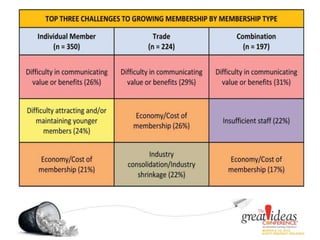
Growing your Association
through Innovative
Membership Models
Introduction
• Tony Rossell, Senior Vice President
• Marketing General Incorporated
• Seventy Five (75) staff members
• Vice Chair of the ASAE Membership Section Council
• Writes the Membership Marketing Blog
• Started the MGI Membership Marketing
Benchmarking Report
• Contributing author to ASAE’s Membership Essentials
(2008) and Membership Marketing (2000)
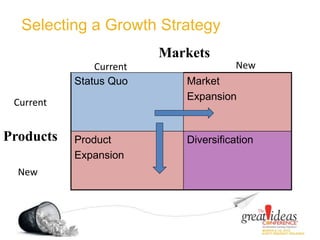
Selecting a Growth Strategy
Status Quo Market
Expansion
Product
Expansion
Diversification
Markets
Products
Current New
New
Current
Product Line Extension
“Adding depth to an existing product line by
introducing new products in the same product
category; product line extensions give
customers greater choice and help to protect
the firm from a flanking attack by a
competitor.“
The Marketing Dictionary
A Data Source
5
36%
35%
15%
1%
13%
70%
15%
5%
2%
9%
49%
19%
19%
3%
11%
The membership dues are based on
certain attributes (e.g., qualifications,
experience, company size, revenue)
Everyone pays the same membership
dues
The membership dues are based on a
tiered structure of increasing benefits
The membership dues are based on
member-selected benefits (a la carte)
Other
Individual (n = 346)
Trade (n = 223)
Combination (n = 197)
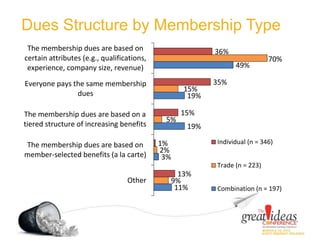
Dues Structure by Membership Type
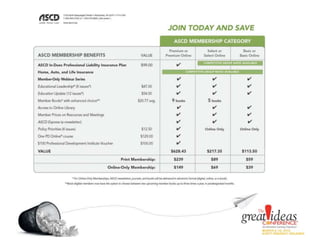
Tiered Membership
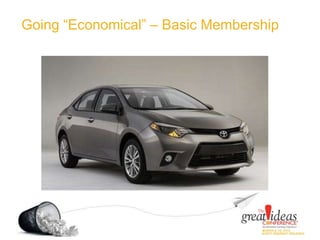
Going “Economical” – Basic Membership
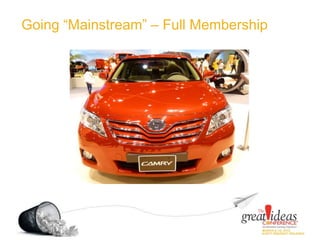
Going “Mainstream” – Full Membership
Going “First Class” – Premium Membership
Organizational or Hybrid Membership
Going “My Way”– Organizational
Membership/Hybrid
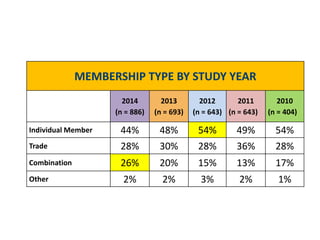
MEMBERSHIP TYPE BY STUDY YEAR
2014
(n = 886)
2013
(n = 693)
2012
(n = 643)
2011
(n = 643)
2010
(n = 404)
Individual Member 44% 48% 54% 49% 54%
Trade 28% 30% 28% 36% 28%
Combination 26% 20% 15% 13% 17%
Other 2% 2% 3% 2% 1%
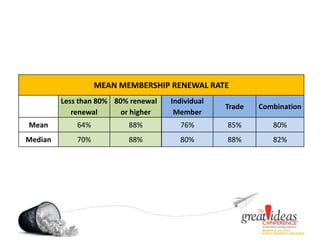
MEAN MEMBERSHIP RENEWAL RATE
Less than 80%
renewal
80% renewal
or higher
Individual
Member
Trade Combination
Mean 64% 88% 76% 85% 80%
Median 70% 88% 80% 88% 82%
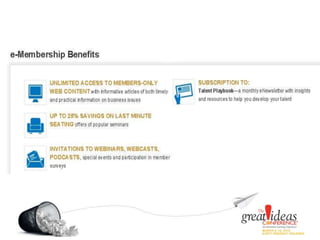
Online E-Membership OR Freemium
Membership
•
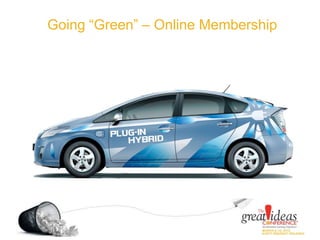
Going “Green” – Online Membership
Over the past decade “freemium”—a
combination of “free” and “premium”—has
become the dominant business model
among internet start-ups and smartphone
app developers. Users get basic features at
no cost and can access richer functionality
for a subscription fee. If you’ve networked
on LinkedIn . . . . you’ve experienced the
model firsthand.
Harvard Business Review, May 2014
Group Membership
•
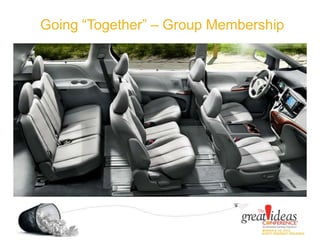
Going “Together” – Group Membership
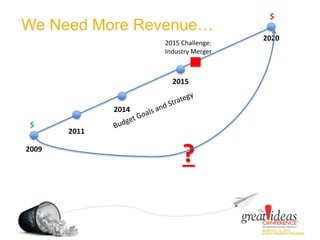
We Need More Revenue…
2009
2015 Challenge:
Industry Merger
2011
2014
2015
2020
$
$
?
What can get us there
• Individual Memberships
– $75 for Individual Members
• Training Courses
– More than 30 online training courses
• Leadership Programs
– 2 week long leadership programs
The Original Plan
• Partner Funding
– Pay an upfront “dues” fees to further discounts
• Minimum number of members required
– 25% of total workforce had to be members
• Benefits of this “Fund”
– Input into our programs
– Discounts on programs
– Specialized Reporting
• LAUNCH IT WITH NO INPUT OR FEEDBACk
The Original Plan Backlash
• Partner Funding Has No ROI
– We always get questions on our value proposition
• Membership Minimum Not an Option
– 25% of total workforce had to be members
• Biggest Benefit of this “Fund” was the most damaging
– All members expected to be listened to
• Some Positives…Everyone liked the discounts and
specialized reporting
Going From Old to New
• Define What Makes a Partner
– Spend significant dollars with us
• What Does Our Current Data Say?
– Identify organizations that we could identify as partners
• Level the Playing Field of Partnership
– Ensure that all companies can be a partner, regardless of size
• Vet the Program with the Industry
– Get Feedback on value, partner benefits
• Set Internal Goals to Remain Focused On
– New Goal was about engagement
The New Plan
• Spending Thresholds Established
– Spending for Partnership Dependent on the Org Size
• Show the Historical Data
– Let Organizations Understand What They do with Us Already
• Simplify Further Engagement
– Create “Account Executives” to Present Partnership
• Incentivize Future Involvement
– Provide benefits to get more involved
• Create Internal Tracking
– Understand if our Partnerships are working
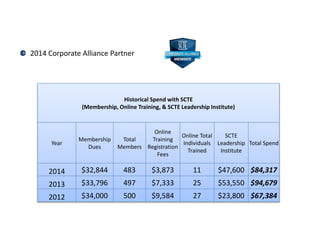
ORGANIZATION X: SCTE INVOLVEMENT
2014 Corporate Alliance Partner
Historical Spend with SCTE
(Membership, Online Training, & SCTE Leadership Institute)
Year
Membership
Dues
Total
Members
Online
Training
Registration
Fees
Online Total
Individuals
Trained
SCTE
Leadership
Institute
Total Spend
2014 $32,844 483 $3,873 11 $47,600 $84,317
2013 $33,796 497 $7,333 25 $53,550 $94,679
2012 $34,000 500 $9,584 27 $23,800 $67,384
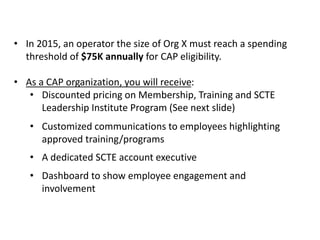
GCI SPENDING THRESHOLD AND
BENEFITS
• In 2015, an operator the size of Org X must reach a spending
threshold of $75K annually for CAP eligibility.
• As a CAP organization, you will receive:
• Discounted pricing on Membership, Training and SCTE
Leadership Institute Program (See next slide)
• Customized communications to employees highlighting
approved training/programs
• A dedicated SCTE account executive
• Dashboard to show employee engagement and
involvement
BENEFITS OF CAP
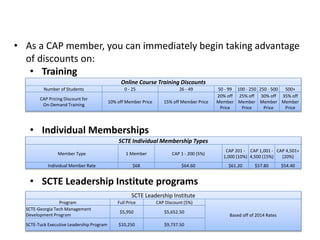
• As a CAP member, you can immediately begin taking advantage
of discounts on:
• Training
• Individual Memberships
• SCTE Leadership Institute programs
Online Course Training Discounts
Number of Students 0 - 25 26 - 49 50 - 99 100 - 250 250 - 500 500+
CAP Pricing Discount for
On-Demand Training
10% off Member Price 15% off Member Price
20% off
Member
Price
25% off
Member
Price
30% off
Member
Price
35% off
Member
Price
SCTE Individual Membership Types
Member Type 1 Member CAP 1 - 200 (5%)
CAP 201 -
1,000 (10%)
CAP 1,001 -
4,500 (15%)
CAP 4,501+
(20%)
Individual Member Rate $68 $64.60 $61.20 $57.80 $54.40
SCTE Leadership Institute
Program Full Price CAP Discount (5%)
Based off of 2014 Rates
SCTE-Georgia Tech Management
Development Program
$5,950 $5,652.50
SCTE-Tuck Executive Leadership Program $10,250 $9,737.50
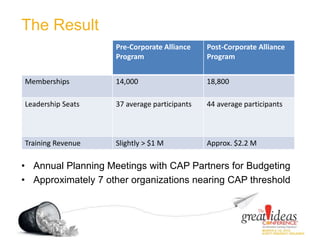
The Result
Pre-Corporate Alliance
Program
Post-Corporate Alliance
Program
Memberships 14,000 18,800
Leadership Seats 37 average participants 44 average participants
Training Revenue Slightly > $1 M Approx. $2.2 M
• Annual Planning Meetings with CAP Partners for Budgeting
• Approximately 7 other organizations nearing CAP threshold
Introduction
• Addy M. Kujawa, CAE, executive director
• American Association of Orthopaedic Executives
(AAOE)
• Indianapolis, IN
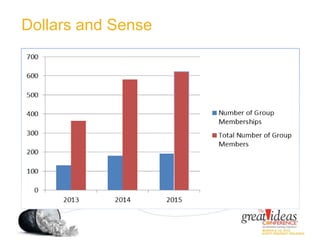
• Members: Just under 1,400
• Individual membership
• Six (6) staff members
• Council Member, Membership Section Council
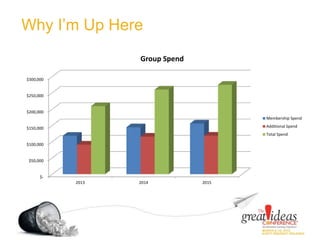
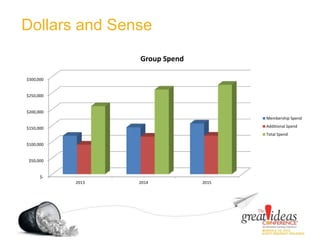
Why I’m Up Here
$-
$50,000
$100,000
$150,000
$200,000
$250,000
$300,000
2013 2014 2015
Group Spend
Membership Spend
Additional Spend
Total Spend
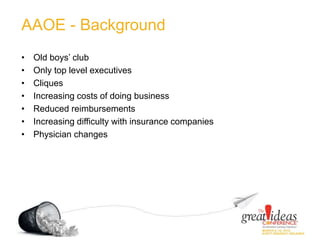
AAOE - Background
• Old boys’ club
• Only top level executives
• Cliques
• Increasing costs of doing business
• Reduced reimbursements
• Increasing difficulty with insurance companies
• Physician changes
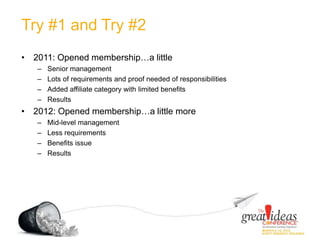
Try #1 and Try #2
• 2011: Opened membership…a little
– Senior management
– Lots of requirements and proof needed of responsibilities
– Added affiliate category with limited benefits
– Results
• 2012: Opened membership…a little more
– Mid-level management
– Less requirements
– Benefits issue
– Results
The Third Times the Charm!
• Research
• Models we explored
• Hurdles
• Questions we needed to answer
• Criteria revamp
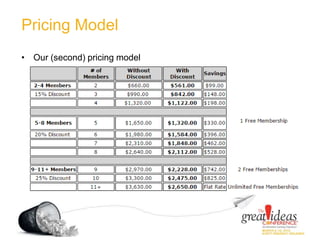
Pricing Model
• Our (second) pricing model
Dollars and Sense
Dollars and Sense
$-
$50,000
$100,000
$150,000
$200,000
$250,000
$300,000
2013 2014 2015
Group Spend
Membership Spend
Additional Spend
Total Spend
Lessons Learned
• Don’t rush it
• Practice your math skills
• Communication
• Track and correct
• Small associations CAN make this change
Contact Us
Tony Rossell
Senior Vice President
Marketing General, Inc.
Tony@MarketingGeneral.com
Phone: 703-706-0360
Twitter handle:@TonyRossell
Bill Schankel, CAE
Vice President, Marketing
Society of Cable
Telecommunications
Engineers
bschankel@scte.org
Phone: 800-542-5040
Twitter handle: @SchankelCAE
Addy M. Kujawa, CAE
Executive Director
American Association of
Orthopaedic Executives
akujawa@aaoe.net
Phone: 317-472-2541
Twitter handle: @AddyKujawa

Growing Your Association through Innovative Membership Models

  • 1.
    Growing your Association throughInnovative Membership Models
  • 2.
    Introduction • Tony Rossell,Senior Vice President • Marketing General Incorporated • Seventy Five (75) staff members • Vice Chair of the ASAE Membership Section Council • Writes the Membership Marketing Blog • Started the MGI Membership Marketing Benchmarking Report • Contributing author to ASAE’s Membership Essentials (2008) and Membership Marketing (2000)
  • 3.
    Selecting a GrowthStrategy Status Quo Market Expansion Product Expansion Diversification Markets Products Current New New Current
  • 4.
    Product Line Extension “Addingdepth to an existing product line by introducing new products in the same product category; product line extensions give customers greater choice and help to protect the firm from a flanking attack by a competitor.“ The Marketing Dictionary
  • 5.
  • 6.
    36% 35% 15% 1% 13% 70% 15% 5% 2% 9% 49% 19% 19% 3% 11% The membership duesare based on certain attributes (e.g., qualifications, experience, company size, revenue) Everyone pays the same membership dues The membership dues are based on a tiered structure of increasing benefits The membership dues are based on member-selected benefits (a la carte) Other Individual (n = 346) Trade (n = 223) Combination (n = 197) Dues Structure by Membership Type
  • 8.
  • 9.
  • 10.
  • 11.
    Going “First Class”– Premium Membership
  • 13.
  • 14.
    Going “My Way”–Organizational Membership/Hybrid
  • 15.
    MEMBERSHIP TYPE BYSTUDY YEAR 2014 (n = 886) 2013 (n = 693) 2012 (n = 643) 2011 (n = 643) 2010 (n = 404) Individual Member 44% 48% 54% 49% 54% Trade 28% 30% 28% 36% 28% Combination 26% 20% 15% 13% 17% Other 2% 2% 3% 2% 1%
  • 18.
    MEAN MEMBERSHIP RENEWALRATE Less than 80% renewal 80% renewal or higher Individual Member Trade Combination Mean 64% 88% 76% 85% 80% Median 70% 88% 80% 88% 82%
  • 19.
    Online E-Membership ORFreemium Membership
  • 20.
    • Going “Green” –Online Membership
  • 22.
    Over the pastdecade “freemium”—a combination of “free” and “premium”—has become the dominant business model among internet start-ups and smartphone app developers. Users get basic features at no cost and can access richer functionality for a subscription fee. If you’ve networked on LinkedIn . . . . you’ve experienced the model firsthand. Harvard Business Review, May 2014
  • 23.
  • 24.
  • 25.
    We Need MoreRevenue… 2009 2015 Challenge: Industry Merger 2011 2014 2015 2020 $ $ ?
  • 26.
    What can getus there • Individual Memberships – $75 for Individual Members • Training Courses – More than 30 online training courses • Leadership Programs – 2 week long leadership programs
  • 27.
    The Original Plan •Partner Funding – Pay an upfront “dues” fees to further discounts • Minimum number of members required – 25% of total workforce had to be members • Benefits of this “Fund” – Input into our programs – Discounts on programs – Specialized Reporting • LAUNCH IT WITH NO INPUT OR FEEDBACk
  • 28.
    The Original PlanBacklash • Partner Funding Has No ROI – We always get questions on our value proposition • Membership Minimum Not an Option – 25% of total workforce had to be members • Biggest Benefit of this “Fund” was the most damaging – All members expected to be listened to • Some Positives…Everyone liked the discounts and specialized reporting
  • 29.
    Going From Oldto New • Define What Makes a Partner – Spend significant dollars with us • What Does Our Current Data Say? – Identify organizations that we could identify as partners • Level the Playing Field of Partnership – Ensure that all companies can be a partner, regardless of size • Vet the Program with the Industry – Get Feedback on value, partner benefits • Set Internal Goals to Remain Focused On – New Goal was about engagement
  • 30.
    The New Plan •Spending Thresholds Established – Spending for Partnership Dependent on the Org Size • Show the Historical Data – Let Organizations Understand What They do with Us Already • Simplify Further Engagement – Create “Account Executives” to Present Partnership • Incentivize Future Involvement – Provide benefits to get more involved • Create Internal Tracking – Understand if our Partnerships are working
  • 31.
    ORGANIZATION X: SCTEINVOLVEMENT 2014 Corporate Alliance Partner Historical Spend with SCTE (Membership, Online Training, & SCTE Leadership Institute) Year Membership Dues Total Members Online Training Registration Fees Online Total Individuals Trained SCTE Leadership Institute Total Spend 2014 $32,844 483 $3,873 11 $47,600 $84,317 2013 $33,796 497 $7,333 25 $53,550 $94,679 2012 $34,000 500 $9,584 27 $23,800 $67,384
  • 32.
    GCI SPENDING THRESHOLDAND BENEFITS • In 2015, an operator the size of Org X must reach a spending threshold of $75K annually for CAP eligibility. • As a CAP organization, you will receive: • Discounted pricing on Membership, Training and SCTE Leadership Institute Program (See next slide) • Customized communications to employees highlighting approved training/programs • A dedicated SCTE account executive • Dashboard to show employee engagement and involvement
  • 33.
    BENEFITS OF CAP •As a CAP member, you can immediately begin taking advantage of discounts on: • Training • Individual Memberships • SCTE Leadership Institute programs Online Course Training Discounts Number of Students 0 - 25 26 - 49 50 - 99 100 - 250 250 - 500 500+ CAP Pricing Discount for On-Demand Training 10% off Member Price 15% off Member Price 20% off Member Price 25% off Member Price 30% off Member Price 35% off Member Price SCTE Individual Membership Types Member Type 1 Member CAP 1 - 200 (5%) CAP 201 - 1,000 (10%) CAP 1,001 - 4,500 (15%) CAP 4,501+ (20%) Individual Member Rate $68 $64.60 $61.20 $57.80 $54.40 SCTE Leadership Institute Program Full Price CAP Discount (5%) Based off of 2014 Rates SCTE-Georgia Tech Management Development Program $5,950 $5,652.50 SCTE-Tuck Executive Leadership Program $10,250 $9,737.50
  • 34.
    The Result Pre-Corporate Alliance Program Post-CorporateAlliance Program Memberships 14,000 18,800 Leadership Seats 37 average participants 44 average participants Training Revenue Slightly > $1 M Approx. $2.2 M • Annual Planning Meetings with CAP Partners for Budgeting • Approximately 7 other organizations nearing CAP threshold
  • 35.
    Introduction • Addy M.Kujawa, CAE, executive director • American Association of Orthopaedic Executives (AAOE) • Indianapolis, IN • Members: Just under 1,400 • Individual membership • Six (6) staff members • Council Member, Membership Section Council
  • 36.
    Why I’m UpHere $- $50,000 $100,000 $150,000 $200,000 $250,000 $300,000 2013 2014 2015 Group Spend Membership Spend Additional Spend Total Spend
  • 37.
    AAOE - Background •Old boys’ club • Only top level executives • Cliques • Increasing costs of doing business • Reduced reimbursements • Increasing difficulty with insurance companies • Physician changes
  • 38.
    Try #1 andTry #2 • 2011: Opened membership…a little – Senior management – Lots of requirements and proof needed of responsibilities – Added affiliate category with limited benefits – Results • 2012: Opened membership…a little more – Mid-level management – Less requirements – Benefits issue – Results
  • 39.
    The Third Timesthe Charm! • Research • Models we explored • Hurdles • Questions we needed to answer • Criteria revamp
  • 40.
    Pricing Model • Our(second) pricing model
  • 41.
  • 42.
    Dollars and Sense $- $50,000 $100,000 $150,000 $200,000 $250,000 $300,000 20132014 2015 Group Spend Membership Spend Additional Spend Total Spend
  • 43.
    Lessons Learned • Don’trush it • Practice your math skills • Communication • Track and correct • Small associations CAN make this change
  • 44.
    Contact Us Tony Rossell SeniorVice President Marketing General, Inc. Tony@MarketingGeneral.com Phone: 703-706-0360 Twitter handle:@TonyRossell Bill Schankel, CAE Vice President, Marketing Society of Cable Telecommunications Engineers bschankel@scte.org Phone: 800-542-5040 Twitter handle: @SchankelCAE Addy M. Kujawa, CAE Executive Director American Association of Orthopaedic Executives akujawa@aaoe.net Phone: 317-472-2541 Twitter handle: @AddyKujawa