
Emerging Hybrid
Membership Models
Greg Melia, CAE
Tony Rossell
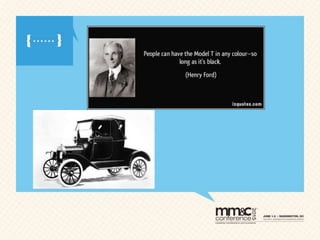
Traditional association model
• Individual or Company membership
• All members pay similar, annual dues
• Many “checkbook” members with limited usage
• Sponsors and advertising subsidize education, meetings,
and publications
• Joining is the operative norm
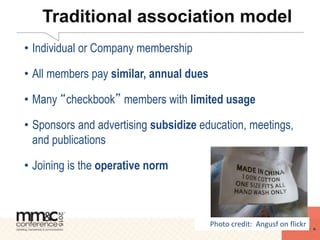
Photo credit: Angusf on flickr
• Technological advances
• Demographic, gender and age diversity
• Globalization
• Mass customization
• Changing nature of work & careers
Changing world
Definitions
• Professional Society — represents individuals with a
common background in a subject or a profession such as
law, medicine, and accounting.
• Trade Association —represents a group of companies
having a business or trade in common. Companies work
together to accomplish goals that no single firm could
reach by itself.
• Hybrid membership model — serves a combination of
individuals and organizations engaged in a cause, industry,
or profession
What are the trends for hybrid
memberships for associations?
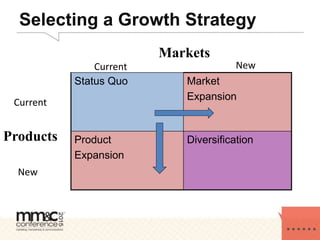
Selecting a Growth Strategy
Status Quo Market
Expansion
Product
Expansion
Diversification
Markets
Products
Current New
New
Current
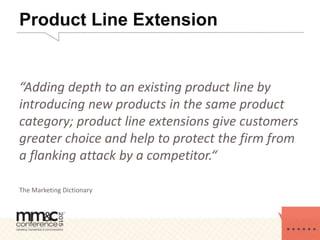
Product Line Extension
“Adding depth to an existing product line by
introducing new products in the same product
category; product line extensions give customers
greater choice and help to protect the firm from
a flanking attack by a competitor.“
The Marketing Dictionary
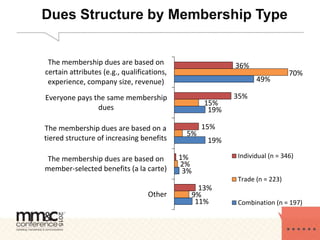
Dues Structure by Membership Type
36%
35%
15%
1%
13%
70%
15%
5%
2%
9%
49%
19%
19%
3%
11%
The membership dues are based on
certain attributes (e.g., qualifications,
experience, company size, revenue)
Everyone pays the same membership
dues
The membership dues are based on a
tiered structure of increasing benefits
The membership dues are based on
member-selected benefits (a la carte)
Other
Individual (n = 346)
Trade (n = 223)
Combination (n = 197)
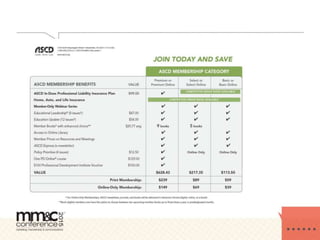
Tiered Membership
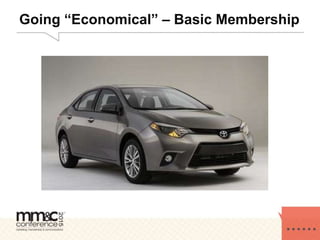
Going “Economical” – Basic Membership
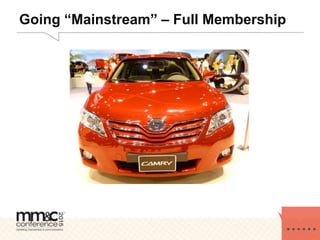
Going “Mainstream” – Full Membership
Going “First Class” – Premium Membership
Combination Organizational and
Individual Membership
“My Way”– Organizational and Individual
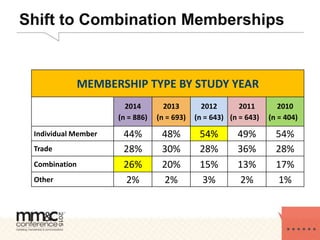
MEMBERSHIP TYPE BY STUDY YEAR
2014
(n = 886)
2013
(n = 693)
2012
(n = 643)
2011
(n = 643)
2010
(n = 404)
Individual Member 44% 48% 54% 49% 54%
Trade 28% 30% 28% 36% 28%
Combination 26% 20% 15% 13% 17%
Other 2% 2% 3% 2% 1%
Shift to Combination Memberships
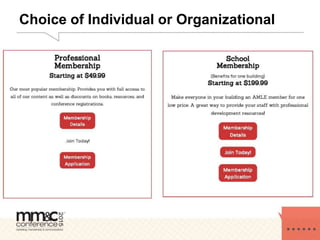
Choice of Individual or Organizational
Online E-Membership OR
Freemium Membership
•
Going “Green” – Online Membership
Over the past decade “freemium”—a
combination of “free” and “premium”—
has become the dominant business model
among internet start-ups and smartphone
app developers. Users get basic features at
no cost and can access richer functionality
for a subscription fee. If you’ve networked
on LinkedIn . . . . you’ve experienced the
model firsthand.
Harvard Business Review, May 2014
Group Membership
•
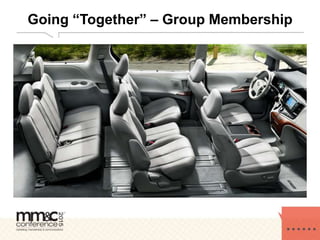
Going “Together” – Group Membership
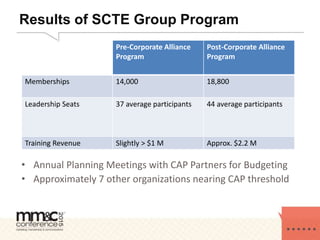
Results of SCTE Group Program
Pre-Corporate Alliance
Program
Post-Corporate Alliance
Program
Memberships 14,000 18,800
Leadership Seats 37 average participants 44 average participants
Training Revenue Slightly > $1 M Approx. $2.2 M
• Annual Planning Meetings with CAP Partners for Budgeting
• Approximately 7 other organizations nearing CAP threshold
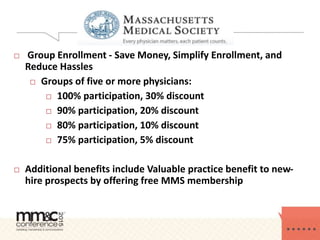
 Group Enrollment - Save Money, Simplify Enrollment, and
Reduce Hassles
 Groups of five or more physicians:
 100% participation, 30% discount
 90% participation, 20% discount
 80% participation, 10% discount
 75% participation, 5% discount
 Additional benefits include Valuable practice benefit to new-
hire prospects by offering free MMS membership
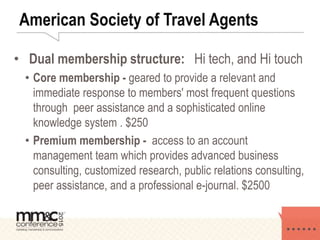
American Society of Travel Agents
• Dual membership structure: Hi tech, and Hi touch
• Core membership - geared to provide a relevant and
immediate response to members' most frequent questions
through peer assistance and a sophisticated online
knowledge system . $250
• Premium membership - access to an account
management team which provides advanced business
consulting, customized research, public relations consulting,
peer assistance, and a professional e-journal. $2500
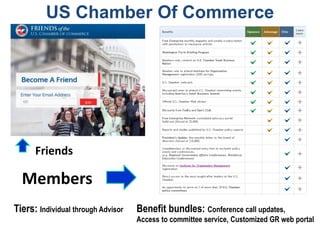
US Chamber Of Commerce
Tiers: Individual through Advisor Benefit bundles: Conference call updates,
Access to committee service, Customized GR web portal
Friends
Members
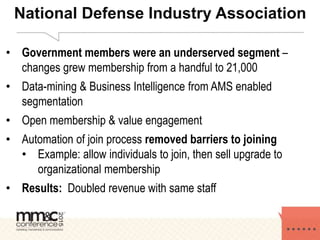
National Defense Industry Association
• Government members were an underserved segment –
changes grew membership from a handful to 21,000
• Data-mining & Business Intelligence from AMS enabled
segmentation
• Open membership & value engagement
• Automation of join process removed barriers to joining
• Example: allow individuals to join, then sell upgrade to
organizational membership
• Results: Doubled revenue with same staff
• Institutional Membership
• 10 “personal membership groups” in specialty
areas like healthcare engineering, risk
management, and human resource administration.
Personal membership includes access to some
(but not all) AHA benefits, such as members only
website and hospital literature.
• American Bankers Association too!
• Individual ($50 - $90)
– Build Job Skills (development programs and networks)
– Manage Your Career (member logo, mentoring)
– Stay Informed (magazine, e-news)
– Save Money (registration discounts, fellowships)
– Make the Case for Museums (advocacy)
• Museum Membership (Pay what you can - $8,000)
– Strive for Excellence (standards, resources)
– Distinguish Your Museum (directory listing)
– Stay Informed (magazine, e-news)
– Save Money (registration discounts, fellowships)
– Make the Case for Museums (advocacy)
What ASAE is doing
• Adding an organization focus to existing individual
membership
• Focusing on the 15,000 staffed member-based
professional c3s and c6s
• Developing persuasive offers for organization
purchases – from basic membership to Circle Club
• Adding a Career Portal to introduce ASAE to
potential members and foster engagement
All Approaches at a Glance
Career - Freemium model, which promotes value of ASAE
membership, programs, and services to help advance an
association professional’s career.
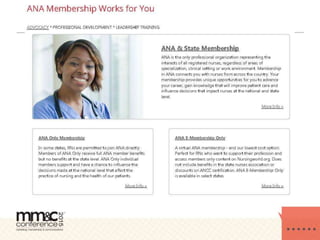
Individual Membership – Gives access to all ASAE content,
community and career resources.
Organizational Membership – Gives all employees at an
association the option of accessing ASAE content, plus the
option of participating in the ASAE community and career
resources. Also, bundled pre-purchase savings options.
Do you have a hybrid opportunity?
• What membership structure changes can expand
your organization beyond its current focus?
• How will you identify membership prospects?
• Who funds membership, participation & content?
• What is the core portion of the market? Is there a
high end subset or lower part of the market?
• How can membership growth create new product
and market opportunities?
Potential Directions
• Create a portfolio of engagement options – from customer to a
variety of membership opportunities
• Appeal to both individuals and organizations – maintain a
connection to individuals, while providing economy of scale to
organizations
• Leverage technology – to allow for targeted, customized
information delivered quickly in cost-effective ways
• Serve many niches – create a model and systems that provide
value to demographic and functional niches.
In conclusion …
• Understand what your members want and need.
• Develop member benefits that solve the problems.
• Assess the costs to provide those benefits and get rid of
anything that does not provide a benefit.
• Put a membership model in place that both aligns with
the way your audience wants to pay and makes it easy for
your offering to sell.
• Test these offerings and revenue models with members
and nonmembers. Adjust accordingly.
Source: The End of Membership as We Know It (ASAE Press)
Questions? Contact us!
Greg Melia, CAE
Chief Member Relations and Strategy Development Officer
ASAE
gmelia@asaecenter.org
Twitter: @gmeliacae
Tony Rossell
Senior Vice President
Marketing General, Inc.
Tony@MarketingGeneral.com
Twitter: @TonyRossell

Emerging Hybrid Membership Models

  • 1.
  • 2.
    Traditional association model •Individual or Company membership • All members pay similar, annual dues • Many “checkbook” members with limited usage • Sponsors and advertising subsidize education, meetings, and publications • Joining is the operative norm Photo credit: Angusf on flickr
  • 3.
    • Technological advances •Demographic, gender and age diversity • Globalization • Mass customization • Changing nature of work & careers Changing world
  • 4.
    Definitions • Professional Society— represents individuals with a common background in a subject or a profession such as law, medicine, and accounting. • Trade Association —represents a group of companies having a business or trade in common. Companies work together to accomplish goals that no single firm could reach by itself. • Hybrid membership model — serves a combination of individuals and organizations engaged in a cause, industry, or profession
  • 5.
    What are thetrends for hybrid memberships for associations?
  • 6.
    Selecting a GrowthStrategy Status Quo Market Expansion Product Expansion Diversification Markets Products Current New New Current
  • 7.
    Product Line Extension “Addingdepth to an existing product line by introducing new products in the same product category; product line extensions give customers greater choice and help to protect the firm from a flanking attack by a competitor.“ The Marketing Dictionary
  • 8.
    Dues Structure byMembership Type 36% 35% 15% 1% 13% 70% 15% 5% 2% 9% 49% 19% 19% 3% 11% The membership dues are based on certain attributes (e.g., qualifications, experience, company size, revenue) Everyone pays the same membership dues The membership dues are based on a tiered structure of increasing benefits The membership dues are based on member-selected benefits (a la carte) Other Individual (n = 346) Trade (n = 223) Combination (n = 197)
  • 10.
  • 11.
  • 12.
  • 13.
    Going “First Class”– Premium Membership
  • 15.
  • 16.
  • 17.
    MEMBERSHIP TYPE BYSTUDY YEAR 2014 (n = 886) 2013 (n = 693) 2012 (n = 643) 2011 (n = 643) 2010 (n = 404) Individual Member 44% 48% 54% 49% 54% Trade 28% 30% 28% 36% 28% Combination 26% 20% 15% 13% 17% Other 2% 2% 3% 2% 1% Shift to Combination Memberships
  • 18.
    Choice of Individualor Organizational
  • 19.
  • 20.
    • Going “Green” –Online Membership
  • 22.
    Over the pastdecade “freemium”—a combination of “free” and “premium”— has become the dominant business model among internet start-ups and smartphone app developers. Users get basic features at no cost and can access richer functionality for a subscription fee. If you’ve networked on LinkedIn . . . . you’ve experienced the model firsthand. Harvard Business Review, May 2014
  • 23.
  • 24.
  • 25.
    Results of SCTEGroup Program Pre-Corporate Alliance Program Post-Corporate Alliance Program Memberships 14,000 18,800 Leadership Seats 37 average participants 44 average participants Training Revenue Slightly > $1 M Approx. $2.2 M • Annual Planning Meetings with CAP Partners for Budgeting • Approximately 7 other organizations nearing CAP threshold
  • 27.
     Group Enrollment- Save Money, Simplify Enrollment, and Reduce Hassles  Groups of five or more physicians:  100% participation, 30% discount  90% participation, 20% discount  80% participation, 10% discount  75% participation, 5% discount  Additional benefits include Valuable practice benefit to new- hire prospects by offering free MMS membership
  • 28.
    American Society ofTravel Agents • Dual membership structure: Hi tech, and Hi touch • Core membership - geared to provide a relevant and immediate response to members' most frequent questions through peer assistance and a sophisticated online knowledge system . $250 • Premium membership - access to an account management team which provides advanced business consulting, customized research, public relations consulting, peer assistance, and a professional e-journal. $2500
  • 29.
    US Chamber OfCommerce Tiers: Individual through Advisor Benefit bundles: Conference call updates, Access to committee service, Customized GR web portal Friends Members
  • 30.
    National Defense IndustryAssociation • Government members were an underserved segment – changes grew membership from a handful to 21,000 • Data-mining & Business Intelligence from AMS enabled segmentation • Open membership & value engagement • Automation of join process removed barriers to joining • Example: allow individuals to join, then sell upgrade to organizational membership • Results: Doubled revenue with same staff
  • 31.
    • Institutional Membership •10 “personal membership groups” in specialty areas like healthcare engineering, risk management, and human resource administration. Personal membership includes access to some (but not all) AHA benefits, such as members only website and hospital literature. • American Bankers Association too!
  • 32.
    • Individual ($50- $90) – Build Job Skills (development programs and networks) – Manage Your Career (member logo, mentoring) – Stay Informed (magazine, e-news) – Save Money (registration discounts, fellowships) – Make the Case for Museums (advocacy) • Museum Membership (Pay what you can - $8,000) – Strive for Excellence (standards, resources) – Distinguish Your Museum (directory listing) – Stay Informed (magazine, e-news) – Save Money (registration discounts, fellowships) – Make the Case for Museums (advocacy)
  • 33.
    What ASAE isdoing • Adding an organization focus to existing individual membership • Focusing on the 15,000 staffed member-based professional c3s and c6s • Developing persuasive offers for organization purchases – from basic membership to Circle Club • Adding a Career Portal to introduce ASAE to potential members and foster engagement
  • 34.
    All Approaches ata Glance Career - Freemium model, which promotes value of ASAE membership, programs, and services to help advance an association professional’s career. Individual Membership – Gives access to all ASAE content, community and career resources. Organizational Membership – Gives all employees at an association the option of accessing ASAE content, plus the option of participating in the ASAE community and career resources. Also, bundled pre-purchase savings options.
  • 35.
    Do you havea hybrid opportunity? • What membership structure changes can expand your organization beyond its current focus? • How will you identify membership prospects? • Who funds membership, participation & content? • What is the core portion of the market? Is there a high end subset or lower part of the market? • How can membership growth create new product and market opportunities?
  • 36.
    Potential Directions • Createa portfolio of engagement options – from customer to a variety of membership opportunities • Appeal to both individuals and organizations – maintain a connection to individuals, while providing economy of scale to organizations • Leverage technology – to allow for targeted, customized information delivered quickly in cost-effective ways • Serve many niches – create a model and systems that provide value to demographic and functional niches.
  • 37.
    In conclusion … •Understand what your members want and need. • Develop member benefits that solve the problems. • Assess the costs to provide those benefits and get rid of anything that does not provide a benefit. • Put a membership model in place that both aligns with the way your audience wants to pay and makes it easy for your offering to sell. • Test these offerings and revenue models with members and nonmembers. Adjust accordingly. Source: The End of Membership as We Know It (ASAE Press)
  • 38.
    Questions? Contact us! GregMelia, CAE Chief Member Relations and Strategy Development Officer ASAE gmelia@asaecenter.org Twitter: @gmeliacae Tony Rossell Senior Vice President Marketing General, Inc. Tony@MarketingGeneral.com Twitter: @TonyRossell

Editor's Notes

  • #3 Every 8 seconds someone will turn 65. Thousands of members will retire in the next 10 years Generations X and Y values the opportunity to: Lead Learn Make a difference. (Sheri, these points all come from Sarah Sladek’s new book for ASAE that will be released at Annual. If you prefer to add/replace with your research on generations, totally understand. “Two key factors have evolved that will prevent associations from ever having success by doing things the way they have been done for the past three centuries: technology and demographic shifts.” Sladek Technology has been a game-changer, giving people access to networks and information without the assistance of associations. Yet, the hurdle that technology poses pales in comparison to the generational shift that’s about to occur in the 21st century. Workers who suffered a spell of unemployment during Great Recession are, on average, less satisfied with their new jobs than workers who didn’t. They are more likely to consider themselves over-qualified for their current position. A majority of the re-employed (55%) report their family is worse off financially now than before the recession started. More than a third (35%) report they have had to make major changes in their lifestyle because of the bad economy; by contrast, just 20% of Americans who didn’t lose their job during the recession say the same. While they were out of work, six-in-ten of the re-employed seriously thought about switching fields; four-in-ten considered moving to an area where jobs were more plentiful and nearly as many went back to school or enrolled in job-retraining. From now until 2030, every eight seconds someone will turn 65. This shift in human capital—the largest shift in our country’s history—poses the greatest threat to associations because most associations remain entirely governed and supported by the Baby Boomer generation, and few have or are developing strategies to cushion themselves from this massive exodus of board members, committee chairs, and dedicated volunteers. , The New Recruit: What Your Association Needs to Know About X, Y, & Z  (2007):   “The Boomer-centric associations still think they can launch something new and it will resolve all their recruiting woes. These associations have overlooked the simple fact that the vast majority of their membership will retire in the next decade or two—and the generations to follow are radically different from the generations of the past two centuries.
  • #4 Every 8 seconds someone will turn 65. Thousands of members will retire in the next 10 years Generations X and Y values the opportunity to: Lead Learn Make a difference. (Sheri, these points all come from Sarah Sladek’s new book for ASAE that will be released at Annual. If you prefer to add/replace with your research on generations, totally understand. “Two key factors have evolved that will prevent associations from ever having success by doing things the way they have been done for the past three centuries: technology and demographic shifts.” Sladek Technology has been a game-changer, giving people access to networks and information without the assistance of associations. Yet, the hurdle that technology poses pales in comparison to the generational shift that’s about to occur in the 21st century. Workers who suffered a spell of unemployment during Great Recession are, on average, less satisfied with their new jobs than workers who didn’t. They are more likely to consider themselves over-qualified for their current position. A majority of the re-employed (55%) report their family is worse off financially now than before the recession started. More than a third (35%) report they have had to make major changes in their lifestyle because of the bad economy; by contrast, just 20% of Americans who didn’t lose their job during the recession say the same. While they were out of work, six-in-ten of the re-employed seriously thought about switching fields; four-in-ten considered moving to an area where jobs were more plentiful and nearly as many went back to school or enrolled in job-retraining. From now until 2030, every eight seconds someone will turn 65. This shift in human capital—the largest shift in our country’s history—poses the greatest threat to associations because most associations remain entirely governed and supported by the Baby Boomer generation, and few have or are developing strategies to cushion themselves from this massive exodus of board members, committee chairs, and dedicated volunteers. , The New Recruit: What Your Association Needs to Know About X, Y, & Z  (2007):   “The Boomer-centric associations still think they can launch something new and it will resolve all their recruiting woes. These associations have overlooked the simple fact that the vast majority of their membership will retire in the next decade or two—and the generations to follow are radically different from the generations of the past two centuries.
  • #6 Hybrid business definition: “Anything derived from heterogeneous sources, or composed of elements of different or incongruous kinds.” So Greg told you some reasons WHY associations are thinking more creatively about their membership models. I am going to share with you WHAT we are seeing in the greater association marketplace
  • #7 When it comes to growth opportunities for associations there are three classic strategic options: Status Quo – Optimizing your current programs. Market Expansion – Finding new market segments (AARP) Product Expansion – Growing your share of wallet within your current market. The third option is what we will be focusing on today.
  • #8 Key Concept: This is NOT a new marketing strategy. Effectively these concepts of tiered membership and combination membership represent the deployment of a basic marketing concept called “Product Line Extension”. However, it is an emerging trend in the association world.
  • #9 Only 15% of individual membership associations offer a tiered structure of membership benefits. Growth in organizations offering tiered membership was from 12% to 14% over the past year. Many based on “Who you are” instead of “What you get” 85% of trades offer only the same membership for all or versioned by size or revenue. 71% of individual associations offer only the same or versioned Student Associate Retired 38% Honorary 28% Affiliate Academic Unemployed 11% Government Public Sector Non-Profit Military Transitioning – Student 11% Consultant Young Professional 15%
  • #10 The historical way associations made membership available was: One size fits all Price is same for everyone OR based on who you were Benefits are the same for everyone
  • #11  Tiered Membership with both a Basic, Mid-Level, and a Premium or “Cadillac” Offering (Applicable to both Individual and Trade Groups). Often these tiers are built using already existing products and services that the association has in place like newsletters, books, research, or continuing education. Opportunities Share of Wallet Retention Additional Purchases Challenges Too expensive Elitism
  • #12 Provides an economical starting point – sample size instead of giant size Affordable for members paying from their own dues Builds larger membership numbers Provides a platform for upgrades to higher levels of membership
  • #13 Product: This mid-level membership has been the traditional association individual membership. Price testing shows that many people choose the mid-level option when offered a selection.
  • #14 Market Segment: There always seem to be about 20% of members who want the very best – prestige or premium pricing. Product: Additional benefits are typically drawn from products already in place at the association – Books, webinars, peer groups, special meetings. Marketing: This is an upgrade product and not an introductory product. Offer the option to your best members at renewal time. Results: Higher renewing members and higher levels of product purchases
  • #15 Example of Tiered Membership Structure Basic – Print or Online – Includes magazine and newsletters Select – Print or Online – Adds 5 books Premium – Print or Online – Adds Voucher, Online Course, 4 MORE books PROFESSIONAL Liability Insurance
  • #17 Organizational Membership Option (Combination or Hybrid) Opportunities Growth Multiple Membership Champions Retention Challenges Data Integrity and Updates Staff Time Infrastructure
  • #18 Key Concept: Again, data from the 2014 MMBR shows that the proportion of associations offering a combined membership of both and individual and an organizational option has nearly doubled. While the proportion of organizations offering an individual only option has decreased. Trade associations have remained constant.
  • #19 Here is an example of a combination membership organization. The organizational OR school membership allows everyone at that location with a membership access.
  • #20 Do your homework – product line extension is NOT a “silver bullet” Determine your strategy Who you are What you get
  • #21 Online E-Membership Opportunities Cost to service Attractive Lower Price Challenges Making the Value Proposition Tangible Retention Low introductory cost Benefits accessible from tablet or smart phone Much lower renewal rates – less product push Often ideal for Global membership Recommend forced or opt out CCAR billing
  • #22 Online E-Membership Opportunities Cost to service Attractive Lower Price Challenges Making the Value Proposition Tangible Retention
  • #23 Freemium Membership Opportunities High volume of prospective members accepting “free” Fast growth potential Ability to understand, research, an convert these members to a paid status Challenges Low conversion rates to paid status Long term strategy and payout Lack of a well thought out economic strategy and conversion system QUESTION: DOES ANYONE HERE OFFER THIS TYPE OF MODEL? HOW IS IT WORKING FOR YOU?
  • #25 Group Membership Opportunities Challenges
  • #28 Group Enrollment Improved Group Enrollment Discounts Up to 30% An ever increasing percentage of MMS members are part of physician groups that join the Society to take advantage of our group enrollment options.  Along with savings of up to 30% off regular state dues, our group enrollment program also offers convenience. Groups of five or more physicians are eligible to receive the following discounts: 100% participation, 30% discount  90% participation, 20% discount 80% participation, 10% discount  75% participation, 5% discount Save Money, Simplify Enrollment, and Reduce Hassles In addition to the savings, group enrollment offers significant practice management benefits: Simplified billing with one dues invoice for your entire physician group Accurate membership information with group rosters Reduced practice administrative hassles for physicians Valuable practice benefit to new-hire prospects by offering free MMS membership Click here for group enrollment materials Individual Membership Multiyear Savings Solo practitioners or physicians in groups with fewer than five members can now realize these same percentage discounts available through group enrollment and avoid the need to process MMS membership information on an annual basis by choosing from the following dues-saving multiyear options: 10-year membership, 30% discount 5-year membership, 20% discount 3-year membership, 10% discount 2-year membership, 5% discount Group Enrollment for Residents and Fellows The MMS offers dues-exempt enrollment for residents and fellows who enroll as part of an accredited residency training program. Read more
  • #29 Sheri 3 minutes Multi-tier American Society of Travel Agents (ASTA) http://www.asta.org/join/?navItemNumber=1498 Core membership. These members will find ASTA making a real commitment to building a technology infrastructure to support enhanced online services, such as peer assistance and a knowledge system similar to that used by Dell, Microsoft, and other Fortune 500 firms. The strategy is geared to provide a relevant and immediate response to members' questions. "The core membership will find great value in this," says Ruden. "It's those types of repetitive questions and assistance queries that we need to institutionalize and deliver electronically." Core membership dues are $250 a year for an individual or agency. Premium membership. For $2,500 a year, each premium member has access to an account management team composed of one lead person and one or two additional staff backups. Teams will provide such services as advanced business consulting, customized research, public relations consulting, peer assistance, and a professional e-journal. Premium members may identify four additional employees of their agencies who will be eligible to access benefits.
  • #30 Goals included grow total revenue through affinity programs Seven membership tiers, ranging from $80 at the entry or product level to $5,700 at the gold level Results after nine years: Doubled involved firms Dues revenue increased half a million Affinity program revenues quadrupled Three membership tiers Durham 2.0 – “key investor group”, highest level Business 2.0 – mid-level, mid-benefits Entry-level – $99, all electronic Custom options – Enhanced online listing. Customer options – Non-member Cert. of Origin; Relocation Guide; Map
  • #31 Data-mining & Business Intelligence from AMS enabled segmentation Open membership drives value engagement Maintain membership growth during economic downturn without increasing staff http://www.ndia.org/MembershipAndChapters/Pages/MembershipPackages.aspx http://www.youtube.com/watch?v=D5fkyFAgXWo Doubled revenue with same staff business automation AHA moment: Government members were an underserved segment: they attend conferences, but not joining. Our current model was an old model, little automation. Massive growth required web based tools to manage relationships Grew govt members from handful to 21,000 Pilot first, soft launch, learn test, adjust, go big when you are seeing results Decision based in customer data
  • #32 ASHHRA membership also includes: AHA Affiliation Access to the Members Only section of the AHA website at www.aha.org Access to the world's largest collection of hospital literature through the AHA Resource Center. Member discounts on more than 300 publications and AV resources, available through the AHA Member Resources, Publications and Products Catalog. The opportunity to partner with other personal membership societies of AHA on a variety of projects and issues of mutual interest to the groups. Access to the AHA Quality Center Web site and its resources. ABA Membership Opportunities Page Content ABA Bank Membership US Domestic Banks De Novo Banks International Banks Insurance Institutions ABA Service Membership Non-banks & Other Service Providers ABA Individual Memberships ABA Marketing Network Certified Financial Professionals ABA Subsidiary Individual Memberships ABA Marketing Network The ABA Marketing Network is the premier organization for financial marketing. Bringing together the brightest bank marketing professionals who are ready and willing to share their challenges, resources and successes. Learn more about the ABA Marketing Network.  For more information call 1-800-BANKERS or email marketingnetwork@aba.com. Certified Financial Professionals - ICB The Institute of Certified Bankers (ICB) is a national association of certified professionals in the financial services industry. The ICB is a non-profit, independent corporation that is sponsored by the American Bankers Association (ABA). ICB is dedicated to promoting excellence and professionalism in all parts of the industry. Visit ICB's website.
  • #35  ASAE offers a wide variety of programs, products and services.
  • #36 Suggest Sue Bowman 8 minutes total next several slides Sladek: One of the key components of any growth plan is a thorough understanding of the target market. You must know who is most likely to buy your product and why and must plan how you will reach them. Data analysis: Analyzing your current and potential membership, demographic trends, etc. Membership marketing: Identifying marketable value propositions Dues structuring options: thinking beyond member-supplier rates; alternative structures for trade associations; hybrid models Leveraging Technology: practical considerations for effective growth Building buy-in: Making your case for change to staff, the Board, your members & industry
  • #37 Sue 4 minutes National Trust for Historic Preservation describes their structure as one whereby 150,000 donors support the services provided to their 7-8,000 leader members Texas Medical Association, operating in what may in fact be a small country, has 35,200 physician members and another 9,100 student and resident members. Their relationship to their chapters is much like a national to state relationship. They have conjoint membership with local county medical societies, supporting local chapters with technological assistance, billing services, database management, IT support, website development, marketing and messaging, graphics and printing assistance, and speakers for events. They spend time and money making sure county medical societies are successful. "A member for them is a member for us and vice versa. We also have spent time building our association brand over the years and it has paid off.“TMA student memberships are free, residents pay $40, first-year docs pay $244, and actives pay $489.   Carolinas Independent Automobile Dealers Assoc. increased dues 27% in 2008 after not increasing dues for 12 years. Rather than change dues, they added the VIP card which offers $1800 in discounts on various services. This is available to regular members but not associate/vendors. International Society for Pharmaceutical Engineering "Emerging Economy" membership to ensure that the international element of this core value was realized. Individual dues for the category are priced at 30 euro, considerably lower than the 140 euro paid by active individual members. "They are individuals in pharmaceutical manufacturing and technology in countries that ISPE classifies as 'emerging economies' based on the World Bank rating," says Linda G. Brady, CAE, director of membership services for the association. ISPE determined that membership growth in countries where the pharmaceutical industry is rapidly growing would be stifled unless it offered a lower-cost membership option. By delivering its magazine and newsletter via its Web site as a PDF, which eliminated printing and mailing costs to emerging-economy countries,
  • #38 Sarah closes, shares information about the new book availability. 4 minutes If you’re looking for a cheat sheet for building a membership dominance, the advice in this book comes down to six key points: Understand what your members want and need. Develop member benefits that solve the problems of your target audience. Assess the costs to provide those benefits and get rid of anything that doesn’t provide a benefit. Put a membership model in place that both aligns with the way your audience wants to pay to have their problems solved and makes it easy for your offering to sell. Test these offerings and revenue models with members and nonmembers. Make adjustments accordingly. Repeat. If you’re looking for one piece of light-a-fire-under-my-CEO information it’s this: Change or die. There are no alternatives.