02.09

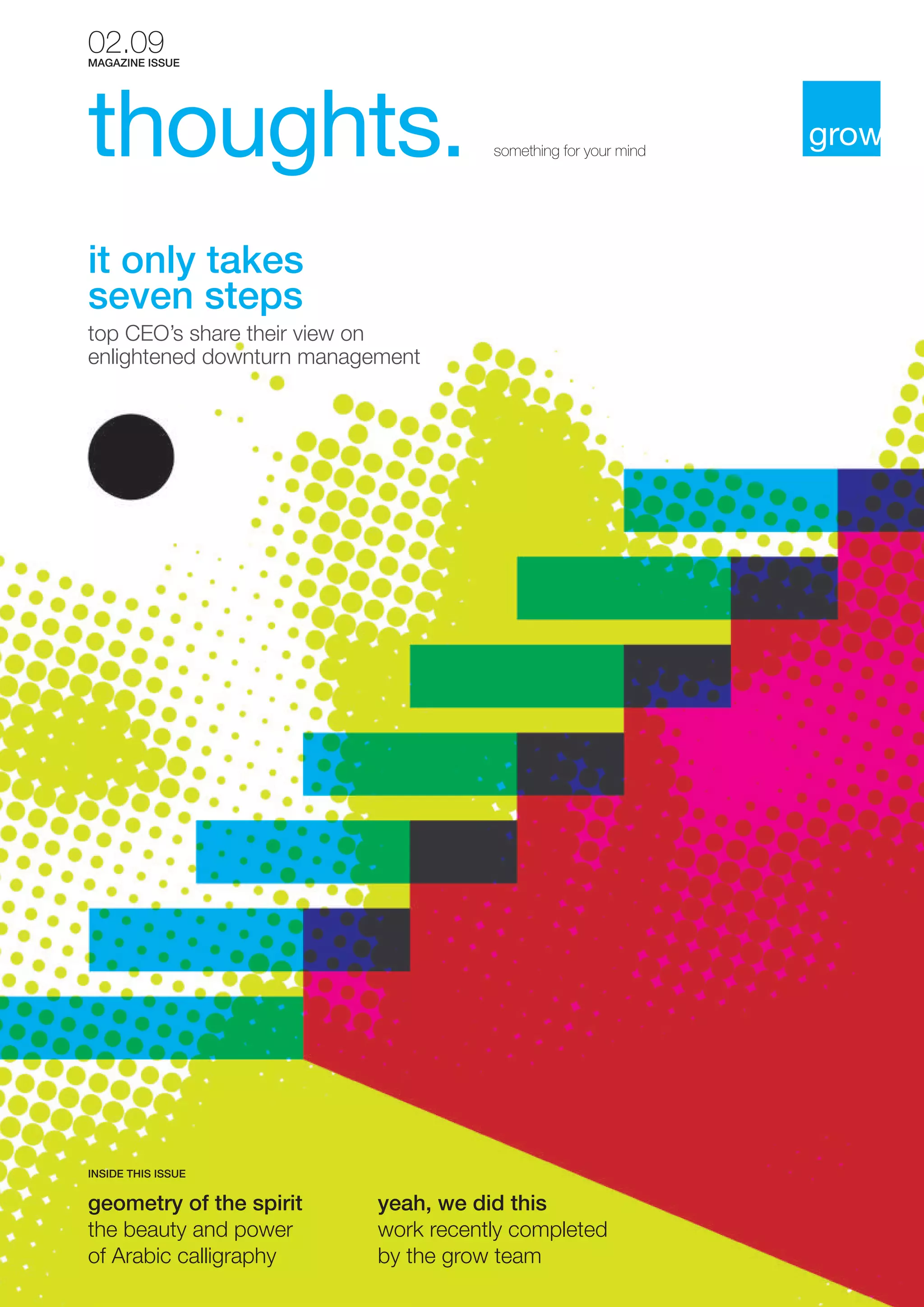
MAGAZINE ISSUE

thoughts.

something for your mind

it only takes
seven steps
top CEO’s share their view on
enlightened downturn management

INSIDE THIS ISSUE

geometry of the spirit
the beauty and power
of Arabic calligraphy

yeah, we did this
work recently completed
by the grow team
2 thoughts. 02.09

02.09 thoughts. 3

credits

BY ANTHONY RYMAN — MANAGING DIRECTOR OF GROW

Issue Writers

Editor

Anthony Ryman
Raj Fernandez
Bassel Allahham

Raj Fernandez
Lui Rogliano

Creative Director
Garry Behling

Typesetting

Graphic Elements

Photography

Cover Artwork

Lui Rogliano

Lui Rogliano

Jason Anonuevo
Lui Rogliano

Lui Rogliano

7 steps to enlightened
downturn management.

yeah,
we did this!

Top CEO’s believe that
cutting prices, reducing
salaries and making staff
redundant are the wrong
steps to take during an
economic downturn.

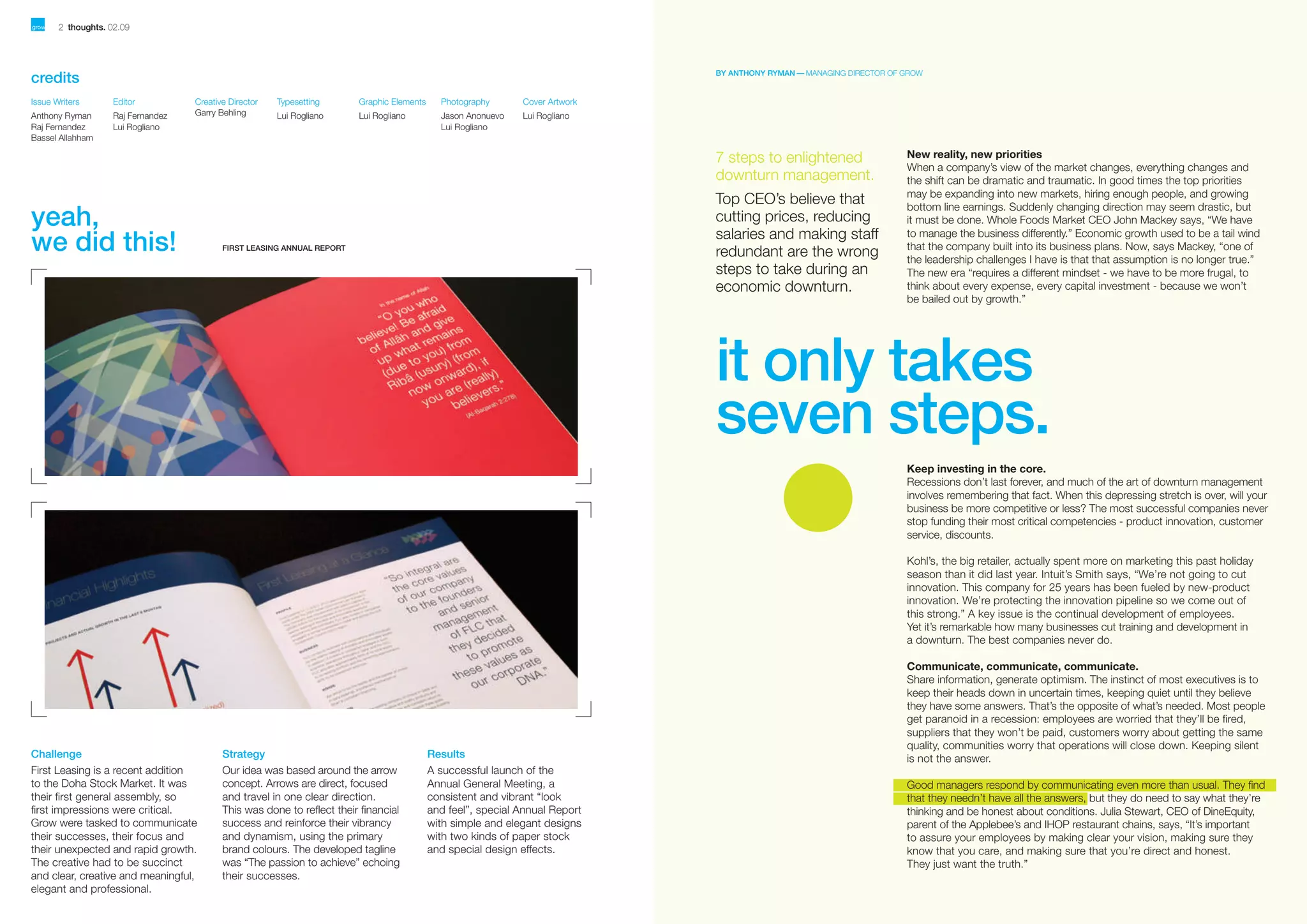
FIRST LEASING ANNUAL REPORT

New reality, new priorities
When a company’s view of the market changes, everything changes and
the shift can be dramatic and traumatic. In good times the top priorities
may be expanding into new markets, hiring enough people, and growing
bottom line earnings. Suddenly changing direction may seem drastic, but
it must be done. Whole Foods Market CEO John Mackey says, “We have
to manage the business differently.” Economic growth used to be a tail wind
that the company built into its business plans. Now, says Mackey, “one of
the leadership challenges I have is that that assumption is no longer true.”
The new era “requires a different mindset - we have to be more frugal, to
think about every expense, every capital investment - because we won’t
be bailed out by growth.”

it only takes
seven steps.
Keep investing in the core.
Recessions don’t last forever, and much of the art of downturn management
involves remembering that fact. When this depressing stretch is over, will your
business be more competitive or less? The most successful companies never
stop funding their most critical competencies - product innovation, customer
service, discounts.
Kohl’s, the big retailer, actually spent more on marketing this past holiday
season than it did last year. Intuit’s Smith says, “We’re not going to cut
innovation. This company for 25 years has been fueled by new-product
innovation. We’re protecting the innovation pipeline so we come out of
this strong.” A key issue is the continual development of employees.
Yet it’s remarkable how many businesses cut training and development in
a downturn. The best companies never do.

Challenge
First Leasing is a recent addition
to the Doha Stock Market. It was
their first general assembly, so
first impressions were critical.
Grow were tasked to communicate
their successes, their focus and
their unexpected and rapid growth.
The creative had to be succinct
and clear, creative and meaningful,
elegant and professional.

Strategy
Our idea was based around the arrow
concept. Arrows are direct, focused
and travel in one clear direction.
This was done to reflect their financial
success and reinforce their vibrancy
and dynamism, using the primary
brand colours. The developed tagline
was “The passion to achieve” echoing
their successes.

Results
A successful launch of the
Annual General Meeting, a
consistent and vibrant “look
and feel”, special Annual Report
with simple and elegant designs
with two kinds of paper stock
and special design effects.

Communicate, communicate, communicate.
Share information, generate optimism. The instinct of most executives is to
keep their heads down in uncertain times, keeping quiet until they believe
they have some answers. That’s the opposite of what’s needed. Most people
get paranoid in a recession: employees are worried that they’ll be fired,
suppliers that they won’t be paid, customers worry about getting the same
quality, communities worry that operations will close down. Keeping silent
is not the answer.
Good managers respond by communicating even more than usual. They find
that they needn’t have all the answers, but they do need to say what they’re
thinking and be honest about conditions. Julia Stewart, CEO of DineEquity,
parent of the Applebee’s and IHOP restaurant chains, says, “It’s important
to assure your employees by making clear your vision, making sure they
know that you care, and making sure that you’re direct and honest.
They just want the truth.”
4 thoughts. 02.09

02.09 thoughts. 5

Don’t rush to cut prices.
Yes, everyone would like to pay less, especially in a recession, but the dangers
of price chopping are greater than you may realize. McKinsey’s research finds
that in a typical S&P 500 company, a price cut of 5% would have to generate
increased sales volume of 19% to pay for itself - and that almost never
happens. The implication is that while holding prices steady may cause
sales to decline somewhat, that course may nonetheless be wiser.
It all depends on the pricing dynamics in your business, which may be
changing rapidly in this recession. For example, gasoline at $4 a gallon
caused many U.S. consumers to cut back drastically on discretionary
purchases; since gas today is below $2, some consumers may have more
available income - but may also be more worried about their jobs.
Now is the time to study price sensitivity in your markets much more
closely than before.
Re-evaluate people - and hire some good ones.
Funny thing is most employees can look like excellent performers in a
booming economy but now is the time to identify the ‘great pretenders’.
Working hard at that task is important, because if you need to lay people
off, as you well may, it’s critical that you choose wisely.

New problems call for new solutions.
We need to box clever in times like these. The astute thinkers understand
their customers’ businesses and can respond in innovative ways. For example,
McKinsey reports that when the economy was booming, a client company
that sells plastic resins developed a fast-curing resin for customers that wanted
maximum productivity from their injection-molding machines. But when the
economy turned down and clients no longer needed as much output from
their machines, the company developed a less expensive, slower-curing resin.
Customers are happy because their costs have fallen, and since the new
product is cheaper to make, the company maintains its profit margins even
when selling at a lower price. It’s a “win/win” situation for all.
No matter what business you’re in, you can redefine value for the customer.
When the economy was strong, CKE Restaurants, parent of the Hardee’s
and Carl’s Jr. chains, developed a winning strategy based on massive burgers
at premium prices. Reacting to the recession by suddenly selling skinny
burgers cheap would destroy the company’s market position, so it’s responding
in other ways. “We can’t add meat to a burger anymore,” says CKE marketing
chief Brad Haley, since the cost is too high. “We have to be more creative.
Carl’s Jr. is promoting a guacamole bacon cheeseburger. Avocados are a
less expensive topping.”

Then again if salaries were to get slashed, you would be tempted to reduce
them fairly across the employee spectrum in an effort to show that we’re all
in this together. But think of the message that practice sends to your best
performers, who will feel they’re being punished rather than rewarded for
their great work. Mel Stark of the Hay Group consulting firm points out that
in his survey of the World’s Most Admired Companies as ranked by Fortune,
the best ones take extra pains to reassure their “most driven and focused
employees,” the ones it is most important to keep. Instead of spreading the
pain, reward your best workers well, even in a recession. With the others,
get the most out of them, make them play several roles to be useful. You
could also trawl for the best performers working with the competition and
who face redundancy. This is the best time to pick the cream of the crop.
A good time for mergers and acquisitions.
It seems obvious that a recession is a great time to buy assets cheap.
The wonder is that so few companies do it. Merger activity tends to peak
when markets are at their height, while most companies see a recession as
a time to hoard resources until things improve. Companies are twice as likely
to acquire businesses in their major segments during an upturn as they are
during a downturn, the opposite of what makes sense.
Of course if you’re strapped, you can’t follow Warren Buffett’s dictum to
be greedy when others are fearful. But if you’re financially strong, this is your
moment. McKesson’s Hammergren says, “This is a great opportunity to pick
up small companies and their talent”.
Take the first step today. Who knows, on the path to enlightened downturn
management you might invent a few steps of your own. Heads up!

Source Acknowledgements
Fortune Magazine
Images
Lui Rogliano
www.flickr.com member:
David Gallagher (Customer Parking)
http://www.flickr.com/photos/anythreewords/
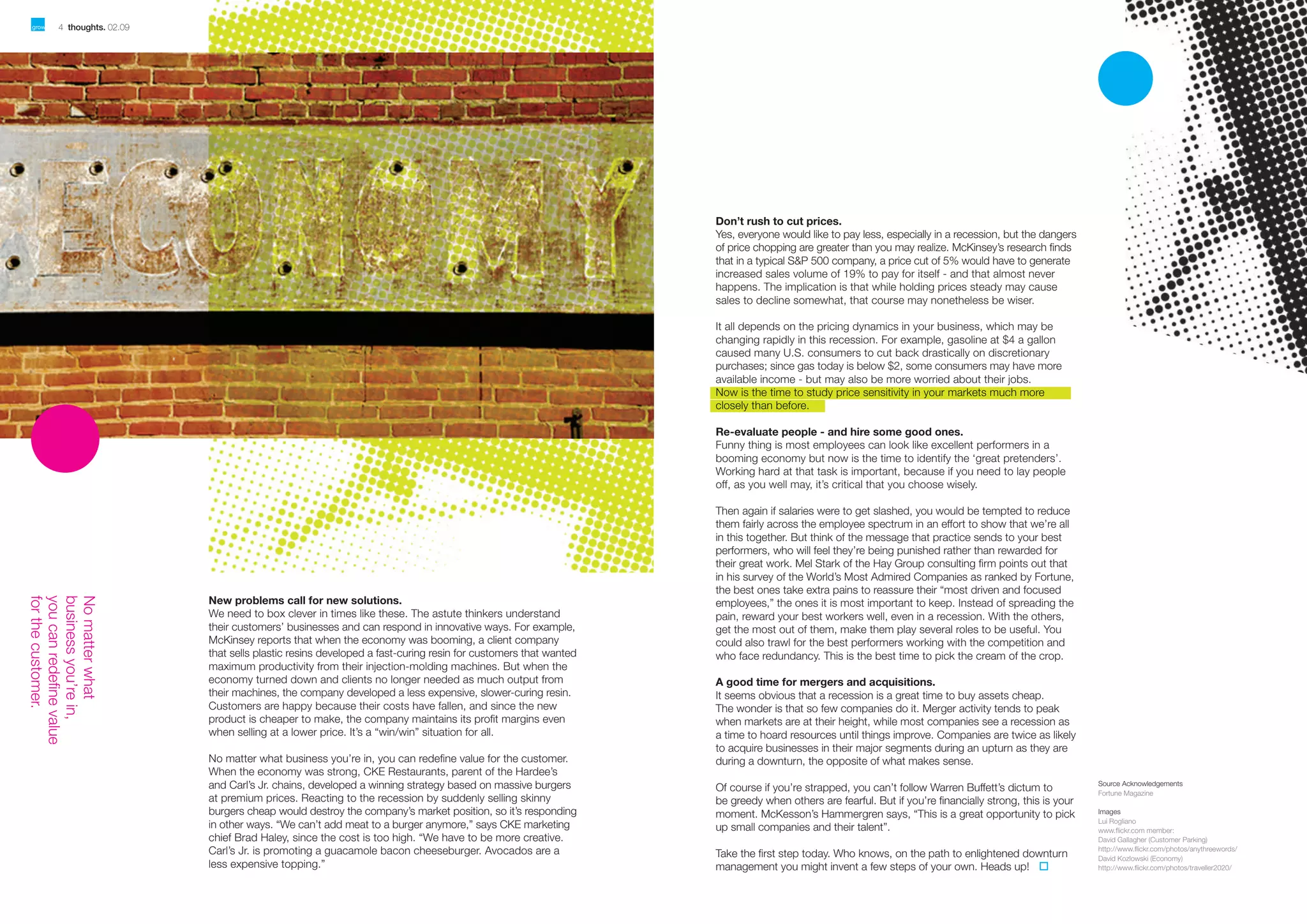
David Kozlowski (Economy)
http://www.flickr.com/photos/traveller2020/
6 thoughts. 02.09

yeah,
we did this!

02.09 thoughts. 7

BY BASSEL ALLAHHAM— SENIOR DESIGNER AT GROW

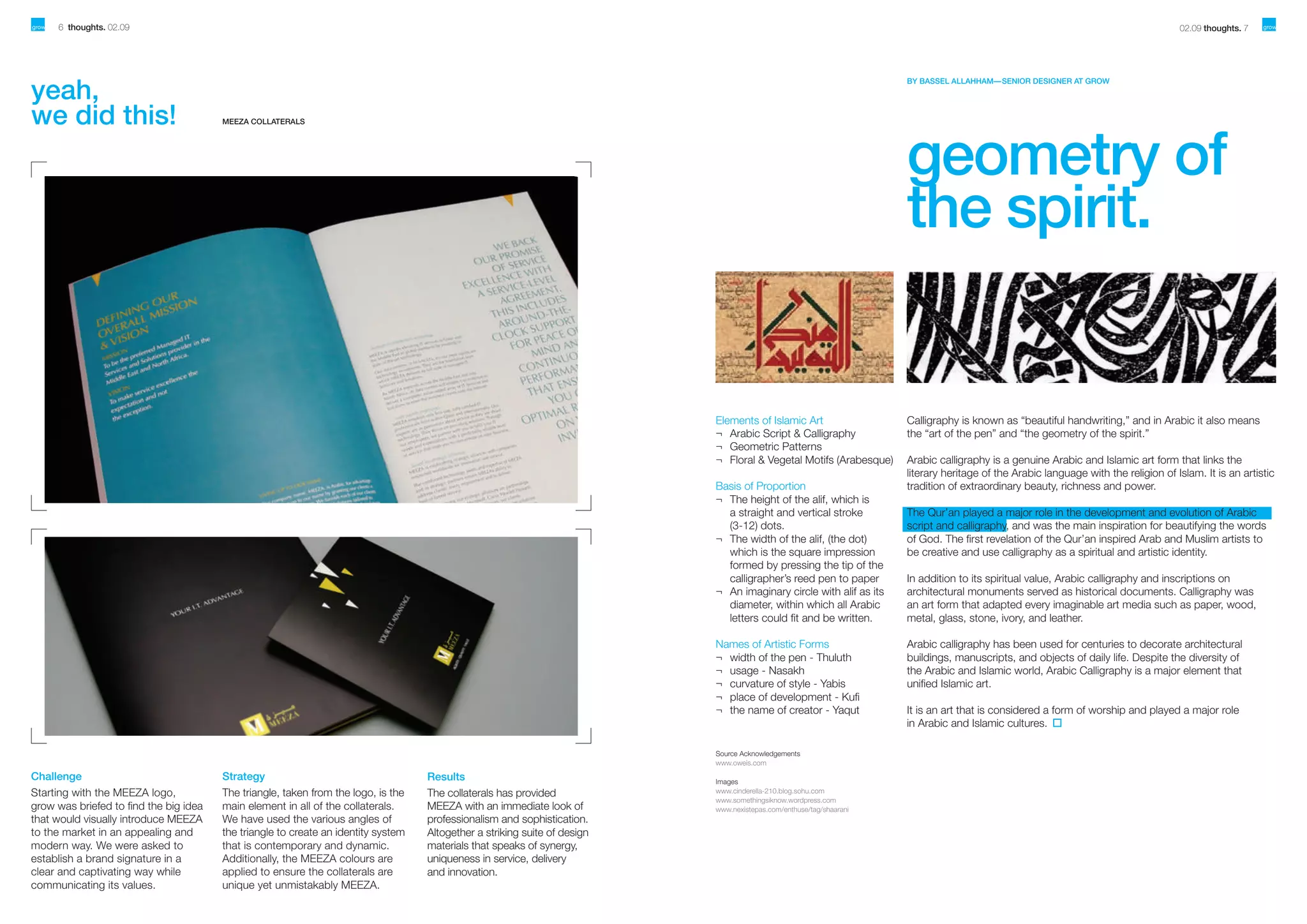
MEEZA COLLATERALS

geometry of
the spirit.

Elements of Islamic Art
¬	 Arabic Script & Calligraphy
¬	 Geometric Patterns
¬	 Floral & Vegetal Motifs (Arabesque)
Basis of Proportion
¬	 The height of the alif, which is
	 a straight and vertical stroke
	 (3-12) dots.
¬	 The width of the alif, (the dot)
	 which is the square impression
	 formed by pressing the tip of the
	 calligrapher’s reed pen to paper
¬	 An imaginary circle with alif as its
	 diameter, within which all Arabic
	 letters could fit and be written.
Names of Artistic Forms
¬	 width of the pen - Thuluth
¬	 usage - Nasakh
¬	 curvature of style - Yabis
¬	 place of development - Kufi
¬	 the name of creator - Yaqut

Source Acknowledgements
www.oweis.com

Challenge
Starting with the MEEZA logo,
grow was briefed to find the big idea
that would visually introduce MEEZA
to the market in an appealing and
modern way. We were asked to
establish a brand signature in a
clear and captivating way while
communicating its values.

Strategy
The triangle, taken from the logo, is the
main element in all of the collaterals.
We have used the various angles of
the triangle to create an identity system
that is contemporary and dynamic.
Additionally, the MEEZA colours are
applied to ensure the collaterals are
unique yet unmistakably MEEZA.

Results
The collaterals has provided
MEEZA with an immediate look of
professionalism and sophistication.
Altogether a striking suite of design
materials that speaks of synergy,
uniqueness in service, delivery
and innovation.

Images
www.cinderella-210.blog.sohu.com
www.somethingsiknow.wordpress.com
www.nexistepas.com/enthuse/tag/shaarani

Calligraphy is known as “beautiful handwriting,” and in Arabic it also means
the “art of the pen” and “the geometry of the spirit.”
Arabic calligraphy is a genuine Arabic and Islamic art form that links the
literary heritage of the Arabic language with the religion of Islam. It is an artistic
tradition of extraordinary beauty, richness and power.
The Qur’an played a major role in the development and evolution of Arabic
script and calligraphy, and was the main inspiration for beautifying the words
of God. The first revelation of the Qur’an inspired Arab and Muslim artists to
be creative and use calligraphy as a spiritual and artistic identity.
In addition to its spiritual value, Arabic calligraphy and inscriptions on
architectural monuments served as historical documents. Calligraphy was
an art form that adapted every imaginable art media such as paper, wood,
metal, glass, stone, ivory, and leather.
Arabic calligraphy has been used for centuries to decorate architectural
buildings, manuscripts, and objects of daily life. Despite the diversity of
the Arabic and Islamic world, Arabic Calligraphy is a major element that
unified Islamic art.
It is an art that is considered a form of worship and played a major role
in Arabic and Islamic cultures.
8 thoughts. 02.09

grow
3rd Floor
Thani Bin Abdullah Complex
Ibn Seena Street, Doha, Qatar
T +974 444 6222
F +974 431 4982
E grow@growqatar.com
W www.growqatar.com
© grow 2008. All rights reserved.
No part of this publication may be reproduced without prior written permission
of grow. The contents, layout and design are copyrighted and are protected by
worldwide copyright laws and treaty provisions including Qatar Law No.9 of 2002
on the protection of copyrights and related rights.

grow Thoughts Issue 2

  • 1.
    02.09 MAGAZINE ISSUE thoughts. something foryour mind it only takes seven steps top CEO’s share their view on enlightened downturn management INSIDE THIS ISSUE geometry of the spirit the beauty and power of Arabic calligraphy yeah, we did this work recently completed by the grow team
  • 2.
    2 thoughts. 02.09 02.09thoughts. 3 credits BY ANTHONY RYMAN — MANAGING DIRECTOR OF GROW Issue Writers Editor Anthony Ryman Raj Fernandez Bassel Allahham Raj Fernandez Lui Rogliano Creative Director Garry Behling Typesetting Graphic Elements Photography Cover Artwork Lui Rogliano Lui Rogliano Jason Anonuevo Lui Rogliano Lui Rogliano 7 steps to enlightened downturn management. yeah, we did this! Top CEO’s believe that cutting prices, reducing salaries and making staff redundant are the wrong steps to take during an economic downturn. FIRST LEASING ANNUAL REPORT New reality, new priorities When a company’s view of the market changes, everything changes and the shift can be dramatic and traumatic. In good times the top priorities may be expanding into new markets, hiring enough people, and growing bottom line earnings. Suddenly changing direction may seem drastic, but it must be done. Whole Foods Market CEO John Mackey says, “We have to manage the business differently.” Economic growth used to be a tail wind that the company built into its business plans. Now, says Mackey, “one of the leadership challenges I have is that that assumption is no longer true.” The new era “requires a different mindset - we have to be more frugal, to think about every expense, every capital investment - because we won’t be bailed out by growth.” it only takes seven steps. Keep investing in the core. Recessions don’t last forever, and much of the art of downturn management involves remembering that fact. When this depressing stretch is over, will your business be more competitive or less? The most successful companies never stop funding their most critical competencies - product innovation, customer service, discounts. Kohl’s, the big retailer, actually spent more on marketing this past holiday season than it did last year. Intuit’s Smith says, “We’re not going to cut innovation. This company for 25 years has been fueled by new-product innovation. We’re protecting the innovation pipeline so we come out of this strong.” A key issue is the continual development of employees. Yet it’s remarkable how many businesses cut training and development in a downturn. The best companies never do. Challenge First Leasing is a recent addition to the Doha Stock Market. It was their first general assembly, so first impressions were critical. Grow were tasked to communicate their successes, their focus and their unexpected and rapid growth. The creative had to be succinct and clear, creative and meaningful, elegant and professional. Strategy Our idea was based around the arrow concept. Arrows are direct, focused and travel in one clear direction. This was done to reflect their financial success and reinforce their vibrancy and dynamism, using the primary brand colours. The developed tagline was “The passion to achieve” echoing their successes. Results A successful launch of the Annual General Meeting, a consistent and vibrant “look and feel”, special Annual Report with simple and elegant designs with two kinds of paper stock and special design effects. Communicate, communicate, communicate. Share information, generate optimism. The instinct of most executives is to keep their heads down in uncertain times, keeping quiet until they believe they have some answers. That’s the opposite of what’s needed. Most people get paranoid in a recession: employees are worried that they’ll be fired, suppliers that they won’t be paid, customers worry about getting the same quality, communities worry that operations will close down. Keeping silent is not the answer. Good managers respond by communicating even more than usual. They find that they needn’t have all the answers, but they do need to say what they’re thinking and be honest about conditions. Julia Stewart, CEO of DineEquity, parent of the Applebee’s and IHOP restaurant chains, says, “It’s important to assure your employees by making clear your vision, making sure they know that you care, and making sure that you’re direct and honest. They just want the truth.”
  • 3.
    4 thoughts. 02.09 02.09thoughts. 5 Don’t rush to cut prices. Yes, everyone would like to pay less, especially in a recession, but the dangers of price chopping are greater than you may realize. McKinsey’s research finds that in a typical S&P 500 company, a price cut of 5% would have to generate increased sales volume of 19% to pay for itself - and that almost never happens. The implication is that while holding prices steady may cause sales to decline somewhat, that course may nonetheless be wiser. It all depends on the pricing dynamics in your business, which may be changing rapidly in this recession. For example, gasoline at $4 a gallon caused many U.S. consumers to cut back drastically on discretionary purchases; since gas today is below $2, some consumers may have more available income - but may also be more worried about their jobs. Now is the time to study price sensitivity in your markets much more closely than before. Re-evaluate people - and hire some good ones. Funny thing is most employees can look like excellent performers in a booming economy but now is the time to identify the ‘great pretenders’. Working hard at that task is important, because if you need to lay people off, as you well may, it’s critical that you choose wisely. New problems call for new solutions. We need to box clever in times like these. The astute thinkers understand their customers’ businesses and can respond in innovative ways. For example, McKinsey reports that when the economy was booming, a client company that sells plastic resins developed a fast-curing resin for customers that wanted maximum productivity from their injection-molding machines. But when the economy turned down and clients no longer needed as much output from their machines, the company developed a less expensive, slower-curing resin. Customers are happy because their costs have fallen, and since the new product is cheaper to make, the company maintains its profit margins even when selling at a lower price. It’s a “win/win” situation for all. No matter what business you’re in, you can redefine value for the customer. When the economy was strong, CKE Restaurants, parent of the Hardee’s and Carl’s Jr. chains, developed a winning strategy based on massive burgers at premium prices. Reacting to the recession by suddenly selling skinny burgers cheap would destroy the company’s market position, so it’s responding in other ways. “We can’t add meat to a burger anymore,” says CKE marketing chief Brad Haley, since the cost is too high. “We have to be more creative. Carl’s Jr. is promoting a guacamole bacon cheeseburger. Avocados are a less expensive topping.” Then again if salaries were to get slashed, you would be tempted to reduce them fairly across the employee spectrum in an effort to show that we’re all in this together. But think of the message that practice sends to your best performers, who will feel they’re being punished rather than rewarded for their great work. Mel Stark of the Hay Group consulting firm points out that in his survey of the World’s Most Admired Companies as ranked by Fortune, the best ones take extra pains to reassure their “most driven and focused employees,” the ones it is most important to keep. Instead of spreading the pain, reward your best workers well, even in a recession. With the others, get the most out of them, make them play several roles to be useful. You could also trawl for the best performers working with the competition and who face redundancy. This is the best time to pick the cream of the crop. A good time for mergers and acquisitions. It seems obvious that a recession is a great time to buy assets cheap. The wonder is that so few companies do it. Merger activity tends to peak when markets are at their height, while most companies see a recession as a time to hoard resources until things improve. Companies are twice as likely to acquire businesses in their major segments during an upturn as they are during a downturn, the opposite of what makes sense. Of course if you’re strapped, you can’t follow Warren Buffett’s dictum to be greedy when others are fearful. But if you’re financially strong, this is your moment. McKesson’s Hammergren says, “This is a great opportunity to pick up small companies and their talent”. Take the first step today. Who knows, on the path to enlightened downturn management you might invent a few steps of your own. Heads up! Source Acknowledgements Fortune Magazine Images Lui Rogliano www.flickr.com member: David Gallagher (Customer Parking) http://www.flickr.com/photos/anythreewords/ David Kozlowski (Economy) http://www.flickr.com/photos/traveller2020/
  • 4.
    6 thoughts. 02.09 yeah, wedid this! 02.09 thoughts. 7 BY BASSEL ALLAHHAM— SENIOR DESIGNER AT GROW MEEZA COLLATERALS geometry of the spirit. Elements of Islamic Art ¬ Arabic Script & Calligraphy ¬ Geometric Patterns ¬ Floral & Vegetal Motifs (Arabesque) Basis of Proportion ¬ The height of the alif, which is a straight and vertical stroke (3-12) dots. ¬ The width of the alif, (the dot) which is the square impression formed by pressing the tip of the calligrapher’s reed pen to paper ¬ An imaginary circle with alif as its diameter, within which all Arabic letters could fit and be written. Names of Artistic Forms ¬ width of the pen - Thuluth ¬ usage - Nasakh ¬ curvature of style - Yabis ¬ place of development - Kufi ¬ the name of creator - Yaqut Source Acknowledgements www.oweis.com Challenge Starting with the MEEZA logo, grow was briefed to find the big idea that would visually introduce MEEZA to the market in an appealing and modern way. We were asked to establish a brand signature in a clear and captivating way while communicating its values. Strategy The triangle, taken from the logo, is the main element in all of the collaterals. We have used the various angles of the triangle to create an identity system that is contemporary and dynamic. Additionally, the MEEZA colours are applied to ensure the collaterals are unique yet unmistakably MEEZA. Results The collaterals has provided MEEZA with an immediate look of professionalism and sophistication. Altogether a striking suite of design materials that speaks of synergy, uniqueness in service, delivery and innovation. Images www.cinderella-210.blog.sohu.com www.somethingsiknow.wordpress.com www.nexistepas.com/enthuse/tag/shaarani Calligraphy is known as “beautiful handwriting,” and in Arabic it also means the “art of the pen” and “the geometry of the spirit.” Arabic calligraphy is a genuine Arabic and Islamic art form that links the literary heritage of the Arabic language with the religion of Islam. It is an artistic tradition of extraordinary beauty, richness and power. The Qur’an played a major role in the development and evolution of Arabic script and calligraphy, and was the main inspiration for beautifying the words of God. The first revelation of the Qur’an inspired Arab and Muslim artists to be creative and use calligraphy as a spiritual and artistic identity. In addition to its spiritual value, Arabic calligraphy and inscriptions on architectural monuments served as historical documents. Calligraphy was an art form that adapted every imaginable art media such as paper, wood, metal, glass, stone, ivory, and leather. Arabic calligraphy has been used for centuries to decorate architectural buildings, manuscripts, and objects of daily life. Despite the diversity of the Arabic and Islamic world, Arabic Calligraphy is a major element that unified Islamic art. It is an art that is considered a form of worship and played a major role in Arabic and Islamic cultures.
  • 5.
    8 thoughts. 02.09 grow 3rdFloor Thani Bin Abdullah Complex Ibn Seena Street, Doha, Qatar T +974 444 6222 F +974 431 4982 E grow@growqatar.com W www.growqatar.com © grow 2008. All rights reserved. No part of this publication may be reproduced without prior written permission of grow. The contents, layout and design are copyrighted and are protected by worldwide copyright laws and treaty provisions including Qatar Law No.9 of 2002 on the protection of copyrights and related rights.