Wednesday, 14
December 2016
Top Considerations for Business Leaders
1
Cloud Computing ?
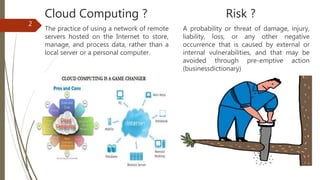
The practice of using a network of remote
servers hosted on the Internet to store,
manage, and process data, rather than a
local server or a personal computer.
2
Risk ?
A probability or threat of damage, injury,
liability, loss, or any other negative
occurrence that is caused by external or
internal vulnerabilities, and that may be
avoided through pre-emptive action
(businessdictionary)
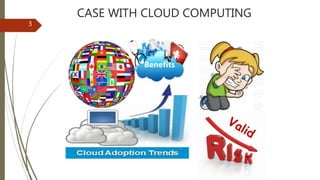
CASE WITH CLOUD COMPUTING
Benefits
3
4
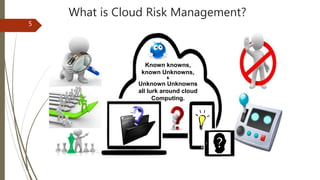
What is Cloud Risk Management?
Known knowns,
known Unknowns,
&
Unknown Unknowns
all lurk around cloud
Computing.
5
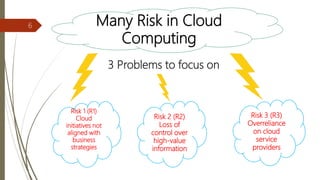
Many Risk in Cloud
Computing
3 Problems to focus on
Risk 2 (R2)
Loss of
control over
high-value
information
Risk 3 (R3)
Overreliance
on cloud
service
providers
Risk 1 (R1)
Cloud
initiatives not
aligned with
business
strategies
6
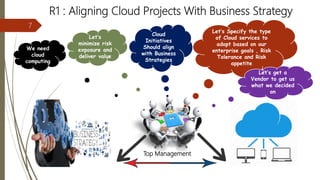
R1 : Aligning Cloud Projects With Business Strategy
Top Management
Cloud
Initiatives
Should align
with Business
Strategies
Let’s
minimize risk
exposure and
deliver value
Let’s Specify the type
of Cloud services to
adopt based on our
enterprise goals , Risk
Tolerance and Risk
appetite
We need
cloud
computing
Let’s get a
Vendor to get us
what we decided
on
7
Management should not focus on Benefits
alone but :
Provide Adequate visibility of Associated risk,
Challenge the adequacy of risk measures against appetite and
business strategy.
8
Some Solutions to R1
 Cloud value proposition, traceable links to business strategy and how benefits will be
measured
 Top business risk and treatment strategies, i.e., data security, privacy laws, data location,
business resilience, regulatory compliance
 Proposed cloud deployment model: public, private or hybrid and associated risk
implications
 Planned cloud service delivery model: Software as a Service (SaaS), Platform as a Service
(PaaS) or Infrastructure as a Service (IaaS), and associated risk implications
 Service provider selection criteria, including financial viability, operational stability and
cybersecurity capabilities
 Plausible business disruption scenarios and recovery plans
 Service level agreements (SLAs), incident response and operational governance
 Third-party assurance, penetration testing, vulnerability assessments and right-to-audit
clauses
9
R2: Protecting High-value Information
(Security Matters)
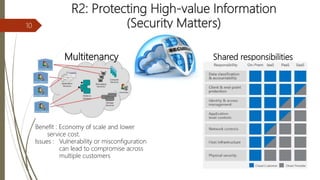
Multitenancy
Benefit : Economy of scale and lower
service cost.
Issues : Vulnerability or misconfiguration
can lead to compromise across
multiple customers
Shared responsibilities
10
Some Solutions to R2
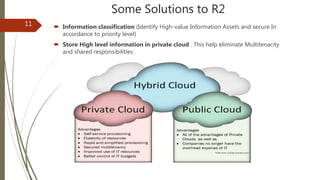
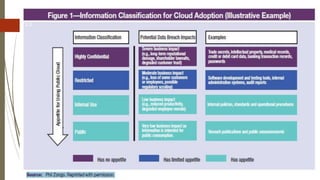
 Information classification (Identify High-value Information Assets and secure In
accordance to priority level)
 Store High level information in private cloud . This help eliminate Multitenacity
and shared responsibilities
11
Solutions to R2 continued
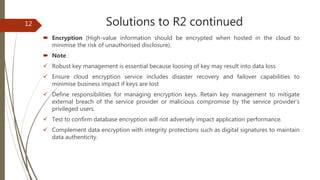
 Encryption (High-value information should be encrypted when hosted in the cloud to
minimise the risk of unauthorised disclosure).
 Note :
 Robust key management is essential because loosing of key may result into data loss
 Ensure cloud encryption service includes disaster recovery and failover capabilities to
minimise business impact if keys are lost
 Define responsibilities for managing encryption keys. Retain key management to mitigate
external breach of the service provider or malicious compromise by the service provider’s
privileged users.
 Test to confirm database encryption will not adversely impact application performance.
 Complement data encryption with integrity protections such as digital signatures to maintain
data authenticity.
12
13
Solution to R2 continued
 privileged access management (Deploy Strong Controls Over High-privileged
Access). Recommendations to achieve this are :
 Implement strong passwords and automate security policy provisioning.
 Enforce two-factor authentication and two-person rule over high-impact activities.
 Log and monitor access to privileged accounts, including execution of high-impact
commands.
 Retain superuser account credentials for accounts that give full access to all cloud
resources.
 Regularly rotate passwords for service accounts, using an automated password
management solution
14
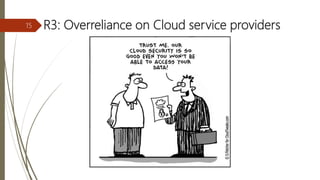
R3: Overreliance on Cloud service providers15
Minimising Reliance on Cloud Service Providers
 Review the cloud service provider’s business continuity plan and disaster recovery plan
to determine if they meet the organisation’s recovery objectives.
 Utilise multiple cloud service providers to reduce risk of vendor lock-in.
 Implement high-availability cloud architecture to minimise service interruption.
 Complement the resilient architecture with regular backup and restore procedures, and
store backup data outside of the cloud provider premises.
 Update and test the organisation’s crisis management plan.
 Simulate recovery from different disaster scenarios, including recovery of individual
applications, virtual environments and the entire cloud service provider.
 To maintain business continuity and facilitate smooth transitions, organisations should
formulate exit strategies or contingency plans to migrate critical records to an alternate
solution, cloud or non-cloud.
16
Benefit of Cloud Risk Management
 Identifying possible Problems
 Provision of Measures to Prevent risk
 Ensuring Cloud initiatives align with organisational Goals
 Getting the best value from Cloud computing
 Providing measure to minimize the effect of Risk if they occur
 Boost the confidence of Adopting and sustaining cloud computing
17
Conclusion
 When properly planned, implemented and governed, the cloud can be
a major catalyst for process improvement as well as a driver of
business transformation. Cloud service providers are working
relentlessly to improve their security and resilience capabilities.
 In reality, an organisation’s onsite systems may not be more secure
than the cloud.
 Security and reliability risk may not outweigh the lost opportunity to
transform an enterprise with strategic use of the cloud.
 Cloud initiatives built upon enterprise strategy, coupled with robust risk
management processes, have the potential to accelerate business
innovation, transform customer experiences and improve competitive
advantage.
18
Presenter
Ibrahim Adeboye, Apena
19
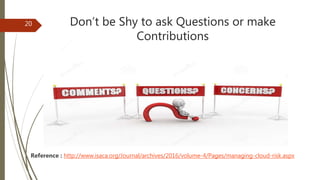
Don’t be Shy to ask Questions or make
Contributions
Reference : http://www.isaca.org/Journal/archives/2016/volume-4/Pages/managing-cloud-risk.aspx
20

Group reading assignments on managing cloud risk

  • 1.
    Wednesday, 14 December 2016 TopConsiderations for Business Leaders 1
  • 2.
    Cloud Computing ? Thepractice of using a network of remote servers hosted on the Internet to store, manage, and process data, rather than a local server or a personal computer. 2 Risk ? A probability or threat of damage, injury, liability, loss, or any other negative occurrence that is caused by external or internal vulnerabilities, and that may be avoided through pre-emptive action (businessdictionary)
  • 3.
    CASE WITH CLOUDCOMPUTING Benefits 3
  • 4.
  • 5.
    What is CloudRisk Management? Known knowns, known Unknowns, & Unknown Unknowns all lurk around cloud Computing. 5
  • 6.
    Many Risk inCloud Computing 3 Problems to focus on Risk 2 (R2) Loss of control over high-value information Risk 3 (R3) Overreliance on cloud service providers Risk 1 (R1) Cloud initiatives not aligned with business strategies 6
  • 7.
    R1 : AligningCloud Projects With Business Strategy Top Management Cloud Initiatives Should align with Business Strategies Let’s minimize risk exposure and deliver value Let’s Specify the type of Cloud services to adopt based on our enterprise goals , Risk Tolerance and Risk appetite We need cloud computing Let’s get a Vendor to get us what we decided on 7
  • 8.
    Management should notfocus on Benefits alone but : Provide Adequate visibility of Associated risk, Challenge the adequacy of risk measures against appetite and business strategy. 8
  • 9.
    Some Solutions toR1  Cloud value proposition, traceable links to business strategy and how benefits will be measured  Top business risk and treatment strategies, i.e., data security, privacy laws, data location, business resilience, regulatory compliance  Proposed cloud deployment model: public, private or hybrid and associated risk implications  Planned cloud service delivery model: Software as a Service (SaaS), Platform as a Service (PaaS) or Infrastructure as a Service (IaaS), and associated risk implications  Service provider selection criteria, including financial viability, operational stability and cybersecurity capabilities  Plausible business disruption scenarios and recovery plans  Service level agreements (SLAs), incident response and operational governance  Third-party assurance, penetration testing, vulnerability assessments and right-to-audit clauses 9
  • 10.
    R2: Protecting High-valueInformation (Security Matters) Multitenancy Benefit : Economy of scale and lower service cost. Issues : Vulnerability or misconfiguration can lead to compromise across multiple customers Shared responsibilities 10
  • 11.
    Some Solutions toR2  Information classification (Identify High-value Information Assets and secure In accordance to priority level)  Store High level information in private cloud . This help eliminate Multitenacity and shared responsibilities 11
  • 12.
    Solutions to R2continued  Encryption (High-value information should be encrypted when hosted in the cloud to minimise the risk of unauthorised disclosure).  Note :  Robust key management is essential because loosing of key may result into data loss  Ensure cloud encryption service includes disaster recovery and failover capabilities to minimise business impact if keys are lost  Define responsibilities for managing encryption keys. Retain key management to mitigate external breach of the service provider or malicious compromise by the service provider’s privileged users.  Test to confirm database encryption will not adversely impact application performance.  Complement data encryption with integrity protections such as digital signatures to maintain data authenticity. 12
  • 13.
  • 14.
    Solution to R2continued  privileged access management (Deploy Strong Controls Over High-privileged Access). Recommendations to achieve this are :  Implement strong passwords and automate security policy provisioning.  Enforce two-factor authentication and two-person rule over high-impact activities.  Log and monitor access to privileged accounts, including execution of high-impact commands.  Retain superuser account credentials for accounts that give full access to all cloud resources.  Regularly rotate passwords for service accounts, using an automated password management solution 14
  • 15.
    R3: Overreliance onCloud service providers15
  • 16.
    Minimising Reliance onCloud Service Providers  Review the cloud service provider’s business continuity plan and disaster recovery plan to determine if they meet the organisation’s recovery objectives.  Utilise multiple cloud service providers to reduce risk of vendor lock-in.  Implement high-availability cloud architecture to minimise service interruption.  Complement the resilient architecture with regular backup and restore procedures, and store backup data outside of the cloud provider premises.  Update and test the organisation’s crisis management plan.  Simulate recovery from different disaster scenarios, including recovery of individual applications, virtual environments and the entire cloud service provider.  To maintain business continuity and facilitate smooth transitions, organisations should formulate exit strategies or contingency plans to migrate critical records to an alternate solution, cloud or non-cloud. 16
  • 17.
    Benefit of CloudRisk Management  Identifying possible Problems  Provision of Measures to Prevent risk  Ensuring Cloud initiatives align with organisational Goals  Getting the best value from Cloud computing  Providing measure to minimize the effect of Risk if they occur  Boost the confidence of Adopting and sustaining cloud computing 17
  • 18.
    Conclusion  When properlyplanned, implemented and governed, the cloud can be a major catalyst for process improvement as well as a driver of business transformation. Cloud service providers are working relentlessly to improve their security and resilience capabilities.  In reality, an organisation’s onsite systems may not be more secure than the cloud.  Security and reliability risk may not outweigh the lost opportunity to transform an enterprise with strategic use of the cloud.  Cloud initiatives built upon enterprise strategy, coupled with robust risk management processes, have the potential to accelerate business innovation, transform customer experiences and improve competitive advantage. 18
  • 19.
  • 20.
    Don’t be Shyto ask Questions or make Contributions Reference : http://www.isaca.org/Journal/archives/2016/volume-4/Pages/managing-cloud-risk.aspx 20

Editor's Notes

  • #4 A publication of International Data Corporation (IDC) forecasts worldwide use of public cloud growing at 19.4 percent annually over the next five years, early doubling from approximately US $70 billion in 2015 to more than US $141 billion in 2019. This is almost six times the growth of enterprise IT spending as a whole.