Neuropsychiatric Decision
             Making: The Role of
Disorder Prevalence in Diagnostic
                          Testing


               Heather Jacobson, Jessica Landin,
               Will Liu, Brian Wiggs
 1702-1761
 English Mathematician
 Presbyterian Minister
 Deep interest in probability
 Bayes’ solution to “inverse probability” was
  presented after his death, became “Bayes’
  Theorem”
 Purpose:  To revise probabilities as new
 information becomes available- i.e., the
 probability of our prior probability, given the
 result of our conditional probability
  • Example: the probability of condition in a patient given
   the probability of this condition in the general
   population

 The  theorem states that the post-test
 likelihood of a condition is a function of the
 test’s accuracy and the pretest likelihood that
 the condition was present.
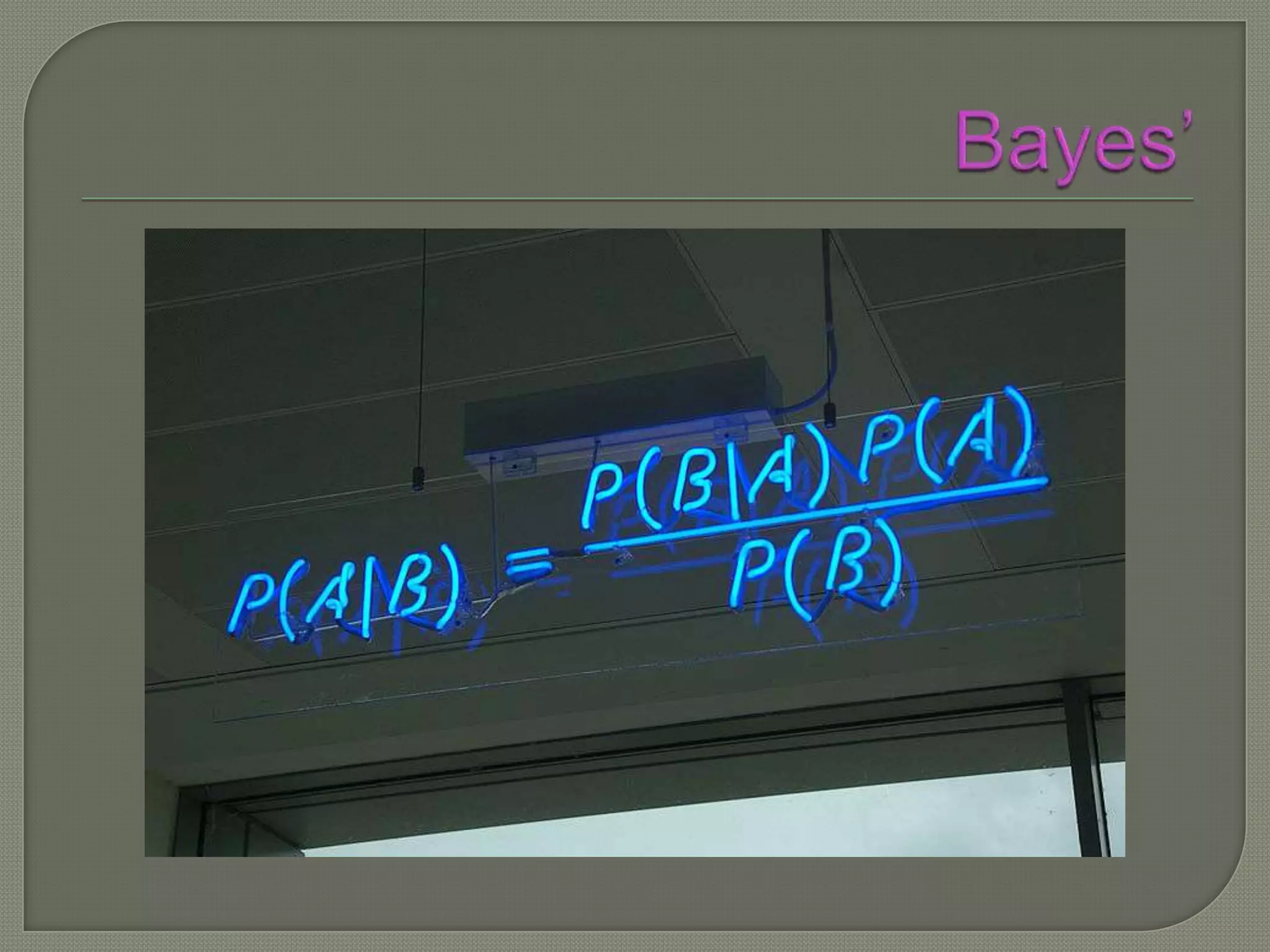
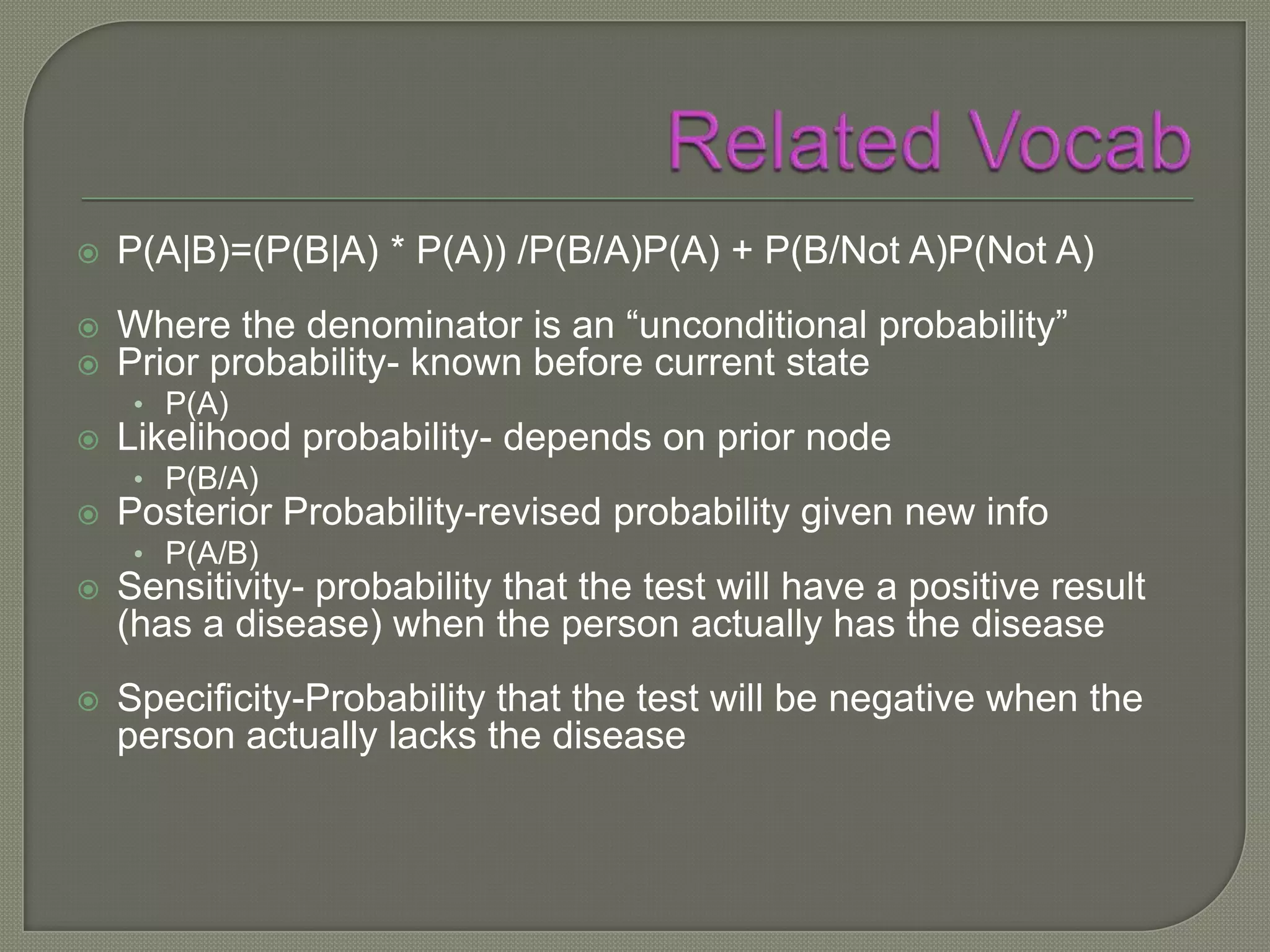
   P(A|B)=(P(B|A) * P(A)) /P(B/A)P(A) + P(B/Not A)P(Not A)
   Where the denominator is an “unconditional probability”
   Prior probability- known before current state
     • P(A)
   Likelihood probability- depends on prior node
     • P(B/A)
   Posterior Probability-revised probability given new info
     • P(A/B)
   Sensitivity- probability that the test will have a positive result
    (has a disease) when the person actually has the disease
   Specificity-Probability that the test will be negative when the
    person actually lacks the disease
 Mr. A Is a 65 year-old male has dementia.
 Dr. X administers the Short Test of Mental
  Status (STMS)
 For persons in Mr. A’s age group,
  scores<30 are considered diagnostic of
  dementia
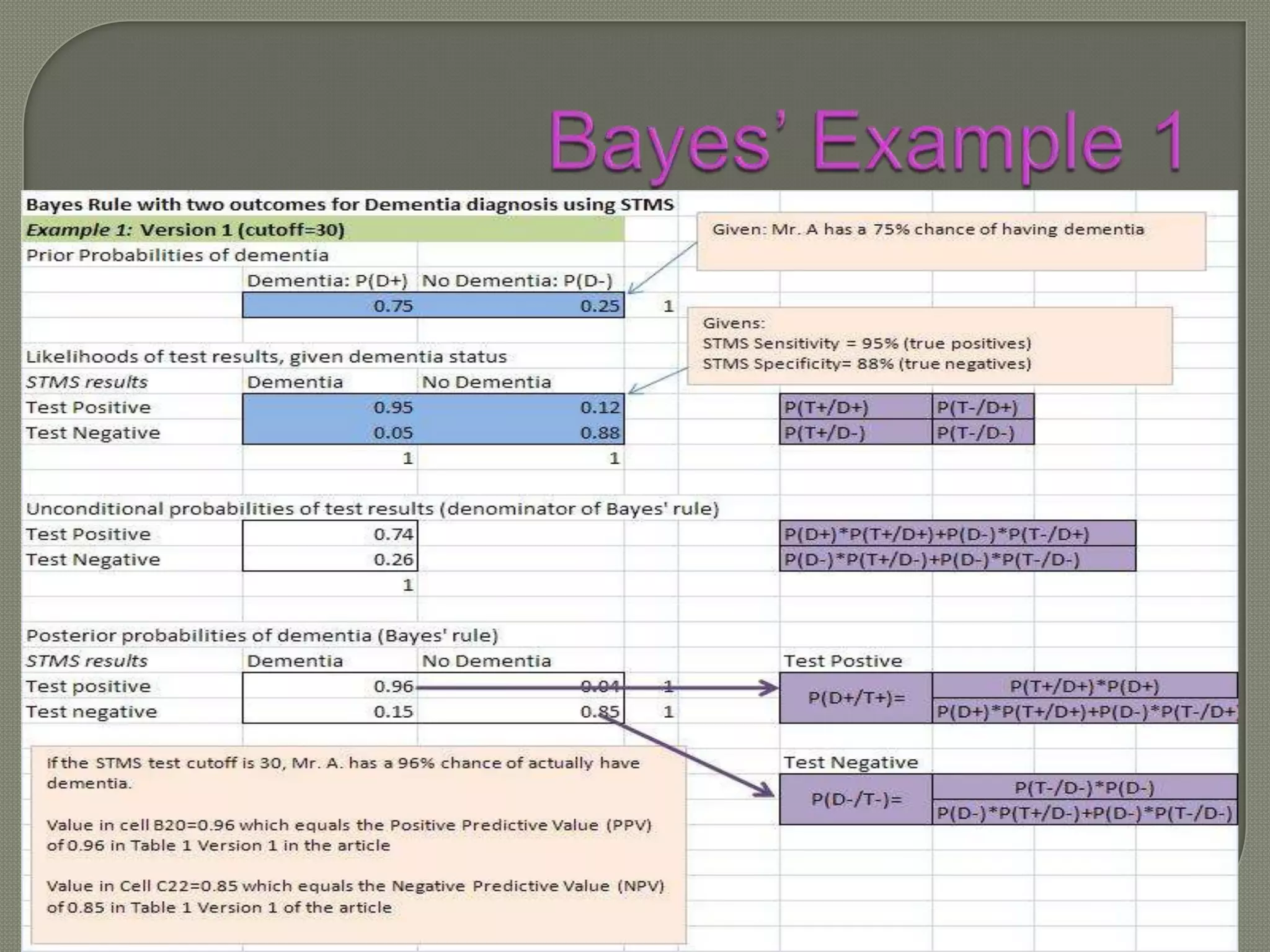
 STMS has a sensitivity of 95% and
  specificity of 88%
 Mr. A scores below 30.
 Dr. X should conclude that:
  • A.) Mr. A. has a 95% chance of having dementia
  • B.) Mr. A has an 88% chance of having dementia
  • C.)Mr. A has a 92% chance of having dementia
  • D.)She needs more information to specify the
   post-test likelihood of dementia
 Answer:   D

 To specify the post-test likelihood of having
 dementia, Dr. X needs to know what the
 likelihood of his having dementia before he
 was tested

Dr.   X needs to use Bayes’ Rule!!
Dr. X estimates that before testing
 Mr. A has a 75% chance of having
 dementia
 • Prior probability of dementia:
                P(D+)=75%
 • Prior probability of no dementia:
                 P(D-)=25%
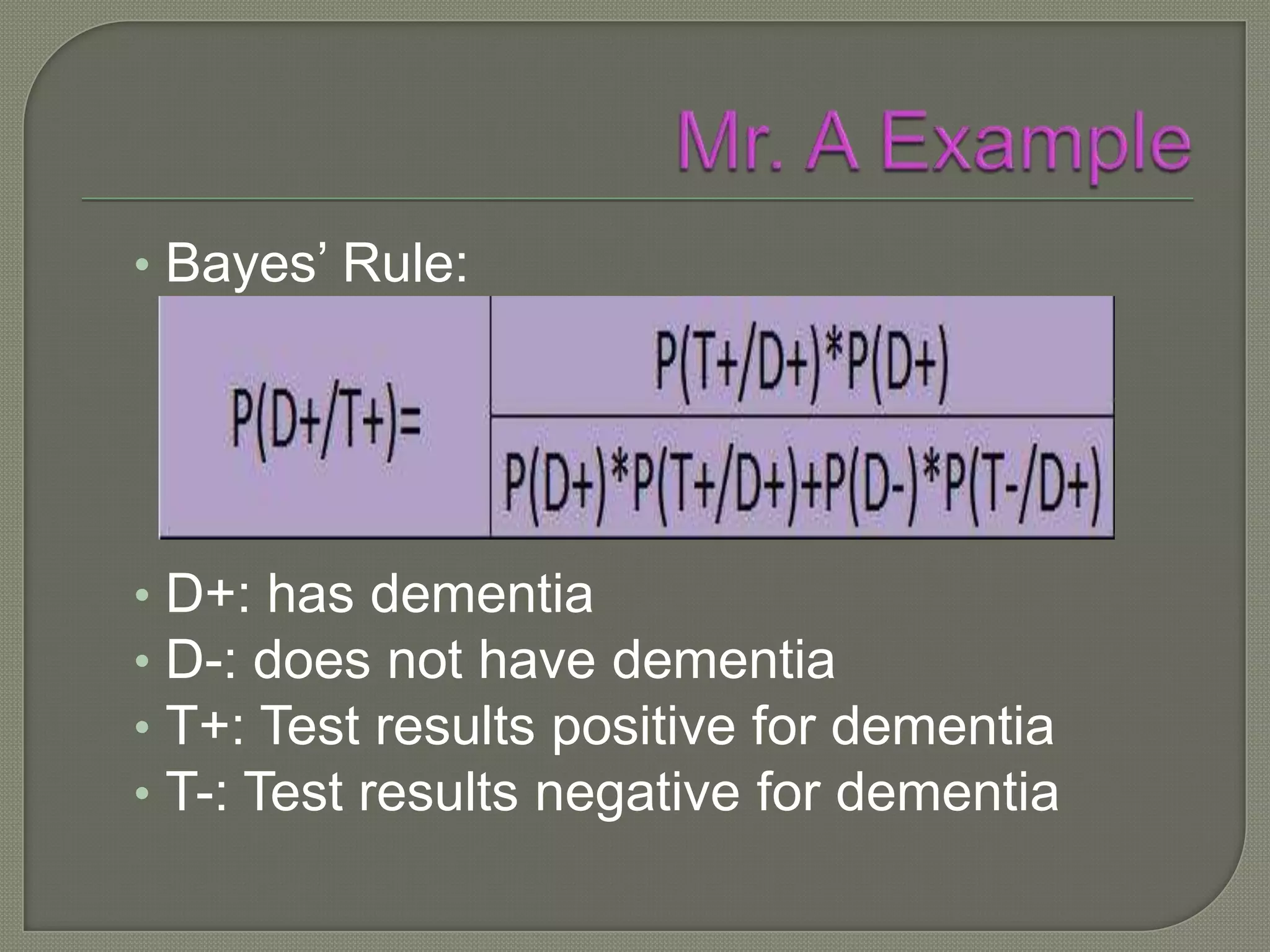
• Bayes’ Rule:


• D+: has dementia
• D-: does not have dementia
• T+: Test results positive for dementia
• T-: Test results negative for dementia
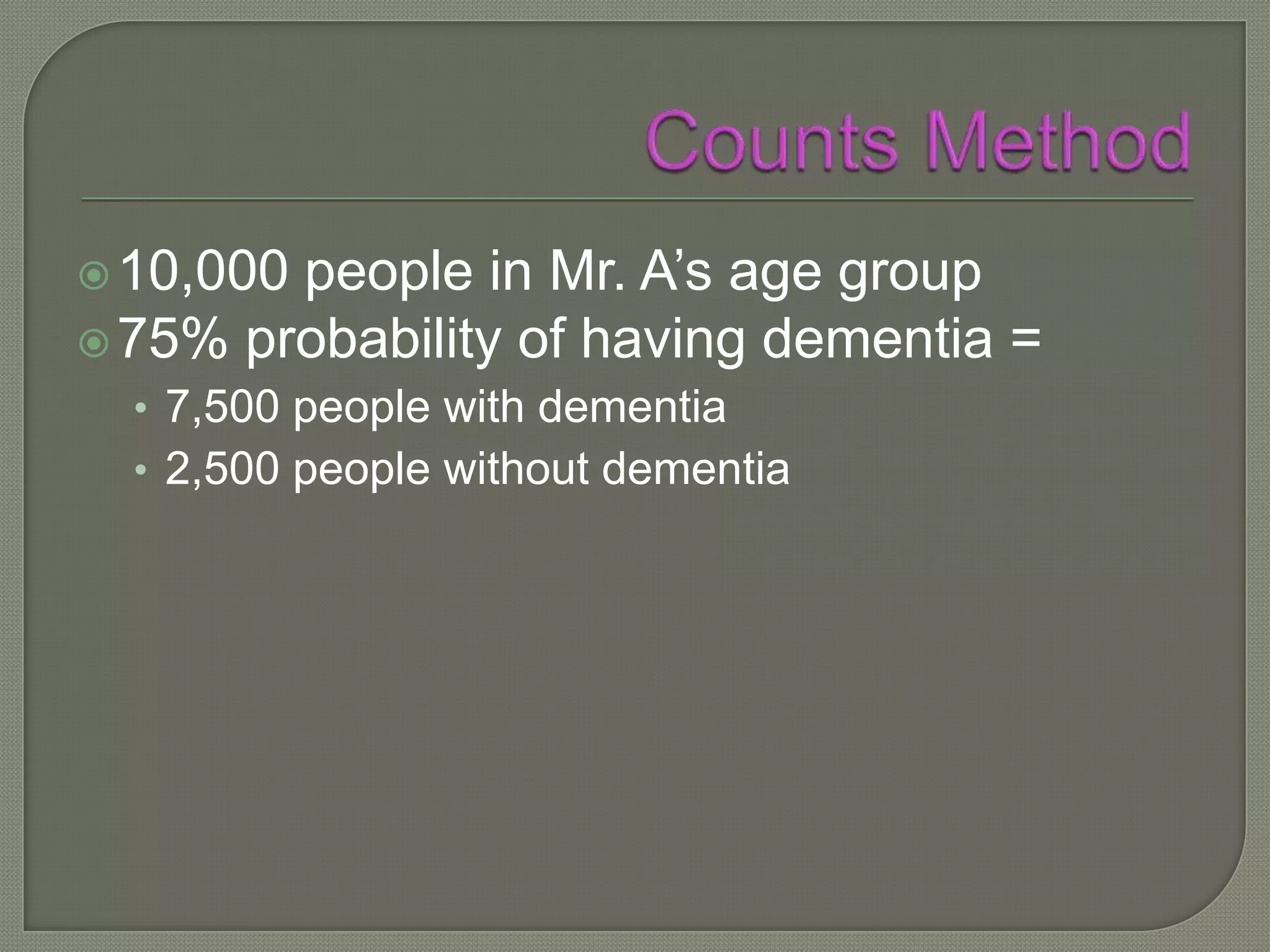
 10,000people in Mr. A’s age group
 75% probability of having dementia =
  • 7,500 people with dementia
  • 2,500 people without dementia
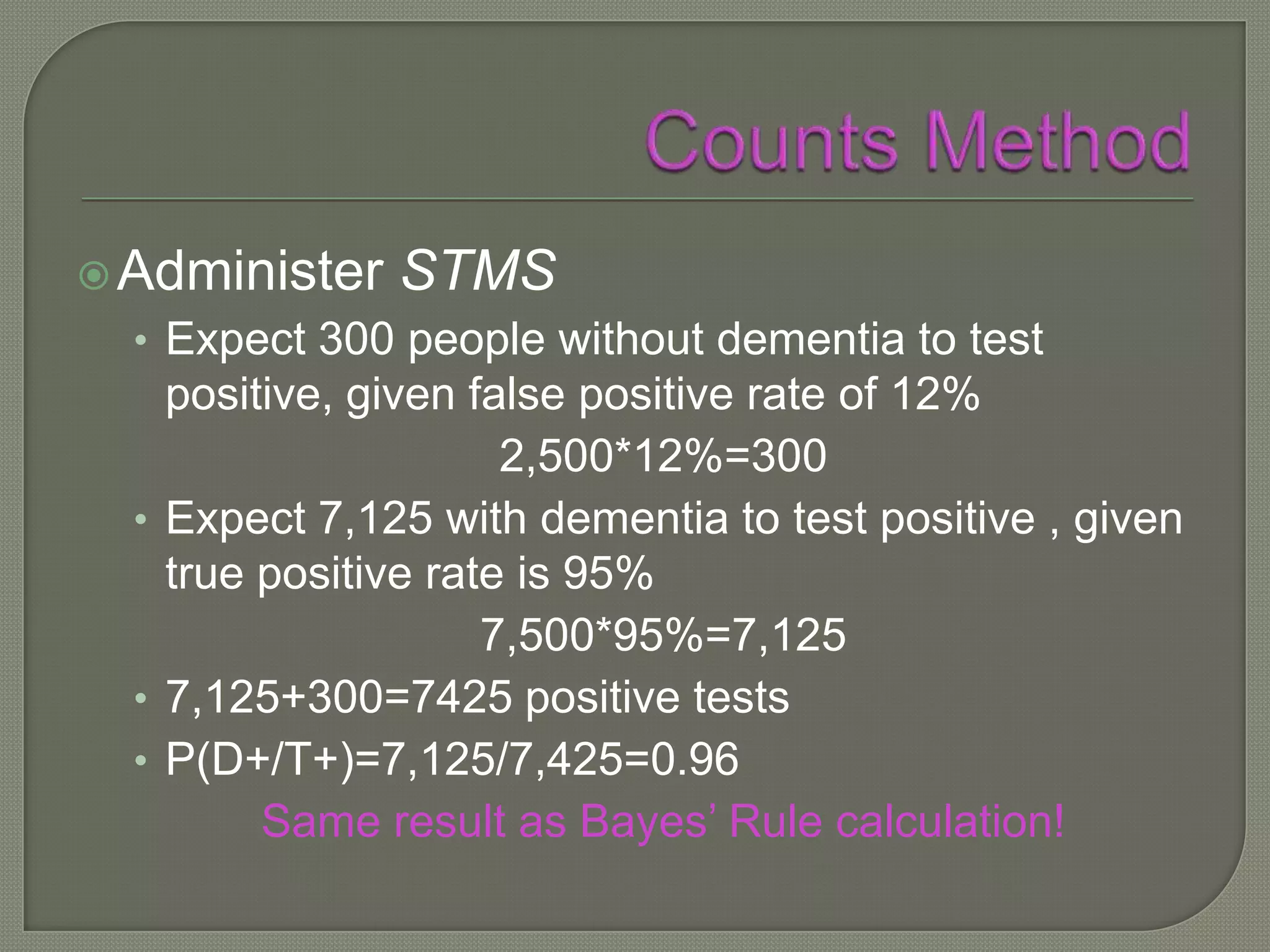
 Administer   STMS
  • Expect 300 people without dementia to test
    positive, given false positive rate of 12%
                      2,500*12%=300
  • Expect 7,125 with dementia to test positive , given
    true positive rate is 95%
                     7,500*95%=7,125
  • 7,125+300=7425 positive tests
  • P(D+/T+)=7,125/7,425=0.96
         Same result as Bayes’ Rule calculation!
Decision Management Presentation

Decision Management Presentation

  • 1.
    Neuropsychiatric Decision Making: The Role of Disorder Prevalence in Diagnostic Testing Heather Jacobson, Jessica Landin, Will Liu, Brian Wiggs
  • 2.
     1702-1761  EnglishMathematician  Presbyterian Minister  Deep interest in probability  Bayes’ solution to “inverse probability” was presented after his death, became “Bayes’ Theorem”
  • 3.
     Purpose: To revise probabilities as new information becomes available- i.e., the probability of our prior probability, given the result of our conditional probability • Example: the probability of condition in a patient given the probability of this condition in the general population  The theorem states that the post-test likelihood of a condition is a function of the test’s accuracy and the pretest likelihood that the condition was present.
  • 5.
    P(A|B)=(P(B|A) * P(A)) /P(B/A)P(A) + P(B/Not A)P(Not A)  Where the denominator is an “unconditional probability”  Prior probability- known before current state • P(A)  Likelihood probability- depends on prior node • P(B/A)  Posterior Probability-revised probability given new info • P(A/B)  Sensitivity- probability that the test will have a positive result (has a disease) when the person actually has the disease  Specificity-Probability that the test will be negative when the person actually lacks the disease
  • 6.
     Mr. AIs a 65 year-old male has dementia.  Dr. X administers the Short Test of Mental Status (STMS)  For persons in Mr. A’s age group, scores<30 are considered diagnostic of dementia  STMS has a sensitivity of 95% and specificity of 88%
  • 7.
     Mr. Ascores below 30.  Dr. X should conclude that: • A.) Mr. A. has a 95% chance of having dementia • B.) Mr. A has an 88% chance of having dementia • C.)Mr. A has a 92% chance of having dementia • D.)She needs more information to specify the post-test likelihood of dementia
  • 8.
     Answer: D  To specify the post-test likelihood of having dementia, Dr. X needs to know what the likelihood of his having dementia before he was tested Dr. X needs to use Bayes’ Rule!!
  • 9.
    Dr. X estimatesthat before testing Mr. A has a 75% chance of having dementia • Prior probability of dementia: P(D+)=75% • Prior probability of no dementia: P(D-)=25%
  • 10.
    • Bayes’ Rule: •D+: has dementia • D-: does not have dementia • T+: Test results positive for dementia • T-: Test results negative for dementia
  • 13.
     10,000people inMr. A’s age group  75% probability of having dementia = • 7,500 people with dementia • 2,500 people without dementia
  • 14.
     Administer STMS • Expect 300 people without dementia to test positive, given false positive rate of 12% 2,500*12%=300 • Expect 7,125 with dementia to test positive , given true positive rate is 95% 7,500*95%=7,125 • 7,125+300=7425 positive tests • P(D+/T+)=7,125/7,425=0.96 Same result as Bayes’ Rule calculation!

Editor's Notes

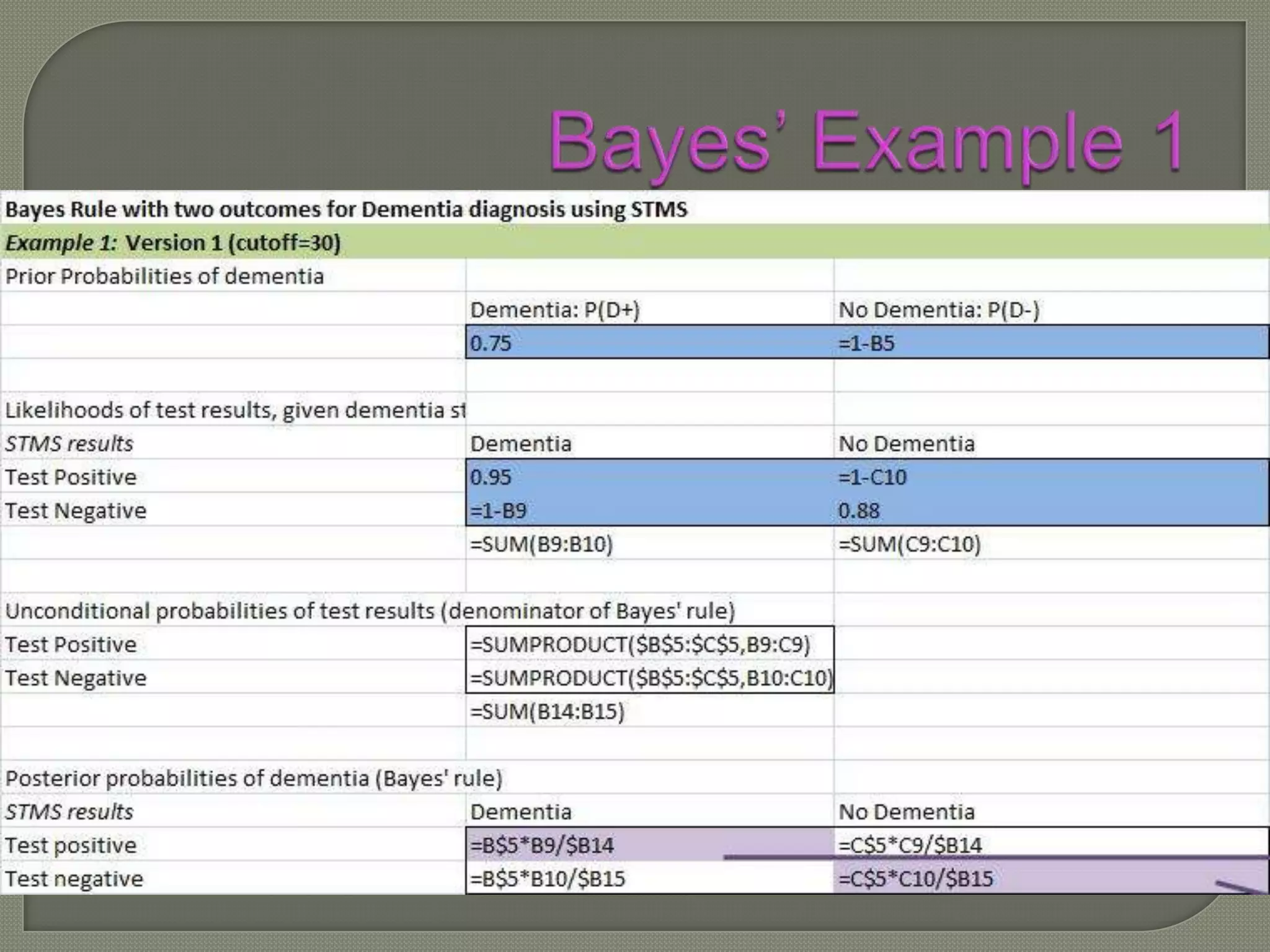
  • #5 We can see how the denominator is derived on the next slide.
  • #11 Probability Mr. A has dementia given he tested positive for dementia
  • #14 Imagine that there are 10,000 people in Mr. A&apos;s age group. Because 75% of people in this age group have Dementia, we assume that 7,500 of the 10,000 people have dementia and the other 2,500 do not.
  • #15 Now we administer the STMS test to all of them. We expect 12%, or 300 people without dementia to test positive (because the false positive rate is 12%); we expect 95%, or 7125 people with dementia to test positive (true positive rate is 95%). Therefore, we observe a total of 300 + 7125 = 7425 positives. If we choose one of these people at random, the probability that they are dementedis P (D+|T+) = 7125 / 7425 = 0.96. This is the same result as we got using Bayes&apos; rule.
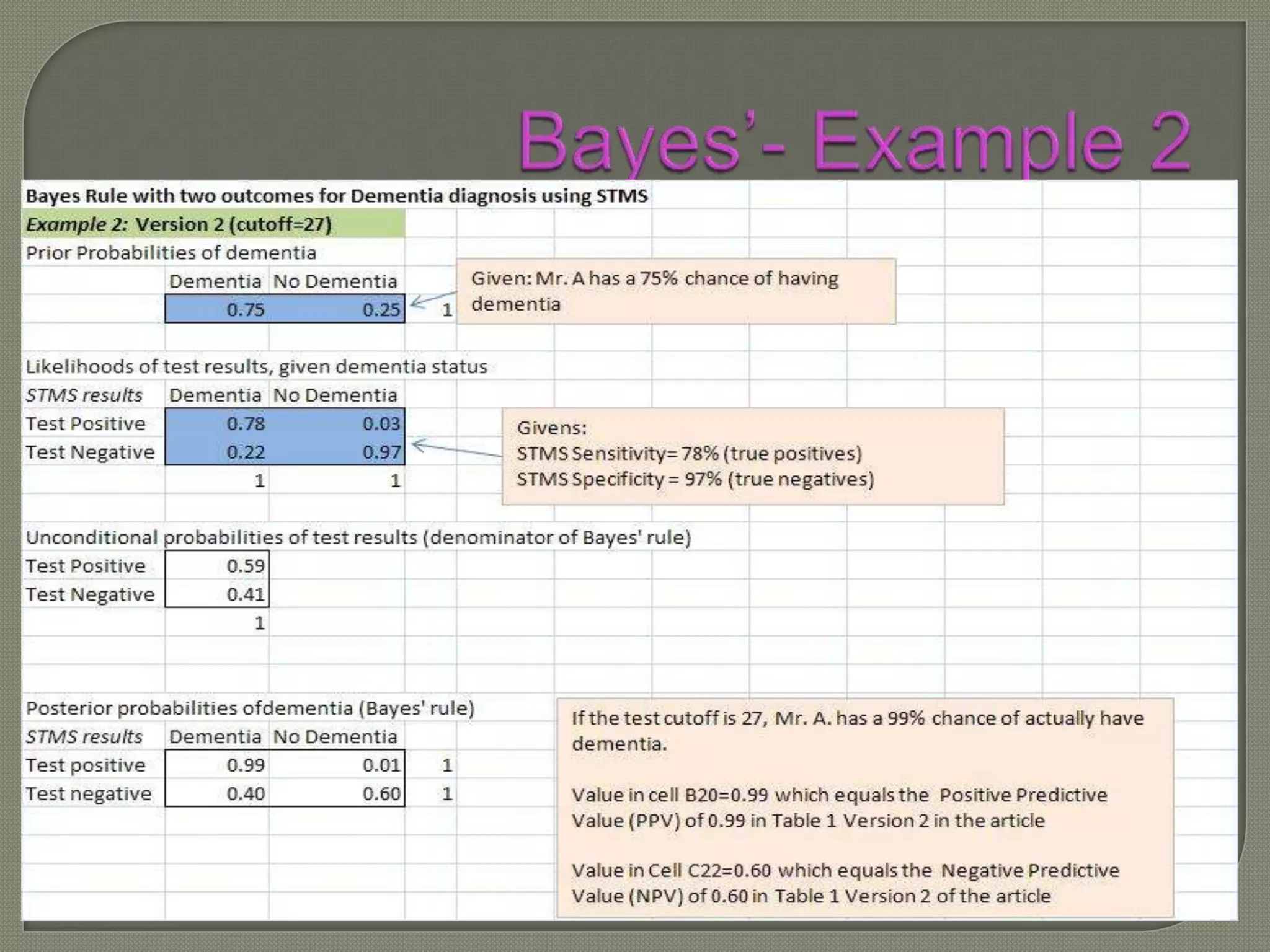
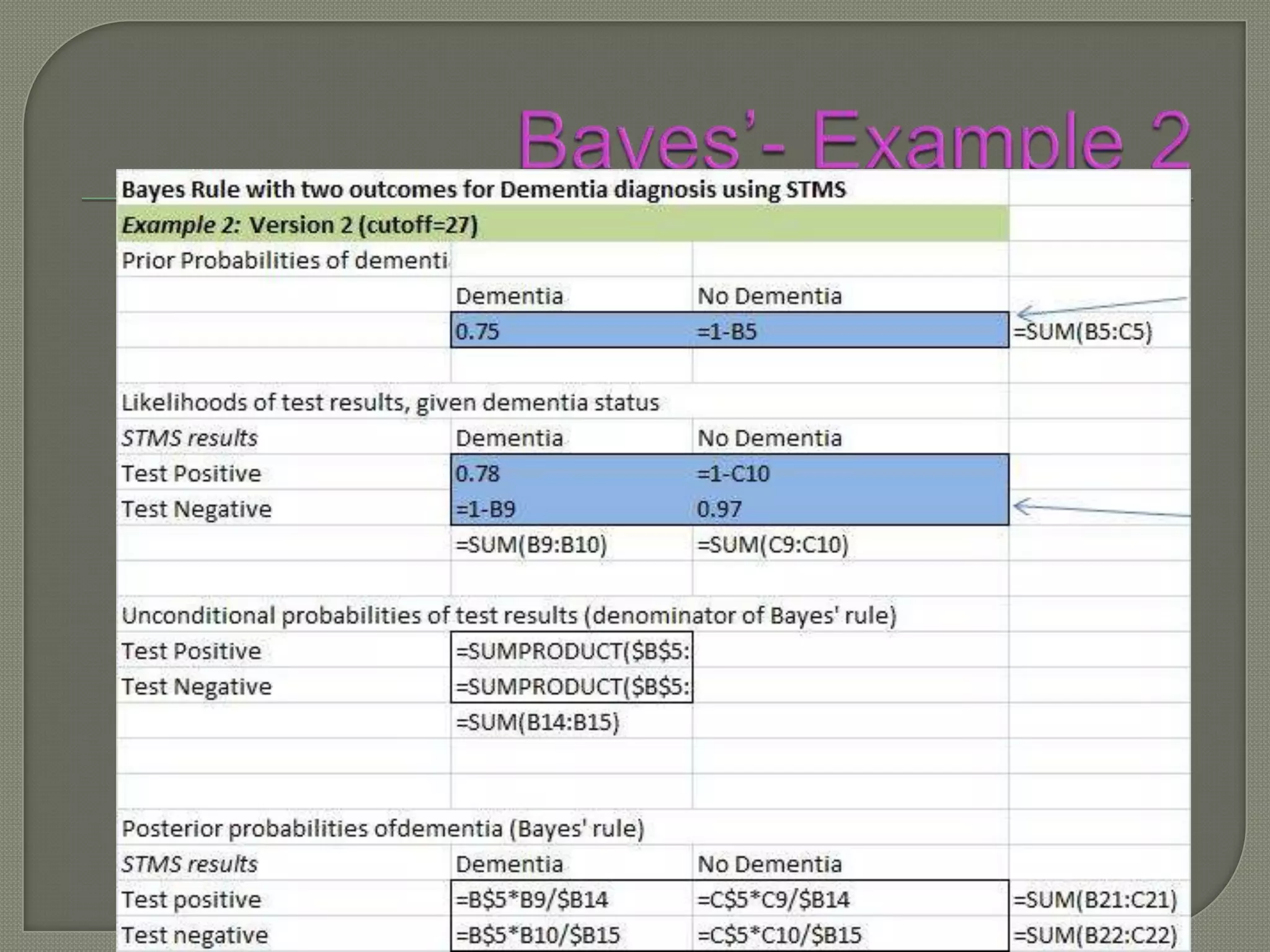
  • #16 Cut off is now a score below 27, not 30.
  • #17 Cut off is now a score below 27, not 30.