GROUP 7
Members: ALLAPITAN,JHAYLZEA ANNE
BANZUELA, NIKKI
CRUZ, GRACE
FERMIN, MARY RHODELYN
MARAGGUN, BENALYN
THE INFORMATION AGE
AND
INFORMATION SOCIETY
LESSON OBJECTIVES:
Discuss InformationAge;
Outline the history of Information Age;
Spot truthful news from fake news;
Explain instances of cyberbullying; and
Cite the importance of Information Age
in various aspects of the society.
4.
The Information Age,also known as the Digital Age or the
New Media Age, began in the late 20th century and is
characterized by rapid access to and management of
information through digital platforms.
Writing, painting, coding, and other forms of expression
have been transformed by digital advancements. The
widespread application of computers in different aspects
of society has further accelerated modernization, making
information more accessible than ever before.
INFORMATION AGE
5.
In the late1960s and early 1970s, the sheer
abundance of information made it challenging to
collect and process data.
By the 1980s, this led to what Richard Wurman termed
"Information Anxiety," a phenomenon where people
struggled to cope with the overwhelming flow of
data.
By the 1990s, information became a vital currency in
the business world, and managing it effectively
became a priority.
6.
Information has becomea mass-produced
commodity, influencing society in profound
ways. Despite differing views on the
Information Age's evolution, its impact is
undeniable. The digital revolution has
spawned innovative fields like AI, Robotics,
and Cybersecurity, offering benefits but also
raising concerns about data privacy and
security.
Transformation of ScientificCommunity: Easy access to vast
information through computers and the internet.
Digital Experiments: Automated techniques for data collection
and analysis.
Bioinformatics: Combination of computer science and statistical
methods.
Collaboration and Sharing: Easy sharing of results and online
storage.
Responsible Information Generation: Importance of proper
citation and acknowledging original authors.
SCIENCE AND INFORMATION AGE
Power of Words:Words can make or break people
and relationships.
Social Media Impact: Shapes events, updates, and
provokes.
Cyberbullying: Posts and commentaries can
embarrass, offend, criticize, or threaten.
Consequences of Online Behavior: Importance of
responsible online interactions.
INFORMATION AGE AND
CYBERBULLYING
11.
EMERGENCE OF FAKENEWS
Younger individuals prefer online news, with those under
50 receiving half of their news digitally.
Fake news spreads quickly due to the ease of sharing
without verifying accuracy.
Individuals favor information that aligns with their beliefs,
promoting the spread of misleading information.
Misleading information spreads rapidly online.
Fake news is shared for personal affirmation rather than
factual accuracy.
12.
HOW TO SPOTFAKE NEWS?
The following practical tips from Nagler, C. (2017) of Harvard Division of
Continuing Education can help us spot a fake news.
1. Vet the publisher's credibility
Try to consider these questions whenever we see an article that
captures our attention.
Would the publishing site meet the academic citation standards?
What is the domain name?
What is the publication's point of view?
Who is the author?
13.
HOW TO SPOTFAKE NEWS?
2. Pay attention to quality and timeliness.
Notice spelling errors and dramatic punctuations from the
article. Check if the story is current or recycled.
3. Check the sources and citations.
How did you find the article?
Who is (or is not) quoted, and what do they say?
Is the information available on other sites?
Can you perform reverse researches and images?
INFORMATION SOCIETY; THEROLE OF
LANGUAGE
- Ancient Greeks saw language as an object of admiration. Language was
seen as a tool for understanding and communicating deeper truths. Science,
derived from the Latin "scire" (to know), was a form of knowledge the Greeks
sought to understand. Early Greek philosophers believed that language and
words helped uncover the deeper principles of the natural world.
- "Meta-phusis" means "after nature" (De Chardin, 1965). Early philosophers
believed there was a deeper meaning or structure beyond what is visible in
nature.
- Language plays a crucial role in describing and exploring complex concepts
and scientific discoveries.
16.
Plato’s "One andthe Many”
- Describes the underlying unity among diverse
beings in the natural world.
- In science and technology, despite apparent
diversity, universal laws or principles (e.g.,
electricity, algorithms) unite various elements
and phenomena.
- Society, though diverse, shares common
values, laws, and systems.
17.
The Role ofTechnology in Understanding Nature’s Diversity:
- 21st-century technology has expanded our knowledge of
biodiversity.
- Scientific tools enable exploration of previously unknown
species, ecosystems, and microorganisms.
- Technology helps monitor threats to biodiversity, such as
climate change and deforestation.
- Digital media and online tools make biodiversity information
more accessible.
- Virtual reality, documentaries, and databases allow global
access to knowledge about nature and ecosystems.
- Technology aids in conservation efforts and tracking
endangered species.
- Nature operatesaccording to laws that can
be described and understood through
mathematics.
- Mathematics allows humans to comprehend
natural phenomena and make sense of the
world (Wigner, 1960).
MATHEMATICS AS THE LANGUAGE
OF NATURE
20.
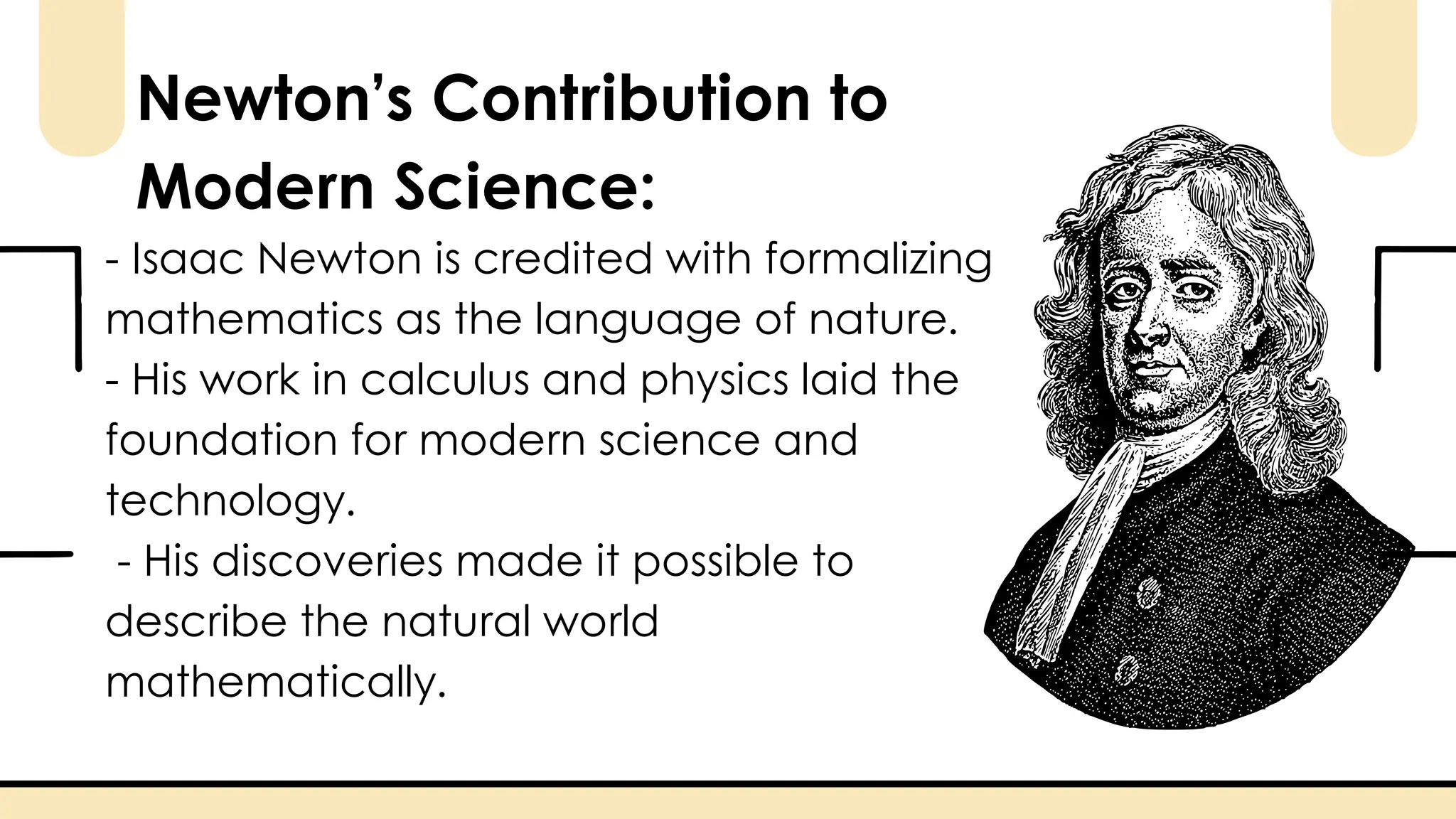
- Isaac Newtonis credited with formalizing
mathematics as the language of nature.
- His work in calculus and physics laid the
foundation for modern science and
technology.
- His discoveries made it possible to
describe the natural world
mathematically.
Newton’s Contribution to
Modern Science:
21.
Equations explain motion,energy, and forces.
Mathematical models predict genetic variations and chemical reactions.
Calculations determine planetary movements and support space exploration.
Computers and algorithms operate on mathematical logic, driving innovation in
programming and cybersecurity.
Mathematical calculations ensure safety and durability in infrastructure projects
like bridges and buildings.
Complex statistical models enable AI and big data to process information and
enhance decision-making.
Mathematical models help predict market trends and guide economic policies,
ensuring financial stability.
Statistical analysis aids in disease tracking, medical research, and treatment
planning.
Mathematics helps in modeling climate change, resource management, and
sustainability efforts.
TECHNOLOGICAL WORLD
- Theability to think critically and understand natural principles
led to the advancement of science and technology.
- Early technologies were essential in expanding civilizations
and shaping human progress.
- One of the earliest technological advancements, the sailing
vessel, harnessed the power of wind for transportation and
trade.
- Its exact origins are unknown, but it played a significant role
in the expansion of civilizations by facilitating travel and
commerce.
24.
- Fire, anessential discovery, became vital for cooking,
warmth, protection, and metalworking.
- While the exact timeline of its discovery is unclear, it was
crucial in the development of tools and weapons, driving early
societal progress.
- In the 1st century, Hero of Alexandria, a Greek engineer and
mathematician, invented the aeolipile, a primitive steam
engine.
- Although it wasn't used for industrial purposes, it
demonstrated the principles of steam power, which later
played a key role in the Industrial Revolution.
- The printingpress, invented in the 15th century, revolutionized
the preservation and transmission of knowledge.
- Before its invention, information was hand-copied, limiting
access to education and knowledge.
- The printing press enabled the mass production of books,
making scientific discoveries, ideas, and cultural advancements
more accessible.
- This innovation aligned with the ancient Greek belief that
knowledge should be shared and communicated among
people.
THE PRINTING PRESS AND BEYOND
27.
- The Studyof Electricity and Magnetism led to the
invention of the radio, which enabled wireless
communication.
- The development of the television revolutionized
entertainment and information-sharing, connecting
people globally.
- The Shift from Analog to Digital Communication
marked the beginning of the digital age, where
information could be stored and transmitted in digital
signals.
- The WorldWide Web was invented by Sir Tim Berners-
Lee in the 20th century.
- Initially developed to facilitate data sharing among
scientists at CERN , the Web became a global platform
for information exchange and communication.
- The Web and Internet allowed people to connect
globally, access vast amounts of information, and
revolutionize industries like education, business, and
entertainment.
THE WORLD WIDE WEB
30.
Challenges of theInformation Age:
Anyone can produce content, making it difficult to distinguish facts from
misinformation.
People tend to form echo chambers with like-minded individuals,
reinforcing biases and limiting exposure to diverse perspectives.
Certain groups or individuals can use the internet to influence public
opinion or suppress opposing views.
Easy access to personal information leaves individuals vulnerable to
identity theft, scams, and online predators.
Responsibility in Technology Use:
While technology offers numerous benefits, we must use it responsibly to
avoid harming others and ourselves.
Understanding both the benefits and risks of technological
advancements is crucial for a balanced and ethical approach to
progress.
31.
WEB VERSIONS:
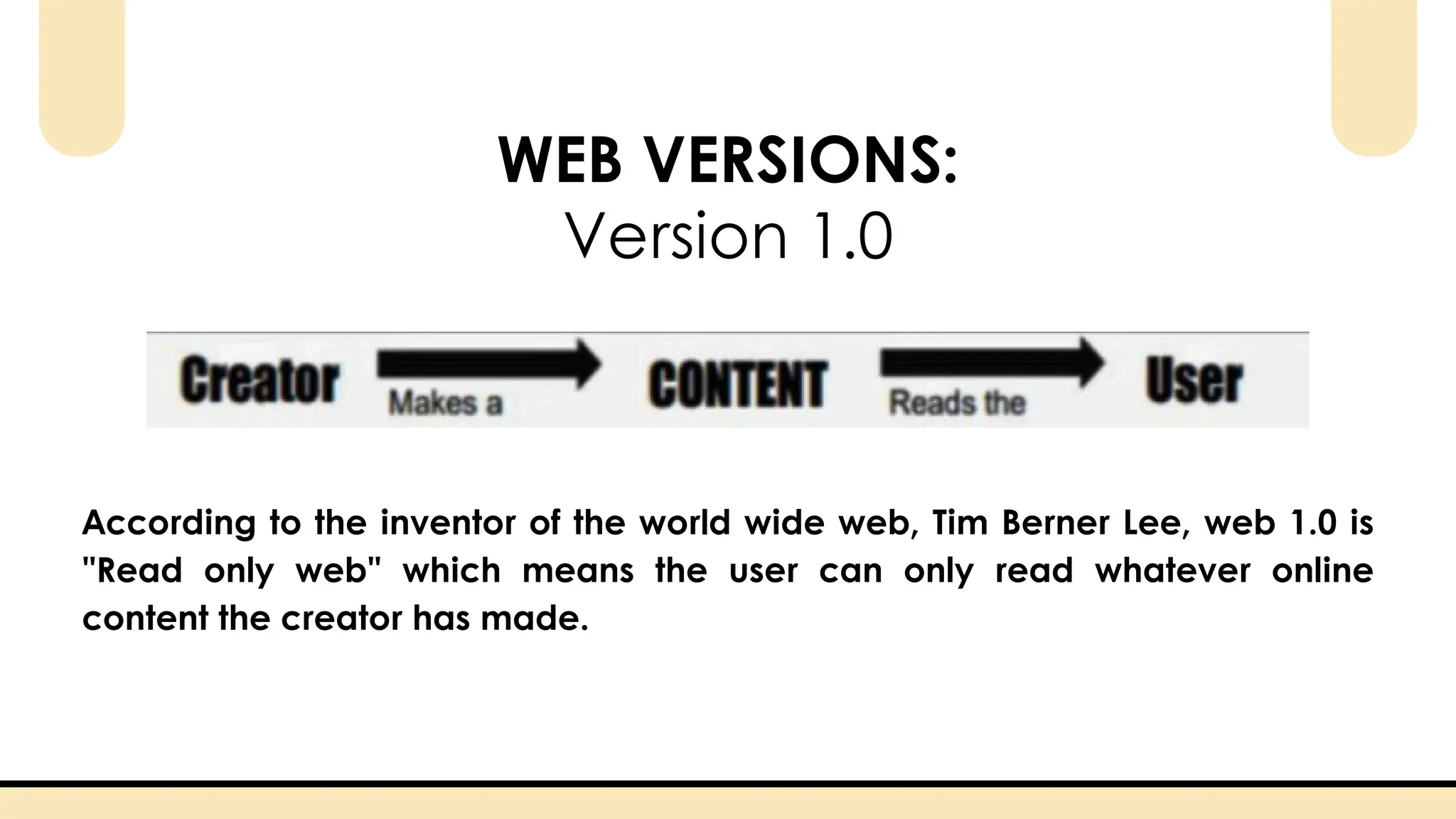
According tothe inventor of the world wide web, Tim Berner Lee, web 1.0 is
"Read only web" which means the user can only read whatever online
content the creator has made.
Version 1.0
32.
WEB VERSIONS:
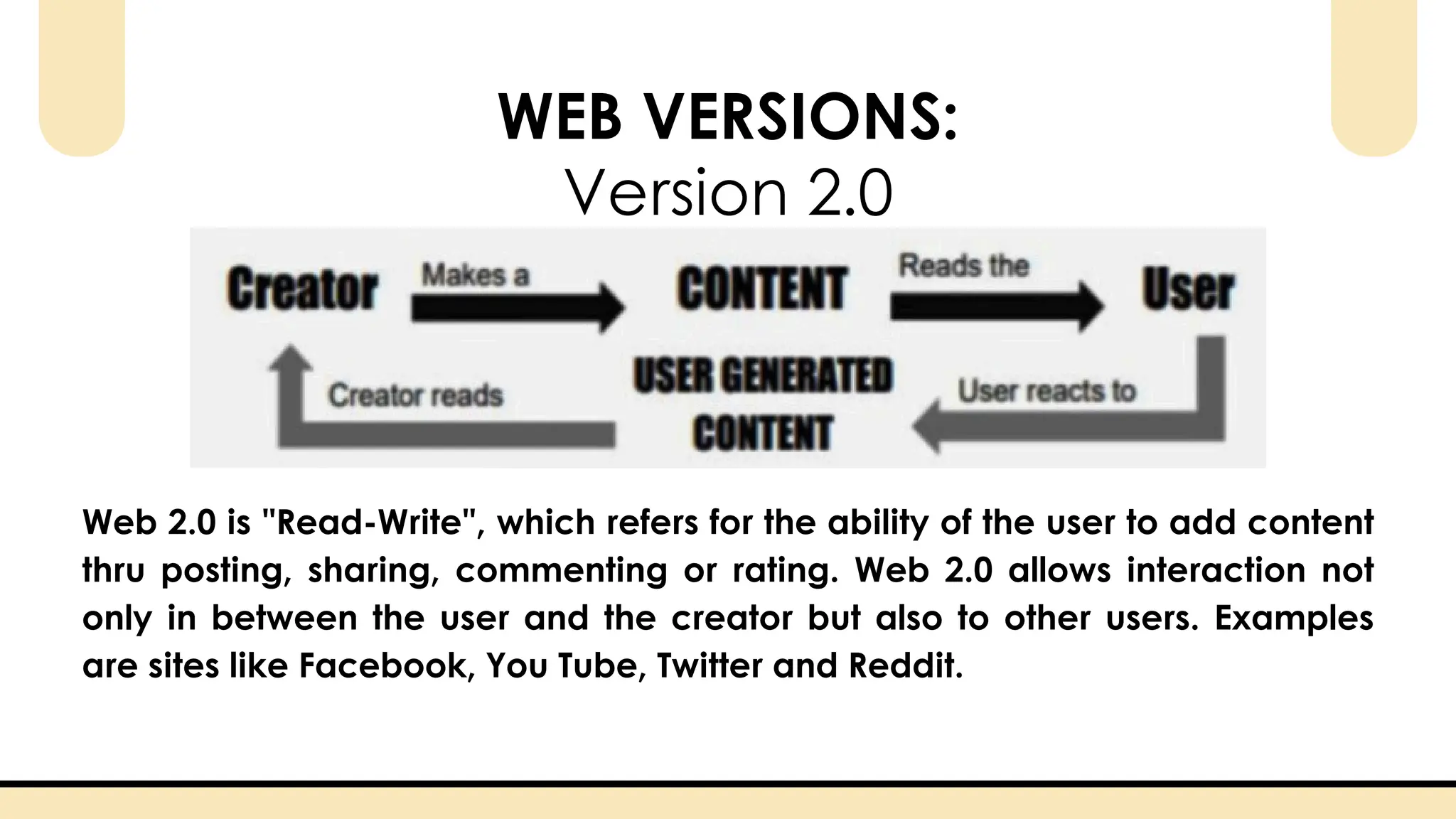
Web 2.0is "Read-Write", which refers for the ability of the user to add content
thru posting, sharing, commenting or rating. Web 2.0 allows interaction not
only in between the user and the creator but also to other users. Examples
are sites like Facebook, You Tube, Twitter and Reddit.
Version 2.0
33.
WEB VERSIONS:
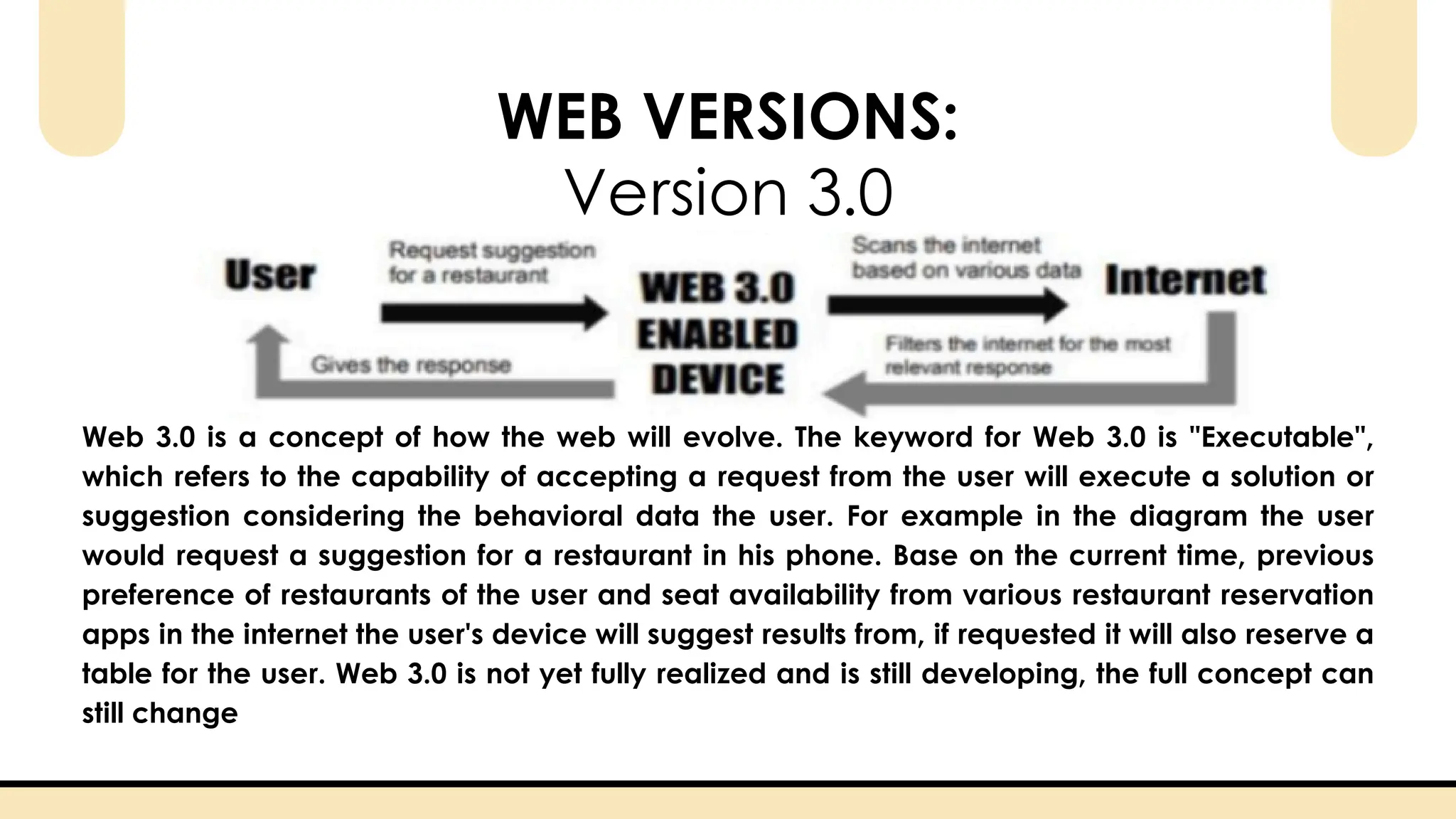
Web 3.0is a concept of how the web will evolve. The keyword for Web 3.0 is "Executable",
which refers to the capability of accepting a request from the user will execute a solution or
suggestion considering the behavioral data the user. For example in the diagram the user
would request a suggestion for a restaurant in his phone. Base on the current time, previous
preference of restaurants of the user and seat availability from various restaurant reservation
apps in the internet the user's device will suggest results from, if requested it will also reserve a
table for the user. Web 3.0 is not yet fully realized and is still developing, the full concept can
still change
Version 3.0
THE INFORMATION AGE
-Processed, organized, and structured data.
- Provides context for decision-making.
- Derives from the Latin word "informare," meaning
to give form or shape.
- All communication is based on information.
- Acts as an outlet for messages about the outside
world.
36.
Pre-Gutenberg Era (Beforethe 15th Century)
- Information sharing was difficult and limited to word-
of-mouth.
- Knowledge was a privilege of a small elite.
Gutenberg Era (15th Century)
- The invention of the printing press by Johannes
Gutenberg revolutionized information sharing.
- Mass production of information became possible,
albeit at a high cost.
- Emergence of institutions like newspapers and banks.
37.
Information Age (ModernEra)
- Computers and the Internet made accessing information
easier.
- Social networks and online platforms encouraged
communication and collaboration.
- Significant advancements in science and technology (e.g.,
driverless cars, enhanced reality).
Challenges of the Information Age
- Impact on mental health and relationships due to social
media addiction.
- Societal shift towards convenience and efficiency in
communication.
TRADITIONAL MEDIA
1. GutenbergPrinciple:
- Traditional institutions (e.g., newspapers,
publishers) control creation, production, and
distribution of content.
- Consumers pay for access to content.
- Gatekeeping role: Deciding what is published,
how it's presented, and who has access.
40.
SOCIAL MEDIA:
1. SocialInformation Principle:
- Shift to freely accessible information without institutional control
(e.g., Google, Facebook).
2. Crowdsourcing:
- Collaborative creation and improvement of content by users (e.g.,
Wikipedia, open-source software).
3. Social Networking:
- Platforms enable users to connect, share, and build communities
(e.g., Facebook, Instagram).
41.
IMPACTS ON SOCIETY:
1.Education:
- Revolutionized access to educational resources (online courses, tutorials).
- Challenges: Exposure to misinformation, biased content, and explicit material.
2. Business:
- Cost-effective promotion on social media platforms.
- Crowdsourcing for valuable customer feedback, refining products/services.
- Enhances marketing strategies and drives growth.
3. Society:
- Positive: Facilitates global communication and collaboration.
- Negative: Privacy concerns (personal info sharing) and addiction (dependence
on social media for interaction, entertainment, validation).