
Technology and
  Innovation
         By: Jose Fung
Introduction
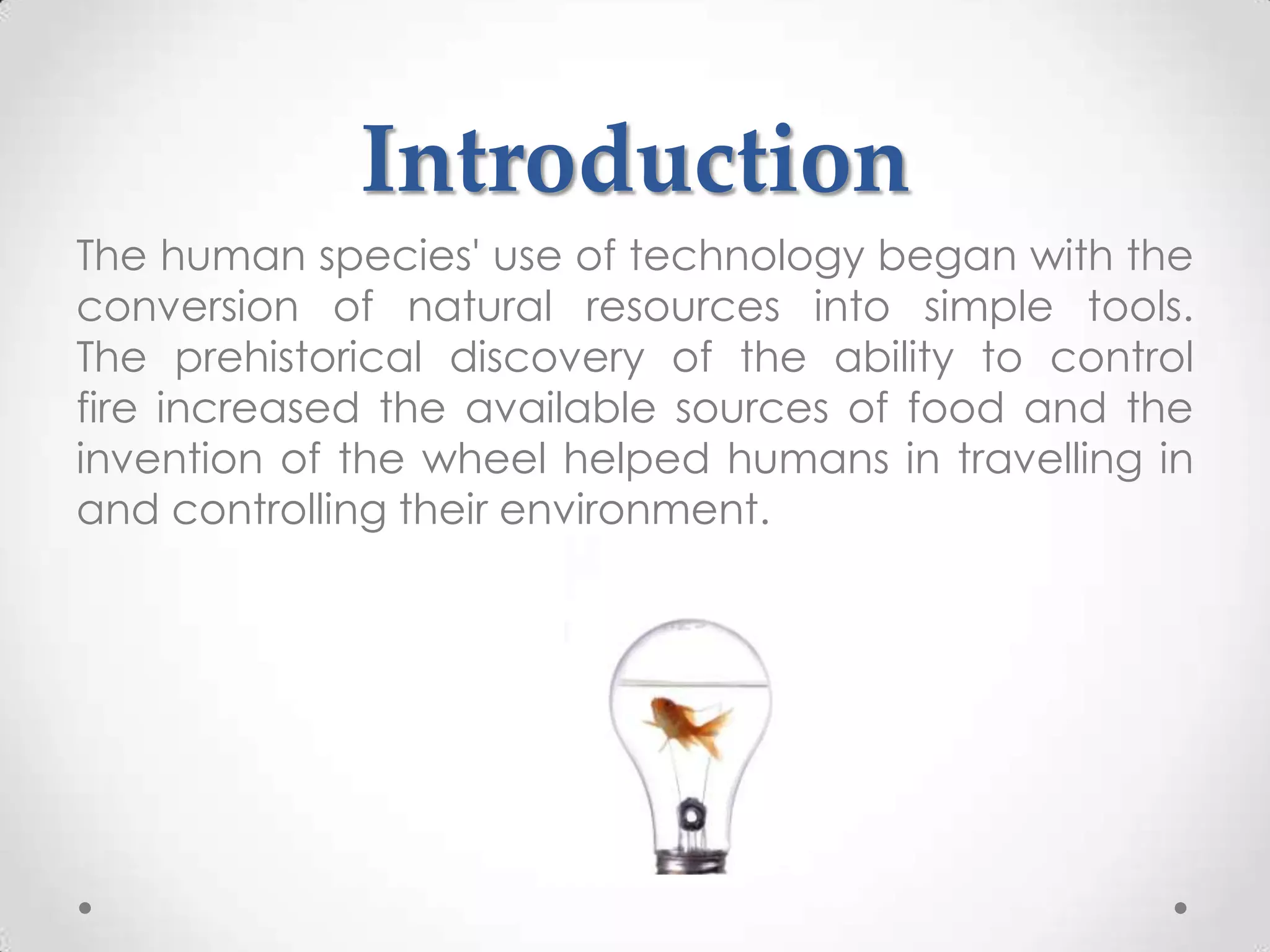
The human species' use of technology began with the
conversion of natural resources into simple tools.
The prehistorical discovery of the ability to control
fire increased the available sources of food and the
invention of the wheel helped humans in travelling in
and controlling their environment.
What is technology?
Technology is the making, modification, usage, and
knowledge           of        tools,       machines,
techniques, crafts, systems, methods of organization,
in order to solve a problem, improve a preexisting
solution to a problem, achieve a goal or perform a
specific function.
What is technology?
It can also refer to the collection of such
tools, machinery, modifications, arrangements and
procedures. Technologies significantly affect human
as well as other animal species' ability to control and
adapt to their natural environments.
What is the meaning of the word?
The       word        technology         comes       from
Greek τεχνολογία (technología); from τέχνη (téchnē),
meaning "art, skill, craft", and -λογία (-logía), meaning
"study of-". The term can either be applied generally or
to specific areas: examples include construction
technology, medical technology, and information
technology.
Technological
          Developments
Recent technological developments, including
the     printing    press, the telephone,  and
the Internet, have lessened physical barriers
to communication and allowed humans to interact
freely on a global scale.
Technological
          Developments
However, not all technology has been used for
peaceful purposes; the development of weapons of
ever-increasing destructive power has progressed
throughout history, from clubs to nuclear weapons.
Can the technologies solve real-world problems?
Technology can be most broadly defined as the
entities, both material and immaterial, created by the
application of mental and physical effort in order to
achieve some value. In this usage, technology refers
to tools and machines that may be used to solve real-
world problems.
Science, engineering and technology
The distinction between science, engineering and
technology is not always clear. Science is
the    reasoned     investigation        or   study of
phenomena, aimed at discovering enduring principles
among elements of the phenomenal world by
employing formal techniques such as the scientific
method. Technologies are not usually exclusively
products of science, because they have to satisfy
requirements such as utility, usability and safety.
Science, engineering and technology
Engineering is the goal-oriented process of designing
and making tools and systems to exploit natural
phenomena for practical human means, often (but
not always) using results and techniques from science.
The development of technology may draw upon
many fields of knowledge, including scientific,
engineering, mathematical, linguistic, and historical
knowledge, to achieve some practical result.
Science, engineering and technology
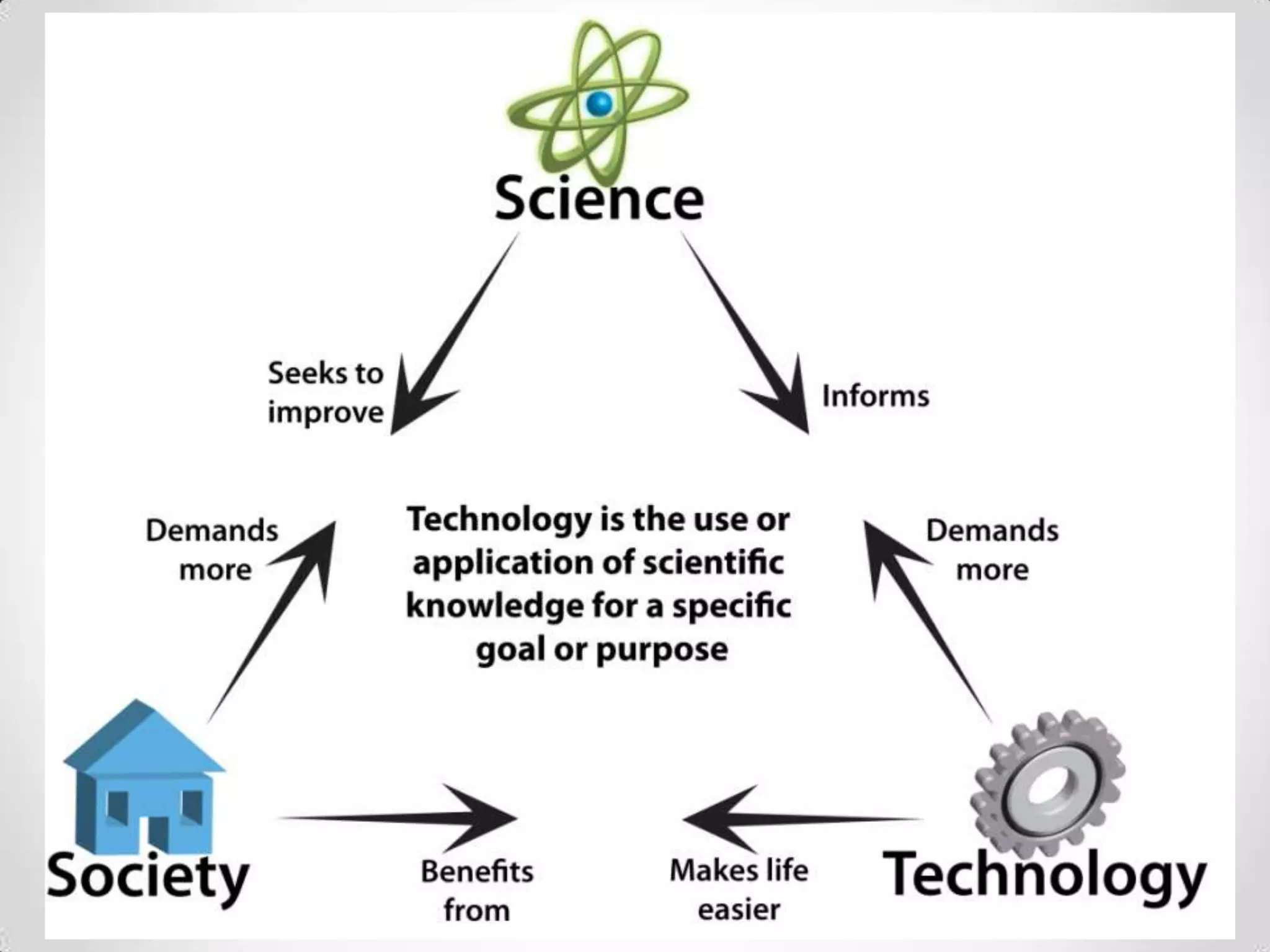
Technology is often a consequence of science and
engineering — although technology as a human
activity precedes the two fields. For example, science
might study the flow of electrons in electrical
conductors, by using already-existing tools and
knowledge. This new-found knowledge may then be
used by engineers to create new tools and
machines, such as semiconductors, computers, and
other forms of advanced technology. In this
sense, scientists and engineers may both be
considered technologists; the three fields are often
considered as one for the purposes of research and
reference.
What is Innovation?
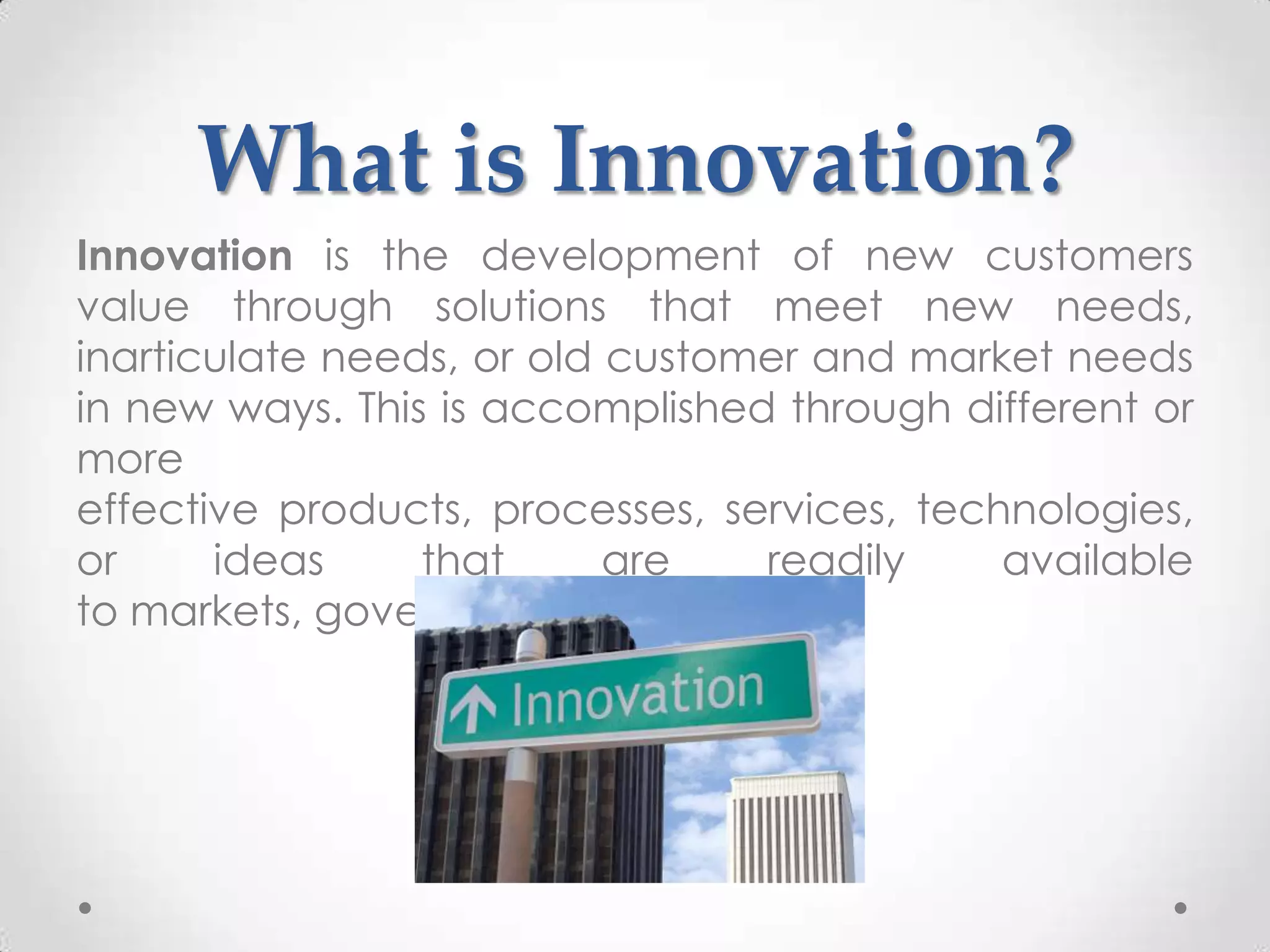
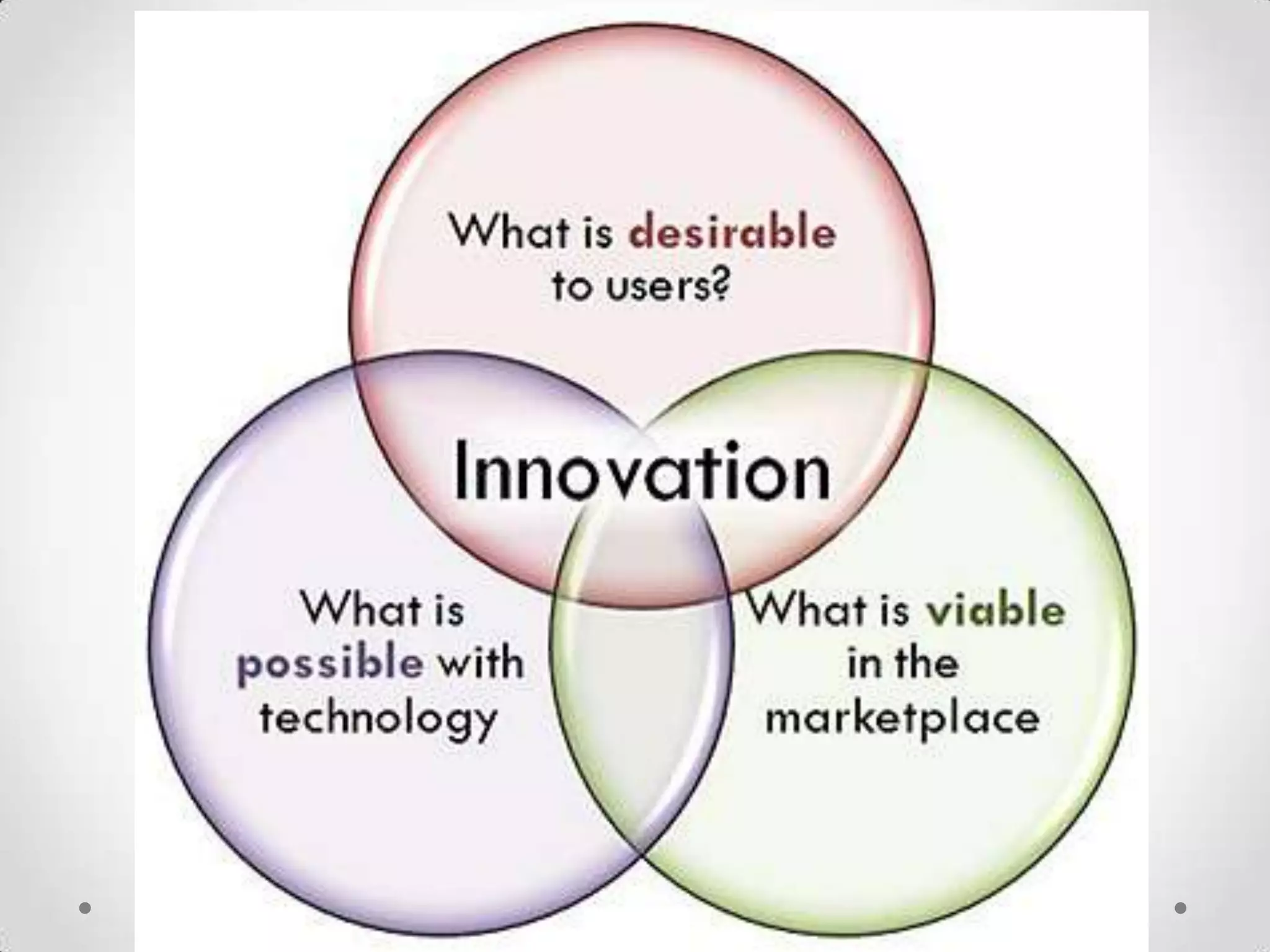
Innovation is the development of new customers
value through solutions that meet new needs,
inarticulate needs, or old customer and market needs
in new ways. This is accomplished through different or
more
effective products, processes, services, technologies,
or     ideas     that      are   readily     available
to markets, governments, and society.
Sources of innovation
There are several sources of innovation. According
to Peter F. Drucker the general sources of innovations
are different changes in industry structure, in market
structure, in local and global demographics, in human
perception, mood and meaning, in the amount of
already available scientific knowledge, etc.
Sources of innovation
Also, internet research, developing of people skills,
language development, cultural background, skype,
Facebook, etc. In the simplest linear model of
innovation the traditionally recognized source
is manufacturer innovation. This is where an agent
(person or business) innovates in order to sell the
innovation. Another source of innovation, only now
becoming widely recognized, is end-user innovation.
This is where an agent (person or company) develops
an innovation for their own (personal or in-house) use
because existing products do not meet their needs.
Sources of innovation
In addition, the famous robotics engineer Joseph F.
Engelberger asserts that innovations require only three
things:
 1. A recognized need.
2. Competent people with relevant technology.
3. Financial support.
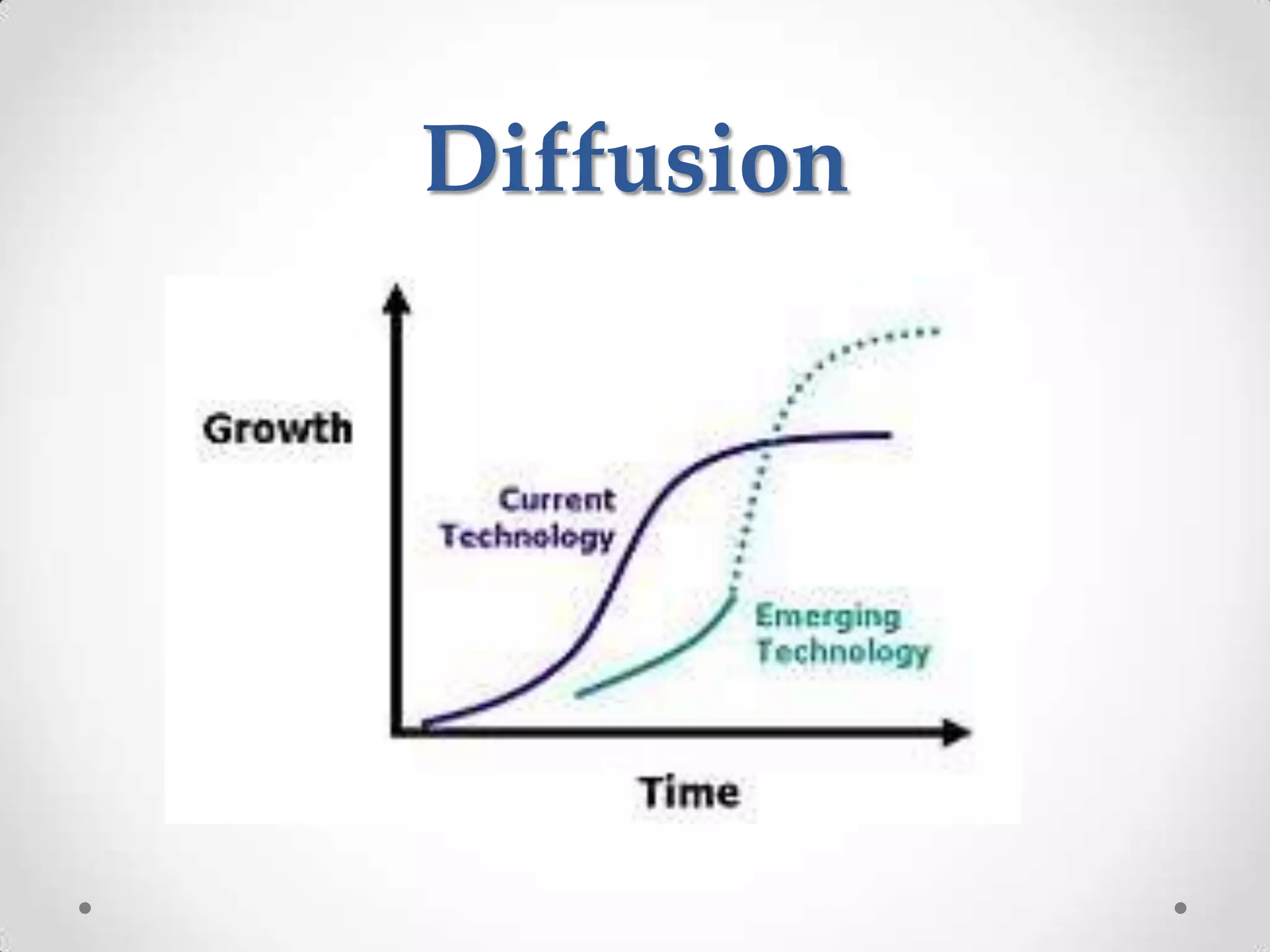
Diffusion
Once innovation occurs, innovations may be spread
from the innovator to other individuals and groups. This
process has been proposed that the life cycle of
innovations can be described using the 's-curve'
or diffusion curve. The s-curve maps growth of
revenue or productivity against time. In the early
stage of a particular innovation, growth is relatively
slow as the new product establishes itself.
Diffusion
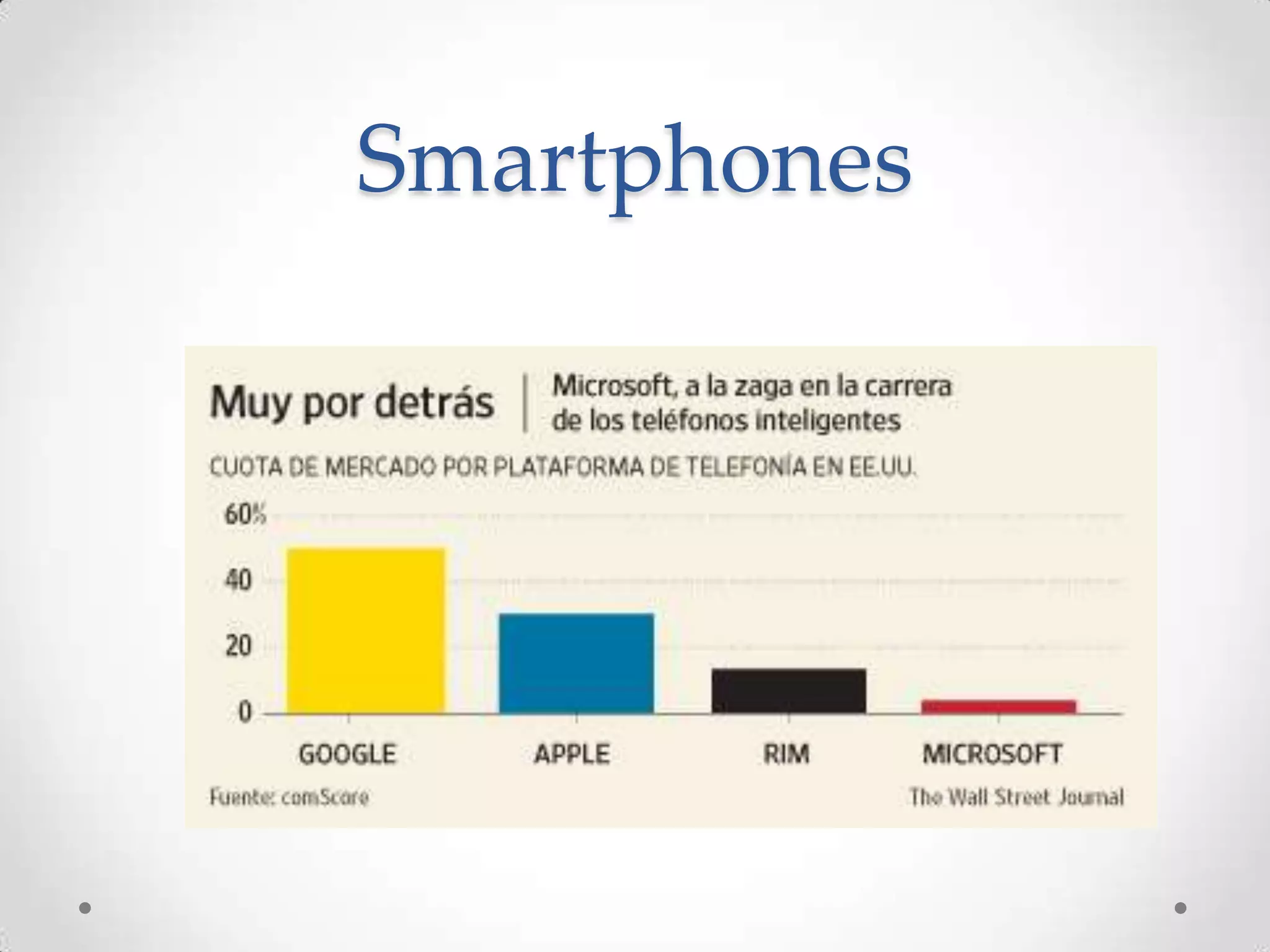
Smartphones
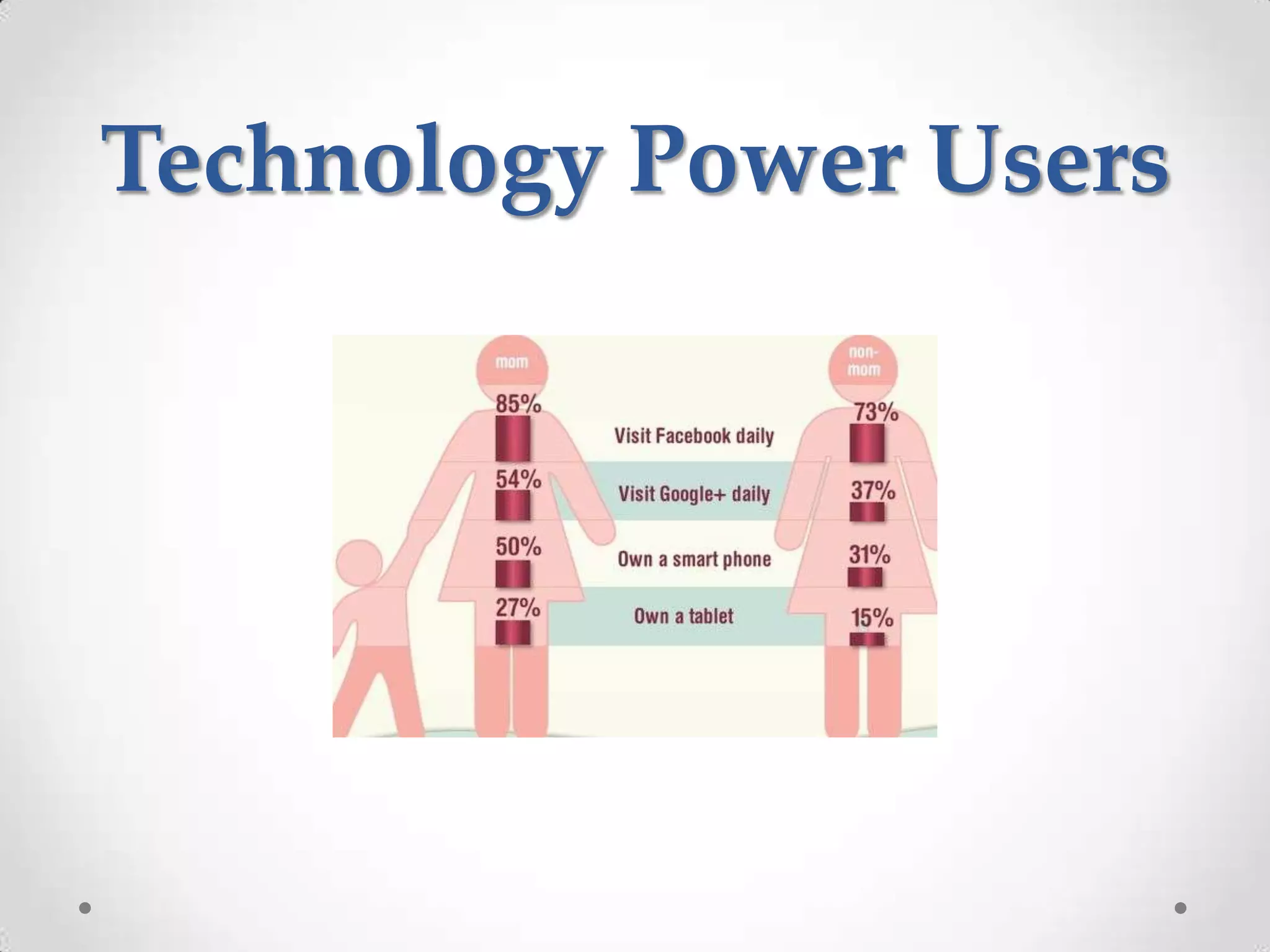
Technology Power Users
Thanks…

Technology and innovation

  • 1.
    Technology and Innovation By: Jose Fung
  • 2.
    Introduction The human species'use of technology began with the conversion of natural resources into simple tools. The prehistorical discovery of the ability to control fire increased the available sources of food and the invention of the wheel helped humans in travelling in and controlling their environment.
  • 3.
    What is technology? Technologyis the making, modification, usage, and knowledge of tools, machines, techniques, crafts, systems, methods of organization, in order to solve a problem, improve a preexisting solution to a problem, achieve a goal or perform a specific function.
  • 4.
    What is technology? Itcan also refer to the collection of such tools, machinery, modifications, arrangements and procedures. Technologies significantly affect human as well as other animal species' ability to control and adapt to their natural environments.
  • 5.
    What is themeaning of the word? The word technology comes from Greek τεχνολογία (technología); from τέχνη (téchnē), meaning "art, skill, craft", and -λογία (-logía), meaning "study of-". The term can either be applied generally or to specific areas: examples include construction technology, medical technology, and information technology.
  • 7.
    Technological Developments Recent technological developments, including the printing press, the telephone, and the Internet, have lessened physical barriers to communication and allowed humans to interact freely on a global scale.
  • 8.
    Technological Developments However, not all technology has been used for peaceful purposes; the development of weapons of ever-increasing destructive power has progressed throughout history, from clubs to nuclear weapons.
  • 9.
    Can the technologiessolve real-world problems? Technology can be most broadly defined as the entities, both material and immaterial, created by the application of mental and physical effort in order to achieve some value. In this usage, technology refers to tools and machines that may be used to solve real- world problems.
  • 10.
    Science, engineering andtechnology The distinction between science, engineering and technology is not always clear. Science is the reasoned investigation or study of phenomena, aimed at discovering enduring principles among elements of the phenomenal world by employing formal techniques such as the scientific method. Technologies are not usually exclusively products of science, because they have to satisfy requirements such as utility, usability and safety.
  • 11.
    Science, engineering andtechnology Engineering is the goal-oriented process of designing and making tools and systems to exploit natural phenomena for practical human means, often (but not always) using results and techniques from science. The development of technology may draw upon many fields of knowledge, including scientific, engineering, mathematical, linguistic, and historical knowledge, to achieve some practical result.
  • 12.
    Science, engineering andtechnology Technology is often a consequence of science and engineering — although technology as a human activity precedes the two fields. For example, science might study the flow of electrons in electrical conductors, by using already-existing tools and knowledge. This new-found knowledge may then be used by engineers to create new tools and machines, such as semiconductors, computers, and other forms of advanced technology. In this sense, scientists and engineers may both be considered technologists; the three fields are often considered as one for the purposes of research and reference.
  • 13.
    What is Innovation? Innovationis the development of new customers value through solutions that meet new needs, inarticulate needs, or old customer and market needs in new ways. This is accomplished through different or more effective products, processes, services, technologies, or ideas that are readily available to markets, governments, and society.
  • 15.
    Sources of innovation Thereare several sources of innovation. According to Peter F. Drucker the general sources of innovations are different changes in industry structure, in market structure, in local and global demographics, in human perception, mood and meaning, in the amount of already available scientific knowledge, etc.
  • 16.
    Sources of innovation Also,internet research, developing of people skills, language development, cultural background, skype, Facebook, etc. In the simplest linear model of innovation the traditionally recognized source is manufacturer innovation. This is where an agent (person or business) innovates in order to sell the innovation. Another source of innovation, only now becoming widely recognized, is end-user innovation. This is where an agent (person or company) develops an innovation for their own (personal or in-house) use because existing products do not meet their needs.
  • 17.
    Sources of innovation Inaddition, the famous robotics engineer Joseph F. Engelberger asserts that innovations require only three things: 1. A recognized need. 2. Competent people with relevant technology. 3. Financial support.
  • 18.
    Diffusion Once innovation occurs,innovations may be spread from the innovator to other individuals and groups. This process has been proposed that the life cycle of innovations can be described using the 's-curve' or diffusion curve. The s-curve maps growth of revenue or productivity against time. In the early stage of a particular innovation, growth is relatively slow as the new product establishes itself.
  • 19.
  • 20.
  • 22.
  • 24.