A Rose For Emily


Group: Bửu Châu, Mai Duyên, Quỳnh Như( Nguyễn), Anh Thư
                  Quỳnh Như( Phạm), Châu Anh
CONTENT
     1. Author
     2. Topic
     3. Themes
     4. Plot
     5. Characters
     6. Setting
     7 Conclusion
William Faulkner(1897-1962)

- Born in New Albany Mississippi
  and came from an old Southern
  family

- His greatest novels and short
  stories are set in mythical
  Yoknapatawpha County

- Wrote about every aspect of life,
  from the mundane to the
  sensational – in the American
  South
William Faulkner( cont)

                  - Used pieces of his own
                    life and family history in
                    his fiction

                  -   Won two Pulitzer
                      Prizes, a National Book
                      Award, and the Nobel
                      Prize for Literature

                  - Died on July 6, 1962
-Soldier's Pay(1926)

-Mosquitoes (1927)

-Sartoris(1929)

-The Sound and The Fury (1929)

- As I Lay Dying (1930)

- Light in August, Absalom, Albasom!, The Wild Palms, The Hamlet,
and Go Down, Moses (1940s)
TOPIC


A tragical Emily’s life because she lived
as the generation time between the old
and the new, between the obsolete
THEMES


         One's excessive pride in
         the past can prevent
         someone from living
         well in the present.
PLOTS
Introduction Emily’s status & character       Homer find out as a corpse


           Emily’s father died
                                                  Emily died at 74

    Emily refuse to pay taxes


                                          Emily buy arsenic to poison Homer
          Emily meet Homer


 The townspeople want to stop their
relationship by Emily’s relatives                 Homer disappear
CONFLICTS

                   Emily vs. father


3 main conflicts   Emily vs. townspeople


                   Emily vs. Homer
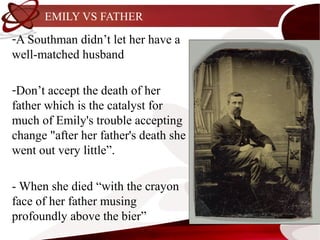
EMILY VS FATHER
-A Southman didn’t let her have a
well-matched husband

-Don’t accept the death of her
father which is the catalyst for
much of Emily's trouble accepting
change "after her father's death she
went out very little”.

- When she died “with the crayon
face of her father musing
profoundly above the bier”
EMILY VS HOMER
-“a tradition, a duty, and    -“a Yankee—a big, dark,
a care” of the town           ready man, with a big voice
                              and eyes lighter than his
                              face”
                              - “He liked men, and it was
-"Of course a Grierson
                              known that he drank with the
would not think seriously of younger men in the Elks'
a Northerner, a day laborer.“ Club—that he was not a
                              marrying man “


 Emily buy arsenic to kill Homer or to keep her
lover forever, it’s a bizarre love
EMILY VS THE TOWNSPEOPLE
- The complaints about the smell of the house

- The gossip and curiosity about who she is

- Refused to pay taxes for the property when the officials
  contacted

- “She carried her head high enough—even when we believed
  that she was fallen. It was as if she demanded more than
  ever the recognition of her dignity as the last Grierson; as if
  it had wanted that touch of earthiness to reaffirm her
  imperviousness”.
CLIMAX

I want some poison,” she said to the druggist.
“Yes, Miss Emily. What kind? For rats and such?
“I want the best you have. I don't care what kind.”
The druggist named several. “They'll kill anything up to an
elephant. But what you want is—”
“Arsenic,” Miss Emily said. “Is that a good one?”“Is . . .
arsenic? Yes, ma’am. But what you want—”
“I want arsenic.”……
………… When she opened the package at home there was
written on the box, under the skull and bones: “For rats.”
CHARACTER


                                           Homer Baron
Miss Emily Grierson


                      - Mr. Grierson

                      - Tobe

                      - Colonel Sartoris
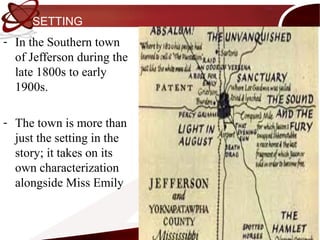
SETTING
- In the Southern town
  of Jefferson during the
  late 1800s to early
  1900s.

- The town is more than
  just the setting in the
  story; it takes on its
  own characterization
  alongside Miss Emily
SOME ANALYSIS ABOUT “A ROSE FOR EMILY”


- Foreshadowing
- Simile
- Flashback
- The Emily’s house
- The Gorthic
- The imagination of “ a rose”
- “Poor emily”
- Tobe
Some figures of speech:

- Foreshadowing: "I want some poison," she
  said to the druggist” and “ Two days later we
  learned that she had bought a complete outfit
  of men's clothing, including a nightshirt,…”.


- Simile: "bloated, like a body long submerged
  in motionless water, and of that pallid hue."
Some figures of speech:

Flashback: list of order events, not arrangement
  +Section 1 reminds the Emily’s death,
  +Section 2 describes Emily’s father death ,
  +Section 3 is the first appearance of Homer
  Barron,
  +Section 4 Emily’s action to kill her lover, Homer,
  indirect description
  + Section 5 back to present time Emily’ death
Some good details in A Rose for Emily

                      - The Emily’s house:
                         “only Miss Emily's
                         house was left,
                         lifting its stubborn
                         and coquettish decay
                         above the cotton
                         wagons and the
                         gasoline pumps” ->
                         Miss Emily’s
                         characteristic
Some good details in A Rose for Emily


The Gorthic( yếu tố kinh dị): the image Homer
 Baron was poisoned not described directly, the
 reader more chained to come to the conclusion.
Some good details in A Rose for Emily


The imagination of


 ->the author’s commemoration to Emily in overall
 the story
  -> represented as Homer , the old Negro, the
 mayor Colonel Sartoris, and the respect of the
 townspeople to Emily
Some good details in A Rose for Emily
“Poor emily”: the attitude of the townspeople with
  Emily
-> It is not only ironical voice from the town but also
  the author’s regret for Emily character.

Tobe: a servant who take care of Emily until she died
-> “the Negro men went in and out with a market
  basket” was repeated as regualrly, slowly and even
  softly as his appearance throughout Emily’s life
-> “his voice had grown harsh and rusty, as if from
  disuse” Tobe might want to spend all his lifetime to
  take care of her as well as to love her in mute
POINT OF VIEW


The willingness of the town to now
admit responsibility is a hopeful
sign, and one that allows us to
envision a better future for
generations to come
CONCLUSION


In summary, the effect of "A Rose for
Emily" is one that is positive and enjoyable.
 "A Rose for Emily" will continue to be a
definite success in the works of William
Faulkner.
Group 7

Group 7

  • 1.
    A Rose ForEmily Group: Bửu Châu, Mai Duyên, Quỳnh Như( Nguyễn), Anh Thư Quỳnh Như( Phạm), Châu Anh
  • 2.
    CONTENT 1. Author 2. Topic 3. Themes 4. Plot 5. Characters 6. Setting 7 Conclusion
  • 3.
    William Faulkner(1897-1962) - Bornin New Albany Mississippi and came from an old Southern family - His greatest novels and short stories are set in mythical Yoknapatawpha County - Wrote about every aspect of life, from the mundane to the sensational – in the American South
  • 4.
    William Faulkner( cont) - Used pieces of his own life and family history in his fiction - Won two Pulitzer Prizes, a National Book Award, and the Nobel Prize for Literature - Died on July 6, 1962
  • 5.
    -Soldier's Pay(1926) -Mosquitoes (1927) -Sartoris(1929) -TheSound and The Fury (1929) - As I Lay Dying (1930) - Light in August, Absalom, Albasom!, The Wild Palms, The Hamlet, and Go Down, Moses (1940s)
  • 6.
    TOPIC A tragical Emily’slife because she lived as the generation time between the old and the new, between the obsolete
  • 7.
    THEMES One's excessive pride in the past can prevent someone from living well in the present.
  • 8.
    PLOTS Introduction Emily’s status& character Homer find out as a corpse Emily’s father died Emily died at 74 Emily refuse to pay taxes Emily buy arsenic to poison Homer Emily meet Homer The townspeople want to stop their relationship by Emily’s relatives Homer disappear
  • 9.
    CONFLICTS Emily vs. father 3 main conflicts Emily vs. townspeople Emily vs. Homer
  • 10.
    EMILY VS FATHER -ASouthman didn’t let her have a well-matched husband -Don’t accept the death of her father which is the catalyst for much of Emily's trouble accepting change "after her father's death she went out very little”. - When she died “with the crayon face of her father musing profoundly above the bier”
  • 11.
    EMILY VS HOMER -“atradition, a duty, and -“a Yankee—a big, dark, a care” of the town ready man, with a big voice and eyes lighter than his face” - “He liked men, and it was -"Of course a Grierson known that he drank with the would not think seriously of younger men in the Elks' a Northerner, a day laborer.“ Club—that he was not a marrying man “  Emily buy arsenic to kill Homer or to keep her lover forever, it’s a bizarre love
  • 12.
    EMILY VS THETOWNSPEOPLE - The complaints about the smell of the house - The gossip and curiosity about who she is - Refused to pay taxes for the property when the officials contacted - “She carried her head high enough—even when we believed that she was fallen. It was as if she demanded more than ever the recognition of her dignity as the last Grierson; as if it had wanted that touch of earthiness to reaffirm her imperviousness”.
  • 13.
    CLIMAX I want somepoison,” she said to the druggist. “Yes, Miss Emily. What kind? For rats and such? “I want the best you have. I don't care what kind.” The druggist named several. “They'll kill anything up to an elephant. But what you want is—” “Arsenic,” Miss Emily said. “Is that a good one?”“Is . . . arsenic? Yes, ma’am. But what you want—” “I want arsenic.”…… ………… When she opened the package at home there was written on the box, under the skull and bones: “For rats.”
  • 14.
    CHARACTER Homer Baron Miss Emily Grierson - Mr. Grierson - Tobe - Colonel Sartoris
  • 15.
    SETTING - In theSouthern town of Jefferson during the late 1800s to early 1900s. - The town is more than just the setting in the story; it takes on its own characterization alongside Miss Emily
  • 16.
    SOME ANALYSIS ABOUT“A ROSE FOR EMILY” - Foreshadowing - Simile - Flashback - The Emily’s house - The Gorthic - The imagination of “ a rose” - “Poor emily” - Tobe
  • 17.
    Some figures ofspeech: - Foreshadowing: "I want some poison," she said to the druggist” and “ Two days later we learned that she had bought a complete outfit of men's clothing, including a nightshirt,…”. - Simile: "bloated, like a body long submerged in motionless water, and of that pallid hue."
  • 18.
    Some figures ofspeech: Flashback: list of order events, not arrangement +Section 1 reminds the Emily’s death, +Section 2 describes Emily’s father death , +Section 3 is the first appearance of Homer Barron, +Section 4 Emily’s action to kill her lover, Homer, indirect description + Section 5 back to present time Emily’ death
  • 19.
    Some good detailsin A Rose for Emily - The Emily’s house: “only Miss Emily's house was left, lifting its stubborn and coquettish decay above the cotton wagons and the gasoline pumps” -> Miss Emily’s characteristic
  • 20.
    Some good detailsin A Rose for Emily The Gorthic( yếu tố kinh dị): the image Homer Baron was poisoned not described directly, the reader more chained to come to the conclusion.
  • 21.
    Some good detailsin A Rose for Emily The imagination of ->the author’s commemoration to Emily in overall the story -> represented as Homer , the old Negro, the mayor Colonel Sartoris, and the respect of the townspeople to Emily
  • 22.
    Some good detailsin A Rose for Emily “Poor emily”: the attitude of the townspeople with Emily -> It is not only ironical voice from the town but also the author’s regret for Emily character. Tobe: a servant who take care of Emily until she died -> “the Negro men went in and out with a market basket” was repeated as regualrly, slowly and even softly as his appearance throughout Emily’s life -> “his voice had grown harsh and rusty, as if from disuse” Tobe might want to spend all his lifetime to take care of her as well as to love her in mute
  • 23.
    POINT OF VIEW Thewillingness of the town to now admit responsibility is a hopeful sign, and one that allows us to envision a better future for generations to come
  • 24.
    CONCLUSION In summary, theeffect of "A Rose for Emily" is one that is positive and enjoyable. "A Rose for Emily" will continue to be a definite success in the works of William Faulkner.

Editor's Notes