2
Food Purchasing, Storageand Control
• Liaison with the foodsuppliers
➲Food Buying
➲Portion Control
➲Methods of Purchasing
➲The Standard Recipe
➲Cost Control
➲Food Cost and Operational Control
➲Organisation of Control
➲Introduction to the Organisation of Recourses
➲Storekeeping
3.
3
Liaison with foodsuppliers
Thesupplier as well as the buyer both have responsibilities that
must be carried out to ensure proper food safety and quality.
➲ Aware of food-borne illness incidents
➲ Food safety limitations
➲ Product specifications
4.
4
Food Purchasing
➲ Oncea menu card is planned, purchasing of ingredients starts
➲ You have to know:
➲ The market;
➲ Determine quantities needed;
➲ Make and use menu specifications;
➲ Make the purchase procedure;
➲ Receive and check the goods;
5.
5
Knowing the Market
➲It's important the a food and beverage buyer has knowledge
of the items to be purchased, such as:
➲ Where they are grown;
➲ Seasons of production;
➲ Approximate costs;
➲ Conditions of supply and demand;
➲ Laws and regulations governing the market;
➲ Marketing agents and their services;
➲ Storage requirements;
➲ Commodity and product, class and grade.
6.
6
The buyer
➲ Thisis the person who makes decisions regarding quality,
amounts, price, what will satisfy the customers but also make
a profit.
➲ Knowledge about products;
➲ Necessary skills required in dealing with sales people, suppliers and other
market agents;
➲ Be prepared to negotiate about the prices.
7.
7
Buying methods
➲ Thesedepend on the type of market and the kind of
operation. Buying procedures are;
➲Informal buying
➲ This usually involves oral negotiations, talking directly
to sales people, face to face or using the telephone
normally on the market.
➲Formal buying
➲ Known as competitive buying, formal buying involves
giving suppliers written specifications and quantity
needs
8.
8
Selecting suppliers
➲ Selectingsuppliers is important in the buying process. First
consider how a supplier will be able to meet the needs of your
operation.
➲ Consider:
Price;
➲ Delivery;
➲ HYGIENE
➲ Quality
Standards.
9.
9
Principles of buying
➲The Menu card dictates the operation's needs. Based on
this the buyer searches for a market that can supply the
company
Depending on:
➲ Type and image of the establishment;
➲ Style of operation and system of service;
➲ Occasion for which the item is needed;
➲ Storage available (dry, refrigerated or frozen);
➲ Finance available
➲ Supply policies of the organisation;
➲ Availability, seasonability, price, trends and supply
10.
10
Three types ofarticles
➲Perishable:
➲ Fresh fruits, vegetables, dairy products, meat and fish.
➲Staple long duration:
➲ Supplies canned, bottled, dehydrated and frozen products.
Rice, pasta, dry beans etc
➲Daily use needs:
➲ Daily use or contract items are delivered frequently on par
stock basis. Stocks are kept up to the desired level and
supply is automatic beer alcohol
11.
11
What quantity andquality?
➲ Exterminating quantity and quality of items to be
purchased is important. Base this on the needs.
➲ The number of people to be served in a given
period;
➲ The sales history;
➲ Portion sizes (this is determined on the standard
recipe with a standard portion per meal served
drawn up by the chef and the management
12.
12
Other aspects offood buying
➲ The chef must inform the buyer of quantities. The
buyer must be aware also of different packaging sizes,
such as jars, bottles, cans and the yield from each
package. Grades, styles, appearance, composition,
varieties, quality factors must be indicated, such as:
➲ Color; texture; size; absence of defects; bruising;
irregular shape; maturity.
13.
13
Buying tip
➲ Ifthere is lots of supply prices go down
➲ See if you can benefit
➲ Example; lots of salmon on market and low prices in a
certain season and lots of freezing space available
14.
14
PORTION CONTROL
• PortionControl means controlling the size or quantity
of food and beverage to be served to each customer.
• The type of customer or establishment
• The quality of the food
• The buying price of the food
15.
15
PORTION CONTROL EQUIPMENT
•Scoops for icecream or rice
• Ladles for soups and sauces
• Butter pats mould, giving 10 grams each
• Fruit juice glasses, 100 grams
• Soup plates or bowls, 14,16, 17, 18 cm
• Coffee-measuring machine
• Individual pie dishes
• Moulds
• Coupes etc.
16.
16
PORTION AMOUNTS
• Thefollowing list of the approximate number of portions that are
obtainable from various foods
• Soup : 4 portions in a litre
• Starter : 120–180 gram per portion
• Fishfillet : 6 portions to the kg
• Fish on the bone: 4 portions to the kg
• Sauces : 70 grs each
• Meats: Roast boneless: 5 portions per kg
• Sirloinsteak : 120-180 per portion
• etc.
17.
17
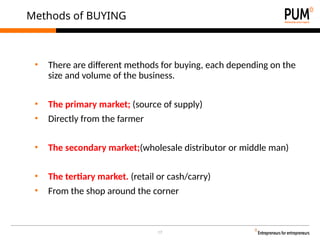
Methods of BUYING
•There are different methods for buying, each depending on the
size and volume of the business.
• The primary market; (source of supply)
• Directly from the farmer
• The secondary market;(wholesale distributor or middle man)
• The tertiary market. (retail or cash/carry)
• From the shop around the corner
18.
18
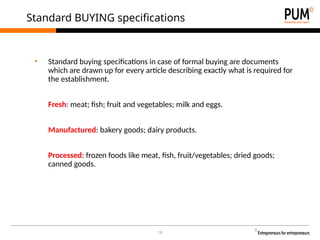
Standard BUYING specifications
•Standard buying specifications in case of formal buying are documents
which are drawn up for every article describing exactly what is required for
the establishment.
Fresh: meat; fish; fruit and vegetables; milk and eggs.
Manufactured: bakery goods; dairy products.
Processed: frozen foods like meat, fish, fruit/vegetables; dried goods;
canned goods.
19.
19
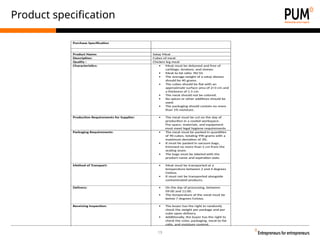
Product specification
Purchase Specification
ProductName: Satay Meat
Description: Cubes of meat
Quality : Chicken leg meat
Characteristics: Meat must be deboned and free of
cartilage, tendons, and sinews.
Meat to fat ratio: 90/10.
The average weight of a satay skewer
should be 40 grams.
The cubes should be flat with an
approximate surface area of 2×3 cm and
a thickness of 1.5 cm.
The meat should not be colored.
No spices or other additives should be
used.
The packaging should contain no more
than 1% moisture.
Production Requirements for Supplier: The meat must be cut on the day of
production in a cooled workspace.
The space, materials, and equipment
must meet legal hygiene requirements
Packaging Requirements: The meat must be packed in quantities
of 90 cubes, totaling 990 grams with a
maximum deviation of 3%.
It must be packed in vacuum bags,
trimmed no more than 5 cm from the
sealing seam.
The bags must be labeled with the
product name and expiration date.
Method of Transport: Meat must be transported at a
temperature between 2 and 4 degrees
Celsius.
It must not be transported alongside
contaminated products.
Delivery: On the day of processing, between
09:00 and 11:00.
The temperature of the meat must be
below 7 degrees Celsius.
Receiving Inspection: The buyer has the right to randomly
check the weight per package and per
cube upon delivery.
Additionally, the buyer has the right to
check the color, packaging, meat-to-fat
ratio, and moisture content.
20.
20
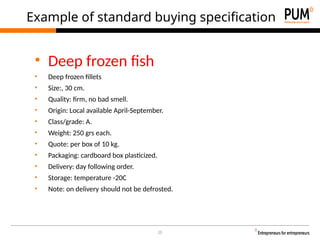
Example of standardbuying specification
• Deep frozen fish
• Deep frozen fillets
• Size:, 30 cm.
• Quality: firm, no bad smell.
• Origin: Local available April-September.
• Class/grade: A.
• Weight: 250 grs each.
• Quote: per box of 10 kg.
• Packaging: cardboard box plasticized.
• Delivery: day following order.
• Storage: temperature -20C
• Note: on delivery should not be defrosted.
21.
21
The standard recipe
•Standard recipe is a recipe written out with all its different ingredients with the
quality and quantity for use in the kitchen.
• It should show the exact weights and qualities of the ingredients together with
the method of preparation and service.
• It allows makes sure that always the same dish is prepared and served to the
customers.
• It allows the management to control the cost.
22.
22
Standard Recipe
Determine thefollowing:
• Quantities and Qualities ingredients used;
• The foodcost per portion;
• Used for;
• Menu planning;
• Buying and internal requisitioning;
• Portion control
• Food preparation and production;
23.
23
COST CONTROL
• It'simportant to know the exact cost of each process and every item produced
• System of cost analysis and cost information is essential.
24.
24
Advantage of acosting systeem
• It makes the profit visible per department of the organisation and shows cost of
each meal made.
• It shows possible sources of economy and can result in a more effective use of
stores, labour, materials, etc.
• Costing provides information necessary for the formation of a price policy.
• Cost records provide and facilitate the speedy quotations for special parties,
weddings, etc.
• And it enables to keep to a budget.
25.
25
Guidelines for acosting system
• Cooperation of all departments is essential.
• Costing system must be adapted to the business and not the other way
around.
• Clear written instructions for the staff who keep records.
• System must be SIMPLE and EASY
• Administration kept to a minimum.
26.
26
TOTAL COSTS
• Tocalculate the total cost of one item or meal provided it is necessary to
analyse the total expenditure. Basically total cost of an item consists of
• Three main elements
• Food- or Materials costs; known as variable costs.
• Labour
• Overhead.
#1 This presentation is made special for chefs and f&b-managers to consider and learn that investing a little bit more time in the daily usual work in kitchen and restaurant can give in the future more profit out of your food-and beverage operations.
#2 This are the subject we will discuss the coming sessions.
#3 There are certain important factors involved in a successful working relationship with foodsuppliers. Suppliers must be aware of what is expected of the produce.
#4 One of the first and most important stages is to purchase and receive the materials needed to produce the menu items. Skilful purchasing with good receiving can do much to maximise the results of a good menu.
#5 Since markets vary considerably, to do a good job of purchasing a buyer must know the characteristics of each market.
A market is a place in which ownership of commodity changes from one person to another.
This could occur using the telephone, on a street corner, in retail or wholesale establishement or at an auction.
#6 The wisdom of the buyer's dicisions will be reflected in the succes or failuure of the operation.
Bying may be the responsibility of the chef, manager, storekeeper, buyer or buying department.
#7 A buyer must also be able to make good use of marketconditions. For example, if there is a glut of fresh salmon at low cost, has the organisation the facility to make use of the extra salmon purchases? Is theresufficient freezer space? Cann the chef make use of salmon, by creating a demand on the menu?
#8 Information on suppliers is important in the purchasing process.
Information on suppliers can be obtained from other purchasers. Visits suppliers establishments are to be encouraged. When interviewing prospective suppliers, you need to question how reliable a supplier will be under competition and how stable under varying market conditions.
#9 After the right market is located, the various products available that may meet the needs are then investigated. The right product must be
obtained to meet the need and give the right quality desired by the establishment.
#10 It's very useful to keep this three types of needs also in your kitchenstockforms. So you can more easy realise your stocktakingprocedure.
#11 The buyer must be informed by the chef or other members of the production team of the products needed. The chef and his or her team must establish the quality and they should be required to inspect the goods on arrival. The buyer with this information then checks out the market and looks for the best quality and best price.
#12 Quality standards should be established by the chef and management team when the menu is planned. Menus and recipes may be developed using standardised recipes which directly relate to the buying procedure and standard purchasing specifications.
#13 A buyer must also be able to make good use of marketconditions. For example, if there is a glut of fresh salmon at low cost, has the organisation the facility to make use of the extra salmon purchases? Is theresufficient freezer space? Cann the chef make use of salmon, by creating a demand on the menu?
#14 To evolve a sound system of portion control each establishment (or type of establishment) needs individual consideration. A golden rule should be 'a fair portion for a fair price'.
#15 It was found that 0.007 litre of milk was being lost per cup by spilling it from a jug; 32000 cups = 224 litres of milk lost daily; this resulted in a loss of hundred of Euro's per year.
#16 From every product on the menu we can make the portion amount like:
-Soup
-Hors d'oeuvre
-Fish
-Sauces
-Meats
-Offal
-Lamb
-Pork
-Ham
-Ducks and chickens
-Vegetables and potatoes
#17 -The primary market: Some establishment or large organisations will have a buyer who will buy directly from the primary markets.
-The secondary market: Goods are bought whole sale from a distributor or middle man; the establishment will pay wholesale prices and obtain possible discounts.
The tertiary market:retail or cash and carry is a method suitable for smaller companies.
#18 These standard purchasing specifications will assist with the formulation of standard recipes. A watertight specification is drawn up which, once approved, will be referred to every time the item is delivered. It is a statement of various criteria related to quality, grade, weight, size and method of preparation, if required, such as washed and selected potatoes for baking. Other information given may be variety, maturity, age, colour, shape,etc.
#22 Also the standard recipe will assist new staff in preparation and production of standard products, which can be facilitated by photographs or drawings illustrating the finished product.
#24 It is important to know the exact cost of each process and every item produced, so a system of cost analysis and cost information is essential.
#25 No one costing system will automatically suit every catering business.
#26 Food- or materials costs known as variable costs because the level will vary according to the volume of business; in an operation that uses part-time or extra staff for special occasions, the money paid to these staff also comes under variable costs; by comparison, salaries and wages paid regurarly to permanent staff are fixed costs.
All cost of labour and overheads: regular charges which come under the heading of fixed costs; labour costs in the majority of opprations fall into two categories: direct labour cost, which is salaries and wages paid to staff such as chefs, waiters, barstaff, housekeepers, chambermaids.Indirect labercosts, which would include salaries and wages paid, for example, to managers, office staff and maintenance
Overhead consists of rent, rates, heating, lighting and equipment