Sandia National Laboratories is a multi-mission laboratory managed and operated by Sandia Corporation, a wholly owned subsidiary of Lockheed Martin Corporation, for
the U.S. Department of Energy’s National Nuclear Security Administration under contract DE-AC04-94AL85000
Sandia	National	Laboratories
Grid	Modernization	Program	Area
Charles	Hanley	
December,	2016
1
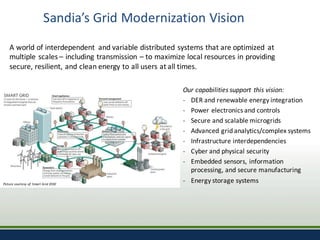
Sandia’s	Grid	Modernization	Vision
A	world	of	interdependent	 and	variable	distributed	systems	that	are	optimized	 at	
multiple	scales	– including	transmission	– to	maximize	local	resources	in	providing	
secure,	resilient,	and	clean	energy	to	all	users	at	all	times.
Our	capabilities	support	this	vision:
- DER	and	renewable	energy	integration
- Power	electronics	and	controls
- Secure	and	scalable	microgrids
- Advanced	grid	analytics/complex	systems
- Infrastructure	interdependencies
- Cyber	and	physical	security
- Embedded	sensors,	information	
processing,	and	secure	manufacturing
- Energy	storage	systemsPicture	courtesy	of:	Smart	Grid	2030
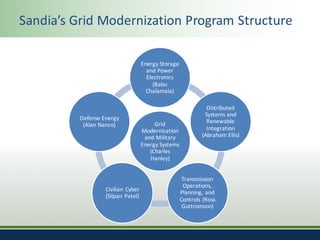
Sandia’s	Grid	Modernization	Program	Structure
Grid	
Modernization	
and	Military	
Energy	Systems	
(Charles	
Hanley)
Energy	Storage	
and	Power	
Electronics	
(Babu	
Chalamala)	
Distributed	
Systems	and	
Renewable	
Integration	
(Abraham	Ellis)
Transmission	
Operations,	
Planning,	and	
Controls	(Ross	
Guttromson)
Civilian	Cyber	
(Silpan	Patel)
Defense	Energy	
(Alan	Nanco)
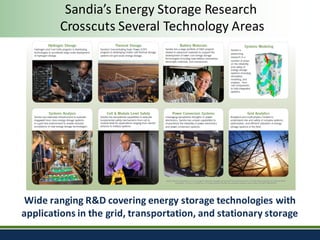
Sandia’s	Energy	Storage	Research
Crosscuts	Several	Technology	Areas
Wide	ranging	R&D	covering	energy	storage	technologies	with	
applications	in	the	grid,	transportation,	and	stationary	storage
Improving	Grid	Resilience	
in	Planning	and	Operations
• Sandia	developed	a	framework	for	
rigorous	quantification	of	energy	
system	resilience
• This	framework	enables	decision	
making	to	obtain	demonstrable	
resilience	improvements
• PJM	Partnership:	Applied	to	
GMD	as	a	threat	we	consider	
– Multiple	scenarios	for	worst	case	
GMD	intensity	and	uncertainty	in	
the	orientation	of	the	GMD
– Formulate	an	optimization	
problem	where	minimizing	
consequences	of	one	or	multiple	
types	is	the	objective
– This	results	in	a	non-linear	
program	(operations)	or	a	mixed-
integer	non-linear	program	
(planning)
5
ProbabilityofConsequences
[$]GivenThreatX
Consequences [$]
Reduced Expected Financial
Consequence
Reduced Risk
Baseline System
Resilience
Resilience of System
after Improvements
Improvements
must cost
significantly less
than E-E’
E’(C) E(C)
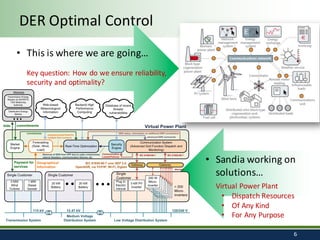
DER	Optimal	Control
6
3 kW PV
Inverter
20 kW
Battery
Plug In
Electric
Vehicle
Single
Customer
200 W
Micro-
inverter
Market
Engine
Communication System
(Advanced Grid Function Dispatch and
Monitoring)
Forecasting
(Solar, Wind,
Load)
Real-Time Optimization
Virtual Power Plant
Payment for
services
Markets
Transmission Energy
Market via ISO/RTO/
TSO Balancing
Authority
Geographical
Information
Distribution Energy
Market
200 W
Micro-
inverter
200 W
Micro-
inverter
200 W
Micro-
inverter
200 W
Micro-
inverter
200 W
Micro-
inverter
200 W
Micro-
inverter
200 W
Micro-
inverter
= 200
Micro-
inverters
IEC 61850-90-7 over SEP 2.0,
OpenADR, via TCP/IP, Wi-Fi, Zigbee
115 kV 12.47 kV 120/240 V
Transmission System
20 kW
Battery
Gateway Gateway
Security
Engine
bids commitments
commitments
expected power/load for
multiple time horizons
DER status, information on additional DER connections
3 MW
Wind
Turbine
1 MW
Diesel
Genset
Medium Voltage
Distribution System Low Voltage Distribution System
advanced DER commands
Removal of DER from VPP due to cyber compromise,
natural disasters, communication failures, etc.
IEC 61850-90-7 IEC 61850-90-7
Communication
Losses/Failures
Web-based
Meteorological
Information
Backend High
Performance
Computing
Single CustomerSingle Customer
Wireless
Database of recent
threats/
vulnerabilities
• This	is	where	we	are	going…
Key	question:	How	do	we	ensure	reliability,	
security	and	optimality?
• Sandia	working	on	
solutions…
Virtual	Power	Plant
• Dispatch	Resources
• Of	Any	Kind
• For	Any	Purpose
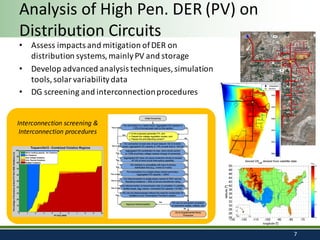
Analysis	of	High	Pen.	DER	(PV)	on	
Distribution	Circuits
• Assess	impacts	and	mitigation	of	DER	on	
distribution	systems,	mainly	PV	and	storage
• Develop	advanced	analysis	techniques,	simulation	
tools,	solar	variability	data
• DG	screening	and	interconnection	procedures
7
Interconnection	screening	&
Interconnection	procedures
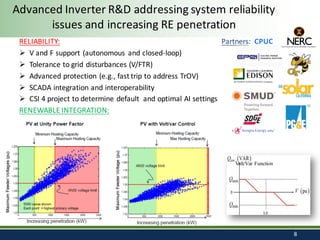
Advanced	Inverter	R&D	addressing	system	reliability	
issues	and	increasing	RE	penetration
RELIABILITY:
Ø V	and	F	support	(autonomous	 and	closed-loop)
Ø Tolerance	to	grid	disturbances	(V/FTR)
Ø Advanced	protection	(e.g.,	fast	trip	to	address	TrOV)
Ø SCADA	integration	and	interoperability
Ø CSI	4	project	to	determine	default		and	optimal	AI	settings
RENEWABLE	INTEGRATION:
8
Volt/Var Function
Partners:		CPUC
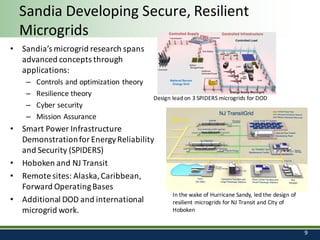
Sandia	Developing	Secure,	Resilient	
Microgrids
• Sandia’s	microgrid	research	spans	
advanced	concepts	through	
applications:
– Controls	and	optimization	theory
– Resilience	theory
– Cyber	security
– Mission	Assurance
• Smart	Power	Infrastructure	
Demonstration	for	Energy	Reliability	
and	Security	(SPIDERS)
• Hoboken	and	NJ	Transit
• Remote	sites:	Alaska,	Caribbean,	
Forward	Operating	Bases	
• Additional	DOD	and	international	
microgrid	work.
9
Design	lead	on	3	SPIDERS	microgrids	for	DOD
In	the	wake	of	Hurricane	Sandy,	led	the	design	of	
resilient	microgrids	for	NJ	Transit	and	City	of	
Hoboken
Advanced	Microgrid	Conceptual	and	Operational	Designs
Military Conceptual
Designs/Assessments
<1 MW Microgrid
Operations
Large Scale
Microgrid Operations
Community
Microgrid Designs
• Creech AFB – FY12 DoD
• Soto Cano – FY12 DoD
• West Point FY12, DoD/DOE OE
• Osan AFB, FY 12, DoD
• Philadelphia Navy Yard – FY11,
DOE OE/PIDC
• Camp Smith – FY10, DOE FEMP
• Indian Head NWC – FY09, DOE
OE/DoD
• Ft. Sill – FY08, Sandia LDRD
• Ft. Bliss – FY10, DOE FEMP
• Ft. Carson – FY10, DOE FEMP
• Ft. Devens (99th ANG) – FY09, DOE
OE/DoD
• Ft. Belvoir – FY09 DOE OE/FEMP
• Cannon AFB – FY11, DOE OE/DoD
• Vandenberg AFB – FY11, DOE
FEMP
• Kirtland AFB – FY10, DOE OE/DoD
• Maxwell AFB – FY09, DoD/DOE
• Bagram – FY13, DOD
• Kuwait – FY15, DoD
• 29 Palms – FY14, DoD/ESTCP
• Maxwell AFB – FY11 -
14, DoD
• Ft. Sill – FY10, DoD
• Ft. Bliss – FY12-13,
DoD/ESTCP
• SPIDERS JCTD – FY11-
15, DOE/DoD/CERL
• Camp Smith
• Ft. Carson
• Hickam AFB
• Ft. Belvoir FY15 DoD
• Northampton, MA
• NJ Transit
• Hoboken, NJ
• Lihue, Kauai
• New Orleans, LA
• Alaskan Villages
Community
Military
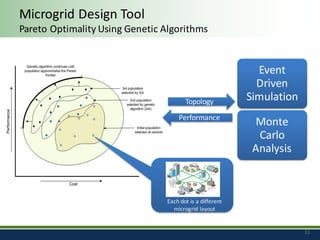
Microgrid	Design	Tool
Pareto	Optimality	Using	Genetic	Algorithms
11
Topology
Performance
Event	
Driven	
Simulation
Monte	
Carlo	
Analysis
Each	dot	is	a	different
microgrid layout
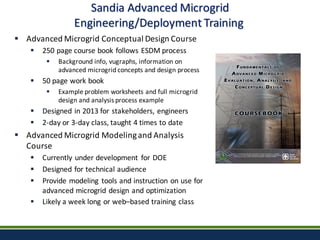
Sandia	Advanced	Microgrid	
Engineering/Deployment	Training
§ Advanced	Microgrid	Conceptual	Design	Course
§ 250	page	course	book	follows	ESDM	process
§ Background info,	vugraphs,	information	on	
advanced microgrid	concepts	and	design	process
§ 50	page	work	book
§ Example	problem	worksheets and full	microgrid	
design	and	analysis	process	example
§ Designed	in	2013	for	stakeholders,	engineers
§ 2-day	or	3-day	class,	taught	4	times	to	date	
§ Advanced	Microgrid	Modeling	and	Analysis	
Course
§ Currently	under	development	 for	DOE
§ Designed	for	technical	audience
§ Provide	modeling tools and	instruction	on	use	for	
advanced	microgrid design	and optimization
§ Likely	a	week	long	or	web–based	training	class
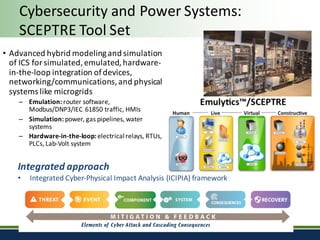
Cybersecurity	and	Power	Systems:	
SCEPTRE	Tool	Set
• Advanced	hybrid	modeling	and	simulation	
of	ICS	for	simulated,	emulated,	hardware-
in-the-loop	integration	of	devices,	
networking/communications,	and	physical	
systems	like	microgrids
– Emulation:	router	software,	
Modbus/DNP3/IEC	61850	traffic,	HMIs
– Simulation:	power,	gas	pipelines,	water	
systems
– Hardware-in-the-loop:	electrical	relays,	RTUs,	
PLCs,	Lab-Volt	system
Integrated	approach
• Integrated	Cyber-Physical	Impact	Analysis	(ICIPIA)	framework
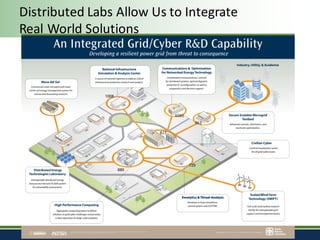
Distributed	Labs	Allow	Us	to	Integrate	
Real	World	Solutions
Partnerships	are	Key	to	Our	Strategy
15
Thank	You
Charles	Hanley
Sr.	Manager,	Grid	Modernization	and	Military	
Energy	Systems
505-844-4435
cjhanle@sandia.gov
16

Grid Modernization Program Area