




greenMan marketing leighhimel.blogspot.com All rights reserved yada yada part I
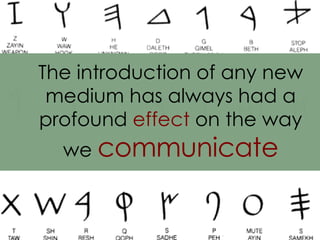
The introduction of any new medium has always had a profound  effect  on the way we  communicate
“ Allow  events to  change  you” - Bruce Mau  "Incomplete Manifesto for Growth"
To strategize and plan within the digitally empowered world, we need to start with the underlying  dynamics
That’s where mother nature comes in
To understand  digital , and the new ecology of networks, you have to first get  ecosystems
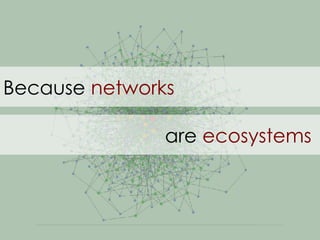
Because  networks are  ecosystems
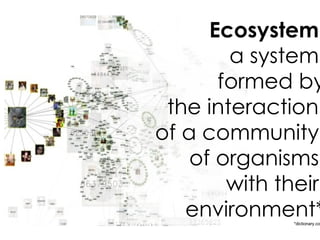
Ecosystem: a system  formed by the interaction  of a community  of organisms  with their  environment* *dictionary.com
Ecosystems have 5 key characteristics
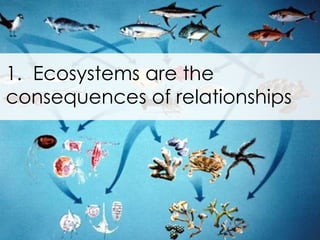
1.  Ecosystems are the consequences of relationships
2.  Ecosystems are open to energy and material flow
3.  Ecosystems have no boundaries
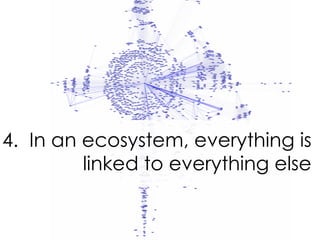
4.  In an ecosystem, everything is linked to everything else
5.  Ecosystems are intractable  (not easily manipulated or managed)
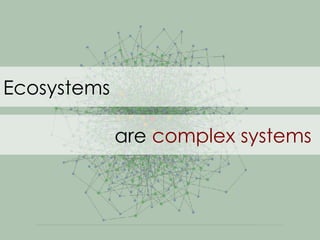
Ecosystems are  complex systems
Where relationships are not prescribed but rather ‘emerge’
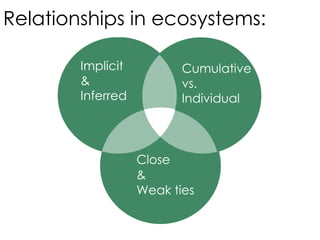
Relationships in ecosystems: Implicit& Inferred Cumulative vs. Individual Close  &  Weak ties
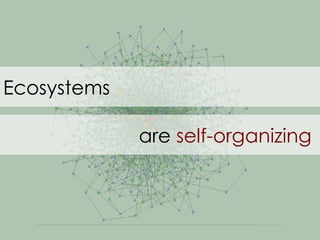
Ecosystems are  self-organizing
Self organizing behaviour increases the complexity of the system over time  without  being guided or  managed  by an outside source…….and the system starts to display  emergent properties  that you couldn’t have predicted before you started
“ The opposite of an imposed structure is  not chaos …the opposite of an imposed structure is an  emergent structure , one that  forms  over time based on the  interactions  of a lot of people” Andrew Mcafee, HBS
How does this mesh with  traditional  business  thinking ?
It doesn’t ;)
“ Ecosystem are not only more complex than we think, ecosystems are more complex than we  can  think” - FB Golley, 1993
Lessons From:   Environmental Theory & Management
Environmentalists used to manage the environment the same way that many businesses manage their customers, employees and brands today
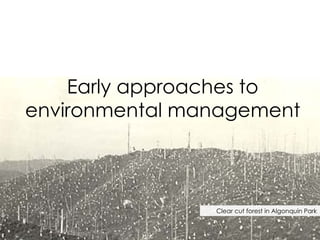
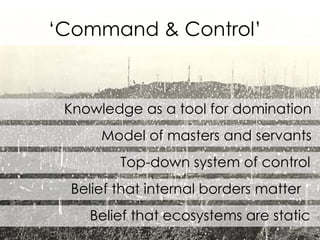
Early approaches to environmental management Clear cut forest in Algonquin Park
Knowledge as a tool for domination Model of masters and servants Top-down system of control Belief that internal borders matter  Belief that ecosystems are static ‘ Command & Control’
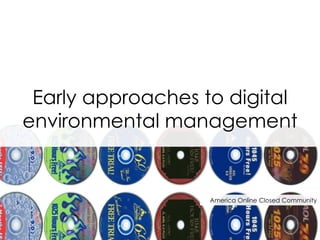
Early approaches to digital environmental management America Online Closed Community
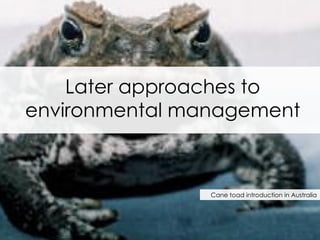
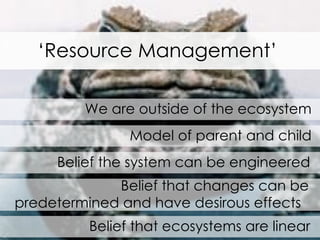
Later approaches to environmental management Cane toad introduction in Australia
We are outside of the ecosystem Model of parent and child Belief the system can be engineered Belief that changes can be predetermined and have desirous effects  Belief that ecosystems are linear ‘ Resource Management’
Later approaches to digital environmental management Microsoft’s What We Think is Best For You Approach
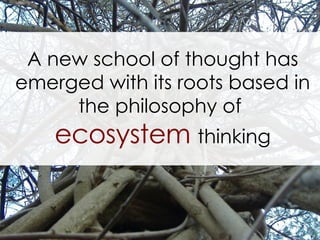
A new school of thought has emerged with its roots based in the philosophy of  ecosystem  thinking
‘ The Ecosystem Approach’
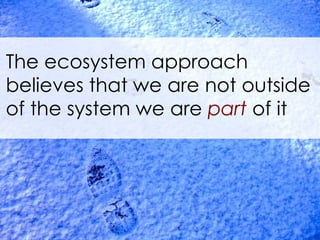
The ecosystem approach believes that we are not outside of the system we are  part   of it
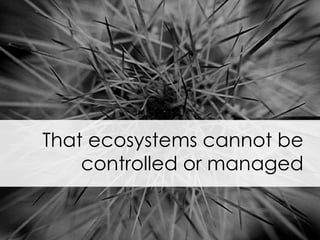
That ecosystems cannot be controlled or managed
That healthy ecosystems are open
And that ecosystems are alive, organic and constantly evolving
Finally, the ecosystem approach understands that as the system changes, so do we
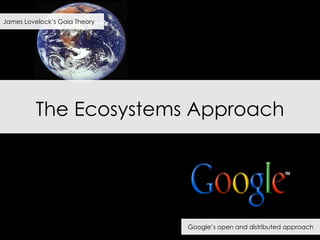
The Ecosystems Approach Google’s open and distributed approach  James Lovelock’s Gaia Theory
How will this  effect  how we do  business  day today ? I’ll discuss that in Part II coming soon….but for now…
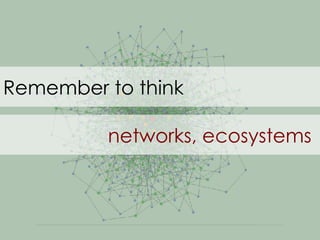
Remember to think  networks, ecosystems
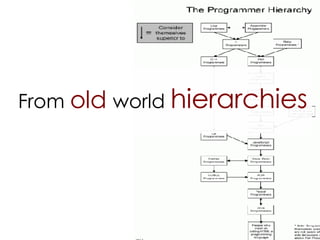
From  old  world  hierarchies
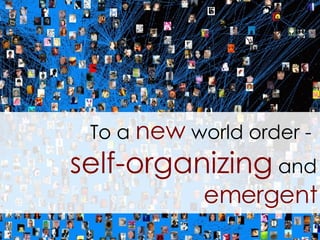
To a  new  world order -  self-organizing  and  emergent
Until then :) leighhimel.blogspot.com
sources ESF Scientific Programme (Jan 2000) “Linking Community and Ecosystem Ecology (LINKECOL) Hollick, Malcolm (1993) “Self-organizing systems and environmental management” Centre for water research, University of Western Australia Katsoupas, Vassilios (1992) “Mobilizations to Safe the Kalamas River” Masters Thesis Korn, Stadler, Maltby & Kerr (Eds) “Report of the scientific workshop on “The ecosystem approach - what does it mean for European ecosystems?” Laffoley, D.d'A., Maltby, E., Vincent, M.A., Mee, L., Dunn, E., Gilliland, P., Hamer, J.P, Mortimer, D., and Pound, D.  2004.  The Ecosystem Approach.  Coherent actions for marine and coastal environments.  A report to the UK Government.  Peterborough, English Nature.  65pp.   Lovelock, James (1982) The Gaia Theory:A New Look Of Life On Earth   Leibow, Edward (March 2007) “Environmental Management and Development” Geographical Research 45(1): 105-115 Wylynko, Bradley D.  “Beyond Command and Control:  Regulating in an Era of Uncertainty” Photo Credits* P.  www . krazydad.com/gustavog/poster/finder.html P.  aol.bfxmedia.com/aol_disk11.jpg P “Vines”  by imbadatthis   www.flickr.com/photos/8524543@N06/ P “Rain Forest” by januszbc I ww.flickr.com/photos/januszbc/ P “footprints in snow” by  bram app www.flickr.com/photos/bramapp P “chaotic star” by accrama www.flickr.com/photos/mariodeleo/ P “wide open sky” by duluthquims  www.flickr.com/photos/duluthquism/ P “breath of fresh air” by aflodan www.flickr.com/photos/asbjorn_floden/ P”earth day every day by montana raven www.flickr.com/photos/montanaraven/ *Some photo credits were lost so if you see a photo and recognize it please email me and I”ll update the presentation with it

Ecosystem Marketing

  • 1.
    greenMan marketing leighhimel.blogspot.comAll rights reserved yada yada part I
  • 2.
    The introduction ofany new medium has always had a profound effect on the way we communicate
  • 3.
    “ Allow events to change you” - Bruce Mau "Incomplete Manifesto for Growth"
  • 4.
    To strategize andplan within the digitally empowered world, we need to start with the underlying dynamics
  • 5.
    That’s where mothernature comes in
  • 6.
    To understand digital , and the new ecology of networks, you have to first get ecosystems
  • 7.
    Because networksare ecosystems
  • 8.
    Ecosystem: a system formed by the interaction of a community of organisms with their environment* *dictionary.com
  • 9.
    Ecosystems have 5key characteristics
  • 10.
    1. Ecosystemsare the consequences of relationships
  • 11.
    2. Ecosystemsare open to energy and material flow
  • 12.
    3. Ecosystemshave no boundaries
  • 13.
    4. Inan ecosystem, everything is linked to everything else
  • 14.
    5. Ecosystemsare intractable (not easily manipulated or managed)
  • 15.
    Ecosystems are complex systems
  • 16.
    Where relationships arenot prescribed but rather ‘emerge’
  • 17.
    Relationships in ecosystems:Implicit& Inferred Cumulative vs. Individual Close & Weak ties
  • 18.
    Ecosystems are self-organizing
  • 19.
    Self organizing behaviourincreases the complexity of the system over time without being guided or managed by an outside source…….and the system starts to display emergent properties that you couldn’t have predicted before you started
  • 20.
    “ The oppositeof an imposed structure is not chaos …the opposite of an imposed structure is an emergent structure , one that forms over time based on the interactions of a lot of people” Andrew Mcafee, HBS
  • 21.
    How does thismesh with traditional business thinking ?
  • 22.
  • 23.
    “ Ecosystem arenot only more complex than we think, ecosystems are more complex than we can think” - FB Golley, 1993
  • 24.
    Lessons From: Environmental Theory & Management
  • 25.
    Environmentalists used tomanage the environment the same way that many businesses manage their customers, employees and brands today
  • 26.
    Early approaches toenvironmental management Clear cut forest in Algonquin Park
  • 27.
    Knowledge as atool for domination Model of masters and servants Top-down system of control Belief that internal borders matter Belief that ecosystems are static ‘ Command & Control’
  • 28.
    Early approaches todigital environmental management America Online Closed Community
  • 29.
    Later approaches toenvironmental management Cane toad introduction in Australia
  • 30.
    We are outsideof the ecosystem Model of parent and child Belief the system can be engineered Belief that changes can be predetermined and have desirous effects Belief that ecosystems are linear ‘ Resource Management’
  • 31.
    Later approaches todigital environmental management Microsoft’s What We Think is Best For You Approach
  • 32.
    A new schoolof thought has emerged with its roots based in the philosophy of ecosystem thinking
  • 33.
    ‘ The EcosystemApproach’
  • 34.
    The ecosystem approachbelieves that we are not outside of the system we are part of it
  • 35.
    That ecosystems cannotbe controlled or managed
  • 36.
  • 37.
    And that ecosystemsare alive, organic and constantly evolving
  • 38.
    Finally, the ecosystemapproach understands that as the system changes, so do we
  • 39.
    The Ecosystems ApproachGoogle’s open and distributed approach James Lovelock’s Gaia Theory
  • 40.
    How will this effect how we do business day today ? I’ll discuss that in Part II coming soon….but for now…
  • 41.
    Remember to think networks, ecosystems
  • 42.
    From old world hierarchies
  • 43.
    To a new world order - self-organizing and emergent
  • 44.
    Until then :)leighhimel.blogspot.com
  • 45.
    sources ESF ScientificProgramme (Jan 2000) “Linking Community and Ecosystem Ecology (LINKECOL) Hollick, Malcolm (1993) “Self-organizing systems and environmental management” Centre for water research, University of Western Australia Katsoupas, Vassilios (1992) “Mobilizations to Safe the Kalamas River” Masters Thesis Korn, Stadler, Maltby & Kerr (Eds) “Report of the scientific workshop on “The ecosystem approach - what does it mean for European ecosystems?” Laffoley, D.d'A., Maltby, E., Vincent, M.A., Mee, L., Dunn, E., Gilliland, P., Hamer, J.P, Mortimer, D., and Pound, D. 2004. The Ecosystem Approach. Coherent actions for marine and coastal environments. A report to the UK Government. Peterborough, English Nature. 65pp. Lovelock, James (1982) The Gaia Theory:A New Look Of Life On Earth Leibow, Edward (March 2007) “Environmental Management and Development” Geographical Research 45(1): 105-115 Wylynko, Bradley D. “Beyond Command and Control: Regulating in an Era of Uncertainty” Photo Credits* P. www . krazydad.com/gustavog/poster/finder.html P. aol.bfxmedia.com/aol_disk11.jpg P “Vines” by imbadatthis www.flickr.com/photos/8524543@N06/ P “Rain Forest” by januszbc I ww.flickr.com/photos/januszbc/ P “footprints in snow” by bram app www.flickr.com/photos/bramapp P “chaotic star” by accrama www.flickr.com/photos/mariodeleo/ P “wide open sky” by duluthquims www.flickr.com/photos/duluthquism/ P “breath of fresh air” by aflodan www.flickr.com/photos/asbjorn_floden/ P”earth day every day by montana raven www.flickr.com/photos/montanaraven/ *Some photo credits were lost so if you see a photo and recognize it please email me and I”ll update the presentation with it