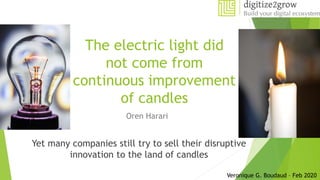
The electric light did
not come from
continuous improvement
of candles
Oren Harari
Yet many companies still try to sell their disruptive
innovation to the land of candles
Veronique G. Boudaud – Feb 2020
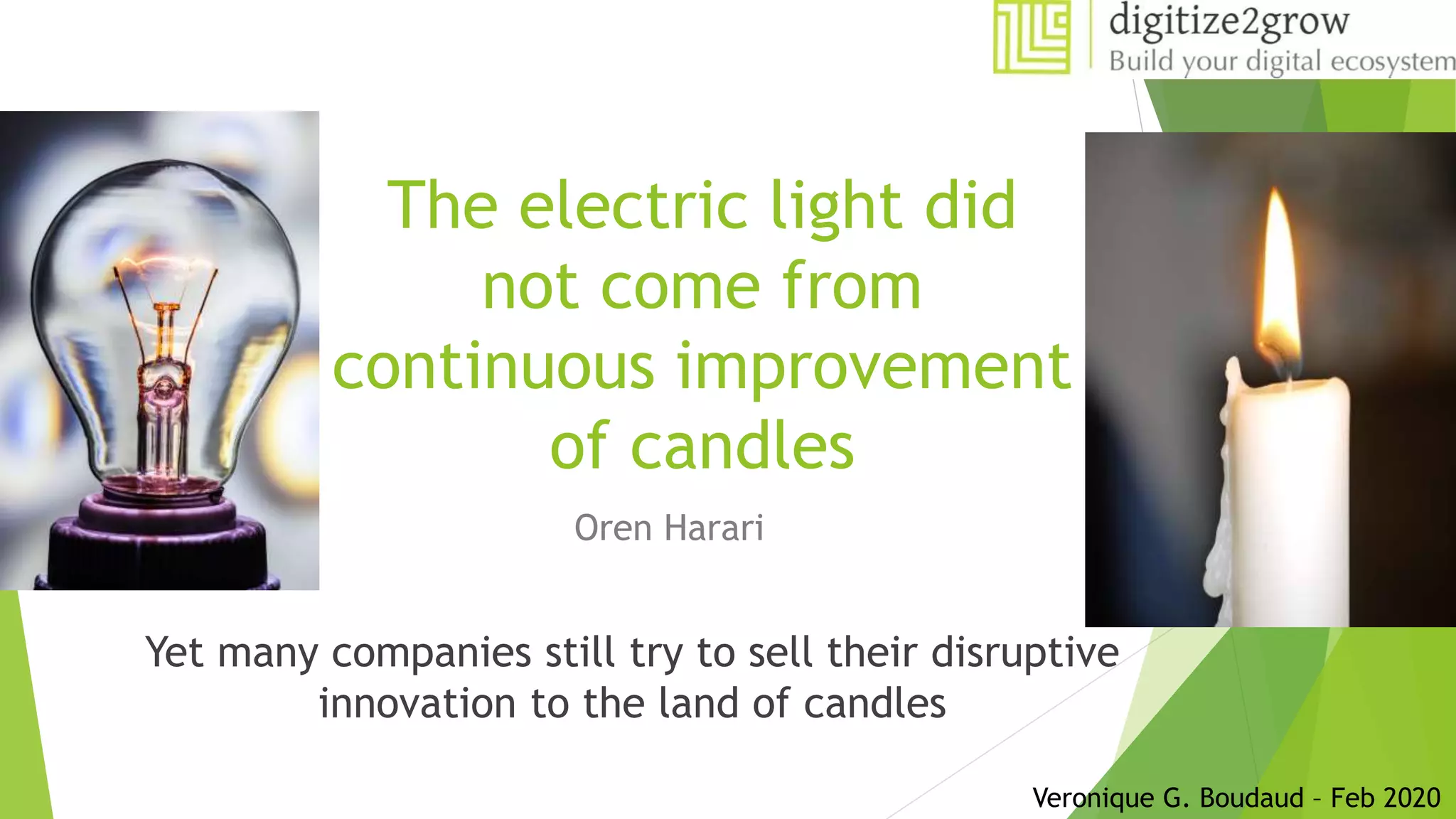
The world is changing
Hierarchical
Transact
Single role
Controlled
Interconnected
Contribute 1st
Multiple role
Organic
Veronique G. Boudaud – Feb 2020
‣ late 1700's Antoine Lavoisier, a chemist,
discovered Oxygen and Carbon and their
importance to living things
‣ 1852 Robert Angus Smith connected acid rain to
air pollution
‣ 1869 Ernst Haeckel coins the term ecology
‣ 1875- Eduard Seuss defines the biosphere
‣ 1879 Symbiosis is first described
‣ late 1800's animal camouflage studied and
described
‣ 1900 Henry Chandler Cowles studies ecological
succession
‣ 1915 Ecological Society of America founded
‣ 1927 Charles Elton makes the concept of food
chains and webs part of ecology
‣ 1933 Aldo Leopold writes Game Management,
beginning the discipline of wildlife management
‣ 1935 The Dust Bowl crisis re-focuses ecology on
practical land usage practices
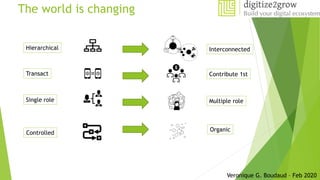
‣ 1935 Arthur Tansley defines ecosystem
An ecosystem is a geographic area where plants,
animals, and other organisms, as well as weather and
landscape, work together to form a bubble of life.
National Geographic
A digital ecosystem is a dynamic virtual and physical
environment where people, systems, institutions,
enterprises continuously inter-connect to exchange
value. The value exchange is accelerated by the use
of technology.
Think Digital Ecosystems !
Veronique G. Boudaud – Feb 2020
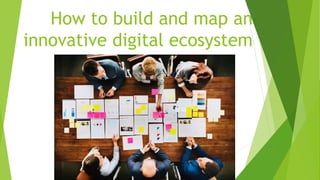
How to build and map an
innovative digital ecosystem
The 5 points method
1. Understand the context. What is happening in the new
environment where you want to
sell ? Become a netnograph.
2. Identify the tribes in the ecosystem
3. Establish the inter-connections that already exist and
have to be established. Will there
be any concentration of value, the magnets ?
4. Make your ecosystem dynamic and autonomous.
Describe the brains and the heart of the
ecosystem.
5. Use the map of the ecosystem over time, make it an
agile tool.
Veronique G. Boudaud – Feb 2020
This Photo by Unknown Author is licensed under CC BY-SA
Understand the context
 What do I not know ?
 What are the main trends in the new environment ?
 Interview experts with different view points and
background. Think historians, sociologists, designers
depending on the exploration you have to do.
 Become a netnograph using data mining tools to dig
information out of the social networks such as (not
limited to) :
 Hashtagify, keyhole
 Talkwalker, Google insight
Veronique G. Boudaud – Feb 2020
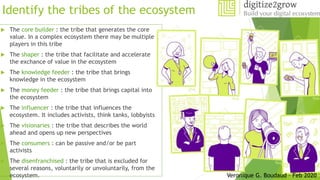
Identify the tribes of the ecosystem
 The core builder : the tribe that generates the core
value. In a complex ecosystem there may be multiple
players in this tribe
 The shaper : the tribe that facilitate and accelerate
the exchance of value in the ecosystem
 The knowledge feeder : the tribe that brings
knowledge in the ecosystem
 The money feeder : the tribe that brings capital into
the ecosystem
 The influencer : the tribe that influences the
ecosystem. It includes activists, think tanks, lobbyists
 The visionaries : the tribe that describes the world
ahead and opens up new perspectives
 The consumers : can be passive and/or be part
activists
 The disenfranchised : the tribe that is excluded for
several reasons, voluntarily or unvoluntarily, from the
ecosystem. Veronique G. Boudaud – Feb 2020
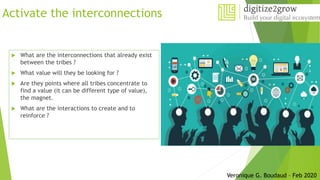
Activate the interconnections
 What are the interconnections that already exist
between the tribes ?
 What value will they be looking for ?
 Are they points where all tribes concentrate to
find a value (it can be different type of value),
the magnet.
 What are the interactions to create and to
reinforce ?
Veronique G. Boudaud – Feb 2020
Make the ecosystem dynamic and
autonomous
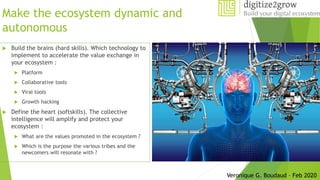
 Build the brains (hard skills). Which technology to
implement to accelerate the value exchange in
your ecosystem :
 Platform
 Collaborative tools
 Viral tools
 Growth hacking
 Define the heart (softskills). The collective
intelligence will amplify and protect your
ecosystem :
 What are the values promoted in the ecosystem ?
 Which is the purpose the various tribes and the
newcomers will resonate with ?
Veronique G. Boudaud – Feb 2020
Use the ecosystem map as an ongoing agile
tool
 An innovative digital ecosystem can thrive and die
quickly. Think « Fail Lab »
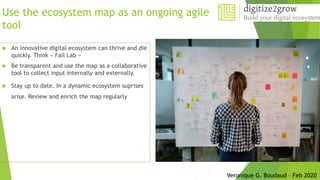
 Be transparent and use the map as a collaborative
tool to collect input internally and externally.
 Stay up to date. In a dynamic ecosystem suprises
arise. Review and enrich the map regularly
Veronique G. Boudaud – Feb 2020

How to build an innovative digital ecosystem

  • 1.
    The electric lightdid not come from continuous improvement of candles Oren Harari Yet many companies still try to sell their disruptive innovation to the land of candles Veronique G. Boudaud – Feb 2020
  • 2.
    The world ischanging Hierarchical Transact Single role Controlled Interconnected Contribute 1st Multiple role Organic Veronique G. Boudaud – Feb 2020
  • 3.
    ‣ late 1700'sAntoine Lavoisier, a chemist, discovered Oxygen and Carbon and their importance to living things ‣ 1852 Robert Angus Smith connected acid rain to air pollution ‣ 1869 Ernst Haeckel coins the term ecology ‣ 1875- Eduard Seuss defines the biosphere ‣ 1879 Symbiosis is first described ‣ late 1800's animal camouflage studied and described ‣ 1900 Henry Chandler Cowles studies ecological succession ‣ 1915 Ecological Society of America founded ‣ 1927 Charles Elton makes the concept of food chains and webs part of ecology ‣ 1933 Aldo Leopold writes Game Management, beginning the discipline of wildlife management ‣ 1935 The Dust Bowl crisis re-focuses ecology on practical land usage practices ‣ 1935 Arthur Tansley defines ecosystem An ecosystem is a geographic area where plants, animals, and other organisms, as well as weather and landscape, work together to form a bubble of life. National Geographic A digital ecosystem is a dynamic virtual and physical environment where people, systems, institutions, enterprises continuously inter-connect to exchange value. The value exchange is accelerated by the use of technology. Think Digital Ecosystems ! Veronique G. Boudaud – Feb 2020
  • 4.
    How to buildand map an innovative digital ecosystem
  • 5.
    The 5 pointsmethod 1. Understand the context. What is happening in the new environment where you want to sell ? Become a netnograph. 2. Identify the tribes in the ecosystem 3. Establish the inter-connections that already exist and have to be established. Will there be any concentration of value, the magnets ? 4. Make your ecosystem dynamic and autonomous. Describe the brains and the heart of the ecosystem. 5. Use the map of the ecosystem over time, make it an agile tool. Veronique G. Boudaud – Feb 2020 This Photo by Unknown Author is licensed under CC BY-SA
  • 6.
    Understand the context What do I not know ?  What are the main trends in the new environment ?  Interview experts with different view points and background. Think historians, sociologists, designers depending on the exploration you have to do.  Become a netnograph using data mining tools to dig information out of the social networks such as (not limited to) :  Hashtagify, keyhole  Talkwalker, Google insight Veronique G. Boudaud – Feb 2020
  • 7.
    Identify the tribesof the ecosystem  The core builder : the tribe that generates the core value. In a complex ecosystem there may be multiple players in this tribe  The shaper : the tribe that facilitate and accelerate the exchance of value in the ecosystem  The knowledge feeder : the tribe that brings knowledge in the ecosystem  The money feeder : the tribe that brings capital into the ecosystem  The influencer : the tribe that influences the ecosystem. It includes activists, think tanks, lobbyists  The visionaries : the tribe that describes the world ahead and opens up new perspectives  The consumers : can be passive and/or be part activists  The disenfranchised : the tribe that is excluded for several reasons, voluntarily or unvoluntarily, from the ecosystem. Veronique G. Boudaud – Feb 2020
  • 8.
    Activate the interconnections What are the interconnections that already exist between the tribes ?  What value will they be looking for ?  Are they points where all tribes concentrate to find a value (it can be different type of value), the magnet.  What are the interactions to create and to reinforce ? Veronique G. Boudaud – Feb 2020
  • 9.
    Make the ecosystemdynamic and autonomous  Build the brains (hard skills). Which technology to implement to accelerate the value exchange in your ecosystem :  Platform  Collaborative tools  Viral tools  Growth hacking  Define the heart (softskills). The collective intelligence will amplify and protect your ecosystem :  What are the values promoted in the ecosystem ?  Which is the purpose the various tribes and the newcomers will resonate with ? Veronique G. Boudaud – Feb 2020
  • 10.
    Use the ecosystemmap as an ongoing agile tool  An innovative digital ecosystem can thrive and die quickly. Think « Fail Lab »  Be transparent and use the map as a collaborative tool to collect input internally and externally.  Stay up to date. In a dynamic ecosystem suprises arise. Review and enrich the map regularly Veronique G. Boudaud – Feb 2020
  • 11.

Editor's Notes

  • #4 Objection : this is a buzz word we have always been working within systems and ecosystems : customers - suppliers - partners - resellers