GreenBuild Expo
26th
May 2010
The Benefits Of Solar
Photovoltaics
Presenter : Andy Craddock
Welcome
• Seminar Content
• Sustainable Vs Renewable Energy sources
• A basic understanding of Solar Photovoltaics (PV)
• Policies & Legislation
• Factors affecting PV performance
• The current deployment of Renewable Energy
types
• The benefits of Solar PV over alternative
technologies
• The future of Solar PV
Who Are
Cleaner Air Solutions?
Who Are Cleaner Air Solutions?
• Based in the N.E. of England (Durham)
• Privately Owned
• Working in the field of Solar PV since 2004
• One of the first in the UK to gain MCS accreditation
• One of the first members of the REAL Assurance scheme
• Now 50+ employees (and growing)
• Multiple installation teams
• National Franchise scheme
• C&G 2372 accredited training facility
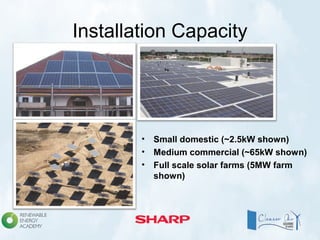
Installation Capacity
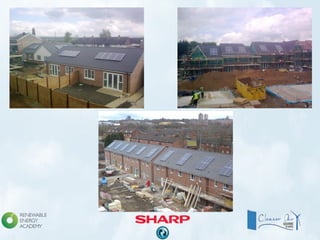
• Small domestic (~2.5kW shown)
• Medium commercial (~65kW shown)
• Full scale solar farms (5MW farm
shown)
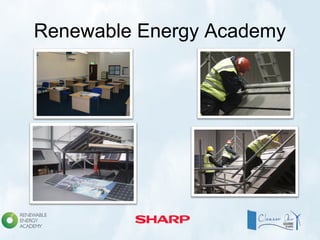
Renewable Energy Academy
Accreditation & Affiliation
Renewable Vs Sustainable?
Renewable Vs Sustainable
• Renewable energy is energy which comes from natural
resources such as sunlight, wind, rain, tides and
geothermal heat which are renewable (naturally
replenished).
• Sustainable energy is the provision of energy such that it
meets the needs of the present without compromising
the ability of future generations to meet their needs.
Extracts taken from Wikipedia
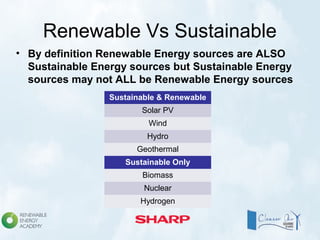
Renewable Vs Sustainable
• By definition Renewable Energy sources are ALSO
Sustainable Energy sources but Sustainable Energy
sources may not ALL be Renewable Energy sources
Sustainable & Renewable
Solar PV
Wind
Hydro
Geothermal
Sustainable Only
Biomass
Nuclear
Hydrogen
The Basics Of PV?
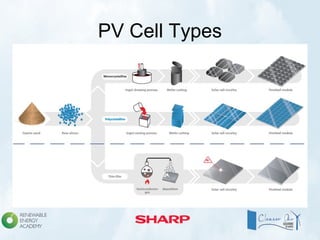
PV Cell Types
• Mono-crystalline
• Highest efficiency
• 12-18%
• Poly-crystalline
• Medium efficiency
• 10-14%
• Amorphous (Thin Film)
• Lowest efficiency
• 8-10%
PV Cell Types
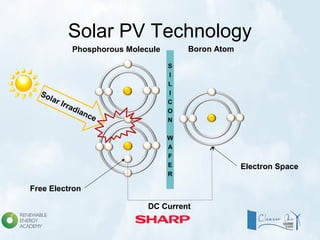
S
I
L
I
C
O
N
W
A
F
E
R
DC Current
Solar Irradiance
Solar PV Technology
Free Electron
Phosphorous Molecule Boron Atom
Electron Space
PV Array
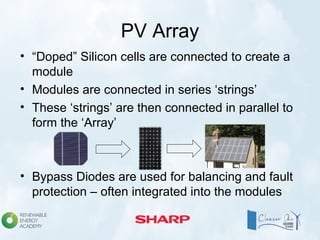
• “Doped” Silicon cells are connected to create a
module
• Modules are connected in series ‘strings’
• These ‘strings’ are then connected in parallel to
form the ‘Array’
• Bypass Diodes are used for balancing and fault
protection – often integrated into the modules
System Overview
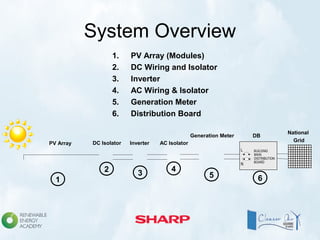
1. PV Array (Modules)
2. DC Wiring and Isolator
3. Inverter
4. AC Wiring & Isolator
5. Generation Meter
6. Distribution Board
National
Grid
PV Array
1
DC Isolator
2
Inverter
3
AC Isolator
4
Generation Meter
5
L
N
BUILDING
MAIN
DISTRIBUTION
BOARD
DB
6
Factors Affecting
Performance?
Factors Affecting Performance
• Irradiance
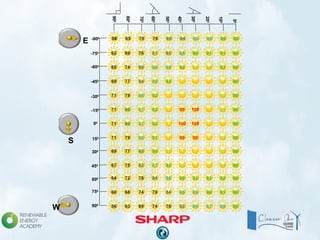
• Inclination
• Azimuth
PV Performance
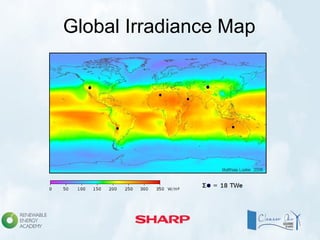
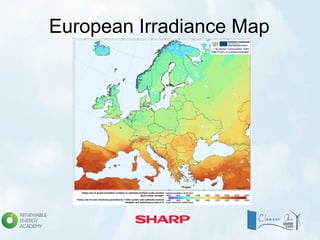
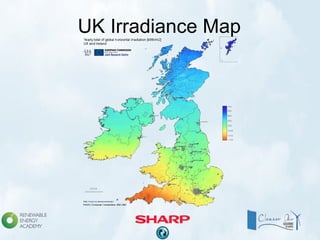
• Irradiance or Insolation
• A measure of how much energy per m2
is received
from the sun
• This varies depending on geography and shading
• UK yearly average of 750kWh/kWp2
• Equatorial yearly average of up to 1650kWh/kWp2
• Also measured in kWh/m2
output per year
Global Irradiance Map
European Irradiance Map
UK Irradiance Map
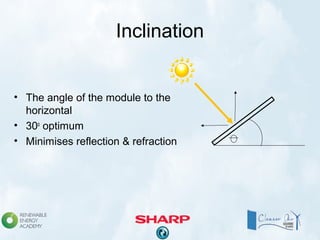
Inclination
• The angle of the module to the
horizontal
• 30o
optimum
• Minimises reflection & refraction
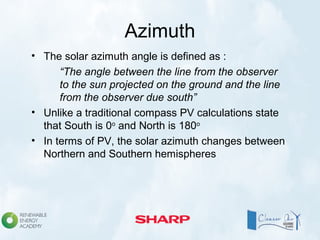
Azimuth
• The solar azimuth angle is defined as :
“The angle between the line from the observer
to the sun projected on the ground and the line
from the observer due south”
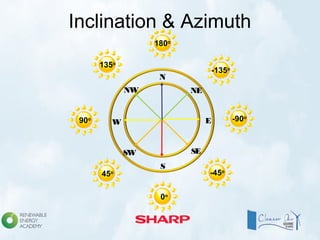
• Unlike a traditional compass PV calculations state
that South is 0o
and North is 180o
• In terms of PV, the solar azimuth changes between
Northern and Southern hemispheres
S
0o
E -90o
W90o
SW
45o
SE
-45o
Inclination & Azimuth
NE
-135o
N
180o
NW
135o
58 65 70 76 80 84 86 88 90 90
62 69 76 81 85 88 90 91 91 90
65 74 80 86 89 92 94 94 93 90
69 77 84 89 93 96 96 96 94 90
71 79 86 92 96 98 98 97 95 90
71 80 87 93 97 99 100 98 95 90
71 80 87 93 97 100 100 98 96 90
71 79 86 91 96 99 99 98 95 90
69 77 85 90 95 97 98 97 95 90
67 75 82 87 92 95 96 96 94 90
64 72 78 84 88 90 93 93 92 90
60 68 74 79 84 86 89 90 91 90
56 63 69 74 78 82 86 87 89 90
S
E
W
-900
-750
-600
-450
-300
-150
00
150
300
450
600
750
900
00
100
200
300
400
500
600
700
800
900
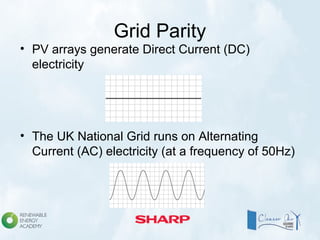
Grid Parity
• PV arrays generate Direct Current (DC)
electricity
• The UK National Grid runs on Alternating
Current (AC) electricity (at a frequency of 50Hz)
Direct Current (DC)
Alternating Current (AC)
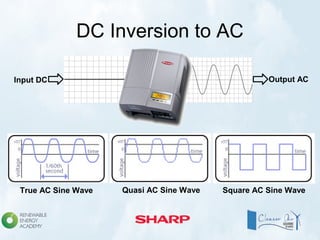
DC Inversion to AC
True AC Sine Wave Quasi AC Sine Wave Square AC Sine Wave
Input DC Output AC
What Legislation?
UK Renewable Legislation
• The “Stern Review” emphasised that carbon pricing
is not sufficient to reduce emissions at the scale and
pace required.
• UK Government Targets
• Expand and extend the Renewables Obligation
• Introduce new incentives to householders,
businesses and communities
• Deal with immediate pressures resulting from the
global financial crisis
Extracts taken from “The UK Renewable Energy Strategy 2009”
Political Manifesto (Pre Election)
• We need to radically increase our use of renewable
electricity, heat and transport…
• Sets out the path for us to meet our legally-binding
target to ensure 15% of our energy comes from
renewable source by 2020…
• Reducing the UK’s emissions of carbon dioxide by
over 750 million tonnes between now and 2030.
• Create up to half a million more jobs in the UK
renewable energy sector
Extracts taken from “The UK Renewable Energy Strategy 2009”
Political Manifesto (Post Election)
• The Government believes that climate change is one
of the greatest threats we face…
• Supporting an increase in the EU emission reduction
target to 30% by 2020.
• Establish a full system of feed-in-tariffs in electricity –
as well as the maintenance of banded Renewable
Obligation Certificates (ROCs)
• Encourage community-owned renewable energy
schemes….communities that host renewable energy
projects to keep the additional business rates they
generate.
Extracts taken from “The Coalition – Our Programme For Government” May 20th
2010
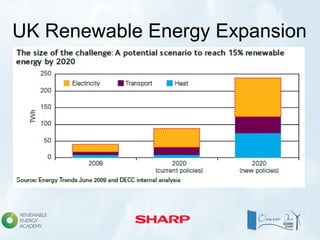
UK Renewable Energy Expansion
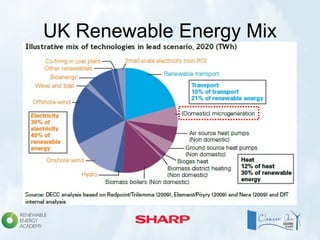
UK Renewable Energy Mix
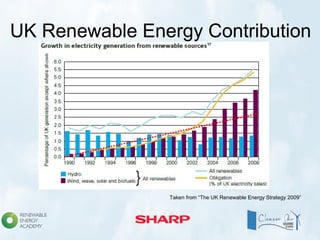
UK Renewable Energy Contribution
Taken from “The UK Renewable Energy Strategy 2009”
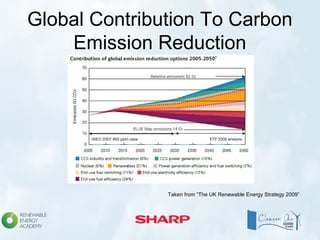
Global Contribution To Carbon
Emission Reduction
Taken from “The UK Renewable Energy Strategy 2009”
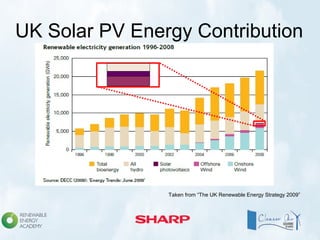
UK Solar PV Energy Contribution
Taken from “The UK Renewable Energy Strategy 2009”
Review Of Key Points
• Increase renewable energy by 30% by 2020
• Decrease CO2 emissions by 750MT by 2030
• Decrease CO2 emissions by 10GT by 2050
• Increase PV contribution to energy supply
How Does Solar PV Meet The
Legislative Requirements?
Solar PV Contribution
• “Carbon Neutral” within 3 years of commissioning
• Constantly improving cell efficiencies
• 25 year warranty
• No moving parts = no maintenance requirements
Benefits Of Solar PV
Over Alternative Technologies
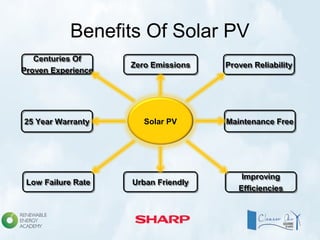
Benefits Of Solar PV
Solar PV
Zero EmissionsZero Emissions
Urban FriendlyUrban Friendly
25 Year Warranty25 Year Warranty Maintenance FreeMaintenance Free
Centuries Of
Proven Experience
Centuries Of
Proven Experience
Proven ReliabilityProven Reliability
Low Failure RateLow Failure Rate
Improving
Efficiencies
Improving
Efficiencies
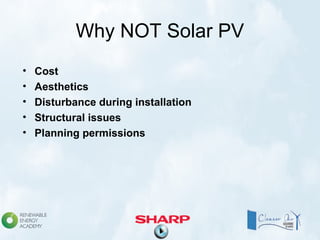
Why NOT Solar PV
• Cost
• Aesthetics
• Disturbance during installation
• Structural issues
• Planning permissions
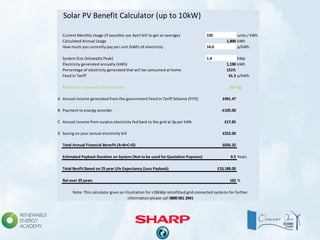
Solar PV Benefit Calculator (up to 10kW)
Current Monthly Usage (if possible use April bill to get an average) 150 units / kWh
Calculated Annual Usage 1,800 kWh
How much you currently pay per unit (kWh) of electricity 14.0 p/kWh
System Size (kilowatts Peak) 1.4 kWp
Electricity generated annually (kWh) 1,190 kWh
Percentage of electricity generated that will be consumed at home 151%
Feed In Tariff 41.3 p/kWh
Reduction in annual CO2 emissions 627 kg
A Annual income generated from the government Feed In Tariff Scheme (FITS) £491.47
B Payment to energy provider -£105.00
C Annual income from surplus electricity fed back to the grid at 3p per kWh £17.85
D Saving on your annual electricity bill £252.00
Total Annual Financial Benefit (A+B+C+D) £656.32
Estimated Payback Duration on System (Not to be used for Quotation Puposes) 9.5 Years
£16,408.00
Total Benfit Based on 25 year Life Expectancy (Less Payback) £10,188.00
£6,220.00
RoI over 25 years 162 %
Note: This calculator gives an illustration for <10kWp retrofitted grid connected systems for further
information please call 0800 061 2041
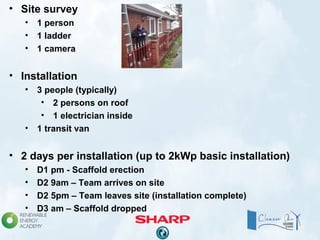
• Site survey
• 1 person
• 1 ladder
• 1 camera
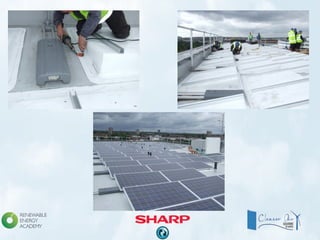
• Installation
• 3 people (typically)
• 2 persons on roof
• 1 electrician inside
• 1 transit van
• 2 days per installation (up to 2kWp basic installation)
• D1 pm - Scaffold erection
• D2 9am – Team arrives on site
• D2 5pm – Team leaves site (installation complete)
• D3 am – Scaffold dropped
• Do you need planning permission?
In England and Scotland, you don't need planning
permission for most home solar electricity systems, as long
as they're below a certain size - but you should check with
your local planning officer if your home is a listed building,
or is in a conservation area or World Heritage Site
Why Solar PV?
WHY NOT?
What Is The Future Of
Solar PV?
GreenBuild Seminar

GreenBuild Seminar

  • 1.
    GreenBuild Expo 26th May 2010 TheBenefits Of Solar Photovoltaics Presenter : Andy Craddock
  • 2.
    Welcome • Seminar Content •Sustainable Vs Renewable Energy sources • A basic understanding of Solar Photovoltaics (PV) • Policies & Legislation • Factors affecting PV performance • The current deployment of Renewable Energy types • The benefits of Solar PV over alternative technologies • The future of Solar PV
  • 3.
  • 4.
    Who Are CleanerAir Solutions? • Based in the N.E. of England (Durham) • Privately Owned • Working in the field of Solar PV since 2004 • One of the first in the UK to gain MCS accreditation • One of the first members of the REAL Assurance scheme • Now 50+ employees (and growing) • Multiple installation teams • National Franchise scheme • C&G 2372 accredited training facility
  • 5.
    Installation Capacity • Smalldomestic (~2.5kW shown) • Medium commercial (~65kW shown) • Full scale solar farms (5MW farm shown)
  • 6.
  • 7.
  • 8.
  • 9.
    Renewable Vs Sustainable •Renewable energy is energy which comes from natural resources such as sunlight, wind, rain, tides and geothermal heat which are renewable (naturally replenished). • Sustainable energy is the provision of energy such that it meets the needs of the present without compromising the ability of future generations to meet their needs. Extracts taken from Wikipedia
  • 10.
    Renewable Vs Sustainable •By definition Renewable Energy sources are ALSO Sustainable Energy sources but Sustainable Energy sources may not ALL be Renewable Energy sources Sustainable & Renewable Solar PV Wind Hydro Geothermal Sustainable Only Biomass Nuclear Hydrogen
  • 11.
  • 12.
    PV Cell Types •Mono-crystalline • Highest efficiency • 12-18% • Poly-crystalline • Medium efficiency • 10-14% • Amorphous (Thin Film) • Lowest efficiency • 8-10%
  • 13.
  • 14.
    S I L I C O N W A F E R DC Current Solar Irradiance SolarPV Technology Free Electron Phosphorous Molecule Boron Atom Electron Space
  • 15.
    PV Array • “Doped”Silicon cells are connected to create a module • Modules are connected in series ‘strings’ • These ‘strings’ are then connected in parallel to form the ‘Array’ • Bypass Diodes are used for balancing and fault protection – often integrated into the modules
  • 16.
    System Overview 1. PVArray (Modules) 2. DC Wiring and Isolator 3. Inverter 4. AC Wiring & Isolator 5. Generation Meter 6. Distribution Board National Grid PV Array 1 DC Isolator 2 Inverter 3 AC Isolator 4 Generation Meter 5 L N BUILDING MAIN DISTRIBUTION BOARD DB 6
  • 17.
  • 18.
    Factors Affecting Performance •Irradiance • Inclination • Azimuth
  • 19.
    PV Performance • Irradianceor Insolation • A measure of how much energy per m2 is received from the sun • This varies depending on geography and shading • UK yearly average of 750kWh/kWp2 • Equatorial yearly average of up to 1650kWh/kWp2 • Also measured in kWh/m2 output per year
  • 20.
  • 21.
  • 22.
  • 23.
    Inclination • The angleof the module to the horizontal • 30o optimum • Minimises reflection & refraction
  • 24.
    Azimuth • The solarazimuth angle is defined as : “The angle between the line from the observer to the sun projected on the ground and the line from the observer due south” • Unlike a traditional compass PV calculations state that South is 0o and North is 180o • In terms of PV, the solar azimuth changes between Northern and Southern hemispheres
  • 25.
    S 0o E -90o W90o SW 45o SE -45o Inclination &Azimuth NE -135o N 180o NW 135o
  • 26.
    58 65 7076 80 84 86 88 90 90 62 69 76 81 85 88 90 91 91 90 65 74 80 86 89 92 94 94 93 90 69 77 84 89 93 96 96 96 94 90 71 79 86 92 96 98 98 97 95 90 71 80 87 93 97 99 100 98 95 90 71 80 87 93 97 100 100 98 96 90 71 79 86 91 96 99 99 98 95 90 69 77 85 90 95 97 98 97 95 90 67 75 82 87 92 95 96 96 94 90 64 72 78 84 88 90 93 93 92 90 60 68 74 79 84 86 89 90 91 90 56 63 69 74 78 82 86 87 89 90 S E W -900 -750 -600 -450 -300 -150 00 150 300 450 600 750 900 00 100 200 300 400 500 600 700 800 900
  • 27.
    Grid Parity • PVarrays generate Direct Current (DC) electricity • The UK National Grid runs on Alternating Current (AC) electricity (at a frequency of 50Hz)
  • 28.
  • 29.
  • 30.
    DC Inversion toAC True AC Sine Wave Quasi AC Sine Wave Square AC Sine Wave Input DC Output AC
  • 31.
  • 32.
    UK Renewable Legislation •The “Stern Review” emphasised that carbon pricing is not sufficient to reduce emissions at the scale and pace required. • UK Government Targets • Expand and extend the Renewables Obligation • Introduce new incentives to householders, businesses and communities • Deal with immediate pressures resulting from the global financial crisis Extracts taken from “The UK Renewable Energy Strategy 2009”
  • 33.
    Political Manifesto (PreElection) • We need to radically increase our use of renewable electricity, heat and transport… • Sets out the path for us to meet our legally-binding target to ensure 15% of our energy comes from renewable source by 2020… • Reducing the UK’s emissions of carbon dioxide by over 750 million tonnes between now and 2030. • Create up to half a million more jobs in the UK renewable energy sector Extracts taken from “The UK Renewable Energy Strategy 2009”
  • 34.
    Political Manifesto (PostElection) • The Government believes that climate change is one of the greatest threats we face… • Supporting an increase in the EU emission reduction target to 30% by 2020. • Establish a full system of feed-in-tariffs in electricity – as well as the maintenance of banded Renewable Obligation Certificates (ROCs) • Encourage community-owned renewable energy schemes….communities that host renewable energy projects to keep the additional business rates they generate. Extracts taken from “The Coalition – Our Programme For Government” May 20th 2010
  • 35.
  • 36.
  • 37.
    UK Renewable EnergyContribution Taken from “The UK Renewable Energy Strategy 2009”
  • 38.
    Global Contribution ToCarbon Emission Reduction Taken from “The UK Renewable Energy Strategy 2009”
  • 39.
    UK Solar PVEnergy Contribution Taken from “The UK Renewable Energy Strategy 2009”
  • 40.
    Review Of KeyPoints • Increase renewable energy by 30% by 2020 • Decrease CO2 emissions by 750MT by 2030 • Decrease CO2 emissions by 10GT by 2050 • Increase PV contribution to energy supply
  • 41.
    How Does SolarPV Meet The Legislative Requirements?
  • 42.
    Solar PV Contribution •“Carbon Neutral” within 3 years of commissioning • Constantly improving cell efficiencies • 25 year warranty • No moving parts = no maintenance requirements
  • 43.
    Benefits Of SolarPV Over Alternative Technologies
  • 44.
    Benefits Of SolarPV Solar PV Zero EmissionsZero Emissions Urban FriendlyUrban Friendly 25 Year Warranty25 Year Warranty Maintenance FreeMaintenance Free Centuries Of Proven Experience Centuries Of Proven Experience Proven ReliabilityProven Reliability Low Failure RateLow Failure Rate Improving Efficiencies Improving Efficiencies
  • 45.
    Why NOT SolarPV • Cost • Aesthetics • Disturbance during installation • Structural issues • Planning permissions
  • 46.
    Solar PV BenefitCalculator (up to 10kW) Current Monthly Usage (if possible use April bill to get an average) 150 units / kWh Calculated Annual Usage 1,800 kWh How much you currently pay per unit (kWh) of electricity 14.0 p/kWh System Size (kilowatts Peak) 1.4 kWp Electricity generated annually (kWh) 1,190 kWh Percentage of electricity generated that will be consumed at home 151% Feed In Tariff 41.3 p/kWh Reduction in annual CO2 emissions 627 kg A Annual income generated from the government Feed In Tariff Scheme (FITS) £491.47 B Payment to energy provider -£105.00 C Annual income from surplus electricity fed back to the grid at 3p per kWh £17.85 D Saving on your annual electricity bill £252.00 Total Annual Financial Benefit (A+B+C+D) £656.32 Estimated Payback Duration on System (Not to be used for Quotation Puposes) 9.5 Years £16,408.00 Total Benfit Based on 25 year Life Expectancy (Less Payback) £10,188.00 £6,220.00 RoI over 25 years 162 % Note: This calculator gives an illustration for <10kWp retrofitted grid connected systems for further information please call 0800 061 2041
  • 49.
    • Site survey •1 person • 1 ladder • 1 camera • Installation • 3 people (typically) • 2 persons on roof • 1 electrician inside • 1 transit van • 2 days per installation (up to 2kWp basic installation) • D1 pm - Scaffold erection • D2 9am – Team arrives on site • D2 5pm – Team leaves site (installation complete) • D3 am – Scaffold dropped
  • 51.
    • Do youneed planning permission? In England and Scotland, you don't need planning permission for most home solar electricity systems, as long as they're below a certain size - but you should check with your local planning officer if your home is a listed building, or is in a conservation area or World Heritage Site
  • 52.
  • 53.
    What Is TheFuture Of Solar PV?

Editor's Notes

  • #3 Use example of solar cell
  • #5 Use example of solar cell
  • #10 Use example of solar cell
  • #11 Use example of solar cell
  • #13 Explain differences in areas Calculators use amorphous Satellites monocrystallinne
  • #14 Explain differences in areas Calculators use amorphous Satellites monocrystallinne
  • #33 Use example of solar cell
  • #34 Use example of solar cell
  • #35 Use example of solar cell
  • #36 Use example of solar cell
  • #37 Use example of solar cell
  • #38 Use example of solar cell
  • #39 Use example of solar cell
  • #40 Use example of solar cell
  • #41 Use example of solar cell
  • #43 Use example of solar cell
  • #45 Use example of solar cell
  • #46 Use example of solar cell
  • #53 Use example of solar cell