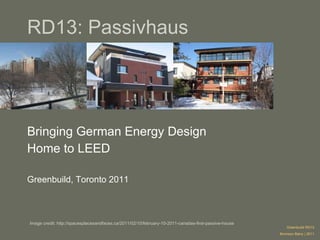
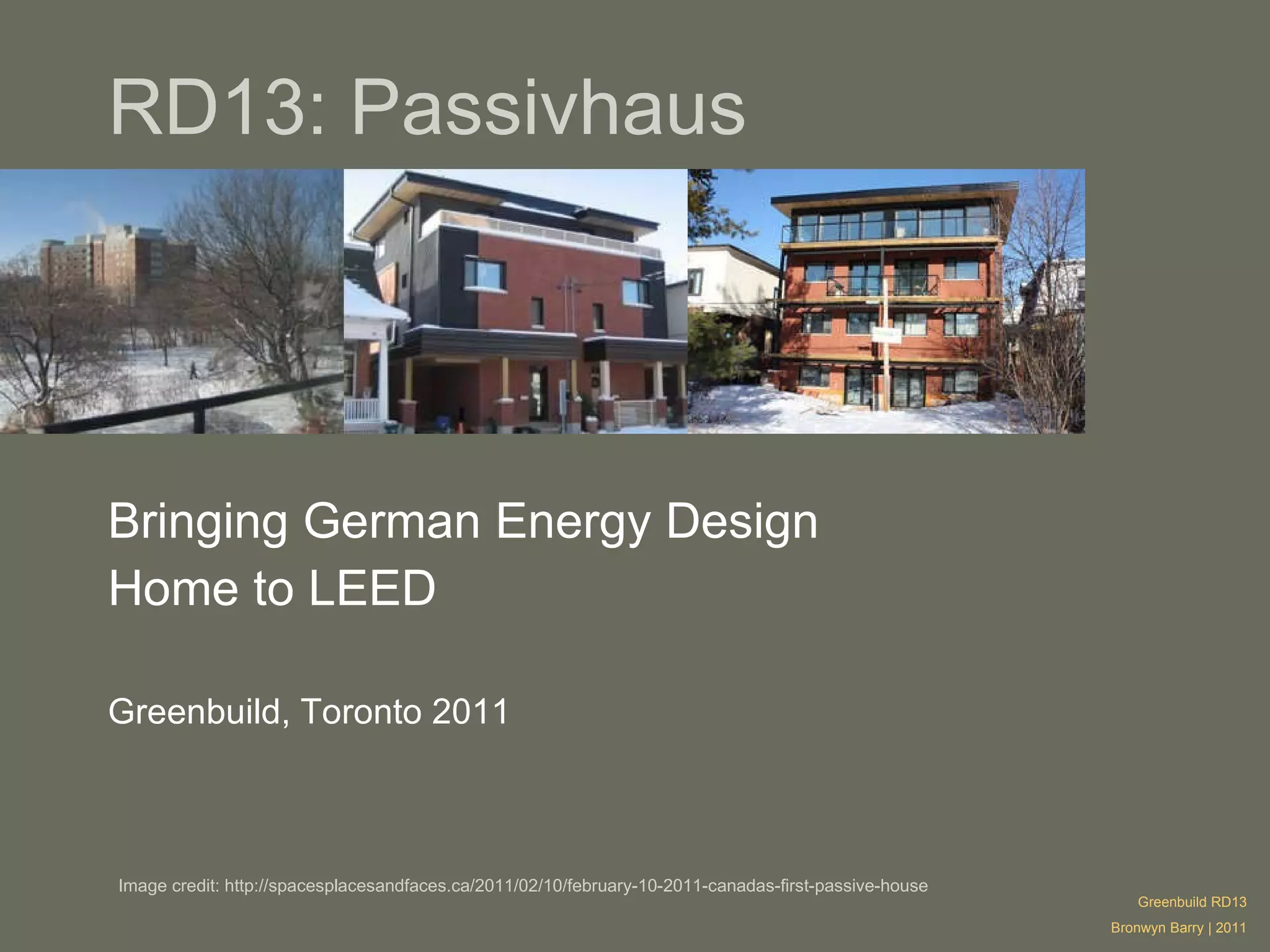
RD13: Passivhaus Bringing German Energy Design  Home to LEED Greenbuild, Toronto 2011 Greenbuild RD13 Bronwyn Barry | 2011 Image credit: http://spacesplacesandfaces.ca/2011/02/10/february-10-2011-canadas-first-passive-house
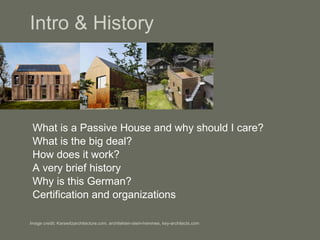
Intro & History What is a Passive House and why should I care? What is the big deal? How does it work? A very brief history Why is this German? Certification and organizations Image credit: Karawitzarchitecture.com, architekten-stein-hemmes, key-architects.com
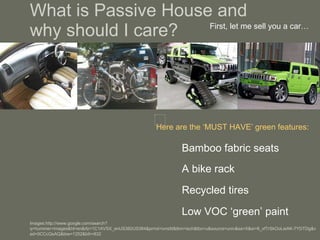
What is Passive House and  why should I care? Bamboo fabric seats First, let me sell you a car… Here are the ‘MUST HAVE’ green features: A bike rack Recycled tires Low VOC ‘green’ paint Images:http://www.google.com/search?q=hummer+images&hl=en&rlz=1C1AVSX_enUS382US384&prmd=ivnsfd&tbm=isch&tbo=u&source=univ&sa=X&ei=8_xfTrSkOoLeiAK-7YDTDg&ved=0CCcQsAQ&biw=1252&bih=632
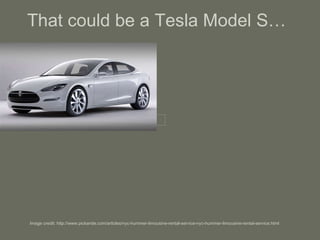
That could be a Tesla Model S… Image credit: http://www.pickaride.com/articles/nyc-hummer-limousine-rental-service-nyc-hummer-limousine-rental-service.html
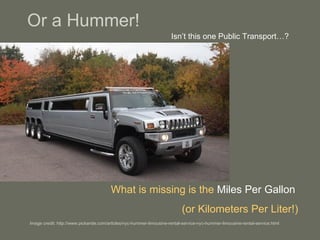
Or a Hummer! Isn’t this one Public Transport…? Image credit: http://www.pickaride.com/articles/nyc-hummer-limousine-rental-service-nyc-hummer-limousine-rental-service.html What is missing is the  Miles Per Gallon  (or Kilometers Per Liter!)
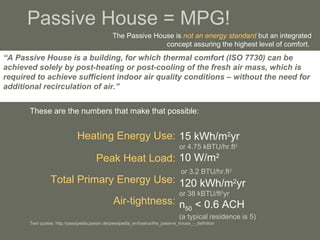
Passive House = MPG! Heating Energy Use: Peak Heat Load: Total Primary Energy Use: Air-tightness: 15 kWh/m 2 yr or 4.75 kBTU/hr.ft 2 10 W/m 2 or 3.2 BTU/hr.ft 2 120 kWh/m 2 yr or 38 kBTU/ft 2 yr n 50  < 0.6 ACH (a typical residence is 5) The Passive House is  not an energy standard  but an integrated concept assuring the highest level of comfort.  These are the numbers that make that possible: “ A Passive House is a building, for which thermal comfort (ISO 7730) can be achieved solely by post-heating or post-cooling of the fresh air mass, which is required to achieve sufficient indoor air quality conditions – without the need for additional recirculation of air.” Text quotes: http://passipedia.passiv.de/passipedia_en/basics/the_passive_house_-_definition
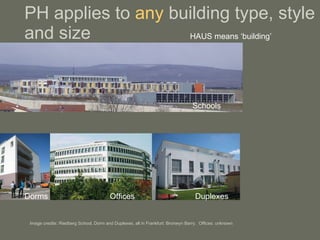
PH applies to  any  building type, style and size HAUS means ‘building’ Schools Dorms Offices Duplexes Image credits: Riedberg School, Dorm and Duplexes, all in Frankfurt: Bronwyn Barry.  Offices: unknown
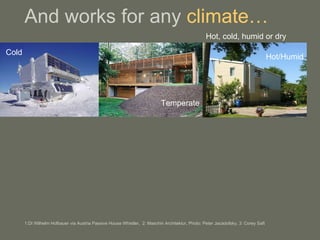
And works for any  climate… Hot, cold, humid or dry Cold   1:DI Wilhelm Hofbauer via Austria Passive House Whistler,  2: Maschin Architektur, Photo: Peter Jacadofsky, 3: Corey Saft Temperate Hot/Humid
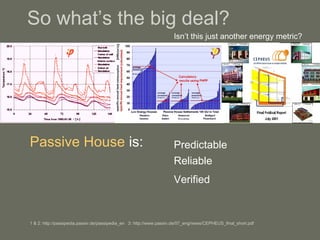
So what’s the big deal? Isn’t this just another energy metric? Predictable Passive House  is: 1 & 2: http://passipedia.passiv.de/passipedia_en  3: http://www.passiv.de/07_eng/news/CEPHEUS_final_short.pdf Reliable Verified
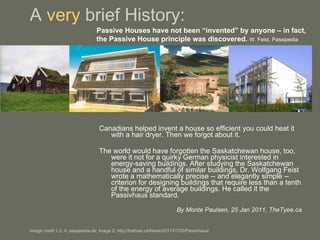
A  very  brief History: Canadians helped invent a house so efficient you could heat it with a hair dryer. Then we forgot about it.  The world would have forgotten the Saskatchewan house, too, were it not for a quirky German physicist interested in energy-saving buildings. After studying the Saskatchewan house and a handful of similar buildings, Dr. Wolfgang Feist wrote a mathematically precise -- and elegantly simple -- criterion for designing buildings that require less than a tenth of the energy of average buildings. He called it the Passivhaus standard.  By Monte Paulsen, 25 Jan 2011, TheTyee.ca   Image credit 1,3, 4: passipedia.de, Image 2: http://thetyee.ca/News/2011/01/25/Passivhaus/ Passive Houses have not been “invented” by anyone – in fact, the Passive House principle was discovered.   W. Feist, Passipedia
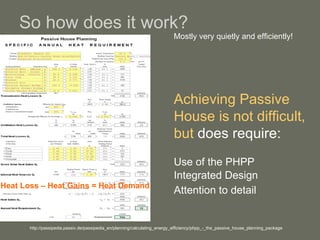
So how does it work? Mostly very quietly and efficiently! Achieving Passive House is not difficult, but  does require: http://passipedia.passiv.de/passipedia_en/planning/calculating_energy_efficiency/phpp_-_the_passive_house_planning_package Use of the PHPP Heat Loss – Heat Gains = Heat Demand Integrated Design Attention to detail
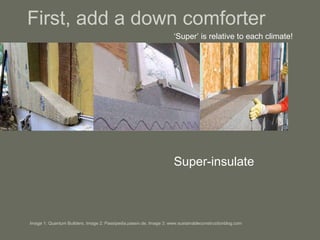
First, add a down comforter ‘ Super’ is relative to each climate! Super-insulate Image 1: Quantum Builders, Image 2: Passipedia.passiv.de, Image 3: www.sustainableconstructionblog.com
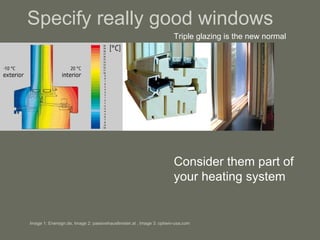
Specify really good windows Triple glazing is the new normal Consider them part of your heating system Image 1: Enersign.de, Image 2: passivehausfenster.at , Image 3: optiwin-usa.com
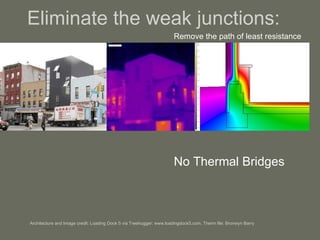
Eliminate the weak junctions: Remove the path of least resistance No Thermal Bridges Architecture and Image credit: Loading Dock 5 via Treehugger: www.loadingdock5.com, Therm file: Bronwyn Barry
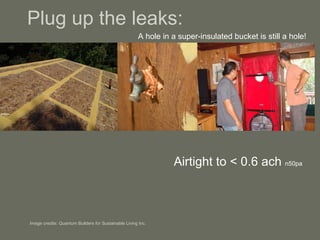
Plug up the leaks: A hole in a super-insulated bucket is still a hole! Airtight to < 0.6 ach  n50pa Image credits: Quantum Builders for Sustainable Living Inc.
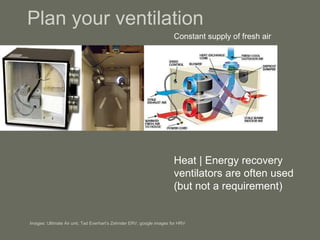
Plan your ventilation Constant supply of fresh air  Heat | Energy recovery ventilators are often used  (but not a requirement) Images: Ultimate Air unit, Tad Everhart’s Zehnder ERV, google images for HRV
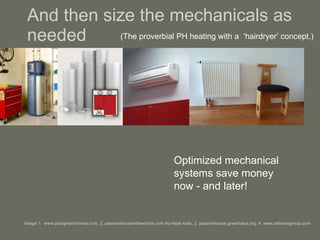
And then size the mechanicals as needed (The proverbial PH heating with a  ‘hairdryer’ concept.) Optimized mechanical systems save money  now - and later!  Image 1:  www.postgreenhomes.com, 2. passivehouseinthewoods.com Nu-heat mats, 3. passivehouse.greenhaus.org, 4. www.artisansgroup.com
How do the certifications work? “ Yes, it's good to have certification. But it's by far not the most important thing in the world.”  Wolfgang Feist Logos: www.passivehouse.com Your building can receive this plaque from any number of International Certifying Bodies, including the PHI Architects, designers and building professionals can obtain this credential from any number of certified international training organizations And there may be other certification options available….
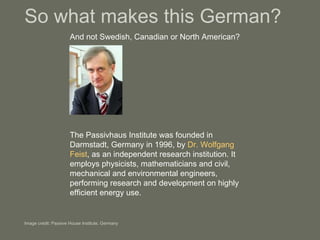
So what makes this German? And not Swedish, Canadian or North American? Image credit: Passive House Institute, Germany The Passivhaus Institute was founded in Darmstadt, Germany in 1996, by  Dr. Wolfgang Feist , as an independent research institution. It employs physicists, mathematicians and civil, mechanical and environmental engineers, performing research and development on highly efficient energy use.
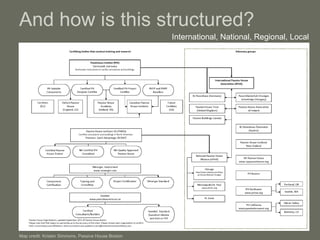
And how is this structured? International, National, Regional, Local Map credit: Kristen Simmons, Passive House Boston
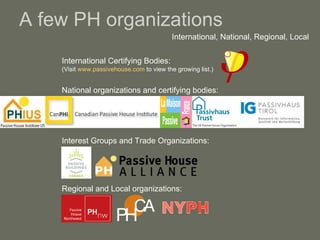
A few PH organizations International, National, Regional, Local International Certifying Bodies:  (Visit  www.passivehouse.com  to view the growing list.) National organizations and certifying bodies:  Interest Groups and Trade Organizations:  Regional and Local organizations:
Thank you! Questions? A few more resources and some of my favorite PH blogs:  www.bruteforcecollaborative.com www.treehugger.com And organizations: www.passivehousecal.org www.nypassivehouse.org www.phnw.org Bronwyn Barry e:  [email_address] c: 415.819.7978 Greenbuild RD13 Bronwyn Barry | 2011 Image credit: The Jewel Box Passive House by the Artisans Group www.artisansgroup.com

Greenbuild 2011

  • 1.
    RD13: Passivhaus BringingGerman Energy Design Home to LEED Greenbuild, Toronto 2011 Greenbuild RD13 Bronwyn Barry | 2011 Image credit: http://spacesplacesandfaces.ca/2011/02/10/february-10-2011-canadas-first-passive-house
  • 2.
    Intro & HistoryWhat is a Passive House and why should I care? What is the big deal? How does it work? A very brief history Why is this German? Certification and organizations Image credit: Karawitzarchitecture.com, architekten-stein-hemmes, key-architects.com
  • 3.
    What is PassiveHouse and why should I care? Bamboo fabric seats First, let me sell you a car… Here are the ‘MUST HAVE’ green features: A bike rack Recycled tires Low VOC ‘green’ paint Images:http://www.google.com/search?q=hummer+images&hl=en&rlz=1C1AVSX_enUS382US384&prmd=ivnsfd&tbm=isch&tbo=u&source=univ&sa=X&ei=8_xfTrSkOoLeiAK-7YDTDg&ved=0CCcQsAQ&biw=1252&bih=632
  • 4.
    That could bea Tesla Model S… Image credit: http://www.pickaride.com/articles/nyc-hummer-limousine-rental-service-nyc-hummer-limousine-rental-service.html
  • 5.
    Or a Hummer!Isn’t this one Public Transport…? Image credit: http://www.pickaride.com/articles/nyc-hummer-limousine-rental-service-nyc-hummer-limousine-rental-service.html What is missing is the Miles Per Gallon (or Kilometers Per Liter!)
  • 6.
    Passive House =MPG! Heating Energy Use: Peak Heat Load: Total Primary Energy Use: Air-tightness: 15 kWh/m 2 yr or 4.75 kBTU/hr.ft 2 10 W/m 2 or 3.2 BTU/hr.ft 2 120 kWh/m 2 yr or 38 kBTU/ft 2 yr n 50 < 0.6 ACH (a typical residence is 5) The Passive House is not an energy standard but an integrated concept assuring the highest level of comfort. These are the numbers that make that possible: “ A Passive House is a building, for which thermal comfort (ISO 7730) can be achieved solely by post-heating or post-cooling of the fresh air mass, which is required to achieve sufficient indoor air quality conditions – without the need for additional recirculation of air.” Text quotes: http://passipedia.passiv.de/passipedia_en/basics/the_passive_house_-_definition
  • 7.
    PH applies to any building type, style and size HAUS means ‘building’ Schools Dorms Offices Duplexes Image credits: Riedberg School, Dorm and Duplexes, all in Frankfurt: Bronwyn Barry. Offices: unknown
  • 8.
    And works forany climate… Hot, cold, humid or dry Cold 1:DI Wilhelm Hofbauer via Austria Passive House Whistler, 2: Maschin Architektur, Photo: Peter Jacadofsky, 3: Corey Saft Temperate Hot/Humid
  • 9.
    So what’s thebig deal? Isn’t this just another energy metric? Predictable Passive House is: 1 & 2: http://passipedia.passiv.de/passipedia_en 3: http://www.passiv.de/07_eng/news/CEPHEUS_final_short.pdf Reliable Verified
  • 10.
    A very brief History: Canadians helped invent a house so efficient you could heat it with a hair dryer. Then we forgot about it. The world would have forgotten the Saskatchewan house, too, were it not for a quirky German physicist interested in energy-saving buildings. After studying the Saskatchewan house and a handful of similar buildings, Dr. Wolfgang Feist wrote a mathematically precise -- and elegantly simple -- criterion for designing buildings that require less than a tenth of the energy of average buildings. He called it the Passivhaus standard. By Monte Paulsen, 25 Jan 2011, TheTyee.ca Image credit 1,3, 4: passipedia.de, Image 2: http://thetyee.ca/News/2011/01/25/Passivhaus/ Passive Houses have not been “invented” by anyone – in fact, the Passive House principle was discovered. W. Feist, Passipedia
  • 11.
    So how doesit work? Mostly very quietly and efficiently! Achieving Passive House is not difficult, but does require: http://passipedia.passiv.de/passipedia_en/planning/calculating_energy_efficiency/phpp_-_the_passive_house_planning_package Use of the PHPP Heat Loss – Heat Gains = Heat Demand Integrated Design Attention to detail
  • 12.
    First, add adown comforter ‘ Super’ is relative to each climate! Super-insulate Image 1: Quantum Builders, Image 2: Passipedia.passiv.de, Image 3: www.sustainableconstructionblog.com
  • 13.
    Specify really goodwindows Triple glazing is the new normal Consider them part of your heating system Image 1: Enersign.de, Image 2: passivehausfenster.at , Image 3: optiwin-usa.com
  • 14.
    Eliminate the weakjunctions: Remove the path of least resistance No Thermal Bridges Architecture and Image credit: Loading Dock 5 via Treehugger: www.loadingdock5.com, Therm file: Bronwyn Barry
  • 15.
    Plug up theleaks: A hole in a super-insulated bucket is still a hole! Airtight to < 0.6 ach n50pa Image credits: Quantum Builders for Sustainable Living Inc.
  • 16.
    Plan your ventilationConstant supply of fresh air Heat | Energy recovery ventilators are often used (but not a requirement) Images: Ultimate Air unit, Tad Everhart’s Zehnder ERV, google images for HRV
  • 17.
    And then sizethe mechanicals as needed (The proverbial PH heating with a ‘hairdryer’ concept.) Optimized mechanical systems save money now - and later! Image 1: www.postgreenhomes.com, 2. passivehouseinthewoods.com Nu-heat mats, 3. passivehouse.greenhaus.org, 4. www.artisansgroup.com
  • 18.
    How do thecertifications work? “ Yes, it's good to have certification. But it's by far not the most important thing in the world.” Wolfgang Feist Logos: www.passivehouse.com Your building can receive this plaque from any number of International Certifying Bodies, including the PHI Architects, designers and building professionals can obtain this credential from any number of certified international training organizations And there may be other certification options available….
  • 19.
    So what makesthis German? And not Swedish, Canadian or North American? Image credit: Passive House Institute, Germany The Passivhaus Institute was founded in Darmstadt, Germany in 1996, by Dr. Wolfgang Feist , as an independent research institution. It employs physicists, mathematicians and civil, mechanical and environmental engineers, performing research and development on highly efficient energy use.
  • 20.
    And how isthis structured? International, National, Regional, Local Map credit: Kristen Simmons, Passive House Boston
  • 21.
    A few PHorganizations International, National, Regional, Local International Certifying Bodies: (Visit www.passivehouse.com to view the growing list.) National organizations and certifying bodies: Interest Groups and Trade Organizations: Regional and Local organizations:
  • 22.
    Thank you! Questions?A few more resources and some of my favorite PH blogs: www.bruteforcecollaborative.com www.treehugger.com And organizations: www.passivehousecal.org www.nypassivehouse.org www.phnw.org Bronwyn Barry e: [email_address] c: 415.819.7978 Greenbuild RD13 Bronwyn Barry | 2011 Image credit: The Jewel Box Passive House by the Artisans Group www.artisansgroup.com