Green India Green earth
Introduction:
“You cannot change your future, but, you can change your habits, and surely your habits will
change the future.” – Dr. APJ Abdul Kalam
Dr. APJ Abdul Kalam, the former President of India, a great scientist, a profound thinker, a
prolific writer, whose action speaks his words. He was a person who always believed in youth
power. He said youth has power and capabilities which can accomplish many milestones and
overcome many hurdles which come in their way to put India in examples of sustainable
developed countries. He had been inspiring youth to take initiative and give a hand for
eliminating poverty not only from India but also from the world. He believed that if children of
our country are properly molded and diverted their minds to contribute towards country’s
progress India can never lag behind in terms of development. At the same time he firmly
believed in innovative sustainable techniques which would minimize the cost of development on
the environment.
What India needs today is not just development which would result in increase in employment
and national income, infrastructural progress but it also mean to have secure future which does
not bear any cost on environment. This is because any adversity to environment ultimately going
to have adverse effects on humans by causing rise in temperature, many deceases (newly invaded
deceases) and the most drastic and vulnerable effect will be on agriculture which is being
experienced in today’s date also. For example, in India, in 2015 rainfall was scarce, some north-
east areas of Maharashtra experienced draught condition in fact addition to that it was recorded
highest temperature in this year; on the other side in the month of November when the north-east
monsoon arrived in India it caused flood condition which took life of 250 people.
This kind of uncertain behavior of nature deviated from the usual is the result of human
interference in the working of nature. Man seeks development but does not consider whether that
development is causing any adversity, he always desire for his betterment. His action, since the
industrial revolution has taken place, is releasing carbon dioxide, methane, black carbon in the
air which is raising global temperature. What man has caused to the environment, environment is
now taking back on mankind.
“Every action has equal and opposite reaction.” This is a law of Newton, a famous scientist. This
law states the exact position of human.
Sustainable development through innovative solutions:
Though India is a late comer in the process of raising global temperature through industrial
revolution and is accountable for only 3% of the increased global temperature, still India has
huge responsibility to not to let further increase in temperature. Same applies to other countries
which are on the verge of development must acclimatize themselves with the reality of hazards
of climate change. According to developing countries the main culprits for the green house gas
emissions are developed countries where industrial revolution started much before the
developing world. Hence it was put forward in the recently held Paris climate change conference
that the developed countries should finance developing countries to mitigate their reduction in
GHG emissions. But the conference is not about putting blame on others rather it is about give
and take. To get something, loosing something is essential. In any ways India is also in the line
with one of the most polluting countries in the world even though it is a late comer. At the same
time development is also very important to eliminate poverty and generate employment.
According to so called Intended nationally determined contributions which every country had to
submit before the negotiations began in Paris, India pledged to reduce the emissions intensity of
GDP by 33 to 35% by 2030 based on 2005 levels. It proposes to achieve this by investing
significantly in low-carbon technologies. The government is also taking steps to increase forest
coverage for performing the task as carbon sink.
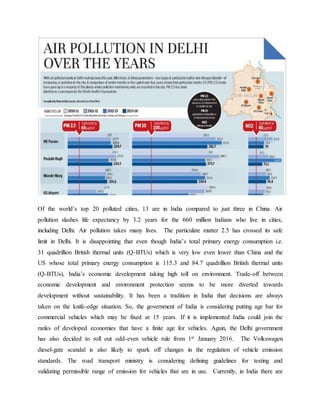
Of the world’s top 20 polluted cities, 13 are in India compared to just three in China. Air
pollution slashes life expectancy by 3.2 years for the 660 million Indians who live in cities,
including Delhi. Air pollution takes many lives. The particulate matter 2.5 has crossed its safe
limit in Delhi. It is disappointing that even though India’s total primary energy consumption i.e.
31 quadrillion British thermal units (Q-BTUs) which is very low even lower than China and the
US whose total primary energy consumption is 115.3 and 84.7 quadrillion British thermal units
(Q-BTUs), India’s economic development taking high toll on environment. Trade-off between
economic development and environment protection seems to be more diverted towards
development without sustainability. It has been a tradition in India that decisions are always
taken on the knife-edge situation. So, the government of India is considering putting age bar for
commercial vehicles which may be fixed at 15 years. If it is implemented India could join the
ranks of developed economies that have a finite age for vehicles. Again, the Delhi government
has also decided to roll out odd-even vehicle rule from 1st January 2016. The Volkswagen
diesel-gate scandal is also likely to spark off changes in the regulation of vehicle emission
standards. The road transport ministry is considering defining guidelines for testing and
validating permissible range of emission for vehicles that are in use. Currently, in India there are
only defined regulatory emission standards available for new vehicles and not for in-use ones.
This move, if implemented would help to start a fight against air pollution which is a major issue
worldwide. Working from the grass root level like these reforms is needed rather initially
investing in air purifier which the idea currently is being considered to apply in Beijing, China
for dealing with air pollution. This is because if everyone camouflage their own mistakes and try
to solve the problem from outer resolutions would never solve the problem. Small changes in
human habits can go miles to protect environment. Along with this we also need cleaner fuel
which would release less carbon particles in the air. Carbon dioxide has long life which remains
in the atmosphere for more than hundred years and other responsible particles for climate change
like black carbon, methane remains for few weeks and seven years respectively. Therefore,
investment in research of green technology or sustainable technology to reduce the level of all
these factors responsible for raising temperature is essential. People who are living in polluted
cities are very anxious about their health as air pollution creates most health problems related to
lungs such as cancer. Health problems are on the verge of rise which needs immediate attention.
The strategic solutions and scientific innovation in every field of development would reduce
emission levels up to certain level. What we need today is not calculating how much level of
emission of gases can be reduced if certain measures are adopted but to introduce or change the
method of development where the relevance of environment is inescapable and maximum
environment friendly techniques are feasible. Air pollution is a major problem in many cities of
the world especially in India as 13 cities out of first 20 polluted cities in the world are from India,
government need to adopt advance filters and modified pollution abetment devices for particulate
matter and attendant emissions. And also need to step up investment in oil refineries for ultra low
sulfur diesel and petrol.
Small things count in the efforts when it cumulatively results in drastic change. This can be
identified from the government’s efforts to build energy on the basis of solar power. The
government of India is committed to generate energy from renewable sources to 40% by 2030.
The government has pledged to produce 100GW energy from solar by 2022. These initiatives of
government have created hope for better future and is considered as a ‘global priority’ and
backed by many other countries. India’s solar commitment could make or break its climate
commitment. In 2015 at the parties 21 on climate change in Paris, India is seen as crucial to the
success global cooperation for climate action. India demanded support from developed world for
developing nations and in return India devoted its efforts for reduction in CO2 emissions.
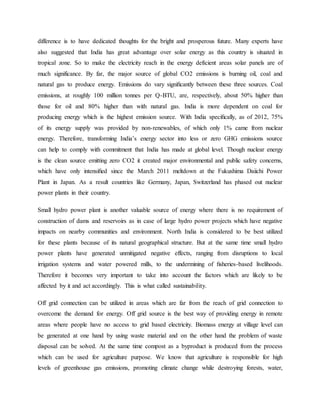
Sustainable techniques like canals covered with solar panels as happening in case of Sardar
sarovar canal and Indira Gandhi canal can not only use waste land for generating electricity but it
also reduce evaporation of water from the canal reduce cost of water waste and take us further
towards clean energy generation techniques. India’s proposal to fix solar panels on hospitals,
government buildings, offices is worth appreciating. The government should also consider to
make it mandatory for new multi-storeyed residential/commercial buildings, communities,
MALLS in four metros; Gurgaon, Bangalore, Hyderabad, Pune, Thane, NOIDA, Ahmedabad to
have rooftop solar panels such that common lighting, hot water and minimal light in each unit is
provided. The government has also launched an Indian Renewable Energy Development Agency
loan scheme for rooftop solar projects in the country.
‘Ideas are present in the consciousness, which when released and given scope to grow and take
shape, can lead to successful events.’ This fact can lead us to archive many milestones only the
difference is to have dedicated thoughts for the bright and prosperous future. Many experts have
also suggested that India has great advantage over solar energy as this country is situated in
tropical zone. So to make the electricity reach in the energy deficient areas solar panels are of
much significance. By far, the major source of global CO2 emissions is burning oil, coal and
natural gas to produce energy. Emissions do vary significantly between these three sources. Coal
emissions, at roughly 100 million tonnes per Q-BTU, are, respectively, about 50% higher than
those for oil and 80% higher than with natural gas. India is more dependent on coal for
producing energy which is the highest emission source. With India specifically, as of 2012, 75%
of its energy supply was provided by non-renewables, of which only 1% came from nuclear
energy. Therefore, transforming India’s energy sector into less or zero GHG emissions source
can help to comply with commitment that India has made at global level. Though nuclear energy
is the clean source emitting zero CO2 it created major environmental and public safety concerns,
which have only intensified since the March 2011 meltdown at the Fukushima Daiichi Power
Plant in Japan. As a result countries like Germany, Japan, Switzerland has phased out nuclear
power plants in their country.
Small hydro power plant is another valuable source of energy where there is no requirement of
construction of dams and reservoirs as in case of large hydro power projects which have negative
impacts on nearby communities and environment. North India is considered to be best utilized
for these plants because of its natural geographical structure. But at the same time small hydro
power plants have generated unmitigated negative effects, ranging from disruptions to local
irrigation systems and water powered mills, to the undermining of fisheries-based livelihoods.
Therefore it becomes very important to take into account the factors which are likely to be
affected by it and act accordingly. This is what called sustainability.
Off grid connection can be utilized in areas which are far from the reach of grid connection to
overcome the demand for energy. Off grid source is the best way of providing energy in remote
areas where people have no access to grid based electricity. Biomass energy at village level can
be generated at one hand by using waste material and on the other hand the problem of waste
disposal can be solved. At the same time compost as a byproduct is produced from the process
which can be used for agriculture purpose. We know that agriculture is responsible for high
levels of greenhouse gas emissions, promoting climate change while destroying forests, water,
soils, and biodiversity. After Green Revolution in India, adverse effects on human started
appearing in later period. Climate smart agriculture is the only way which can enhance the future
of human. The concept of ‘Agroecology’ should be adopted which is free from chemical
fertilizers and pesticides, growing many crops together - grains, lentils, beans, oilseeds. This
method can preserve the natural ingredients of many crops and hence maintain ecosystem. The
collective groups can help to cope up with many problems and keep traditional methods which
are cost effective and beneficial for both the nature and human beings.
It is true that in upcoming future we cannot completely replace coal, oil, and natural gas with
renewable source of energy but at least with growing acknowledgement of environment safety a
hybrid energy generating system, green libraries policies can be introduced. Loss in transmission
and distribution of electricity is avoidable with more effective technology. It has been proved
that though renewable energy is expensive its investment can be regained in few years whereas
non renewable energy have continuous expense and at the same time have adverse impact on
environment.
‘Innovations that will change the world’ is the headline everywhere. Today the world is shifting
its approach from marketing and same old practices to research and innovation for more
sustainable use. The same approach is also needed towards environment. Innovation and research
will do the favor and save the mother earth. What human have been doing up till now is
extracting more from the earth for self use even when other alternatives are available from the
nature itself. What we need is just to recognize it put more efforts in research and innovation. For
example, hydrogen can be used as a future fuel which is considered as clean fuel. Again cars
which can run on batteries can be proved to be advantageous as it emitted zero gases. India needs
to give attention to these kinds of innovations that are sustainable. It is not difficult for India
where it has already achieved credibility in technology by sending ‘Mangalyan’ in the orbit of
Mars at low cost.
Waste management has become a cause of concern in big cities like Mumbai and Delhi. Soon
there will be a need another dumping ground. Municipal corporations should come up with new
ideas to manage growing waste material. Sweden, a scandinavian country, has adopted a
technique for waste disposal which not only create energy but it also use the residue in
manufacturing. Now the situation has arrived that this country imports garbage from other
countries. This kind of waste management will also solve the problem of disposing garbage in
rivers and seas. The Indian government initiative ‘clean Ganga mission’ has got a pace. The
Ganga and Yamuna are ranked among the world’s 10 most polluted rivers. The nation owes to its
credibility it build on letting untreated industrial chemical flow in the river Ganga which is a
holy river in Hindu religion. Almost 40 companies have been closed because of not followings
the order of environment ministry. The environment minister Prakash Javadekar has said that no
industrial waste will be allowed to add in the river unless it is treated. But it is not just this,
which would help along with this people intention should be changed towards environment. The
government is also working towards stringent green norms for industries which would affect
small and medium enterprises the most because they have no awareness about waste treatment
and also faces finance issues. Therefore, a trade-off between the environment and SME should
be taken care by government in phased wise manner. Dealing with each incident, caused by
poorly managed legacy assets for cleaning up the environmental damage cost heavily to the
government. Therefore the government should take initiative for setting up units that make a
profit from turning wastes into secondary raw materials that are sold to the construction sector
and chemicals industries. All the waste material whether metals or tires should sent to these
units. There is always a panacea available for maintaining balance the only difference is to see it.
The one of the most major problems is the use of plastic bags. We should question ourselves is
that really so hard to avoid plastic or polythene bags in our day to day chores? No. it is
avoidable. Two decades earlier shopkeeper were using brown paper bags for packing varieties of
commodity but in later period it was replaced by polythene bags which has become a cause for
floods in cities. Cloth bags are another good example for protecting environment which is
reusable. If people take it seriously and act accordingly will definitely avert man-made disasters.
Conclusion:
It is not necessary that environment friendly development is expensive in today’s cost cutting
competitive world. Smart solutions and technologies and small changes in human habits can
create environment friendly atmosphere. A strong desire is also needed to work towards
development process by taking into account the most important factor of our life ‘Environment’.
References:
Pollin Robert, Chakraborty Shouvik, An Egalitarian Green Growth Programme for India,
Economic & Political Weekly, October 17, 2015, vol l no 42.
Climate smart development (2014), World Bank and the ClimateWorks Foundation,
Lavasa A., India’s Progress in Combating Climate Change Briefing Paper for UNFCCC COP 20
Lima, PERU, Ministry of Environment, Forests and Climate Change Government of India, New
Delhi, December, 2014.
B.Vijayalakshmi, Green Library – An Overview, Sri Sarada College for Women, Tirunelveli.
Tripathi Alok, Sagar Ambuj D, Smith Kirk R, Promoting Clean and Affordable Cooking Smarter
Subsidies for LPG, Economic and Political Weekly, November 28, 2015, vol l no 48.
Lytton W., Recycle industrial wastes to cut 1Gt from world's carbon emissions, Ecologist,
Published online on 1st December 2015.
Paul Helena, Climate-Smart Agriculture-preparing for a corporate soil and climate-grab in
Paris?, Ecologist, Published on 26th November 2015.
Quinn T., Agroecology leading the fight against India's Green Revolution, Ecologist, Published
on 29th September 2015.
Vaughan A., India unveils climate change plan, Retrieved from
http://www.theguardian.com/profile/adam-vaughan, Published on Friday 2 October 2015
07.57 BST.

Green India Green earth

  • 1.
  • 2.
    Introduction: “You cannot changeyour future, but, you can change your habits, and surely your habits will change the future.” – Dr. APJ Abdul Kalam Dr. APJ Abdul Kalam, the former President of India, a great scientist, a profound thinker, a prolific writer, whose action speaks his words. He was a person who always believed in youth power. He said youth has power and capabilities which can accomplish many milestones and overcome many hurdles which come in their way to put India in examples of sustainable developed countries. He had been inspiring youth to take initiative and give a hand for eliminating poverty not only from India but also from the world. He believed that if children of our country are properly molded and diverted their minds to contribute towards country’s progress India can never lag behind in terms of development. At the same time he firmly believed in innovative sustainable techniques which would minimize the cost of development on the environment. What India needs today is not just development which would result in increase in employment and national income, infrastructural progress but it also mean to have secure future which does not bear any cost on environment. This is because any adversity to environment ultimately going to have adverse effects on humans by causing rise in temperature, many deceases (newly invaded deceases) and the most drastic and vulnerable effect will be on agriculture which is being experienced in today’s date also. For example, in India, in 2015 rainfall was scarce, some north- east areas of Maharashtra experienced draught condition in fact addition to that it was recorded highest temperature in this year; on the other side in the month of November when the north-east monsoon arrived in India it caused flood condition which took life of 250 people. This kind of uncertain behavior of nature deviated from the usual is the result of human interference in the working of nature. Man seeks development but does not consider whether that development is causing any adversity, he always desire for his betterment. His action, since the industrial revolution has taken place, is releasing carbon dioxide, methane, black carbon in the air which is raising global temperature. What man has caused to the environment, environment is now taking back on mankind.
  • 3.
    “Every action hasequal and opposite reaction.” This is a law of Newton, a famous scientist. This law states the exact position of human. Sustainable development through innovative solutions: Though India is a late comer in the process of raising global temperature through industrial revolution and is accountable for only 3% of the increased global temperature, still India has huge responsibility to not to let further increase in temperature. Same applies to other countries which are on the verge of development must acclimatize themselves with the reality of hazards of climate change. According to developing countries the main culprits for the green house gas emissions are developed countries where industrial revolution started much before the developing world. Hence it was put forward in the recently held Paris climate change conference that the developed countries should finance developing countries to mitigate their reduction in GHG emissions. But the conference is not about putting blame on others rather it is about give and take. To get something, loosing something is essential. In any ways India is also in the line with one of the most polluting countries in the world even though it is a late comer. At the same time development is also very important to eliminate poverty and generate employment. According to so called Intended nationally determined contributions which every country had to submit before the negotiations began in Paris, India pledged to reduce the emissions intensity of GDP by 33 to 35% by 2030 based on 2005 levels. It proposes to achieve this by investing significantly in low-carbon technologies. The government is also taking steps to increase forest coverage for performing the task as carbon sink.
  • 4.
    Of the world’stop 20 polluted cities, 13 are in India compared to just three in China. Air pollution slashes life expectancy by 3.2 years for the 660 million Indians who live in cities, including Delhi. Air pollution takes many lives. The particulate matter 2.5 has crossed its safe limit in Delhi. It is disappointing that even though India’s total primary energy consumption i.e. 31 quadrillion British thermal units (Q-BTUs) which is very low even lower than China and the US whose total primary energy consumption is 115.3 and 84.7 quadrillion British thermal units (Q-BTUs), India’s economic development taking high toll on environment. Trade-off between economic development and environment protection seems to be more diverted towards development without sustainability. It has been a tradition in India that decisions are always taken on the knife-edge situation. So, the government of India is considering putting age bar for commercial vehicles which may be fixed at 15 years. If it is implemented India could join the ranks of developed economies that have a finite age for vehicles. Again, the Delhi government has also decided to roll out odd-even vehicle rule from 1st January 2016. The Volkswagen diesel-gate scandal is also likely to spark off changes in the regulation of vehicle emission standards. The road transport ministry is considering defining guidelines for testing and validating permissible range of emission for vehicles that are in use. Currently, in India there are
  • 5.
    only defined regulatoryemission standards available for new vehicles and not for in-use ones. This move, if implemented would help to start a fight against air pollution which is a major issue worldwide. Working from the grass root level like these reforms is needed rather initially investing in air purifier which the idea currently is being considered to apply in Beijing, China for dealing with air pollution. This is because if everyone camouflage their own mistakes and try to solve the problem from outer resolutions would never solve the problem. Small changes in human habits can go miles to protect environment. Along with this we also need cleaner fuel which would release less carbon particles in the air. Carbon dioxide has long life which remains in the atmosphere for more than hundred years and other responsible particles for climate change like black carbon, methane remains for few weeks and seven years respectively. Therefore, investment in research of green technology or sustainable technology to reduce the level of all these factors responsible for raising temperature is essential. People who are living in polluted cities are very anxious about their health as air pollution creates most health problems related to lungs such as cancer. Health problems are on the verge of rise which needs immediate attention. The strategic solutions and scientific innovation in every field of development would reduce emission levels up to certain level. What we need today is not calculating how much level of emission of gases can be reduced if certain measures are adopted but to introduce or change the method of development where the relevance of environment is inescapable and maximum environment friendly techniques are feasible. Air pollution is a major problem in many cities of the world especially in India as 13 cities out of first 20 polluted cities in the world are from India, government need to adopt advance filters and modified pollution abetment devices for particulate matter and attendant emissions. And also need to step up investment in oil refineries for ultra low sulfur diesel and petrol. Small things count in the efforts when it cumulatively results in drastic change. This can be identified from the government’s efforts to build energy on the basis of solar power. The government of India is committed to generate energy from renewable sources to 40% by 2030. The government has pledged to produce 100GW energy from solar by 2022. These initiatives of government have created hope for better future and is considered as a ‘global priority’ and backed by many other countries. India’s solar commitment could make or break its climate commitment. In 2015 at the parties 21 on climate change in Paris, India is seen as crucial to the
  • 6.
    success global cooperationfor climate action. India demanded support from developed world for developing nations and in return India devoted its efforts for reduction in CO2 emissions. Sustainable techniques like canals covered with solar panels as happening in case of Sardar sarovar canal and Indira Gandhi canal can not only use waste land for generating electricity but it also reduce evaporation of water from the canal reduce cost of water waste and take us further towards clean energy generation techniques. India’s proposal to fix solar panels on hospitals, government buildings, offices is worth appreciating. The government should also consider to make it mandatory for new multi-storeyed residential/commercial buildings, communities, MALLS in four metros; Gurgaon, Bangalore, Hyderabad, Pune, Thane, NOIDA, Ahmedabad to have rooftop solar panels such that common lighting, hot water and minimal light in each unit is provided. The government has also launched an Indian Renewable Energy Development Agency loan scheme for rooftop solar projects in the country. ‘Ideas are present in the consciousness, which when released and given scope to grow and take shape, can lead to successful events.’ This fact can lead us to archive many milestones only the
  • 7.
    difference is tohave dedicated thoughts for the bright and prosperous future. Many experts have also suggested that India has great advantage over solar energy as this country is situated in tropical zone. So to make the electricity reach in the energy deficient areas solar panels are of much significance. By far, the major source of global CO2 emissions is burning oil, coal and natural gas to produce energy. Emissions do vary significantly between these three sources. Coal emissions, at roughly 100 million tonnes per Q-BTU, are, respectively, about 50% higher than those for oil and 80% higher than with natural gas. India is more dependent on coal for producing energy which is the highest emission source. With India specifically, as of 2012, 75% of its energy supply was provided by non-renewables, of which only 1% came from nuclear energy. Therefore, transforming India’s energy sector into less or zero GHG emissions source can help to comply with commitment that India has made at global level. Though nuclear energy is the clean source emitting zero CO2 it created major environmental and public safety concerns, which have only intensified since the March 2011 meltdown at the Fukushima Daiichi Power Plant in Japan. As a result countries like Germany, Japan, Switzerland has phased out nuclear power plants in their country. Small hydro power plant is another valuable source of energy where there is no requirement of construction of dams and reservoirs as in case of large hydro power projects which have negative impacts on nearby communities and environment. North India is considered to be best utilized for these plants because of its natural geographical structure. But at the same time small hydro power plants have generated unmitigated negative effects, ranging from disruptions to local irrigation systems and water powered mills, to the undermining of fisheries-based livelihoods. Therefore it becomes very important to take into account the factors which are likely to be affected by it and act accordingly. This is what called sustainability. Off grid connection can be utilized in areas which are far from the reach of grid connection to overcome the demand for energy. Off grid source is the best way of providing energy in remote areas where people have no access to grid based electricity. Biomass energy at village level can be generated at one hand by using waste material and on the other hand the problem of waste disposal can be solved. At the same time compost as a byproduct is produced from the process which can be used for agriculture purpose. We know that agriculture is responsible for high levels of greenhouse gas emissions, promoting climate change while destroying forests, water,
  • 8.
    soils, and biodiversity.After Green Revolution in India, adverse effects on human started appearing in later period. Climate smart agriculture is the only way which can enhance the future of human. The concept of ‘Agroecology’ should be adopted which is free from chemical fertilizers and pesticides, growing many crops together - grains, lentils, beans, oilseeds. This method can preserve the natural ingredients of many crops and hence maintain ecosystem. The collective groups can help to cope up with many problems and keep traditional methods which are cost effective and beneficial for both the nature and human beings. It is true that in upcoming future we cannot completely replace coal, oil, and natural gas with renewable source of energy but at least with growing acknowledgement of environment safety a hybrid energy generating system, green libraries policies can be introduced. Loss in transmission and distribution of electricity is avoidable with more effective technology. It has been proved that though renewable energy is expensive its investment can be regained in few years whereas non renewable energy have continuous expense and at the same time have adverse impact on environment. ‘Innovations that will change the world’ is the headline everywhere. Today the world is shifting its approach from marketing and same old practices to research and innovation for more sustainable use. The same approach is also needed towards environment. Innovation and research will do the favor and save the mother earth. What human have been doing up till now is extracting more from the earth for self use even when other alternatives are available from the nature itself. What we need is just to recognize it put more efforts in research and innovation. For example, hydrogen can be used as a future fuel which is considered as clean fuel. Again cars which can run on batteries can be proved to be advantageous as it emitted zero gases. India needs to give attention to these kinds of innovations that are sustainable. It is not difficult for India where it has already achieved credibility in technology by sending ‘Mangalyan’ in the orbit of Mars at low cost. Waste management has become a cause of concern in big cities like Mumbai and Delhi. Soon there will be a need another dumping ground. Municipal corporations should come up with new ideas to manage growing waste material. Sweden, a scandinavian country, has adopted a technique for waste disposal which not only create energy but it also use the residue in
  • 9.
    manufacturing. Now thesituation has arrived that this country imports garbage from other countries. This kind of waste management will also solve the problem of disposing garbage in rivers and seas. The Indian government initiative ‘clean Ganga mission’ has got a pace. The Ganga and Yamuna are ranked among the world’s 10 most polluted rivers. The nation owes to its credibility it build on letting untreated industrial chemical flow in the river Ganga which is a holy river in Hindu religion. Almost 40 companies have been closed because of not followings the order of environment ministry. The environment minister Prakash Javadekar has said that no industrial waste will be allowed to add in the river unless it is treated. But it is not just this, which would help along with this people intention should be changed towards environment. The government is also working towards stringent green norms for industries which would affect small and medium enterprises the most because they have no awareness about waste treatment and also faces finance issues. Therefore, a trade-off between the environment and SME should be taken care by government in phased wise manner. Dealing with each incident, caused by poorly managed legacy assets for cleaning up the environmental damage cost heavily to the government. Therefore the government should take initiative for setting up units that make a profit from turning wastes into secondary raw materials that are sold to the construction sector and chemicals industries. All the waste material whether metals or tires should sent to these units. There is always a panacea available for maintaining balance the only difference is to see it. The one of the most major problems is the use of plastic bags. We should question ourselves is that really so hard to avoid plastic or polythene bags in our day to day chores? No. it is avoidable. Two decades earlier shopkeeper were using brown paper bags for packing varieties of commodity but in later period it was replaced by polythene bags which has become a cause for floods in cities. Cloth bags are another good example for protecting environment which is reusable. If people take it seriously and act accordingly will definitely avert man-made disasters. Conclusion: It is not necessary that environment friendly development is expensive in today’s cost cutting competitive world. Smart solutions and technologies and small changes in human habits can create environment friendly atmosphere. A strong desire is also needed to work towards development process by taking into account the most important factor of our life ‘Environment’.
  • 10.
    References: Pollin Robert, ChakrabortyShouvik, An Egalitarian Green Growth Programme for India, Economic & Political Weekly, October 17, 2015, vol l no 42. Climate smart development (2014), World Bank and the ClimateWorks Foundation, Lavasa A., India’s Progress in Combating Climate Change Briefing Paper for UNFCCC COP 20 Lima, PERU, Ministry of Environment, Forests and Climate Change Government of India, New Delhi, December, 2014. B.Vijayalakshmi, Green Library – An Overview, Sri Sarada College for Women, Tirunelveli. Tripathi Alok, Sagar Ambuj D, Smith Kirk R, Promoting Clean and Affordable Cooking Smarter Subsidies for LPG, Economic and Political Weekly, November 28, 2015, vol l no 48. Lytton W., Recycle industrial wastes to cut 1Gt from world's carbon emissions, Ecologist, Published online on 1st December 2015. Paul Helena, Climate-Smart Agriculture-preparing for a corporate soil and climate-grab in Paris?, Ecologist, Published on 26th November 2015. Quinn T., Agroecology leading the fight against India's Green Revolution, Ecologist, Published on 29th September 2015. Vaughan A., India unveils climate change plan, Retrieved from http://www.theguardian.com/profile/adam-vaughan, Published on Friday 2 October 2015 07.57 BST.