GREEN
COMPUTING : A
PARADIGM SHIFT
Presented By : Ritika
Mahanta
BCA 5th Sem
Guided by : Dr.
Sarbeswara Hota
CONTENTS
What is Green
Computing?
Examples of
green computing
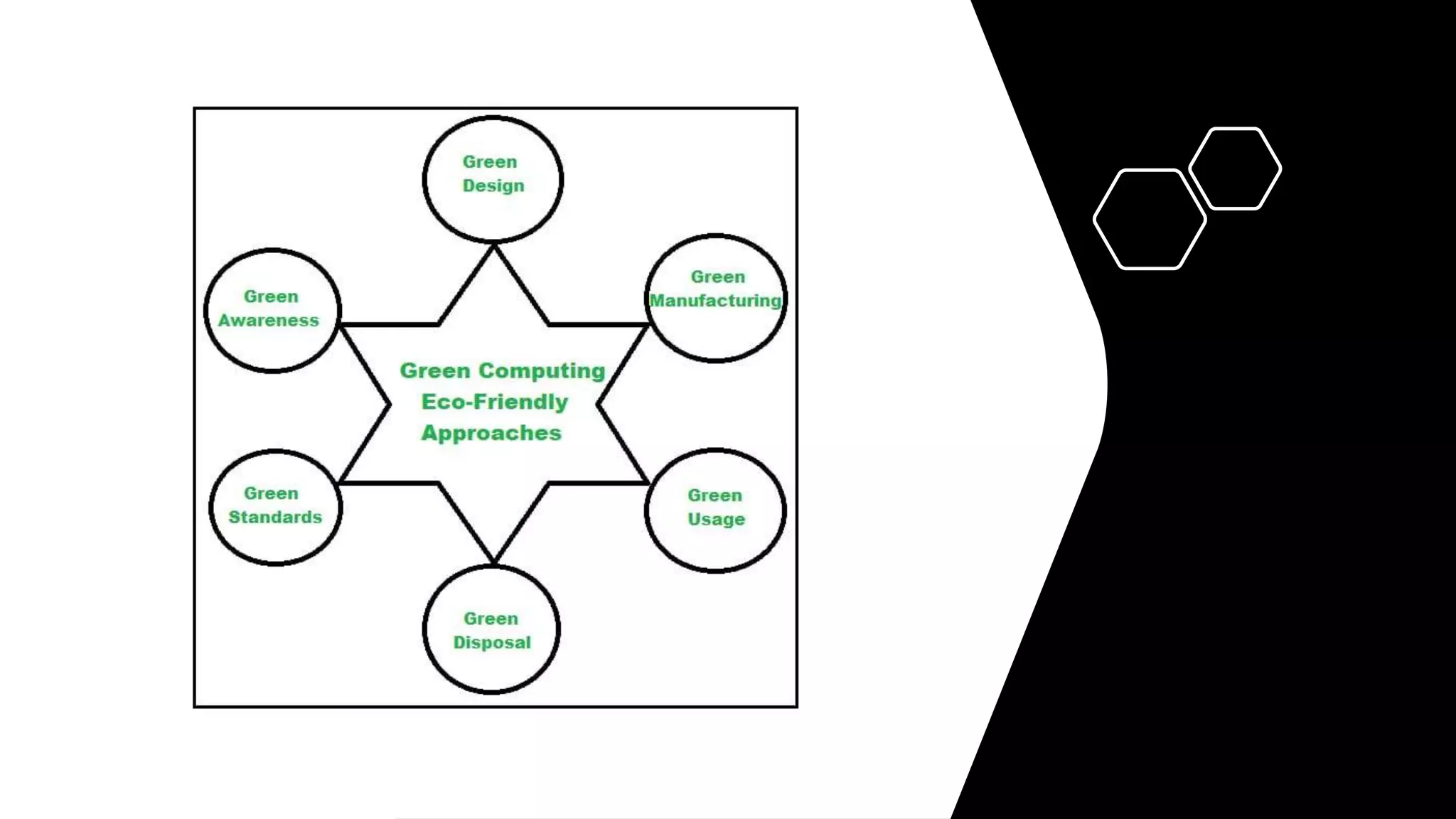
Approaches to
Green Computing
Virtualization
Power
Management
Power Supply
Storage Displays
Materials
Recycling
Implementations Advantages Limitations
References Conclusion
What is Green
Computing?
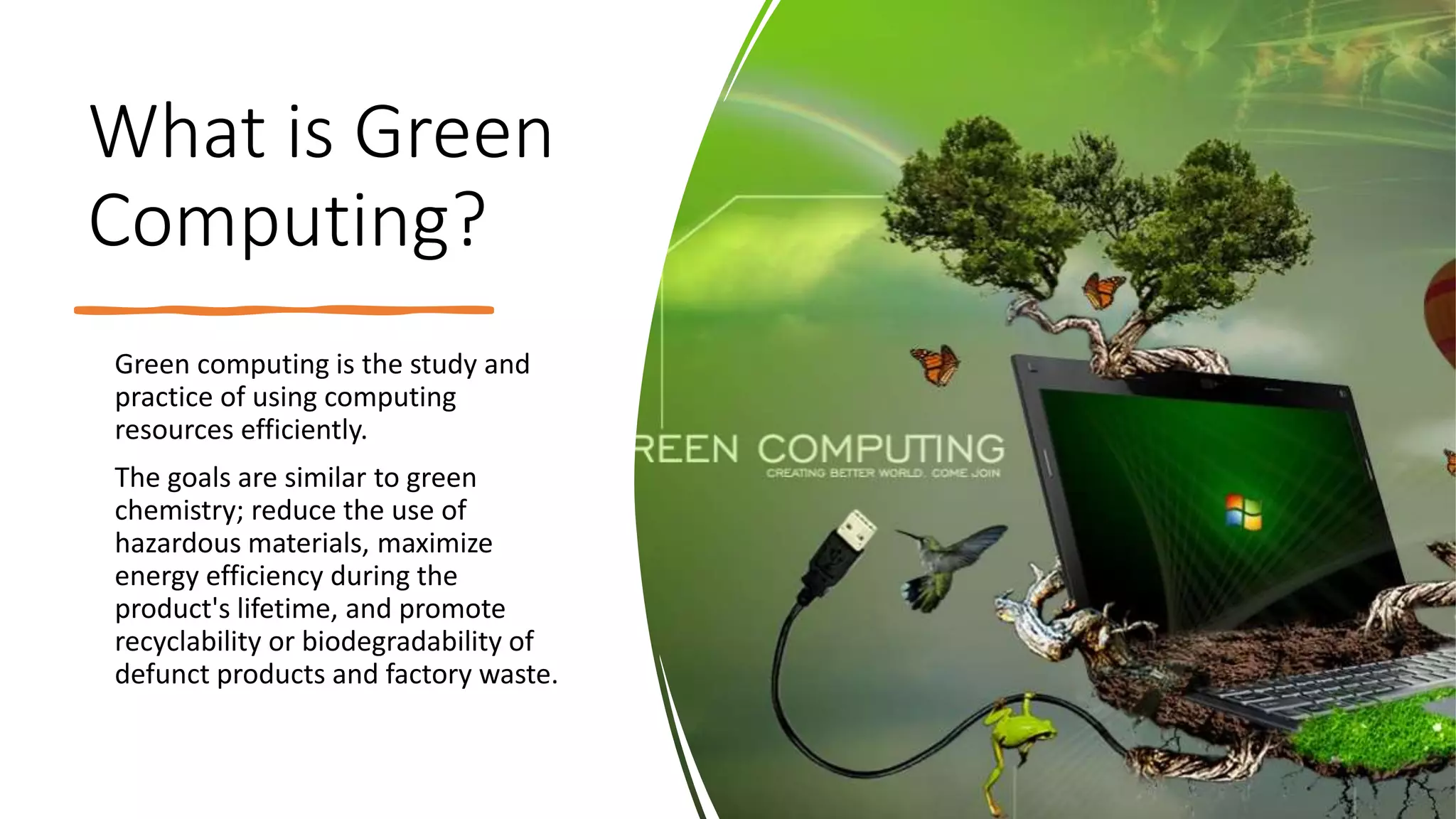
Green computing is the study and
practice of using computing
resources efficiently.
The goals are similar to green
chemistry; reduce the use of
hazardous materials, maximize
energy efficiency during the
product's lifetime, and promote
recyclability or biodegradability of
defunct products and factory waste.
Examples of green computing
Purchasing from
Environmentally
Committed
Companies.
1
Participating in
Electronic
Recycling
Programs.
2
Deploying
Virtual
Technologies.
3
Limiting Printing
and Recycling
Paper.
4
Who invented Green
Computing
The term Green computing came into existence with
the launch of Energy Star program in 1992 by U.S
environmental protection agency. It aims towards
electricity saving and less amount of heat generated
by the computers. Widespread use of computers and
related IT products has a very bad effect on the
environment.
Approaches to
Green Computing
Virtualization
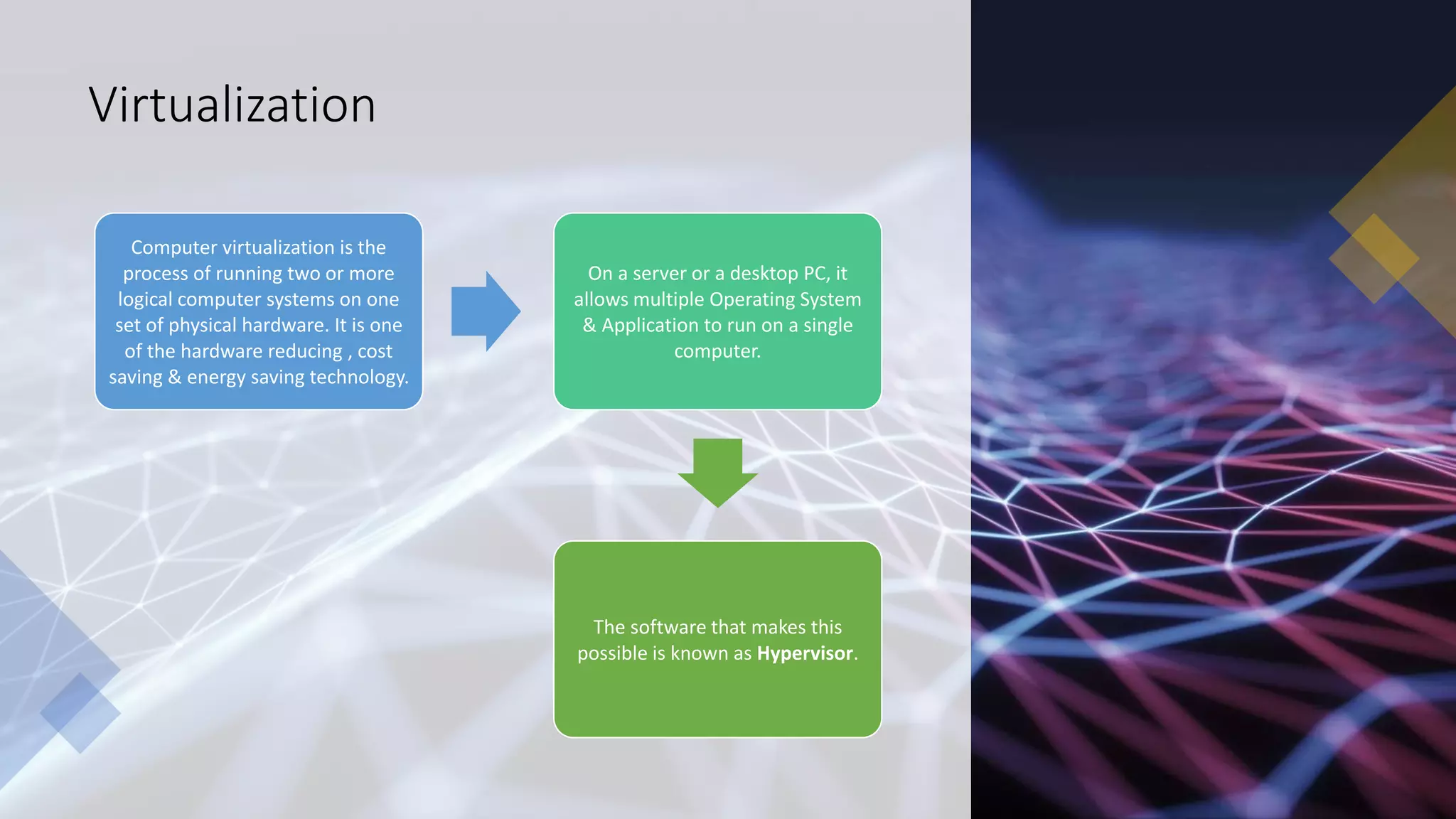
Computer virtualization is the
process of running two or more
logical computer systems on one
set of physical hardware. It is one
of the hardware reducing , cost
saving & energy saving technology.
On a server or a desktop PC, it
allows multiple Operating System
& Application to run on a single
computer.
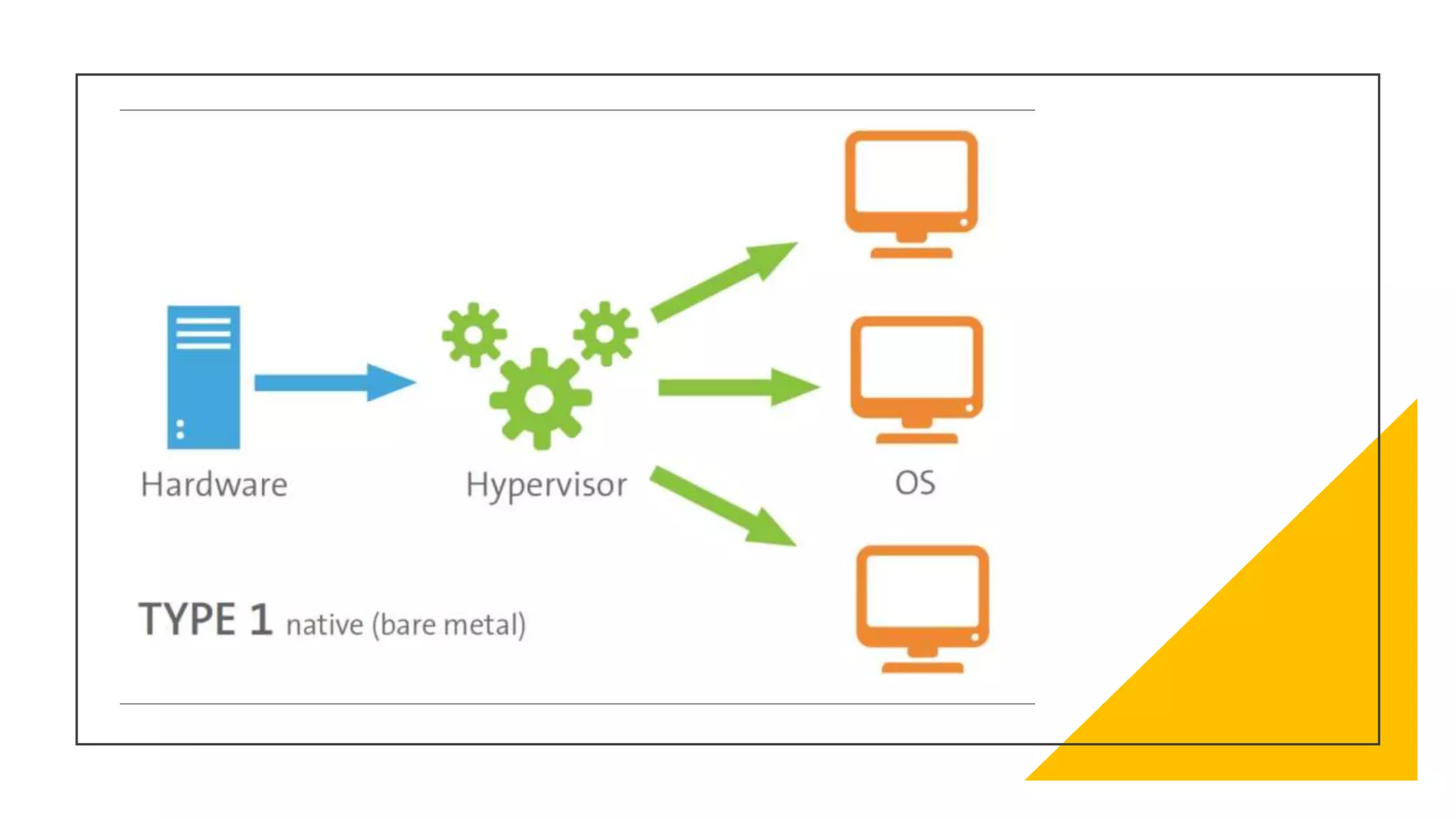
The software that makes this
possible is known as Hypervisor.
Why do we need to
virtualize?
1. We can run multiple servers on one single
physical server thus reducing the usage of
hardware and saving money.
2. We can upgrade virtual machine hardware
with just a mouse click.
3. Disaster Recovery : Virtual machinery are files
so the entire vm(virtual machine) can backed
up.We can not only create a backup for the data
but the installed programs and OS as well.
Power Management
The Advanced Configuration & Power
Interface(ACPI) , an open industry standard,
allows an operating system to directly control
the power saving aspects of its underlying
hardware.
Power management for computer systems are
desired for many reasons, particularly:
1. Prolong battery life for portable and
embedded systems.
2. Reduce cooling requirements.
3. Reduce noise.
4. Reduce operating costs for energy and
cooling.
How to enable ACPI on machine
Click the 'Device Manager' button
Expand the Computer object
Its type will be shown, probably 'Standard PC' (if it says (Advanced Configuration and Power Interface
(ACPI) PC then ACPI is enabled already)
Click here to view image
Right click on the Computer type and select Properties
Select the 'Driver' tab
Click 'Update Driver'
The Upgrade Device Driver Wizard will start. Click Next
You can now either ask it to find a driver or manually select
If you select Manual select the 'Show all hardware of this device class' and select the ACPI driver. Click
Next
Click Next to install the driver
Click Finish to the wizard and click Close the computer property driver dialog
Click Yes to restart your computer
Power Supply
• Power supplies in most computers (PSUs)
aren't designed for energy efficiency. In
fact, most computers drain more power
than they need during normal operation,
leading to higher electrical bills and a
more dire environmental impact.
• Various initiatives are underway to
improve the efficiency of computer
power supplies. Climate savers
computing initiative promotes energy
saving and reduction of greenhouse gas
emissions by encouraging development
and use of more efficient Power supplies.
Climate
Savers
Computing
Initiative
Storage
There are three routes available, all of which
vary in cost, performance, and capacity.
SSDs may use more power than hard disks,
(e.g., 4GBi-RAM uses more power and space
than laptop drives).
GREEN STORAGE
To reduce the amount of carbon
dioxide released into the
atmosphere as result of day to day
activities of a particular
organization is called green
storage.
The real goal of green storage is
not just being environment-
friendly, but also lowering costs,
improving the efficiency of
resources, and preserving energy.
TAPES
Tapes are still a popular solution for
reducing carbon footprints(carbon
dioxide released) because it has no
parts that uses energy and has more
shelf-life(length of a time a product
may be stored)than other methods of
storage and it is portable. Tape systems
consumes about 87% less energy than
equivalent amounts of hard disk
storage and can produce up to an 87%
reduction in CO2 emissions.
Storage Capacity – 100 MB to 200 GB
This Photo by Unknown author is licensed under CC BY.
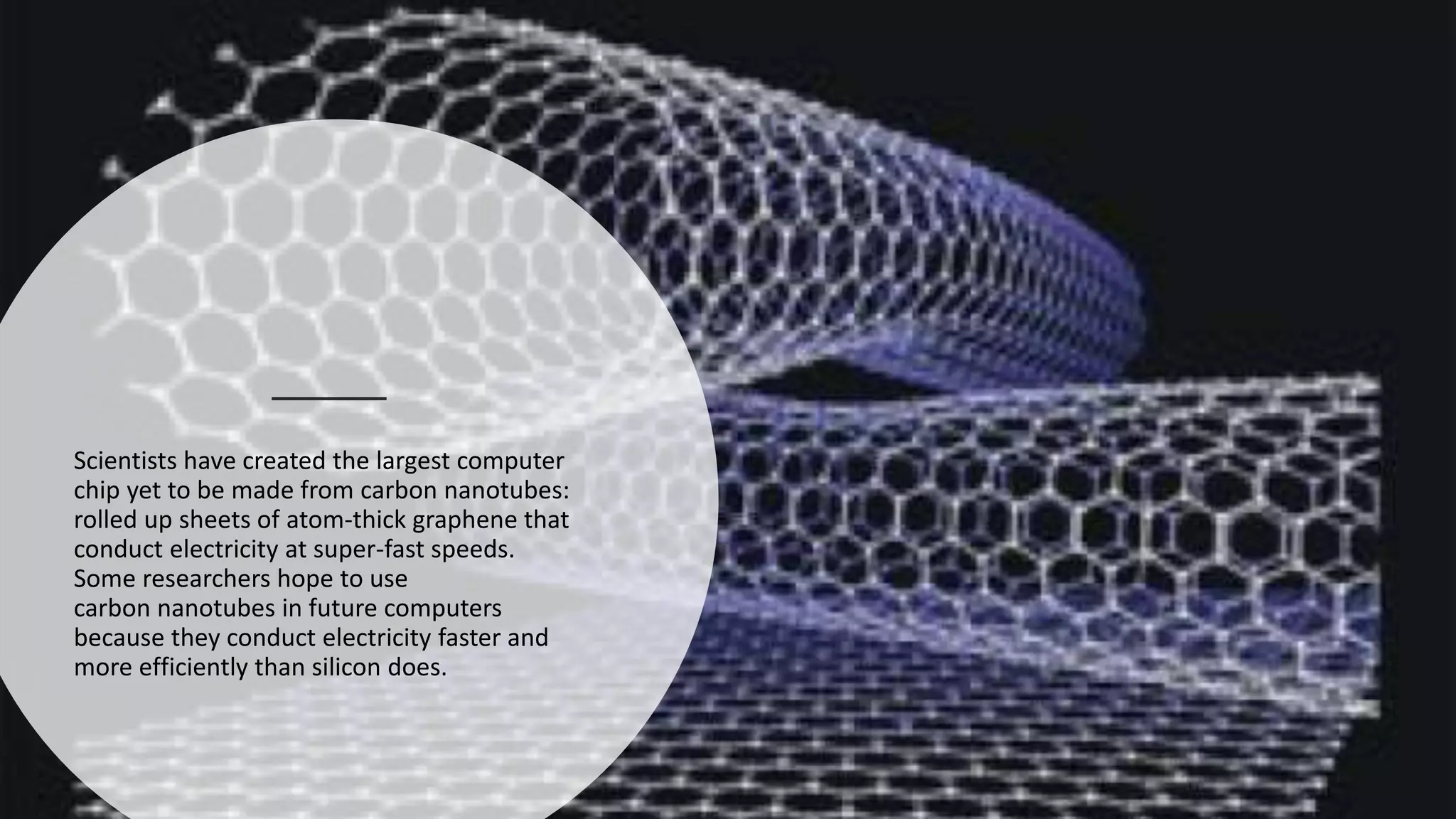
Scientists have created the largest computer
chip yet to be made from carbon nanotubes:
rolled up sheets of atom-thick graphene that
conduct electricity at super-fast speeds.
Some researchers hope to use
carbon nanotubes in future computers
because they conduct electricity faster and
more efficiently than silicon does.​
Displays
LCDs are up to 66% more energy efficient than CRTs,
LCDs are also upwards of 80% smaller in size and
weight, leading to fuel savings in shipping.
LCDs produce less heat, meaning you'll need less AC
to keep cool.
LCD screens are also easier on the eyes. Their lower
intensity and steady light pattern result in less
fatigue versus CRTs.
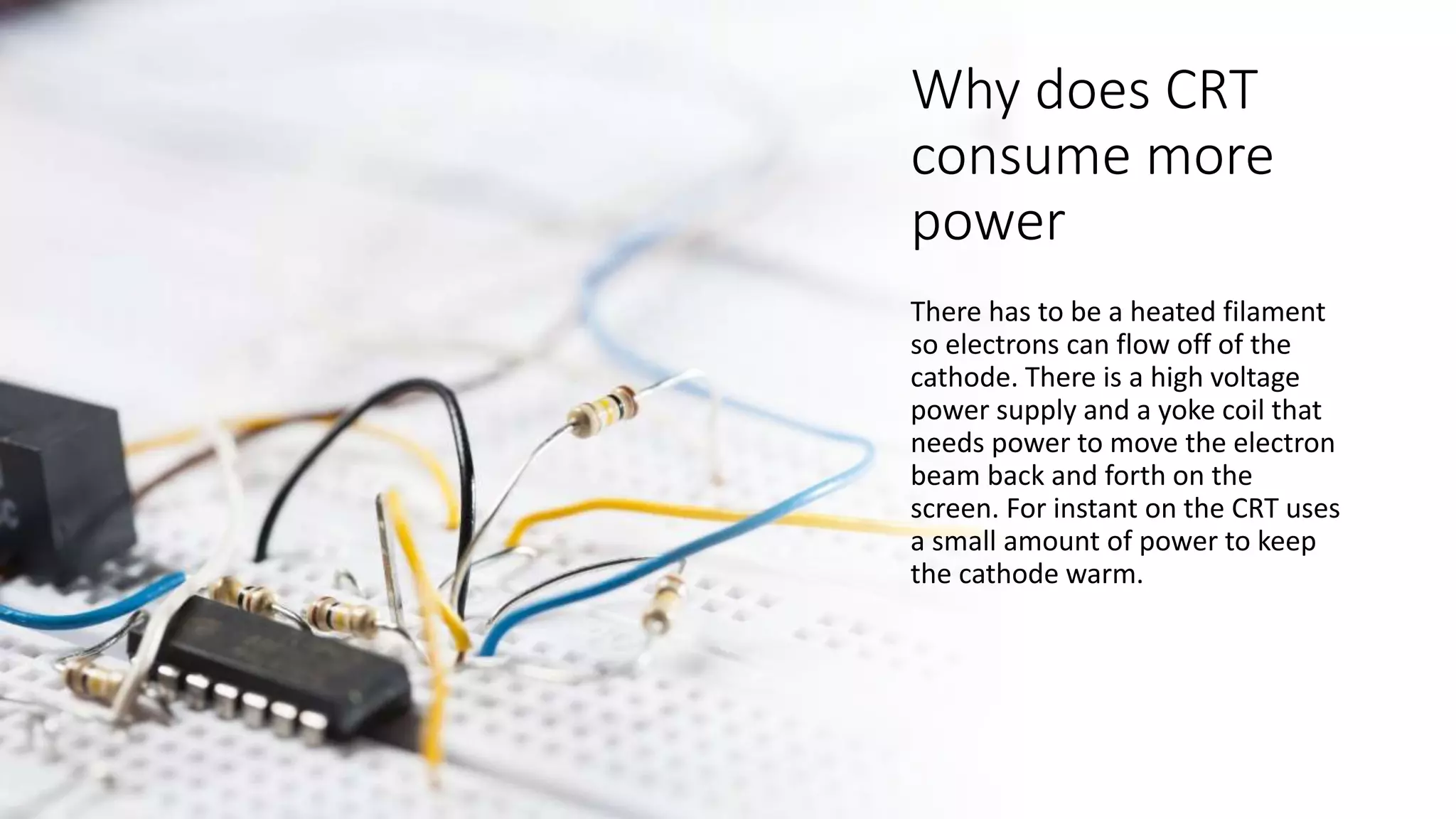
Why does CRT
consume more
power
There has to be a heated filament
so electrons can flow off of the
cathode. There is a high voltage
power supply and a yoke coil that
needs power to move the electron
beam back and forth on the
screen. For instant on the CRT uses
a small amount of power to keep
the cathode warm.
Materials
Recycling
• Computer recycling refers to recycling
or reuse of a computer or electronic
Waste. This can include finding
another use for the system (i. e.
donated to charity), or having the
system dismantled in a manner that
allows for the safe extraction of the
constituent materials for reuse in
other products.
• Additionally, parts from outdated
systems may be salvaged and recycled
through certain retail outlets and
municipal or private recycling centres.
What is
green
disposal in
green
computing?
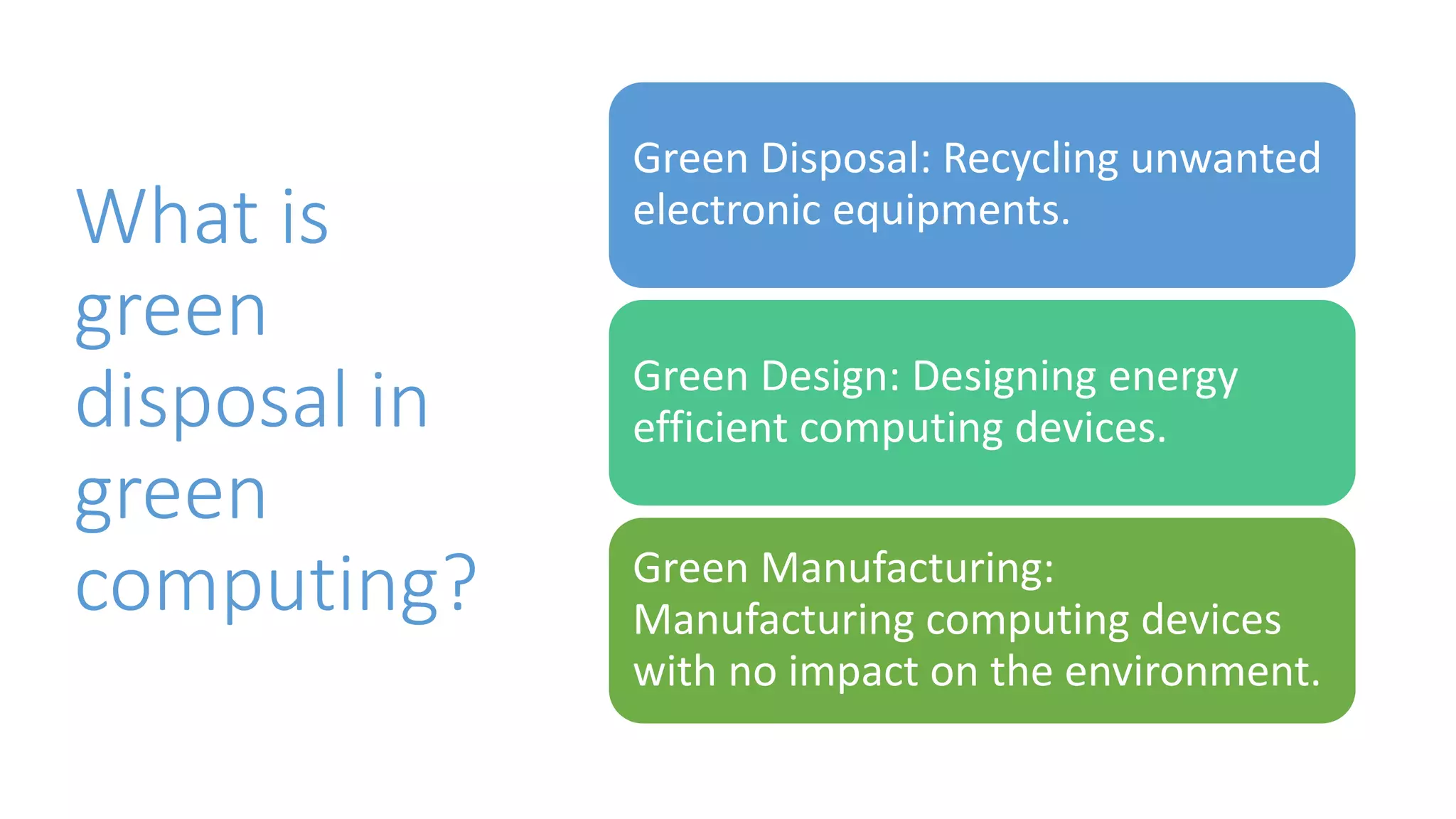
Green Disposal: Recycling unwanted
electronic equipments.
Green Design: Designing energy
efficient computing devices.
Green Manufacturing:
Manufacturing computing devices
with no impact on the environment.
Implementation
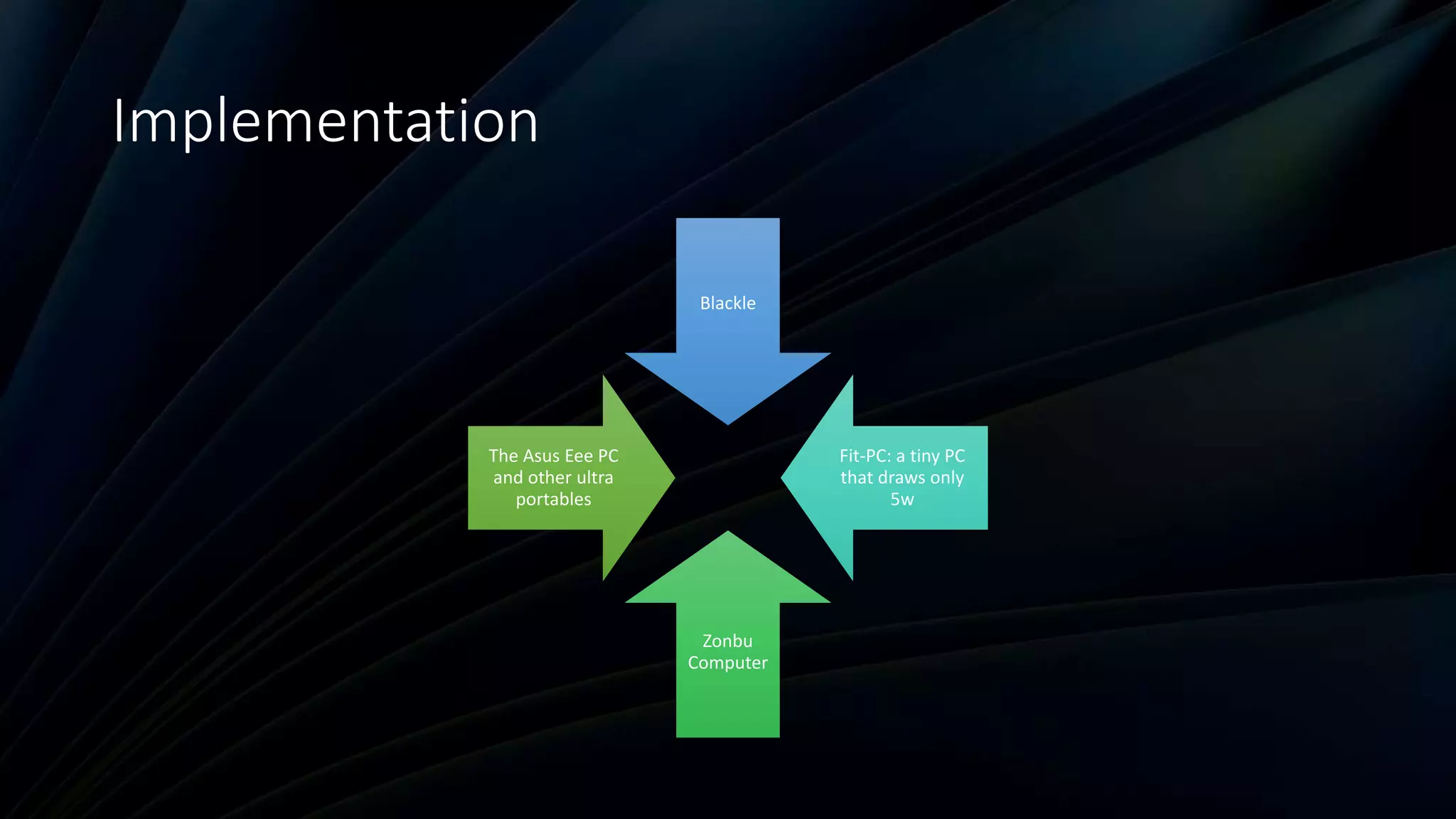
Blackle
Fit-PC: a tiny PC
that draws only
5w
Zonbu
Computer
The Asus Eee PC
and other ultra
portables
Blackle
Blackle is a search-engine site powered by
Google Search.
Blackle came into being based on the
concept that when a computer screen is
white, presenting an empty word page or
the Google home page, your computer
consumes 74W.When the screen is black it
consumes only 59W.
Based on this theory if everyone switched
from Google to Blackle, mother earth would
save 750MW each year.
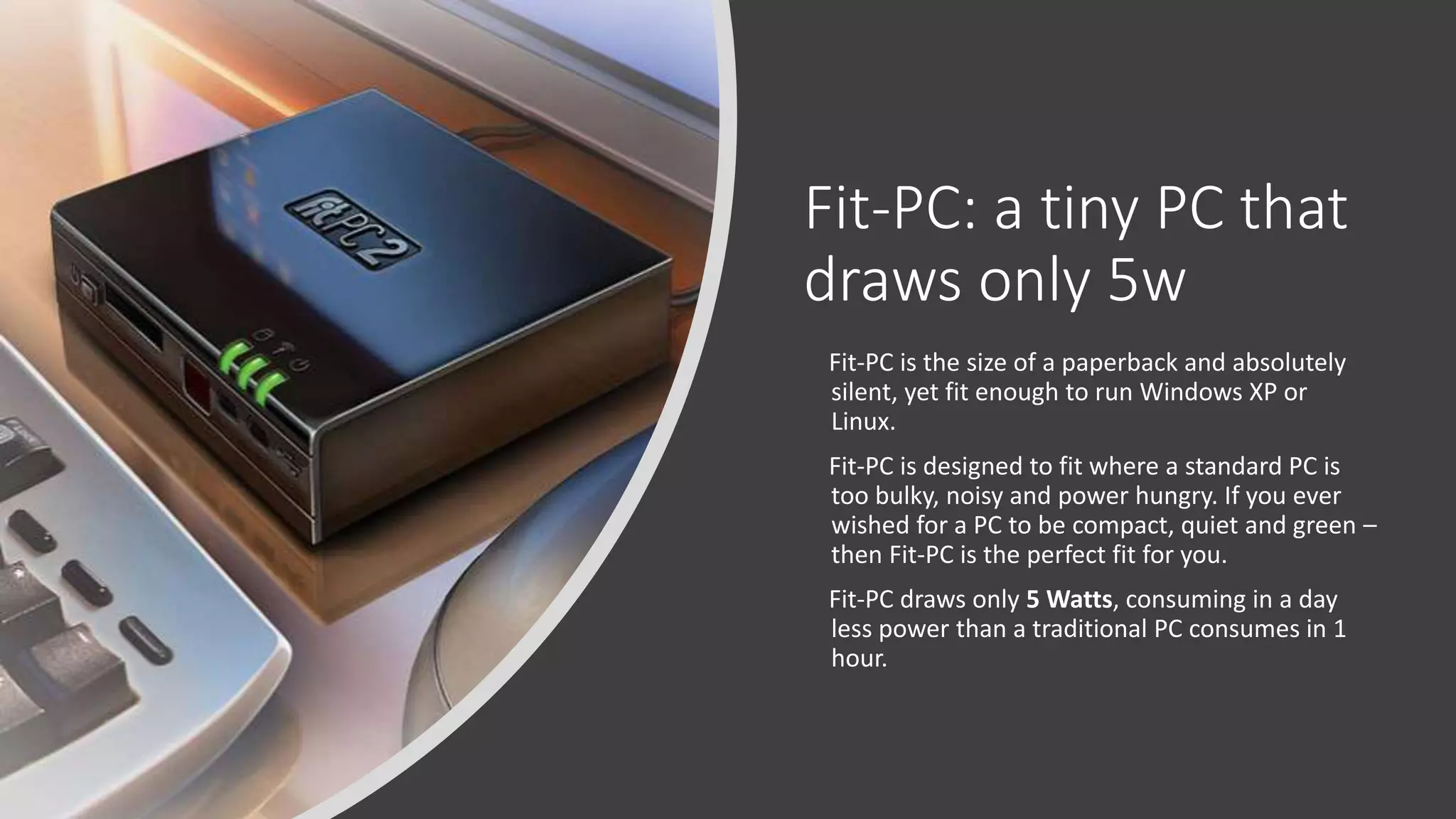
Fit-PC: a tiny PC that
draws only 5w
Fit-PC is the size of a paperback and absolutely
silent, yet fit enough to run Windows XP or
Linux.
Fit-PC is designed to fit where a standard PC is
too bulky, noisy and power hungry. If you ever
wished for a PC to be compact, quiet and green –
then Fit-PC is the perfect fit for you.
Fit-PC draws only 5 Watts, consuming in a day
less power than a traditional PC consumes in 1
hour.
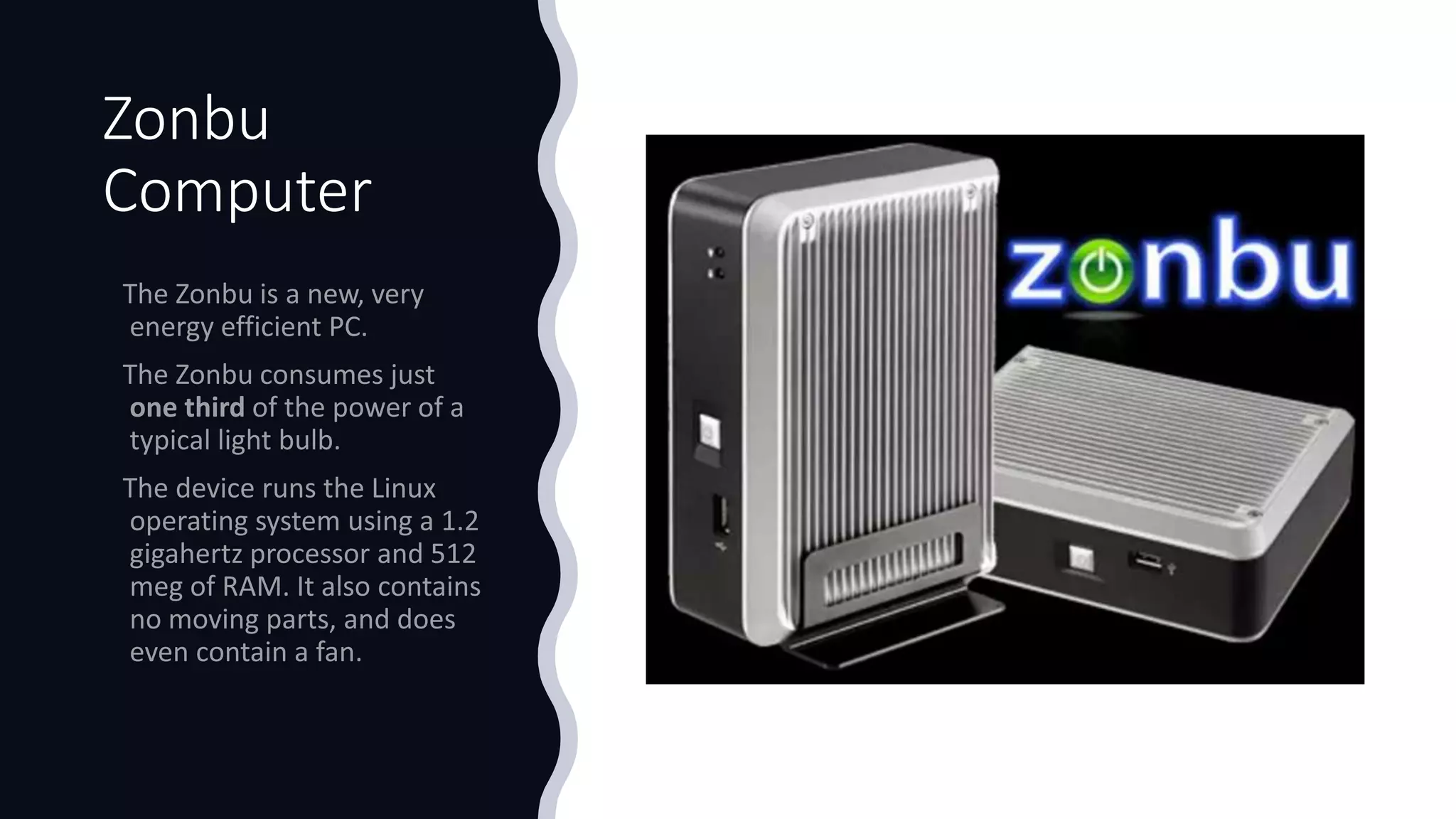
Zonbu
Computer
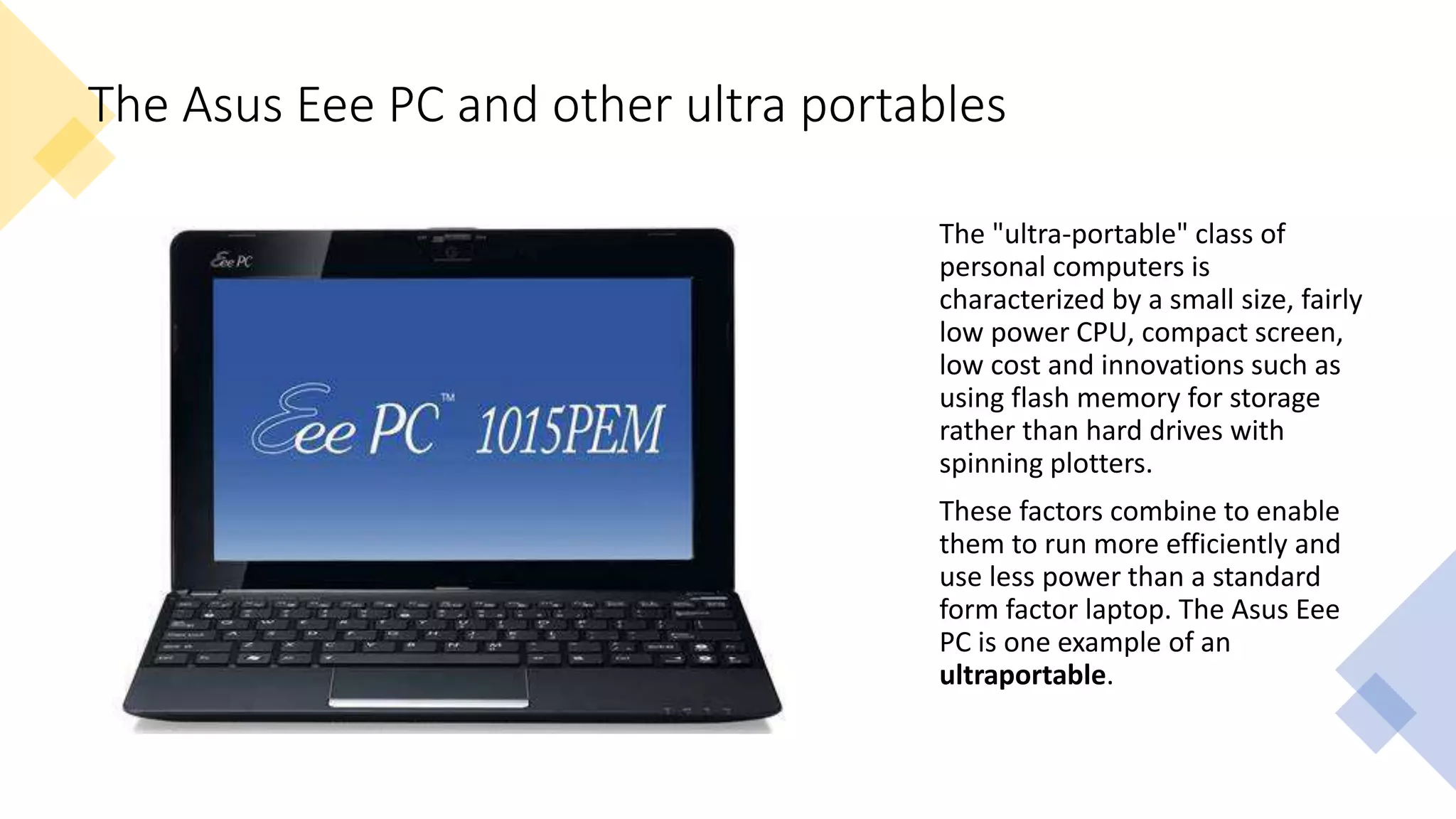
The Asus Eee PC and other ultra portables
The "ultra-portable" class of
personal computers is
characterized by a small size, fairly
low power CPU, compact screen,
low cost and innovations such as
using flash memory for storage
rather than hard drives with
spinning plotters.
These factors combine to enable
them to run more efficiently and
use less power than a standard
form factor laptop. The Asus Eee
PC is one example of an
ultraportable.
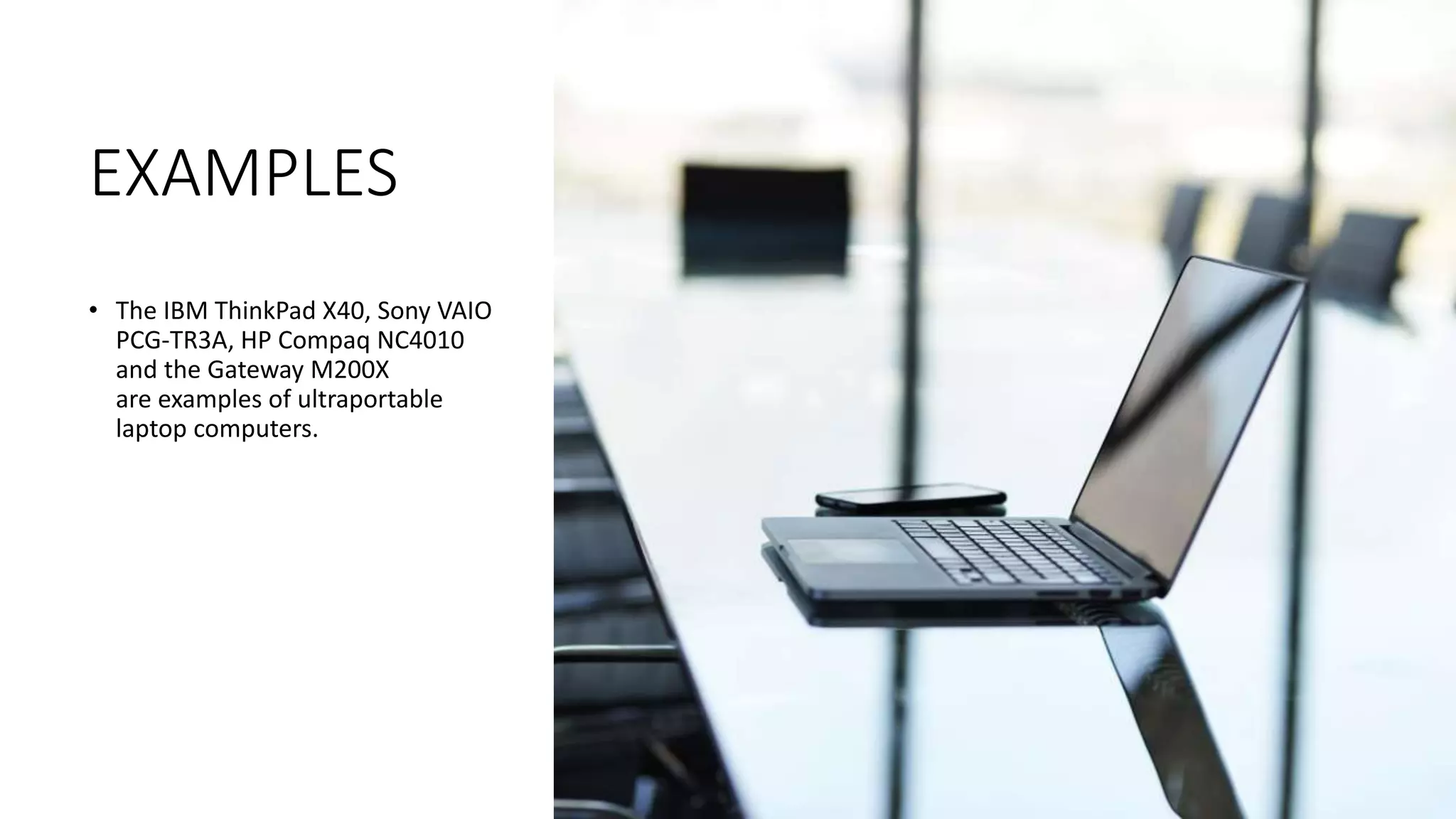
EXAMPLES
• The IBM ThinkPad X40, Sony VAIO
PCG-TR3A, HP Compaq NC4010
and the Gateway M200X
are examples of ultraportable
laptop computers.
ADVANTAGES
Energy Saving
Environment Friendly
Less pollution
Less greenhouse gas emissions
Limitations
Green Computing could be quite costly.
Some computers that are green may be considerably underpowered.
Rapid technology change.
Conclusion
Consumers haven't
cared about
ecological impact
when buying
computers, they've
cared only about
speed and price.
But as Moore's
Law marches on
and computers
commoditize,
consumers will
become pickier
about being green.
Devices use less
and less power
while renewable
energy gets more
and more portable
and effective.
New green
materials are
developed every
year, and many
toxic ones are
already being
replaced by them.
REFERENCES
Kayathri, Mrs S., Mrs S. Girija, and Ms S. Meena. "Green
Computing to Reduce the Harmful Impact of Technology
on the Earth." International Journal of Applied
Engineering Research 13, no. 11 (2018): 9965-9968.
Jindal, Gaurav, and Manisha Gupta. "Green computing
“future of computers”." International Journal of Emerging
Research in Management &Technology (2012): 14-18.
Raza, Khalid, V. K. Patle, and Sandeep Arya. "A review on
green computing for eco-friendly and sustainable
it." Journal of Computational Intelligence and Electronic
Systems 1, no. 1 (2012): 3-16.
"GO GREEN AND
SAVE OUR EARTH"
Green computing ppt Ritika Mahanta

Green computing ppt Ritika Mahanta

  • 1.
    GREEN COMPUTING : A PARADIGMSHIFT Presented By : Ritika Mahanta BCA 5th Sem Guided by : Dr. Sarbeswara Hota
  • 2.
    CONTENTS What is Green Computing? Examplesof green computing Approaches to Green Computing Virtualization Power Management Power Supply Storage Displays Materials Recycling Implementations Advantages Limitations References Conclusion
  • 3.
    What is Green Computing? Greencomputing is the study and practice of using computing resources efficiently. The goals are similar to green chemistry; reduce the use of hazardous materials, maximize energy efficiency during the product's lifetime, and promote recyclability or biodegradability of defunct products and factory waste.
  • 4.
    Examples of greencomputing Purchasing from Environmentally Committed Companies. 1 Participating in Electronic Recycling Programs. 2 Deploying Virtual Technologies. 3 Limiting Printing and Recycling Paper. 4
  • 5.
    Who invented Green Computing Theterm Green computing came into existence with the launch of Energy Star program in 1992 by U.S environmental protection agency. It aims towards electricity saving and less amount of heat generated by the computers. Widespread use of computers and related IT products has a very bad effect on the environment.
  • 6.
  • 7.
    Virtualization Computer virtualization isthe process of running two or more logical computer systems on one set of physical hardware. It is one of the hardware reducing , cost saving & energy saving technology. On a server or a desktop PC, it allows multiple Operating System & Application to run on a single computer. The software that makes this possible is known as Hypervisor.
  • 9.
    Why do weneed to virtualize? 1. We can run multiple servers on one single physical server thus reducing the usage of hardware and saving money. 2. We can upgrade virtual machine hardware with just a mouse click. 3. Disaster Recovery : Virtual machinery are files so the entire vm(virtual machine) can backed up.We can not only create a backup for the data but the installed programs and OS as well.
  • 10.
    Power Management The AdvancedConfiguration & Power Interface(ACPI) , an open industry standard, allows an operating system to directly control the power saving aspects of its underlying hardware. Power management for computer systems are desired for many reasons, particularly: 1. Prolong battery life for portable and embedded systems. 2. Reduce cooling requirements. 3. Reduce noise. 4. Reduce operating costs for energy and cooling.
  • 11.
    How to enableACPI on machine Click the 'Device Manager' button Expand the Computer object Its type will be shown, probably 'Standard PC' (if it says (Advanced Configuration and Power Interface (ACPI) PC then ACPI is enabled already) Click here to view image Right click on the Computer type and select Properties Select the 'Driver' tab Click 'Update Driver' The Upgrade Device Driver Wizard will start. Click Next You can now either ask it to find a driver or manually select If you select Manual select the 'Show all hardware of this device class' and select the ACPI driver. Click Next Click Next to install the driver Click Finish to the wizard and click Close the computer property driver dialog Click Yes to restart your computer
  • 12.
    Power Supply • Powersupplies in most computers (PSUs) aren't designed for energy efficiency. In fact, most computers drain more power than they need during normal operation, leading to higher electrical bills and a more dire environmental impact. • Various initiatives are underway to improve the efficiency of computer power supplies. Climate savers computing initiative promotes energy saving and reduction of greenhouse gas emissions by encouraging development and use of more efficient Power supplies.
  • 13.
  • 14.
    Storage There are threeroutes available, all of which vary in cost, performance, and capacity. SSDs may use more power than hard disks, (e.g., 4GBi-RAM uses more power and space than laptop drives).
  • 15.
    GREEN STORAGE To reducethe amount of carbon dioxide released into the atmosphere as result of day to day activities of a particular organization is called green storage. The real goal of green storage is not just being environment- friendly, but also lowering costs, improving the efficiency of resources, and preserving energy.
  • 16.
    TAPES Tapes are stilla popular solution for reducing carbon footprints(carbon dioxide released) because it has no parts that uses energy and has more shelf-life(length of a time a product may be stored)than other methods of storage and it is portable. Tape systems consumes about 87% less energy than equivalent amounts of hard disk storage and can produce up to an 87% reduction in CO2 emissions. Storage Capacity – 100 MB to 200 GB This Photo by Unknown author is licensed under CC BY.
  • 17.
    Scientists have createdthe largest computer chip yet to be made from carbon nanotubes: rolled up sheets of atom-thick graphene that conduct electricity at super-fast speeds. Some researchers hope to use carbon nanotubes in future computers because they conduct electricity faster and more efficiently than silicon does.​
  • 18.
    Displays LCDs are upto 66% more energy efficient than CRTs, LCDs are also upwards of 80% smaller in size and weight, leading to fuel savings in shipping. LCDs produce less heat, meaning you'll need less AC to keep cool. LCD screens are also easier on the eyes. Their lower intensity and steady light pattern result in less fatigue versus CRTs.
  • 19.
    Why does CRT consumemore power There has to be a heated filament so electrons can flow off of the cathode. There is a high voltage power supply and a yoke coil that needs power to move the electron beam back and forth on the screen. For instant on the CRT uses a small amount of power to keep the cathode warm.
  • 20.
    Materials Recycling • Computer recyclingrefers to recycling or reuse of a computer or electronic Waste. This can include finding another use for the system (i. e. donated to charity), or having the system dismantled in a manner that allows for the safe extraction of the constituent materials for reuse in other products. • Additionally, parts from outdated systems may be salvaged and recycled through certain retail outlets and municipal or private recycling centres.
  • 21.
    What is green disposal in green computing? GreenDisposal: Recycling unwanted electronic equipments. Green Design: Designing energy efficient computing devices. Green Manufacturing: Manufacturing computing devices with no impact on the environment.
  • 23.
    Implementation Blackle Fit-PC: a tinyPC that draws only 5w Zonbu Computer The Asus Eee PC and other ultra portables
  • 24.
    Blackle Blackle is asearch-engine site powered by Google Search. Blackle came into being based on the concept that when a computer screen is white, presenting an empty word page or the Google home page, your computer consumes 74W.When the screen is black it consumes only 59W. Based on this theory if everyone switched from Google to Blackle, mother earth would save 750MW each year.
  • 25.
    Fit-PC: a tinyPC that draws only 5w Fit-PC is the size of a paperback and absolutely silent, yet fit enough to run Windows XP or Linux. Fit-PC is designed to fit where a standard PC is too bulky, noisy and power hungry. If you ever wished for a PC to be compact, quiet and green – then Fit-PC is the perfect fit for you. Fit-PC draws only 5 Watts, consuming in a day less power than a traditional PC consumes in 1 hour.
  • 26.
  • 27.
    The Asus EeePC and other ultra portables The "ultra-portable" class of personal computers is characterized by a small size, fairly low power CPU, compact screen, low cost and innovations such as using flash memory for storage rather than hard drives with spinning plotters. These factors combine to enable them to run more efficiently and use less power than a standard form factor laptop. The Asus Eee PC is one example of an ultraportable.
  • 28.
    EXAMPLES • The IBMThinkPad X40, Sony VAIO PCG-TR3A, HP Compaq NC4010 and the Gateway M200X are examples of ultraportable laptop computers.
  • 29.
    ADVANTAGES Energy Saving Environment Friendly Lesspollution Less greenhouse gas emissions
  • 30.
    Limitations Green Computing couldbe quite costly. Some computers that are green may be considerably underpowered. Rapid technology change.
  • 31.
    Conclusion Consumers haven't cared about ecologicalimpact when buying computers, they've cared only about speed and price. But as Moore's Law marches on and computers commoditize, consumers will become pickier about being green. Devices use less and less power while renewable energy gets more and more portable and effective. New green materials are developed every year, and many toxic ones are already being replaced by them.
  • 32.
    REFERENCES Kayathri, Mrs S.,Mrs S. Girija, and Ms S. Meena. "Green Computing to Reduce the Harmful Impact of Technology on the Earth." International Journal of Applied Engineering Research 13, no. 11 (2018): 9965-9968. Jindal, Gaurav, and Manisha Gupta. "Green computing “future of computers”." International Journal of Emerging Research in Management &Technology (2012): 14-18. Raza, Khalid, V. K. Patle, and Sandeep Arya. "A review on green computing for eco-friendly and sustainable it." Journal of Computational Intelligence and Electronic Systems 1, no. 1 (2012): 3-16.
  • 33.