

Green Chemistry: Strategies to launch a program Megan Murphy,  Green Chemistry Intern, LabRATS  University of California, Santa Barbara
12 Principles  Prevention Prevent waste rather than treat it or clean it up Inherently Safer Chemistry for Accident Prevention Reduce Waste  Atom Economy Reduce Derivatives Use of Renewable Feedstocks   Reduce Hazards Less Hazardous Chemical Syntheses Designing Safer Chemicals  (Minimizing Toxicity) Safer Solvents and Auxiliaries
12 Principles (continued) Catalysis Catalytic reagents (as selective as possible) are superior to stoichiometric reagents. Design for Degradation Real-time analysis for Pollution Prevention
Scope Assistance to Researchers Reduction of Unneeded Chemicals Chemical Replacements Curriculum Public Education
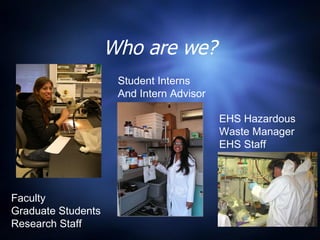
Who are we? Faculty Graduate Students Research Staff Student Interns And Intern Advisor EHS Hazardous Waste Manager EHS Staff
Choosing A Campaign What issues is there already buy in for?
Choosing A Campaign What issues is there already buy in for? What campaigns can you launch and succeed at within a year?
Choosing A Campaign What issues is there already buy in for? What campaigns can you launch and succeed at within a year? What chemicals make up the majority of waste produced on the campus?
Choosing A Campaign What issues is there already buy in for? What campaigns can you launch and succeed at within a year? What chemicals make up the majority of waste produced on the campus? What are the worst chemicals on your campus?
Choosing A Campaign What issues is there already buy in for? What campaigns can you launch and succeed at within a year? What chemicals make up the majority of waste produced on the campus? What are the worst chemicals on your campus? What is your team most invested in?
Building off existing buy-in Someone on campus already wants tqo see this happen Champions already identified  Ties in with goals outside of sustainability (safety, cost, quality, etc..)
Room Temperature  DNA/RNA Storage Problem Freezer failure and associated degradation of precious samples  High energy and financial cost of freezers The Right Time Other campuses initiating pilots High incentive for companies to support pilot programs
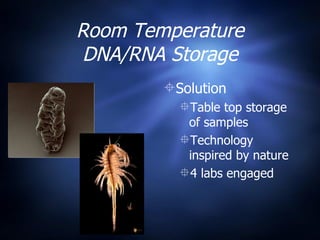
Room Temperature DNA/RNA Storage Solution Table top storage of samples Technology inspired by nature 4 labs engaged
Low Hanging Fruit What campaigns can you launch and succeed at within a year? Easy to accomplish  Quick successes  Great for publicity in the first few years
Low Hanging Fruit Mercury Thermometer Program Surplus Chemical Program
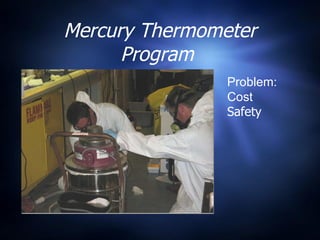
Mercury Thermometer Program  Problem: Cost Safety
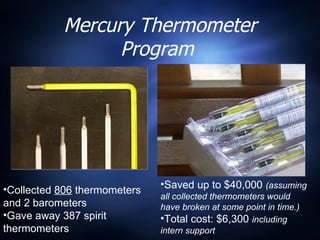
Mercury Thermometer Program  Collected  806  thermometers and 2 barometers Gave away 387 spirit thermometers Saved up to $40,000  (assuming all collected thermometers would have broken at some point in time.) Total cost: $6,300  including intern support
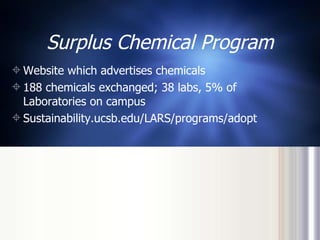
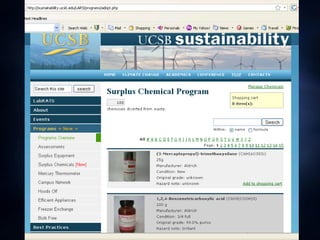
Surplus Chemical Program Website which advertises chemicals 188 chemicals exchanged; 38 labs, 5% of Laboratories on campus Sustainability.ucsb.edu/LARS/programs/adopt
 
Biggest waste stream Often not the “worst” chemicals, but critical due to the scale of the waste stream Affects a large number of laboratories across the campus and has the potential to develop a broad support base
Flammable Solvents  Problem 35 tons/yr of flammable solvents treated  as waste Nearly $44,000 spent to dispose of solvent waste Solution Switch labs over to solvent free processes  where possible
Worst Chemicals Only applicable to a relatively small subset of laboratories Risk of not being successful Try combining campaigns where you know you’ll be successful and riskier ones run simultaneously
HF Acid Strong support from faculty who would prefer an alternative  Safety and Sustainability motivations High potential for no alternative to be found, but important to ask the question Great learning opportunity for student interns performing the research
Team or Personal commitment A campaign you or your team is strongly invested in that might be harder to achieve or require long-term planning
Curriculum Development Honors courses as a testing ground Step 1: Identify courses that use a chemical you want to replace  Step 2: Identify a potential alternative (MIT Green Purchasing Wizard, great start) Step 3: Test alternative in honors class and use the rest of the class as a control
Curriculum Development K-12 Outreach  Developing 12 lesson plans for the 12 principles of Green Chemistry Centered on 5 th  grade audience because existing chemistry outreach programs are focused on 5 th  grade
Expanding to larger scale Bring in the experts  Utilize every opportunity to develop support of Chairs, Deans, and administration Engage faculty
The Challenge We challenge you to take on the issue
Questions? Please Contact our group at: (805)893-2003 Or  [email_address]

Green Chemistry Strategies

  • 1.
    Green Chemistry: Strategiesto launch a program Megan Murphy, Green Chemistry Intern, LabRATS University of California, Santa Barbara
  • 2.
    12 Principles Prevention Prevent waste rather than treat it or clean it up Inherently Safer Chemistry for Accident Prevention Reduce Waste Atom Economy Reduce Derivatives Use of Renewable Feedstocks Reduce Hazards Less Hazardous Chemical Syntheses Designing Safer Chemicals (Minimizing Toxicity) Safer Solvents and Auxiliaries
  • 3.
    12 Principles (continued)Catalysis Catalytic reagents (as selective as possible) are superior to stoichiometric reagents. Design for Degradation Real-time analysis for Pollution Prevention
  • 4.
    Scope Assistance toResearchers Reduction of Unneeded Chemicals Chemical Replacements Curriculum Public Education
  • 5.
    Who are we?Faculty Graduate Students Research Staff Student Interns And Intern Advisor EHS Hazardous Waste Manager EHS Staff
  • 6.
    Choosing A CampaignWhat issues is there already buy in for?
  • 7.
    Choosing A CampaignWhat issues is there already buy in for? What campaigns can you launch and succeed at within a year?
  • 8.
    Choosing A CampaignWhat issues is there already buy in for? What campaigns can you launch and succeed at within a year? What chemicals make up the majority of waste produced on the campus?
  • 9.
    Choosing A CampaignWhat issues is there already buy in for? What campaigns can you launch and succeed at within a year? What chemicals make up the majority of waste produced on the campus? What are the worst chemicals on your campus?
  • 10.
    Choosing A CampaignWhat issues is there already buy in for? What campaigns can you launch and succeed at within a year? What chemicals make up the majority of waste produced on the campus? What are the worst chemicals on your campus? What is your team most invested in?
  • 11.
    Building off existingbuy-in Someone on campus already wants tqo see this happen Champions already identified Ties in with goals outside of sustainability (safety, cost, quality, etc..)
  • 12.
    Room Temperature DNA/RNA Storage Problem Freezer failure and associated degradation of precious samples High energy and financial cost of freezers The Right Time Other campuses initiating pilots High incentive for companies to support pilot programs
  • 13.
    Room Temperature DNA/RNAStorage Solution Table top storage of samples Technology inspired by nature 4 labs engaged
  • 14.
    Low Hanging FruitWhat campaigns can you launch and succeed at within a year? Easy to accomplish Quick successes Great for publicity in the first few years
  • 15.
    Low Hanging FruitMercury Thermometer Program Surplus Chemical Program
  • 16.
    Mercury Thermometer Program Problem: Cost Safety
  • 17.
    Mercury Thermometer Program Collected 806 thermometers and 2 barometers Gave away 387 spirit thermometers Saved up to $40,000 (assuming all collected thermometers would have broken at some point in time.) Total cost: $6,300 including intern support
  • 18.
    Surplus Chemical ProgramWebsite which advertises chemicals 188 chemicals exchanged; 38 labs, 5% of Laboratories on campus Sustainability.ucsb.edu/LARS/programs/adopt
  • 19.
  • 20.
    Biggest waste streamOften not the “worst” chemicals, but critical due to the scale of the waste stream Affects a large number of laboratories across the campus and has the potential to develop a broad support base
  • 21.
    Flammable Solvents Problem 35 tons/yr of flammable solvents treated as waste Nearly $44,000 spent to dispose of solvent waste Solution Switch labs over to solvent free processes where possible
  • 22.
    Worst Chemicals Onlyapplicable to a relatively small subset of laboratories Risk of not being successful Try combining campaigns where you know you’ll be successful and riskier ones run simultaneously
  • 23.
    HF Acid Strongsupport from faculty who would prefer an alternative Safety and Sustainability motivations High potential for no alternative to be found, but important to ask the question Great learning opportunity for student interns performing the research
  • 24.
    Team or Personalcommitment A campaign you or your team is strongly invested in that might be harder to achieve or require long-term planning
  • 25.
    Curriculum Development Honorscourses as a testing ground Step 1: Identify courses that use a chemical you want to replace Step 2: Identify a potential alternative (MIT Green Purchasing Wizard, great start) Step 3: Test alternative in honors class and use the rest of the class as a control
  • 26.
    Curriculum Development K-12Outreach Developing 12 lesson plans for the 12 principles of Green Chemistry Centered on 5 th grade audience because existing chemistry outreach programs are focused on 5 th grade
  • 27.
    Expanding to largerscale Bring in the experts Utilize every opportunity to develop support of Chairs, Deans, and administration Engage faculty
  • 28.
    The Challenge Wechallenge you to take on the issue
  • 29.
    Questions? Please Contactour group at: (805)893-2003 Or [email_address]

Editor's Notes

  • #3 Formulated by Paul Anastes
  • #4 Designing chemicals to break down
  • #5 Its important to note that these are what we see our scope as including (we haven’t achieved all of these pieces yet). Under Assistance to Researchers emphasize that it is critical that we assist researchers with efforts that they are leading towards Green Chemistry and that they see us as benefiting their ongoing research (such as by providing free chemicals) and not just addressing “sustainability” needs. Under Curriculum you can mention honors classes, educating students about the changes made in labs and K-12 education. You’ll talk in more detail later so this can be a pretty quick overview.
  • #7 Zero waste by 2012?
  • #14 Biomimicry – Companies such as Biomatrica and GenVault have developed a synthetic substance modeled after natural compounds that Water bears and Sea Monkeys use to protect themselves through desiccation.
  • #16 Build support and trust with researchers; address a current frustration and common problem; common sense and unintrusive to research experiments; buy in from EHS --- Add slides:
  • #17 Mercury (Problem – cost, breaks and safety, pervasive; Solution – sprit therm, small grant, labrats outreach; Effectiveness of the Pilot,- number of thermometers gone or replaced, barometers)
  • #19 Chem Surplus Program (Problem, Solution – basic overview, Screen Shots, effectiveness – number of chem exchanged, storage not a problem; number of labs engaged; attention to program – thesis Miriam Weil)
  • #22 Should I mention super critical CO2 here?
  • #28 Bring in the experts = lecture series
  • #29 Great you can be the innovator on that Curriculum refer to UC Berkeley Inventory and cataloging, Get card We look to purity of research, other researchers are doing this… This is now common procedure… Look into junior faculty Get senior faculty through lecture series Contamination; we trust researchers to make those decisions, but do our best to gauge contamination risk, solvents, acids and bases we don’t recommend use for issues Storage;