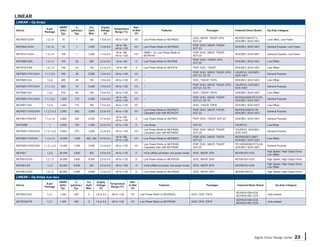
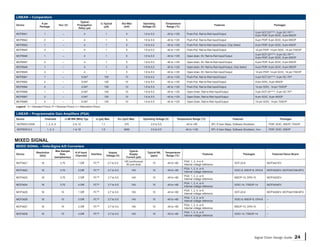
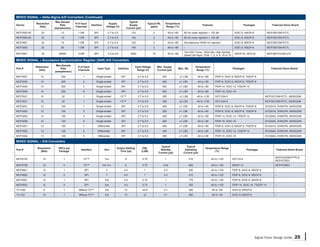
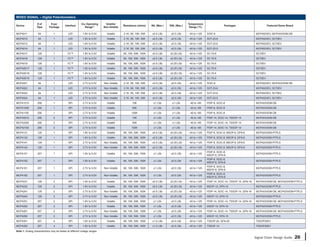
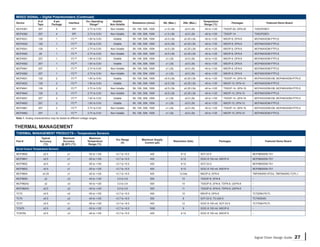
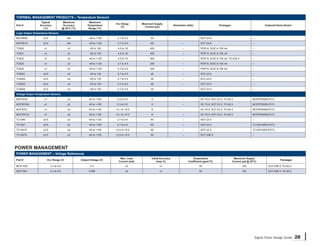
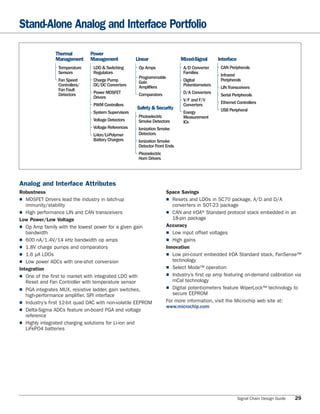
Analog and Interface Product Solutions


                     Signal Chain Design Guide
                     Devices For Use With Sensors


Design ideas in this guide use the following devices. A complete device list and corresponding data sheets for these
products can be found at www.microchip.com/analog.
Operational       Comparators     Analog-to-Digital   Temperature     Voltage        Digital            Digital-to-Analog
Amplifiers                        Converters          Sensors         References     Potentiometers     Converters
MCP6XX            MCP654X         MCP3421             MCP9800         MCP1525        MCP40XX            MCP4725
MCP6XXX           MCP656X         MCP3422/3/4         MCP9804         MCP1541        MCP40D1X           MCP4728
MCP6V01/2/3                       MCP355X             MCP9700/A                      MCP41XX            MCP482X
MCP6V06/7/8                       MCP3901             MCP9701/A                      MCP42XX            MCP492X
                                                                                     MCP43XX
                                                                                     MCP45XX
                                                                                     MCP46XX
                                                                                     MCP41XXX
                                                                                     MCP42XXX

                                                                      www.microchip.com/analog
Signal Chain Overview
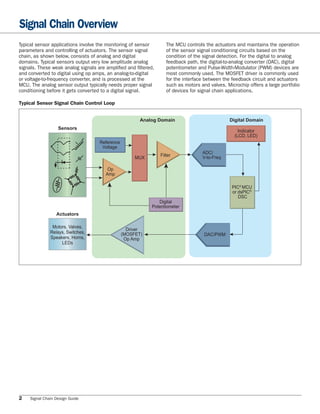
Typical sensor applications involve the monitoring of sensor      The MCU controls the actuators and maintains the operation
parameters and controlling of actuators. The sensor signal        of the sensor signal conditioning circuits based on the
chain, as shown below, consists of analog and digital             condition of the signal detection. For the digital to analog
domains. Typical sensors output very low amplitude analog         feedback path, the digital-to-analog converter (DAC), digital
signals. These weak analog signals are amplified and filtered,      potentiometer and Pulse-Width-Modulator (PWM) devices are
and converted to digital using op amps, an analog-to-digital      most commonly used. The MOSFET driver is commonly used
or voltage-to-frequency converter, and is processed at the        for the interface between the feedback circuit and actuators
MCU. The analog sensor output typically needs proper signal       such as motors and valves. Microchip offers a large portfolio
conditioning before it gets converted to a digital signal.        of devices for signal chain applications.

Typical Sensor Signal Chain Control Loop


                                                      Analog Domain                            Digital Domain
                   Sensors
                                                                                                   Indicator
                                                                                                 (LCD, LED)
                                   Reference
                                    Voltage
                                                                                  ADC/
                                                               Filter             V-to-Freq
                                                    MUX

                                       Op
                                      Amp

                                                                                                PIC® MCU
                                                                                                or dsPIC®
                                                                                                   DSC
                                                              Digital
                                                           Potentiometer
                  Actuators

                Motors, Valves,
                                                 Driver
               Relays, Switches,               (MOSFET)                            DAC/PWM
               Speakers, Horns,                 Op Amp
                    LEDs


2    Signal Chain Design Guide
Sensor Overview
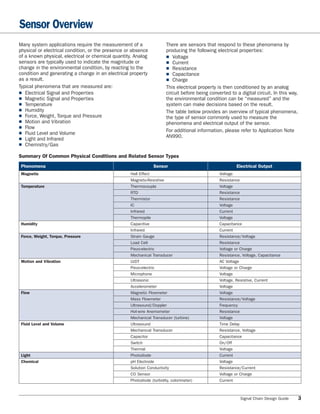
Many system applications require the measurement of a                  There are sensors that respond to these phenomena by
physical or electrical condition, or the presence or absence           producing the following electrical properties:
of a known physical, electrical or chemical quantity. Analog           ■ Voltage
sensors are typically used to indicate the magnitude or                ■ Current
change in the environmental condition, by reacting to the              ■ Resistance
condition and generating a change in an electrical property            ■ Capacitance
as a result.                                                           ■ Charge
Typical phenomena that are measured are:                               This electrical property is then conditioned by an analog
■ Electrical Signal and Properties                                    circuit before being converted to a digital circuit. In this way,
■ Magnetic Signal and Properties                                      the environmental condition can be “measured” and the
■ Temperature                                                         system can make decisions based on the result.
■ Humidity                                                            The table below provides an overview of typical phenomena,
■ Force, Weight, Torque and Pressure                                  the type of sensor commonly used to measure the
■ Motion and Vibration                                                phenomena and electrical output of the sensor.
■ Flow
■                                                                     For additional information, please refer to Application Note
   Fluid Level and Volume
■                                                                     AN990.
   Light and Infrared
■ Chemistry/Gas

Summary Of Common Physical Conditions and Related Sensor Types
 Phenomena                                                      Sensor                                   Electrical Output
 Magnetic                                          Hall Effect                                   Voltage
                                                   Magneto-Resistive                             Resistance
 Temperature                                       Thermocouple                                  Voltage
                                                   RTD                                           Resistance
                                                   Thermistor                                    Resistance
                                                   IC                                            Voltage
                                                   Infrared                                      Current
                                                   Thermopile                                    Voltage
 Humidity                                          Capacitive                                    Capacitance
                                                   Infrared                                      Current
 Force, Weight, Torque, Pressure                   Strain Gauge                                  Resistance/Voltage
                                                   Load Cell                                     Resistance
                                                   Piezo-electric                                Voltage or Charge
                                                   Mechanical Transducer                         Resistance, Voltage, Capacitance
 Motion and Vibration                              LVDT                                          AC Voltage
                                                   Piezo-electric                                Voltage or Charge
                                                   Microphone                                    Voltage
                                                   Ultrasonic                                    Voltage, Resistive, Current
                                                   Accelerometer                                 Voltage
 Flow                                              Magnetic Flowmeter                            Voltage
                                                   Mass Flowmeter                                Resistance/Voltage
                                                   Ultrasound/Doppler                            Frequency
                                                   Hot-wire Anemometer                           Resistance
                                                   Mechanical Transducer (turbine)               Voltage
 Fluid Level and Volume                            Ultrasound                                    Time Delay
                                                   Mechanical Transducer                         Resistance, Voltage
                                                   Capacitor                                     Capacitance
                                                   Switch                                        On/Off
                                                   Thermal                                       Voltage
 Light                                             Photodiode                                    Current
 Chemical                                          pH Electrode                                  Voltage
                                                   Solution Conductivity                         Resistance/Current
                                                   CO Sensor                                     Voltage or Charge
                                                   Photodiode (turbidity, colorimeter)           Current


                                                                                                           Signal Chain Design Guide       3
Product Overviews
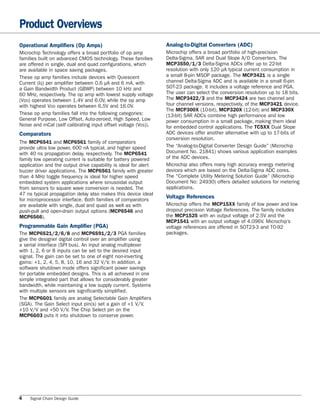
Operational Amplifiers (Op Amps)                                 Analog-to-Digital Converters (ADC)
Microchip Technology offers a broad portfolio of op amp          Microchip offers a broad portfolio of high-precision
families built on advanced CMOS technology. These families       Delta-Sigma, SAR and Dual Slope A/D Converters. The
are offered in single, dual and quad configurations, which       MCP3550/1/3 Delta-Sigma ADCs offer up to 22-bit
are available in space saving packages.                          resolution with only 120 μA typical current consumption in
These op amp families include devices with Quiescent             a small 8-pin MSOP package. The MCP3421 is a single
Current (IQ) per amplifier between 0.6 μA and 6 mA, with         channel Delta-Sigma ADC and is available in a small 6-pin
a Gain Bandwidth Product (GBWP) between 10 kHz and               SOT-23 package. It includes a voltage reference and PGA.
60 MHz, respectively. The op amp with lowest supply voltage      The user can select the conversion resolution up to 18 bits.
(VDD) operates between 1.4V and 6.0V, while the op amp           The MCP3422/3 and the MCP3424 are two channel and
with highest VDD operates between 6.5V and 16.0V.                four channel versions, respectively, of the MCP3421 device.
                                                                 The MCP300X (10-bit), MCP320X (12-bit) and MCP330X
These op amp families fall into the following categories:        (13-bit) SAR ADCs combine high performance and low
General Purpose, Low Offset, Auto-zeroed, High Speed, Low        power consumption in a small package, making them ideal
Noise and mCal (self calibrating input offset voltage (VOS)).    for embedded control applications. The TC5XX Dual Slope
Comparators                                                      ADC devices offer another alternative with up to 17-bits of
                                                                 conversion resolution.
The MCP6541 and MCP6561 family of comparators
provide ultra low power, 600 nA typical, and higher speed        The “Analog-to-Digital Converter Design Guide” (Microchip
with 40 ns propagation delay, respectively. The MCP6541          Document No. 21841) shows various application examples
family low operating current is suitable for battery powered     of the ADC devices.
application and the output drive capability is ideal for alert   Microchip also offers many high accuracy energy metering
buzzer driver applications. The MCP6561 family with greater      devices which are based on the Delta-Sigma ADC cores.
than 4 MHz toggle frequency is ideal for higher speed            The “Complete Utility Metering Solution Guide” (Microchip
embedded system applications where sinusoidal output             Document No: 24930) offers detailed solutions for metering
from sensors to square wave conversion is needed. The            applications.
47 ns typical propagation delay also makes this device ideal
for microprocessor interface. Both families of comparators
                                                                 Voltage References
are available with single, dual and quad as well as with         Microchip offers the MCP15XX family of low power and low
push-pull and open-drain output options (MCP6546 and             dropout precision Voltage References. The family includes
MCP6566).                                                        the MCP1525 with an output voltage of 2.5V and the
                                                                 MCP1541 with an output voltage of 4.096V. Microchip’s
Programmable Gain Amplifier (PGA)                                voltage references are offered in SOT23-3 and TO-92
The MCP6S21/2/6/8 and MCP6S91/2/3 PGA families                   packages.
give the designer digital control over an amplifier using
a serial interface (SPI bus). An input analog multiplexer
with 1, 2, 6 or 8 inputs can be set to the desired input
signal. The gain can be set to one of eight non-inverting
gains: +1, 2, 4, 5, 8, 10, 16 and 32 V/V. In addition, a
software shutdown mode offers significant power savings
for portable embedded designs. This is all achieved in one
simple integrated part that allows for considerably greater
bandwidth, while maintaining a low supply current. Systems
with multiple sensors are significantly simplified.
The MCP6G01 family are analog Selectable Gain Amplifiers
(SGA). The Gain Select input pin(s) set a gain of +1 V/V,
+10 V/V and +50 V/V. The Chip Select pin on the
MCP6G03 puts it into shutdown to conserve power.


4   Signal Chain Design Guide
Product Overviews
Digital Potentiometers                                          Digital-to-Analog Converters (DAC)
Microchip’s family of digital potentiometers offer a wide       Microchip has a number of Digital-to-Analog Converters that
range of options. These devices support the 6-bit through       range from high performance 12-bit devices to cost effective
8-bit applications. Offering both volatile and non-volatile     8-bit devices.
options, with digital interfaces from the simple Up/            The MCP4725 is a single channel 12-bit DAC with non-
Down interface to the standard SPI and I2C™ interfaces.         volatile memory (EEPROM). The user can store DAC input
These devices are offered in small packages such as             code and configuration register bits into the EEPROM. This
6-lead SC70 and 8-lead DFN for the single potentiometer         non-volatile memory feature enables the device to hold
devices, 14-lead TSSOP and 16-lead QFN packages for the         the DAC input code during power-off time allowing the DAC
dual potentiometer devices, and 20-lead TSSOP and QFN           output to be available immediately after power-up. This
packages for the quad potentiometer devices. Non-volatile       feature is very useful when the DAC is used as a supporting
devices offer a Wiperlock™ Technology feature, while volatile   device for other device operations in systems. The
devices will operate down to 1.8V. Resistances are offered      MCP4725 is availabe in a tiny SOT23-6 package.
from 2.1 kΩ to 100 kΩ. Over 50 device configurations are
currently available.                                            The MCP4728 is a 12-bit DAC with four analog outputs. This
                                                                device also has non-volatile memory (EEPROM) for each DAC
The “Digital Potentiometer Design Guide” (Microchip             channel. The user can select internal reference or VDD as
Document No. 22017), shows various application examples         reference individually for each channel. The MCP4725 and
of the digital potentiometer devices.                           MCP4728 are available with I2C serial interface.
                                                                The MCP4821/2 family of 12-bit DACs combines high
                                                                performance with an internal reference voltage and SPI
                                                                interface. The MCP4921/2 family is similar and allows
                                                                for an external reference. These DAC devices provide
                                                                high accuracy and low noise, and are ideal for industrial
                                                                applications where calibration or compensation of signals
                                                                (such as temperature, pressure and humidity) is required.
                                                                The TC1320/1 family of DACs has 8- and 10-bit precision
                                                                that uses the 2-wire SMBus/I2C serial interface protocol.


                                                                                                 Signal Chain Design Guide   5
Local Sensors
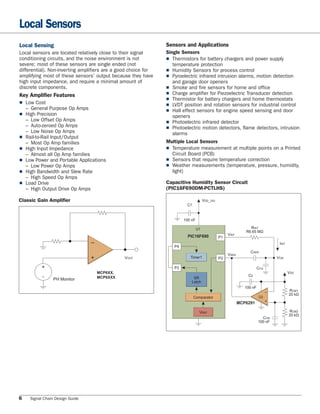
Local Sensing                                                   Sensors and Applications
Local sensors are located relatively close to their signal      Single Sensors
conditioning circuits, and the noise environment is not         ■ Thermistors for battery chargers and power supply
severe; most of these sensors are single ended (not                temperature protection
differential). Non-inverting amplifiers are a good choice for   ■ Humidity Sensors for process control
amplifying most of these sensors’ output because they have      ■ Pyroelectric infrared intrusion alarms, motion detection
high input impedance, and require a minimal amount of              and garage door openers
discrete components.                                            ■ Smoke and fire sensors for home and office
Key Amplifier Features                                          ■ Charge amplifier for Piezoelectric Transducer detection
                                                                ■ Thermistor for battery chargers and home thermostats
■Low Cost                                                      ■ LVDT position and rotation sensors for industrial control
  – General Purpose Op Amps                                     ■ Hall effect sensors for engine speed sensing and door
■High Precision                                                   openers
  – Low Offset Op Amps                                          ■ Photoelectric infrared detector
  – Auto-zeroed Op Amps                                         ■ Photoelectric motion detectors, flame detectors, intrusion
  – Low Noise Op Amps                                              alarms
■Rail-to-Rail Input/Output
  – Most Op Amp families                                        Multiple Local Sensors
■High Input Impedance                                          ■Temperature measurement at multiple points on a Printed
  – Almost all Op Amp families                                    Circuit Board (PCB)
■Low Power and Portable Applications                           ■Sensors that require temperature correction
  – Low Power Op Amps                                           ■Weather measurements (temperature, pressure, humidity,
■High Bandwidth and Slew Rate                                    light)
  – High Speed Op Amps
■Load Drive                                                    Capacitive Humidity Sensor Circuit
  – High Output Drive Op Amps                                   (PIC16F690DM-PCTLHS)

Classic Gain Amplifier                                                                 VDD_DIG
                                                                         C1


                                                                        100 nF

                                                                                 U1                              RINT
                                                                                                               R6.65 MΩ
                                                                          PIC16F690                  VINT
                                                                                                P1
                                –
                                                                                                                                   IINT
                                                                   P4
                                                                                                                  CSEN
                                +                                                                    VSEN
                                                VOUT                       Timer1               P2                                VCM

          +                                                        P3                                                   CCG
                                    MCP6XX,                                                                                               VDD
          -
                                    MCP6XXX                                                                     C2
               PH Monitor                                                    SR
                                                                            Latch
                                                                                                               100 nF
                                                                                                                              –           RCM1
                                                                                                                                          20 kΩ
                                                                              Comparator                                U2
                                                                                                            MCP6291           +

                                                                                  VREF                                                    RCM2
                                                                                                                                          20 kΩ
                                                                                                                          CCM
                                                                                                                        100 nF


6   Signal Chain Design Guide
Remote Sensors
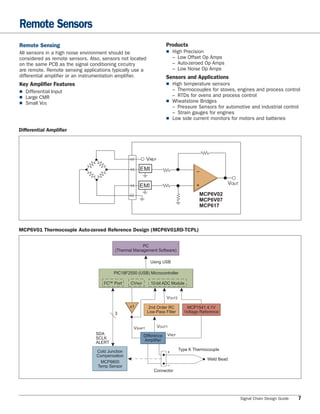
Remote Sensing                                                        Products
All sensors in a high noise environment should be                     ■High Precision
considered as remote sensors. Also, sensors not located                 – Low Offset Op Amps
on the same PCB as the signal conditioning circuitry                    – Auto-zeroed Op Amps
are remote. Remote sensing applications typically use a                 – Low Noise Op Amps
differential amplifier or an instrumentation amplifier.               Sensors and Applications
Key Amplifier Features                                                ■High temperature sensors
■Differential Input                                                    – Thermocouples for stoves, engines and process control
■Large CMR                                                             – RTDs for ovens and process control
■Small VOS                                                           ■Wheatstone Bridges
                                                                        – Pressure Sensors for automotive and industrial control
                                                                        – Strain gauges for engines
                                                                      ■Low side current monitors for motors and batteries

Differential Amplifier


                                                           VREF
                                                      EMI                             –


                                                      EMI
                                                                                      +                VOUT

                                                                                       MCP6V02
                                                                                       MCP6V07
                                                                                       MCP617


MCP6V01 Thermocouple Auto-zeroed Reference Design (MCP6V01RD-TCPL)


                                                      PC
                                         (Thermal Management Software)

                                                            Using USB

                                         PIC18F2550 (USB) Microcontroller

                                    I2C™ Port    CVREF      10-bit ADC Module


                                                                      VOUT2

                                                 x1         2nd Order RC         MCP1541 4.1V
                                         3                 Low-Pass Filter      Voltage Reference


                                                  VSHIFT          VOUT1
                                 SDA                     Difference   VREF
                                 SCLK                    Amplifier
                                 ALERT

                                 Cold Junction                                Type K Thermocouple
                                                                      +
                                 Compensation
                                                                                           Weld Bead
                                   MCP9800
                                 Temp Sensor                        –
                                                              Connector


                                                                                                              Signal Chain Design Guide   7
Oscillator Circuits For Sensors
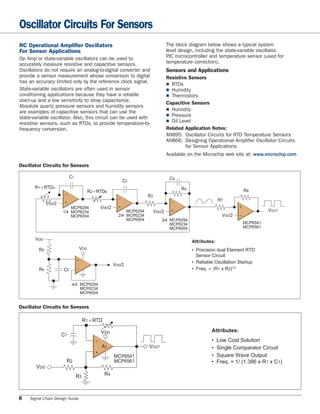
RC Operational Amplifier Oscillators                                                  The block diagram below shows a typical system
For Sensor Applications                                                               level design, including the state-variable oscillator,
Op Amp or state-variable oscillators can be used to                                   PIC microcontroller and temperature sensor (used for
accurately measure resistive and capacitive sensors.                                  temperature correction).
Oscillators do not require an analog-to-digital converter and                         Sensors and Applications
provide a sensor measurement whose conversion to digital                              Resistive Sensors
has an accuracy limited only by the reference clock signal.                           ■RTDs
State-variable oscillators are often used in sensor                                   ■Humidity
conditioning applications because they have a reliable                                ■Thermistors
start-up and a low sensitivity to stray capacitance.
                                                                                      Capacitive Sensors
Absolute quartz pressure sensors and humidity sensors
                                                                                      ■Humidity
are examples of capacitive sensors that can use the
                                                                                      ■Pressure
state-variable oscillator. Also, this circuit can be used with
                                                                                      ■ Level
                                                                                        Oil
resistive sensors, such as RTDs, to provide temperature-to-
frequency conversion.                                                                 Related Application Notes:
                                                                                      AN895: Oscillator Circuits for RTD Temperature Sensors
                                                                                      AN866: Designing Operational Amplifier Oscillator Circuits
                                                                                               for Sensor Applications
                                                                                      Available on the Microchip web site at: www.microchip.com

Oscillator Circuits for Sensors

                           C1                                                          C4
                                                               C2
       R1 = RTDA                                                                            R4
                       –                  R2 = RTDB                                                                          R8
                                                           –             R3
                       +                                                                –                      R7
              VDD/2                                        +
                          MCP6294                VDD/2                                  +                                +
                      1/4 MCP6234                              MCP6294        VDD/2                                                    VOUT
                          MCP6004                          2/4 MCP6234                                           VDD/2   –
                                                               MCP6004           3/4 MCP6294
                                                                                     MCP6234                                 MCP6541
                                                                                     MCP6004                                 MCP6561

       VDD                                                                                       Attributes:
         R5                         VDD                                                          • Precision dual Element RTD
                                                                                                   Sensor Circuit
                                +
                                                                                                 • Reliable Oscillation Startup
                                                         VDD/2
         R6           C5        –                                                                • Freq. ∝ (R1 x R2)1/2


                            4/4 MCP6294
                                MCP6234
                                MCP6004


Oscillator Circuits for Sensors

                                     R1 = RTD

                                                 VDD                                                      Attributes:
                      C1
                                             –                                                            •    Low Cost Solution
                                             +
                                                 A1                      VOUT                             •    Single Comparator Circuit
                                                         MCP6541                                          •    Square Wave Output
                       R2                                MCP6561                                          •    Freq. = 1/ (1.386 x R1 x C1)
        VDD
                                R3                R4


8    Signal Chain Design Guide
Wheatstone Bridge
Bridge Sensor Circuit                                                steps (if any) should be used to increase the overall system
Sensors for temperature, pressure, load or other phys-               resolution when using the MCP355X. In many situations, the
ical excitation quantities are most often configured in a            MCP355X devices can be used to directly digitize the sensor
Wheatstone bridge configuration. The bridge can have                 output, eliminating any need for external signal conditioning
anywhere from one to all four elements reacting to the               circuitry.
physical excitation, and should be used in a ratiometeric            Using the absolute pressure sensor as our Wheatstone
configuration when possible, with the system reference               bridge example, the NPP-301 device has a typical full
driving both the sensor and the ADC voltage reference. By            scale output of 60 mV when excited with a 3V battery. The
using the same reference for both the sensor excitation and          pressure range for this device is 100 kPa. The MCP3551
ADC, the variation in the reference can be cancelled out.            has a output noise specification of 2.5 μVRMS.
Furthermore, the output voltage from the bridge sensor is            The following equation is a first order approximation of the
proportional to the excitation voltage. Therefore, the ADC           relationship between pressure in pascals (P) and altitude (h),
that is using the external reference is more popular than            in meters.
the ADC that is using internal reference, for the ratiometric                         h
configuration.                                                       log(P) ≈ 5 –
                                                                                    15500
One example sensor from GE NovaSensor is an absolute
                                                                     Using 60 mV as the full scale range and 2.5 μV as the
pressure sensor, shown below, a four element varying
                                                                     resolution, the resulting resolution from direct digitization in
bridge. This example uses the MCP355X family of delta
                                                                     meters is 0.64 meters or approximately 2 feet.
sigma ADCs. When designing with the MCP355X family
of 22-bit delta-sigma ADCs, the initial step should be to            It should be noted that this is only used as an example for
evaluate the sensor performance and then determine what              discussion; temperature effects and the error from a first
                                                                     order approximation must be included in final system design.

Example of Wheatstone Bridge Sensor Configuration with High Resolution Delta-Sigma ADC

                                                                       0.1 μF 1.0 μF

                                                                                                                         To VDD
                                             NPP-301
                                                                                           1         8
                                                                                    2              VDD
                                                                                           VREF
                                                          R2                            VIN+
                                                                                                 SCK         SPI
                                                                                         MCP3551 SDO                    MCU
                                                R1              R3
                                                                                      VIN-       CS          5, 6, 7
                                                                                    3      VSS
                                                                                               4
                                                          R4


       Altimeter Watch
                                                     ∆V ~ [(∆R2+ ∆R4) - (∆R1+∆R3)]/4R * VDD

                                                     With R1 = R2 = R3 = R4 = R


                                                                                                         Signal Chain Design Guide   9
Delta-Sigma ADCs
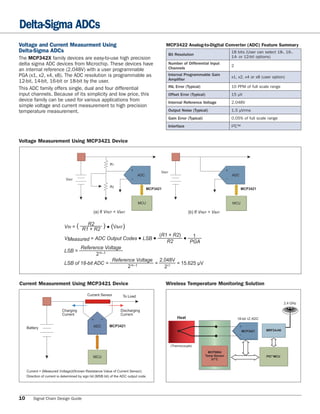
Voltage and Current Measurment Using                                                           MCP3422 Analog-to-Digital Converter (ADC) Feature Summary
Delta-Sigma ADCs                                                                                                                             18 bits (User can select 18-, 16-,
                                                                                                  Bit Resolution
The MCP342X family devices are easy-to-use high precision                                                                                    14- or 12-bit options)
delta sigma ADC devices from Microchip. These devices have                                        Number of Differential Input
                                                                                                                                             2
an internal reference (2.048V) with a user programmable                                           Channels
PGA (x1, x2, x4, x8). The ADC resolution is programmable as                                       Internal Programmable Gain
                                                                                                                                             x1, x2, x4 or x8 (user option)
12-bit, 14-bit, 16-bit or 18-bit by the user.                                                     Amplifier

This ADC family offers single, dual and four differential                                         INL Error (Typical)                        10 PPM of full scale range
input channels. Because of its simplicity and low price, this                                     Offset Error (Typical)                     15 μV
device family can be used for various applications from                                           Internal Reference Voltage                 2.048V
simple voltage and current measurement to high precision
temperature measurement.                                                                          Output Noise (Typical)                     1.5 μVrms
                                                                                                  Gain Error (Typical)                       0.05% of full scale range
                                                                                                  Interface                                  I2C™


Voltage Measurement Using MCP3421 Device


                                                            R1
                                                                          +                                                              +
                                                                                           VBAT
                                                                               ADC                                                           ADC
                               VBAT                                       –                                                              –

                                                            R2
                                                                                     MCP3421                                                        MCP3421


                                                                               MCU                                                           MCU

                                                 (a) If VREF < VBAT                                           (b) If VREF > VBAT

                                     ________
                                        R2
                              VIN = ( R1 + R2 ) ● (VBAT)
                                                                      (R1 + R2)    1
                              VMeasured = ADC Output Codes ● LSB ● _________ ● _____
                                                                         R2       PGA
                                     Reference Voltage
                              LSB = ________________
                                             2 N –1
                                                    Reference Voltage 2.048V
                              LSB of 18-bit ADC = ________________ = ______ = 15.625 μV
                                                          2 N –1        217


Current Measurement Using MCP3421 Device                                                       Wireless Temperature Monitoring Solution

                                             Current Sensor          To Load
                                                                                                                                                                            2.4 GHz

                            Charging                               Discharging
                            Current                                Current
                                                +     –                                                Heat                                      18-bit ∆∑ ADC

     Battery                                     ADC        MCP3421                                                                                +
                                                                                                                                                       MCP3421   MRF24J40
                                                                                                                                                   –


                                                                                                   (Thermocouple)

                                                                                                                             MCP9804
                                                 MCU                                                                       Temp Sensor                           PIC® MCU
                                                                                                                              ±1°C


     Current = (Measured Voltage)/(Known Resistance Value of Current Sensor)
     Direction of current is determined by sign bit (MSB bit) of the ADC output code.


10       Signal Chain Design Guide
Delta-Sigma ADCs
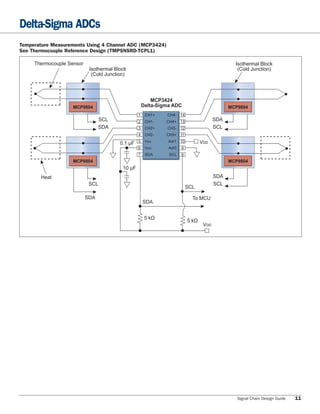
Temperature Measurements Using 4 Channel ADC (MCP3424)
See Thermocouple Reference Design (TMPSNSRD-TCPL1)

     Thermocouple Sensor                                                                         Isothermal Block
                            Isothermal Block                                                      (Cold Junction)
                             (Cold Junction)


                                                          MCP3424
                    MCP9804                           Delta-Sigma ADC                          MCP9804
                                                  1    CH1+    CH4- 14
                                 SCL              2    CH1-    CH4+ 13                   SDA
                                 SDA              3    CH2+    CH3- 12                   SCL
                                                  4    CH2-    CH3+ 11
                                                  5    VSS      Adr1 10           VDD
                                         0.1 μF
                                                  6    VDD      Adr0   9
                                                  7    SDA      SCL    8
                    MCP9804                                                                    MCP9804
                                          10 μF
       Heat                                                                              SDA
                            SCL                                                          SCL
                                                                           SCL

                           SDA                                               To MCU
                                                      SDA


                                                       5 kΩ
                                                                           5 kΩ
                                                                                   VDD


                                                                                                  Signal Chain Design Guide   11
Thermistor and RTD Solutions
Thermistor Solutions                                                    RTD Solution
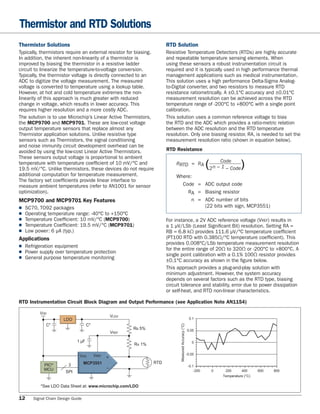
Typically, thermistors require an external resistor for biasing.        Resistive Temperature Detectors (RTDs) are highly accurate
In addition, the inherent non-linearity of a thermistor is              and repeatable temperature sensing elements. When
improved by biasing the thermistor in a resistive ladder                using these sensors a robust instrumentation circuit is
circuit to linearize the temperature-to-voltage conversion.             required and it is typically used in high performance thermal
Typically, the thermistor voltage is directly connected to an           management applications such as medical instrumentation.
ADC to digitize the voltage measurement. The measured                   This solution uses a high performance Delta-Sigma Analog-
voltage is converted to temperature using a lookup table.               to-Digital converter, and two resistors to measure RTD
However, at hot and cold temperature extremes the non-                  resistance ratiometrically. A ±0.1°C accuracy and ±0.01°C
linearity of this approach is much greater with reduced                 measurement resolution can be achieved across the RTD
change in voltage, which results in lower accuracy. This                temperature range of -200°C to +800°C with a single point
requires higher resolution and a more costly ADC.                       calibration.
The solution is to use Microchip’s Linear Active Thermistors,           This solution uses a common reference voltage to bias
the MCP9700 and MCP9701. These are low-cost voltage                     the RTD and the ADC which provides a ratio-metric relation
output temperature sensors that replace almost any                      between the ADC resolution and the RTD temperature
Thermistor application solutions. Unlike resistive type                 resolution. Only one biasing resistor, RA, is needed to set the
sensors such as Thermistors, the signal conditioning                    measurement resolution ratio (shown in equation below).
and noise immunity circuit development overhead can be
avoided by using the low-cost Linear Active Thermistors.                RTD Resistance
These sensors output voltage is proportional to ambient
temperature with temperature coefficient of 10 mV/°C and
19.5 mV/°C. Unlike thermistors, these devices do not require
                                                                            RRTD = RA                               (2 n – CodeCode)
                                                                                                                           1–
additional computation for temperature measurement.                         Where:
The factory set coefficients provide linear interface to
measure ambient temperatures (refer to AN1001 for sensor                      Code = ADC output code
optimization).                                                                  RA = Biasing resistor
MCP9700 and MCP9701 Key Features                                                  n = ADC number of bits
■SC70, TO92 packages                                                                 (22 bits with sign, MCP3551)
■Operating temperature range: -40°C to +150°C
■Temperature Coefficient: 10 mV/°C (MCP9700)                            For instance, a 2V ADC reference voltage (VREF) results in
■Temperature Coefficient: 19.5 mV/°C (MCP9701)                          a 1 μV/LSb (Least Significant Bit) resolution. Setting RA =
■Low power: 6 μA (typ.)                                                RB = 6.8 kΩ provides 111.6 μV/°C temperature coefficient
Applications                                                            (PT100 RTD with 0.385Ω/°C temperature coefficient). This
■ Refrigeration equipment                                               provides 0.008°C/LSb temperature measurement resolution
■ Power supply over temperature protection                              for the entire range of 20Ω to 320Ω or -200°C to +800°C. A
■ General purpose temperature monitoring                                single point calibration with a 0.1% 100Ω resistor provides
                                                                        ±0.1°C accuracy as shown in the figure below.
                                                                        This approach provides a plug-and-play solution with
                                                                        minimum adjustment. However, the system accuracy
                                                                        depends on several factors such as the RTD type, biasing
                                                                        circuit tolerance and stability, error due to power dissipation
                                                                        or self-heat, and RTD non-linear characteristics.

RTD Instrumentation Circuit Block Diagram and Output Performance (see Application Note AN1154)

          VDD
                                                   VLDO
                     LDO                                                                                 0.1
            C*                     C*
                                                                               Measured Accuracy (°C)


                                                          RB 5%                                         0.05
                                                   VREF

                            1 μF                                                                           0
                                                          RA 1%

                                        VREF                                                            -0.05
                              VDD              +
                                  MCP3551                         RTD
           PIC®         3                                                                                -0.1
           MCU                                 –
                      SPI                                                                                    -200     0     200      400      600   800
                                                                                                                           Temperature (°C)

          *See LDO Data Sheet at: www.microchip.com/LDO

12    Signal Chain Design Guide
Programmable Gain Using Digital Potentiometers
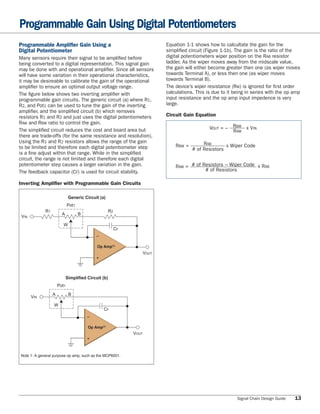
Programmable Amplifier Gain Using a                                            Equation 1-1 shows how to calcultate the gain for the
Digital Potentiometer                                                         simplified circuit (Figure 1-1b). The gain is the ratio of the
Many sensors require their signal to be amplified before                       digital potentiometers wiper position on the RAB resistor
being converted to a digital representation. This signal gain                 ladder. As the wiper moves away from the midscale value,
may be done with and operational amplifier. Since all sensors                  the gain will either become greater then one (as wiper moves
will have some variation in their operational characteristics,                towards Terminal A), or less then one (as wiper moves
it may be desireable to calibrate the gain of the operational                 towards Terminal B).
amplifier to ensure an optimal output voltage range.                           The device’s wiper resistance (RW) is ignored for first order
The figure below shows two inverting amplifier with                             calculations. This is due to it being in series with the op amp
programmable gain circuits. The generic circuit (a) where R1,                 input resistance and the op amp input impedence is very
R2, and Pot1 can be used to tune the gain of the inverting                    large.
amplifier, and the simplified circuit (b) which removes
resistors R1 and R2 and just uses the digital potentiometers                  Circuit Gain Equation
RAW and RBW ratio to control the gain.
The simplified circuit reduces the cost and board area but                                         VOUT = – RBW x VIN
                                                                                                           RAW
there are trade-offs (for the same resistance and resolution),
Using the R1 and R2 resistors allows the range of the gain                                     RAB
to be limited and therefore each digital potentiometer step                       RBW =                  x Wiper Code
                                                                                          # of Resistors
is a fine adjust within that range. While in the simplified
circuit, the range is not limited and therefore each digital
potentiometer step causes a larger variation in the gain.                         RAW = # of Resistors – Wiper Code x RAB
The feedback capacitor (CF) is used for circuit stability.                                    # of Resistors

Inverting Amplifier with Programmable Gain Circuits

                              Generic Circuit (a)
                             Pot1
             R1                                       R2
                        A           B
 VIN
                         W
                                                           CF
                                             –

                                             Op Amp(1)

                                             +                         VOUT


                             Simplified Circuit (b)
                      Pot1
                  A           B
       VIN
                  W
                                                 CF
                                        –

                                        Op Amp(1)

                                        +                       VOUT


Note 1: A general purpose op amp, such as the MCP6001.


                                                                                                               Signal Chain Design Guide   13
Programmable Gain Using Digital Potentiometers
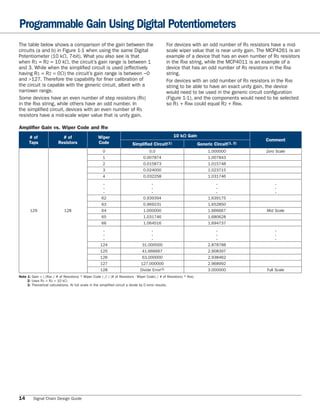
The table below shows a comparison of the gain between the                                       For devices with an odd number of RS resistors have a mid-
circuits (a and b) in Figure 1-1 when using the same Digital                                     scale wiper value that is near unity gain. The MCP4261 is an
Potentiometer (10 kΩ, 7-bit). What you also see is that                                          example of a device that has an even number of RS resistors
when R1 = R2 = 10 kΩ, the circuit’s gain range is between 1                                      in the RAB string, while the MCP4011 is an example of a
and 3. While when the simplified circuit is used (effectively                                     device that has an odd number of RS resistors in the RAB
having R1 = R2 = 0Ω) the circuit’s gain range is between ~0                                      string.
and >127. Therefore the capability for finer calibration of                                       For devices with an odd number of RS resistors in the RAB
the circuit is capable with the generic circuit, albeit with a                                   string to be able to have an exact unity gain, the device
narrower range.                                                                                  would need to be used in the generic circuit configuration
Some devices have an even number of step resistors (RS)                                          (Figure 1-1), and the components would need to be selected
in the RAB string, while others have an odd number. In                                           so R1 + RAW could equal R2 + RBW.
the simplified circuit, devices with an even number of RS
resistors have a mid-scale wiper value that is unity gain.

Amplifier Gain vs. Wiper Code and RW
      # of                 # of                    Wiper                                            10 kΩ Gain
                                                                                                                                             Comment
      Taps               Resistors                 Code                   Simplified Circuit(1)                      Generic Circuit(1, 2)
                                                      0                             0.0                                   1.000000           Zero Scale
                                                      1                          0.007874                                 1.007843
                                                      2                          0.015873                                 1.015748
                                                      3                          0.024000                                 1.023715
                                                      4                          0.032258                                 1.031746
                                                       .                              .                                        .                  .
                                                       .                              .                                        .                  .
                                                       .                              .                                        .                  .
                                                     62                          0.939394                                 1.639175
                                                     63                          0.969231                                 1.652850
       129                   128                     64                          1.000000                                 1.666667            Mid Scale
                                                     65                          1.031746                                 1.680628
                                                     66                          1.064516                                 1.694737
                                                       .                              .                                        .                  .
                                                       .                              .                                        .                  .
                                                       .                              .                                        .                  .
                                                     124                        31.000000                                 2.878788
                                                     125                        41.666667                                 2.908397
                                                     126                        63.000000                                 2.938462
                                                     127                       127.000000                                 2.968992
                                                     128                       Divide Error(3)                            3.000000            Full Scale
Note 1: Gain = ( (RAB / # of Resistors) * Wiper Code ) /( ( (# of Resistors - Wiper Code) / # of Resistors) * RAB)
     2: Uses R1 = R2 = 10 kΩ.
     3: Theoretical calculations. At full scale in the simplified circuit a divide by 0 error results.


14       Signal Chain Design Guide
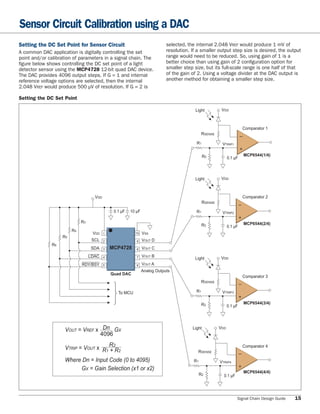
Sensor Circuit Calibration using a DAC
Setting the DC Set Point for Sensor Circuit                                  selected, the internal 2.048 VREF would produce 1 mV of
A common DAC application is digitally controlling the set                    resolution. If a smaller output step size is desired, the output
point and/or calibration of parameters in a signal chain. The                range would need to be reduced. So, using gain of 1 is a
figure below shows controlling the DC set point of a light                    better choice than using gain of 2 configuration option for
detector sensor using the MCP4728 12-bit quad DAC device.                    smaller step size, but its full-scale range is one half of that
The DAC provides 4096 output steps. If G = 1 and internal                    of the gain of 2. Using a voltage divider at the DAC output is
reference voltage options are selected, then the internal                    another method for obtaining a smaller step size.
2.048 VREF would produce 500 μV of resolution. If G = 2 is

Setting the DC Set Point

                                                                                          Light           VDD


                                                                                                                            Comparator 1
                                                                                                RSENSE                  –
                                                                                           R1             VTRIP1        +

                                                                                                 R2                         MCP6544(1/4)
                                                                                                               0.1 μF


                                                                                          Light           VDD


                                    VDD                                                                                     Comparator 2
                                                                                                RSENSE                  –
                                               0.1 μF   10 μF                              R1             VTRIP2        +
                             R3                                                                                             MCP6544(2/4)
                                                                                                R2             0.1 μF
                        R4
                                   VDD    1                 10   VSS
                   R5
                                   SCL    2                 9    VOUT D
              R6
                                  SDA     3   MCP4728       8    VOUT C
                                  LDAC    4                 7    VOUT B                                   VDD
                                                                                          Light
                             RDY/BSY      5                 6    VOUT A
                                                                 Analog Outputs
                                              Quad DAC
                                                                                                                            Comparator 3
                                               ⎩                                                RSENSE                  –
                                               ⎨                                           R1             VTRIP3
                                                   To MCU                                                               +
                                               ⎧
                                                                                                R2                          MCP6544(3/4)
                                                                                                               0.1 μF


                    VOUT = VREF x Dn GX                                                  Light           VDD
                                 4096
                                     R2                                                                                     Comparator 4
                    VTRIP = VOUT x R1 + R2
                                                                                            RSENSE                      –
                    Where Dn = Input Code (0 to 4095)                                     R1             VTRIP4         +
                         GX = Gain Selection (x1 or x2)
                                                                                                                            MCP6544(4/4)
                                                                                               R2          0.1 μF


                                                                                                                    Signal Chain Design Guide   15
Mindi™ Amplifier Designer & Simulator
Mindi™ Amplifier Designer & Simulator                            Mindi™ Active Filter Designer & Simulator
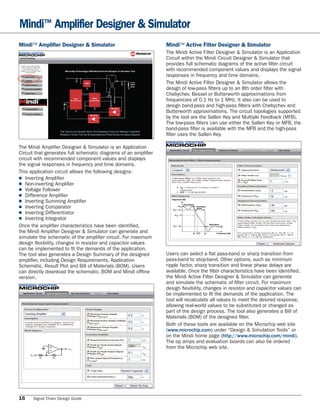
                                                                The Mindi Active Filter Designer & Simulator is an Application
                                                                Circuit within the Mindi Circuit Designer & Simulator that
                                                                provides full schematic diagrams of the active filter circuit
                                                                with recommended component values and displays the signal
                                                                responses in frequency and time domains.
                                                                The Mindi Active Filter Designer & Simulator allows the
                                                                design of low-pass filters up to an 8th order filter with
                                                                Chebychev, Bessel or Butterworth approximations from
                                                                frequencies of 0.1 Hz to 1 MHz. It also can be used to
                                                                design band-pass and high-pass filters with Chebychev and
                                                                Butterworth approximations. The circuit topologies supported
                                                                by the tool are the Sallen Key and Multiple Feedback (MFB).
                                                                The low-pass filters can use either the Sallen Key or MFB, the
                                                                band-pass filter is available with the MFB and the high-pass
                                                                filter uses the Sallen Key.

The Mindi Amplifier Designer & Simulator is an Application
Circuit that generates full schematic diagrams of an amplifier
circuit with recommended component values and displays
the signal responses in frequency and time domains.
This application circuit allows the following designs:
■ Inverting Amplifier
■ Non-inverting Amplifier
■ Voltage Follower
■ Difference Amplifier
■ Inverting Summing Amplifier
■ Inverting Comparator
■ Inverting Differentiator
■ Inverting Integrator
Once the amplifier characteristics have been identified,
the Mindi Amplifier Designer & Simulator can generate and
simulate the schematic of the amplifier circuit. For maximum
design flexibility, changes in resistor and capacitor values
can be implemented to fit the demands of the application.
The tool also generates a Design Summary of the designed        Users can select a flat pass-band or sharp transition from
amplifier, including Design Requirements, Application            pass-band to stop-band. Other options, such as minimum
Schematic, Result Plot and Bill of Materials (BOM). Users       ripple factor, sharp transition and linear phase delays are
can directly download the schematic, BOM and Mindi offline       available. Once the filter characteristics have been identified,
version.                                                        the Mindi Active Filter Designer & Simulator can generate
                                                                and simulate the schematic of filter circuit. For maximum
                                                                design flexibility, changes in resistor and capacitor values can
                                                                be implemented to fit the demands of the application. The
                                                                tool will recalculate all values to meet the desired response,
                                                                allowing real-world values to be substituted or changed as
                                                                part of the design process. The tool also generates a Bill of
                                                                Materials (BOM) of the designed filter.
                                                                Both of these tools are available on the Microchip web site
                                                                (www.microchip.com) under “Design & Simulation Tools” or
                                                                on the Mindi home page (http://www.microchip.com/mindi).
                                                                The op amps and evaluation boards can also be ordered
                                                                from the Microchip web site.


16    Signal Chain Design Guide
Development Tools
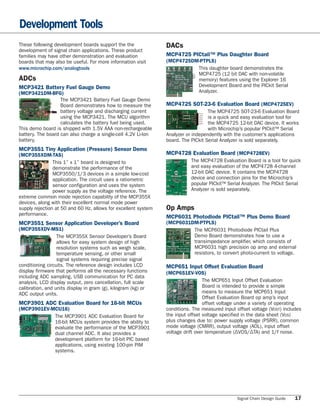
These following development boards support the the              DACs
development of signal chain applications. These product
families may have other demonstration and evaluation            MCP4725 PICtail™ Plus Daughter Board
boards that may also be useful. For more information visit      (MCP4725DM-PTPLS)
www.microchip.com/analogtools                                             This daughter board demonstrates the
                                                                          MCP4725 (12 bit DAC with non-volatile
ADCs                                                                      memory) features using the Explorer 16
MCP3421 Battery Fuel Gauge Demo                                           Development Board and the PICkit Serial
(MCP3421DM-BFG)                                                           Analyzer.
                   The MCP3421 Battery Fuel Gauge Demo
                   Board demonstrates how to measure the        MCP4725 SOT-23-6 Evaluation Board (MCP4725EV)
                   battery voltage and discharging current                         The MCP4725 SOT-23-6 Evaluation Board
                   using the MCP3421. The MCU algorithm                            is a quick and easy evaluation tool for
                   calculates the battery fuel being used.                         the MCP4725 12-bit DAC device. It works
This demo board is shipped with 1.5V AAA non-rechargeable                          with Microchip’s popular PICkit™ Serial
battery. The board can also charge a single-cell 4.2V Li-Ion    Analyzer or independently with the customer’s applications
battery.                                                        board. The PICkit Serial Analyzer is sold separately.
MCP3551 Tiny Application (Pressure) Sensor Demo
(MCP355XDM-TAS)                                                 MCP4728 Evaluation Board (MCP4728EV)
                This 1˝ x 1˝ board is designed to                          The MCP4728 Evaluation Board is a tool for quick
                demonstrate the performance of the                         and easy evaluation of the MCP4728 4-channel
                MCP3550/1/3 devices in a simple low-cost                   12-bit DAC device. It contains the MCP4728
                application. The circuit uses a ratiometric                device and connection pins for the Microchip’s
                sensor configuration and uses the system                   popular PICkit™ Serial Analyzer. The PICkit Serial
                power supply as the voltage reference. The                 Analyzer is sold separately.
extreme common mode rejection capability of the MCP355X
devices, along with their excellent normal mode power
supply rejection at 50 and 60 Hz, allows for excellent system   Op Amps
performance.
                                                                MCP6031 Photodiode PICtail™ Plus Demo Board
MCP3551 Sensor Application Developer’s Board                    (MCP6031DM-PTPLS)
(MCP355XDV-MS1)                                                          The MCP6031 Photodiode PICtail Plus
                  The MCP355X Sensor Developer’s Board                   Demo Board demonstrates how to use a
                  allows for easy system design of high                  transimpedance amplifier, which consists of
                  resolution systems such as weigh scale,                MCP6031 high precision op amp and external
                  temperature sensing, or other small                    resistors, to convert photo-current to voltage.
                  signal systems requiring precise signal
conditioning circuits. The reference design includes LCD        MCP651 Input Offset Evaluation Board
display firmware that performs all the necessary functions      (MCP651EV-VOS)
including ADC sampling, USB communication for PC data
analysis, LCD display output, zero cancellation, full scale                      The MCP651 Input Offset Evaluation
calibration, and units display in gram (g), kilogram (kg) or                     Board is intended to provide a simple
ADC output units.                                                                means to measure the MCP651 Input
                                                                                 Offset Evaluation Board op amp’s input
MCP3901 ADC Evaluation Board for 16-bit MCUs                                     offset voltage under a variety of operating
(MCP3901EV-MCU16)                                               conditions. The measured input offset voltage (VOST) includes
            The MCP3901 ADC Evaluation Board for                the input offset voltage specified in the data sheet (VOS)
            16-bit MCUs system provides the ability to          plus changes due to: power supply voltage (PSRR), common
            evaluate the performance of the MCP3901             mode voltage (CMRR), output voltage (AOL), input offset
            dual channel ADC. It also provides a                voltage drift over temperature (ΔVOS/ΔTA) and 1/f noise.
            development platform for 16-bit PIC based
            applications, using existing 100-pin PIM
            systems.


                                                                                                Signal Chain Design Guide   17
Development Tools
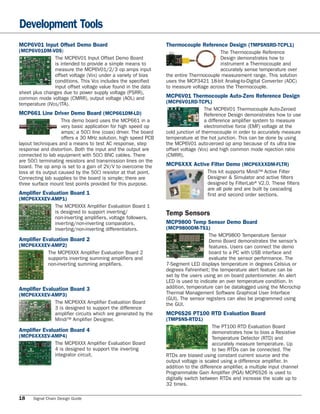
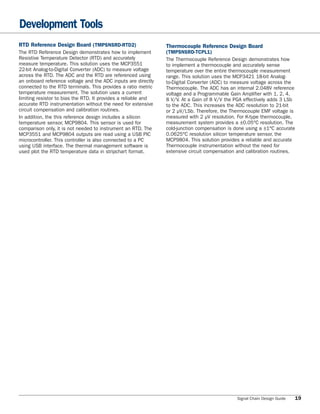
MCP6V01 Input Offset Demo Board                                 Thermocouple Reference Design (TMPSNSRD-TCPL1)
(MCP6V01DM-VOS)                                                                        The Thermocouple Reference
                The MCP6V01 Input Offset Demo Board                                    Design demonstrates how to
                is intended to provide a simple means to                               instrument a Thermocouple and
                measure the MCP6V01/2/3 op amps input                                  accurately sense temperature over
                offset voltage (VOS) under a variety of bias    the entire Thermocouple measurement range. This solution
                conditions. This VOS includes the specified     uses the MCP3421 18-bit Analog-to-Digital Converter (ADC)
                input offset voltage value found in the data    to measure voltage across the Thermocouple.
sheet plus changes due to power supply voltage (PSRR),
common mode voltage (CMRR), output voltage (AOL) and            MCP6V01 Thermocouple Auto-Zero Reference Design
temperature (IVOS/ITA).                                         (MCP6V01RD-TCPL)
                                                                                  The MCP6V01 Thermocouple Auto-Zeroed
MCP661 Line Driver Demo Board (MCP661DM-LD)                                       Reference Design demonstrates how to use
                    This demo board uses the MCP661 in a                          a difference amplifier system to measure
                    very basic application for high speed op                      electromotive force (EMF) voltage at the
                    amps; a 50Ω line (coax) driver. The board   cold junction of thermocouple in order to accurately measure
                    offers a 30 MHz solution, high speed PCB    temperature at the hot junction. This can be done by using
layout techniques and a means to test AC response, step         the MCP6V01 auto-zeroed op amp because of its ultra low
response and distortion. Both the input and the output are      offset voltage (VOS) and high common mode rejection ratio
connected to lab equipment with 50Ω BNC cables. There           (CMRR).
are 50Ω terminating resistors and transmission lines on the
board. The op amp is set to a gain of 2V/V to overcome the      MCP6XXX Active Filter Demo (MCP6XXXDM-FLTR)
loss at its output caused by the 50Ω resistor at that point.                       This kit supports Mindi™ Active Filter
Connecting lab supplies to the board is simple; there are                          Designer & Simulator and active filters
three surface mount test points provided for this purpose.                         designed by FilterLab® V2.0. These filters
                                                                                   are all pole and are built by cascading
Amplifier Evaluation Board 1                                                       first and second order sections.
(MCP6XXXEV-AMP1)
            The MCP6XXX Amplifier Evaluation Board 1
            is designed to support inverting/                   Temp Sensors
            non-inverting amplifiers, voltage followers,
            inverting/non-inverting comparators,                MCP9800 Temp Sensor Demo Board
            inverting/non-inverting differentiators.            (MCP9800DM-TS1)
                                                                                   The MCP9800 Temperature Sensor
Amplifier Evaluation Board 2                                                       Demo Board demonstrates the sensor’s
(MCP6XXXEV-AMP2)                                                                   features. Users can connect the demo
         The MCP6XXX Amplifier Evaluation Board 2                                  board to a PC with USB interface and
         supports inverting summing amplifiers and                                 evaluate the sensor performance. The
         non-inverting summing amplifiers.                      7-Segment LED displays temperature in degrees Celsius or
                                                                degrees Fahrenheit; the temperature alert feature can be
                                                                set by the users using an on board potentiometer. An alert
                                                                LED is used to indicate an over temperature condition. In
Amplifier Evaluation Board 3                                    addition, temperature can be datalogged using the Microchip
(MCP6XXXEV-AMP3)                                                Thermal Management Software Graphical User Interface
                                                                (GUI). The sensor registers can also be programmed using
            The MCP6XXX Amplifier Evaluation Board              the GUI.
            3 is designed to support the difference
            amplifier circuits which are generated by the       MCP6S26 PT100 RTD Evaluation Board
            Mindi™ Amplifier Designer.                          (TMPSNS-RTD1)
                                                                                      The PT100 RTD Evaluation Board
Amplifier Evaluation Board 4                                                          demonstrates how to bias a Resistive
(MCP6XXXEV-AMP4)                                                                      Temperature Detector (RTD) and
            The MCP6XXX Amplifier Evaluation Board                                    accurately measure temperature. Up
            4 is designed to support the inverting                                    to two RTDs can be connected. The
            integrator circuit.                                 RTDs are biased using constant current source and the
                                                                output voltage is scaled using a difference amplifier. In
                                                                addition to the difference amplifier, a multiple input channel
                                                                Programmable Gain Amplifier (PGA) MCP6S26 is used to
                                                                digitally switch between RTDs and increase the scale up to
                                                                32 times.

18    Signal Chain Design Guide
Development Tools
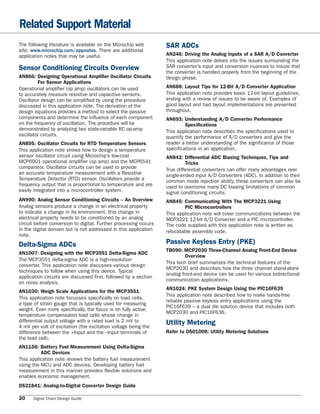
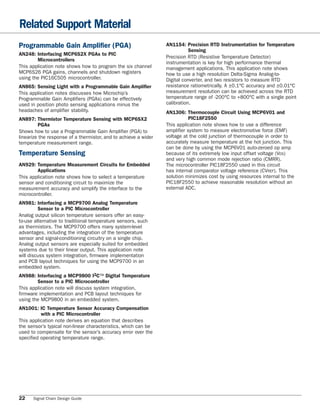
RTD Reference Design Board (TMPSNSRD-RTD2)                      Thermocouple Reference Design Board
The RTD Reference Design demonstrates how to implement          (TMPSNSRD-TCPL1)
Resistive Temperature Detector (RTD) and accurately             The Thermocouple Reference Design demonstrates how
measure temperature. This solution uses the MCP3551             to implement a thermocouple and accurately sense
22-bit Analog-to-Digital Converter (ADC) to measure voltage     temperature over the entire thermocouple measurement
across the RTD. The ADC and the RTD are referenced using        range. This solution uses the MCP3421 18-bit Analog-
an onboard reference voltage and the ADC inputs are directly    to-Digital Converter (ADC) to measure voltage across the
connected to the RTD terminals. This provides a ratio metric    Thermocouple. The ADC has an internal 2.048V reference
temperature measurement. The solution uses a current            voltage and a Programmable Gain Amplifier with 1, 2, 4,
limiting resistor to bias the RTD. It provides a reliable and   8 V/V. At a Gain of 8 V/V the PGA effectively adds 3 LSb
accurate RTD instrumentation without the need for extensive     to the ADC. This increases the ADC resolution to 21-bit
circuit compensation and calibration routines.                  or 2 μV/LSb. Therefore, the Thermocouple EMF voltage is
In addition, the this reference design includes a silicon       measured with 2 μV resolution. For K-type thermocouple,
temperature sensor, MCP9804. This sensor is used for            measurement system provides a ±0.05°C resolution. The
comparison only, it is not needed to instrument an RTD. The     cold-junction compensation is done using a ±1°C accurate
MCP3551 and MCP9804 outputs are read using a USB PIC            0.0625°C resolution silicon temperature sensor, the
microcontroller. This controller is also connected to a PC      MCP9804. This solution provides a reliable and accurate
using USB interface. The thermal management software is         Thermocouple instrumentation without the need for
used plot the RTD temperature data in stripchart format.        extensive circuit compensation and calibration routines.


                                                                                              Signal Chain Design Guide   19
Related Support Material
The following literature is available on the Microchip web        SAR ADCs
site: www.microchip.com/appnotes. There are additional
application notes that may be useful.                             AN246: Driving the Analog Inputs of a SAR A/D Converter
                                                                  This application note delves into the issues surrounding the
Sensor Conditioning Circuits Overview                             SAR converter’s input and conversion nuances to insure that
                                                                  the converter is handled properly from the beginning of the
AN866: Designing Operational Amplifier Oscillator Circuits        design phase.
         For Sensor Applications
Operational amplifier (op amp) oscillators can be used            AN688: Layout Tips for 12-Bit A/D Converter Application
to accurately measure resistive and capacitive sensors.           This application note provides basic 12-bit layout guidelines,
Oscillator design can be simplified by using the procedure        ending with a review of issues to be aware of. Examples of
discussed in this application note. The derivation of the         good layout and bad layout implementations are presented
design equations provides a method to select the passive          throughout.
components and determine the influence of each component          AN693: Understanding A/D Converter Performance
on the frequency of oscillation. The procedure will be                     Specifications
demonstrated by analyzing two state-variable RC op-amp            This application note describes the specifications used to
oscillator circuits.                                              quantify the performance of A/D converters and give the
AN895: Oscillator Circuits for RTD Temperature Sensors            reader a better understanding of the significance of those
This application note shows how to design a temperature           specifications in an application.
sensor oscillator circuit using Microchip’s low-cost              AN842: Differential ADC Biasing Techniques, Tips and
MCP6001 operational amplifier (op amp) and the MCP6541                     Tricks
comparator. Oscillator circuits can be used to provide            True differential converters can offer many advantages over
an accurate temperature measurement with a Resistive              single-ended input A/D Converters (ADC). In addition to their
Temperature Detector (RTD) sensor. Oscillators provide a          common mode rejection ability, these converters can also be
frequency output that is proportional to temperature and are      used to overcome many DC biasing limitations of common
easily integrated into a microcontroller system.                  signal conditioning circuits.
AN990: Analog Sensor Conditioning Circuits – An Overview          AN845: Communicating With The MCP3221 Using
Analog sensors produce a change in an electrical property                 PIC Microcontrollers
to indicate a change in its environment. this change in           This application note will cover communications between the
electrical property needs to be conditioned by an analog          MCP3221 12-bit A/D Converter and a PIC microcontroller.
circuit before conversion to digital. Further processing occurs   The code supplied with this application note is written as
in the digital domain but is not addressed in this application    relocatable assembly code.
note.
Delta-Sigma ADCs                                                  Passive Keyless Entry (PKE)
                                                                  TB090: MCP2030 Three-Channel Analog Front-End Device
AN1007: Designing with the MCP3551 Delta-Sigma ADC
                                                                           Overview
The MCP3551 delta-sigma ADC is a high-resolution
                                                                  This tech brief summarizes the technical features of the
converter. This application note discusses various design
                                                                  MCP2030 and describes how the three channel stand-alone
techniques to follow when using this device. Typical
                                                                  analog front-end device can be used for various bidirectional
application circuits are discussed first, followed by a section
                                                                  communication applications.
on noise analysis.
                                                                  AN1024: PKE System Design Using the PIC16F639
AN1030: Weigh Scale Applications for the MCP3551
                                                                  This application note described how to make hands-free
This application note focusses specifically on load cells,
                                                                  reliable passive keyless entry applications using the
a type of strain gauge that is typically used for measuring
                                                                  PIC16F639 – a dual die solution device that includes both
weight. Even more specifically, the focus is on fully active,
                                                                  MCP2030 and PIC16F636.
temperature compensated load cells whose change in
differential output voltage with a rated load is 2 mV to          Utility Metering
4 mV per volt of excitation (the excitation voltage being the
difference between the +Input and the –Input terminals of         Refer to DS01008: Utility Metering Solutions
the load cell).
AN1156: Battery Fuel Measurement Using Delta-Sigma
          ADC Devices
This application note reviews the battery fuel measurement
using the MCU and ADC devices. Developing battery fuel
measurement in this manner provides flexible solutions and
enables economic management.
DS21841: Analog-to-Digital Converter Design Guide

20    Signal Chain Design Guide
Related Support Material
Digital Potentiometers                                          AN866: Designing Operational Amplifier Oscillator Circuits
                                                                         For Sensor Applications
AN691: Optimizing the Digital Potentiometer in Precision
                                                                Gives simple design procedures for op amp oscillators.
         Circuits
                                                                These circuits are used to accurately measure resistive and
In this application note, circuit ideas are presented that      capacitive sensors.
use the necessary design techniques to mitigate errors,
consequently optimizing the performance of the digital          AN884: Driving Capacitive Loads With Op Amps
potentiometer.                                                  Explains why all op amps tend to have problems driving
                                                                large capacitive loads. A simple, one resistor compensation
AN692: Using a Digital Potentiometer to Optimize a
                                                                scheme is given that gives much better performance.
         Precision Single Supply Photo Detect
This application note shows how the adjustability of the        AN951: Amplifying High-Impedance Sensors –
digital potentiometer can be used to an advantage in                    Photodiode Example
photosensing circuits.                                          Shows how to condition the current out of a high-impedance
                                                                sensor. A photodiode detector illustrates the theory.
AN1080: Understanding Digital Potentiometer Resistance
                                                                AN990: Analog Sensor Conditioning Circuits – An Overview
           Variations
                                                                Gives an overview of the many sensor types, applications
This application note discusses how process, voltage and        and conditioning circuits.
temperature effect the resistor network’s characteristics,
specifications and techniques to improve system                 AN1014: Measuring Small Changes in Capacitive Sensors
performance.                                                    This application note shows a switched capacitor circuit that
                                                                uses a PIC microcontroller, and minimal external passive
Op Amps                                                         components, to measure small changes in capacitance. The
AN679: Temperature Sensing Technologies                         values are very repeatable under constant environmental
                                                                conditions.
Covers the most popular temperature sensor technologies
and helps determine the most appropriate sensor for an          AN1016: Detecting Small Capacitive Sensors Using the
application.                                                                MCP6291 and PIC16F690 Devices
                                                                The circuit discussed here uses an op amp and a
AN681: Reading and Using Fast Fourier Transformation            microcontroller to implement a dual slope integrator and
          (FFT)                                                 timer. It gives accurate results, and is appropriate for small
Discusses the use of frequency analysis (FFTs), time            capacitive sensors, such as capacitive humidity sensors.
analysis and DC analysis techniques. It emphasizes Analog-
to-Digital converter applications.                              AN1177: Op Amp Precision Design: DC Errors
                                                                This application note covers the essential background
AN684: Single Supply Temperature Sensing with                   information and design theory needed to design a precision
          Thermocouples                                         DC circuit using op amps.
Focuses on thermocouple circuit solutions. It builds from
signal conditioning components to complete application          AN1228: Op Amp Precision Design: Random Noise
circuits.                                                       This application note covers the essential background
                                                                information and design theory needed to design low noise,
AN695: Interfacing Pressure Sensors to Microchip’s              precision op amp circuits. The focus is on simple, results
         Analog Peripherals                                     oriented methods and approximations useful for circuits with
Shows how to condition a Wheatstone bridge sensor using         a low-pass response.
simple circuits. A piezoresistive pressure sensor application
is used to illustrate the theory.                               AN1258: Op Amp Precision Design: PCB Layout Techniques
                                                                This application note covers Printed Circuit Board (PCB)
AN699: Anti-Aliasing, Analog Filters for Data Acquisition       effects encountered in high (DC) precision op amp circuits.
         Systems                                                It provides techniques for improving the performance,
A tutorial on active analog filters and their most common       giving more flexibility in solving a given design problem. It
applications.                                                   demonstrates one important factor necessary to convert a
AN722: Operational Amplifier Topologies and                     good schematic into a working precision design.
          DC Specifications                                     AN1297: Microchip’s Op Amp SPICE Macro Models
Defines op amp DC specifications found in a data sheet. It      This application note covers the function and use of
shows where these specifications are critical in application    Microchip’s op amp SPICE macro models. It does not explain
circuits.                                                       how to use the circuit simulator but will give the user a
AN723: Operational Amplifier AC Specifications and              better understanding how the model behaves and tips on
          Applications                                          convergence issues.
Defines op amp AC specifications found in a data sheet. It
shows where these specifications are critical in application
circuits.

                                                                                                 Signal Chain Design Guide   21
Related Support Material
Programmable Gain Amplifier (PGA)                                AN1154: Precision RTD Instrumentation for Temperature
                                                                            Sensing
AN248: Interfacing MCP6S2X PGAs to PIC
                                                                 Precision RTD (Resistive Temperature Detector)
        Microcontrollers
                                                                 instrumentation is key for high performance thermal
This application note shows how to program the six channel       management applications. This application note shows
MCP6S26 PGA gains, channels and shutdown registers               how to use a high resolution Delta-Sigma Analog-to-
using the PIC16C505 microcontroller.                             Digital converter, and two resistors to measure RTD
AN865: Sensing Light with a Programmable Gain Amplifier          resistance ratiometrically. A ±0.1°C accuracy and ±0.01°C
This application notes discusses how Microchip’s                 measurement resolution can be achieved across the RTD
Programmable Gain Amplifiers (PGAs) can be effectively           temperature range of -200°C to +800°C with a single point
used in position photo sensing applications minus the            calibration.
headaches of amplifier stability.                                AN1306: Thermocouple Circuit Using MCP6V01 and
AN897: Thermistor Temperature Sensing with MCP6SX2                          PIC18F2550
         PGAs                                                    This application note shows how to use a difference
Shows how to use a Programmable Gain Amplifier (PGA) to          amplifier system to measure electromotive force (EMF)
linearize the response of a thermistor, and to achieve a wider   voltage at the cold junction of thermocouple in order to
temperature measurement range.                                   accurately measure temperature at the hot junction. This
                                                                 can be done by using the MCP6V01 auto-zeroed op amp
Temperature Sensing                                              because of its extremely low input offset voltage (VOS)
                                                                 and very high common mode rejection ratio (CMRR).
AN929: Temperature Measurement Circuits for Embedded             The microcontroller PIC18F2550 used in this circuit
        Applications                                             has internal comparator voltage reference (CVREF). This
This application note shows how to select a temperature          solution minimizes cost by using resources internal to the
sensor and conditioning circuit to maximize the                  PIC18F2550 to achieve reasonable resolution without an
measurement accuracy and simplify the interface to the           external ADC.
microcontroller.
AN981: Interfacing a MCP9700 Analog Temperature
         Sensor to a PIC Microcontroller
Analog output silicon temperature sensors offer an easy-
to-use alternative to traditional temperature sensors, such
as thermistors. The MCP9700 offers many system-level
advantages, including the integration of the temperature
sensor and signal-conditioning circuitry on a single chip.
Analog output sensors are especially suited for embedded
systems due to their linear output. This application note
will discuss system integration, firmware implementation
and PCB layout techniques for using the MCP9700 in an
embedded system.
AN988: Interfacing a MCP9800 I2C™ Digital Temperature
        Sensor to a PIC Microcontroller
This application note will discuss system integration,
firmware implementation and PCB layout techniques for
using the MCP9800 in an embedded system.
AN1001: IC Temperature Sensor Accuracy Compensation
          with a PIC Microcontroller
This application note derives an equation that describes
the sensor’s typical non-linear characteristics, which can be
used to compensate for the sensor’s accuracy error over the
specified operating temperature range.


22    Signal Chain Design Guide
LINEAR
LINEAR – Op Amps
                                   GBWP         IQ         VOS        Supply                            Rail-
                      # per                                                          Temperature
Device                             (kHz)    (μA/amp.)     (±μV)       Voltage                          to-Rail                    Features                               Packages              Featured Demo Board    Op Amp Category
                     Package                                                          Range (°C)
                                    Typ.       Typ.       Max.          (V)                              I/O
                                                                                                                                                               SOIC, MSOP, TSSOP, DFN,         MCP6031DM-PCTL,
MCP6031/2/3/4         1,2,1,4       10          1         150         1.8 to 5.5      -40 to +125          I/O     Low Power Mode on MCP6033                                                                          Low Offset, Low Power
                                                                                                                                                               SOT-23                          SOIC8EV, SOIC14EV
                                                                                      -40 to +85,                                                              PDIP, SOIC, MSOP, TSSOP,
MCP6041/2/3/4         1,2,1,4       14          1         3,000       1.4 to 6.0                           I/O     Low Power Mode on MCP6043                                                   SOIC8EV, SOIC14EV      General Purpose, Low Power
                                                                                      -40 to +125                                                              SOT-23
                                                                                      -40 to +85,                  GMIN = 10, Low Power Mode on                PDIP, SOIC, MSOP, TSSOP,
MCP6141/2/3/4         1,2,1,4       100         1         3,000       1.4 to 6.0                           I/O                                                                                 SOIC8EV, SOIC14EV      General Purpose, Low Power
                                                                                      -40 to +125                  MCP6143                                     SOT-23
                                                                                                                                                               PDIP, SOIC, TSSOP, DFN,
MCP606/7/8/9          1,2,1,4       155        25         250         2.5 to 6.0      -40 to +85           O       Low Power Mode on MCP608                                                    SOIC8EV, SOIC14EV      Low Offset
                                                                                                                                                               SOT-23
MCP616/7/8/9          1,2,1,4       190        25         150         2.3 to 5.5      -40 to +85           O       Low Power Mode on MCP618                    PDIP, SOIC, TSSOP               SOIC8EV, SOIC14EV      Low Offset
                                                                                                                                                               PDIP, SOIC, MSOP, TSSOP, DFN,   VSUPEV2, SOIC8EV,
MCP6231/1R/1U/2/4    1,1,1,2,4      300        30         5,000       1.8 to 6.0      -40 to +125          I/O     –                                                                                                  General Purpose
                                                                                                                                                               SOT-23, SC-70                   SOIC14EV
MCP6051/2/4            1,2,4        385        45         150         1.8 to 6.0      -40 to +125          I/O     –                                           SOIC, TSSOP, TDFN               SOIC8EV, SOIC14EV      Low Offset
                                                                                                                                                               PDIP, SOIC, MSOP, TSSOP, DFN,   VSUPEV2, SOIC8EV,
MCP6241/1R/1U/2/4    1,1,1,2,4      550        70         5,000       1.8 to 5.5      -40 to +125          I/O     –                                                                                                  General Purpose
                                                                                                                                                               SOT-23, SC-70                   SOIC14EV
MCP6061/2/4            1,2,4        730        90         150         1.8 to 6.0      -40 to +125          I/O     –                                           SOIC, TSSOP, TDFN               SOIC8EV, SOIC14EV      Low Offset
                                                                                      -40 to +85,                                                              PDIP, SOIC, MSOP, TSSOP,        MCP6SX2DM-PICTLPD,
MCP6001/1R/1U/2/4    1,1,1,2,4     1,000       170        4,500       1.8 to 6.0                           I/O     –                                                                                                  General Purpose
                                                                                      -40 to +125                                                              SOT-23, SC-70                   SOIC8EV, SOIC14EV
MCP6071/2/4            1,2,4       1,200       170        150         1.8 to 6.0      -40 to +125          I/O     –                                           SOIC, TSSOP, TDFN               SOIC8EV, SOIC14EV      Low Offset
                                                                                                                   Low Power Mode on MCP6273,                  PDIP, SOIC, MSOP, TSSOP,        MCP6XXXDM-FLTR,
MCP6271/1R/2/3/4/5   1,1,2,1,4,2   2,000       240        3,000       2.0 to 6.0      -40 to +125          I/O                                                                                                        General Purpose
                                                                                                                   Cascaded Gain with MCP6275                  SOT-23                          SOIC8EV, SOIC14EV
                                                                                      -40 to +85,
MCP601/1R/2/3/4      1,1,2,1,4     2,800       325        2,000       2.7 to 6.0                           O       Low Power Mode on MCP603                    PDIP, SOIC, TSSOP, SOT-23       SOIC8EV, SOIC14EV      General Purpose
                                                                                      -40 to +125
MCP6286                  1         3,500       720        1,500       2.2 to 5.5      -40 to +125          O       Low Noise                                   SOT-23                          VSUPEV2                Low Noise
                                                                                                                   Low Power Mode on MCP6283,                  PDIP, SOIC, MSOP, TSSOP,        VSUPEV2, SOIC8EV,
MCP6281/1R/2/3/4/5   1,1,2,1,4,2   5,000       570        3,000       2.2 to 6.0      -40 to +125          I/O                                                                                                        General Purpose
                                                                                                                   Cascaded Gain with MCP6285                  SOT-23                          SOIC14EV
                                                                                      -40 to +85,                                                              PDIP, SOIC, MSOP, TSSOP,        MCP6XXXEV-AMP1,
MCP6021/1R/2/3/4     1,1,2,1,4     10,000     1,350     500, 250      2.5 to 5.5                           I/O     Low Power Mode on MCP6023                                                                          Low Offset
                                                                                      -40 to +125                                                              SOT-23                          SOIC8EV, SOIC14EV
                                                                                                                   Low Power Mode on MCP6293,                  PDIP, SOIC, MSOP, TSSOP,        PIC16F690DM-PCTLHS,
MCP6291/1R/2/3/4/5   1,1,2,1,4,2   10,000     1,300       3,000       2.4 to 6.0      -40 to +125          I/O                                                                                                        General Purpose
                                                                                                                   Cascaded Gain with MCP6295                  SOT-23                          SOIC8EV, SOIC14EV
                                                                                                                                                                                                                      High Speed, High Output Drive,
MCP621                 1,2,2       20,000     3,600       200         2.5 to 5.5      -40 to +125          O       mCal (offset correction, low power mode)    SOIC, MSOP, DFN                 MCP651EV-VOS
                                                                                                                                                                                                                      Low Offset
MCP631/2/3/5          1,2,1,2      24,000     3,600       8,000       2.5 to 5.5      -40 to +125          O       Low Power Mode on MCP633/5                  SOIC, MSOP, DFN                 MCP651EV-VOS           High Speed, High Output Drive
                                                                                                                                                                                                                      High Speed, High Output Drive,
MCP651/2/5             1,2,2       50,000     9,000       200         2.5 to 5.5      -40 to +125          O       mCal (offset correction, low power mode)    SOIC, MSOP, DFN                 MCP651EV-VOS
                                                                                                                                                                                                                      Low Offset
MCP661/2/3/5          1,2,1,2      60,000     9,000       8,000       2.5 to 5.5      -40 to +125          O       Low Power Mode on MCP663/5                  SOIC, MSOP, DFN                 MCP661DM-LD            High Speed, High Output Drive

LINEAR – Op Amps Auto-Zero
                                   GBWP         IQ       VOS       Supply                            Rail-
                      # per                                                     Temperature
Device                             (kHz)    (μA/amp.)   (±μV)      Voltage                          to-Rail                     Features                                 Packages               Featured Demo Board         Op Amp Category
                     Package                                                     Range (°C)
                                    Typ.       Typ.     Max.         (V)                              I/O
                                                                                                                                                                                               MCP6V01DM-VOS,
MCP6V01/2/3            1,2,1       1,300      400        2        1.8 to 5.5       -40 to +125       I/O         Low Power Mode on MCP6V03                    SOIC, DFN, TDFN                                         Auto-zeroed
                                                                                                                                                                                               MCP6V01RD-TCPL
                                                                                                                                                                                               MCP6V01DM-VOS,
MCP6V06/7/8            1,2,1       1,300      400        3        1.8 to 5.5       -40 to +125       I/O         Low Power Mode on MCP6V08                    SOIC, DFN, TDFN                                         Auto-zeroed
                                                                                                                                                                                               MCP6V01RD-TCPL


                                                                                                                                                                                                             Signal Chain Design Guide        23
LINEAR – Comparators
                                                            Typical
                    # per                                                       IQ Typical                 Vos Max           Operating            Temperature
Device                                   VREF (V)         Propagation                                                                                                                         Features                                                 Packages
                   Package                                                         (μA)                     (mV)             Voltage (V)           Range (°C)
                                                           Delay (μs)
                                                                                                                                                                                                                                     5-pin SOT-23(S,R,U), 5-pin SC-70(S,U),
MCP6541                1                    –                    4                        1                   5                1.6 to 5.5          -40 to +125     Push-Pull, Rail-to-Rail Input/Output
                                                                                                                                                                                                                                     8-pin PDIP, 8-pin SOIC, 8-pin MSOP
MCP6542                2                    –                    4                        1                   5                1.6 to 5.5          -40 to +125     Push-Pull, Rail-to-Rail Input/Output                              8-pin PDIP, 8-pin SOIC, 8-pin MSOP
MCP6543                1                    –                    4                        1                   5                1.6 to 5.5          -40 to +125     Push-Pull, Rail-to-Rail Input/Output, Chip Select                 8-pin PDIP, 8-pin SOIC, 8-pin MSOP
MCP6544                4                    –                    4                        1                   5                1.6 to 5.5          -40 to +125     Push-Pull, Rail-to-Rail Input/Output                              14-pin PDIP, 14-pin SOIC, 14-pin TSSOP
                                                                                                                                                                                                                                     5-pin SOT-23(S,R,U), 5-pin SC-70(S,U),
MCP6546                1                    –                    4                        1                   5                1.6 to 5.5          -40 to +125     Open-drain, 9V, Rail-to-Rail Input/Output
                                                                                                                                                                                                                                     8-pin PDIP, 8-pin SOIC, 8-pin MSOP
MCP6547                2                    –                    4                        1                   5                1.6 to 5.5          -40 to +125     Open-drain, 9V, Rail-to-Rail Input/Output                         8-pin PDIP, 8-pin SOIC, 8-pin MSOP
MCP6548                1                    –                    4                        1                   5                1.6 to 5.5          -40 to +125     Open-drain, 9V, Rail-to-Rail Input/Output, Chip Select            8-pin PDIP, 8-pin SOIC, 8-pin MSOP
MCP6549                4                    –                    4                        1                   5                1.6 to 5.5          -40 to +125     Open-drain, 9V, Rail-to-Rail Input/Output                         14-pin PDIP, 14-pin SOIC, 14-pin TSSOP
MCP6561                1                    –                   0.047                 100                    10                1.8 to 5.5          -40 to +125     Push-Pull, Rail-to-Rail Input/Output                              5-pin SOT-23(S,R,U), 5-pin SC-70(S)
MCP6562                2                    –                   0.047                 100                    10                1.8 to 5.5          -40 to +125     Push-Pull, Rail-to-Rail Input/Output                              8-pin SOIC, 8-pin MSOP
MCP6564                4                    –                   0.047                 100                    10                1.8 to 5.5          -40 to +125     Push-Pull, Rail-to-Rail Input/Output                              14-pin SOIC, 14-pin TSSOP
MCP6566                1                    –                   0.047                 100                    10                1.8 to 5.5          -40 to +125     Open-Drain, Rail-to-Rail Input/Output                             5-pin SOT-23(S,R,U), 5-pin SC-70(S)
MCP6567                2                    –                   0.047                 100                    10                1.8 to 5.5          -40 to +125     Open-Drain, Rail-to-Rail Input/Output                             8-pin SOIC, 8-pin MSOP
MCP6569                4                    –                   0.047                 100                    10                1.8 to 5.5          -40 to +125     Open-Drain, Rail-to-Rail Input/Output                             14-pin SOIC, 14-pin TSSOP
Legend: S = Standard Pinout; R = Reverse Pinout; U = Alternative Pinout

LINEAR – Programmable Gain Amplifiers (PGA)
Device                    Channels              -3 dB BW (MHz) Typ.         IQ (μA) Max.               VOS (±μV) Max.          Operating Voltage (V)       Temperature Range (°C)                              Features                                     Packages
MCP6S21/2/6/8              1, 2, 6, 8                 2 to 12                       1.1                     275                      2.5 to 5.5                   -40 to +85             SPI, 8 Gain Steps, Software Shutdown                       PDIP, SOIC, MSOP, TSSOP
MCP6S912,3                  1, 2, 2                   1 to 18                       1.0                     4000                     2.5 to 5.5                  -40 to +125             SPI, 8 Gain Steps, Software Shutdown, VREF                 PDIP, SOIC, MSOP


MIXED SIGNAL
MIXED SIGNAL – Delta-Sigma A/D Converters
                                       Max.Sample                                                               Typical
                Resolution                              # of Input                          Supply                                Typical INL     Temperature
Device                                    Rate                          Interface                               Supply                                                           Features                                 Packages                    Featured Demo Board
                  (bits)                                Channels                          Voltage (V)                               (ppm)          Range (°C)
                                      (samples/sec)                                                           Current (μA)
                                                                                                            145 (continuous)                                     PGA: 1, 2, 4 or 8
MCP3421              18                   3.75            1 Diff         I2C™                 2.7 to 5.5                               10          -40 to +85                                                   SOT-23-6                        MCP3421EV
                                                                                                             39 (one shot)                                       Internal voltage reference
                                                                                                                                                                 PGA: 1, 2, 4, or 8
MCP3422              18                   3.75            2 Diff         I²C™                 2.7 to 5.5           145                 10          -40 to +85                                                   SOIC-8, MSOP-8, DFN-8           MCP3422EV, MCP3421DM-BFG
                                                                                                                                                                 Internal voltage reference
                                                                                                                                                                 PGA: 1, 2, 4, or 8
MCP3423              18                   3.75            2 Diff         I²C™                 2.7 to 5.5           145                 10          -40 to +85                                                   MSOP-10, DFN-10                 MCP3423EV
                                                                                                                                                                 Internal voltage reference
                                                                                                                                                                 PGA: 1, 2, 4, or 8
MCP3424              18                   3.75            4 Diff         I²C™                 2.7 to 5.5           145                 10          -40 to +85                                                   SOIC-14, TSSOP-14               MCP3424EV
                                                                                                                                                                 Internal voltage reference
                                                                                                                                                                 PGA: 1, 2, 4, or 8
MCP3425              16                    15             1 Diff         I²C™                 2.7 to 5.5           155                 10          -40 to +85                                                   SOT-23-6                        MCP3425EV, MCP3421DM-BFG
                                                                                                                                                                 Internal voltage reference
                                                                                                                                                                 PGA: 1, 2, 4, or 8
MCP3426              16                    15             2 Diff         I²C™                 2.7 to 5.5           145                 10          -40 to +85                                                   SOIC-8, MSOP-8, DFN-8           –
                                                                                                                                                                 Internal voltage reference
                                                                                                                                                                 PGA: 1, 2, 4, or 8
MCP3427              16                    15             2 Diff         I²C™                 2.7 to 5.5           145                 10          -40 to +85                                                   MSOP-10, DFN-10                 –
                                                                                                                                                                 Internal voltage reference
                                                                                                                                                                 PGA: 1, 2, 4, or 8
MCP3428              16                    15             4 Diff         I²C™                 2.7 to 5.5           145                 10          -40 to +85                                                   SOIC-14, TSSOP-14               –
                                                                                                                                                                 Internal voltage reference


                                                                                                                                                                                                                                 Signal Chain Design Guide                 24
MIXED SIGNAL – Delta-Sigma A/D Converters (Continued)
                            Max.Sample                                                              Typical
             Resolution                    # of Input                        Supply                                     Typical INL    Temperature
Device                         Rate                         Interface                               Supply                                                                   Features                               Packages             Featured Demo Board
               (bits)                      Channels                        Voltage (V)                                    (ppm)         Range (°C)
                           (samples/sec)                                                          Current (μA)
MCP3550-50       22             13           1 Diff           SPI           2.7 to 5.5                120                   2               -40 to +85      50 Hz noise rejection > 120 dB                SOIC-8, MSOP-8              MCP3551DM-PCTL
MCP3550-60       22             15           1 Diff           SPI           2.7 to 5.5                140                   2               -40 to +85      60 Hz noise rejection > 120 dB                SOIC-8, MSOP-8              MCP3551DM-PCTL
MCP3551          22             14           1 Diff           SPI           2.7 to 5.5                120                   2               -40 to +85      Simultaneous 50/60 Hz rejection               SOIC-8, MSOP-8              MCP3551DM-PCTL
MCP3553          20             60           1 Diff           SPI           2.7 to 5.5                140                   2               -40 to +85      –                                             SOIC-8, MSOP-8              MCP3551DM-PCTL
                                                                                                                                                            Two ADC Cores, 16/24 bits, High Sample
MCP3901          16           64000          2 Diff           SPI              4.5 to 5.5            2050                   15              -40 to +85                                                    SSOP-20, QFN-20             MCP3901EV-MCU16
                                                                                                                                                            Speed (64 ksps), PGA: 1, 2, 4, 8, 16 or 32
MIXED SIGNAL – Successive Approximation Register (SAR) A/D Converters
                            Max.Sample
             Resolution                      # of Input                                                  Input Voltage           Max. Supply                            Temperature
Part #                         Rate                              Input Type              Interface                                                   Max. INL                                            Packages                       Featured Demo Board
               (bits)                        Channels                                                      Range (V)             Current (μA)                            Range (°C)
                           (samples/sec)
MCP3001         10              200               1             Single-ended                SPI             2.7 to 5.5                500                ±1 LSB          -40 to +85      PDIP-8, SOIC-8, MSOP-8, TSSOP-8          –
MCP3002         10              200               2             Single-ended                SPI             2.7 to 5.5                650                ±1 LSB          -40 to +85      PDIP-8, SOIC-8, MSOP-8, TSSOP-8          –
MCP3004         10              200               4             Single-ended                SPI             2.7 to 5.5                550                ±1 LSB          -40 to +85      PDIP-14, SOIC-14, TSSOP-14               –
MCP3008         10              200               8             Single-ended                SPI             2.7 to 5.5                550                ±1 LSB          -40 to +85      PDIP-16, SOIC-16                         –
MCP3021         10              22                1             Single-ended                I2C™            2.7 to 5.5                250                ±1 LSB         -40 to +125      SOT-23A-5                                MCP3221DM-PCTL, MXSIGDM
MCP3221         12              22                1             Single-ended                I2C™            2.7 to 5.5                250                ±2 LSB         -40 to +125      SOT-23A-5                                MCP3221DM-PCTL, MXSIGDM
MCP3201         12              100               1             Single-ended                SPI             2.7 to 5.5                400                ±1 LSB          -40 to +85      PDIP-8, SOIC-8, MSOP-8, TSSOP-8          DV3201A, DVMCPA, MXSIGDM
MCP3202         12              100               2             Single-ended                SPI             2.7 to 5.5                550                ±1 LSB          -40 to +85      PDIP-8, SOIC-8, MSOP-8, TSSOP-8          DV3201A, DVMCPA, MXSIGDM
MCP3204         12              100               4             Single-ended                SPI             2.7 to 5.5                400                ±1 LSB          -40 to +85      PDIP-14, SOIC-14, TSSOP-14               DV3204A, DVMCPA, MXSIGDM
MCP3208         12              100               8             Single-ended                SPI             2.7 to 5.5                400                ±1 LSB          -40 to +85      PDIP-16, SOIC-16                         DV3204A, DVMCPA, MXSIGDM
MCP3301         13              100               1              Differential               SPI             2.7 to 5.5                450                ±1 LSB          -40 to +85      PDIP-8, SOIC-8, MSOP-8, TSSOP-8          DV3201A, DVMCPA, MXSIGDM
MCP3302         13              100               2              Differential               SPI             2.7 to 5.5                450                ±1 LSB          -40 to +85      PDIP-14, SOIC-14, TSSOP-14               DV3204A, DVMCPA, MXSIGDM
MCP3304         13              100               4              Differential               SPI             2.7 to 5.5                450                ±1 LSB          -40 to +85      PDIP-16, SOIC-16                         DV3204A, DVMCPA, MXSIGDM

MIXED SIGNAL – D/A Converters
                                                                                                                                   Typical                    Typical
              Resolution      DACs per                                                 Output Settling            DNL                                                           Temperature Range
Part #                                          Interface                VREF                                                     Standby                    Operating                                                Packages             Featured Demo Board
                (Bits)        Package                                                    Time (μs)               (LSB)                                                                (°C)
                                                                                                                                 Current (μA)               Current (μA)
                                                                                                                                                                                                                                           MCP4725DM-PTPLS,
MCP4725           12              1               I2C™                   VDD                   6                 0.75                  1                          210                 -40 to +125        SOT-23-6
                                                                                                                                                                                                                                           MCP4725EV
MCP4728           12              4               I2C™                  Int/ VDD               6                 0.75                 0.04                        800                 -40 to +125        MSOP-10                           MCP4728EV
MCP4821           12              1                   SPI                  Y                  4.5                 1                    0.3                        330                 -40 to +125        PDIP-8, SOIC-8, MSOP-8            –
MCP4822           12              2                   SPI                  Y                  4.5                 1                    0.3                        415                 -40 to +125        PDIP-8, SOIC-8, MSOP-8            –
MCP4921           12              1                   SPI                 Ext                 4.5                0.75                  1                          175                 -40 to +125        PDIP-8, SOIC-8, MSOP-8            –
MCP4922           12              2                   SPI                 Ext                 4.5                0.75                  1                          350                 -40 to +125        PDIP-14, SOIC-14, TSSOP-14        –
TC1320            8               1          SMbus/ I2C™                  Ext                 10                 ±0.8                  0.1                        350                 -40 to +85         SOIC-8, MSOP-8                    –
TC1321            10              1          SMbus/ I2C™                  Ext                 10                  ±2                   0.1                        350                 -40 to +85         SOIC-8, MSOP-8                    –


                                                                                                                                                                                                                           Signal Chain Design Guide     25
MIXED SIGNAL – Digital Potentiometers

                  # of        # per                       VDD Operating      Volatile/                                                    Temperature
Device                                      Interface                                      Resistance (ohms)    INL (Max.)   DNL (Max.)                              Packages                          Featured Demo Board
                  Taps       Package                         Range(1)       Non-Volatile                                                   Range (°C)

MCP4011            64            1            U/D          1.8V to 5.5V       Volatile     2.1K, 5K, 10K, 50K   ±0.5 LSb      ±0.5 LSb    -40 to +125   SOIC-8                                MCP402XEV, MCP4XXXDM-DB
MCP4012            64            1            U/D          1.8V to 5.5V       Volatile     2.1K, 5K, 10K, 50K   ±0.5 LSb      ±0.5 LSb    -40 to +125   SOT-23-6                              MCP402XEV, SC70EV
MCP4013            64            1            U/D          1.8V to 5.5V       Volatile     2.1K, 5K, 10K, 50K   ±0.5 LSb      ±0.5 LSb    -40 to +125   SOT-23-6                              MCP402XEV, SC70EV
MCP4014            64            1            U/D          1.8V to 5.5V       Volatile     2.1K, 5K, 10K, 50K   ±0.5 LSb      ±0.5 LSb    -40 to +125   SOT-23-5                              MCP402XEV, SC70EV
MCP4017            128           1            I2C™         1.8V to 5.5V       Volatile     5K, 10K, 50K, 100K   ±0.5 LSb     ±0.25 LSb    -40 to +125   SC-70-6                               SC70EV
MCP4018            128           1            I2C™         1.8V to 5.5V       Volatile     5K, 10K, 50K, 100K   ±0.5 LSb     ±0.25 LSb    -40 to +125   SC-70-6                               SC70EV
MCP4019            128           1            I2C™         1.8V to 5.5V       Volatile     5K, 10K, 50K, 100K   ±0.5 LSb     ±0.25 LSb    -40 to +125   SC-70-5                               SC70EV
MCP40D17           128           1            I2C™         1.8V to 5.5V       Volatile     5K, 10K, 50K, 100K   ±0.5 LSb     ±0.25 LSb    -40 to +125   SC-70-6                               SC70EV
                                              2
MCP40D18           128           1            I C™         1.8V to 5.5V       Volatile     5K, 10K, 50K, 100K   ±0.5 LSb     ±0.25 LSb    -40 to +125   SC-70-6                               SC70EV
MCP40D19           128           1            I2C™         1.8V to 5.5V       Volatile     5K, 10K, 50K, 100K   ±0.5 LSb     ±0.25 LSb    -40 to +125   SC-70-5                               SC70EV
MCP4021            64            1            U/D          2.7V to 5.5V     Non-Volatile   2.1K, 5K, 10K, 50K   ±0.5 LSb      ±0.5 LSb    -40 to +125   SOIC-8                                MCP402XEV, MCP4XXXDM-DB
MCP4022            64            1            U/D          2.7V to 5.5V     Non-Volatile   2.1K, 5K, 10K, 50K   ±0.5 LSb      ±0.5 LSb    -40 to +125   SOT-23-6                              MCP402XEV, SC70EV
MCP4023            64            1            U/D          2.7V to 5.5V     Non-Volatile   2.1K, 5K, 10K, 50K   ±0.5 LSb      ±0.5 LSb    -40 to +125   SOT-23-6                              MCP402XEV, SC70EV
MCP4024            64            1            U/D          2.7V to 5.5V     Non-Volatile   2.1K, 5K, 10K, 50K   ±0.5 LSb      ±0.5 LSb    -40 to +125   SOT-23-5                              MCP402XEV, SC70EV
MCP41010           256           1             SPI         2.7V to 5.5V       Volatile            10K            ±1 LSb       ±1 LSb       -40 to +85   PDIP-8, SOIC-8                        MCP4XXXDM-DB
MCP41050           256           1             SPI         2.7V to 5.5V       Volatile            50K            ±1 LSb       ±1 LSb       -40 to +85   PDIP-8, SOIC-8                        MCP4XXXDM-DB
MCP41100           256           1             SPI         2.7V to 5.5V       Volatile           100K            ±1 LSb       ±1 LSb       -40 to +85   PDIP-8, SOIC-8                        MCP4XXXDM-DB
MCP42010           256           2             SPI         2.7V to 5.5V       Volatile            10K            ±1 LSb       ±1 LSb       -40 to +85   PDIP-14, SOIC-14, TSSOP-14            MCP4XXXDM-DB
MCP42050           256           2             SPI         2.7V to 5.5V       Volatile            50K            ±1 LSb       ±1 LSb       -40 to +85   PDIP-14, SOIC-14, TSSOP-14            MCP4XXXDM-DB
MCP42100           256           2             SPI         2.7V to 5.5V       Volatile           100K            ±1 LSb       ±1 LSb       -40 to +85   PDIP-14, SOIC-14, TSSOP-14            MCP4XXXDM-DB
MCP4131            129           1             SPI         1.8V to 5.5V       Volatile     5K, 10K, 50K, 100K   ±0.5 LSb     ±0.25 LSb    -40 to +125   PDIP-8, SOIC-8, MSOP-8, DFN-8         MCP42XXDM-PTPLS
MCP4132            129           1             SPI         1.8V to 5.5V       Volatile     5K, 10K, 50K, 100K   ±0.5 LSb     ±0.25 LSb    -40 to +125   PDIP-8, SOIC-8, MSOP-8, DFN-8         MCP42XXDM-PTPLS
MCP4141            129           1             SPI         2.7V to 5.5V     Non-Volatile   5K, 10K, 50K, 100K   ±0.5 LSb     ±0.25 LSb    -40 to +125   PDIP-8, SOIC-8, MSOP-8, DFN-8         MCP42XXDM-PTPLS
MCP4142            129           1             SPI         2.7V to 5.5V     Non-Volatile   5K, 10K, 50K, 100K   ±0.5 LSb     ±0.25 LSb    -40 to +125   PDIP-8, SOIC-8, MSOP-8, DFN-8         MCP42XXDM-PTPLS
                                                                                                                                                        PDIP-8, SOIC-8,
MCP4151            257           1             SPI         1.8V to 5.5V       Volatile     5K, 10K, 50K, 100K    ±1 LSb       ±0.5 LSb    -40 to +125                                         MCP42XXDM-PTPLS
                                                                                                                                                        MSOP-8, DFN-8
                                                                                                                                                        PDIP-8, SOIC-8,
MCP4152            257           1             SPI         1.8V to 5.5V       Volatile     5K, 10K, 50K, 100K    ±1 LSb       ±0.5 LSb    -40 to +125                                         MCP42XXDM-PTPLS
                                                                                                                                                        MSOP-8, DFN-8
                                                                                                                                                        PDIP-8, SOIC-8,
MCP4161            257           1             SPI         2.7V to 5.5V     Non-Volatile   5K, 10K, 50K, 100K    ±1 LSb       ±0.5 LSb    -40 to +125                                         MCP42XXDM-PTPLS
                                                                                                                                                        MSOP-8, DFN-8
                                                                                                                                                        PDIP-8, SOIC-8,
MCP4162            257           1             SPI         2.7V to 5.5V     Non-Volatile   5K, 10K, 50K, 100K    ±1 LSb       ±0.5 LSb    -40 to +125                                         MCP42XXDM-PTPLS
                                                                                                                                                        MSOP-8, DFN-8
MCP4231            129           2             SPI         1.8V to 5.5V       Volatile     5K, 10K, 50K, 100K   ±0.5 LSb     ±0.25 LSb    -40 to +125   PDIP-14, SOIC-14, TSSOP-14, QFN-16    MCP4XXXDM-DB, MCP42XXDM-PTPLS
MCP4232            129           2             SPI         1.8V to 5.5V       Volatile     5K, 10K, 50K, 100K   ±0.5 LSb     ±0.25 LSb    -40 to +125   MSOP-10, DFN-10                       MCP42XXDM-PTPLS
MCP4241            129           2             SPI         2.7V to 5.5V     Non-Volatile   5K, 10K, 50K, 100K   ±0.5 LSb     ±0.25 LSb    -40 to +125   PDIP-14, SOIC-14, TSSOP-14, QFN-16    MCP4XXXDM-DB, MCP42XXDM-PTPLS
MCP4242            129           2             SPI         2.7V to 5.5V     Non-Volatile   5K, 10K, 50K, 100K   ±0.5 LSb     ±0.25 LSb    -40 to +125   MSOP-10, DFN-10                       MCP42XXDM-PTPLS
MCP4251            257           2             SPI         1.8V to 5.5V       Volatile     5K, 10K, 50K, 100K    ±1 LSb       ±0.5 LSb    -40 to +125   PDIP-14, SOIC-14, TSSOP-14, QFN-16    MCP4XXXDM-DB, MCP42XXDM-PTPLS
MCP4252            257           2             SPI         1.8V to 5.5V       Volatile     5K, 10K, 50K, 100K    ±1 LSb       ±0.5 LSb    -40 to +125   MSOP-10, DFN-10                       MCP42XXDM-PTPLS
MCP4261            257           2             SPI         2.7V to 5.5V     Non-Volatile   5K, 10K, 50K, 100K    ±1 LSb       ±0.5 LSb    -40 to +125   PDIP-14, SOIC-14, TSSOP-14, QFN-16    MCP4XXXDM-DB, MCP42XXDM-PTPLS
MCP4262            257           2             SPI         2.7V to 5.5V     Non-Volatile   5K, 10K, 50K, 100K    ±1 LSb       ±0.5 LSb    -40 to +125   MSOP-10, DFN-10                       MCP42XXDM-PTPLS
MCP4351            257           4             SPI         1.8V to 5.5V       Volatile     5K, 10K, 50K, 100K   ±1.0 LSb      ±0.5 LSb    -40 to +125   TSSOP-20, QFN-20                      TSSOP20EV
MCP4352            257           4             SPI         1.8V to 5.5V       Volatile     5K, 10K, 50K, 100K   ±1.0 LSb      ±0.5 LSb    -40 to +125   TSSOP-14                              TSSOP20EV
Note 1: Analog characteristics may be tested at different voltage ranges.

                                                                                                                                                                                             Signal Chain Design Guide       26
MIXED SIGNAL – Digital Potentiometers (Continued)
                   # of           # per                        VDD Operating    Volatile/                                                                  Temperature
Device                                         Interface                                          Resistance (ohms)       INL (Max.)      DNL (Max.)                                 Packages              Featured Demo Board
                   Taps          Package                          Range(1)     Non-Volatile                                                                 Range (°C)
MCP4361            257              4              SPI          2.7V to 5.5V   Non-Volatile       5K, 10K, 50K, 100K      ±1.0 LSb            ±0.5 LSb      -40 to +125     TSSOP-20, QFN-20        TSSOP20EV
MCP4362            257              4              SPI          2.7V to 5.5V   Non-Volatile       5K, 10K, 50K, 100K      ±1.0 LSb            ±0.5 LSb      -40 to +125     TSSOP-14                TSSOP20EV
MCP4531            129              1              I2C™         1.8V to 5.5V     Volatile         5K, 10K, 50K, 100K      ±0.5 LSb         ±0.25 LSb        -40 to +125     MSOP-8, DFN-8           MCP46XXDM-PTPLS
MCP4532            129              1              I2C™         1.8V to 5.5V     Volatile         5K, 10K, 50K, 100K      ±0.5 LSb         ±0.25 LSb        -40 to +125     MSOP-8, DFN-8           MCP46XXDM-PTPLS
MCP4541            129              1              I2C™         2.7V to 5.5V   Non-Volatile       5K, 10K, 50K, 100K      ±0.5 LSb         ±0.25 LSb        -40 to +125     MSOP-8, DFN-8           MCP46XXDM-PTPLS
MCP4542             29              1              I2C™         2.7V to 5.5V   Non-Volatile       5K, 10K, 50K, 100K      ±0.5 LSb         ±0.25 LSb        -40 to +125     MSOP-8, DFN-8           MCP46XXDM-PTPLS
MCP4551            257              1              I2C™         1.8V to 5.5V     Volatile         5K, 10K, 50K, 100K       ±1 LSb             ±0.5 LSb      -40 to +125     MSOP-8, DFN-8           MCP46XXDM-PTPLS
                                                   2
MCP4552            257              1              I C™         1.8V to 5.5V     Volatile         5K, 10K, 50K, 100K       ±1 LSb             ±0.5 LSb      -40 to +125     MSOP-8, DFN-8           MCP46XXDM-PTPLS
MCP4561            257              1              I2C™         2.7V to 5.5V   Non-Volatile       5K, 10K, 50K, 100K       ±1 LSb             ±0.5 LSb      -40 to +125     MSOP-8, DFN-8           MCP46XXDM-PTPLS
MCP4562            257              1              I2C™         2.7V to 5.5V   Non-Volatile       5K, 10K, 50K, 100K       ±1 LSb             ±0.5 LSb      -40 to +125     MSOP-8, DFN-8           MCP46XXDM-PTPLS
MCP4631            129              2              I2C™         1.8V to 5.5V     Volatile         5K, 10K, 50K, 100K      ±0.5 LSb         ±0.25 LSb        -40 to +125     TSSOP-14, QFN-16        MCP4XXXDM-DB, MCP46XXDM-PTPLS
MCP4632            129              2              I2C™         1.8V to 5.5V     Volatile         5K, 10K, 50K, 100K      ±0.5 LSb         ±0.25 LSb        -40 to +125     MSOP-10, DFN-10         MCP46XXDM-PTPLS
MCP4641            129              2              I2C™         2.7V to 5.5V   Non-Volatile       5K, 10K, 50K, 100K      ±0.5 LSb         ±0.25 LSb        -40 to +125     TSSOP-14, QFN-16        MCP4XXXDM-DB, MCP46XXDM-PTPLS
MCP4642            129              2              I2C™         2.7V to 5.5V   Non-Volatile       5K, 10K, 50K, 100K      ±0.5 LSb         ±0.25 LSb        -40 to +125     MSOP-10, DFN-10         MCP46XXDM-PTPLS
MCP4651            257              2              I2C™         1.8V to 5.5V     Volatile         5K, 10K, 50K, 100K       ±1 LSb             ±0.5 LSb      -40 to +125     TSSOP-14, QFN-16        MCP4XXXDM-DB, MCP46XXDM-PTPLS
MCP4652            257              2              I2C™         1.8V to 5.5V     Volatile         5K, 10K, 50K, 100K       ±1 LSb             ±0.5 LSb      -40 to +125     MSOP-10, DFN-10         MCP46XXDM-PTPLS
MCP4661            257              2              I2C™         2.7V to 5.5V   Non-Volatile       5K, 10K, 50K, 100K       ±1 LSb             ±0.5 LSb      -40 to +125     TSSOP-14, QFN-16        MCP4XXXDM-DB, MCP46XXDM-PTPLS
MCP4662            257              2              I2C™         2.7V to 5.5V   Non-Volatile       5K, 10K, 50K, 100K       ±1 LSb             ±0.5 LSb      -40 to +125     MSOP-10, DFN-10         MCP46XXDM-PTPLS
Note 1: Analog characteristics may be tested at different voltage ranges.


THERMAL MANAGEMENT
THERMAL MANAGEMENT PRODUCTS – Temperature Sensors
                      Typical            Maximum                 Maximum
                                                                                   Vcc Range             Maximum Supply
Part #               Accuracy             Accuracy              Temperature                                                       Resolution (bits)                       Packages                         Featured Demo Board
                                                                                      (V)                  Current (μA)
                       (°C)              @ 25°C (°C)             Range (°C)
Serial Output Temperature Sensors
MCP9800                  ±0.5                 ±1                 -55 to +125       +2.7 to +5.5                 400                     9-12             SOT-23-5                               MCP9800DM-TS1
MCP9801                  ±0.5                 ±1                 -55 to +125       +2.7 to +5.5                 400                     9-12             SOIC-8 150 mil, MSOP-8                 MCP9800DM-TS1
MCP9802                  ±0.5                 ±1                 -55 to +125       +2.7 to +5.5                 400                     9-12             SOT-23-5                               MCP9800DM-TS1
MCP9803                  ±0.5                 ±1                 -55 to +125       +2.7 to +5.5                 400                     9-12             SOIC-8 150 mil, MSOP-8                 MCP9800DM-TS1
MCP9804                  ±0.25                ±1                 -40 to +125       +2.7 to +5.5                 400                    12-bits           MSOP-8, DFN-8                          TMPSNSRD-RTD2, TMPSNSRD-TCPL1
MCP9805                   ±2                  ±3                 -40 to +125        3.0 to 3.6                  500                      10              TSSOP-8, DFN-8                         –
MCP98242                  ±2                  ±3                 -40 to +125        3.0 to 3.6                  500                      10              TSSOP-8, DFN-8, TDFN-8, UDFN-8         –
MCP98243                 ±0.5                 ±3                 -40 to +125        3.0 to 3.6                  500                      11              TSSOP-8, DFN-8, TDFN-8, UDFN-8         –
TC72                     ±0.5                 ±2                 -55 to +125       +2.7 to +5.5                 400                      10              MSOP-8, DFN-8                          TC72DM-PICTL
TC74                     ±0.5                 ±2                 -40 to +125       +2.7 to +5.5                 350                      8               SOT-23-5, TO-220-5                     TC74DEMO
TC77                     ±0.5                 ±1                 -55 to +125       +2.7 to +5.5                 400                      12              SOIC-8 150 mil, SOT-23-5               TC77DM-PICTL
TCN75                    ±0.5                 ±3                 -55 to +125       +2.7 to +5.5                1000                      9               SOIC-8 150 mil, MSOP-8                 –
TCN75A                   ±0.5                 ±3                 -40 to +125       +2.7 to +5.5                 400                     9-12             SOIC-8 150 mil, MSOP-8                 –


                                                                                                                                                                                                    Signal Chain Design Guide    27
THERMAL MANAGEMENT PRODUCTS – Temperature Sensors
                   Typical              Maximum             Maximum
                                                                           Vcc Range        Maximum Supply
Part #            Accuracy               Accuracy          Temperature                                               Resolution (bits)                   Packages                              Featured Demo Board
                                                                              (V)             Current (μA)
                    (°C)                @ 25°C (°C)         Range (°C)
Logic Output Temperature Sensors
MCP9509             ±0.5                    NA              -40 to +125     2.7 to 5.5            50                        –             SOT-23-5                                  –
MCP9510             ±0.5                    NA              -40 to +125     2.7 to 5.5            80                        –             SOT-23-6                                  –
TC620                ±1                     ±3               -55 to 125     4.5 to 18            400                        –             PDIP-8, SOIC-8 150 mil                    –
TC621                ±1                     ±3               -55 to 125     4.5 to 18            400                        –             PDIP-8, SOIC-8 150 mil                    –
TC622                ±1                     ±5              -40 to +125     4.5 to 18            600                        –             PDIP-8, SOIC-8 150 mil, TO-220-5          –
TC623                ±1                     ±3              -40 to +125     2.7 to 4.5           250                        –             PDIP-8, SOIC-8 150 mil                    –
TC624                ±1                     ±5              -40 to +125     2.7 to 4.5           300                        –             PDIP-8, SOIC-8 150 mil                    –
TC6501              ±0.5                    ±4               -55 to 135     2.7 to 5.5            40                        –             SOT-23-5                                  –
TC6502              ±0.5                    ±4               -55 to 135     2.7 to 5.5            40                        –             SOT-23-5                                  –
TC6503              ±0.5                    ±4               -55 to 135     2.7 to 5.5            40                        –             SOT-23-5                                  –
TC6504              ±0.5                    ±4               -55 to 135     2.7 to 5.5            40                        –             SOT-23-5                                  –
Voltage Output Temperature Sensors
MCP9700              ±1                     ±4              -40 to +150     2.3 to 5.5            6                         –             SC-70-5, SOT-23-3, TO-92-3                MCP9700DM-PCTL
MCP9700A             ±1                     ±2              -40 to +150     2.3 to 5.5            6                         –             SC-70-5, SOT-23-3, TO-92-3                MCP9700DM-PCTL
MCP9701              ±1                     ±4              -40 to +125    +3.1 to +5.5           6                         –             SC-70-5, SOT-23-3, TO-92-3                MCP9700DM-PCTL
MCP9701A             ±1                     ±2              -40 to +125    +3.1 to +5.5           6                         –             SC-70-5, SOT-23-3, TO-92-3                MCP9700DM-PCTL
TC1046              ±0.5                    ±2              -40 to +125     2.7 to 4.4            60                        –             SOT-23-3                                  –
TC1047              ±0.5                    ±2              -40 to +125     2.7 to 4.4            60                        –             SOT-23-3                                  TC1047ADM-PICTL
TC1047A             ±0.5                    ±2              -40 to +125    +2.5 to +5.5           60                        –             SOT-23-3                                  TC1047ADM-PICTL
TC1047A             ±0.5                    ±2              -40 to +125    +2.5 to +5.5           60                        –             SOT-23B-3                                 –


POWER MANAGEMENT
POWER MANAGEMENT – Voltage References
                                                                              Max. Load           Initial Accuracy                  Temperature                      Maximum Supply
Part #                 Vcc Range (V)                  Output Voltage (V)                                                                                                                                  Packages
                                                                             Current (mA)              (max.%)                   Coefficient (ppm/°C)                Current (μA @ 25°C)
MCP1525                    2.7 to 5.5                        2.5                   ±2                   ±1                               50                                  100                 SOT-23B-3, TO-92-3
MCP1541                    4.3 to 5.5                       4.096                  ±2                   ±1                               50                                  100                 SOT-23B-3, TO-92-3


                                                                                                                                                                                        Signal Chain Design Guide     28
Stand-Alone Analog and Interface Portfolio

                Thermal         Power
                Management      Management            Linear                 Mixed-Signal      Interface
                 Temperature     LDO & Switching       Op Amps                A/D Converter     CAN Peripherals
                 Sensors         Regulators                                   Families
                                                       Programmable                             Infrared
                 Fan Speed       Charge Pump           Gain                   Digital           Peripherals
                 Controllers/    DC/DC Converters      Amplifiers              Potentiometers
                 Fan Fault                                                                      LIN Transceivers
                 Detectors       Power MOSFET          Comparators            D/A Converters
                                 Drivers                                                        Serial Peripherals
                                                                              V/F and F/V
                                 PWM Controllers                              Converters        Ethernet Controllers
                                                      Safety & Security                         USB Peripheral
                                 System Supervisors                           Energy
                                                       Photoelectric          Measurement
                                 Voltage Detectors     Smoke Detectors        ICs
                                 Voltage References    Ionization Smoke
                                 Li-Ion/Li-Polymer     Detectors
                                 Battery Chargers      Ionization Smoke
                                                       Detector Front Ends
                                                       Piezoelectric
                                                       Horn Drivers


Analog and Interface Attributes
Robustness                                                             Space Savings
■ MOSFET Drivers lead the industry in latch-up                        ■ Resets and LDOs in SC70 package, A/D and D/A
   immunity/stability                                                     converters in SOT-23 package
■ High performance LIN and CAN transceivers                           ■ CAN and IrDA® Standard protocol stack embedded in an
Low Power/Low Voltage                                                     18-pin package
■ Amp family with the lowest power for a given gain
   Op                                                                  Accuracy
   bandwidth                                                           ■ Low input offset voltages
■ 600 nA/1.4V/14 kHz bandwidth op amps                                ■ High gains
■ 1.8V charge pumps and comparators                                   Innovation
■ μA LDOs
   1.6                                                                 ■ Low pin-count embedded IrDA Standard stack, FanSense™
■ Low power ADCs with one-shot conversion                                technology
Integration                                                            ■ Select Mode™ operation
■ One of the first to market with integrated LDO with                 ■ Industry’s first op amp featuring on-demand calibration via
   Reset and Fan Controller with temperature sensor                       mCal technology
■ PGA integrates MUX, resistive ladder, gain switches,                ■ Digital potentiometers feature WiperLock™ technology to
   high-performance amplifier, SPI interface                              secure EEPROM
■ Industry’s first 12-bit quad DAC with non-volatile EEPROM           For more information, visit the Microchip web site at:
                                                                       www.microchip.com
■ Delta-Sigma ADCs feature on-board PGA and voltage
   reference
■ Highly integrated charging solutions for Li-ion and
   LiFePO4 batteries


                                                                                                           Signal Chain Design Guide   29
Support                                                                                               Training
Microchip is committed to supporting its customers                                                    If additional training interests you, then Microchip can
in developing products faster and more efficiently. We                                                help. We continue to expand our technical training options,
maintain a worldwide network of field applications                                                    offering a growing list of courses and in-depth curriculum
engineers and technical support ready to provide product                                              locally, as well as significant online resources – whenever
and system assistance. In addition, the following service                                             you want to use them.
areas are available at www.microchip.com:                                                             ■ Regional Training Centers: www.microchip.com/rtc
■ Support link provides a way to get questions                                                        ■ MASTERs Conferences: www.microchip.com/masters
   answered fast: http://support.microchip.com                                                        ■ Worldwide Seminars: www.microchip.com/seminars
■ Sample link offers evaluation samples of any                                                        ■ eLearning: www.microchip.com/webseminars
   Microchip device: http://sample.microchip.com
                                                                                                      ■ Resources from our Distribution and Third Party Partners
■ Forum link provides access to knowledge base and
                                                                                                          www.microchip.com/training
   peer help: http://forum.microchip.com
■ Buy link provides locations of Microchip Sales Channel
   Partners: www.microchip.com/sales


Sales Office Listing
AMERICAS                                          EUROPE                                                 ASIA/PACIFIC                    ASIA/PACIFIC
Atlanta                                           Austria - Wels                                         Australia - Sydney              India - Bangalore
Tel: 678-957-9614                                 Tel: 43-7242-2244-39                                   Tel: 61-2-9868-6733             Tel: 91-80-3090-4444
Boston                                            Denmark - Copenhagen                                   China - Beijing                 India - New Delhi
Tel: 774-760-0087                                 Tel: 45-4450-2828                                      Tel: 86-10-8528-2100            Tel: 91-11-4160-8631
Chicago                                           France - Paris                                         China - Chengdu                 India - Pune
Tel: 630-285-0071                                 Tel: 33-1-69-53-63-20                                  Tel: 86-28-8665-5511            Tel: 91-20-2566-1512
Cleveland                                         Germany - Munich                                       China - Hong Kong SAR           Japan - Yokohama
Tel: 216-447-0464                                 Tel: 49-89-627-144-0                                   Tel: 852-2401-1200              Tel: 81-45-471- 6166
Dallas                                            Italy - Milan                                          China - Nanjing                 Korea - Daegu
Tel: 972-818-7423                                 Tel: 39-0331-742611                                    Tel: 86-25-8473-2460            Tel: 82-53-744-4301
Detroit                                           Netherlands - Drunen                                   China - Qingdao                 Korea - Seoul
Tel: 248-538-2250                                 Tel: 31-416-690399                                     Tel: 86-532-8502-7355           Tel: 82-2-554-7200
Kokomo                                            Spain - Madrid                                         China - Shanghai                Malaysia - Kuala Lumpur
Tel: 765-864-8360                                 Tel: 34-91-708-08-90                                   Tel: 86-21-5407-5533            Tel: 60-3-6201-9857
Los Angeles                                       UK - Wokingham                                         China - Shenyang                Malaysia - Penang
Tel: 949-462-9523                                 Tel: 44-118-921-5869                                   Tel: 86-24-2334-2829            Tel: 60-4-227-8870
Santa Clara                                                                                              China - Shenzhen                Philippines - Manila
Tel: 408-961-6444                                                                                        Tel: 86-755-8203-2660           Tel: 63-2-634-9065
Toronto                                                                                                  China - Wuhan                   Singapore
Mississauga, Ontario                                                                                     Tel: 86-27-5980-5300            Tel: 65-6334-8870
Tel: 905-673-0699                                                                                        China - Xiamen                  Taiwan - Hsin Chu
                                                                                                         Tel: 86-592-2388138             Tel: 886-3-572-9526
                                                                                                         China - Xian                    Taiwan - Kaohsiung
                                                                                                         Tel: 86-29-8833-7252            Tel: 886-7-536-4818
                                                                                                         China - Zhuhai                  Taiwan - Taipei
                                                                                                         Tel: 86-756-3210040             Tel: 886-2-2500-6610
                                                                                                                                         Thailand - Bangkok
                                                                                                                                         Tel: 66-2-694-1351
                                                                                                                                         1/26/09


Information subject to change. The Microchip name and logo, the Microchip logo and PIC are registered trademarks of Microchip
                                                                                                                                  www.microchip.com
Technology Incorporated in the U.S.A. and other countries. FilterLab, MXDEV and MXLAB are registered trademarks of Microchip         Microchip Technology Inc.
Technology Incorporated in the U.S.A. FanSense, Select Mode and WiperLock are trademarks of Microchip Technology Incorporated
in the U.S.A. and other countries. All other trademarks mentioned herein are property of their respective companies.                  2355 W. Chandler Blvd.
© 2010, Microchip Technology Incorporated. All Rights Reserved. Printed in the U.S.A. 4/10                                           Chandler, AZ 85224-6199
DS21825F

*DS21825F*

great adc

  • 1.
    Analog and InterfaceProduct Solutions Signal Chain Design Guide Devices For Use With Sensors Design ideas in this guide use the following devices. A complete device list and corresponding data sheets for these products can be found at www.microchip.com/analog. Operational Comparators Analog-to-Digital Temperature Voltage Digital Digital-to-Analog Amplifiers Converters Sensors References Potentiometers Converters MCP6XX MCP654X MCP3421 MCP9800 MCP1525 MCP40XX MCP4725 MCP6XXX MCP656X MCP3422/3/4 MCP9804 MCP1541 MCP40D1X MCP4728 MCP6V01/2/3 MCP355X MCP9700/A MCP41XX MCP482X MCP6V06/7/8 MCP3901 MCP9701/A MCP42XX MCP492X MCP43XX MCP45XX MCP46XX MCP41XXX MCP42XXX www.microchip.com/analog
  • 2.
    Signal Chain Overview Typicalsensor applications involve the monitoring of sensor The MCU controls the actuators and maintains the operation parameters and controlling of actuators. The sensor signal of the sensor signal conditioning circuits based on the chain, as shown below, consists of analog and digital condition of the signal detection. For the digital to analog domains. Typical sensors output very low amplitude analog feedback path, the digital-to-analog converter (DAC), digital signals. These weak analog signals are amplified and filtered, potentiometer and Pulse-Width-Modulator (PWM) devices are and converted to digital using op amps, an analog-to-digital most commonly used. The MOSFET driver is commonly used or voltage-to-frequency converter, and is processed at the for the interface between the feedback circuit and actuators MCU. The analog sensor output typically needs proper signal such as motors and valves. Microchip offers a large portfolio conditioning before it gets converted to a digital signal. of devices for signal chain applications. Typical Sensor Signal Chain Control Loop Analog Domain Digital Domain Sensors Indicator (LCD, LED) Reference Voltage ADC/ Filter V-to-Freq MUX Op Amp PIC® MCU or dsPIC® DSC Digital Potentiometer Actuators Motors, Valves, Driver Relays, Switches, (MOSFET) DAC/PWM Speakers, Horns, Op Amp LEDs 2 Signal Chain Design Guide
  • 3.
    Sensor Overview Many systemapplications require the measurement of a There are sensors that respond to these phenomena by physical or electrical condition, or the presence or absence producing the following electrical properties: of a known physical, electrical or chemical quantity. Analog ■ Voltage sensors are typically used to indicate the magnitude or ■ Current change in the environmental condition, by reacting to the ■ Resistance condition and generating a change in an electrical property ■ Capacitance as a result. ■ Charge Typical phenomena that are measured are: This electrical property is then conditioned by an analog ■ Electrical Signal and Properties circuit before being converted to a digital circuit. In this way, ■ Magnetic Signal and Properties the environmental condition can be “measured” and the ■ Temperature system can make decisions based on the result. ■ Humidity The table below provides an overview of typical phenomena, ■ Force, Weight, Torque and Pressure the type of sensor commonly used to measure the ■ Motion and Vibration phenomena and electrical output of the sensor. ■ Flow ■ For additional information, please refer to Application Note Fluid Level and Volume ■ AN990. Light and Infrared ■ Chemistry/Gas Summary Of Common Physical Conditions and Related Sensor Types Phenomena Sensor Electrical Output Magnetic Hall Effect Voltage Magneto-Resistive Resistance Temperature Thermocouple Voltage RTD Resistance Thermistor Resistance IC Voltage Infrared Current Thermopile Voltage Humidity Capacitive Capacitance Infrared Current Force, Weight, Torque, Pressure Strain Gauge Resistance/Voltage Load Cell Resistance Piezo-electric Voltage or Charge Mechanical Transducer Resistance, Voltage, Capacitance Motion and Vibration LVDT AC Voltage Piezo-electric Voltage or Charge Microphone Voltage Ultrasonic Voltage, Resistive, Current Accelerometer Voltage Flow Magnetic Flowmeter Voltage Mass Flowmeter Resistance/Voltage Ultrasound/Doppler Frequency Hot-wire Anemometer Resistance Mechanical Transducer (turbine) Voltage Fluid Level and Volume Ultrasound Time Delay Mechanical Transducer Resistance, Voltage Capacitor Capacitance Switch On/Off Thermal Voltage Light Photodiode Current Chemical pH Electrode Voltage Solution Conductivity Resistance/Current CO Sensor Voltage or Charge Photodiode (turbidity, colorimeter) Current Signal Chain Design Guide 3
  • 4.
    Product Overviews Operational Amplifiers(Op Amps) Analog-to-Digital Converters (ADC) Microchip Technology offers a broad portfolio of op amp Microchip offers a broad portfolio of high-precision families built on advanced CMOS technology. These families Delta-Sigma, SAR and Dual Slope A/D Converters. The are offered in single, dual and quad configurations, which MCP3550/1/3 Delta-Sigma ADCs offer up to 22-bit are available in space saving packages. resolution with only 120 μA typical current consumption in These op amp families include devices with Quiescent a small 8-pin MSOP package. The MCP3421 is a single Current (IQ) per amplifier between 0.6 μA and 6 mA, with channel Delta-Sigma ADC and is available in a small 6-pin a Gain Bandwidth Product (GBWP) between 10 kHz and SOT-23 package. It includes a voltage reference and PGA. 60 MHz, respectively. The op amp with lowest supply voltage The user can select the conversion resolution up to 18 bits. (VDD) operates between 1.4V and 6.0V, while the op amp The MCP3422/3 and the MCP3424 are two channel and with highest VDD operates between 6.5V and 16.0V. four channel versions, respectively, of the MCP3421 device. The MCP300X (10-bit), MCP320X (12-bit) and MCP330X These op amp families fall into the following categories: (13-bit) SAR ADCs combine high performance and low General Purpose, Low Offset, Auto-zeroed, High Speed, Low power consumption in a small package, making them ideal Noise and mCal (self calibrating input offset voltage (VOS)). for embedded control applications. The TC5XX Dual Slope Comparators ADC devices offer another alternative with up to 17-bits of conversion resolution. The MCP6541 and MCP6561 family of comparators provide ultra low power, 600 nA typical, and higher speed The “Analog-to-Digital Converter Design Guide” (Microchip with 40 ns propagation delay, respectively. The MCP6541 Document No. 21841) shows various application examples family low operating current is suitable for battery powered of the ADC devices. application and the output drive capability is ideal for alert Microchip also offers many high accuracy energy metering buzzer driver applications. The MCP6561 family with greater devices which are based on the Delta-Sigma ADC cores. than 4 MHz toggle frequency is ideal for higher speed The “Complete Utility Metering Solution Guide” (Microchip embedded system applications where sinusoidal output Document No: 24930) offers detailed solutions for metering from sensors to square wave conversion is needed. The applications. 47 ns typical propagation delay also makes this device ideal for microprocessor interface. Both families of comparators Voltage References are available with single, dual and quad as well as with Microchip offers the MCP15XX family of low power and low push-pull and open-drain output options (MCP6546 and dropout precision Voltage References. The family includes MCP6566). the MCP1525 with an output voltage of 2.5V and the MCP1541 with an output voltage of 4.096V. Microchip’s Programmable Gain Amplifier (PGA) voltage references are offered in SOT23-3 and TO-92 The MCP6S21/2/6/8 and MCP6S91/2/3 PGA families packages. give the designer digital control over an amplifier using a serial interface (SPI bus). An input analog multiplexer with 1, 2, 6 or 8 inputs can be set to the desired input signal. The gain can be set to one of eight non-inverting gains: +1, 2, 4, 5, 8, 10, 16 and 32 V/V. In addition, a software shutdown mode offers significant power savings for portable embedded designs. This is all achieved in one simple integrated part that allows for considerably greater bandwidth, while maintaining a low supply current. Systems with multiple sensors are significantly simplified. The MCP6G01 family are analog Selectable Gain Amplifiers (SGA). The Gain Select input pin(s) set a gain of +1 V/V, +10 V/V and +50 V/V. The Chip Select pin on the MCP6G03 puts it into shutdown to conserve power. 4 Signal Chain Design Guide
  • 5.
    Product Overviews Digital Potentiometers Digital-to-Analog Converters (DAC) Microchip’s family of digital potentiometers offer a wide Microchip has a number of Digital-to-Analog Converters that range of options. These devices support the 6-bit through range from high performance 12-bit devices to cost effective 8-bit applications. Offering both volatile and non-volatile 8-bit devices. options, with digital interfaces from the simple Up/ The MCP4725 is a single channel 12-bit DAC with non- Down interface to the standard SPI and I2C™ interfaces. volatile memory (EEPROM). The user can store DAC input These devices are offered in small packages such as code and configuration register bits into the EEPROM. This 6-lead SC70 and 8-lead DFN for the single potentiometer non-volatile memory feature enables the device to hold devices, 14-lead TSSOP and 16-lead QFN packages for the the DAC input code during power-off time allowing the DAC dual potentiometer devices, and 20-lead TSSOP and QFN output to be available immediately after power-up. This packages for the quad potentiometer devices. Non-volatile feature is very useful when the DAC is used as a supporting devices offer a Wiperlock™ Technology feature, while volatile device for other device operations in systems. The devices will operate down to 1.8V. Resistances are offered MCP4725 is availabe in a tiny SOT23-6 package. from 2.1 kΩ to 100 kΩ. Over 50 device configurations are currently available. The MCP4728 is a 12-bit DAC with four analog outputs. This device also has non-volatile memory (EEPROM) for each DAC The “Digital Potentiometer Design Guide” (Microchip channel. The user can select internal reference or VDD as Document No. 22017), shows various application examples reference individually for each channel. The MCP4725 and of the digital potentiometer devices. MCP4728 are available with I2C serial interface. The MCP4821/2 family of 12-bit DACs combines high performance with an internal reference voltage and SPI interface. The MCP4921/2 family is similar and allows for an external reference. These DAC devices provide high accuracy and low noise, and are ideal for industrial applications where calibration or compensation of signals (such as temperature, pressure and humidity) is required. The TC1320/1 family of DACs has 8- and 10-bit precision that uses the 2-wire SMBus/I2C serial interface protocol. Signal Chain Design Guide 5
  • 6.
    Local Sensors Local Sensing Sensors and Applications Local sensors are located relatively close to their signal Single Sensors conditioning circuits, and the noise environment is not ■ Thermistors for battery chargers and power supply severe; most of these sensors are single ended (not temperature protection differential). Non-inverting amplifiers are a good choice for ■ Humidity Sensors for process control amplifying most of these sensors’ output because they have ■ Pyroelectric infrared intrusion alarms, motion detection high input impedance, and require a minimal amount of and garage door openers discrete components. ■ Smoke and fire sensors for home and office Key Amplifier Features ■ Charge amplifier for Piezoelectric Transducer detection ■ Thermistor for battery chargers and home thermostats ■Low Cost ■ LVDT position and rotation sensors for industrial control – General Purpose Op Amps ■ Hall effect sensors for engine speed sensing and door ■High Precision openers – Low Offset Op Amps ■ Photoelectric infrared detector – Auto-zeroed Op Amps ■ Photoelectric motion detectors, flame detectors, intrusion – Low Noise Op Amps alarms ■Rail-to-Rail Input/Output – Most Op Amp families Multiple Local Sensors ■High Input Impedance ■Temperature measurement at multiple points on a Printed – Almost all Op Amp families Circuit Board (PCB) ■Low Power and Portable Applications ■Sensors that require temperature correction – Low Power Op Amps ■Weather measurements (temperature, pressure, humidity, ■High Bandwidth and Slew Rate light) – High Speed Op Amps ■Load Drive Capacitive Humidity Sensor Circuit – High Output Drive Op Amps (PIC16F690DM-PCTLHS) Classic Gain Amplifier VDD_DIG C1 100 nF U1 RINT R6.65 MΩ PIC16F690 VINT P1 – IINT P4 CSEN + VSEN VOUT Timer1 P2 VCM + P3 CCG MCP6XX, VDD - MCP6XXX C2 PH Monitor SR Latch 100 nF – RCM1 20 kΩ Comparator U2 MCP6291 + VREF RCM2 20 kΩ CCM 100 nF 6 Signal Chain Design Guide
  • 7.
    Remote Sensors Remote Sensing Products All sensors in a high noise environment should be ■High Precision considered as remote sensors. Also, sensors not located – Low Offset Op Amps on the same PCB as the signal conditioning circuitry – Auto-zeroed Op Amps are remote. Remote sensing applications typically use a – Low Noise Op Amps differential amplifier or an instrumentation amplifier. Sensors and Applications Key Amplifier Features ■High temperature sensors ■Differential Input – Thermocouples for stoves, engines and process control ■Large CMR – RTDs for ovens and process control ■Small VOS ■Wheatstone Bridges – Pressure Sensors for automotive and industrial control – Strain gauges for engines ■Low side current monitors for motors and batteries Differential Amplifier VREF EMI – EMI + VOUT MCP6V02 MCP6V07 MCP617 MCP6V01 Thermocouple Auto-zeroed Reference Design (MCP6V01RD-TCPL) PC (Thermal Management Software) Using USB PIC18F2550 (USB) Microcontroller I2C™ Port CVREF 10-bit ADC Module VOUT2 x1 2nd Order RC MCP1541 4.1V 3 Low-Pass Filter Voltage Reference VSHIFT VOUT1 SDA Difference VREF SCLK Amplifier ALERT Cold Junction Type K Thermocouple + Compensation Weld Bead MCP9800 Temp Sensor – Connector Signal Chain Design Guide 7
  • 8.
    Oscillator Circuits ForSensors RC Operational Amplifier Oscillators The block diagram below shows a typical system For Sensor Applications level design, including the state-variable oscillator, Op Amp or state-variable oscillators can be used to PIC microcontroller and temperature sensor (used for accurately measure resistive and capacitive sensors. temperature correction). Oscillators do not require an analog-to-digital converter and Sensors and Applications provide a sensor measurement whose conversion to digital Resistive Sensors has an accuracy limited only by the reference clock signal. ■RTDs State-variable oscillators are often used in sensor ■Humidity conditioning applications because they have a reliable ■Thermistors start-up and a low sensitivity to stray capacitance. Capacitive Sensors Absolute quartz pressure sensors and humidity sensors ■Humidity are examples of capacitive sensors that can use the ■Pressure state-variable oscillator. Also, this circuit can be used with ■ Level Oil resistive sensors, such as RTDs, to provide temperature-to- frequency conversion. Related Application Notes: AN895: Oscillator Circuits for RTD Temperature Sensors AN866: Designing Operational Amplifier Oscillator Circuits for Sensor Applications Available on the Microchip web site at: www.microchip.com Oscillator Circuits for Sensors C1 C4 C2 R1 = RTDA R4 – R2 = RTDB R8 – R3 + – R7 VDD/2 + MCP6294 VDD/2 + + 1/4 MCP6234 MCP6294 VDD/2 VOUT MCP6004 2/4 MCP6234 VDD/2 – MCP6004 3/4 MCP6294 MCP6234 MCP6541 MCP6004 MCP6561 VDD Attributes: R5 VDD • Precision dual Element RTD Sensor Circuit + • Reliable Oscillation Startup VDD/2 R6 C5 – • Freq. ∝ (R1 x R2)1/2 4/4 MCP6294 MCP6234 MCP6004 Oscillator Circuits for Sensors R1 = RTD VDD Attributes: C1 – • Low Cost Solution + A1 VOUT • Single Comparator Circuit MCP6541 • Square Wave Output R2 MCP6561 • Freq. = 1/ (1.386 x R1 x C1) VDD R3 R4 8 Signal Chain Design Guide
  • 9.
    Wheatstone Bridge Bridge SensorCircuit steps (if any) should be used to increase the overall system Sensors for temperature, pressure, load or other phys- resolution when using the MCP355X. In many situations, the ical excitation quantities are most often configured in a MCP355X devices can be used to directly digitize the sensor Wheatstone bridge configuration. The bridge can have output, eliminating any need for external signal conditioning anywhere from one to all four elements reacting to the circuitry. physical excitation, and should be used in a ratiometeric Using the absolute pressure sensor as our Wheatstone configuration when possible, with the system reference bridge example, the NPP-301 device has a typical full driving both the sensor and the ADC voltage reference. By scale output of 60 mV when excited with a 3V battery. The using the same reference for both the sensor excitation and pressure range for this device is 100 kPa. The MCP3551 ADC, the variation in the reference can be cancelled out. has a output noise specification of 2.5 μVRMS. Furthermore, the output voltage from the bridge sensor is The following equation is a first order approximation of the proportional to the excitation voltage. Therefore, the ADC relationship between pressure in pascals (P) and altitude (h), that is using the external reference is more popular than in meters. the ADC that is using internal reference, for the ratiometric h configuration. log(P) ≈ 5 – 15500 One example sensor from GE NovaSensor is an absolute Using 60 mV as the full scale range and 2.5 μV as the pressure sensor, shown below, a four element varying resolution, the resulting resolution from direct digitization in bridge. This example uses the MCP355X family of delta meters is 0.64 meters or approximately 2 feet. sigma ADCs. When designing with the MCP355X family of 22-bit delta-sigma ADCs, the initial step should be to It should be noted that this is only used as an example for evaluate the sensor performance and then determine what discussion; temperature effects and the error from a first order approximation must be included in final system design. Example of Wheatstone Bridge Sensor Configuration with High Resolution Delta-Sigma ADC 0.1 μF 1.0 μF To VDD NPP-301 1 8 2 VDD VREF R2 VIN+ SCK SPI MCP3551 SDO MCU R1 R3 VIN- CS 5, 6, 7 3 VSS 4 R4 Altimeter Watch ∆V ~ [(∆R2+ ∆R4) - (∆R1+∆R3)]/4R * VDD With R1 = R2 = R3 = R4 = R Signal Chain Design Guide 9
  • 10.
    Delta-Sigma ADCs Voltage andCurrent Measurment Using MCP3422 Analog-to-Digital Converter (ADC) Feature Summary Delta-Sigma ADCs 18 bits (User can select 18-, 16-, Bit Resolution The MCP342X family devices are easy-to-use high precision 14- or 12-bit options) delta sigma ADC devices from Microchip. These devices have Number of Differential Input 2 an internal reference (2.048V) with a user programmable Channels PGA (x1, x2, x4, x8). The ADC resolution is programmable as Internal Programmable Gain x1, x2, x4 or x8 (user option) 12-bit, 14-bit, 16-bit or 18-bit by the user. Amplifier This ADC family offers single, dual and four differential INL Error (Typical) 10 PPM of full scale range input channels. Because of its simplicity and low price, this Offset Error (Typical) 15 μV device family can be used for various applications from Internal Reference Voltage 2.048V simple voltage and current measurement to high precision temperature measurement. Output Noise (Typical) 1.5 μVrms Gain Error (Typical) 0.05% of full scale range Interface I2C™ Voltage Measurement Using MCP3421 Device R1 + + VBAT ADC ADC VBAT – – R2 MCP3421 MCP3421 MCU MCU (a) If VREF < VBAT (b) If VREF > VBAT ________ R2 VIN = ( R1 + R2 ) ● (VBAT) (R1 + R2) 1 VMeasured = ADC Output Codes ● LSB ● _________ ● _____ R2 PGA Reference Voltage LSB = ________________ 2 N –1 Reference Voltage 2.048V LSB of 18-bit ADC = ________________ = ______ = 15.625 μV 2 N –1 217 Current Measurement Using MCP3421 Device Wireless Temperature Monitoring Solution Current Sensor To Load 2.4 GHz Charging Discharging Current Current + – Heat 18-bit ∆∑ ADC Battery ADC MCP3421 + MCP3421 MRF24J40 – (Thermocouple) MCP9804 MCU Temp Sensor PIC® MCU ±1°C Current = (Measured Voltage)/(Known Resistance Value of Current Sensor) Direction of current is determined by sign bit (MSB bit) of the ADC output code. 10 Signal Chain Design Guide
  • 11.
    Delta-Sigma ADCs Temperature MeasurementsUsing 4 Channel ADC (MCP3424) See Thermocouple Reference Design (TMPSNSRD-TCPL1) Thermocouple Sensor Isothermal Block Isothermal Block (Cold Junction) (Cold Junction) MCP3424 MCP9804 Delta-Sigma ADC MCP9804 1 CH1+ CH4- 14 SCL 2 CH1- CH4+ 13 SDA SDA 3 CH2+ CH3- 12 SCL 4 CH2- CH3+ 11 5 VSS Adr1 10 VDD 0.1 μF 6 VDD Adr0 9 7 SDA SCL 8 MCP9804 MCP9804 10 μF Heat SDA SCL SCL SCL SDA To MCU SDA 5 kΩ 5 kΩ VDD Signal Chain Design Guide 11
  • 12.
    Thermistor and RTDSolutions Thermistor Solutions RTD Solution Typically, thermistors require an external resistor for biasing. Resistive Temperature Detectors (RTDs) are highly accurate In addition, the inherent non-linearity of a thermistor is and repeatable temperature sensing elements. When improved by biasing the thermistor in a resistive ladder using these sensors a robust instrumentation circuit is circuit to linearize the temperature-to-voltage conversion. required and it is typically used in high performance thermal Typically, the thermistor voltage is directly connected to an management applications such as medical instrumentation. ADC to digitize the voltage measurement. The measured This solution uses a high performance Delta-Sigma Analog- voltage is converted to temperature using a lookup table. to-Digital converter, and two resistors to measure RTD However, at hot and cold temperature extremes the non- resistance ratiometrically. A ±0.1°C accuracy and ±0.01°C linearity of this approach is much greater with reduced measurement resolution can be achieved across the RTD change in voltage, which results in lower accuracy. This temperature range of -200°C to +800°C with a single point requires higher resolution and a more costly ADC. calibration. The solution is to use Microchip’s Linear Active Thermistors, This solution uses a common reference voltage to bias the MCP9700 and MCP9701. These are low-cost voltage the RTD and the ADC which provides a ratio-metric relation output temperature sensors that replace almost any between the ADC resolution and the RTD temperature Thermistor application solutions. Unlike resistive type resolution. Only one biasing resistor, RA, is needed to set the sensors such as Thermistors, the signal conditioning measurement resolution ratio (shown in equation below). and noise immunity circuit development overhead can be avoided by using the low-cost Linear Active Thermistors. RTD Resistance These sensors output voltage is proportional to ambient temperature with temperature coefficient of 10 mV/°C and 19.5 mV/°C. Unlike thermistors, these devices do not require RRTD = RA (2 n – CodeCode) 1– additional computation for temperature measurement. Where: The factory set coefficients provide linear interface to measure ambient temperatures (refer to AN1001 for sensor Code = ADC output code optimization). RA = Biasing resistor MCP9700 and MCP9701 Key Features n = ADC number of bits ■SC70, TO92 packages (22 bits with sign, MCP3551) ■Operating temperature range: -40°C to +150°C ■Temperature Coefficient: 10 mV/°C (MCP9700) For instance, a 2V ADC reference voltage (VREF) results in ■Temperature Coefficient: 19.5 mV/°C (MCP9701) a 1 μV/LSb (Least Significant Bit) resolution. Setting RA = ■Low power: 6 μA (typ.) RB = 6.8 kΩ provides 111.6 μV/°C temperature coefficient Applications (PT100 RTD with 0.385Ω/°C temperature coefficient). This ■ Refrigeration equipment provides 0.008°C/LSb temperature measurement resolution ■ Power supply over temperature protection for the entire range of 20Ω to 320Ω or -200°C to +800°C. A ■ General purpose temperature monitoring single point calibration with a 0.1% 100Ω resistor provides ±0.1°C accuracy as shown in the figure below. This approach provides a plug-and-play solution with minimum adjustment. However, the system accuracy depends on several factors such as the RTD type, biasing circuit tolerance and stability, error due to power dissipation or self-heat, and RTD non-linear characteristics. RTD Instrumentation Circuit Block Diagram and Output Performance (see Application Note AN1154) VDD VLDO LDO 0.1 C* C* Measured Accuracy (°C) RB 5% 0.05 VREF 1 μF 0 RA 1% VREF -0.05 VDD + MCP3551 RTD PIC® 3 -0.1 MCU – SPI -200 0 200 400 600 800 Temperature (°C) *See LDO Data Sheet at: www.microchip.com/LDO 12 Signal Chain Design Guide
  • 13.
    Programmable Gain UsingDigital Potentiometers Programmable Amplifier Gain Using a Equation 1-1 shows how to calcultate the gain for the Digital Potentiometer simplified circuit (Figure 1-1b). The gain is the ratio of the Many sensors require their signal to be amplified before digital potentiometers wiper position on the RAB resistor being converted to a digital representation. This signal gain ladder. As the wiper moves away from the midscale value, may be done with and operational amplifier. Since all sensors the gain will either become greater then one (as wiper moves will have some variation in their operational characteristics, towards Terminal A), or less then one (as wiper moves it may be desireable to calibrate the gain of the operational towards Terminal B). amplifier to ensure an optimal output voltage range. The device’s wiper resistance (RW) is ignored for first order The figure below shows two inverting amplifier with calculations. This is due to it being in series with the op amp programmable gain circuits. The generic circuit (a) where R1, input resistance and the op amp input impedence is very R2, and Pot1 can be used to tune the gain of the inverting large. amplifier, and the simplified circuit (b) which removes resistors R1 and R2 and just uses the digital potentiometers Circuit Gain Equation RAW and RBW ratio to control the gain. The simplified circuit reduces the cost and board area but VOUT = – RBW x VIN RAW there are trade-offs (for the same resistance and resolution), Using the R1 and R2 resistors allows the range of the gain RAB to be limited and therefore each digital potentiometer step RBW = x Wiper Code # of Resistors is a fine adjust within that range. While in the simplified circuit, the range is not limited and therefore each digital potentiometer step causes a larger variation in the gain. RAW = # of Resistors – Wiper Code x RAB The feedback capacitor (CF) is used for circuit stability. # of Resistors Inverting Amplifier with Programmable Gain Circuits Generic Circuit (a) Pot1 R1 R2 A B VIN W CF – Op Amp(1) + VOUT Simplified Circuit (b) Pot1 A B VIN W CF – Op Amp(1) + VOUT Note 1: A general purpose op amp, such as the MCP6001. Signal Chain Design Guide 13
  • 14.
    Programmable Gain UsingDigital Potentiometers The table below shows a comparison of the gain between the For devices with an odd number of RS resistors have a mid- circuits (a and b) in Figure 1-1 when using the same Digital scale wiper value that is near unity gain. The MCP4261 is an Potentiometer (10 kΩ, 7-bit). What you also see is that example of a device that has an even number of RS resistors when R1 = R2 = 10 kΩ, the circuit’s gain range is between 1 in the RAB string, while the MCP4011 is an example of a and 3. While when the simplified circuit is used (effectively device that has an odd number of RS resistors in the RAB having R1 = R2 = 0Ω) the circuit’s gain range is between ~0 string. and >127. Therefore the capability for finer calibration of For devices with an odd number of RS resistors in the RAB the circuit is capable with the generic circuit, albeit with a string to be able to have an exact unity gain, the device narrower range. would need to be used in the generic circuit configuration Some devices have an even number of step resistors (RS) (Figure 1-1), and the components would need to be selected in the RAB string, while others have an odd number. In so R1 + RAW could equal R2 + RBW. the simplified circuit, devices with an even number of RS resistors have a mid-scale wiper value that is unity gain. Amplifier Gain vs. Wiper Code and RW # of # of Wiper 10 kΩ Gain Comment Taps Resistors Code Simplified Circuit(1) Generic Circuit(1, 2) 0 0.0 1.000000 Zero Scale 1 0.007874 1.007843 2 0.015873 1.015748 3 0.024000 1.023715 4 0.032258 1.031746 . . . . . . . . . . . . 62 0.939394 1.639175 63 0.969231 1.652850 129 128 64 1.000000 1.666667 Mid Scale 65 1.031746 1.680628 66 1.064516 1.694737 . . . . . . . . . . . . 124 31.000000 2.878788 125 41.666667 2.908397 126 63.000000 2.938462 127 127.000000 2.968992 128 Divide Error(3) 3.000000 Full Scale Note 1: Gain = ( (RAB / # of Resistors) * Wiper Code ) /( ( (# of Resistors - Wiper Code) / # of Resistors) * RAB) 2: Uses R1 = R2 = 10 kΩ. 3: Theoretical calculations. At full scale in the simplified circuit a divide by 0 error results. 14 Signal Chain Design Guide
  • 15.
    Sensor Circuit Calibrationusing a DAC Setting the DC Set Point for Sensor Circuit selected, the internal 2.048 VREF would produce 1 mV of A common DAC application is digitally controlling the set resolution. If a smaller output step size is desired, the output point and/or calibration of parameters in a signal chain. The range would need to be reduced. So, using gain of 1 is a figure below shows controlling the DC set point of a light better choice than using gain of 2 configuration option for detector sensor using the MCP4728 12-bit quad DAC device. smaller step size, but its full-scale range is one half of that The DAC provides 4096 output steps. If G = 1 and internal of the gain of 2. Using a voltage divider at the DAC output is reference voltage options are selected, then the internal another method for obtaining a smaller step size. 2.048 VREF would produce 500 μV of resolution. If G = 2 is Setting the DC Set Point Light VDD Comparator 1 RSENSE – R1 VTRIP1 + R2 MCP6544(1/4) 0.1 μF Light VDD VDD Comparator 2 RSENSE – 0.1 μF 10 μF R1 VTRIP2 + R3 MCP6544(2/4) R2 0.1 μF R4 VDD 1 10 VSS R5 SCL 2 9 VOUT D R6 SDA 3 MCP4728 8 VOUT C LDAC 4 7 VOUT B VDD Light RDY/BSY 5 6 VOUT A Analog Outputs Quad DAC Comparator 3 ⎩ RSENSE – ⎨ R1 VTRIP3 To MCU + ⎧ R2 MCP6544(3/4) 0.1 μF VOUT = VREF x Dn GX Light VDD 4096 R2 Comparator 4 VTRIP = VOUT x R1 + R2 RSENSE – Where Dn = Input Code (0 to 4095) R1 VTRIP4 + GX = Gain Selection (x1 or x2) MCP6544(4/4) R2 0.1 μF Signal Chain Design Guide 15
  • 16.
    Mindi™ Amplifier Designer& Simulator Mindi™ Amplifier Designer & Simulator Mindi™ Active Filter Designer & Simulator The Mindi Active Filter Designer & Simulator is an Application Circuit within the Mindi Circuit Designer & Simulator that provides full schematic diagrams of the active filter circuit with recommended component values and displays the signal responses in frequency and time domains. The Mindi Active Filter Designer & Simulator allows the design of low-pass filters up to an 8th order filter with Chebychev, Bessel or Butterworth approximations from frequencies of 0.1 Hz to 1 MHz. It also can be used to design band-pass and high-pass filters with Chebychev and Butterworth approximations. The circuit topologies supported by the tool are the Sallen Key and Multiple Feedback (MFB). The low-pass filters can use either the Sallen Key or MFB, the band-pass filter is available with the MFB and the high-pass filter uses the Sallen Key. The Mindi Amplifier Designer & Simulator is an Application Circuit that generates full schematic diagrams of an amplifier circuit with recommended component values and displays the signal responses in frequency and time domains. This application circuit allows the following designs: ■ Inverting Amplifier ■ Non-inverting Amplifier ■ Voltage Follower ■ Difference Amplifier ■ Inverting Summing Amplifier ■ Inverting Comparator ■ Inverting Differentiator ■ Inverting Integrator Once the amplifier characteristics have been identified, the Mindi Amplifier Designer & Simulator can generate and simulate the schematic of the amplifier circuit. For maximum design flexibility, changes in resistor and capacitor values can be implemented to fit the demands of the application. The tool also generates a Design Summary of the designed Users can select a flat pass-band or sharp transition from amplifier, including Design Requirements, Application pass-band to stop-band. Other options, such as minimum Schematic, Result Plot and Bill of Materials (BOM). Users ripple factor, sharp transition and linear phase delays are can directly download the schematic, BOM and Mindi offline available. Once the filter characteristics have been identified, version. the Mindi Active Filter Designer & Simulator can generate and simulate the schematic of filter circuit. For maximum design flexibility, changes in resistor and capacitor values can be implemented to fit the demands of the application. The tool will recalculate all values to meet the desired response, allowing real-world values to be substituted or changed as part of the design process. The tool also generates a Bill of Materials (BOM) of the designed filter. Both of these tools are available on the Microchip web site (www.microchip.com) under “Design & Simulation Tools” or on the Mindi home page (http://www.microchip.com/mindi). The op amps and evaluation boards can also be ordered from the Microchip web site. 16 Signal Chain Design Guide
  • 17.
    Development Tools These followingdevelopment boards support the the DACs development of signal chain applications. These product families may have other demonstration and evaluation MCP4725 PICtail™ Plus Daughter Board boards that may also be useful. For more information visit (MCP4725DM-PTPLS) www.microchip.com/analogtools This daughter board demonstrates the MCP4725 (12 bit DAC with non-volatile ADCs memory) features using the Explorer 16 MCP3421 Battery Fuel Gauge Demo Development Board and the PICkit Serial (MCP3421DM-BFG) Analyzer. The MCP3421 Battery Fuel Gauge Demo Board demonstrates how to measure the MCP4725 SOT-23-6 Evaluation Board (MCP4725EV) battery voltage and discharging current The MCP4725 SOT-23-6 Evaluation Board using the MCP3421. The MCU algorithm is a quick and easy evaluation tool for calculates the battery fuel being used. the MCP4725 12-bit DAC device. It works This demo board is shipped with 1.5V AAA non-rechargeable with Microchip’s popular PICkit™ Serial battery. The board can also charge a single-cell 4.2V Li-Ion Analyzer or independently with the customer’s applications battery. board. The PICkit Serial Analyzer is sold separately. MCP3551 Tiny Application (Pressure) Sensor Demo (MCP355XDM-TAS) MCP4728 Evaluation Board (MCP4728EV) This 1˝ x 1˝ board is designed to The MCP4728 Evaluation Board is a tool for quick demonstrate the performance of the and easy evaluation of the MCP4728 4-channel MCP3550/1/3 devices in a simple low-cost 12-bit DAC device. It contains the MCP4728 application. The circuit uses a ratiometric device and connection pins for the Microchip’s sensor configuration and uses the system popular PICkit™ Serial Analyzer. The PICkit Serial power supply as the voltage reference. The Analyzer is sold separately. extreme common mode rejection capability of the MCP355X devices, along with their excellent normal mode power supply rejection at 50 and 60 Hz, allows for excellent system Op Amps performance. MCP6031 Photodiode PICtail™ Plus Demo Board MCP3551 Sensor Application Developer’s Board (MCP6031DM-PTPLS) (MCP355XDV-MS1) The MCP6031 Photodiode PICtail Plus The MCP355X Sensor Developer’s Board Demo Board demonstrates how to use a allows for easy system design of high transimpedance amplifier, which consists of resolution systems such as weigh scale, MCP6031 high precision op amp and external temperature sensing, or other small resistors, to convert photo-current to voltage. signal systems requiring precise signal conditioning circuits. The reference design includes LCD MCP651 Input Offset Evaluation Board display firmware that performs all the necessary functions (MCP651EV-VOS) including ADC sampling, USB communication for PC data analysis, LCD display output, zero cancellation, full scale The MCP651 Input Offset Evaluation calibration, and units display in gram (g), kilogram (kg) or Board is intended to provide a simple ADC output units. means to measure the MCP651 Input Offset Evaluation Board op amp’s input MCP3901 ADC Evaluation Board for 16-bit MCUs offset voltage under a variety of operating (MCP3901EV-MCU16) conditions. The measured input offset voltage (VOST) includes The MCP3901 ADC Evaluation Board for the input offset voltage specified in the data sheet (VOS) 16-bit MCUs system provides the ability to plus changes due to: power supply voltage (PSRR), common evaluate the performance of the MCP3901 mode voltage (CMRR), output voltage (AOL), input offset dual channel ADC. It also provides a voltage drift over temperature (ΔVOS/ΔTA) and 1/f noise. development platform for 16-bit PIC based applications, using existing 100-pin PIM systems. Signal Chain Design Guide 17
  • 18.
    Development Tools MCP6V01 InputOffset Demo Board Thermocouple Reference Design (TMPSNSRD-TCPL1) (MCP6V01DM-VOS) The Thermocouple Reference The MCP6V01 Input Offset Demo Board Design demonstrates how to is intended to provide a simple means to instrument a Thermocouple and measure the MCP6V01/2/3 op amps input accurately sense temperature over offset voltage (VOS) under a variety of bias the entire Thermocouple measurement range. This solution conditions. This VOS includes the specified uses the MCP3421 18-bit Analog-to-Digital Converter (ADC) input offset voltage value found in the data to measure voltage across the Thermocouple. sheet plus changes due to power supply voltage (PSRR), common mode voltage (CMRR), output voltage (AOL) and MCP6V01 Thermocouple Auto-Zero Reference Design temperature (IVOS/ITA). (MCP6V01RD-TCPL) The MCP6V01 Thermocouple Auto-Zeroed MCP661 Line Driver Demo Board (MCP661DM-LD) Reference Design demonstrates how to use This demo board uses the MCP661 in a a difference amplifier system to measure very basic application for high speed op electromotive force (EMF) voltage at the amps; a 50Ω line (coax) driver. The board cold junction of thermocouple in order to accurately measure offers a 30 MHz solution, high speed PCB temperature at the hot junction. This can be done by using layout techniques and a means to test AC response, step the MCP6V01 auto-zeroed op amp because of its ultra low response and distortion. Both the input and the output are offset voltage (VOS) and high common mode rejection ratio connected to lab equipment with 50Ω BNC cables. There (CMRR). are 50Ω terminating resistors and transmission lines on the board. The op amp is set to a gain of 2V/V to overcome the MCP6XXX Active Filter Demo (MCP6XXXDM-FLTR) loss at its output caused by the 50Ω resistor at that point. This kit supports Mindi™ Active Filter Connecting lab supplies to the board is simple; there are Designer & Simulator and active filters three surface mount test points provided for this purpose. designed by FilterLab® V2.0. These filters are all pole and are built by cascading Amplifier Evaluation Board 1 first and second order sections. (MCP6XXXEV-AMP1) The MCP6XXX Amplifier Evaluation Board 1 is designed to support inverting/ Temp Sensors non-inverting amplifiers, voltage followers, inverting/non-inverting comparators, MCP9800 Temp Sensor Demo Board inverting/non-inverting differentiators. (MCP9800DM-TS1) The MCP9800 Temperature Sensor Amplifier Evaluation Board 2 Demo Board demonstrates the sensor’s (MCP6XXXEV-AMP2) features. Users can connect the demo The MCP6XXX Amplifier Evaluation Board 2 board to a PC with USB interface and supports inverting summing amplifiers and evaluate the sensor performance. The non-inverting summing amplifiers. 7-Segment LED displays temperature in degrees Celsius or degrees Fahrenheit; the temperature alert feature can be set by the users using an on board potentiometer. An alert LED is used to indicate an over temperature condition. In Amplifier Evaluation Board 3 addition, temperature can be datalogged using the Microchip (MCP6XXXEV-AMP3) Thermal Management Software Graphical User Interface (GUI). The sensor registers can also be programmed using The MCP6XXX Amplifier Evaluation Board the GUI. 3 is designed to support the difference amplifier circuits which are generated by the MCP6S26 PT100 RTD Evaluation Board Mindi™ Amplifier Designer. (TMPSNS-RTD1) The PT100 RTD Evaluation Board Amplifier Evaluation Board 4 demonstrates how to bias a Resistive (MCP6XXXEV-AMP4) Temperature Detector (RTD) and The MCP6XXX Amplifier Evaluation Board accurately measure temperature. Up 4 is designed to support the inverting to two RTDs can be connected. The integrator circuit. RTDs are biased using constant current source and the output voltage is scaled using a difference amplifier. In addition to the difference amplifier, a multiple input channel Programmable Gain Amplifier (PGA) MCP6S26 is used to digitally switch between RTDs and increase the scale up to 32 times. 18 Signal Chain Design Guide
  • 19.
    Development Tools RTD ReferenceDesign Board (TMPSNSRD-RTD2) Thermocouple Reference Design Board The RTD Reference Design demonstrates how to implement (TMPSNSRD-TCPL1) Resistive Temperature Detector (RTD) and accurately The Thermocouple Reference Design demonstrates how measure temperature. This solution uses the MCP3551 to implement a thermocouple and accurately sense 22-bit Analog-to-Digital Converter (ADC) to measure voltage temperature over the entire thermocouple measurement across the RTD. The ADC and the RTD are referenced using range. This solution uses the MCP3421 18-bit Analog- an onboard reference voltage and the ADC inputs are directly to-Digital Converter (ADC) to measure voltage across the connected to the RTD terminals. This provides a ratio metric Thermocouple. The ADC has an internal 2.048V reference temperature measurement. The solution uses a current voltage and a Programmable Gain Amplifier with 1, 2, 4, limiting resistor to bias the RTD. It provides a reliable and 8 V/V. At a Gain of 8 V/V the PGA effectively adds 3 LSb accurate RTD instrumentation without the need for extensive to the ADC. This increases the ADC resolution to 21-bit circuit compensation and calibration routines. or 2 μV/LSb. Therefore, the Thermocouple EMF voltage is In addition, the this reference design includes a silicon measured with 2 μV resolution. For K-type thermocouple, temperature sensor, MCP9804. This sensor is used for measurement system provides a ±0.05°C resolution. The comparison only, it is not needed to instrument an RTD. The cold-junction compensation is done using a ±1°C accurate MCP3551 and MCP9804 outputs are read using a USB PIC 0.0625°C resolution silicon temperature sensor, the microcontroller. This controller is also connected to a PC MCP9804. This solution provides a reliable and accurate using USB interface. The thermal management software is Thermocouple instrumentation without the need for used plot the RTD temperature data in stripchart format. extensive circuit compensation and calibration routines. Signal Chain Design Guide 19
  • 20.
    Related Support Material Thefollowing literature is available on the Microchip web SAR ADCs site: www.microchip.com/appnotes. There are additional application notes that may be useful. AN246: Driving the Analog Inputs of a SAR A/D Converter This application note delves into the issues surrounding the Sensor Conditioning Circuits Overview SAR converter’s input and conversion nuances to insure that the converter is handled properly from the beginning of the AN866: Designing Operational Amplifier Oscillator Circuits design phase. For Sensor Applications Operational amplifier (op amp) oscillators can be used AN688: Layout Tips for 12-Bit A/D Converter Application to accurately measure resistive and capacitive sensors. This application note provides basic 12-bit layout guidelines, Oscillator design can be simplified by using the procedure ending with a review of issues to be aware of. Examples of discussed in this application note. The derivation of the good layout and bad layout implementations are presented design equations provides a method to select the passive throughout. components and determine the influence of each component AN693: Understanding A/D Converter Performance on the frequency of oscillation. The procedure will be Specifications demonstrated by analyzing two state-variable RC op-amp This application note describes the specifications used to oscillator circuits. quantify the performance of A/D converters and give the AN895: Oscillator Circuits for RTD Temperature Sensors reader a better understanding of the significance of those This application note shows how to design a temperature specifications in an application. sensor oscillator circuit using Microchip’s low-cost AN842: Differential ADC Biasing Techniques, Tips and MCP6001 operational amplifier (op amp) and the MCP6541 Tricks comparator. Oscillator circuits can be used to provide True differential converters can offer many advantages over an accurate temperature measurement with a Resistive single-ended input A/D Converters (ADC). In addition to their Temperature Detector (RTD) sensor. Oscillators provide a common mode rejection ability, these converters can also be frequency output that is proportional to temperature and are used to overcome many DC biasing limitations of common easily integrated into a microcontroller system. signal conditioning circuits. AN990: Analog Sensor Conditioning Circuits – An Overview AN845: Communicating With The MCP3221 Using Analog sensors produce a change in an electrical property PIC Microcontrollers to indicate a change in its environment. this change in This application note will cover communications between the electrical property needs to be conditioned by an analog MCP3221 12-bit A/D Converter and a PIC microcontroller. circuit before conversion to digital. Further processing occurs The code supplied with this application note is written as in the digital domain but is not addressed in this application relocatable assembly code. note. Delta-Sigma ADCs Passive Keyless Entry (PKE) TB090: MCP2030 Three-Channel Analog Front-End Device AN1007: Designing with the MCP3551 Delta-Sigma ADC Overview The MCP3551 delta-sigma ADC is a high-resolution This tech brief summarizes the technical features of the converter. This application note discusses various design MCP2030 and describes how the three channel stand-alone techniques to follow when using this device. Typical analog front-end device can be used for various bidirectional application circuits are discussed first, followed by a section communication applications. on noise analysis. AN1024: PKE System Design Using the PIC16F639 AN1030: Weigh Scale Applications for the MCP3551 This application note described how to make hands-free This application note focusses specifically on load cells, reliable passive keyless entry applications using the a type of strain gauge that is typically used for measuring PIC16F639 – a dual die solution device that includes both weight. Even more specifically, the focus is on fully active, MCP2030 and PIC16F636. temperature compensated load cells whose change in differential output voltage with a rated load is 2 mV to Utility Metering 4 mV per volt of excitation (the excitation voltage being the difference between the +Input and the –Input terminals of Refer to DS01008: Utility Metering Solutions the load cell). AN1156: Battery Fuel Measurement Using Delta-Sigma ADC Devices This application note reviews the battery fuel measurement using the MCU and ADC devices. Developing battery fuel measurement in this manner provides flexible solutions and enables economic management. DS21841: Analog-to-Digital Converter Design Guide 20 Signal Chain Design Guide
  • 21.
    Related Support Material DigitalPotentiometers AN866: Designing Operational Amplifier Oscillator Circuits For Sensor Applications AN691: Optimizing the Digital Potentiometer in Precision Gives simple design procedures for op amp oscillators. Circuits These circuits are used to accurately measure resistive and In this application note, circuit ideas are presented that capacitive sensors. use the necessary design techniques to mitigate errors, consequently optimizing the performance of the digital AN884: Driving Capacitive Loads With Op Amps potentiometer. Explains why all op amps tend to have problems driving large capacitive loads. A simple, one resistor compensation AN692: Using a Digital Potentiometer to Optimize a scheme is given that gives much better performance. Precision Single Supply Photo Detect This application note shows how the adjustability of the AN951: Amplifying High-Impedance Sensors – digital potentiometer can be used to an advantage in Photodiode Example photosensing circuits. Shows how to condition the current out of a high-impedance sensor. A photodiode detector illustrates the theory. AN1080: Understanding Digital Potentiometer Resistance AN990: Analog Sensor Conditioning Circuits – An Overview Variations Gives an overview of the many sensor types, applications This application note discusses how process, voltage and and conditioning circuits. temperature effect the resistor network’s characteristics, specifications and techniques to improve system AN1014: Measuring Small Changes in Capacitive Sensors performance. This application note shows a switched capacitor circuit that uses a PIC microcontroller, and minimal external passive Op Amps components, to measure small changes in capacitance. The AN679: Temperature Sensing Technologies values are very repeatable under constant environmental conditions. Covers the most popular temperature sensor technologies and helps determine the most appropriate sensor for an AN1016: Detecting Small Capacitive Sensors Using the application. MCP6291 and PIC16F690 Devices The circuit discussed here uses an op amp and a AN681: Reading and Using Fast Fourier Transformation microcontroller to implement a dual slope integrator and (FFT) timer. It gives accurate results, and is appropriate for small Discusses the use of frequency analysis (FFTs), time capacitive sensors, such as capacitive humidity sensors. analysis and DC analysis techniques. It emphasizes Analog- to-Digital converter applications. AN1177: Op Amp Precision Design: DC Errors This application note covers the essential background AN684: Single Supply Temperature Sensing with information and design theory needed to design a precision Thermocouples DC circuit using op amps. Focuses on thermocouple circuit solutions. It builds from signal conditioning components to complete application AN1228: Op Amp Precision Design: Random Noise circuits. This application note covers the essential background information and design theory needed to design low noise, AN695: Interfacing Pressure Sensors to Microchip’s precision op amp circuits. The focus is on simple, results Analog Peripherals oriented methods and approximations useful for circuits with Shows how to condition a Wheatstone bridge sensor using a low-pass response. simple circuits. A piezoresistive pressure sensor application is used to illustrate the theory. AN1258: Op Amp Precision Design: PCB Layout Techniques This application note covers Printed Circuit Board (PCB) AN699: Anti-Aliasing, Analog Filters for Data Acquisition effects encountered in high (DC) precision op amp circuits. Systems It provides techniques for improving the performance, A tutorial on active analog filters and their most common giving more flexibility in solving a given design problem. It applications. demonstrates one important factor necessary to convert a AN722: Operational Amplifier Topologies and good schematic into a working precision design. DC Specifications AN1297: Microchip’s Op Amp SPICE Macro Models Defines op amp DC specifications found in a data sheet. It This application note covers the function and use of shows where these specifications are critical in application Microchip’s op amp SPICE macro models. It does not explain circuits. how to use the circuit simulator but will give the user a AN723: Operational Amplifier AC Specifications and better understanding how the model behaves and tips on Applications convergence issues. Defines op amp AC specifications found in a data sheet. It shows where these specifications are critical in application circuits. Signal Chain Design Guide 21
  • 22.
    Related Support Material ProgrammableGain Amplifier (PGA) AN1154: Precision RTD Instrumentation for Temperature Sensing AN248: Interfacing MCP6S2X PGAs to PIC Precision RTD (Resistive Temperature Detector) Microcontrollers instrumentation is key for high performance thermal This application note shows how to program the six channel management applications. This application note shows MCP6S26 PGA gains, channels and shutdown registers how to use a high resolution Delta-Sigma Analog-to- using the PIC16C505 microcontroller. Digital converter, and two resistors to measure RTD AN865: Sensing Light with a Programmable Gain Amplifier resistance ratiometrically. A ±0.1°C accuracy and ±0.01°C This application notes discusses how Microchip’s measurement resolution can be achieved across the RTD Programmable Gain Amplifiers (PGAs) can be effectively temperature range of -200°C to +800°C with a single point used in position photo sensing applications minus the calibration. headaches of amplifier stability. AN1306: Thermocouple Circuit Using MCP6V01 and AN897: Thermistor Temperature Sensing with MCP6SX2 PIC18F2550 PGAs This application note shows how to use a difference Shows how to use a Programmable Gain Amplifier (PGA) to amplifier system to measure electromotive force (EMF) linearize the response of a thermistor, and to achieve a wider voltage at the cold junction of thermocouple in order to temperature measurement range. accurately measure temperature at the hot junction. This can be done by using the MCP6V01 auto-zeroed op amp Temperature Sensing because of its extremely low input offset voltage (VOS) and very high common mode rejection ratio (CMRR). AN929: Temperature Measurement Circuits for Embedded The microcontroller PIC18F2550 used in this circuit Applications has internal comparator voltage reference (CVREF). This This application note shows how to select a temperature solution minimizes cost by using resources internal to the sensor and conditioning circuit to maximize the PIC18F2550 to achieve reasonable resolution without an measurement accuracy and simplify the interface to the external ADC. microcontroller. AN981: Interfacing a MCP9700 Analog Temperature Sensor to a PIC Microcontroller Analog output silicon temperature sensors offer an easy- to-use alternative to traditional temperature sensors, such as thermistors. The MCP9700 offers many system-level advantages, including the integration of the temperature sensor and signal-conditioning circuitry on a single chip. Analog output sensors are especially suited for embedded systems due to their linear output. This application note will discuss system integration, firmware implementation and PCB layout techniques for using the MCP9700 in an embedded system. AN988: Interfacing a MCP9800 I2C™ Digital Temperature Sensor to a PIC Microcontroller This application note will discuss system integration, firmware implementation and PCB layout techniques for using the MCP9800 in an embedded system. AN1001: IC Temperature Sensor Accuracy Compensation with a PIC Microcontroller This application note derives an equation that describes the sensor’s typical non-linear characteristics, which can be used to compensate for the sensor’s accuracy error over the specified operating temperature range. 22 Signal Chain Design Guide
  • 23.
    LINEAR LINEAR – OpAmps GBWP IQ VOS Supply Rail- # per Temperature Device (kHz) (μA/amp.) (±μV) Voltage to-Rail Features Packages Featured Demo Board Op Amp Category Package Range (°C) Typ. Typ. Max. (V) I/O SOIC, MSOP, TSSOP, DFN, MCP6031DM-PCTL, MCP6031/2/3/4 1,2,1,4 10 1 150 1.8 to 5.5 -40 to +125 I/O Low Power Mode on MCP6033 Low Offset, Low Power SOT-23 SOIC8EV, SOIC14EV -40 to +85, PDIP, SOIC, MSOP, TSSOP, MCP6041/2/3/4 1,2,1,4 14 1 3,000 1.4 to 6.0 I/O Low Power Mode on MCP6043 SOIC8EV, SOIC14EV General Purpose, Low Power -40 to +125 SOT-23 -40 to +85, GMIN = 10, Low Power Mode on PDIP, SOIC, MSOP, TSSOP, MCP6141/2/3/4 1,2,1,4 100 1 3,000 1.4 to 6.0 I/O SOIC8EV, SOIC14EV General Purpose, Low Power -40 to +125 MCP6143 SOT-23 PDIP, SOIC, TSSOP, DFN, MCP606/7/8/9 1,2,1,4 155 25 250 2.5 to 6.0 -40 to +85 O Low Power Mode on MCP608 SOIC8EV, SOIC14EV Low Offset SOT-23 MCP616/7/8/9 1,2,1,4 190 25 150 2.3 to 5.5 -40 to +85 O Low Power Mode on MCP618 PDIP, SOIC, TSSOP SOIC8EV, SOIC14EV Low Offset PDIP, SOIC, MSOP, TSSOP, DFN, VSUPEV2, SOIC8EV, MCP6231/1R/1U/2/4 1,1,1,2,4 300 30 5,000 1.8 to 6.0 -40 to +125 I/O – General Purpose SOT-23, SC-70 SOIC14EV MCP6051/2/4 1,2,4 385 45 150 1.8 to 6.0 -40 to +125 I/O – SOIC, TSSOP, TDFN SOIC8EV, SOIC14EV Low Offset PDIP, SOIC, MSOP, TSSOP, DFN, VSUPEV2, SOIC8EV, MCP6241/1R/1U/2/4 1,1,1,2,4 550 70 5,000 1.8 to 5.5 -40 to +125 I/O – General Purpose SOT-23, SC-70 SOIC14EV MCP6061/2/4 1,2,4 730 90 150 1.8 to 6.0 -40 to +125 I/O – SOIC, TSSOP, TDFN SOIC8EV, SOIC14EV Low Offset -40 to +85, PDIP, SOIC, MSOP, TSSOP, MCP6SX2DM-PICTLPD, MCP6001/1R/1U/2/4 1,1,1,2,4 1,000 170 4,500 1.8 to 6.0 I/O – General Purpose -40 to +125 SOT-23, SC-70 SOIC8EV, SOIC14EV MCP6071/2/4 1,2,4 1,200 170 150 1.8 to 6.0 -40 to +125 I/O – SOIC, TSSOP, TDFN SOIC8EV, SOIC14EV Low Offset Low Power Mode on MCP6273, PDIP, SOIC, MSOP, TSSOP, MCP6XXXDM-FLTR, MCP6271/1R/2/3/4/5 1,1,2,1,4,2 2,000 240 3,000 2.0 to 6.0 -40 to +125 I/O General Purpose Cascaded Gain with MCP6275 SOT-23 SOIC8EV, SOIC14EV -40 to +85, MCP601/1R/2/3/4 1,1,2,1,4 2,800 325 2,000 2.7 to 6.0 O Low Power Mode on MCP603 PDIP, SOIC, TSSOP, SOT-23 SOIC8EV, SOIC14EV General Purpose -40 to +125 MCP6286 1 3,500 720 1,500 2.2 to 5.5 -40 to +125 O Low Noise SOT-23 VSUPEV2 Low Noise Low Power Mode on MCP6283, PDIP, SOIC, MSOP, TSSOP, VSUPEV2, SOIC8EV, MCP6281/1R/2/3/4/5 1,1,2,1,4,2 5,000 570 3,000 2.2 to 6.0 -40 to +125 I/O General Purpose Cascaded Gain with MCP6285 SOT-23 SOIC14EV -40 to +85, PDIP, SOIC, MSOP, TSSOP, MCP6XXXEV-AMP1, MCP6021/1R/2/3/4 1,1,2,1,4 10,000 1,350 500, 250 2.5 to 5.5 I/O Low Power Mode on MCP6023 Low Offset -40 to +125 SOT-23 SOIC8EV, SOIC14EV Low Power Mode on MCP6293, PDIP, SOIC, MSOP, TSSOP, PIC16F690DM-PCTLHS, MCP6291/1R/2/3/4/5 1,1,2,1,4,2 10,000 1,300 3,000 2.4 to 6.0 -40 to +125 I/O General Purpose Cascaded Gain with MCP6295 SOT-23 SOIC8EV, SOIC14EV High Speed, High Output Drive, MCP621 1,2,2 20,000 3,600 200 2.5 to 5.5 -40 to +125 O mCal (offset correction, low power mode) SOIC, MSOP, DFN MCP651EV-VOS Low Offset MCP631/2/3/5 1,2,1,2 24,000 3,600 8,000 2.5 to 5.5 -40 to +125 O Low Power Mode on MCP633/5 SOIC, MSOP, DFN MCP651EV-VOS High Speed, High Output Drive High Speed, High Output Drive, MCP651/2/5 1,2,2 50,000 9,000 200 2.5 to 5.5 -40 to +125 O mCal (offset correction, low power mode) SOIC, MSOP, DFN MCP651EV-VOS Low Offset MCP661/2/3/5 1,2,1,2 60,000 9,000 8,000 2.5 to 5.5 -40 to +125 O Low Power Mode on MCP663/5 SOIC, MSOP, DFN MCP661DM-LD High Speed, High Output Drive LINEAR – Op Amps Auto-Zero GBWP IQ VOS Supply Rail- # per Temperature Device (kHz) (μA/amp.) (±μV) Voltage to-Rail Features Packages Featured Demo Board Op Amp Category Package Range (°C) Typ. Typ. Max. (V) I/O MCP6V01DM-VOS, MCP6V01/2/3 1,2,1 1,300 400 2 1.8 to 5.5 -40 to +125 I/O Low Power Mode on MCP6V03 SOIC, DFN, TDFN Auto-zeroed MCP6V01RD-TCPL MCP6V01DM-VOS, MCP6V06/7/8 1,2,1 1,300 400 3 1.8 to 5.5 -40 to +125 I/O Low Power Mode on MCP6V08 SOIC, DFN, TDFN Auto-zeroed MCP6V01RD-TCPL Signal Chain Design Guide 23
  • 24.
    LINEAR – Comparators Typical # per IQ Typical Vos Max Operating Temperature Device VREF (V) Propagation Features Packages Package (μA) (mV) Voltage (V) Range (°C) Delay (μs) 5-pin SOT-23(S,R,U), 5-pin SC-70(S,U), MCP6541 1 – 4 1 5 1.6 to 5.5 -40 to +125 Push-Pull, Rail-to-Rail Input/Output 8-pin PDIP, 8-pin SOIC, 8-pin MSOP MCP6542 2 – 4 1 5 1.6 to 5.5 -40 to +125 Push-Pull, Rail-to-Rail Input/Output 8-pin PDIP, 8-pin SOIC, 8-pin MSOP MCP6543 1 – 4 1 5 1.6 to 5.5 -40 to +125 Push-Pull, Rail-to-Rail Input/Output, Chip Select 8-pin PDIP, 8-pin SOIC, 8-pin MSOP MCP6544 4 – 4 1 5 1.6 to 5.5 -40 to +125 Push-Pull, Rail-to-Rail Input/Output 14-pin PDIP, 14-pin SOIC, 14-pin TSSOP 5-pin SOT-23(S,R,U), 5-pin SC-70(S,U), MCP6546 1 – 4 1 5 1.6 to 5.5 -40 to +125 Open-drain, 9V, Rail-to-Rail Input/Output 8-pin PDIP, 8-pin SOIC, 8-pin MSOP MCP6547 2 – 4 1 5 1.6 to 5.5 -40 to +125 Open-drain, 9V, Rail-to-Rail Input/Output 8-pin PDIP, 8-pin SOIC, 8-pin MSOP MCP6548 1 – 4 1 5 1.6 to 5.5 -40 to +125 Open-drain, 9V, Rail-to-Rail Input/Output, Chip Select 8-pin PDIP, 8-pin SOIC, 8-pin MSOP MCP6549 4 – 4 1 5 1.6 to 5.5 -40 to +125 Open-drain, 9V, Rail-to-Rail Input/Output 14-pin PDIP, 14-pin SOIC, 14-pin TSSOP MCP6561 1 – 0.047 100 10 1.8 to 5.5 -40 to +125 Push-Pull, Rail-to-Rail Input/Output 5-pin SOT-23(S,R,U), 5-pin SC-70(S) MCP6562 2 – 0.047 100 10 1.8 to 5.5 -40 to +125 Push-Pull, Rail-to-Rail Input/Output 8-pin SOIC, 8-pin MSOP MCP6564 4 – 0.047 100 10 1.8 to 5.5 -40 to +125 Push-Pull, Rail-to-Rail Input/Output 14-pin SOIC, 14-pin TSSOP MCP6566 1 – 0.047 100 10 1.8 to 5.5 -40 to +125 Open-Drain, Rail-to-Rail Input/Output 5-pin SOT-23(S,R,U), 5-pin SC-70(S) MCP6567 2 – 0.047 100 10 1.8 to 5.5 -40 to +125 Open-Drain, Rail-to-Rail Input/Output 8-pin SOIC, 8-pin MSOP MCP6569 4 – 0.047 100 10 1.8 to 5.5 -40 to +125 Open-Drain, Rail-to-Rail Input/Output 14-pin SOIC, 14-pin TSSOP Legend: S = Standard Pinout; R = Reverse Pinout; U = Alternative Pinout LINEAR – Programmable Gain Amplifiers (PGA) Device Channels -3 dB BW (MHz) Typ. IQ (μA) Max. VOS (±μV) Max. Operating Voltage (V) Temperature Range (°C) Features Packages MCP6S21/2/6/8 1, 2, 6, 8 2 to 12 1.1 275 2.5 to 5.5 -40 to +85 SPI, 8 Gain Steps, Software Shutdown PDIP, SOIC, MSOP, TSSOP MCP6S912,3 1, 2, 2 1 to 18 1.0 4000 2.5 to 5.5 -40 to +125 SPI, 8 Gain Steps, Software Shutdown, VREF PDIP, SOIC, MSOP MIXED SIGNAL MIXED SIGNAL – Delta-Sigma A/D Converters Max.Sample Typical Resolution # of Input Supply Typical INL Temperature Device Rate Interface Supply Features Packages Featured Demo Board (bits) Channels Voltage (V) (ppm) Range (°C) (samples/sec) Current (μA) 145 (continuous) PGA: 1, 2, 4 or 8 MCP3421 18 3.75 1 Diff I2C™ 2.7 to 5.5 10 -40 to +85 SOT-23-6 MCP3421EV 39 (one shot) Internal voltage reference PGA: 1, 2, 4, or 8 MCP3422 18 3.75 2 Diff I²C™ 2.7 to 5.5 145 10 -40 to +85 SOIC-8, MSOP-8, DFN-8 MCP3422EV, MCP3421DM-BFG Internal voltage reference PGA: 1, 2, 4, or 8 MCP3423 18 3.75 2 Diff I²C™ 2.7 to 5.5 145 10 -40 to +85 MSOP-10, DFN-10 MCP3423EV Internal voltage reference PGA: 1, 2, 4, or 8 MCP3424 18 3.75 4 Diff I²C™ 2.7 to 5.5 145 10 -40 to +85 SOIC-14, TSSOP-14 MCP3424EV Internal voltage reference PGA: 1, 2, 4, or 8 MCP3425 16 15 1 Diff I²C™ 2.7 to 5.5 155 10 -40 to +85 SOT-23-6 MCP3425EV, MCP3421DM-BFG Internal voltage reference PGA: 1, 2, 4, or 8 MCP3426 16 15 2 Diff I²C™ 2.7 to 5.5 145 10 -40 to +85 SOIC-8, MSOP-8, DFN-8 – Internal voltage reference PGA: 1, 2, 4, or 8 MCP3427 16 15 2 Diff I²C™ 2.7 to 5.5 145 10 -40 to +85 MSOP-10, DFN-10 – Internal voltage reference PGA: 1, 2, 4, or 8 MCP3428 16 15 4 Diff I²C™ 2.7 to 5.5 145 10 -40 to +85 SOIC-14, TSSOP-14 – Internal voltage reference Signal Chain Design Guide 24
  • 25.
    MIXED SIGNAL –Delta-Sigma A/D Converters (Continued) Max.Sample Typical Resolution # of Input Supply Typical INL Temperature Device Rate Interface Supply Features Packages Featured Demo Board (bits) Channels Voltage (V) (ppm) Range (°C) (samples/sec) Current (μA) MCP3550-50 22 13 1 Diff SPI 2.7 to 5.5 120 2 -40 to +85 50 Hz noise rejection > 120 dB SOIC-8, MSOP-8 MCP3551DM-PCTL MCP3550-60 22 15 1 Diff SPI 2.7 to 5.5 140 2 -40 to +85 60 Hz noise rejection > 120 dB SOIC-8, MSOP-8 MCP3551DM-PCTL MCP3551 22 14 1 Diff SPI 2.7 to 5.5 120 2 -40 to +85 Simultaneous 50/60 Hz rejection SOIC-8, MSOP-8 MCP3551DM-PCTL MCP3553 20 60 1 Diff SPI 2.7 to 5.5 140 2 -40 to +85 – SOIC-8, MSOP-8 MCP3551DM-PCTL Two ADC Cores, 16/24 bits, High Sample MCP3901 16 64000 2 Diff SPI 4.5 to 5.5 2050 15 -40 to +85 SSOP-20, QFN-20 MCP3901EV-MCU16 Speed (64 ksps), PGA: 1, 2, 4, 8, 16 or 32 MIXED SIGNAL – Successive Approximation Register (SAR) A/D Converters Max.Sample Resolution # of Input Input Voltage Max. Supply Temperature Part # Rate Input Type Interface Max. INL Packages Featured Demo Board (bits) Channels Range (V) Current (μA) Range (°C) (samples/sec) MCP3001 10 200 1 Single-ended SPI 2.7 to 5.5 500 ±1 LSB -40 to +85 PDIP-8, SOIC-8, MSOP-8, TSSOP-8 – MCP3002 10 200 2 Single-ended SPI 2.7 to 5.5 650 ±1 LSB -40 to +85 PDIP-8, SOIC-8, MSOP-8, TSSOP-8 – MCP3004 10 200 4 Single-ended SPI 2.7 to 5.5 550 ±1 LSB -40 to +85 PDIP-14, SOIC-14, TSSOP-14 – MCP3008 10 200 8 Single-ended SPI 2.7 to 5.5 550 ±1 LSB -40 to +85 PDIP-16, SOIC-16 – MCP3021 10 22 1 Single-ended I2C™ 2.7 to 5.5 250 ±1 LSB -40 to +125 SOT-23A-5 MCP3221DM-PCTL, MXSIGDM MCP3221 12 22 1 Single-ended I2C™ 2.7 to 5.5 250 ±2 LSB -40 to +125 SOT-23A-5 MCP3221DM-PCTL, MXSIGDM MCP3201 12 100 1 Single-ended SPI 2.7 to 5.5 400 ±1 LSB -40 to +85 PDIP-8, SOIC-8, MSOP-8, TSSOP-8 DV3201A, DVMCPA, MXSIGDM MCP3202 12 100 2 Single-ended SPI 2.7 to 5.5 550 ±1 LSB -40 to +85 PDIP-8, SOIC-8, MSOP-8, TSSOP-8 DV3201A, DVMCPA, MXSIGDM MCP3204 12 100 4 Single-ended SPI 2.7 to 5.5 400 ±1 LSB -40 to +85 PDIP-14, SOIC-14, TSSOP-14 DV3204A, DVMCPA, MXSIGDM MCP3208 12 100 8 Single-ended SPI 2.7 to 5.5 400 ±1 LSB -40 to +85 PDIP-16, SOIC-16 DV3204A, DVMCPA, MXSIGDM MCP3301 13 100 1 Differential SPI 2.7 to 5.5 450 ±1 LSB -40 to +85 PDIP-8, SOIC-8, MSOP-8, TSSOP-8 DV3201A, DVMCPA, MXSIGDM MCP3302 13 100 2 Differential SPI 2.7 to 5.5 450 ±1 LSB -40 to +85 PDIP-14, SOIC-14, TSSOP-14 DV3204A, DVMCPA, MXSIGDM MCP3304 13 100 4 Differential SPI 2.7 to 5.5 450 ±1 LSB -40 to +85 PDIP-16, SOIC-16 DV3204A, DVMCPA, MXSIGDM MIXED SIGNAL – D/A Converters Typical Typical Resolution DACs per Output Settling DNL Temperature Range Part # Interface VREF Standby Operating Packages Featured Demo Board (Bits) Package Time (μs) (LSB) (°C) Current (μA) Current (μA) MCP4725DM-PTPLS, MCP4725 12 1 I2C™ VDD 6 0.75 1 210 -40 to +125 SOT-23-6 MCP4725EV MCP4728 12 4 I2C™ Int/ VDD 6 0.75 0.04 800 -40 to +125 MSOP-10 MCP4728EV MCP4821 12 1 SPI Y 4.5 1 0.3 330 -40 to +125 PDIP-8, SOIC-8, MSOP-8 – MCP4822 12 2 SPI Y 4.5 1 0.3 415 -40 to +125 PDIP-8, SOIC-8, MSOP-8 – MCP4921 12 1 SPI Ext 4.5 0.75 1 175 -40 to +125 PDIP-8, SOIC-8, MSOP-8 – MCP4922 12 2 SPI Ext 4.5 0.75 1 350 -40 to +125 PDIP-14, SOIC-14, TSSOP-14 – TC1320 8 1 SMbus/ I2C™ Ext 10 ±0.8 0.1 350 -40 to +85 SOIC-8, MSOP-8 – TC1321 10 1 SMbus/ I2C™ Ext 10 ±2 0.1 350 -40 to +85 SOIC-8, MSOP-8 – Signal Chain Design Guide 25
  • 26.
    MIXED SIGNAL –Digital Potentiometers # of # per VDD Operating Volatile/ Temperature Device Interface Resistance (ohms) INL (Max.) DNL (Max.) Packages Featured Demo Board Taps Package Range(1) Non-Volatile Range (°C) MCP4011 64 1 U/D 1.8V to 5.5V Volatile 2.1K, 5K, 10K, 50K ±0.5 LSb ±0.5 LSb -40 to +125 SOIC-8 MCP402XEV, MCP4XXXDM-DB MCP4012 64 1 U/D 1.8V to 5.5V Volatile 2.1K, 5K, 10K, 50K ±0.5 LSb ±0.5 LSb -40 to +125 SOT-23-6 MCP402XEV, SC70EV MCP4013 64 1 U/D 1.8V to 5.5V Volatile 2.1K, 5K, 10K, 50K ±0.5 LSb ±0.5 LSb -40 to +125 SOT-23-6 MCP402XEV, SC70EV MCP4014 64 1 U/D 1.8V to 5.5V Volatile 2.1K, 5K, 10K, 50K ±0.5 LSb ±0.5 LSb -40 to +125 SOT-23-5 MCP402XEV, SC70EV MCP4017 128 1 I2C™ 1.8V to 5.5V Volatile 5K, 10K, 50K, 100K ±0.5 LSb ±0.25 LSb -40 to +125 SC-70-6 SC70EV MCP4018 128 1 I2C™ 1.8V to 5.5V Volatile 5K, 10K, 50K, 100K ±0.5 LSb ±0.25 LSb -40 to +125 SC-70-6 SC70EV MCP4019 128 1 I2C™ 1.8V to 5.5V Volatile 5K, 10K, 50K, 100K ±0.5 LSb ±0.25 LSb -40 to +125 SC-70-5 SC70EV MCP40D17 128 1 I2C™ 1.8V to 5.5V Volatile 5K, 10K, 50K, 100K ±0.5 LSb ±0.25 LSb -40 to +125 SC-70-6 SC70EV 2 MCP40D18 128 1 I C™ 1.8V to 5.5V Volatile 5K, 10K, 50K, 100K ±0.5 LSb ±0.25 LSb -40 to +125 SC-70-6 SC70EV MCP40D19 128 1 I2C™ 1.8V to 5.5V Volatile 5K, 10K, 50K, 100K ±0.5 LSb ±0.25 LSb -40 to +125 SC-70-5 SC70EV MCP4021 64 1 U/D 2.7V to 5.5V Non-Volatile 2.1K, 5K, 10K, 50K ±0.5 LSb ±0.5 LSb -40 to +125 SOIC-8 MCP402XEV, MCP4XXXDM-DB MCP4022 64 1 U/D 2.7V to 5.5V Non-Volatile 2.1K, 5K, 10K, 50K ±0.5 LSb ±0.5 LSb -40 to +125 SOT-23-6 MCP402XEV, SC70EV MCP4023 64 1 U/D 2.7V to 5.5V Non-Volatile 2.1K, 5K, 10K, 50K ±0.5 LSb ±0.5 LSb -40 to +125 SOT-23-6 MCP402XEV, SC70EV MCP4024 64 1 U/D 2.7V to 5.5V Non-Volatile 2.1K, 5K, 10K, 50K ±0.5 LSb ±0.5 LSb -40 to +125 SOT-23-5 MCP402XEV, SC70EV MCP41010 256 1 SPI 2.7V to 5.5V Volatile 10K ±1 LSb ±1 LSb -40 to +85 PDIP-8, SOIC-8 MCP4XXXDM-DB MCP41050 256 1 SPI 2.7V to 5.5V Volatile 50K ±1 LSb ±1 LSb -40 to +85 PDIP-8, SOIC-8 MCP4XXXDM-DB MCP41100 256 1 SPI 2.7V to 5.5V Volatile 100K ±1 LSb ±1 LSb -40 to +85 PDIP-8, SOIC-8 MCP4XXXDM-DB MCP42010 256 2 SPI 2.7V to 5.5V Volatile 10K ±1 LSb ±1 LSb -40 to +85 PDIP-14, SOIC-14, TSSOP-14 MCP4XXXDM-DB MCP42050 256 2 SPI 2.7V to 5.5V Volatile 50K ±1 LSb ±1 LSb -40 to +85 PDIP-14, SOIC-14, TSSOP-14 MCP4XXXDM-DB MCP42100 256 2 SPI 2.7V to 5.5V Volatile 100K ±1 LSb ±1 LSb -40 to +85 PDIP-14, SOIC-14, TSSOP-14 MCP4XXXDM-DB MCP4131 129 1 SPI 1.8V to 5.5V Volatile 5K, 10K, 50K, 100K ±0.5 LSb ±0.25 LSb -40 to +125 PDIP-8, SOIC-8, MSOP-8, DFN-8 MCP42XXDM-PTPLS MCP4132 129 1 SPI 1.8V to 5.5V Volatile 5K, 10K, 50K, 100K ±0.5 LSb ±0.25 LSb -40 to +125 PDIP-8, SOIC-8, MSOP-8, DFN-8 MCP42XXDM-PTPLS MCP4141 129 1 SPI 2.7V to 5.5V Non-Volatile 5K, 10K, 50K, 100K ±0.5 LSb ±0.25 LSb -40 to +125 PDIP-8, SOIC-8, MSOP-8, DFN-8 MCP42XXDM-PTPLS MCP4142 129 1 SPI 2.7V to 5.5V Non-Volatile 5K, 10K, 50K, 100K ±0.5 LSb ±0.25 LSb -40 to +125 PDIP-8, SOIC-8, MSOP-8, DFN-8 MCP42XXDM-PTPLS PDIP-8, SOIC-8, MCP4151 257 1 SPI 1.8V to 5.5V Volatile 5K, 10K, 50K, 100K ±1 LSb ±0.5 LSb -40 to +125 MCP42XXDM-PTPLS MSOP-8, DFN-8 PDIP-8, SOIC-8, MCP4152 257 1 SPI 1.8V to 5.5V Volatile 5K, 10K, 50K, 100K ±1 LSb ±0.5 LSb -40 to +125 MCP42XXDM-PTPLS MSOP-8, DFN-8 PDIP-8, SOIC-8, MCP4161 257 1 SPI 2.7V to 5.5V Non-Volatile 5K, 10K, 50K, 100K ±1 LSb ±0.5 LSb -40 to +125 MCP42XXDM-PTPLS MSOP-8, DFN-8 PDIP-8, SOIC-8, MCP4162 257 1 SPI 2.7V to 5.5V Non-Volatile 5K, 10K, 50K, 100K ±1 LSb ±0.5 LSb -40 to +125 MCP42XXDM-PTPLS MSOP-8, DFN-8 MCP4231 129 2 SPI 1.8V to 5.5V Volatile 5K, 10K, 50K, 100K ±0.5 LSb ±0.25 LSb -40 to +125 PDIP-14, SOIC-14, TSSOP-14, QFN-16 MCP4XXXDM-DB, MCP42XXDM-PTPLS MCP4232 129 2 SPI 1.8V to 5.5V Volatile 5K, 10K, 50K, 100K ±0.5 LSb ±0.25 LSb -40 to +125 MSOP-10, DFN-10 MCP42XXDM-PTPLS MCP4241 129 2 SPI 2.7V to 5.5V Non-Volatile 5K, 10K, 50K, 100K ±0.5 LSb ±0.25 LSb -40 to +125 PDIP-14, SOIC-14, TSSOP-14, QFN-16 MCP4XXXDM-DB, MCP42XXDM-PTPLS MCP4242 129 2 SPI 2.7V to 5.5V Non-Volatile 5K, 10K, 50K, 100K ±0.5 LSb ±0.25 LSb -40 to +125 MSOP-10, DFN-10 MCP42XXDM-PTPLS MCP4251 257 2 SPI 1.8V to 5.5V Volatile 5K, 10K, 50K, 100K ±1 LSb ±0.5 LSb -40 to +125 PDIP-14, SOIC-14, TSSOP-14, QFN-16 MCP4XXXDM-DB, MCP42XXDM-PTPLS MCP4252 257 2 SPI 1.8V to 5.5V Volatile 5K, 10K, 50K, 100K ±1 LSb ±0.5 LSb -40 to +125 MSOP-10, DFN-10 MCP42XXDM-PTPLS MCP4261 257 2 SPI 2.7V to 5.5V Non-Volatile 5K, 10K, 50K, 100K ±1 LSb ±0.5 LSb -40 to +125 PDIP-14, SOIC-14, TSSOP-14, QFN-16 MCP4XXXDM-DB, MCP42XXDM-PTPLS MCP4262 257 2 SPI 2.7V to 5.5V Non-Volatile 5K, 10K, 50K, 100K ±1 LSb ±0.5 LSb -40 to +125 MSOP-10, DFN-10 MCP42XXDM-PTPLS MCP4351 257 4 SPI 1.8V to 5.5V Volatile 5K, 10K, 50K, 100K ±1.0 LSb ±0.5 LSb -40 to +125 TSSOP-20, QFN-20 TSSOP20EV MCP4352 257 4 SPI 1.8V to 5.5V Volatile 5K, 10K, 50K, 100K ±1.0 LSb ±0.5 LSb -40 to +125 TSSOP-14 TSSOP20EV Note 1: Analog characteristics may be tested at different voltage ranges. Signal Chain Design Guide 26
  • 27.
    MIXED SIGNAL –Digital Potentiometers (Continued) # of # per VDD Operating Volatile/ Temperature Device Interface Resistance (ohms) INL (Max.) DNL (Max.) Packages Featured Demo Board Taps Package Range(1) Non-Volatile Range (°C) MCP4361 257 4 SPI 2.7V to 5.5V Non-Volatile 5K, 10K, 50K, 100K ±1.0 LSb ±0.5 LSb -40 to +125 TSSOP-20, QFN-20 TSSOP20EV MCP4362 257 4 SPI 2.7V to 5.5V Non-Volatile 5K, 10K, 50K, 100K ±1.0 LSb ±0.5 LSb -40 to +125 TSSOP-14 TSSOP20EV MCP4531 129 1 I2C™ 1.8V to 5.5V Volatile 5K, 10K, 50K, 100K ±0.5 LSb ±0.25 LSb -40 to +125 MSOP-8, DFN-8 MCP46XXDM-PTPLS MCP4532 129 1 I2C™ 1.8V to 5.5V Volatile 5K, 10K, 50K, 100K ±0.5 LSb ±0.25 LSb -40 to +125 MSOP-8, DFN-8 MCP46XXDM-PTPLS MCP4541 129 1 I2C™ 2.7V to 5.5V Non-Volatile 5K, 10K, 50K, 100K ±0.5 LSb ±0.25 LSb -40 to +125 MSOP-8, DFN-8 MCP46XXDM-PTPLS MCP4542 29 1 I2C™ 2.7V to 5.5V Non-Volatile 5K, 10K, 50K, 100K ±0.5 LSb ±0.25 LSb -40 to +125 MSOP-8, DFN-8 MCP46XXDM-PTPLS MCP4551 257 1 I2C™ 1.8V to 5.5V Volatile 5K, 10K, 50K, 100K ±1 LSb ±0.5 LSb -40 to +125 MSOP-8, DFN-8 MCP46XXDM-PTPLS 2 MCP4552 257 1 I C™ 1.8V to 5.5V Volatile 5K, 10K, 50K, 100K ±1 LSb ±0.5 LSb -40 to +125 MSOP-8, DFN-8 MCP46XXDM-PTPLS MCP4561 257 1 I2C™ 2.7V to 5.5V Non-Volatile 5K, 10K, 50K, 100K ±1 LSb ±0.5 LSb -40 to +125 MSOP-8, DFN-8 MCP46XXDM-PTPLS MCP4562 257 1 I2C™ 2.7V to 5.5V Non-Volatile 5K, 10K, 50K, 100K ±1 LSb ±0.5 LSb -40 to +125 MSOP-8, DFN-8 MCP46XXDM-PTPLS MCP4631 129 2 I2C™ 1.8V to 5.5V Volatile 5K, 10K, 50K, 100K ±0.5 LSb ±0.25 LSb -40 to +125 TSSOP-14, QFN-16 MCP4XXXDM-DB, MCP46XXDM-PTPLS MCP4632 129 2 I2C™ 1.8V to 5.5V Volatile 5K, 10K, 50K, 100K ±0.5 LSb ±0.25 LSb -40 to +125 MSOP-10, DFN-10 MCP46XXDM-PTPLS MCP4641 129 2 I2C™ 2.7V to 5.5V Non-Volatile 5K, 10K, 50K, 100K ±0.5 LSb ±0.25 LSb -40 to +125 TSSOP-14, QFN-16 MCP4XXXDM-DB, MCP46XXDM-PTPLS MCP4642 129 2 I2C™ 2.7V to 5.5V Non-Volatile 5K, 10K, 50K, 100K ±0.5 LSb ±0.25 LSb -40 to +125 MSOP-10, DFN-10 MCP46XXDM-PTPLS MCP4651 257 2 I2C™ 1.8V to 5.5V Volatile 5K, 10K, 50K, 100K ±1 LSb ±0.5 LSb -40 to +125 TSSOP-14, QFN-16 MCP4XXXDM-DB, MCP46XXDM-PTPLS MCP4652 257 2 I2C™ 1.8V to 5.5V Volatile 5K, 10K, 50K, 100K ±1 LSb ±0.5 LSb -40 to +125 MSOP-10, DFN-10 MCP46XXDM-PTPLS MCP4661 257 2 I2C™ 2.7V to 5.5V Non-Volatile 5K, 10K, 50K, 100K ±1 LSb ±0.5 LSb -40 to +125 TSSOP-14, QFN-16 MCP4XXXDM-DB, MCP46XXDM-PTPLS MCP4662 257 2 I2C™ 2.7V to 5.5V Non-Volatile 5K, 10K, 50K, 100K ±1 LSb ±0.5 LSb -40 to +125 MSOP-10, DFN-10 MCP46XXDM-PTPLS Note 1: Analog characteristics may be tested at different voltage ranges. THERMAL MANAGEMENT THERMAL MANAGEMENT PRODUCTS – Temperature Sensors Typical Maximum Maximum Vcc Range Maximum Supply Part # Accuracy Accuracy Temperature Resolution (bits) Packages Featured Demo Board (V) Current (μA) (°C) @ 25°C (°C) Range (°C) Serial Output Temperature Sensors MCP9800 ±0.5 ±1 -55 to +125 +2.7 to +5.5 400 9-12 SOT-23-5 MCP9800DM-TS1 MCP9801 ±0.5 ±1 -55 to +125 +2.7 to +5.5 400 9-12 SOIC-8 150 mil, MSOP-8 MCP9800DM-TS1 MCP9802 ±0.5 ±1 -55 to +125 +2.7 to +5.5 400 9-12 SOT-23-5 MCP9800DM-TS1 MCP9803 ±0.5 ±1 -55 to +125 +2.7 to +5.5 400 9-12 SOIC-8 150 mil, MSOP-8 MCP9800DM-TS1 MCP9804 ±0.25 ±1 -40 to +125 +2.7 to +5.5 400 12-bits MSOP-8, DFN-8 TMPSNSRD-RTD2, TMPSNSRD-TCPL1 MCP9805 ±2 ±3 -40 to +125 3.0 to 3.6 500 10 TSSOP-8, DFN-8 – MCP98242 ±2 ±3 -40 to +125 3.0 to 3.6 500 10 TSSOP-8, DFN-8, TDFN-8, UDFN-8 – MCP98243 ±0.5 ±3 -40 to +125 3.0 to 3.6 500 11 TSSOP-8, DFN-8, TDFN-8, UDFN-8 – TC72 ±0.5 ±2 -55 to +125 +2.7 to +5.5 400 10 MSOP-8, DFN-8 TC72DM-PICTL TC74 ±0.5 ±2 -40 to +125 +2.7 to +5.5 350 8 SOT-23-5, TO-220-5 TC74DEMO TC77 ±0.5 ±1 -55 to +125 +2.7 to +5.5 400 12 SOIC-8 150 mil, SOT-23-5 TC77DM-PICTL TCN75 ±0.5 ±3 -55 to +125 +2.7 to +5.5 1000 9 SOIC-8 150 mil, MSOP-8 – TCN75A ±0.5 ±3 -40 to +125 +2.7 to +5.5 400 9-12 SOIC-8 150 mil, MSOP-8 – Signal Chain Design Guide 27
  • 28.
    THERMAL MANAGEMENT PRODUCTS– Temperature Sensors Typical Maximum Maximum Vcc Range Maximum Supply Part # Accuracy Accuracy Temperature Resolution (bits) Packages Featured Demo Board (V) Current (μA) (°C) @ 25°C (°C) Range (°C) Logic Output Temperature Sensors MCP9509 ±0.5 NA -40 to +125 2.7 to 5.5 50 – SOT-23-5 – MCP9510 ±0.5 NA -40 to +125 2.7 to 5.5 80 – SOT-23-6 – TC620 ±1 ±3 -55 to 125 4.5 to 18 400 – PDIP-8, SOIC-8 150 mil – TC621 ±1 ±3 -55 to 125 4.5 to 18 400 – PDIP-8, SOIC-8 150 mil – TC622 ±1 ±5 -40 to +125 4.5 to 18 600 – PDIP-8, SOIC-8 150 mil, TO-220-5 – TC623 ±1 ±3 -40 to +125 2.7 to 4.5 250 – PDIP-8, SOIC-8 150 mil – TC624 ±1 ±5 -40 to +125 2.7 to 4.5 300 – PDIP-8, SOIC-8 150 mil – TC6501 ±0.5 ±4 -55 to 135 2.7 to 5.5 40 – SOT-23-5 – TC6502 ±0.5 ±4 -55 to 135 2.7 to 5.5 40 – SOT-23-5 – TC6503 ±0.5 ±4 -55 to 135 2.7 to 5.5 40 – SOT-23-5 – TC6504 ±0.5 ±4 -55 to 135 2.7 to 5.5 40 – SOT-23-5 – Voltage Output Temperature Sensors MCP9700 ±1 ±4 -40 to +150 2.3 to 5.5 6 – SC-70-5, SOT-23-3, TO-92-3 MCP9700DM-PCTL MCP9700A ±1 ±2 -40 to +150 2.3 to 5.5 6 – SC-70-5, SOT-23-3, TO-92-3 MCP9700DM-PCTL MCP9701 ±1 ±4 -40 to +125 +3.1 to +5.5 6 – SC-70-5, SOT-23-3, TO-92-3 MCP9700DM-PCTL MCP9701A ±1 ±2 -40 to +125 +3.1 to +5.5 6 – SC-70-5, SOT-23-3, TO-92-3 MCP9700DM-PCTL TC1046 ±0.5 ±2 -40 to +125 2.7 to 4.4 60 – SOT-23-3 – TC1047 ±0.5 ±2 -40 to +125 2.7 to 4.4 60 – SOT-23-3 TC1047ADM-PICTL TC1047A ±0.5 ±2 -40 to +125 +2.5 to +5.5 60 – SOT-23-3 TC1047ADM-PICTL TC1047A ±0.5 ±2 -40 to +125 +2.5 to +5.5 60 – SOT-23B-3 – POWER MANAGEMENT POWER MANAGEMENT – Voltage References Max. Load Initial Accuracy Temperature Maximum Supply Part # Vcc Range (V) Output Voltage (V) Packages Current (mA) (max.%) Coefficient (ppm/°C) Current (μA @ 25°C) MCP1525 2.7 to 5.5 2.5 ±2 ±1 50 100 SOT-23B-3, TO-92-3 MCP1541 4.3 to 5.5 4.096 ±2 ±1 50 100 SOT-23B-3, TO-92-3 Signal Chain Design Guide 28
  • 29.
    Stand-Alone Analog andInterface Portfolio Thermal Power Management Management Linear Mixed-Signal Interface Temperature LDO & Switching Op Amps A/D Converter CAN Peripherals Sensors Regulators Families Programmable Infrared Fan Speed Charge Pump Gain Digital Peripherals Controllers/ DC/DC Converters Amplifiers Potentiometers Fan Fault LIN Transceivers Detectors Power MOSFET Comparators D/A Converters Drivers Serial Peripherals V/F and F/V PWM Controllers Converters Ethernet Controllers Safety & Security USB Peripheral System Supervisors Energy Photoelectric Measurement Voltage Detectors Smoke Detectors ICs Voltage References Ionization Smoke Li-Ion/Li-Polymer Detectors Battery Chargers Ionization Smoke Detector Front Ends Piezoelectric Horn Drivers Analog and Interface Attributes Robustness Space Savings ■ MOSFET Drivers lead the industry in latch-up ■ Resets and LDOs in SC70 package, A/D and D/A immunity/stability converters in SOT-23 package ■ High performance LIN and CAN transceivers ■ CAN and IrDA® Standard protocol stack embedded in an Low Power/Low Voltage 18-pin package ■ Amp family with the lowest power for a given gain Op Accuracy bandwidth ■ Low input offset voltages ■ 600 nA/1.4V/14 kHz bandwidth op amps ■ High gains ■ 1.8V charge pumps and comparators Innovation ■ μA LDOs 1.6 ■ Low pin-count embedded IrDA Standard stack, FanSense™ ■ Low power ADCs with one-shot conversion technology Integration ■ Select Mode™ operation ■ One of the first to market with integrated LDO with ■ Industry’s first op amp featuring on-demand calibration via Reset and Fan Controller with temperature sensor mCal technology ■ PGA integrates MUX, resistive ladder, gain switches, ■ Digital potentiometers feature WiperLock™ technology to high-performance amplifier, SPI interface secure EEPROM ■ Industry’s first 12-bit quad DAC with non-volatile EEPROM For more information, visit the Microchip web site at: www.microchip.com ■ Delta-Sigma ADCs feature on-board PGA and voltage reference ■ Highly integrated charging solutions for Li-ion and LiFePO4 batteries Signal Chain Design Guide 29
  • 30.
    Support Training Microchip is committed to supporting its customers If additional training interests you, then Microchip can in developing products faster and more efficiently. We help. We continue to expand our technical training options, maintain a worldwide network of field applications offering a growing list of courses and in-depth curriculum engineers and technical support ready to provide product locally, as well as significant online resources – whenever and system assistance. In addition, the following service you want to use them. areas are available at www.microchip.com: ■ Regional Training Centers: www.microchip.com/rtc ■ Support link provides a way to get questions ■ MASTERs Conferences: www.microchip.com/masters answered fast: http://support.microchip.com ■ Worldwide Seminars: www.microchip.com/seminars ■ Sample link offers evaluation samples of any ■ eLearning: www.microchip.com/webseminars Microchip device: http://sample.microchip.com ■ Resources from our Distribution and Third Party Partners ■ Forum link provides access to knowledge base and www.microchip.com/training peer help: http://forum.microchip.com ■ Buy link provides locations of Microchip Sales Channel Partners: www.microchip.com/sales Sales Office Listing AMERICAS EUROPE ASIA/PACIFIC ASIA/PACIFIC Atlanta Austria - Wels Australia - Sydney India - Bangalore Tel: 678-957-9614 Tel: 43-7242-2244-39 Tel: 61-2-9868-6733 Tel: 91-80-3090-4444 Boston Denmark - Copenhagen China - Beijing India - New Delhi Tel: 774-760-0087 Tel: 45-4450-2828 Tel: 86-10-8528-2100 Tel: 91-11-4160-8631 Chicago France - Paris China - Chengdu India - Pune Tel: 630-285-0071 Tel: 33-1-69-53-63-20 Tel: 86-28-8665-5511 Tel: 91-20-2566-1512 Cleveland Germany - Munich China - Hong Kong SAR Japan - Yokohama Tel: 216-447-0464 Tel: 49-89-627-144-0 Tel: 852-2401-1200 Tel: 81-45-471- 6166 Dallas Italy - Milan China - Nanjing Korea - Daegu Tel: 972-818-7423 Tel: 39-0331-742611 Tel: 86-25-8473-2460 Tel: 82-53-744-4301 Detroit Netherlands - Drunen China - Qingdao Korea - Seoul Tel: 248-538-2250 Tel: 31-416-690399 Tel: 86-532-8502-7355 Tel: 82-2-554-7200 Kokomo Spain - Madrid China - Shanghai Malaysia - Kuala Lumpur Tel: 765-864-8360 Tel: 34-91-708-08-90 Tel: 86-21-5407-5533 Tel: 60-3-6201-9857 Los Angeles UK - Wokingham China - Shenyang Malaysia - Penang Tel: 949-462-9523 Tel: 44-118-921-5869 Tel: 86-24-2334-2829 Tel: 60-4-227-8870 Santa Clara China - Shenzhen Philippines - Manila Tel: 408-961-6444 Tel: 86-755-8203-2660 Tel: 63-2-634-9065 Toronto China - Wuhan Singapore Mississauga, Ontario Tel: 86-27-5980-5300 Tel: 65-6334-8870 Tel: 905-673-0699 China - Xiamen Taiwan - Hsin Chu Tel: 86-592-2388138 Tel: 886-3-572-9526 China - Xian Taiwan - Kaohsiung Tel: 86-29-8833-7252 Tel: 886-7-536-4818 China - Zhuhai Taiwan - Taipei Tel: 86-756-3210040 Tel: 886-2-2500-6610 Thailand - Bangkok Tel: 66-2-694-1351 1/26/09 Information subject to change. The Microchip name and logo, the Microchip logo and PIC are registered trademarks of Microchip www.microchip.com Technology Incorporated in the U.S.A. and other countries. FilterLab, MXDEV and MXLAB are registered trademarks of Microchip Microchip Technology Inc. Technology Incorporated in the U.S.A. FanSense, Select Mode and WiperLock are trademarks of Microchip Technology Incorporated in the U.S.A. and other countries. All other trademarks mentioned herein are property of their respective companies. 2355 W. Chandler Blvd. © 2010, Microchip Technology Incorporated. All Rights Reserved. Printed in the U.S.A. 4/10 Chandler, AZ 85224-6199 DS21825F *DS21825F*