GRAPHS
Graph Definition
A graph G is defined as an ordered set (V, E), where V(G) represents the set of
vertices and E(G) represents the edges that connect these vertices.
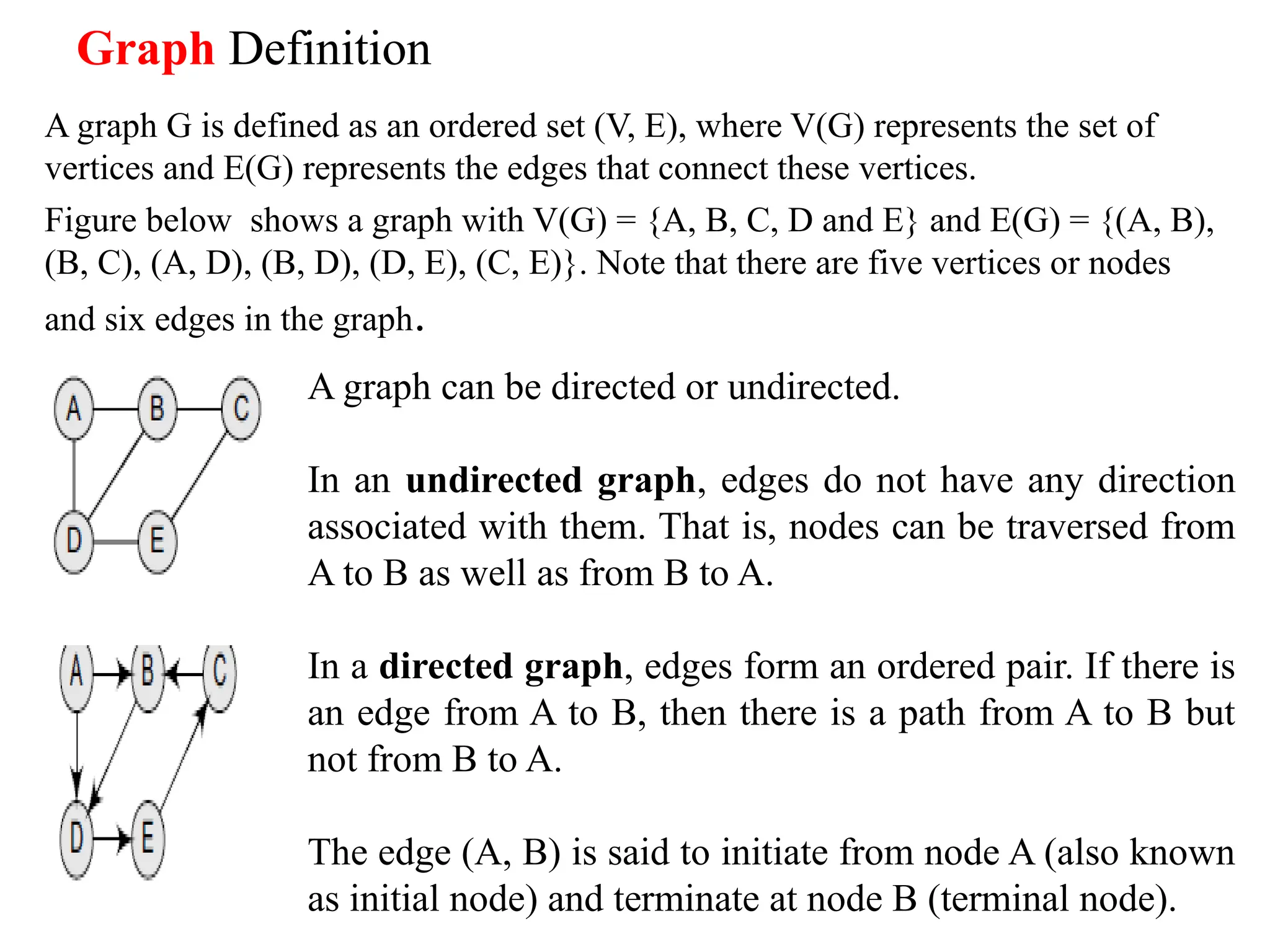
Figure below shows a graph with V(G) = {A, B, C, D and E} and E(G) = {(A, B),
(B, C), (A, D), (B, D), (D, E), (C, E)}. Note that there are five vertices or nodes
and six edges in the graph.
A graph can be directed or undirected.
In an undirected graph, edges do not have any direction
associated with them. That is, nodes can be traversed from
A to B as well as from B to A.
In a directed graph, edges form an ordered pair. If there is
an edge from A to B, then there is a path from A to B but
not from B to A.
The edge (A, B) is said to initiate from node A (also known
as initial node) and terminate at node B (terminal node).
Graph Terminology
Adjacent nodes or neighbors
For every edge, e = (u, v) that connects nodes u and v, the nodes u
and v are the end-points and are said to be the adjacent nodes or
neighbors.
Degree of a node
Degree of a node u, deg(u), is the total number of edges containing
the node u.
If deg(u) = 0, it means that u does not belong to any edge and such a
node is known as an isolated node.
Path A path P written as P = {v0, v1, v2, ..., vn), of length n from a
node u to v is defined as a sequence of (n+1) nodes. Here, u = v0, v =
vn and vi–1 is adjacent to vi for i = 1, 2, 3, ..., n.
Closed path A path P is known as a closed path if the edge has the
same end-points. That is, if v0 = vn.
Simple path A path P is known as a simple path if all the nodes in the
path are distinct with an exception that v0 may be equal to vn. If v0 =
vn, then the path is called a closed simple path.
Cycle A path in which the first and the last vertices are same. A simple
cycle has no repeated edges or vertices (except the first and last
vertices).
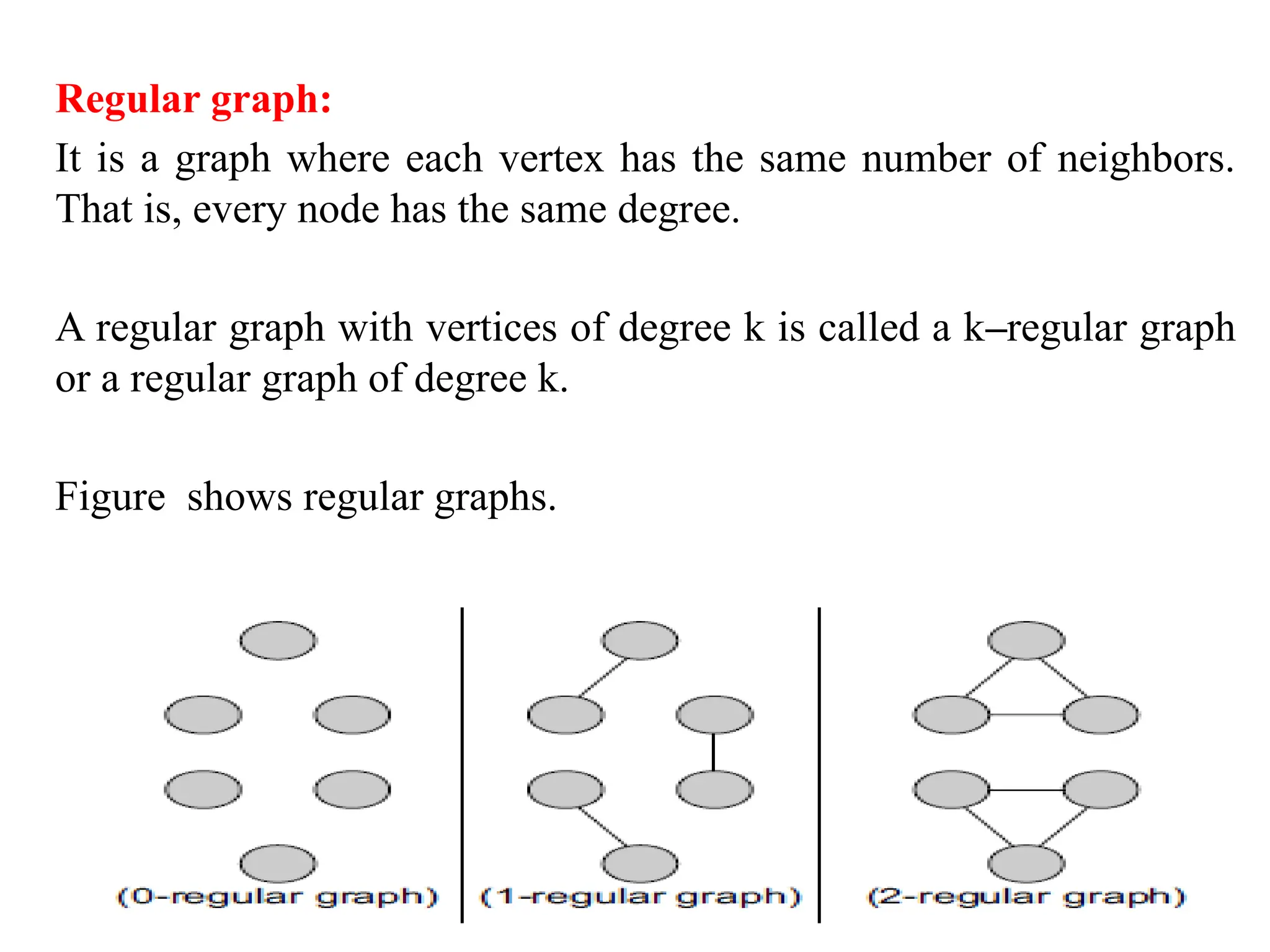
Regular graph:
It is a graph where each vertex has the same number of neighbors.
That is, every node has the same degree.
A regular graph with vertices of degree k is called a k–regular graph
or a regular graph of degree k.
Figure shows regular graphs.
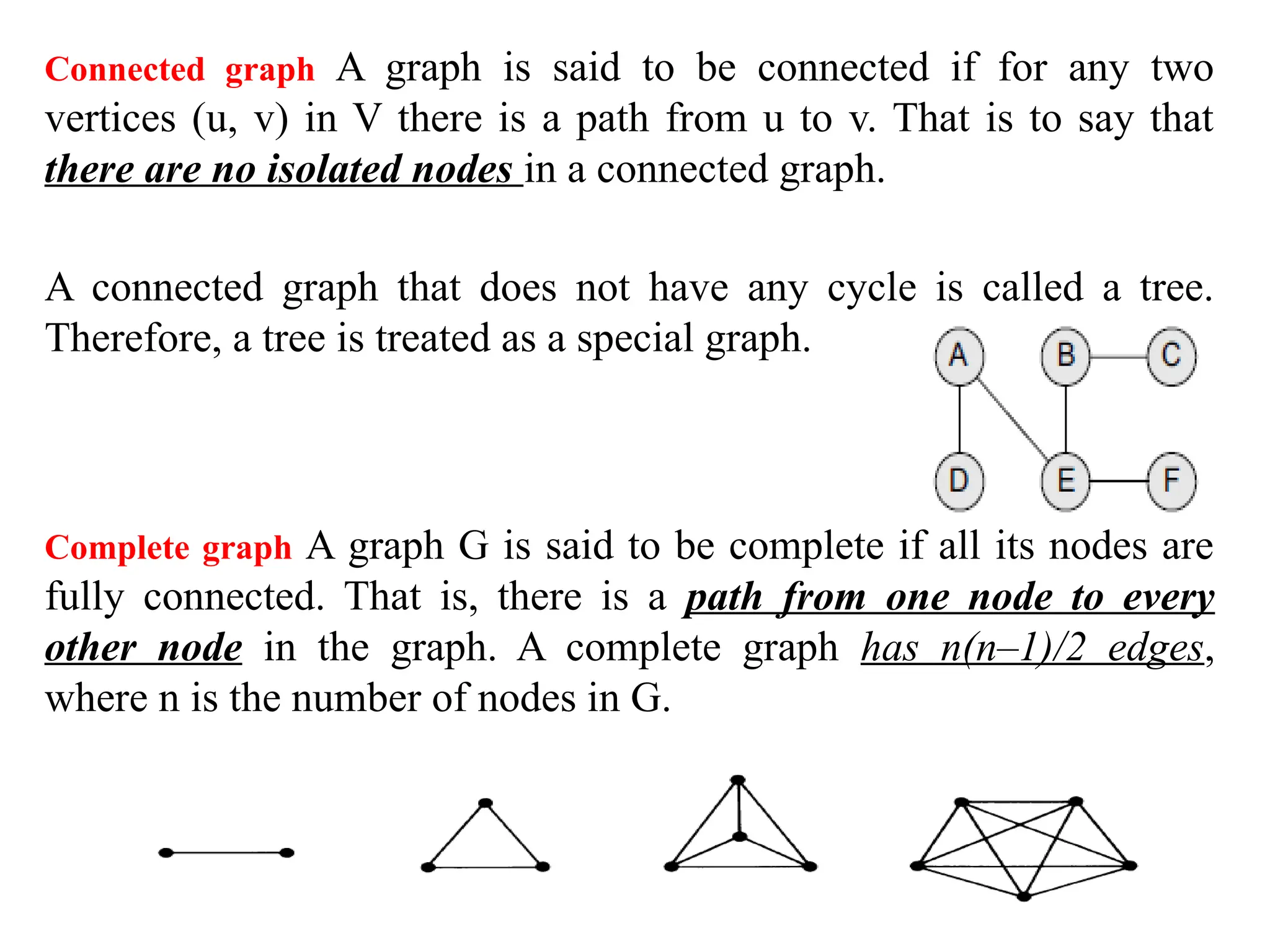
Connected graph A graph is said to be connected if for any two
vertices (u, v) in V there is a path from u to v. That is to say that
there are no isolated nodes in a connected graph.
A connected graph that does not have any cycle is called a tree.
Therefore, a tree is treated as a special graph.
Complete graph A graph G is said to be complete if all its nodes are
fully connected. That is, there is a path from one node to every
other node in the graph. A complete graph has n(n–1)/2 edges,
where n is the number of nodes in G.
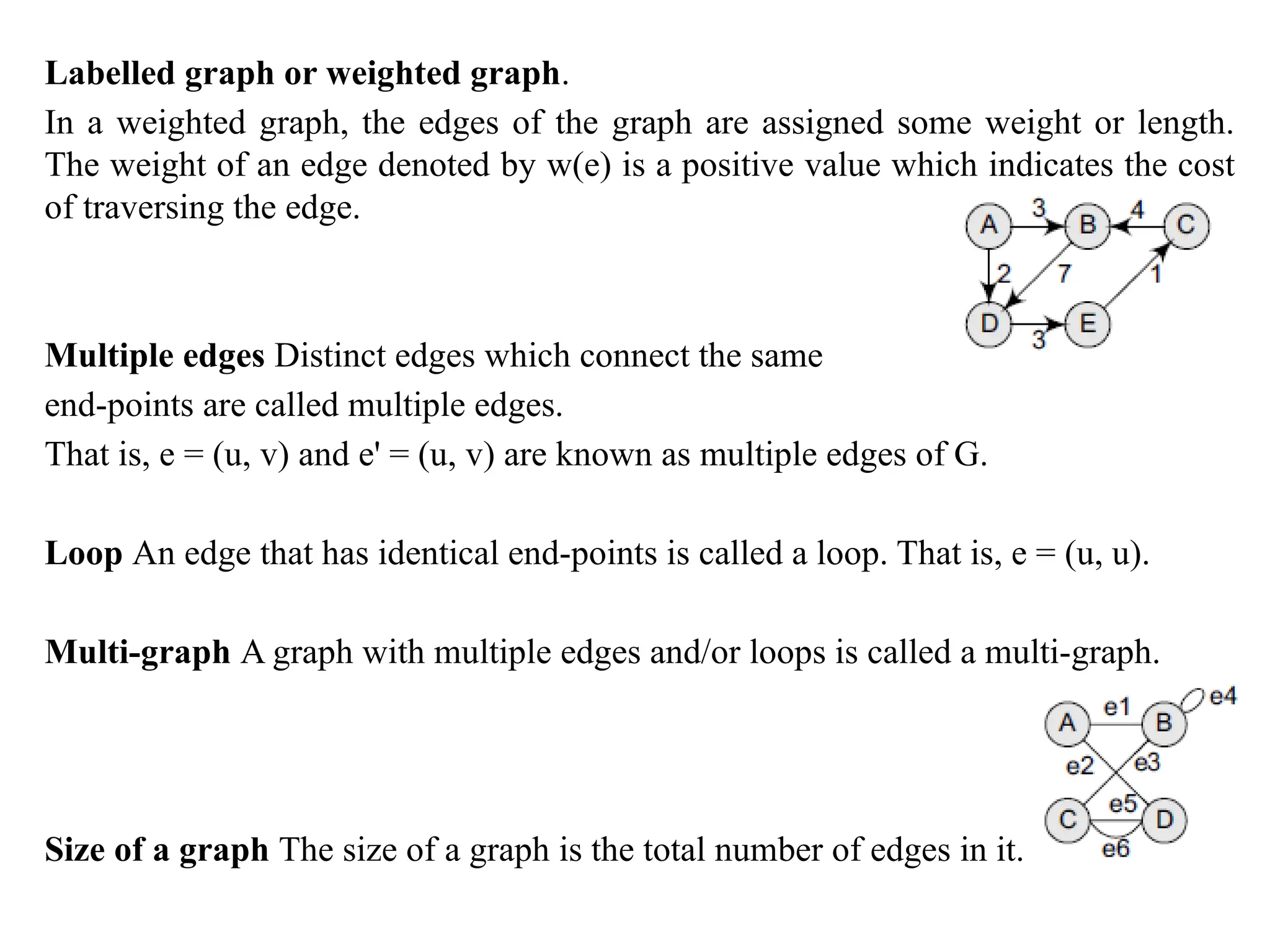
Labelled graph or weighted graph.
In a weighted graph, the edges of the graph are assigned some weight or length.
The weight of an edge denoted by w(e) is a positive value which indicates the cost
of traversing the edge.
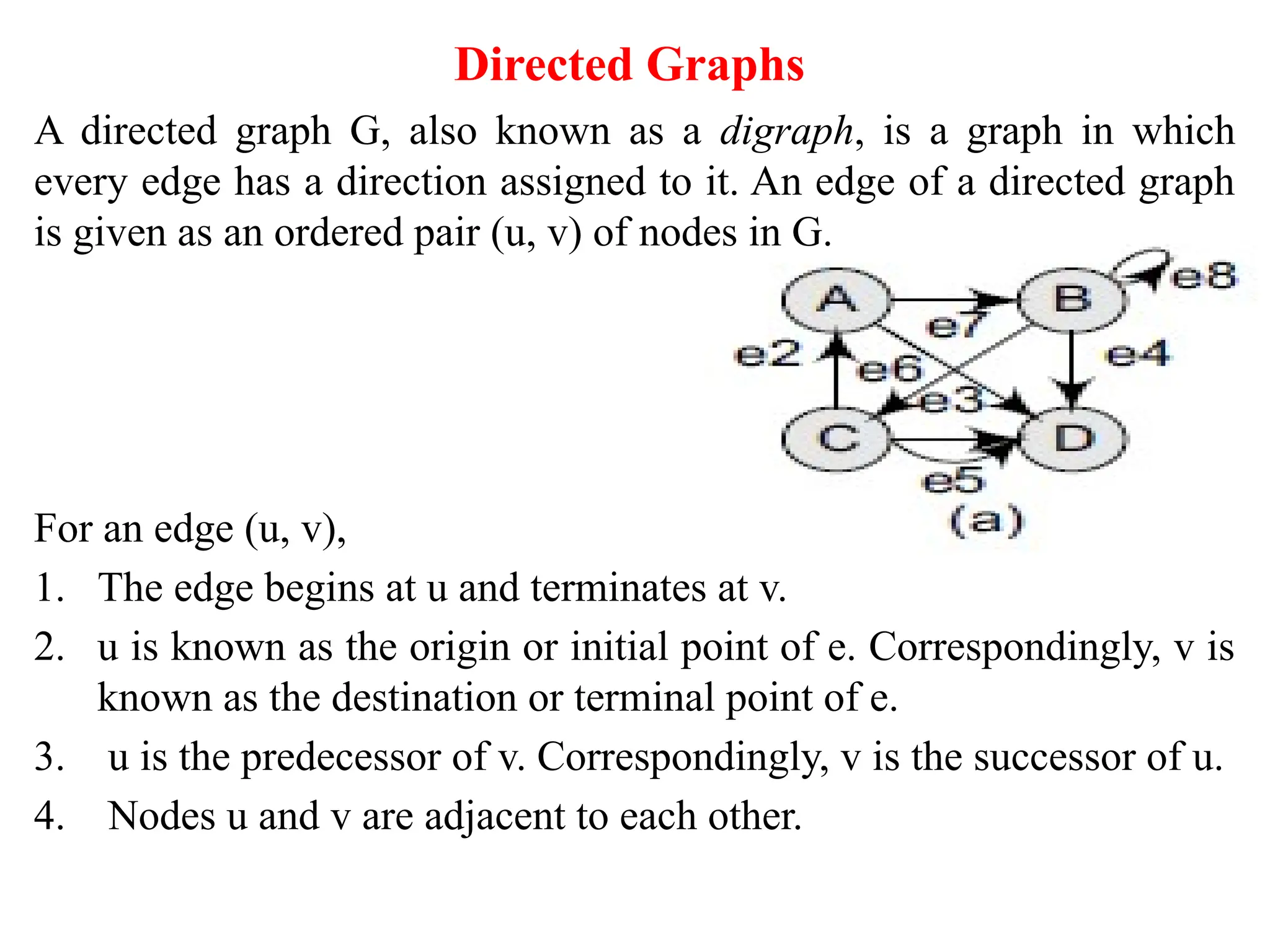
Multiple edges Distinct edges which connect the same
end-points are called multiple edges.
That is, e = (u, v) and e' = (u, v) are known as multiple edges of G.
Loop An edge that has identical end-points is called a loop. That is, e = (u, u).
Multi-graph A graph with multiple edges and/or loops is called a multi-graph.
Size of a graph The size of a graph is the total number of edges in it.
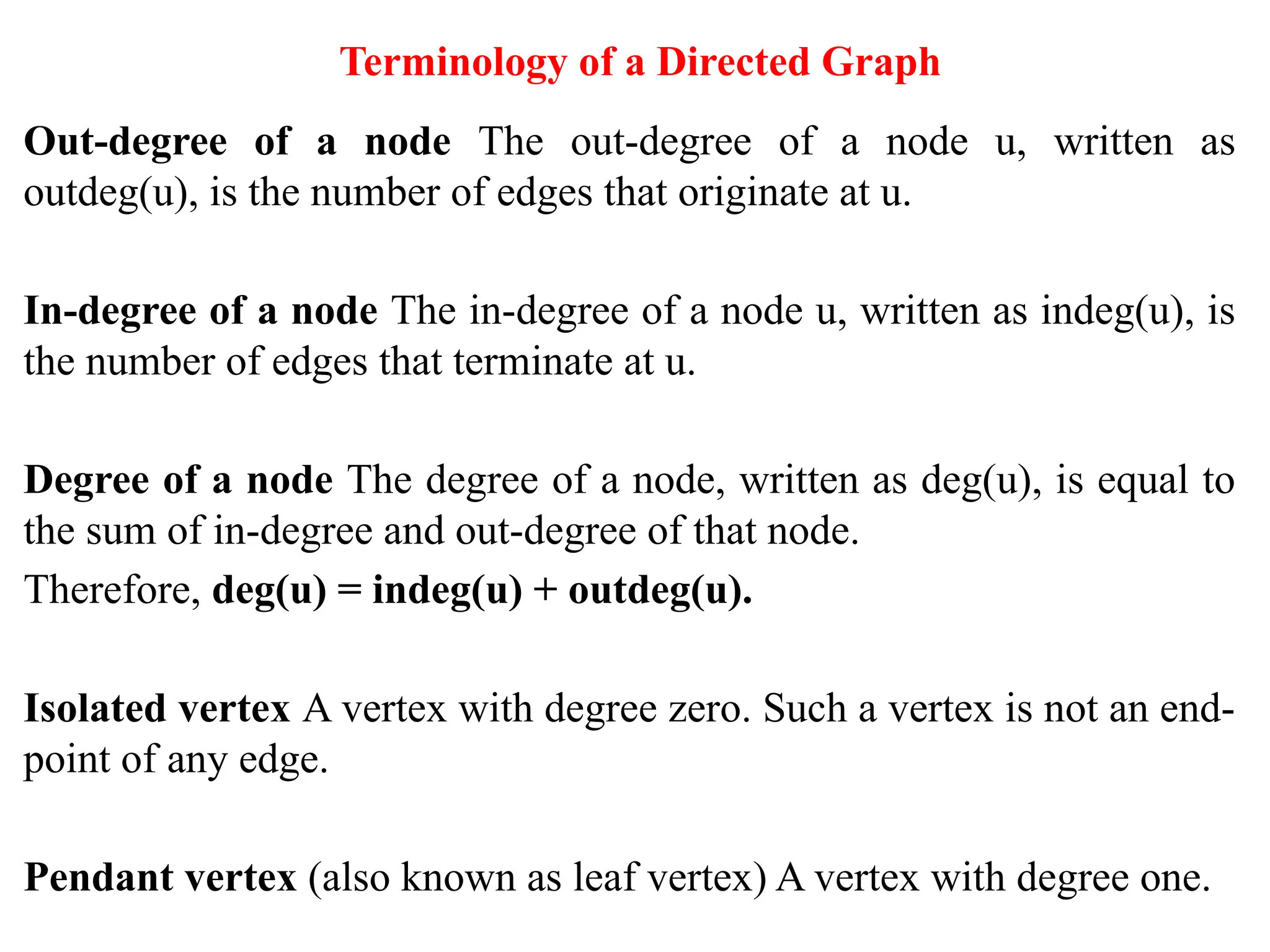
Directed Graphs
A directed graph G, also known as a digraph, is a graph in which
every edge has a direction assigned to it. An edge of a directed graph
is given as an ordered pair (u, v) of nodes in G.
For an edge (u, v),
1. The edge begins at u and terminates at v.
2. u is known as the origin or initial point of e. Correspondingly, v is
known as the destination or terminal point of e.
3. u is the predecessor of v. Correspondingly, v is the successor of u.
4. Nodes u and v are adjacent to each other.
Terminology of a Directed Graph
Out-degree of a node The out-degree of a node u, written as
outdeg(u), is the number of edges that originate at u.
In-degree of a node The in-degree of a node u, written as indeg(u), is
the number of edges that terminate at u.
Degree of a node The degree of a node, written as deg(u), is equal to
the sum of in-degree and out-degree of that node.
Therefore, deg(u) = indeg(u) + outdeg(u).
Isolated vertex A vertex with degree zero. Such a vertex is not an end-
point of any edge.
Pendant vertex (also known as leaf vertex) A vertex with degree one.
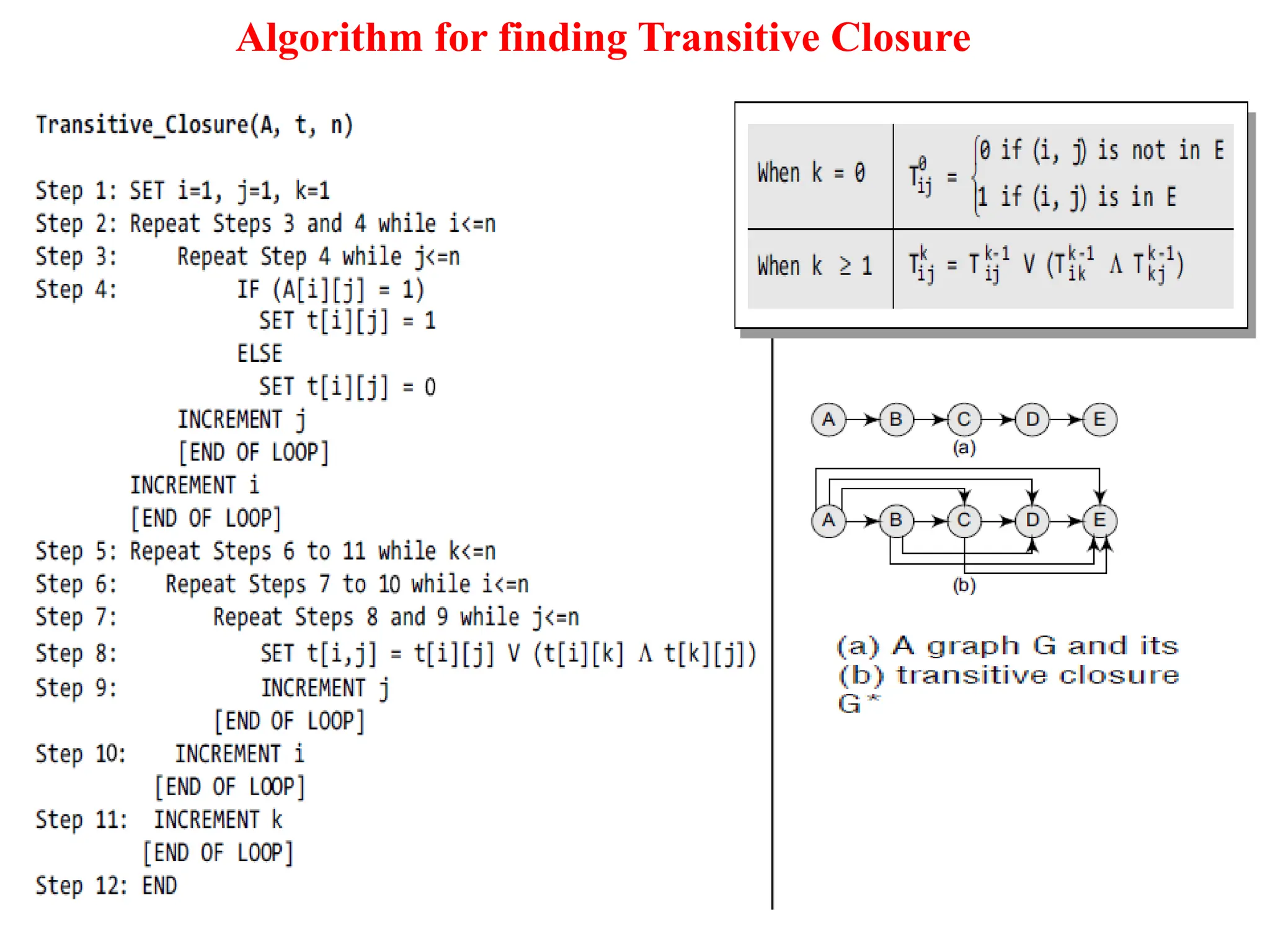
Transitive Closure of a Directed Graph
For a directed graph G = (V,E), the transitive closure of G is a graph G* =
(V,E*). In G*, for every vertex pair v, w in V there is an edge (v, w) in E* if
and only if there is a valid path from v to w in G.
Where and Why is it Needed?
Finding the transitive closure of a directed graph is an important problem in
the following computational tasks:
• Transitive closure is used to find the reachability analysis of transition
networks representing distributed and parallel systems.
• It is used in the construction of parsing automata in compiler
construction.
• transitive closure computation is being used to evaluate recursive
database queries (because almost all practical recursive queries are
transitive in nature).
Algorithm for finding Transitive Closure
REPRESENTATION OF GRAPHS
There are two common ways of storing graphs in the computer’s
memory. They are:
1. Sequential representation by using an adjacency matrix.
2. Linked representation by using an adjacency list that stores the
neighbors of a node using a linked list.
Adjacency Matrix Representation
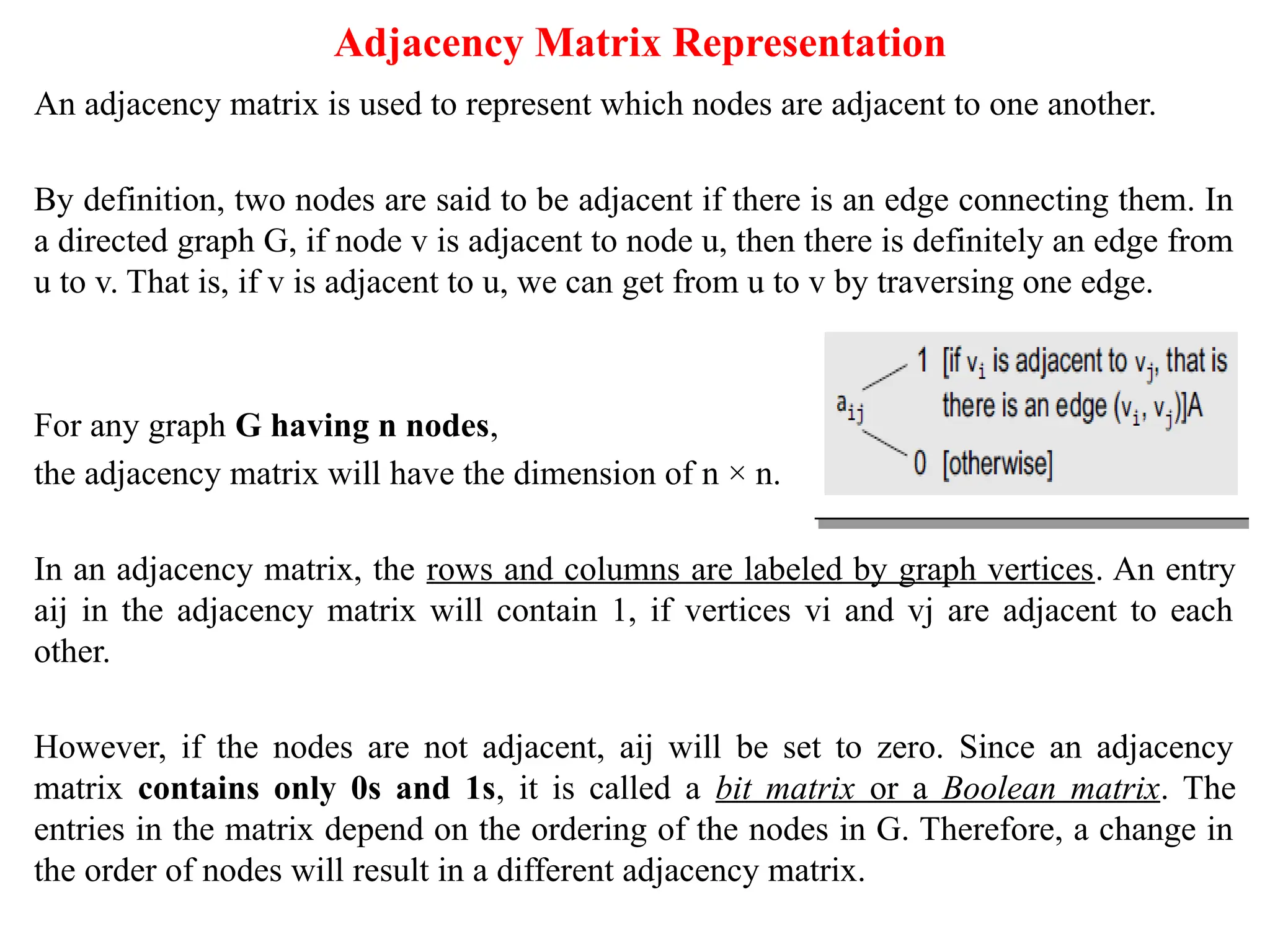
An adjacency matrix is used to represent which nodes are adjacent to one another.
By definition, two nodes are said to be adjacent if there is an edge connecting them. In
a directed graph G, if node v is adjacent to node u, then there is definitely an edge from
u to v. That is, if v is adjacent to u, we can get from u to v by traversing one edge.
For any graph G having n nodes,
the adjacency matrix will have the dimension of n × n.
In an adjacency matrix, the rows and columns are labeled by graph vertices. An entry
aij in the adjacency matrix will contain 1, if vertices vi and vj are adjacent to each
other.
However, if the nodes are not adjacent, aij will be set to zero. Since an adjacency
matrix contains only 0s and 1s, it is called a bit matrix or a Boolean matrix. The
entries in the matrix depend on the ordering of the nodes in G. Therefore, a change in
the order of nodes will result in a different adjacency matrix.
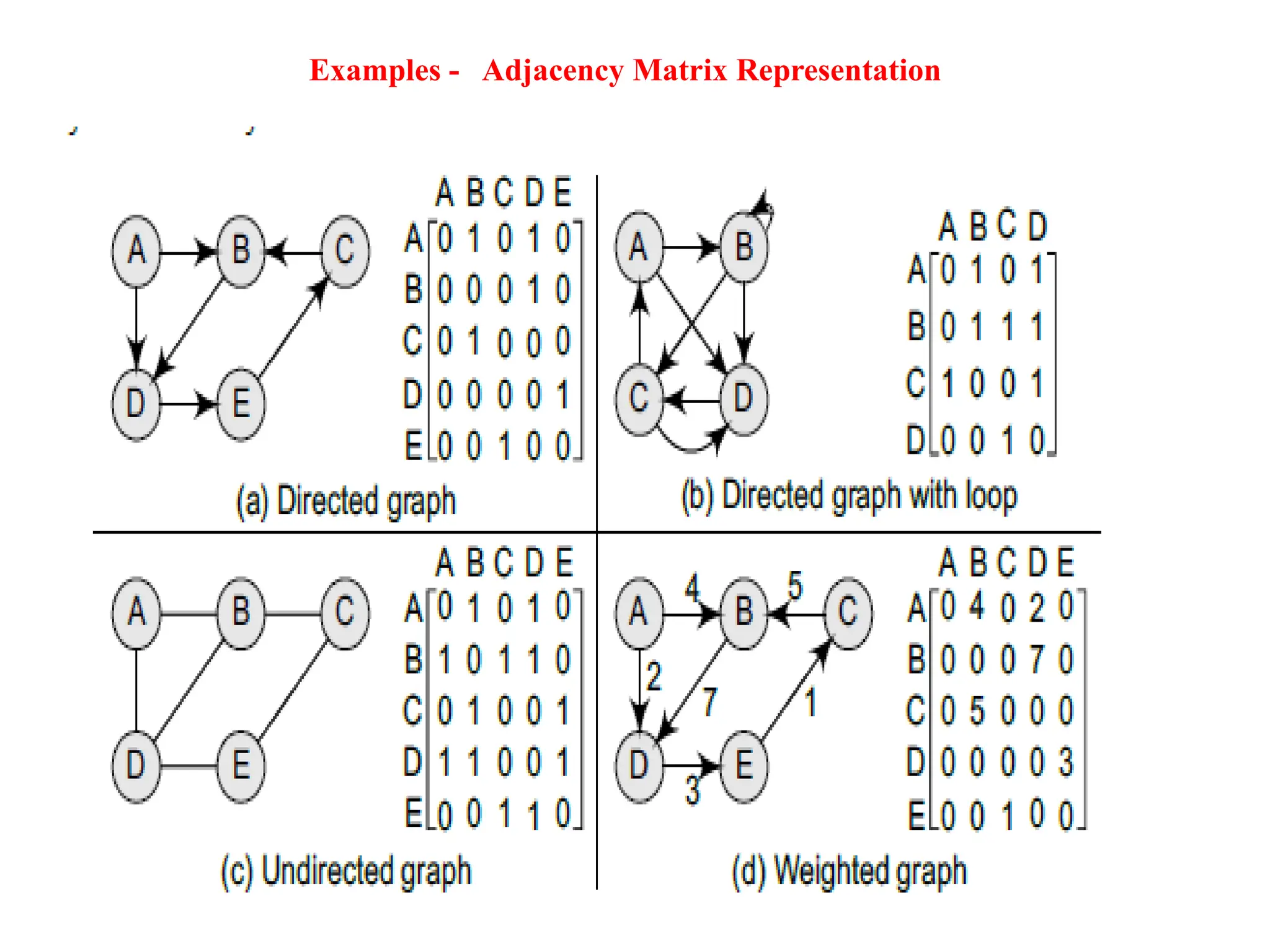
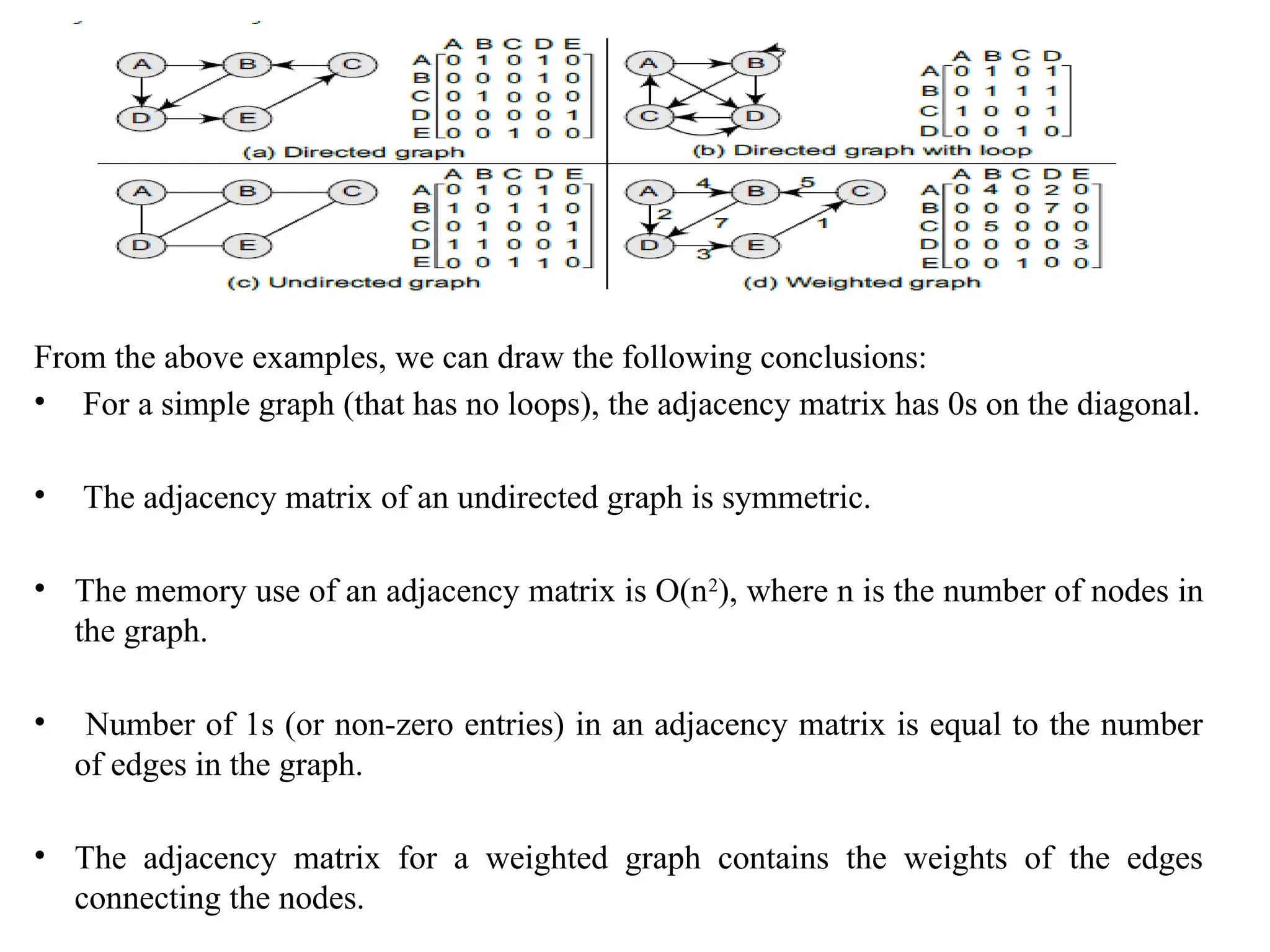
Examples - Adjacency Matrix Representation
From the above examples, we can draw the following conclusions:
• For a simple graph (that has no loops), the adjacency matrix has 0s on the diagonal.
• The adjacency matrix of an undirected graph is symmetric.
• The memory use of an adjacency matrix is O(n2
), where n is the number of nodes in
the graph.
• Number of 1s (or non-zero entries) in an adjacency matrix is equal to the number
of edges in the graph.
• The adjacency matrix for a weighted graph contains the weights of the edges
connecting the nodes.
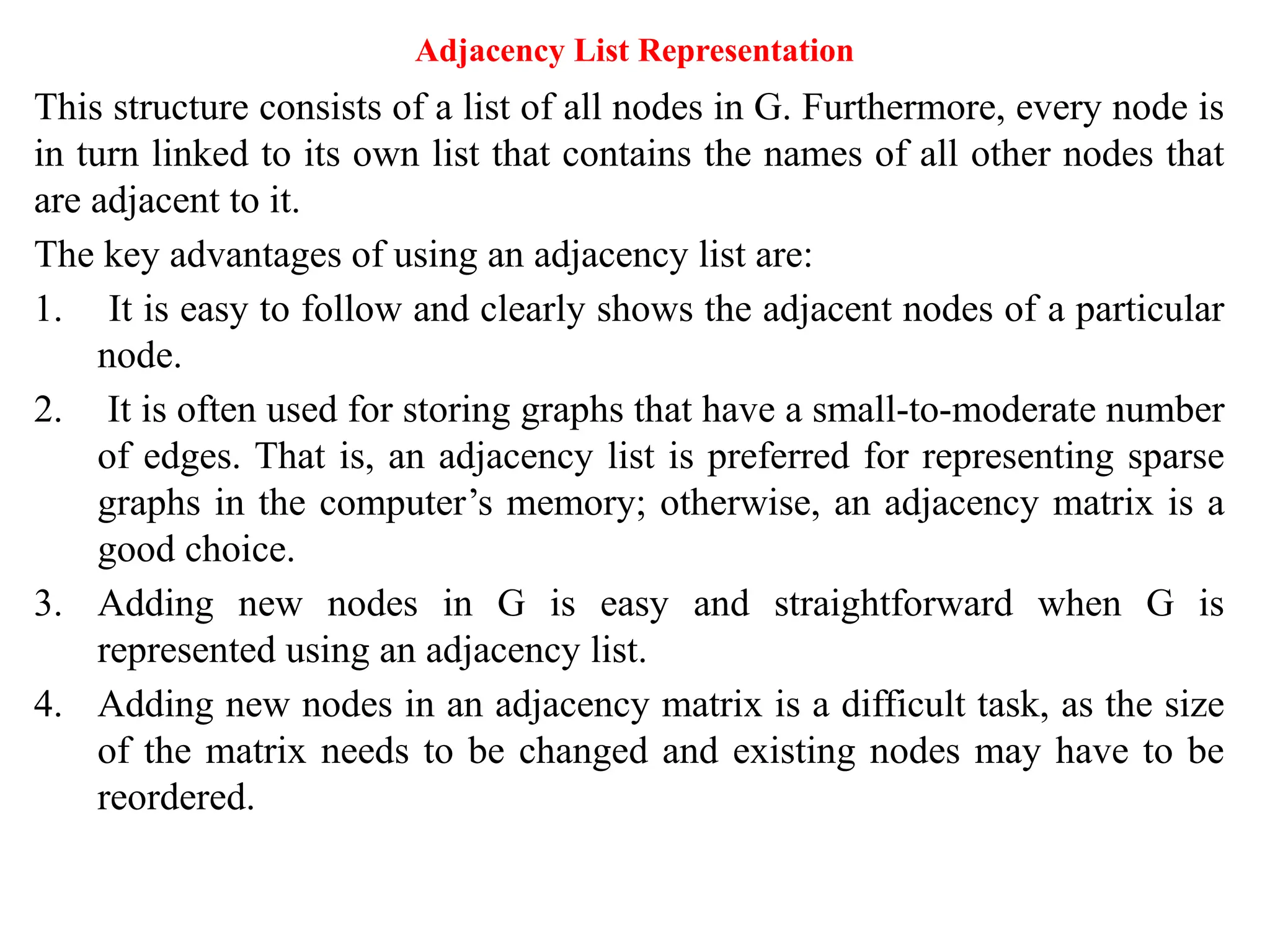
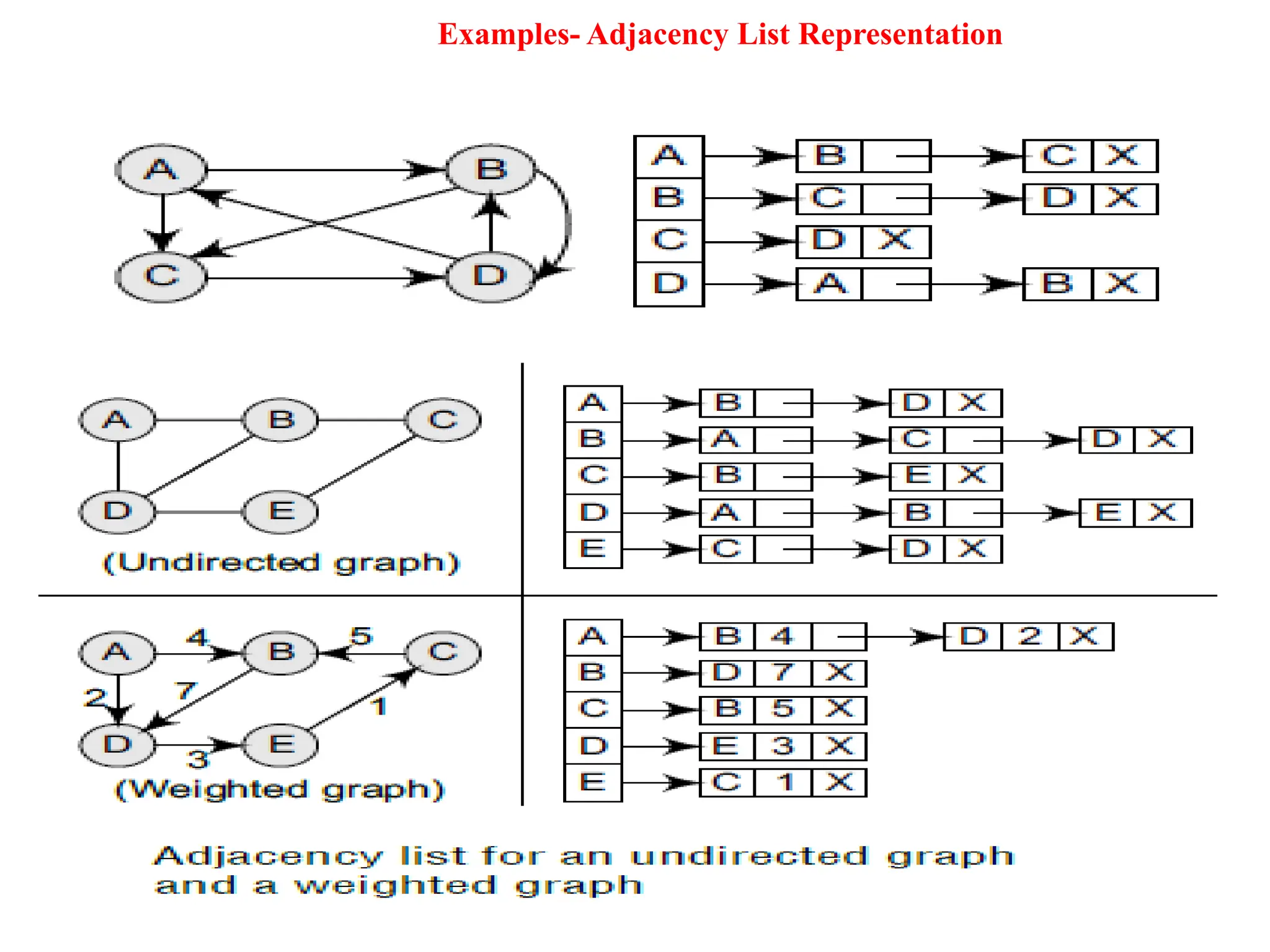
Adjacency List Representation
This structure consists of a list of all nodes in G. Furthermore, every node is
in turn linked to its own list that contains the names of all other nodes that
are adjacent to it.
The key advantages of using an adjacency list are:
1. It is easy to follow and clearly shows the adjacent nodes of a particular
node.
2. It is often used for storing graphs that have a small-to-moderate number
of edges. That is, an adjacency list is preferred for representing sparse
graphs in the computer’s memory; otherwise, an adjacency matrix is a
good choice.
3. Adding new nodes in G is easy and straightforward when G is
represented using an adjacency list.
4. Adding new nodes in an adjacency matrix is a difficult task, as the size
of the matrix needs to be changed and existing nodes may have to be
reordered.
Examples- Adjacency List Representation

Graphs aktu notes computer networks.pptx

  • 1.
  • 2.
    Graph Definition A graphG is defined as an ordered set (V, E), where V(G) represents the set of vertices and E(G) represents the edges that connect these vertices. Figure below shows a graph with V(G) = {A, B, C, D and E} and E(G) = {(A, B), (B, C), (A, D), (B, D), (D, E), (C, E)}. Note that there are five vertices or nodes and six edges in the graph. A graph can be directed or undirected. In an undirected graph, edges do not have any direction associated with them. That is, nodes can be traversed from A to B as well as from B to A. In a directed graph, edges form an ordered pair. If there is an edge from A to B, then there is a path from A to B but not from B to A. The edge (A, B) is said to initiate from node A (also known as initial node) and terminate at node B (terminal node).
  • 3.
    Graph Terminology Adjacent nodesor neighbors For every edge, e = (u, v) that connects nodes u and v, the nodes u and v are the end-points and are said to be the adjacent nodes or neighbors. Degree of a node Degree of a node u, deg(u), is the total number of edges containing the node u. If deg(u) = 0, it means that u does not belong to any edge and such a node is known as an isolated node.
  • 4.
    Path A pathP written as P = {v0, v1, v2, ..., vn), of length n from a node u to v is defined as a sequence of (n+1) nodes. Here, u = v0, v = vn and vi–1 is adjacent to vi for i = 1, 2, 3, ..., n. Closed path A path P is known as a closed path if the edge has the same end-points. That is, if v0 = vn. Simple path A path P is known as a simple path if all the nodes in the path are distinct with an exception that v0 may be equal to vn. If v0 = vn, then the path is called a closed simple path. Cycle A path in which the first and the last vertices are same. A simple cycle has no repeated edges or vertices (except the first and last vertices).
  • 5.
    Regular graph: It isa graph where each vertex has the same number of neighbors. That is, every node has the same degree. A regular graph with vertices of degree k is called a k–regular graph or a regular graph of degree k. Figure shows regular graphs.
  • 6.
    Connected graph Agraph is said to be connected if for any two vertices (u, v) in V there is a path from u to v. That is to say that there are no isolated nodes in a connected graph. A connected graph that does not have any cycle is called a tree. Therefore, a tree is treated as a special graph. Complete graph A graph G is said to be complete if all its nodes are fully connected. That is, there is a path from one node to every other node in the graph. A complete graph has n(n–1)/2 edges, where n is the number of nodes in G.
  • 7.
    Labelled graph orweighted graph. In a weighted graph, the edges of the graph are assigned some weight or length. The weight of an edge denoted by w(e) is a positive value which indicates the cost of traversing the edge. Multiple edges Distinct edges which connect the same end-points are called multiple edges. That is, e = (u, v) and e' = (u, v) are known as multiple edges of G. Loop An edge that has identical end-points is called a loop. That is, e = (u, u). Multi-graph A graph with multiple edges and/or loops is called a multi-graph. Size of a graph The size of a graph is the total number of edges in it.
  • 8.
    Directed Graphs A directedgraph G, also known as a digraph, is a graph in which every edge has a direction assigned to it. An edge of a directed graph is given as an ordered pair (u, v) of nodes in G. For an edge (u, v), 1. The edge begins at u and terminates at v. 2. u is known as the origin or initial point of e. Correspondingly, v is known as the destination or terminal point of e. 3. u is the predecessor of v. Correspondingly, v is the successor of u. 4. Nodes u and v are adjacent to each other.
  • 9.
    Terminology of aDirected Graph Out-degree of a node The out-degree of a node u, written as outdeg(u), is the number of edges that originate at u. In-degree of a node The in-degree of a node u, written as indeg(u), is the number of edges that terminate at u. Degree of a node The degree of a node, written as deg(u), is equal to the sum of in-degree and out-degree of that node. Therefore, deg(u) = indeg(u) + outdeg(u). Isolated vertex A vertex with degree zero. Such a vertex is not an end- point of any edge. Pendant vertex (also known as leaf vertex) A vertex with degree one.
  • 10.
    Transitive Closure ofa Directed Graph For a directed graph G = (V,E), the transitive closure of G is a graph G* = (V,E*). In G*, for every vertex pair v, w in V there is an edge (v, w) in E* if and only if there is a valid path from v to w in G. Where and Why is it Needed? Finding the transitive closure of a directed graph is an important problem in the following computational tasks: • Transitive closure is used to find the reachability analysis of transition networks representing distributed and parallel systems. • It is used in the construction of parsing automata in compiler construction. • transitive closure computation is being used to evaluate recursive database queries (because almost all practical recursive queries are transitive in nature).
  • 11.
    Algorithm for findingTransitive Closure
  • 12.
    REPRESENTATION OF GRAPHS Thereare two common ways of storing graphs in the computer’s memory. They are: 1. Sequential representation by using an adjacency matrix. 2. Linked representation by using an adjacency list that stores the neighbors of a node using a linked list.
  • 13.
    Adjacency Matrix Representation Anadjacency matrix is used to represent which nodes are adjacent to one another. By definition, two nodes are said to be adjacent if there is an edge connecting them. In a directed graph G, if node v is adjacent to node u, then there is definitely an edge from u to v. That is, if v is adjacent to u, we can get from u to v by traversing one edge. For any graph G having n nodes, the adjacency matrix will have the dimension of n × n. In an adjacency matrix, the rows and columns are labeled by graph vertices. An entry aij in the adjacency matrix will contain 1, if vertices vi and vj are adjacent to each other. However, if the nodes are not adjacent, aij will be set to zero. Since an adjacency matrix contains only 0s and 1s, it is called a bit matrix or a Boolean matrix. The entries in the matrix depend on the ordering of the nodes in G. Therefore, a change in the order of nodes will result in a different adjacency matrix.
  • 14.
    Examples - AdjacencyMatrix Representation
  • 15.
    From the aboveexamples, we can draw the following conclusions: • For a simple graph (that has no loops), the adjacency matrix has 0s on the diagonal. • The adjacency matrix of an undirected graph is symmetric. • The memory use of an adjacency matrix is O(n2 ), where n is the number of nodes in the graph. • Number of 1s (or non-zero entries) in an adjacency matrix is equal to the number of edges in the graph. • The adjacency matrix for a weighted graph contains the weights of the edges connecting the nodes.
  • 16.
    Adjacency List Representation Thisstructure consists of a list of all nodes in G. Furthermore, every node is in turn linked to its own list that contains the names of all other nodes that are adjacent to it. The key advantages of using an adjacency list are: 1. It is easy to follow and clearly shows the adjacent nodes of a particular node. 2. It is often used for storing graphs that have a small-to-moderate number of edges. That is, an adjacency list is preferred for representing sparse graphs in the computer’s memory; otherwise, an adjacency matrix is a good choice. 3. Adding new nodes in G is easy and straightforward when G is represented using an adjacency list. 4. Adding new nodes in an adjacency matrix is a difficult task, as the size of the matrix needs to be changed and existing nodes may have to be reordered.
  • 17.