Download to read offline






![n1 = number of grains completely inside the
test circle
n2 = number of grains intercepting
circle
the
NA = f[ n1 + (n2/2)]
f = Jeffries multiplier
f = magnification2/circle area](https://image.slidesharecdn.com/grainsizemeasurement-220912012842-9c2c3790/85/Grain_Size_Measurement-pptx-43-320.jpg)


![NA = f[n1 + (n2/2)]
NA = (0.497)[68 + (41/2)]
mm-2
NA = 44.02](https://image.slidesharecdn.com/grainsizemeasurement-220912012842-9c2c3790/85/Grain_Size_Measurement-pptx-47-320.jpg)

![1
The great Russian stereologist, SarkisA.
Saltykov, showed that as n1 decreases, bias
results. He recommended using a square or
rectangular test figure. Intercepted grains at the
corner are not counted (assumed to be 1). n2 is
the number of grains intersecting the four sides,
but not the corners. n1 is the number of grains
inside the test figure, as before.
NA = f[n1 + (n2/2) + 1]](https://image.slidesharecdn.com/grainsizemeasurement-220912012842-9c2c3790/85/Grain_Size_Measurement-pptx-49-320.jpg)
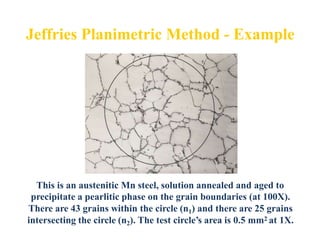
![NA = f[n1 + (n2/2)]
f = [(1002)/5000]
mm-2
NA = 2[43 + (25/2)] = 111
G = [3.22Log10(111)] – 2.954 = 3.8
(Of course, more than one field should be measured to get
good statistical results)](https://image.slidesharecdn.com/grainsizemeasurement-220912012842-9c2c3790/85/Grain_Size_Measurement-pptx-51-320.jpg)


![—
1
—
1
1
—
PL
Mean Lineal Intercept, l = =
NL
G = [6.644Log10(NL or PL)] – 3.288
G = [-6.644Log10(l)] – 3.288
mm-1
Note: Units are in (for NL and PL) or mm (for l)](https://image.slidesharecdn.com/grainsizemeasurement-220912012842-9c2c3790/85/Grain_Size_Measurement-pptx-56-320.jpg)


![LT = 11.4 mm
N = 41 + 25 + 20 = 86
—
8—
6
11.4
mm-1
NL = = 7.54
l = —1— = 0.133
7.54
mm
G = [-6.644Log10(0.133)] – 3.288 = 2.5](https://image.slidesharecdn.com/grainsizemeasurement-220912012842-9c2c3790/85/Grain_Size_Measurement-pptx-60-320.jpg)

![Intercept Grain Size Example – Single Phase
75
mm-1
PL = ——— = 15
500/100
l = —1
— = 0.067
15
mm
G = [-6.644Log10(0.067)] – 3.288 = 4.5](https://image.slidesharecdn.com/grainsizemeasurement-220912012842-9c2c3790/85/Grain_Size_Measurement-pptx-62-320.jpg)

![Intercept Grain Size Example:
Single Phase Twinned Grain Structure
63
mm-1
PL = ——— = 12.6
500/100
l = —1— = 0.0794 mm
12.6
G = [-6.644Log10(0.0794)] – 3.288 = 4](https://image.slidesharecdn.com/grainsizemeasurement-220912012842-9c2c3790/85/Grain_Size_Measurement-pptx-64-320.jpg)


![(0.485)(500/500)
l = ———————— = 0.006382 mm
76
G = [-6.644Log10(0.006382)] – 3.288 = 11.3](https://image.slidesharecdn.com/grainsizemeasurement-220912012842-9c2c3790/85/Grain_Size_Measurement-pptx-67-320.jpg)
![Because the grain size of hardened high speed tool steels is generally around
G = 9 to 12, Snyder and Graff proposed an alternate intercept method. In
this range NA changes by a factor of 10 and the mean lineal intercept length,
l, varies from 14.1 to 5 µm.
To increase the sensitivity to these small variations, they suggested doing an
intercept count at 1000X using a 5-inch (127-mm) test line. The number of
grains intercepted by the line is counted. This is repeated for 10 random
placements of the test line. The average value of the number of intercepted
grains is the S-G intercept grain size number.
ASTM G can be calculated from the NIS-G value:
G = [6.635Log10(NIS-G)] + 2.66](https://image.slidesharecdn.com/grainsizemeasurement-220912012842-9c2c3790/85/Grain_Size_Measurement-pptx-68-320.jpg)


This document discusses various methods that have been developed and standardized over time for characterizing and quantifying grain size in metals. Some key points: - Early methods involved planimetry and measuring grain boundaries intercepted by test lines or circles under the microscope. Standard charts were developed correlating these measurements to grain size numbers. - Fracture surface comparisons were also used to characterize prior austenite grain size in steels. The Shepherd method from 1934 established a scale of 10 fractures corresponding to grain size numbers 1 through 10. - Standardization organizations like ASTM have developed and refined standards over decades, incorporating new methods and addressing criticisms of early charts and techniques. Current standards cover various grain structure types


