Eindhoven University of Technology
Department of Applied Physics
Group Physics of Nanostructures (FNA)
Electron Beam Induced
Deposition of Iron
exploring the surface processes governing
EBID
M. Beljaars
August, 2008
Supervisors:
R. Lavrijsen, M.Sc. (TU/e)
prof.dr.ir. H.J.M. Swagten (TU/e)
prof.dr. B. Koopmans (TU/e)
dr.ir. J.J.L. Mulders (FEI company)
About this research
This research is part of a collaboration between FEI com-
pany and the research group Physics of Nanostructures at
the Technical University of Eindhoven (TU/e). A part of
the experiments has been performed at FEI company on a
FEI Nova Nanolab 600i. The other part of the experiments
has been conducted at the TU/e on an identical system.
This project has been carried out under supervision of dr.ir.
J.J.L. Mulders from FEI company and R. Lavrijsen, M.Sc.,
prof.dr.ir. H.J.M. Swagten and prof.dr. B. Koopmans from
TU/e.
Abstract
In this thesis the properties of iron depositions, created with Electron Beam
Induced Deposition (EBID) are investigated. In EBID a precursor gas is intro-
duced in a vacuum system, which adsorbs on a sample substrate. Subsequently
the adsorbed molecules are decomposed in volatile and non volatile fractions
by local irradiation with electrons. By precipitation of the non volatile parts a
deposition is formed. The deposition of iron by means of EBID is relatively un-
explored. The combination of the local, direct structuring capabilities of EBID
and the ferromagnetic properties of iron are a promising combination for the field
of Spintronics.
Two different iron precursors, Fe3(CO)12 (TIDC) and Fe2(CO)9 (DINC), are in-
vestigated. Both these precursors are characterized by deposition yield, composi-
tion of the resulting depositions and, on a preliminary level, magnetic properties.
Due to the limited flux of both precursors, the yield depends on the used beam
current. Characteristic values for the yield of TIDC and DINC are 10−3
and 10−4
µm3
nC−1
respectively at a electron beam current of 1 nA. The composition of
the DINC depositions is found to depend on the beam current used to create the
depositions. At low currents the found Fe content is 25 atomic %, which con-
verges at high currents to 60 atomic %. The TIDC depositions are found to have
a typical Fe content of 51 atomic %, independent of beam current. The prelim-
inary magnetic characterization of the TIDC depositions show a paramagnetic,
and possibly ferromagnetic behavior. The structures in the DINC depositions,
visualized with MFM, strongly indicate a ferromagnetic ordering.
The greater part of this thesis deals with the enhanced deposition at the edges,
that can arise as a consequence of surface diffusion. In this part of the thesis the
focus lies on the TIDC precursor. The TIDC precursor is shipped in methanol to
protect it from air. This methanol is seen to be of great influence on the shape
of the depositions. An experiment where isopropanol is introduced in the system
confirms the significant effect of volatile contamination on the depositions. A
analytical model and accompanying computer simulation is developed to study
these shapes. Experimentally, diffusion is studied by the creation of depositions
at different temperatures and different waiting times between consecutive depo-
sition passes. It is observed that the depositions change shape with temperature
and waiting time, in accordance with the model.
Preface
Dear reader,
You have just started reading an extensive thesis on the Electron Beam Induced
Deposition (EBID) of iron. The main reason for its size is the fact that the
technique of EBID and the related scientific equipment are new to the research
group Physics of Nanostructures. In that sense this thesis can be also be seen as
a first exploration of our recently obtained nanostructuring tool, the FEI Nova
Nanolab 600i dual beam. Therefore we have chosen to elaborate somewhat more
on details, that may not be directly relevant for the interpretation of the results
of this thesis, but do contribute to the overall understanding of EBID and the
Nova Nanolab.
The reader who finds himself acquainted with part of the subjects presented
in this thesis, may want to skip some of the corresponding chapters. Therefore,
at the end of chapter 1 Introduction a guide to this thesis is given. Based on
this guide, the reader can decide which chapters are of his interest.
Please note that for your convenience a glossary of frequently used abbreviations
is added on page 106. I hope you will enjoy reading this thesis.
Contents
1 Introduction 1
1.1 The discovery of the electron . . . . . . . . . . . . . . . . . . . . . 1
1.2 The origin of dia- and paramagnetism . . . . . . . . . . . . . . . . 3
1.3 The mystery of spontaneous magnetization . . . . . . . . . . . . . 3
1.4 Give it a spin . . . . . . . . . . . . . . . . . . . . . . . . . . . . . 4
1.5 The rise of Spintronics . . . . . . . . . . . . . . . . . . . . . . . . 5
1.6 Short tutorial to EBID . . . . . . . . . . . . . . . . . . . . . . . . 6
1.7 Guide to this thesis . . . . . . . . . . . . . . . . . . . . . . . . . . 7
2 EBID and Iron Deposition 9
2.1 The wonderful world of EBID . . . . . . . . . . . . . . . . . . . . 9
2.2 Beam Induced Structuring Techniques . . . . . . . . . . . . . . . 11
2.2.1 Ions versus electrons . . . . . . . . . . . . . . . . . . . . . 12
2.2.2 In conclusion . . . . . . . . . . . . . . . . . . . . . . . . . 17
2.3 Iron precursors . . . . . . . . . . . . . . . . . . . . . . . . . . . . 18
2.4 The ideal precursor . . . . . . . . . . . . . . . . . . . . . . . . . . 18
2.4.1 Literary survey on EBID deposited iron . . . . . . . . . . 19
2.4.2 Our approach . . . . . . . . . . . . . . . . . . . . . . . . . 22
3 Physical Processes in EBID 24
3.1 Origin of EBID . . . . . . . . . . . . . . . . . . . . . . . . . . . . 24
3.2 Electron Beam Induced Deposition . . . . . . . . . . . . . . . . . 24
3.2.1 Electron - substrate interactions . . . . . . . . . . . . . . . 25
3.2.2 Precursor - substrate interactions . . . . . . . . . . . . . . 31
3.2.3 Electron - precursor interactions . . . . . . . . . . . . . . . 32
4 Experimental Tool Box 33
4.1 FEI Nova Nanolab 600i dual beam . . . . . . . . . . . . . . . . . 33
4.1.1 Detectors and imaging . . . . . . . . . . . . . . . . . . . . 37
4.1.2 Gas injection system . . . . . . . . . . . . . . . . . . . . . 44
4.1.3 Precursors . . . . . . . . . . . . . . . . . . . . . . . . . . . 45
4.2 Topology characterization tools . . . . . . . . . . . . . . . . . . . 47
4.2.1 Scanning Electron Microscopy . . . . . . . . . . . . . . . . 47
4.2.2 Atomic Force Microscopy . . . . . . . . . . . . . . . . . . . 47
4.3 Electric characterization tools . . . . . . . . . . . . . . . . . . . . 48
4.4 Magnetic characterization tools . . . . . . . . . . . . . . . . . . . 48
4.4.1 SQUID . . . . . . . . . . . . . . . . . . . . . . . . . . . . . 49
i
ii CONTENTS
4.4.2 MOKE . . . . . . . . . . . . . . . . . . . . . . . . . . . . . 50
4.4.3 Magnetic Force Microscopy (MFM) . . . . . . . . . . . . . 51
5 Results: Precursor Characterization 52
5.1 Yield . . . . . . . . . . . . . . . . . . . . . . . . . . . . . . . . . . 52
5.2 EDS analysis . . . . . . . . . . . . . . . . . . . . . . . . . . . . . 55
5.2.1 EDS on a Co-Fe wedge . . . . . . . . . . . . . . . . . . . . 56
5.2.2 Composition iron depositions . . . . . . . . . . . . . . . . 60
5.3 Magnetic characterization by MFM . . . . . . . . . . . . . . . . . 64
6 Modeling EBID 67
6.1 Understanding surface processes of EBID . . . . . . . . . . . . . . 67
6.2 Analytical Model . . . . . . . . . . . . . . . . . . . . . . . . . . . 71
6.2.1 Adsorption . . . . . . . . . . . . . . . . . . . . . . . . . . 71
6.2.2 Desorption . . . . . . . . . . . . . . . . . . . . . . . . . . . 72
6.2.3 Diffusion . . . . . . . . . . . . . . . . . . . . . . . . . . . . 73
6.2.4 Deposition . . . . . . . . . . . . . . . . . . . . . . . . . . . 74
6.2.5 Final expression . . . . . . . . . . . . . . . . . . . . . . . . 75
6.2.6 Implications of the model . . . . . . . . . . . . . . . . . . 75
6.2.7 In conclusion . . . . . . . . . . . . . . . . . . . . . . . . . 78
6.3 Numerical implementation . . . . . . . . . . . . . . . . . . . . . . 79
6.3.1 Adsorption & desorption . . . . . . . . . . . . . . . . . . . 79
6.3.2 Diffusion . . . . . . . . . . . . . . . . . . . . . . . . . . . . 79
6.3.3 Deposition . . . . . . . . . . . . . . . . . . . . . . . . . . . 80
6.3.4 Simulation test case . . . . . . . . . . . . . . . . . . . . . . 80
6.4 In conclusion . . . . . . . . . . . . . . . . . . . . . . . . . . . . . 82
7 Results: Shape Analysis 83
7.1 About the experiments . . . . . . . . . . . . . . . . . . . . . . . . 83
7.2 Influence of substrate temperature . . . . . . . . . . . . . . . . . . 85
7.3 Influence of volatile contamination . . . . . . . . . . . . . . . . . 88
7.4 Influence of waiting time . . . . . . . . . . . . . . . . . . . . . . . 90
7.5 Iron precursors compared . . . . . . . . . . . . . . . . . . . . . . . 91
7.6 In conclusion . . . . . . . . . . . . . . . . . . . . . . . . . . . . . 92
8 Conclusions 93
8.1 Precursor characterization . . . . . . . . . . . . . . . . . . . . . . 93
8.2 EDS quantification of thin films . . . . . . . . . . . . . . . . . . . 94
8.3 Model & simulation . . . . . . . . . . . . . . . . . . . . . . . . . . 94
8.4 Shape analysis . . . . . . . . . . . . . . . . . . . . . . . . . . . . . 94
8.4.1 Presence of volatile contamination . . . . . . . . . . . . . . 95
8.4.2 Diffusion study . . . . . . . . . . . . . . . . . . . . . . . . 95
CONTENTS iii
9 Outlook 97
9.1 This thesis . . . . . . . . . . . . . . . . . . . . . . . . . . . . . . . 97
9.1.1 Precursor characterization . . . . . . . . . . . . . . . . . . 97
9.1.2 Model & Simulation . . . . . . . . . . . . . . . . . . . . . 98
9.1.3 Shape analysis . . . . . . . . . . . . . . . . . . . . . . . . . 99
9.2 Purity enhancement . . . . . . . . . . . . . . . . . . . . . . . . . 99
9.2.1 In situ treatment . . . . . . . . . . . . . . . . . . . . . . . 100
9.2.2 Ex situ treatment . . . . . . . . . . . . . . . . . . . . . . . 100
9.3 Electrical characterization . . . . . . . . . . . . . . . . . . . . . . 100
References 102
Acknowledgements 104
Glossary 107
A Formal Derivation 109
A.1 Adsorption & desorption . . . . . . . . . . . . . . . . . . . . . . . 109
A.2 Adsorption . . . . . . . . . . . . . . . . . . . . . . . . . . . . . . . 110
A.3 Desorption . . . . . . . . . . . . . . . . . . . . . . . . . . . . . . . 111
A.4 Diffusion . . . . . . . . . . . . . . . . . . . . . . . . . . . . . . . . 111
B Effective Beam Profile 114
C Simulation Flowchart 118
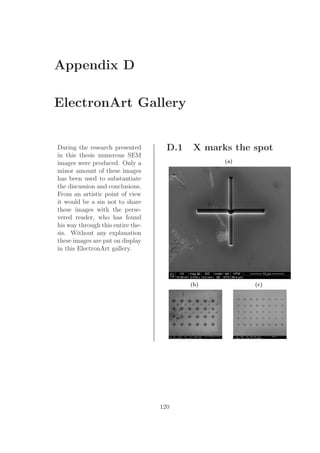
D ElectronArt Gallery 120
D.1 X marks the spot . . . . . . . . . . . . . . . . . . . . . . . . . . . 120
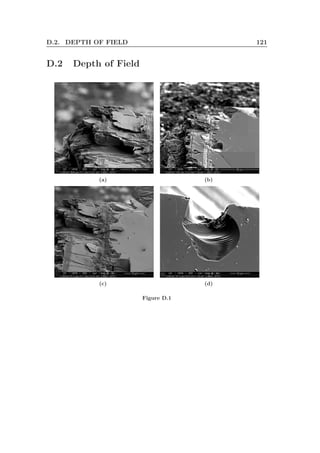
D.2 Depth of Field . . . . . . . . . . . . . . . . . . . . . . . . . . . . . 121
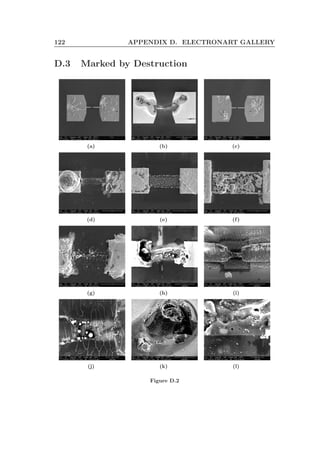
D.3 Marked by Destruction . . . . . . . . . . . . . . . . . . . . . . . . 122
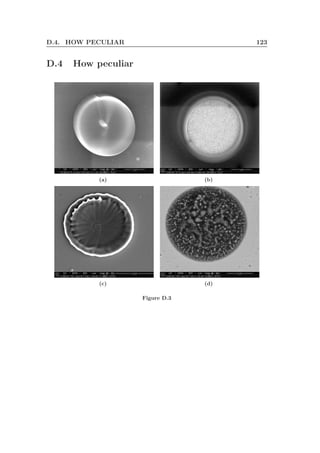
D.4 How peculiar . . . . . . . . . . . . . . . . . . . . . . . . . . . . . 123
Chapter 1
Introduction
The first part of this chapter will give a general introduction to the research field
of Spintronics, beginning with the discovery of the electron and the exploration
of its properties. In section 1.5 the rise of Spintronics is described, followed by a
section containing a brief introduction to Electron Beam Induced Deposition. In
the last section the framework of this thesis is explained.
As will become clear in the chapters to come, the electron plays a crucial role in
this thesis. Therefore I would like to start by taking you back more than a cen-
tury, to the century of Michael Faraday, Thomas Edison and George Ohm. These
gentlemen of grand prestige all contributed to the unraveling of the phenomenon
of electricity. But it was only at the end of the 19th century that mankind really
started to understand the origin of electricity.
1.1 The discovery of the electron
”Could anything at first sight seem more impractical than a body which
is so small that its mass is an insignificant fraction of the mass of an
atom of hydrogen?” – J.J. Thomson.
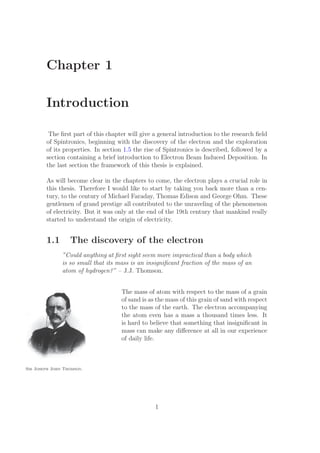
The mass of atom with respect to the mass of a grain
Sir Joseph John Thomson.
of sand is as the mass of this grain of sand with respect
to the mass of the earth. The electron accompanying
the atom even has a mass a thousand times less. It
is hard to believe that something that insignificant in
mass can make any difference at all in our experience
of daily life.
1
2 CHAPTER 1. INTRODUCTION
That the discovery of the electron changed the world as we knew it, is quite ap-
parent these days. The importance of the electron for our daily use lies not in its
mass, but in the charge that it carries. It is this charge that enables the enormous
scala of useful applications that we are so accustomed to today. Computers, mo-
bile phones, portable music players, but also the refrigerator and something as
natural as electrical lighting, it is hard to think of technical applications that do
not depend on electrons.
The discovery of the electron is mostly at-
Thomson experimenting in the Cavendish Lab-
oratory in Cambridge.
tributed to J.J. Thomson, who received a No-
bel price for his work on cathode rays in 1906.
Thomson found that these cathode rays con-
sisted of charged particles with a fixed mass
to charge ratio. The idea of a unit of charge
and the term electron itself were already in-
troduced in 1874 and 1894 respectively by G.
Johnstone Stoney, but it was Thomson who
is said to have identified it as a subatomic
particle. This was a revolutionary discovery,
because in those days it was believed that the
atom was the smallest indivisible entity that
the universe was build of, the ultimate build-
ing block. The Greek word £tomoj means uncuttable (i.e. something that cannot
be divided), hence the name atom.
Who actually can be said to have discovered the electron is still a point of con-
troversy as a few other physicians performed experiments similar to Thomson’s
experiments, even before him. In his contribution to the book Histories of the
Electron [1] Peter Archinstein sketches a extensive overview of all the different
contributions that lead to the discovery of the electron. As he argues, before
some conclusion can be drawn about who discovered the electron, it is necessary
to answer the philosophical question what it means to discover something. He
advocates that at least Thomson, more than any other, can legitimately be called
the discoverer of the electron. Besides Archinstein, 15 other authors contributed
to the book from their own perspective, which makes the story of the electron
very diverse and colorful and a must read for really everyone with an interest in
history, philosophy and applications of the electron.
The discovery of the electron enabled the explanation of a variety of phenom-
ena on a more fundamental level, one of which was magnetism. Magnetism due
to magnetic materials has been known to men since before the start of the Gre-
gorian calendar. The origin of this strange invisible force, however, had not been
1.2. THE ORIGIN OF DIA- AND PARAMAGNETISM 3
explained in more detail than in terms of small magnets of which the material
supposedly was composed. The ordering of these small magnets would give rise
to magnetism. Apart from being only a very basic explanation and in fact just
shifting the problem, it does not explain all forms of magnetism. To explain the
various manifestations of magnetism, science needed the electron.
1.2 The origin of dia- and paramagnetism
The presence of electrons in atoms initiated the idea that they might as well
be the origin of the various magnetic properties of materials, as it was already
known that moving charges generate a magnetic field. One of these properties is
diamagnetism, the effect that an object generates a (small) opposing magnetic
field as a consequence of an externally applied magnetic field. It was successfully
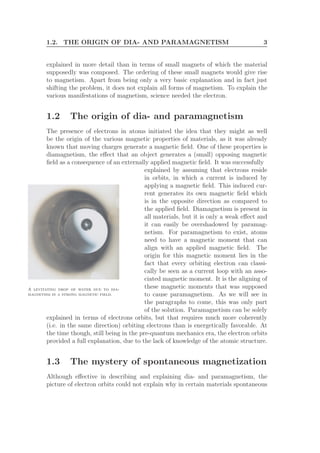
explained by assuming that electrons reside
A levitating drop of water due to dia-
magnetism in a strong magnetic field.
in orbits, in which a current is induced by
applying a magnetic field. This induced cur-
rent generates its own magnetic field which
is in the opposite direction as compared to
the applied field. Diamagnetism is present in
all materials, but it is only a weak effect and
it can easily be overshadowed by paramag-
netism. For paramagnetism to exist, atoms
need to have a magnetic moment that can
align with an applied magnetic field. The
origin for this magnetic moment lies in the
fact that every orbiting electron can classi-
cally be seen as a current loop with an asso-
ciated magnetic moment. It is the aligning of
these magnetic moments that was supposed
to cause paramagnetism. As we will see in
the paragraphs to come, this was only part
of the solution. Paramagnetism can be solely
explained in terms of electrons orbits, but that requires much more coherently
(i.e. in the same direction) orbiting electrons than is energetically favorable. At
the time though, still being in the pre-quantum mechanics era, the electron orbits
provided a full explanation, due to the lack of knowledge of the atomic structure.
1.3 The mystery of spontaneous magnetization
Although effective in describing and explaining dia- and paramagnetism, the
picture of electron orbits could not explain why in certain materials spontaneous
4 CHAPTER 1. INTRODUCTION
magnetic ordering occurred below a certain critical temperature, an effect which
is known as ferromagnetism. The French physicist Pierre Ernest Weiss realized in
1906 that for a spontaneous magnetization to arise, there had to exist an internal
magnetic field that caused the magnetic moments to align. Weiss called this
internal field the molecular field. The description of magnetic materials in terms
of this field proved to be a very useful description of ferromagnetism, but what
gave rise to the Weiss molecular field remained unclear until the discovery of a
new property of the electron, the electron spin.
1.4 Give it a spin
With the identification of the electron as a carrier of quantized charge the explo-
ration had only just begun. Additional qualities of the electron were discovered,
like the pairing of electrons in so called Cooper pairs, the underlying mechanism
for superconductivity.
In 1925 Samuel Goudsmit en George Uhlen-
(l-r) Samuel Abraham Goudsmit, Hendrik
Kramers and George Eugene Uhlenbeck
around 1928 in Ann Arbor.
beck, both students of Paul Ehrenfest in Lei-
den, daringly posed an extra property of the
electron [2]. Besides a charge, they specu-
lated, an electron also should have a intrinsic
spin, an orbital moment. This spin gives the
electron a permanent magnetic moment.
It was a bold proposition, because how could
a supposedly point particle have spin, a prop-
erty that classically is associated with the ro-
tation of a body around its own axis? For
that reason the scientific community remained
sceptical to say the least, especially because
the paper of Goudsmit and Uhlenbeck lacked
a formal derivation. If they would have formally derived the formula for the
Land´e g-factor, the factor that relates orbital momentum to its corresponding
magnetic moment, they would have found that there was a factor of 2 missing,
as was remarked by Heisenberg in response on their article. Luckily this had
not withdrawn Goudsmit and Uhlenbeck from publishing as not much later a
young physicist Llewellyn H. Thomas in Copenhagen came up with a relativistic
derivation of the g-factor in which the factor of 2 popped up [3]1
.
1
If you are fascinated by the story of the discovery of the electron, you may find it interesting
to know that there is a document available on the internet in which Goudsmit describes his
personal view on the discovery of the electron spin. The document is a translation of the closing
lecture Goudsmit gave during the golden jubilee of the Dutch Physical Society in 1971[4].
1.5. THE RISE OF SPINTRONICS 5
The introduction of spin changed the theoretical picture behind paramagnetism
quite significantly. It was realized that for some materials not so much the orbital
magnetic moment contributed to this effect, but that it was the electron spin and
its associated magnetic moment that to a greater extent caused the uncompen-
sated net magnetic moment.2
Within the framework of the upcoming quantum
Visualization of the wavefunction of an
electron. Picture taken from [5].
mechanics, it was Heisenberg3
who proved that be-
cause of the property of spin, electrons interact,
besides the known electrostatic repulsion, via a so-
called exchange mechanism. This exchange mecha-
nism gives rise to an additional energy contribution
for the electron orbits and makes it favorable for
spins to couple either parallel or anti-parallel, de-
pending on the sign of the exchange integral. The
former case leads to ferromagnetism, whereas the
latter is the cause for antiferromagnetism. Anti-
ferromagnetic materials produce no external mag-
netic stray field, due to the internal compensation
of the spins.
So there you have it: we found the electron and ‘gave’ it a spin. This lead
to a lot of new insights with respect to the atomic structure and the origin of
magnetism. For almost a century the electron and its spin remained an interest-
ing study object, but it was not realized until the end of the 20th century that
spin transport could be of vital importance in a direct application.
1.5 The rise of Spintronics
In 1988 Peter Gr¨unberg and Albert Fert discovered the Giant Magneto Resistance
(GMR) effect, for which they received the Nobel price in 2007. The GMR effect is
based on the resistance of a nonmagnetic metallic spacer sandwiched between two
ferromagnetic layers. The device is constructed as such that the magnetizations
of the ferromagnetic layers are oriented either parallel or antiparallel. In parallel
configuration the device has a low electrical resistance, while in the anti-parallel
configuration it has a high resistance.
The underlying cause for this effect is related to the fact that electrons have
spin. Recalling that spin is nothing but a small magnetic moment, it can be
expected to interact with a magnetic field. It turns out that when this spin
is aligned parallel with the magnetization of the materials it travels through, it
fairly easily ‘floats’ through. On the other hand, when the spin is aligned antipar-
2
This great influence arises from the difference in g-factor, which in case of orbital momentum
is equal to 1, whereas for spin momentum equals 2. This means that for similar orbital and
spin momentum, spin momentum accounts for 2/3 of the magnetic moment of the atom.
3
A interesting overview of Heisenberg’s contributions to the understanding of ferromag-
netism is given in a paper by Sabyasachi Chatterjee[6].
6 CHAPTER 1. INTRODUCTION
allel with respect to the magnetization, it ‘senses’ a resistance, which makes it
difficult for the electron to pass through. This shows how GMR devices explicitly
exploit the property of electron spin. Nowadays the GMR effect is exploited in a
variety of magnetic sensors, for example inside drug tests (in combination with
magnetic tags) and most importantly in the read head of a computer harddisk.
The application of a GMR sensor in harddisk has enabled the continuation of the
exponential increase in data storage density.
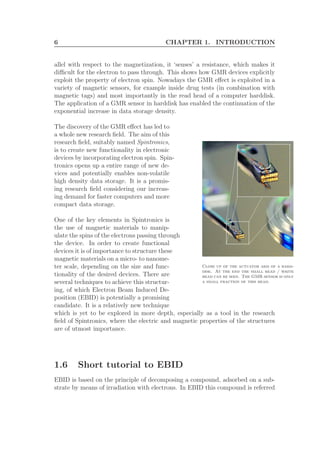
The discovery of the GMR effect has led to
Close up of the actuator arm of a hard-
disk. At the end the small read / write
head can be seen. The GMR sensor is only
a small fraction of this head.
a whole new research field. The aim of this
research field, suitably named Spintronics,
is to create new functionality in electronic
devices by incorporating electron spin. Spin-
tronics opens up a entire range of new de-
vices and potentially enables non-volatile
high density data storage. It is a promis-
ing research field considering our increas-
ing demand for faster computers and more
compact data storage.
One of the key elements in Spintronics is
the use of magnetic materials to manip-
ulate the spins of the electrons passing through
the device. In order to create functional
devices it is of importance to structure these
magnetic materials on a micro- to nanome-
ter scale, depending on the size and func-
tionality of the desired devices. There are
several techniques to achieve this structur-
ing, of which Electron Beam Induced De-
position (EBID) is potentially a promising
candidate. It is a relatively new technique
which is yet to be explored in more depth, especially as a tool in the research
field of Spintronics, where the electric and magnetic properties of the structures
are of utmost importance.
1.6 Short tutorial to EBID
EBID is based on the principle of decomposing a compound, adsorbed on a sub-
strate by means of irradiation with electrons. In EBID this compound is referred
1.7. GUIDE TO THIS THESIS 7
to as the precursor. The precursor containing the element(s) of interest is brought
in gas phase at a substrate, on which it partially adsorbs. Subsequently the ad-
sorbed precursor molecules are locally decomposed by irradiation with electrons.
After decomposition the fractions of the former precursor molecules either pre-
cipitate on the substrate (in the case of non-volatile ‘heavy’ fractions) or leave
the substrate altogether (in the case of volatile ‘light’ fractions). It are these
settling fractions that form the deposition referred to in the name Electron Beam
Induced Deposition. Ideally these fractions only consist of the desired material,
but reality learns us that this is mostly not the case. Due their presence in the
precursor and in hydrocarbons present in the system, part of the deposition will
consist out of carbon atoms. Obtaining a high purity in EBID depositions is still
one of the challenges to be faced, although recent studies have shown purities up
to 95 atomic percent [7].
1.7 Guide to this thesis
In this thesis we will explore the application of Electron Beam Induced Deposition
in Spintronics. Specifically we will be focussing on the creation of depositions of
magnetic materials and investigate their shape, composition and magnetic prop-
erties. For this purpose the ferromagnetic transition metal iron is chosen as a
model system. We will show, using a computer simulation, that specific shapes
of depositions are caused by surface processes such as diffusion. Furthermore, we
will see that the composition of EBID depositions highly depends on the choice
of precursor and on the deposition environment. Last, but most certainly not
least we will demonstrate the ferromagnetic properties of the depositions.
This last section is a quick guide to this thesis to provide the reader with an
overview of the chapters and how these relate to each other. To obtain a con-
densed overview of this research, it is suggested to start reading at chapter 5.
Note however that for a thorough understanding of the results, knowledge of the
other chapters may be useful.
In this chapter Introduction a general motivation for this type of research was
given. In the first part of chapter 2 EBID and Spintronics a more detailed
motivation for the choice of EBID is given. In the second part an overview of
publications on the subject of EBID deposited iron is given, after which our spe-
cific approach is motivated
Chapter 3 Physical Processes in EBID starts with a brief exploration of
the history of EBID and continues with an extensive explanation of the theory
behind this technique. Some special attention goes to the physics of electron -
8 CHAPTER 1. INTRODUCTION
solid interactions, as these processes are also relevant for one of the used charac-
terization tools, Energy Dispersive X-ray Spectroscopy (EDS).
For the EBID process itself as well as for the analysis of the depositions sev-
eral tools are used, which are described in chapter 4 Experimental Tool Box.
The main focus of this chapter is on the tool used to create the depositions, the
FEI Nova Nanolab 600i, and on the detector to analyze their composition, the
EDX detector.
The remainder of this thesis can be seen to consist out of two parts. The first
part, chapter 5 Results: Precursor Characterization, deals with the charac-
terization of the depositions in terms of the deposition speed, composition and
magnetic properties. The characteristics of two different iron precursors used to
create the depositions are compared.
In the second part, the specific shapes of the depositions that arise as a con-
sequence of EBID related processes are investigated. This research was initi-
ated by the unexpected shapes of the first depositions. For predictable magnetic
properties of the depositions accurate control over their shape is essential. To
understand the origin of these shapes, an analytical model is developed in chap-
ter 6 Modeling EBID. Based on this analytical model a computer simulation
is created. The results of this simulation are compared to experimental results
in chapter 7 Results: Shape Analysis.
The conclusions of both the shape analysis and precursor characterization are
summarized in chapter 8 Conclusions, followed by an overview of promising
ideas for the continuation of this research in chapter 9 Outlook.
Chapter 2
EBID and Iron Deposition
We will start this chapter by showing the great potential of Electron Beam
Induced Deposition (EBID) as a nano structuring tool, followed by a basic ex-
planation of EBID. EBID is a member of a group of four structuring techniques,
which we will call Beam Induced Structuring techniques. First an overview of
these techniques is given and subsequently we zoom in on the specific effects that
lie at the basis of these techniques. The first part of this chapter is concluded by
substantiating why EBID is chosen for further research.
In the last part of this chapter we will present a literary survey of EBID ex-
periments in which iron is deposited, which will give an overview of achieved
results as well as provide an outline for the available iron containing substances.
The advantages and disadvantages of these substances, generally referred to as
precursors, are then discussed, followed by a motivation for the precursor(s) used
in this thesis.
2.1 The wonderful world of EBID
The great advantage that EBID has over other nanostructuring techniques is its
capability of depositing virtually any material on any substrate of choice with
any desired shape on a nanometer size. To put it more compact, the strength of
EBID lies in the fact that it is a local direct structuring technique. Here, local
refers to the possibility to deposit on any place of choice on any desired substrate,
whereas the direct structuring means that no preprocessing steps are required to
make depositions. EBID acts as a special nano pen as it were. A very special
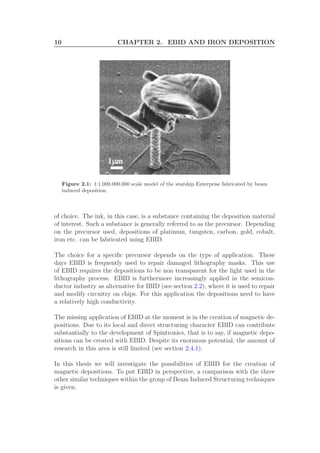
nano pen indeed, as it is even possible to create self supporting 3D structures
with this technique, as is shown in figure 2.1.
The model shown in figure 2.1 is build directly from a CAD drawing. It shows
only one of the infinite possible shapes that can be created with EBID. As the
shapes are only limited by imagination, it becomes clear what a powerful tech-
nique it is.
The other significant advantage is that this nano pen can be filled with the ink
9
10 CHAPTER 2. EBID AND IRON DEPOSITION
Figure 2.1: 1:1.000.000.000 scale model of the starship Enterprise fabricated by beam
induced deposition.
of choice. The ink, in this case, is a substance containing the deposition material
of interest. Such a substance is generally referred to as the precursor. Depending
on the precursor used, depositions of platinum, tungsten, carbon, gold, cobalt,
iron etc. can be fabricated using EBID.
The choice for a specific precursor depends on the type of application. These
days EBID is frequently used to repair damaged lithography masks. This use
of EBID requires the depositions to be non transparent for the light used in the
lithography process. EBID is furthermore increasingly applied in the semicon-
ductor industry as alternative for IBID (see section 2.2), where it is used to repair
and modify circuitry on chips. For this application the depositions need to have
a relatively high conductivity.
The missing application of EBID at the moment is in the creation of magnetic de-
positions. Due to its local and direct structuring character EBID can contribute
substantially to the development of Spintronics, that is to say, if magnetic depo-
sitions can be created with EBID. Despite its enormous potential, the amount of
research in this area is still limited (see section 2.4.1).
In this thesis we will investigate the possibilities of EBID for the creation of
magnetic depositions. To put EBID in perspective, a comparison with the three
other similar techniques within the group of Beam Induced Structuring techniques
is given.
2.2. BEAM INDUCED STRUCTURING TECHNIQUES 11
2.2 Beam Induced Structuring Techniques
Since the discovery of carbon deposition due to electron irradiation of substrates
as an unwanted effect of electron microscopy (see section 3.1) a variety of struc-
turing techniques has been developed that turn this process in an advantage.
These techniques can be classified by type of beam used (ion or electron) and
application (additive or subtractive). Here, additive refers to the addition of
material to a substrate / sample (i.e. deposition), whereas subtractive concerns
the removal of material from a substrate / sample (i.e. etching). The creation
of depositions with the ion beam is referred to as Ion Beam Induced Deposition
(IBID). The etching techniques with electron and ion beam are called Electron
Beam Induced Etching (EBIE) and Ion Beam Induced Etching (IBIE)1
.
In all four cases the process can be described as the complex 3-way interac-
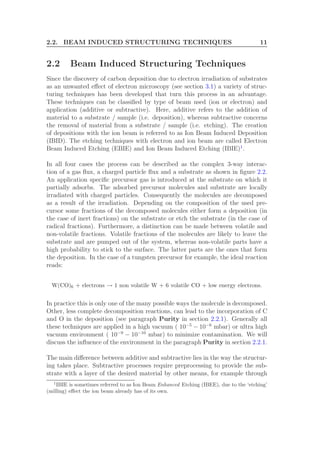
tion of a gas flux, a charged particle flux and a substrate as shown in figure 2.2.
An application specific precursor gas is introduced at the substrate on which it
partially adsorbs. The adsorbed precursor molecules and substrate are locally
irradiated with charged particles. Consequently the molecules are decomposed
as a result of the irradiation. Depending on the composition of the used pre-
cursor some fractions of the decomposed molecules either form a deposition (in
the case of inert fractions) on the substrate or etch the substrate (in the case of
radical fractions). Furthermore, a distinction can be made between volatile and
non-volatile fractions. Volatile fractions of the molecules are likely to leave the
substrate and are pumped out of the system, whereas non-volatile parts have a
high probability to stick to the surface. The latter parts are the ones that form
the deposition. In the case of a tungsten precursor for example, the ideal reaction
reads:
W(CO)6 + electrons → 1 non volatile W + 6 volatile CO + low energy electrons.
In practice this is only one of the many possible ways the molecule is decomposed.
Other, less complete decomposition reactions, can lead to the incorporation of C
and O in the deposition (see paragraph Purity in section 2.2.1). Generally all
these techniques are applied in a high vacuum ( 10−5
− 10−6
mbar) or ultra high
vacuum environment ( 10−9
− 10−10
mbar) to minimize contamination. We will
discuss the influence of the environment in the paragraph Purity in section 2.2.1.
The main difference between additive and subtractive lies in the way the structur-
ing takes place. Subtractive processes require preprocessing to provide the sub-
strate with a layer of the desired material by other means, for example through
1
IBIE is sometimes referred to as Ion Beam Enhanced Etching (IBEE), due to the ‘etching’
(milling) effect the ion beam already has of its own.
12 CHAPTER 2. EBID AND IRON DEPOSITION
particle
flux
electron
beam
deposition
volatile
fractions
Figure 2.2: Graphical view on EBID. A flux of precursor particles coming from the
top left adsorbs at the substrate and is decomposed by a beam of electrons coming from
the top. The deposition formed is shown in red. The small volatile fractions leave the
substrate.
sputtering or molecular beam epitaxy. Subsequently the sample can be structured
by selectively removing material by means of etching. The additive processes can
be described as direct structuring techniques, meaning that nothing but a sub-
strate is required to create structures. It is this direct structuring that we are
interested in, therefore the two subtractive structuring techniques are not of fur-
ther interest to this research.
The deposition with ions or electrons are both potential interesting local direct
structuring techniques for the application in structuring magnetic materials. In
the following sections we will make a comparison of these two techniques, EBID
and IBID and argue why EBID is expected to be more suitable for structuring
magnetic materials.
2.2.1 Ions versus electrons
Although the general process is the same for both electrons and ions, there are a
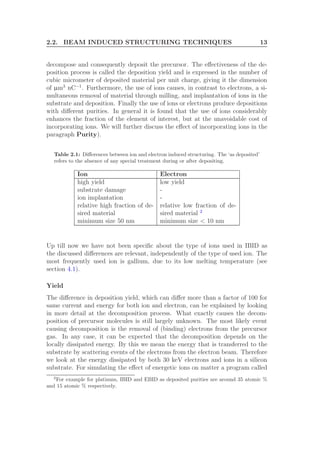
few important differences. Table 2.1 gives an overview of these differences. One
large difference between ions and electrons is the effectiveness with which they
2.2. BEAM INDUCED STRUCTURING TECHNIQUES 13
decompose and consequently deposit the precursor. The effectiveness of the de-
position process is called the deposition yield and is expressed in the number of
cubic micrometer of deposited material per unit charge, giving it the dimension
of µm3
nC−1
. Furthermore, the use of ions causes, in contrast to electrons, a si-
multaneous removal of material through milling, and implantation of ions in the
substrate and deposition. Finally the use of ions or electrons produce depositions
with different purities. In general it is found that the use of ions considerably
enhances the fraction of the element of interest, but at the unavoidable cost of
incorporating ions. We will further discuss the effect of incorporating ions in the
paragraph Purity).
Table 2.1: Differences between ion and electron induced structuring. The ‘as deposited’
refers to the absence of any special treatment during or after depositing.
Ion Electron
high yield low yield
substrate damage -
ion implantation -
relative high fraction of de-
sired material
relative low fraction of de-
sired material 2
minimum size 50 nm minimum size < 10 nm
Up till now we have not been specific about the type of ions used in IBID as
the discussed differences are relevant, independently of the type of used ion. The
most frequently used ion is gallium, due to its low melting temperature (see
section 4.1).
Yield
The difference in deposition yield, which can differ more than a factor of 100 for
same current and energy for both ion and electron, can be explained by looking
in more detail at the decomposition process. What exactly causes the decom-
position of precursor molecules is still largely unknown. The most likely event
causing decomposition is the removal of (binding) electrons from the precursor
gas. In any case, it can be expected that the decomposition depends on the
locally dissipated energy. By this we mean the energy that is transferred to the
substrate by scattering events of the electrons from the electron beam. Therefore
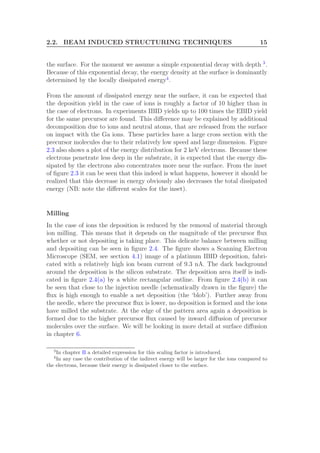
we look at the energy dissipated by both 30 keV electrons and ions in a silicon
substrate. For simulating the effect of energetic ions on matter a program called
2
For example for platinum, IBID and EBID as deposited purities are around 35 atomic %
and 15 atomic % respectively.
14 CHAPTER 2. EBID AND IRON DEPOSITION
SRIM (Stopping Range Ions in Matter) is used [8]. The interaction of electrons
with the silicon substrate is simulated with a Monte Carlo based program called
Casino [9].
depth (nm)
dissipatedenergy(a.u.)
Figure 2.3: Comparison of the depth distribution of dissipated energy between 2 and
30 keV electrons and 30 keV Gallium ions in a Si substrate. The inset shows a zoom in
of the two electron graphs, where 2 keV corresponds to the right axis and 30 keV to the
left axis as indicated by the arrows. It can be seen that ions dispose much more energy
close to the surface than electrons, causing a more efficient decomposition. The integral
of the curves is related to the total dissipated energy. Data is generated with Casino (for
the electrons) and SRIM (for the ions).
As can be seen from figure 2.3, the energy dissipated by the 30 keV ion is more
concentrated near the surface than the energy of the 30 keV electron. It can be
expected that the amount of decomposition is correlated with the energy density
at the surface of the substrate. The energy density at the surface depends on the
local dissipated energy as well as on the transport of dissipated energy deeper
in the substrate towards the surface by secondary mechanisms. This means that
the energy distribution displayed in figure 2.3 has to be integrated, taking into
account a depth dependent scaling factor to obtain the total energy density at
2.2. BEAM INDUCED STRUCTURING TECHNIQUES 15
the surface. For the moment we assume a simple exponential decay with depth 3
.
Because of this exponential decay, the energy density at the surface is dominantly
determined by the locally dissipated energy4
.
From the amount of dissipated energy near the surface, it can be expected that
the deposition yield in the case of ions is roughly a factor of 10 higher than in
the case of electrons. In experiments IBID yields up to 100 times the EBID yield
for the same precursor are found. This difference may be explained by additional
decomposition due to ions and neutral atoms, that are released from the surface
on impact with the Ga ions. These particles have a large cross section with the
precursor molecules due to their relatively low speed and large dimension. Figure
2.3 also shows a plot of the energy distribution for 2 keV electrons. Because these
electrons penetrate less deep in the substrate, it is expected that the energy dis-
sipated by the electrons also concentrates more near the surface. From the inset
of figure 2.3 it can be seen that this indeed is what happens, however it should be
realized that this decrease in energy obviously also decreases the total dissipated
energy (NB: note the different scales for the inset).
Milling
In the case of ions the deposition is reduced by the removal of material through
ion milling. This means that it depends on the magnitude of the precursor flux
whether or not depositing is taking place. This delicate balance between milling
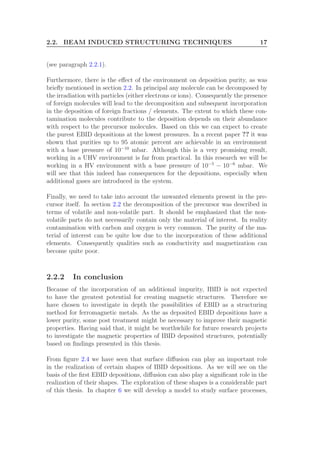
and depositing can be seen in figure 2.4. The figure shows a Scanning Electron
Microscope (SEM, see section 4.1) image of a platinum IBID deposition, fabri-
cated with a relatively high ion beam current of 9.3 nA. The dark background
around the deposition is the silicon substrate. The deposition area itself is indi-
cated in figure 2.4(a) by a white rectangular outline. From figure 2.4(b) it can
be seen that close to the injection needle (schematically drawn in the figure) the
flux is high enough to enable a net deposition (the ‘blob’). Further away from
the needle, where the precursor flux is lower, no deposition is formed and the ions
have milled the substrate. At the edge of the pattern area again a deposition is
formed due to the higher precursor flux caused by inward diffusion of precursor
molecules over the surface. We will be looking in more detail at surface diffusion
in chapter 6.
3
In chapter B a detailed expression for this scaling factor is introduced.
4
In any case the contribution of the indirect energy will be larger for the ions compared to
the electrons, because their energy is dissipated closer to the surface.
16 CHAPTER 2. EBID AND IRON DEPOSITION
deposition area
depositiondiffusion edge
(a)
substrate
visualized flux
GIS needle
(b)
Figure 2.4: Scanning Electron Microscope (SEM) image of a deposition made with
IBID, using a 30 keV 9.3nA Ga focussed ion beam. Figures (a) and (b) show the same
SEM image, but for clarity in (b) a drawing of the needle and a visualization of the flux
are added (not to scale).
Ion implantation
The most important disadvantage of using ions, especially in the application of
structuring magnetic materials, is the unavoidable implantation of Ga ions. First
of all, the use of ions adds an extra contaminant to the depositions. Secondly,
it is know from literature that the implantation of Ga ions affects the magnetic
properties of materials. In [10] it is reported that implantation leads to a decrease
of the GMR effect and exchange bias field. On the other hand it has been shown
that properties such as the coercive field can be enhanced by Ga implantation
[11]. It must be noted that the situation in these papers is not directly similar to
the implantation of ions in IBID, but it can be expected that the ions will have
an effect. If this effect is significant in IBID deposited magnetic materials is still
something that has to be researched.
Purity
The main advantage of using ions with respect to electrons is the higher purity
of the depositions. The current hypothesis is that this effect is caused by a more
complete decomposition (i.e. breaking of the precursor into smaller fractions)
due to the much higher energy density and release of ions and neutrals from the
substrate. A higher purity in general leads to better qualities such as a larger
conductivity in case of metals and a larger magnetization in case of ferromag-
netic materials. However, it could be that the positive effect of the purity on the
magnetization is counteracted by the implantation of Ga ions in the case of IBID
2.2. BEAM INDUCED STRUCTURING TECHNIQUES 17
(see paragraph 2.2.1).
Furthermore, there is the effect of the environment on deposition purity, as was
briefly mentioned in section 2.2. In principal any molecule can be decomposed by
the irradiation with particles (either electrons or ions). Consequently the presence
of foreign molecules will lead to the decomposition and subsequent incorporation
in the deposition of foreign fractions / elements. The extent to which these con-
tamination molecules contribute to the deposition depends on their abundance
with respect to the precursor molecules. Based on this we can expect to create
the purest EBID depositions at the lowest pressures. In a recent paper ?? it was
shown that purities up to 95 atomic percent are achievable in an environment
with a base pressure of 10−10
mbar. Although this is a very promising result,
working in a UHV environment is far from practical. In this research we will be
working in a HV environment with a base pressure of 10−5
− 10−6
mbar. We
will see that this indeed has consequences for the depositions, especially when
additional gases are introduced in the system.
Finally, we need to take into account the unwanted elements present in the pre-
cursor itself. In section 2.2 the decomposition of the precursor was described in
terms of volatile and non-volatile part. It should be emphasized that the non-
volatile parts do not necessarily contain only the material of interest. In reality
contamination with carbon and oxygen is very common. The purity of the ma-
terial of interest can be quite low due to the incorporation of these additional
elements. Consequently qualities such as conductivity and magnetization can
become quite poor.
2.2.2 In conclusion
Because of the incorporation of an additional impurity, IBID is not expected
to have the greatest potential for creating magnetic structures. Therefore we
have chosen to investigate in depth the possibilities of EBID as a structuring
method for ferromagnetic metals. As the as deposited EBID depositions have a
lower purity, some post treatment might be necessary to improve their magnetic
properties. Having said that, it might be worthwhile for future research projects
to investigate the magnetic properties of IBID deposited structures, potentially
based on findings presented in this thesis.
From figure 2.4 we have seen that surface diffusion can play an important role
in the realization of certain shapes of IBID depositions. As we will see on the
basis of the first EBID depositions, diffusion can also play a significant role in the
realization of their shapes. The exploration of these shapes is a considerable part
of this thesis. In chapter 6 we will develop a model to study surface processes,
18 CHAPTER 2. EBID AND IRON DEPOSITION
such as diffusion. This model will contribute to the understanding of the origin
of certain deposition shapes. In the subsequent chapter 7 trends in the shapes of
experimentally obtained depositions are explained, using the developed model.
2.3 Iron precursors
For the investigating of the potential of EBID in structuring magnetic materials
iron was chosen as a model system. We will start this section by discussing what
in general would be the ideal type of precursor. Subsequently we will present a
short overview of the available iron precursors, followed by literary survey to cre-
ate an overview of the research field of EBID deposited iron. In the last section
the precursors are compared, after which our approach for choosing a precursor
is explained.
2.4 The ideal precursor
The main problem with EBID is the incorporation of contaminants in the deposi-
tions, which has a harmful effect on properties as conductivity and magnetization.
The origin of these contaminants is twofold. Partially contamination is caused by
hydrocarbons that are always present in the vacuum system, but the greater part
is causes by foreign atoms in the precursor species. With ‘foreign’ we indicate all
the atoms that are not of the desired element. Therefore EBID scientists have
always been looking for contamination free5
precursors, to assist them on the
quest for the holy grail of EBID, depositions of high purity.
Unfortunately for decomposition to work a EBID precursor needs to contain for-
eign species in order for it to remain a selective deposition process. Using a pure
substance as a precursor would result in coating the whole substrate, not purely
on the area irradiated by electrons. What can make a difference is which type of
contaminants is present in the precursor. One of the most problematic contami-
nants is carbon and that is why ‘contamination free’ in practice means ‘without
carbon’. An example of such a carbon free precursor is Tungstenhexafluoride
(WF6), which is an alternative to the carbon containing Tungstenhexacarbonyl
(W(CO)6). Because fluor is very volatile, it is unlikely that it gets incorporated
in the deposition. An additional property of fluor is that it forms radicals after
decomposition, which have an etching effect. This has both the disadvantage of
less efficient depositing as the advantage of cleaning the substrate by reacting
5
Contamination free with respect to what is incorporated in the depositions. Elements that
are present in the precursor, but that are not (or barely) incorporated in the depositions, are
not considered contaminants.
2.4. THE IDEAL PRECURSOR 19
with other contaminants.
Although for various materials carbon free precursors have been found or de-
veloped, no such precursor exists for the deposition of iron today. One could
think of synthesizing a custom developed precursor for this purpose, but that is
a project of its own. Therefore we will focus on the existing precursors.
2.4.1 Literary survey on EBID deposited iron
Iron precursors
Table 2.2 gives an overview of the four currently known iron precursors in lit-
erature. These precursors originate from a technique called Chemical Vapor
Deposition (CVD), in which a molecule is thermally decomposed on a substrate.
Three of the four precursors belong to the same chemical category, i.e. the car-
bonyl group. By photolysis and heating Fe(CO)5 is transformed in Fe2(CO)9 and
Fe3(CO)12, respectively. The fourth precursor is commonly used in a non local
deposition process called Chemical Vapor Deposition (CVD), where the precur-
sor is decomposed due to a high substrate temperature.
Table 2.2: Overview of the currently known iron precursors.
Name Formula Atomic % Fe Weight % Fe
Iron-penta-carbonyl Fe(CO)5 9.1 28.5
Di-iron-nona-carbonyl Fe2(CO)9 10 30.7
Tri-iron-dodeca-carbonyl Fe3(CO)12 11.1 33.3
Ferrocene Fe(C5H5)2 4.8 30.0
(Iron-cyclo-penta-dienyl)
Although not new, the deposition of iron by means of EBID is relatively un-
explored. In table ?? an overview is given of which precursors were found in
literature. The process of EBID using Fe(CO)5 was first shown by Kunz [12],
although it is not indisputably shown that iron is deposited.
The possibilities of the deposition of iron using the Ironpentacarbonyl precur-
sor were studied extensively by a Japanese research group. They are one of the
few who published multiple papers on this subject, starting in 2004 with the
investigation of iron nanopillars and the effect of annealing on their shape and
composition [13]. In the paper it is shown that the as deposited pillars consist of
an amorphous mixture of Fe and C and are covered with an oxide layer. After
20 CHAPTER 2. EBID AND IRON DEPOSITION
Table 2.3: Overview of publications per iron precursor.
Precursor name Precursor formula Reference
Ironpentacarbonyl Fe(CO)5 [12, 13, 14, 15, 16, 17,
18, 19, 7]
Diironnonacarbonyl
Fe2(CO)9 -
Triirondodecacarbonyl
Fe3(CO)12 [20]
Ferrocene Fe(C5H5)2 [18]
annealing for 1 hour at 600◦
C the depositions had turned into a mixture of α-Fe
and several iron carbides.
Subsequent papers [14, 15] from the same group deal more extensively with the
magnetic properties, visualized and quantified by means of electron holography.
Next their focus is shifted to the crystallographic structure of the depositions and
the possibilities to enhance this [16, 17]. It is shown that the addition of water
vapor decreases the carbon content of the depositions at the expense of incorpo-
rating more oxygen. Above a certain ratio of iron precursor to water vapor flux,
polycrystalline Fe3O4 depositions can be obtained.
In a recent paper from Furuya et al a comparison of the magnetic properties
is made between depositions made with Ironpentacarbonyl and an alternative
iron precursor, Ferrocene (Fe(C5H5)2) [18]. By changing the relative fluxes depo-
sitions are created with varying Ferrocene to Ironpentacarbonyl content. These
depositions are then characterized by their remanent magnetic flux density, again
using electron holography. From these results it is concluded that, because a
higher Ferrocene content decreases the remanence, less iron is incorporated in
these depositions. From this it is concluded that the Ferrocene contributes less
iron atoms to the depositions compared to foreign atoms (carbon, oxygen) than
Ironpentacarbonyl.
In a paper by Bruk et al. [20] the electrical properties of Triirondodecacarbonyl
(Fe3(CO)12) depositions are investigated as function of beam current, deposition
time and temperature. It is shown that the resistance of the depositions decreases
with increasing beam current and deposition time. Preliminary experiments at
15 and 20 keV indicate an increase in the resistance with increasing electron beam
energy. The measurements of the resistance as function of temperature reveal a
positive temperature coefficient, pointing at non metallic conduction. The paper
is concluded with a preliminary experiment that shows the influence of the envi-
ronment of the depositions during measuring of the resistance. It is shown that
2.4. THE IDEAL PRECURSOR 21
the addition of water vapor has a permanent effect on the resistance, whereas the
addition of acetone and ammonia only reduce the resistance while present in the
system. Regrettably no magnetic characterization is performed.
600 nm
Figure 2.5: Reconstructed phase image of an electron holographic image of a magnetic
bar deposited at the end of a tungsten tip. Adapted from [19].
Applications of EBID deposited iron
To conclude this section, two papers showing the application of iron EBID de-
positions are discussed. One of these papers is from the Japanese group [19] and
shows the growth of a nanomagnet (see figure 2.5) on top op a tungsten tip. By
approaching magnetic nanostructures on a substrate with this tip, the magnetic
interaction between the two can be studied. This technique is very similar to
Magnetic Force Microscopy (see chapter 4), where a magnetically coated tip is
used. One can think of using EBID to coat a tip with magnetic material using
EBID rather than to grow a nanomagnet, to approach or supersede the spatial
resolution of MFM. An alternative approach may be the perpendicular growth
(in contrast to the lateral growth of the nanomagnet shown in figure 2.5) of a
magnetic pillar on the end of a tip.
In the other paper, by M¨uller et al [21], it is shown that the resistance of a
Permalloy strip is influenced by the magnetic configuration of an EBID deposited
array of iron nanopillars (see figure 2.6). This effect is caused by the change in
magnetoresistance of the Permalloy strip due to the magnetic coupling with the
array. This application already shows the potential of EBID in Spintronics.
22 CHAPTER 2. EBID AND IRON DEPOSITION
Figure 2.6: SEM images (left) and schematic (right) of an array of iron EBID deposi-
tions on a permalloy strip. Adapted from [21].
2.4.2 Our approach
A first approximation of the final composition of the depositions is the atomic
iron fraction in the precursors. Based on this approximation, Ferrocene is not
expected to lead to the highest iron content. Therefore the focus of this thesis
will be on the precursors in the iron carbonyl group.
Considering the carbonyls, most experimental data is available on the Ironpen-
tacarbonyl, therefore using this precursor would give the research a head start.
However, one disadvantage of Ironpentacarbonyl is its toxicity. Therefore we
have chosen to start with characterizing the depositions of Triirondodecacar-
bonyl (TIDC) and work our way via the Diirondodecacarbonyl (DINC) to the
Ironpentacarbonyl (IPC).
Within the time frame of this research only the first two mentioned precursors
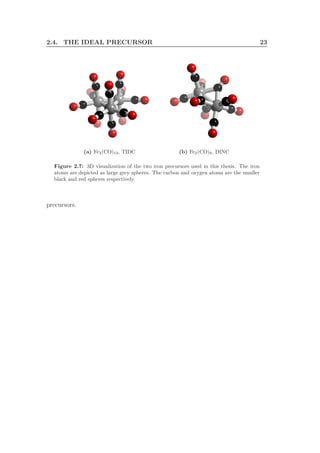
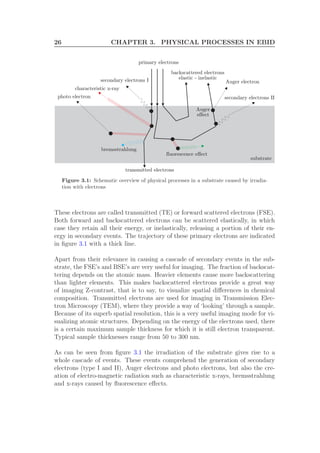
have been used. 3D views of these precursors are shown in figure 2.7. One of
the aspects of the used supply of TIDC precursor is that it is shipped in a 5 - 10
weight % methanol solution to protect it from exposure to air. We need to be
aware that if this methanol is introduced in the vacuum chamber together with
TIDC, this may have consequences for our depositions. The DINC precursor is
shipped under argon atmosphere, which is not expected to be of great influence
due to its inert nature.
Both the TIDC and DINC are characterized by deposition yield, composition
and magnetic properties of the depositions in chapter 5. The origin of partic-
ular shapes of the depositions, as briefly introduced in the introduction, was
first spotted using the TIDC precursors. Therefore the further investigation of
these shapes in chapter 7 is based on the depositions created with this precursor.
Nonetheless the outcome of this investigation will be applicable to many other
2.4. THE IDEAL PRECURSOR 23
(a) Fe3(CO)12, TIDC (b) Fe2(CO)9, DINC
Figure 2.7: 3D visualization of the two iron precursors used in this thesis. The iron
atoms are depicted as large grey spheres. The carbon and oxygen atoms are the smaller
black and red spheres respectively.
precursors.
Chapter 3
Physical Processes in EBID
As introduced and motivated in the previous chapter, the main subject of this
thesis is Electron Beam Induced Deposition (EBID) of the ferromagnetic tran-
sition metals iron. In this chapter we will elaborate more on the origin and
qualitative description of EBID. A qualitative description of EBID. A real quan-
titative description is postponed until chapter 6.
3.1 Origin of EBID
The development of beam induced structuring techniques started with the discov-
ery of EBID. Beam Induced Deposition was discovered as an undesired side effect
of Scanning Electron Microscopes (SEM) [22]. It was found that while scanning
with SEMs carbon was deposited on the substrate. This carbon deposition was a
consequence of adsorbed organic molecules decomposing under irradiation with
the electron beam.
At first this contamination deposition was seen as a nuisance, an annoying conse-
quence of the use of oil diffusion pumps, O-rings and grease, until in 1976 Broers
came up with the idea to use the carbon deposition as a negative resist during
reactive ion etching. He proved it to be possible to produce 80 ˚A thin metal lines
with this new technique called contamination lithography [23]. Since Broers dis-
covery various variations of beam induced processes have been developed, which
we already introduced in the previous chapter as Beam Induced Structuring tech-
niques.
3.2 Electron Beam Induced Deposition
Although the principle behind EBID is relatively simple, the exact processes un-
derlying this technique are numerous and complex. The aim of this chapter is to
give the reader insight in some of the processes that are relevant to this research.
It is beyond the scope of this thesis to present a full overview of what is known
about EBID. The interested reader can find an overview of EBID in the review
24
3.2. ELECTRON BEAM INDUCED DEPOSITION 25
article by S.J. Randolph et al [24]. Furthermore an extensive work on EBID,
including a valuable literature study, was performed by Silvis-Cividjian [25]. A
more recent work that focusses on simulating EBID can be found in the thesis of
Smith [26].
For simplicity and because of its origin, EBID was introduced as a deposition
process by means of a focussed electron beam. In principle any electron source is
capable of inducing decomposition, provided that the electron energy exceeds a
certain threshold. This threshold is easily reached by many electron sources, since
it is related to the chemical bond strength, which generally is not higher than 10 to
20 electron volts. Apart from the most frequently used Scanning Electron Micro-
scope (SEM) as a tool for EBID, also Transmission Electron Microscopes (TEM),
Scanning Transmission Electron Microscopes (STEM) and Scanning Tunneling
Microscopes (STM) are used. In this thesis we will focus on SEM and conse-
quently the relevant equipment for SEM will be dealt with more extensively in
this thesis. For specific applications one of the other tools might have advantages
over the others. For more information on these techniques we refer to [25].
As outlined in chapter 2, EBID can be seen as an interaction between three
subsystems, which are the electron (beam), the precursor and the substrate. We
will now discuss the interactions between these subsystems. It should be empha-
sized that once a precursor molecule is adsorbed on the substrate, it is considered
to be part of the substrate. This means that interactions of the electrons with
the adsorbed precursor are mediated via the substrate. It does not mean however
that these molecules are considered to be stuck on the substrate, as if they where
already deposited.
3.2.1 Electron - substrate interactions
Depending on its energy, several physical processes can occur when a electron
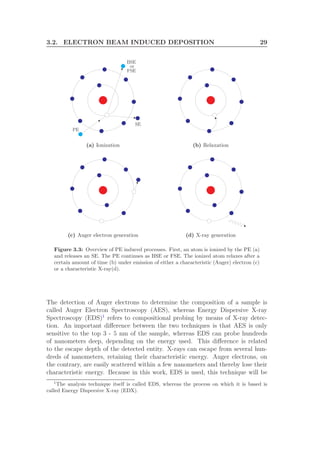
hits a substrate. Figure 3.1 displays a schematic overview of these processes. Not
all of these processes are relevant for EBID, but because some of these processes
are of importance for Energy Dispersive X-ray Spectroscopy (see chapter 4), we
will present the full picture here. At the end of this subsection, a short summary
is given to clearly recapitulate the important processes.
Considering the case of a primary electron (PE) hitting the substrate, there are
three possible futures. Either it leaves at the same side it entered the substrate,
in which case it is called a backscattered electron (BSE). It can be stopped inside
the substrate after releasing all its energy in secondary events. Or, in the case
the substrate is thin enough with respect to the energy of the electron, it is trans-
mitted and leaves the substrate on the other side, generally with a lower energy.
26 CHAPTER 3. PHYSICAL PROCESSES IN EBID
primary electrons
transmitted electrons
substrate
secondary electrons II
Auger electron
Auger
effect
fluorescence effect
secondary electrons I
bremsstrahlung
characteristic x-ray
photo electron
backscattered electrons
elastic - inelastic
Figure 3.1: Schematic overview of physical processes in a substrate caused by irradia-
tion with electrons
These electrons are called transmitted (TE) or forward scattered electrons (FSE).
Both forward and backscattered electrons can be scattered elastically, in which
case they retain all their energy, or inelastically, releasing a portion of their en-
ergy in secondary events. The trajectory of these primary electrons are indicated
in figure 3.1 with a thick line.
Apart from their relevance in causing a cascade of secondary events in the sub-
strate, the FSE’s and BSE’s are very useful for imaging. The fraction of backscat-
tering depends on the atomic mass. Heavier elements cause more backscattering
than lighter elements. This makes backscattered electrons provide a great way
of imaging Z-contrast, that is to say, to visualize spatial differences in chemical
composition. Transmitted electrons are used for imaging in Transmission Elec-
tron Microscopy (TEM), where they provide a way of ‘looking’ through a sample.
Because of its superb spatial resolution, this is a very useful imaging mode for vi-
sualizing atomic structures. Depending on the energy of the electrons used, there
is a certain maximum sample thickness for which it is still electron transparent.
Typical sample thicknesses range from 50 to 300 nm.
As can be seen from figure 3.1 the irradiation of the substrate gives rise to a
whole cascade of events. These events comprehend the generation of secondary
electrons (type I and II), Auger electrons and photo electrons, but also the cre-
ation of electro-magnetic radiation such as characteristic x-rays, bremsstrahlung
and x-rays caused by fluorescence effects.
3.2. ELECTRON BEAM INDUCED DEPOSITION 27
Secondary electrons
Secondary electrons (SE) are electrons that originate from the ionization of atoms
due to irradiation with the PE’s and subsequent BSE’s and FSE’s. They have a
non-specific energy which can be anywhere between zero and the energy of the
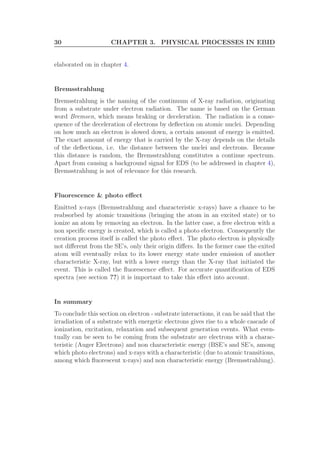
PE’s. Figure 3.3(a) schematically shows the ionization process for an atom with
10 electrons (i.e. Neon).
Strictly speaking, one can discriminate between SE of type I and type II. SE
I’s are electrons that are generated by ionization due to the PE’s, whereas SE
II’s are generated by the BSE’s and FSE’s. This mainly expresses itself in differ-
ence in the radial distance from where the PE’s strike the substrate. SE II’s are
more likely to be generated further from the point of incidence of the PE beam
as compared to the SE I’s.
The generation of SE’s is exploited in Scanning Electron Microscopy, where the
spatial dependent intensity of the SE’s is used to form an image. How this tech-
nique exactly works, is described in more detail in chapter 4. Considering EBID,
the SE’s are the main cause for the decomposition of the adsorbed precursor
molecules due to their relative low energy and consequently larger cross section
with the precursor. Therefore the deposition yield depends highly on the SE yield
in the substrate. An empirical formula that successfully describes the SE yield
for a variety of materials as function of energy is
δ
δm
= 1.28 ∗
EP E
EM
P E
0.67
1 − exp −1.614
EP E
EM
P E
[27] (3.1)
This formula relates the ratio of the SE yield δ and its maximum δM to the ratio
of the used PE energy EP E and the PE energy of maximum SE yield EM
P E. Values
for δM and EM
P E are material dependent. A list of values for these parameters for
different materials can be found in [27]. In figure 3.2 equation 3.1 is plotted for
average values of δM and EM
P E, indicated by the solid line. The four dashed lines
show the SE curves for the extreme values of δM and EM
P E. From these extremes
we can indicate an area of maximum SE yield, marked by the hatched rectangle.
It can be seen that the maximum SE yield generally lies between 200 and 700 eV
and takes values from 0.25 up to 2 SE electrons per PE electron. Since we expect
the EBID deposition yield to be correlated with the SE’s, the highest EBID yield
is likely to be achieved at this energy.
28 CHAPTER 3. PHYSICAL PROCESSES IN EBID
0 1 2 3 4 5
0.0
0.5
1.0
1.5
2.0
2.5
PE energy (keV)
SEyield(SE/PE)
SE boundary curves
Typical SE curve
area of maximum
SE yield
Figure 3.2: A typical shape of the SE yield versus PE energy. The solid line shows
a typical SE yield versus PE energy curve. The dashed lines are plots of equation 3.1,
using extreme values for δM and EM
P E as given in [27]. The rectangle indicates the region
in which the maximum yield lies for most materials.
Auger electrons and X-rays
After ionization the atom eventually relaxes to a lower energy state. Figure
3.3(b) to 3.3(d) give a schematic overview of this process. The relaxation occurs
by transferring an electron from a higher shell to a vacant state in a lower shell.
As a consequence of this process a characteristic amount of energy is released, cor-
responding to the energy difference of the two states. This energy can be released
either through a solid state excitation, the emission of a characteristic X-ray or
by ejecting an electron out of one of the outer shells of the atom. This electron is
called an Auger electron, after its discoverer Pierre Victor Auger. Although solid
state excitations, or phonons, can give rise to an additional SE generation, they
are not discussed here. The energy carried by the phonons is very low compared
to the PE, BSE and FSE and thereby cause only a minor fraction of the total of
generated SE’s.
The generation of an electron or photon by relaxation of an atom to a lower
energy state are visualized respectively in figure 3.3(c) and 3.3(d). The energy
states in an atom have very well defined energies, which are different for every
element. Consequently the energy carried by the electron or photon is specific
for the transition and element in question. Therefore these emitted photons or
electrons can be used to determine the chemical composition of a sample.
3.2. ELECTRON BEAM INDUCED DEPOSITION 29
PE
SE
BSE
or
FSE
(a) Ionization (b) Relaxation
(c) Auger electron generation (d) X-ray generation
Figure 3.3: Overview of PE induced processes. First, an atom is ionized by the PE (a)
and releases an SE. The PE continues as BSE or FSE. The ionized atom relaxes after a
certain amount of time (b) under emission of either a characteristic (Auger) electron (c)
or a characteristic X-ray(d).
The detection of Auger electrons to determine the composition of a sample is
called Auger Electron Spectroscopy (AES), whereas Energy Dispersive X-ray
Spectroscopy (EDS)1
refers to compositional probing by means of X-ray detec-
tion. An important difference between the two techniques is that AES is only
sensitive to the top 3 - 5 nm of the sample, whereas EDS can probe hundreds
of nanometers deep, depending on the energy used. This difference is related
to the escape depth of the detected entity. X-rays can escape from several hun-
dreds of nanometers, retaining their characteristic energy. Auger electrons, on
the contrary, are easily scattered within a few nanometers and thereby lose their
characteristic energy. Because in this work, EDS is used, this technique will be
1
The analysis technique itself is called EDS, whereas the process on which it is based is
called Energy Dispersive X-ray (EDX).
30 CHAPTER 3. PHYSICAL PROCESSES IN EBID
elaborated on in chapter 4.
Bremsstrahlung
Bremsstrahlung is the naming of the continuum of X-ray radiation, originating
from a substrate under electron radiation. The name is based on the German
word Bremsen, which means braking or deceleration. The radiation is a conse-
quence of the deceleration of electrons by deflection on atomic nuclei. Depending
on how much an electron is slowed down, a certain amount of energy is emitted.
The exact amount of energy that is carried by the X-ray depends on the details
of the deflections, i.e. the distance between the nuclei and electrons. Because
this distance is random, the Bremsstrahlung constitutes a continue spectrum.
Apart from causing a background signal for EDS (to be addressed in chapter 4),
Bremsstrahlung is not of relevance for this research.
Fluorescence & photo effect
Emitted x-rays (Bremsstrahlung and characteristic x-rays) have a chance to be
reabsorbed by atomic transitions (bringing the atom in an excited state) or to
ionize an atom by removing an electron. In the latter case, a free electron with a
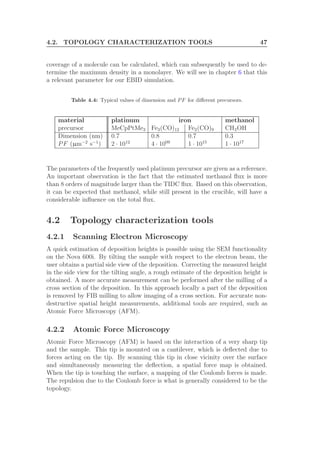
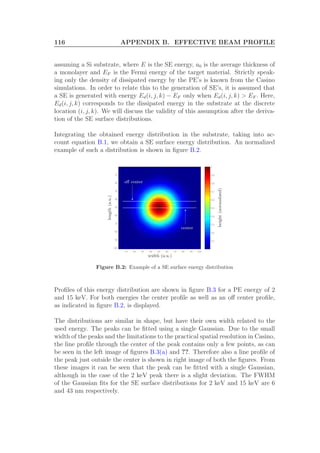
non specific energy is created, which is called a photo electron. Consequently the
creation process itself is called the photo effect. The photo electron is physically
not different from the SE’s, only their origin differs. In the former case the exited
atom will eventually relax to its lower energy state under emission of another
characteristic X-ray, but with a lower energy than the X-ray that initiated the
event. This is called the fluorescence effect. For accurate quantification of EDS
spectra (see section ??) it is important to take this effect into account.
In summary
To conclude this section on electron - substrate interactions, it can be said that the
irradiation of a substrate with energetic electrons gives rise to a whole cascade of
ionization, excitation, relaxation and subsequent generation events. What even-
tually can be seen to be coming from the substrate are electrons with a charac-
teristic (Auger Electrons) and non characteristic energy (BSE’s and SE’s, among
which photo electrons) and x-rays with a characteristic (due to atomic transitions,
among which fluorescent x-rays) and non characteristic energy (Bremsstrahlung).
3.2. ELECTRON BEAM INDUCED DEPOSITION 31
3.2.2 Precursor - substrate interactions
The principle of EBID is based on the decomposition of a precursor molecule
containing the desired element of deposition. There are two different approaches
to introduce the precursor gas in the vacuum system. It can be brought into
the system locally by means of a hollow needle or throughout the whole system
by a non-local inlet controlled by a valve. The advantage of using a needle is a
much higher precursor density in the area of deposition and therefore a higher
efficiency. In this thesis the precursor is introduced by means of a needle.
adsorption
desorption
diffusion
substrate
needle
(a) Schematic view on the interaction be-
tween substrate and precursor gas.
energy
position
adsorption
desorption
diffusion
(b) Adsorption, diffusion and desorption
depicted as processes in an energy land-
scape.
Figure 3.4: Visualizations of precursor - electron interactions.
The processes involved in the precursor - substrate interactions are schematically
shown in figure 3.4. The interactions with the substrate can be described in terms
of a energy landscape where the precursor molecule can be trapped in local energy
minima (adsorption). Due to thermal vibrations these trapped molecules have a
finite chance of escaping. They can escape and find their way to another local
energy minimum (diffusion) or they can leave the substrate entirely (desorption).
The balancing of these processes produces an average local density of adsorbed
precursor molecules, also called the substrate occupation. It is this local den-
sity that is one of the important parameters for the efficiency of EBID, because
decomposition of free molecules does not contribute to the deposition. This is
further substantiated in the next subsection on electron - precursor interactions.
In the first experimental part of this thesis, chapter 7, the focus lies on the
analysis of the topological features of the depositions, which appear to be a con-
sequence of diffusion processes at the substrate. For a thorough exploration of
the physics involved a simulation was developed, based upon a physical model.
32 CHAPTER 3. PHYSICAL PROCESSES IN EBID
Both the model and the simulation are dealt with in chapter 6.
3.2.3 Electron - precursor interactions
It has been shown that the interaction of free precursor molecules (i.e. not ad-
sorbed) and the electrons (PE, BSE and SE) does not contribute to the deposition
[12]. To put it differently, apparently only adsorbed molecules are efficiently de-
composed and form a deposition. There are different views that support this
result. Most importantly the density of the molecules in the chamber (even near
the needle) is in general much lower than the density on the substrate. The sub-
strate can in this case be seen as a reservoir for the precursor species. Secondly,
free fractions of decomposed molecules do not necessarily stick to the substrate
on the target position, or to the substrate at all. These two conditions justify
the assumption that direct decomposition of free molecules by primary electrons
can be neglected and that only adsorbed molecules have to be taken into account.
The adsorbed molecules are subjected to a shower of PE’s and SE’s, as explained
in subsection 3.2.1. How this exactly leads to decomposition of the molecule is
still largely unknown. In this thesis it is assumed that the SE’s are the main cause
for decomposition, based on the large cross section with the molecules compared
to the PE’s.
Chapter 4
Experimental Tool Box
In this chapter an overview is given of the experimental tools used to create and
analyse the electron beam induced depositions. The main tool in this research is
the FEI Nova 600 dual beam, which was used to fabricate the EBID depositions
and analyze their composition. The thereupon following sections deal with the
additional analytic tools, classified by type of characterization.
4.1 FEI Nova Nanolab 600i dual beam
The structure of the Nova Nanolab 600i dual beam is schematically shown in
figure 4.1. Figure 4.2 shows two photos of the system, one of the outside of the
system and one of the inside of the vacuum chamber. At the heart of the dual
beam system are, as the name suggests, two (particle) beams: a focussed elec-
tron beam and a focussed ion beam. The electron column is fitted on top of the
vacuum chamber and is perpendicular to the stage at zero tilt angle. The ion
column is fitted under a 52 degree angle with respect to the electron column. For
simultaneous use of both the beams, the user should position the sample at the
height of coincidence of both beams as shown in figure 4.1. Ideally this beam
coincidence point coincides with eucentric height. Eucentric height is the specific
height at which the surface of the substrate is located directly at the position
of the tilt axis. Positioning of the sample at this height has the advantage of
retaining the substrate position while tilting. A mismatch between the two point
generally can be canceled by bringing the sample at eucentric height and sub-
sequently aligning the two beam using beam shift. The Nova Nanolab 600i is a
high vacuum device, meaning that the base pressure in the chamber is generally
in the order of 10−5
to 10−6
mbar.
The electrons are generated by a Field Emission Gun (FEG) in the top part of
the electron column. The great advantage of a FEG compared to the alternative,
a heated filament, is the fine tip out of which the electrons are extracted. Start-
ing from a better defined source enables the electron beam to be better focussed,
resulting in a higher imaging resolution. After extraction from the FEG, the
electrons are accelerated by a electric field between the FEG and the anode and
pass through lens 1 and 2. The beam subsequently passes through an aperture
33
34 CHAPTER 4. EXPERIMENTAL TOOL BOX
electron
ion
column
column
electron beam
ion beam
FEG
anode
lens 1
lens 2
aperture
scan coils
lens 3
detector
impact area
sample
stage
tilt socket
52◦
0◦
Ga+ LMI source
lens 1
beam limiting aperture
lens 2
blanking plates
blanking aperture
52◦
Figure 4.1: Schematic view of the dual beam system and the two particle columns.
to cut down the size of the beam. A set of coils enables the beam to be scanned
across the sample. Finally the beam passes through lens 3 before it enters the
vacuum chamber. Lens 3 can be operated in immersion mode. In this mode the
magnetic field of the lens extends into the vacuum chamber, allowing the sample
to be immersed in the magnetic field of the lens. By effectively bringing the sam-
ple in the lens itself, focussing of the electron beam into a smaller spot becomes
possible, enabling high resolution (sub nanometer) imaging.
In the case of the ion column, a Liquid Metal Ion (LMI) source is used to gen-
erated the ions. The currently most used metal is Galium, as it has a very low
melting temperature. These ions are accelerated and pass through a first aperture
before being focused by lens 1. After this first lens the ions are passed through
a beam defining aperture to create a well defined beam. Finally the beam is
focussed by lens 2 and enters the vacuum chamber.
The basic principle of the ion column is similar to that of the electron column,
but the type of lenses used is different. Because of the much larger mass of the
ions compared to the electrons, electrostatic lenses are used for the ion column.
This causes the lenses to respond slower on adjustments compared to the elec-
tromagnetic lenses in the electron column.
4.1. FEI NOVA NANOLAB 600I DUAL BEAM 35
electron column
(SEM)
ion column
(FIB)
gas injection system
(GIS)
sample holder
stage
Figure 4.2: Outside view (left) and view inside the vacuum chamber (right) view of
the Nova Nanolab 600i.
Patterning The term patterning in general refers to the defining of a pattern
and subsequent tracing of this pattern by the electron or ion beam. Due to its
relevance for understanding the results in this thesis, we will discuss here briefly
how patterning works and what the important pattern parameters are. The two
beams both have their own patterning hardware which operates the scanning
coils, allowing for a possible simultaneous operation of the two beams. The soft-
ware allows for the definition of simple patterns such as rectangles, circles and
polygons, but also more complex patterns through the use of bitmaps or stream
files1
. On execution, defined patterns are sent to the patterning board in pattern
points. The board converts these patterns in beam positions and subsequently
addresses these positions by setting the scanning coils.
The parameters relevant for this research are listed in table 4.1. Apart from
its shape, a pattern is defined by a list of parameters. The amount of time that
every point is addressed is called the dwell time and is a parameter of the pattern.
Typical values for the dwell time range from several microseconds to hundreds
of nanoseconds. Furthermore the beam overlap can be set, which defines how
closely packed the pattern points are. Depending on the dwell time, beam over-
lap, number of pattern points and the total patterning time, the pattern points
are addressed multiple times. A single completion of addressing all pattern points
1
Stream files are basically collections of pattern points.
36 CHAPTER 4. EXPERIMENTAL TOOL BOX
is called a pass.
Table 4.1: Relevant pattern parameters
Parameter Description
Dwell Time The time that one pattern point is addressed.
Beam Overlap The beam diameter overlap between adjacent pattern
points. This consequently fixes the distance between the
points (pitch).
Passes The number of times that all the pattern points are ad-
dressed.
Refresh Time The minimum loop time that must at least elapse before
the next pass.
Total Time The time it takes to compete the whole pattern.
The way in which the patterns are scanned can be set to a few standard options,
depending on the type of pattern. In figure 4.3 a visualization of these scanning
strategies is presented. For circles the scanning direction can be set to circular or
raster. Rectangular patterns can be scanned in a serpentine type or raster type
fashion. Furthermore the scan direction can be set for each of these strategies.
For circular the choice is limited to inner to outer or outer to inner. Raster and
serpentine can be applied from left to right, or vise versa and from top to bottom,
or vise versa.
Accessories Apart from the two beams, the machine is equipped with a vari-
ety of ‘accessories’ that enable a whole spectrum of applications. Table 4.2 lists
an overview of these accessories and their use. Some of these accessories are op-
tional, so they may not be present on every Nova 600i. Because the number of
applications of this system is virtually infinite, we will give a brief broad overview
and subsequently zoom in on the applications relevant to our research.
In the next sections the applications listed in table 4.2 will be discussed in more
detail.
4.1. FEI NOVA NANOLAB 600I DUAL BEAM 37
(a) Circular, inner to
outer
(b) Circular, outer to in-
ner
(c) Serpentine (d) Raster
Figure 4.3: Visualization of different scanning strategies.
4.1.1 Detectors and imaging
In the first place the Nova 600i can be used as an Scanning Electron Microscope
to obtain images with a magnification up to 1.500.000 times. In this application
the object to be imaged is locally bombarded with energetic electrons from the
focussed electron beam. These electrons generate a cascade of secondary elec-
trons (SE), backscattered electrons (BSE) and forward scattered electrons (FSE
as discussed in chapter 3. By simultaneous scanning of the electron beam and
subsequent detection of the generated particles an image can be obtained.
Images of different characteristics can be obtained including SE yield, BSE elec-
tron yield, FSE yield and X-ray yield. Detection of the SE yield results in a
‘standard’ SEM image. It should be emphasized that such an image cannot be
interpreted as an optical recording. The human mind is very skilled in interpret-
ing light and dark differences as depth, but what the image actually displays is
the spatial SE generation. Contrast differences can be caused by differences in
height, but as well by differences in SE yield (i.e. different materials).
Alternatively an image can be made by collecting only the backscattered elec-
trons. By negatively biasing the SE detector, all (low energetic) secondary elec-
trons are kept from reaching the detector. Only the high energetic backscattered
38 CHAPTER 4. EXPERIMENTAL TOOL BOX
Beam Accessory Application
Electron Detector Imaging
Electron
GIS (inert)
Depositing
Electron
GIS (radical)
Etching
Ion - Milling
Ion Detector Imaging
Ion
GIS (inert)
Depositing
Ion
GIS (radical)
Enhanced etching
Table 4.2: Condensed overview of the applications of the FEI Nova 600i dual beam.
The application of the Gas Injection System (GIS) depends on the type of gas used (inert
for depositing, radical for etching). A more detailed description can be found in section
4.1.2.
electrons are able to make it to the detector. Because the amount of backscat-
tered electrons depends on the mass of the elements, backscatter images give a
high Z-contrast2
.
In principle also the ion beam can be used for imaging, but with the disad-
vantage of simultaneous milling. Therefore the used ion current should be kept
as low as possible to minimize damage. Advantages of the imaging with the ion
beam compared to the electron beam are the higher SE yield and the possibility
to image the secondary ion yield. These are the ions that are released from the
sample on impact with the primary ions.
Depending on the characteristic to be imaged, a certain beam (electron / ion)
and detector combination is suitable. Without going into much detail, table 4.3
gives an overview of the different type of detectors and their application.
The modes in the third column correspond to the operating modes of the elec-
tron column. Mode 1 is the default survey mode. This mode is essentially for
navigating and reviewing sites at lower magnifications. In mode 1 the immersion
lens is switched off and the default detector is the ETD in Secondary Electron
operation. Mode 2 is used for most imaging operations at magnifications larger
than 2000 times. In this mode the immersion lens is switched on, and the default
detector is the TLD in Secondary Electron operation. This mode is used to form
ultra-high resolution electron images of the sample. Mode 3 is used for analyt-
2
Z refers here to the atomic number.
4.1. FEI NOVA NANOLAB 600I DUAL BEAM 39
Detector type Detector mode Lens mode
Thru-the-Lens Detector Secondary electron 1, 2 or 3
(TLD) Backscatter electron
Charge reduction 2
Down-Hole visibility
Everhart Thornley Detector Secondary electron 1 or 3
(ETD) Backscatter electrons
Continuous Dynode Secondary ion 1
Electron Multiplier (CDEM) Secondary electron
Energy Dispersive X-ray
(EDX)
X-ray 3
(see section 4.1.1)
Scanning Transmission Transmitted electron 1, 2 or 3
Electron Microscopy
Table 4.3: Table with detector properties and applications.
ical work such as Energy Dispersive X-ray where the Immersion Lens is not so
powerful as mode 2 but can act as a electron trap to improve X-ray collection.
This mode can be used with the ion or electron beam.
Two widely used configurations in this research are the imaging of secondary
electrons and the imaging of backscattered electrons with the electron beam,
both in combination with either the TLD (for high resolution mode) or the ETD
detector. For EDS measurements the EDX detector is used in mode 3. The next
section the application of EDS is explained.
EDX detector
A special imaging detector on the system is the EDAX EDX detector, which
enables the imaging of x-rays emanating from the substrate. In contrast to the
other qualitative imaging techniques, EDX has the potential to provide quanti-
tative information about the composition of a sample.
The origin of the x-rays was discussed in subsection 3.2.1, but a brief recapit-
ulation is given here. Under irradiation with electrons, atoms are ionized and
subsequently relax by transfer of an electron to a lower shell. The energy dif-
40 CHAPTER 4. EXPERIMENTAL TOOL BOX
energy (keV)
counts
L lines
K lines
bremsstrahlung
bremsstrahlung
Figure 4.4: Spectrum of iron, collected using 15 keV electrons. The K and L series are
indicated with a rectangular marker. Also the continuum X-ray radiation, the so called
Bremsstrahlung, can be seen.
ference between these two states is very well defined and characteristic for the
atom in question. This energy is either used to free an electron, which is called
an Auger electron or emitted as a X-ray. The EDX detector detects the incom-
ing x-rays and constructs a histogram of the amount of x-rays per energy range.
Typically this energy range (detector resolution) is in the order of 10 eV. The
histogram is called a spectrum and is unique for each element.
In figure 4.4 the spectrum of iron is shown. The appearance of peaks at defi-
nite positions in the energy spectrum makes it possible to identify the presence
of certain elements, in this case iron. These peaks are generally referred to as
X-ray lines and appear in series, labeled as K, L, M etc. corresponding to the
transitions between different shells [28]. In figure 4.4 both the K and L lines
of iron are shown. Each line series in principle consists of sub lines, labeled α,
β, γ etc., but in general only the α sub lines are visible due to their high tran-
sition probability. Consequently we refer to these lines as the K and L lines,
which technically means Kα and Lα respectively. In most cases, however, one
is interested not only in the possible presence of an element, but merely in its
relative abundance. The process of determining relative abundances is called
quantification.
4.1. FEI NOVA NANOLAB 600I DUAL BEAM 41
Quantification The identification of elements is relatively simple compared
to the quantification of elements. Quantification is based upon the so called k-
ratios, the ratio between the measured peak intensity and the peak intensity of
a reference spectrum of that same element. In the case this reference spectrum
is a spectrum of the pure element or a compound with known composition, it
is called a standard. By multiplication with correction factors for atomic mass
(Z), absorption (A) and fluorescence (F) these k-ratios are linked to a weight
percentage3
.
The EDAX software package that controls the EDX is called Genesis and pro-
vides two ways to perform quantification. The first method is through the use
of the before mentioned standards. To obtain reliable results, all the standard
spectra of the element of interest should be collected under the same conditions
as the spectra of the sample to be analyzed. Same conditions refer to same beam
energy, beam current, sample position and orientation. Preferably the collection
of the spectra of the sample and standards are performed directly after each other.
The second method for quantification is called standardless and as the name sug-
gests this method enables quantification without the use of physical standards.
To obtain a reference spectrum for calculating k-ratios, standardless quantifica-
tion uses a model of the X-ray generation in a sample. The great advantage of this
method is the absence of requiring standards. The collection of standard spectra
can be a time consuming procedure, depending on the amount of elements to be
quantified. On the other hand the use of standards can lead to a more accurate
quantification, especially at low energy.
For both quantification methods, it is important to correct for the non element
specific Bremsstrahlung (see section 3.2.1). This is done by curve fitting through
points that are expected to have no element specific counts. It should be realized
that especially for low count peaks, the inaccuracy in the background correction
can alter the outcome of the quantification. This situation is common for spectra
in which one peak dominates the other peaks. In this case we say that the low
count peaks are masked by the high count peak.
Related to this masking issue, are the statistics involved in the collection of a
spectrum. Because the error in this type of measurement scales with the square
root of the number of counts, a considerable number of counts are needed in
order to obtain a spectrum reliable for quantification. The number of counts can
be increased by using a higher electron beam current, decreasing the detector -
sample distance or measuring for a longer time. Although increasing the num-
3
Alternative correction methods are sometimes used depending on the application. See
chapter 9 of [28] for more information.
42 CHAPTER 4. EXPERIMENTAL TOOL BOX
0 2 4 6 8 10 12 14 16
0
200
400
600
800
1000
1200
1400
1600
1800
2000
2200
energy (keV)
depth(nm)
Si average
Si 95%
Fe60O15C25 average
Fe60O15C25 95%
Figure 4.5: Penetration depth of PE’s as function of PE energy in Si and Fe60O15C25.
Average indicates the average penetration depth, whereas 95% refers to the depth in
which 95% of the electrons are stopped. Curves are obtained from simulations with
Casino.
ber of counts will make small peaks less sensitive to the background correction,
it does not lead to a better peak to background ratio, as this is determined by
the sample itself and, in the case of layered sample, by the used energy. Conse-
quently, it is important, besides collecting sufficient counts, to optimize the peak
to background, taking into account all the peaks of interest. In section 5.2.1 we
will discuss a technique for choosing an optimal energy for layered samples.
With the choice of a certain energy comes the visibility of certain X-ray lines
and a certain penetration depth. Moreover the penetration depth is dependent
on the composition of the sample as can be seen from figure 4.5. The figure shows
the penetration depth of PE electrons as function of their energy for Si and a
typical composition of a iron deposition, Fe60O15C25
4
, where the subscripts indi-
cate the composition in atom precent. The data of this figure was extracted from
simulations with Casino. For each sample two curves are shown. The average
curves show the average penetration depth of the PE’s, whereas the 95% curves
show the penetration depth within which 95% of the PE’s is stopped. From the
figure it can be seen that the penetration depths increase more than proportional
with increasing PE energy. Furthermore the penetration in Si is deeper than
in the Fe composition due to their difference in density. EDX quantification is
based on the assumption that the sample can be considered thick with respect
4
We will see in chapter 5 that this is a common composition for our EBID iron depositions.
4.1. FEI NOVA NANOLAB 600I DUAL BEAM 43
to the penetration depth of the electrons. For sample thicknesses in the order of
nanometers the condition is generally not fulfilled. We will distinguish between
choosing a relatively low energy and high energy with respect to the thickness of
the sample and elaborate on the consequences of both cases.
In figure 4.6 the generation depths of the detected X-rays5
as function of PE
energy are shown for the two discussed materials. The definitions of the average
and 95% curves are the same as in figure 4.5 with the difference that it involves
the generated X-rays in stead of PE’s. Again, it can be seen that the generation
depth increases with increasing PE energy and that the penetration depth in Si
is larger than in the Fe composition. At low energies only the L-lines of iron are
visible (see figure 4.6(b)) and the penetration is small. Due to the small pene-
tration depth, the majority of the x-rays will be generated in the top part of the
sample. This is shown in figure 4.6 for pure Si and Fe composition. For a thin
deposition this would lead to a strong signal emanating from the deposition itself,
thereby leading to a possible accurate quantification. The downside of using the
L lines is the inability of the model used by the software to accurately determine
the k-ratios, which may have a pronounced effect on the quantification results.
0 2 4 6 8 10 12 14 16
0
200
400
600
800
1000
1200
1400
1600
1800
energy (keV)
depth(nm)
Si K average
Si K 95%
(a) Si K line
0 2 4 6 8 10 12 14 16
0
100
200
300
400
500
600
700
800
energy (keV)
depth(nm)
Fe K average
Fe K 95%
Fe L average
Fe L 95%
(b) Fe K & L lines
Figure 4.6: X-ray generation depths for the Si K in pure Si and Fe L and Fe K lines in
Fe60O15C25 as function of PE energy. Average indicates the average penetration depth,
whereas 95% refers to the depth in which 95% of the electrons are stopped.
For higher energies the K lines will be visible as well (see figure 4.6(b)) and the
penetration depth is large. For thin depositions this large penetration depth may
lead to a considerable probing of the underlying substrate. Consequently due to
the weak signal from the deposition itself quantification results may be inaccu-
rate. The effect of limited thickness on the EDX quantification is investigated in
5
Part of the x-rays generated in the sample do not reach the detector due to reabsorption.
44 CHAPTER 4. EXPERIMENTAL TOOL BOX
chapter 5.
In theory it is possible to perform quantifications with an accuracy up to 0.1
atom percent. In practice this can be hard to achieve. Problems arise when
peaks of different elements overlap or when quantities are small. The aim of the
EDX quantification in this thesis is to obtain reliable reproducible results within
a few percent.
This section only provides a condensed view on EDX and EDX quantification.
For a more in depth exploration of X-ray generation and detection we refer to
[28].
4.1.2 Gas injection system
In chapter 3 we briefly mentioned two different ways to introduce a gas in the
vacuum system for the application of Beam Induced Structuring techniques, in
specific EBID. This either takes place by means of a valve controlled inlet (in-
jection throughout the whole vacuum system) or through a small hollow needle
(local injection). On the FEI Nova 600i dualbeam the gas is injected locally, close
to the substrate, by means of a hollow needle with an end diameter of 600 µm.
This needle is part of a larger system called the Gas Injection System (GIS). A
photo of a GIS is shown in figure 4.7.
The GIS consists of two major parts. The larger part is situated outside the
vacuum and contains a pneumatic system to insert and retract the needle and
to open and close the GIS. Inside the vacuum system the crucible is situated,
in which the precursor of choice is loaded. A plunger inside the middle of the
crucible acts as a valve and is operated by the pneumatics on the outside. The
crucible is equipped with a heater to bring the precursor to the desired temper-
ature. The temperature provides a way to control the precursor flux through
the needle. Heating of the precursor results in increased evaporation, thereby
increasing the flux through the needle.
The GIS is connected to the vacuum chamber of the Nova 600i by means of
a flange. This flange rests on a rubber O-ring that seals the vacuum chamber.
The unit is kept in place by two aluminium clamps in which the flange fits. By
means of little Allen screws in the clamps, pressure can be locally applied on
the flange. Because of the flexibility of the O-ring, this causes a slight change
in the alignment of the GIS. The length of insertion can be controlled through a
turnable ring, that acts as an stop. In this way the position and distance of the
needle with respect to the substrate and the two focussed beams can be adjusted.
The GIS should be aligned for operation at eucentric height. This ensures the
4.1. FEI NOVA NANOLAB 600I DUAL BEAM 45
air
vacuum
heater
connector
pneumatics
connections
flange
crucible
needle
Figure 4.7: GIS unit suspended in GIS standard. The needle (not shown in image) is
attached to the crucible.
ability to use the GIS with either one of the beams. By aligning the GIS with
respect to eucentric height, the alignment of the GIS has to be performed only
once. Alignments for follow up experiments are done by positioning the sample
at eucentric height.
4.1.3 Precursors
The state of the majority of the precursor in the crucible is either solid or liquid
depending on the used precursor6
. Due to heating and low pressure (in the case
the GIS is open), the precursor evaporates and leaves the crucible in gas phase.
The evaporation rate of a precursor is determined by its vapor pressure. The
vapor pressure is the temperature dependent pressure at which the precursor va-
por is in equilibrium with its non-vapor phases (solid or liquid, depending on
temperature and pressure). The higher this pressure, the easier is the transi-
tion to gas phase. Figure 4.8 shows the vapor pressure curves for the two used
iron precursors, Triirondodecacarbonyl (TIDC) and Diironnonacarbonyl (DINC).
6
With this specific GIS it is not possible to introduce precursors that are in gas phase under
standard conditions (293K, 105
Pa).
46 CHAPTER 4. EXPERIMENTAL TOOL BOX
Furthermore the curves for methanol and isopropanol are shown. In the temper-
ature regime of interest the vapor pressure for the DINC and TIDC precursor is
related to the equilibrium between solid and gas phase, whereas for the methanol
and isopropanol it comprehends the equilibrium between liquid and gas phase.
0 20 40 60 80 100
10-2
10-1
100
101
102
103
104
105
106
temperature (◦C)
pressure(Pa)
solid
liquid
gas
gas
isopropanol
methanol
DINC
TIDC
Figure 4.8: Vapor pressure curves as function of temperature for Methanol, Iso-
propanol, TIDC and DINC. The curves were obtained using the Clausius-Clapeyron
equation, which relates the pressure to the temperature via the evaporation enthalpy
(in case of a liquid - gas transition) or sublimation enthalpy (in case of a solid - gas
transition).
The used supply of TIDC precursor is shipped with a 5 -10 weight % methanol.
If one wants to limit the exposure to air, the precursor is unavoidably loaded in
the GIS together with the methanol. Due to its high vapor pressure compared
to TIDC, as shown in figure 4.8, it can be expected that initially after filling of
the GIS the methanol contributes considerably to the total flux into the vacuum
chamber. We will see in chapters 5 and 7 to what extent the presence of methanol
is relevant. To test the influence of the presence of volatile alcohols in general,
an experiment was conducted using isopropanol (see chapter 7.) due to its com-
parable composition and vapor pressure (see figure 4.8).
Based on the vapor pressures and the flow resistance of the GIS the expected
precursor flux can be estimated. The precursor flux is estimated using a flow
conductance of 2 · 10−6
m3
s−1
and a effectively supplied sample surface of 1
mm2
. An overview of values for PF for different precursors is given in table 4.4,
together with their typical dimensions. From this typical dimension the surface
4.2. TOPOLOGY CHARACTERIZATION TOOLS 47
coverage of a molecule can be calculated, which can subsequently be used to de-
termine the maximum density in a monolayer. We will see in chapter 6 that this
a relevant parameter for our EBID simulation.
Table 4.4: Typical values of dimension and PF for different precursors.
material platinum iron methanol
precursor MeCpPtMe3 Fe3(CO)12 Fe2(CO)9 CH3OH
Dimension (nm) 0.7 0.8 0.7 0.3
PF (µm−2
s−1
) 2 · 1012
4 · 1009
1 · 1015
1 · 1017
The parameters of the frequently used platinum precursor are given as a reference.
An important observation is the fact that the estimated methanol flux is more
than 8 orders of magnitude larger than the TIDC flux. Based on this observation,
it can be expected that methanol, while still present in the crucible, will have a
considerable influence on the total flux.
4.2 Topology characterization tools
4.2.1 Scanning Electron Microscopy
A quick estimation of deposition heights is possible using the SEM functionality
on the Nova 600i. By tilting the sample with respect to the electron beam, the
user obtains a partial side view of the deposition. Correcting the measured height
in the side view for the tilting angle, a rough estimate of the deposition height is
obtained. A more accurate measurement can be performed after the milling of a
cross section of the deposition. In this approach locally a part of the deposition
is removed by FIB milling to allow imaging of a cross section. For accurate non-
destructive spatial height measurements, additional tools are required, such as
Atomic Force Microscopy (AFM).
4.2.2 Atomic Force Microscopy
Atomic Force Microscopy (AFM) is based on the interaction of a very sharp tip
and the sample. This tip is mounted on a cantilever, which is deflected due to
forces acting on the tip. By scanning this tip in close vicinity over the surface
and simultaneously measuring the deflection, a spatial force map is obtained.
When the tip is touching the surface, a mapping of the Coulomb forces is made.
The repulsion due to the Coulomb force is what is generally considered to be the
topology.
48 CHAPTER 4. EXPERIMENTAL TOOL BOX
Behind the simple principle on which AFM is based, hides a world of various
operating modes and force regimes. It is beyond the scope of this thesis to ex-
plain this in more detail. For a condensed overview of AFM, it is recommended
to read [29]. A more complete overview of the possibilities of this technique can
be found in [30].
4.3 Electric characterization tools
Electrical measurements were performed on depositions, situated between two
macroscopic golden electrodes as shown in figure 4.9(a). These electrodes were
fabricated using Electron Beam Litography (EBL) and lift-off technique. The
electrodes were contacted using four sharp needles (7 µm tip diameter), 2 needles
on each electrode. Two of the needles, one on each electrode, are used to send a
current through the deposition. The other two are used to measure the voltage
drop across the deposition. This type of conductivity measurement is generally
referred to as a four point measurement.
The positioning of the needles is done by means of a probe station. An optical
microscope is used to visually detect the landing of the needles on the electrodes.
An example view from the microscope is shown in figure 4.9(b). The picture
also shows a potential danger of this measuring technique. Due to electrostatic
charging of the needles, high potential differences can arise between the tip and
sample. When approaching the sample this potential difference results in a dis-
charge through the deposition, which causes partial evaporation of the deposition.
To avoid this destructive discharge, the needles should be temporarily grounded
before approaching the sample.
4.4 Magnetic characterization tools
For the magnetic characterization of the iron depositions, three different tools are
available within the group of Physics of Nanostructures. For quantitative mea-
surements there is the Superconducting QUantum Interference Device (SQUID).
Normalized measurements of the magnetization of samples can be preformed us-
ing the Magneto Optical Kerr Effect (MOKE). Finally there is Magnetic Force
Microscopy (MFM), which provides an accurate way of imaging the strayfield
emanating from the sample as a consequence of its local magnetization. These
three techniques are treated in the next sections.
4.4. MAGNETIC CHARACTERIZATION TOOLS 49
75 µm
(a) SEM image of the electrodes. In between
the thin ends the deposition is situated.
(b) Microscope image of the four needles on
the electrodes.
Figure 4.9: SEM image of the electrodes and microscope image of the electrodes and
needles.
4.4.1 SQUID
The full explanation of SQUID is beyond the scope of this thesis. A description
of SQUID can be found in [31]. For now it suffices to note that it is a relatively
sensitive technique to measure magnetic moments. In order to determine whether
SQUID is applicable in this research, we will estimate the minimum deposition
time necessary to obtain a measurable magnetic moment.
The sensitivity of the Superconducting Quantum Interference Device µmin avail-
able in the group is 10−9
A m2
. The volume necessary to obtain this magnetiza-
tion was estimated through
Vmin =
µmin
MF e
0
, (4.1)
using a value of 1.7 · 106
A m−1
for the saturation magnetization of pure iron
MF e
0 at 0 K7
. This leads to a volume of 6.0 · 102
µm3
of pure iron. After the
characterization of the deposition yield Y , an estimation is made of the deposition
time necessary to deposit this volume. Taking into account a 60 atomic percent
7
Because the Curie temperature for iron (1043 K) is high compared to room temperature
(300 K), the saturation magnetization at room temperature will not differ significantly from
the value at 0 K [32].
50 CHAPTER 4. EXPERIMENTAL TOOL BOX
iron concentration in the depositions8
(see section 5.2) leads to an estimate for
the effective iron deposition yield YF e in the order of 10−4
µm3
nC−1
for the TIDC
precursor. The time needed to create a deposition that can be detected in the
SQUID is given by
tdep =
Vmin
YF e · Iebeam
. (4.2)
Substituting the estimated values for the parameters gives a time of 6 · 105
s
for a typical electron beam current Iebeam of 1 nA. This is equivalent to almost
7 days, hence it is not considered practical to pursue the characterization of
the TIDC depositions using SQUID. Because of the considerable higher yield of
DINC, it may be feasible to determine the magnetic moment associated with the
depositions created with this precursor. This was not accomplished within the
time frame of this thesis, as we have focussed on the characterization of the TIDC
precursor.
4.4.2 MOKE
MOKE exploits the effect that the polarization of light is changed upon reflec-
tion on a magnetic sample due to interactions with the local magnetization. By
applying an external magnetic field to the sample and sweeping it from negative
to positive and back, a magnetic hysteresis curve can be obtained. The range
of the field sweep is dependent on the properties of the sample. From the hys-
teresis curve sample characteristics such as the coercive field can be determined.
Standard MOKE provides a normalized signal with respect to the saturation
magnetization, meaning that it does not provide an absolute value of the magne-
tization as function of applied field. The theory of MOKE is explained in more
detail in [31].
The main problem of the used MOKE setup with respect to the depositions
is the size of the laser spot. The spot is estimated to be 100 - 150 µm in diam-
eter, which is a factor of 100 more than the typical dimension of a deposition.
Consequently the MOKE signal will be small, if not impossible to detect. At-
tempts have been made to obtain MOKE hysteresis loops for small (5x5µm, 1h)
and large (100x100µm, 12h overnight deposition) samples, but none of them
were successful. An explanation for the lack of a MOKE signal in case of a small
deposition was already given at the beginning of this paragraph. In case of the
large deposition, the amount of magnetic material may have been too small to
measure or the deposition may lack a net magnetization due to domain formation.
8
It is hard to calculate the volume corresponding to 60 atomic percent iron due to unknown
densities of the other constituents. It can nevertheless be concluded that iron takes up no more
than 60 volume percent.
4.4. MAGNETIC CHARACTERIZATION TOOLS 51
MOKE is potentially a suitable tool to investigate the magnetic properties of the
depositions, provided that the spot size is optimized for analyzing micrometer
sized structures. Within the time frame of this thesis, this was not accomplished.
4.4.3 Magnetic Force Microscopy (MFM)
MFM can be seen as an extension of the capabilities of AFM. By replacing the
AFM tip with a magnetic MFM tip, the magnetic interaction of the tip with the
stray field of the sample can be studied. In order to distinguish between topology
and magnetic interactions, MFM uses a multi pass technique, meaning that every
scan line is scanned twice. In the first pass, the surface topology is determined,
while in the second pass a certain height above this topology is maintained during
scanning. The deflection of the cantilever in the second pass is a measure for the
magnetic interaction. A more detailed description of MFM can be found in [29].
The current shortcoming of MFM is the inability to quantify its signal due to
the unknown magnetic moment of the tip. The possibilities of the calibration
of a MFM tip were investigated in [33]. The results are promising, but further
research is required for the actual calibration. Consequently the MFM scans in
this thesis can only be interpreted qualitatively.
The measuring of magnetic stray fields with MFM is a very subtle process. The
success of MFM depends highly on the stability and reliability of the setup and
on the properties of the MFM tip. Especially for small stray field, such as ema-
nating from the iron EBID depositions, the interaction with the tip is only with
its mere end. Any small damage or pollution of the tip can result in total quench-
ing of the MFM signal. The used MFM is operated under ambient conditions,
which enables easy operation, but is also frequently accompanied with vibrational
noise and dust contamination. Especially because of the sensitivity of the MFM
technique these effect can be of great influence on the MFM signal.
Chapter 5
Results: Precursor
Characterization
In this chapter the characteristics of the iron EBID depositions made using the
Triirondodecacarbonyl (Fe3(CO)12, TIDC) and Diironnonacarbonyl (Fe2(CO)9,
DINC) precursor are explored. We start with the determination and comparison
of the yield of both precursors. By means of Energy Dispersive X-ray Spec-
troscopy (EDS) the composition of the depositions is determined. Because of
difficulties with the quantification of the EDS data of the depositions, an effort is
made to investigate the reliability of the EDS quantification of thin films. This
chapter is concluded with the preliminary results on the magnetic characteriza-
tion of the depositions.
5.1 Yield
One of the important aspects of the characterization of a precursor is the de-
position yield. To determine the yield for both the TIDC and DINC precursor
300 s depositions are made for 3 different beam energies (2, 5 and 10 keV) and
3 different beam currents. These depositions are created by scanning the beam
in a circular fashion from inner to outer, resulting in circular depositions with
a diameter of 3 µm. A SEM image of one of the depositions is shown in figure 5.1.
The resulting 9 depositions are measured by means of AFM, whereby the volume
of the depositions can be determined. Figure 5.2 shows the yield as function of
beam energy and beam current.
We will first compare the found values to the yield of a frequently used precur-
sor for platinum, MeCpPtMe3. A typical value for the yield of this precursor is
5 · 10−3
µm3
nC−1
when using a beam energy of 2 keV. From the figure it can
be seen that the DINC precursor has a yield in this same regime for low beam
currents. The TIDC yield, however, is considerably lower than the typical yield
for the platinum precursor. Based on this observation, we might expect different
behavior of the TIDC precursor.
52
5.1. YIELD 53
Figure 5.1: SEM image of a circular deposition. The rectangular area on top of the
deposition is additional carbon deposition, due to the performed EDS analysis (see section
5.2.2).
Furthermore it can be seen that the difference in yield between the TIDC and
DINC precursor is, over the whole current and energy regime, more than an or-
der of magnitude. The underlying cause can be found in the difference in vapor
pressure as shown in figure 4.8. With respect to these vapor pressures, it is rather
surprising that the difference in yield between the two is only one order of magn-
titude. Based on the three orders of magnitude difference in vapor pressure, one
would expect to see a similar difference in deposition yield. One possible expla-
nation for the fact that this is not observed is that the TIDC precursor is shipped
with 5 -10 weight % methanol, to protect it from air. This methanol is loaded
in the crucible together with the TIDC. The presence of methanol increases the
effective vapor pressure to a value in between the methanol and TIDC. Associ-
ated with this increased vapor pressure is a higher precursor flux, resulting in a
higher yield1
. Furthermore it can be seen that the yield is highest for the lowest
energies, which can be explained in terms of the SE yield (see figure 3.2). For the
discussed energy range the SE yield increases with decreasing energy, leading to
an increase in deposition yield.
Considering the yield as function of beam current, we can in general discrim-
inate between two regimes. In the case of a high precursor flux compared to the
beam current, the supply of adsorbed precursor will exceed the amount that can
be decomposed by the electron beam. Hence the yield will not depend signifi-
cantly on the beam current in this regime. This situation is called the current
limited. The opposite case, where the precursor flux is low compared to the beam
current, is logically called precursor flux limited. In this regime the yield depends
1
Note that this does not increase the yield with respect to the amount of iron deposited
54CHAPTER 5. RESULTS: PRECURSOR CHARACTERIZATION
beam current (nA)
yield(µm3nC−1)
DINC
Fe2(CO)9
TIDC
Fe3(CO)12
2 keV
2 keV
5 keV
5 keV
10 keV
10 keV
Figure 5.2: Yield versus beam current for different beam energies. For al depositions
the substrate temperature TSUB was 24◦
C and the GIS temperature TGIS was 45◦
C.
The lines are guides to the eye.
barely on the precursor flux, but is sensitive to changes in the beam current. Due
to the limited supply of adsorbed precursor, the yield decreases with increasing
beam current, caused by the lack of a sufficient amount of adsorbed molecules.
It can be seen from figure 5.2 that this is the relevant regime for the TIDC and
DINC precursor. The slope of the guide lines of TIDC and DINC differ slightly.
The slope of the DINC guides is smaller than those of the TIDC. Based on this
observation, it can be concluded that the TIDC precursor is stronger precursor
flux limited than the DINC precursor. Based on the vapor pressures, it can in-
deed be expected that the TIDC flux is considerably lower than the DINC flux,
which explains the difference in slope.
To quantitatively describe the yield as function of beam current, it is impor-
tant to accurately know the precursor flux, the electron - precursor molecule
decomposition cross section(s) and the ordering (amorphous, crystalline) of the
deposition. In this thesis the precursor flux is calculated based on the vapor pres-
sure of the precursor and geometry of the GIS. For an accurate determination of
the flux, a direct measurement is necessary. A technique for measuring precursor
flux was not present on the equipment used in this thesis. As for the decom-
position, there are multiple reactions involved in a decomposition process and it
can be expected that these all have their own specific cross section. These cross
sections are largely unknown and would have to be determined for the specific
precursor. Finally the crystallographic structure (or lack thereof) of the deposi-
5.2. EDS ANALYSIS 55
tion is generally unknown, which makes it hard to relate the decomposed fractions
to an experimentally determined yield. Due to these difficulties, a quantitative
description is an extensive task and beyond the scope of this thesis.
5.2 EDS analysis
The composition of the depositions is investigated using Energy Dispersive X-ray
Spectroscopy (EDS). EDS was developed for the analysis of homogeneous, mi-
cron scale bulk samples. Since we are dealing with nanometer thick depositions,
it should be investigated under which conditions EDS can still be used to analyze
these depositions.
An example of the difficulties that arise for EDS quantification of the iron depo-
sitions is given in table 5.1. EDS was performed using both 2 keV and 10 keV
electrons. The quantification was obtained using the Standardless quantification
of Genesis (see section 4.1.1). It can be seen that the quantification results differ
substantially. In the case of 2 keV an iron content of 61.8 atomic percent is found,
in contrast to the 16.0 atomic percent at 10 keV.
Table 5.1: EDS quantification of a iron deposition at 2 and 10keV.
Element Line Atomic %
2keV 10keV
C K 27.8 64.5
O K 10.4 19.5
Fe L 61.8 16.0
Total 100 100
As explained in section 4.1.1 this difference may be attributed to the difference
in penetration depth of the electrons. Where the 2keV electrons mainly generate
electrons within the deposition, the 10keV electrons largely probe the underlying
substrate. This large substrate signal masks the peaks of interest and increases
their sensitivity to the background correction. Based on this reasoning, the re-
sults obtained with 2keV electrons are expected to be more accurate.
Aided by a special software package for the EDS analysis of thin samples Stratagem
[34] an attempt is made to investigate quantification of thin samples. By study-
ing a Co90Fe10 layer of varying thickness, a so called wedge, we gain insight in
additional difficulties related to EDS quantification, which are not specifically
associated with thin films. Due to these difficulties, the found results can not
directly be related to the quantification of EBID iron depositions. However, we
56CHAPTER 5. RESULTS: PRECURSOR CHARACTERIZATION
choose to present this study here, as it contributes to the overall understanding
of the challenges involved in quantitative EDS. In section 5.2.2 we will continue
with analysis and quantification of the composition of iron EBID depositions.
The inquisitive reader may skip the following section and continue reading at
section 5.2.2.
5.2.1 EDS on a Co-Fe wedge
A Co90Fe10 wedge is sputtered on a Si substrate. Subsequently point spectra are
collected for different layer thicknesses and different beam energies of 2, 4, 15
and 30 keV. First, these results are quantified using only the Standardless quan-
tification of the EDAX Genesis software. The results of these quantifications are
shown in figure 5.3. The wedge thickness is drawn in the background in gray.
0 50 100 150 200 250 300 350 400
0.0
0.1
0.2
0.8
0.9
1.0
thickness (nm)
atomicfraction
2 keV L
2 keV L
4 keV L
4 keV L
15 keV K
15 keV K
30 keV K
30 keV K
Co content
Fe content
Figure 5.3: EDS quantification of the Co90Fe10 wedge at different thicknesses and for
different beam energies. The dashed horizontal lines at 0.1 and 0.9 correspond to the
expected iron and cobalt atomic fractions respectively.
The graph shows the atomic fraction of cobalt (filled markers) and iron (open
markers). At 2 and 4 keV the L lines of Co and Fe are used in the EDS analysis,
because at these PE energies these are the only lines visible for these elements.
At the higher energies, the K lines are used. The expected atomic fractions of
0.90 for Co and 0.10 for Fe are indicated by the dashed lines.
5.2. EDS ANALYSIS 57
It can be seen from the figure that quantification obtained at 15 and 30 keV
matches well with the expected values for large layer thicknesses (160 and 315
nm). The measurement at the thin part of the wedge (35 nm) shows a small devi-
ation ( 10%) from this value, which can be understood by realizing that for these
energy - thickness combinations we probe a considerable part of the underlying
substrate. The large signal from the substrate masks the signal emanating from
the Co-Fe layer. This emphasizes the importance of choosing the used energy in
the correct energy range for a given sample thickness in order to obtain accurate
quantification data.
Because of their visibility at lower energies, the L lines may be preferred for
quantifying thin films. However, in the case of the Co-Fe wedge we can see that
the atomic fraction obtained using these lines deviates considerably from the ex-
pected values. This can be attributed to the overlapping of the L lines of Co
and Fe (see figure 5.4). Due to this overlap, peak intensities (and consequently
k-ratios, see section 4.1.1) will include an additional deconvolution error.
0 500 1000 1500 2000 2500
0
2000
4000
6000
8000
10000
12000
14000
16000
18000
20000
600 700 800 900 1000
0
2000
4000
6000
8000
10000
12000
14000
16000
18000
20000
energy (eV)
counts
energy (eV)
counts
Co L
Co L
Fe L
Fe L
Figure 5.4: X-ray spectrum of the Co - Fe wedge measured at 5 keV with fits of
the different peaks. Inset displays a zoom of the overlapping Fe L line(left) and Co L
line(right). The shown spectrum is already corrected for the background radiation.
In this specific case of a single Co-Fe layer, the standardless quantification leads
to reliable results, due to the absence of a strong interaction between the layer
and the substrate. Relevant interactions for quantitative EDS are for example
reabsorption and fluorescence processes in different layers, which will alter the
collected X-ray spectrum. When multiple interacting layers are involved, EDS
58CHAPTER 5. RESULTS: PRECURSOR CHARACTERIZATION
quantification is not as straightforward. A possible solution to the difficulties
involved in EDS analysis on these samples is a software package called Stratagem
[34]. Stratagem can account for interactions between different layers and thereby
enables EDS quantification of layered samples. A bonus of Stratagem is its capa-
bility to determine the thickness of layers from the EDS data. The accuracy of
the results of Stratagem still depends on the reliability of the k-ratios determined
by Genesis. We will therefore focus on quantification with Stratagem using the
K-lines.
Additional EDS spectra are collected on the thin part of the wedge (0 - 140 nm)
using energies of 10 and 15 keV. The k-ratios of the K lines of these measure-
ments, returned by Genesis, are used in Stratagem to calculate the composition
of the layer and the corresponding thickness. In figure 5.5 the results are shown.
0 20 40 60 80 100 120 140
0.0
0.1
0.2
0.8
0.9
1.0
thickness (nm)
atomicfraction
10 keV K
10 keV K
15 keV K
15 keV K
Co content
Fe content
(a) Composition in atomic percent as
function of layer thickness for 10 and 15
keV using the K lines.
0 10 20 30 40 50 60 70 80 90 100 110 120 130 140
0
20
40
60
80
100
120
140
160
actual thickness (nm)
Stratagemthickness(nm)
10 keV K
15 keV K
(b) Thickness as determined by
Stratagem versus actual thickness
Figure 5.5: Stratagem corrected quantification results and calculated layer thicknesses.
The quantification results obtained with the K lines agree with the expected val-
ues. The spectra collected at expected zero thickness reveal small Co K and Fe
K peaks, indicating that we are not exactly at the beginning of the wedge. The
deviation at this thickness is again a consequence of the masking of the Co K and
Fe K lines by the Si K line of the substrate. The negligible difference between the
results from Genesis and Stratagem confirms the absence of strong interactions
between the Co-Fe layer and the Si substrate.
Additional to the composition, Stratagem calculates the thickness of the layer.
Figure 5.5(b) shows the calculated thickness as function of the actual thickness of
the wedge. The thickness values returned by Stratagem match very well with the
expected thickness. The difference with the actual thickness may even be smaller
5.2. EDS ANALYSIS 59
as there is an uncertainty associated with position of the onset of the wedge2
.
The already mentioned observation of small Fe and Co peaks in the spectrum at
the supposed onset of the wedge confirms this.
Stratagem calculates thicknesses by dividing the amount of material necessary
for a certain peak intensity by the estimated density of the material. A value
for this density is obtained by adding the relative contributions of the densities
of the materials present. In the case of our Co - Fe wedge, this calculated value
matches well with the actual density. In the case this value for the density de-
viates from the actual value, the thickness calculated by Stratagem may differ
from the actual thickness.
For accurate quantification of layered samples, it is sensible to optimize the peak
to background ratio by choosing the correct electron beam energy, as was briefly
discussed in the section EDX detector in chapter 4. This minimizes the influ-
ence of the background correction on the k-ratios and ensures the proper determi-
nation of the layer thicknesses by providing a correct reference peak. To obtain
an estimate of which energy to use for a certain layer thickness, Stratagem is
capable of creating a k-ratio versus energy plot. Figure 5.6 shows such plots for
a 100 nm thick Co90Fe10 layer on top of a Si substrate for the K lines (figure
5.6(a)) and L lines (figure 5.6(b)). From these plots a approximate energy range
can be determined, within which accurate quantification can be achieved. The
boundaries of this range are determined by comparing the k-ratios of the relevant
elements. Suitable energies for EDS quantification of this layer are for example
between 6 and 12 keV for the L lines3
and 8 and 15 keV for the K lines as indi-
cated by the gray rectangles.
There are no strict criteria for these boundaries, but we can provide some gen-
eral rules to determine the optimal energy range. In figure 5.6(a) for example,
we need to choose an energy above 6 keV, because that is where the Si k-ratio
becomes significant. On the other side we do not want to end up with a too low
k-ratio for Fe, meaning we should not use energies over 12 keV. Apart from the
decreasing Fe k-ratio for higher energies, it can be seen that also the Si k-ratio
is becoming dominant over the Co k-ratio. Since we are mainly interested in the
Co - Fe content and only need Si as a reference for calculating layer thickness, it
is sensible to not use energies higher than 12 keV.
It can be concluded that the thickness calculations returned by Stratagem are
promising, as they match well with the expected thickness. Manually inserting
the expected density in the software may even improve the agreement with the
2
This is a consequence of the method used to fabricate the wedge.
3
Quantification would of course still be problematic due to the overlapping of the L lines.
60CHAPTER 5. RESULTS: PRECURSOR CHARACTERIZATION
0 5 10 15 20 25 30
0.0
0.1
0.2
0.3
0.4
0.5
0.6
0.7
0.8
0.9
1.0
energy (keV)
k-ratio
Co L
Fe L
Si K
(a) Co and Fe L lines
0 5 10 15 20 25 30
0.0
0.1
0.2
0.3
0.4
0.5
0.6
0.7
0.8
0.9
1.0
energy (keV)
k-ratio
Co K
Fe K
Si K
(b) Co and Fe K lines
Figure 5.6: K-ratios for a 100 nm thick Co90Fe10 layer as function of beam energy for
the L lines (a) and K lines (b). The optimal EDS energy range is indicated with the gray
rectangles.
actual thickness.
The main conclusions about EDS quantification is to avoid the use of overlapping
X-ray lines if possible. For our iron depositions, we will be looking at the C K
line, O K line and Fe L line, which are located at energies of 0.266, 0.515 and
0.705 keV respectively. These lines should be separated far enough to avoid this
problem. For thin films the used energy should be matched to the thickness of
the sample of interest. The k-ratio versus energy plots of Stratagem are useful to
determine this matching energy. In order to be conclusive about the use of the
L lines for quantification, it is recommended to repeat the experiment using an
alloy of two materials with less or non overlapping L-lines, for example Fe and Ni.
5.2.2 Composition iron depositions
In accordance with the conclusions derived in the previous section, k-ratios versus
energy plots are made of the TIDC (average thickness 7 nm) and DINC (average
thickness 70 nm) depositions, which are shown in figure 5.7.
From figure 5.7 it can be seen that the optimal energy range for DINC is centered
around 4 keV, whereas for the thinner TIDC depositions this energy optimum
is around 2.5 keV. To allow for a direct comparison, the depositions of both the
precursors were measured with EDS at a thickness matched energy of 4 keV.
The experiment was repeated for the TIDC precursor using 2.5 keV to optimally
match the energy to the thickness of the deposition. An example of one of the
depositions is shown in figure 5.1, in which the area scanned for EDS analysis is
visible due to additional carbon deposition during the spectrum collection. These
5.2. EDS ANALYSIS 61
0 1 2 3 4 5
0.0
0.1
0.2
0.3
0.4
0.5
0.6
0.7
0.8
0.9
1.0
energy (keV)
k-ratio
O K
C K
Fe L
Si K
(a) TIDC deposition of 7 nm thickness
0 1 2 3 4 5
0.0
0.1
0.2
0.3
0.4
0.5
0.6
0.7
0.8
0.9
1.0
energy (keV)
k-ratio
O K
C K
Fe L
Si K
(b) DINC deposition of 70 nm thickness
Figure 5.7: K-ratio versus energy plots calculated by Stratagem for a 7 nm thick TIDC
deposition (a) and a 70 nm thick DINC deposition (b) on Si.
measurements where done on a new set of depositions fabricated under the exact
same conditions, but with exposure to air after deposition. The exposure to air
was a consequence of AFM measurements performed on this set of depositions.
The composition of the depositions was determined in Stratagem using the k-
ratios of the Fe L, O K and C K lines. The results are shown in figures 5.8 and
5.9.
We will first discuss the implications of these results on the reliability of EDS thin
film analysis, before interpreting the results with respect to EBID. The quantifi-
cation of the TIDC depositions at 2.5 and 4 keV are consistent within an error
of a few percent, even though the energy of 4 keV does not optimally match the
thickness of the depositions (see figure 5.7(a)). Based on this observation it is
expected that EDS quantification of thin films can be assumed to be accurate
within a few percent as long as the used energy is within the same range as the
optimal energy. A higher accuracy may even be obtained when the used energy
optimally matches with the thickness of the sample.
The background in the graphs of figure 5.8 has been colored by means of three
horizontal bands to emphasize the fact that the composition of these TIDC depo-
sitions does not change significantly with the electron beam current. In literature
[13, ?] it is generally seen that with increasing beam current, the purity of EBID
depositions increases as well. The mechanism responsible for this effect can be
understood in terms of the dissipated energy and consequent more complete de-
composition. Moreover, the dissipated energy could lead to heating, thereby
purifying the depositions through a process called annealing4
. None of these pro-
4
Annealing is a general term for a heat treatment to alter material properties.
62CHAPTER 5. RESULTS: PRECURSOR CHARACTERIZATION
beam current (nA)
atomicfraction
Fe
O
C
(a) EDS quantification at 4 keV.
beam current (nA)
atomicfraction
Fe
O
C
(b) EDS quantification at 2.5 keV.
Figure 5.8: EDS quantifications at 4 (a) and 2.5 (b) keV of iron TIDC depositions,
fabricated at different beam currents and beam energies. The width of the bars indicates
the energy used to fabricate the depositions. From narrow to wide corresponds to 2, 5
and 10 keV respectively. The shaded background indicates the trend in the composition.
cesses seem to play a role for the TIDC depositions. The conclusion that can be
drawn from this observation is that the highest purity achievable through this
method is already obtained at the lowest current. An explanation for finding
this limit can be found by reflecting on the precursor flux. The position of this
optimum as function of current will depend on the magnitude of the precursor
flux. For a small flux this limit will be found at low currents, as is the case with
TIDC, due to the high amount of dissipated energy per precursor molecule.
As briefly mentioned in the introductory paragraph of this section, the TIDC
depositions measured at 2.5 keV have been taken out the vacuum chamber for
characterization by AFM. Consequently the depositions have been exposed to air
5.2. EDS ANALYSIS 63
beam current (nA)
atomicfraction
Fe
O
C
Figure 5.9: EDS quantifications at 4 keV of iron DINC depositions, fabricated at
different beam currents and beam energies. The width of the bars indicates the energy
used to fabricate the depositions. From small to wide corresponds to 2, 5 and 10 keV.
The shaded background indicates the trend in the composition.
for approximately one day before EDS scans were performed. As can be seen by
comparing figures 5.8(a) and 5.8(b) the exposure to air has not lead to a major
compositional change.
In contrast to the TIDC depositions, the composition of the DINC depositions
as shown in figure 5.9 displays an appreciable change as function of beam cur-
rent, which can be attributed to a higher precursor flux. Extrapolating the trend
indicated by the color bands in the background it is plausible that the purity
of these depositions also converges to a certain limit. This purity limit appears
to be slightly higher for the DINC precursor compared to the TIDC precursor,
which is not expected on the basis of the iron fraction in the respective precursor
molecules as argued in section 2.4.2. On the other hand, the TIDC molecules
are larger than the DINC molecules, which potentially leads to less complete
decomposition in the case of the TIDC precursor. Consequently more carbon
and oxygen may be incorporated in the deposition. What is more, the TIDC
precursor flux consists partially of methanol, as discussed in section 4.1.3, which
contributes to the carbon content of the depositions.
64CHAPTER 5. RESULTS: PRECURSOR CHARACTERIZATION
5.3 Magnetic characterization by MFM
A preliminary magnetic characterization of a deposition of each precursor has
been performed by means of Magnetic Force Microscopy (MFM, see section 4.4.3).
Using the TIDC precursor a 5 by 1 µm bar shaped deposition was fabricated.
Because of its elongated shape, the deposition is expected to have a magnetic
shape anisotropy along its long axis. The results of a MFM scan of this deposition,
made in an applied field, are shown in figure 5.10.
(a) AFM (top) and MFM (bot-
tom)
0 1 2 3 4 5 6 7
20
21
22
23
24
25
26
width ( m)
phase(degrees)
(b) MFM line profile
Figure 5.10: (a) AFM (top) and accompanying MFM (bottom) image of a 5 by 1 µm
TIDC deposition in an in plane applied field in horizontal direction of approximately 3.4
kG. (b) Line profile of the MFM signal along the direction indicated in image (a).
The magnetic interaction of the deposition can best be seen in the MFM line
profile shown in figure 5.10(b). Due to the strong applied field the magnetiza-
tion of the deposition is entirely aligned along the direction of the applied field.
Since MFM is only sensitive to the gradient of the stray field perpendicular to
the sample plane, we only expect influence on the MFM signal at the ends of the
deposition. It can be seen that indeed at the ends of the deposition a magnetic
gradient is detected. The MFM line profile from left to right shows a peak fol-
lowed by a well, which reproduces on the other side of the deposition. The fact
that this gradient repeats in the same way on both ends is a strong indication for
measuring magnetic stray field. The importance of this result lies in the fact that
the magnetization of the deposition shows to align with an applied magnetic field,
proving that it is at least paramagnetic. Moreover it proves that it is possible
to measure the stray field emanating from the iron EBID depositions using MFM.
For a magnetic characterization of the DINC precursor, one of the circular depo-
sitions was scanned with the MFM without an applied field. Figure 5.11 shows
5.3. MAGNETIC CHARACTERIZATION BY MFM 65
the circular deposition made using the DINC precursor at 10keV with a beam
current of 8.1 nA. This deposition was chosen based on the high iron concentra-
tion, revealed by the earlier discussed EDS quantification results (see figure 5.9).
The AFM and MFM scan of the deposition are respectively presented in figure
5.11(a) and 5.11(b). The MFM image clearly shows features near the edge of
the deposition that are not visible in the topology shown by the AFM scan, in-
dicating a possible ferromagnetic ordering. The features, appearing as elongated
bright spots separated by dark regions, can be interpreted as magnetic domains,
which are areas of homogeneous magnetization, separated by narrow regions in
which the magnetization changes direction, so called domain walls. The increased
surface anisotropy near the edge can be an explanation as to why these domains
are mainly seen near the edge of the deposition.
The appearance of these features in the MFM image does not necessarily im-
ply the presence of ferromagnetic ordering in domains. The interaction could as
well be paramagnetic, in which case it would point to the presence of iron clusters
inside the deposition. To rule out the possibility of iron clusters, the deposition
is imaged with the SEM in low energy backscatter mode. As explained in sec-
tion 3.2.1 and 4.1.1 the imaging of backscattered electrons provides information
on the chemical composition of the sample. By using a relative low energy the
interaction region of the electrons is limited to the deposition. No iron clusters
are found on the scale of the features displayed by the MFM image as can be
seen from figure 5.11(c).
(a) AFM image (b) MFM image (c) SEM image
Figure 5.11: From left to right: an AFM image, accompanying MFM image and SEM
image of a 3 µm circular DINC deposition fabricated with an beam energy of 10 keV
and a beam current of 8.1 nA.
As a final check for possible spatial variation of iron, a EDS line scan is made in
the area where the structures in the MFM image appeared. This scan is shown
in figure 5.12. No pronounced changes in the Fe L line intensity are found. The
obtained signal does not show any correlation with the structures visible in the
66CHAPTER 5. RESULTS: PRECURSOR CHARACTERIZATION
MFM image. From this we speculate that the structures shown in the MFM im-
ages are due to ferromagnetic ordering in magnetic domains. For a more detailed
imaging of these domains a more stable MFM setup is needed.
Figure 5.12: EDS line scan, performed at 2 keV, of the path indicated by the white
line.
Chapter 6
Modeling EBID
In this chapter we will develop a model that can describe and predict the spe-
cific shapes of EBID depositions that can arise as a consequence of surface pro-
cesses. The development of this model was initiated by the observation of un-
expected shapes of the first iron EBID depositions using the Triirondodecacar-
bonyl (Fe3(CO)12, TIDC) precursor. Square depositions were fabricated on a Si
substrate with native SiO2 layer by scanning the electron beam in a serpentine
fashion over the substrate. During this scanning the needle of the opened GIS
was located approximately 150 µm above and 100 µm away from the area of
deposition. The GIS temperature was maintained at 45 ◦
C.
A SEM image and a 3D image of an AFM scan of such a deposition are shown in
figure 6.1. It was expected that the deposition would have a flat top, resembling
a box shape, based on the fact that the electron dose is the same for each point
of the deposition. Instead a ‘castle’ shape is observed. From the AFM scan the
deposition can be seen to have a small height in the middle, high ‘walls’ and even
higher ‘towers’.
It is hypothesized that these features are the results of differences in substrate
occupation caused by the surface processes involved (introduced in section 3.2.2).
In the next section we will present a conceptual model of these processes, to
visualize how they can give rise to such features.
6.1 Understanding surface processes of EBID
In section 3.2.2 we introduced the three surface processes involved in EBID: ad-
sorption, desorption and diffusion (see figure 3.4). It was explained that these
processes are controlled by the local potential related to the interaction of the
molecule and the substrate. For a homogeneous substrate we can assume that
this potential on average is the same for every molecule. This allows these pro-
cesses to be described in terms of specific energy barriers that are associated with
the surface processes. If we assume that desorption is the reverse process of ad-
sorption, these processes are governed by the same energy barrier Eads. A high
value for Eads will lead to much adsorption and less desorption and consequently
67
68 CHAPTER 6. MODELING EBID
(a) SEM image of a square deposi-
tion
0
0.5
1
1.5
2
0
0.5
1
1.5
2
0
10
20
30
40
50
length (µm)width (µm)
height[nm]
(b) 3D view of an AFM image of the same deposition as
in (a)
Figure 6.1: SEM (a) and AFM (b) images of a 300s square deposition with a beam
energy of 5 keV and a beam current of 1.6 nA.
to a high surface occupation N. In the opposite case, a lower surface occupation
will be realized. Diffusion depends on a barrier for diffusion Ediff , which is in
general smaller than Eads, and on the local gradient in the surface occupation.
In case of a homogeneous occupation, diffusion does not have an effect on the
surface occupation.
In the case of EBID we locally modify the properties of the substrate by cre-
ating a deposition, which changes the energy barriers of the surface processes.
The modification of the area of deposition occurs in the first few passes of the
deposition. Since a typical deposition consists of thousands of passes, this mod-
ification can be considered instantaneous. The magnitude of this change will
depend on the used substrate and precursor. Considering Eads we can distin-
guish between two extremes as depicted in figure 6.2a. Either the barrier is lower
on the deposition compared to the barrier (left side of the figure) on the sub-
strate or vise versa (right side). This difference in Eads leads to a difference in N
between the deposition and the substrate as can be seen in figure 6.2b.
The gradient at the transition between substrate and deposition makes that dif-
fusion starts to play a role. Diffusion will cause a gradual change between the
different surface occupations, as visualized in the figure, leading to an new equi-
librium occupation in the transition region. The width of the transition will
depend on the occupation gradient ∇N and the diffusion energy barrier Ediff .
6.1. UNDERSTANDING SURFACE PROCESSES OF EBID 69
position
position
position
depositiondeposition
adsorption desorption
diffusiondiffusion
heightNEads
(a)
(b)
(c)
Figure 6.2: Schematic of the possible spatial variations of Eads, N and their conse-
quences on the shape of the deposition (bottom part of the figure).
In figure 6.2c it is visualized how a lower occupation on the deposition leads
to a deposition with elevated edges, resembling a cross section of the initial de-
position shown in figure 6.1. In the opposite case the deposition will have round
edges. How pronounced these effects are depends on the magnitude of the diffu-
sion flux with respect to the adsorption, desorption and deposition flux.
To understand in more detail how the surface occupation is reflected in the de-
position, we need to study the relation between the deposition flux and the other
fluxes. We will limit ourselves to the case in which adsorption and desorption
maintain the equilibrium occupations outside the deposition region and transition
region. We will distinguish between two flux regimes, one in which the diffusion
flux is dominant over the deposition flux, regime A, and visa versa, regime B.
The deposition process of these two regimes is visualized in figure 6.3a and 6.3b,
respectively, as a one dimensional ‘surface’ with a single transition. The diffi-
culty with the conceptual description of the deposition process is its changing
position in time due to the scanning of the electron beam. Therefore we have
visualized one pass of this process in three time steps, where the beam is scanned
from right to left. The electron beam is displayed as a gray vertical line. The
red dashed lines indicate the equilibrium occupation. As we go through the im-
ages from t1 to t3, we see in the case of regime A that the transition region has
70 CHAPTER 6. MODELING EBID
t1 t2 t3
time
resulting depositiondeposition process
NN
heightheight
(a)
(b)
Figure 6.3: Visualization in time of the deposition process for the regime in which
diffusion is dominant over deposition (a) and visa versa (b). The images on the left are
snapshots of the surface occupation during one pass at different times, increasing from
t1 to t3 as indicated by the horizontal arrow. A complete deposition process consists of
multiple passes. The electron beam is visualized by the gray vertical line. The area in
which the beam is scanned (the deposition area) is indicated by the light gray rectangle in
the back of the electron beam. The red dashed lines indicated the equilibrium occupation.
On the right side of the image the resulting depositions are shown.
reached equilibrium before the electron beam enters this region. Moreover due
to the small deposition flux, the gradient in the transition region remains and
molecules can diffuse past the electron beam. The resulting deposition resembles
the equilibrium surface occupation. In regime B the diffusion is much slower
and consequently the transition region is not in its equilibrium occupation at the
moment the electron beam arrives. Furthermore, due to the magnitude of the
deposition flux compared to the diffusion flux, no diffusion past the deposition
region is possible. This can be seen most clearly from image t3 in figure 6.3b.
The resulting deposition deviates from the equilibrium surface occupation as can
be seen in the most right image in the figure. Compared to the deposition in
regime A, the peak on the left side becomes narrower due to the diffusion being
limited by the dominant deposition flux.
To summarize the situation in both regimes, we can state that in regime A
depositing takes place in equilibrium conditions. The distortion of the surface
occupation by the electron beam is small and local. After displacement of the
beam the equilibrium is relatively fast recovered. In this regime the deposition
resembles the surface equilibrium occupation. In regime B non-equilibrium de-
6.2. ANALYTICAL MODEL 71
positing takes place in the transition region, due to the limitation of diffusion by
the substantial distortion of the surface occupation by the electron beam. The
width of depositional features will depend on the relative magnitude of the de-
position flux and diffusion flux.
This concludes the introduction of our conceptual model of EBID. Based on
the introduced concept, we expect our precursor - substrate system to have a
high adsorption barrier on the substrate compared to a low barrier on the depo-
sition, leading to a situation as sketched in the left part of figure 6.2. In the next
section we will start with the development of an analytical model to describe the
surface processes. Based on this analytical model we can investigate the differ-
ence in equilibrium occupation between the substrate and the deposition, which
is an important measure for the extent to which the described features are visible.
6.2 Analytical Model
The variation in surface occupation is given by the addition of the fluxes corre-
sponding to the surface processes. This leads to the differential equation
dN
dt
= Adsorption − Desorption + Diffusion − Deposition, (6.1)
where N is the surface density of adsorbed molecules and t is time. For the terms
on the right side of equation 6.1 expressions need to be derived in terms of the
relevant parameter, among which the earlier introduced energy barriers.
6.2.1 Adsorption
The adsorption can be described as the fr action of the precursor flux PF that
adsorbs at the substrate as a consequence of an associated adsorption energy Eads,
weighed by the fraction of N with respect to the maximum adsorbed molecules
Nm. This maximum originates from the limited amount of molecules that can
occupy a certain substrate area, given the fact that in general not more than one
monolayer is adsorbed on the substrate. This leads to the equation
Adsorption =
Nm − N
Nm
· PF 1 − exp −
Eads
kbTs
(6.2)
=
Nm − N
Nm
· PFpads, (6.3)
where the additional parameters are the substrate temperature Ts and the Boltz-
mann constant kb. The term between brackets can be interpreted as a probability
for adsorption and is therefore replaced by the shorter pads.
72 CHAPTER 6. MODELING EBID
6.2.2 Desorption
Desorption is the process where adsorbed molecules overcome a critical adsorption
barrier Eads and leave the substrate. The expression for desorption is given by
multiplying the desorption chance by the density of adsorbed molecules
Desorption = νd exp −
Eads
kbTs
N (6.4)
= νdpdesN, (6.5)
taking into account a certain attempt frequency νd. This attempt frequency is
often chosen to be the vibrational frequency of the substrate lattice
νd =
E
h
(6.6)
with h Planck’s constant and E the thermal energy given by
E = nuf
1
2
kbTs. (6.7)
Here, f is the number of degrees of freedom of an atom and nu the number of
atoms in a lattice unit. Due to the incorporation in a crystal lattice, the substrate
atoms lack rotational freedom, leaving 3 translational degrees of freedom. The
number of atoms in a unit cell depends on the specific substrate used, but will in
general be in the order of 3. Based on these typical numbers, the thermal energy
can be estimated as
E ≈ 5kbTs, (6.8)
which gives νd a typical value of 1 · 1013
s−1
.
As was explained in the first section of this chapter, it is assumed that the
interaction of the precursor with the substrate with respect to adsorption and
desorption can be described by a single energy barrier Eads. Under this assump-
tion desorption is the reverse process of adsorption. Consequently the respective
chances of these processes add up to one:
pads + pdes = (1 − exp −
Eads
kbTs
) + exp −
Eads
kbTs
= 1. (6.9)
6.2. ANALYTICAL MODEL 73
6.2.3 Diffusion
The last term in equation 6.1 is the diffusion term. Macroscopically this process
can be described through the well known diffusion equation
x2
= 2Dt (6.10)
with
D = D0 · exp
−Ediff
kbTs
(6.11)
and
D0 = a0
2
νd. (6.12)
The variables in these formula are the diffusion barrier Ediff , the diffusion jump
distance a0 and the attempt frequency νd, which was already introduced in the
previous paragraph.
The process of diffusion on a microscopic scale is governed by the two dimen-
sional variant of Fick’s Law for non steady state diffusion,
Diffusion = ∇ (D · ∇N) (6.13)
= ∇ D ·
∂N
∂x
+
∂N
∂y
(6.14)
In the special case that the diffusion coefficient D does not depend on the spatial
coordinates x and y, the equation simplifies to
Diffusion = D · ∇2
N , (6.15)
where ∇2
is defined as
∇2
=
δ2
δx2
+
δ2
δy2
. (6.16)
For this last assumption to be valid, we will have to take the diffusion barrier on
the substrate and the deposition to be the same.
74 CHAPTER 6. MODELING EBID
6.2.4 Deposition
The deposition at a certain substrate position (x, y) varies over time due to the
scanning of the beam over the sample. Figure 6.4 shows an example of what an
actual time dependent intensity at a certain position may look like for a serpentine
patterning strategy. The nine sub images of figure 6.4(a) show the substrate
at nine different times during scanning. The arrows indicate the direction in
which time is increased. The small red circle marks the position of interest. The
big circle is a visualization of the electron beam. If we map the electron beam
intensity at the position of the red circle, we obtain figure 6.4(b). One should
realize that the appearance of the number of peaks depends on parameters as
beam spot size and beam overlap.
delay
delay
(a)
intensity(a.u.)
time (a.u.)
(b)
Figure 6.4: Visualization of the beam spot. Figure (a) shows a schematic of a mean-
dering type of scanning pattern. The squares are instances of the substrate at different
consecutive times. The green (low intensity) to yellow (high intensity) circle visualizes
the beam spot. The red spots indicate the position of which the beam intensity as
function of time is plotted in (b).
In general the effective beam intensity at the substrate position (x,y) depends on
time and can be described by the generic expression
Deposition = SdepBeam(x, y, t)N, (6.17)
where Sdep is the effectiveness coefficient and Beam(x, y, t) the beam intensity as
function of position and time.
Due to its complexity, it is not possible to evaluate the deposition analytically.
Therefore we will develop a numerical implementation of the model in section
6.3, that can be used in a computer simulation.
6.2. ANALYTICAL MODEL 75
6.2.5 Final expression
Substituting the expressions for adsorption (6.3), desorption (6.5), diffusion (6.15)
and deposition (6.17) in equation 6.1, the differential equation takes the shape of
dN
dt
=
Nm − N
Nm
· PF [1 − pdes] − νdNpdes + D · ∇2
N − SdepBeam(x, y, t)N.
(6.18)
where pads is replaced by 1 − pdes. By ordering the terms as function of N and
its derivatives, we obtain
dN
dt
= D · ∇2
N −
PF[1 − pdes]
Nm
+ νdpdes − SdepBeam(x, y, t N + PF [1 − pdes] .
(6.19)
If we take into account only adsorption and desorption, this equation 6.19 reduces
to
dN
dt
= PF [1 − pdes] −
PF[1 − pdes]
Nm
+ νdpdes N. (6.20)
We will see in the next section that we can use this last equation to calculate
equilibrium occupations on the substrate and on the deposition, far from the
region where diffusion plays a role.
6.2.6 Implications of the model
We can study part of the effect of diffusion by looking at the difference between
the equilibrium occupation at the substrate Ns
eq and the deposition Nd
eq. Far from
the boundary between substrate and deposition, the equilibrium condition will
not depend on diffusion and can be found by equating equation 6.20 to zero. This
leads to
Neq =
1
1
Nm
+ pdes
[1−pdes]
νd
P F
. (6.21)
Substituting the respective energy barriers in expression 6.21 we obtain the equi-
librium occupations Ns
eq and Nd
eq. The variable of interest is R, the difference
between the two surface occupations relative to the surface occupation on the
deposition, because this gives an estimate of the extent to which the discussed
features are visible. The expression for R is given by
76 CHAPTER 6. MODELING EBID
R =
Ns
eq − Nd
eq
Nd
eq
=
Ns
eq
Nd
eq
− 1 (6.22)
=
1
Nm
+
pd
des
[1−pd
des]
νd
P F
1
Nm
+
ps
des
[1−ps
des]
νd
P F
− 1. (6.23)
From this formula, it can be seen that we can distinguish between two extremes.
For the condition
PF >>
pdes
1 − pdes
νdNm (6.24)
R reduces to zero. In this condition pdes is the larger of the two desorption
chances. This means that for high particle fluxes compared to the maximum
occupation, the equilibrium occupation on both the substrate and the deposition
are equal to the maximum occupation. Consequently the difference between the
two reduces to zero.
The other extreme is found for the condition
PF <<
pdes
1 − pdes
νdNm (6.25)
where pdes is the smaller of the two desorption chances. Under this condition R
simplifies to
R =
pd
des
[1−pd
des]
ps
des
[1−ps
des]
− 1 =
1 − pd
des
[1 − ps
des]
pd
des
ps
des
− 1. (6.26)
The derived expression depends only on the adsorption and desorption chances,
which themselves are a function of energy barriers and temperature. For a given
precursor - substrate combination, the energy barriers are fixed and consequently
expression 6.26 is only a function of temperature.
In figure 6.5 the normalized expression for R is plotted as function of PF, nor-
malized with respect to the transition flux PFT . This is the flux at which the
transition between the two regimes discussed above takes place. An expression
for the transition precursor flux can be found by calculating the second derivative
of R with respect to log(PF) and subsequently equating the obtained expression
6.2. ANALYTICAL MODEL 77
to zero. The transition precursor flux is given by
ps
des
1−ps
des
νdNm, as shown in the
figure by the vertical dashed line. On the left side R converges to the limit for a
low precursor flux. The derived value for this limit is indicated in the figure. On
the right side it can be seen that the curve approaches zero, the limit for a high
precursor flux.
10
0
10
5
10
5
0
0.1
0.2
0.3
0.4
0.5
0.6
0.7
0.8
0.9
1
P F (normalized)
R(normalized)
1−pd
des
[1−ps
des]
pd
des
ps
des
− 1
0
P F << pdes
1−pdes
νdNm
P F >> pdes
1−pdes
νdNm
ps
des
1−ps
des
νdNm
Figure 6.5: A plot of R, normalized, as function of PF, normalized with respect to the
transitions precursor flux PFT . Indicated in the figure are the conditions and values for
the limits discussed in the text. Furthermore the analytical expression for the transition
precursor flux is shown.
In figure 6.6 plots are shown of R versus PF, for different values of the substrate
temperature T (figure 6.6(a) and maximum occupation Nm (figure 6.6(b)) to
study their effect on R. The middle curve of both plots is normalized along the x
axis with respect to the precursor transition flux and along the y axis with respect
to its maximum. The other curves are scaled with the normalization factors of
the middle curve. has been The arrows in the figures indicate the direction in
which the relevant parameter increases. From figure 6.6(a) it can be seen that
increasing the temperature, leads to a decrease of R in the precursor flux lim-
ited regime and a slight shift of the transition flux PFT towards a higher value.
Consequently it can be expected that the extent to which deposition features are
present is diminished. The variation of Nm causes a shift of the curve along the
x-axis. For smaller Nm than Nm of the normalization curve, the curve shifts to
lower values of PF and visa versa. In contrast to the temperature, the maximum
occupation, being based on the spatial extent of a precursor molecule, is not a
parameter that can easily be controlled. In principle the value for Nm for a given
precursor is fixed, but may be influenced by the presence of other molecules. For
a change in Nm to be reflected in deposition characteristics, the precursor flux
78 CHAPTER 6. MODELING EBID
PF needs to be in the order of the transition flux PFT .
10
0
10
5
0
0.2
0.4
0.6
0.8
1
1.2
1.4
10
-5
P F (normalized)
R(normalized)
T
T
(a) R as function of PF for T = 200,
300 and 450 K.
10
0
10
5
10
-5
0
0.1
0.2
0.3
0.4
0.5
0.6
0.7
0.8
0.9
1
P F (normalized)
R(normalized)
Nm
(b) R as function of PF for Nm=104
,
105
and 106
µm−2
.
Figure 6.6: Normalized R as function of P F
P F 0
T
, where PF0
T corresponds to the transition
precursor flux PFT at T =300 K and Nm=105
µm−2
.
6.2.7 In conclusion
Starting from the equilibrium occupations for adsorption and desorption, we have
found an expression for the gradient between substrate and deposition, which is
the underlying cause for diffusion. On the basis of this expression we studied
the influence of temperature T and maximum occupation Nm as function of the
precursor flux PF.
Although a gradient in the surface occupation is essential for diffusion, the mag-
nitude of the contribution of diffusion to the surface occupation still depends on
two other conditions. The first condition is the diffusion energy barrier Ediff ,
which we already mentioned in the beginning of this chapter. The effective dif-
fusion speed, and by that the width of the transition between Ns
eq and Nd
eq, will
depend on this energy barrier. The other condition is related to the magnitude
of the diffusion flux relative to the adsorption and desorption fluxes. In the case
that the diffusion flux is only a minor fraction of the adsorption1
the transition
between substrate and deposition occupation will be narrow. In the opposite case
diffusion can contribute considerably to the surface occupation and consequently
the transition will be more extended.
1
In equilibrium adsorption is balanced by desorption, hence the corresponding fluxes are
equal.
6.3. NUMERICAL IMPLEMENTATION 79
This concludes the development of the analytical EBID model. The next task at
hand is to turn this model into a discrete numerical version which can be used
in a computer simulation.
6.3 Numerical implementation
Before the previous described model can be implemented in a computer simula-
tion we will have to transform it into a discreet model in both spatial coordinates
x and y and the time coordinate t. The spatial discretization of the model is done
by defining a square grid with spacing d. This effectively creates square cells of
dimensions d x d, which we will call bins. We will refer to d as the bin size. Time
will be discretized by introducing a time step ∆t, which should be chosen small
enough to ensure numerical stability. In the next subsections we will postulate
the expressions applied in the computer simulation. A full derivation of these
expressions can be found in appendix A.
6.3.1 Adsorption & desorption
For adsorption and desorption a joint expression has been derived for implemen-
tation in the computer simulation. The change from the occupation Ni at time
ti to Ni + ∆N at ti + ∆t is given by
Ni + ∆N = Neq (1 − exp (−B∆t)) + Ni exp (−B∆t) , (6.27)
where B is defined as
B =
PF
Nm
(1 − pdes) + νdpdes. (6.28)
6.3.2 Diffusion
The change in occupation ∆N for a given bin as a result of diffusion can be
described as
∆N =
(C1 − C2Ni)
C2
(1 − exp (−C2∆t)) (6.29)
where
C1 − C2Ni =
1
8
D
d2
1
∆i=−1
1
∆j=−1
α2
∆i,∆j(Ni+∆i,j+∆j − Nij) (6.30)
80 CHAPTER 6. MODELING EBID
and
C2 =
(1 + α2
) D
2d2
. (6.31)
The parameter α is a geometrical weighing factor, related to the difference in
distance of diagonal bins compared to adjacent bins. It is defined as
α =
1 if δ(∆i∆j)
1
2
else
(6.32)
where
δ(i)
1 if i = 0
0 else
(6.33)
6.3.3 Deposition
The deposition induced by the electron beam is implemented in the simulation
as an effective two dimensional profile for which a derivation is given in appendix
B. On the basis of this derivation we presume a gaussian shaped profile with a
FWHM of 15nm for a 2 keV electron beam. This profile is discretized in bin sizes,
where bins with a value of less than 1 percent of the peak value are set to zero.
Figure 6.7 shows what the time dependent intensity for a discretized beam of 3
by 3 elements may look like at a certain fixed substrate position. This discretized
beam profile is basically a two dimensional matrix containing coefficients that
describe the deposition effectiveness. The beam profile is normalized by equating
the sum of all bins to 1.
It is important to note that with this implementation of the beam, the overlap
of the profile for adjacent bins changes with bin size. This means that the depo-
sition height and volume still depend on the bin size. As long as the bin size is
kept constant, results can be compared to one another. For future improvements
and wider application of the simulation, it may be interesting to develop a more
detailed implementation of the electron beam. We will elaborate more on the
possible improvements in chapter 9.
6.3.4 Simulation test case
To test the simulation, a square deposition is simulated. It is investigated if the
experimentally observed ‘castle’ shape of figure 6.1(b) can be reproduced. The
simulation was performed at room temperature, similar to the experiment. The
6.3. NUMERICAL IMPLEMENTATION 81
delay
delay
(a)
intensity(a.u.)
time (a.u.)]
(b)
Figure 6.7: Visualization of a discretized beam spot. (a) shows a schematic of a
discrete meandering type of scanning pattern. The large squares are instances of the
substrate at different consecutive times. The small squares the substrate is build of are
the discretization bins. The green (low intensity) and yellow (high intensity) square
visualizes the beam spot. The small red squares indicate the position of which the beam
intensity as function of time is plotted in (b).
used value for the precursor flux PF of TIDC was calculated from the vapor
pressure and GIS flow conductance, as explained in section 4.1.3. The maximum
occupation Nm was calculated based on the surface coverage of a TIDC molecule.
The result of this simulation is shown in figure 6.8.
0
20
40
60
80
0
20
40
60
80
0
5
10
15
20
0
2
4
6
8
10
12
14
16
length (bins)
width
(bins)
height(a.u.)
Figure 6.8: Simulation of a square deposition.
The shape of the simulation matches well with the experimentally observed shape.
82 CHAPTER 6. MODELING EBID
The used values for the energy barriers were Es
ads = 0.45 eV, Es
ads = 0.43 eV and
Ediff =0.05 eV. It should be emphasized that no conclusions with respect to the
experimental system can be drawn from these values. In the experiment we are
dealing with a mixture of TIDC and methanol, whereas the simulation only takes
into account the presence and properties of TIDC.
6.4 In conclusion
The numerical model is implemented in a computer simulation in C++ code. A
simplified flow chart of the simulation is shown in appendix C. As a first results,
we have shown that the simulation reproduces the experimentally observed ‘cas-
tle’ shape that initiated its development. This concludes the development of our
EBID model and simulation. In the next chapter we will present the experimental
results and compare them with results from the above derived model.
Chapter 7
Results: Shape Analysis
In this chapter we will investigate the shapes of EBID depositions. As was ex-
plained in the previous chapter, these shapes are subject to the involved surface
processes. We will study the influence of these processes by varying the substrate
temperature (section 7.2) and the time between consecutive passes (section 7.4).
In section 7.3 an experiment is conducted to study the influence of volatile con-
tamination on the depositions. Finally, we present a comparison between the
deposition shapes of the Triirondodecacarbonyl (Fe2(CO)9, TIDC) and Diiron-
nonacarbonyl (Fe3(CO)12, DINC) precursors in section 7.5. In the next section
the approach used in these experiments is explained.
7.1 About the experiments
The observation of unexpected shapes of EBID iron depositions, fabricated using
the Triirondodecacarbonyl (Fe3(CO)12, TIDC) precursor, triggered the develop-
ment of a model to investigate the influence of surface processes on deposition
shapes. This model and its implications were described in the previous chapter.
In this chapter we will investigate experimentally the dependence of the depo-
sitions on temperature and waiting time (the time between subsequent passes,
see section 4.1) and try to explain the experimental results on the basis of the
predictions of our model. As the energy barriers involved are unknown, we will
focus on establishing trends. In chapter 9, Outlook, we will make some sugges-
tions for experiments to determine these energy barriers.
For most of the experiments presented in this chapter the TIDC precursor was
used. This precursor is shipped with 5 - 10 weight % methanol to protect the
precursor from exposure to air. As already mentioned in chapter 5 this has the
unavoidable consequence of incorporating methanol in the GIS crucible and sub-
sequently introducing it together with the precursor in the vacuum chamber.
Based on the fact that a mixture of two gasses adsorbs on the substrate, it can
be expected that the total surface occupation will be a superposition of the occu-
pations of the separate substances. Due to their different nature (vapor pressure,
molecule size, composition) it is likely that the adsorption and diffusion energy
barriers involved are different for the two substances. This implies that their
83
84 CHAPTER 7. RESULTS: SHAPE ANALYSIS
dependence on diffusion will be different as well. We need to be aware when
interpreting the results that we are not dealing with a pure precursor, but with
a mixture of two different materials, which also changes in time due the relative
decrease of the methanol content in the crucible.
The presence of methanol is especially apparent directly after filling of the GIS.
Due to high vapor pressure of the methanol, pressure is build up in the crucible of
the GIS, which leads to a pressure burst into the vacuum chamber the first time
the GIS is opened. This behavior fades over time, but because of the fine-grain
structure of the precursor it is expected to take a substantial amount of time to
get rid of the methanol entirely. Initial use of the GIS after filling is expected to
lead to carbon rich depositions due to the large contribution of methanol to the
total flux. Because of the decreasing methanol content in the crucible, the mag-
nitude of the methanol flux out of the GIS is assumed to decrease over time. This
not only leads to a lower total flux, but as well to a different ratio of methanol
and TIDC in the total flux. As a consequence of these processes, the yield of the
precursor will decrease, while the purity increases. The different batches of ex-
periments presented in this chapter are each conducted within a time over which
the (composition of the) precursor flux can expected to be constant. Differences
in precursor flux may be present between the different batches.
The effect of the surface processes on depositions is explored by the fabrication
of two batches of depositions. For one batch the substrate temperature is varied,
while for the other the waiting time between respective passes is changed. Based
on our model (see previous chapter) we expect the variation of the temperature
to alter the equilibrium occupations and at the same time enhance diffusion. This
presumably leads to lower overall deposition height and potentially wider edge
peaks. The variation of dwell time is expected to have an effect in the case we
are depositing in a non-equilibrium surface occupation in the transition region
(see figure 6.3b). In this case the increasing time between passes will allow for a
more complete development of the surface occupation and consequently to wider
edge peaks.
To simplify the interpretation of the results, a circular deposition pattern is cho-
sen for these experiments. Combined with a inner to outer spiraling writing
sequence as shown in figure 7.1 this reduces the diffusion effectively to a one di-
mensional problem. With the reduction of the dimensionality of the problem, it
becomes easier to study the diffusion process.
Most of the parameters of the depositions presented in this chapter are the same.
All depositions are made on a Si substrate with native SiO layer using a electron
beam with an energy of 2 keV and a beam current of 0.84 nA. The depositions
are made by scanning a 3 µm circle in a spiraling fashion from inner to outer (see
section 4.1, paragraph patterning) with a dwell time of 1 µs. The deposition
7.2. INFLUENCE OF SUBSTRATE TEMPERATURE 85
high N
low N
Figure 7.1: Vizualisation of the inner to outer spiraling writing of a circular pattern.
The white arrows indicate the diffusion direction. The color indicates the magnitude of
the surface occupation N.
time varies for the different batches of experiments.
7.2 Influence of substrate temperature
In the first experiment the effect of temperature on the depositions is studied.
To this purpose, three depositions of 30 minutes each are fabricated at temper-
atures of 24, 45 and 70 ◦
C. Figure 7.2 shows the results of AFM scans of these
depositions. In figure 7.2(a) line profiles through the center of the depositions
are shown. Figure 7.2(b) displays a 3D view of the AFM scan of the depositions.
Two effects can clearly be seen from the profiles in figure 7.2(a). One is the disap-
pearance of the edge peaks from 24 to 45◦
C, the other is the decrease in average
height of the middle plateau. The decrease in average height can be explained in
terms of the change in equilibrium occupation as function of temperature, as was
predicted by our model. For illustration purposes, line profiles of simulated de-
positions for the same temperatures are plotted in figure 7.3. The energy barriers
are chosen in the correct regime to show the experimentally observed behavior.
The chosen values are Es
ads = 0.4 eV, Ed
ads = 0.3 eV and Ediff = 0.05 eV.
Considering the diffusion peaks at the edge, we expect from the model to see a
inward broadening with temperature due to increased diffusion. If we look closely
at the profile at 45 ◦
C in figure 7.2(a), we can see a small inward slope in the
profile with a small dip in the middle. With the increase of temperature from
24 to 45 ◦
C, the edge peaks have transformed from relatively pronounced and
narrow to low and extremely wide. This observation points to the diffusion of
a material with a diffusion that is very sensitive to temperature in this range.
86 CHAPTER 7. RESULTS: SHAPE ANALYSIS
0 0.5 1 1.5 2 2.5 3 3.5 4
0
10
20
30
40
50
60
70
80
90
width (µm)
height(nm)
24◦C
45◦C
70◦C
(a) (b)
Figure 7.2: Line profiles (a) and 3D views (b) of AFM images of 30 minute long depo-
sitions with a beam energy of 2 keV and a beam current of 0.84 nA at different substrate
temperatures. (a) Line profiles of the depositions at different substrate temperatures as
indicated in the figure. (b) From top to bottom the images correspond with TSUB = 24,
45 and 70 ◦
C. The spikes in the images are due to dust particles.
Recalling that we have both methanol and TIDC adsorbed on our substrate, we
can evaluate on the basis of their characteristics, which of the two is likely to be
the most sensitive to temperature changes. Based on the fact that methanol is
the smaller molecule of the two, has a much smaller molecular weight and a much
higher vapor pressure, it is expected that the diffusion energy barrier of methanol
is smaller than the diffusion energy barrier of TIDC. Consequently, the diffusion
of methanol will be more sensitive to temperature changes than TIDC. Due to
this dominant presence of methanol, possible features of the TIDC precursor are
not visible. Comparing these experimental results to the results of the simula-
tions, shown in figure 7.3, we see that no pronounced change in peak width is
observed. The height of the peaks is decreased as in the experiments, but not as
much as was seen experimentally. The significance of the change of these peaks
depends highly on the choice of the energy barriers. Moreover the surface pro-
cesses depend exponentially on these barriers, which makes them very sensitive
parameters. Further investigation is needed to determine these parameters and
to tune the simulations to the experimental results.
To study the change of the deposition profile gradually, the experiment is re-
peated in smaller temperature steps between 30 and 45◦
C. In order to avoid
the potential influence of the heated substrate at higher temperatures on the al-
7.2. INFLUENCE OF SUBSTRATE TEMPERATURE 87
30 40 50 60 70 80 90
0
1000
2000
3000
4000
5000
6000
7000
8000
9000
width (a.u.)
height(a.u.)
24◦C
45◦C
70◦C
Figure 7.3: Line profiles of simulated depositions for different temperatures as indicated
in the legend.
ready deposited structures, the substrate is heated to 45◦
C first and subsequently
cooled down to the desired temperatures. The deposition time was decreased to
10 minutes per deposition to limit the total time. In figure 7.4 averaged AFM
line profiles corresponding to these depositions are shown.
0 1000 2000 3000 4000
0
10
20
30
40
50
60
70
30°
C
35°
C
40°
C
45
°
C
width (nm)
height(nm)
dust particle
(a)
700 800 900 1000
0
5
10
15
20
25
30
35
width (nm)
height(nm)
(b)
3500 3600 3700 3800
0
5
10
15
20
25
30
35
width (nm)
height(nm)
(c)
Figure 7.4: Average AFM profiles of TIDC depositions fabricated at temperatures
ranging from 30 to 45 ◦
C. Figures (b) and (c) show a zoom in of the left and right side of
the profiles respectively. The small peaks in the curve at 45◦
C are due to dust particles.
Looking at the zoom in of the edge peaks in figure 7.4(b) and 7.4(c), we can
clearly see that the profile at the edge of the depositions consists of two sepa-
rate peaks. Combined with the fact that the double peak reproduces on both
88 CHAPTER 7. RESULTS: SHAPE ANALYSIS
sides in the same way, this is a strong indication for the presence of two different
materials with different adsorption and diffusion barriers. The profiles can be
interpreted as the superposition of two diffusion processes, corresponding to the
methanol and TIDC. At temperatures of 40 and 45 ◦
C we observe only a single
peak. Due to the enhanced diffusion of methanol (as was shown in figure 7.2(a)),
it is expected that this peak is caused by the TIDC precursor.
The visibility of both peaks in this second experiment (compared to the first
experiment, where only a single peak was visible) is probably caused by a lower
methanol flux. As already emphasized in section 4.1.3, the composition of the
flux will change over time due to the decreasing methanol content in the crucible.
As the second experiment was performed a considerable amount of time after
the first, it can be expected that the composition of the flux has changed. The
lower methanol content in the flux may also explain the less pronounced change
in overall deposition height with temperature compared to the change visible in
figure 7.2(a).
7.3 Influence of volatile contamination
Triggered by the observed edge peaks in figure 7.2, which are attributed to the
presence of methanol, an experiment is conducted to study the influence of this
type of contamination. It is speculated that the dominant influence of methanol
is due its high diffusion speed, caused by its high vapor pressure. To investigate
this, the less toxic isopropanol is chosen because of its comparable vapor pressure
(see section 4.1.3) and composition.
The isopropanol is manually introduced in the vacuum chamber. This is done by
venting the chamber and subsequently supplying a minor amount of isopropanol
to the stage. When a pressure of low 10−5
mbar in the vacuum chamber is
retained, the deposition is made. The averaged line profiles of the depositions
fabricated at 26◦
C is shown in figure 7.5. The profile of the deposition made at
30◦
C is displayed for comparison and is the same as in figure 7.4(a).
What stands out in figure 7.4 are enormous peaks at the edges for the deposi-
tion at 26◦
C, which are most likely caused by the isopropanol. Despite the low
pressure in the chamber, a part of the isopropanol is still present in the vacuum
chamber or adsorbed on the substrate. Analog to methanol, isopropanol diffuses
fast over the surface due to its high vapor pressure and small molar mass, giving
rise to the giant peaks as seen in figure 7.4.
If indeed the isopropanol is the cause for the high edge peaks, it is expected
that these consists mostly out of carbon. This is confirmed by preforming an
7.3. INFLUENCE OF VOLATILE CONTAMINATION 89
0 500 1000 1500 2000 2500 3000 3500 4000 4500
0
20
40
60
80
100
120
140
26
°
c
30°
c
width (nm)
height(nm)
Figure 7.5: Average center line profile of depositions fabricated at 26 and 30◦
C.
EDS line scan across the deposition. The results are shown in figure 7.6. The
EDS signal of the carbon K line displays two large peaks at the position of the
observed topological peaks in the AFM scan. At the same positions, the signal
of the Si K line shows two dips, due to blocking of the electron beam by the high
carbon peaks. The Fe L and O K line do not show any correlation with the edge
peaks.
0
500
1000
1500
2000
2500
3000
3500
0 1 2 3 4 5 6
0
500
1000
1500
2000
2500
3000
3500
0 1 2 3 4 5 6
countsCK
countsFeL
countsSiK
countsOK
distance (µm)
Figure 7.6: EDS line scan of the TIDC deposition with the high edge peaks. The
scale of all four graphs is the same. In the SEM image on the right, the scanned path is
indicated by the white line.
The introduction of isopropanol in the system once more shows the significant
influence of volatile materials present in the vacuum chamber, even at pressures
90 CHAPTER 7. RESULTS: SHAPE ANALYSIS
of 10−5
− 10−6
mbar.
7.4 Influence of waiting time
In the case of deposition in a non-equilibrium occupation in the transition region,
it is expected that an increase of the waiting time between consecutive passes will
give rise to wider edge peaks. This effect is caused by the additional time available
for diffusion to attain a further developed transition. At a constant temperature
the equilibrium occupations on the substrate and deposition do not change and
consequently diffusion of molecules depends only on the amount of time available
before decomposition and subsequent precipitation. By setting a waiting time
between passes, the diffusion distance can be influenced, which will be reflected
in the width of the deposition peaks. For these depositions all parameters are
kept constant except for the waiting time and total time. The total time is al-
tered as a consequence of the added waiting time. The effective time deposition
takes place remains constant.
The results of the experiment are shown in figure 7.7. From figure 7.7(b) it can
be seen that the width of the peaks increases slightly with waiting time, meaning
that we are depositing to some extent in a non-equilibrium regime considering
the transition region.
5
10
15
20
25
30
35
0 ms
15 ms
40 ms
65 ms
0 1 2 3 4 5
0
width (µm)
height(nm)
(a)
1 1.2 1.4 1.6
0
5
10
15
20
25
30
35
width (µm)
height(nm)
(b)
Figure 7.7: Average profiles of AFM scans of TIDC depositions for different waiting
times between consecutive passes. The legend shows the waiting times in ms. A single
pass takes 46.7 ms.
In the previous chapter we have described this regime on a conceptual level. Due
to the complexity of both the diffusion and deposition process, it is not possible
to derive an analytical expression for these features. However, in principle it is
7.5. IRON PRECURSORS COMPARED 91
possible to study these processes using the computer simulation that we have
developed. For the simulation of the temperature dependence of the depositions
it was sufficient to simulate a single pass, assuming a deposition process under
equilibrium conditions. In order to study the effect of waiting time under non-
equilibrium conditions, we need to simulate multiple passes, which makes the
simulation time consuming. In itself this would not be a problem, if we were
more or less certain of the values for the energy barriers involved. Since this is
not the case, attempts to recreate the experimental results by simulation have
not been satisfactory until now. We will discuss in chapter 9 how these barriers
can be determined experimentally.
7.5 Iron precursors compared
We will conclude this chapter by comparing the shapes of the depositions that
were used for the precursor characterization (see chapter 5). Figure 7.8 shows
the average center profile of the TIDC depositions (a) and DINC depositions (b)
fabricated at 5 keV at three different beam currents.
0
2
4
6
8
10
12
14
0 1 2 3 4 5
width (µm)
height(nm)
1.0 nA
1.8 nA
2.4 nA
(a) TIDC
20
40
60
80
100
120
140
0 1 2 3 4 5
0
width (µm)
height(nm)
1.4 nA
2.7 nA
4.0 nA
(b) DINC
Figure 7.8: Average line profiles of AFM scans made of the TIDC and DINC depositions
fabricated at 5 keV for different beam currents.
Looking at the TIDC depositions, we can see that the average height of the de-
positions increases with increasing beam current, but the overall profile remains
the same: flat in the middle and narrow peaks on the sides. A closer look reveals
that the peaks slightly become narrower with increasing beam current and at
the highest used current almost completely vanish. In the case of DINC, we also
92 CHAPTER 7. RESULTS: SHAPE ANALYSIS
see an increase in overall height of the deposition. In contrast to the TIDC de-
positions, however, the DINC depositions show a transition from relatively wide
peaks for low beam currents to narrower peaks for high beam currents.
The overall increase of deposition height with beam current can be explained
by the decomposition of a larger fraction of the adsorbed precursor. Although
the deposition efficiency most likely decreases with increasing beam current (i.e.
the number of deposited molecules per electron), the net amount of deposition
will grow.
The peaks nicely illustrate the effect of the magnitude of the deposition flux
in the non-equilibrium regime. For the TIDC precursor, the distortion of the
surface occupation by the electron beam is already significant at the lowest used
current. This severe disturbance prevents significant diffusion past the electron
beam. In the case of the DINC precursor, the deposition flux is relatively low
and a considerable amount of molecules diffuse past the electron beam. As the
beam current is increased, the disturbance is enhanced and less and less molecules
diffuse past the electron beam, hence the peaks become narrower.
Two probable causes for the difference between TIDC and DINC are the possible
difference in energy barriers and precursor flux. Since TIDC and DINC have
dissimilar vapor pressures (see section 4.1.3), characteristic dimensions, compo-
sition, and molar mass, it can be expected that the involved energy barriers
for adsorption and diffusion are different. In addition to these unequal energy
barriers, the unequal precursor fluxes will lead to different surface occupations.
7.6 In conclusion
We have shown on the basis of trends that we qualitatively understand and can
predict the shapes of EBID depositions. In order to be more specific about the
dependence on parameters, such as temperature, waiting time and beam current,
and to make quantitative predictions using our developed model, the involved
energy barriers need to be determined.
Chapter 8
Conclusions
This chapter provides a summary of the most important conclusions that were
drawn in the previous two chapters. For a thorough understanding of some of
the conclusions it is useful to have read specific sections. In this case a reference
to this section will be added to the conclusion.
8.1 Precursor characterization
Two iron precursors have been characterized by yield, composition of depositions
as function of beam energy and beam current and magnetic properties. These
precursors are Triirondodecacarbonyl (TIDC), which was used in the research
on the shapes of the depositions, and Diironnonacarbonyl (DINC). The yield of
the precursors as function of beam energy is shown in figure 5.2. The yield at a
typical current of 1 nA and beam energy of 2 keV, is 10−4
µm3
nC−1
for TIDC
and 10−3
µm3
nC−1
for DINC.
An EDS analysis of 300s depositions for various beam energies and currents has
been performed for both precursors. The depositions of the TIDC precursor do
not show significant change in composition as function of beam current. The av-
erage composition of a TIDC deposition is found to be 52 atomic percent Fe, 29
atomic percent O and 19 atomic percent C. That the maximum purity is already
reached at the lowest beam current may be related to the low yield of TIDC. A
more detailed explanation for this effect was given in section 5.2.
The depositions of the DINC depositions do show a clear increase in iron content
with increasing beam current. The deposition of the highest purity contained
60 atomic percent Fe, 14 atomic percent O and 26 atomic percent C and was
obtained using the highest beam current.
Finally a preliminary magnetic characterization of the depositions of both pre-
cursors was performed using MFM. The results of these measurements prove that
the depositions behave (para)magnetically. In the case of DINC even first indi-
cations for ferromagnetic domains are observed. Due to time constraints and
difficulties with the MFM setup, a more in depth investigation of the magnetic
93
94 CHAPTER 8. CONCLUSIONS
properties could not be performed.
Comparing the two characterized precursors, we can conclude that the DINC
precursor has the greatest potential. There is no indication that the TIDC pre-
cursor, even with the absence of methanol, will lead to higher purity depositions
than the DINC precursor. Moreover TIDC has a 10 times smaller yield com-
pared to DINC, which is only expected to decrease even further in the case the
methanol is absent.
8.2 EDS quantification of thin films
A study on EDS quantification of thin films has been performed. It has been
shown that reliable EDS quantification can be obtained with the use of Stratagem
if the used energy is matched to the thickness of the sample of interest. The thick-
ness calculated by Stratagem is well within the order of magnitude of the actual
thickness. Small deviations can be attributed to the theoretical density of the
deposition assumed by Stratagem. Values obtained for the composition of the
iron depositions using different electron beam energies are consistent. It is fur-
thermore important to avoid EDS quantification using overlapping lines.
8.3 Model & simulation
A physical model and accompanying computer simulation have been developed to
study the process of Electron Beam Induced Depositions from a surface chemistry
point of view. The model allowed us to study and explain the specific shapes that
experimentally obtained EBID depositions showed. The model gives insight in the
importance of parameters such as the precursor flux, the adsorption, desorption
and diffusion energy barriers and the effectiveness of the beam on the shape
of the depositions. Using the computer simulation the experimentally observed
deposition shapes were reproduced. Although used to study diffusion related
processes, the program has the potential to become a more general simulation
for EBID depositions on a micrometer scale. In chapter 9 we will elaborate on
possible additions to the simulation.
8.4 Shape analysis
The main conclusions concerning the shape analysis of the depositions can be
divided in two subsections. The first subsection deals with the influence of volatile
substances, present in the vacuum chamber together with the precursor, on the
8.4. SHAPE ANALYSIS 95
shape of depositions. The other subsection treats the determination of diffusion
constants by shape analysis of depositions.
8.4.1 Presence of volatile contamination
The experiments with the Triirondodecacarbonyl (TIDC) precursor in methanol
together with the experiment with isopropanol have shown the substantial in-
fluence of the presence of volatile species next to the desired precursor. It can
be expected that its presence leads to additional incorporation of carbon in the
deposition and it is seen to give rise to enormous carbon peaks at the edges of
the deposition. To be conclusive about the possible influence carbon has on the
magnetic properties, further research is necessary.
Apart from potentially increasing the carbon content in the depositions, the
presence of a considerable amount of volatile substances in the precursor flux
is undesired as it leads to a changing behavior over time. The predictable and
reproducible fabrication of depositions under these conditions is nearly impossi-
ble.
8.4.2 Diffusion study
To study the effect of diffusion on the shapes of EBID depositions, two different
approaches have been investigated. In the first experiment the edge peaks were
studied as a function of substrate temperature. We showed that the shapes of the
edge peaks change width and position as a function of temperature, as expected
from our model. Moreover it was seen that the edge peaks at low temperatures
consisted of a superposition of two separate peaks, most likely because the pre-
cursor flux consisted of a mixture of two gasses, TIDC and methanol. Due to
their different diffusion energy barriers, their response to an increase in temper-
ature is different. At the higher temperatures only one peak was visible, which
is expected to be caused by the TIDC precursor, based on the high sensitivity of
diffusion of methanol to temperature.
In the second experiment the influence of the waiting time between consecutive
passes on the position and width of the edge peaks was studied. It was observed
that the width of the peaks increases with waiting time, as was conceptually ex-
plained in chapter 6. Due to the unknown energy barriers involved in the surface
processes, these experimental results could not accurately be reproduced by the
simulation.
In retrospect, we can say that the general difficulty in the before mentioned ex-
periments was the presence of methanol next to the precursor of interest, TIDC.
96 CHAPTER 8. CONCLUSIONS
In the case of a pure precursor, values for the energy barriers can be potentially
be extracted from these experiments. We will elaborate on this in chapter 9.
Chapter 9
Outlook
This thesis has been an exploration of the potential of EBID in Spintronics.
With the preliminary proof of magnetic properties of the depositions and an as
deposited purity up to 60 atomic percent, it can be concluded that EBID most
definitely is a promising tool for Spintronics. Having said that, still more inves-
tigation is needed before EBID can be considered a tool for creating magnetic
depositions with reproducible properties. In the previous chapter we have formu-
lated conclusions that lead the development of EBID in that direction. In this
chapter we will propose concrete steps for the continuation of this research. The
first three sections treat the possibilities for continuing the research concerning
the simulation, shape analysis and precursor characterization. In the one but last
section the possibilities of improving the composition of the depositions by in situ
and post treatment are discussed. Finally some words are spent on preliminary
electrical characterization results.
9.1 This thesis
9.1.1 Precursor characterization
In chapter 2 we gave an overview of the four available iron precursors. We have
characterized two of these precursors, viz. Triirondodecacarbonyl (TIDC) and
Diironnonacarbonyl (DINC). Based on this characterization we concluded that
DINC is the most promising precursor. It would be interesting to see how the
depositions of DINC compare with the Ironpentacarbonyl (IPC), especially be-
cause this precursor is well known in literature. The high vapor pressure of IPC
will cause a high flux, potentially leading to a high yield. This high yield may
come at the expense of purity.
Considering the characterization of the iron precursors, a lot of questions re-
garding the magnetic properties of the depositions remain unanswered. Here lies
the potential for future research. The observed ferromagnetic domains can be
studied as a function of applied field using MFM for various purity enhance-
ment techniques (See next section). Particulary in these experiments, it would
be interesting to compare DINC and IPC. In order for these experiments to be
97
98 CHAPTER 9. OUTLOOK
conclusive, a reliable MFM setup is required.
9.1.2 Model & Simulation
At this stage, the model and the accompanying computer simulation describe
EBID depositions on a qualitative level. As we have seen in chapter 6, it succeeds
in reproducing features that are observed in experimentally obtained depositions.
What the model is lacking at the moment is a quantitative predication regard-
ing the dimensions (overall height, width of the edge peaks) of depositions. The
reason for this deficiency is twofold. One reason is the fact the energy barri-
ers involved in adsorption, desorption and diffusion are not known. In order to
match the model to reality, these parameters should be determined. The diffu-
sion barrier may be determined by studying the peak width as function of waiting
time. The other barriers can potentially be determined by repeating the same
experiment at different substrate temperatures. The difficulty again is that, as
with diffusion, adsorption and desorption depend exponentially on their respec-
tive energy barriers. Therefore a substantial amount of measurements over a wide
range (of waiting time and temperature) is needed. Moreover it should be em-
phasized that it is important to eliminate effects caused by contamination, such
as the methanol in case of the TIDC precursor. Preferably, one should work with
a single precursor without additional contaminants in order to make interpreta-
tion of the results and determination of the energy barriers more straightforward.
The other reason is related to the beam profile. We have investigated the in-
teraction of the PE beam with a flat Si substrate and extracted from that an
effective beam profile based on a few assumptions (see section B). For simplicity
this effective beam profile was normalized in the simulation, but in reality it will
have a certain deposition effectiveness. Using Monte Carlo simulation in which
also generation and trajectory of SE’s is calculated will allow for a more accurate,
quantitative, effective beam profile to be calculated.
Another possible improvement that also involves these Monte Carlo simulations
is the investigation of the effect of a non-flat surface on the effective beam profile.
In our model we have assumed a flat beam - sample interaction region. This
assumption is valid as long as the deposition features are large compared to the
beam profile. In our case we use a 2 keV electron beam, which is expected to
have a FWHM of 15 nm. This is in general relatively small with respect to the
observed features. In the case of smaller features or higher energy electron beam,
this assumption may not longer be valid. In this case the simulation will underes-
timate the broadening effect that arise as a consequence of SE’s emanating from
the sides of the deposition features. One could think of simulating the interac-
tion with a single substrate peak, which is small compared to the PE beam. This
9.2. PURITY ENHANCEMENT 99
will define a response signal, which can be used to convolute with the deposition
in order to obtain a position dependant beam profile. Note however that this
addition will dramatically increase calculation times and most probably will only
slightly modify the outcome as long as the depositions are approximately flat.
To study the influence of multiple materials adsorbed at the substrate, the model
can be adjusted to incorporate multiple substances. The challenge herein lies
in the implementation of the interaction of the different molecules. Also with
respect to this adjustment, it should be realized that it will drastically increase
calculations times.
9.1.3 Shape analysis
A substantial part of this thesis involved the investigation and understanding of
the shapes of EBID depositions, motivated by our quest for magnetic deposi-
tions. We now know that the irregularities are mainly caused by the presence of
additional volatile substances. The minor peaks that can arise as a consequence
of the precursor itself can be controlled by the substrate temperature or the pre-
cursor flux. From a Spintronics point of view, that concludes this part of the
research. From a physics point of view, there is still much to learn here. As was
suggested in the previous section, attempts can be made to quantify the energy
barriers involved in adsorption, desorption and diffusion, which subsequently can
be used in the simulation. By varying the waiting time over a wide range at
a fixed temperature, the diffusion energy barrier may be determined from the
changing width of the edge peaks. By investigating the temperature dependence
of the depositions, values for the adsorption barriers may be found. Necessary
conditions for straightforward interpretation of the results are the use of a pure
precursor, minimization of contamination and a stable electron beam without
considerable drift on the scale of the depositions.
9.2 Purity enhancement
This thesis has been a first exploration of the possibilities of EBID deposited
iron. The composition of these depositions have been analyzed using EDS, but
a systematic study to the possibilities of improving the purity and its effect on
the magnetic properties has not been performed. We would like to give here a
short overview of possible techniques to enhance the iron concentration in the
depositions. We have divided this overview in two subsections. The first deals
with techniques that can be applied during depositing, which are called in situ
treatments. The other subsection considers applying certain techniques after the
deposition process, hence called ex situ treatment.
100 CHAPTER 9. OUTLOOK
9.2.1 In situ treatment
In the experiments in chapter 7 heating of the substrate was used to study dif-
fusion. Heating of the substrate may also enhance the purity of the depositions.
Aided by the raised substrate temperature, the threshold for decomposition is
easier to overcome. If the substrate temperature is set too high, decomposition
will take place independent of the electron beam by merely thermal decomposi-
tion. It is expected that, below this limit, there exist an optimal temperature
with respect to the purity of the depositions. Increasing the substrate temper-
ature may also affect the diffusion of contaminants such as carbon out of the
depositions. This effect will contribute to the enhancement of the purity.
A technique in literature [16] that has been proven to decrease carbon content
is the addition of water vapor during depositing. The water molecules dissociate
into radicals under irradiation with the electron beam and subsequently bind to
carbon. Because of the volatile nature of the radicals, they have a high proba-
bility of leaving the deposition. The removal of carbon occurs at the cost of the
incorporation of additional oxygen.
An alternative to using water vapor is the application of a hydrogen gun. By
means of this gun, atomic hydrogen is supplied to the deposition area. In a sim-
ilar way as in the case of water vapor, carbon is removed from the depositions.
The great advantage of the hydrogen gun is that it does not lead to incorporation
of additional oxygen.
9.2.2 Ex situ treatment
To improve the purity after deposition, the depositions can be given a specific
heat treatment to distil the pollutants from the deposition. Such a heat treatment
is generally referred to as annealing. The environment in which annealing is
performed is of importance for the purifying. Therefore generally ultra high
vacuum (UHV) or argon atmosphere are chosen to perform the annealing process.
Annealing may not only improve purity, but it can also lead to an enhancement of
other properties such as the magnetic properties and the electrical conductivity.
In the next section we will present preliminary results on the measuring of the
electrical conductivity of the TIDC depositions before and after annealing in
UHV as an outlook for further research.
9.3 Electrical characterization
In a first attempt to characterize the electrical conductivity of the TIDC deposi-
tions, annealing was applied. To measure the resistances, rectangular 5 x 1 µm
depositions were fabricated between two gold electrodes shown in figure 9.1(b).
9.3. ELECTRICAL CHARACTERIZATION 101
These electrodes are connected to gold pads, which were contacted using a probe
station (see section 4.3). Before and after annealing the resistance of the deposi-
tions was measured. The depositions were annealed in UHV for 1 hour at 600◦
C.
The results are shown in figure 9.1(a).
0 200 400 600 800 1000 1200 1400 1600 1800 2000
10-10
10-9
10-8
10-7
10-6
10-5
10-4
10-3
deposition time (s)
conductance(Ω−1)
Before annealing
After annealing
(a) Conductance of TIDC depositions before and after an-
nealing for different depositions times.
(b) Before (top) and after
(bottom) annealing
Figure 9.1: Conductance versus deposition time graph (a) and SEM images of one of
the TIDC depositions before and after annealing (b).
As can be seen from the figure, the conductance of the depositions fluctuates
considerably, both before and after annealing. Moreover, annealing does not al-
ways seem to have a positive effect on the conductance. The underlying cause for
this effect can be seen from the before and after annealing SEM images shown in
figure 9.1(b). Due to the small deposition volume associated with the TIDC pre-
cursor, the existence of current paths depends highly on percolation, especially
after annealing.
Figure 9.1(b) also shows the formation of clusters. From EDS analysis before
annealing it is known that the depositions consist of carbon, oxygen and iron.
This leads to the speculation that the formed clusters mainly consist of iron,
which would indicate an effective increase in purity due to annealing. Further
research is needed to confirm this. Based on these indications it is expected that
for higher deposition volumes (i.e. longer deposition times or different precursor
(DINC, IPC)) annealing leads to an enhancement of the conductance.
References
[1] Multiple Authors. Histories of the Electron. MIT Press, 2001.
[2] S. Goudsmit and G. E. Uhlenbeck. Die Kopplungsm¨oglichkeiten der Quan-
tenvektoren im Atom. Zeitschrift fur Physik, 35:618–625, August 1926.
[3] L. H. Thomas. The Motion of the Spinning Electron. Nature, 117:514, April
1926.
[4] S. Goudsmit. The discovery of the electron spin, 1971. Closing lecture at
the golden jubilee of the Dutch Physical Society in 1971
http://www.optics.arizona.edu/opti511r/HW/goudsmit_lecture.pdf
http://www-lorentz.leidenuniv.nl/history/spin/goudsmit.html.
[5] J. Mauritsson, P. Johnsson, E. Mansten, M. Swoboda, T. Ruchon,
A. L’Huillier, and K. J. Schafer. Coherent electron scattering captured by
an attosecond quantum stroboscope. Physical Review Letters, 100(7):073003,
2008.
[6] S. Chatterjee. Heisenberg and ferromagnetism. Resonance, pages 57–66,
August 2004.
[7] T. Lukasczyk, M. Schirmer, H. Steinrck, and H. Marbach. Electron-beam-
induced deposition in ultrahigh vacuum: Lithographic fabrication of clean
iron nanostructures. Nanolithography, 4(6):841, 2008.
[8] J. F. Ziegler. SRIM-2003. Nuclear Instruments and Methods in Physics
Research B, 219:1027–1036, June 2004.
[9] Dany Joly Xavier Tastet Vincent Aimez Raynald Gauvin Dominique Drouin,
Alexandre Ral Couture. Casino v2.42-a fast and easy-to-use modeling
tool for scanning electron microscopy and microanalysis users. Scanning,
29(3):92–101, 2007.
[10] E. Kerr, S. van Dijken, R. M. Langford, and J. M. D. Coey. Effects of Ga+
ion implantation on the magnetoresistive properties of spin valves. Journal
of Magnetism and Magnetic Materials, 290:124–126, April 2005.
[11] D. Ozkaya L, R. M. Langford, W. L. Chan, and A. K. Petford-Long. Effect of
Ga implantation on the magnetic properties of permalloy thin films. Journal
of Applied Physics, 91:9937–9942, June 2002.
102
REFERENCES 103
[12] R. R. Kunz, T. E. Allen, and T. M. Mayer. Selective area deposition of met-
als using low-energy electron beams. Journal of Vacuum Science & Tech-
nology B: Microelectronics and Nanometer Structures, Volume 5, Issue 5,
September 1987, pp.1427-1431, 5:1427–1431, September 1987.
[13] M. Shimojo, M. Takeguchi, M. Tanaka, K. Mitsuishi, and K. Furuya. Elec-
tron beam-induced deposition using iron carbonyl and the effects of heat
treatment on nanostructure. Applied Physics A: Materials Science & Pro-
cessing, 79:1869–1872, December 2004.
[14] M. Takeguchi, M. Shimojo, and K. Furuya. Fabrication of magnetic nanos-
tructures using electron beam induced chemical vapour deposition. Nan-
otechnology, 16:1321–1325, August 2005.
[15] R. C. Che, M. Takeguchi, M. Shimojo, W. Zhang, and K. Furuya. Fabrication
and electron holography characterization of FePt alloy nanorods. Applied
Physics Letters, 87(22):223109, November 2005.
[16] M. Shimojo, M. Takeguchi, and K. Furuya. Formation of crystalline iron
oxide nanostructures by electron beam-induced deposition at room temper-
ature. Nanotechnology, 17:3637–3640, August 2006.
[17] M. Takeguchi, M. Shimojo, and K. Furuya. Nanostructure Fabrication by
Electron-Beam-Induced Deposition with Metal Carbonyl Precursor and Wa-
ter Vapor. Japanese Journal of Applied Physics, 46:6183, September 2007.
[18] K. Furuya, M. Takeguchi, and K. Mitsuishi. Iron nanostructures fabricated
by electron beam induced deposition and its magnetic properties. Solid State
Phenomena, 124-126:139–142, 2007.
[19] M. Takeguchi, M. Shimojo, and K. Furuya. Fabrication of a nano-magnet
on a piezo-driven tip in a tem sample holder. Journal of Materials Science,
41:2627–2630, 2006.
[20] M. A. Bruk, E. N. Zhikharev, E. I. Grigoriev, A. V. Spirin, V. A. Kalnov,
and I. E. Kardash. Focused Electron Beam-Induced Deposition of Iron
and Carbon-containing Nanostructures from Triiron Dodecacarbonyl Vapor.
High Energy Chemistry, 39:93–96, 2005.
[21] J. M¨uller, S. von Moln´ar, and S. Wirth. Room temperature magnetore-
sistance switching of Permalloy thin films induced by iron nanoparticles.
Applied Physics Letters, 92(9):093121, March 2008.
[22] C. W. Oatley. The early history of the scanning electron microscope. Journal
of Applied Physics, 53, February 1982.
104 REFERENCES
[23] A. N. Broers, W. W. Molzen, J. J. Cuomo, and N. D. Wittels. Electron-beam
fabrication of 80-˚A metal structures. Applied Physics Letters, 29:596–598,
November 1976.
[24] Randolph, S. J., Fowlkes, J. D., Rack, and P. D. Focused, nanoscale electron-
beam-induced deposition and etching. Critical Reviews in Solid State and
Material Sciences, 31(3):55–89, September 2006.
[25] Natalia Silvis-Cividjian. Electron Beam Induced Nanometer Scale Deposi-
tion. PhD thesis, Technische Universiteit Delft, 2002.
[26] Daryl Allen Smith. Elucidating the Growth Mechanisms of Electron Beam
Induced Deposition via a Three Dimensional, Monte Carlo Based Simulation.
PhD thesis, University of Tennessee, 2007.
[27] David C. Joy Yinghong Lin. A new examination of secondary electron yield
data. Surface and Interface Analysis, 37(11):895–900, 2005.
[28] J. Goldstein, D. Newbury, D. Joy, C. Lyman, P. Echlin, E. Lifshin,
L. Sawyer, and J. Michael. Scanning Electron Microscopy and X-ray Mi-
croanalysis. Springer, third edition, 2003.
[29] M. Beljaars. Imaging of domain walls in small shape anisotropy dominated
magnetic structures. Technical report, Technische Universiteit Eindhoven,
2005.
[30] R. Wiesendanger and H. J. G¨untherodt. Scanning Tunneling Microscopy II.
Springer-Verlag, 1992.
[31] M. M. H. Willekens. Giant Magneto Resistance in Spin Valves. PhD thesis,
Technische Universiteit Eindhoven, 1997.
[32] prof.dr.ir. H.J.M. Swagten. Magnetism & magnetic materials. course syl-
labus, 2005.
[33] J. Jongen. Quantitative magnetic force microscopy: determining the mag-
netic moment of a mfm tip. Technical report, Technische Universiteit Eind-
hoven, 2008.
[34] J. Pouchou. X-ray microanalysis of stratified specimens. Analytica Chimica
Acta, 283(1):81, 1993.
Acknowledgements
The work presented in this thesis is part of a collaboration between the group
Physics of Nanostructures and FEI company. Therefore I would like to start
with thanking FEI for providing the means necessary to enable this research.
In particular I would like to thank Hans Mulders for supervising the project on
behalf of FEI. Special thanks go out to Piet Trompenaars for all his help with
my project and for sharing my frustrations about the peculiarities so often shown
by D4, the pet name of the dual beam at FEI. In general I would like to thank
all FEI employees who have assisted me with the solving of problems during my
operating time on D4.
I am undoubtedly in dept to Roeland Huijink, who helped me greatly with the
debugging of my computer simulations and who always was a great sparring part-
ner for scientific discussions. I lost count of the number of times that I asked him
for help and even when he was very busy himself, trying to finish up his own
master thesis, he always found some spare minutes to help me out.
I would like to express my gratitude towards my direct supervisor within the
group Physics of Nanostructures, Reinoud Lavrijsen. His enthusiasm for physics
and refreshing insights enabled me to bring this masters project to a successful
end. Furthermore I would like to thank my afstudeerdocent Henk Swagten, with
whom I share, frustratingly, the same urge for perfectionism. His well placed
remarks and comments have refined this thesis. Finally I would like to thank
the whole group Physics of Nanostructures, but particularly Henk Swagten and
group leader Bert Koopmans for providing such a nice, social and fun atmosphere
within the group. I am convinced that I could not have found a better masters
project and accompanying environment.
Let me conclude by expressing how grateful I am to my girlfriend Inge, who
always made sure that I would not overwork myself. At the times that I worked
until late at night, she would make sure that I would not get too stressed out,
especially in the last weeks before my deadline. Ironically it were these com-
pulsory relax moments that lead to the greatest insights and provided the most
inspiration.
105
106 REFERENCES
Glossary
AFM Atomic Force Microscope 47, 51, 52, 60, 61, 64, 65, 67,
85, 87, 88, 90, 91
BSE Back Scattered Electron 25, 27, 28, 30, 32, 36
CVD Chemical Vapor Deposition 19
DINC Diironnonacarbonyl, Fe2(CO)9 19, 21, 22, 45, 46, 50, 52, 60,
61, 64, 65, 83, 91, 93, 97, 101
EBID Electron Beam Induced Deposition 6, 7, 9, 11, 13, 14, 16–19, 21,
24, 25, 27, 30, 31, 33, 41, 44,
46, 51, 52, 55, 61, 64, 67, 69,
78, 82, 83, 92, 94, 95, 97–99,
114, 118
EBIE Electron Beam Induced Etching 10
EDS Energy Dispersive X-ray Spectroscopy 7, 28, 30, 38, 52, 55–61, 64–
66, 88, 89, 93, 94, 99, 101
EDX Energy Dispersive X-ray 7, 28, 38–41, 43
FEG Field Emission Gun 33
FIB Focussed Ion Beam 47
FSE Forward Scattered Electron 25, 27, 28, 36
GIS Gas Injection System 36, 44–46, 52, 67, 80, 83
GMR Giant Magneto Resistance 5, 6, 15
IBID Ion Beam Induced Deposition 9–11, 13–17
IBIE Ion Beam Induced Etching 10
107
108 Glossary
IPC Ironpentacarbonyl, Fe(CO)5 19, 21, 97, 101
LMI(S) Liquid Metal Ion (Source) 33
MFM Magnetic Force Microscopy 21, 48, 51, 63–65, 93, 97
MOKE Magneto Optical Kerr Effect 48, 50
PE Primary Electron 25, 27, 28, 32, 41, 43, 56, 98,
114–117
SE Secondary Electron 27, 28, 30, 32, 36, 52, 98,
114–117
SEM Scanning Electron Microscope 15, 21, 24, 36, 47, 48, 52, 64,
65, 67, 89, 101, 119
SQUID Superconducting QUantum Interference
Device
48–50
STEM Scanning Transmission Electron Micro-
scope
24
STM Scanning Tunneling Microscope 24
TEM Transmission Electron Microscope 24, 25
TIDC Triirondodecacarbonyl, Fe3(CO)12 19, 21, 22, 45–47, 49, 50, 52,
60, 61, 63, 64, 67, 80, 81, 83,
85, 87, 89–91, 93, 95, 97, 98,
100, 101
Appendix A
Formal Derivation
In this appendix, we will give a derivation of the expressions for adsorption, des-
orption and diffusion, as implemented in the simulation. For the implementation
in the simulation, we can derive a joint expression for desorption and adsorption.
However, because it is sometimes useful to evaluate the fluxes corresponding to
these processes separately, we will, after the evaluation of the joint processes, de-
rive their separate expressions. The parameters PF and Nm in these expressions
are scaled to the surface d · d of the used bin size d.
A.1 Adsorption & desorption
Starting from the combined equation 6.20
dN
dt
=
Nm − N
Nm
PF (1 − pdes) − νdpdesN
for adsorption and desorption as introduced in chapter 6, we separate the vari-
ables. Subsequently we integrate N from its start value Ni at t = ti to its end
value Ni + ∆N at t = ti + ∆t. By rewriting the obtained equation we obtain an
expression for ∆N as function of ∆t.
dN
dt
=
Nm − N
Nm
PF (1 − pdes) − νdpdesN
= PF (1 − pdes) −
PF
Nm
(1 − pdes) + νdpdes N
= A − BN
109
110 APPENDIX A. FORMAL DERIVATION
Ni+∆N
Ni
dN
A − BN
=
ti+∆t
ti
dt
−
1
B
ln (A − BN)
Ni+∆N
Ni
= ∆t
ln
A − B (Ni + ∆N)
A − BNi
= −B∆t
A − B (Ni + ∆N) = (A − BNi) exp (−B∆t)
Ni + ∆N =
A
B
−
A
B
− Ni exp (−B∆t)
Ni + ∆N =
A
B
(1 − exp (−B∆t)) + Ni exp (−B∆t)
= Neq (1 − exp (−B∆t)) + Ni exp (−B∆t)
A.2 Adsorption
Analog to the combined equation for adsorption and desorption, we can solve the
differential equation
dN
dt
=
Nm − N
Nm
PF (1 − pdes)
for the adsorption. After the same operations as in previous derivation, we obtain
Nm
Nm − N
dN = PF (1 − pdes) dt
Ni+∆N
Ni
Nm
Nm − N
dN =
ti+∆t
ti
PF (1 − pdes) dt
−Nm ln [Nm − N]Ni+∆N
Ni
= [PF (1 − pdes) t]ti+∆t
ti
ln
Nm − Ni − ∆N
Nm − Ni
= −
PF
Nm
(1 − pdes) ∆t
Nm − Ni − ∆N = (Nm − Ni) exp −
PF
Nm
(1 − pdes) ∆t
∆N = (Nm − Ni) 1 − exp −
PF
Nm
(1 − pdes) ∆t .
A.3. DESORPTION 111
A.3 Desorption
The approach to the derivation of an numerical expression for the desorption is
similar to that of the adsorption. Starting from the adsorption equation from
chapter 6
dN
dt
= −νdpdesN,
we separate variables and integrate to obtain
1
N
dN = −νdpdesdt
Ni+∆N
Ni
1
N
dN =
ti+∆t
ti
−νdpdesdt
ln [N]Ni+∆N
Ni
= [−νdpdest]ti+∆t
ti
ln
Ni + ∆N
Ni
= −νdpdes∆t
Ni + ∆N = Ni exp (−νdpdes∆t)
∆N = Ni (exp (−νdpdes∆t) − 1) .
A.4 Diffusion
The numerical expression for diffusion as introduced in section 6.2.3 is given by
Diffusion = D · ∇2
N . (A.1)
We will first derive a numerical expression to calculate ∇2
N. In order to do this,
we will first look at calculating the first derivative. Numeric differentiation in bin
units is equivalent to calculating the difference between adjacent bins divided by
their distance d
N′
(x) =
N(x) − N(x + h)
d
(A.2)
N′
(i) =
N(i) − N(i + ∆i)
d∆i
(A.3)
=
N(i) − N(i + 1)
d
, (A.4)
112 APPENDIX A. FORMAL DERIVATION
where the substitution of x by i indicates the transformation to discrete bin in-
dices and ∆i is taken to be 1, the smallest possible change of bin index. For the
calculation of the second derivative a similar derivation can be performed. The
second derivative is nothing more than the differences in first derivatives of adja-
cent bins. Interpreting these results, it is concluded that, for each bin, diffusion
can be calculated as the average difference with its adjacent bins, divided by a
factor d2
.
Up till now we have been looking at derivatives with respect to x and y, meaning
we have only been looking at the differences with adjacent bins on the left and
right, above and below the bin in question. Intuitively one can expect diffusion
to take place in the simulation along the diagonal directions as well. This is im-
plemented in a similar way as for the other bins, but weighed by α to compensate
for the difference in distance.
δNij =
1
8
D
d2
1
∆i=−1
1
∆j=−1
α2
∆i,∆j(Ni+∆i,j+∆j − Nij), (A.5)
where
α =
1 if δ(∆i∆j)
1
2
else
(A.6)
and
δ(i)
1 if i = 0
0 else
(A.7)
For spatial discretization we again use the same procedure as for adsorption and
desorption. For simplicity we label the directly adjacent bins 1 to 4 and the
diagonal bins 5 to 8. This simplifies equation A.5 to
A.4. DIFFUSION 113
dN
dt
=
1
8
D
d2
8
i=1
α2
i {Ni − N}
=
1
8
D
d2
4
i=1
{Ni − N} +
α2
8
D
d2
8
i=5
{Ni − N}
=
1
8
D
d2
4
i=1
{Ni} +
α2
8
D
d2
8
i=5
{DiNi} −
1
2
D
d2
N −
α2
2
D
d2
N
= C1 −
(1 + α2
) D
2d2
N
= C1 − C2N
After separation of the variables and subsequently integration over one time step
we obtain the expression
1
C1 − C2N
dN = dt
Ni+∆N
Ni
1
C1 − C2N
dN =
ti+∆t
ti
dt
−
1
C2
ln [C1 − C2N]Ni+∆N
Ni
= [t]ti+∆t
ti
ln
C1 − C2 (Ni + ∆N)
C1 − C2Ni
= −C2∆t
C1 − C2 (Ni + ∆N) = (C1 − C2Ni) exp (−C2∆t)
∆N =
(C1 − C2Ni)
C2
(1 − exp (−C2∆t)) .
Appendix B
Effective Beam Profile
Most EBID simulations use Monte Carlo based models1
to simulate the electron
- solid interactions. These simulations were developed to investigate the ultimate
resolution of EBID [25] or to simulate nanometer sized depositions [26]. For these
small scales Monte Carlo is a suitable technique, however for the micrometer sized
depositions investigated in this thesis this method is unfit. Therefore we will de-
velop an alternative way to describe the deposition process as function of surface
occupation. We will call this description the effective beam profile.
A way to investigate the interaction of an electron beam with a substrate is
by means of a Monte Carlo simulation. Figure B.1 shows the trajectory of the
primary electrons (PE) in a Si substrate for a 2 keV beam and a 15 keV beam.
The figures are made with a freeware Monte Carlo based simulation program
called Casino [?].
From figure B.1(a) and B.1(b) it is clear that the penetration depth and scatter
width of the PE’s depend on their energy, which will affect the amount of energy
dissipated at a certain position. The amount of SE’s that will be generated at a
certain position in the substrate depends on the amount of energy dissipated by
the PE’s. In this respect it is useful to define surfaces of constant dissipated en-
ergy, so called isosurfaces of dissipated energy. The shape of these isosurfaces can
be described as droplet shaped shells as can be seen in figures B.1(c) and B.1(d).
Although these surfaces differ in size for different PE energies, their overall shape
remains the same. This will greatly simplify the description of an effective beam
profile as function of the energy of the primary electrons.
For describing the electron beam as an effective beam profile at the surface of
the substrate, it is necessary to know the amount and energy of secondary elec-
trons that arrive at the surface after generation in the substrate. We assume
here, as already mentioned in chapter 3, that deposition is mainly induced by
the secondary electrons. Because Casino does not calculate the generation and
trajectory of the secondary electrons, we will use the simple straight line approxi-
1
Monte Carlo simulations are based on the tracing of every PE trajectory and subsequently
generated SE trajectory.
114
115
(a) PE trajectory of 2 keV electrons, inset
displays an enlargement of the same simula-
tion
(b) PE trajectory of 15 keV electrons
(c) Sliced view of isosurfaces of 2 keV elec-
trons
(d) Sliced view of isosurfaces of 15 keV elec-
trons
Figure B.1: Monte Carlo simulations of electrons in Silicon
mation [25] for the transport of SE’s towards the surface. The assumptions made
in this model are that SE move in straight paths to the surface and that scattered
SE are immediately adsorbed. The equation
p(E, z0) = e
−
z0
λinel(E)cos(θ)
(B.1)
describes the chance for an electron generated at depth z0 and moving in a di-
rection θ to reach the surface unscattered. The parameter λinel is the inelastic
mean free path of the electron and is given by the equation [25]
λinel(E) = a0 ∗
538
(E − EF )2
+ 0.72(a0(E − EF ))1/2
(B.2)
116 APPENDIX B. EFFECTIVE BEAM PROFILE
assuming a Si substrate, where E is the SE energy, a0 is the average thickness of
a monolayer and EF is the Fermi energy of the target material. Strictly speak-
ing only the density of dissipated energy by the PE’s is known from the Casino
simulations. In order to relate this to the generation of SE’s, it is assumed that
a SE is generated with energy Ed(i, j, k) − EF only when Ed(i, j, k) > EF . Here,
Ed(i, j, k) corresponds to the dissipated energy in the substrate at the discrete
location (i, j, k). We will discuss the validity of this assumption after the deriva-
tion of the SE surface distributions.
Integrating the obtained energy distribution in the substrate, taking into ac-
count equation B.1, we obtain a SE surface energy distribution. An normalized
example of such a distribution is shown in figure B.2.
10 20 30 40 50 60 70 80 90 100
10
20
30
40
50
60
70
80
90
100
0.1
0.2
0.3
0.4
0.5
0.6
0.7
0.8
0.9
1
width (a.u.)
length(a.u.)
height(normalized)
center
off center
Figure B.2: Example of a SE surface energy distribution
Profiles of this energy distribution are shown in figure B.3 for a PE energy of 2
and 15 keV. For both energies the center profile as well as an off center profile,
as indicated in figure B.2, is displayed.
The distributions are similar in shape, but have their own width related to the
used energy. The peaks can be fitted using a single Gaussian. Due to the small
width of the peaks and the limitations to the practical spatial resolution in Casino,
the line profile through the center of the peak contains only a few points, as can
be seen in the left image of figures B.3(a) and ??. Therefore also a line profile of
the peak just outside the center is shown in right image of both the figures. From
these images it can be seen that the peak can be fitted with a single Gaussian,
although in the case of the 2 keV peak there is a slight deviation. The FWHM
of the Gaussian fits for the SE surface distributions for 2 keV and 15 keV are 6
and 43 nm respectively.
117
-15 -10 -5 0 5 10 15
0.0
0.2
0.4
0.6
0.8
1.0
1.2
-40 -20 0 20 40
0.0
5.0x10⁻⁶
1.0x10⁻⁵
1.5x10⁻⁵
2.0x10⁻⁵
2.5x10⁻⁵
3.0x10⁻⁵
width (nm) width (nm)
SEsurfaceenergydensity(a.u.)
center off center
(a) 2 keV
-250 0 250
0.0
0.5
1.0
1.5
2.0
2.5
3.0
3.5
-1500 -1000 -500 0 500 1000 1500
0.0
2.0x10⁻⁴
4.0x10⁻⁴
6.0x10⁻⁴
8.0x10⁻⁴
1.0x10⁻³
width (nm) width (nm)
SEsurfaceenergydensity(a.u.)
center off center
(b) 15 keV
Figure B.3: SE surface energy density for 2 keV and 15 keV PE beam of 10 nm. The
center profile as well as the profile just outside the center are shown.
Due to its use for fabricating most of the depositions shown in chapter 7, we
are mainly interested in the profile for the 2 keV PE beam. By comparing the
found value for the 2 keV beam to the 10 nm diameter of the PE beam, it can
be seen that this value is very optimistic. We have assumed that SE’s only travel
in straight paths and that possible scattered SE’s are adsorbed. In reality, also
scattered SE’s can reach the surface, especially when generated close to the sur-
face. For low energy PE’s this is the case for a substantial amount of SE’s, which
consequently gives rise to broadening of the SE surface profile. Also deviations
from the assumed relation between dissipated energy and SE generation can lead
to a broadening of the SE profile, although a prominent change in the shape
of the profile is not expected. Finally it should be emphasized that the surface
distribution of SE’s depends on the focus of the PE beam as well. The focussing
of the beam becomes more difficult at lower energies due to stability issues in the
electron column. Taking all this into account and combining it with experience,
we assume a 15 nm FWHM of the SE surface energy density distribution of 2
keV PE beams. This parameter was used in the simulations
In this section we have proven that under the assumption that the sample is
flat and homogeneous on the scale of the electron beam, the interaction with the
sample can be described as a Gaussian profile with a certain width and height
related to the used energy.
Appendix C
Simulation Flowchart
118
119
start
EBID simulation
load &
initialize
parameters
Calculate
equilibrium
adsorption &
desoprtion
diffusion
deposition
(pattern index)
input pattern start time loop
store results
end simulation
pattern
index
time < total time
yes
no
time= time +
time step
Figure C.1: Simplified flowchart of the EBID simulation
Appendix D
ElectronArt Gallery
During the research presented
in this thesis numerous SEM
images were produced. Only a
minor amount of these images
has been used to substantiate
the discussion and conclusions.
From an artistic point of view
it would be a sin not to share
these images with the perse-
vered reader, who has found
his way through this entire the-
sis. Without any explanation
these images are put on display
in this ElectronArt gallery.
D.1 X marks the spot
(a)
(b) (c)
120
D.2. DEPTH OF FIELD 121
D.2 Depth of Field
(a) (b)
(c) (d)
Figure D.1
122 APPENDIX D. ELECTRONART GALLERY
D.3 Marked by Destruction
(a) (b) (c)
(d) (e) (f)
(g) (h) (i)
(j) (k) (l)
Figure D.2
D.4. HOW PECULIAR 123
D.4 How peculiar
(a) (b)
(c) (d)
Figure D.3
124 APPENDIX D. ELECTRONART GALLERY
(a) (b)
(c) (d)
Figure D.4

Graduation Thesis TUe- Michael Beljaars

  • 1.
    Eindhoven University ofTechnology Department of Applied Physics Group Physics of Nanostructures (FNA) Electron Beam Induced Deposition of Iron exploring the surface processes governing EBID M. Beljaars August, 2008 Supervisors: R. Lavrijsen, M.Sc. (TU/e) prof.dr.ir. H.J.M. Swagten (TU/e) prof.dr. B. Koopmans (TU/e) dr.ir. J.J.L. Mulders (FEI company)
  • 2.
    About this research Thisresearch is part of a collaboration between FEI com- pany and the research group Physics of Nanostructures at the Technical University of Eindhoven (TU/e). A part of the experiments has been performed at FEI company on a FEI Nova Nanolab 600i. The other part of the experiments has been conducted at the TU/e on an identical system. This project has been carried out under supervision of dr.ir. J.J.L. Mulders from FEI company and R. Lavrijsen, M.Sc., prof.dr.ir. H.J.M. Swagten and prof.dr. B. Koopmans from TU/e.
  • 3.
    Abstract In this thesisthe properties of iron depositions, created with Electron Beam Induced Deposition (EBID) are investigated. In EBID a precursor gas is intro- duced in a vacuum system, which adsorbs on a sample substrate. Subsequently the adsorbed molecules are decomposed in volatile and non volatile fractions by local irradiation with electrons. By precipitation of the non volatile parts a deposition is formed. The deposition of iron by means of EBID is relatively un- explored. The combination of the local, direct structuring capabilities of EBID and the ferromagnetic properties of iron are a promising combination for the field of Spintronics. Two different iron precursors, Fe3(CO)12 (TIDC) and Fe2(CO)9 (DINC), are in- vestigated. Both these precursors are characterized by deposition yield, composi- tion of the resulting depositions and, on a preliminary level, magnetic properties. Due to the limited flux of both precursors, the yield depends on the used beam current. Characteristic values for the yield of TIDC and DINC are 10−3 and 10−4 µm3 nC−1 respectively at a electron beam current of 1 nA. The composition of the DINC depositions is found to depend on the beam current used to create the depositions. At low currents the found Fe content is 25 atomic %, which con- verges at high currents to 60 atomic %. The TIDC depositions are found to have a typical Fe content of 51 atomic %, independent of beam current. The prelim- inary magnetic characterization of the TIDC depositions show a paramagnetic, and possibly ferromagnetic behavior. The structures in the DINC depositions, visualized with MFM, strongly indicate a ferromagnetic ordering. The greater part of this thesis deals with the enhanced deposition at the edges, that can arise as a consequence of surface diffusion. In this part of the thesis the focus lies on the TIDC precursor. The TIDC precursor is shipped in methanol to protect it from air. This methanol is seen to be of great influence on the shape of the depositions. An experiment where isopropanol is introduced in the system confirms the significant effect of volatile contamination on the depositions. A analytical model and accompanying computer simulation is developed to study these shapes. Experimentally, diffusion is studied by the creation of depositions at different temperatures and different waiting times between consecutive depo- sition passes. It is observed that the depositions change shape with temperature and waiting time, in accordance with the model.
  • 5.
    Preface Dear reader, You havejust started reading an extensive thesis on the Electron Beam Induced Deposition (EBID) of iron. The main reason for its size is the fact that the technique of EBID and the related scientific equipment are new to the research group Physics of Nanostructures. In that sense this thesis can be also be seen as a first exploration of our recently obtained nanostructuring tool, the FEI Nova Nanolab 600i dual beam. Therefore we have chosen to elaborate somewhat more on details, that may not be directly relevant for the interpretation of the results of this thesis, but do contribute to the overall understanding of EBID and the Nova Nanolab. The reader who finds himself acquainted with part of the subjects presented in this thesis, may want to skip some of the corresponding chapters. Therefore, at the end of chapter 1 Introduction a guide to this thesis is given. Based on this guide, the reader can decide which chapters are of his interest. Please note that for your convenience a glossary of frequently used abbreviations is added on page 106. I hope you will enjoy reading this thesis.
  • 6.
    Contents 1 Introduction 1 1.1The discovery of the electron . . . . . . . . . . . . . . . . . . . . . 1 1.2 The origin of dia- and paramagnetism . . . . . . . . . . . . . . . . 3 1.3 The mystery of spontaneous magnetization . . . . . . . . . . . . . 3 1.4 Give it a spin . . . . . . . . . . . . . . . . . . . . . . . . . . . . . 4 1.5 The rise of Spintronics . . . . . . . . . . . . . . . . . . . . . . . . 5 1.6 Short tutorial to EBID . . . . . . . . . . . . . . . . . . . . . . . . 6 1.7 Guide to this thesis . . . . . . . . . . . . . . . . . . . . . . . . . . 7 2 EBID and Iron Deposition 9 2.1 The wonderful world of EBID . . . . . . . . . . . . . . . . . . . . 9 2.2 Beam Induced Structuring Techniques . . . . . . . . . . . . . . . 11 2.2.1 Ions versus electrons . . . . . . . . . . . . . . . . . . . . . 12 2.2.2 In conclusion . . . . . . . . . . . . . . . . . . . . . . . . . 17 2.3 Iron precursors . . . . . . . . . . . . . . . . . . . . . . . . . . . . 18 2.4 The ideal precursor . . . . . . . . . . . . . . . . . . . . . . . . . . 18 2.4.1 Literary survey on EBID deposited iron . . . . . . . . . . 19 2.4.2 Our approach . . . . . . . . . . . . . . . . . . . . . . . . . 22 3 Physical Processes in EBID 24 3.1 Origin of EBID . . . . . . . . . . . . . . . . . . . . . . . . . . . . 24 3.2 Electron Beam Induced Deposition . . . . . . . . . . . . . . . . . 24 3.2.1 Electron - substrate interactions . . . . . . . . . . . . . . . 25 3.2.2 Precursor - substrate interactions . . . . . . . . . . . . . . 31 3.2.3 Electron - precursor interactions . . . . . . . . . . . . . . . 32 4 Experimental Tool Box 33 4.1 FEI Nova Nanolab 600i dual beam . . . . . . . . . . . . . . . . . 33 4.1.1 Detectors and imaging . . . . . . . . . . . . . . . . . . . . 37 4.1.2 Gas injection system . . . . . . . . . . . . . . . . . . . . . 44 4.1.3 Precursors . . . . . . . . . . . . . . . . . . . . . . . . . . . 45 4.2 Topology characterization tools . . . . . . . . . . . . . . . . . . . 47 4.2.1 Scanning Electron Microscopy . . . . . . . . . . . . . . . . 47 4.2.2 Atomic Force Microscopy . . . . . . . . . . . . . . . . . . . 47 4.3 Electric characterization tools . . . . . . . . . . . . . . . . . . . . 48 4.4 Magnetic characterization tools . . . . . . . . . . . . . . . . . . . 48 4.4.1 SQUID . . . . . . . . . . . . . . . . . . . . . . . . . . . . . 49 i
  • 7.
    ii CONTENTS 4.4.2 MOKE. . . . . . . . . . . . . . . . . . . . . . . . . . . . . 50 4.4.3 Magnetic Force Microscopy (MFM) . . . . . . . . . . . . . 51 5 Results: Precursor Characterization 52 5.1 Yield . . . . . . . . . . . . . . . . . . . . . . . . . . . . . . . . . . 52 5.2 EDS analysis . . . . . . . . . . . . . . . . . . . . . . . . . . . . . 55 5.2.1 EDS on a Co-Fe wedge . . . . . . . . . . . . . . . . . . . . 56 5.2.2 Composition iron depositions . . . . . . . . . . . . . . . . 60 5.3 Magnetic characterization by MFM . . . . . . . . . . . . . . . . . 64 6 Modeling EBID 67 6.1 Understanding surface processes of EBID . . . . . . . . . . . . . . 67 6.2 Analytical Model . . . . . . . . . . . . . . . . . . . . . . . . . . . 71 6.2.1 Adsorption . . . . . . . . . . . . . . . . . . . . . . . . . . 71 6.2.2 Desorption . . . . . . . . . . . . . . . . . . . . . . . . . . . 72 6.2.3 Diffusion . . . . . . . . . . . . . . . . . . . . . . . . . . . . 73 6.2.4 Deposition . . . . . . . . . . . . . . . . . . . . . . . . . . . 74 6.2.5 Final expression . . . . . . . . . . . . . . . . . . . . . . . . 75 6.2.6 Implications of the model . . . . . . . . . . . . . . . . . . 75 6.2.7 In conclusion . . . . . . . . . . . . . . . . . . . . . . . . . 78 6.3 Numerical implementation . . . . . . . . . . . . . . . . . . . . . . 79 6.3.1 Adsorption & desorption . . . . . . . . . . . . . . . . . . . 79 6.3.2 Diffusion . . . . . . . . . . . . . . . . . . . . . . . . . . . . 79 6.3.3 Deposition . . . . . . . . . . . . . . . . . . . . . . . . . . . 80 6.3.4 Simulation test case . . . . . . . . . . . . . . . . . . . . . . 80 6.4 In conclusion . . . . . . . . . . . . . . . . . . . . . . . . . . . . . 82 7 Results: Shape Analysis 83 7.1 About the experiments . . . . . . . . . . . . . . . . . . . . . . . . 83 7.2 Influence of substrate temperature . . . . . . . . . . . . . . . . . . 85 7.3 Influence of volatile contamination . . . . . . . . . . . . . . . . . 88 7.4 Influence of waiting time . . . . . . . . . . . . . . . . . . . . . . . 90 7.5 Iron precursors compared . . . . . . . . . . . . . . . . . . . . . . . 91 7.6 In conclusion . . . . . . . . . . . . . . . . . . . . . . . . . . . . . 92 8 Conclusions 93 8.1 Precursor characterization . . . . . . . . . . . . . . . . . . . . . . 93 8.2 EDS quantification of thin films . . . . . . . . . . . . . . . . . . . 94 8.3 Model & simulation . . . . . . . . . . . . . . . . . . . . . . . . . . 94 8.4 Shape analysis . . . . . . . . . . . . . . . . . . . . . . . . . . . . . 94 8.4.1 Presence of volatile contamination . . . . . . . . . . . . . . 95 8.4.2 Diffusion study . . . . . . . . . . . . . . . . . . . . . . . . 95
  • 8.
    CONTENTS iii 9 Outlook97 9.1 This thesis . . . . . . . . . . . . . . . . . . . . . . . . . . . . . . . 97 9.1.1 Precursor characterization . . . . . . . . . . . . . . . . . . 97 9.1.2 Model & Simulation . . . . . . . . . . . . . . . . . . . . . 98 9.1.3 Shape analysis . . . . . . . . . . . . . . . . . . . . . . . . . 99 9.2 Purity enhancement . . . . . . . . . . . . . . . . . . . . . . . . . 99 9.2.1 In situ treatment . . . . . . . . . . . . . . . . . . . . . . . 100 9.2.2 Ex situ treatment . . . . . . . . . . . . . . . . . . . . . . . 100 9.3 Electrical characterization . . . . . . . . . . . . . . . . . . . . . . 100 References 102 Acknowledgements 104 Glossary 107 A Formal Derivation 109 A.1 Adsorption & desorption . . . . . . . . . . . . . . . . . . . . . . . 109 A.2 Adsorption . . . . . . . . . . . . . . . . . . . . . . . . . . . . . . . 110 A.3 Desorption . . . . . . . . . . . . . . . . . . . . . . . . . . . . . . . 111 A.4 Diffusion . . . . . . . . . . . . . . . . . . . . . . . . . . . . . . . . 111 B Effective Beam Profile 114 C Simulation Flowchart 118 D ElectronArt Gallery 120 D.1 X marks the spot . . . . . . . . . . . . . . . . . . . . . . . . . . . 120 D.2 Depth of Field . . . . . . . . . . . . . . . . . . . . . . . . . . . . . 121 D.3 Marked by Destruction . . . . . . . . . . . . . . . . . . . . . . . . 122 D.4 How peculiar . . . . . . . . . . . . . . . . . . . . . . . . . . . . . 123
  • 9.
    Chapter 1 Introduction The firstpart of this chapter will give a general introduction to the research field of Spintronics, beginning with the discovery of the electron and the exploration of its properties. In section 1.5 the rise of Spintronics is described, followed by a section containing a brief introduction to Electron Beam Induced Deposition. In the last section the framework of this thesis is explained. As will become clear in the chapters to come, the electron plays a crucial role in this thesis. Therefore I would like to start by taking you back more than a cen- tury, to the century of Michael Faraday, Thomas Edison and George Ohm. These gentlemen of grand prestige all contributed to the unraveling of the phenomenon of electricity. But it was only at the end of the 19th century that mankind really started to understand the origin of electricity. 1.1 The discovery of the electron ”Could anything at first sight seem more impractical than a body which is so small that its mass is an insignificant fraction of the mass of an atom of hydrogen?” – J.J. Thomson. The mass of atom with respect to the mass of a grain Sir Joseph John Thomson. of sand is as the mass of this grain of sand with respect to the mass of the earth. The electron accompanying the atom even has a mass a thousand times less. It is hard to believe that something that insignificant in mass can make any difference at all in our experience of daily life. 1
  • 10.
    2 CHAPTER 1.INTRODUCTION That the discovery of the electron changed the world as we knew it, is quite ap- parent these days. The importance of the electron for our daily use lies not in its mass, but in the charge that it carries. It is this charge that enables the enormous scala of useful applications that we are so accustomed to today. Computers, mo- bile phones, portable music players, but also the refrigerator and something as natural as electrical lighting, it is hard to think of technical applications that do not depend on electrons. The discovery of the electron is mostly at- Thomson experimenting in the Cavendish Lab- oratory in Cambridge. tributed to J.J. Thomson, who received a No- bel price for his work on cathode rays in 1906. Thomson found that these cathode rays con- sisted of charged particles with a fixed mass to charge ratio. The idea of a unit of charge and the term electron itself were already in- troduced in 1874 and 1894 respectively by G. Johnstone Stoney, but it was Thomson who is said to have identified it as a subatomic particle. This was a revolutionary discovery, because in those days it was believed that the atom was the smallest indivisible entity that the universe was build of, the ultimate build- ing block. The Greek word £tomoj means uncuttable (i.e. something that cannot be divided), hence the name atom. Who actually can be said to have discovered the electron is still a point of con- troversy as a few other physicians performed experiments similar to Thomson’s experiments, even before him. In his contribution to the book Histories of the Electron [1] Peter Archinstein sketches a extensive overview of all the different contributions that lead to the discovery of the electron. As he argues, before some conclusion can be drawn about who discovered the electron, it is necessary to answer the philosophical question what it means to discover something. He advocates that at least Thomson, more than any other, can legitimately be called the discoverer of the electron. Besides Archinstein, 15 other authors contributed to the book from their own perspective, which makes the story of the electron very diverse and colorful and a must read for really everyone with an interest in history, philosophy and applications of the electron. The discovery of the electron enabled the explanation of a variety of phenom- ena on a more fundamental level, one of which was magnetism. Magnetism due to magnetic materials has been known to men since before the start of the Gre- gorian calendar. The origin of this strange invisible force, however, had not been
  • 11.
    1.2. THE ORIGINOF DIA- AND PARAMAGNETISM 3 explained in more detail than in terms of small magnets of which the material supposedly was composed. The ordering of these small magnets would give rise to magnetism. Apart from being only a very basic explanation and in fact just shifting the problem, it does not explain all forms of magnetism. To explain the various manifestations of magnetism, science needed the electron. 1.2 The origin of dia- and paramagnetism The presence of electrons in atoms initiated the idea that they might as well be the origin of the various magnetic properties of materials, as it was already known that moving charges generate a magnetic field. One of these properties is diamagnetism, the effect that an object generates a (small) opposing magnetic field as a consequence of an externally applied magnetic field. It was successfully explained by assuming that electrons reside A levitating drop of water due to dia- magnetism in a strong magnetic field. in orbits, in which a current is induced by applying a magnetic field. This induced cur- rent generates its own magnetic field which is in the opposite direction as compared to the applied field. Diamagnetism is present in all materials, but it is only a weak effect and it can easily be overshadowed by paramag- netism. For paramagnetism to exist, atoms need to have a magnetic moment that can align with an applied magnetic field. The origin for this magnetic moment lies in the fact that every orbiting electron can classi- cally be seen as a current loop with an asso- ciated magnetic moment. It is the aligning of these magnetic moments that was supposed to cause paramagnetism. As we will see in the paragraphs to come, this was only part of the solution. Paramagnetism can be solely explained in terms of electrons orbits, but that requires much more coherently (i.e. in the same direction) orbiting electrons than is energetically favorable. At the time though, still being in the pre-quantum mechanics era, the electron orbits provided a full explanation, due to the lack of knowledge of the atomic structure. 1.3 The mystery of spontaneous magnetization Although effective in describing and explaining dia- and paramagnetism, the picture of electron orbits could not explain why in certain materials spontaneous
  • 12.
    4 CHAPTER 1.INTRODUCTION magnetic ordering occurred below a certain critical temperature, an effect which is known as ferromagnetism. The French physicist Pierre Ernest Weiss realized in 1906 that for a spontaneous magnetization to arise, there had to exist an internal magnetic field that caused the magnetic moments to align. Weiss called this internal field the molecular field. The description of magnetic materials in terms of this field proved to be a very useful description of ferromagnetism, but what gave rise to the Weiss molecular field remained unclear until the discovery of a new property of the electron, the electron spin. 1.4 Give it a spin With the identification of the electron as a carrier of quantized charge the explo- ration had only just begun. Additional qualities of the electron were discovered, like the pairing of electrons in so called Cooper pairs, the underlying mechanism for superconductivity. In 1925 Samuel Goudsmit en George Uhlen- (l-r) Samuel Abraham Goudsmit, Hendrik Kramers and George Eugene Uhlenbeck around 1928 in Ann Arbor. beck, both students of Paul Ehrenfest in Lei- den, daringly posed an extra property of the electron [2]. Besides a charge, they specu- lated, an electron also should have a intrinsic spin, an orbital moment. This spin gives the electron a permanent magnetic moment. It was a bold proposition, because how could a supposedly point particle have spin, a prop- erty that classically is associated with the ro- tation of a body around its own axis? For that reason the scientific community remained sceptical to say the least, especially because the paper of Goudsmit and Uhlenbeck lacked a formal derivation. If they would have formally derived the formula for the Land´e g-factor, the factor that relates orbital momentum to its corresponding magnetic moment, they would have found that there was a factor of 2 missing, as was remarked by Heisenberg in response on their article. Luckily this had not withdrawn Goudsmit and Uhlenbeck from publishing as not much later a young physicist Llewellyn H. Thomas in Copenhagen came up with a relativistic derivation of the g-factor in which the factor of 2 popped up [3]1 . 1 If you are fascinated by the story of the discovery of the electron, you may find it interesting to know that there is a document available on the internet in which Goudsmit describes his personal view on the discovery of the electron spin. The document is a translation of the closing lecture Goudsmit gave during the golden jubilee of the Dutch Physical Society in 1971[4].
  • 13.
    1.5. THE RISEOF SPINTRONICS 5 The introduction of spin changed the theoretical picture behind paramagnetism quite significantly. It was realized that for some materials not so much the orbital magnetic moment contributed to this effect, but that it was the electron spin and its associated magnetic moment that to a greater extent caused the uncompen- sated net magnetic moment.2 Within the framework of the upcoming quantum Visualization of the wavefunction of an electron. Picture taken from [5]. mechanics, it was Heisenberg3 who proved that be- cause of the property of spin, electrons interact, besides the known electrostatic repulsion, via a so- called exchange mechanism. This exchange mecha- nism gives rise to an additional energy contribution for the electron orbits and makes it favorable for spins to couple either parallel or anti-parallel, de- pending on the sign of the exchange integral. The former case leads to ferromagnetism, whereas the latter is the cause for antiferromagnetism. Anti- ferromagnetic materials produce no external mag- netic stray field, due to the internal compensation of the spins. So there you have it: we found the electron and ‘gave’ it a spin. This lead to a lot of new insights with respect to the atomic structure and the origin of magnetism. For almost a century the electron and its spin remained an interest- ing study object, but it was not realized until the end of the 20th century that spin transport could be of vital importance in a direct application. 1.5 The rise of Spintronics In 1988 Peter Gr¨unberg and Albert Fert discovered the Giant Magneto Resistance (GMR) effect, for which they received the Nobel price in 2007. The GMR effect is based on the resistance of a nonmagnetic metallic spacer sandwiched between two ferromagnetic layers. The device is constructed as such that the magnetizations of the ferromagnetic layers are oriented either parallel or antiparallel. In parallel configuration the device has a low electrical resistance, while in the anti-parallel configuration it has a high resistance. The underlying cause for this effect is related to the fact that electrons have spin. Recalling that spin is nothing but a small magnetic moment, it can be expected to interact with a magnetic field. It turns out that when this spin is aligned parallel with the magnetization of the materials it travels through, it fairly easily ‘floats’ through. On the other hand, when the spin is aligned antipar- 2 This great influence arises from the difference in g-factor, which in case of orbital momentum is equal to 1, whereas for spin momentum equals 2. This means that for similar orbital and spin momentum, spin momentum accounts for 2/3 of the magnetic moment of the atom. 3 A interesting overview of Heisenberg’s contributions to the understanding of ferromag- netism is given in a paper by Sabyasachi Chatterjee[6].
  • 14.
    6 CHAPTER 1.INTRODUCTION allel with respect to the magnetization, it ‘senses’ a resistance, which makes it difficult for the electron to pass through. This shows how GMR devices explicitly exploit the property of electron spin. Nowadays the GMR effect is exploited in a variety of magnetic sensors, for example inside drug tests (in combination with magnetic tags) and most importantly in the read head of a computer harddisk. The application of a GMR sensor in harddisk has enabled the continuation of the exponential increase in data storage density. The discovery of the GMR effect has led to Close up of the actuator arm of a hard- disk. At the end the small read / write head can be seen. The GMR sensor is only a small fraction of this head. a whole new research field. The aim of this research field, suitably named Spintronics, is to create new functionality in electronic devices by incorporating electron spin. Spin- tronics opens up a entire range of new de- vices and potentially enables non-volatile high density data storage. It is a promis- ing research field considering our increas- ing demand for faster computers and more compact data storage. One of the key elements in Spintronics is the use of magnetic materials to manip- ulate the spins of the electrons passing through the device. In order to create functional devices it is of importance to structure these magnetic materials on a micro- to nanome- ter scale, depending on the size and func- tionality of the desired devices. There are several techniques to achieve this structur- ing, of which Electron Beam Induced De- position (EBID) is potentially a promising candidate. It is a relatively new technique which is yet to be explored in more depth, especially as a tool in the research field of Spintronics, where the electric and magnetic properties of the structures are of utmost importance. 1.6 Short tutorial to EBID EBID is based on the principle of decomposing a compound, adsorbed on a sub- strate by means of irradiation with electrons. In EBID this compound is referred
  • 15.
    1.7. GUIDE TOTHIS THESIS 7 to as the precursor. The precursor containing the element(s) of interest is brought in gas phase at a substrate, on which it partially adsorbs. Subsequently the ad- sorbed precursor molecules are locally decomposed by irradiation with electrons. After decomposition the fractions of the former precursor molecules either pre- cipitate on the substrate (in the case of non-volatile ‘heavy’ fractions) or leave the substrate altogether (in the case of volatile ‘light’ fractions). It are these settling fractions that form the deposition referred to in the name Electron Beam Induced Deposition. Ideally these fractions only consist of the desired material, but reality learns us that this is mostly not the case. Due their presence in the precursor and in hydrocarbons present in the system, part of the deposition will consist out of carbon atoms. Obtaining a high purity in EBID depositions is still one of the challenges to be faced, although recent studies have shown purities up to 95 atomic percent [7]. 1.7 Guide to this thesis In this thesis we will explore the application of Electron Beam Induced Deposition in Spintronics. Specifically we will be focussing on the creation of depositions of magnetic materials and investigate their shape, composition and magnetic prop- erties. For this purpose the ferromagnetic transition metal iron is chosen as a model system. We will show, using a computer simulation, that specific shapes of depositions are caused by surface processes such as diffusion. Furthermore, we will see that the composition of EBID depositions highly depends on the choice of precursor and on the deposition environment. Last, but most certainly not least we will demonstrate the ferromagnetic properties of the depositions. This last section is a quick guide to this thesis to provide the reader with an overview of the chapters and how these relate to each other. To obtain a con- densed overview of this research, it is suggested to start reading at chapter 5. Note however that for a thorough understanding of the results, knowledge of the other chapters may be useful. In this chapter Introduction a general motivation for this type of research was given. In the first part of chapter 2 EBID and Spintronics a more detailed motivation for the choice of EBID is given. In the second part an overview of publications on the subject of EBID deposited iron is given, after which our spe- cific approach is motivated Chapter 3 Physical Processes in EBID starts with a brief exploration of the history of EBID and continues with an extensive explanation of the theory behind this technique. Some special attention goes to the physics of electron -
  • 16.
    8 CHAPTER 1.INTRODUCTION solid interactions, as these processes are also relevant for one of the used charac- terization tools, Energy Dispersive X-ray Spectroscopy (EDS). For the EBID process itself as well as for the analysis of the depositions sev- eral tools are used, which are described in chapter 4 Experimental Tool Box. The main focus of this chapter is on the tool used to create the depositions, the FEI Nova Nanolab 600i, and on the detector to analyze their composition, the EDX detector. The remainder of this thesis can be seen to consist out of two parts. The first part, chapter 5 Results: Precursor Characterization, deals with the charac- terization of the depositions in terms of the deposition speed, composition and magnetic properties. The characteristics of two different iron precursors used to create the depositions are compared. In the second part, the specific shapes of the depositions that arise as a con- sequence of EBID related processes are investigated. This research was initi- ated by the unexpected shapes of the first depositions. For predictable magnetic properties of the depositions accurate control over their shape is essential. To understand the origin of these shapes, an analytical model is developed in chap- ter 6 Modeling EBID. Based on this analytical model a computer simulation is created. The results of this simulation are compared to experimental results in chapter 7 Results: Shape Analysis. The conclusions of both the shape analysis and precursor characterization are summarized in chapter 8 Conclusions, followed by an overview of promising ideas for the continuation of this research in chapter 9 Outlook.
  • 17.
    Chapter 2 EBID andIron Deposition We will start this chapter by showing the great potential of Electron Beam Induced Deposition (EBID) as a nano structuring tool, followed by a basic ex- planation of EBID. EBID is a member of a group of four structuring techniques, which we will call Beam Induced Structuring techniques. First an overview of these techniques is given and subsequently we zoom in on the specific effects that lie at the basis of these techniques. The first part of this chapter is concluded by substantiating why EBID is chosen for further research. In the last part of this chapter we will present a literary survey of EBID ex- periments in which iron is deposited, which will give an overview of achieved results as well as provide an outline for the available iron containing substances. The advantages and disadvantages of these substances, generally referred to as precursors, are then discussed, followed by a motivation for the precursor(s) used in this thesis. 2.1 The wonderful world of EBID The great advantage that EBID has over other nanostructuring techniques is its capability of depositing virtually any material on any substrate of choice with any desired shape on a nanometer size. To put it more compact, the strength of EBID lies in the fact that it is a local direct structuring technique. Here, local refers to the possibility to deposit on any place of choice on any desired substrate, whereas the direct structuring means that no preprocessing steps are required to make depositions. EBID acts as a special nano pen as it were. A very special nano pen indeed, as it is even possible to create self supporting 3D structures with this technique, as is shown in figure 2.1. The model shown in figure 2.1 is build directly from a CAD drawing. It shows only one of the infinite possible shapes that can be created with EBID. As the shapes are only limited by imagination, it becomes clear what a powerful tech- nique it is. The other significant advantage is that this nano pen can be filled with the ink 9
  • 18.
    10 CHAPTER 2.EBID AND IRON DEPOSITION Figure 2.1: 1:1.000.000.000 scale model of the starship Enterprise fabricated by beam induced deposition. of choice. The ink, in this case, is a substance containing the deposition material of interest. Such a substance is generally referred to as the precursor. Depending on the precursor used, depositions of platinum, tungsten, carbon, gold, cobalt, iron etc. can be fabricated using EBID. The choice for a specific precursor depends on the type of application. These days EBID is frequently used to repair damaged lithography masks. This use of EBID requires the depositions to be non transparent for the light used in the lithography process. EBID is furthermore increasingly applied in the semicon- ductor industry as alternative for IBID (see section 2.2), where it is used to repair and modify circuitry on chips. For this application the depositions need to have a relatively high conductivity. The missing application of EBID at the moment is in the creation of magnetic de- positions. Due to its local and direct structuring character EBID can contribute substantially to the development of Spintronics, that is to say, if magnetic depo- sitions can be created with EBID. Despite its enormous potential, the amount of research in this area is still limited (see section 2.4.1). In this thesis we will investigate the possibilities of EBID for the creation of magnetic depositions. To put EBID in perspective, a comparison with the three other similar techniques within the group of Beam Induced Structuring techniques is given.
  • 19.
    2.2. BEAM INDUCEDSTRUCTURING TECHNIQUES 11 2.2 Beam Induced Structuring Techniques Since the discovery of carbon deposition due to electron irradiation of substrates as an unwanted effect of electron microscopy (see section 3.1) a variety of struc- turing techniques has been developed that turn this process in an advantage. These techniques can be classified by type of beam used (ion or electron) and application (additive or subtractive). Here, additive refers to the addition of material to a substrate / sample (i.e. deposition), whereas subtractive concerns the removal of material from a substrate / sample (i.e. etching). The creation of depositions with the ion beam is referred to as Ion Beam Induced Deposition (IBID). The etching techniques with electron and ion beam are called Electron Beam Induced Etching (EBIE) and Ion Beam Induced Etching (IBIE)1 . In all four cases the process can be described as the complex 3-way interac- tion of a gas flux, a charged particle flux and a substrate as shown in figure 2.2. An application specific precursor gas is introduced at the substrate on which it partially adsorbs. The adsorbed precursor molecules and substrate are locally irradiated with charged particles. Consequently the molecules are decomposed as a result of the irradiation. Depending on the composition of the used pre- cursor some fractions of the decomposed molecules either form a deposition (in the case of inert fractions) on the substrate or etch the substrate (in the case of radical fractions). Furthermore, a distinction can be made between volatile and non-volatile fractions. Volatile fractions of the molecules are likely to leave the substrate and are pumped out of the system, whereas non-volatile parts have a high probability to stick to the surface. The latter parts are the ones that form the deposition. In the case of a tungsten precursor for example, the ideal reaction reads: W(CO)6 + electrons → 1 non volatile W + 6 volatile CO + low energy electrons. In practice this is only one of the many possible ways the molecule is decomposed. Other, less complete decomposition reactions, can lead to the incorporation of C and O in the deposition (see paragraph Purity in section 2.2.1). Generally all these techniques are applied in a high vacuum ( 10−5 − 10−6 mbar) or ultra high vacuum environment ( 10−9 − 10−10 mbar) to minimize contamination. We will discuss the influence of the environment in the paragraph Purity in section 2.2.1. The main difference between additive and subtractive lies in the way the structur- ing takes place. Subtractive processes require preprocessing to provide the sub- strate with a layer of the desired material by other means, for example through 1 IBIE is sometimes referred to as Ion Beam Enhanced Etching (IBEE), due to the ‘etching’ (milling) effect the ion beam already has of its own.
  • 20.
    12 CHAPTER 2.EBID AND IRON DEPOSITION particle flux electron beam deposition volatile fractions Figure 2.2: Graphical view on EBID. A flux of precursor particles coming from the top left adsorbs at the substrate and is decomposed by a beam of electrons coming from the top. The deposition formed is shown in red. The small volatile fractions leave the substrate. sputtering or molecular beam epitaxy. Subsequently the sample can be structured by selectively removing material by means of etching. The additive processes can be described as direct structuring techniques, meaning that nothing but a sub- strate is required to create structures. It is this direct structuring that we are interested in, therefore the two subtractive structuring techniques are not of fur- ther interest to this research. The deposition with ions or electrons are both potential interesting local direct structuring techniques for the application in structuring magnetic materials. In the following sections we will make a comparison of these two techniques, EBID and IBID and argue why EBID is expected to be more suitable for structuring magnetic materials. 2.2.1 Ions versus electrons Although the general process is the same for both electrons and ions, there are a few important differences. Table 2.1 gives an overview of these differences. One large difference between ions and electrons is the effectiveness with which they
  • 21.
    2.2. BEAM INDUCEDSTRUCTURING TECHNIQUES 13 decompose and consequently deposit the precursor. The effectiveness of the de- position process is called the deposition yield and is expressed in the number of cubic micrometer of deposited material per unit charge, giving it the dimension of µm3 nC−1 . Furthermore, the use of ions causes, in contrast to electrons, a si- multaneous removal of material through milling, and implantation of ions in the substrate and deposition. Finally the use of ions or electrons produce depositions with different purities. In general it is found that the use of ions considerably enhances the fraction of the element of interest, but at the unavoidable cost of incorporating ions. We will further discuss the effect of incorporating ions in the paragraph Purity). Table 2.1: Differences between ion and electron induced structuring. The ‘as deposited’ refers to the absence of any special treatment during or after depositing. Ion Electron high yield low yield substrate damage - ion implantation - relative high fraction of de- sired material relative low fraction of de- sired material 2 minimum size 50 nm minimum size < 10 nm Up till now we have not been specific about the type of ions used in IBID as the discussed differences are relevant, independently of the type of used ion. The most frequently used ion is gallium, due to its low melting temperature (see section 4.1). Yield The difference in deposition yield, which can differ more than a factor of 100 for same current and energy for both ion and electron, can be explained by looking in more detail at the decomposition process. What exactly causes the decom- position of precursor molecules is still largely unknown. The most likely event causing decomposition is the removal of (binding) electrons from the precursor gas. In any case, it can be expected that the decomposition depends on the locally dissipated energy. By this we mean the energy that is transferred to the substrate by scattering events of the electrons from the electron beam. Therefore we look at the energy dissipated by both 30 keV electrons and ions in a silicon substrate. For simulating the effect of energetic ions on matter a program called 2 For example for platinum, IBID and EBID as deposited purities are around 35 atomic % and 15 atomic % respectively.
  • 22.
    14 CHAPTER 2.EBID AND IRON DEPOSITION SRIM (Stopping Range Ions in Matter) is used [8]. The interaction of electrons with the silicon substrate is simulated with a Monte Carlo based program called Casino [9]. depth (nm) dissipatedenergy(a.u.) Figure 2.3: Comparison of the depth distribution of dissipated energy between 2 and 30 keV electrons and 30 keV Gallium ions in a Si substrate. The inset shows a zoom in of the two electron graphs, where 2 keV corresponds to the right axis and 30 keV to the left axis as indicated by the arrows. It can be seen that ions dispose much more energy close to the surface than electrons, causing a more efficient decomposition. The integral of the curves is related to the total dissipated energy. Data is generated with Casino (for the electrons) and SRIM (for the ions). As can be seen from figure 2.3, the energy dissipated by the 30 keV ion is more concentrated near the surface than the energy of the 30 keV electron. It can be expected that the amount of decomposition is correlated with the energy density at the surface of the substrate. The energy density at the surface depends on the local dissipated energy as well as on the transport of dissipated energy deeper in the substrate towards the surface by secondary mechanisms. This means that the energy distribution displayed in figure 2.3 has to be integrated, taking into account a depth dependent scaling factor to obtain the total energy density at
  • 23.
    2.2. BEAM INDUCEDSTRUCTURING TECHNIQUES 15 the surface. For the moment we assume a simple exponential decay with depth 3 . Because of this exponential decay, the energy density at the surface is dominantly determined by the locally dissipated energy4 . From the amount of dissipated energy near the surface, it can be expected that the deposition yield in the case of ions is roughly a factor of 10 higher than in the case of electrons. In experiments IBID yields up to 100 times the EBID yield for the same precursor are found. This difference may be explained by additional decomposition due to ions and neutral atoms, that are released from the surface on impact with the Ga ions. These particles have a large cross section with the precursor molecules due to their relatively low speed and large dimension. Figure 2.3 also shows a plot of the energy distribution for 2 keV electrons. Because these electrons penetrate less deep in the substrate, it is expected that the energy dis- sipated by the electrons also concentrates more near the surface. From the inset of figure 2.3 it can be seen that this indeed is what happens, however it should be realized that this decrease in energy obviously also decreases the total dissipated energy (NB: note the different scales for the inset). Milling In the case of ions the deposition is reduced by the removal of material through ion milling. This means that it depends on the magnitude of the precursor flux whether or not depositing is taking place. This delicate balance between milling and depositing can be seen in figure 2.4. The figure shows a Scanning Electron Microscope (SEM, see section 4.1) image of a platinum IBID deposition, fabri- cated with a relatively high ion beam current of 9.3 nA. The dark background around the deposition is the silicon substrate. The deposition area itself is indi- cated in figure 2.4(a) by a white rectangular outline. From figure 2.4(b) it can be seen that close to the injection needle (schematically drawn in the figure) the flux is high enough to enable a net deposition (the ‘blob’). Further away from the needle, where the precursor flux is lower, no deposition is formed and the ions have milled the substrate. At the edge of the pattern area again a deposition is formed due to the higher precursor flux caused by inward diffusion of precursor molecules over the surface. We will be looking in more detail at surface diffusion in chapter 6. 3 In chapter B a detailed expression for this scaling factor is introduced. 4 In any case the contribution of the indirect energy will be larger for the ions compared to the electrons, because their energy is dissipated closer to the surface.
  • 24.
    16 CHAPTER 2.EBID AND IRON DEPOSITION deposition area depositiondiffusion edge (a) substrate visualized flux GIS needle (b) Figure 2.4: Scanning Electron Microscope (SEM) image of a deposition made with IBID, using a 30 keV 9.3nA Ga focussed ion beam. Figures (a) and (b) show the same SEM image, but for clarity in (b) a drawing of the needle and a visualization of the flux are added (not to scale). Ion implantation The most important disadvantage of using ions, especially in the application of structuring magnetic materials, is the unavoidable implantation of Ga ions. First of all, the use of ions adds an extra contaminant to the depositions. Secondly, it is know from literature that the implantation of Ga ions affects the magnetic properties of materials. In [10] it is reported that implantation leads to a decrease of the GMR effect and exchange bias field. On the other hand it has been shown that properties such as the coercive field can be enhanced by Ga implantation [11]. It must be noted that the situation in these papers is not directly similar to the implantation of ions in IBID, but it can be expected that the ions will have an effect. If this effect is significant in IBID deposited magnetic materials is still something that has to be researched. Purity The main advantage of using ions with respect to electrons is the higher purity of the depositions. The current hypothesis is that this effect is caused by a more complete decomposition (i.e. breaking of the precursor into smaller fractions) due to the much higher energy density and release of ions and neutrals from the substrate. A higher purity in general leads to better qualities such as a larger conductivity in case of metals and a larger magnetization in case of ferromag- netic materials. However, it could be that the positive effect of the purity on the magnetization is counteracted by the implantation of Ga ions in the case of IBID
  • 25.
    2.2. BEAM INDUCEDSTRUCTURING TECHNIQUES 17 (see paragraph 2.2.1). Furthermore, there is the effect of the environment on deposition purity, as was briefly mentioned in section 2.2. In principal any molecule can be decomposed by the irradiation with particles (either electrons or ions). Consequently the presence of foreign molecules will lead to the decomposition and subsequent incorporation in the deposition of foreign fractions / elements. The extent to which these con- tamination molecules contribute to the deposition depends on their abundance with respect to the precursor molecules. Based on this we can expect to create the purest EBID depositions at the lowest pressures. In a recent paper ?? it was shown that purities up to 95 atomic percent are achievable in an environment with a base pressure of 10−10 mbar. Although this is a very promising result, working in a UHV environment is far from practical. In this research we will be working in a HV environment with a base pressure of 10−5 − 10−6 mbar. We will see that this indeed has consequences for the depositions, especially when additional gases are introduced in the system. Finally, we need to take into account the unwanted elements present in the pre- cursor itself. In section 2.2 the decomposition of the precursor was described in terms of volatile and non-volatile part. It should be emphasized that the non- volatile parts do not necessarily contain only the material of interest. In reality contamination with carbon and oxygen is very common. The purity of the ma- terial of interest can be quite low due to the incorporation of these additional elements. Consequently qualities such as conductivity and magnetization can become quite poor. 2.2.2 In conclusion Because of the incorporation of an additional impurity, IBID is not expected to have the greatest potential for creating magnetic structures. Therefore we have chosen to investigate in depth the possibilities of EBID as a structuring method for ferromagnetic metals. As the as deposited EBID depositions have a lower purity, some post treatment might be necessary to improve their magnetic properties. Having said that, it might be worthwhile for future research projects to investigate the magnetic properties of IBID deposited structures, potentially based on findings presented in this thesis. From figure 2.4 we have seen that surface diffusion can play an important role in the realization of certain shapes of IBID depositions. As we will see on the basis of the first EBID depositions, diffusion can also play a significant role in the realization of their shapes. The exploration of these shapes is a considerable part of this thesis. In chapter 6 we will develop a model to study surface processes,
  • 26.
    18 CHAPTER 2.EBID AND IRON DEPOSITION such as diffusion. This model will contribute to the understanding of the origin of certain deposition shapes. In the subsequent chapter 7 trends in the shapes of experimentally obtained depositions are explained, using the developed model. 2.3 Iron precursors For the investigating of the potential of EBID in structuring magnetic materials iron was chosen as a model system. We will start this section by discussing what in general would be the ideal type of precursor. Subsequently we will present a short overview of the available iron precursors, followed by literary survey to cre- ate an overview of the research field of EBID deposited iron. In the last section the precursors are compared, after which our approach for choosing a precursor is explained. 2.4 The ideal precursor The main problem with EBID is the incorporation of contaminants in the deposi- tions, which has a harmful effect on properties as conductivity and magnetization. The origin of these contaminants is twofold. Partially contamination is caused by hydrocarbons that are always present in the vacuum system, but the greater part is causes by foreign atoms in the precursor species. With ‘foreign’ we indicate all the atoms that are not of the desired element. Therefore EBID scientists have always been looking for contamination free5 precursors, to assist them on the quest for the holy grail of EBID, depositions of high purity. Unfortunately for decomposition to work a EBID precursor needs to contain for- eign species in order for it to remain a selective deposition process. Using a pure substance as a precursor would result in coating the whole substrate, not purely on the area irradiated by electrons. What can make a difference is which type of contaminants is present in the precursor. One of the most problematic contami- nants is carbon and that is why ‘contamination free’ in practice means ‘without carbon’. An example of such a carbon free precursor is Tungstenhexafluoride (WF6), which is an alternative to the carbon containing Tungstenhexacarbonyl (W(CO)6). Because fluor is very volatile, it is unlikely that it gets incorporated in the deposition. An additional property of fluor is that it forms radicals after decomposition, which have an etching effect. This has both the disadvantage of less efficient depositing as the advantage of cleaning the substrate by reacting 5 Contamination free with respect to what is incorporated in the depositions. Elements that are present in the precursor, but that are not (or barely) incorporated in the depositions, are not considered contaminants.
  • 27.
    2.4. THE IDEALPRECURSOR 19 with other contaminants. Although for various materials carbon free precursors have been found or de- veloped, no such precursor exists for the deposition of iron today. One could think of synthesizing a custom developed precursor for this purpose, but that is a project of its own. Therefore we will focus on the existing precursors. 2.4.1 Literary survey on EBID deposited iron Iron precursors Table 2.2 gives an overview of the four currently known iron precursors in lit- erature. These precursors originate from a technique called Chemical Vapor Deposition (CVD), in which a molecule is thermally decomposed on a substrate. Three of the four precursors belong to the same chemical category, i.e. the car- bonyl group. By photolysis and heating Fe(CO)5 is transformed in Fe2(CO)9 and Fe3(CO)12, respectively. The fourth precursor is commonly used in a non local deposition process called Chemical Vapor Deposition (CVD), where the precur- sor is decomposed due to a high substrate temperature. Table 2.2: Overview of the currently known iron precursors. Name Formula Atomic % Fe Weight % Fe Iron-penta-carbonyl Fe(CO)5 9.1 28.5 Di-iron-nona-carbonyl Fe2(CO)9 10 30.7 Tri-iron-dodeca-carbonyl Fe3(CO)12 11.1 33.3 Ferrocene Fe(C5H5)2 4.8 30.0 (Iron-cyclo-penta-dienyl) Although not new, the deposition of iron by means of EBID is relatively un- explored. In table ?? an overview is given of which precursors were found in literature. The process of EBID using Fe(CO)5 was first shown by Kunz [12], although it is not indisputably shown that iron is deposited. The possibilities of the deposition of iron using the Ironpentacarbonyl precur- sor were studied extensively by a Japanese research group. They are one of the few who published multiple papers on this subject, starting in 2004 with the investigation of iron nanopillars and the effect of annealing on their shape and composition [13]. In the paper it is shown that the as deposited pillars consist of an amorphous mixture of Fe and C and are covered with an oxide layer. After
  • 28.
    20 CHAPTER 2.EBID AND IRON DEPOSITION Table 2.3: Overview of publications per iron precursor. Precursor name Precursor formula Reference Ironpentacarbonyl Fe(CO)5 [12, 13, 14, 15, 16, 17, 18, 19, 7] Diironnonacarbonyl Fe2(CO)9 - Triirondodecacarbonyl Fe3(CO)12 [20] Ferrocene Fe(C5H5)2 [18] annealing for 1 hour at 600◦ C the depositions had turned into a mixture of α-Fe and several iron carbides. Subsequent papers [14, 15] from the same group deal more extensively with the magnetic properties, visualized and quantified by means of electron holography. Next their focus is shifted to the crystallographic structure of the depositions and the possibilities to enhance this [16, 17]. It is shown that the addition of water vapor decreases the carbon content of the depositions at the expense of incorpo- rating more oxygen. Above a certain ratio of iron precursor to water vapor flux, polycrystalline Fe3O4 depositions can be obtained. In a recent paper from Furuya et al a comparison of the magnetic properties is made between depositions made with Ironpentacarbonyl and an alternative iron precursor, Ferrocene (Fe(C5H5)2) [18]. By changing the relative fluxes depo- sitions are created with varying Ferrocene to Ironpentacarbonyl content. These depositions are then characterized by their remanent magnetic flux density, again using electron holography. From these results it is concluded that, because a higher Ferrocene content decreases the remanence, less iron is incorporated in these depositions. From this it is concluded that the Ferrocene contributes less iron atoms to the depositions compared to foreign atoms (carbon, oxygen) than Ironpentacarbonyl. In a paper by Bruk et al. [20] the electrical properties of Triirondodecacarbonyl (Fe3(CO)12) depositions are investigated as function of beam current, deposition time and temperature. It is shown that the resistance of the depositions decreases with increasing beam current and deposition time. Preliminary experiments at 15 and 20 keV indicate an increase in the resistance with increasing electron beam energy. The measurements of the resistance as function of temperature reveal a positive temperature coefficient, pointing at non metallic conduction. The paper is concluded with a preliminary experiment that shows the influence of the envi- ronment of the depositions during measuring of the resistance. It is shown that
  • 29.
    2.4. THE IDEALPRECURSOR 21 the addition of water vapor has a permanent effect on the resistance, whereas the addition of acetone and ammonia only reduce the resistance while present in the system. Regrettably no magnetic characterization is performed. 600 nm Figure 2.5: Reconstructed phase image of an electron holographic image of a magnetic bar deposited at the end of a tungsten tip. Adapted from [19]. Applications of EBID deposited iron To conclude this section, two papers showing the application of iron EBID de- positions are discussed. One of these papers is from the Japanese group [19] and shows the growth of a nanomagnet (see figure 2.5) on top op a tungsten tip. By approaching magnetic nanostructures on a substrate with this tip, the magnetic interaction between the two can be studied. This technique is very similar to Magnetic Force Microscopy (see chapter 4), where a magnetically coated tip is used. One can think of using EBID to coat a tip with magnetic material using EBID rather than to grow a nanomagnet, to approach or supersede the spatial resolution of MFM. An alternative approach may be the perpendicular growth (in contrast to the lateral growth of the nanomagnet shown in figure 2.5) of a magnetic pillar on the end of a tip. In the other paper, by M¨uller et al [21], it is shown that the resistance of a Permalloy strip is influenced by the magnetic configuration of an EBID deposited array of iron nanopillars (see figure 2.6). This effect is caused by the change in magnetoresistance of the Permalloy strip due to the magnetic coupling with the array. This application already shows the potential of EBID in Spintronics.
  • 30.
    22 CHAPTER 2.EBID AND IRON DEPOSITION Figure 2.6: SEM images (left) and schematic (right) of an array of iron EBID deposi- tions on a permalloy strip. Adapted from [21]. 2.4.2 Our approach A first approximation of the final composition of the depositions is the atomic iron fraction in the precursors. Based on this approximation, Ferrocene is not expected to lead to the highest iron content. Therefore the focus of this thesis will be on the precursors in the iron carbonyl group. Considering the carbonyls, most experimental data is available on the Ironpen- tacarbonyl, therefore using this precursor would give the research a head start. However, one disadvantage of Ironpentacarbonyl is its toxicity. Therefore we have chosen to start with characterizing the depositions of Triirondodecacar- bonyl (TIDC) and work our way via the Diirondodecacarbonyl (DINC) to the Ironpentacarbonyl (IPC). Within the time frame of this research only the first two mentioned precursors have been used. 3D views of these precursors are shown in figure 2.7. One of the aspects of the used supply of TIDC precursor is that it is shipped in a 5 - 10 weight % methanol solution to protect it from exposure to air. We need to be aware that if this methanol is introduced in the vacuum chamber together with TIDC, this may have consequences for our depositions. The DINC precursor is shipped under argon atmosphere, which is not expected to be of great influence due to its inert nature. Both the TIDC and DINC are characterized by deposition yield, composition and magnetic properties of the depositions in chapter 5. The origin of partic- ular shapes of the depositions, as briefly introduced in the introduction, was first spotted using the TIDC precursors. Therefore the further investigation of these shapes in chapter 7 is based on the depositions created with this precursor. Nonetheless the outcome of this investigation will be applicable to many other
  • 31.
    2.4. THE IDEALPRECURSOR 23 (a) Fe3(CO)12, TIDC (b) Fe2(CO)9, DINC Figure 2.7: 3D visualization of the two iron precursors used in this thesis. The iron atoms are depicted as large grey spheres. The carbon and oxygen atoms are the smaller black and red spheres respectively. precursors.
  • 32.
    Chapter 3 Physical Processesin EBID As introduced and motivated in the previous chapter, the main subject of this thesis is Electron Beam Induced Deposition (EBID) of the ferromagnetic tran- sition metals iron. In this chapter we will elaborate more on the origin and qualitative description of EBID. A qualitative description of EBID. A real quan- titative description is postponed until chapter 6. 3.1 Origin of EBID The development of beam induced structuring techniques started with the discov- ery of EBID. Beam Induced Deposition was discovered as an undesired side effect of Scanning Electron Microscopes (SEM) [22]. It was found that while scanning with SEMs carbon was deposited on the substrate. This carbon deposition was a consequence of adsorbed organic molecules decomposing under irradiation with the electron beam. At first this contamination deposition was seen as a nuisance, an annoying conse- quence of the use of oil diffusion pumps, O-rings and grease, until in 1976 Broers came up with the idea to use the carbon deposition as a negative resist during reactive ion etching. He proved it to be possible to produce 80 ˚A thin metal lines with this new technique called contamination lithography [23]. Since Broers dis- covery various variations of beam induced processes have been developed, which we already introduced in the previous chapter as Beam Induced Structuring tech- niques. 3.2 Electron Beam Induced Deposition Although the principle behind EBID is relatively simple, the exact processes un- derlying this technique are numerous and complex. The aim of this chapter is to give the reader insight in some of the processes that are relevant to this research. It is beyond the scope of this thesis to present a full overview of what is known about EBID. The interested reader can find an overview of EBID in the review 24
  • 33.
    3.2. ELECTRON BEAMINDUCED DEPOSITION 25 article by S.J. Randolph et al [24]. Furthermore an extensive work on EBID, including a valuable literature study, was performed by Silvis-Cividjian [25]. A more recent work that focusses on simulating EBID can be found in the thesis of Smith [26]. For simplicity and because of its origin, EBID was introduced as a deposition process by means of a focussed electron beam. In principle any electron source is capable of inducing decomposition, provided that the electron energy exceeds a certain threshold. This threshold is easily reached by many electron sources, since it is related to the chemical bond strength, which generally is not higher than 10 to 20 electron volts. Apart from the most frequently used Scanning Electron Micro- scope (SEM) as a tool for EBID, also Transmission Electron Microscopes (TEM), Scanning Transmission Electron Microscopes (STEM) and Scanning Tunneling Microscopes (STM) are used. In this thesis we will focus on SEM and conse- quently the relevant equipment for SEM will be dealt with more extensively in this thesis. For specific applications one of the other tools might have advantages over the others. For more information on these techniques we refer to [25]. As outlined in chapter 2, EBID can be seen as an interaction between three subsystems, which are the electron (beam), the precursor and the substrate. We will now discuss the interactions between these subsystems. It should be empha- sized that once a precursor molecule is adsorbed on the substrate, it is considered to be part of the substrate. This means that interactions of the electrons with the adsorbed precursor are mediated via the substrate. It does not mean however that these molecules are considered to be stuck on the substrate, as if they where already deposited. 3.2.1 Electron - substrate interactions Depending on its energy, several physical processes can occur when a electron hits a substrate. Figure 3.1 displays a schematic overview of these processes. Not all of these processes are relevant for EBID, but because some of these processes are of importance for Energy Dispersive X-ray Spectroscopy (see chapter 4), we will present the full picture here. At the end of this subsection, a short summary is given to clearly recapitulate the important processes. Considering the case of a primary electron (PE) hitting the substrate, there are three possible futures. Either it leaves at the same side it entered the substrate, in which case it is called a backscattered electron (BSE). It can be stopped inside the substrate after releasing all its energy in secondary events. Or, in the case the substrate is thin enough with respect to the energy of the electron, it is trans- mitted and leaves the substrate on the other side, generally with a lower energy.
  • 34.
    26 CHAPTER 3.PHYSICAL PROCESSES IN EBID primary electrons transmitted electrons substrate secondary electrons II Auger electron Auger effect fluorescence effect secondary electrons I bremsstrahlung characteristic x-ray photo electron backscattered electrons elastic - inelastic Figure 3.1: Schematic overview of physical processes in a substrate caused by irradia- tion with electrons These electrons are called transmitted (TE) or forward scattered electrons (FSE). Both forward and backscattered electrons can be scattered elastically, in which case they retain all their energy, or inelastically, releasing a portion of their en- ergy in secondary events. The trajectory of these primary electrons are indicated in figure 3.1 with a thick line. Apart from their relevance in causing a cascade of secondary events in the sub- strate, the FSE’s and BSE’s are very useful for imaging. The fraction of backscat- tering depends on the atomic mass. Heavier elements cause more backscattering than lighter elements. This makes backscattered electrons provide a great way of imaging Z-contrast, that is to say, to visualize spatial differences in chemical composition. Transmitted electrons are used for imaging in Transmission Elec- tron Microscopy (TEM), where they provide a way of ‘looking’ through a sample. Because of its superb spatial resolution, this is a very useful imaging mode for vi- sualizing atomic structures. Depending on the energy of the electrons used, there is a certain maximum sample thickness for which it is still electron transparent. Typical sample thicknesses range from 50 to 300 nm. As can be seen from figure 3.1 the irradiation of the substrate gives rise to a whole cascade of events. These events comprehend the generation of secondary electrons (type I and II), Auger electrons and photo electrons, but also the cre- ation of electro-magnetic radiation such as characteristic x-rays, bremsstrahlung and x-rays caused by fluorescence effects.
  • 35.
    3.2. ELECTRON BEAMINDUCED DEPOSITION 27 Secondary electrons Secondary electrons (SE) are electrons that originate from the ionization of atoms due to irradiation with the PE’s and subsequent BSE’s and FSE’s. They have a non-specific energy which can be anywhere between zero and the energy of the PE’s. Figure 3.3(a) schematically shows the ionization process for an atom with 10 electrons (i.e. Neon). Strictly speaking, one can discriminate between SE of type I and type II. SE I’s are electrons that are generated by ionization due to the PE’s, whereas SE II’s are generated by the BSE’s and FSE’s. This mainly expresses itself in differ- ence in the radial distance from where the PE’s strike the substrate. SE II’s are more likely to be generated further from the point of incidence of the PE beam as compared to the SE I’s. The generation of SE’s is exploited in Scanning Electron Microscopy, where the spatial dependent intensity of the SE’s is used to form an image. How this tech- nique exactly works, is described in more detail in chapter 4. Considering EBID, the SE’s are the main cause for the decomposition of the adsorbed precursor molecules due to their relative low energy and consequently larger cross section with the precursor. Therefore the deposition yield depends highly on the SE yield in the substrate. An empirical formula that successfully describes the SE yield for a variety of materials as function of energy is δ δm = 1.28 ∗ EP E EM P E 0.67 1 − exp −1.614 EP E EM P E [27] (3.1) This formula relates the ratio of the SE yield δ and its maximum δM to the ratio of the used PE energy EP E and the PE energy of maximum SE yield EM P E. Values for δM and EM P E are material dependent. A list of values for these parameters for different materials can be found in [27]. In figure 3.2 equation 3.1 is plotted for average values of δM and EM P E, indicated by the solid line. The four dashed lines show the SE curves for the extreme values of δM and EM P E. From these extremes we can indicate an area of maximum SE yield, marked by the hatched rectangle. It can be seen that the maximum SE yield generally lies between 200 and 700 eV and takes values from 0.25 up to 2 SE electrons per PE electron. Since we expect the EBID deposition yield to be correlated with the SE’s, the highest EBID yield is likely to be achieved at this energy.
  • 36.
    28 CHAPTER 3.PHYSICAL PROCESSES IN EBID 0 1 2 3 4 5 0.0 0.5 1.0 1.5 2.0 2.5 PE energy (keV) SEyield(SE/PE) SE boundary curves Typical SE curve area of maximum SE yield Figure 3.2: A typical shape of the SE yield versus PE energy. The solid line shows a typical SE yield versus PE energy curve. The dashed lines are plots of equation 3.1, using extreme values for δM and EM P E as given in [27]. The rectangle indicates the region in which the maximum yield lies for most materials. Auger electrons and X-rays After ionization the atom eventually relaxes to a lower energy state. Figure 3.3(b) to 3.3(d) give a schematic overview of this process. The relaxation occurs by transferring an electron from a higher shell to a vacant state in a lower shell. As a consequence of this process a characteristic amount of energy is released, cor- responding to the energy difference of the two states. This energy can be released either through a solid state excitation, the emission of a characteristic X-ray or by ejecting an electron out of one of the outer shells of the atom. This electron is called an Auger electron, after its discoverer Pierre Victor Auger. Although solid state excitations, or phonons, can give rise to an additional SE generation, they are not discussed here. The energy carried by the phonons is very low compared to the PE, BSE and FSE and thereby cause only a minor fraction of the total of generated SE’s. The generation of an electron or photon by relaxation of an atom to a lower energy state are visualized respectively in figure 3.3(c) and 3.3(d). The energy states in an atom have very well defined energies, which are different for every element. Consequently the energy carried by the electron or photon is specific for the transition and element in question. Therefore these emitted photons or electrons can be used to determine the chemical composition of a sample.
  • 37.
    3.2. ELECTRON BEAMINDUCED DEPOSITION 29 PE SE BSE or FSE (a) Ionization (b) Relaxation (c) Auger electron generation (d) X-ray generation Figure 3.3: Overview of PE induced processes. First, an atom is ionized by the PE (a) and releases an SE. The PE continues as BSE or FSE. The ionized atom relaxes after a certain amount of time (b) under emission of either a characteristic (Auger) electron (c) or a characteristic X-ray(d). The detection of Auger electrons to determine the composition of a sample is called Auger Electron Spectroscopy (AES), whereas Energy Dispersive X-ray Spectroscopy (EDS)1 refers to compositional probing by means of X-ray detec- tion. An important difference between the two techniques is that AES is only sensitive to the top 3 - 5 nm of the sample, whereas EDS can probe hundreds of nanometers deep, depending on the energy used. This difference is related to the escape depth of the detected entity. X-rays can escape from several hun- dreds of nanometers, retaining their characteristic energy. Auger electrons, on the contrary, are easily scattered within a few nanometers and thereby lose their characteristic energy. Because in this work, EDS is used, this technique will be 1 The analysis technique itself is called EDS, whereas the process on which it is based is called Energy Dispersive X-ray (EDX).
  • 38.
    30 CHAPTER 3.PHYSICAL PROCESSES IN EBID elaborated on in chapter 4. Bremsstrahlung Bremsstrahlung is the naming of the continuum of X-ray radiation, originating from a substrate under electron radiation. The name is based on the German word Bremsen, which means braking or deceleration. The radiation is a conse- quence of the deceleration of electrons by deflection on atomic nuclei. Depending on how much an electron is slowed down, a certain amount of energy is emitted. The exact amount of energy that is carried by the X-ray depends on the details of the deflections, i.e. the distance between the nuclei and electrons. Because this distance is random, the Bremsstrahlung constitutes a continue spectrum. Apart from causing a background signal for EDS (to be addressed in chapter 4), Bremsstrahlung is not of relevance for this research. Fluorescence & photo effect Emitted x-rays (Bremsstrahlung and characteristic x-rays) have a chance to be reabsorbed by atomic transitions (bringing the atom in an excited state) or to ionize an atom by removing an electron. In the latter case, a free electron with a non specific energy is created, which is called a photo electron. Consequently the creation process itself is called the photo effect. The photo electron is physically not different from the SE’s, only their origin differs. In the former case the exited atom will eventually relax to its lower energy state under emission of another characteristic X-ray, but with a lower energy than the X-ray that initiated the event. This is called the fluorescence effect. For accurate quantification of EDS spectra (see section ??) it is important to take this effect into account. In summary To conclude this section on electron - substrate interactions, it can be said that the irradiation of a substrate with energetic electrons gives rise to a whole cascade of ionization, excitation, relaxation and subsequent generation events. What even- tually can be seen to be coming from the substrate are electrons with a charac- teristic (Auger Electrons) and non characteristic energy (BSE’s and SE’s, among which photo electrons) and x-rays with a characteristic (due to atomic transitions, among which fluorescent x-rays) and non characteristic energy (Bremsstrahlung).
  • 39.
    3.2. ELECTRON BEAMINDUCED DEPOSITION 31 3.2.2 Precursor - substrate interactions The principle of EBID is based on the decomposition of a precursor molecule containing the desired element of deposition. There are two different approaches to introduce the precursor gas in the vacuum system. It can be brought into the system locally by means of a hollow needle or throughout the whole system by a non-local inlet controlled by a valve. The advantage of using a needle is a much higher precursor density in the area of deposition and therefore a higher efficiency. In this thesis the precursor is introduced by means of a needle. adsorption desorption diffusion substrate needle (a) Schematic view on the interaction be- tween substrate and precursor gas. energy position adsorption desorption diffusion (b) Adsorption, diffusion and desorption depicted as processes in an energy land- scape. Figure 3.4: Visualizations of precursor - electron interactions. The processes involved in the precursor - substrate interactions are schematically shown in figure 3.4. The interactions with the substrate can be described in terms of a energy landscape where the precursor molecule can be trapped in local energy minima (adsorption). Due to thermal vibrations these trapped molecules have a finite chance of escaping. They can escape and find their way to another local energy minimum (diffusion) or they can leave the substrate entirely (desorption). The balancing of these processes produces an average local density of adsorbed precursor molecules, also called the substrate occupation. It is this local den- sity that is one of the important parameters for the efficiency of EBID, because decomposition of free molecules does not contribute to the deposition. This is further substantiated in the next subsection on electron - precursor interactions. In the first experimental part of this thesis, chapter 7, the focus lies on the analysis of the topological features of the depositions, which appear to be a con- sequence of diffusion processes at the substrate. For a thorough exploration of the physics involved a simulation was developed, based upon a physical model.
  • 40.
    32 CHAPTER 3.PHYSICAL PROCESSES IN EBID Both the model and the simulation are dealt with in chapter 6. 3.2.3 Electron - precursor interactions It has been shown that the interaction of free precursor molecules (i.e. not ad- sorbed) and the electrons (PE, BSE and SE) does not contribute to the deposition [12]. To put it differently, apparently only adsorbed molecules are efficiently de- composed and form a deposition. There are different views that support this result. Most importantly the density of the molecules in the chamber (even near the needle) is in general much lower than the density on the substrate. The sub- strate can in this case be seen as a reservoir for the precursor species. Secondly, free fractions of decomposed molecules do not necessarily stick to the substrate on the target position, or to the substrate at all. These two conditions justify the assumption that direct decomposition of free molecules by primary electrons can be neglected and that only adsorbed molecules have to be taken into account. The adsorbed molecules are subjected to a shower of PE’s and SE’s, as explained in subsection 3.2.1. How this exactly leads to decomposition of the molecule is still largely unknown. In this thesis it is assumed that the SE’s are the main cause for decomposition, based on the large cross section with the molecules compared to the PE’s.
  • 41.
    Chapter 4 Experimental ToolBox In this chapter an overview is given of the experimental tools used to create and analyse the electron beam induced depositions. The main tool in this research is the FEI Nova 600 dual beam, which was used to fabricate the EBID depositions and analyze their composition. The thereupon following sections deal with the additional analytic tools, classified by type of characterization. 4.1 FEI Nova Nanolab 600i dual beam The structure of the Nova Nanolab 600i dual beam is schematically shown in figure 4.1. Figure 4.2 shows two photos of the system, one of the outside of the system and one of the inside of the vacuum chamber. At the heart of the dual beam system are, as the name suggests, two (particle) beams: a focussed elec- tron beam and a focussed ion beam. The electron column is fitted on top of the vacuum chamber and is perpendicular to the stage at zero tilt angle. The ion column is fitted under a 52 degree angle with respect to the electron column. For simultaneous use of both the beams, the user should position the sample at the height of coincidence of both beams as shown in figure 4.1. Ideally this beam coincidence point coincides with eucentric height. Eucentric height is the specific height at which the surface of the substrate is located directly at the position of the tilt axis. Positioning of the sample at this height has the advantage of retaining the substrate position while tilting. A mismatch between the two point generally can be canceled by bringing the sample at eucentric height and sub- sequently aligning the two beam using beam shift. The Nova Nanolab 600i is a high vacuum device, meaning that the base pressure in the chamber is generally in the order of 10−5 to 10−6 mbar. The electrons are generated by a Field Emission Gun (FEG) in the top part of the electron column. The great advantage of a FEG compared to the alternative, a heated filament, is the fine tip out of which the electrons are extracted. Start- ing from a better defined source enables the electron beam to be better focussed, resulting in a higher imaging resolution. After extraction from the FEG, the electrons are accelerated by a electric field between the FEG and the anode and pass through lens 1 and 2. The beam subsequently passes through an aperture 33
  • 42.
    34 CHAPTER 4.EXPERIMENTAL TOOL BOX electron ion column column electron beam ion beam FEG anode lens 1 lens 2 aperture scan coils lens 3 detector impact area sample stage tilt socket 52◦ 0◦ Ga+ LMI source lens 1 beam limiting aperture lens 2 blanking plates blanking aperture 52◦ Figure 4.1: Schematic view of the dual beam system and the two particle columns. to cut down the size of the beam. A set of coils enables the beam to be scanned across the sample. Finally the beam passes through lens 3 before it enters the vacuum chamber. Lens 3 can be operated in immersion mode. In this mode the magnetic field of the lens extends into the vacuum chamber, allowing the sample to be immersed in the magnetic field of the lens. By effectively bringing the sam- ple in the lens itself, focussing of the electron beam into a smaller spot becomes possible, enabling high resolution (sub nanometer) imaging. In the case of the ion column, a Liquid Metal Ion (LMI) source is used to gen- erated the ions. The currently most used metal is Galium, as it has a very low melting temperature. These ions are accelerated and pass through a first aperture before being focused by lens 1. After this first lens the ions are passed through a beam defining aperture to create a well defined beam. Finally the beam is focussed by lens 2 and enters the vacuum chamber. The basic principle of the ion column is similar to that of the electron column, but the type of lenses used is different. Because of the much larger mass of the ions compared to the electrons, electrostatic lenses are used for the ion column. This causes the lenses to respond slower on adjustments compared to the elec- tromagnetic lenses in the electron column.
  • 43.
    4.1. FEI NOVANANOLAB 600I DUAL BEAM 35 electron column (SEM) ion column (FIB) gas injection system (GIS) sample holder stage Figure 4.2: Outside view (left) and view inside the vacuum chamber (right) view of the Nova Nanolab 600i. Patterning The term patterning in general refers to the defining of a pattern and subsequent tracing of this pattern by the electron or ion beam. Due to its relevance for understanding the results in this thesis, we will discuss here briefly how patterning works and what the important pattern parameters are. The two beams both have their own patterning hardware which operates the scanning coils, allowing for a possible simultaneous operation of the two beams. The soft- ware allows for the definition of simple patterns such as rectangles, circles and polygons, but also more complex patterns through the use of bitmaps or stream files1 . On execution, defined patterns are sent to the patterning board in pattern points. The board converts these patterns in beam positions and subsequently addresses these positions by setting the scanning coils. The parameters relevant for this research are listed in table 4.1. Apart from its shape, a pattern is defined by a list of parameters. The amount of time that every point is addressed is called the dwell time and is a parameter of the pattern. Typical values for the dwell time range from several microseconds to hundreds of nanoseconds. Furthermore the beam overlap can be set, which defines how closely packed the pattern points are. Depending on the dwell time, beam over- lap, number of pattern points and the total patterning time, the pattern points are addressed multiple times. A single completion of addressing all pattern points 1 Stream files are basically collections of pattern points.
  • 44.
    36 CHAPTER 4.EXPERIMENTAL TOOL BOX is called a pass. Table 4.1: Relevant pattern parameters Parameter Description Dwell Time The time that one pattern point is addressed. Beam Overlap The beam diameter overlap between adjacent pattern points. This consequently fixes the distance between the points (pitch). Passes The number of times that all the pattern points are ad- dressed. Refresh Time The minimum loop time that must at least elapse before the next pass. Total Time The time it takes to compete the whole pattern. The way in which the patterns are scanned can be set to a few standard options, depending on the type of pattern. In figure 4.3 a visualization of these scanning strategies is presented. For circles the scanning direction can be set to circular or raster. Rectangular patterns can be scanned in a serpentine type or raster type fashion. Furthermore the scan direction can be set for each of these strategies. For circular the choice is limited to inner to outer or outer to inner. Raster and serpentine can be applied from left to right, or vise versa and from top to bottom, or vise versa. Accessories Apart from the two beams, the machine is equipped with a vari- ety of ‘accessories’ that enable a whole spectrum of applications. Table 4.2 lists an overview of these accessories and their use. Some of these accessories are op- tional, so they may not be present on every Nova 600i. Because the number of applications of this system is virtually infinite, we will give a brief broad overview and subsequently zoom in on the applications relevant to our research. In the next sections the applications listed in table 4.2 will be discussed in more detail.
  • 45.
    4.1. FEI NOVANANOLAB 600I DUAL BEAM 37 (a) Circular, inner to outer (b) Circular, outer to in- ner (c) Serpentine (d) Raster Figure 4.3: Visualization of different scanning strategies. 4.1.1 Detectors and imaging In the first place the Nova 600i can be used as an Scanning Electron Microscope to obtain images with a magnification up to 1.500.000 times. In this application the object to be imaged is locally bombarded with energetic electrons from the focussed electron beam. These electrons generate a cascade of secondary elec- trons (SE), backscattered electrons (BSE) and forward scattered electrons (FSE as discussed in chapter 3. By simultaneous scanning of the electron beam and subsequent detection of the generated particles an image can be obtained. Images of different characteristics can be obtained including SE yield, BSE elec- tron yield, FSE yield and X-ray yield. Detection of the SE yield results in a ‘standard’ SEM image. It should be emphasized that such an image cannot be interpreted as an optical recording. The human mind is very skilled in interpret- ing light and dark differences as depth, but what the image actually displays is the spatial SE generation. Contrast differences can be caused by differences in height, but as well by differences in SE yield (i.e. different materials). Alternatively an image can be made by collecting only the backscattered elec- trons. By negatively biasing the SE detector, all (low energetic) secondary elec- trons are kept from reaching the detector. Only the high energetic backscattered
  • 46.
    38 CHAPTER 4.EXPERIMENTAL TOOL BOX Beam Accessory Application Electron Detector Imaging Electron GIS (inert) Depositing Electron GIS (radical) Etching Ion - Milling Ion Detector Imaging Ion GIS (inert) Depositing Ion GIS (radical) Enhanced etching Table 4.2: Condensed overview of the applications of the FEI Nova 600i dual beam. The application of the Gas Injection System (GIS) depends on the type of gas used (inert for depositing, radical for etching). A more detailed description can be found in section 4.1.2. electrons are able to make it to the detector. Because the amount of backscat- tered electrons depends on the mass of the elements, backscatter images give a high Z-contrast2 . In principle also the ion beam can be used for imaging, but with the disad- vantage of simultaneous milling. Therefore the used ion current should be kept as low as possible to minimize damage. Advantages of the imaging with the ion beam compared to the electron beam are the higher SE yield and the possibility to image the secondary ion yield. These are the ions that are released from the sample on impact with the primary ions. Depending on the characteristic to be imaged, a certain beam (electron / ion) and detector combination is suitable. Without going into much detail, table 4.3 gives an overview of the different type of detectors and their application. The modes in the third column correspond to the operating modes of the elec- tron column. Mode 1 is the default survey mode. This mode is essentially for navigating and reviewing sites at lower magnifications. In mode 1 the immersion lens is switched off and the default detector is the ETD in Secondary Electron operation. Mode 2 is used for most imaging operations at magnifications larger than 2000 times. In this mode the immersion lens is switched on, and the default detector is the TLD in Secondary Electron operation. This mode is used to form ultra-high resolution electron images of the sample. Mode 3 is used for analyt- 2 Z refers here to the atomic number.
  • 47.
    4.1. FEI NOVANANOLAB 600I DUAL BEAM 39 Detector type Detector mode Lens mode Thru-the-Lens Detector Secondary electron 1, 2 or 3 (TLD) Backscatter electron Charge reduction 2 Down-Hole visibility Everhart Thornley Detector Secondary electron 1 or 3 (ETD) Backscatter electrons Continuous Dynode Secondary ion 1 Electron Multiplier (CDEM) Secondary electron Energy Dispersive X-ray (EDX) X-ray 3 (see section 4.1.1) Scanning Transmission Transmitted electron 1, 2 or 3 Electron Microscopy Table 4.3: Table with detector properties and applications. ical work such as Energy Dispersive X-ray where the Immersion Lens is not so powerful as mode 2 but can act as a electron trap to improve X-ray collection. This mode can be used with the ion or electron beam. Two widely used configurations in this research are the imaging of secondary electrons and the imaging of backscattered electrons with the electron beam, both in combination with either the TLD (for high resolution mode) or the ETD detector. For EDS measurements the EDX detector is used in mode 3. The next section the application of EDS is explained. EDX detector A special imaging detector on the system is the EDAX EDX detector, which enables the imaging of x-rays emanating from the substrate. In contrast to the other qualitative imaging techniques, EDX has the potential to provide quanti- tative information about the composition of a sample. The origin of the x-rays was discussed in subsection 3.2.1, but a brief recapit- ulation is given here. Under irradiation with electrons, atoms are ionized and subsequently relax by transfer of an electron to a lower shell. The energy dif-
  • 48.
    40 CHAPTER 4.EXPERIMENTAL TOOL BOX energy (keV) counts L lines K lines bremsstrahlung bremsstrahlung Figure 4.4: Spectrum of iron, collected using 15 keV electrons. The K and L series are indicated with a rectangular marker. Also the continuum X-ray radiation, the so called Bremsstrahlung, can be seen. ference between these two states is very well defined and characteristic for the atom in question. This energy is either used to free an electron, which is called an Auger electron or emitted as a X-ray. The EDX detector detects the incom- ing x-rays and constructs a histogram of the amount of x-rays per energy range. Typically this energy range (detector resolution) is in the order of 10 eV. The histogram is called a spectrum and is unique for each element. In figure 4.4 the spectrum of iron is shown. The appearance of peaks at defi- nite positions in the energy spectrum makes it possible to identify the presence of certain elements, in this case iron. These peaks are generally referred to as X-ray lines and appear in series, labeled as K, L, M etc. corresponding to the transitions between different shells [28]. In figure 4.4 both the K and L lines of iron are shown. Each line series in principle consists of sub lines, labeled α, β, γ etc., but in general only the α sub lines are visible due to their high tran- sition probability. Consequently we refer to these lines as the K and L lines, which technically means Kα and Lα respectively. In most cases, however, one is interested not only in the possible presence of an element, but merely in its relative abundance. The process of determining relative abundances is called quantification.
  • 49.
    4.1. FEI NOVANANOLAB 600I DUAL BEAM 41 Quantification The identification of elements is relatively simple compared to the quantification of elements. Quantification is based upon the so called k- ratios, the ratio between the measured peak intensity and the peak intensity of a reference spectrum of that same element. In the case this reference spectrum is a spectrum of the pure element or a compound with known composition, it is called a standard. By multiplication with correction factors for atomic mass (Z), absorption (A) and fluorescence (F) these k-ratios are linked to a weight percentage3 . The EDAX software package that controls the EDX is called Genesis and pro- vides two ways to perform quantification. The first method is through the use of the before mentioned standards. To obtain reliable results, all the standard spectra of the element of interest should be collected under the same conditions as the spectra of the sample to be analyzed. Same conditions refer to same beam energy, beam current, sample position and orientation. Preferably the collection of the spectra of the sample and standards are performed directly after each other. The second method for quantification is called standardless and as the name sug- gests this method enables quantification without the use of physical standards. To obtain a reference spectrum for calculating k-ratios, standardless quantifica- tion uses a model of the X-ray generation in a sample. The great advantage of this method is the absence of requiring standards. The collection of standard spectra can be a time consuming procedure, depending on the amount of elements to be quantified. On the other hand the use of standards can lead to a more accurate quantification, especially at low energy. For both quantification methods, it is important to correct for the non element specific Bremsstrahlung (see section 3.2.1). This is done by curve fitting through points that are expected to have no element specific counts. It should be realized that especially for low count peaks, the inaccuracy in the background correction can alter the outcome of the quantification. This situation is common for spectra in which one peak dominates the other peaks. In this case we say that the low count peaks are masked by the high count peak. Related to this masking issue, are the statistics involved in the collection of a spectrum. Because the error in this type of measurement scales with the square root of the number of counts, a considerable number of counts are needed in order to obtain a spectrum reliable for quantification. The number of counts can be increased by using a higher electron beam current, decreasing the detector - sample distance or measuring for a longer time. Although increasing the num- 3 Alternative correction methods are sometimes used depending on the application. See chapter 9 of [28] for more information.
  • 50.
    42 CHAPTER 4.EXPERIMENTAL TOOL BOX 0 2 4 6 8 10 12 14 16 0 200 400 600 800 1000 1200 1400 1600 1800 2000 2200 energy (keV) depth(nm) Si average Si 95% Fe60O15C25 average Fe60O15C25 95% Figure 4.5: Penetration depth of PE’s as function of PE energy in Si and Fe60O15C25. Average indicates the average penetration depth, whereas 95% refers to the depth in which 95% of the electrons are stopped. Curves are obtained from simulations with Casino. ber of counts will make small peaks less sensitive to the background correction, it does not lead to a better peak to background ratio, as this is determined by the sample itself and, in the case of layered sample, by the used energy. Conse- quently, it is important, besides collecting sufficient counts, to optimize the peak to background, taking into account all the peaks of interest. In section 5.2.1 we will discuss a technique for choosing an optimal energy for layered samples. With the choice of a certain energy comes the visibility of certain X-ray lines and a certain penetration depth. Moreover the penetration depth is dependent on the composition of the sample as can be seen from figure 4.5. The figure shows the penetration depth of PE electrons as function of their energy for Si and a typical composition of a iron deposition, Fe60O15C25 4 , where the subscripts indi- cate the composition in atom precent. The data of this figure was extracted from simulations with Casino. For each sample two curves are shown. The average curves show the average penetration depth of the PE’s, whereas the 95% curves show the penetration depth within which 95% of the PE’s is stopped. From the figure it can be seen that the penetration depths increase more than proportional with increasing PE energy. Furthermore the penetration in Si is deeper than in the Fe composition due to their difference in density. EDX quantification is based on the assumption that the sample can be considered thick with respect 4 We will see in chapter 5 that this is a common composition for our EBID iron depositions.
  • 51.
    4.1. FEI NOVANANOLAB 600I DUAL BEAM 43 to the penetration depth of the electrons. For sample thicknesses in the order of nanometers the condition is generally not fulfilled. We will distinguish between choosing a relatively low energy and high energy with respect to the thickness of the sample and elaborate on the consequences of both cases. In figure 4.6 the generation depths of the detected X-rays5 as function of PE energy are shown for the two discussed materials. The definitions of the average and 95% curves are the same as in figure 4.5 with the difference that it involves the generated X-rays in stead of PE’s. Again, it can be seen that the generation depth increases with increasing PE energy and that the penetration depth in Si is larger than in the Fe composition. At low energies only the L-lines of iron are visible (see figure 4.6(b)) and the penetration is small. Due to the small pene- tration depth, the majority of the x-rays will be generated in the top part of the sample. This is shown in figure 4.6 for pure Si and Fe composition. For a thin deposition this would lead to a strong signal emanating from the deposition itself, thereby leading to a possible accurate quantification. The downside of using the L lines is the inability of the model used by the software to accurately determine the k-ratios, which may have a pronounced effect on the quantification results. 0 2 4 6 8 10 12 14 16 0 200 400 600 800 1000 1200 1400 1600 1800 energy (keV) depth(nm) Si K average Si K 95% (a) Si K line 0 2 4 6 8 10 12 14 16 0 100 200 300 400 500 600 700 800 energy (keV) depth(nm) Fe K average Fe K 95% Fe L average Fe L 95% (b) Fe K & L lines Figure 4.6: X-ray generation depths for the Si K in pure Si and Fe L and Fe K lines in Fe60O15C25 as function of PE energy. Average indicates the average penetration depth, whereas 95% refers to the depth in which 95% of the electrons are stopped. For higher energies the K lines will be visible as well (see figure 4.6(b)) and the penetration depth is large. For thin depositions this large penetration depth may lead to a considerable probing of the underlying substrate. Consequently due to the weak signal from the deposition itself quantification results may be inaccu- rate. The effect of limited thickness on the EDX quantification is investigated in 5 Part of the x-rays generated in the sample do not reach the detector due to reabsorption.
  • 52.
    44 CHAPTER 4.EXPERIMENTAL TOOL BOX chapter 5. In theory it is possible to perform quantifications with an accuracy up to 0.1 atom percent. In practice this can be hard to achieve. Problems arise when peaks of different elements overlap or when quantities are small. The aim of the EDX quantification in this thesis is to obtain reliable reproducible results within a few percent. This section only provides a condensed view on EDX and EDX quantification. For a more in depth exploration of X-ray generation and detection we refer to [28]. 4.1.2 Gas injection system In chapter 3 we briefly mentioned two different ways to introduce a gas in the vacuum system for the application of Beam Induced Structuring techniques, in specific EBID. This either takes place by means of a valve controlled inlet (in- jection throughout the whole vacuum system) or through a small hollow needle (local injection). On the FEI Nova 600i dualbeam the gas is injected locally, close to the substrate, by means of a hollow needle with an end diameter of 600 µm. This needle is part of a larger system called the Gas Injection System (GIS). A photo of a GIS is shown in figure 4.7. The GIS consists of two major parts. The larger part is situated outside the vacuum and contains a pneumatic system to insert and retract the needle and to open and close the GIS. Inside the vacuum system the crucible is situated, in which the precursor of choice is loaded. A plunger inside the middle of the crucible acts as a valve and is operated by the pneumatics on the outside. The crucible is equipped with a heater to bring the precursor to the desired temper- ature. The temperature provides a way to control the precursor flux through the needle. Heating of the precursor results in increased evaporation, thereby increasing the flux through the needle. The GIS is connected to the vacuum chamber of the Nova 600i by means of a flange. This flange rests on a rubber O-ring that seals the vacuum chamber. The unit is kept in place by two aluminium clamps in which the flange fits. By means of little Allen screws in the clamps, pressure can be locally applied on the flange. Because of the flexibility of the O-ring, this causes a slight change in the alignment of the GIS. The length of insertion can be controlled through a turnable ring, that acts as an stop. In this way the position and distance of the needle with respect to the substrate and the two focussed beams can be adjusted. The GIS should be aligned for operation at eucentric height. This ensures the
  • 53.
    4.1. FEI NOVANANOLAB 600I DUAL BEAM 45 air vacuum heater connector pneumatics connections flange crucible needle Figure 4.7: GIS unit suspended in GIS standard. The needle (not shown in image) is attached to the crucible. ability to use the GIS with either one of the beams. By aligning the GIS with respect to eucentric height, the alignment of the GIS has to be performed only once. Alignments for follow up experiments are done by positioning the sample at eucentric height. 4.1.3 Precursors The state of the majority of the precursor in the crucible is either solid or liquid depending on the used precursor6 . Due to heating and low pressure (in the case the GIS is open), the precursor evaporates and leaves the crucible in gas phase. The evaporation rate of a precursor is determined by its vapor pressure. The vapor pressure is the temperature dependent pressure at which the precursor va- por is in equilibrium with its non-vapor phases (solid or liquid, depending on temperature and pressure). The higher this pressure, the easier is the transi- tion to gas phase. Figure 4.8 shows the vapor pressure curves for the two used iron precursors, Triirondodecacarbonyl (TIDC) and Diironnonacarbonyl (DINC). 6 With this specific GIS it is not possible to introduce precursors that are in gas phase under standard conditions (293K, 105 Pa).
  • 54.
    46 CHAPTER 4.EXPERIMENTAL TOOL BOX Furthermore the curves for methanol and isopropanol are shown. In the temper- ature regime of interest the vapor pressure for the DINC and TIDC precursor is related to the equilibrium between solid and gas phase, whereas for the methanol and isopropanol it comprehends the equilibrium between liquid and gas phase. 0 20 40 60 80 100 10-2 10-1 100 101 102 103 104 105 106 temperature (◦C) pressure(Pa) solid liquid gas gas isopropanol methanol DINC TIDC Figure 4.8: Vapor pressure curves as function of temperature for Methanol, Iso- propanol, TIDC and DINC. The curves were obtained using the Clausius-Clapeyron equation, which relates the pressure to the temperature via the evaporation enthalpy (in case of a liquid - gas transition) or sublimation enthalpy (in case of a solid - gas transition). The used supply of TIDC precursor is shipped with a 5 -10 weight % methanol. If one wants to limit the exposure to air, the precursor is unavoidably loaded in the GIS together with the methanol. Due to its high vapor pressure compared to TIDC, as shown in figure 4.8, it can be expected that initially after filling of the GIS the methanol contributes considerably to the total flux into the vacuum chamber. We will see in chapters 5 and 7 to what extent the presence of methanol is relevant. To test the influence of the presence of volatile alcohols in general, an experiment was conducted using isopropanol (see chapter 7.) due to its com- parable composition and vapor pressure (see figure 4.8). Based on the vapor pressures and the flow resistance of the GIS the expected precursor flux can be estimated. The precursor flux is estimated using a flow conductance of 2 · 10−6 m3 s−1 and a effectively supplied sample surface of 1 mm2 . An overview of values for PF for different precursors is given in table 4.4, together with their typical dimensions. From this typical dimension the surface
  • 55.
    4.2. TOPOLOGY CHARACTERIZATIONTOOLS 47 coverage of a molecule can be calculated, which can subsequently be used to de- termine the maximum density in a monolayer. We will see in chapter 6 that this a relevant parameter for our EBID simulation. Table 4.4: Typical values of dimension and PF for different precursors. material platinum iron methanol precursor MeCpPtMe3 Fe3(CO)12 Fe2(CO)9 CH3OH Dimension (nm) 0.7 0.8 0.7 0.3 PF (µm−2 s−1 ) 2 · 1012 4 · 1009 1 · 1015 1 · 1017 The parameters of the frequently used platinum precursor are given as a reference. An important observation is the fact that the estimated methanol flux is more than 8 orders of magnitude larger than the TIDC flux. Based on this observation, it can be expected that methanol, while still present in the crucible, will have a considerable influence on the total flux. 4.2 Topology characterization tools 4.2.1 Scanning Electron Microscopy A quick estimation of deposition heights is possible using the SEM functionality on the Nova 600i. By tilting the sample with respect to the electron beam, the user obtains a partial side view of the deposition. Correcting the measured height in the side view for the tilting angle, a rough estimate of the deposition height is obtained. A more accurate measurement can be performed after the milling of a cross section of the deposition. In this approach locally a part of the deposition is removed by FIB milling to allow imaging of a cross section. For accurate non- destructive spatial height measurements, additional tools are required, such as Atomic Force Microscopy (AFM). 4.2.2 Atomic Force Microscopy Atomic Force Microscopy (AFM) is based on the interaction of a very sharp tip and the sample. This tip is mounted on a cantilever, which is deflected due to forces acting on the tip. By scanning this tip in close vicinity over the surface and simultaneously measuring the deflection, a spatial force map is obtained. When the tip is touching the surface, a mapping of the Coulomb forces is made. The repulsion due to the Coulomb force is what is generally considered to be the topology.
  • 56.
    48 CHAPTER 4.EXPERIMENTAL TOOL BOX Behind the simple principle on which AFM is based, hides a world of various operating modes and force regimes. It is beyond the scope of this thesis to ex- plain this in more detail. For a condensed overview of AFM, it is recommended to read [29]. A more complete overview of the possibilities of this technique can be found in [30]. 4.3 Electric characterization tools Electrical measurements were performed on depositions, situated between two macroscopic golden electrodes as shown in figure 4.9(a). These electrodes were fabricated using Electron Beam Litography (EBL) and lift-off technique. The electrodes were contacted using four sharp needles (7 µm tip diameter), 2 needles on each electrode. Two of the needles, one on each electrode, are used to send a current through the deposition. The other two are used to measure the voltage drop across the deposition. This type of conductivity measurement is generally referred to as a four point measurement. The positioning of the needles is done by means of a probe station. An optical microscope is used to visually detect the landing of the needles on the electrodes. An example view from the microscope is shown in figure 4.9(b). The picture also shows a potential danger of this measuring technique. Due to electrostatic charging of the needles, high potential differences can arise between the tip and sample. When approaching the sample this potential difference results in a dis- charge through the deposition, which causes partial evaporation of the deposition. To avoid this destructive discharge, the needles should be temporarily grounded before approaching the sample. 4.4 Magnetic characterization tools For the magnetic characterization of the iron depositions, three different tools are available within the group of Physics of Nanostructures. For quantitative mea- surements there is the Superconducting QUantum Interference Device (SQUID). Normalized measurements of the magnetization of samples can be preformed us- ing the Magneto Optical Kerr Effect (MOKE). Finally there is Magnetic Force Microscopy (MFM), which provides an accurate way of imaging the strayfield emanating from the sample as a consequence of its local magnetization. These three techniques are treated in the next sections.
  • 57.
    4.4. MAGNETIC CHARACTERIZATIONTOOLS 49 75 µm (a) SEM image of the electrodes. In between the thin ends the deposition is situated. (b) Microscope image of the four needles on the electrodes. Figure 4.9: SEM image of the electrodes and microscope image of the electrodes and needles. 4.4.1 SQUID The full explanation of SQUID is beyond the scope of this thesis. A description of SQUID can be found in [31]. For now it suffices to note that it is a relatively sensitive technique to measure magnetic moments. In order to determine whether SQUID is applicable in this research, we will estimate the minimum deposition time necessary to obtain a measurable magnetic moment. The sensitivity of the Superconducting Quantum Interference Device µmin avail- able in the group is 10−9 A m2 . The volume necessary to obtain this magnetiza- tion was estimated through Vmin = µmin MF e 0 , (4.1) using a value of 1.7 · 106 A m−1 for the saturation magnetization of pure iron MF e 0 at 0 K7 . This leads to a volume of 6.0 · 102 µm3 of pure iron. After the characterization of the deposition yield Y , an estimation is made of the deposition time necessary to deposit this volume. Taking into account a 60 atomic percent 7 Because the Curie temperature for iron (1043 K) is high compared to room temperature (300 K), the saturation magnetization at room temperature will not differ significantly from the value at 0 K [32].
  • 58.
    50 CHAPTER 4.EXPERIMENTAL TOOL BOX iron concentration in the depositions8 (see section 5.2) leads to an estimate for the effective iron deposition yield YF e in the order of 10−4 µm3 nC−1 for the TIDC precursor. The time needed to create a deposition that can be detected in the SQUID is given by tdep = Vmin YF e · Iebeam . (4.2) Substituting the estimated values for the parameters gives a time of 6 · 105 s for a typical electron beam current Iebeam of 1 nA. This is equivalent to almost 7 days, hence it is not considered practical to pursue the characterization of the TIDC depositions using SQUID. Because of the considerable higher yield of DINC, it may be feasible to determine the magnetic moment associated with the depositions created with this precursor. This was not accomplished within the time frame of this thesis, as we have focussed on the characterization of the TIDC precursor. 4.4.2 MOKE MOKE exploits the effect that the polarization of light is changed upon reflec- tion on a magnetic sample due to interactions with the local magnetization. By applying an external magnetic field to the sample and sweeping it from negative to positive and back, a magnetic hysteresis curve can be obtained. The range of the field sweep is dependent on the properties of the sample. From the hys- teresis curve sample characteristics such as the coercive field can be determined. Standard MOKE provides a normalized signal with respect to the saturation magnetization, meaning that it does not provide an absolute value of the magne- tization as function of applied field. The theory of MOKE is explained in more detail in [31]. The main problem of the used MOKE setup with respect to the depositions is the size of the laser spot. The spot is estimated to be 100 - 150 µm in diam- eter, which is a factor of 100 more than the typical dimension of a deposition. Consequently the MOKE signal will be small, if not impossible to detect. At- tempts have been made to obtain MOKE hysteresis loops for small (5x5µm, 1h) and large (100x100µm, 12h overnight deposition) samples, but none of them were successful. An explanation for the lack of a MOKE signal in case of a small deposition was already given at the beginning of this paragraph. In case of the large deposition, the amount of magnetic material may have been too small to measure or the deposition may lack a net magnetization due to domain formation. 8 It is hard to calculate the volume corresponding to 60 atomic percent iron due to unknown densities of the other constituents. It can nevertheless be concluded that iron takes up no more than 60 volume percent.
  • 59.
    4.4. MAGNETIC CHARACTERIZATIONTOOLS 51 MOKE is potentially a suitable tool to investigate the magnetic properties of the depositions, provided that the spot size is optimized for analyzing micrometer sized structures. Within the time frame of this thesis, this was not accomplished. 4.4.3 Magnetic Force Microscopy (MFM) MFM can be seen as an extension of the capabilities of AFM. By replacing the AFM tip with a magnetic MFM tip, the magnetic interaction of the tip with the stray field of the sample can be studied. In order to distinguish between topology and magnetic interactions, MFM uses a multi pass technique, meaning that every scan line is scanned twice. In the first pass, the surface topology is determined, while in the second pass a certain height above this topology is maintained during scanning. The deflection of the cantilever in the second pass is a measure for the magnetic interaction. A more detailed description of MFM can be found in [29]. The current shortcoming of MFM is the inability to quantify its signal due to the unknown magnetic moment of the tip. The possibilities of the calibration of a MFM tip were investigated in [33]. The results are promising, but further research is required for the actual calibration. Consequently the MFM scans in this thesis can only be interpreted qualitatively. The measuring of magnetic stray fields with MFM is a very subtle process. The success of MFM depends highly on the stability and reliability of the setup and on the properties of the MFM tip. Especially for small stray field, such as ema- nating from the iron EBID depositions, the interaction with the tip is only with its mere end. Any small damage or pollution of the tip can result in total quench- ing of the MFM signal. The used MFM is operated under ambient conditions, which enables easy operation, but is also frequently accompanied with vibrational noise and dust contamination. Especially because of the sensitivity of the MFM technique these effect can be of great influence on the MFM signal.
  • 60.
    Chapter 5 Results: Precursor Characterization Inthis chapter the characteristics of the iron EBID depositions made using the Triirondodecacarbonyl (Fe3(CO)12, TIDC) and Diironnonacarbonyl (Fe2(CO)9, DINC) precursor are explored. We start with the determination and comparison of the yield of both precursors. By means of Energy Dispersive X-ray Spec- troscopy (EDS) the composition of the depositions is determined. Because of difficulties with the quantification of the EDS data of the depositions, an effort is made to investigate the reliability of the EDS quantification of thin films. This chapter is concluded with the preliminary results on the magnetic characteriza- tion of the depositions. 5.1 Yield One of the important aspects of the characterization of a precursor is the de- position yield. To determine the yield for both the TIDC and DINC precursor 300 s depositions are made for 3 different beam energies (2, 5 and 10 keV) and 3 different beam currents. These depositions are created by scanning the beam in a circular fashion from inner to outer, resulting in circular depositions with a diameter of 3 µm. A SEM image of one of the depositions is shown in figure 5.1. The resulting 9 depositions are measured by means of AFM, whereby the volume of the depositions can be determined. Figure 5.2 shows the yield as function of beam energy and beam current. We will first compare the found values to the yield of a frequently used precur- sor for platinum, MeCpPtMe3. A typical value for the yield of this precursor is 5 · 10−3 µm3 nC−1 when using a beam energy of 2 keV. From the figure it can be seen that the DINC precursor has a yield in this same regime for low beam currents. The TIDC yield, however, is considerably lower than the typical yield for the platinum precursor. Based on this observation, we might expect different behavior of the TIDC precursor. 52
  • 61.
    5.1. YIELD 53 Figure5.1: SEM image of a circular deposition. The rectangular area on top of the deposition is additional carbon deposition, due to the performed EDS analysis (see section 5.2.2). Furthermore it can be seen that the difference in yield between the TIDC and DINC precursor is, over the whole current and energy regime, more than an or- der of magnitude. The underlying cause can be found in the difference in vapor pressure as shown in figure 4.8. With respect to these vapor pressures, it is rather surprising that the difference in yield between the two is only one order of magn- titude. Based on the three orders of magnitude difference in vapor pressure, one would expect to see a similar difference in deposition yield. One possible expla- nation for the fact that this is not observed is that the TIDC precursor is shipped with 5 -10 weight % methanol, to protect it from air. This methanol is loaded in the crucible together with the TIDC. The presence of methanol increases the effective vapor pressure to a value in between the methanol and TIDC. Associ- ated with this increased vapor pressure is a higher precursor flux, resulting in a higher yield1 . Furthermore it can be seen that the yield is highest for the lowest energies, which can be explained in terms of the SE yield (see figure 3.2). For the discussed energy range the SE yield increases with decreasing energy, leading to an increase in deposition yield. Considering the yield as function of beam current, we can in general discrim- inate between two regimes. In the case of a high precursor flux compared to the beam current, the supply of adsorbed precursor will exceed the amount that can be decomposed by the electron beam. Hence the yield will not depend signifi- cantly on the beam current in this regime. This situation is called the current limited. The opposite case, where the precursor flux is low compared to the beam current, is logically called precursor flux limited. In this regime the yield depends 1 Note that this does not increase the yield with respect to the amount of iron deposited
  • 62.
    54CHAPTER 5. RESULTS:PRECURSOR CHARACTERIZATION beam current (nA) yield(µm3nC−1) DINC Fe2(CO)9 TIDC Fe3(CO)12 2 keV 2 keV 5 keV 5 keV 10 keV 10 keV Figure 5.2: Yield versus beam current for different beam energies. For al depositions the substrate temperature TSUB was 24◦ C and the GIS temperature TGIS was 45◦ C. The lines are guides to the eye. barely on the precursor flux, but is sensitive to changes in the beam current. Due to the limited supply of adsorbed precursor, the yield decreases with increasing beam current, caused by the lack of a sufficient amount of adsorbed molecules. It can be seen from figure 5.2 that this is the relevant regime for the TIDC and DINC precursor. The slope of the guide lines of TIDC and DINC differ slightly. The slope of the DINC guides is smaller than those of the TIDC. Based on this observation, it can be concluded that the TIDC precursor is stronger precursor flux limited than the DINC precursor. Based on the vapor pressures, it can in- deed be expected that the TIDC flux is considerably lower than the DINC flux, which explains the difference in slope. To quantitatively describe the yield as function of beam current, it is impor- tant to accurately know the precursor flux, the electron - precursor molecule decomposition cross section(s) and the ordering (amorphous, crystalline) of the deposition. In this thesis the precursor flux is calculated based on the vapor pres- sure of the precursor and geometry of the GIS. For an accurate determination of the flux, a direct measurement is necessary. A technique for measuring precursor flux was not present on the equipment used in this thesis. As for the decom- position, there are multiple reactions involved in a decomposition process and it can be expected that these all have their own specific cross section. These cross sections are largely unknown and would have to be determined for the specific precursor. Finally the crystallographic structure (or lack thereof) of the deposi-
  • 63.
    5.2. EDS ANALYSIS55 tion is generally unknown, which makes it hard to relate the decomposed fractions to an experimentally determined yield. Due to these difficulties, a quantitative description is an extensive task and beyond the scope of this thesis. 5.2 EDS analysis The composition of the depositions is investigated using Energy Dispersive X-ray Spectroscopy (EDS). EDS was developed for the analysis of homogeneous, mi- cron scale bulk samples. Since we are dealing with nanometer thick depositions, it should be investigated under which conditions EDS can still be used to analyze these depositions. An example of the difficulties that arise for EDS quantification of the iron depo- sitions is given in table 5.1. EDS was performed using both 2 keV and 10 keV electrons. The quantification was obtained using the Standardless quantification of Genesis (see section 4.1.1). It can be seen that the quantification results differ substantially. In the case of 2 keV an iron content of 61.8 atomic percent is found, in contrast to the 16.0 atomic percent at 10 keV. Table 5.1: EDS quantification of a iron deposition at 2 and 10keV. Element Line Atomic % 2keV 10keV C K 27.8 64.5 O K 10.4 19.5 Fe L 61.8 16.0 Total 100 100 As explained in section 4.1.1 this difference may be attributed to the difference in penetration depth of the electrons. Where the 2keV electrons mainly generate electrons within the deposition, the 10keV electrons largely probe the underlying substrate. This large substrate signal masks the peaks of interest and increases their sensitivity to the background correction. Based on this reasoning, the re- sults obtained with 2keV electrons are expected to be more accurate. Aided by a special software package for the EDS analysis of thin samples Stratagem [34] an attempt is made to investigate quantification of thin samples. By study- ing a Co90Fe10 layer of varying thickness, a so called wedge, we gain insight in additional difficulties related to EDS quantification, which are not specifically associated with thin films. Due to these difficulties, the found results can not directly be related to the quantification of EBID iron depositions. However, we
  • 64.
    56CHAPTER 5. RESULTS:PRECURSOR CHARACTERIZATION choose to present this study here, as it contributes to the overall understanding of the challenges involved in quantitative EDS. In section 5.2.2 we will continue with analysis and quantification of the composition of iron EBID depositions. The inquisitive reader may skip the following section and continue reading at section 5.2.2. 5.2.1 EDS on a Co-Fe wedge A Co90Fe10 wedge is sputtered on a Si substrate. Subsequently point spectra are collected for different layer thicknesses and different beam energies of 2, 4, 15 and 30 keV. First, these results are quantified using only the Standardless quan- tification of the EDAX Genesis software. The results of these quantifications are shown in figure 5.3. The wedge thickness is drawn in the background in gray. 0 50 100 150 200 250 300 350 400 0.0 0.1 0.2 0.8 0.9 1.0 thickness (nm) atomicfraction 2 keV L 2 keV L 4 keV L 4 keV L 15 keV K 15 keV K 30 keV K 30 keV K Co content Fe content Figure 5.3: EDS quantification of the Co90Fe10 wedge at different thicknesses and for different beam energies. The dashed horizontal lines at 0.1 and 0.9 correspond to the expected iron and cobalt atomic fractions respectively. The graph shows the atomic fraction of cobalt (filled markers) and iron (open markers). At 2 and 4 keV the L lines of Co and Fe are used in the EDS analysis, because at these PE energies these are the only lines visible for these elements. At the higher energies, the K lines are used. The expected atomic fractions of 0.90 for Co and 0.10 for Fe are indicated by the dashed lines.
  • 65.
    5.2. EDS ANALYSIS57 It can be seen from the figure that quantification obtained at 15 and 30 keV matches well with the expected values for large layer thicknesses (160 and 315 nm). The measurement at the thin part of the wedge (35 nm) shows a small devi- ation ( 10%) from this value, which can be understood by realizing that for these energy - thickness combinations we probe a considerable part of the underlying substrate. The large signal from the substrate masks the signal emanating from the Co-Fe layer. This emphasizes the importance of choosing the used energy in the correct energy range for a given sample thickness in order to obtain accurate quantification data. Because of their visibility at lower energies, the L lines may be preferred for quantifying thin films. However, in the case of the Co-Fe wedge we can see that the atomic fraction obtained using these lines deviates considerably from the ex- pected values. This can be attributed to the overlapping of the L lines of Co and Fe (see figure 5.4). Due to this overlap, peak intensities (and consequently k-ratios, see section 4.1.1) will include an additional deconvolution error. 0 500 1000 1500 2000 2500 0 2000 4000 6000 8000 10000 12000 14000 16000 18000 20000 600 700 800 900 1000 0 2000 4000 6000 8000 10000 12000 14000 16000 18000 20000 energy (eV) counts energy (eV) counts Co L Co L Fe L Fe L Figure 5.4: X-ray spectrum of the Co - Fe wedge measured at 5 keV with fits of the different peaks. Inset displays a zoom of the overlapping Fe L line(left) and Co L line(right). The shown spectrum is already corrected for the background radiation. In this specific case of a single Co-Fe layer, the standardless quantification leads to reliable results, due to the absence of a strong interaction between the layer and the substrate. Relevant interactions for quantitative EDS are for example reabsorption and fluorescence processes in different layers, which will alter the collected X-ray spectrum. When multiple interacting layers are involved, EDS
  • 66.
    58CHAPTER 5. RESULTS:PRECURSOR CHARACTERIZATION quantification is not as straightforward. A possible solution to the difficulties involved in EDS analysis on these samples is a software package called Stratagem [34]. Stratagem can account for interactions between different layers and thereby enables EDS quantification of layered samples. A bonus of Stratagem is its capa- bility to determine the thickness of layers from the EDS data. The accuracy of the results of Stratagem still depends on the reliability of the k-ratios determined by Genesis. We will therefore focus on quantification with Stratagem using the K-lines. Additional EDS spectra are collected on the thin part of the wedge (0 - 140 nm) using energies of 10 and 15 keV. The k-ratios of the K lines of these measure- ments, returned by Genesis, are used in Stratagem to calculate the composition of the layer and the corresponding thickness. In figure 5.5 the results are shown. 0 20 40 60 80 100 120 140 0.0 0.1 0.2 0.8 0.9 1.0 thickness (nm) atomicfraction 10 keV K 10 keV K 15 keV K 15 keV K Co content Fe content (a) Composition in atomic percent as function of layer thickness for 10 and 15 keV using the K lines. 0 10 20 30 40 50 60 70 80 90 100 110 120 130 140 0 20 40 60 80 100 120 140 160 actual thickness (nm) Stratagemthickness(nm) 10 keV K 15 keV K (b) Thickness as determined by Stratagem versus actual thickness Figure 5.5: Stratagem corrected quantification results and calculated layer thicknesses. The quantification results obtained with the K lines agree with the expected val- ues. The spectra collected at expected zero thickness reveal small Co K and Fe K peaks, indicating that we are not exactly at the beginning of the wedge. The deviation at this thickness is again a consequence of the masking of the Co K and Fe K lines by the Si K line of the substrate. The negligible difference between the results from Genesis and Stratagem confirms the absence of strong interactions between the Co-Fe layer and the Si substrate. Additional to the composition, Stratagem calculates the thickness of the layer. Figure 5.5(b) shows the calculated thickness as function of the actual thickness of the wedge. The thickness values returned by Stratagem match very well with the expected thickness. The difference with the actual thickness may even be smaller
  • 67.
    5.2. EDS ANALYSIS59 as there is an uncertainty associated with position of the onset of the wedge2 . The already mentioned observation of small Fe and Co peaks in the spectrum at the supposed onset of the wedge confirms this. Stratagem calculates thicknesses by dividing the amount of material necessary for a certain peak intensity by the estimated density of the material. A value for this density is obtained by adding the relative contributions of the densities of the materials present. In the case of our Co - Fe wedge, this calculated value matches well with the actual density. In the case this value for the density de- viates from the actual value, the thickness calculated by Stratagem may differ from the actual thickness. For accurate quantification of layered samples, it is sensible to optimize the peak to background ratio by choosing the correct electron beam energy, as was briefly discussed in the section EDX detector in chapter 4. This minimizes the influ- ence of the background correction on the k-ratios and ensures the proper determi- nation of the layer thicknesses by providing a correct reference peak. To obtain an estimate of which energy to use for a certain layer thickness, Stratagem is capable of creating a k-ratio versus energy plot. Figure 5.6 shows such plots for a 100 nm thick Co90Fe10 layer on top of a Si substrate for the K lines (figure 5.6(a)) and L lines (figure 5.6(b)). From these plots a approximate energy range can be determined, within which accurate quantification can be achieved. The boundaries of this range are determined by comparing the k-ratios of the relevant elements. Suitable energies for EDS quantification of this layer are for example between 6 and 12 keV for the L lines3 and 8 and 15 keV for the K lines as indi- cated by the gray rectangles. There are no strict criteria for these boundaries, but we can provide some gen- eral rules to determine the optimal energy range. In figure 5.6(a) for example, we need to choose an energy above 6 keV, because that is where the Si k-ratio becomes significant. On the other side we do not want to end up with a too low k-ratio for Fe, meaning we should not use energies over 12 keV. Apart from the decreasing Fe k-ratio for higher energies, it can be seen that also the Si k-ratio is becoming dominant over the Co k-ratio. Since we are mainly interested in the Co - Fe content and only need Si as a reference for calculating layer thickness, it is sensible to not use energies higher than 12 keV. It can be concluded that the thickness calculations returned by Stratagem are promising, as they match well with the expected thickness. Manually inserting the expected density in the software may even improve the agreement with the 2 This is a consequence of the method used to fabricate the wedge. 3 Quantification would of course still be problematic due to the overlapping of the L lines.
  • 68.
    60CHAPTER 5. RESULTS:PRECURSOR CHARACTERIZATION 0 5 10 15 20 25 30 0.0 0.1 0.2 0.3 0.4 0.5 0.6 0.7 0.8 0.9 1.0 energy (keV) k-ratio Co L Fe L Si K (a) Co and Fe L lines 0 5 10 15 20 25 30 0.0 0.1 0.2 0.3 0.4 0.5 0.6 0.7 0.8 0.9 1.0 energy (keV) k-ratio Co K Fe K Si K (b) Co and Fe K lines Figure 5.6: K-ratios for a 100 nm thick Co90Fe10 layer as function of beam energy for the L lines (a) and K lines (b). The optimal EDS energy range is indicated with the gray rectangles. actual thickness. The main conclusions about EDS quantification is to avoid the use of overlapping X-ray lines if possible. For our iron depositions, we will be looking at the C K line, O K line and Fe L line, which are located at energies of 0.266, 0.515 and 0.705 keV respectively. These lines should be separated far enough to avoid this problem. For thin films the used energy should be matched to the thickness of the sample of interest. The k-ratio versus energy plots of Stratagem are useful to determine this matching energy. In order to be conclusive about the use of the L lines for quantification, it is recommended to repeat the experiment using an alloy of two materials with less or non overlapping L-lines, for example Fe and Ni. 5.2.2 Composition iron depositions In accordance with the conclusions derived in the previous section, k-ratios versus energy plots are made of the TIDC (average thickness 7 nm) and DINC (average thickness 70 nm) depositions, which are shown in figure 5.7. From figure 5.7 it can be seen that the optimal energy range for DINC is centered around 4 keV, whereas for the thinner TIDC depositions this energy optimum is around 2.5 keV. To allow for a direct comparison, the depositions of both the precursors were measured with EDS at a thickness matched energy of 4 keV. The experiment was repeated for the TIDC precursor using 2.5 keV to optimally match the energy to the thickness of the deposition. An example of one of the depositions is shown in figure 5.1, in which the area scanned for EDS analysis is visible due to additional carbon deposition during the spectrum collection. These
  • 69.
    5.2. EDS ANALYSIS61 0 1 2 3 4 5 0.0 0.1 0.2 0.3 0.4 0.5 0.6 0.7 0.8 0.9 1.0 energy (keV) k-ratio O K C K Fe L Si K (a) TIDC deposition of 7 nm thickness 0 1 2 3 4 5 0.0 0.1 0.2 0.3 0.4 0.5 0.6 0.7 0.8 0.9 1.0 energy (keV) k-ratio O K C K Fe L Si K (b) DINC deposition of 70 nm thickness Figure 5.7: K-ratio versus energy plots calculated by Stratagem for a 7 nm thick TIDC deposition (a) and a 70 nm thick DINC deposition (b) on Si. measurements where done on a new set of depositions fabricated under the exact same conditions, but with exposure to air after deposition. The exposure to air was a consequence of AFM measurements performed on this set of depositions. The composition of the depositions was determined in Stratagem using the k- ratios of the Fe L, O K and C K lines. The results are shown in figures 5.8 and 5.9. We will first discuss the implications of these results on the reliability of EDS thin film analysis, before interpreting the results with respect to EBID. The quantifi- cation of the TIDC depositions at 2.5 and 4 keV are consistent within an error of a few percent, even though the energy of 4 keV does not optimally match the thickness of the depositions (see figure 5.7(a)). Based on this observation it is expected that EDS quantification of thin films can be assumed to be accurate within a few percent as long as the used energy is within the same range as the optimal energy. A higher accuracy may even be obtained when the used energy optimally matches with the thickness of the sample. The background in the graphs of figure 5.8 has been colored by means of three horizontal bands to emphasize the fact that the composition of these TIDC depo- sitions does not change significantly with the electron beam current. In literature [13, ?] it is generally seen that with increasing beam current, the purity of EBID depositions increases as well. The mechanism responsible for this effect can be understood in terms of the dissipated energy and consequent more complete de- composition. Moreover, the dissipated energy could lead to heating, thereby purifying the depositions through a process called annealing4 . None of these pro- 4 Annealing is a general term for a heat treatment to alter material properties.
  • 70.
    62CHAPTER 5. RESULTS:PRECURSOR CHARACTERIZATION beam current (nA) atomicfraction Fe O C (a) EDS quantification at 4 keV. beam current (nA) atomicfraction Fe O C (b) EDS quantification at 2.5 keV. Figure 5.8: EDS quantifications at 4 (a) and 2.5 (b) keV of iron TIDC depositions, fabricated at different beam currents and beam energies. The width of the bars indicates the energy used to fabricate the depositions. From narrow to wide corresponds to 2, 5 and 10 keV respectively. The shaded background indicates the trend in the composition. cesses seem to play a role for the TIDC depositions. The conclusion that can be drawn from this observation is that the highest purity achievable through this method is already obtained at the lowest current. An explanation for finding this limit can be found by reflecting on the precursor flux. The position of this optimum as function of current will depend on the magnitude of the precursor flux. For a small flux this limit will be found at low currents, as is the case with TIDC, due to the high amount of dissipated energy per precursor molecule. As briefly mentioned in the introductory paragraph of this section, the TIDC depositions measured at 2.5 keV have been taken out the vacuum chamber for characterization by AFM. Consequently the depositions have been exposed to air
  • 71.
    5.2. EDS ANALYSIS63 beam current (nA) atomicfraction Fe O C Figure 5.9: EDS quantifications at 4 keV of iron DINC depositions, fabricated at different beam currents and beam energies. The width of the bars indicates the energy used to fabricate the depositions. From small to wide corresponds to 2, 5 and 10 keV. The shaded background indicates the trend in the composition. for approximately one day before EDS scans were performed. As can be seen by comparing figures 5.8(a) and 5.8(b) the exposure to air has not lead to a major compositional change. In contrast to the TIDC depositions, the composition of the DINC depositions as shown in figure 5.9 displays an appreciable change as function of beam cur- rent, which can be attributed to a higher precursor flux. Extrapolating the trend indicated by the color bands in the background it is plausible that the purity of these depositions also converges to a certain limit. This purity limit appears to be slightly higher for the DINC precursor compared to the TIDC precursor, which is not expected on the basis of the iron fraction in the respective precursor molecules as argued in section 2.4.2. On the other hand, the TIDC molecules are larger than the DINC molecules, which potentially leads to less complete decomposition in the case of the TIDC precursor. Consequently more carbon and oxygen may be incorporated in the deposition. What is more, the TIDC precursor flux consists partially of methanol, as discussed in section 4.1.3, which contributes to the carbon content of the depositions.
  • 72.
    64CHAPTER 5. RESULTS:PRECURSOR CHARACTERIZATION 5.3 Magnetic characterization by MFM A preliminary magnetic characterization of a deposition of each precursor has been performed by means of Magnetic Force Microscopy (MFM, see section 4.4.3). Using the TIDC precursor a 5 by 1 µm bar shaped deposition was fabricated. Because of its elongated shape, the deposition is expected to have a magnetic shape anisotropy along its long axis. The results of a MFM scan of this deposition, made in an applied field, are shown in figure 5.10. (a) AFM (top) and MFM (bot- tom) 0 1 2 3 4 5 6 7 20 21 22 23 24 25 26 width ( m) phase(degrees) (b) MFM line profile Figure 5.10: (a) AFM (top) and accompanying MFM (bottom) image of a 5 by 1 µm TIDC deposition in an in plane applied field in horizontal direction of approximately 3.4 kG. (b) Line profile of the MFM signal along the direction indicated in image (a). The magnetic interaction of the deposition can best be seen in the MFM line profile shown in figure 5.10(b). Due to the strong applied field the magnetiza- tion of the deposition is entirely aligned along the direction of the applied field. Since MFM is only sensitive to the gradient of the stray field perpendicular to the sample plane, we only expect influence on the MFM signal at the ends of the deposition. It can be seen that indeed at the ends of the deposition a magnetic gradient is detected. The MFM line profile from left to right shows a peak fol- lowed by a well, which reproduces on the other side of the deposition. The fact that this gradient repeats in the same way on both ends is a strong indication for measuring magnetic stray field. The importance of this result lies in the fact that the magnetization of the deposition shows to align with an applied magnetic field, proving that it is at least paramagnetic. Moreover it proves that it is possible to measure the stray field emanating from the iron EBID depositions using MFM. For a magnetic characterization of the DINC precursor, one of the circular depo- sitions was scanned with the MFM without an applied field. Figure 5.11 shows
  • 73.
    5.3. MAGNETIC CHARACTERIZATIONBY MFM 65 the circular deposition made using the DINC precursor at 10keV with a beam current of 8.1 nA. This deposition was chosen based on the high iron concentra- tion, revealed by the earlier discussed EDS quantification results (see figure 5.9). The AFM and MFM scan of the deposition are respectively presented in figure 5.11(a) and 5.11(b). The MFM image clearly shows features near the edge of the deposition that are not visible in the topology shown by the AFM scan, in- dicating a possible ferromagnetic ordering. The features, appearing as elongated bright spots separated by dark regions, can be interpreted as magnetic domains, which are areas of homogeneous magnetization, separated by narrow regions in which the magnetization changes direction, so called domain walls. The increased surface anisotropy near the edge can be an explanation as to why these domains are mainly seen near the edge of the deposition. The appearance of these features in the MFM image does not necessarily im- ply the presence of ferromagnetic ordering in domains. The interaction could as well be paramagnetic, in which case it would point to the presence of iron clusters inside the deposition. To rule out the possibility of iron clusters, the deposition is imaged with the SEM in low energy backscatter mode. As explained in sec- tion 3.2.1 and 4.1.1 the imaging of backscattered electrons provides information on the chemical composition of the sample. By using a relative low energy the interaction region of the electrons is limited to the deposition. No iron clusters are found on the scale of the features displayed by the MFM image as can be seen from figure 5.11(c). (a) AFM image (b) MFM image (c) SEM image Figure 5.11: From left to right: an AFM image, accompanying MFM image and SEM image of a 3 µm circular DINC deposition fabricated with an beam energy of 10 keV and a beam current of 8.1 nA. As a final check for possible spatial variation of iron, a EDS line scan is made in the area where the structures in the MFM image appeared. This scan is shown in figure 5.12. No pronounced changes in the Fe L line intensity are found. The obtained signal does not show any correlation with the structures visible in the
  • 74.
    66CHAPTER 5. RESULTS:PRECURSOR CHARACTERIZATION MFM image. From this we speculate that the structures shown in the MFM im- ages are due to ferromagnetic ordering in magnetic domains. For a more detailed imaging of these domains a more stable MFM setup is needed. Figure 5.12: EDS line scan, performed at 2 keV, of the path indicated by the white line.
  • 75.
    Chapter 6 Modeling EBID Inthis chapter we will develop a model that can describe and predict the spe- cific shapes of EBID depositions that can arise as a consequence of surface pro- cesses. The development of this model was initiated by the observation of un- expected shapes of the first iron EBID depositions using the Triirondodecacar- bonyl (Fe3(CO)12, TIDC) precursor. Square depositions were fabricated on a Si substrate with native SiO2 layer by scanning the electron beam in a serpentine fashion over the substrate. During this scanning the needle of the opened GIS was located approximately 150 µm above and 100 µm away from the area of deposition. The GIS temperature was maintained at 45 ◦ C. A SEM image and a 3D image of an AFM scan of such a deposition are shown in figure 6.1. It was expected that the deposition would have a flat top, resembling a box shape, based on the fact that the electron dose is the same for each point of the deposition. Instead a ‘castle’ shape is observed. From the AFM scan the deposition can be seen to have a small height in the middle, high ‘walls’ and even higher ‘towers’. It is hypothesized that these features are the results of differences in substrate occupation caused by the surface processes involved (introduced in section 3.2.2). In the next section we will present a conceptual model of these processes, to visualize how they can give rise to such features. 6.1 Understanding surface processes of EBID In section 3.2.2 we introduced the three surface processes involved in EBID: ad- sorption, desorption and diffusion (see figure 3.4). It was explained that these processes are controlled by the local potential related to the interaction of the molecule and the substrate. For a homogeneous substrate we can assume that this potential on average is the same for every molecule. This allows these pro- cesses to be described in terms of specific energy barriers that are associated with the surface processes. If we assume that desorption is the reverse process of ad- sorption, these processes are governed by the same energy barrier Eads. A high value for Eads will lead to much adsorption and less desorption and consequently 67
  • 76.
    68 CHAPTER 6.MODELING EBID (a) SEM image of a square deposi- tion 0 0.5 1 1.5 2 0 0.5 1 1.5 2 0 10 20 30 40 50 length (µm)width (µm) height[nm] (b) 3D view of an AFM image of the same deposition as in (a) Figure 6.1: SEM (a) and AFM (b) images of a 300s square deposition with a beam energy of 5 keV and a beam current of 1.6 nA. to a high surface occupation N. In the opposite case, a lower surface occupation will be realized. Diffusion depends on a barrier for diffusion Ediff , which is in general smaller than Eads, and on the local gradient in the surface occupation. In case of a homogeneous occupation, diffusion does not have an effect on the surface occupation. In the case of EBID we locally modify the properties of the substrate by cre- ating a deposition, which changes the energy barriers of the surface processes. The modification of the area of deposition occurs in the first few passes of the deposition. Since a typical deposition consists of thousands of passes, this mod- ification can be considered instantaneous. The magnitude of this change will depend on the used substrate and precursor. Considering Eads we can distin- guish between two extremes as depicted in figure 6.2a. Either the barrier is lower on the deposition compared to the barrier (left side of the figure) on the sub- strate or vise versa (right side). This difference in Eads leads to a difference in N between the deposition and the substrate as can be seen in figure 6.2b. The gradient at the transition between substrate and deposition makes that dif- fusion starts to play a role. Diffusion will cause a gradual change between the different surface occupations, as visualized in the figure, leading to an new equi- librium occupation in the transition region. The width of the transition will depend on the occupation gradient ∇N and the diffusion energy barrier Ediff .
  • 77.
    6.1. UNDERSTANDING SURFACEPROCESSES OF EBID 69 position position position depositiondeposition adsorption desorption diffusiondiffusion heightNEads (a) (b) (c) Figure 6.2: Schematic of the possible spatial variations of Eads, N and their conse- quences on the shape of the deposition (bottom part of the figure). In figure 6.2c it is visualized how a lower occupation on the deposition leads to a deposition with elevated edges, resembling a cross section of the initial de- position shown in figure 6.1. In the opposite case the deposition will have round edges. How pronounced these effects are depends on the magnitude of the diffu- sion flux with respect to the adsorption, desorption and deposition flux. To understand in more detail how the surface occupation is reflected in the de- position, we need to study the relation between the deposition flux and the other fluxes. We will limit ourselves to the case in which adsorption and desorption maintain the equilibrium occupations outside the deposition region and transition region. We will distinguish between two flux regimes, one in which the diffusion flux is dominant over the deposition flux, regime A, and visa versa, regime B. The deposition process of these two regimes is visualized in figure 6.3a and 6.3b, respectively, as a one dimensional ‘surface’ with a single transition. The diffi- culty with the conceptual description of the deposition process is its changing position in time due to the scanning of the electron beam. Therefore we have visualized one pass of this process in three time steps, where the beam is scanned from right to left. The electron beam is displayed as a gray vertical line. The red dashed lines indicate the equilibrium occupation. As we go through the im- ages from t1 to t3, we see in the case of regime A that the transition region has
  • 78.
    70 CHAPTER 6.MODELING EBID t1 t2 t3 time resulting depositiondeposition process NN heightheight (a) (b) Figure 6.3: Visualization in time of the deposition process for the regime in which diffusion is dominant over deposition (a) and visa versa (b). The images on the left are snapshots of the surface occupation during one pass at different times, increasing from t1 to t3 as indicated by the horizontal arrow. A complete deposition process consists of multiple passes. The electron beam is visualized by the gray vertical line. The area in which the beam is scanned (the deposition area) is indicated by the light gray rectangle in the back of the electron beam. The red dashed lines indicated the equilibrium occupation. On the right side of the image the resulting depositions are shown. reached equilibrium before the electron beam enters this region. Moreover due to the small deposition flux, the gradient in the transition region remains and molecules can diffuse past the electron beam. The resulting deposition resembles the equilibrium surface occupation. In regime B the diffusion is much slower and consequently the transition region is not in its equilibrium occupation at the moment the electron beam arrives. Furthermore, due to the magnitude of the deposition flux compared to the diffusion flux, no diffusion past the deposition region is possible. This can be seen most clearly from image t3 in figure 6.3b. The resulting deposition deviates from the equilibrium surface occupation as can be seen in the most right image in the figure. Compared to the deposition in regime A, the peak on the left side becomes narrower due to the diffusion being limited by the dominant deposition flux. To summarize the situation in both regimes, we can state that in regime A depositing takes place in equilibrium conditions. The distortion of the surface occupation by the electron beam is small and local. After displacement of the beam the equilibrium is relatively fast recovered. In this regime the deposition resembles the surface equilibrium occupation. In regime B non-equilibrium de-
  • 79.
    6.2. ANALYTICAL MODEL71 positing takes place in the transition region, due to the limitation of diffusion by the substantial distortion of the surface occupation by the electron beam. The width of depositional features will depend on the relative magnitude of the de- position flux and diffusion flux. This concludes the introduction of our conceptual model of EBID. Based on the introduced concept, we expect our precursor - substrate system to have a high adsorption barrier on the substrate compared to a low barrier on the depo- sition, leading to a situation as sketched in the left part of figure 6.2. In the next section we will start with the development of an analytical model to describe the surface processes. Based on this analytical model we can investigate the differ- ence in equilibrium occupation between the substrate and the deposition, which is an important measure for the extent to which the described features are visible. 6.2 Analytical Model The variation in surface occupation is given by the addition of the fluxes corre- sponding to the surface processes. This leads to the differential equation dN dt = Adsorption − Desorption + Diffusion − Deposition, (6.1) where N is the surface density of adsorbed molecules and t is time. For the terms on the right side of equation 6.1 expressions need to be derived in terms of the relevant parameter, among which the earlier introduced energy barriers. 6.2.1 Adsorption The adsorption can be described as the fr action of the precursor flux PF that adsorbs at the substrate as a consequence of an associated adsorption energy Eads, weighed by the fraction of N with respect to the maximum adsorbed molecules Nm. This maximum originates from the limited amount of molecules that can occupy a certain substrate area, given the fact that in general not more than one monolayer is adsorbed on the substrate. This leads to the equation Adsorption = Nm − N Nm · PF 1 − exp − Eads kbTs (6.2) = Nm − N Nm · PFpads, (6.3) where the additional parameters are the substrate temperature Ts and the Boltz- mann constant kb. The term between brackets can be interpreted as a probability for adsorption and is therefore replaced by the shorter pads.
  • 80.
    72 CHAPTER 6.MODELING EBID 6.2.2 Desorption Desorption is the process where adsorbed molecules overcome a critical adsorption barrier Eads and leave the substrate. The expression for desorption is given by multiplying the desorption chance by the density of adsorbed molecules Desorption = νd exp − Eads kbTs N (6.4) = νdpdesN, (6.5) taking into account a certain attempt frequency νd. This attempt frequency is often chosen to be the vibrational frequency of the substrate lattice νd = E h (6.6) with h Planck’s constant and E the thermal energy given by E = nuf 1 2 kbTs. (6.7) Here, f is the number of degrees of freedom of an atom and nu the number of atoms in a lattice unit. Due to the incorporation in a crystal lattice, the substrate atoms lack rotational freedom, leaving 3 translational degrees of freedom. The number of atoms in a unit cell depends on the specific substrate used, but will in general be in the order of 3. Based on these typical numbers, the thermal energy can be estimated as E ≈ 5kbTs, (6.8) which gives νd a typical value of 1 · 1013 s−1 . As was explained in the first section of this chapter, it is assumed that the interaction of the precursor with the substrate with respect to adsorption and desorption can be described by a single energy barrier Eads. Under this assump- tion desorption is the reverse process of adsorption. Consequently the respective chances of these processes add up to one: pads + pdes = (1 − exp − Eads kbTs ) + exp − Eads kbTs = 1. (6.9)
  • 81.
    6.2. ANALYTICAL MODEL73 6.2.3 Diffusion The last term in equation 6.1 is the diffusion term. Macroscopically this process can be described through the well known diffusion equation x2 = 2Dt (6.10) with D = D0 · exp −Ediff kbTs (6.11) and D0 = a0 2 νd. (6.12) The variables in these formula are the diffusion barrier Ediff , the diffusion jump distance a0 and the attempt frequency νd, which was already introduced in the previous paragraph. The process of diffusion on a microscopic scale is governed by the two dimen- sional variant of Fick’s Law for non steady state diffusion, Diffusion = ∇ (D · ∇N) (6.13) = ∇ D · ∂N ∂x + ∂N ∂y (6.14) In the special case that the diffusion coefficient D does not depend on the spatial coordinates x and y, the equation simplifies to Diffusion = D · ∇2 N , (6.15) where ∇2 is defined as ∇2 = δ2 δx2 + δ2 δy2 . (6.16) For this last assumption to be valid, we will have to take the diffusion barrier on the substrate and the deposition to be the same.
  • 82.
    74 CHAPTER 6.MODELING EBID 6.2.4 Deposition The deposition at a certain substrate position (x, y) varies over time due to the scanning of the beam over the sample. Figure 6.4 shows an example of what an actual time dependent intensity at a certain position may look like for a serpentine patterning strategy. The nine sub images of figure 6.4(a) show the substrate at nine different times during scanning. The arrows indicate the direction in which time is increased. The small red circle marks the position of interest. The big circle is a visualization of the electron beam. If we map the electron beam intensity at the position of the red circle, we obtain figure 6.4(b). One should realize that the appearance of the number of peaks depends on parameters as beam spot size and beam overlap. delay delay (a) intensity(a.u.) time (a.u.) (b) Figure 6.4: Visualization of the beam spot. Figure (a) shows a schematic of a mean- dering type of scanning pattern. The squares are instances of the substrate at different consecutive times. The green (low intensity) to yellow (high intensity) circle visualizes the beam spot. The red spots indicate the position of which the beam intensity as function of time is plotted in (b). In general the effective beam intensity at the substrate position (x,y) depends on time and can be described by the generic expression Deposition = SdepBeam(x, y, t)N, (6.17) where Sdep is the effectiveness coefficient and Beam(x, y, t) the beam intensity as function of position and time. Due to its complexity, it is not possible to evaluate the deposition analytically. Therefore we will develop a numerical implementation of the model in section 6.3, that can be used in a computer simulation.
  • 83.
    6.2. ANALYTICAL MODEL75 6.2.5 Final expression Substituting the expressions for adsorption (6.3), desorption (6.5), diffusion (6.15) and deposition (6.17) in equation 6.1, the differential equation takes the shape of dN dt = Nm − N Nm · PF [1 − pdes] − νdNpdes + D · ∇2 N − SdepBeam(x, y, t)N. (6.18) where pads is replaced by 1 − pdes. By ordering the terms as function of N and its derivatives, we obtain dN dt = D · ∇2 N − PF[1 − pdes] Nm + νdpdes − SdepBeam(x, y, t N + PF [1 − pdes] . (6.19) If we take into account only adsorption and desorption, this equation 6.19 reduces to dN dt = PF [1 − pdes] − PF[1 − pdes] Nm + νdpdes N. (6.20) We will see in the next section that we can use this last equation to calculate equilibrium occupations on the substrate and on the deposition, far from the region where diffusion plays a role. 6.2.6 Implications of the model We can study part of the effect of diffusion by looking at the difference between the equilibrium occupation at the substrate Ns eq and the deposition Nd eq. Far from the boundary between substrate and deposition, the equilibrium condition will not depend on diffusion and can be found by equating equation 6.20 to zero. This leads to Neq = 1 1 Nm + pdes [1−pdes] νd P F . (6.21) Substituting the respective energy barriers in expression 6.21 we obtain the equi- librium occupations Ns eq and Nd eq. The variable of interest is R, the difference between the two surface occupations relative to the surface occupation on the deposition, because this gives an estimate of the extent to which the discussed features are visible. The expression for R is given by
  • 84.
    76 CHAPTER 6.MODELING EBID R = Ns eq − Nd eq Nd eq = Ns eq Nd eq − 1 (6.22) = 1 Nm + pd des [1−pd des] νd P F 1 Nm + ps des [1−ps des] νd P F − 1. (6.23) From this formula, it can be seen that we can distinguish between two extremes. For the condition PF >> pdes 1 − pdes νdNm (6.24) R reduces to zero. In this condition pdes is the larger of the two desorption chances. This means that for high particle fluxes compared to the maximum occupation, the equilibrium occupation on both the substrate and the deposition are equal to the maximum occupation. Consequently the difference between the two reduces to zero. The other extreme is found for the condition PF << pdes 1 − pdes νdNm (6.25) where pdes is the smaller of the two desorption chances. Under this condition R simplifies to R = pd des [1−pd des] ps des [1−ps des] − 1 = 1 − pd des [1 − ps des] pd des ps des − 1. (6.26) The derived expression depends only on the adsorption and desorption chances, which themselves are a function of energy barriers and temperature. For a given precursor - substrate combination, the energy barriers are fixed and consequently expression 6.26 is only a function of temperature. In figure 6.5 the normalized expression for R is plotted as function of PF, nor- malized with respect to the transition flux PFT . This is the flux at which the transition between the two regimes discussed above takes place. An expression for the transition precursor flux can be found by calculating the second derivative of R with respect to log(PF) and subsequently equating the obtained expression
  • 85.
    6.2. ANALYTICAL MODEL77 to zero. The transition precursor flux is given by ps des 1−ps des νdNm, as shown in the figure by the vertical dashed line. On the left side R converges to the limit for a low precursor flux. The derived value for this limit is indicated in the figure. On the right side it can be seen that the curve approaches zero, the limit for a high precursor flux. 10 0 10 5 10 5 0 0.1 0.2 0.3 0.4 0.5 0.6 0.7 0.8 0.9 1 P F (normalized) R(normalized) 1−pd des [1−ps des] pd des ps des − 1 0 P F << pdes 1−pdes νdNm P F >> pdes 1−pdes νdNm ps des 1−ps des νdNm Figure 6.5: A plot of R, normalized, as function of PF, normalized with respect to the transitions precursor flux PFT . Indicated in the figure are the conditions and values for the limits discussed in the text. Furthermore the analytical expression for the transition precursor flux is shown. In figure 6.6 plots are shown of R versus PF, for different values of the substrate temperature T (figure 6.6(a) and maximum occupation Nm (figure 6.6(b)) to study their effect on R. The middle curve of both plots is normalized along the x axis with respect to the precursor transition flux and along the y axis with respect to its maximum. The other curves are scaled with the normalization factors of the middle curve. has been The arrows in the figures indicate the direction in which the relevant parameter increases. From figure 6.6(a) it can be seen that increasing the temperature, leads to a decrease of R in the precursor flux lim- ited regime and a slight shift of the transition flux PFT towards a higher value. Consequently it can be expected that the extent to which deposition features are present is diminished. The variation of Nm causes a shift of the curve along the x-axis. For smaller Nm than Nm of the normalization curve, the curve shifts to lower values of PF and visa versa. In contrast to the temperature, the maximum occupation, being based on the spatial extent of a precursor molecule, is not a parameter that can easily be controlled. In principle the value for Nm for a given precursor is fixed, but may be influenced by the presence of other molecules. For a change in Nm to be reflected in deposition characteristics, the precursor flux
  • 86.
    78 CHAPTER 6.MODELING EBID PF needs to be in the order of the transition flux PFT . 10 0 10 5 0 0.2 0.4 0.6 0.8 1 1.2 1.4 10 -5 P F (normalized) R(normalized) T T (a) R as function of PF for T = 200, 300 and 450 K. 10 0 10 5 10 -5 0 0.1 0.2 0.3 0.4 0.5 0.6 0.7 0.8 0.9 1 P F (normalized) R(normalized) Nm (b) R as function of PF for Nm=104 , 105 and 106 µm−2 . Figure 6.6: Normalized R as function of P F P F 0 T , where PF0 T corresponds to the transition precursor flux PFT at T =300 K and Nm=105 µm−2 . 6.2.7 In conclusion Starting from the equilibrium occupations for adsorption and desorption, we have found an expression for the gradient between substrate and deposition, which is the underlying cause for diffusion. On the basis of this expression we studied the influence of temperature T and maximum occupation Nm as function of the precursor flux PF. Although a gradient in the surface occupation is essential for diffusion, the mag- nitude of the contribution of diffusion to the surface occupation still depends on two other conditions. The first condition is the diffusion energy barrier Ediff , which we already mentioned in the beginning of this chapter. The effective dif- fusion speed, and by that the width of the transition between Ns eq and Nd eq, will depend on this energy barrier. The other condition is related to the magnitude of the diffusion flux relative to the adsorption and desorption fluxes. In the case that the diffusion flux is only a minor fraction of the adsorption1 the transition between substrate and deposition occupation will be narrow. In the opposite case diffusion can contribute considerably to the surface occupation and consequently the transition will be more extended. 1 In equilibrium adsorption is balanced by desorption, hence the corresponding fluxes are equal.
  • 87.
    6.3. NUMERICAL IMPLEMENTATION79 This concludes the development of the analytical EBID model. The next task at hand is to turn this model into a discrete numerical version which can be used in a computer simulation. 6.3 Numerical implementation Before the previous described model can be implemented in a computer simula- tion we will have to transform it into a discreet model in both spatial coordinates x and y and the time coordinate t. The spatial discretization of the model is done by defining a square grid with spacing d. This effectively creates square cells of dimensions d x d, which we will call bins. We will refer to d as the bin size. Time will be discretized by introducing a time step ∆t, which should be chosen small enough to ensure numerical stability. In the next subsections we will postulate the expressions applied in the computer simulation. A full derivation of these expressions can be found in appendix A. 6.3.1 Adsorption & desorption For adsorption and desorption a joint expression has been derived for implemen- tation in the computer simulation. The change from the occupation Ni at time ti to Ni + ∆N at ti + ∆t is given by Ni + ∆N = Neq (1 − exp (−B∆t)) + Ni exp (−B∆t) , (6.27) where B is defined as B = PF Nm (1 − pdes) + νdpdes. (6.28) 6.3.2 Diffusion The change in occupation ∆N for a given bin as a result of diffusion can be described as ∆N = (C1 − C2Ni) C2 (1 − exp (−C2∆t)) (6.29) where C1 − C2Ni = 1 8 D d2 1 ∆i=−1 1 ∆j=−1 α2 ∆i,∆j(Ni+∆i,j+∆j − Nij) (6.30)
  • 88.
    80 CHAPTER 6.MODELING EBID and C2 = (1 + α2 ) D 2d2 . (6.31) The parameter α is a geometrical weighing factor, related to the difference in distance of diagonal bins compared to adjacent bins. It is defined as α = 1 if δ(∆i∆j) 1 2 else (6.32) where δ(i) 1 if i = 0 0 else (6.33) 6.3.3 Deposition The deposition induced by the electron beam is implemented in the simulation as an effective two dimensional profile for which a derivation is given in appendix B. On the basis of this derivation we presume a gaussian shaped profile with a FWHM of 15nm for a 2 keV electron beam. This profile is discretized in bin sizes, where bins with a value of less than 1 percent of the peak value are set to zero. Figure 6.7 shows what the time dependent intensity for a discretized beam of 3 by 3 elements may look like at a certain fixed substrate position. This discretized beam profile is basically a two dimensional matrix containing coefficients that describe the deposition effectiveness. The beam profile is normalized by equating the sum of all bins to 1. It is important to note that with this implementation of the beam, the overlap of the profile for adjacent bins changes with bin size. This means that the depo- sition height and volume still depend on the bin size. As long as the bin size is kept constant, results can be compared to one another. For future improvements and wider application of the simulation, it may be interesting to develop a more detailed implementation of the electron beam. We will elaborate more on the possible improvements in chapter 9. 6.3.4 Simulation test case To test the simulation, a square deposition is simulated. It is investigated if the experimentally observed ‘castle’ shape of figure 6.1(b) can be reproduced. The simulation was performed at room temperature, similar to the experiment. The
  • 89.
    6.3. NUMERICAL IMPLEMENTATION81 delay delay (a) intensity(a.u.) time (a.u.)] (b) Figure 6.7: Visualization of a discretized beam spot. (a) shows a schematic of a discrete meandering type of scanning pattern. The large squares are instances of the substrate at different consecutive times. The small squares the substrate is build of are the discretization bins. The green (low intensity) and yellow (high intensity) square visualizes the beam spot. The small red squares indicate the position of which the beam intensity as function of time is plotted in (b). used value for the precursor flux PF of TIDC was calculated from the vapor pressure and GIS flow conductance, as explained in section 4.1.3. The maximum occupation Nm was calculated based on the surface coverage of a TIDC molecule. The result of this simulation is shown in figure 6.8. 0 20 40 60 80 0 20 40 60 80 0 5 10 15 20 0 2 4 6 8 10 12 14 16 length (bins) width (bins) height(a.u.) Figure 6.8: Simulation of a square deposition. The shape of the simulation matches well with the experimentally observed shape.
  • 90.
    82 CHAPTER 6.MODELING EBID The used values for the energy barriers were Es ads = 0.45 eV, Es ads = 0.43 eV and Ediff =0.05 eV. It should be emphasized that no conclusions with respect to the experimental system can be drawn from these values. In the experiment we are dealing with a mixture of TIDC and methanol, whereas the simulation only takes into account the presence and properties of TIDC. 6.4 In conclusion The numerical model is implemented in a computer simulation in C++ code. A simplified flow chart of the simulation is shown in appendix C. As a first results, we have shown that the simulation reproduces the experimentally observed ‘cas- tle’ shape that initiated its development. This concludes the development of our EBID model and simulation. In the next chapter we will present the experimental results and compare them with results from the above derived model.
  • 91.
    Chapter 7 Results: ShapeAnalysis In this chapter we will investigate the shapes of EBID depositions. As was ex- plained in the previous chapter, these shapes are subject to the involved surface processes. We will study the influence of these processes by varying the substrate temperature (section 7.2) and the time between consecutive passes (section 7.4). In section 7.3 an experiment is conducted to study the influence of volatile con- tamination on the depositions. Finally, we present a comparison between the deposition shapes of the Triirondodecacarbonyl (Fe2(CO)9, TIDC) and Diiron- nonacarbonyl (Fe3(CO)12, DINC) precursors in section 7.5. In the next section the approach used in these experiments is explained. 7.1 About the experiments The observation of unexpected shapes of EBID iron depositions, fabricated using the Triirondodecacarbonyl (Fe3(CO)12, TIDC) precursor, triggered the develop- ment of a model to investigate the influence of surface processes on deposition shapes. This model and its implications were described in the previous chapter. In this chapter we will investigate experimentally the dependence of the depo- sitions on temperature and waiting time (the time between subsequent passes, see section 4.1) and try to explain the experimental results on the basis of the predictions of our model. As the energy barriers involved are unknown, we will focus on establishing trends. In chapter 9, Outlook, we will make some sugges- tions for experiments to determine these energy barriers. For most of the experiments presented in this chapter the TIDC precursor was used. This precursor is shipped with 5 - 10 weight % methanol to protect the precursor from exposure to air. As already mentioned in chapter 5 this has the unavoidable consequence of incorporating methanol in the GIS crucible and sub- sequently introducing it together with the precursor in the vacuum chamber. Based on the fact that a mixture of two gasses adsorbs on the substrate, it can be expected that the total surface occupation will be a superposition of the occu- pations of the separate substances. Due to their different nature (vapor pressure, molecule size, composition) it is likely that the adsorption and diffusion energy barriers involved are different for the two substances. This implies that their 83
  • 92.
    84 CHAPTER 7.RESULTS: SHAPE ANALYSIS dependence on diffusion will be different as well. We need to be aware when interpreting the results that we are not dealing with a pure precursor, but with a mixture of two different materials, which also changes in time due the relative decrease of the methanol content in the crucible. The presence of methanol is especially apparent directly after filling of the GIS. Due to high vapor pressure of the methanol, pressure is build up in the crucible of the GIS, which leads to a pressure burst into the vacuum chamber the first time the GIS is opened. This behavior fades over time, but because of the fine-grain structure of the precursor it is expected to take a substantial amount of time to get rid of the methanol entirely. Initial use of the GIS after filling is expected to lead to carbon rich depositions due to the large contribution of methanol to the total flux. Because of the decreasing methanol content in the crucible, the mag- nitude of the methanol flux out of the GIS is assumed to decrease over time. This not only leads to a lower total flux, but as well to a different ratio of methanol and TIDC in the total flux. As a consequence of these processes, the yield of the precursor will decrease, while the purity increases. The different batches of ex- periments presented in this chapter are each conducted within a time over which the (composition of the) precursor flux can expected to be constant. Differences in precursor flux may be present between the different batches. The effect of the surface processes on depositions is explored by the fabrication of two batches of depositions. For one batch the substrate temperature is varied, while for the other the waiting time between respective passes is changed. Based on our model (see previous chapter) we expect the variation of the temperature to alter the equilibrium occupations and at the same time enhance diffusion. This presumably leads to lower overall deposition height and potentially wider edge peaks. The variation of dwell time is expected to have an effect in the case we are depositing in a non-equilibrium surface occupation in the transition region (see figure 6.3b). In this case the increasing time between passes will allow for a more complete development of the surface occupation and consequently to wider edge peaks. To simplify the interpretation of the results, a circular deposition pattern is cho- sen for these experiments. Combined with a inner to outer spiraling writing sequence as shown in figure 7.1 this reduces the diffusion effectively to a one di- mensional problem. With the reduction of the dimensionality of the problem, it becomes easier to study the diffusion process. Most of the parameters of the depositions presented in this chapter are the same. All depositions are made on a Si substrate with native SiO layer using a electron beam with an energy of 2 keV and a beam current of 0.84 nA. The depositions are made by scanning a 3 µm circle in a spiraling fashion from inner to outer (see section 4.1, paragraph patterning) with a dwell time of 1 µs. The deposition
  • 93.
    7.2. INFLUENCE OFSUBSTRATE TEMPERATURE 85 high N low N Figure 7.1: Vizualisation of the inner to outer spiraling writing of a circular pattern. The white arrows indicate the diffusion direction. The color indicates the magnitude of the surface occupation N. time varies for the different batches of experiments. 7.2 Influence of substrate temperature In the first experiment the effect of temperature on the depositions is studied. To this purpose, three depositions of 30 minutes each are fabricated at temper- atures of 24, 45 and 70 ◦ C. Figure 7.2 shows the results of AFM scans of these depositions. In figure 7.2(a) line profiles through the center of the depositions are shown. Figure 7.2(b) displays a 3D view of the AFM scan of the depositions. Two effects can clearly be seen from the profiles in figure 7.2(a). One is the disap- pearance of the edge peaks from 24 to 45◦ C, the other is the decrease in average height of the middle plateau. The decrease in average height can be explained in terms of the change in equilibrium occupation as function of temperature, as was predicted by our model. For illustration purposes, line profiles of simulated de- positions for the same temperatures are plotted in figure 7.3. The energy barriers are chosen in the correct regime to show the experimentally observed behavior. The chosen values are Es ads = 0.4 eV, Ed ads = 0.3 eV and Ediff = 0.05 eV. Considering the diffusion peaks at the edge, we expect from the model to see a inward broadening with temperature due to increased diffusion. If we look closely at the profile at 45 ◦ C in figure 7.2(a), we can see a small inward slope in the profile with a small dip in the middle. With the increase of temperature from 24 to 45 ◦ C, the edge peaks have transformed from relatively pronounced and narrow to low and extremely wide. This observation points to the diffusion of a material with a diffusion that is very sensitive to temperature in this range.
  • 94.
    86 CHAPTER 7.RESULTS: SHAPE ANALYSIS 0 0.5 1 1.5 2 2.5 3 3.5 4 0 10 20 30 40 50 60 70 80 90 width (µm) height(nm) 24◦C 45◦C 70◦C (a) (b) Figure 7.2: Line profiles (a) and 3D views (b) of AFM images of 30 minute long depo- sitions with a beam energy of 2 keV and a beam current of 0.84 nA at different substrate temperatures. (a) Line profiles of the depositions at different substrate temperatures as indicated in the figure. (b) From top to bottom the images correspond with TSUB = 24, 45 and 70 ◦ C. The spikes in the images are due to dust particles. Recalling that we have both methanol and TIDC adsorbed on our substrate, we can evaluate on the basis of their characteristics, which of the two is likely to be the most sensitive to temperature changes. Based on the fact that methanol is the smaller molecule of the two, has a much smaller molecular weight and a much higher vapor pressure, it is expected that the diffusion energy barrier of methanol is smaller than the diffusion energy barrier of TIDC. Consequently, the diffusion of methanol will be more sensitive to temperature changes than TIDC. Due to this dominant presence of methanol, possible features of the TIDC precursor are not visible. Comparing these experimental results to the results of the simula- tions, shown in figure 7.3, we see that no pronounced change in peak width is observed. The height of the peaks is decreased as in the experiments, but not as much as was seen experimentally. The significance of the change of these peaks depends highly on the choice of the energy barriers. Moreover the surface pro- cesses depend exponentially on these barriers, which makes them very sensitive parameters. Further investigation is needed to determine these parameters and to tune the simulations to the experimental results. To study the change of the deposition profile gradually, the experiment is re- peated in smaller temperature steps between 30 and 45◦ C. In order to avoid the potential influence of the heated substrate at higher temperatures on the al-
  • 95.
    7.2. INFLUENCE OFSUBSTRATE TEMPERATURE 87 30 40 50 60 70 80 90 0 1000 2000 3000 4000 5000 6000 7000 8000 9000 width (a.u.) height(a.u.) 24◦C 45◦C 70◦C Figure 7.3: Line profiles of simulated depositions for different temperatures as indicated in the legend. ready deposited structures, the substrate is heated to 45◦ C first and subsequently cooled down to the desired temperatures. The deposition time was decreased to 10 minutes per deposition to limit the total time. In figure 7.4 averaged AFM line profiles corresponding to these depositions are shown. 0 1000 2000 3000 4000 0 10 20 30 40 50 60 70 30° C 35° C 40° C 45 ° C width (nm) height(nm) dust particle (a) 700 800 900 1000 0 5 10 15 20 25 30 35 width (nm) height(nm) (b) 3500 3600 3700 3800 0 5 10 15 20 25 30 35 width (nm) height(nm) (c) Figure 7.4: Average AFM profiles of TIDC depositions fabricated at temperatures ranging from 30 to 45 ◦ C. Figures (b) and (c) show a zoom in of the left and right side of the profiles respectively. The small peaks in the curve at 45◦ C are due to dust particles. Looking at the zoom in of the edge peaks in figure 7.4(b) and 7.4(c), we can clearly see that the profile at the edge of the depositions consists of two sepa- rate peaks. Combined with the fact that the double peak reproduces on both
  • 96.
    88 CHAPTER 7.RESULTS: SHAPE ANALYSIS sides in the same way, this is a strong indication for the presence of two different materials with different adsorption and diffusion barriers. The profiles can be interpreted as the superposition of two diffusion processes, corresponding to the methanol and TIDC. At temperatures of 40 and 45 ◦ C we observe only a single peak. Due to the enhanced diffusion of methanol (as was shown in figure 7.2(a)), it is expected that this peak is caused by the TIDC precursor. The visibility of both peaks in this second experiment (compared to the first experiment, where only a single peak was visible) is probably caused by a lower methanol flux. As already emphasized in section 4.1.3, the composition of the flux will change over time due to the decreasing methanol content in the crucible. As the second experiment was performed a considerable amount of time after the first, it can be expected that the composition of the flux has changed. The lower methanol content in the flux may also explain the less pronounced change in overall deposition height with temperature compared to the change visible in figure 7.2(a). 7.3 Influence of volatile contamination Triggered by the observed edge peaks in figure 7.2, which are attributed to the presence of methanol, an experiment is conducted to study the influence of this type of contamination. It is speculated that the dominant influence of methanol is due its high diffusion speed, caused by its high vapor pressure. To investigate this, the less toxic isopropanol is chosen because of its comparable vapor pressure (see section 4.1.3) and composition. The isopropanol is manually introduced in the vacuum chamber. This is done by venting the chamber and subsequently supplying a minor amount of isopropanol to the stage. When a pressure of low 10−5 mbar in the vacuum chamber is retained, the deposition is made. The averaged line profiles of the depositions fabricated at 26◦ C is shown in figure 7.5. The profile of the deposition made at 30◦ C is displayed for comparison and is the same as in figure 7.4(a). What stands out in figure 7.4 are enormous peaks at the edges for the deposi- tion at 26◦ C, which are most likely caused by the isopropanol. Despite the low pressure in the chamber, a part of the isopropanol is still present in the vacuum chamber or adsorbed on the substrate. Analog to methanol, isopropanol diffuses fast over the surface due to its high vapor pressure and small molar mass, giving rise to the giant peaks as seen in figure 7.4. If indeed the isopropanol is the cause for the high edge peaks, it is expected that these consists mostly out of carbon. This is confirmed by preforming an
  • 97.
    7.3. INFLUENCE OFVOLATILE CONTAMINATION 89 0 500 1000 1500 2000 2500 3000 3500 4000 4500 0 20 40 60 80 100 120 140 26 ° c 30° c width (nm) height(nm) Figure 7.5: Average center line profile of depositions fabricated at 26 and 30◦ C. EDS line scan across the deposition. The results are shown in figure 7.6. The EDS signal of the carbon K line displays two large peaks at the position of the observed topological peaks in the AFM scan. At the same positions, the signal of the Si K line shows two dips, due to blocking of the electron beam by the high carbon peaks. The Fe L and O K line do not show any correlation with the edge peaks. 0 500 1000 1500 2000 2500 3000 3500 0 1 2 3 4 5 6 0 500 1000 1500 2000 2500 3000 3500 0 1 2 3 4 5 6 countsCK countsFeL countsSiK countsOK distance (µm) Figure 7.6: EDS line scan of the TIDC deposition with the high edge peaks. The scale of all four graphs is the same. In the SEM image on the right, the scanned path is indicated by the white line. The introduction of isopropanol in the system once more shows the significant influence of volatile materials present in the vacuum chamber, even at pressures
  • 98.
    90 CHAPTER 7.RESULTS: SHAPE ANALYSIS of 10−5 − 10−6 mbar. 7.4 Influence of waiting time In the case of deposition in a non-equilibrium occupation in the transition region, it is expected that an increase of the waiting time between consecutive passes will give rise to wider edge peaks. This effect is caused by the additional time available for diffusion to attain a further developed transition. At a constant temperature the equilibrium occupations on the substrate and deposition do not change and consequently diffusion of molecules depends only on the amount of time available before decomposition and subsequent precipitation. By setting a waiting time between passes, the diffusion distance can be influenced, which will be reflected in the width of the deposition peaks. For these depositions all parameters are kept constant except for the waiting time and total time. The total time is al- tered as a consequence of the added waiting time. The effective time deposition takes place remains constant. The results of the experiment are shown in figure 7.7. From figure 7.7(b) it can be seen that the width of the peaks increases slightly with waiting time, meaning that we are depositing to some extent in a non-equilibrium regime considering the transition region. 5 10 15 20 25 30 35 0 ms 15 ms 40 ms 65 ms 0 1 2 3 4 5 0 width (µm) height(nm) (a) 1 1.2 1.4 1.6 0 5 10 15 20 25 30 35 width (µm) height(nm) (b) Figure 7.7: Average profiles of AFM scans of TIDC depositions for different waiting times between consecutive passes. The legend shows the waiting times in ms. A single pass takes 46.7 ms. In the previous chapter we have described this regime on a conceptual level. Due to the complexity of both the diffusion and deposition process, it is not possible to derive an analytical expression for these features. However, in principle it is
  • 99.
    7.5. IRON PRECURSORSCOMPARED 91 possible to study these processes using the computer simulation that we have developed. For the simulation of the temperature dependence of the depositions it was sufficient to simulate a single pass, assuming a deposition process under equilibrium conditions. In order to study the effect of waiting time under non- equilibrium conditions, we need to simulate multiple passes, which makes the simulation time consuming. In itself this would not be a problem, if we were more or less certain of the values for the energy barriers involved. Since this is not the case, attempts to recreate the experimental results by simulation have not been satisfactory until now. We will discuss in chapter 9 how these barriers can be determined experimentally. 7.5 Iron precursors compared We will conclude this chapter by comparing the shapes of the depositions that were used for the precursor characterization (see chapter 5). Figure 7.8 shows the average center profile of the TIDC depositions (a) and DINC depositions (b) fabricated at 5 keV at three different beam currents. 0 2 4 6 8 10 12 14 0 1 2 3 4 5 width (µm) height(nm) 1.0 nA 1.8 nA 2.4 nA (a) TIDC 20 40 60 80 100 120 140 0 1 2 3 4 5 0 width (µm) height(nm) 1.4 nA 2.7 nA 4.0 nA (b) DINC Figure 7.8: Average line profiles of AFM scans made of the TIDC and DINC depositions fabricated at 5 keV for different beam currents. Looking at the TIDC depositions, we can see that the average height of the de- positions increases with increasing beam current, but the overall profile remains the same: flat in the middle and narrow peaks on the sides. A closer look reveals that the peaks slightly become narrower with increasing beam current and at the highest used current almost completely vanish. In the case of DINC, we also
  • 100.
    92 CHAPTER 7.RESULTS: SHAPE ANALYSIS see an increase in overall height of the deposition. In contrast to the TIDC de- positions, however, the DINC depositions show a transition from relatively wide peaks for low beam currents to narrower peaks for high beam currents. The overall increase of deposition height with beam current can be explained by the decomposition of a larger fraction of the adsorbed precursor. Although the deposition efficiency most likely decreases with increasing beam current (i.e. the number of deposited molecules per electron), the net amount of deposition will grow. The peaks nicely illustrate the effect of the magnitude of the deposition flux in the non-equilibrium regime. For the TIDC precursor, the distortion of the surface occupation by the electron beam is already significant at the lowest used current. This severe disturbance prevents significant diffusion past the electron beam. In the case of the DINC precursor, the deposition flux is relatively low and a considerable amount of molecules diffuse past the electron beam. As the beam current is increased, the disturbance is enhanced and less and less molecules diffuse past the electron beam, hence the peaks become narrower. Two probable causes for the difference between TIDC and DINC are the possible difference in energy barriers and precursor flux. Since TIDC and DINC have dissimilar vapor pressures (see section 4.1.3), characteristic dimensions, compo- sition, and molar mass, it can be expected that the involved energy barriers for adsorption and diffusion are different. In addition to these unequal energy barriers, the unequal precursor fluxes will lead to different surface occupations. 7.6 In conclusion We have shown on the basis of trends that we qualitatively understand and can predict the shapes of EBID depositions. In order to be more specific about the dependence on parameters, such as temperature, waiting time and beam current, and to make quantitative predictions using our developed model, the involved energy barriers need to be determined.
  • 101.
    Chapter 8 Conclusions This chapterprovides a summary of the most important conclusions that were drawn in the previous two chapters. For a thorough understanding of some of the conclusions it is useful to have read specific sections. In this case a reference to this section will be added to the conclusion. 8.1 Precursor characterization Two iron precursors have been characterized by yield, composition of depositions as function of beam energy and beam current and magnetic properties. These precursors are Triirondodecacarbonyl (TIDC), which was used in the research on the shapes of the depositions, and Diironnonacarbonyl (DINC). The yield of the precursors as function of beam energy is shown in figure 5.2. The yield at a typical current of 1 nA and beam energy of 2 keV, is 10−4 µm3 nC−1 for TIDC and 10−3 µm3 nC−1 for DINC. An EDS analysis of 300s depositions for various beam energies and currents has been performed for both precursors. The depositions of the TIDC precursor do not show significant change in composition as function of beam current. The av- erage composition of a TIDC deposition is found to be 52 atomic percent Fe, 29 atomic percent O and 19 atomic percent C. That the maximum purity is already reached at the lowest beam current may be related to the low yield of TIDC. A more detailed explanation for this effect was given in section 5.2. The depositions of the DINC depositions do show a clear increase in iron content with increasing beam current. The deposition of the highest purity contained 60 atomic percent Fe, 14 atomic percent O and 26 atomic percent C and was obtained using the highest beam current. Finally a preliminary magnetic characterization of the depositions of both pre- cursors was performed using MFM. The results of these measurements prove that the depositions behave (para)magnetically. In the case of DINC even first indi- cations for ferromagnetic domains are observed. Due to time constraints and difficulties with the MFM setup, a more in depth investigation of the magnetic 93
  • 102.
    94 CHAPTER 8.CONCLUSIONS properties could not be performed. Comparing the two characterized precursors, we can conclude that the DINC precursor has the greatest potential. There is no indication that the TIDC pre- cursor, even with the absence of methanol, will lead to higher purity depositions than the DINC precursor. Moreover TIDC has a 10 times smaller yield com- pared to DINC, which is only expected to decrease even further in the case the methanol is absent. 8.2 EDS quantification of thin films A study on EDS quantification of thin films has been performed. It has been shown that reliable EDS quantification can be obtained with the use of Stratagem if the used energy is matched to the thickness of the sample of interest. The thick- ness calculated by Stratagem is well within the order of magnitude of the actual thickness. Small deviations can be attributed to the theoretical density of the deposition assumed by Stratagem. Values obtained for the composition of the iron depositions using different electron beam energies are consistent. It is fur- thermore important to avoid EDS quantification using overlapping lines. 8.3 Model & simulation A physical model and accompanying computer simulation have been developed to study the process of Electron Beam Induced Depositions from a surface chemistry point of view. The model allowed us to study and explain the specific shapes that experimentally obtained EBID depositions showed. The model gives insight in the importance of parameters such as the precursor flux, the adsorption, desorption and diffusion energy barriers and the effectiveness of the beam on the shape of the depositions. Using the computer simulation the experimentally observed deposition shapes were reproduced. Although used to study diffusion related processes, the program has the potential to become a more general simulation for EBID depositions on a micrometer scale. In chapter 9 we will elaborate on possible additions to the simulation. 8.4 Shape analysis The main conclusions concerning the shape analysis of the depositions can be divided in two subsections. The first subsection deals with the influence of volatile substances, present in the vacuum chamber together with the precursor, on the
  • 103.
    8.4. SHAPE ANALYSIS95 shape of depositions. The other subsection treats the determination of diffusion constants by shape analysis of depositions. 8.4.1 Presence of volatile contamination The experiments with the Triirondodecacarbonyl (TIDC) precursor in methanol together with the experiment with isopropanol have shown the substantial in- fluence of the presence of volatile species next to the desired precursor. It can be expected that its presence leads to additional incorporation of carbon in the deposition and it is seen to give rise to enormous carbon peaks at the edges of the deposition. To be conclusive about the possible influence carbon has on the magnetic properties, further research is necessary. Apart from potentially increasing the carbon content in the depositions, the presence of a considerable amount of volatile substances in the precursor flux is undesired as it leads to a changing behavior over time. The predictable and reproducible fabrication of depositions under these conditions is nearly impossi- ble. 8.4.2 Diffusion study To study the effect of diffusion on the shapes of EBID depositions, two different approaches have been investigated. In the first experiment the edge peaks were studied as a function of substrate temperature. We showed that the shapes of the edge peaks change width and position as a function of temperature, as expected from our model. Moreover it was seen that the edge peaks at low temperatures consisted of a superposition of two separate peaks, most likely because the pre- cursor flux consisted of a mixture of two gasses, TIDC and methanol. Due to their different diffusion energy barriers, their response to an increase in temper- ature is different. At the higher temperatures only one peak was visible, which is expected to be caused by the TIDC precursor, based on the high sensitivity of diffusion of methanol to temperature. In the second experiment the influence of the waiting time between consecutive passes on the position and width of the edge peaks was studied. It was observed that the width of the peaks increases with waiting time, as was conceptually ex- plained in chapter 6. Due to the unknown energy barriers involved in the surface processes, these experimental results could not accurately be reproduced by the simulation. In retrospect, we can say that the general difficulty in the before mentioned ex- periments was the presence of methanol next to the precursor of interest, TIDC.
  • 104.
    96 CHAPTER 8.CONCLUSIONS In the case of a pure precursor, values for the energy barriers can be potentially be extracted from these experiments. We will elaborate on this in chapter 9.
  • 105.
    Chapter 9 Outlook This thesishas been an exploration of the potential of EBID in Spintronics. With the preliminary proof of magnetic properties of the depositions and an as deposited purity up to 60 atomic percent, it can be concluded that EBID most definitely is a promising tool for Spintronics. Having said that, still more inves- tigation is needed before EBID can be considered a tool for creating magnetic depositions with reproducible properties. In the previous chapter we have formu- lated conclusions that lead the development of EBID in that direction. In this chapter we will propose concrete steps for the continuation of this research. The first three sections treat the possibilities for continuing the research concerning the simulation, shape analysis and precursor characterization. In the one but last section the possibilities of improving the composition of the depositions by in situ and post treatment are discussed. Finally some words are spent on preliminary electrical characterization results. 9.1 This thesis 9.1.1 Precursor characterization In chapter 2 we gave an overview of the four available iron precursors. We have characterized two of these precursors, viz. Triirondodecacarbonyl (TIDC) and Diironnonacarbonyl (DINC). Based on this characterization we concluded that DINC is the most promising precursor. It would be interesting to see how the depositions of DINC compare with the Ironpentacarbonyl (IPC), especially be- cause this precursor is well known in literature. The high vapor pressure of IPC will cause a high flux, potentially leading to a high yield. This high yield may come at the expense of purity. Considering the characterization of the iron precursors, a lot of questions re- garding the magnetic properties of the depositions remain unanswered. Here lies the potential for future research. The observed ferromagnetic domains can be studied as a function of applied field using MFM for various purity enhance- ment techniques (See next section). Particulary in these experiments, it would be interesting to compare DINC and IPC. In order for these experiments to be 97
  • 106.
    98 CHAPTER 9.OUTLOOK conclusive, a reliable MFM setup is required. 9.1.2 Model & Simulation At this stage, the model and the accompanying computer simulation describe EBID depositions on a qualitative level. As we have seen in chapter 6, it succeeds in reproducing features that are observed in experimentally obtained depositions. What the model is lacking at the moment is a quantitative predication regard- ing the dimensions (overall height, width of the edge peaks) of depositions. The reason for this deficiency is twofold. One reason is the fact the energy barri- ers involved in adsorption, desorption and diffusion are not known. In order to match the model to reality, these parameters should be determined. The diffu- sion barrier may be determined by studying the peak width as function of waiting time. The other barriers can potentially be determined by repeating the same experiment at different substrate temperatures. The difficulty again is that, as with diffusion, adsorption and desorption depend exponentially on their respec- tive energy barriers. Therefore a substantial amount of measurements over a wide range (of waiting time and temperature) is needed. Moreover it should be em- phasized that it is important to eliminate effects caused by contamination, such as the methanol in case of the TIDC precursor. Preferably, one should work with a single precursor without additional contaminants in order to make interpreta- tion of the results and determination of the energy barriers more straightforward. The other reason is related to the beam profile. We have investigated the in- teraction of the PE beam with a flat Si substrate and extracted from that an effective beam profile based on a few assumptions (see section B). For simplicity this effective beam profile was normalized in the simulation, but in reality it will have a certain deposition effectiveness. Using Monte Carlo simulation in which also generation and trajectory of SE’s is calculated will allow for a more accurate, quantitative, effective beam profile to be calculated. Another possible improvement that also involves these Monte Carlo simulations is the investigation of the effect of a non-flat surface on the effective beam profile. In our model we have assumed a flat beam - sample interaction region. This assumption is valid as long as the deposition features are large compared to the beam profile. In our case we use a 2 keV electron beam, which is expected to have a FWHM of 15 nm. This is in general relatively small with respect to the observed features. In the case of smaller features or higher energy electron beam, this assumption may not longer be valid. In this case the simulation will underes- timate the broadening effect that arise as a consequence of SE’s emanating from the sides of the deposition features. One could think of simulating the interac- tion with a single substrate peak, which is small compared to the PE beam. This
  • 107.
    9.2. PURITY ENHANCEMENT99 will define a response signal, which can be used to convolute with the deposition in order to obtain a position dependant beam profile. Note however that this addition will dramatically increase calculation times and most probably will only slightly modify the outcome as long as the depositions are approximately flat. To study the influence of multiple materials adsorbed at the substrate, the model can be adjusted to incorporate multiple substances. The challenge herein lies in the implementation of the interaction of the different molecules. Also with respect to this adjustment, it should be realized that it will drastically increase calculations times. 9.1.3 Shape analysis A substantial part of this thesis involved the investigation and understanding of the shapes of EBID depositions, motivated by our quest for magnetic deposi- tions. We now know that the irregularities are mainly caused by the presence of additional volatile substances. The minor peaks that can arise as a consequence of the precursor itself can be controlled by the substrate temperature or the pre- cursor flux. From a Spintronics point of view, that concludes this part of the research. From a physics point of view, there is still much to learn here. As was suggested in the previous section, attempts can be made to quantify the energy barriers involved in adsorption, desorption and diffusion, which subsequently can be used in the simulation. By varying the waiting time over a wide range at a fixed temperature, the diffusion energy barrier may be determined from the changing width of the edge peaks. By investigating the temperature dependence of the depositions, values for the adsorption barriers may be found. Necessary conditions for straightforward interpretation of the results are the use of a pure precursor, minimization of contamination and a stable electron beam without considerable drift on the scale of the depositions. 9.2 Purity enhancement This thesis has been a first exploration of the possibilities of EBID deposited iron. The composition of these depositions have been analyzed using EDS, but a systematic study to the possibilities of improving the purity and its effect on the magnetic properties has not been performed. We would like to give here a short overview of possible techniques to enhance the iron concentration in the depositions. We have divided this overview in two subsections. The first deals with techniques that can be applied during depositing, which are called in situ treatments. The other subsection considers applying certain techniques after the deposition process, hence called ex situ treatment.
  • 108.
    100 CHAPTER 9.OUTLOOK 9.2.1 In situ treatment In the experiments in chapter 7 heating of the substrate was used to study dif- fusion. Heating of the substrate may also enhance the purity of the depositions. Aided by the raised substrate temperature, the threshold for decomposition is easier to overcome. If the substrate temperature is set too high, decomposition will take place independent of the electron beam by merely thermal decomposi- tion. It is expected that, below this limit, there exist an optimal temperature with respect to the purity of the depositions. Increasing the substrate temper- ature may also affect the diffusion of contaminants such as carbon out of the depositions. This effect will contribute to the enhancement of the purity. A technique in literature [16] that has been proven to decrease carbon content is the addition of water vapor during depositing. The water molecules dissociate into radicals under irradiation with the electron beam and subsequently bind to carbon. Because of the volatile nature of the radicals, they have a high proba- bility of leaving the deposition. The removal of carbon occurs at the cost of the incorporation of additional oxygen. An alternative to using water vapor is the application of a hydrogen gun. By means of this gun, atomic hydrogen is supplied to the deposition area. In a sim- ilar way as in the case of water vapor, carbon is removed from the depositions. The great advantage of the hydrogen gun is that it does not lead to incorporation of additional oxygen. 9.2.2 Ex situ treatment To improve the purity after deposition, the depositions can be given a specific heat treatment to distil the pollutants from the deposition. Such a heat treatment is generally referred to as annealing. The environment in which annealing is performed is of importance for the purifying. Therefore generally ultra high vacuum (UHV) or argon atmosphere are chosen to perform the annealing process. Annealing may not only improve purity, but it can also lead to an enhancement of other properties such as the magnetic properties and the electrical conductivity. In the next section we will present preliminary results on the measuring of the electrical conductivity of the TIDC depositions before and after annealing in UHV as an outlook for further research. 9.3 Electrical characterization In a first attempt to characterize the electrical conductivity of the TIDC deposi- tions, annealing was applied. To measure the resistances, rectangular 5 x 1 µm depositions were fabricated between two gold electrodes shown in figure 9.1(b).
  • 109.
    9.3. ELECTRICAL CHARACTERIZATION101 These electrodes are connected to gold pads, which were contacted using a probe station (see section 4.3). Before and after annealing the resistance of the deposi- tions was measured. The depositions were annealed in UHV for 1 hour at 600◦ C. The results are shown in figure 9.1(a). 0 200 400 600 800 1000 1200 1400 1600 1800 2000 10-10 10-9 10-8 10-7 10-6 10-5 10-4 10-3 deposition time (s) conductance(Ω−1) Before annealing After annealing (a) Conductance of TIDC depositions before and after an- nealing for different depositions times. (b) Before (top) and after (bottom) annealing Figure 9.1: Conductance versus deposition time graph (a) and SEM images of one of the TIDC depositions before and after annealing (b). As can be seen from the figure, the conductance of the depositions fluctuates considerably, both before and after annealing. Moreover, annealing does not al- ways seem to have a positive effect on the conductance. The underlying cause for this effect can be seen from the before and after annealing SEM images shown in figure 9.1(b). Due to the small deposition volume associated with the TIDC pre- cursor, the existence of current paths depends highly on percolation, especially after annealing. Figure 9.1(b) also shows the formation of clusters. From EDS analysis before annealing it is known that the depositions consist of carbon, oxygen and iron. This leads to the speculation that the formed clusters mainly consist of iron, which would indicate an effective increase in purity due to annealing. Further research is needed to confirm this. Based on these indications it is expected that for higher deposition volumes (i.e. longer deposition times or different precursor (DINC, IPC)) annealing leads to an enhancement of the conductance.
  • 110.
    References [1] Multiple Authors.Histories of the Electron. MIT Press, 2001. [2] S. Goudsmit and G. E. Uhlenbeck. Die Kopplungsm¨oglichkeiten der Quan- tenvektoren im Atom. Zeitschrift fur Physik, 35:618–625, August 1926. [3] L. H. Thomas. The Motion of the Spinning Electron. Nature, 117:514, April 1926. [4] S. Goudsmit. The discovery of the electron spin, 1971. Closing lecture at the golden jubilee of the Dutch Physical Society in 1971 http://www.optics.arizona.edu/opti511r/HW/goudsmit_lecture.pdf http://www-lorentz.leidenuniv.nl/history/spin/goudsmit.html. [5] J. Mauritsson, P. Johnsson, E. Mansten, M. Swoboda, T. Ruchon, A. L’Huillier, and K. J. Schafer. Coherent electron scattering captured by an attosecond quantum stroboscope. Physical Review Letters, 100(7):073003, 2008. [6] S. Chatterjee. Heisenberg and ferromagnetism. Resonance, pages 57–66, August 2004. [7] T. Lukasczyk, M. Schirmer, H. Steinrck, and H. Marbach. Electron-beam- induced deposition in ultrahigh vacuum: Lithographic fabrication of clean iron nanostructures. Nanolithography, 4(6):841, 2008. [8] J. F. Ziegler. SRIM-2003. Nuclear Instruments and Methods in Physics Research B, 219:1027–1036, June 2004. [9] Dany Joly Xavier Tastet Vincent Aimez Raynald Gauvin Dominique Drouin, Alexandre Ral Couture. Casino v2.42-a fast and easy-to-use modeling tool for scanning electron microscopy and microanalysis users. Scanning, 29(3):92–101, 2007. [10] E. Kerr, S. van Dijken, R. M. Langford, and J. M. D. Coey. Effects of Ga+ ion implantation on the magnetoresistive properties of spin valves. Journal of Magnetism and Magnetic Materials, 290:124–126, April 2005. [11] D. Ozkaya L, R. M. Langford, W. L. Chan, and A. K. Petford-Long. Effect of Ga implantation on the magnetic properties of permalloy thin films. Journal of Applied Physics, 91:9937–9942, June 2002. 102
  • 111.
    REFERENCES 103 [12] R.R. Kunz, T. E. Allen, and T. M. Mayer. Selective area deposition of met- als using low-energy electron beams. Journal of Vacuum Science & Tech- nology B: Microelectronics and Nanometer Structures, Volume 5, Issue 5, September 1987, pp.1427-1431, 5:1427–1431, September 1987. [13] M. Shimojo, M. Takeguchi, M. Tanaka, K. Mitsuishi, and K. Furuya. Elec- tron beam-induced deposition using iron carbonyl and the effects of heat treatment on nanostructure. Applied Physics A: Materials Science & Pro- cessing, 79:1869–1872, December 2004. [14] M. Takeguchi, M. Shimojo, and K. Furuya. Fabrication of magnetic nanos- tructures using electron beam induced chemical vapour deposition. Nan- otechnology, 16:1321–1325, August 2005. [15] R. C. Che, M. Takeguchi, M. Shimojo, W. Zhang, and K. Furuya. Fabrication and electron holography characterization of FePt alloy nanorods. Applied Physics Letters, 87(22):223109, November 2005. [16] M. Shimojo, M. Takeguchi, and K. Furuya. Formation of crystalline iron oxide nanostructures by electron beam-induced deposition at room temper- ature. Nanotechnology, 17:3637–3640, August 2006. [17] M. Takeguchi, M. Shimojo, and K. Furuya. Nanostructure Fabrication by Electron-Beam-Induced Deposition with Metal Carbonyl Precursor and Wa- ter Vapor. Japanese Journal of Applied Physics, 46:6183, September 2007. [18] K. Furuya, M. Takeguchi, and K. Mitsuishi. Iron nanostructures fabricated by electron beam induced deposition and its magnetic properties. Solid State Phenomena, 124-126:139–142, 2007. [19] M. Takeguchi, M. Shimojo, and K. Furuya. Fabrication of a nano-magnet on a piezo-driven tip in a tem sample holder. Journal of Materials Science, 41:2627–2630, 2006. [20] M. A. Bruk, E. N. Zhikharev, E. I. Grigoriev, A. V. Spirin, V. A. Kalnov, and I. E. Kardash. Focused Electron Beam-Induced Deposition of Iron and Carbon-containing Nanostructures from Triiron Dodecacarbonyl Vapor. High Energy Chemistry, 39:93–96, 2005. [21] J. M¨uller, S. von Moln´ar, and S. Wirth. Room temperature magnetore- sistance switching of Permalloy thin films induced by iron nanoparticles. Applied Physics Letters, 92(9):093121, March 2008. [22] C. W. Oatley. The early history of the scanning electron microscope. Journal of Applied Physics, 53, February 1982.
  • 112.
    104 REFERENCES [23] A.N. Broers, W. W. Molzen, J. J. Cuomo, and N. D. Wittels. Electron-beam fabrication of 80-˚A metal structures. Applied Physics Letters, 29:596–598, November 1976. [24] Randolph, S. J., Fowlkes, J. D., Rack, and P. D. Focused, nanoscale electron- beam-induced deposition and etching. Critical Reviews in Solid State and Material Sciences, 31(3):55–89, September 2006. [25] Natalia Silvis-Cividjian. Electron Beam Induced Nanometer Scale Deposi- tion. PhD thesis, Technische Universiteit Delft, 2002. [26] Daryl Allen Smith. Elucidating the Growth Mechanisms of Electron Beam Induced Deposition via a Three Dimensional, Monte Carlo Based Simulation. PhD thesis, University of Tennessee, 2007. [27] David C. Joy Yinghong Lin. A new examination of secondary electron yield data. Surface and Interface Analysis, 37(11):895–900, 2005. [28] J. Goldstein, D. Newbury, D. Joy, C. Lyman, P. Echlin, E. Lifshin, L. Sawyer, and J. Michael. Scanning Electron Microscopy and X-ray Mi- croanalysis. Springer, third edition, 2003. [29] M. Beljaars. Imaging of domain walls in small shape anisotropy dominated magnetic structures. Technical report, Technische Universiteit Eindhoven, 2005. [30] R. Wiesendanger and H. J. G¨untherodt. Scanning Tunneling Microscopy II. Springer-Verlag, 1992. [31] M. M. H. Willekens. Giant Magneto Resistance in Spin Valves. PhD thesis, Technische Universiteit Eindhoven, 1997. [32] prof.dr.ir. H.J.M. Swagten. Magnetism & magnetic materials. course syl- labus, 2005. [33] J. Jongen. Quantitative magnetic force microscopy: determining the mag- netic moment of a mfm tip. Technical report, Technische Universiteit Eind- hoven, 2008. [34] J. Pouchou. X-ray microanalysis of stratified specimens. Analytica Chimica Acta, 283(1):81, 1993.
  • 113.
    Acknowledgements The work presentedin this thesis is part of a collaboration between the group Physics of Nanostructures and FEI company. Therefore I would like to start with thanking FEI for providing the means necessary to enable this research. In particular I would like to thank Hans Mulders for supervising the project on behalf of FEI. Special thanks go out to Piet Trompenaars for all his help with my project and for sharing my frustrations about the peculiarities so often shown by D4, the pet name of the dual beam at FEI. In general I would like to thank all FEI employees who have assisted me with the solving of problems during my operating time on D4. I am undoubtedly in dept to Roeland Huijink, who helped me greatly with the debugging of my computer simulations and who always was a great sparring part- ner for scientific discussions. I lost count of the number of times that I asked him for help and even when he was very busy himself, trying to finish up his own master thesis, he always found some spare minutes to help me out. I would like to express my gratitude towards my direct supervisor within the group Physics of Nanostructures, Reinoud Lavrijsen. His enthusiasm for physics and refreshing insights enabled me to bring this masters project to a successful end. Furthermore I would like to thank my afstudeerdocent Henk Swagten, with whom I share, frustratingly, the same urge for perfectionism. His well placed remarks and comments have refined this thesis. Finally I would like to thank the whole group Physics of Nanostructures, but particularly Henk Swagten and group leader Bert Koopmans for providing such a nice, social and fun atmosphere within the group. I am convinced that I could not have found a better masters project and accompanying environment. Let me conclude by expressing how grateful I am to my girlfriend Inge, who always made sure that I would not overwork myself. At the times that I worked until late at night, she would make sure that I would not get too stressed out, especially in the last weeks before my deadline. Ironically it were these com- pulsory relax moments that lead to the greatest insights and provided the most inspiration. 105
  • 114.
  • 115.
    Glossary AFM Atomic ForceMicroscope 47, 51, 52, 60, 61, 64, 65, 67, 85, 87, 88, 90, 91 BSE Back Scattered Electron 25, 27, 28, 30, 32, 36 CVD Chemical Vapor Deposition 19 DINC Diironnonacarbonyl, Fe2(CO)9 19, 21, 22, 45, 46, 50, 52, 60, 61, 64, 65, 83, 91, 93, 97, 101 EBID Electron Beam Induced Deposition 6, 7, 9, 11, 13, 14, 16–19, 21, 24, 25, 27, 30, 31, 33, 41, 44, 46, 51, 52, 55, 61, 64, 67, 69, 78, 82, 83, 92, 94, 95, 97–99, 114, 118 EBIE Electron Beam Induced Etching 10 EDS Energy Dispersive X-ray Spectroscopy 7, 28, 30, 38, 52, 55–61, 64– 66, 88, 89, 93, 94, 99, 101 EDX Energy Dispersive X-ray 7, 28, 38–41, 43 FEG Field Emission Gun 33 FIB Focussed Ion Beam 47 FSE Forward Scattered Electron 25, 27, 28, 36 GIS Gas Injection System 36, 44–46, 52, 67, 80, 83 GMR Giant Magneto Resistance 5, 6, 15 IBID Ion Beam Induced Deposition 9–11, 13–17 IBIE Ion Beam Induced Etching 10 107
  • 116.
    108 Glossary IPC Ironpentacarbonyl,Fe(CO)5 19, 21, 97, 101 LMI(S) Liquid Metal Ion (Source) 33 MFM Magnetic Force Microscopy 21, 48, 51, 63–65, 93, 97 MOKE Magneto Optical Kerr Effect 48, 50 PE Primary Electron 25, 27, 28, 32, 41, 43, 56, 98, 114–117 SE Secondary Electron 27, 28, 30, 32, 36, 52, 98, 114–117 SEM Scanning Electron Microscope 15, 21, 24, 36, 47, 48, 52, 64, 65, 67, 89, 101, 119 SQUID Superconducting QUantum Interference Device 48–50 STEM Scanning Transmission Electron Micro- scope 24 STM Scanning Tunneling Microscope 24 TEM Transmission Electron Microscope 24, 25 TIDC Triirondodecacarbonyl, Fe3(CO)12 19, 21, 22, 45–47, 49, 50, 52, 60, 61, 63, 64, 67, 80, 81, 83, 85, 87, 89–91, 93, 95, 97, 98, 100, 101
  • 117.
    Appendix A Formal Derivation Inthis appendix, we will give a derivation of the expressions for adsorption, des- orption and diffusion, as implemented in the simulation. For the implementation in the simulation, we can derive a joint expression for desorption and adsorption. However, because it is sometimes useful to evaluate the fluxes corresponding to these processes separately, we will, after the evaluation of the joint processes, de- rive their separate expressions. The parameters PF and Nm in these expressions are scaled to the surface d · d of the used bin size d. A.1 Adsorption & desorption Starting from the combined equation 6.20 dN dt = Nm − N Nm PF (1 − pdes) − νdpdesN for adsorption and desorption as introduced in chapter 6, we separate the vari- ables. Subsequently we integrate N from its start value Ni at t = ti to its end value Ni + ∆N at t = ti + ∆t. By rewriting the obtained equation we obtain an expression for ∆N as function of ∆t. dN dt = Nm − N Nm PF (1 − pdes) − νdpdesN = PF (1 − pdes) − PF Nm (1 − pdes) + νdpdes N = A − BN 109
  • 118.
    110 APPENDIX A.FORMAL DERIVATION Ni+∆N Ni dN A − BN = ti+∆t ti dt − 1 B ln (A − BN) Ni+∆N Ni = ∆t ln A − B (Ni + ∆N) A − BNi = −B∆t A − B (Ni + ∆N) = (A − BNi) exp (−B∆t) Ni + ∆N = A B − A B − Ni exp (−B∆t) Ni + ∆N = A B (1 − exp (−B∆t)) + Ni exp (−B∆t) = Neq (1 − exp (−B∆t)) + Ni exp (−B∆t) A.2 Adsorption Analog to the combined equation for adsorption and desorption, we can solve the differential equation dN dt = Nm − N Nm PF (1 − pdes) for the adsorption. After the same operations as in previous derivation, we obtain Nm Nm − N dN = PF (1 − pdes) dt Ni+∆N Ni Nm Nm − N dN = ti+∆t ti PF (1 − pdes) dt −Nm ln [Nm − N]Ni+∆N Ni = [PF (1 − pdes) t]ti+∆t ti ln Nm − Ni − ∆N Nm − Ni = − PF Nm (1 − pdes) ∆t Nm − Ni − ∆N = (Nm − Ni) exp − PF Nm (1 − pdes) ∆t ∆N = (Nm − Ni) 1 − exp − PF Nm (1 − pdes) ∆t .
  • 119.
    A.3. DESORPTION 111 A.3Desorption The approach to the derivation of an numerical expression for the desorption is similar to that of the adsorption. Starting from the adsorption equation from chapter 6 dN dt = −νdpdesN, we separate variables and integrate to obtain 1 N dN = −νdpdesdt Ni+∆N Ni 1 N dN = ti+∆t ti −νdpdesdt ln [N]Ni+∆N Ni = [−νdpdest]ti+∆t ti ln Ni + ∆N Ni = −νdpdes∆t Ni + ∆N = Ni exp (−νdpdes∆t) ∆N = Ni (exp (−νdpdes∆t) − 1) . A.4 Diffusion The numerical expression for diffusion as introduced in section 6.2.3 is given by Diffusion = D · ∇2 N . (A.1) We will first derive a numerical expression to calculate ∇2 N. In order to do this, we will first look at calculating the first derivative. Numeric differentiation in bin units is equivalent to calculating the difference between adjacent bins divided by their distance d N′ (x) = N(x) − N(x + h) d (A.2) N′ (i) = N(i) − N(i + ∆i) d∆i (A.3) = N(i) − N(i + 1) d , (A.4)
  • 120.
    112 APPENDIX A.FORMAL DERIVATION where the substitution of x by i indicates the transformation to discrete bin in- dices and ∆i is taken to be 1, the smallest possible change of bin index. For the calculation of the second derivative a similar derivation can be performed. The second derivative is nothing more than the differences in first derivatives of adja- cent bins. Interpreting these results, it is concluded that, for each bin, diffusion can be calculated as the average difference with its adjacent bins, divided by a factor d2 . Up till now we have been looking at derivatives with respect to x and y, meaning we have only been looking at the differences with adjacent bins on the left and right, above and below the bin in question. Intuitively one can expect diffusion to take place in the simulation along the diagonal directions as well. This is im- plemented in a similar way as for the other bins, but weighed by α to compensate for the difference in distance. δNij = 1 8 D d2 1 ∆i=−1 1 ∆j=−1 α2 ∆i,∆j(Ni+∆i,j+∆j − Nij), (A.5) where α = 1 if δ(∆i∆j) 1 2 else (A.6) and δ(i) 1 if i = 0 0 else (A.7) For spatial discretization we again use the same procedure as for adsorption and desorption. For simplicity we label the directly adjacent bins 1 to 4 and the diagonal bins 5 to 8. This simplifies equation A.5 to
  • 121.
    A.4. DIFFUSION 113 dN dt = 1 8 D d2 8 i=1 α2 i{Ni − N} = 1 8 D d2 4 i=1 {Ni − N} + α2 8 D d2 8 i=5 {Ni − N} = 1 8 D d2 4 i=1 {Ni} + α2 8 D d2 8 i=5 {DiNi} − 1 2 D d2 N − α2 2 D d2 N = C1 − (1 + α2 ) D 2d2 N = C1 − C2N After separation of the variables and subsequently integration over one time step we obtain the expression 1 C1 − C2N dN = dt Ni+∆N Ni 1 C1 − C2N dN = ti+∆t ti dt − 1 C2 ln [C1 − C2N]Ni+∆N Ni = [t]ti+∆t ti ln C1 − C2 (Ni + ∆N) C1 − C2Ni = −C2∆t C1 − C2 (Ni + ∆N) = (C1 − C2Ni) exp (−C2∆t) ∆N = (C1 − C2Ni) C2 (1 − exp (−C2∆t)) .
  • 122.
    Appendix B Effective BeamProfile Most EBID simulations use Monte Carlo based models1 to simulate the electron - solid interactions. These simulations were developed to investigate the ultimate resolution of EBID [25] or to simulate nanometer sized depositions [26]. For these small scales Monte Carlo is a suitable technique, however for the micrometer sized depositions investigated in this thesis this method is unfit. Therefore we will de- velop an alternative way to describe the deposition process as function of surface occupation. We will call this description the effective beam profile. A way to investigate the interaction of an electron beam with a substrate is by means of a Monte Carlo simulation. Figure B.1 shows the trajectory of the primary electrons (PE) in a Si substrate for a 2 keV beam and a 15 keV beam. The figures are made with a freeware Monte Carlo based simulation program called Casino [?]. From figure B.1(a) and B.1(b) it is clear that the penetration depth and scatter width of the PE’s depend on their energy, which will affect the amount of energy dissipated at a certain position. The amount of SE’s that will be generated at a certain position in the substrate depends on the amount of energy dissipated by the PE’s. In this respect it is useful to define surfaces of constant dissipated en- ergy, so called isosurfaces of dissipated energy. The shape of these isosurfaces can be described as droplet shaped shells as can be seen in figures B.1(c) and B.1(d). Although these surfaces differ in size for different PE energies, their overall shape remains the same. This will greatly simplify the description of an effective beam profile as function of the energy of the primary electrons. For describing the electron beam as an effective beam profile at the surface of the substrate, it is necessary to know the amount and energy of secondary elec- trons that arrive at the surface after generation in the substrate. We assume here, as already mentioned in chapter 3, that deposition is mainly induced by the secondary electrons. Because Casino does not calculate the generation and trajectory of the secondary electrons, we will use the simple straight line approxi- 1 Monte Carlo simulations are based on the tracing of every PE trajectory and subsequently generated SE trajectory. 114
  • 123.
    115 (a) PE trajectoryof 2 keV electrons, inset displays an enlargement of the same simula- tion (b) PE trajectory of 15 keV electrons (c) Sliced view of isosurfaces of 2 keV elec- trons (d) Sliced view of isosurfaces of 15 keV elec- trons Figure B.1: Monte Carlo simulations of electrons in Silicon mation [25] for the transport of SE’s towards the surface. The assumptions made in this model are that SE move in straight paths to the surface and that scattered SE are immediately adsorbed. The equation p(E, z0) = e − z0 λinel(E)cos(θ) (B.1) describes the chance for an electron generated at depth z0 and moving in a di- rection θ to reach the surface unscattered. The parameter λinel is the inelastic mean free path of the electron and is given by the equation [25] λinel(E) = a0 ∗ 538 (E − EF )2 + 0.72(a0(E − EF ))1/2 (B.2)
  • 124.
    116 APPENDIX B.EFFECTIVE BEAM PROFILE assuming a Si substrate, where E is the SE energy, a0 is the average thickness of a monolayer and EF is the Fermi energy of the target material. Strictly speak- ing only the density of dissipated energy by the PE’s is known from the Casino simulations. In order to relate this to the generation of SE’s, it is assumed that a SE is generated with energy Ed(i, j, k) − EF only when Ed(i, j, k) > EF . Here, Ed(i, j, k) corresponds to the dissipated energy in the substrate at the discrete location (i, j, k). We will discuss the validity of this assumption after the deriva- tion of the SE surface distributions. Integrating the obtained energy distribution in the substrate, taking into ac- count equation B.1, we obtain a SE surface energy distribution. An normalized example of such a distribution is shown in figure B.2. 10 20 30 40 50 60 70 80 90 100 10 20 30 40 50 60 70 80 90 100 0.1 0.2 0.3 0.4 0.5 0.6 0.7 0.8 0.9 1 width (a.u.) length(a.u.) height(normalized) center off center Figure B.2: Example of a SE surface energy distribution Profiles of this energy distribution are shown in figure B.3 for a PE energy of 2 and 15 keV. For both energies the center profile as well as an off center profile, as indicated in figure B.2, is displayed. The distributions are similar in shape, but have their own width related to the used energy. The peaks can be fitted using a single Gaussian. Due to the small width of the peaks and the limitations to the practical spatial resolution in Casino, the line profile through the center of the peak contains only a few points, as can be seen in the left image of figures B.3(a) and ??. Therefore also a line profile of the peak just outside the center is shown in right image of both the figures. From these images it can be seen that the peak can be fitted with a single Gaussian, although in the case of the 2 keV peak there is a slight deviation. The FWHM of the Gaussian fits for the SE surface distributions for 2 keV and 15 keV are 6 and 43 nm respectively.
  • 125.
    117 -15 -10 -50 5 10 15 0.0 0.2 0.4 0.6 0.8 1.0 1.2 -40 -20 0 20 40 0.0 5.0x10⁻⁶ 1.0x10⁻⁵ 1.5x10⁻⁵ 2.0x10⁻⁵ 2.5x10⁻⁵ 3.0x10⁻⁵ width (nm) width (nm) SEsurfaceenergydensity(a.u.) center off center (a) 2 keV -250 0 250 0.0 0.5 1.0 1.5 2.0 2.5 3.0 3.5 -1500 -1000 -500 0 500 1000 1500 0.0 2.0x10⁻⁴ 4.0x10⁻⁴ 6.0x10⁻⁴ 8.0x10⁻⁴ 1.0x10⁻³ width (nm) width (nm) SEsurfaceenergydensity(a.u.) center off center (b) 15 keV Figure B.3: SE surface energy density for 2 keV and 15 keV PE beam of 10 nm. The center profile as well as the profile just outside the center are shown. Due to its use for fabricating most of the depositions shown in chapter 7, we are mainly interested in the profile for the 2 keV PE beam. By comparing the found value for the 2 keV beam to the 10 nm diameter of the PE beam, it can be seen that this value is very optimistic. We have assumed that SE’s only travel in straight paths and that possible scattered SE’s are adsorbed. In reality, also scattered SE’s can reach the surface, especially when generated close to the sur- face. For low energy PE’s this is the case for a substantial amount of SE’s, which consequently gives rise to broadening of the SE surface profile. Also deviations from the assumed relation between dissipated energy and SE generation can lead to a broadening of the SE profile, although a prominent change in the shape of the profile is not expected. Finally it should be emphasized that the surface distribution of SE’s depends on the focus of the PE beam as well. The focussing of the beam becomes more difficult at lower energies due to stability issues in the electron column. Taking all this into account and combining it with experience, we assume a 15 nm FWHM of the SE surface energy density distribution of 2 keV PE beams. This parameter was used in the simulations In this section we have proven that under the assumption that the sample is flat and homogeneous on the scale of the electron beam, the interaction with the sample can be described as a Gaussian profile with a certain width and height related to the used energy.
  • 126.
  • 127.
    119 start EBID simulation load & initialize parameters Calculate equilibrium adsorption& desoprtion diffusion deposition (pattern index) input pattern start time loop store results end simulation pattern index time < total time yes no time= time + time step Figure C.1: Simplified flowchart of the EBID simulation
  • 128.
    Appendix D ElectronArt Gallery Duringthe research presented in this thesis numerous SEM images were produced. Only a minor amount of these images has been used to substantiate the discussion and conclusions. From an artistic point of view it would be a sin not to share these images with the perse- vered reader, who has found his way through this entire the- sis. Without any explanation these images are put on display in this ElectronArt gallery. D.1 X marks the spot (a) (b) (c) 120
  • 129.
    D.2. DEPTH OFFIELD 121 D.2 Depth of Field (a) (b) (c) (d) Figure D.1
  • 130.
    122 APPENDIX D.ELECTRONART GALLERY D.3 Marked by Destruction (a) (b) (c) (d) (e) (f) (g) (h) (i) (j) (k) (l) Figure D.2
  • 131.
    D.4. HOW PECULIAR123 D.4 How peculiar (a) (b) (c) (d) Figure D.3
  • 132.
    124 APPENDIX D.ELECTRONART GALLERY (a) (b) (c) (d) Figure D.4