Introduction
•
•
•
•
The revision ofthe curriculum for Pre-school up to Teacher
Education( Tertiary) in 2013 by MESVTEE has brought a lot of
Changes in the education system .
Some of the noticeable Changes are :
Introduction of career path ways
Introduction of new subjects
Merging of some subjects into one
Emphasizing providing learners with hands-on practical
experience.
Basic concepts of some topics in most Natural Science
subjects in the revised syllabi have been moved from the
higher levels to the lower grade levels.
Increase in the number of subjects at primary school level
Consequently, these changes also imply changes in the test
design for the examinations at all the levels.
This presentations begins with the Grade 7 level
3.
Purpose
•
•
•
•
The Grade 7Composite Examination is an
examination administered to candidates at the
end of the seven year primary education cycle.
The examination is used for Selection and then
Certification.
This examination is referred to as a “composite
examination” because the scores for subjects
are aggregated in one singular score.
The selection cut points is based on the
available space at the next level of education
4.
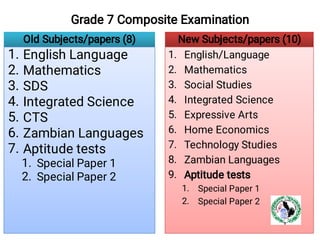
Grade 7 CompositeExamination
Old Subjects/papers (8)
1.
2.
3.
4.
5.
6.
7.
1.
2.
English Language
Mathematics
SDS
Integrated Science
CTS
Zambian Languages
Aptitude tests
Special Paper 1
Special Paper 2
New Subjects/papers (10)
1.
2.
3.
4.
5.
6.
7.
8.
9.
1.
2.
English/Language
Mathematics
Social Studies
Integrated Science
Expressive Arts
Home Economics
Technology Studies
Zambian Languages
Aptitude tests
Special Paper 1
Special Paper 2
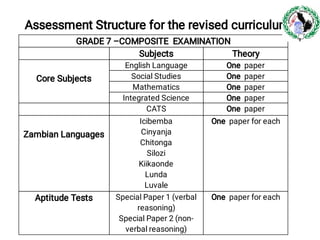
Assessment Structure forthe revised curriculum
GRADE 7 –COMPOSITE EXAMINATION
Subjects Theory
Core Subjects
English Language One paper
Social Studies One paper
Mathematics One paper
Integrated Science One paper
CATS One paper
Zambian Languages
Icibemba
Cinyanja
Chitonga
Silozi
Kiikaonde
Lunda
Luvale
One paper for each
Aptitude Tests Special Paper 1 (verbal
reasoning)
Special Paper 2 (non-
verbal reasoning)
One paper for each
7.
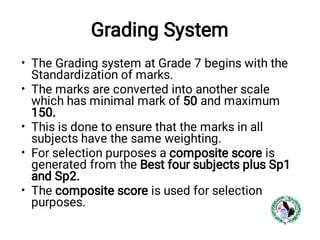
Grading System
•
•
•
•
•
The Gradingsystem at Grade 7 begins with the
Standardization of marks.
The marks are converted into another scale
which has minimal mark of 50 and maximum
150.
This is done to ensure that the marks in all
subjects have the same weighting.
For selection purposes a composite score is
generated from the Best four subjects plus Sp1
and Sp2.
The composite score is used for selection
purposes.
8.
Awarding of aG7 Certificate
•
–
For the certification purposes
4 best subjects are used.
SN Subjects Division 1 Division 2 Division 3 Division 4
1 English 115 and Above 105 -114 99 - 104 98 and Below
2 Social Studies 115 and Above 105 -114 99 - 104 98 and Below
3 Mathematics 115 and Above 105 -114 99 - 104 98 and Below
4 Integrated Science 115 and Above 105 -114 99 - 104 98 and Below
5 Zambian Languages 115 and Above 105 -114 99 - 104 98 and Below
6 CATS 115 and Above 105 -114 99 - 104 98 and Below
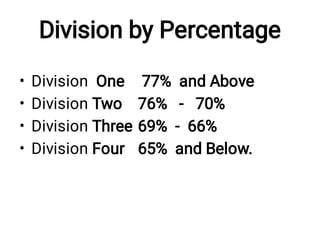
Certificate Classification 460 and Above 422 - 459 398 - 421 397 and Below
9.
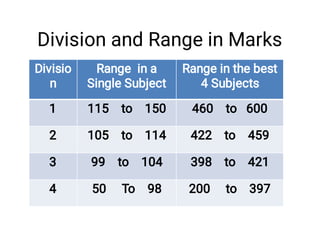
Division and Rangein Marks
Divisio
n
Range in a
Single Subject
Range in the best
4 Subjects
1 115 to 150 460 to 600
2 105 to 114 422 to 459
3 99 to 104 398 to 421
4 50 To 98 200 to 397
10.
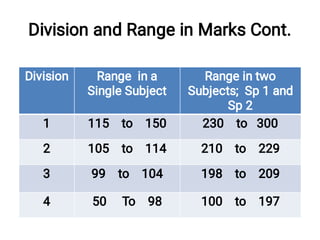
Division and Rangein Marks Cont.
Division Range in a
Single Subject
Range in two
Subjects; Sp 1 and
Sp 2
1 115 to 150 230 to 300
2 105 to 114 210 to 229
3 99 to 104 198 to 209
4 50 To 98 100 to 197
11.
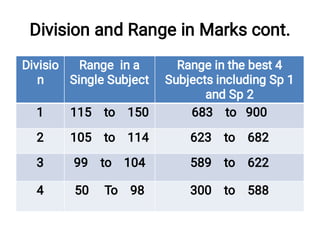
Division and Rangein Marks cont.
Divisio
n
Range in a
Single Subject
Range in the best 4
Subjects including Sp 1
and Sp 2
1 115 to 150 683 to 900
2 105 to 114 623 to 682
3 99 to 104 589 to 622
4 50 To 98 300 to 588
12.
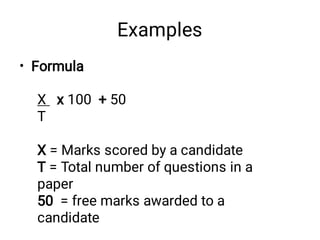
Examples
• Formula
X x100 + 50
T
X = Marks scored by a candidate
T = Total number of questions in a
paper
50 = free marks awarded to a
candidate
13.
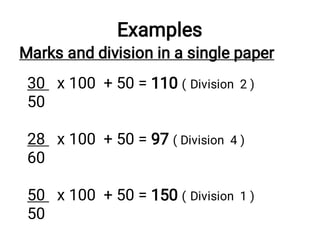
Examples
Marks and divisionin a single paper
30 x 100 + 50 = 110 ( Division 2 )
50
28 x 100 + 50 = 97 ( Division 4 )
60
50 x 100 + 50 = 150 ( Division 1 )
50
14.
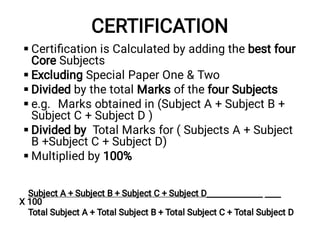
CERTIFICATION
Certification is Calculatedby adding the best four
Core Subjects
Excluding Special Paper One & Two
Divided by the total Marks of the four Subjects
e.g. Marks obtained in (Subject A + Subject B +
Subject C + Subject D )
Divided by Total Marks for ( Subjects A + Subject
B +Subject C + Subject D)
Multiplied by 100%
Subject A + Subject B + Subject C + Subject D______________ ____
X 100
Total Subject A + Total Subject B + Total Subject C + Total Subject D