Objectives:
1. Explain thetypes of Food
Packaging.
2. Design food packaging materials
3. Value the importance of using
food packaging materials in our
daily life.
Vegetable Fiber
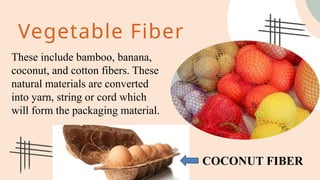
These includebamboo, banana,
coconut, and cotton fibers. These
natural materials are converted
into yarn, string or cord which
will form the packaging material.
COCONUT FIBER
12.
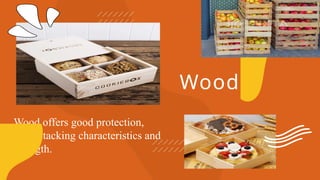
Wood offers goodprotection,
good stacking characteristics and
strength.
Wood
13.
Paper
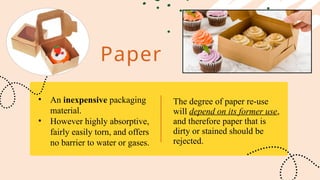
The degree ofpaper re-use
will depend on its former use,
and therefore paper that is
dirty or stained should be
rejected.
• An inexpensive packaging
material.
• However highly absorptive,
fairly easily torn, and offers
no barrier to water or gases.
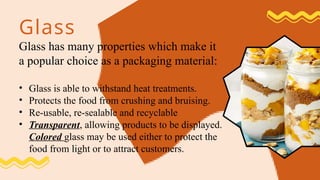
Glass
Glass has manyproperties which make it
a popular choice as a packaging material:
• Glass is able to withstand heat treatments.
• Protects the food from crushing and bruising.
• Re-usable, re-sealable and recyclable
• Transparent, allowing products to be displayed.
Colored glass may be used either to protect the
food from light or to attract customers.
16.
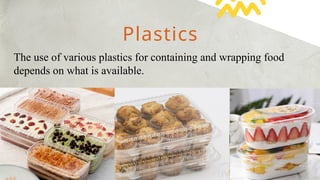
Plastics
The use ofvarious plastics for containing and wrapping food
depends on what is available.
17.
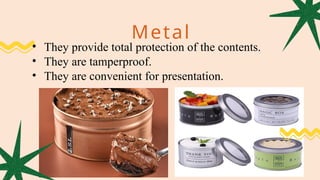
Metal
• They providetotal protection of the contents.
• They are tamperproof.
• They are convenient for presentation.
18.
Why we shouldhave
good packaging?
Provide a barrier against dirt and other contaminants
01.
Prevent losses
02.
Protect food against physical and chemical damage
03.
Provide protection and convenience in handling and transport
04.
Activity:
• You arethe owner of Pastry Restaurant, kindly draw
your packaging that you will use for the take out
order.
• The activity will be grade according to the criteria:
Creativity- 10 pts, Originality- 5 pts and Neatness- 5 pts
• Use short bond paper.
#5 It also shows in the product label any nutrition information on the food being consumed.
#7 It also shows in the product label any nutrition information on the food being consumed.
#8 The main aims of packaging are to keep the food in good condition until it is sold and consumed, and to encourage customers to purchase the product.
Correct packaging is essential to achieve both these objectives.
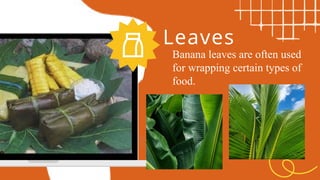
#10 They do not however protect the food against moisture, oxygen, odors or micro-organisms, and therefore, not suitable for long-term storage.
Can you give an example of leaves packaging materials?
Who can give an example of foods that are being wrap with a leave?
#11 As with leaves, vegetable fibers do not provide protection to food which has a long shelf-life since they offer no protection against moisture pick-up, microorganisms, or insects and rodents.
#12 Wooden shipping containers have traditionally been used for a wide range of solid and liquid foods including fruits, vegetables, tea and beer.
Have you seen a wooden box in the market?
#13 Can you give example of paper packaging materials?
We have already an act of no policy. When buy their it’s our responsibility to bring our own bag.
#15 Disadvantages of using glass as packaging materials
glass is heavier than many other packaging materials and this may lead to higher transport costs
it is easy to fracture, scratch and break if heated or cooled too quickly
potentially serious hazards may arise from glass cracks or fragments in the food.
#16 Plastics are extremely useful as they can be made in either soft or hard forms, as sheets or containers, and with different thickness, light resistance, and flexibility.
#17 Disadvantages of metal food packaging materials:
they are heavier than other materials, except glass, and therefore have higher transport costs
the heat treatment associated with the use of metal cans is not suitable for small-scale production.
What is the example of metal packaging?
#18 keeping the product clean
For example, packages should be securely closed to prevent leakage
For example the harmful effects of air, light, insects, and rodents. Each product will have its own needs





![Presentation_food_packaging material [1].pptx](https://cdn.slidesharecdn.com/ss_thumbnails/presentationfoodpackaging1-250729090524-58404741-thumbnail.jpg?width=640&height=640&fit=bounds)


