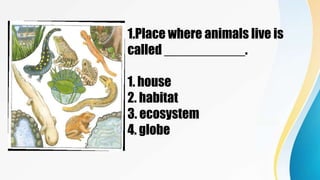
1.Place where animals live is
called ___________.
1. house
2. habitat
3. ecosystem
4. globe
3. Koala bears live on ___________.
1. fruit bearing tree
2. mountain
3. eucalyptus Three
4. acacia tree
4. What kind of poison does Puffer fish
have?
1. Venom
2. Tetradon Toxin
3. Cyanide
4. ethanol
5. Mosquitoes breed and stay in
_____________________.
1. clear stagnant water
2. trees and bushes
3. rice field with plenty of grains
4. inside the house
6. Most animals sleep during winter,
what do we call this?
1. Camouflage
2. Hibernation
3. Estivation
4. Rainy season
7. Largest bird in existence, this bird
cannot fly although it has a pair of wings.
1. Kiwi
2. Ostrich
3. Vulture
4. Dove
8. Animals that can blend with its
surrounding are called ___________.
1. camouflage
2. blending
3. coloring
4. eagl
9. Which of these animals demonstrates
cryptic coloration?
1. native ducks
2. bumble bee
3. grasshopper
4. tamaraw
10. Which of these describes cryptic
coloration?
1. blends with the environment
2. changes the environment
3. changes in color
4. invisibleness
11. Some animals like fish can live only in
water. Some animals can live only in land.
Why can animals live in a particular
environment?
1.They live where they can get food.
2.They live where the temperature is hot
3.They live where they have no enemies.
4.They live where the temperature is cold.
12. Where would you most likely find a bird
with long, stilt-like legs, pointed beak?
1.River
2.Garden
3.Forest
4.Desert
13. Why do polar bears have thick furs?
1.So that they can walk fast.
2.So they can sleep better.
3.So that they are good to look at.
4.So that they can always feel warm.
14. Which of the following animal
characteristics in NOT mimicry?
1.Frogs change their colors.
2.Turtles hide under their hard shells
3.Walking sticks blends with twigs and under
bush.
4.Sphinx moth resembles its wooden resting
place.
15. Animals live in places where they can find
food and shelter. Which animal is mostly
likely in frigid climates?
1.Camel
2.Polar Bear
3.Lion
4.Monkey
16. Why do many desert animals eat meat?
1.Desert animals do not like plants.
2.Desert animals cannot chew grass.
3.Desert animals always hide under the
ground.
4.There are more meats than plants in the
desert.
17. How do animals in cold places adapt to his cold
surroundings?
1.They have thick skin to keep their body warm.
2.Their body’s color blends with their
surroundings.
3.They have layers of fats to keep their body warm.
4.They have feathers or hair to keep their body
warm.
18. How does a skunk protect itself from its
enemies?
1.It blends its color with the environment.
2.It mimics the sound and shape of its prey.
3.It secretes a foul-smelling substance that
keeps its enemies away.
4.They play dead.
19. How do ants, monkeys and elephants
protect themselves from their enemies?
1.They group themselves.
2.They develop strong legs for running.
3.They produce loud cries to scare away their
enemies.
4.They change color that blends with the
surroundings.
20. How do bears prepare themselves for
hibernation?
1.They grow large thick furs.
2.They build nests for themselves.
3.They change the color of their furs.
4.They eat enormous amount of food just
before winter.
Remember:
All living things influence and are influenced by other living things
within a community. No living things exist alone and independently of
others. Some relationships between organisms are beneficial to both
types of organisms. Some relationships are one-sided and some are
harmful.
Animals in general are dependent upon plants for food. In return,
animals give off carbon dioxide which plants use in the food-making
process.
Different relationships exist between organisms in order to satisfy
their needs: food, shelter, protection and others. Plants and animals
live together in order to survive.
Kinds of Relationship
Mutualism- is a kind of relationship wherein both organisms benefit from
each other.
Commensalism – is a kind of relationship in which one organism’s benefits
and the other is not affected at all.
Competition- is a kind of relationship wherein organisms fight with each
other to satisfy their needs to live.
Predation- is a relationship when one organism kills the other for their
survival.
Animals that kill are predators while the victims are called prey.
Parasitism -is a relationship wherein one organism benefits while the other
is harmed.
Parasites get nutrition from another organism while the host is the one
supplying the food.
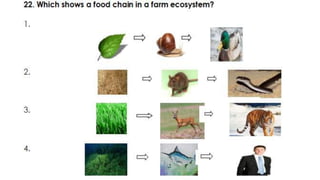
21. Which is an example of a food chain in a land
community?
1. Algae Small fish Big fish
2. Grass Grasshopper Bird
3. Seaweeds Mussels Man
4. All of the above
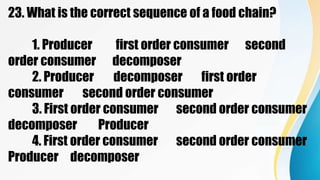
23. What is the correct sequence of a food chain?
1. Producer first order consumer second
order consumer decomposer
2. Producer decomposer first order
consumer second order consumer
3. First order consumer second order consumer
decomposer Producer
4. First order consumer second order consumer
Producer decomposer
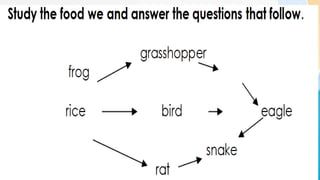
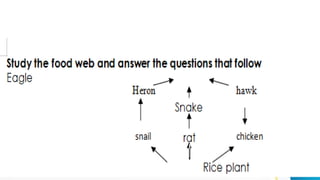
24. Which of the following organisms in the food web is
the producer?
1. Snail
2. Snake
3. Chicken
4. Rice plant
25. Which of the following food chains can be taken
from the food web?
1. Rice plant fish heron
2. Rice plant snake eagle
3. Rice plant chicken hawk
eagle
4. Rice plant rat chicken
hawk eagle
26. How many food chains are there in the food web?
1. 2 2. 3 3. 4 4. 5
27. Which animals in the food web are carnivores?
1. Snail, heron, eagle
2. Rat, snake, heron
3. Chicken, hawk, eagle
4. Heron, snake, hawk
28. If the snake would eat only chicken instead of rat,
what would happen to the
rat population?
1. Rats would all die.
2. Rats would increase in number.
3. Rats would decrease in number.
4. The rat population would be the same.
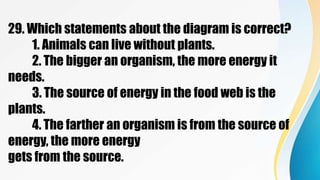
29. Which statements about the diagram is correct?
1. Animals can live without plants.
2. The bigger an organism, the more energy it
needs.
3. The source of energy in the food web is the
plants.
4. The farther an organism is from the source of
energy, the more energy
gets from the source.
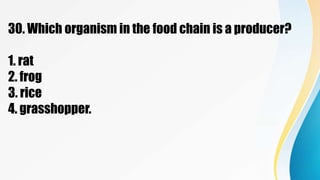
30. Which organism in the food chain is a producer?
1. rat
2. frog
3. rice
4. grasshopper.
Circulatory System and their Functions
Remember:
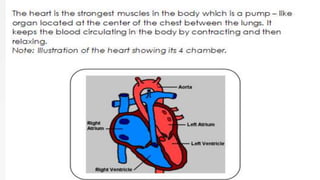
The circulatory system is the transport system of the body. Its major
parts are the heart, the blood and the blood vessels like arteries,
veins and capillaries.Heart. The strongest muscles in the body which
is pump-like organ located at the center of the chest between the
lungs. It keeps the blood circulating inthe body by contracting and
then relaxing.
Blood. The liquid material that circulates throughout the body.
Blood vessels. The raw materials that man needs to power his
thoughts and actions.
31. Which of the following is the function of the
circulatory system?
1. To repair body cells.
2. To distribute body cells.
3. To protect the body from the heat and foreign bodies.
4. To distribute oxygen and nutrients to body cells and
collect their waste.
32. How does circulation of the blood help the body
cells?
1. It brings water to the cells.
2. It brings enzymes to the cells.
3. It brings digested food to the cells.
4. It brings carbon dioxide to the cells.
33. What does the “pump “of the circulatory system
refers too?
1. Heart 2.Blood 3. Muscles 4. Blood vessels
34. Which part of the heart pumps blood out?
1. Atria 2. Valves 3. Arteries 4. Ventricles
35. Which statement is NOT true about the heart?
1. The heart is a hollow muscular organ.
2. The aorta is the largest vein in the body.
3. The heart keeps the blood moving in the
body.
4. The valves keep the blood flowing in the
right direction.
36. The heart pumps blood by contracting and relaxing.
What happens when the
heart relax?
1. Blood flows into the veins from the heart.
2. Blood flows into the arteries from the heart.
3. Blood flows into the heart through the veins.
4. Blood flows into the heart through the
arteries
37. Why does the heart have to pumps blood?
1. To repair body cells.
2. To exchange waste materials from the body.
3. To provide the necessary force for the blood to move
from the lower to the upper part of the body.
4. To provide the necessary force for the blood to move
from the lower to the upper part of the body.
38. A healthy heart beats at the rate of ______.
1. 20-50 times per minute
2. 90-120 times per minute
3. 60-80 times per minute
4. 130-160 times per minute
39. Which is known as the “River of Life”?
1. Saliva
2. Blood
3. Urine
4. Sweat
40.Which blood vessels allow a forceful flow of blood?
1. vein
2. venule
3. artery
4. capillary
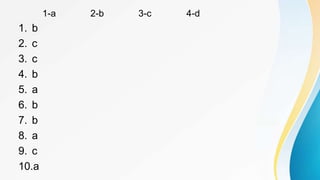
1-a 2-b 3-c 4-d
1. b
2. c
3. c
4. b
5. a
6. b
7. b
8. a
9. c
10.a
11.a
12.a
13.d
14.b
15.b
16.d
17.a
18.c
19.a
20.d
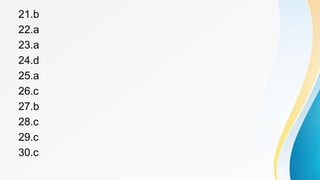
21.b
22.a
23.a
24.d
25.a
26.c
27.b
28.c
29.c
30.c
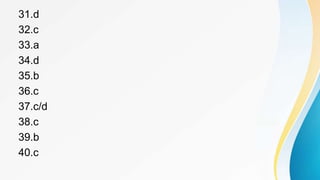
31.d
32.c
33.a
34.d
35.b
36.c
37.c/d
38.c
39.b
40.c

Grade 6 Elementary Science-6-NAT-reviewer.pptx

  • 3.
    1.Place where animalslive is called ___________. 1. house 2. habitat 3. ecosystem 4. globe
  • 5.
    3. Koala bearslive on ___________. 1. fruit bearing tree 2. mountain 3. eucalyptus Three 4. acacia tree
  • 6.
    4. What kindof poison does Puffer fish have? 1. Venom 2. Tetradon Toxin 3. Cyanide 4. ethanol
  • 7.
    5. Mosquitoes breedand stay in _____________________. 1. clear stagnant water 2. trees and bushes 3. rice field with plenty of grains 4. inside the house
  • 8.
    6. Most animalssleep during winter, what do we call this? 1. Camouflage 2. Hibernation 3. Estivation 4. Rainy season
  • 9.
    7. Largest birdin existence, this bird cannot fly although it has a pair of wings. 1. Kiwi 2. Ostrich 3. Vulture 4. Dove
  • 10.
    8. Animals thatcan blend with its surrounding are called ___________. 1. camouflage 2. blending 3. coloring 4. eagl
  • 11.
    9. Which ofthese animals demonstrates cryptic coloration? 1. native ducks 2. bumble bee 3. grasshopper 4. tamaraw
  • 12.
    10. Which ofthese describes cryptic coloration? 1. blends with the environment 2. changes the environment 3. changes in color 4. invisibleness
  • 14.
    11. Some animalslike fish can live only in water. Some animals can live only in land. Why can animals live in a particular environment? 1.They live where they can get food. 2.They live where the temperature is hot 3.They live where they have no enemies. 4.They live where the temperature is cold.
  • 15.
    12. Where wouldyou most likely find a bird with long, stilt-like legs, pointed beak? 1.River 2.Garden 3.Forest 4.Desert
  • 16.
    13. Why dopolar bears have thick furs? 1.So that they can walk fast. 2.So they can sleep better. 3.So that they are good to look at. 4.So that they can always feel warm.
  • 17.
    14. Which ofthe following animal characteristics in NOT mimicry? 1.Frogs change their colors. 2.Turtles hide under their hard shells 3.Walking sticks blends with twigs and under bush. 4.Sphinx moth resembles its wooden resting place.
  • 18.
    15. Animals livein places where they can find food and shelter. Which animal is mostly likely in frigid climates? 1.Camel 2.Polar Bear 3.Lion 4.Monkey
  • 19.
    16. Why domany desert animals eat meat? 1.Desert animals do not like plants. 2.Desert animals cannot chew grass. 3.Desert animals always hide under the ground. 4.There are more meats than plants in the desert.
  • 20.
    17. How doanimals in cold places adapt to his cold surroundings? 1.They have thick skin to keep their body warm. 2.Their body’s color blends with their surroundings. 3.They have layers of fats to keep their body warm. 4.They have feathers or hair to keep their body warm.
  • 21.
    18. How doesa skunk protect itself from its enemies? 1.It blends its color with the environment. 2.It mimics the sound and shape of its prey. 3.It secretes a foul-smelling substance that keeps its enemies away. 4.They play dead.
  • 22.
    19. How doants, monkeys and elephants protect themselves from their enemies? 1.They group themselves. 2.They develop strong legs for running. 3.They produce loud cries to scare away their enemies. 4.They change color that blends with the surroundings.
  • 23.
    20. How dobears prepare themselves for hibernation? 1.They grow large thick furs. 2.They build nests for themselves. 3.They change the color of their furs. 4.They eat enormous amount of food just before winter.
  • 24.
    Remember: All living thingsinfluence and are influenced by other living things within a community. No living things exist alone and independently of others. Some relationships between organisms are beneficial to both types of organisms. Some relationships are one-sided and some are harmful. Animals in general are dependent upon plants for food. In return, animals give off carbon dioxide which plants use in the food-making process. Different relationships exist between organisms in order to satisfy their needs: food, shelter, protection and others. Plants and animals live together in order to survive.
  • 25.
    Kinds of Relationship Mutualism-is a kind of relationship wherein both organisms benefit from each other. Commensalism – is a kind of relationship in which one organism’s benefits and the other is not affected at all. Competition- is a kind of relationship wherein organisms fight with each other to satisfy their needs to live. Predation- is a relationship when one organism kills the other for their survival. Animals that kill are predators while the victims are called prey. Parasitism -is a relationship wherein one organism benefits while the other is harmed. Parasites get nutrition from another organism while the host is the one supplying the food.
  • 26.
    21. Which isan example of a food chain in a land community? 1. Algae Small fish Big fish 2. Grass Grasshopper Bird 3. Seaweeds Mussels Man 4. All of the above
  • 28.
    23. What isthe correct sequence of a food chain? 1. Producer first order consumer second order consumer decomposer 2. Producer decomposer first order consumer second order consumer 3. First order consumer second order consumer decomposer Producer 4. First order consumer second order consumer Producer decomposer
  • 30.
    24. Which ofthe following organisms in the food web is the producer? 1. Snail 2. Snake 3. Chicken 4. Rice plant
  • 31.
    25. Which ofthe following food chains can be taken from the food web? 1. Rice plant fish heron 2. Rice plant snake eagle 3. Rice plant chicken hawk eagle 4. Rice plant rat chicken hawk eagle
  • 32.
    26. How manyfood chains are there in the food web? 1. 2 2. 3 3. 4 4. 5 27. Which animals in the food web are carnivores? 1. Snail, heron, eagle 2. Rat, snake, heron 3. Chicken, hawk, eagle 4. Heron, snake, hawk
  • 33.
    28. If thesnake would eat only chicken instead of rat, what would happen to the rat population? 1. Rats would all die. 2. Rats would increase in number. 3. Rats would decrease in number. 4. The rat population would be the same.
  • 35.
    29. Which statementsabout the diagram is correct? 1. Animals can live without plants. 2. The bigger an organism, the more energy it needs. 3. The source of energy in the food web is the plants. 4. The farther an organism is from the source of energy, the more energy gets from the source.
  • 36.
    30. Which organismin the food chain is a producer? 1. rat 2. frog 3. rice 4. grasshopper.
  • 37.
    Circulatory System andtheir Functions Remember: The circulatory system is the transport system of the body. Its major parts are the heart, the blood and the blood vessels like arteries, veins and capillaries.Heart. The strongest muscles in the body which is pump-like organ located at the center of the chest between the lungs. It keeps the blood circulating inthe body by contracting and then relaxing. Blood. The liquid material that circulates throughout the body. Blood vessels. The raw materials that man needs to power his thoughts and actions.
  • 39.
    31. Which ofthe following is the function of the circulatory system? 1. To repair body cells. 2. To distribute body cells. 3. To protect the body from the heat and foreign bodies. 4. To distribute oxygen and nutrients to body cells and collect their waste.
  • 40.
    32. How doescirculation of the blood help the body cells? 1. It brings water to the cells. 2. It brings enzymes to the cells. 3. It brings digested food to the cells. 4. It brings carbon dioxide to the cells.
  • 41.
    33. What doesthe “pump “of the circulatory system refers too? 1. Heart 2.Blood 3. Muscles 4. Blood vessels 34. Which part of the heart pumps blood out? 1. Atria 2. Valves 3. Arteries 4. Ventricles
  • 42.
    35. Which statementis NOT true about the heart? 1. The heart is a hollow muscular organ. 2. The aorta is the largest vein in the body. 3. The heart keeps the blood moving in the body. 4. The valves keep the blood flowing in the right direction.
  • 43.
    36. The heartpumps blood by contracting and relaxing. What happens when the heart relax? 1. Blood flows into the veins from the heart. 2. Blood flows into the arteries from the heart. 3. Blood flows into the heart through the veins. 4. Blood flows into the heart through the arteries
  • 44.
    37. Why doesthe heart have to pumps blood? 1. To repair body cells. 2. To exchange waste materials from the body. 3. To provide the necessary force for the blood to move from the lower to the upper part of the body. 4. To provide the necessary force for the blood to move from the lower to the upper part of the body.
  • 45.
    38. A healthyheart beats at the rate of ______. 1. 20-50 times per minute 2. 90-120 times per minute 3. 60-80 times per minute 4. 130-160 times per minute
  • 46.
    39. Which isknown as the “River of Life”? 1. Saliva 2. Blood 3. Urine 4. Sweat
  • 47.
    40.Which blood vesselsallow a forceful flow of blood? 1. vein 2. venule 3. artery 4. capillary
  • 48.
    1-a 2-b 3-c4-d 1. b 2. c 3. c 4. b 5. a 6. b 7. b 8. a 9. c 10.a
  • 49.
  • 50.
  • 51.