GRADE II MUSCLE INJURIES
TREATMENT IN ACUTE WITH CRYO MAG:

A PILOT STUDY

40° Congresso Nazionale SIMFER 
e 9th Mediterranean Congress of PRM
                                                                                 
Bellomo R.G., Panelli E., Di Stefano A., Di Pancrazio L., Santini S., Saggini R.
School of Specialities in PRM, “G. D’Annunzio” University, Chieti – Pescara
Italy
Acute muscle injuries are commonly observed in many different sports and 
their incidence is between 10 and 30%
1
. 


It was found an incidence
of 30% in professional
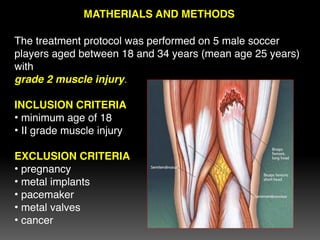
football players where the
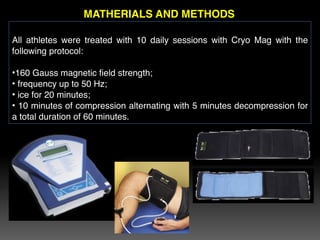
injury occurs often on
quadriceps and hamstring
muscles3.
Properties required in sports for muscular tissue are
strength, endurance, responsiveness, speed, and
flexibility; they’re often obtained with intense workout
at the limit of muscles elastic resistance. 90% of
injuries in sports is made up of muscle injuries2. 
1 Costantino C., Imperio G. Recupero precoce nelle lesioni muscolari acute degli sportivi: nostra esperienza Eur + Phys 2006;42(Suppl. 1 To No. 2):779-82
2 Crisco Jj, Jokl P, Heinen Gt. Et Al. A Muscle Contusion Injury Model. Biomechanics, Physiology, and Histology. Am J Sports Med 1994;22(5):702-10
3 Volpi P, Melegati G, Tornese D, Bandi M. Muscle strains in soccer: A five-years survey of an italian major league team. Knee Surg Sports Traumatol Artrosc 
2004;12(5):482-5. Epub 2004 Mar 31.
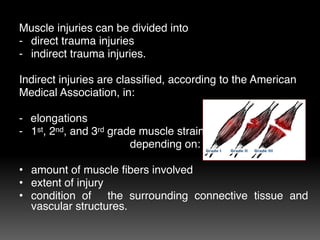
Muscle injuries can be divided into
- direct trauma injuries
- indirect trauma injuries. 

Indirect injuries are classified, according to the American 
Medical Association, in: 

-
 elongations 
- 1st, 2nd, and 3rd grade muscle strain
depending on: 

• amount of muscle fibers involved
• extent of injury
• condition of the surrounding connective tissue and
vascular structures.
PREDISPOSING FACTORS


• Lifestyle 
• Poor coordination within and between muscle and postural
imbalances;
• Asymmetries and imbalances between the extensor and
flexor muscles;
• Poor joint mobility and muscle flexibility;
• Inadequate heating;
• Incorrect diet;
• Changes in the pattern of performance (> game speed);


(Ekstrand1983, Heidt 2000, Junge 2002, Tropp1985, Surve1994, Södermann2000, Caraffa1996,
Hewett1999, 
Askling2003, Mandelbaum 2005, Arnason2007, Gilchrist2008, Soligard2008)
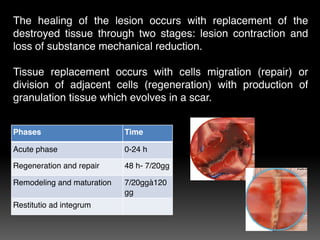
The healing of the lesion occurs with replacement of the
destroyed tissue through two stages: lesion contraction and
loss of substance mechanical reduction. 

Tissue replacement occurs with cells migration (repair) or
division of adjacent cells (regeneration) with production of
granulation tissue which evolves in a scar.
Phases Time
Acute phase 0-24 h
Regeneration and repair 48 h- 7/20gg
Remodeling and maturation 7/20ggà120
gg
Restitutio ad integrum
The healing process is hindered by the hematoma at
the site of lesion
à reduce pain and local edema,


à improve the capillary and lymphatic microcirculation 


à exert a hemostatic action and colliquative to remove
the necrotic material.
So it is necessary:
- Limit the consequences of the damage on the involved
tissues;

- Prevent future damage;

- Return to competition as quickly as possible in
accordance with the biological healing time.


These three points are closely related one to each other
and dependent on the treatment administered at an early
stage (24-48 hours).
The REHABILITATION TREATMENT AIMS TO ....
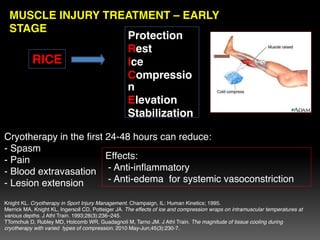
Protection
Rest
Ice
Compressio
n
Elevation
Stabilization
Cryotherapy in the first 24-48 hours can reduce:

- Spasm

- Pain

- Blood extravasation
- Lesion extension 
Effects:

 - Anti-inflammatory

 - Anti-edema for systemic vasoconstriction
MUSCLE INJURY TREATMENT – EARLY
STAGE
RICE
Knight KL. Cryotherapy in Sport Injury Management. Champaign, IL: Human Kinetics; 1995. 
Merrick MA, Knight KL, Ingersoll CD, Potteiger JA. The effects of ice and compression wraps on intramuscular temperatures at
various depths. J Athl Train. 1993;28(3):236–245. 
TTomchuk D, Rubley MD, Holcomb WR, Guadagnoli M, Tarno JM. J Athl Train. The magnitude of tissue cooling during
cryotherapy with varied types of compression. 2010 May-Jun;45(3):230-7.
MUSCLE INJURY TREATMENT – LATER
STAGES
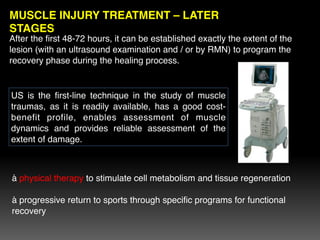
After the first 48-72 hours, it can be established exactly the extent of the
lesion (with an ultrasound examination and / or by RMN) to program the
recovery phase during the healing process.
à physical therapy to stimulate cell metabolism and tissue regeneration

à progressive return to sports through specific programs for functional
recovery
US is the first-line technique in the study of muscle
traumas, as it is readily available, has a good cost-
benefit profile, enables assessment of muscle
dynamics and provides reliable assessment of the
extent of damage.
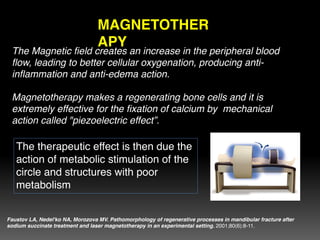
MAGNETOTHER
APY
The Magnetic field creates an increase in the peripheral blood
flow, leading to better cellular oxygenation, producing anti-
inflammation and anti-edema action. 

Magnetotherapy makes a regenerating bone cells and it is
extremely effective for the fixation of calcium by mechanical
action called "piezoelectric effect”.
The therapeutic effect is then due the
action of metabolic stimulation of the
circle and structures with poor
metabolism

Faustov LA, Nedel'ko NA, Morozova MV. Pathomorphology of regenerative processes in mandibular fracture after
sodium succinate treatment and laser magnetotherapy in an experimental setting. 2001;80(6):8-11.
Aim of our study was to assess the
ability of Cryo Mag applicators in
reducing time recovery in athletes with
grade 2 muscle injuries.
AIM OF THE
STUDY
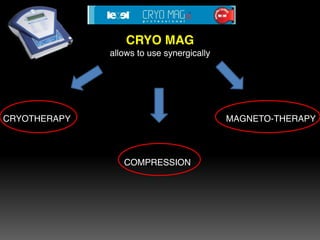
CRYO MAG 
allows to use synergically


CRYOTHERAPY MAGNETO-THERAPY


COMPRESSION
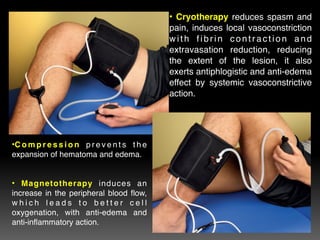
• Cryotherapy reduces spasm and
pain, induces local vasoconstriction
with fibrin contraction and
extravasation reduction, reducing
the extent of the lesion, it also
exerts antiphlogistic and anti-edema
effect by systemic vasoconstrictive
action.
•C o m p r e s s i o n p r e v e n t s t h e
expansion of hematoma and edema.


• Magnetotherapy induces an
increase in the peripheral blood flow,
w h i c h l e a d s t o b e t t e r c e l l
oxygenation, with anti-edema and
anti-inflammatory action.
The treatment protocol was performed on 5 male soccer
players aged between 18 and 34 years (mean age 25 years)
with 
grade 2 muscle injury. 

INCLUSION CRITERIA
• minimum age of 18 
• II grade muscle injury

EXCLUSION CRITERIA
• pregnancy
• metal implants
• pacemaker
• metal valves
• cancer
MATHERIALS AND METHODS
All athletes were treated with 10 daily sessions with Cryo Mag with the
following protocol: 

•160 Gauss magnetic field strength; 
• frequency up to 50 Hz;
• ice for 20 minutes;
• 10 minutes of compression alternating with 5 minutes decompression for
a total duration of 60 minutes.
MATHERIALS AND METHODS
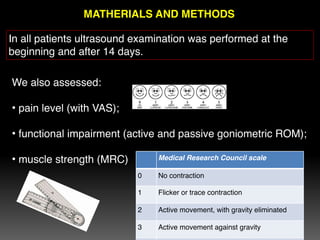
We also assessed: 

• pain level (with VAS); 

• functional impairment (active and passive goniometric ROM); 

• muscle strength (MRC)
In all patients ultrasound examination was performed at the
beginning and after 14 days.
MATHERIALS AND METHODS
Medical Research Council scale
0 No contraction
1 Flicker or trace contraction
2 Active movement, with gravity eliminated
3 Active movement against gravity
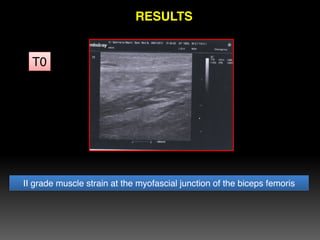
RESULTS
II grade muscle strain at the myofascial junction of the biceps femoris
T0
RESULTS
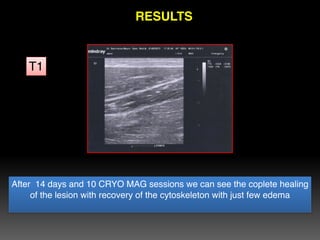
After 14 days and 10 CRYO MAG sessions we can see the coplete healing
of the lesion with recovery of the cytoskeleton with just few edema 
T1
RESULTS
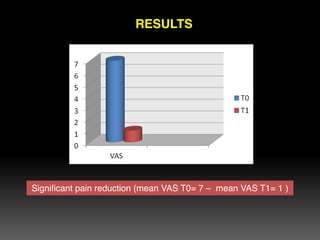
Significant pain reduction (mean VAS T0= 7 – mean VAS T1= 1 )
RESULTS
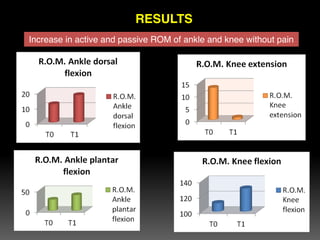
Increase in active and passive ROM of ankle and knee without pain
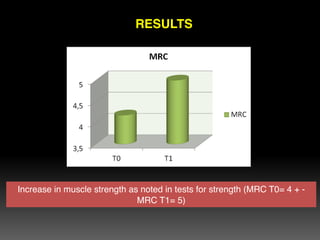
Increase in muscle strength as noted in tests for strength (MRC T0= 4 + -
MRC T1= 5)
RESULTS
The analysis of the results obtained with the
visual analogue scale of pain before and
after the treatment, showed a statistically
significant change (p<0,05). 
Ultrasound monitoring showed complete
resolution of the effusion with a 'good tissue
repair without fibrotic phenomena with just
few edema. 
The return to sports in athletes and 'took
place with complete recovery of the ROM,
and muscle strength in an average time of 27
days.
DISCUSSION
Cryo Mag therapy can take advantage
of the positive effects of cryotherapy,
compression and magnetic therapy in
muscle recovery after injury and proved
to be an excellent therapeutic tool in
terms of effectiveness, easy of use and
resolution of pain.
CONCLUSIONS
Grade 2 muscle injuries treatment with Cryo Mag

Grade 2 muscle injuries treatment with Cryo Mag

  • 1.
    GRADE II MUSCLEINJURIES TREATMENT IN ACUTE WITH CRYO MAG:
 A PILOT STUDY
 40° Congresso Nazionale SIMFER e 9th Mediterranean Congress of PRM                                                                                   Bellomo R.G., Panelli E., Di Stefano A., Di Pancrazio L., Santini S., Saggini R. School of Specialities in PRM, “G. D’Annunzio” University, Chieti – Pescara Italy
  • 2.
    Acute muscle injuriesare commonly observed in many different sports and their incidence is between 10 and 30% 1 . It was found an incidence of 30% in professional football players where the injury occurs often on quadriceps and hamstring muscles3. Properties required in sports for muscular tissue are strength, endurance, responsiveness, speed, and flexibility; they’re often obtained with intense workout at the limit of muscles elastic resistance. 90% of injuries in sports is made up of muscle injuries2. 1 Costantino C., Imperio G. Recupero precoce nelle lesioni muscolari acute degli sportivi: nostra esperienza Eur + Phys 2006;42(Suppl. 1 To No. 2):779-82 2 Crisco Jj, Jokl P, Heinen Gt. Et Al. A Muscle Contusion Injury Model. Biomechanics, Physiology, and Histology. Am J Sports Med 1994;22(5):702-10 3 Volpi P, Melegati G, Tornese D, Bandi M. Muscle strains in soccer: A five-years survey of an italian major league team. Knee Surg Sports Traumatol Artrosc 2004;12(5):482-5. Epub 2004 Mar 31.
  • 3.
    Muscle injuries canbe divided into - direct trauma injuries - indirect trauma injuries. Indirect injuries are classified, according to the American Medical Association, in: - elongations - 1st, 2nd, and 3rd grade muscle strain depending on: • amount of muscle fibers involved • extent of injury • condition of the surrounding connective tissue and vascular structures.
  • 4.
    PREDISPOSING FACTORS • Lifestyle • Poor coordination within and between muscle and postural imbalances; • Asymmetries and imbalances between the extensor and flexor muscles; • Poor joint mobility and muscle flexibility; • Inadequate heating; • Incorrect diet; • Changes in the pattern of performance (> game speed); (Ekstrand1983, Heidt 2000, Junge 2002, Tropp1985, Surve1994, Södermann2000, Caraffa1996, Hewett1999, Askling2003, Mandelbaum 2005, Arnason2007, Gilchrist2008, Soligard2008)
  • 5.
    The healing ofthe lesion occurs with replacement of the destroyed tissue through two stages: lesion contraction and loss of substance mechanical reduction. Tissue replacement occurs with cells migration (repair) or division of adjacent cells (regeneration) with production of granulation tissue which evolves in a scar. Phases Time Acute phase 0-24 h Regeneration and repair 48 h- 7/20gg Remodeling and maturation 7/20ggà120 gg Restitutio ad integrum
  • 6.
    The healing processis hindered by the hematoma at the site of lesion à reduce pain and local edema,
 
 à improve the capillary and lymphatic microcirculation 
 
 à exert a hemostatic action and colliquative to remove the necrotic material. So it is necessary:
  • 7.
    - Limit theconsequences of the damage on the involved tissues; - Prevent future damage; - Return to competition as quickly as possible in accordance with the biological healing time.
 
 These three points are closely related one to each other and dependent on the treatment administered at an early stage (24-48 hours). The REHABILITATION TREATMENT AIMS TO ....
  • 8.
    Protection Rest Ice Compressio n Elevation Stabilization Cryotherapy in thefirst 24-48 hours can reduce:
 - Spasm
 - Pain
 - Blood extravasation - Lesion extension Effects:
  - Anti-inflammatory
  - Anti-edema for systemic vasoconstriction MUSCLE INJURY TREATMENT – EARLY STAGE RICE Knight KL. Cryotherapy in Sport Injury Management. Champaign, IL: Human Kinetics; 1995. Merrick MA, Knight KL, Ingersoll CD, Potteiger JA. The effects of ice and compression wraps on intramuscular temperatures at various depths. J Athl Train. 1993;28(3):236–245. TTomchuk D, Rubley MD, Holcomb WR, Guadagnoli M, Tarno JM. J Athl Train. The magnitude of tissue cooling during cryotherapy with varied types of compression. 2010 May-Jun;45(3):230-7.
  • 9.
    MUSCLE INJURY TREATMENT– LATER STAGES After the first 48-72 hours, it can be established exactly the extent of the lesion (with an ultrasound examination and / or by RMN) to program the recovery phase during the healing process. à physical therapy to stimulate cell metabolism and tissue regeneration à progressive return to sports through specific programs for functional recovery US is the first-line technique in the study of muscle traumas, as it is readily available, has a good cost- benefit profile, enables assessment of muscle dynamics and provides reliable assessment of the extent of damage.
  • 10.
    MAGNETOTHER APY The Magnetic fieldcreates an increase in the peripheral blood flow, leading to better cellular oxygenation, producing anti- inflammation and anti-edema action. Magnetotherapy makes a regenerating bone cells and it is extremely effective for the fixation of calcium by mechanical action called "piezoelectric effect”. The therapeutic effect is then due the action of metabolic stimulation of the circle and structures with poor metabolism Faustov LA, Nedel'ko NA, Morozova MV. Pathomorphology of regenerative processes in mandibular fracture after sodium succinate treatment and laser magnetotherapy in an experimental setting. 2001;80(6):8-11.
  • 11.
    Aim of ourstudy was to assess the ability of Cryo Mag applicators in reducing time recovery in athletes with grade 2 muscle injuries. AIM OF THE STUDY
  • 12.
    CRYO MAG allowsto use synergically CRYOTHERAPY MAGNETO-THERAPY COMPRESSION
  • 13.
    • Cryotherapy reducesspasm and pain, induces local vasoconstriction with fibrin contraction and extravasation reduction, reducing the extent of the lesion, it also exerts antiphlogistic and anti-edema effect by systemic vasoconstrictive action. •C o m p r e s s i o n p r e v e n t s t h e expansion of hematoma and edema. • Magnetotherapy induces an increase in the peripheral blood flow, w h i c h l e a d s t o b e t t e r c e l l oxygenation, with anti-edema and anti-inflammatory action.
  • 14.
    The treatment protocolwas performed on 5 male soccer players aged between 18 and 34 years (mean age 25 years) with grade 2 muscle injury. INCLUSION CRITERIA • minimum age of 18 • II grade muscle injury EXCLUSION CRITERIA • pregnancy • metal implants • pacemaker • metal valves • cancer MATHERIALS AND METHODS
  • 15.
    All athletes weretreated with 10 daily sessions with Cryo Mag with the following protocol: •160 Gauss magnetic field strength; • frequency up to 50 Hz; • ice for 20 minutes; • 10 minutes of compression alternating with 5 minutes decompression for a total duration of 60 minutes. MATHERIALS AND METHODS
  • 16.
    We also assessed: • pain level (with VAS); • functional impairment (active and passive goniometric ROM); • muscle strength (MRC) In all patients ultrasound examination was performed at the beginning and after 14 days. MATHERIALS AND METHODS Medical Research Council scale 0 No contraction 1 Flicker or trace contraction 2 Active movement, with gravity eliminated 3 Active movement against gravity
  • 17.
    RESULTS II grade musclestrain at the myofascial junction of the biceps femoris T0
  • 18.
    RESULTS After 14 daysand 10 CRYO MAG sessions we can see the coplete healing of the lesion with recovery of the cytoskeleton with just few edema T1
  • 19.
    RESULTS Significant pain reduction(mean VAS T0= 7 – mean VAS T1= 1 )
  • 20.
    RESULTS Increase in activeand passive ROM of ankle and knee without pain
  • 21.
    Increase in musclestrength as noted in tests for strength (MRC T0= 4 + - MRC T1= 5) RESULTS
  • 22.
    The analysis ofthe results obtained with the visual analogue scale of pain before and after the treatment, showed a statistically significant change (p<0,05). Ultrasound monitoring showed complete resolution of the effusion with a 'good tissue repair without fibrotic phenomena with just few edema. The return to sports in athletes and 'took place with complete recovery of the ROM, and muscle strength in an average time of 27 days. DISCUSSION
  • 23.
    Cryo Mag therapycan take advantage of the positive effects of cryotherapy, compression and magnetic therapy in muscle recovery after injury and proved to be an excellent therapeutic tool in terms of effectiveness, easy of use and resolution of pain. CONCLUSIONS