

GRABCAD CHALLENGE
VA Innovation Creation Series
Prosthetic & Assistive Technology Challenge
By: Reinaldo Wiener Rocca
PROBLEM STATEMENT
 “Essential tremor is a common neurological disease
and the most common movement disorder, which
impacts hundreds of millions of people worldwide.
Specifically, tremors are an "involuntary shaking
movement that is repeated over and over” and
when they occur in the hand, can be cumbersome
and make daily tasks difficult, such as using a
utensil, phone, or tool.” This is the description of the
problem obtained from the Grabcad Challenge.
 The objective is reduce the tremors effect to enable
the patient to do day to day task without difficulty.
MODEL
 Assumptions (risks):
 1 dof model, hinge mechanism (wrist)
 The system is in resonance (ωnat = 7 Hz)
 Only steady state response considered
 Harmonic force and response
 Technical requirements:
 Reduce a range of tremors (they range from a
frequency of 7 Hz with a low amplitude (0.1-0.015 cm)
to a larger amplitude at 1 Hz)
 Fit under a shirt
 Require no power source
 Permit full thumb, finger, wrist and forearm motion
MAIN IDEA OF THE SOLUTION
 Reduce amplitudes of the tremors:
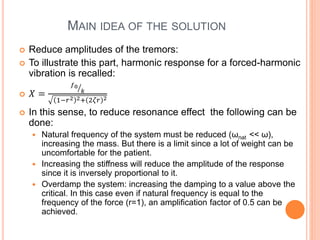
 To illustrate this part, harmonic response for a forced-harmonic
vibration is recalled:
 𝑋 =
𝑓0
𝑘
1−𝑟2 2+ 2𝜁𝑟 2
 In this sense, to reduce resonance effect the following can be
done:
 Natural frequency of the system must be reduced (ωnat << ω),
increasing the mass. But there is a limit since a lot of weight can be
uncomfortable for the patient.
 Increasing the stiffness will reduce the amplitude of the response
since it is inversely proportional to it.
 Overdamp the system: increasing the damping to a value above the
critical. In this case even if natural frequency is equal to the
frequency of the force (r=1), an amplification factor of 0.5 can be
achieved.
PROPOSAL 1
OVERDAMP THE SYSTEM
 The overall concept is a glove that have fibers
made of specific material and its good appealing.
 Use of viscoelastic materials that give the desired
behavior (like thermoplastic polyurethane). It is
expected that if strain rate increases, the material
absorb more vibration energy, same way as a
damper do.
 Use flexible dampers, that are within the glove (is
hidden) and moves when wrist moves. It is
important that the gloves wrap the stem of the
damper to avoid buckling during compression.
PROPOSAL 1
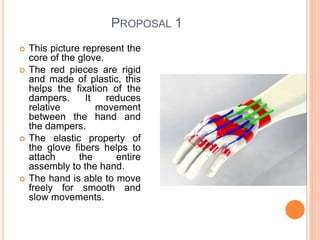
 This picture represent the
core of the glove.
 The red pieces are rigid
and made of plastic, this
helps the fixation of the
dampers. It reduces
relative movement
between the hand and
the dampers.
 The elastic property of
the glove fibers helps to
attach the entire
assembly to the hand.
 The hand is able to move
freely for smooth and
slow movements.
PROPOSAL 1
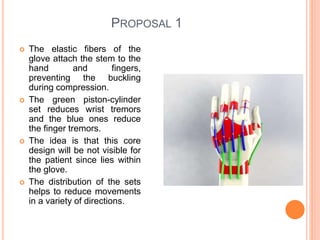
 The elastic fibers of the
glove attach the stem to the
hand and fingers,
preventing the buckling
during compression.
 The green piston-cylinder
set reduces wrist tremors
and the blue ones reduce
the finger tremors.
 The idea is that this core
design will be not visible for
the patient since lies within
the glove.
 The distribution of the sets
helps to reduce movements
in a variety of directions.
PISTON-CYLINDER SET
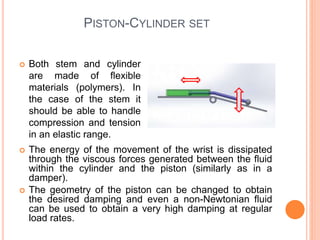
 Both stem and cylinder
are made of flexible
materials (polymers). In
the case of the stem it
should be able to handle
compression and tension
in an elastic range.
 The energy of the movement of the wrist is dissipated
through the viscous forces generated between the fluid
within the cylinder and the piston (similarly as in a
damper).
 The geometry of the piston can be changed to obtain
the desired damping and even a non-Newtonian fluid
can be used to obtain a very high damping at regular
load rates.
PROPOSAL 2
STIFF THE SYSTEM
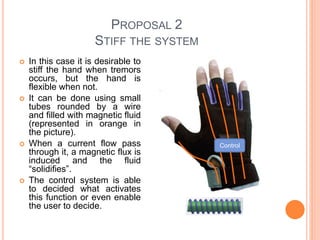
 In this case it is desirable to
stiff the hand when tremors
occurs, but the hand is
flexible when not.
 It can be done using small
tubes rounded by a wire
and filled with magnetic fluid
(represented in orange in
the picture).
 When a current flow pass
through it, a magnetic flux is
induced and the fluid
“solidifies”.
 The control system is able
to decided what activates
this function or even enable
the user to decide.
Control
PROPOSAL 2
STIFF THE SYSTEM
 Despite for this idea a power source is needed I
decided to share anyway. Solar cells, the cell phone
energy or charger that take advantage of the hand
movement, can be used to supply energy to this
solution.
 The main control can communicate with the
smartphone through an app that tells how frequent
the patient suffers tremors, check battery status and
other useful functions.
CONCLUSIONS
 Reducing the natural frequency to 1 Hz will imply a
mass increase of 34kg, which is very high value.
 After some research it was seen that what unable
people to perform day-to-day activities (like writing) is
actually the amplitude of the tremor, if this amplitude is
reduced it will easier to handle daily tasks.
 In general a solution that over damps the hand system
will help to reduce tremors.
 Another possibility is to create a device that suppress
the electrical signals that induces the involuntary muscle
movements. In this case the signal must be of high
amplitude or a specific frequency to be easy to detect.

Proposal for Hand Tremor Reducer Device

  • 1.
    GRABCAD CHALLENGE VA InnovationCreation Series Prosthetic & Assistive Technology Challenge By: Reinaldo Wiener Rocca
  • 2.
    PROBLEM STATEMENT  “Essentialtremor is a common neurological disease and the most common movement disorder, which impacts hundreds of millions of people worldwide. Specifically, tremors are an "involuntary shaking movement that is repeated over and over” and when they occur in the hand, can be cumbersome and make daily tasks difficult, such as using a utensil, phone, or tool.” This is the description of the problem obtained from the Grabcad Challenge.  The objective is reduce the tremors effect to enable the patient to do day to day task without difficulty.
  • 3.
    MODEL  Assumptions (risks): 1 dof model, hinge mechanism (wrist)  The system is in resonance (ωnat = 7 Hz)  Only steady state response considered  Harmonic force and response  Technical requirements:  Reduce a range of tremors (they range from a frequency of 7 Hz with a low amplitude (0.1-0.015 cm) to a larger amplitude at 1 Hz)  Fit under a shirt  Require no power source  Permit full thumb, finger, wrist and forearm motion
  • 4.
    MAIN IDEA OFTHE SOLUTION  Reduce amplitudes of the tremors:  To illustrate this part, harmonic response for a forced-harmonic vibration is recalled:  𝑋 = 𝑓0 𝑘 1−𝑟2 2+ 2𝜁𝑟 2  In this sense, to reduce resonance effect the following can be done:  Natural frequency of the system must be reduced (ωnat << ω), increasing the mass. But there is a limit since a lot of weight can be uncomfortable for the patient.  Increasing the stiffness will reduce the amplitude of the response since it is inversely proportional to it.  Overdamp the system: increasing the damping to a value above the critical. In this case even if natural frequency is equal to the frequency of the force (r=1), an amplification factor of 0.5 can be achieved.
  • 5.
    PROPOSAL 1 OVERDAMP THESYSTEM  The overall concept is a glove that have fibers made of specific material and its good appealing.  Use of viscoelastic materials that give the desired behavior (like thermoplastic polyurethane). It is expected that if strain rate increases, the material absorb more vibration energy, same way as a damper do.  Use flexible dampers, that are within the glove (is hidden) and moves when wrist moves. It is important that the gloves wrap the stem of the damper to avoid buckling during compression.
  • 6.
    PROPOSAL 1  Thispicture represent the core of the glove.  The red pieces are rigid and made of plastic, this helps the fixation of the dampers. It reduces relative movement between the hand and the dampers.  The elastic property of the glove fibers helps to attach the entire assembly to the hand.  The hand is able to move freely for smooth and slow movements.
  • 7.
    PROPOSAL 1  Theelastic fibers of the glove attach the stem to the hand and fingers, preventing the buckling during compression.  The green piston-cylinder set reduces wrist tremors and the blue ones reduce the finger tremors.  The idea is that this core design will be not visible for the patient since lies within the glove.  The distribution of the sets helps to reduce movements in a variety of directions.
  • 8.
    PISTON-CYLINDER SET  Bothstem and cylinder are made of flexible materials (polymers). In the case of the stem it should be able to handle compression and tension in an elastic range.  The energy of the movement of the wrist is dissipated through the viscous forces generated between the fluid within the cylinder and the piston (similarly as in a damper).  The geometry of the piston can be changed to obtain the desired damping and even a non-Newtonian fluid can be used to obtain a very high damping at regular load rates.
  • 9.
    PROPOSAL 2 STIFF THESYSTEM  In this case it is desirable to stiff the hand when tremors occurs, but the hand is flexible when not.  It can be done using small tubes rounded by a wire and filled with magnetic fluid (represented in orange in the picture).  When a current flow pass through it, a magnetic flux is induced and the fluid “solidifies”.  The control system is able to decided what activates this function or even enable the user to decide. Control
  • 10.
    PROPOSAL 2 STIFF THESYSTEM  Despite for this idea a power source is needed I decided to share anyway. Solar cells, the cell phone energy or charger that take advantage of the hand movement, can be used to supply energy to this solution.  The main control can communicate with the smartphone through an app that tells how frequent the patient suffers tremors, check battery status and other useful functions.
  • 11.
    CONCLUSIONS  Reducing thenatural frequency to 1 Hz will imply a mass increase of 34kg, which is very high value.  After some research it was seen that what unable people to perform day-to-day activities (like writing) is actually the amplitude of the tremor, if this amplitude is reduced it will easier to handle daily tasks.  In general a solution that over damps the hand system will help to reduce tremors.  Another possibility is to create a device that suppress the electrical signals that induces the involuntary muscle movements. In this case the signal must be of high amplitude or a specific frequency to be easy to detect.