Apache Groovy:
the language and its ecosystem
Kostas Saidis, Agapios Avramidis
www.niovity.com
9th
FOSSCOMM
Free and Open Source Software Communities Meeting
April 16, 2016
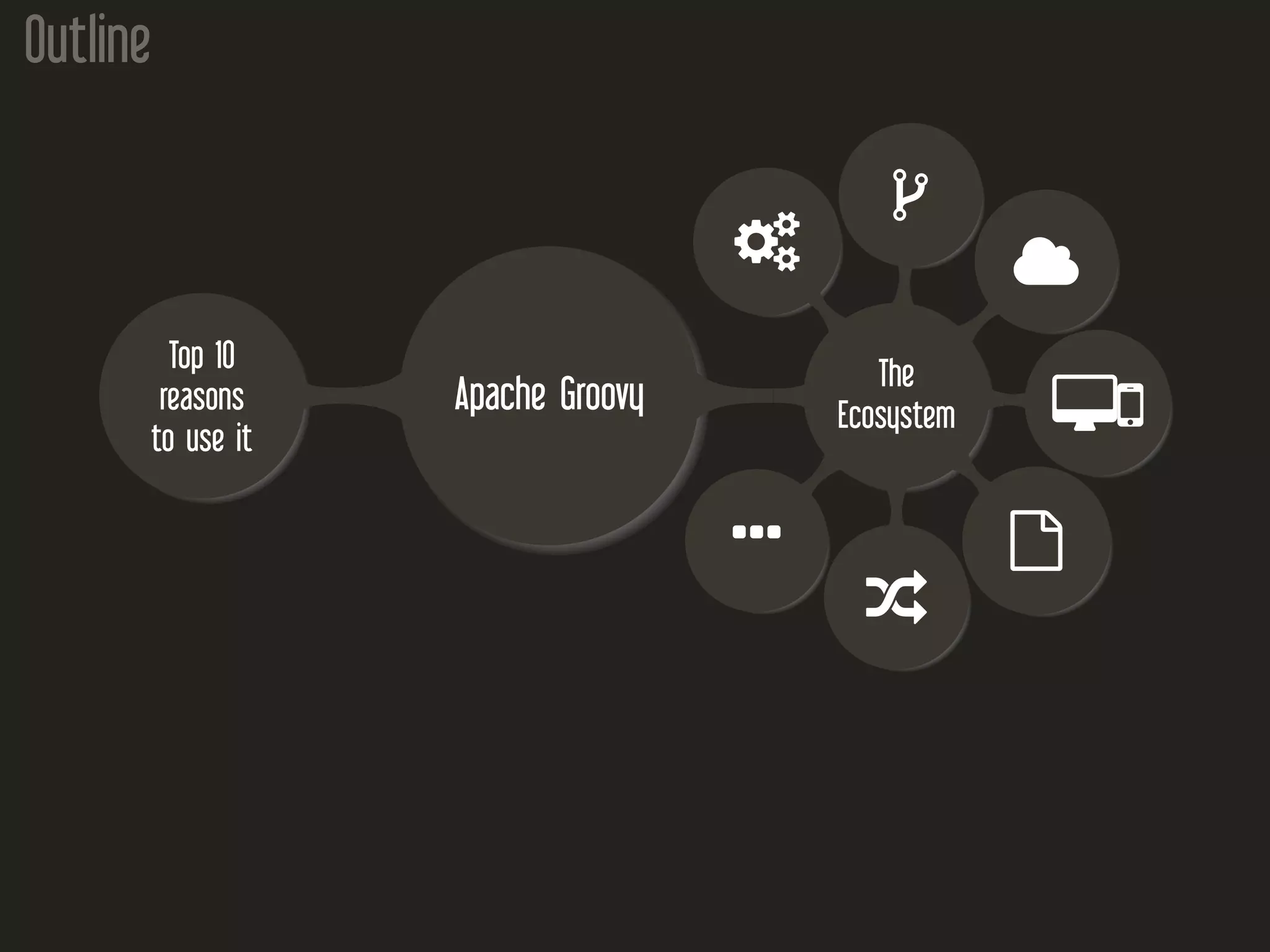
Outline
Apache Groovy
Top 10
reasons
to use it
The
Ecosystem







Niovity
We are a software company
using a Java/Groovy/Javascript stack
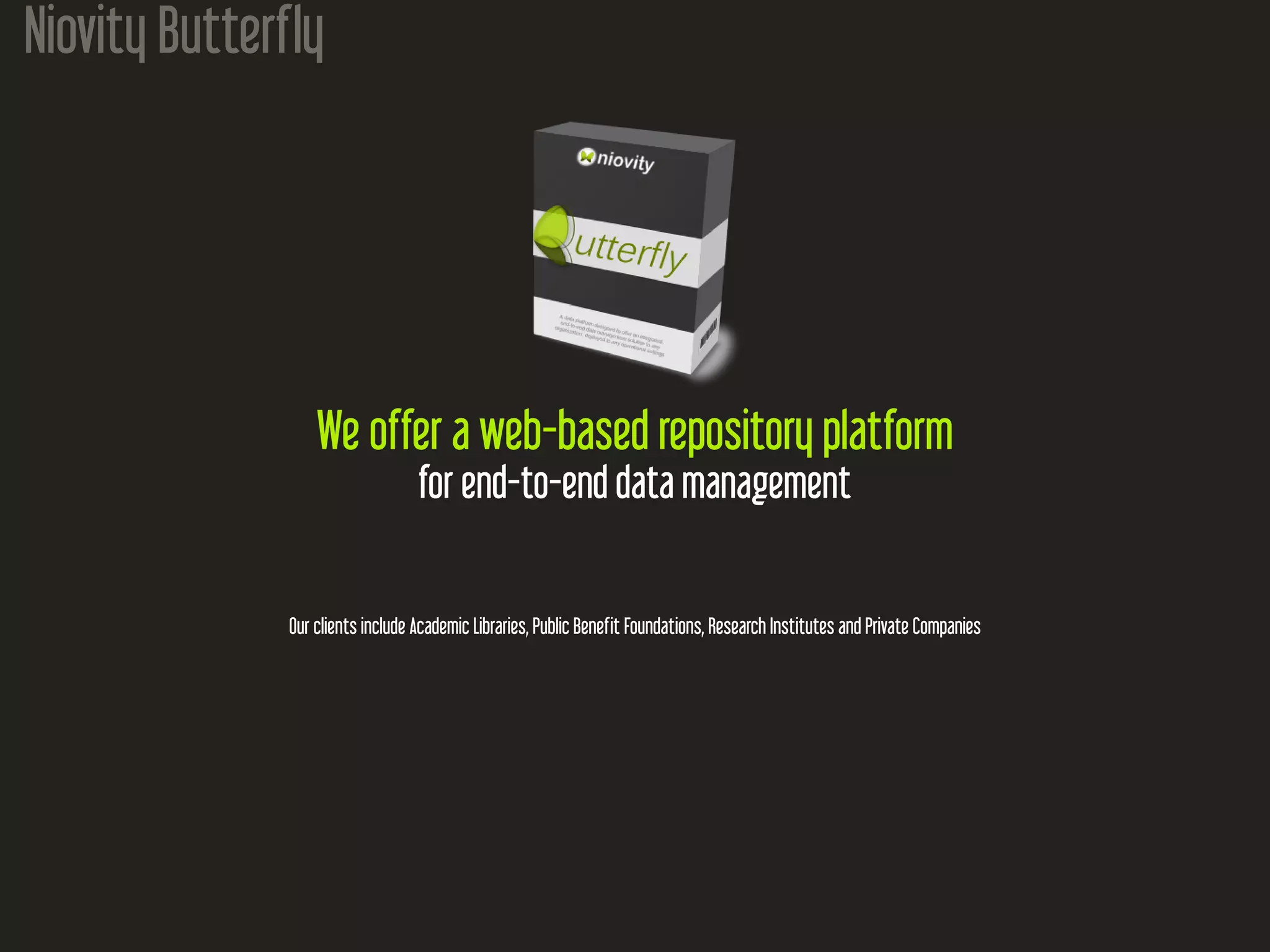
Niovity Butterfly
We offer a web-based repository platform
for end-to-end data management
Our clients include Academic Libraries, Public Benefit Foundations, Research Institutes and Private Companies
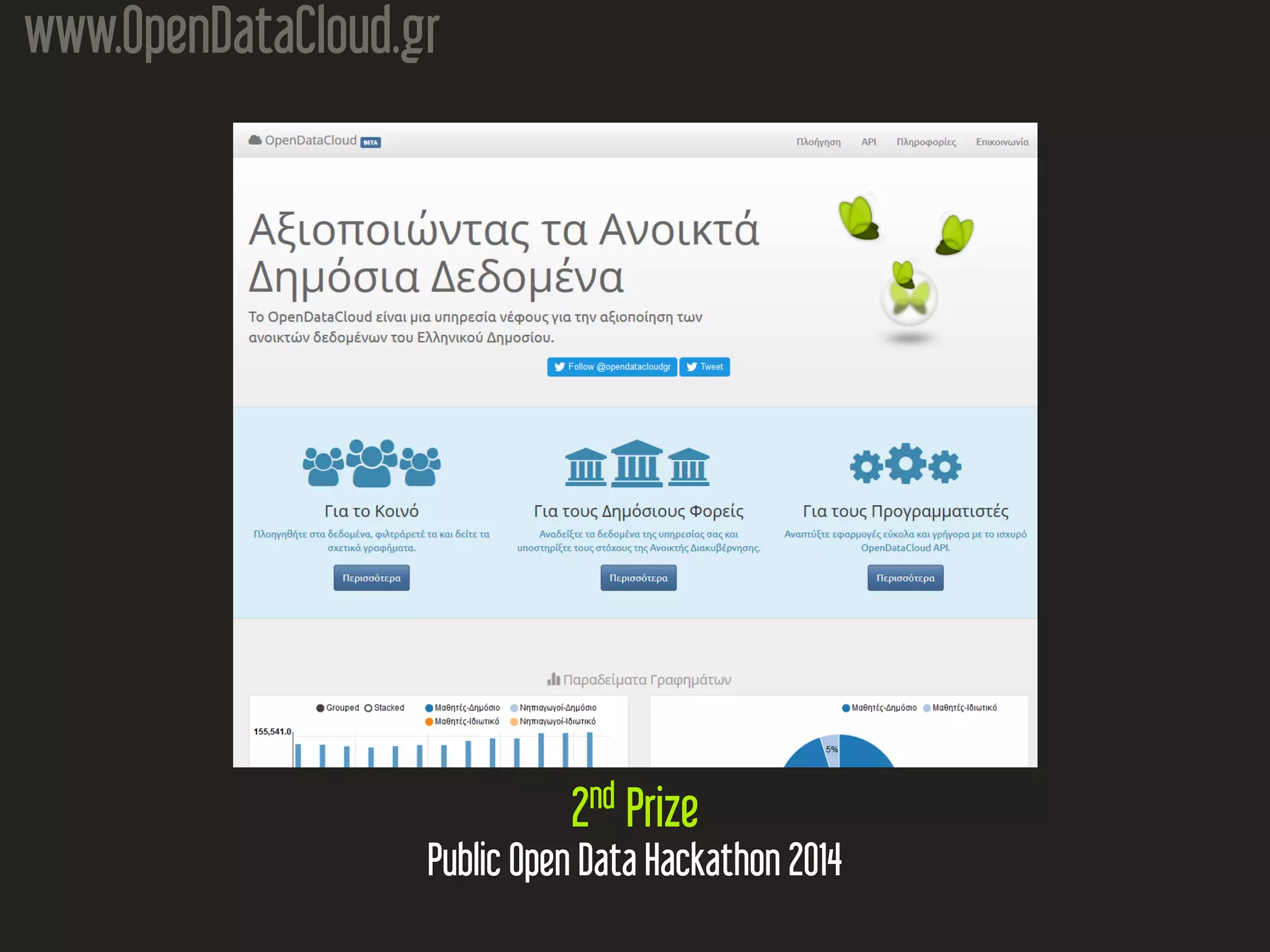
www.OpenDataCloud.gr
2nd
Prize
Public Open Data Hackathon 2014
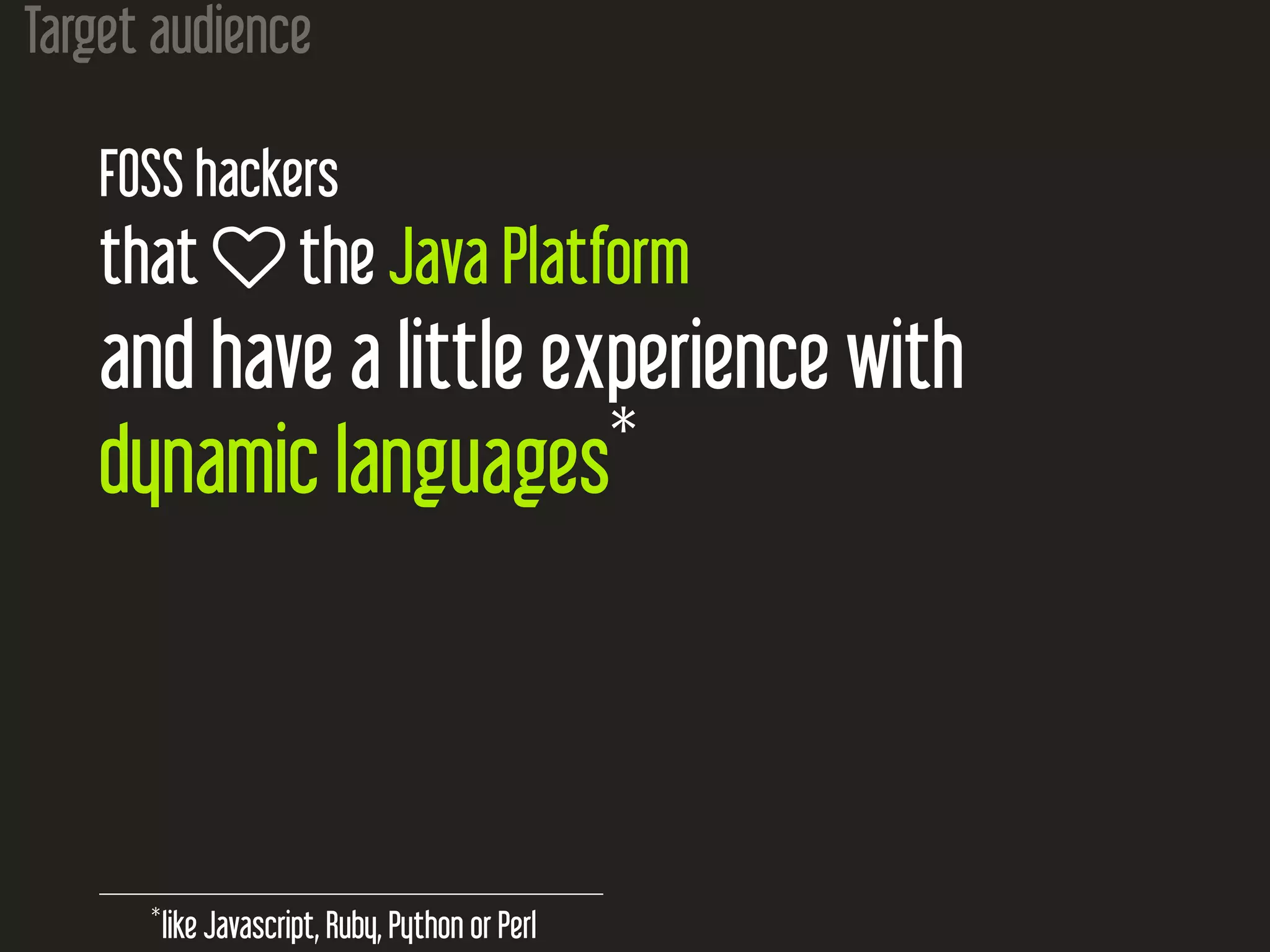
Target audience
FOSS hackers
that  the Java Platform
and have a little experience with
dynamic languages*
*
like Javascript, Ruby, Python or Perl
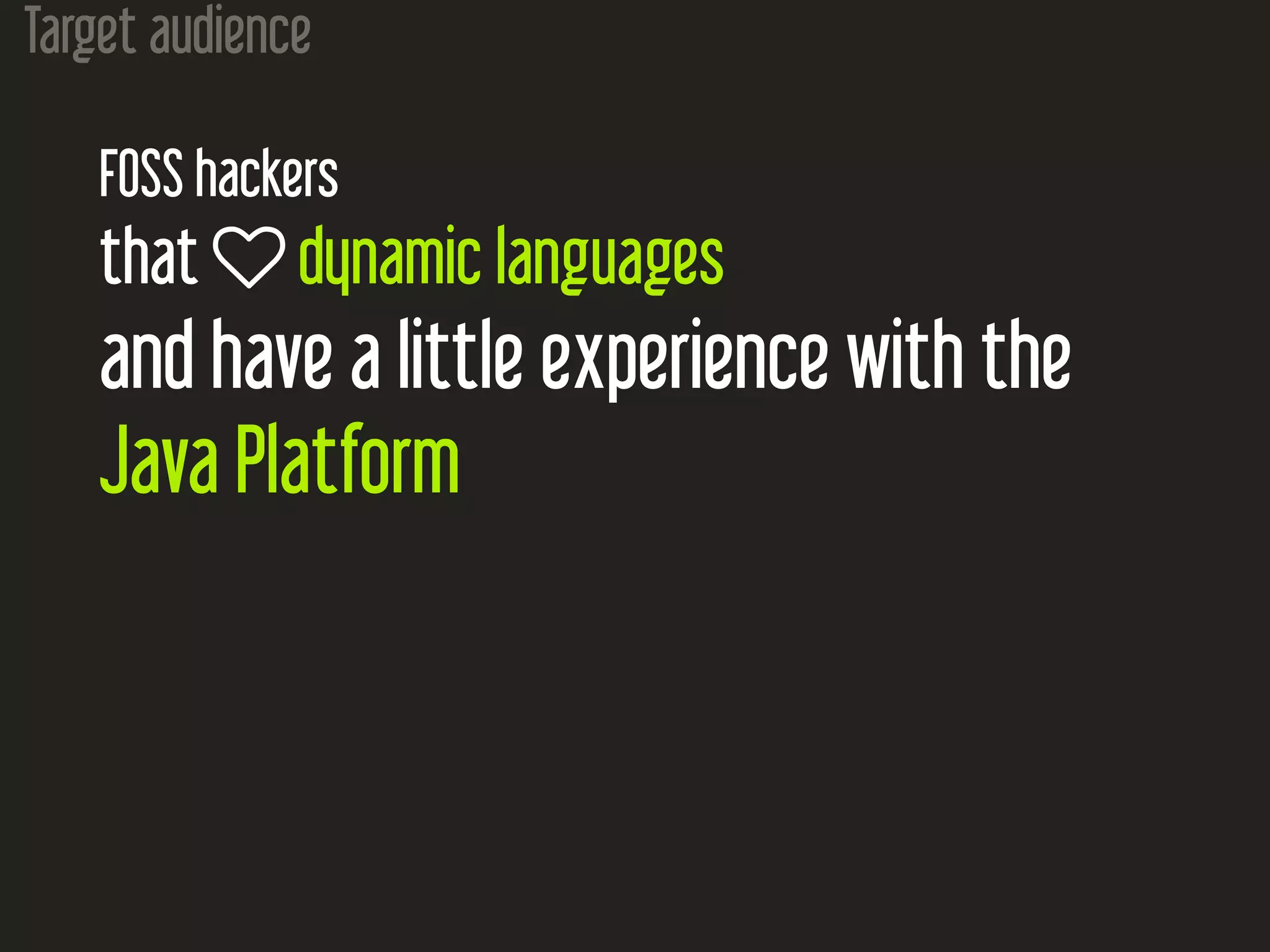
Target audience
FOSS hackers
that  dynamic languages
and have a little experience with the
Java Platform
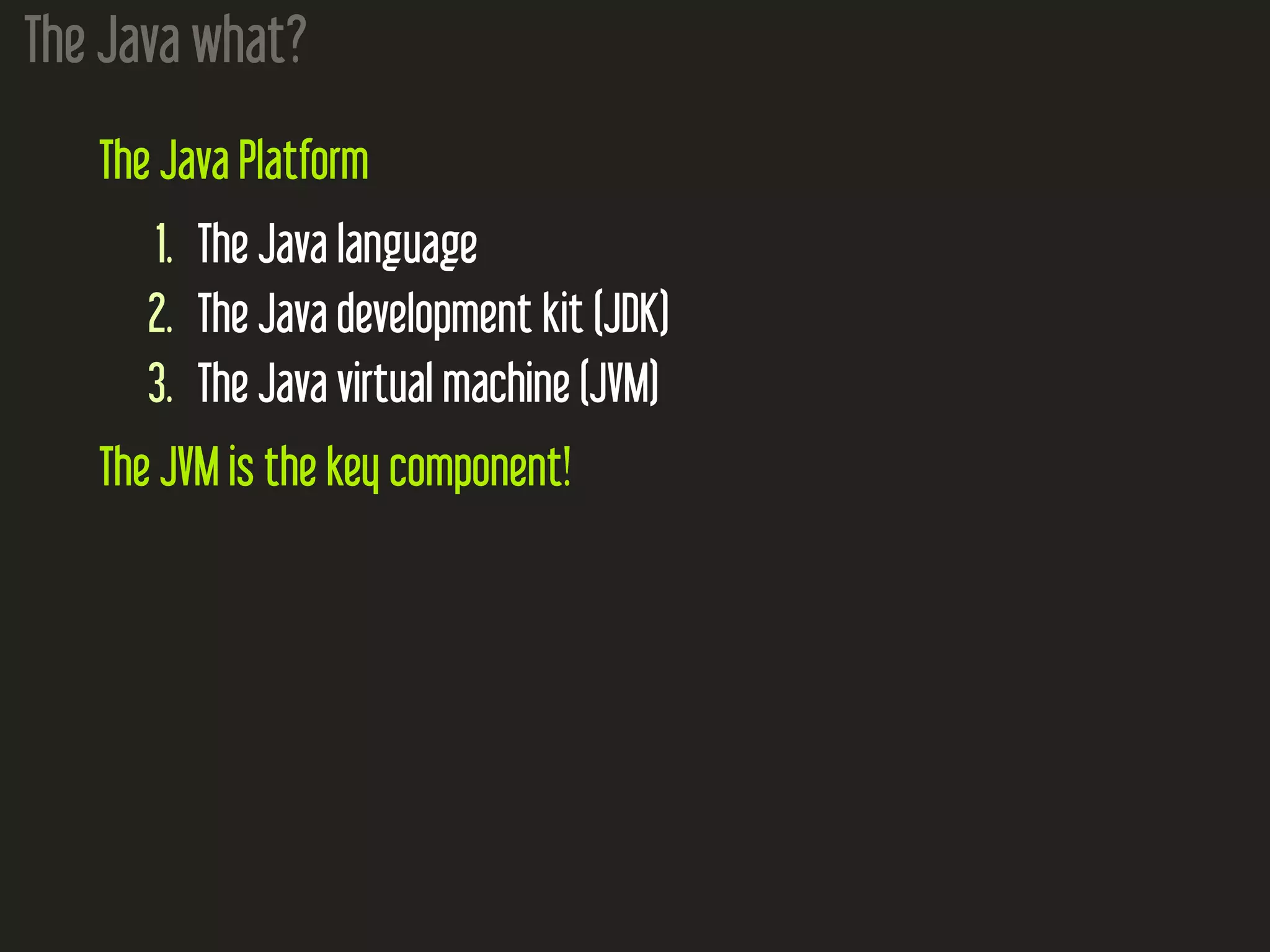
The Java what?
The Java Platform
1. The Java language
2. The Java development kit (JDK)
3. The Java virtual machine (JVM)
The JVM is the key component!
The JVM goes Polyglot
The Java Virtual Machine
A rock-solid, enterprise-grade runtime environment that can
execute multiple languages (not only Java).
Groovy, Javascript, Ruby, Python, Scala, Clojure, Kotlin, Fantom
and many others...
Most of the additional JVM languages are dynamic ones!
Dynamic Languages
Execute many common programming behaviors at runtime –in
contrast to static languages that perform them during
compilation.
Dynamic type checking.
Dynamic method dispatch†
.
Support meta-programming (compiled constructs can be
modified programmatically at runtime).
†
made faster with the invokedynamic bytecode instruction introduced in Java 7.
Flame War

Static vs Dynamic
Groovy

The best of both worlds in the JVM
Part I
Meet Apache Groovy
A feature-rich, Java-friendly, dynamic language for the Java Platform
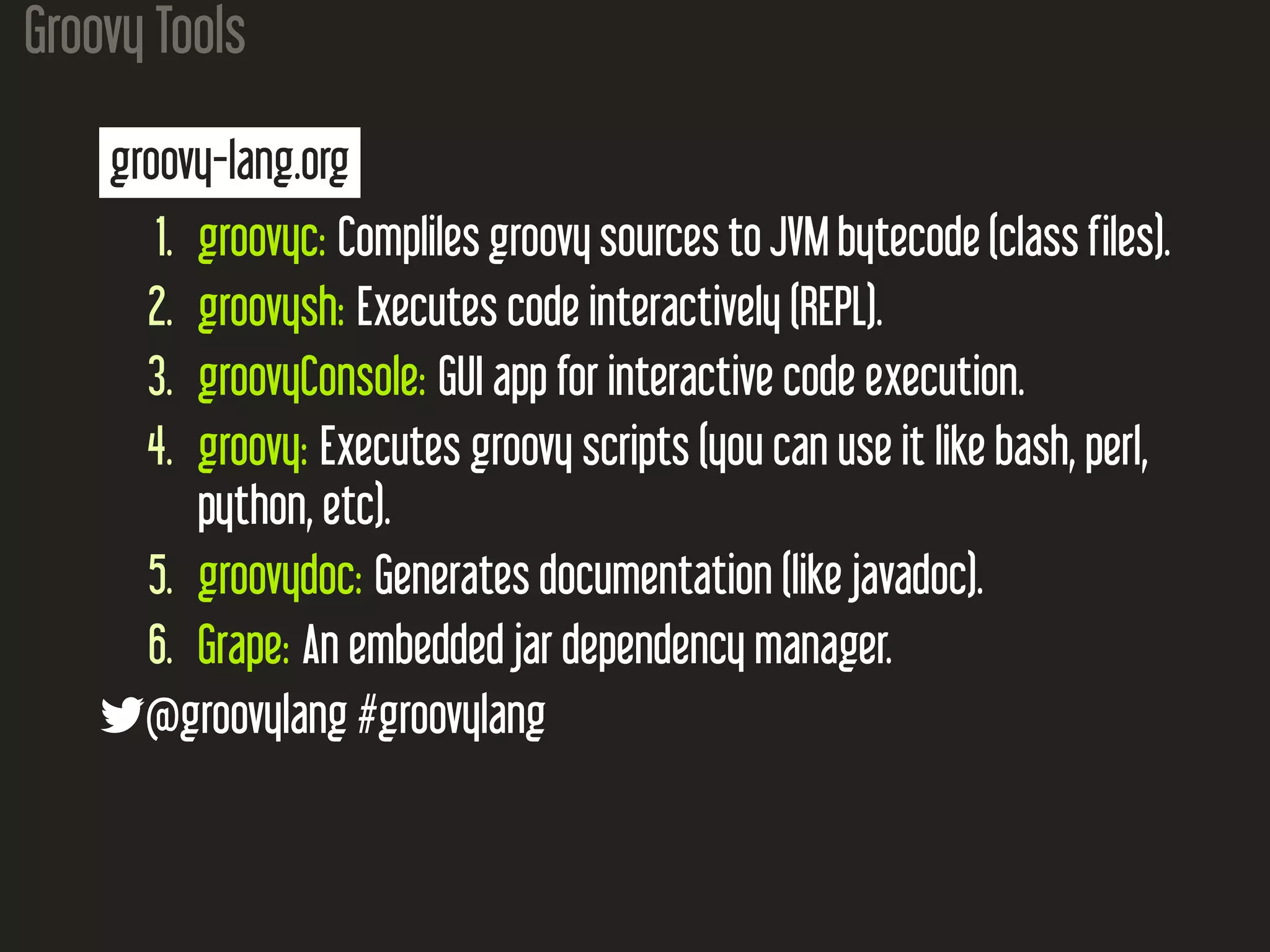
Groovy Tools
groovy-lang.org
1. groovyc: Compliles groovy sources to JVM bytecode (class files).
2. groovysh: Executes code interactively (REPL).
3. groovyConsole: GUI app for interactive code execution.
4. groovy: Executes groovy scripts (you can use it like bash, perl,
python, etc).
5. groovydoc: Generates documentation (like javadoc).
6. Grape: An embedded jar dependency manager.
@groovylang #groovylang
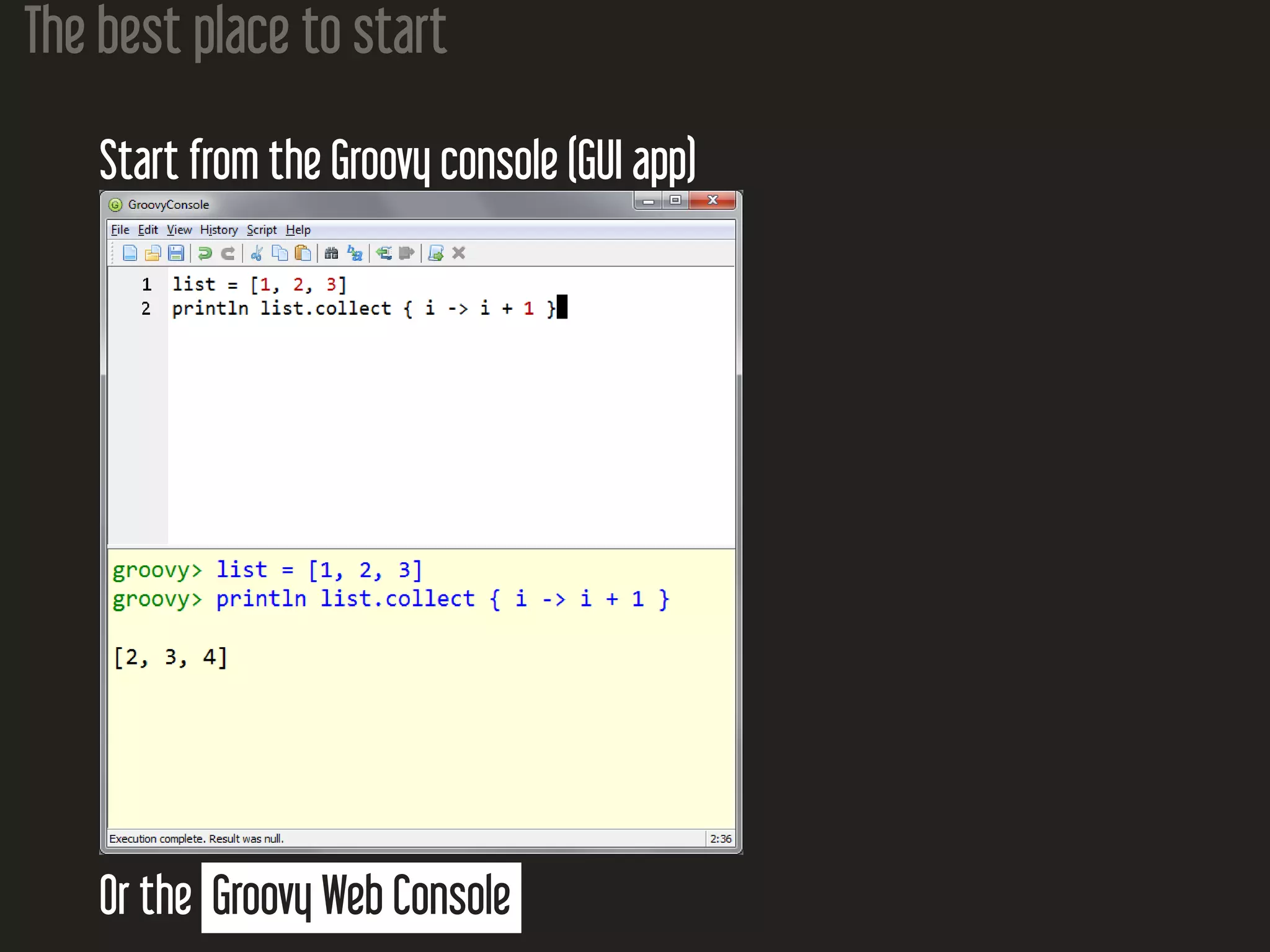
The best place to start
Start from the Groovy console (GUI app)
Or the Groovy Web Console
Why Groovy

Top 10 + 1 reasons to use Groovy
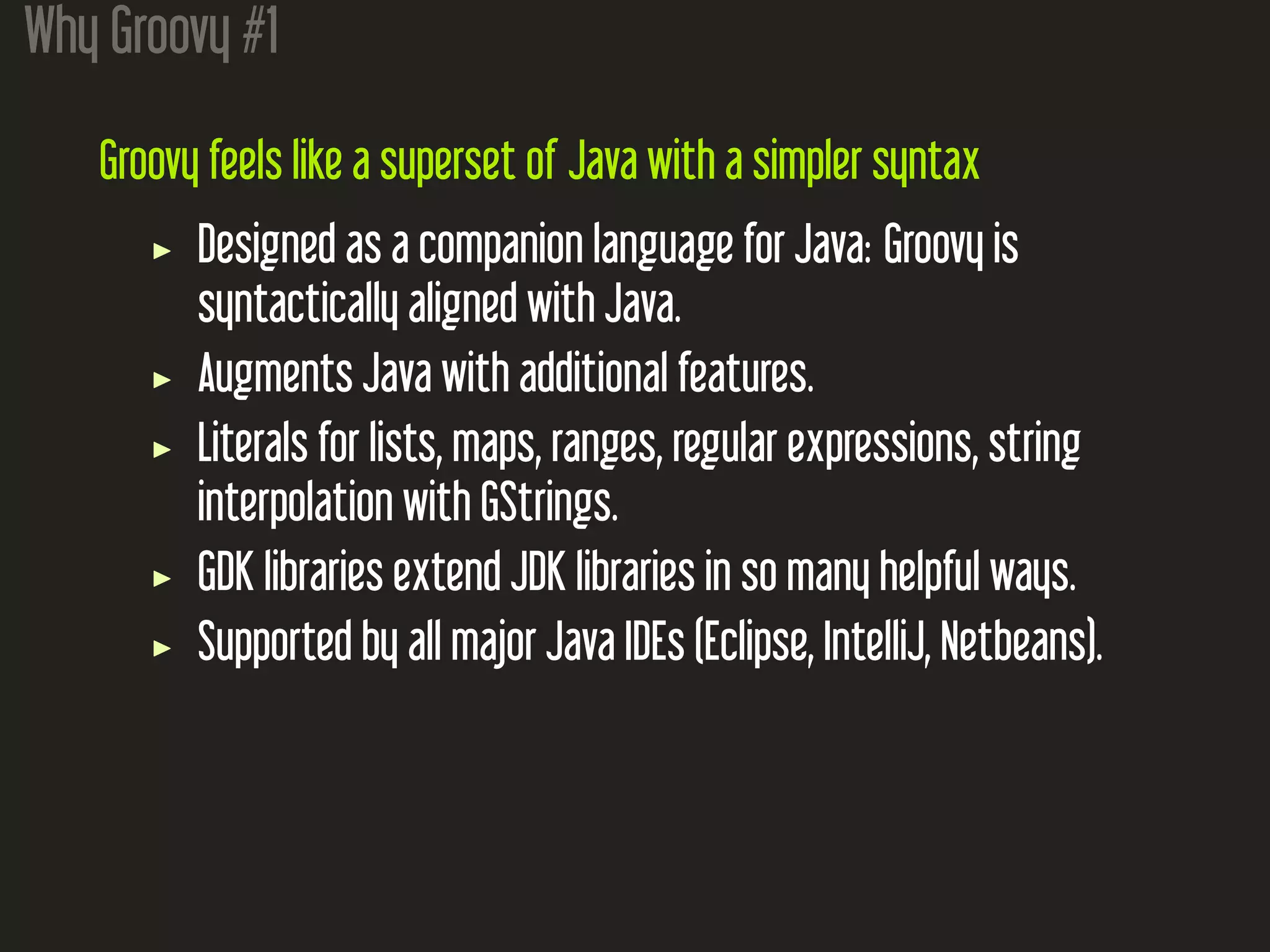
Why Groovy #1
Groovy feels like a superset of Java with a simpler syntax
Designed as a companion language for Java: Groovy is
syntactically aligned with Java.
Augments Java with additional features.
Literals for lists, maps, ranges, regular expressions, string
interpolation with GStrings.
GDK libraries extend JDK libraries in so many helpful ways.
Supported by all major Java IDEs (Eclipse, IntelliJ, Netbeans).
Groovy is Java on Steroids!
Groovy powerful switch statement
1 switch(val) {
2 case ”String”: //a string
3 break
4 case 10..100: //a range
5 break
6 case Date: //a date instance
7 break
8 case ~/gw+/: //a reg−ex
9 break
10 case [’A’, ’B’]: //a list
11 break
12 case { it instanceOf Number && it > Integer.MAX_VALUE }
13 //a closure
14 break
15 default:
16 //the default, treated as an ”else” in Groovy.
17 }
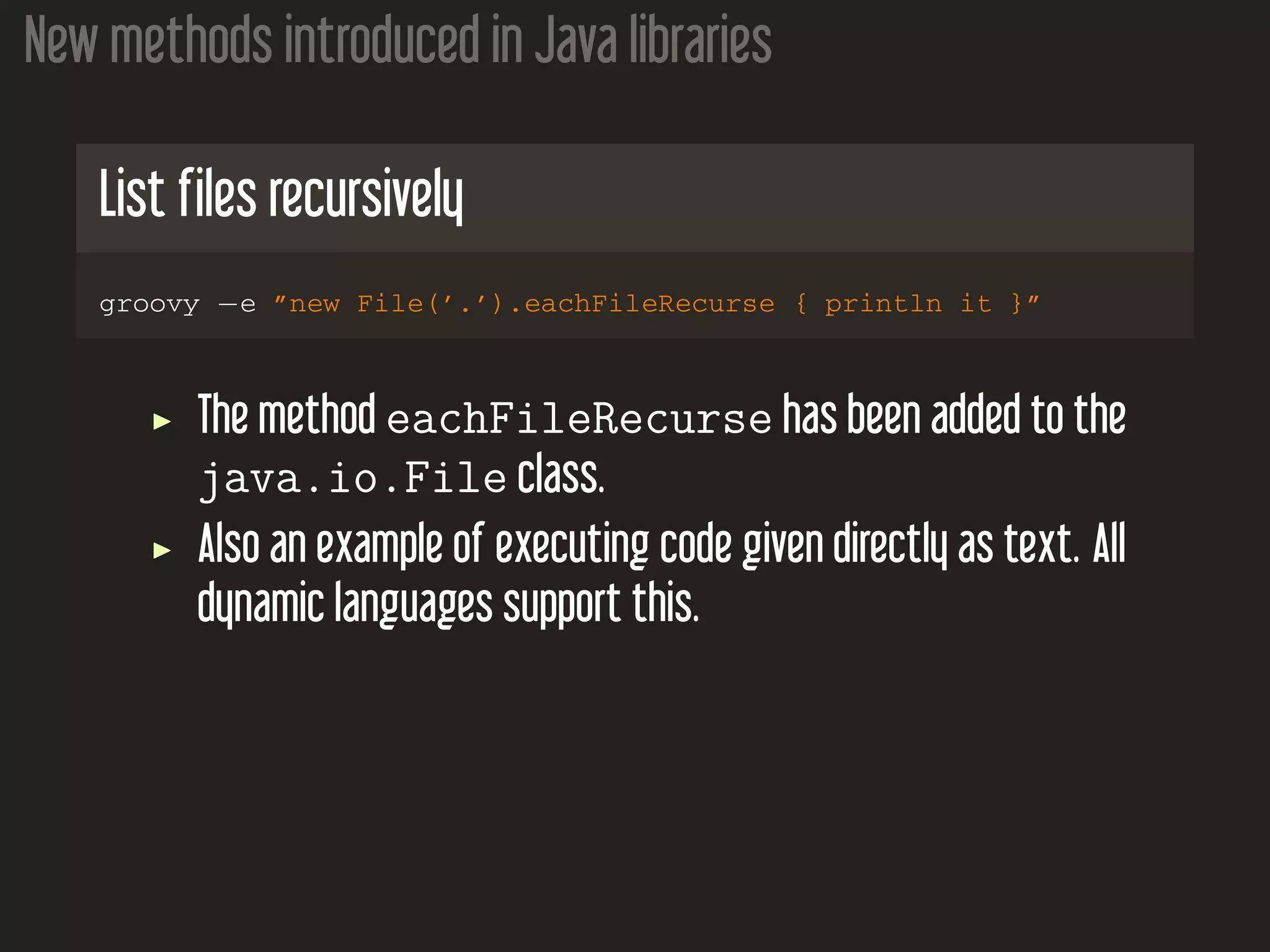
New methods introduced in Java libraries
List files recursively
groovy −e ”new File(’.’).eachFileRecurse { println it }”
The method eachFileRecurse has been added to the
java.io.File class.
Also an example of executing code given directly as text. All
dynamic languages support this.
A better syntax for common things
Example
1 //lists
2 List<Integer> list = [1, 2, 3]
3 assert list[0] == 1
4 //operator overloading
5 list << 4
6 assert list.size() == 4
7 //maps
8 Map<String, String> map = [’one’:’1’, ”two”: ”2”, three:’3’]
9 assert list[1] == map[’two’] as Integer
10 map.one = ’none’
11 //GStrings
12 String s = ”string”
13 println ”value of s = $s”
14 //Java ordinary methods are here
15 map.put(s, ’4’)
16 //with optional parentheses
17 map.put s, 4
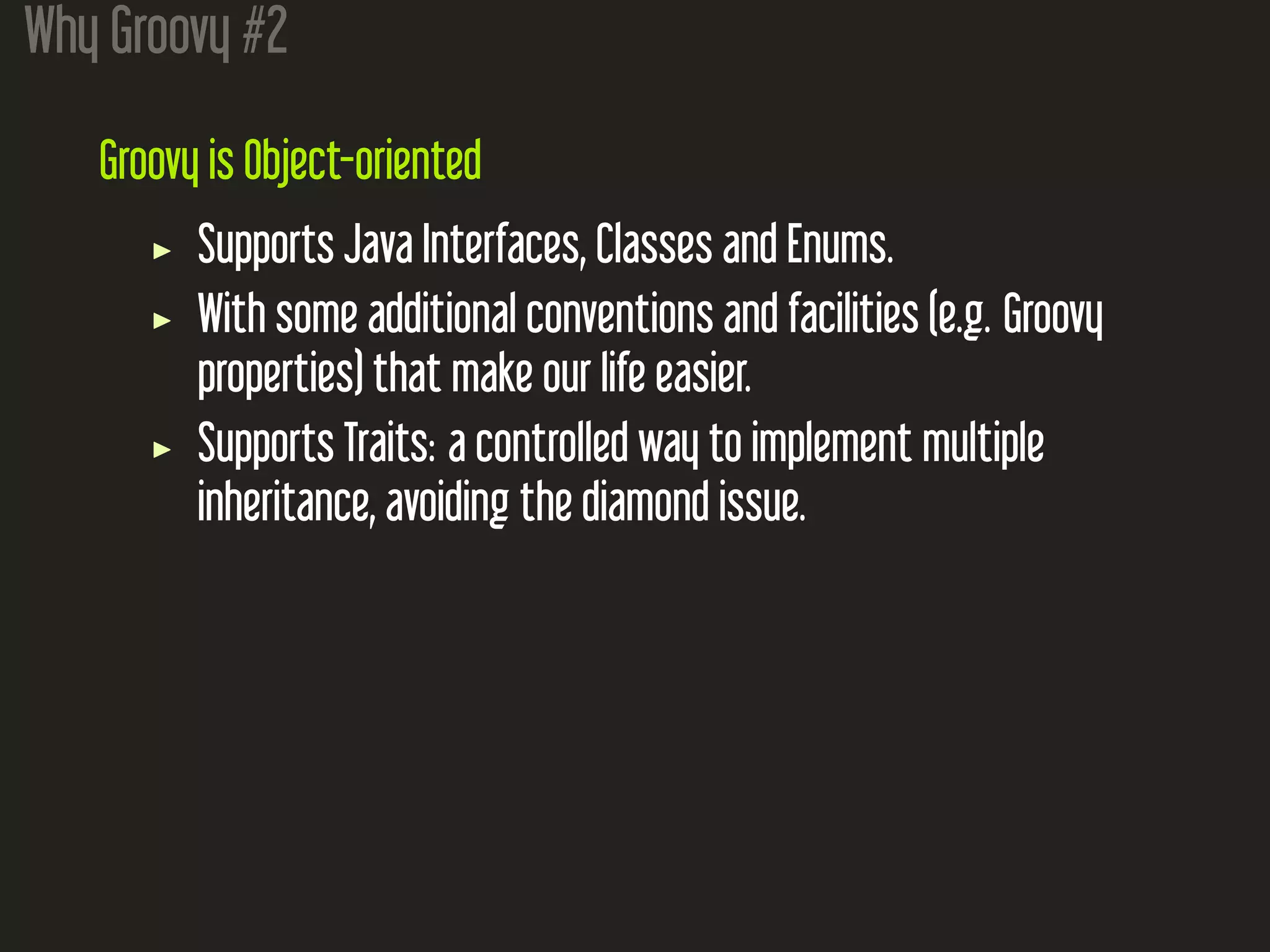
Why Groovy #2
Groovy is Object-oriented
Supports Java Interfaces, Classes and Enums.
With some additional conventions and facilities (e.g. Groovy
properties) that make our life easier.
Supports Traits: a controlled way to implement multiple
inheritance, avoiding the diamond issue.
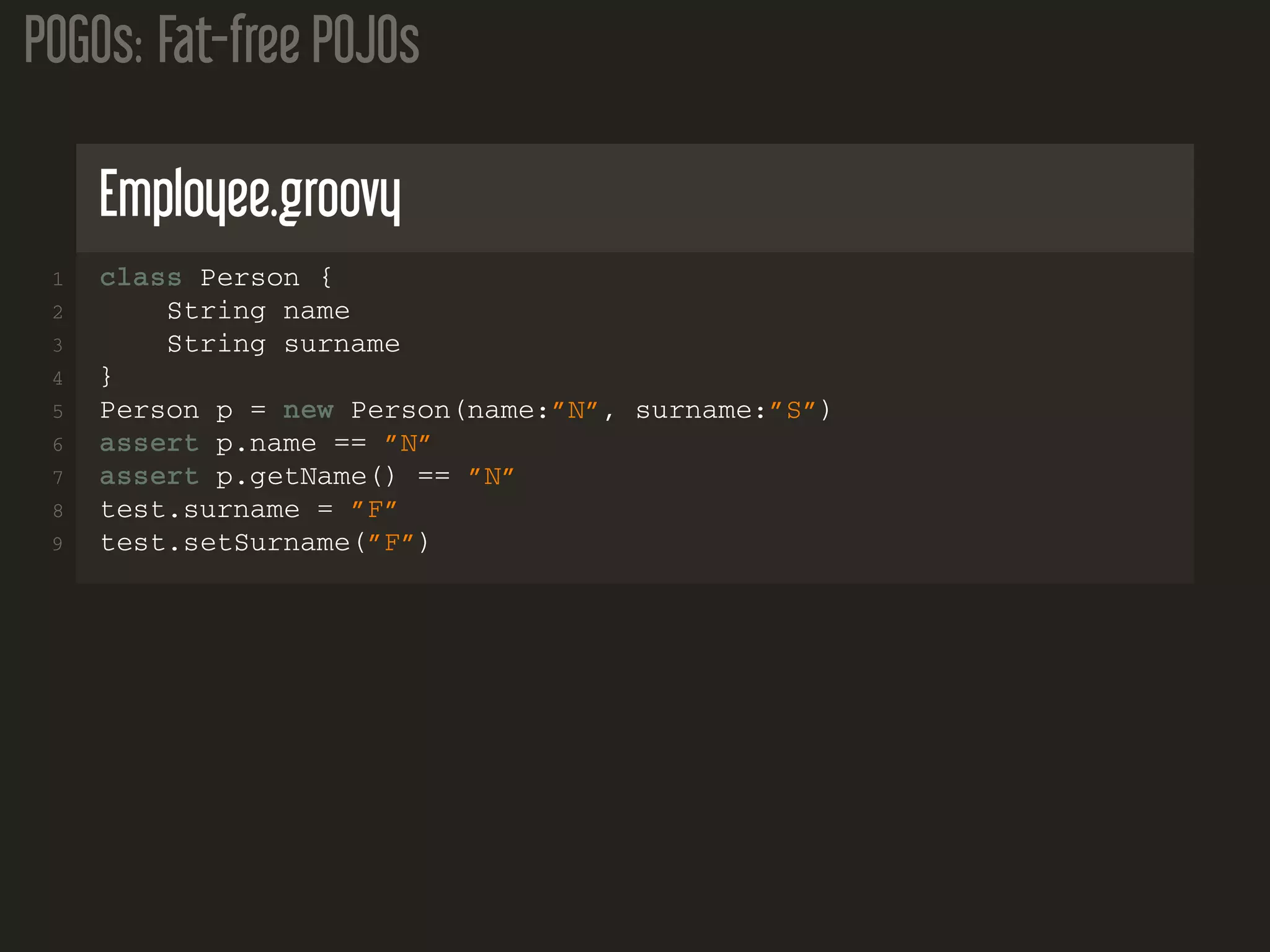
POGOs: Fat-free POJOs
Employee.groovy
1 class Person {
2 String name
3 String surname
4 }
5 Person p = new Person(name:”N”, surname:”S”)
6 assert p.name == ”N”
7 assert p.getName() == ”N”
8 test.surname = ”F”
9 test.setSurname(”F”)
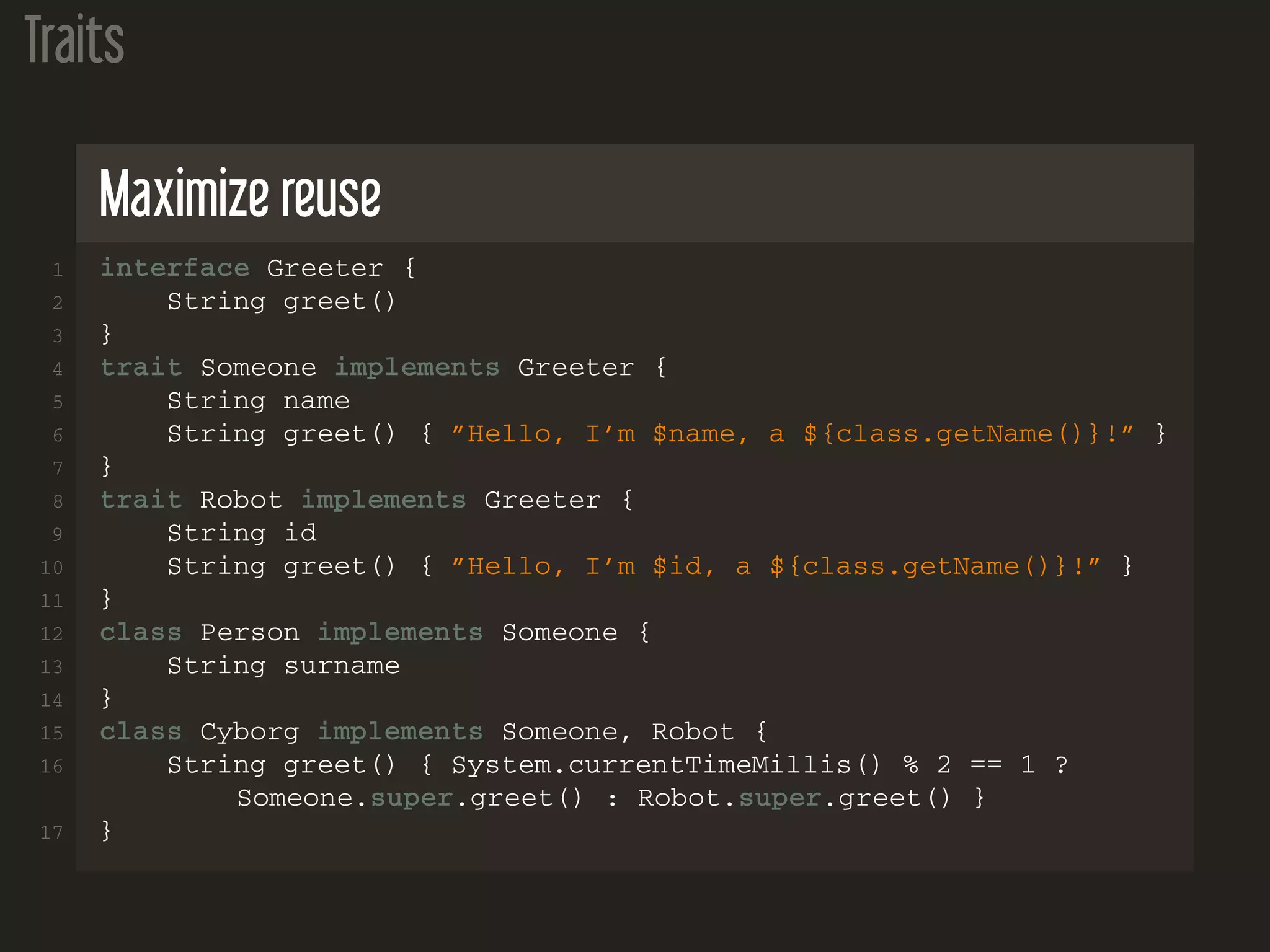
Traits
Maximize reuse
1 interface Greeter {
2 String greet()
3 }
4 trait Someone implements Greeter {
5 String name
6 String greet() { ”Hello, I’m $name, a ${class.getName()}!” }
7 }
8 trait Robot implements Greeter {
9 String id
10 String greet() { ”Hello, I’m $id, a ${class.getName()}!” }
11 }
12 class Person implements Someone {
13 String surname
14 }
15 class Cyborg implements Someone, Robot {
16 String greet() { System.currentTimeMillis() % 2 == 1 ?
Someone.super.greet() : Robot.super.greet() }
17 }
Why Groovy #3
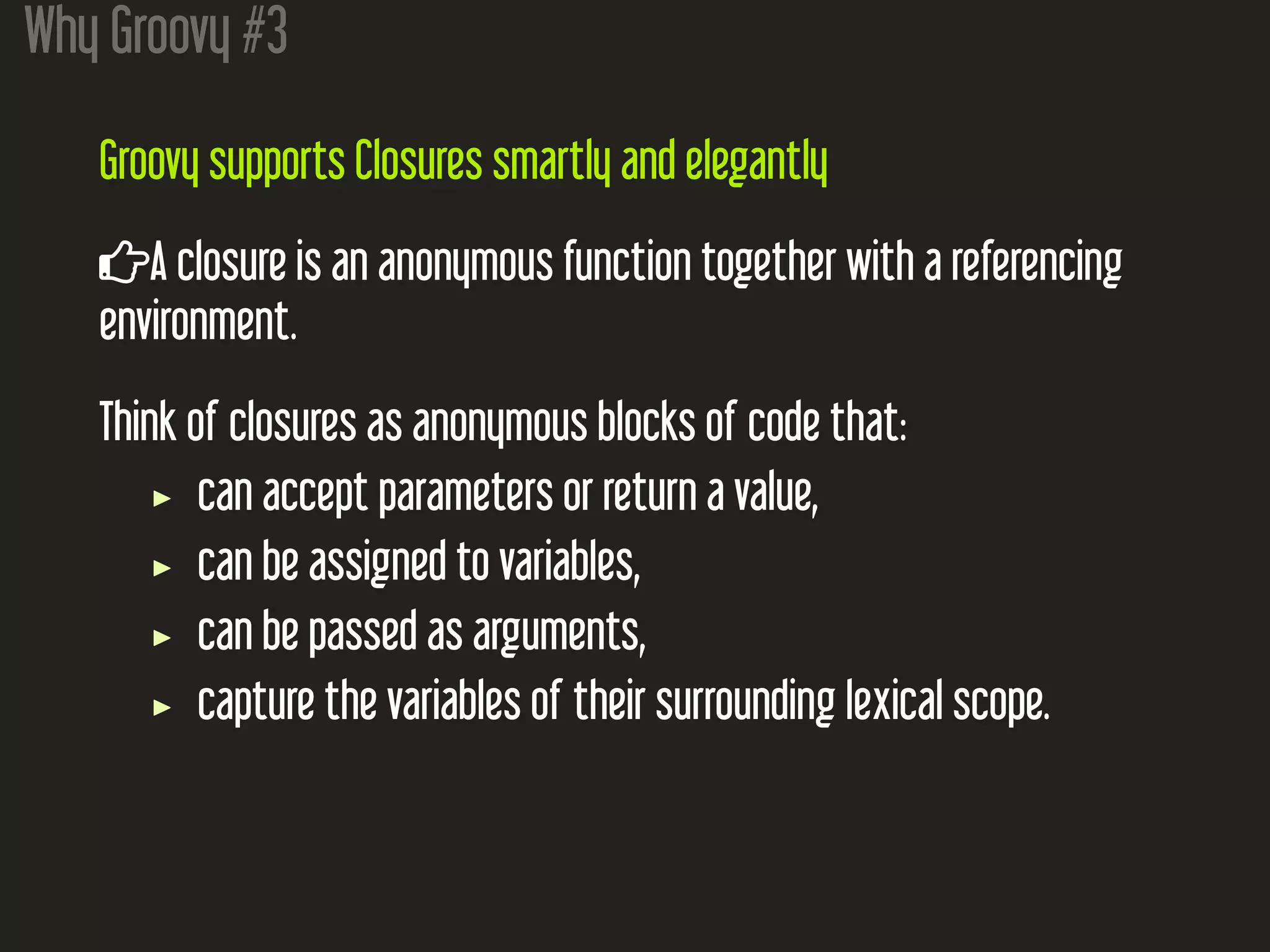
Groovy supports Closures smartly and elegantly
A closure is an anonymous function together with a referencing
environment.
Think of closures as anonymous blocks of code that:
can accept parameters or return a value,
can be assigned to variables,
can be passed as arguments,
capture the variables of their surrounding lexical scope.
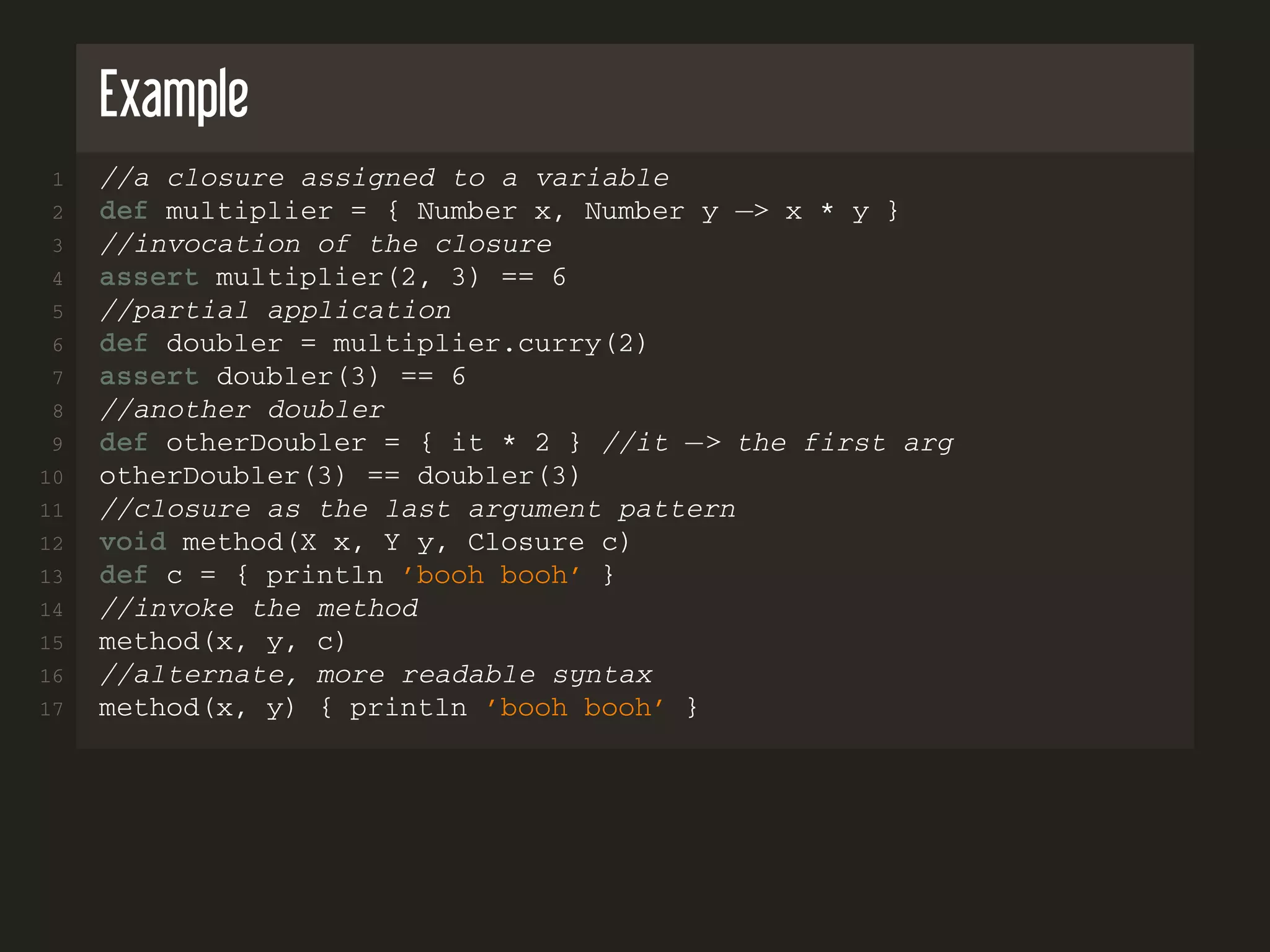
Example
1 //a closure assigned to a variable
2 def multiplier = { Number x, Number y −> x * y }
3 //invocation of the closure
4 assert multiplier(2, 3) == 6
5 //partial application
6 def doubler = multiplier.curry(2)
7 assert doubler(3) == 6
8 //another doubler
9 def otherDoubler = { it * 2 } //it −> the first arg
10 otherDoubler(3) == doubler(3)
11 //closure as the last argument pattern
12 void method(X x, Y y, Closure c)
13 def c = { println ’booh booh’ }
14 //invoke the method
15 method(x, y, c)
16 //alternate, more readable syntax
17 method(x, y) { println ’booh booh’ }
Collection Manipulation
1 //a groovy list (ArrayList behind the scenes)
2 def list = [12, 2, 34, 4, 15]
3 //Collection.collect(Closure c) − extra method available in
Groovy JDK
4 //So, given a closure
5 def inc = { it + 1 }
6 //we can invoke
7 list.collect(inc) == [13, 3, 35, 5, 16]
8 //or pass the closure code directly
9 assert list.collect{ it + 1 } == [13, 3, 35, 5, 16]
10 //some more fun
11 list.findAll{ it > 10 }.groupBy{ it % 2 == 0 ? ’even’ : ’odd’ }
== [even:[12, 34], odd:[15]]
Owner and delegate
1 class Test {
2 long x = 2
3 def xTimes = { l −> x * l }
4 }
5 Test test = new Test()
6 assert test.xTimes.owner == test
7 assert test.xTimes.delegate == test
8 test.xTimes(3) == 6
9 test.x = 3
10 test.xTimes(3) == 9
11 def map = [x:4]
12 assert test.xTimes.resolveStrategy == Closure.OWNER_FIRST
13 test.xTimes.resolveStrategy = Closure.DELEGATE_FIRST
14 test.xTimes.delegate = map
15 assert test.xTimes(3) == 12
Why Groovy #4
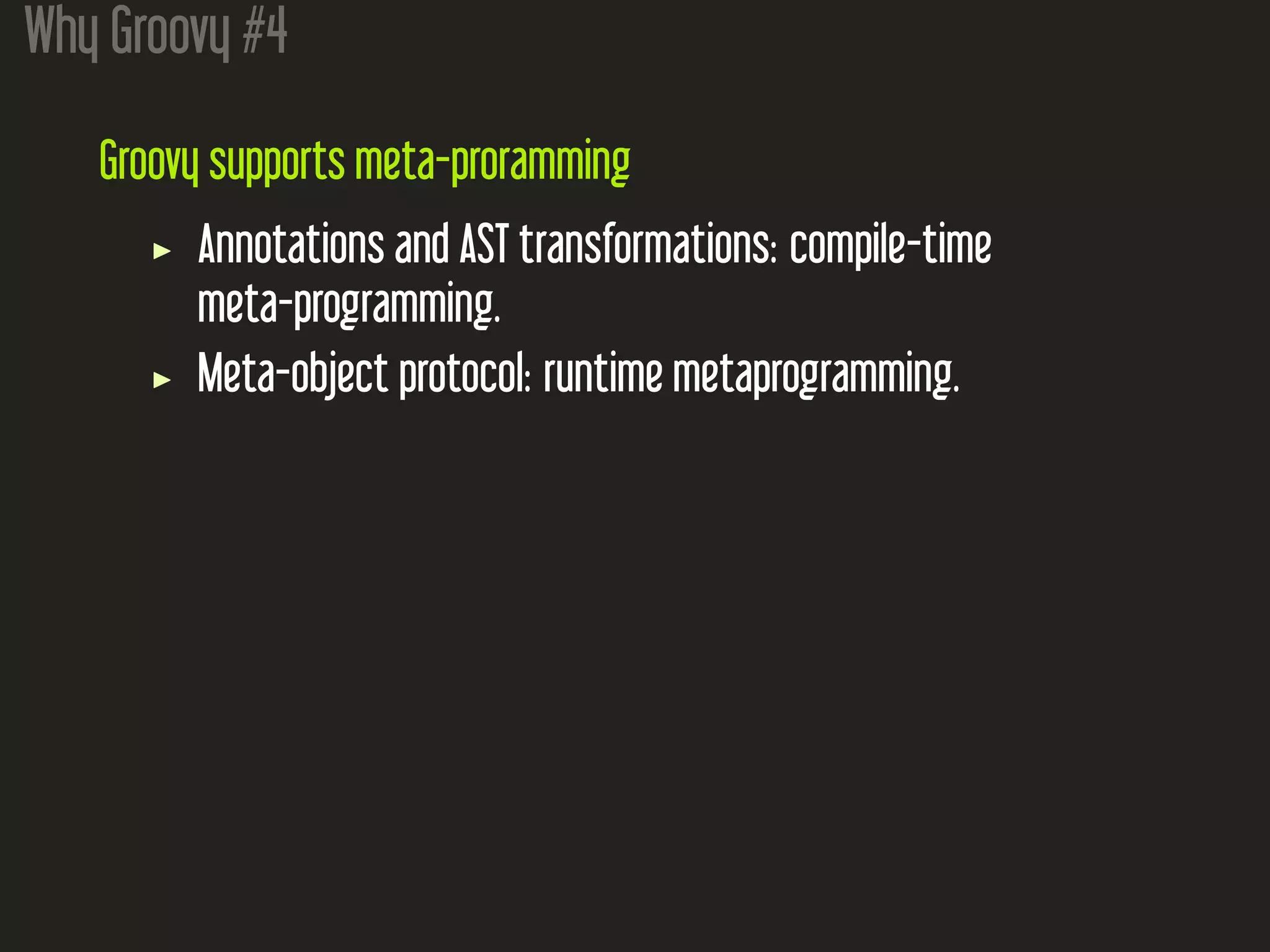
Groovy supports meta-proramming
Annotations and AST transformations: compile-time
meta-programming.
Meta-object protocol: runtime metaprogramming.
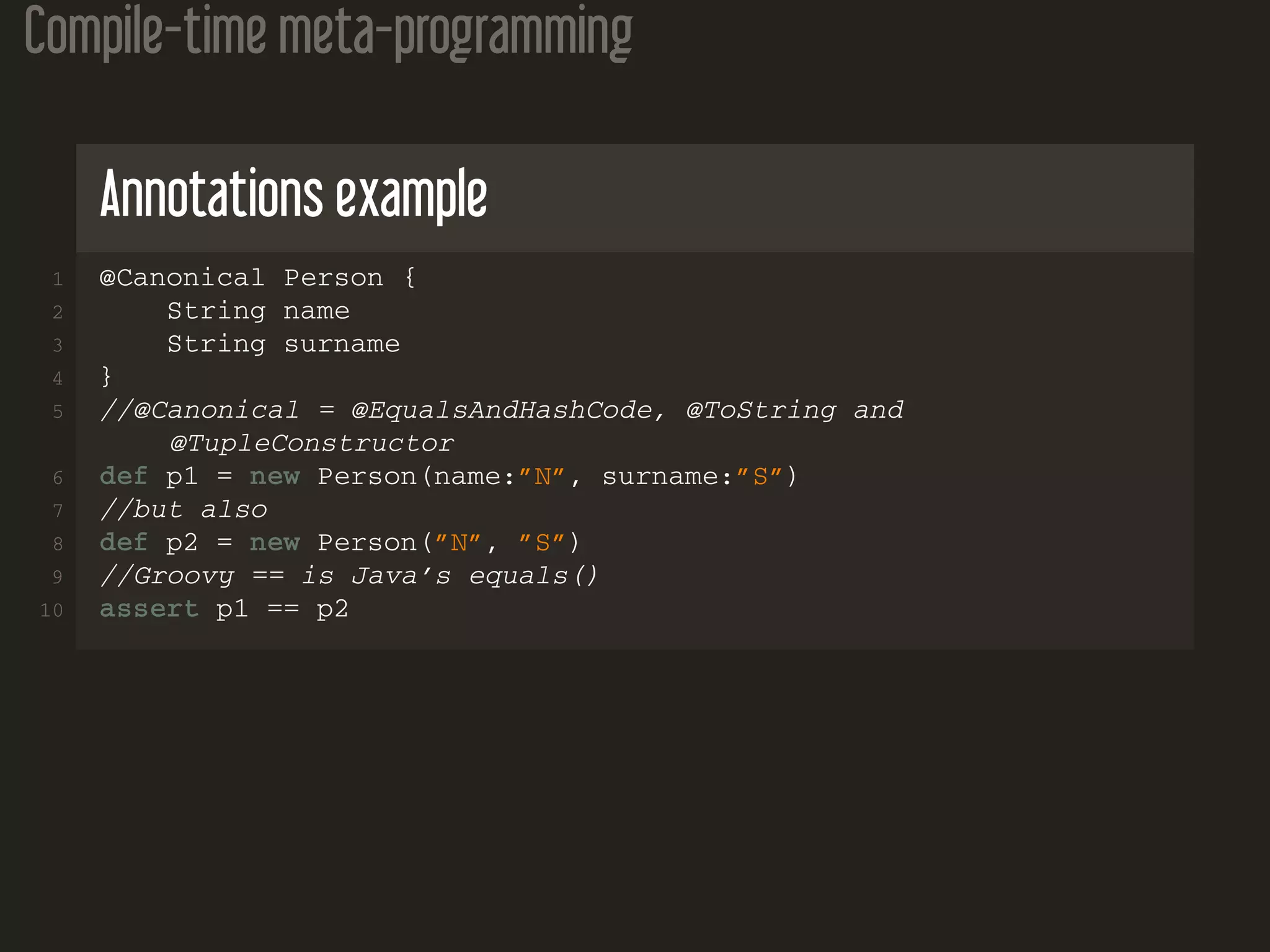
Compile-time meta-programming
Annotations example
1 @Canonical Person {
2 String name
3 String surname
4 }
5 //@Canonical = @EqualsAndHashCode, @ToString and
@TupleConstructor
6 def p1 = new Person(name:”N”, surname:”S”)
7 //but also
8 def p2 = new Person(”N”, ”S”)
9 //Groovy == is Java’s equals()
10 assert p1 == p2
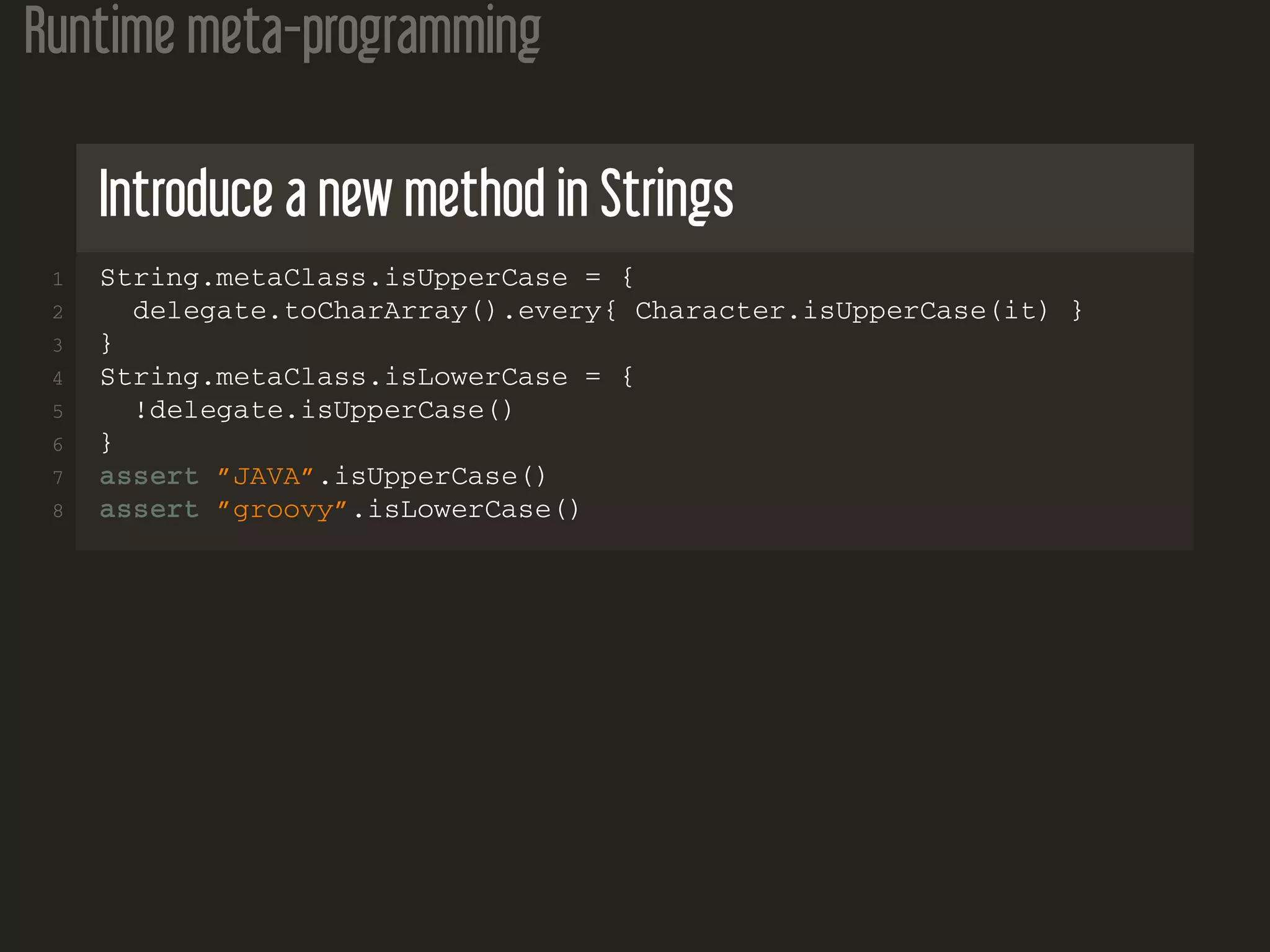
Runtime meta-programming
Introduce a new method in Strings
1 String.metaClass.isUpperCase = {
2 delegate.toCharArray().every{ Character.isUpperCase(it) }
3 }
4 String.metaClass.isLowerCase = {
5 !delegate.isUpperCase()
6 }
7 assert ”JAVA”.isUpperCase()
8 assert ”groovy”.isLowerCase()
Why Groovy #5
Groovy offers seamless integration with Java
Syntactically correct Java will work in Groovy (with some
gotchas).
You get all groovy magic by just adding a jar in the classpath.
Call Groovy from Java == call Java from Java.
Joint compilation: mix Java and Groovy.
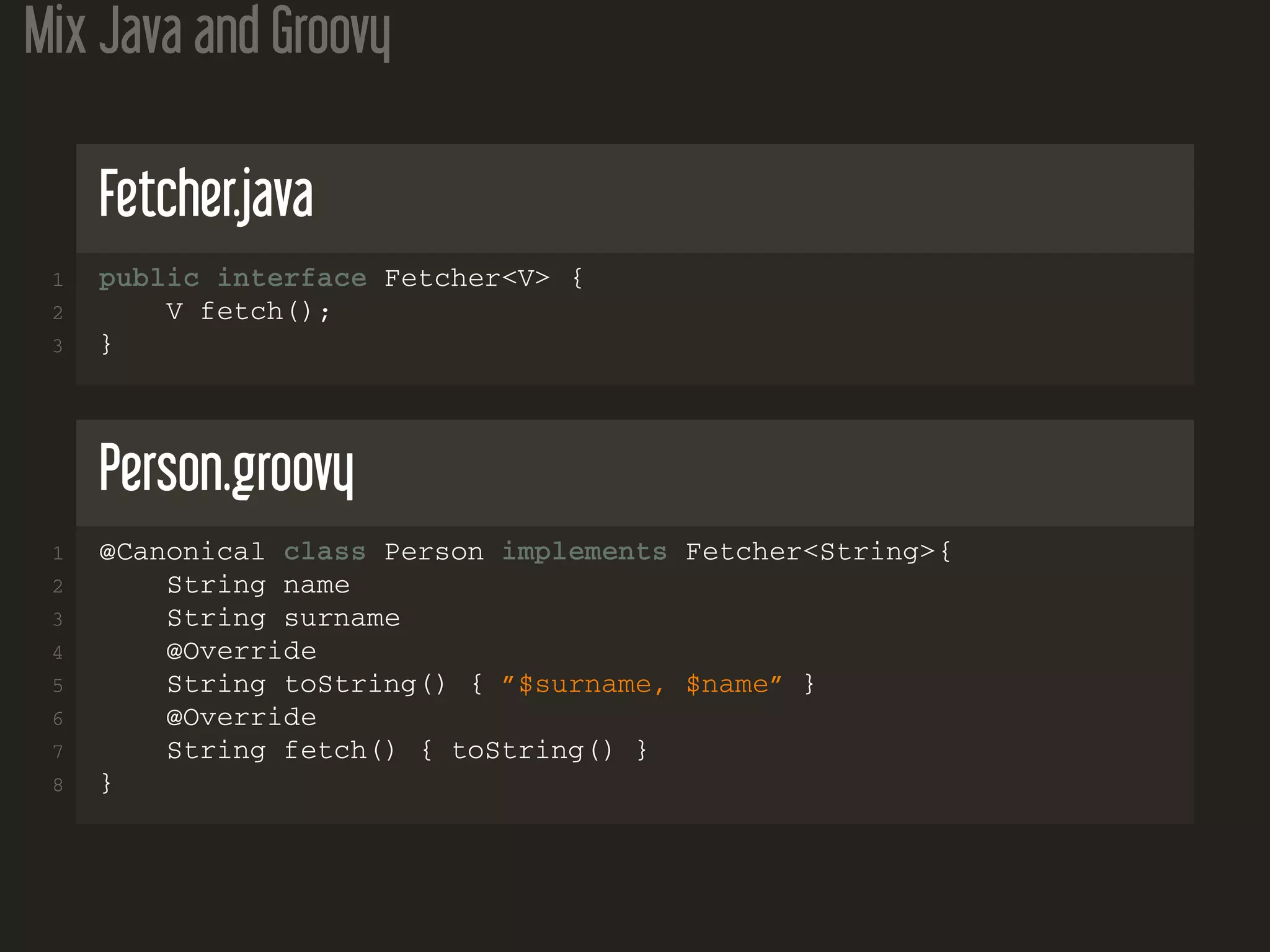
Mix Java and Groovy
Fetcher.java
1 public interface Fetcher<V> {
2 V fetch();
3 }
Person.groovy
1 @Canonical class Person implements Fetcher<String>{
2 String name
3 String surname
4 @Override
5 String toString() { ”$surname, $name” }
6 @Override
7 String fetch() { toString() }
8 }
Mix Java and Groovy
UsingPerson.java
1 public class UsingPerson {
2 public static void main(String[] args) {
3 Person p = new Person(”Theodoros”, ”Kolokotronis”);
4 System.out.println(p.fetch());
5 }
6 }
Joint compilation
> groovyc Fetcher.java Person.groovy UsingPerson.java −j
> java −cp groovy−all.jar:. UsingPerson
> Kolokotronis, Theodoros
Why Groovy #6
Groovy is a Java-powered scripting language
Echo.java
1 public class Echo {
2 public static void main(String[] args) {
3 if (args != null && args.length > 0) {
4 //for Java < 8 you need a third−party library
5 System.out.println(String.join(” ”, args));
6 }
7 }
8 }
Echo.groovy (no boilerplate)
1 if (args) {
2 println args.join(’ ’)
3 }
Querying a MySQL database using JDBC
db.groovy
1 @GrabConfig(systemClassLoader=true)
2 @Grab(’mysql:mysql−connector−java:5.1.6’)
3 import groovy.sql.Sql
4 try {
5 def sql = Sql.newInstance(args[0], args[1], args[2], ”com.mysql
.jdbc.Driver”)
6 def query=”select count(*) as c, date(cDate) as d from table
group by d order by c”
7 sql.eachRow(query) { row −> println ”${row.c}:${row.d}” }
8 }
9 catch(e) { e.printStackTrace() }
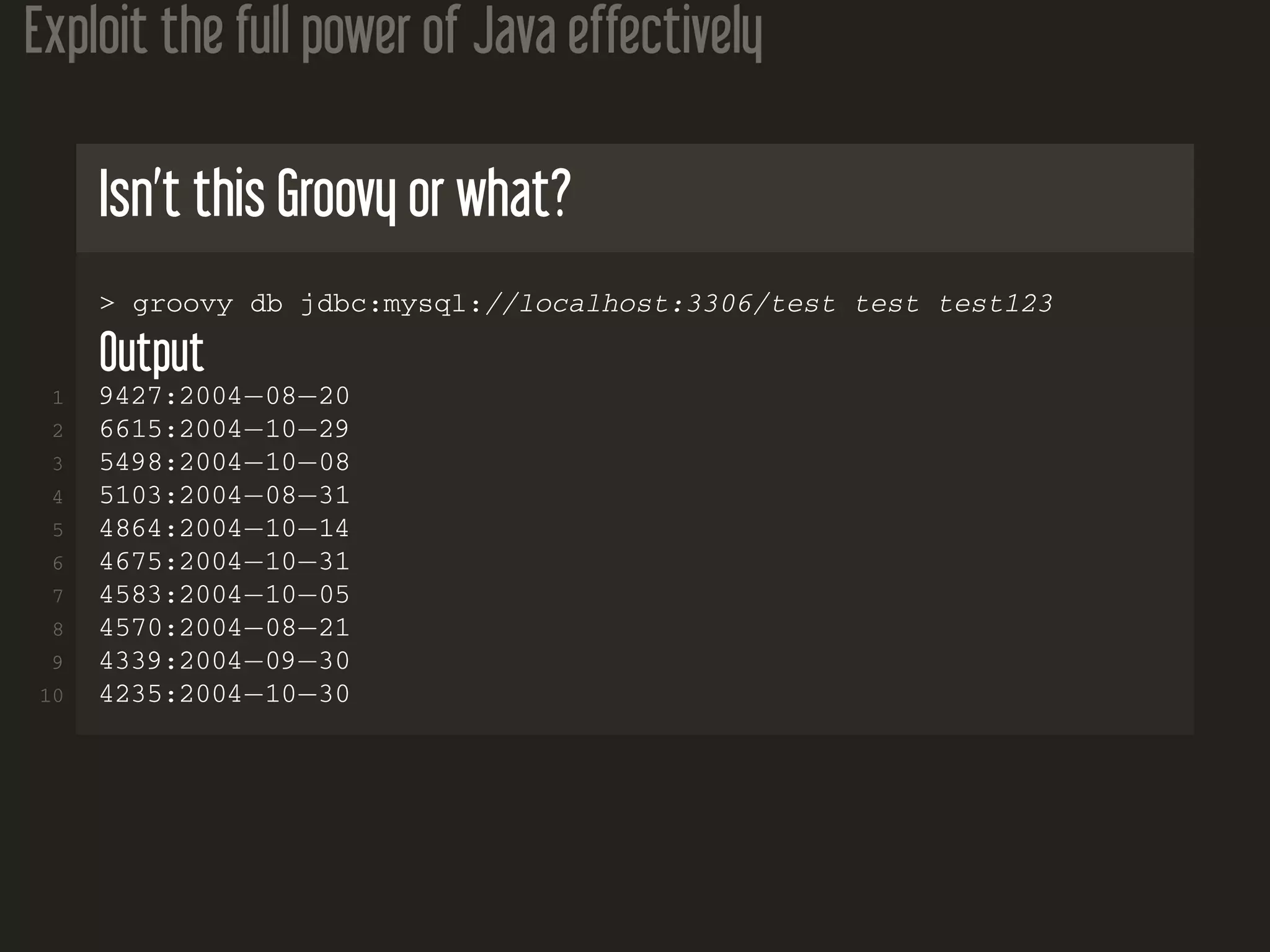
Exploit the full power of Java effectively
Isn’t this Groovy or what?
> groovy db jdbc:mysql://localhost:3306/test test test123
Output
1 9427:2004−08−20
2 6615:2004−10−29
3 5498:2004−10−08
4 5103:2004−08−31
5 4864:2004−10−14
6 4675:2004−10−31
7 4583:2004−10−05
8 4570:2004−08−21
9 4339:2004−09−30
10 4235:2004−10−30
Why Groovy #7
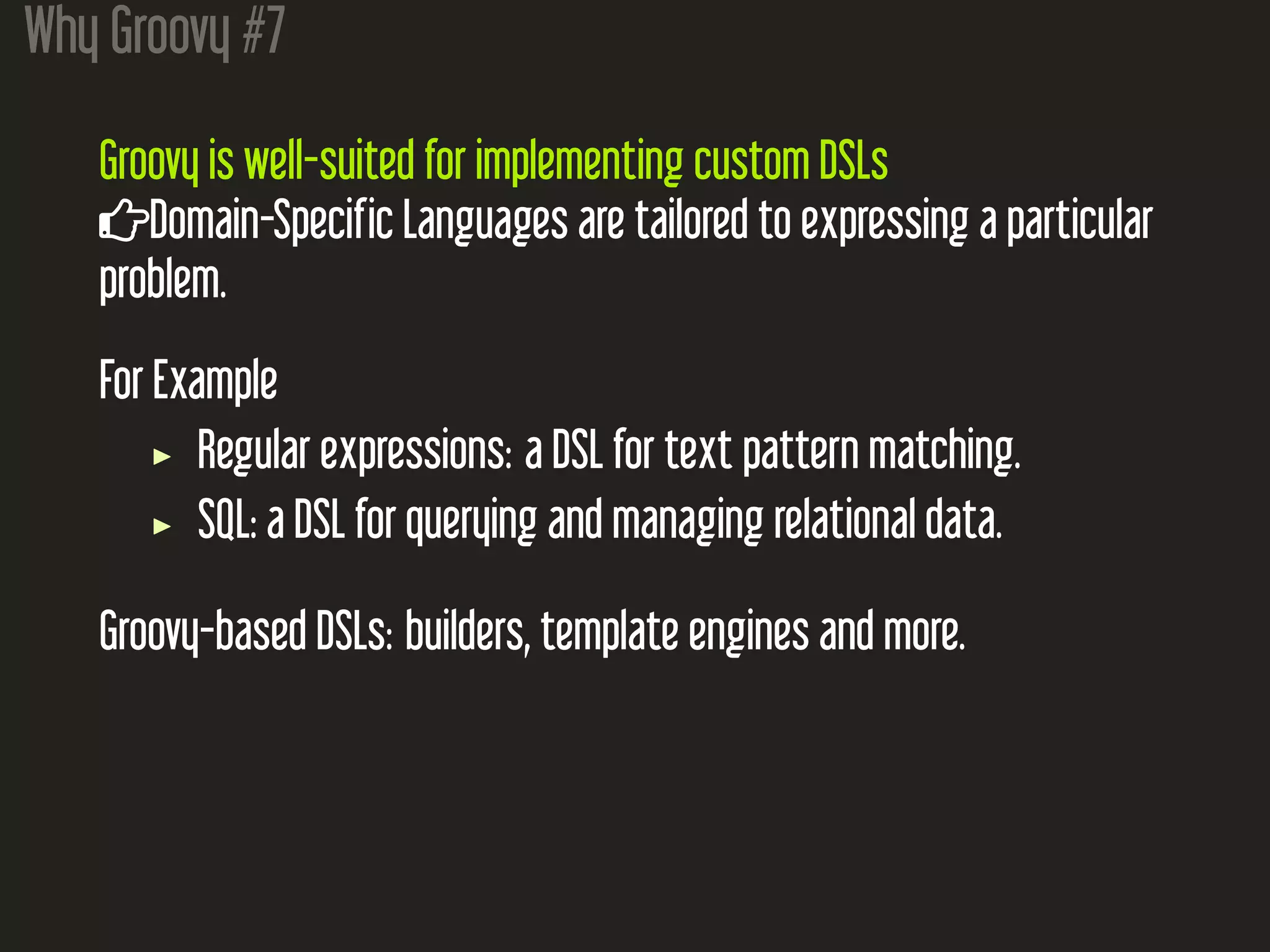
Groovy is well-suited for implementing custom DSLs
Domain-Specific Languages are tailored to expressing a particular
problem.
For Example
Regular expressions: a DSL for text pattern matching.
SQL: a DSL for querying and managing relational data.
Groovy-based DSLs: builders, template engines and more.
FOSSCOMM 2016 Programme
The data
1 def presentations = [
2 [
3 date : ’2016−04−16’,
4 start: ’10:30’,
5 end : ’11:00’,
6 title: ’Welcome’,
7 who : [’Software Libre Society’]
8 ],
9 [
10 date : ’2016−04−16’,
11 start: ’16:00’,
12 end : ’17:00’,
13 title: ’Apache Groovy: the language and the ecosystem’,
14 who : [’Agapios Avramidis’, ’Kostas Saidis’]
15 ]
16 ]
FOSSCOMM 2016 Programme
Groovy MarkupTemplateEngine
1 yieldUnescaped ’<!DOCTYPE html>’
2 html(lang:’el’) {
3 head {
4 meta (’http−equiv’:’...’)
5 title (’FOSSCOMM 2016’)
6 }
7 body {
8 [’2016−04−16’, ’2016−04−17’].each { date −>
9 h1 (date)
10 list.findAll{it.date == date}.sort{it.start}.each{ p−>
11 div {
12 span (”${p.start} − ${p.end} − ”)
13 big (p.title)
14 br()
15 strong (p.who.join(’,’))
16 }
17 }
18 }
19 }
20 }
FOSSCOMM 2016 Programme
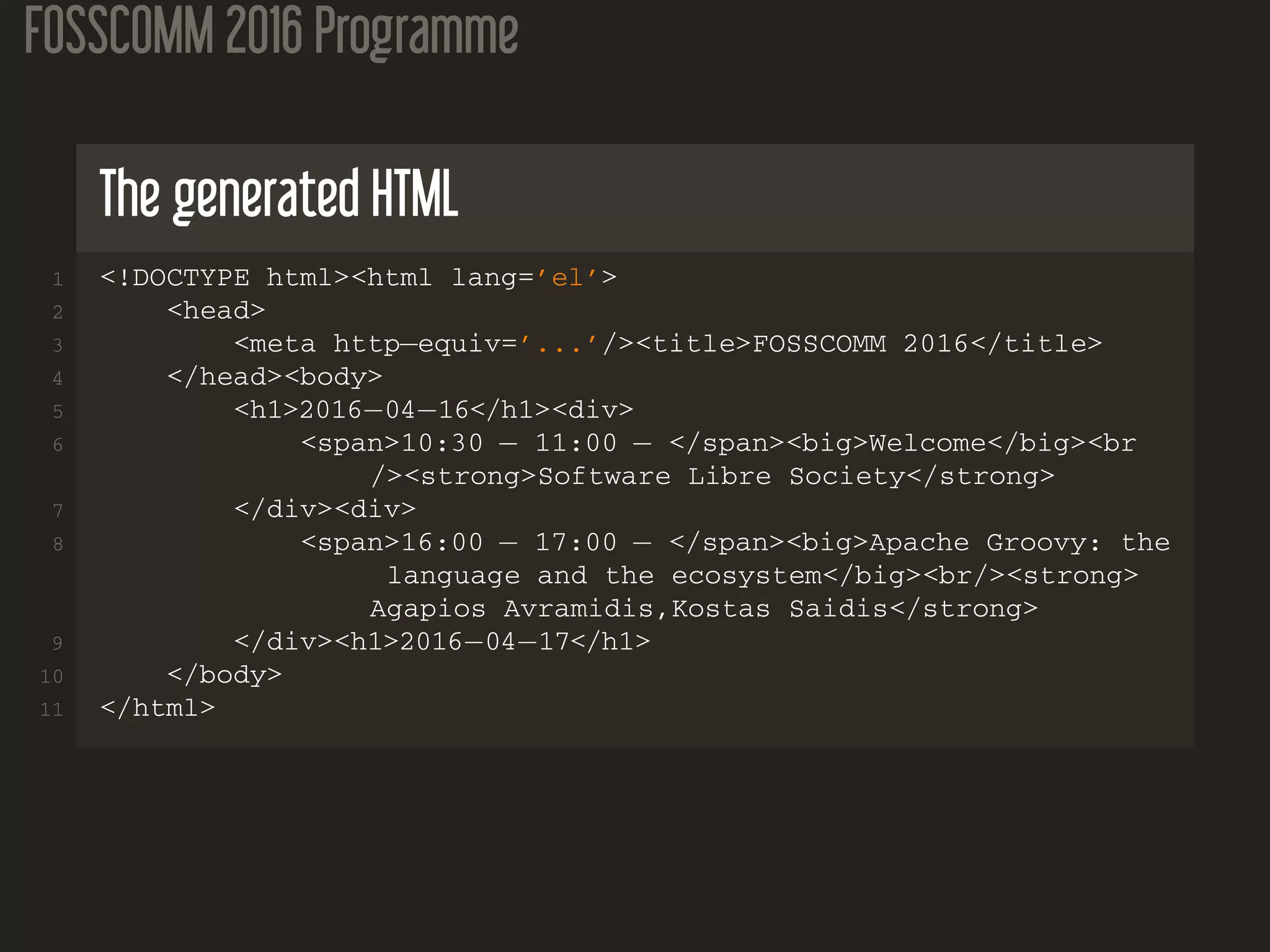
The generated HTML
1 <!DOCTYPE html><html lang=’el’>
2 <head>
3 <meta http−equiv=’...’/><title>FOSSCOMM 2016</title>
4 </head><body>
5 <h1>2016−04−16</h1><div>
6 <span>10:30 − 11:00 − </span><big>Welcome</big><br
/><strong>Software Libre Society</strong>
7 </div><div>
8 <span>16:00 − 17:00 − </span><big>Apache Groovy: the
language and the ecosystem</big><br/><strong>
Agapios Avramidis,Kostas Saidis</strong>
9 </div><h1>2016−04−17</h1>
10 </body>
11 </html>
Why Groovy #8
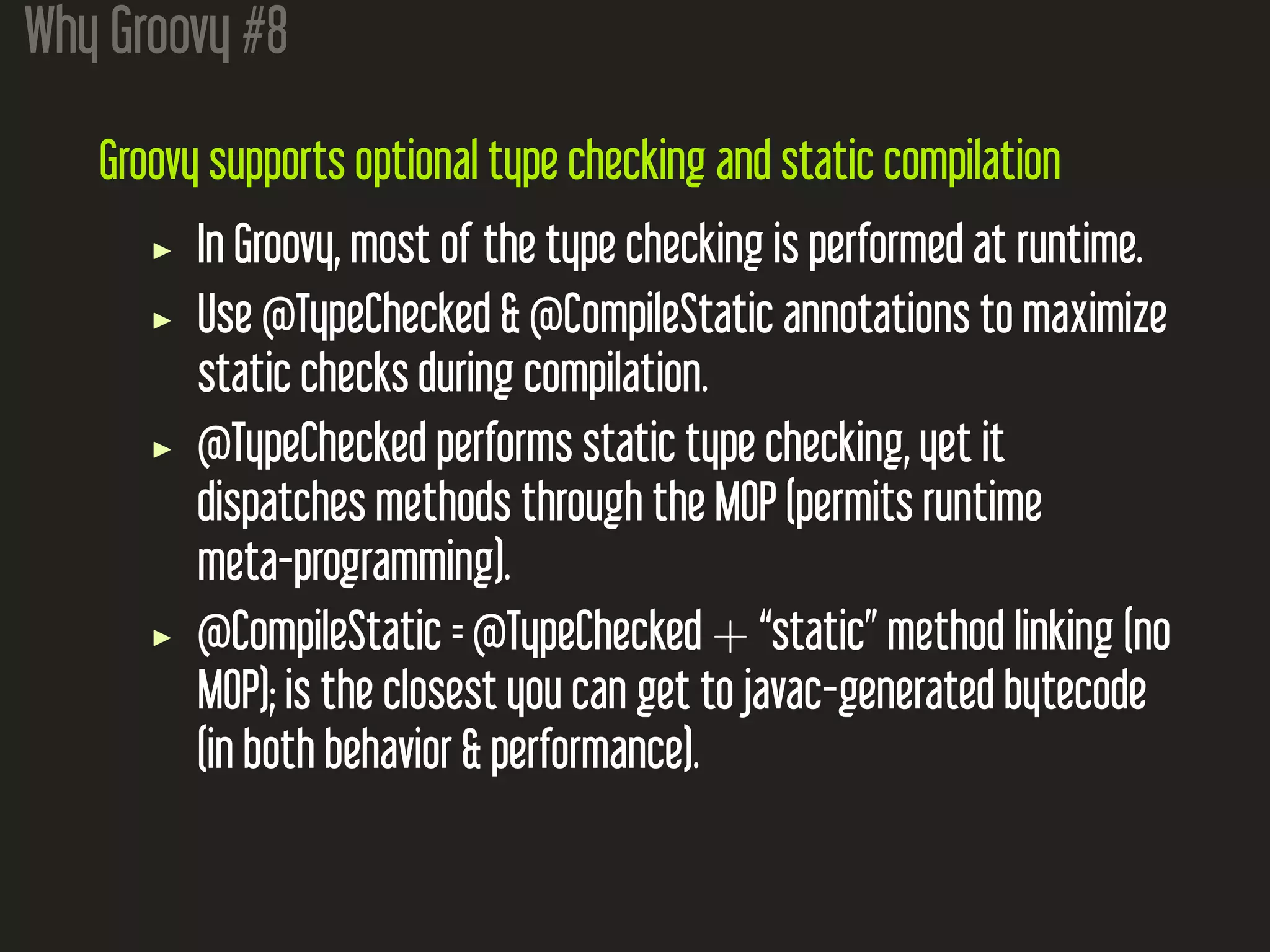
Groovy supports optional type checking and static compilation
In Groovy, most of the type checking is performed at runtime.
Use @TypeChecked & @CompileStatic annotations to maximize
static checks during compilation.
@TypeChecked performs static type checking, yet it
dispatches methods through the MOP (permits runtime
meta-programming).
@CompileStatic = @TypeChecked + “static” method linking (no
MOP); is the closest you can get to javac-generated bytecode
(in both behavior & performance).
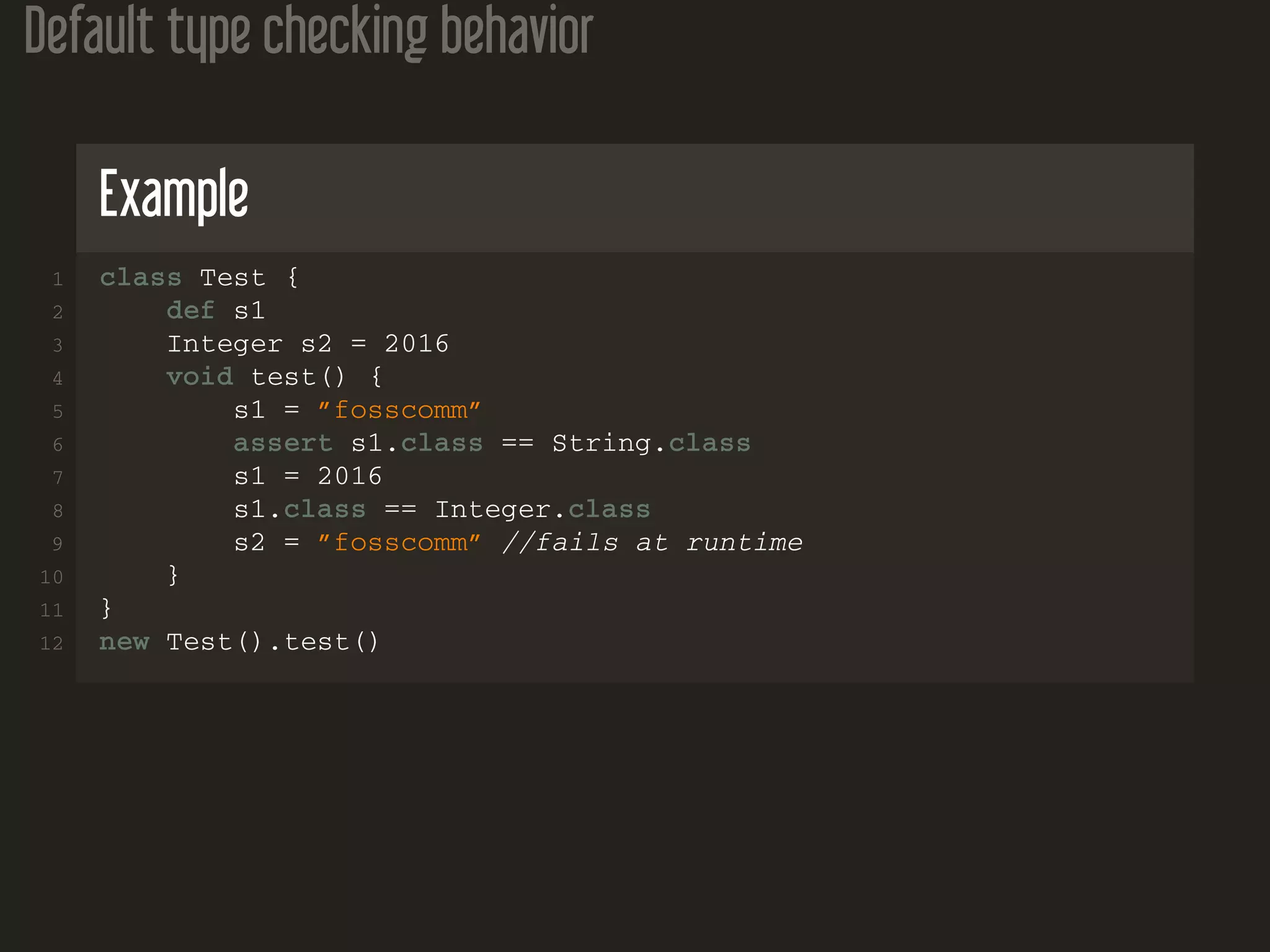
Default type checking behavior
Example
1 class Test {
2 def s1
3 Integer s2 = 2016
4 void test() {
5 s1 = ”fosscomm”
6 assert s1.class == String.class
7 s1 = 2016
8 s1.class == Integer.class
9 s2 = ”fosscomm” //fails at runtime
10 }
11 }
12 new Test().test()
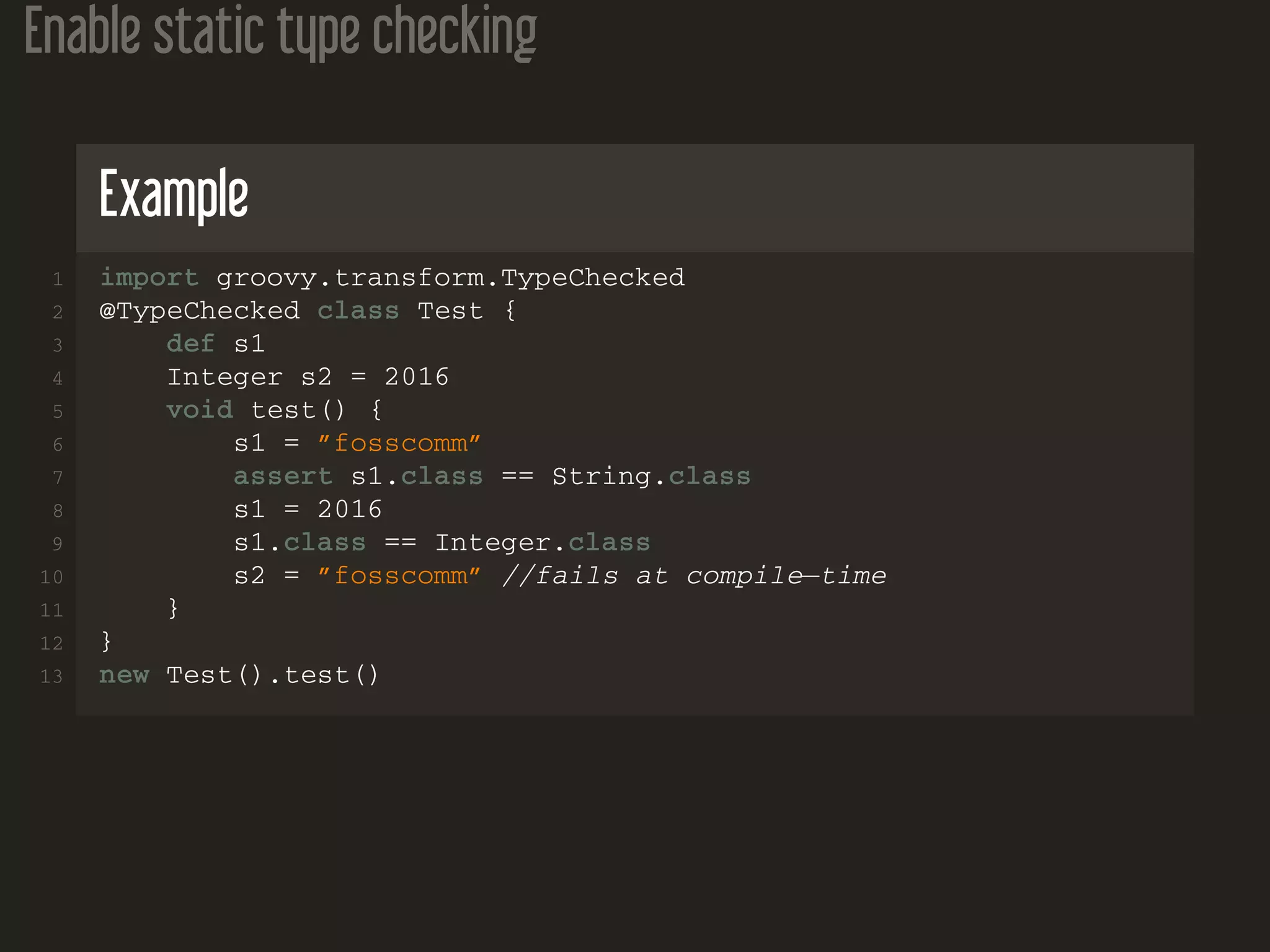
Enable static type checking
Example
1 import groovy.transform.TypeChecked
2 @TypeChecked class Test {
3 def s1
4 Integer s2 = 2016
5 void test() {
6 s1 = ”fosscomm”
7 assert s1.class == String.class
8 s1 = 2016
9 s1.class == Integer.class
10 s2 = ”fosscomm” //fails at compile−time
11 }
12 }
13 new Test().test()
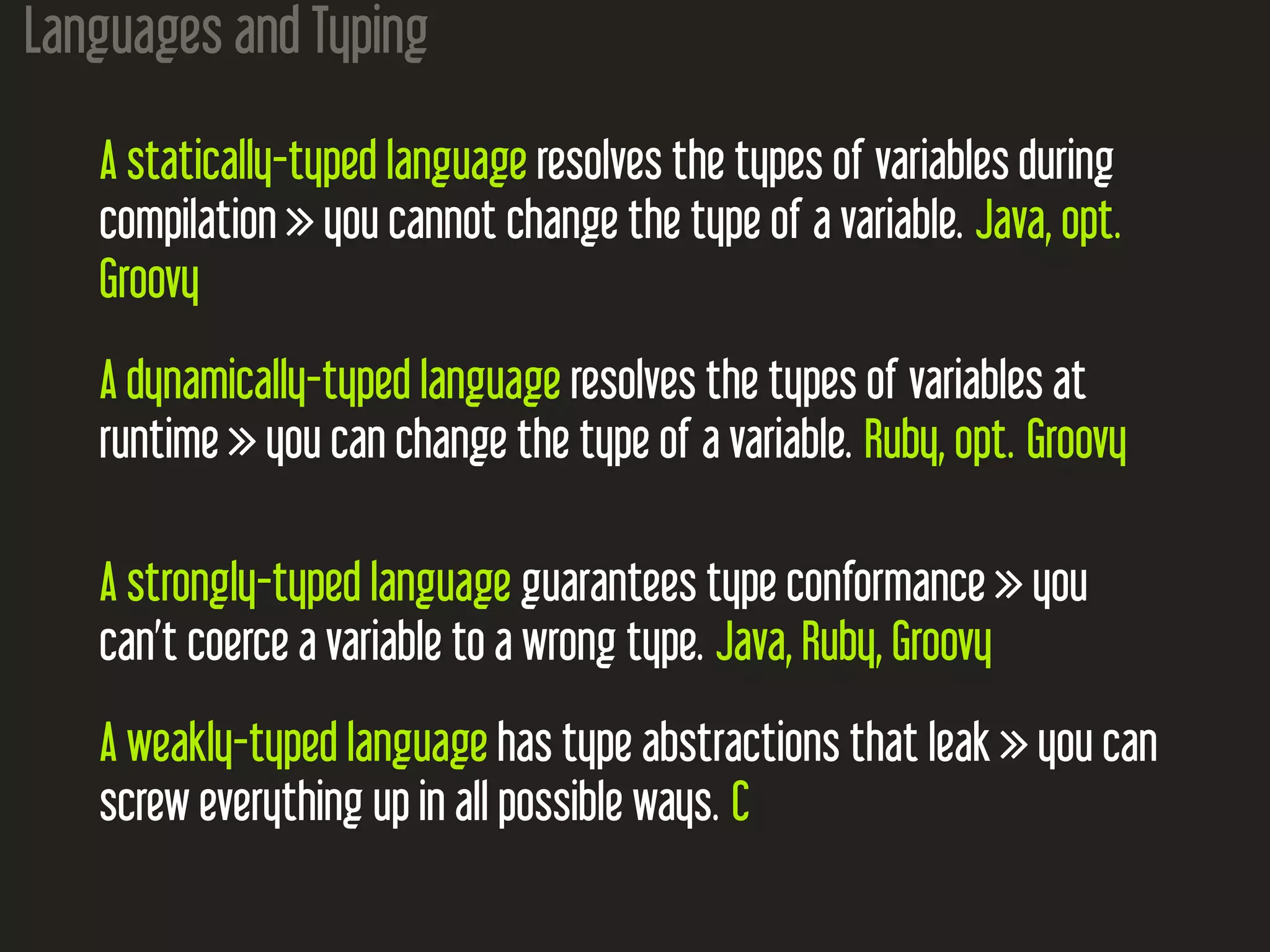
Languages and Typing
A statically-typed language resolves the types of variables during
compilation  you cannot change the type of a variable. Java, opt.
Groovy
A dynamically-typed language resolves the types of variables at
runtime  you can change the type of a variable. Ruby, opt. Groovy
A strongly-typed language guarantees type conformance  you
can’t coerce a variable to a wrong type. Java, Ruby, Groovy
A weakly-typed language has type abstractions that leak  you can
screw everything up in all possible ways. C
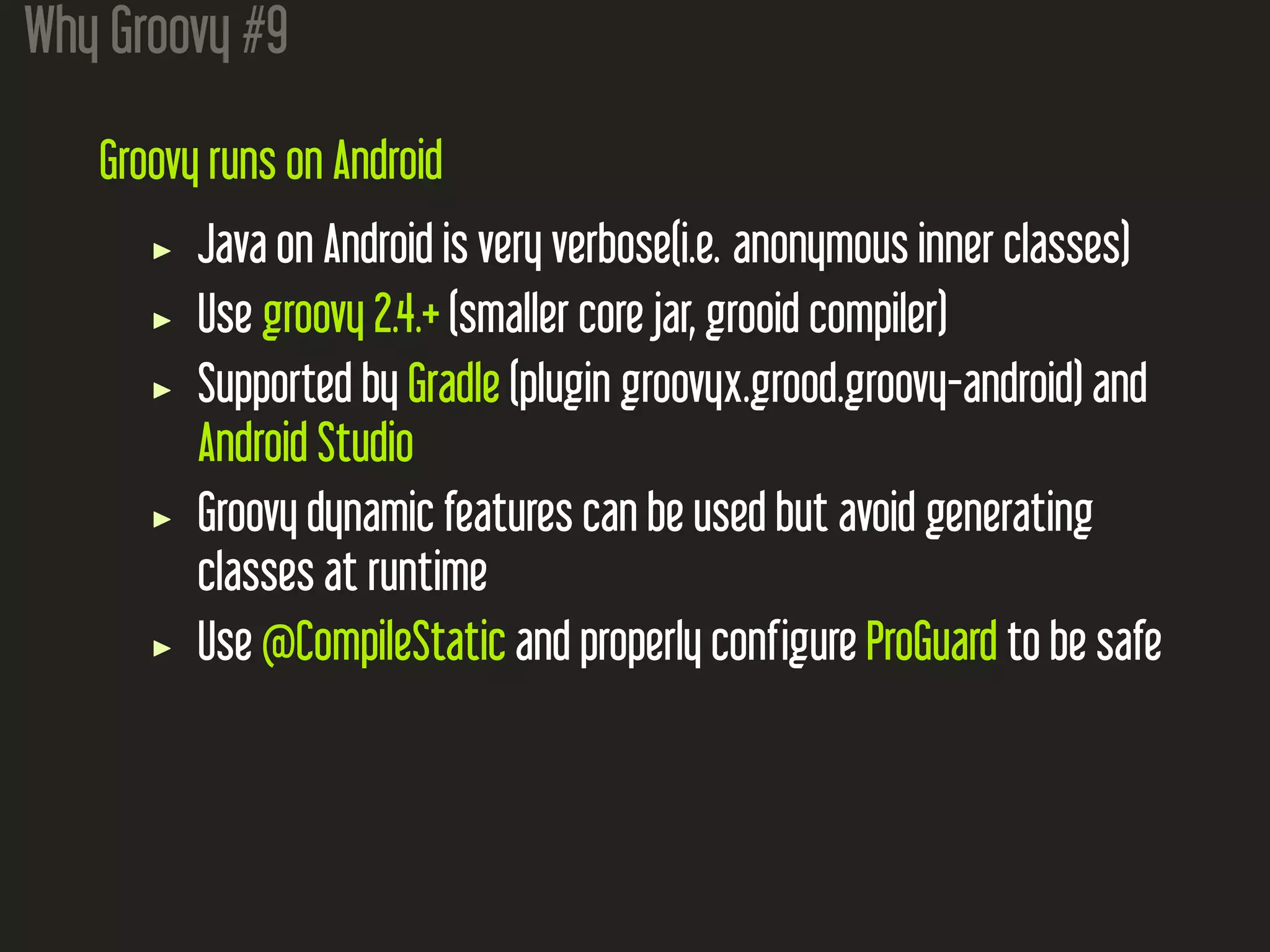
Why Groovy #9
Groovy runs on Android
Java on Android is very verbose(i.e. anonymous inner classes)
Use groovy 2.4.+ (smaller core jar, grooid compiler)
Supported by Gradle (plugin groovyx.grood.groovy-android) and
Android Studio
Groovy dynamic features can be used but avoid generating
classes at runtime
Use @CompileStatic and properly configure ProGuard to be safe
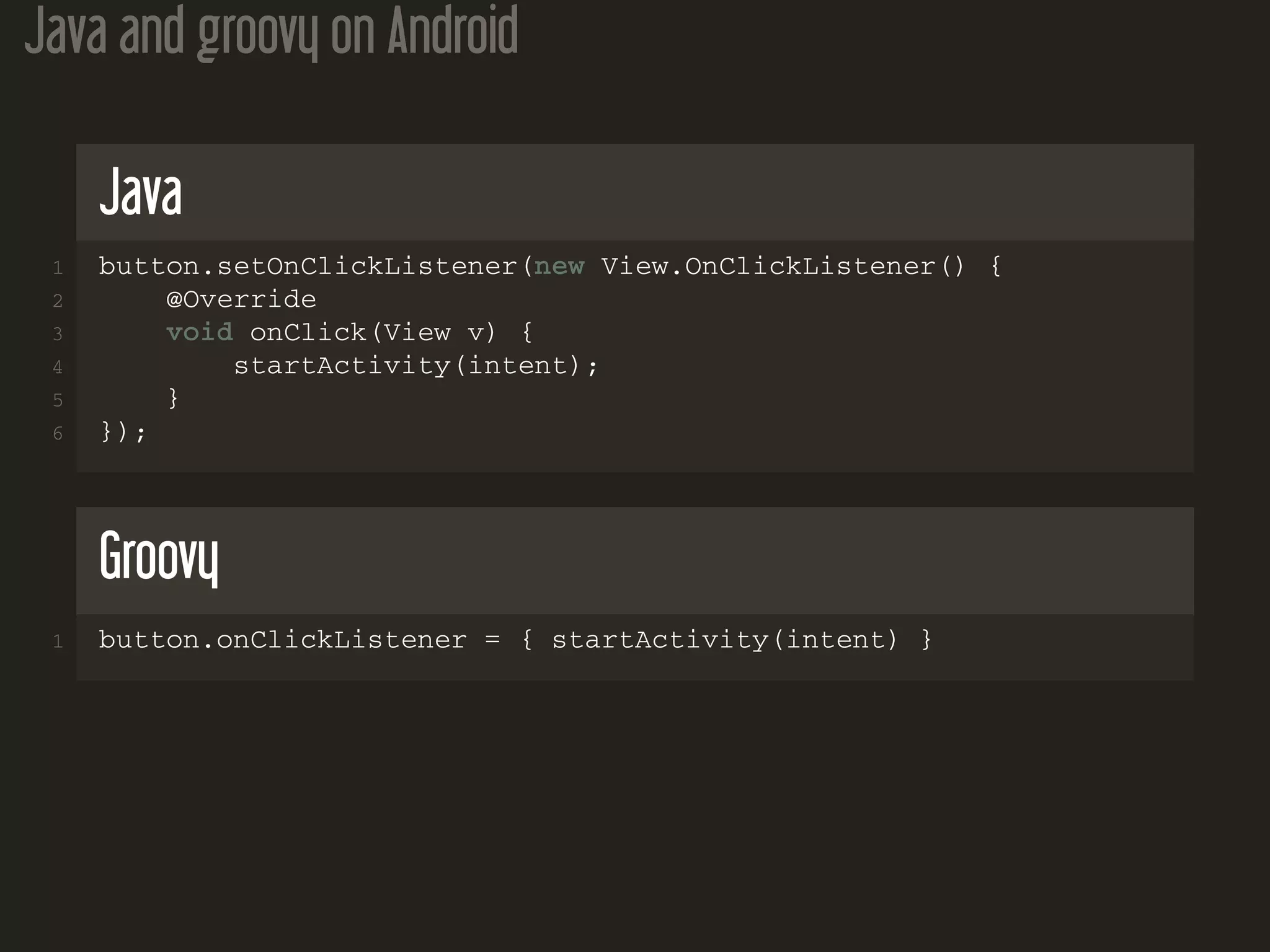
Java and groovy on Android
Java
1 button.setOnClickListener(new View.OnClickListener() {
2 @Override
3 void onClick(View v) {
4 startActivity(intent);
5 }
6 });
Groovy
1 button.onClickListener = { startActivity(intent) }
Why Groovy #10
A mature open source technology that is here to stay!
More than a decade long history‡
.
Free and Open Source Software (Apache License v2).
Joined the ASF in 2015.
‡
Groovy was the first “second language” proposed for the JVM (back in 2004).
Why Groovy #10 + 1
Groovy has a vibrant community and ecosystem
Everything that runs on the JVM is part of the Groovy ecosystem.
Including all Java tools, libraries and frameworks out there!
Thank you!

Just kidding!
Part II
The Groovy Ecosystem
Awesome tools, libraries and frameworks written in Groovy
or for Groovy§
§
We are only including projects with commit activity in 2016. Apologies if we missed some!
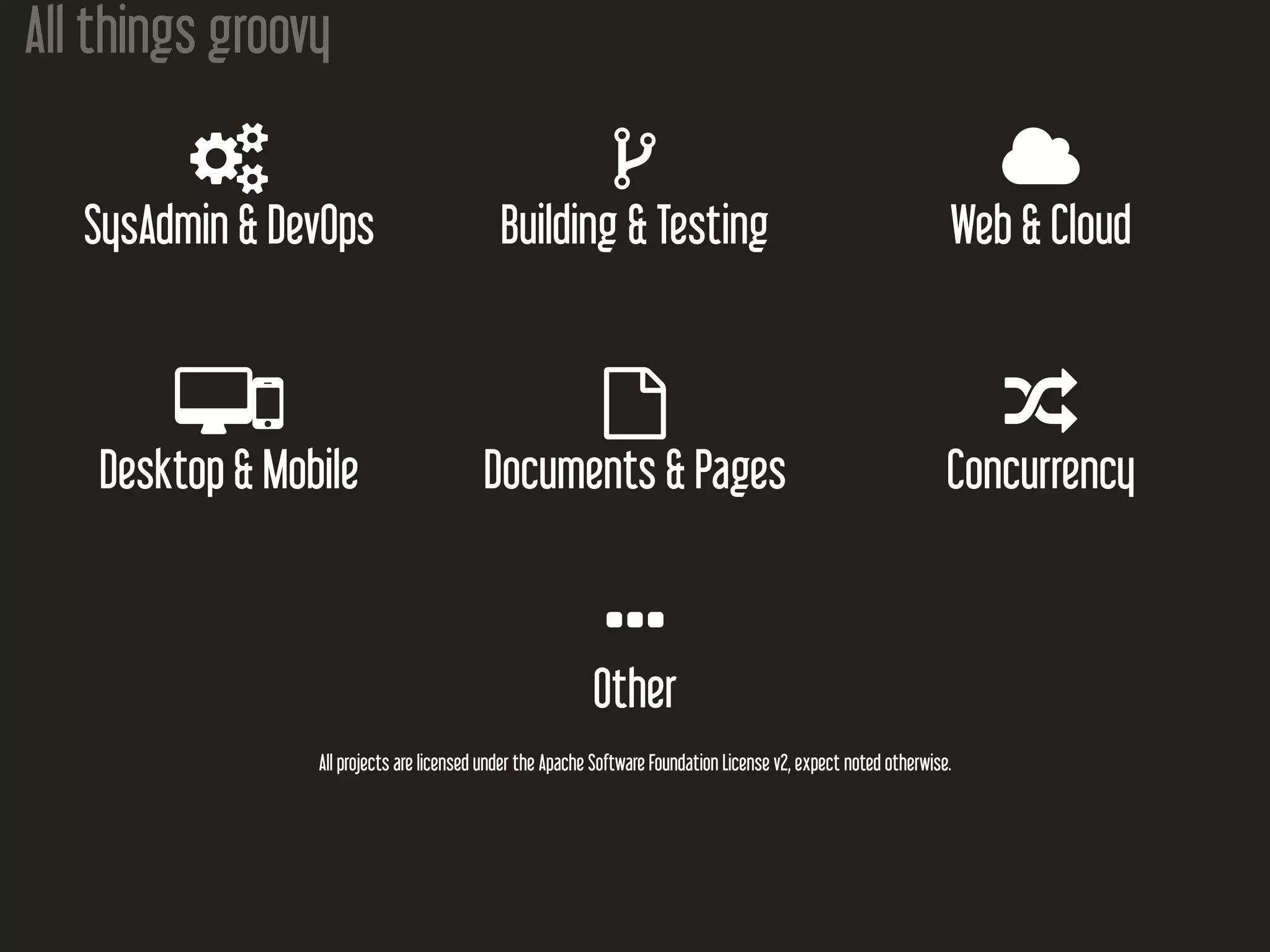
All things groovy

SysAdmin & DevOps

Building & Testing

Web & Cloud

Desktop & Mobile

Documents & Pages

Concurrency

Other
All projects are licensed under the Apache Software Foundation License v2, expect noted otherwise.

SysAdmin & DevOps
sdkman
A tool for managing different versions of SDKs
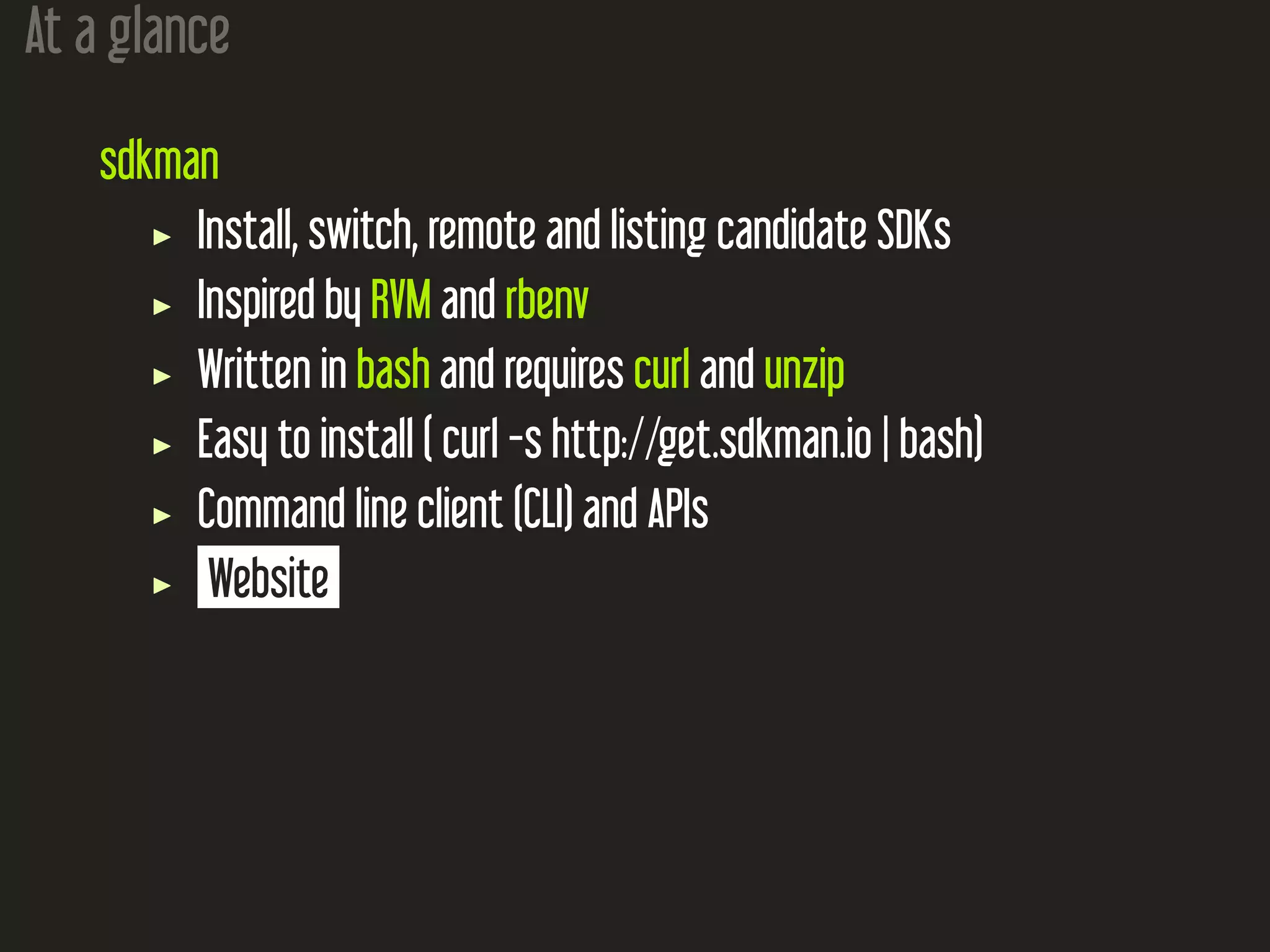
At a glance
sdkman
Install, switch, remote and listing candidate SDKs
Inspired by RVM and rbenv
Written in bash and requires curl and unzip
Easy to install ( curl -s http://get.sdkman.io | bash)
Command line client (CLI) and APIs
Website
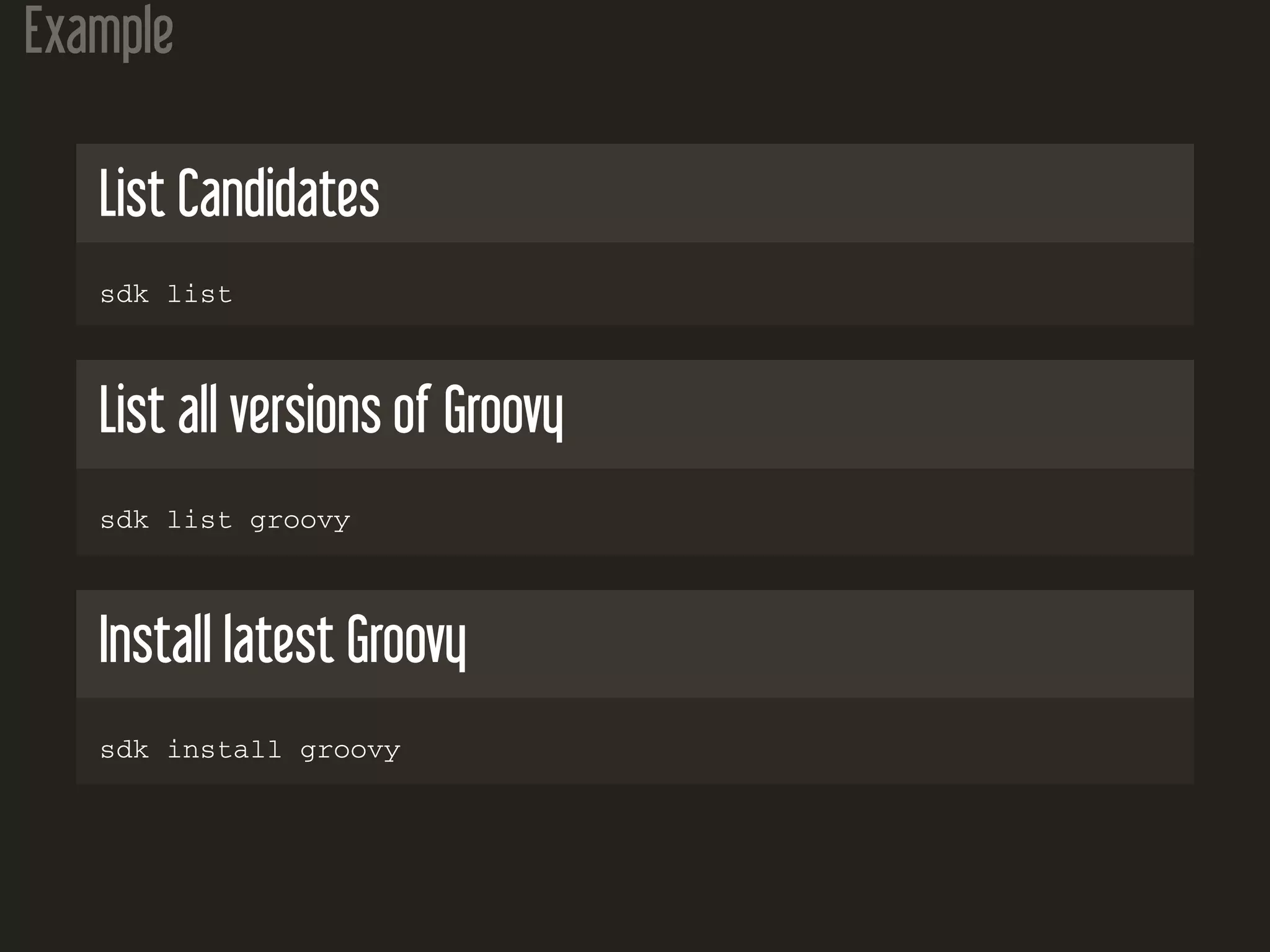
Example
List Candidates
sdk list
List all versions of Groovy
sdk list groovy
Install latest Groovy
sdk install groovy
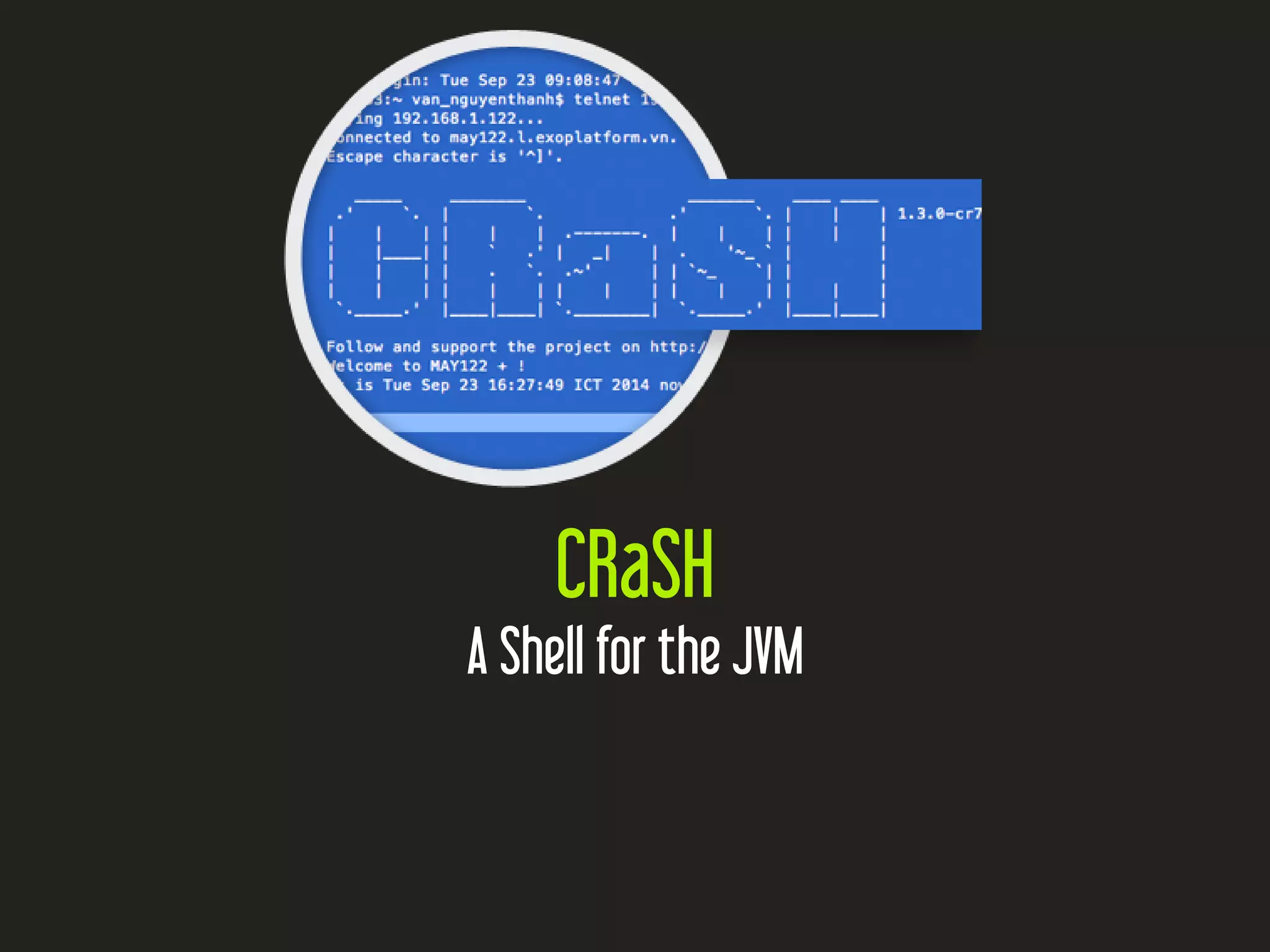
CRaSH
A Shell for the JVM
At a glance
Concepts
Modes
Standalone and Attach through attach API of Hotspot JVM)
Embedded (web apps)
Connectors
JVM, SSH, Telnet, Web (requires WebSocket)
Features
Connect to any JVM (ssh, telnet, web)
Completion, help, pipes.
Built-in commands (jmx, jdbc, thread, memory usage)
Extensible (create new commands in java or groovy)
Authentication (simple, Jaas, key-based)
Free and Open Source Software (LGPL v2.1)
Website
GroovyServ
Reduces startup time of the JVM
At a glance
GroovyServ
Quick startup of Groovy scripts (groovyClient)
Utilizes a JVM process running in background (server)
If a server is not running when a client is invoked, the client
runs a server in background
Available in sdkman
Website
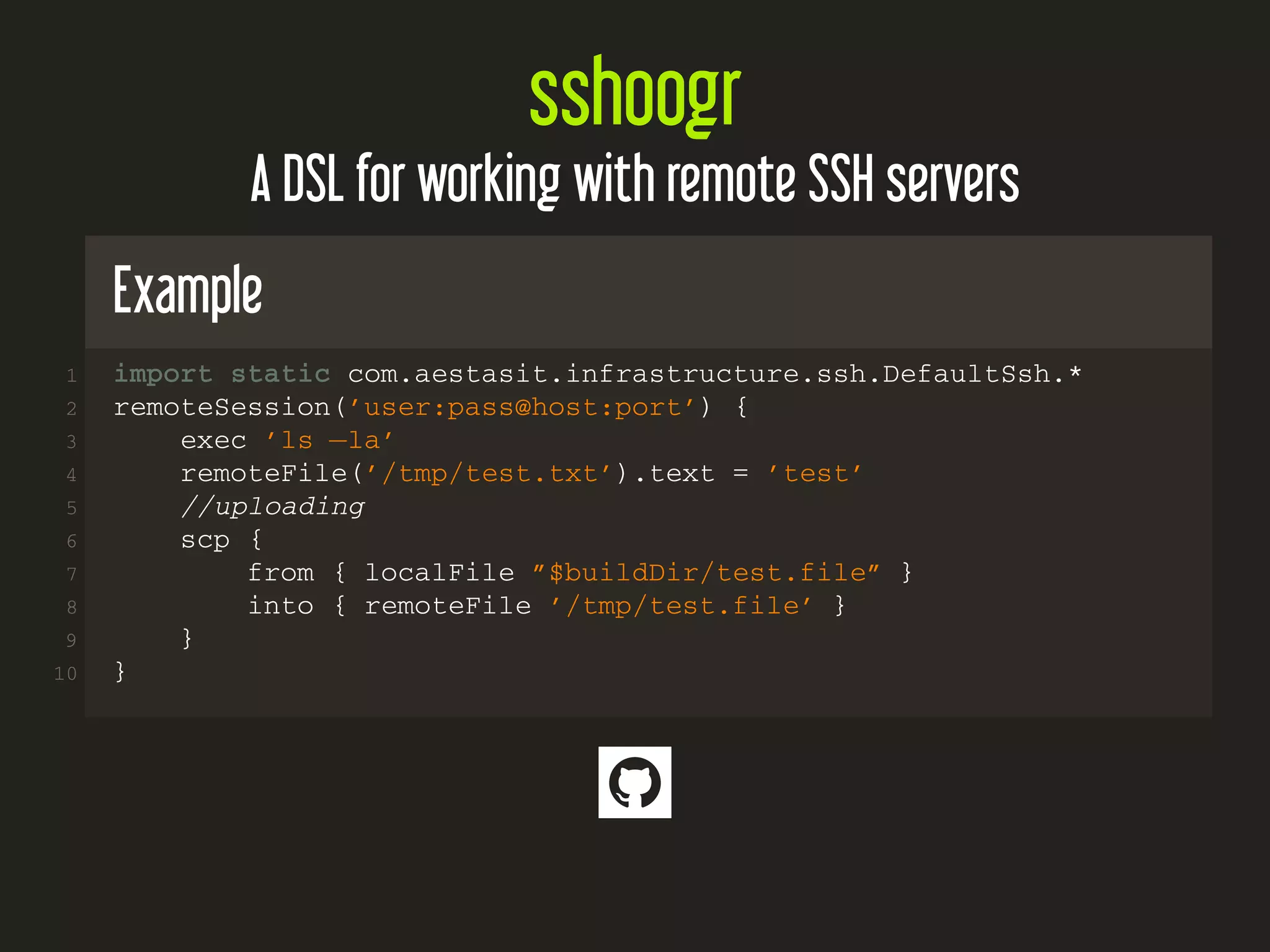
sshoogr
A DSL for working with remote SSH servers
Example
1 import static com.aestasit.infrastructure.ssh.DefaultSsh.*
2 remoteSession(’user:pass@host:port’) {
3 exec ’ls −la’
4 remoteFile(’/tmp/test.txt’).text = ’test’
5 //uploading
6 scp {
7 from { localFile ”$buildDir/test.file” }
8 into { remoteFile ’/tmp/test.file’ }
9 }
10 }

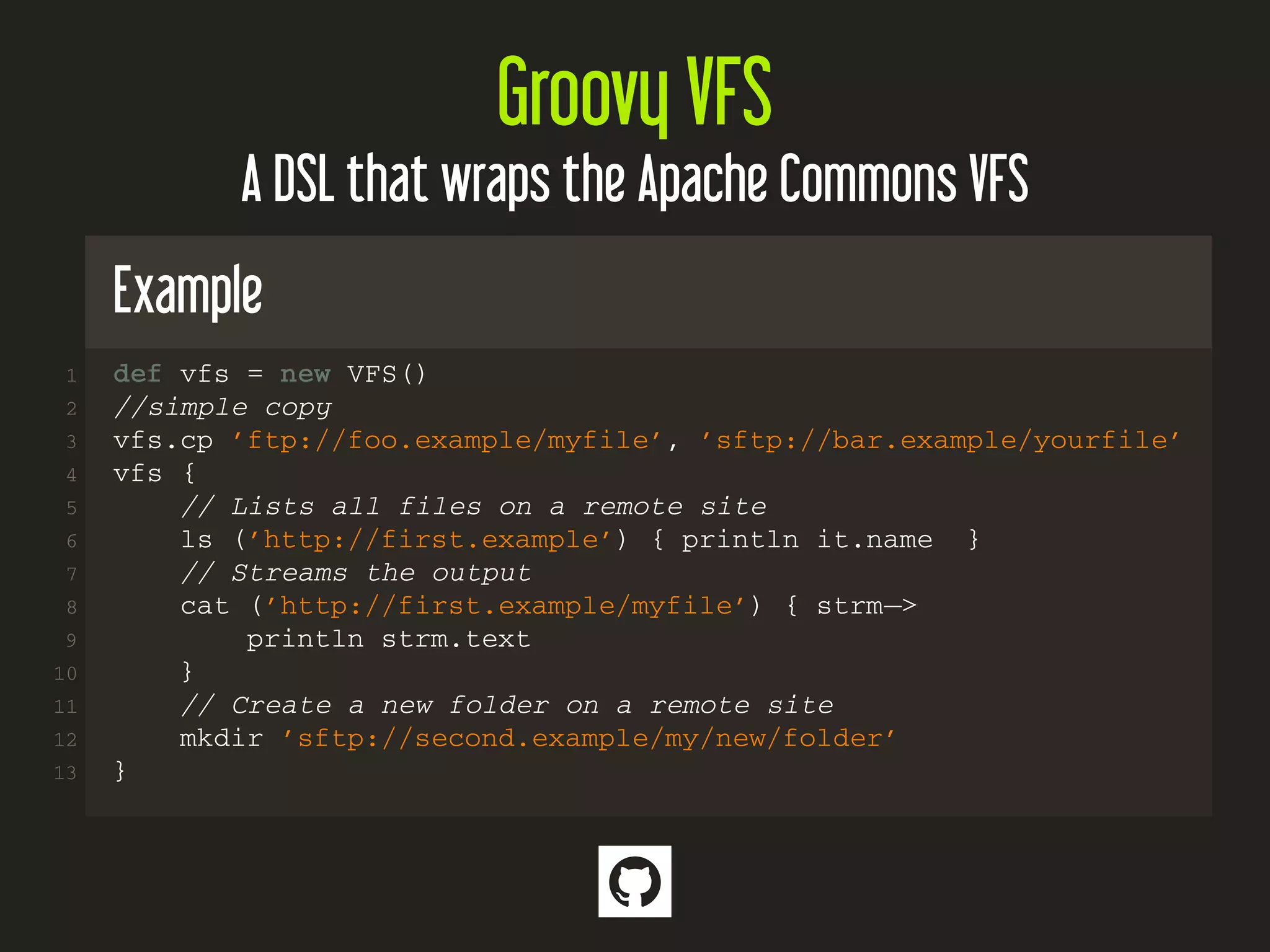
Groovy VFS
A DSL that wraps the Apache Commons VFS
Example
1 def vfs = new VFS()
2 //simple copy
3 vfs.cp ’ftp://foo.example/myfile’, ’sftp://bar.example/yourfile’
4 vfs {
5 // Lists all files on a remote site
6 ls (’http://first.example’) { println it.name }
7 // Streams the output
8 cat (’http://first.example/myfile’) { strm−>
9 println strm.text
10 }
11 // Create a new folder on a remote site
12 mkdir ’sftp://second.example/my/new/folder’
13 }


Building & Testing
Gradle
Emerge from build hell
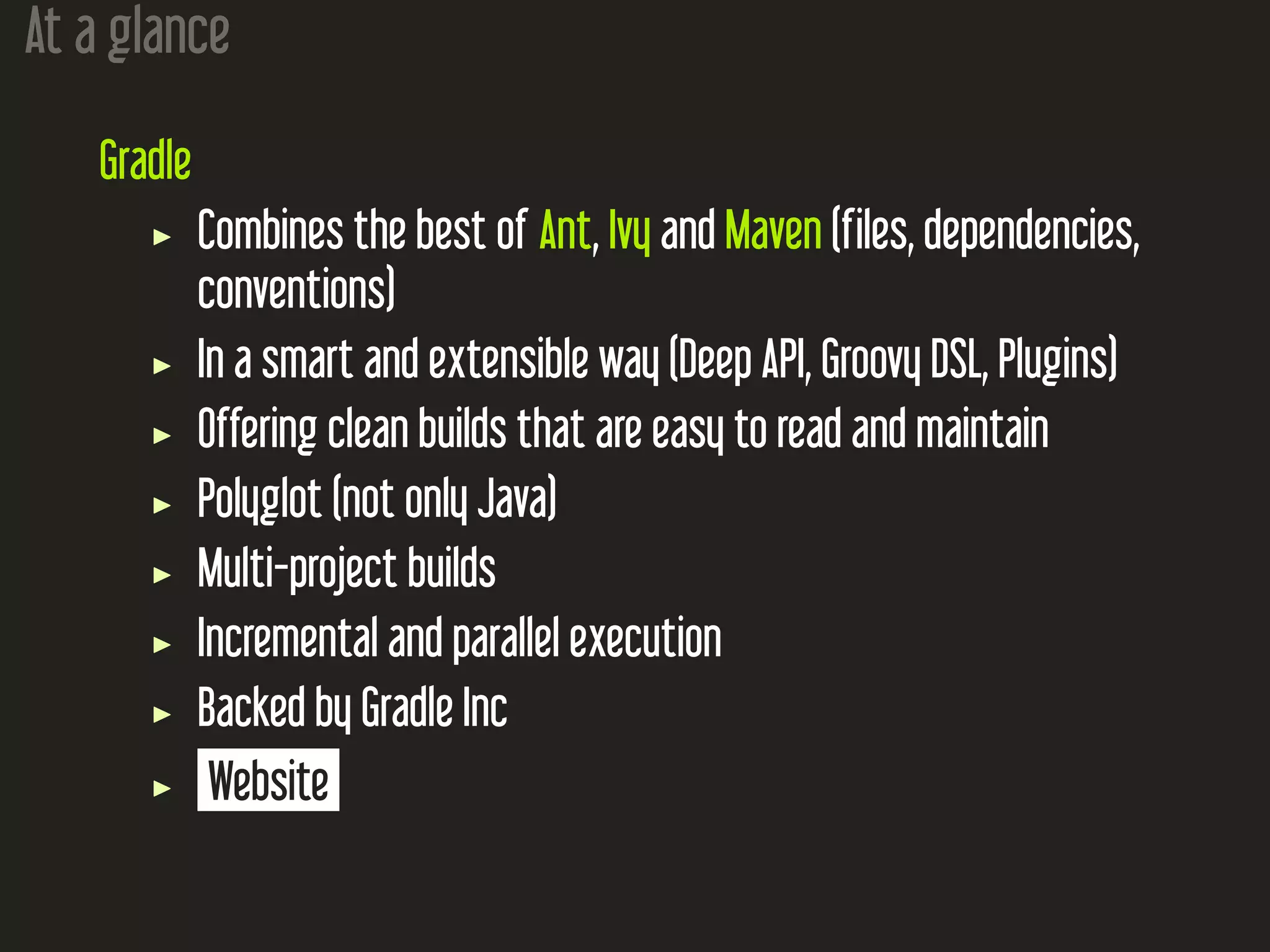
At a glance
Gradle
Combines the best of Ant, Ivy and Maven (files, dependencies,
conventions)
In a smart and extensible way (Deep API, Groovy DSL, Plugins)
Offering clean builds that are easy to read and maintain
Polyglot (not only Java)
Multi-project builds
Incremental and parallel execution
Backed by Gradle Inc
Website
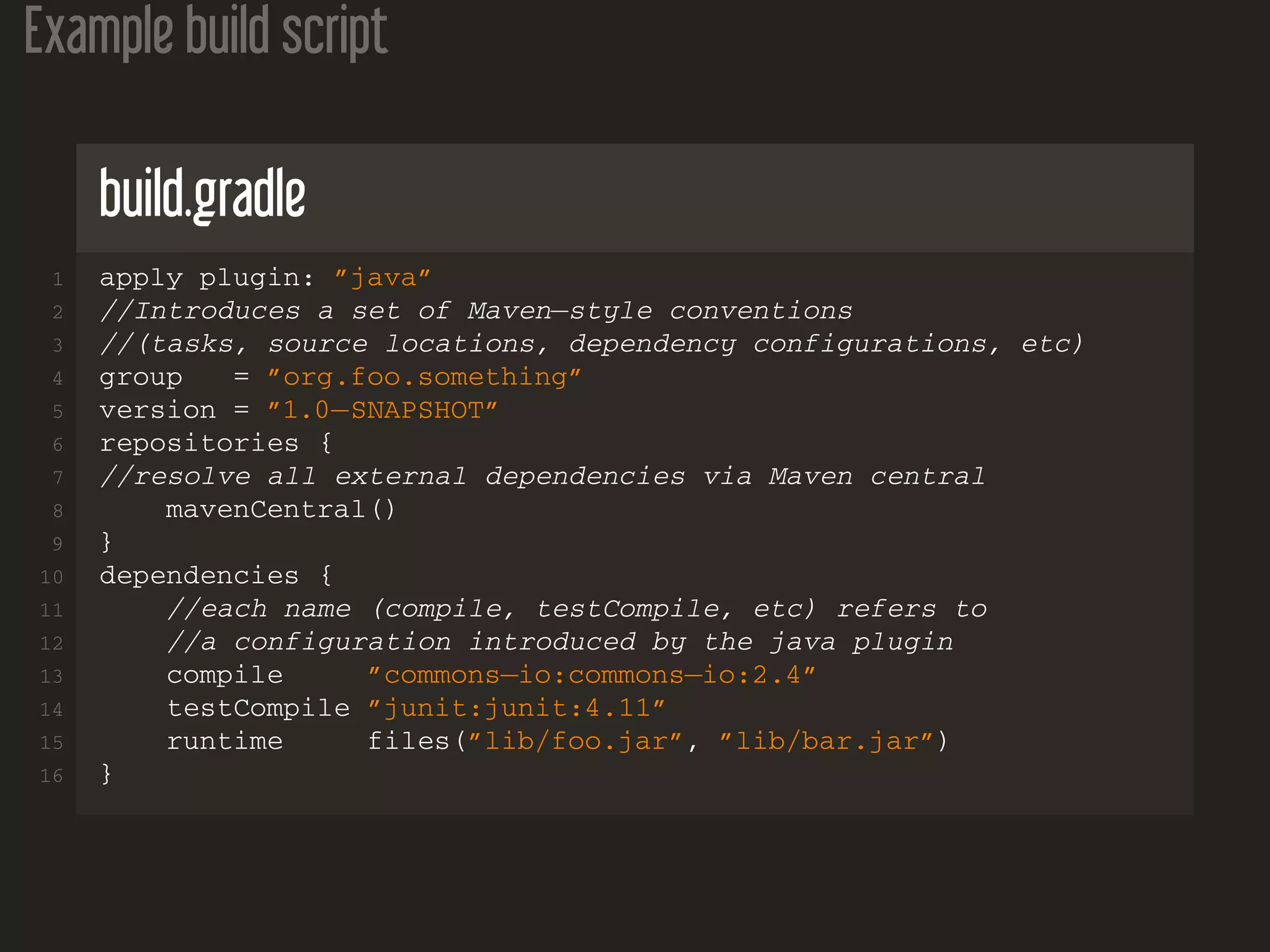
Example build script
build.gradle
1 apply plugin: ”java”
2 //Introduces a set of Maven−style conventions
3 //(tasks, source locations, dependency configurations, etc)
4 group = ”org.foo.something”
5 version = ”1.0−SNAPSHOT”
6 repositories {
7 //resolve all external dependencies via Maven central
8 mavenCentral()
9 }
10 dependencies {
11 //each name (compile, testCompile, etc) refers to
12 //a configuration introduced by the java plugin
13 compile ”commons−io:commons−io:2.4”
14 testCompile ”junit:junit:4.11”
15 runtime files(”lib/foo.jar”, ”lib/bar.jar”)
16 }
Spock
The enterprise-ready testing and specification framework
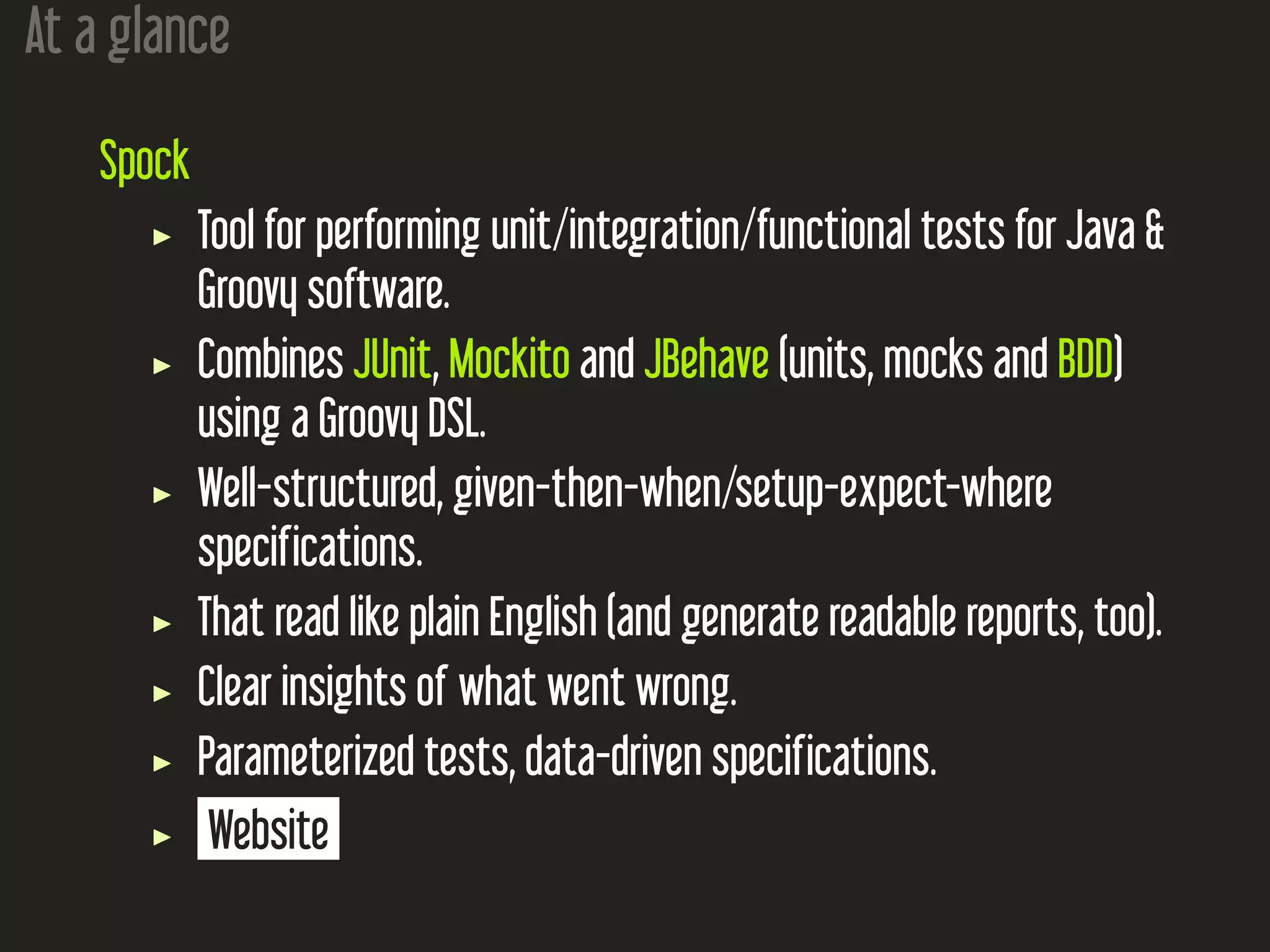
At a glance
Spock
Tool for performing unit/integration/functional tests for Java &
Groovy software.
Combines JUnit, Mockito and JBehave (units, mocks and BDD)
using a Groovy DSL.
Well-structured, given-then-when/setup-expect-where
specifications.
That read like plain English (and generate readable reports, too).
Clear insights of what went wrong.
Parameterized tests, data-driven specifications.
Website
Example spock spec
DataDrivenSpec
1 class DataDrivenSpec extends Specification {
2 def ”maximum of two numbers”() {
3 expect:
4 Math.max(a, b) == c
5 where:
6 a << [3, 5, 9]
7 b << [7, 4, 9]
8 c << [7, 5, 9]
9 }
10 def ”minimum of #a and #b is #c”() {
11 expect:
12 Math.min(a, b) == c
13 where:
14 a | b || c
15 3 | 7 || 3
16 5 | 4 || 4
17 9 | 9 || 9
18 }
19 }
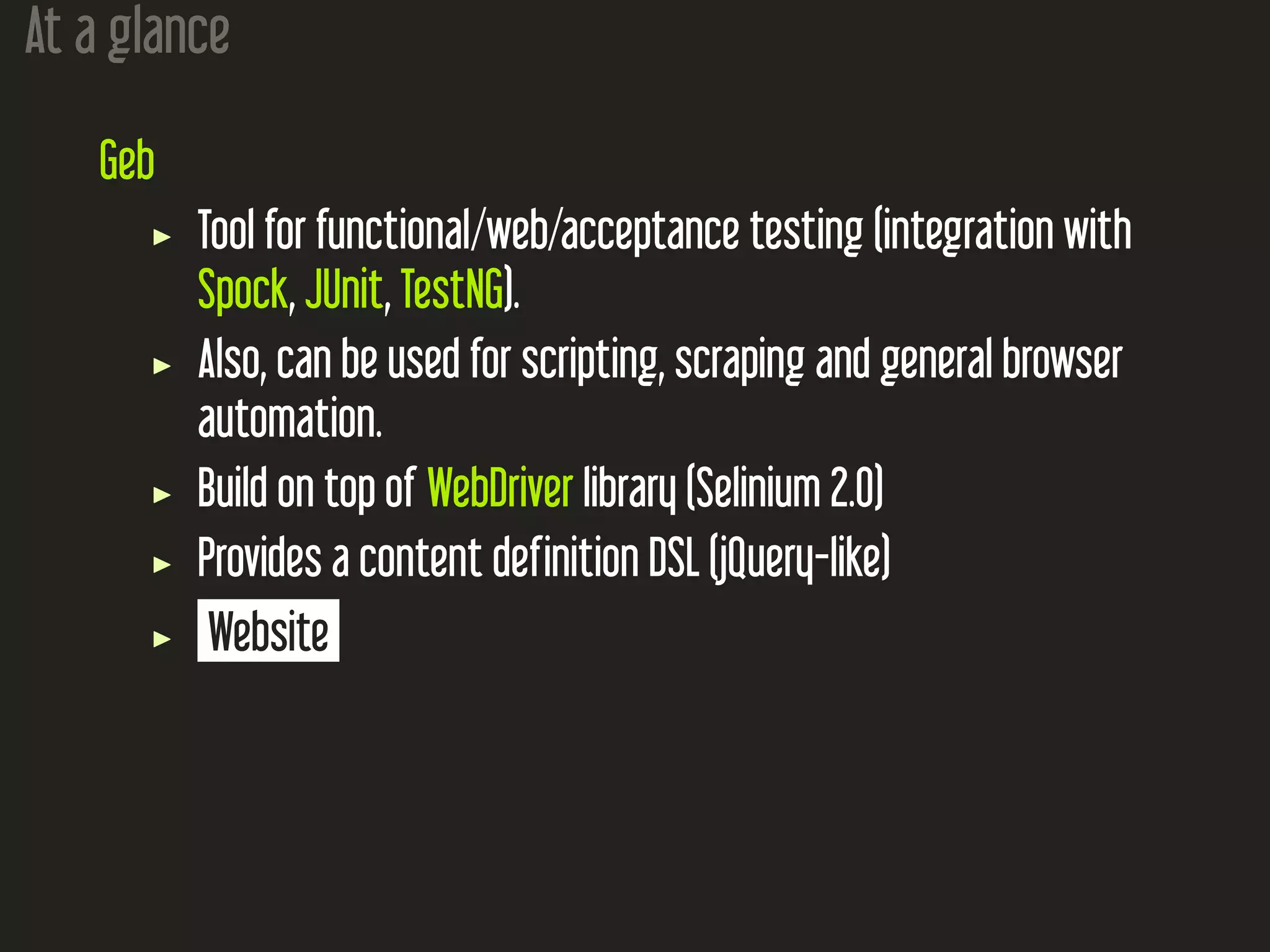
Geb
A browser automation tool
At a glance
Geb
Tool for functional/web/acceptance testing (integration with
Spock, JUnit, TestNG).
Also, can be used for scripting, scraping and general browser
automation.
Build on top of WebDriver library (Selinium 2.0)
Provides a content definition DSL (jQuery-like)
Website
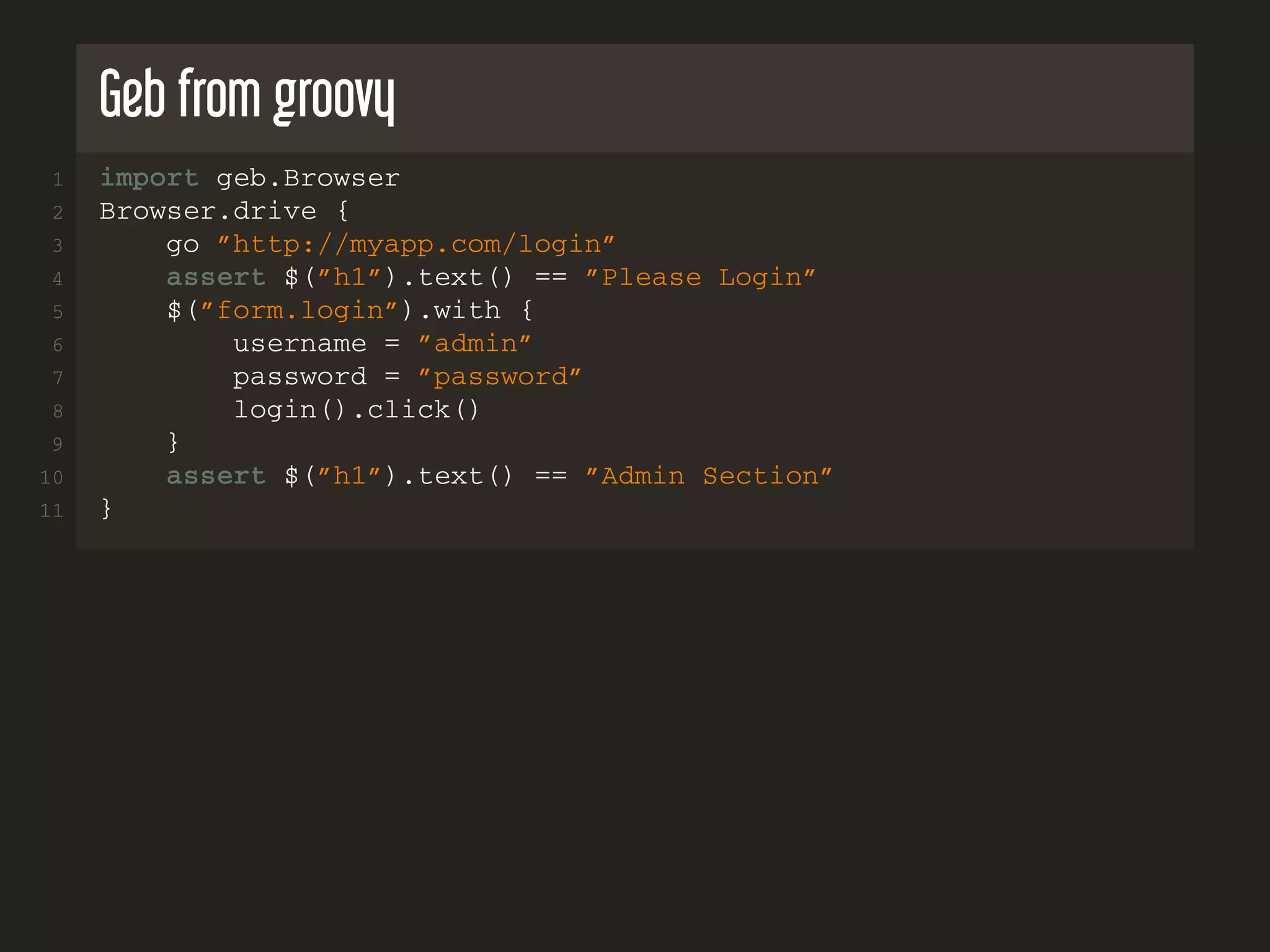
Geb from groovy
1 import geb.Browser
2 Browser.drive {
3 go ”http://myapp.com/login”
4 assert $(”h1”).text() == ”Please Login”
5 $(”form.login”).with {
6 username = ”admin”
7 password = ”password”
8 login().click()
9 }
10 assert $(”h1”).text() == ”Admin Section”
11 }
Betamax
Tool for mocking external HTTP resources in tests
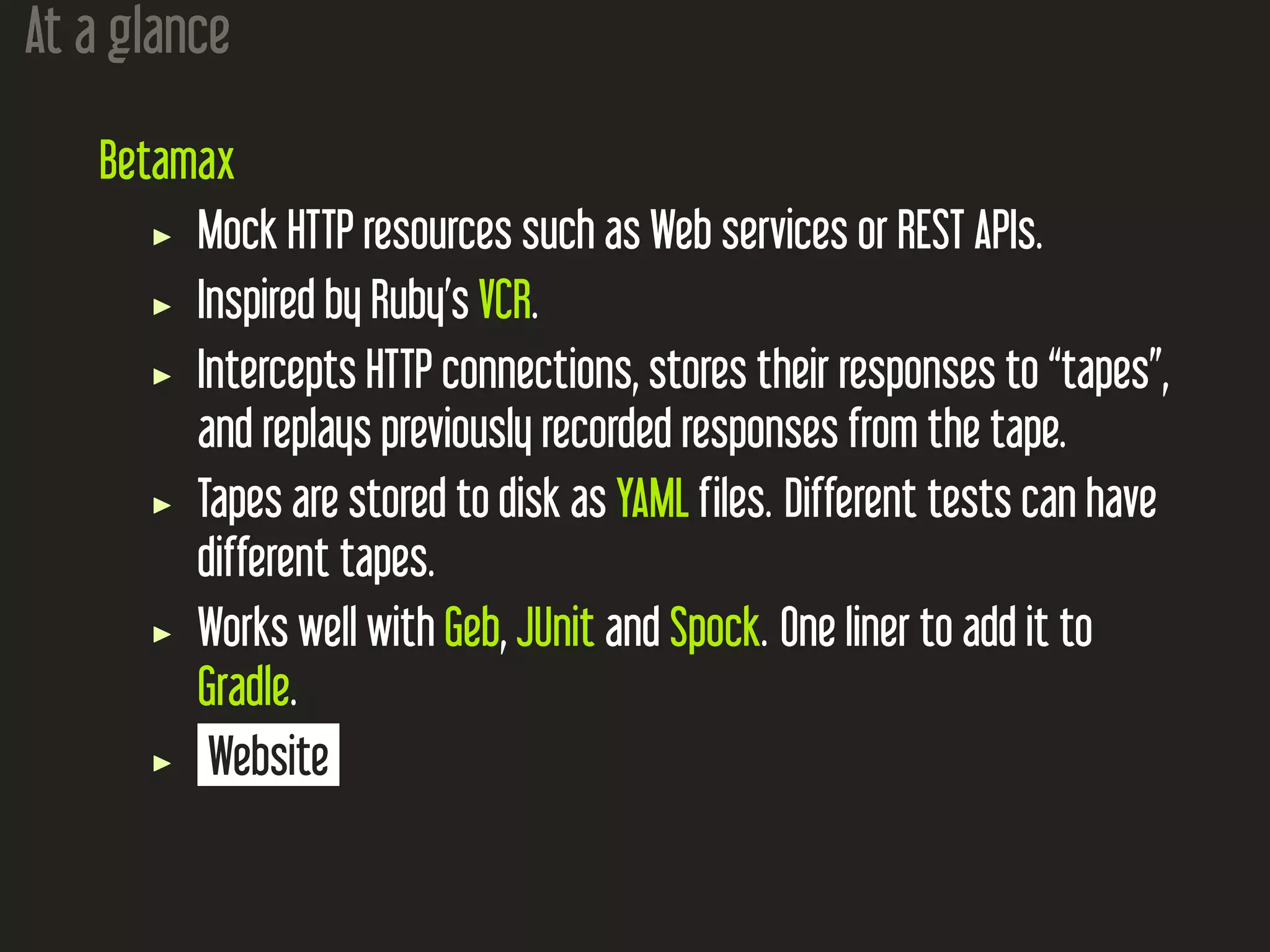
At a glance
Betamax
Mock HTTP resources such as Web services or REST APIs.
Inspired by Ruby’s VCR.
Intercepts HTTP connections, stores their responses to “tapes”,
and replays previously recorded responses from the tape.
Tapes are stored to disk as YAML files. Different tests can have
different tapes.
Works well with Geb, JUnit and Spock. One liner to add it to
Gradle.
Website
Example
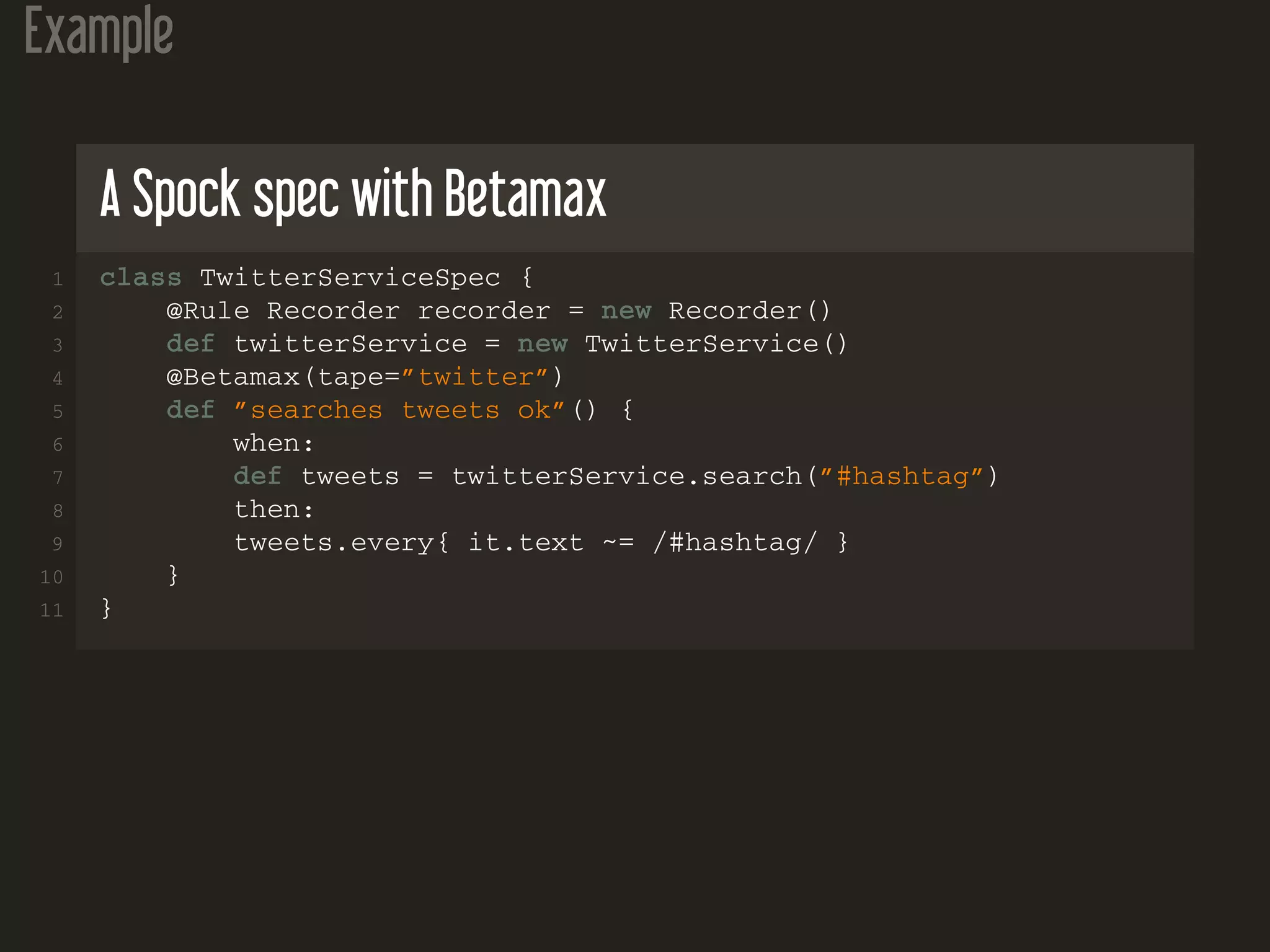
A Spock spec with Betamax
1 class TwitterServiceSpec {
2 @Rule Recorder recorder = new Recorder()
3 def twitterService = new TwitterService()
4 @Betamax(tape=”twitter”)
5 def ”searches tweets ok”() {
6 when:
7 def tweets = twitterService.search(”#hashtag”)
8 then:
9 tweets.every{ it.text ~= /#hashtag/ }
10 }
11 }
CodeNarc
A static code analysis tool for groovy
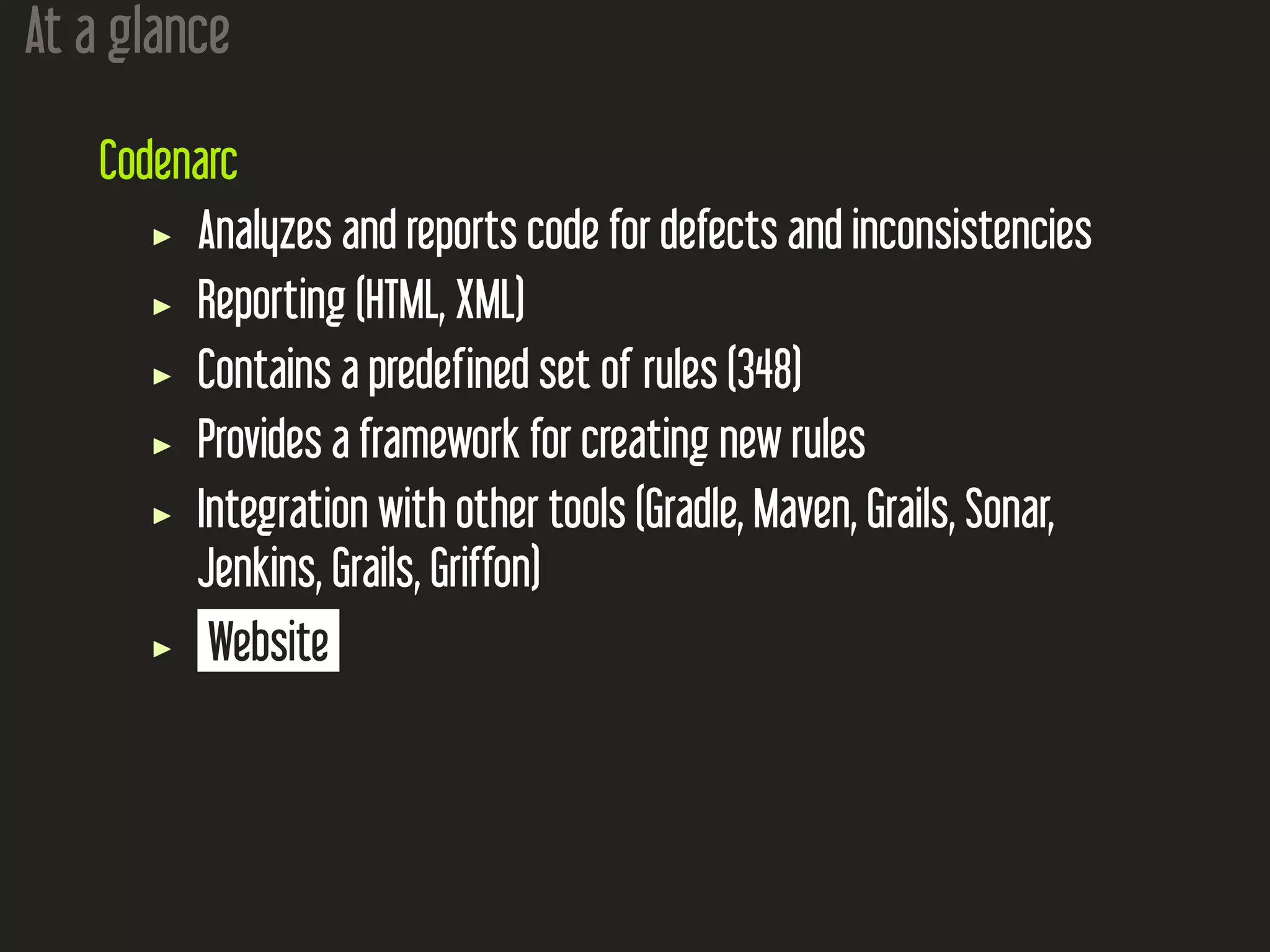
At a glance
Codenarc
Analyzes and reports code for defects and inconsistencies
Reporting (HTML, XML)
Contains a predefined set of rules (348)
Provides a framework for creating new rules
Integration with other tools (Gradle, Maven, Grails, Sonar,
Jenkins, Grails, Griffon)
Website
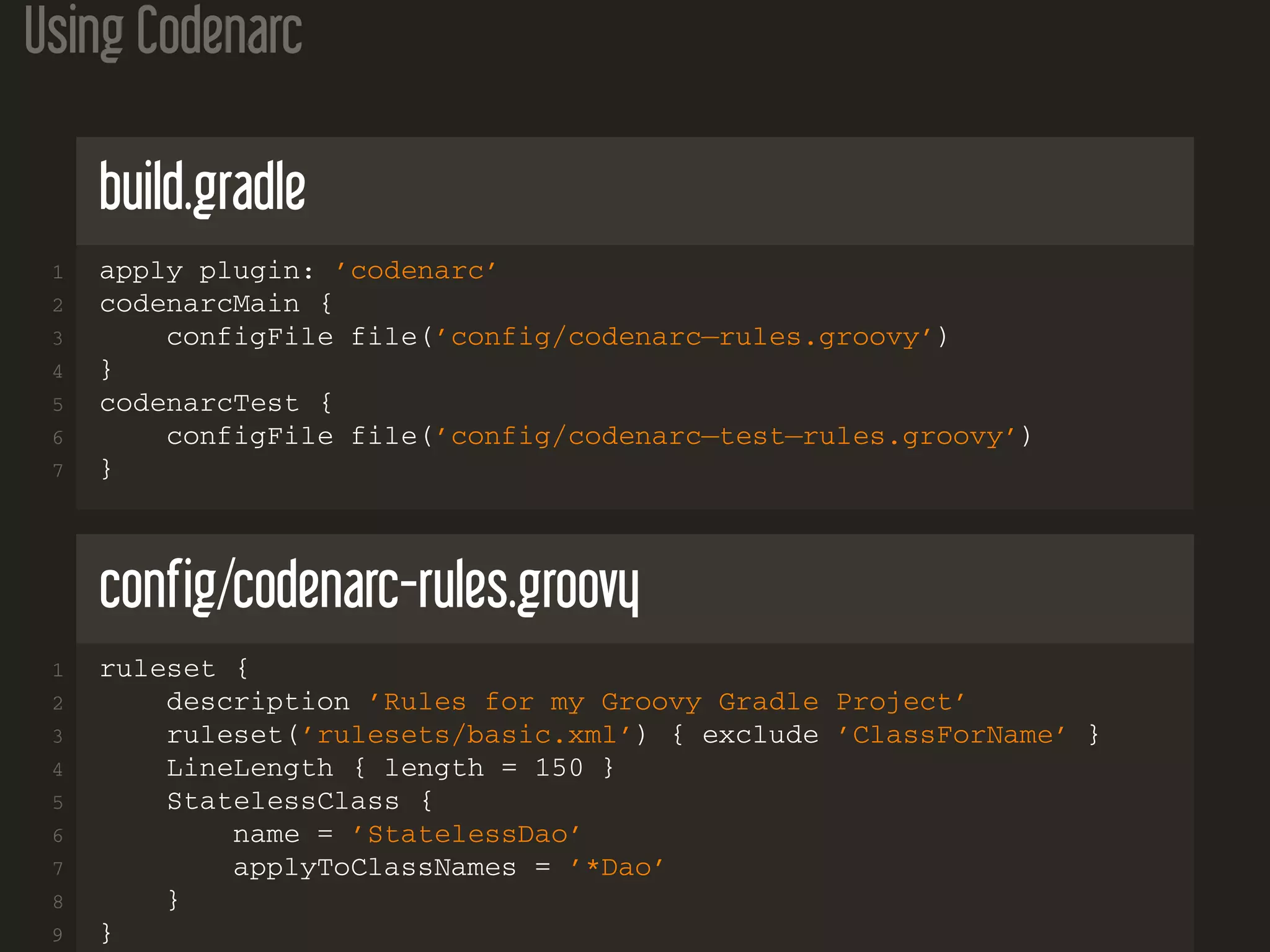
Using Codenarc
build.gradle
1 apply plugin: ’codenarc’
2 codenarcMain {
3 configFile file(’config/codenarc−rules.groovy’)
4 }
5 codenarcTest {
6 configFile file(’config/codenarc−test−rules.groovy’)
7 }
config/codenarc-rules.groovy
1 ruleset {
2 description ’Rules for my Groovy Gradle Project’
3 ruleset(’rulesets/basic.xml’) { exclude ’ClassForName’ }
4 LineLength { length = 150 }
5 StatelessClass {
6 name = ’StatelessDao’
7 applyToClassNames = ’*Dao’
8 }
9 }
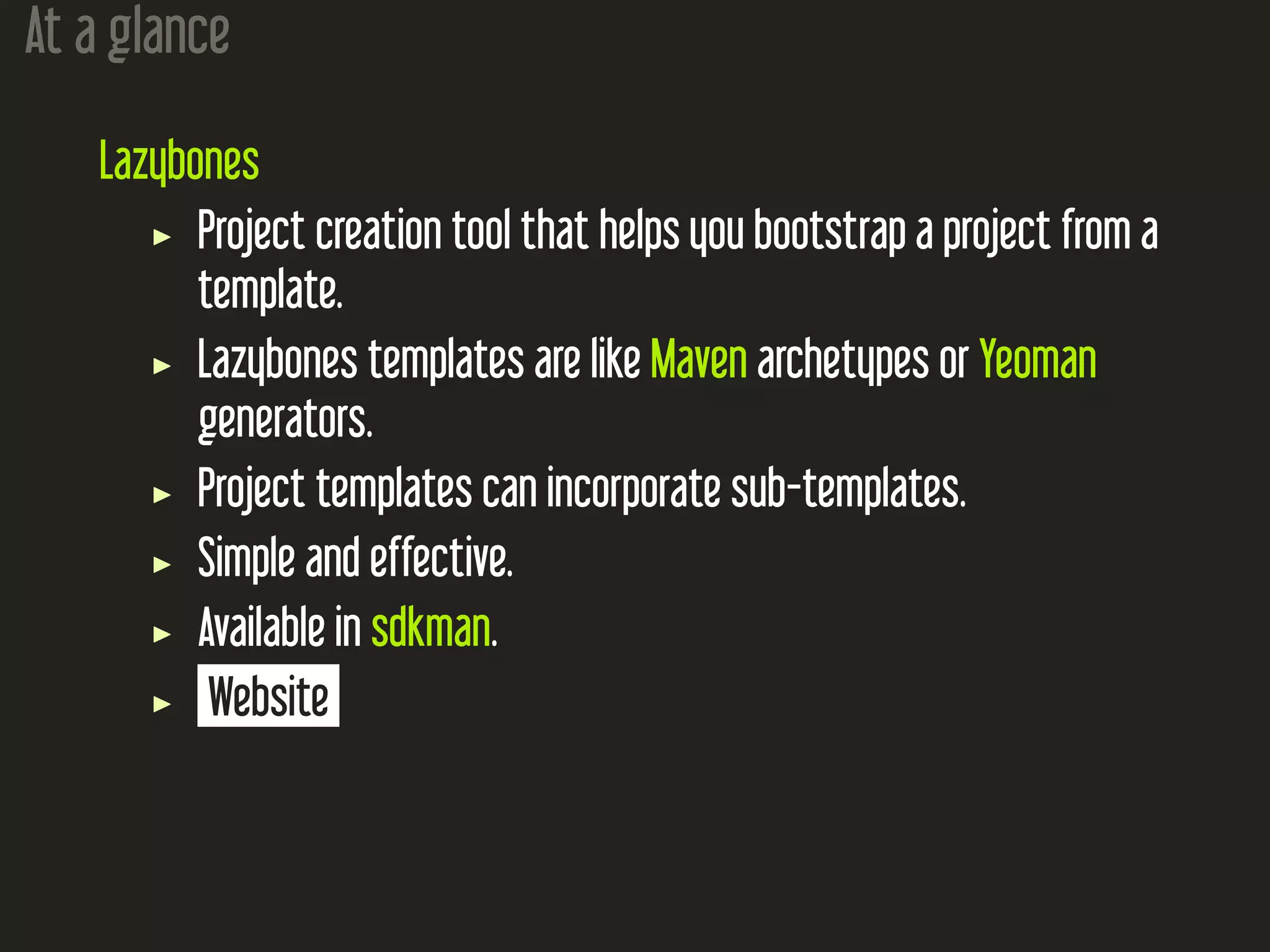
Lazybones
Project creation tool that uses packaged templates
At a glance
Lazybones
Project creation tool that helps you bootstrap a project from a
template.
Lazybones templates are like Maven archetypes or Yeoman
generators.
Project templates can incorporate sub-templates.
Simple and effective.
Available in sdkman.
Website
Example
Install Lazybones
sdk install lazybones
Use Lazybones to create a project
lazybones create <template name> [template version] <target
directory> [options]
lazybones create java−app my−app −Ppackage=org.foo.bar −−with
−git
lazybones generate controller

Web & Cloud
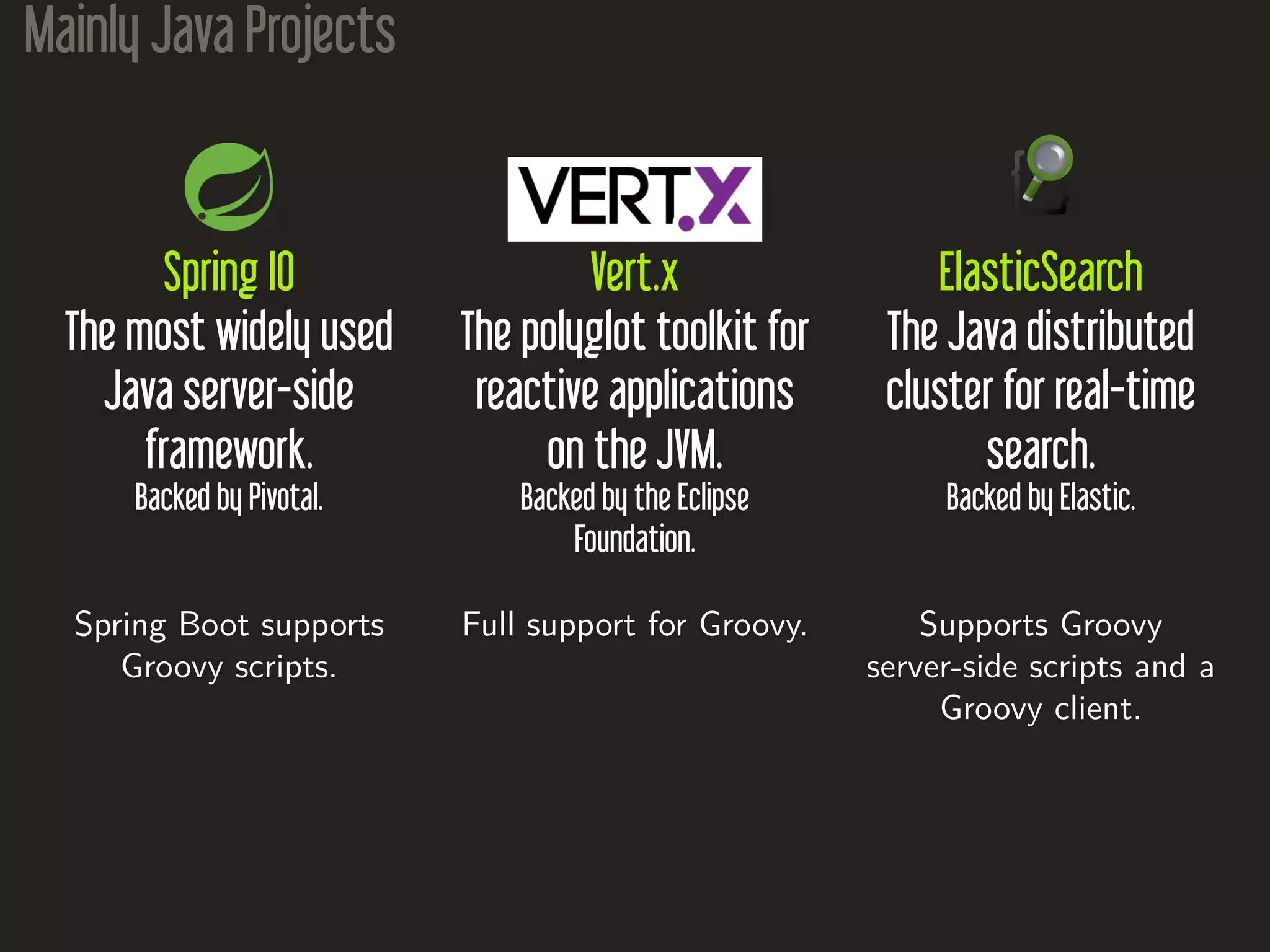
Mainly Java Projects
Spring IO
The most widely used
Java server-side
framework.
Backed by Pivotal.
Spring Boot supports
Groovy scripts.
Vert.x
The polyglot toolkit for
reactive applications
on the JVM.
Backed by the Eclipse
Foundation.
Full support for Groovy.
ElasticSearch
The Java distributed
cluster for real-time
search.
Backed by Elastic.
Supports Groovy
server-side scripts and a
Groovy client.
Grails
Powerful web application framework for the JVM
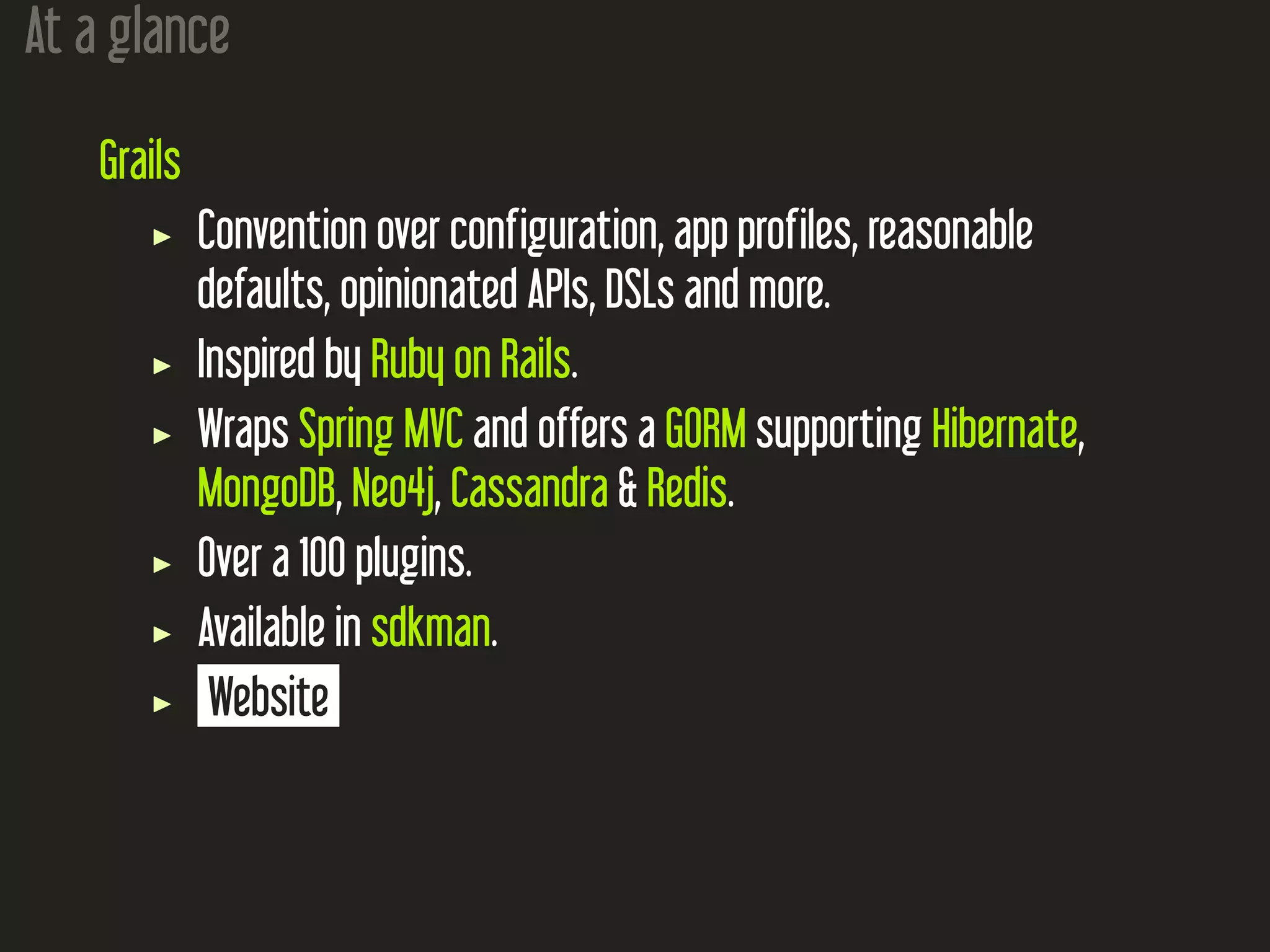
At a glance
Grails
Convention over configuration, app profiles, reasonable
defaults, opinionated APIs, DSLs and more.
Inspired by Ruby on Rails.
Wraps Spring MVC and offers a GORM supporting Hibernate,
MongoDB, Neo4j, Cassandra & Redis.
Over a 100 plugins.
Available in sdkman.
Website
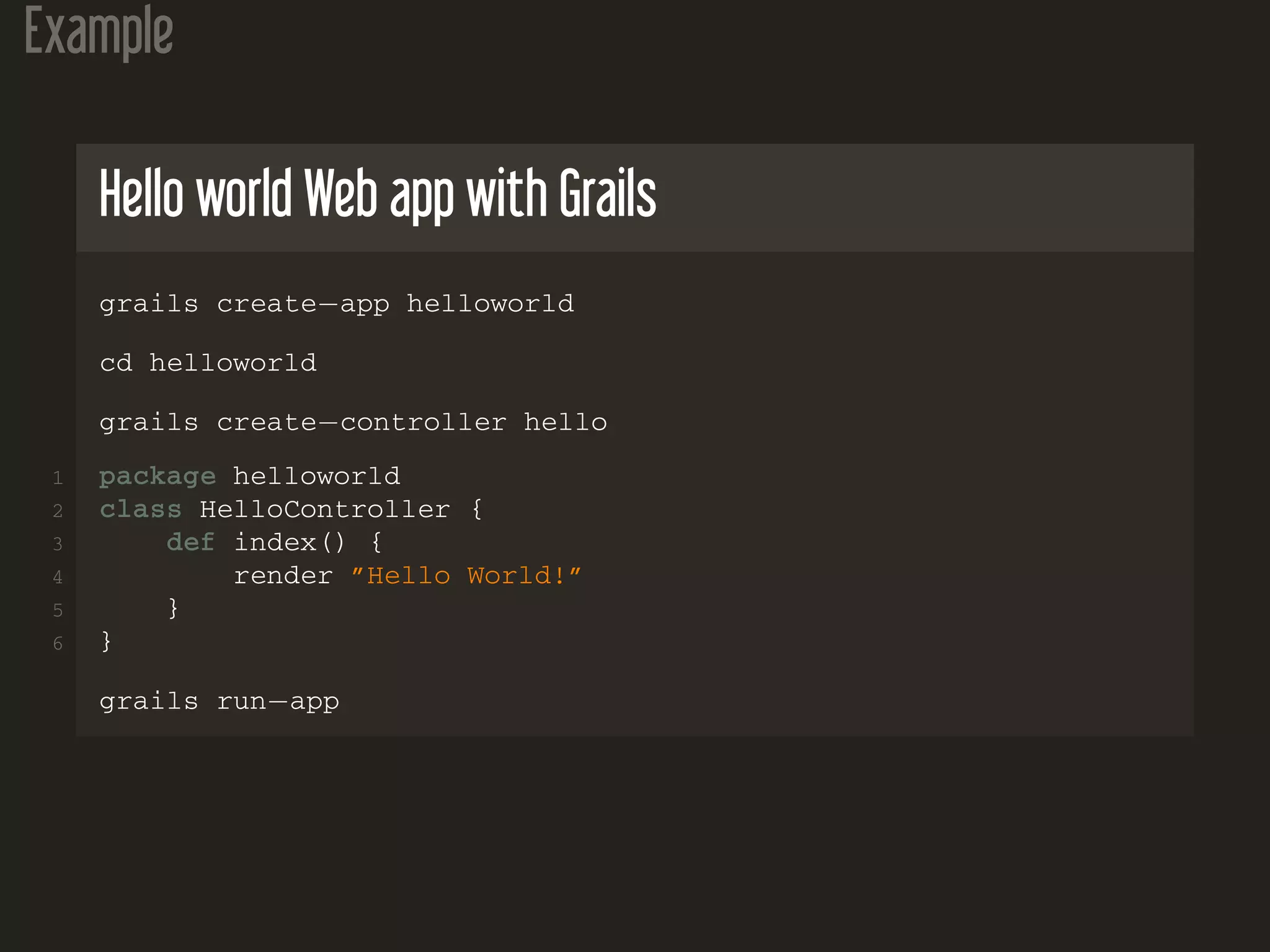
Example
Hello world Web app with Grails
grails create−app helloworld
cd helloworld
grails create−controller hello
1 package helloworld
2 class HelloController {
3 def index() {
4 render ”Hello World!”
5 }
6 }
grails run−app
Ratpack
Lean & powerful HTTP apps for the JVM
At a glance
Ratpack
A set of libraries that facilitate fast, efficient, scalable and
evolvable HTTP apps.
Flexible and unopinionated.
Inspired by Sinatra, built on Netty networking engine.
Asynchronous, non-blocking, event-driven architecture (like
node.js).
Offers lazybones templates.
Website
Example
Hello world Web app with Ratpack
1 @Grapes([
2 @Grab(’io.ratpack:ratpack−groovy:1.2.0’),
3 @Grab(’org.slf4j:slf4j−simple:1.7.12’)
4 ])
5 import static ratpack.groovy.Groovy.ratpack
6 ratpack {
7 handlers {
8 get {
9 render ”Hello World!”
10 }
11 get(”:name”) {
12 render ”Hello $pathTokens.name!”
13 }
14 }
15 }
Glide
A toolkit for Google App Engine
At a glance
Glide
Lets you develop and deploy applications to Google App Engine
Java
Best suited for small-medium complexity apps
Provides a simple Webb App Structure
Has almost zero configuration
Supports hot reloading
Uses Gaelyk
Available in sdkman
Website

Desktop & Mobile
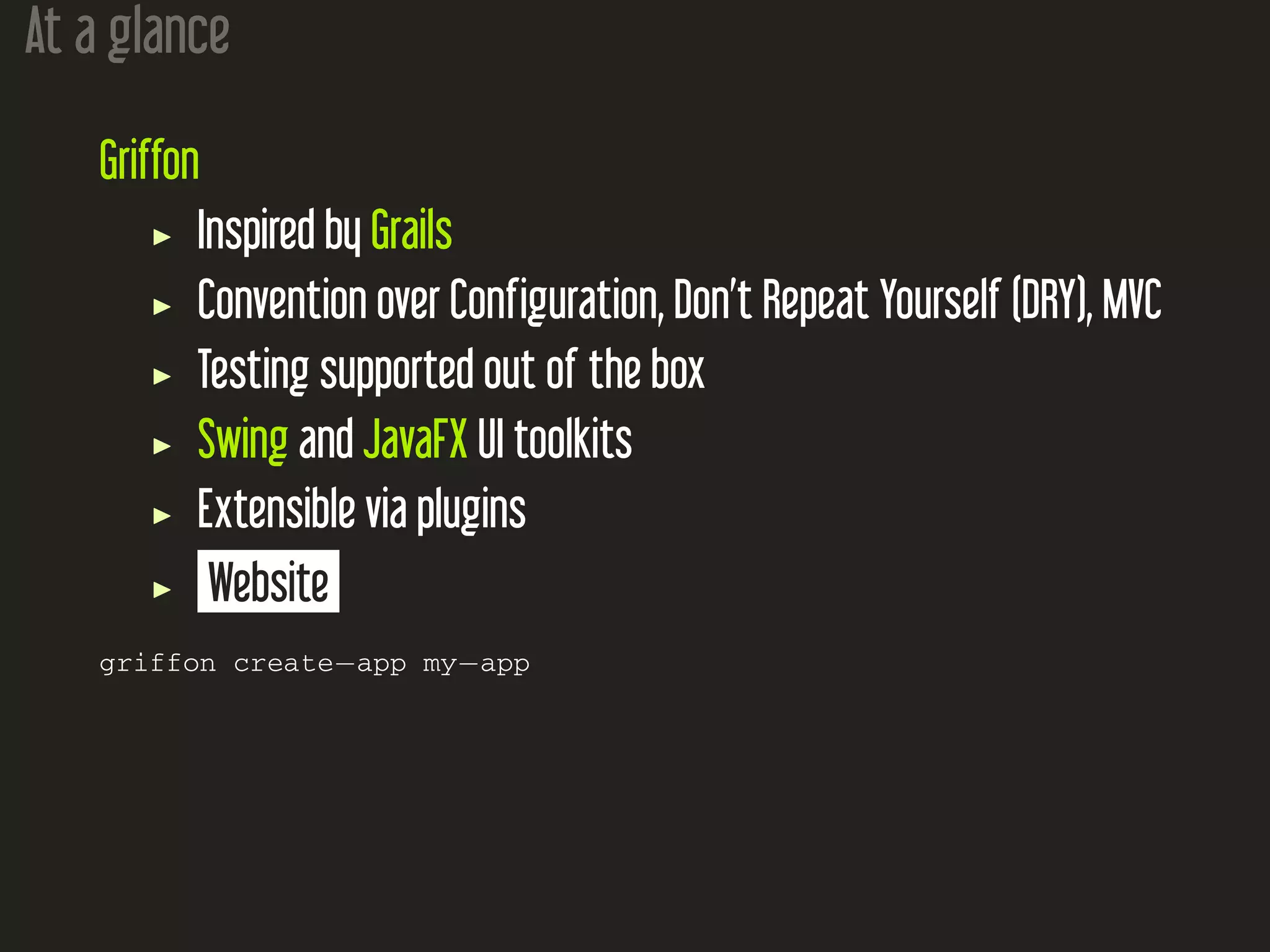
Griffon
A framework for developing desktop apps
At a glance
Griffon
Inspired by Grails
Convention over Configuration, Don’t Repeat Yourself (DRY), MVC
Testing supported out of the box
Swing and JavaFX UI toolkits
Extensible via plugins
Website
griffon create−app my−app
GroovyFX
Groovy bindings for JAVA FX 8
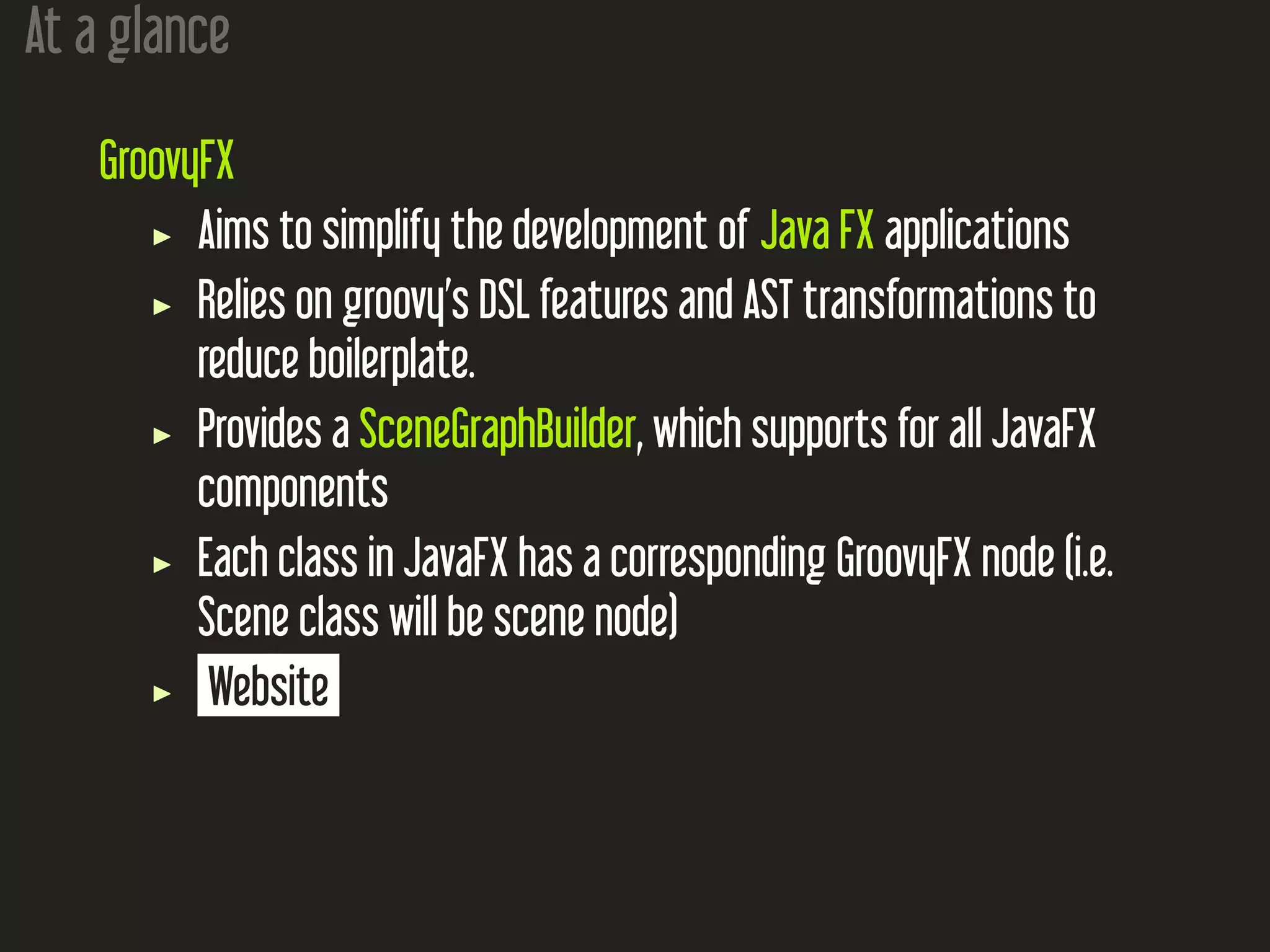
At a glance
GroovyFX
Aims to simplify the development of Java FX applications
Relies on groovy’s DSL features and AST transformations to
reduce boilerplate.
Provides a SceneGraphBuilder, which supports for all JavaFX
components
Each class in JavaFX has a corresponding GroovyFX node (i.e.
Scene class will be scene node)
Website
Example
Hello world GroovyFX
1 import static groovyx.javafx.GroovyFX.start
2 start {
3 stage(title: ’GroovyFX Hello World’, visible: true) {
4 scene(fill: BLACK, width: 500, height: 250) {
5 hbox(padding: 60) {
6 text(text: ’Groovy’, font: ’80pt sanserif’) {
7 fill linearGradient(endX: 0, stops: [PALEGREEN,
SEAGREEN])
8 }
9 text(text: ’FX’, font: ’80pt sanserif’) {
10 fill linearGradient(endX: 0, stops: [CYAN, DODGERBLUE
])
11 effect dropShadow(color: DODGERBLUE, radius: 25,
spread: 0.25)
12 }
13 }
14 }
15 }
16 }
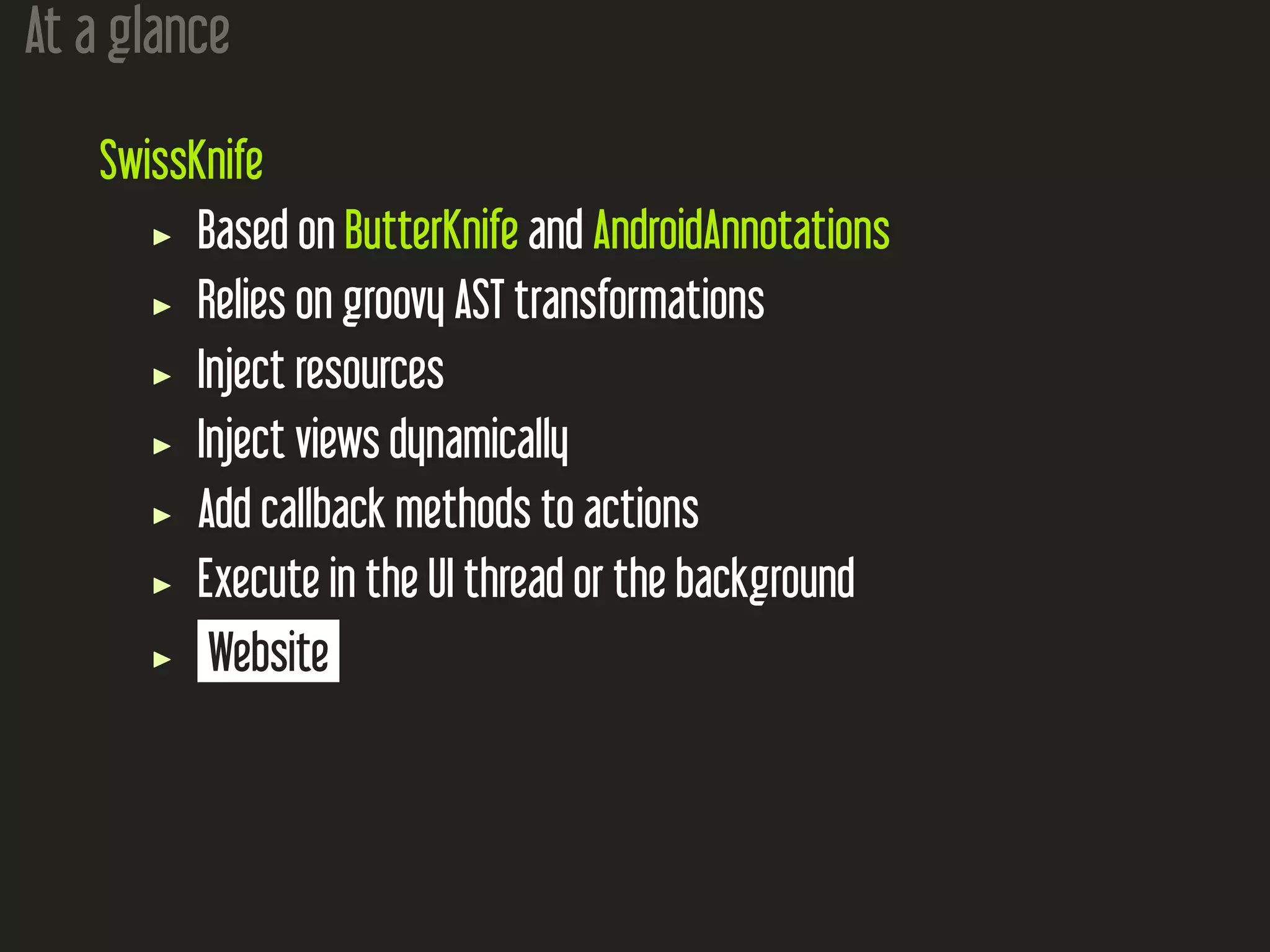
SwissKnife
Annotation Library for Android
At a glance
SwissKnife
Based on ButterKnife and AndroidAnnotations
Relies on groovy AST transformations
Inject resources
Inject views dynamically
Add callback methods to actions
Execute in the UI thread or the background
Website
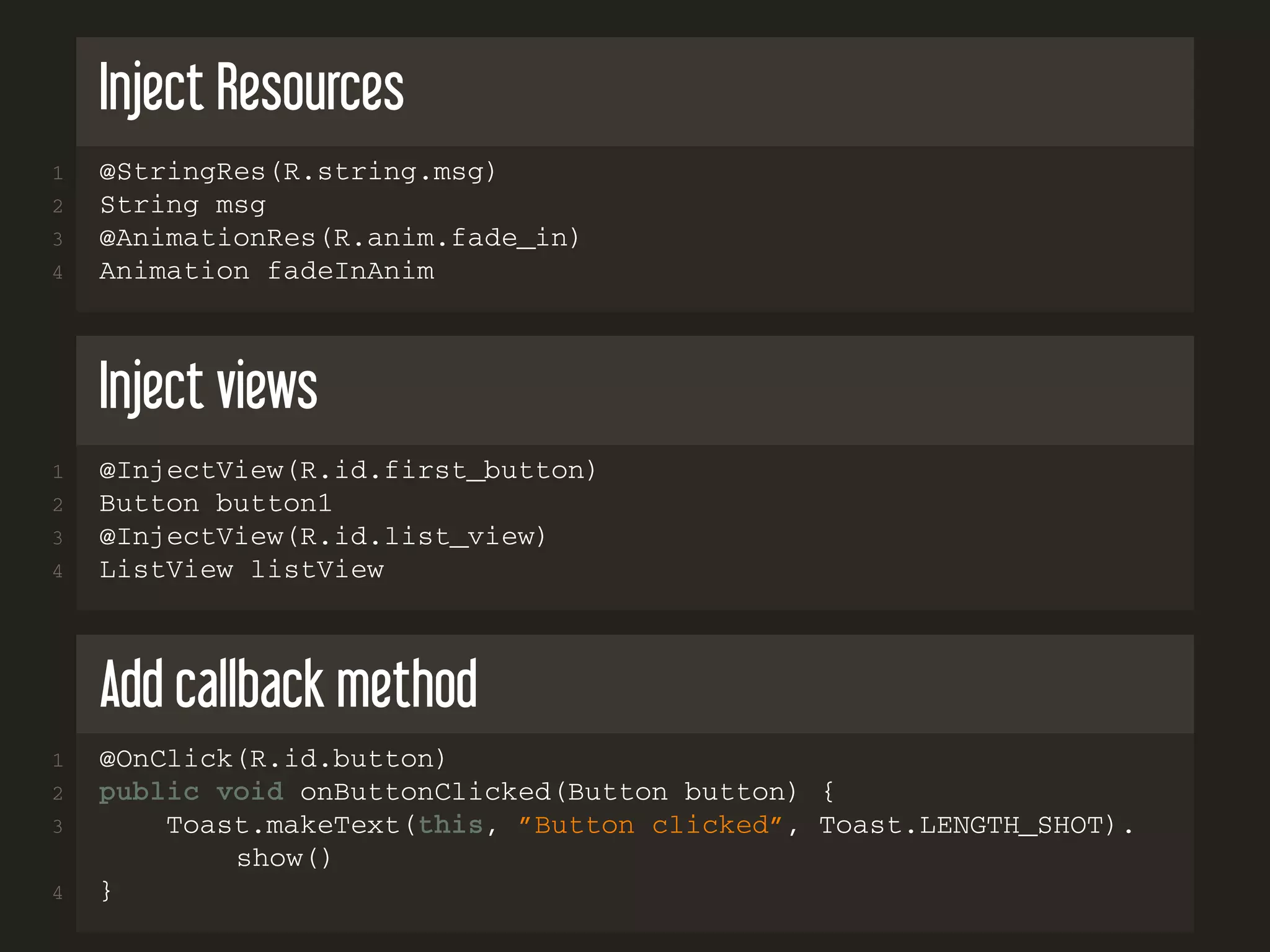
Inject Resources
1 @StringRes(R.string.msg)
2 String msg
3 @AnimationRes(R.anim.fade_in)
4 Animation fadeInAnim
Inject views
1 @InjectView(R.id.first_button)
2 Button button1
3 @InjectView(R.id.list_view)
4 ListView listView
Add callback method
1 @OnClick(R.id.button)
2 public void onButtonClicked(Button button) {
3 Toast.makeText(this, ”Button clicked”, Toast.LENGTH_SHOT).
show()
4 }

Documents & Pages
Grain
Static website generator
At a glance
Grain
Supports compression and minification for sources
Has built-in SASS/SCSS support
Supports Markdown, reStructuredText and AsciiDoctor
Each static resource is represented as a Groovy map.
Resources can be processed with groovy code
(SiteConfig.groovy)
Website
Example
Resource mapper closure:Executed upon change
1 resource_mapper = { resources −>
2 resources.collect { Map resource −>
3 if (resource.location =~//blog/.*/) {
4 // Select all the resources which
5 // contain files placed under /blog dir
6 // Rewrite url for blog posts
7 def unParsedDate = resource.date
8 def date = Date.parse(site.datetime_format, resource.date)
9 .format(’yyyy/MM/dd/’)
10 def title = resource.title.toLowerCase()
11 .replaceAll(”s+”,”−”)
12 resource + [url: ”/blog/$date$title/”]
13 } else {
14 resource
15 }
16 }
17 }
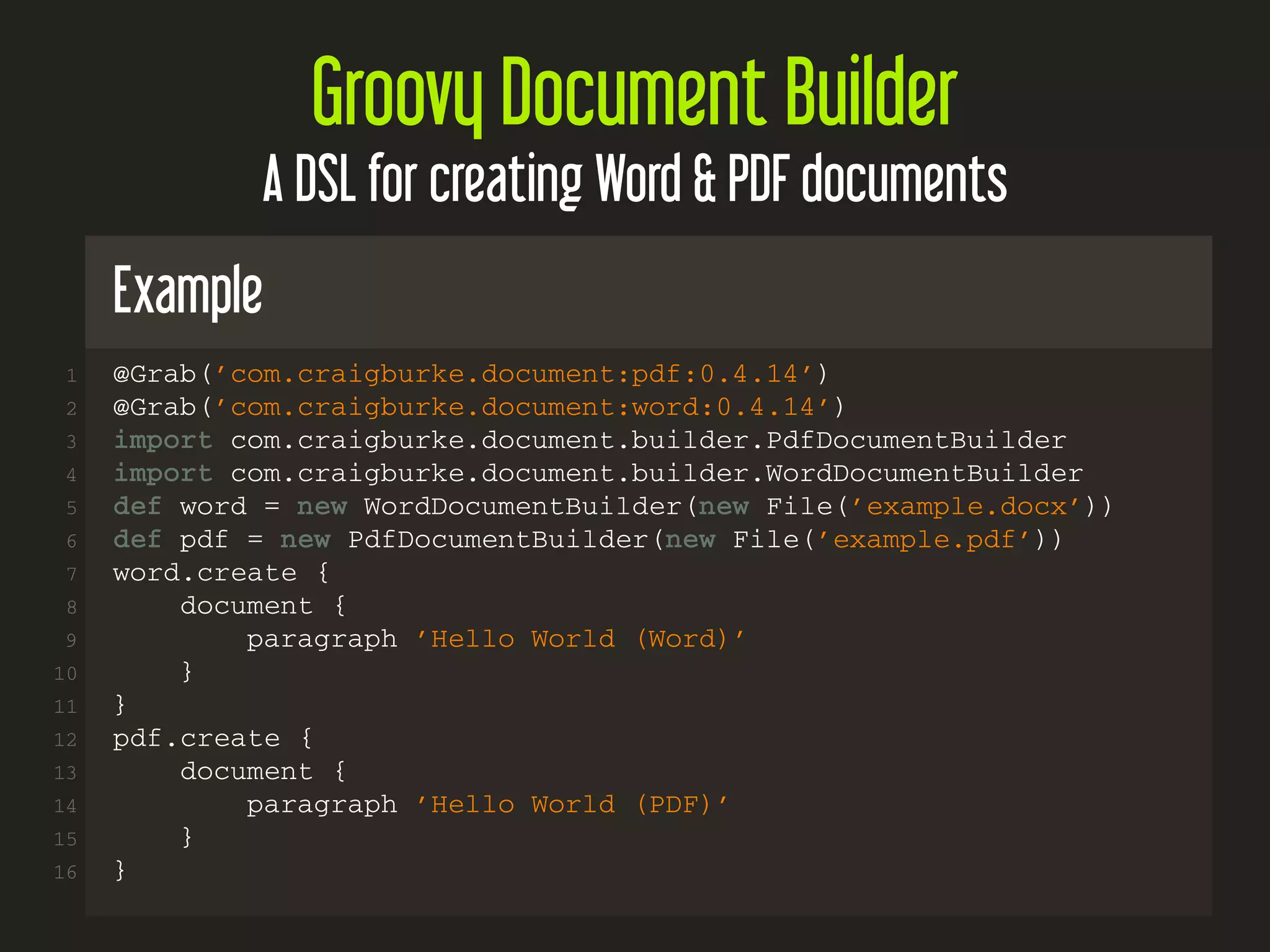
Groovy Document Builder
A DSL for creating Word & PDF documents
Example
1 @Grab(’com.craigburke.document:pdf:0.4.14’)
2 @Grab(’com.craigburke.document:word:0.4.14’)
3 import com.craigburke.document.builder.PdfDocumentBuilder
4 import com.craigburke.document.builder.WordDocumentBuilder
5 def word = new WordDocumentBuilder(new File(’example.docx’))
6 def pdf = new PdfDocumentBuilder(new File(’example.pdf’))
7 word.create {
8 document {
9 paragraph ’Hello World (Word)’
10 }
11 }
12 pdf.create {
13 document {
14 paragraph ’Hello World (PDF)’
15 }
16 }

Concurrency
RxGroovy
Groovy Reactive Extensions for the JVM
At a glance
RxGroovy
ReactivX: APIs for asynchronous programming with observable
streams (aka ReactiveExtensions –Rx).
RxGroovy is the Groovy adapter of RxJava.
ReactiveX is a combination of the best ideas from the Observer
pattern, the Iterator pattern, and functional programming.
Website
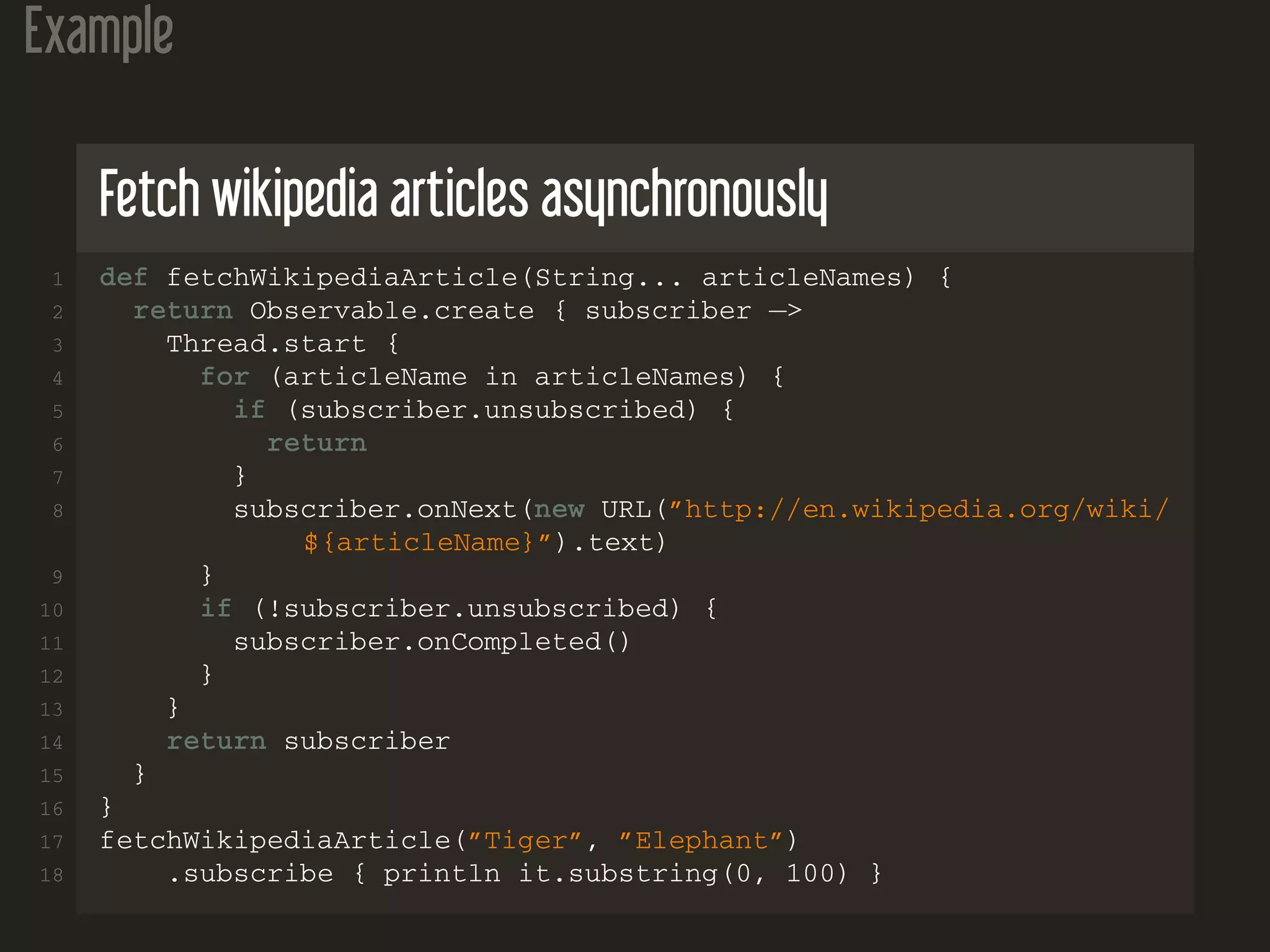
Example
Fetch wikipedia articles asynchronously
1 def fetchWikipediaArticle(String... articleNames) {
2 return Observable.create { subscriber −>
3 Thread.start {
4 for (articleName in articleNames) {
5 if (subscriber.unsubscribed) {
6 return
7 }
8 subscriber.onNext(new URL(”http://en.wikipedia.org/wiki/
${articleName}”).text)
9 }
10 if (!subscriber.unsubscribed) {
11 subscriber.onCompleted()
12 }
13 }
14 return subscriber
15 }
16 }
17 fetchWikipediaArticle(”Tiger”, ”Elephant”)
18 .subscribe { println it.substring(0, 100) }
GPars
Concurrency and parallelism framework for the JVM
At a glance
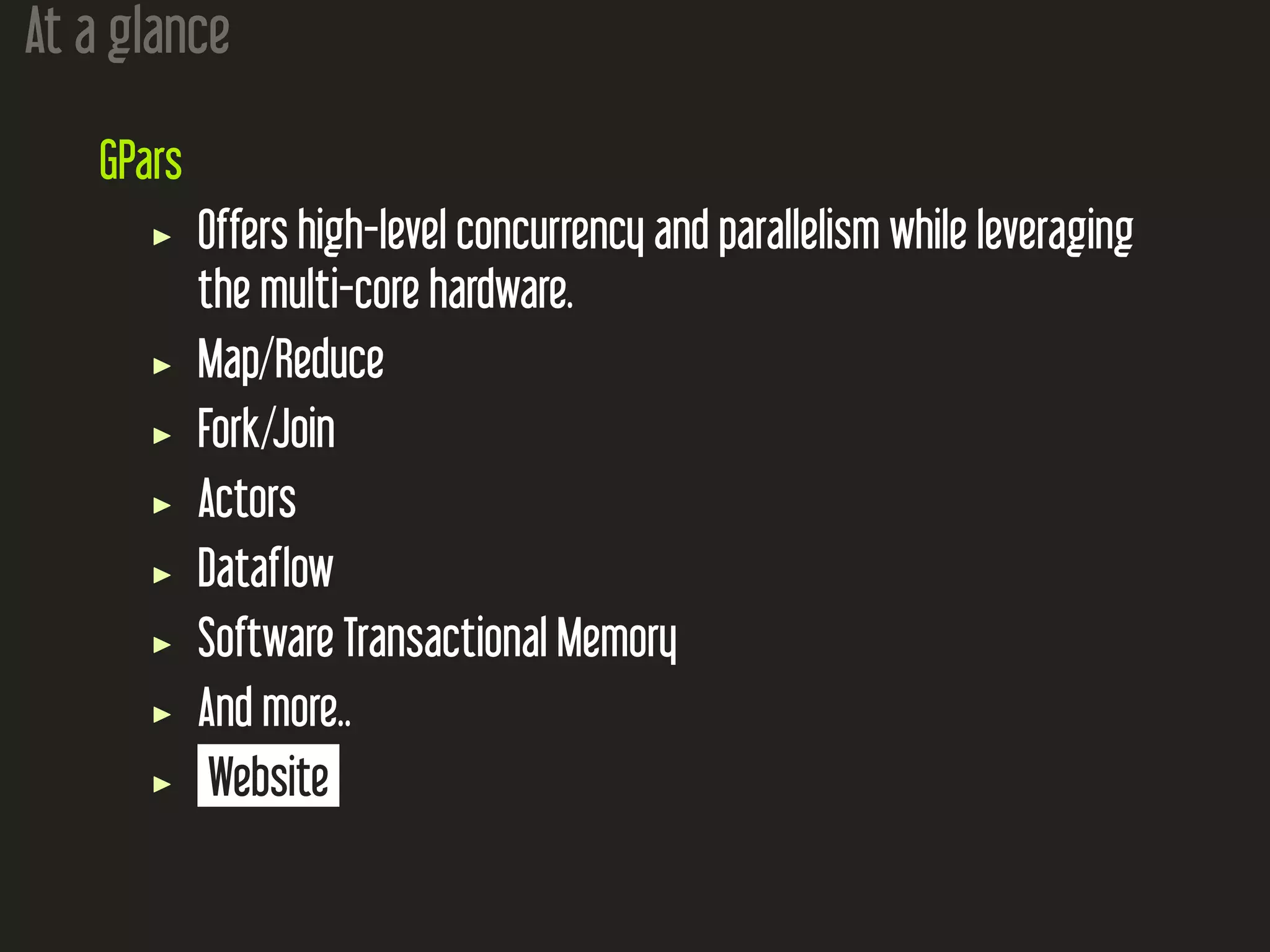
GPars
Offers high-level concurrency and parallelism while leveraging
the multi-core hardware.
Map/Reduce
Fork/Join
Actors
Dataflow
Software Transactional Memory
And more..
Website
Nextflow
A DSL for data-driven computational pipelines
At a glance
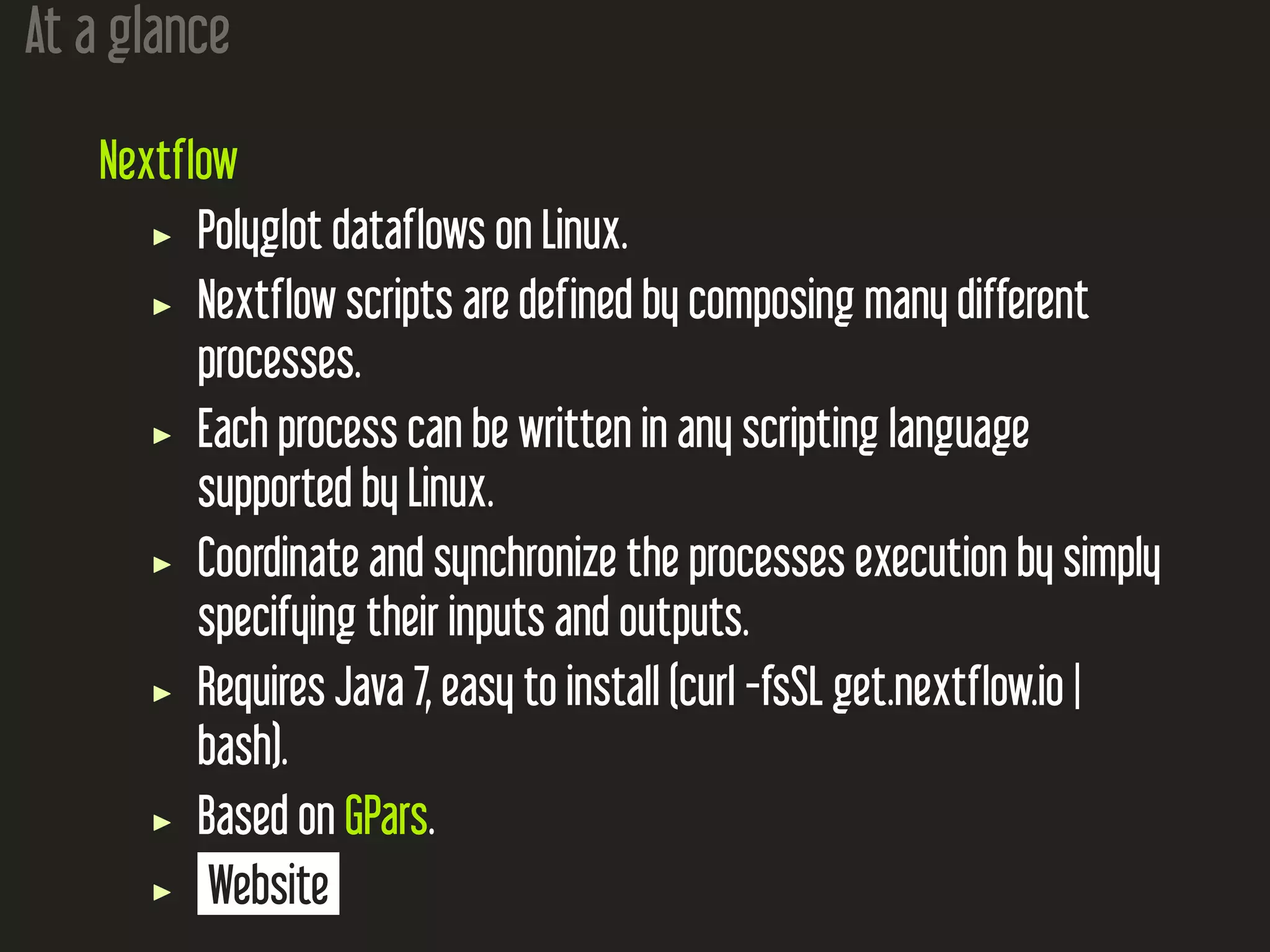
Nextflow
Polyglot dataflows on Linux.
Nextflow scripts are defined by composing many different
processes.
Each process can be written in any scripting language
supported by Linux.
Coordinate and synchronize the processes execution by simply
specifying their inputs and outputs.
Requires Java 7, easy to install (curl -fsSL get.nextflow.io |
bash).
Based on GPars.
Website
Example
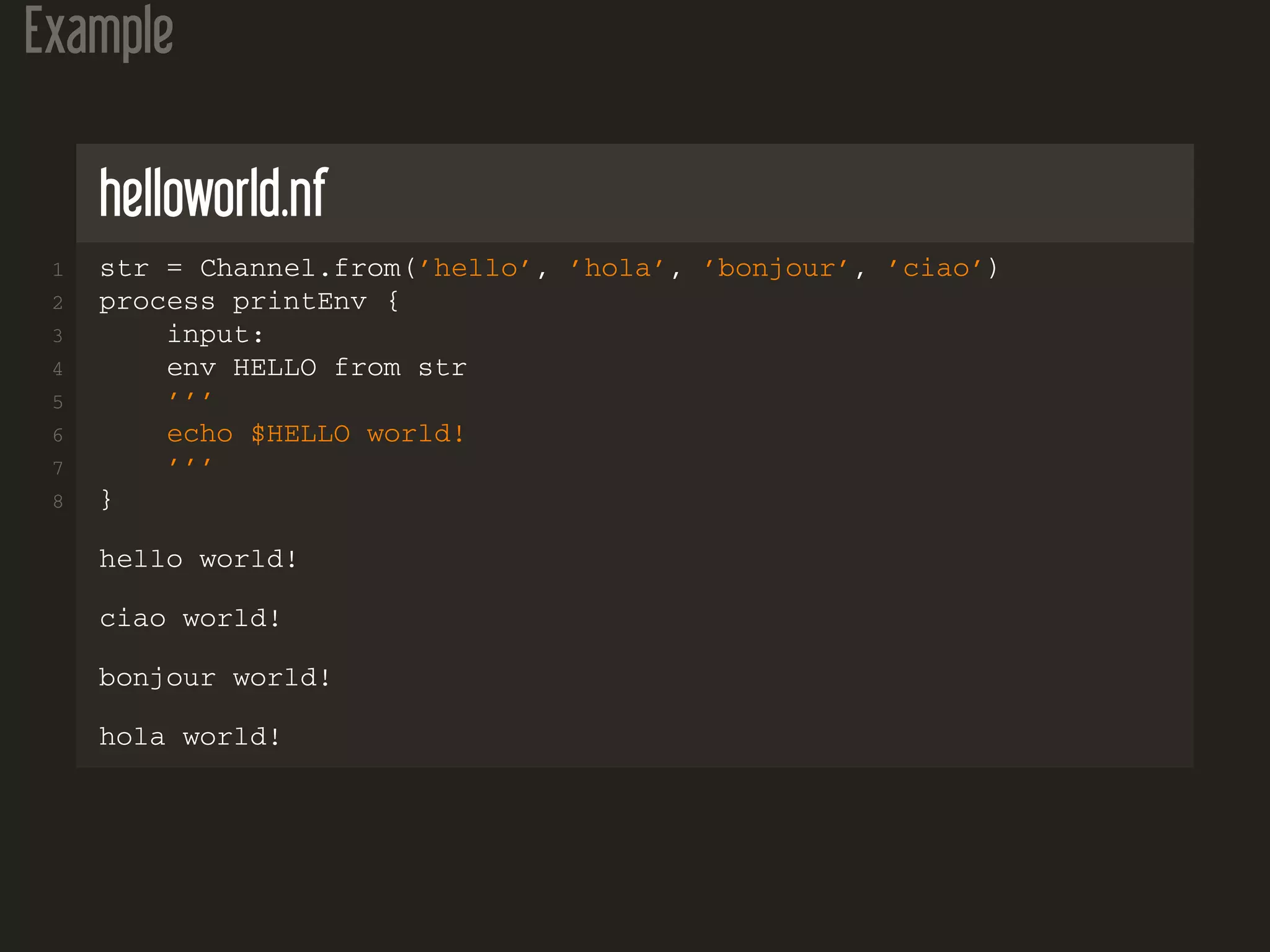
helloworld.nf
1 str = Channel.from(’hello’, ’hola’, ’bonjour’, ’ciao’)
2 process printEnv {
3 input:
4 env HELLO from str
5 ’’’
6 echo $HELLO world!
7 ’’’
8 }
hello world!
ciao world!
bonjour world!
hola world!

Other
Grooscript
Groovy to Javascript transpiler
Example
1 @Grab(’org.grooscript:grooscript:1.2.3’)
2 import org.grooscript.GrooScript
3 def groovy = ’’’
4 def sayHello = { println ”Hello ${it}!” }
5 sayHello(’Javascript’)
6 ’’’
7 println GrooScript.convert groovy
8 //the JS
9 var sayHello = function(it) {
10 return gs.println(”Hello ” + (it) + ”!”);
11 };
12 gs.execCall(sayHello, this, [”Javascript”]);
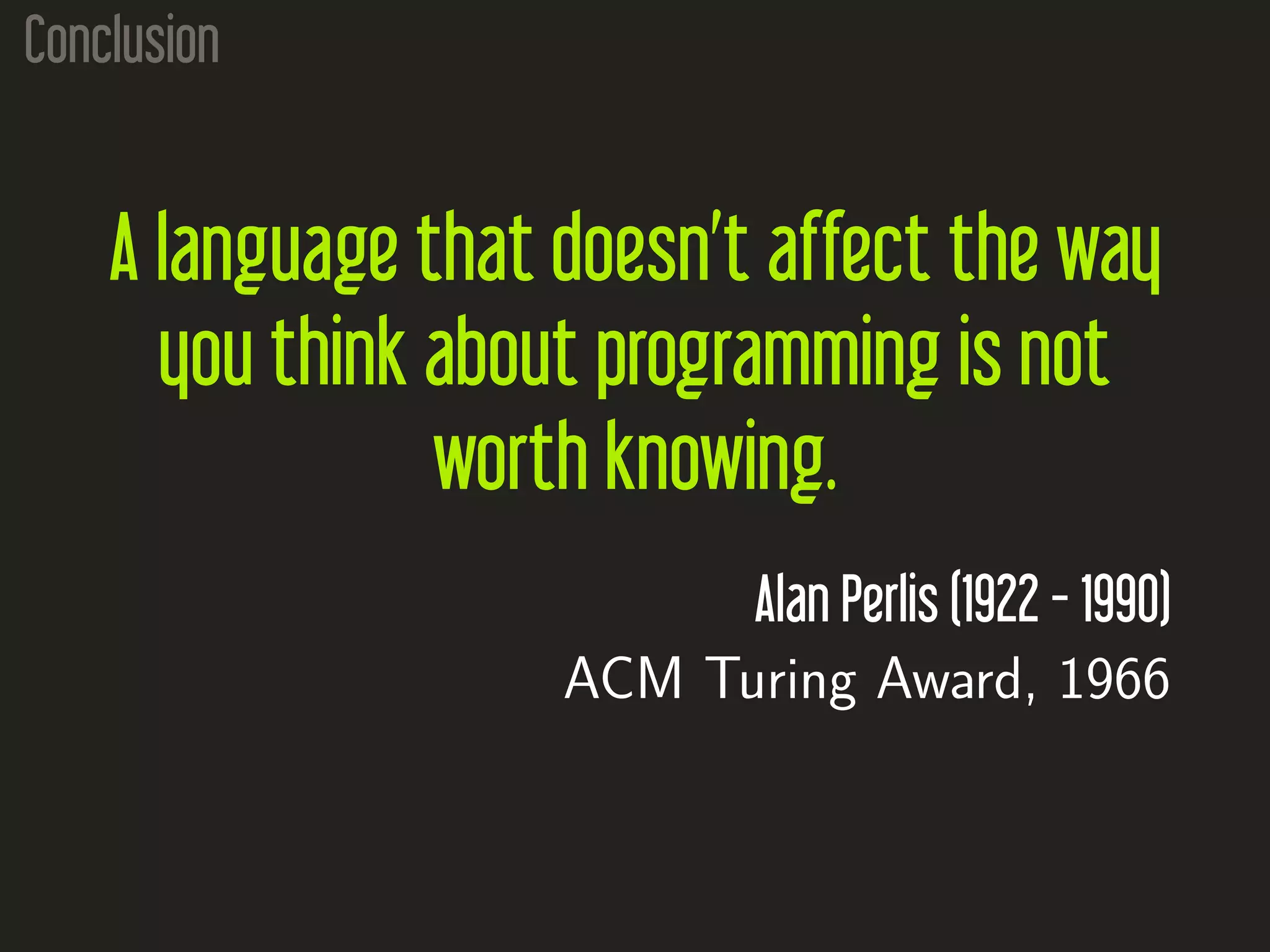
Conclusion
A language that doesn’t affect the way
you think about programming is not
worth knowing.
Alan Perlis (1922 - 1990)
ACM Turing Award, 1966
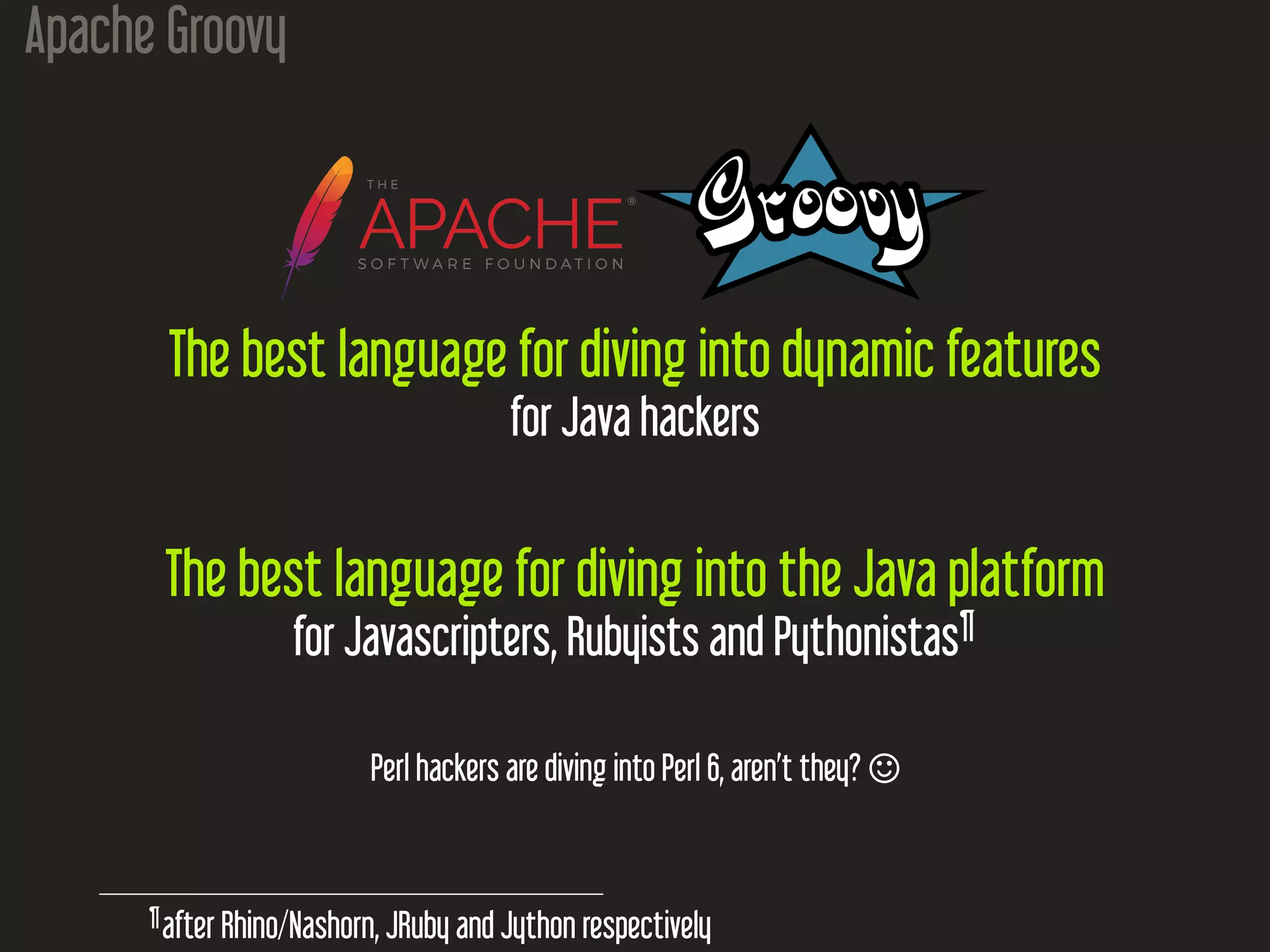
Apache Groovy
The best language for diving into dynamic features
for Java hackers
The best language for diving into the Java platform
for Javascripters, Rubyists and Pythonistas¶
Perl hackers are diving into Perl 6, aren’t they? 
¶
after Rhino/Nashorn, JRuby and Jython respectively
Thank you
@niovity
Proudly powered by
LATEX
Using the Beamer class &
the Wronki theme (slightly modified).

Apache Groovy: the language and the ecosystem

  • 1.
    Apache Groovy: the languageand its ecosystem Kostas Saidis, Agapios Avramidis www.niovity.com 9th FOSSCOMM Free and Open Source Software Communities Meeting April 16, 2016
  • 2.
    Outline Apache Groovy Top 10 reasons touse it The Ecosystem       
  • 3.
    Niovity We are asoftware company using a Java/Groovy/Javascript stack
  • 4.
    Niovity Butterfly We offera web-based repository platform for end-to-end data management Our clients include Academic Libraries, Public Benefit Foundations, Research Institutes and Private Companies
  • 5.
  • 6.
    Target audience FOSS hackers that the Java Platform and have a little experience with dynamic languages* * like Javascript, Ruby, Python or Perl
  • 7.
    Target audience FOSS hackers that dynamic languages and have a little experience with the Java Platform
  • 8.
    The Java what? TheJava Platform 1. The Java language 2. The Java development kit (JDK) 3. The Java virtual machine (JVM) The JVM is the key component!
  • 9.
    The JVM goesPolyglot The Java Virtual Machine A rock-solid, enterprise-grade runtime environment that can execute multiple languages (not only Java). Groovy, Javascript, Ruby, Python, Scala, Clojure, Kotlin, Fantom and many others...
  • 10.
    Most of theadditional JVM languages are dynamic ones! Dynamic Languages Execute many common programming behaviors at runtime –in contrast to static languages that perform them during compilation. Dynamic type checking. Dynamic method dispatch† . Support meta-programming (compiled constructs can be modified programmatically at runtime). † made faster with the invokedynamic bytecode instruction introduced in Java 7.
  • 11.
  • 12.
    Groovy  The best ofboth worlds in the JVM
  • 13.
    Part I Meet ApacheGroovy A feature-rich, Java-friendly, dynamic language for the Java Platform
  • 14.
    Groovy Tools groovy-lang.org 1. groovyc:Compliles groovy sources to JVM bytecode (class files). 2. groovysh: Executes code interactively (REPL). 3. groovyConsole: GUI app for interactive code execution. 4. groovy: Executes groovy scripts (you can use it like bash, perl, python, etc). 5. groovydoc: Generates documentation (like javadoc). 6. Grape: An embedded jar dependency manager. @groovylang #groovylang
  • 15.
    The best placeto start Start from the Groovy console (GUI app) Or the Groovy Web Console
  • 16.
    Why Groovy  Top 10+ 1 reasons to use Groovy
  • 17.
    Why Groovy #1 Groovyfeels like a superset of Java with a simpler syntax Designed as a companion language for Java: Groovy is syntactically aligned with Java. Augments Java with additional features. Literals for lists, maps, ranges, regular expressions, string interpolation with GStrings. GDK libraries extend JDK libraries in so many helpful ways. Supported by all major Java IDEs (Eclipse, IntelliJ, Netbeans).
  • 18.
    Groovy is Javaon Steroids! Groovy powerful switch statement 1 switch(val) { 2 case ”String”: //a string 3 break 4 case 10..100: //a range 5 break 6 case Date: //a date instance 7 break 8 case ~/gw+/: //a reg−ex 9 break 10 case [’A’, ’B’]: //a list 11 break 12 case { it instanceOf Number && it > Integer.MAX_VALUE } 13 //a closure 14 break 15 default: 16 //the default, treated as an ”else” in Groovy. 17 }
  • 19.
    New methods introducedin Java libraries List files recursively groovy −e ”new File(’.’).eachFileRecurse { println it }” The method eachFileRecurse has been added to the java.io.File class. Also an example of executing code given directly as text. All dynamic languages support this.
  • 20.
    A better syntaxfor common things Example 1 //lists 2 List<Integer> list = [1, 2, 3] 3 assert list[0] == 1 4 //operator overloading 5 list << 4 6 assert list.size() == 4 7 //maps 8 Map<String, String> map = [’one’:’1’, ”two”: ”2”, three:’3’] 9 assert list[1] == map[’two’] as Integer 10 map.one = ’none’ 11 //GStrings 12 String s = ”string” 13 println ”value of s = $s” 14 //Java ordinary methods are here 15 map.put(s, ’4’) 16 //with optional parentheses 17 map.put s, 4
  • 21.
    Why Groovy #2 Groovyis Object-oriented Supports Java Interfaces, Classes and Enums. With some additional conventions and facilities (e.g. Groovy properties) that make our life easier. Supports Traits: a controlled way to implement multiple inheritance, avoiding the diamond issue.
  • 22.
    POGOs: Fat-free POJOs Employee.groovy 1class Person { 2 String name 3 String surname 4 } 5 Person p = new Person(name:”N”, surname:”S”) 6 assert p.name == ”N” 7 assert p.getName() == ”N” 8 test.surname = ”F” 9 test.setSurname(”F”)
  • 23.
    Traits Maximize reuse 1 interfaceGreeter { 2 String greet() 3 } 4 trait Someone implements Greeter { 5 String name 6 String greet() { ”Hello, I’m $name, a ${class.getName()}!” } 7 } 8 trait Robot implements Greeter { 9 String id 10 String greet() { ”Hello, I’m $id, a ${class.getName()}!” } 11 } 12 class Person implements Someone { 13 String surname 14 } 15 class Cyborg implements Someone, Robot { 16 String greet() { System.currentTimeMillis() % 2 == 1 ? Someone.super.greet() : Robot.super.greet() } 17 }
  • 24.
    Why Groovy #3 Groovysupports Closures smartly and elegantly A closure is an anonymous function together with a referencing environment. Think of closures as anonymous blocks of code that: can accept parameters or return a value, can be assigned to variables, can be passed as arguments, capture the variables of their surrounding lexical scope.
  • 25.
    Example 1 //a closureassigned to a variable 2 def multiplier = { Number x, Number y −> x * y } 3 //invocation of the closure 4 assert multiplier(2, 3) == 6 5 //partial application 6 def doubler = multiplier.curry(2) 7 assert doubler(3) == 6 8 //another doubler 9 def otherDoubler = { it * 2 } //it −> the first arg 10 otherDoubler(3) == doubler(3) 11 //closure as the last argument pattern 12 void method(X x, Y y, Closure c) 13 def c = { println ’booh booh’ } 14 //invoke the method 15 method(x, y, c) 16 //alternate, more readable syntax 17 method(x, y) { println ’booh booh’ }
  • 26.
    Collection Manipulation 1 //agroovy list (ArrayList behind the scenes) 2 def list = [12, 2, 34, 4, 15] 3 //Collection.collect(Closure c) − extra method available in Groovy JDK 4 //So, given a closure 5 def inc = { it + 1 } 6 //we can invoke 7 list.collect(inc) == [13, 3, 35, 5, 16] 8 //or pass the closure code directly 9 assert list.collect{ it + 1 } == [13, 3, 35, 5, 16] 10 //some more fun 11 list.findAll{ it > 10 }.groupBy{ it % 2 == 0 ? ’even’ : ’odd’ } == [even:[12, 34], odd:[15]]
  • 27.
    Owner and delegate 1class Test { 2 long x = 2 3 def xTimes = { l −> x * l } 4 } 5 Test test = new Test() 6 assert test.xTimes.owner == test 7 assert test.xTimes.delegate == test 8 test.xTimes(3) == 6 9 test.x = 3 10 test.xTimes(3) == 9 11 def map = [x:4] 12 assert test.xTimes.resolveStrategy == Closure.OWNER_FIRST 13 test.xTimes.resolveStrategy = Closure.DELEGATE_FIRST 14 test.xTimes.delegate = map 15 assert test.xTimes(3) == 12
  • 28.
    Why Groovy #4 Groovysupports meta-proramming Annotations and AST transformations: compile-time meta-programming. Meta-object protocol: runtime metaprogramming.
  • 29.
    Compile-time meta-programming Annotations example 1@Canonical Person { 2 String name 3 String surname 4 } 5 //@Canonical = @EqualsAndHashCode, @ToString and @TupleConstructor 6 def p1 = new Person(name:”N”, surname:”S”) 7 //but also 8 def p2 = new Person(”N”, ”S”) 9 //Groovy == is Java’s equals() 10 assert p1 == p2
  • 30.
    Runtime meta-programming Introduce anew method in Strings 1 String.metaClass.isUpperCase = { 2 delegate.toCharArray().every{ Character.isUpperCase(it) } 3 } 4 String.metaClass.isLowerCase = { 5 !delegate.isUpperCase() 6 } 7 assert ”JAVA”.isUpperCase() 8 assert ”groovy”.isLowerCase()
  • 31.
    Why Groovy #5 Groovyoffers seamless integration with Java Syntactically correct Java will work in Groovy (with some gotchas). You get all groovy magic by just adding a jar in the classpath. Call Groovy from Java == call Java from Java. Joint compilation: mix Java and Groovy.
  • 32.
    Mix Java andGroovy Fetcher.java 1 public interface Fetcher<V> { 2 V fetch(); 3 } Person.groovy 1 @Canonical class Person implements Fetcher<String>{ 2 String name 3 String surname 4 @Override 5 String toString() { ”$surname, $name” } 6 @Override 7 String fetch() { toString() } 8 }
  • 33.
    Mix Java andGroovy UsingPerson.java 1 public class UsingPerson { 2 public static void main(String[] args) { 3 Person p = new Person(”Theodoros”, ”Kolokotronis”); 4 System.out.println(p.fetch()); 5 } 6 } Joint compilation > groovyc Fetcher.java Person.groovy UsingPerson.java −j > java −cp groovy−all.jar:. UsingPerson > Kolokotronis, Theodoros
  • 34.
    Why Groovy #6 Groovyis a Java-powered scripting language Echo.java 1 public class Echo { 2 public static void main(String[] args) { 3 if (args != null && args.length > 0) { 4 //for Java < 8 you need a third−party library 5 System.out.println(String.join(” ”, args)); 6 } 7 } 8 } Echo.groovy (no boilerplate) 1 if (args) { 2 println args.join(’ ’) 3 }
  • 35.
    Querying a MySQLdatabase using JDBC db.groovy 1 @GrabConfig(systemClassLoader=true) 2 @Grab(’mysql:mysql−connector−java:5.1.6’) 3 import groovy.sql.Sql 4 try { 5 def sql = Sql.newInstance(args[0], args[1], args[2], ”com.mysql .jdbc.Driver”) 6 def query=”select count(*) as c, date(cDate) as d from table group by d order by c” 7 sql.eachRow(query) { row −> println ”${row.c}:${row.d}” } 8 } 9 catch(e) { e.printStackTrace() }
  • 36.
    Exploit the fullpower of Java effectively Isn’t this Groovy or what? > groovy db jdbc:mysql://localhost:3306/test test test123 Output 1 9427:2004−08−20 2 6615:2004−10−29 3 5498:2004−10−08 4 5103:2004−08−31 5 4864:2004−10−14 6 4675:2004−10−31 7 4583:2004−10−05 8 4570:2004−08−21 9 4339:2004−09−30 10 4235:2004−10−30
  • 37.
    Why Groovy #7 Groovyis well-suited for implementing custom DSLs Domain-Specific Languages are tailored to expressing a particular problem. For Example Regular expressions: a DSL for text pattern matching. SQL: a DSL for querying and managing relational data. Groovy-based DSLs: builders, template engines and more.
  • 38.
    FOSSCOMM 2016 Programme Thedata 1 def presentations = [ 2 [ 3 date : ’2016−04−16’, 4 start: ’10:30’, 5 end : ’11:00’, 6 title: ’Welcome’, 7 who : [’Software Libre Society’] 8 ], 9 [ 10 date : ’2016−04−16’, 11 start: ’16:00’, 12 end : ’17:00’, 13 title: ’Apache Groovy: the language and the ecosystem’, 14 who : [’Agapios Avramidis’, ’Kostas Saidis’] 15 ] 16 ]
  • 39.
    FOSSCOMM 2016 Programme GroovyMarkupTemplateEngine 1 yieldUnescaped ’<!DOCTYPE html>’ 2 html(lang:’el’) { 3 head { 4 meta (’http−equiv’:’...’) 5 title (’FOSSCOMM 2016’) 6 } 7 body { 8 [’2016−04−16’, ’2016−04−17’].each { date −> 9 h1 (date) 10 list.findAll{it.date == date}.sort{it.start}.each{ p−> 11 div { 12 span (”${p.start} − ${p.end} − ”) 13 big (p.title) 14 br() 15 strong (p.who.join(’,’)) 16 } 17 } 18 } 19 } 20 }
  • 40.
    FOSSCOMM 2016 Programme Thegenerated HTML 1 <!DOCTYPE html><html lang=’el’> 2 <head> 3 <meta http−equiv=’...’/><title>FOSSCOMM 2016</title> 4 </head><body> 5 <h1>2016−04−16</h1><div> 6 <span>10:30 − 11:00 − </span><big>Welcome</big><br /><strong>Software Libre Society</strong> 7 </div><div> 8 <span>16:00 − 17:00 − </span><big>Apache Groovy: the language and the ecosystem</big><br/><strong> Agapios Avramidis,Kostas Saidis</strong> 9 </div><h1>2016−04−17</h1> 10 </body> 11 </html>
  • 41.
    Why Groovy #8 Groovysupports optional type checking and static compilation In Groovy, most of the type checking is performed at runtime. Use @TypeChecked & @CompileStatic annotations to maximize static checks during compilation. @TypeChecked performs static type checking, yet it dispatches methods through the MOP (permits runtime meta-programming). @CompileStatic = @TypeChecked + “static” method linking (no MOP); is the closest you can get to javac-generated bytecode (in both behavior & performance).
  • 42.
    Default type checkingbehavior Example 1 class Test { 2 def s1 3 Integer s2 = 2016 4 void test() { 5 s1 = ”fosscomm” 6 assert s1.class == String.class 7 s1 = 2016 8 s1.class == Integer.class 9 s2 = ”fosscomm” //fails at runtime 10 } 11 } 12 new Test().test()
  • 43.
    Enable static typechecking Example 1 import groovy.transform.TypeChecked 2 @TypeChecked class Test { 3 def s1 4 Integer s2 = 2016 5 void test() { 6 s1 = ”fosscomm” 7 assert s1.class == String.class 8 s1 = 2016 9 s1.class == Integer.class 10 s2 = ”fosscomm” //fails at compile−time 11 } 12 } 13 new Test().test()
  • 44.
    Languages and Typing Astatically-typed language resolves the types of variables during compilation  you cannot change the type of a variable. Java, opt. Groovy A dynamically-typed language resolves the types of variables at runtime  you can change the type of a variable. Ruby, opt. Groovy A strongly-typed language guarantees type conformance  you can’t coerce a variable to a wrong type. Java, Ruby, Groovy A weakly-typed language has type abstractions that leak  you can screw everything up in all possible ways. C
  • 45.
    Why Groovy #9 Groovyruns on Android Java on Android is very verbose(i.e. anonymous inner classes) Use groovy 2.4.+ (smaller core jar, grooid compiler) Supported by Gradle (plugin groovyx.grood.groovy-android) and Android Studio Groovy dynamic features can be used but avoid generating classes at runtime Use @CompileStatic and properly configure ProGuard to be safe
  • 46.
    Java and groovyon Android Java 1 button.setOnClickListener(new View.OnClickListener() { 2 @Override 3 void onClick(View v) { 4 startActivity(intent); 5 } 6 }); Groovy 1 button.onClickListener = { startActivity(intent) }
  • 47.
    Why Groovy #10 Amature open source technology that is here to stay! More than a decade long history‡ . Free and Open Source Software (Apache License v2). Joined the ASF in 2015. ‡ Groovy was the first “second language” proposed for the JVM (back in 2004).
  • 48.
    Why Groovy #10+ 1 Groovy has a vibrant community and ecosystem Everything that runs on the JVM is part of the Groovy ecosystem. Including all Java tools, libraries and frameworks out there!
  • 49.
  • 50.
    Part II The GroovyEcosystem Awesome tools, libraries and frameworks written in Groovy or for Groovy§ § We are only including projects with commit activity in 2016. Apologies if we missed some!
  • 51.
    All things groovy  SysAdmin& DevOps  Building & Testing  Web & Cloud  Desktop & Mobile  Documents & Pages  Concurrency  Other All projects are licensed under the Apache Software Foundation License v2, expect noted otherwise.
  • 52.
  • 53.
    sdkman A tool formanaging different versions of SDKs
  • 54.
    At a glance sdkman Install,switch, remote and listing candidate SDKs Inspired by RVM and rbenv Written in bash and requires curl and unzip Easy to install ( curl -s http://get.sdkman.io | bash) Command line client (CLI) and APIs Website
  • 55.
    Example List Candidates sdk list Listall versions of Groovy sdk list groovy Install latest Groovy sdk install groovy
  • 56.
  • 57.
    At a glance Concepts Modes Standaloneand Attach through attach API of Hotspot JVM) Embedded (web apps) Connectors JVM, SSH, Telnet, Web (requires WebSocket) Features Connect to any JVM (ssh, telnet, web) Completion, help, pipes. Built-in commands (jmx, jdbc, thread, memory usage) Extensible (create new commands in java or groovy) Authentication (simple, Jaas, key-based) Free and Open Source Software (LGPL v2.1) Website
  • 58.
  • 59.
    At a glance GroovyServ Quickstartup of Groovy scripts (groovyClient) Utilizes a JVM process running in background (server) If a server is not running when a client is invoked, the client runs a server in background Available in sdkman Website
  • 60.
    sshoogr A DSL forworking with remote SSH servers Example 1 import static com.aestasit.infrastructure.ssh.DefaultSsh.* 2 remoteSession(’user:pass@host:port’) { 3 exec ’ls −la’ 4 remoteFile(’/tmp/test.txt’).text = ’test’ 5 //uploading 6 scp { 7 from { localFile ”$buildDir/test.file” } 8 into { remoteFile ’/tmp/test.file’ } 9 } 10 } 
  • 61.
    Groovy VFS A DSLthat wraps the Apache Commons VFS Example 1 def vfs = new VFS() 2 //simple copy 3 vfs.cp ’ftp://foo.example/myfile’, ’sftp://bar.example/yourfile’ 4 vfs { 5 // Lists all files on a remote site 6 ls (’http://first.example’) { println it.name } 7 // Streams the output 8 cat (’http://first.example/myfile’) { strm−> 9 println strm.text 10 } 11 // Create a new folder on a remote site 12 mkdir ’sftp://second.example/my/new/folder’ 13 } 
  • 62.
  • 63.
  • 64.
    At a glance Gradle Combinesthe best of Ant, Ivy and Maven (files, dependencies, conventions) In a smart and extensible way (Deep API, Groovy DSL, Plugins) Offering clean builds that are easy to read and maintain Polyglot (not only Java) Multi-project builds Incremental and parallel execution Backed by Gradle Inc Website
  • 65.
    Example build script build.gradle 1apply plugin: ”java” 2 //Introduces a set of Maven−style conventions 3 //(tasks, source locations, dependency configurations, etc) 4 group = ”org.foo.something” 5 version = ”1.0−SNAPSHOT” 6 repositories { 7 //resolve all external dependencies via Maven central 8 mavenCentral() 9 } 10 dependencies { 11 //each name (compile, testCompile, etc) refers to 12 //a configuration introduced by the java plugin 13 compile ”commons−io:commons−io:2.4” 14 testCompile ”junit:junit:4.11” 15 runtime files(”lib/foo.jar”, ”lib/bar.jar”) 16 }
  • 66.
    Spock The enterprise-ready testingand specification framework
  • 67.
    At a glance Spock Toolfor performing unit/integration/functional tests for Java & Groovy software. Combines JUnit, Mockito and JBehave (units, mocks and BDD) using a Groovy DSL. Well-structured, given-then-when/setup-expect-where specifications. That read like plain English (and generate readable reports, too). Clear insights of what went wrong. Parameterized tests, data-driven specifications. Website
  • 68.
    Example spock spec DataDrivenSpec 1class DataDrivenSpec extends Specification { 2 def ”maximum of two numbers”() { 3 expect: 4 Math.max(a, b) == c 5 where: 6 a << [3, 5, 9] 7 b << [7, 4, 9] 8 c << [7, 5, 9] 9 } 10 def ”minimum of #a and #b is #c”() { 11 expect: 12 Math.min(a, b) == c 13 where: 14 a | b || c 15 3 | 7 || 3 16 5 | 4 || 4 17 9 | 9 || 9 18 } 19 }
  • 69.
  • 70.
    At a glance Geb Toolfor functional/web/acceptance testing (integration with Spock, JUnit, TestNG). Also, can be used for scripting, scraping and general browser automation. Build on top of WebDriver library (Selinium 2.0) Provides a content definition DSL (jQuery-like) Website
  • 71.
    Geb from groovy 1import geb.Browser 2 Browser.drive { 3 go ”http://myapp.com/login” 4 assert $(”h1”).text() == ”Please Login” 5 $(”form.login”).with { 6 username = ”admin” 7 password = ”password” 8 login().click() 9 } 10 assert $(”h1”).text() == ”Admin Section” 11 }
  • 72.
    Betamax Tool for mockingexternal HTTP resources in tests
  • 73.
    At a glance Betamax MockHTTP resources such as Web services or REST APIs. Inspired by Ruby’s VCR. Intercepts HTTP connections, stores their responses to “tapes”, and replays previously recorded responses from the tape. Tapes are stored to disk as YAML files. Different tests can have different tapes. Works well with Geb, JUnit and Spock. One liner to add it to Gradle. Website
  • 74.
    Example A Spock specwith Betamax 1 class TwitterServiceSpec { 2 @Rule Recorder recorder = new Recorder() 3 def twitterService = new TwitterService() 4 @Betamax(tape=”twitter”) 5 def ”searches tweets ok”() { 6 when: 7 def tweets = twitterService.search(”#hashtag”) 8 then: 9 tweets.every{ it.text ~= /#hashtag/ } 10 } 11 }
  • 75.
    CodeNarc A static codeanalysis tool for groovy
  • 76.
    At a glance Codenarc Analyzesand reports code for defects and inconsistencies Reporting (HTML, XML) Contains a predefined set of rules (348) Provides a framework for creating new rules Integration with other tools (Gradle, Maven, Grails, Sonar, Jenkins, Grails, Griffon) Website
  • 77.
    Using Codenarc build.gradle 1 applyplugin: ’codenarc’ 2 codenarcMain { 3 configFile file(’config/codenarc−rules.groovy’) 4 } 5 codenarcTest { 6 configFile file(’config/codenarc−test−rules.groovy’) 7 } config/codenarc-rules.groovy 1 ruleset { 2 description ’Rules for my Groovy Gradle Project’ 3 ruleset(’rulesets/basic.xml’) { exclude ’ClassForName’ } 4 LineLength { length = 150 } 5 StatelessClass { 6 name = ’StatelessDao’ 7 applyToClassNames = ’*Dao’ 8 } 9 }
  • 78.
    Lazybones Project creation toolthat uses packaged templates
  • 79.
    At a glance Lazybones Projectcreation tool that helps you bootstrap a project from a template. Lazybones templates are like Maven archetypes or Yeoman generators. Project templates can incorporate sub-templates. Simple and effective. Available in sdkman. Website
  • 80.
    Example Install Lazybones sdk installlazybones Use Lazybones to create a project lazybones create <template name> [template version] <target directory> [options] lazybones create java−app my−app −Ppackage=org.foo.bar −−with −git lazybones generate controller
  • 81.
  • 82.
    Mainly Java Projects SpringIO The most widely used Java server-side framework. Backed by Pivotal. Spring Boot supports Groovy scripts. Vert.x The polyglot toolkit for reactive applications on the JVM. Backed by the Eclipse Foundation. Full support for Groovy. ElasticSearch The Java distributed cluster for real-time search. Backed by Elastic. Supports Groovy server-side scripts and a Groovy client.
  • 83.
    Grails Powerful web applicationframework for the JVM
  • 84.
    At a glance Grails Conventionover configuration, app profiles, reasonable defaults, opinionated APIs, DSLs and more. Inspired by Ruby on Rails. Wraps Spring MVC and offers a GORM supporting Hibernate, MongoDB, Neo4j, Cassandra & Redis. Over a 100 plugins. Available in sdkman. Website
  • 85.
    Example Hello world Webapp with Grails grails create−app helloworld cd helloworld grails create−controller hello 1 package helloworld 2 class HelloController { 3 def index() { 4 render ”Hello World!” 5 } 6 } grails run−app
  • 86.
    Ratpack Lean & powerfulHTTP apps for the JVM
  • 87.
    At a glance Ratpack Aset of libraries that facilitate fast, efficient, scalable and evolvable HTTP apps. Flexible and unopinionated. Inspired by Sinatra, built on Netty networking engine. Asynchronous, non-blocking, event-driven architecture (like node.js). Offers lazybones templates. Website
  • 88.
    Example Hello world Webapp with Ratpack 1 @Grapes([ 2 @Grab(’io.ratpack:ratpack−groovy:1.2.0’), 3 @Grab(’org.slf4j:slf4j−simple:1.7.12’) 4 ]) 5 import static ratpack.groovy.Groovy.ratpack 6 ratpack { 7 handlers { 8 get { 9 render ”Hello World!” 10 } 11 get(”:name”) { 12 render ”Hello $pathTokens.name!” 13 } 14 } 15 }
  • 89.
    Glide A toolkit forGoogle App Engine
  • 90.
    At a glance Glide Letsyou develop and deploy applications to Google App Engine Java Best suited for small-medium complexity apps Provides a simple Webb App Structure Has almost zero configuration Supports hot reloading Uses Gaelyk Available in sdkman Website
  • 91.
  • 92.
    Griffon A framework fordeveloping desktop apps
  • 93.
    At a glance Griffon Inspiredby Grails Convention over Configuration, Don’t Repeat Yourself (DRY), MVC Testing supported out of the box Swing and JavaFX UI toolkits Extensible via plugins Website griffon create−app my−app
  • 94.
  • 95.
    At a glance GroovyFX Aimsto simplify the development of Java FX applications Relies on groovy’s DSL features and AST transformations to reduce boilerplate. Provides a SceneGraphBuilder, which supports for all JavaFX components Each class in JavaFX has a corresponding GroovyFX node (i.e. Scene class will be scene node) Website
  • 96.
    Example Hello world GroovyFX 1import static groovyx.javafx.GroovyFX.start 2 start { 3 stage(title: ’GroovyFX Hello World’, visible: true) { 4 scene(fill: BLACK, width: 500, height: 250) { 5 hbox(padding: 60) { 6 text(text: ’Groovy’, font: ’80pt sanserif’) { 7 fill linearGradient(endX: 0, stops: [PALEGREEN, SEAGREEN]) 8 } 9 text(text: ’FX’, font: ’80pt sanserif’) { 10 fill linearGradient(endX: 0, stops: [CYAN, DODGERBLUE ]) 11 effect dropShadow(color: DODGERBLUE, radius: 25, spread: 0.25) 12 } 13 } 14 } 15 } 16 }
  • 97.
  • 98.
    At a glance SwissKnife Basedon ButterKnife and AndroidAnnotations Relies on groovy AST transformations Inject resources Inject views dynamically Add callback methods to actions Execute in the UI thread or the background Website
  • 99.
    Inject Resources 1 @StringRes(R.string.msg) 2String msg 3 @AnimationRes(R.anim.fade_in) 4 Animation fadeInAnim Inject views 1 @InjectView(R.id.first_button) 2 Button button1 3 @InjectView(R.id.list_view) 4 ListView listView Add callback method 1 @OnClick(R.id.button) 2 public void onButtonClicked(Button button) { 3 Toast.makeText(this, ”Button clicked”, Toast.LENGTH_SHOT). show() 4 }
  • 100.
  • 101.
  • 102.
    At a glance Grain Supportscompression and minification for sources Has built-in SASS/SCSS support Supports Markdown, reStructuredText and AsciiDoctor Each static resource is represented as a Groovy map. Resources can be processed with groovy code (SiteConfig.groovy) Website
  • 103.
    Example Resource mapper closure:Executedupon change 1 resource_mapper = { resources −> 2 resources.collect { Map resource −> 3 if (resource.location =~//blog/.*/) { 4 // Select all the resources which 5 // contain files placed under /blog dir 6 // Rewrite url for blog posts 7 def unParsedDate = resource.date 8 def date = Date.parse(site.datetime_format, resource.date) 9 .format(’yyyy/MM/dd/’) 10 def title = resource.title.toLowerCase() 11 .replaceAll(”s+”,”−”) 12 resource + [url: ”/blog/$date$title/”] 13 } else { 14 resource 15 } 16 } 17 }
  • 104.
    Groovy Document Builder ADSL for creating Word & PDF documents Example 1 @Grab(’com.craigburke.document:pdf:0.4.14’) 2 @Grab(’com.craigburke.document:word:0.4.14’) 3 import com.craigburke.document.builder.PdfDocumentBuilder 4 import com.craigburke.document.builder.WordDocumentBuilder 5 def word = new WordDocumentBuilder(new File(’example.docx’)) 6 def pdf = new PdfDocumentBuilder(new File(’example.pdf’)) 7 word.create { 8 document { 9 paragraph ’Hello World (Word)’ 10 } 11 } 12 pdf.create { 13 document { 14 paragraph ’Hello World (PDF)’ 15 } 16 }
  • 105.
  • 106.
  • 107.
    At a glance RxGroovy ReactivX:APIs for asynchronous programming with observable streams (aka ReactiveExtensions –Rx). RxGroovy is the Groovy adapter of RxJava. ReactiveX is a combination of the best ideas from the Observer pattern, the Iterator pattern, and functional programming. Website
  • 108.
    Example Fetch wikipedia articlesasynchronously 1 def fetchWikipediaArticle(String... articleNames) { 2 return Observable.create { subscriber −> 3 Thread.start { 4 for (articleName in articleNames) { 5 if (subscriber.unsubscribed) { 6 return 7 } 8 subscriber.onNext(new URL(”http://en.wikipedia.org/wiki/ ${articleName}”).text) 9 } 10 if (!subscriber.unsubscribed) { 11 subscriber.onCompleted() 12 } 13 } 14 return subscriber 15 } 16 } 17 fetchWikipediaArticle(”Tiger”, ”Elephant”) 18 .subscribe { println it.substring(0, 100) }
  • 109.
    GPars Concurrency and parallelismframework for the JVM
  • 110.
    At a glance GPars Offershigh-level concurrency and parallelism while leveraging the multi-core hardware. Map/Reduce Fork/Join Actors Dataflow Software Transactional Memory And more.. Website
  • 111.
    Nextflow A DSL fordata-driven computational pipelines
  • 112.
    At a glance Nextflow Polyglotdataflows on Linux. Nextflow scripts are defined by composing many different processes. Each process can be written in any scripting language supported by Linux. Coordinate and synchronize the processes execution by simply specifying their inputs and outputs. Requires Java 7, easy to install (curl -fsSL get.nextflow.io | bash). Based on GPars. Website
  • 113.
    Example helloworld.nf 1 str =Channel.from(’hello’, ’hola’, ’bonjour’, ’ciao’) 2 process printEnv { 3 input: 4 env HELLO from str 5 ’’’ 6 echo $HELLO world! 7 ’’’ 8 } hello world! ciao world! bonjour world! hola world!
  • 114.
  • 115.
    Grooscript Groovy to Javascripttranspiler Example 1 @Grab(’org.grooscript:grooscript:1.2.3’) 2 import org.grooscript.GrooScript 3 def groovy = ’’’ 4 def sayHello = { println ”Hello ${it}!” } 5 sayHello(’Javascript’) 6 ’’’ 7 println GrooScript.convert groovy 8 //the JS 9 var sayHello = function(it) { 10 return gs.println(”Hello ” + (it) + ”!”); 11 }; 12 gs.execCall(sayHello, this, [”Javascript”]);
  • 116.
    Conclusion A language thatdoesn’t affect the way you think about programming is not worth knowing. Alan Perlis (1922 - 1990) ACM Turing Award, 1966
  • 117.
    Apache Groovy The bestlanguage for diving into dynamic features for Java hackers The best language for diving into the Java platform for Javascripters, Rubyists and Pythonistas¶ Perl hackers are diving into Perl 6, aren’t they?  ¶ after Rhino/Nashorn, JRuby and Jython respectively
  • 118.
    Thank you @niovity Proudly poweredby LATEX Using the Beamer class & the Wronki theme (slightly modified).