Assembling a Loan Package That Attracts Dollars and Approvals  Presented by: Georgia Ragsdale, Watermark Financial  January 26-29, 2009 The Venetian Resort Hotel Casino/ Sands Expo & Convention Center Las Vegas
Agenda  Assessment of Market Conditions  New Realities in Underwriting Basic Assumptions: APOD (Annual Property Operating Data) Modeling Investment Analysis Tools What is Coming Navigating Change
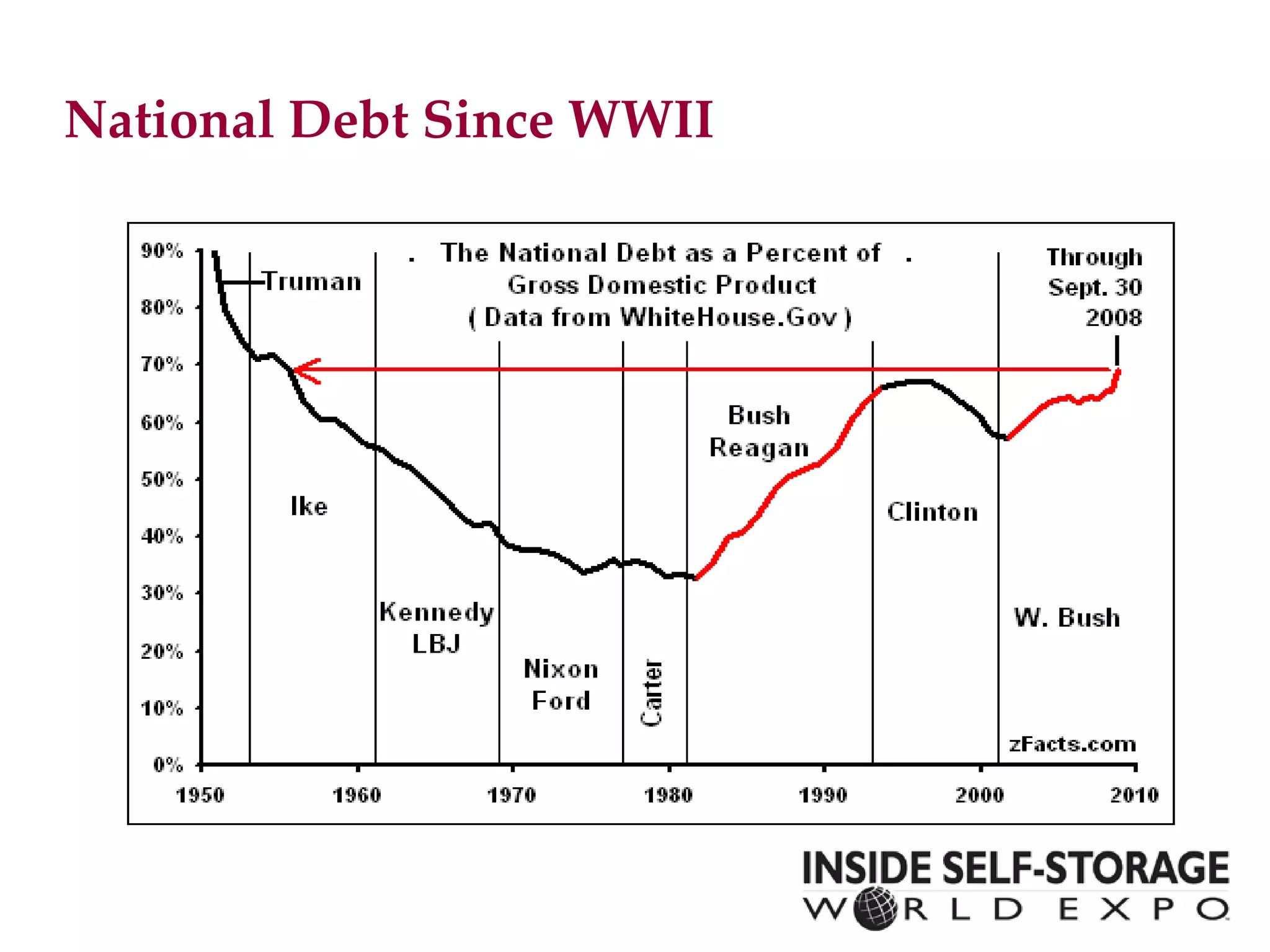
National Debt Since WWII
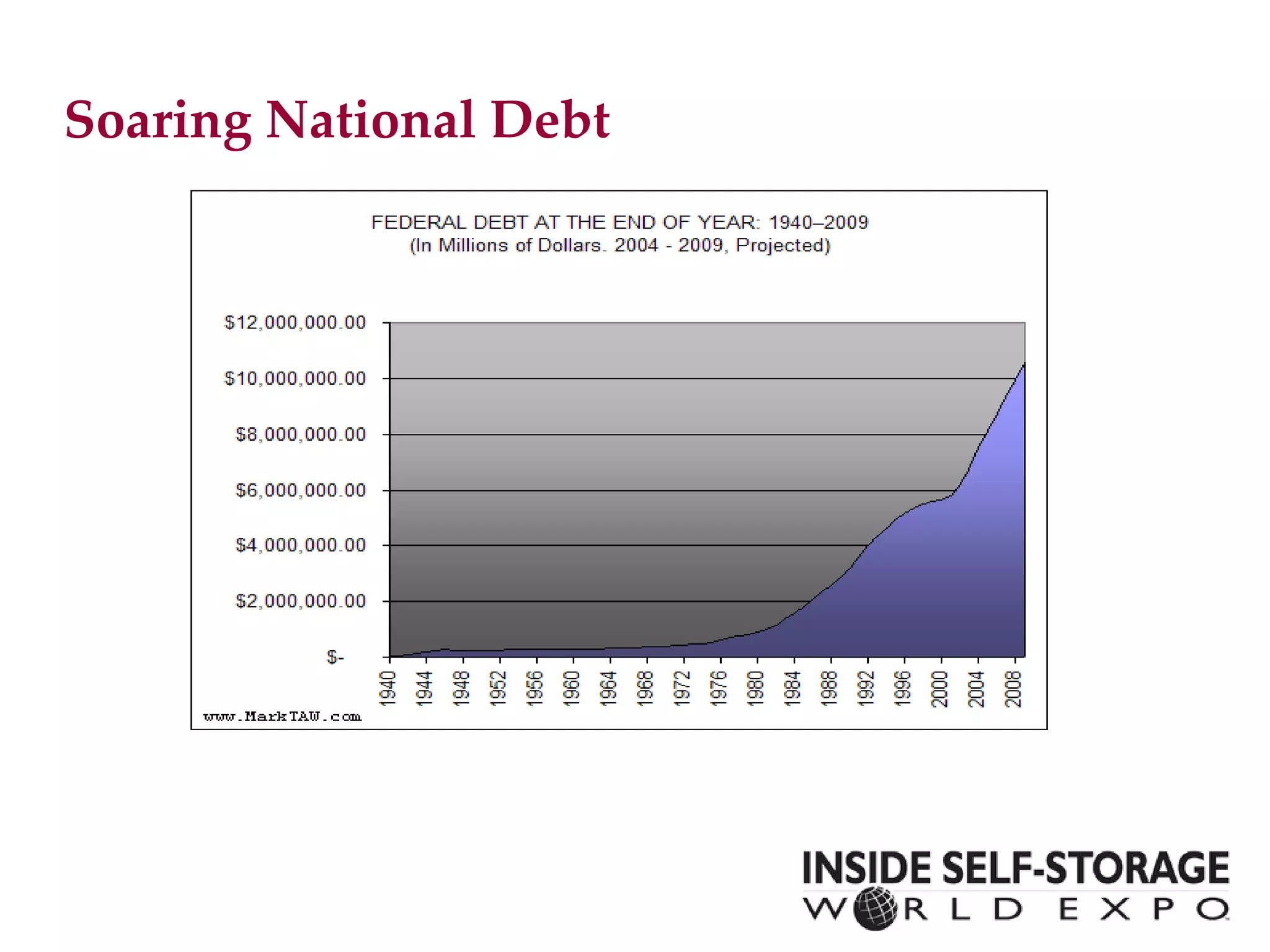
Soaring National Debt
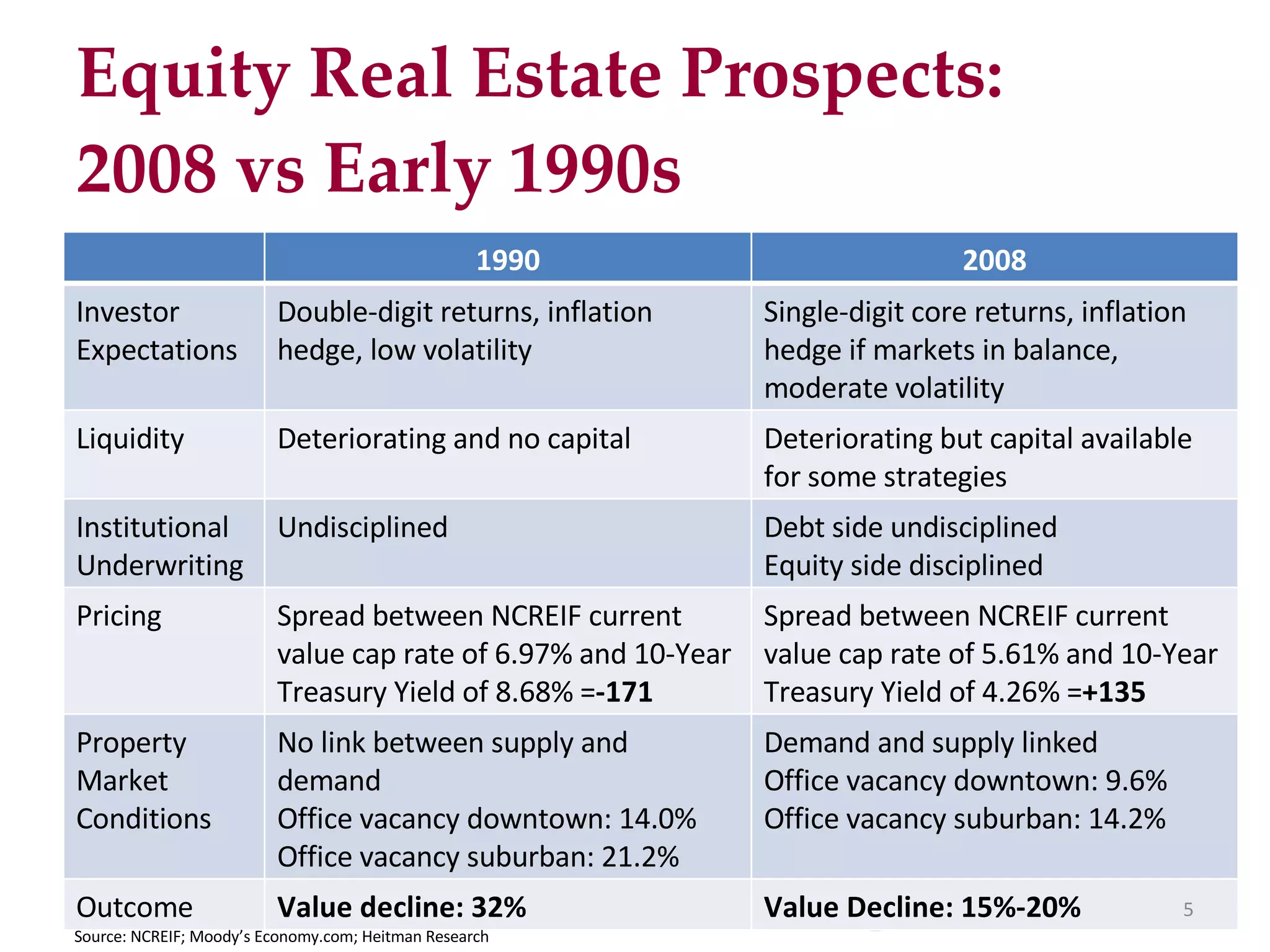
Equity Real Estate Prospects: 2008 vs Early 1990s Source: NCREIF; Moody’s Economy.com; Heitman Research 1990 2008 Investor Expectations Double-digit returns, inflation hedge, low volatility Single-digit core returns, inflation hedge if markets in balance, moderate volatility Liquidity Deteriorating and no capital Deteriorating but capital available for some strategies Institutional Underwriting Undisciplined Debt side undisciplined Equity side disciplined Pricing Spread between NCREIF current value cap rate of 6.97% and 10-Year Treasury Yield of 8.68% = -171  Spread between NCREIF current value cap rate of 5.61% and 10-Year  Treasury Yield of 4.26% = +135 Property Market Conditions No link between supply and demand Office vacancy downtown: 14.0% Office vacancy suburban: 21.2% Demand and supply linked Office vacancy downtown: 9.6% Office vacancy suburban: 14.2% Outcome Value decline: 32% Value Decline: 15%-20%
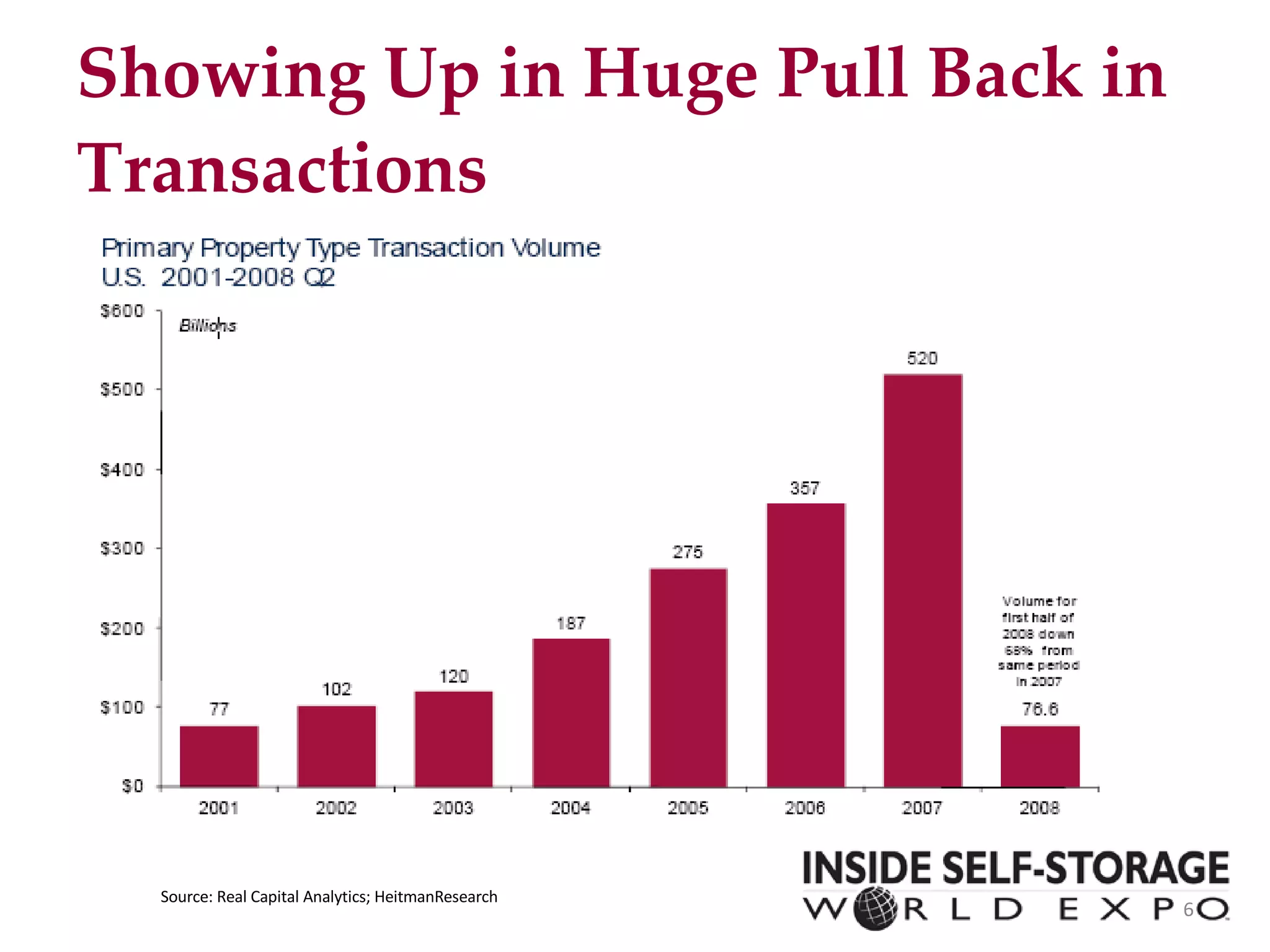
Showing Up in Huge Pull Back in Transactions Source: Real Capital Analytics; HeitmanResearch
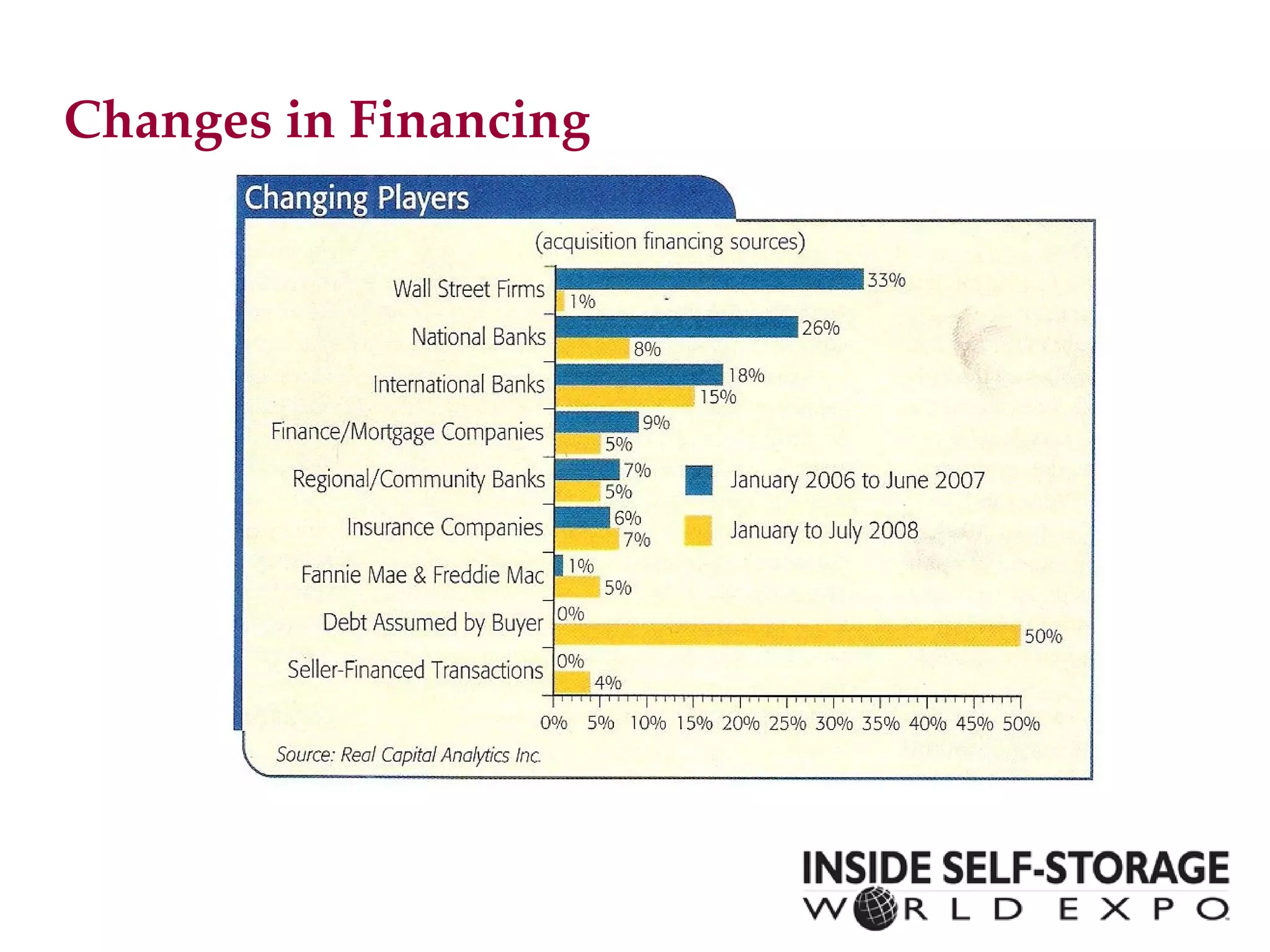
Changes in Financing
What This Means To Your Loan Package  Good credit , banks don’t lend to borrowers who are late on their mortgages or defaulted on their homes Good cash , banks don’t lend to borrowers who are trying to take cash out of their commercial real estate because they have financial difficulties elsewhere. **Some banks are now look at borrowers and do a “global cash flow analysis, limiting the borrower to 50% debt to income –keep consumer debt down. Good experience , banks are not lending to new, inexperienced self storage operators in this market. Lenders are seeking additional deposits in exchange for lending to you, i.e. Accounts Lenders are asking for additional Due Diligence on Properties,  Marketing Study
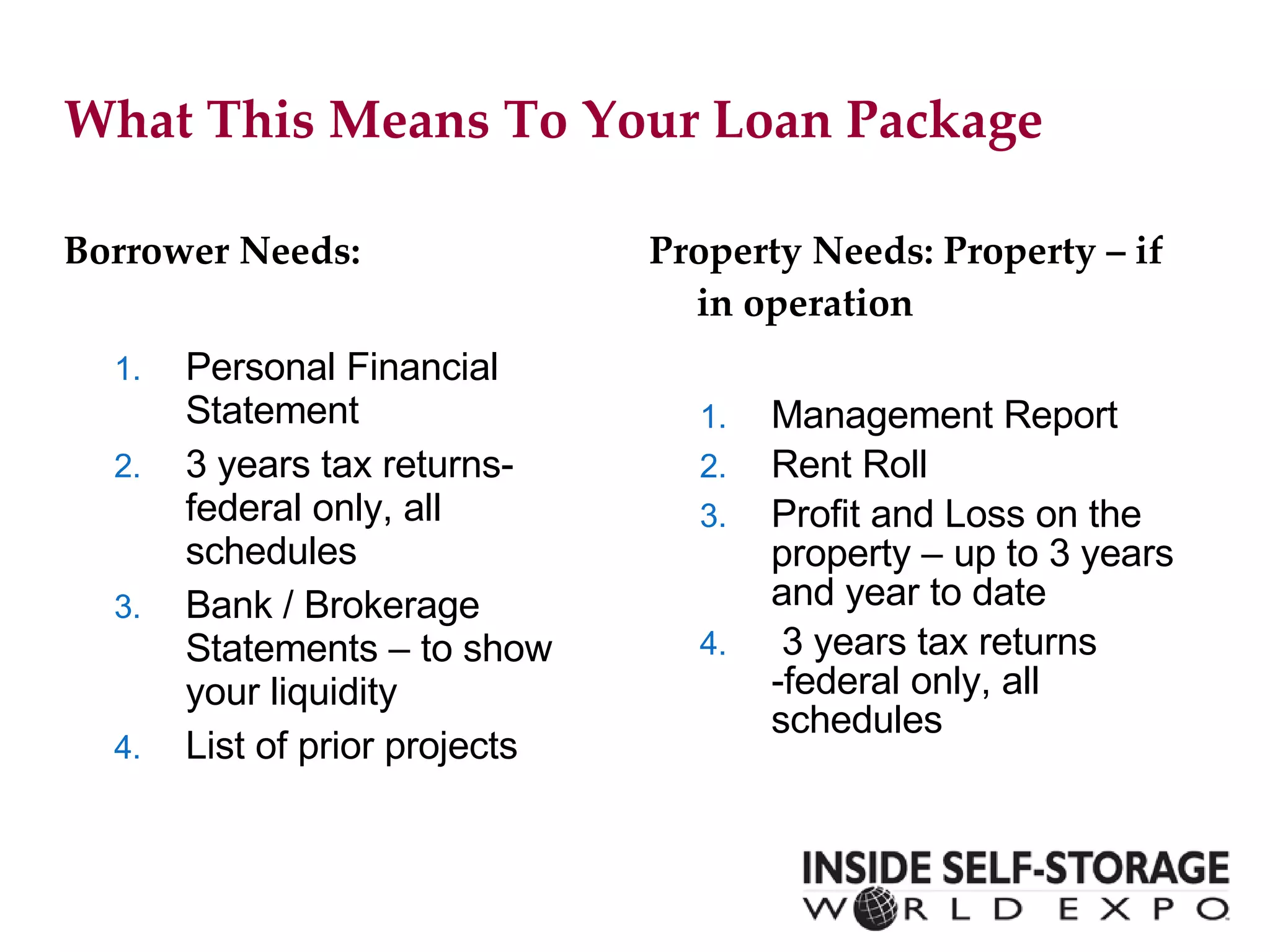
What This Means To Your Loan Package Borrower Needs: Personal Financial Statement 3 years tax returns- federal only, all schedules Bank / Brokerage Statements – to show your liquidity List of prior projects Property Needs:  Property  – if in operation Management Report Rent Roll Profit and Loss on the property – up to 3 years and year to date 3 years tax returns -federal only, all schedules
Your Relationship to the Underwriter:
 
Use Accurate and To Date Information  1. Know the Current Value of Your Property 2. Refute Assumptions of Bank
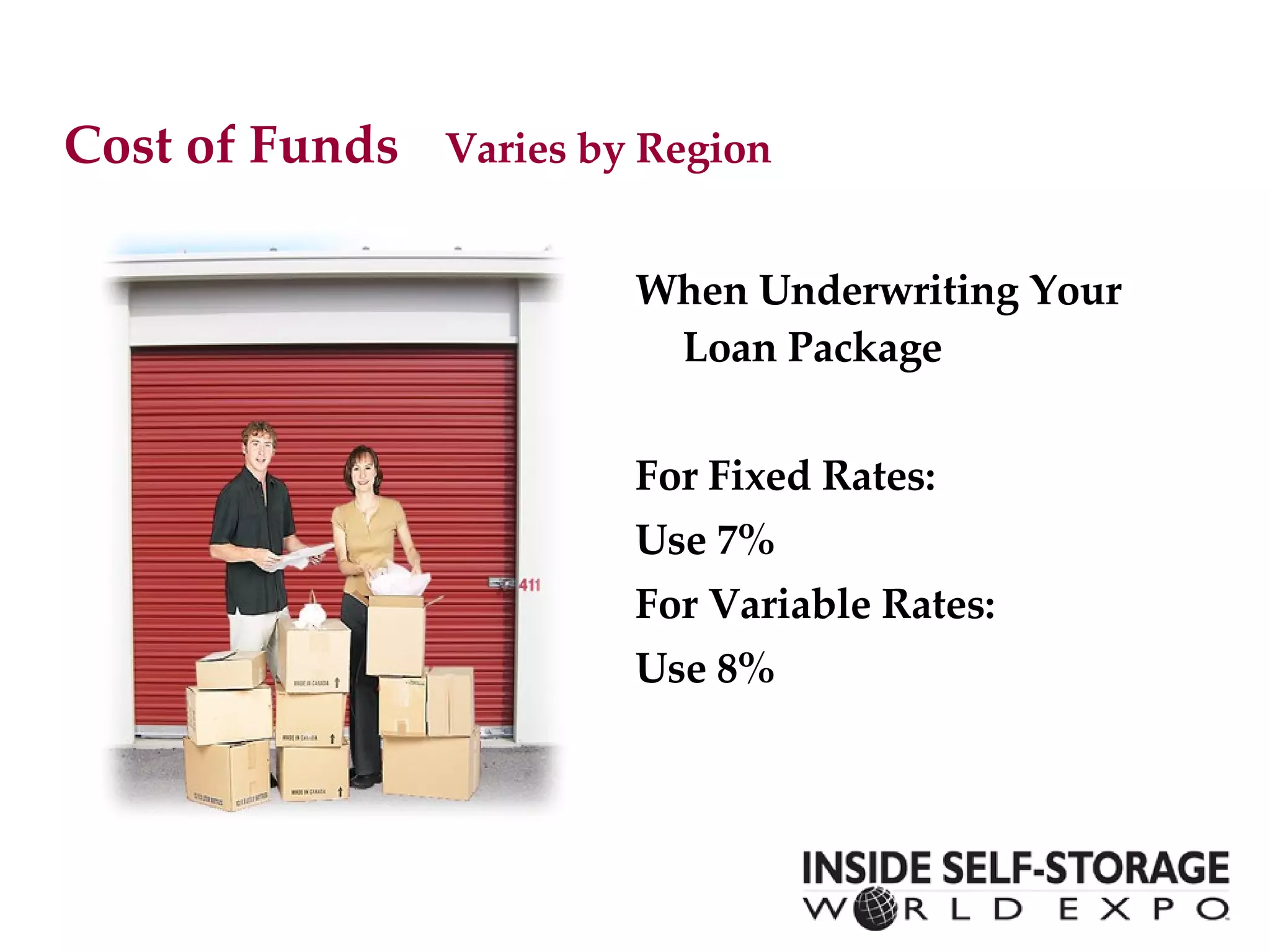
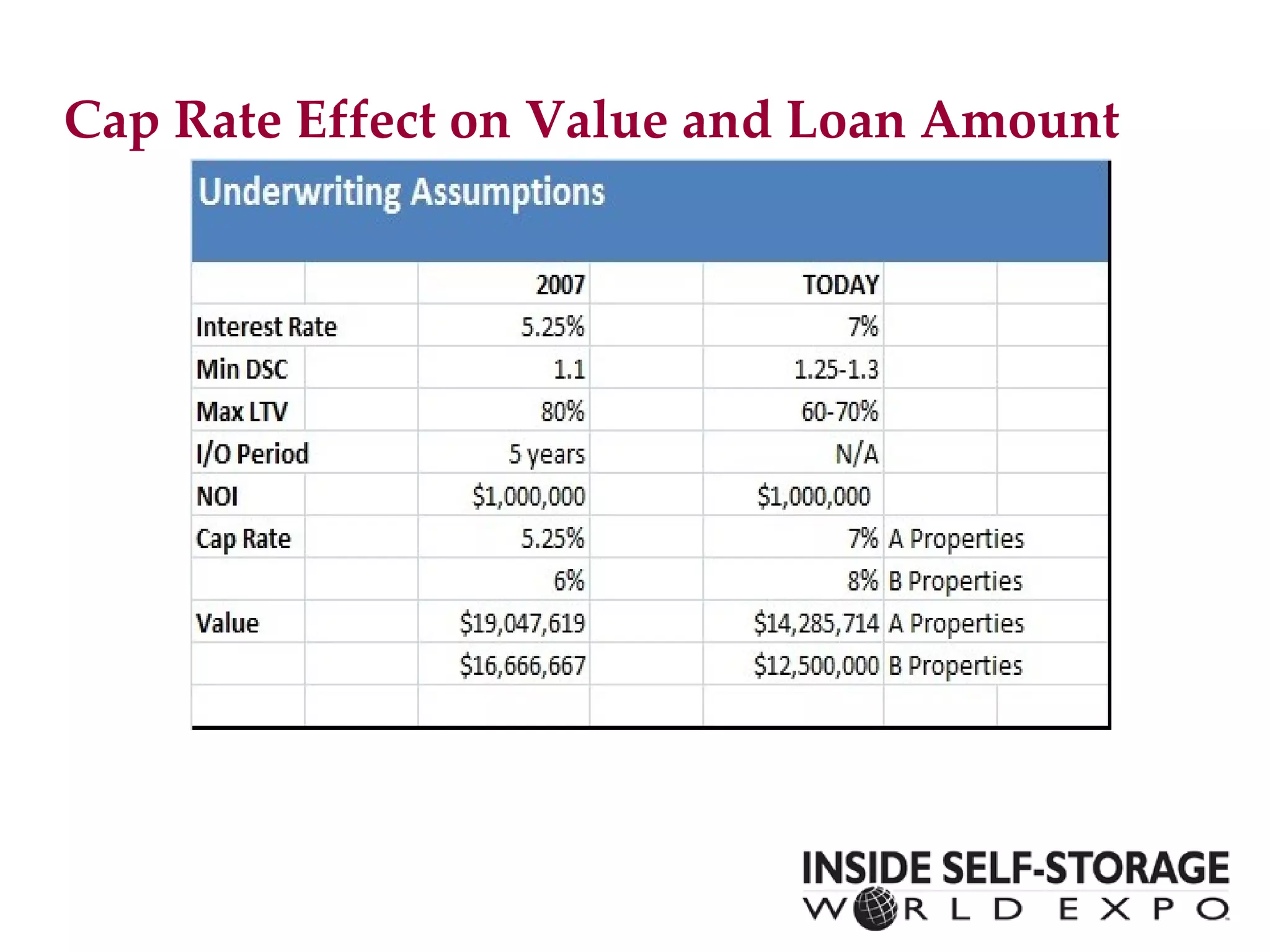
Cost of Funds Varies by Region When Underwriting Your Loan Package For Fixed Rates:  Use 7% For Variable Rates:  Use 8%
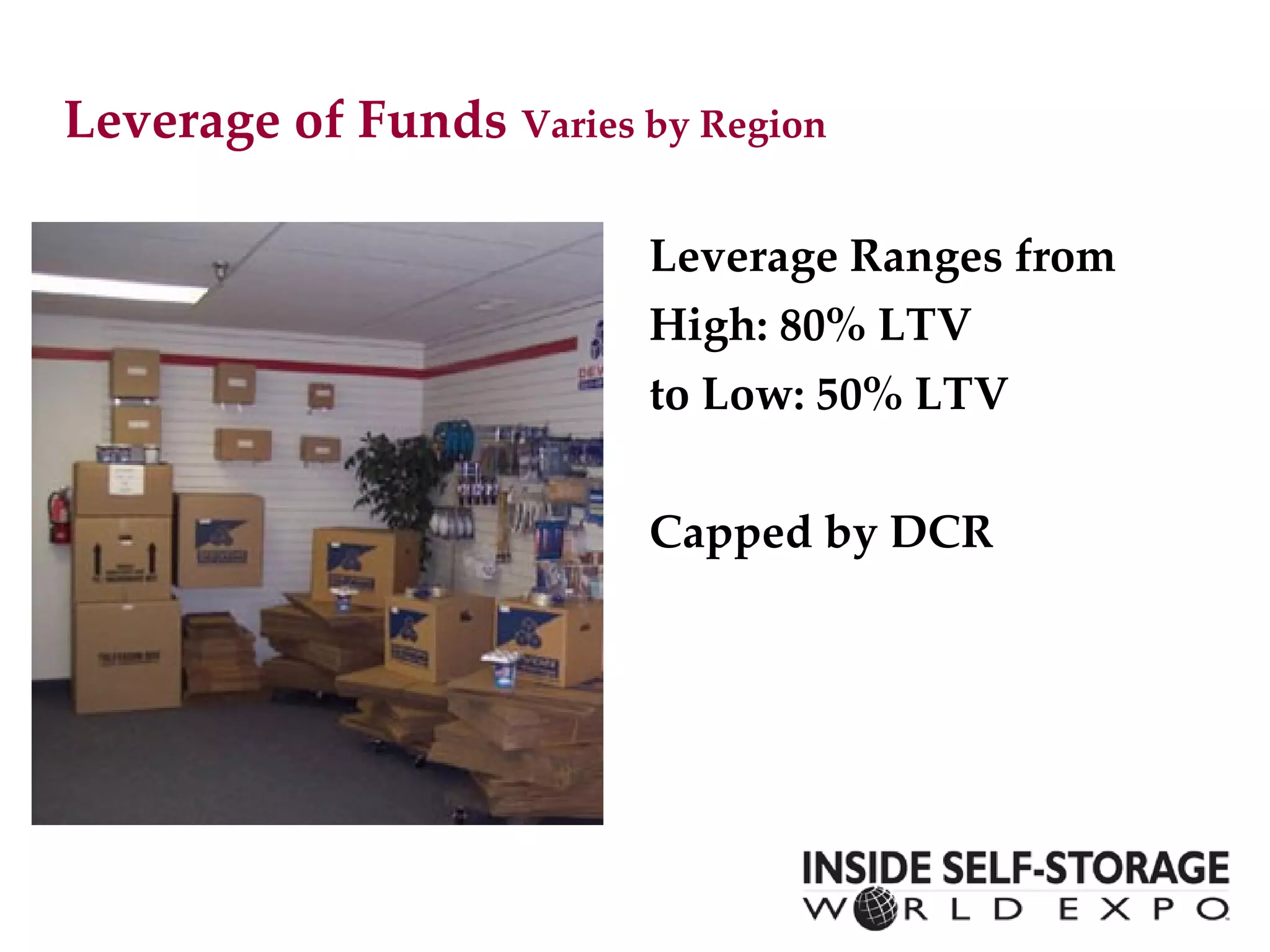
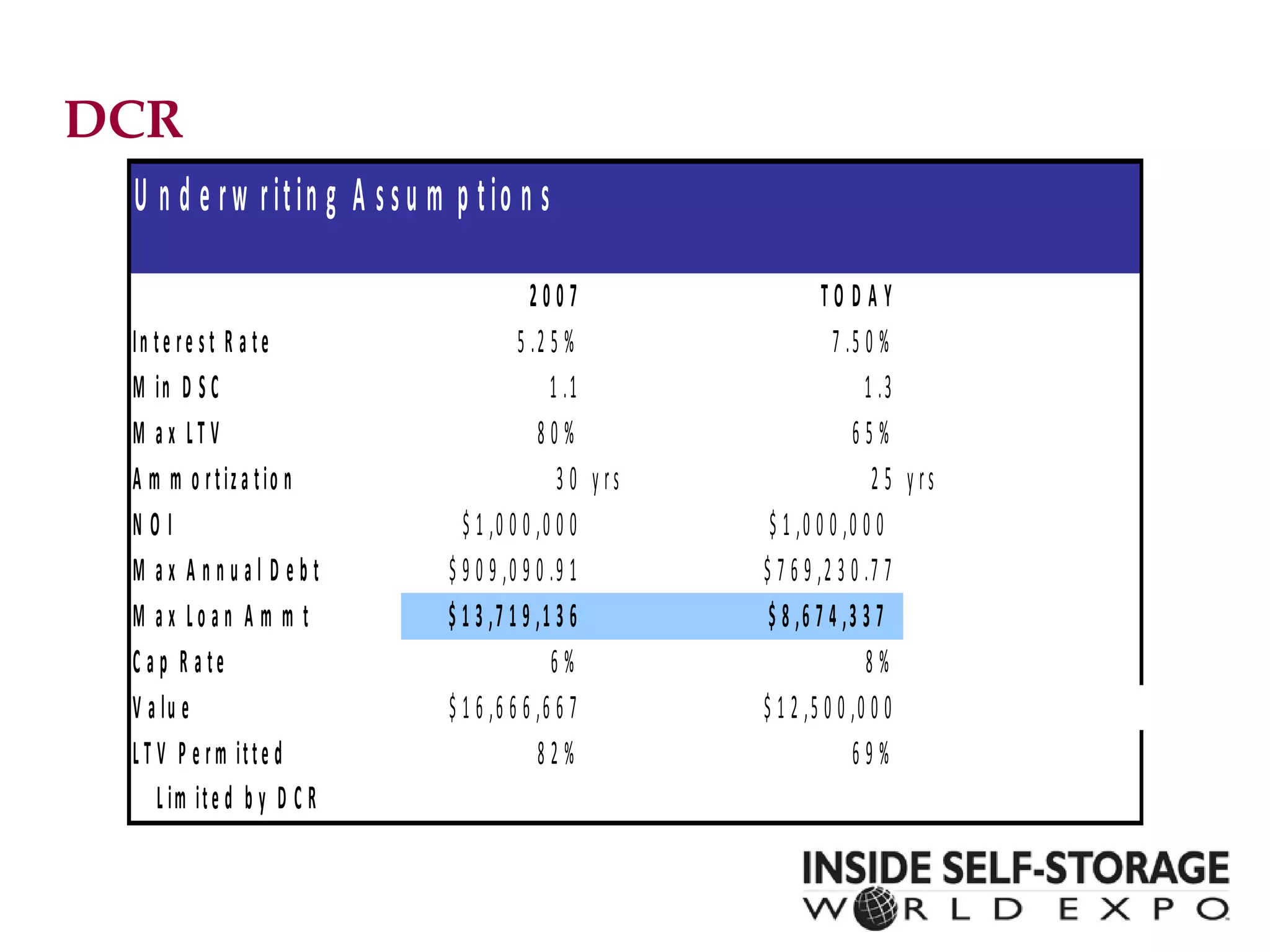
Leverage of Funds  Varies by Region Leverage Ranges from High: 80% LTV  to Low: 50% LTV Capped by DCR
Tools to Analyze Property Ammunition You Need To Have: Cap Rate Debt Coverage Ratio STATIC VS DYNAMIC
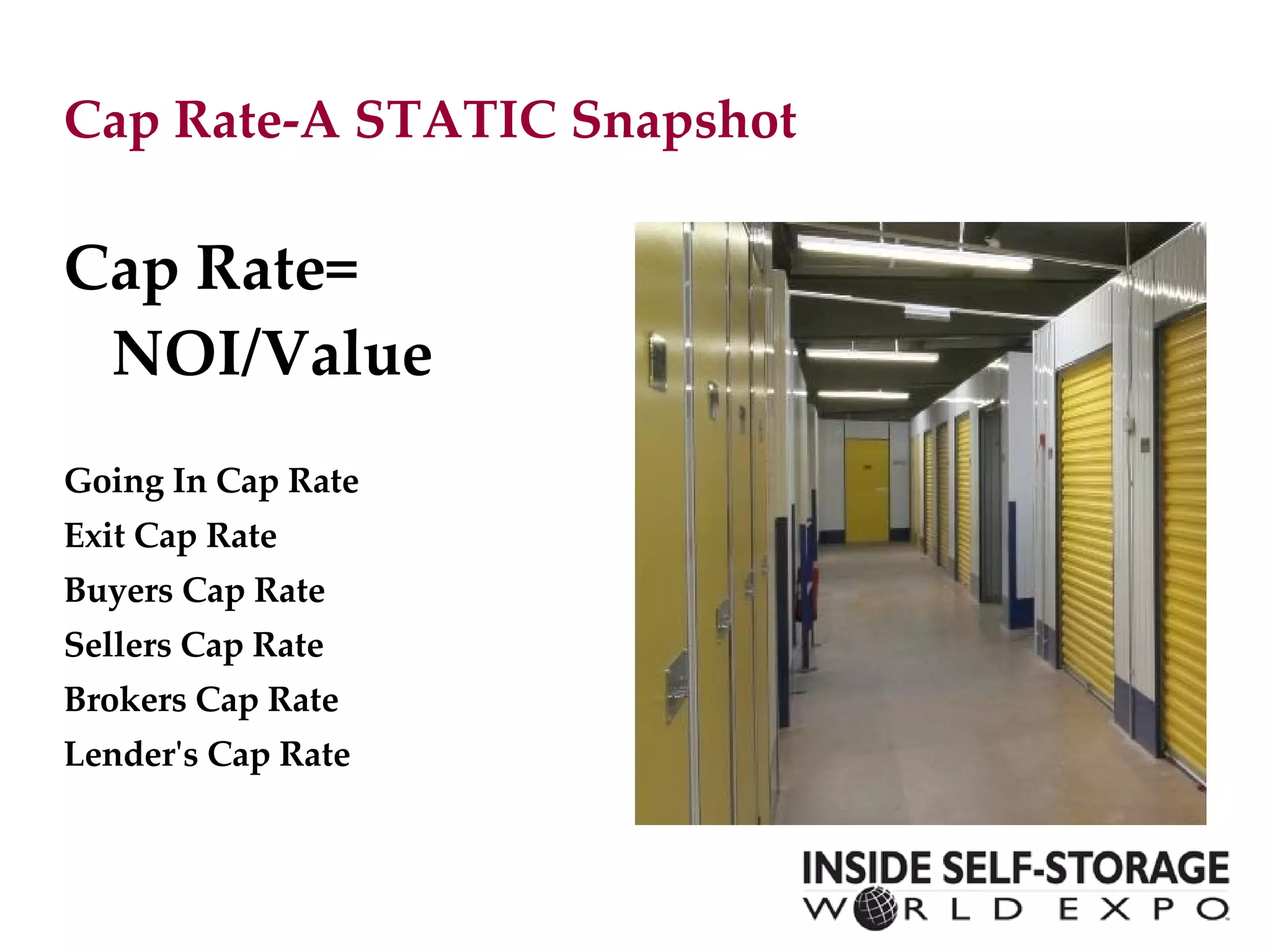
Cap Rate-A STATIC Snapshot  Cap Rate= NOI/Value Going In Cap Rate Exit Cap Rate Buyers Cap Rate Sellers Cap Rate Brokers Cap Rate Lender's Cap Rate
Where to Get Cap Rate ASK:  Appraiser, Self Storage in your area ASK:  Self Storage Broker in your area From Comparables, average of last 5 sales in your area-averaged  Comps 6 months ago are worthless Property Values are Dropping, Cap rates are rising Ideas of values are often not accurate
Cons of Cap Rate Only considers a snapshot in time 1. Disregards the property's expected performance over the entire holding period 2. Works with a number today 3. Only looks at one year 4. Doesn't tell you what the cap rate will be in the following years 5. Cap rates change over time-not a constant 6. Assumes data was reported accurately
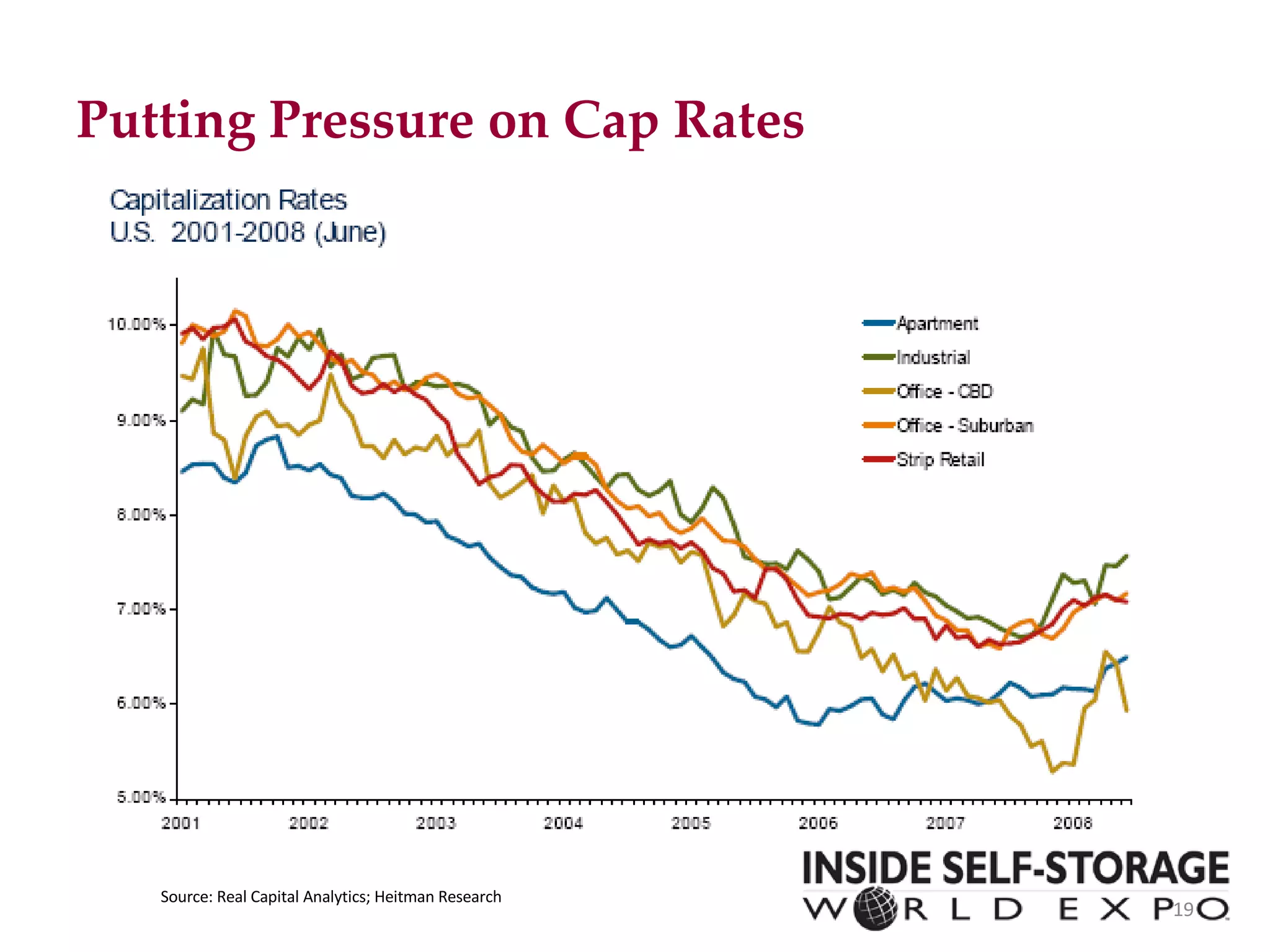
Putting Pressure on Cap Rates Source: Real Capital Analytics; Heitman Research
Cap Rates: What Goes Up... 2003 through the end of 2007: a historic period marked by an abundance of capital at extremely low interest rates, cap rates for self-storage properties dropped from an average of 9.5% to 7.2%
Cap Rate Effect on Value and Loan Amount
DCR
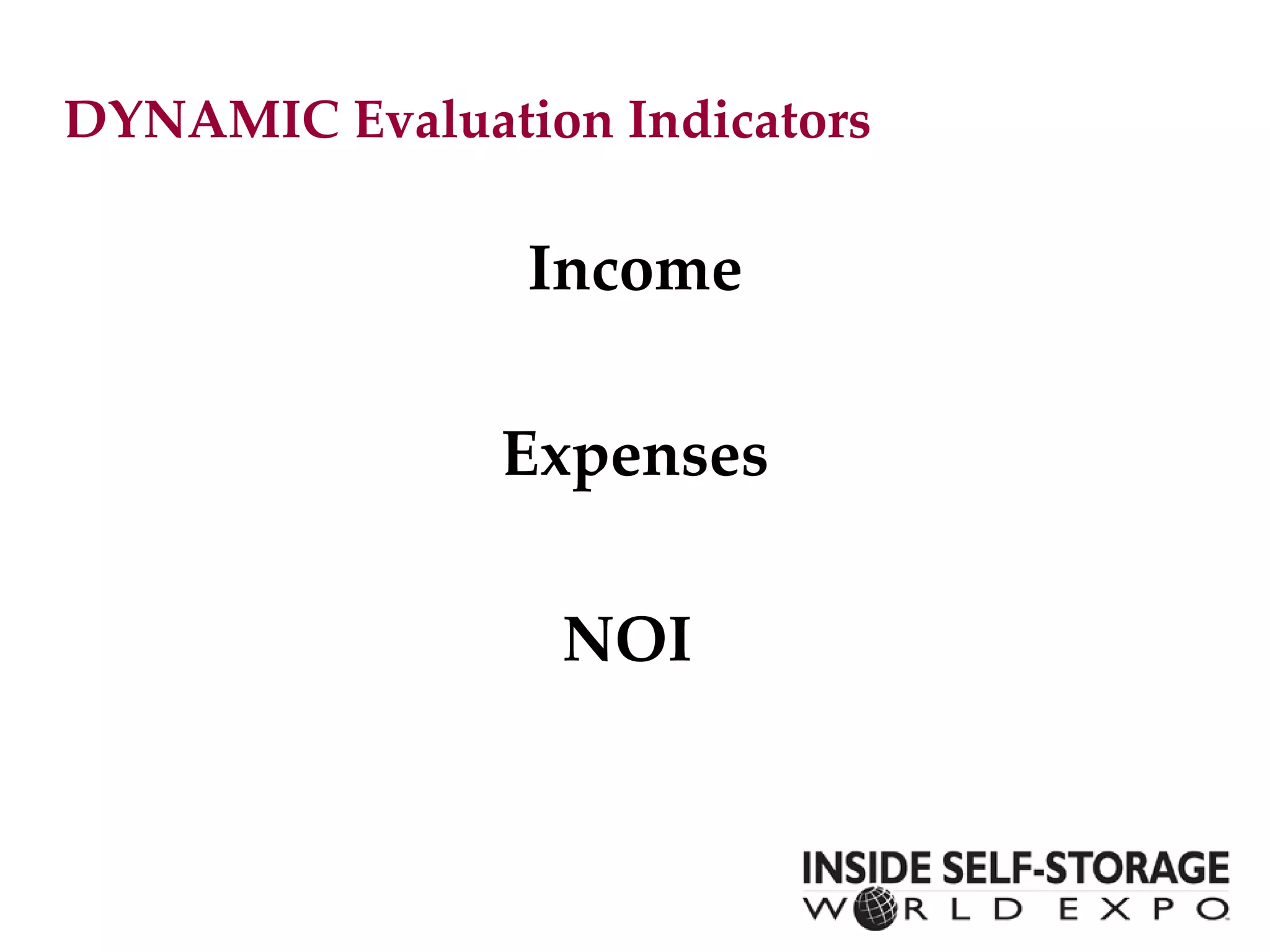
DYNAMIC Evaluation Indicators Income Expenses NOI
Accurate Property Operating Data Lenders are Scrutinizing and Questioning Every Detail, Often Opting for Most Conservative Numbers
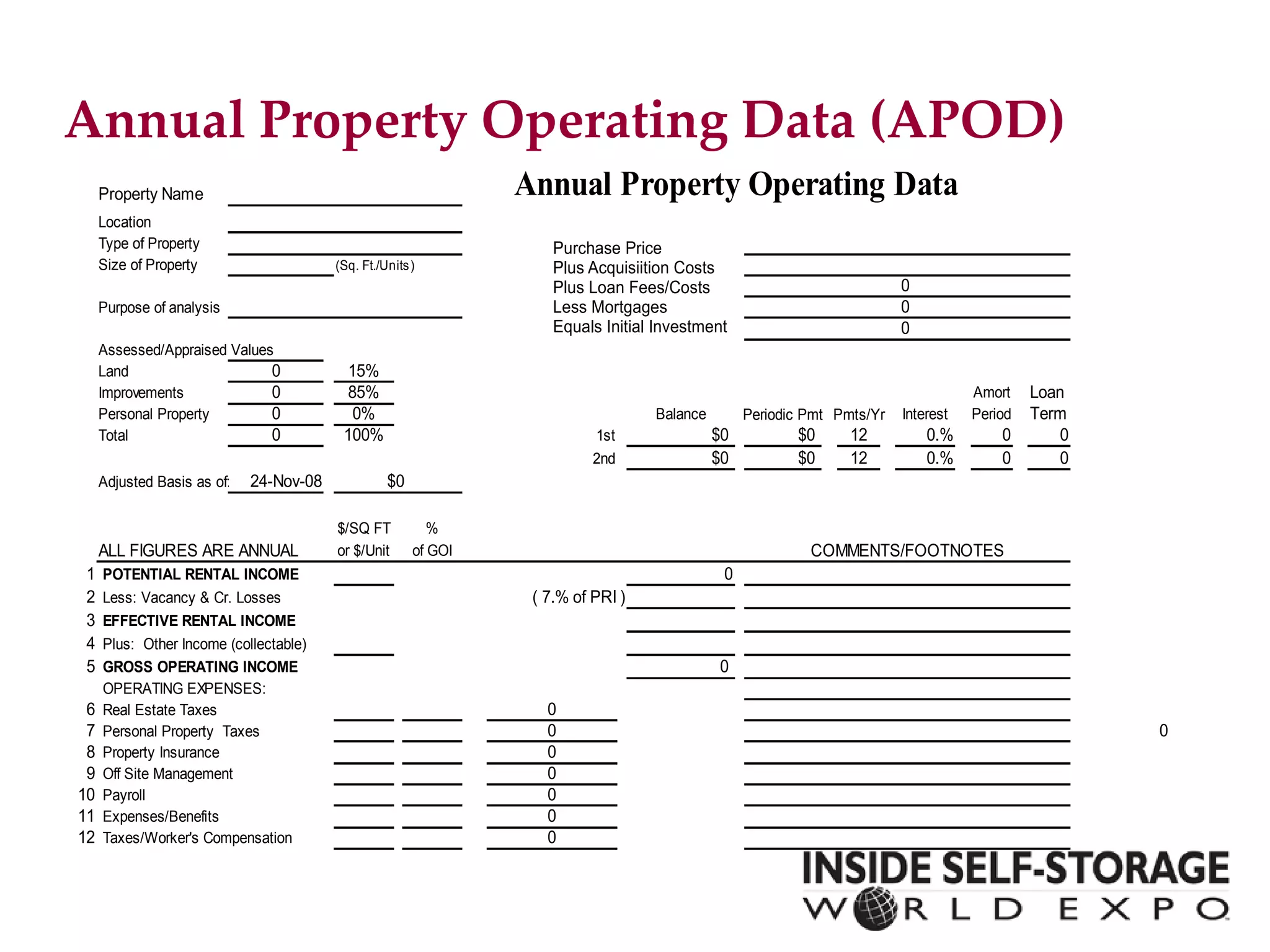
Annual Property Operating Data (APOD)
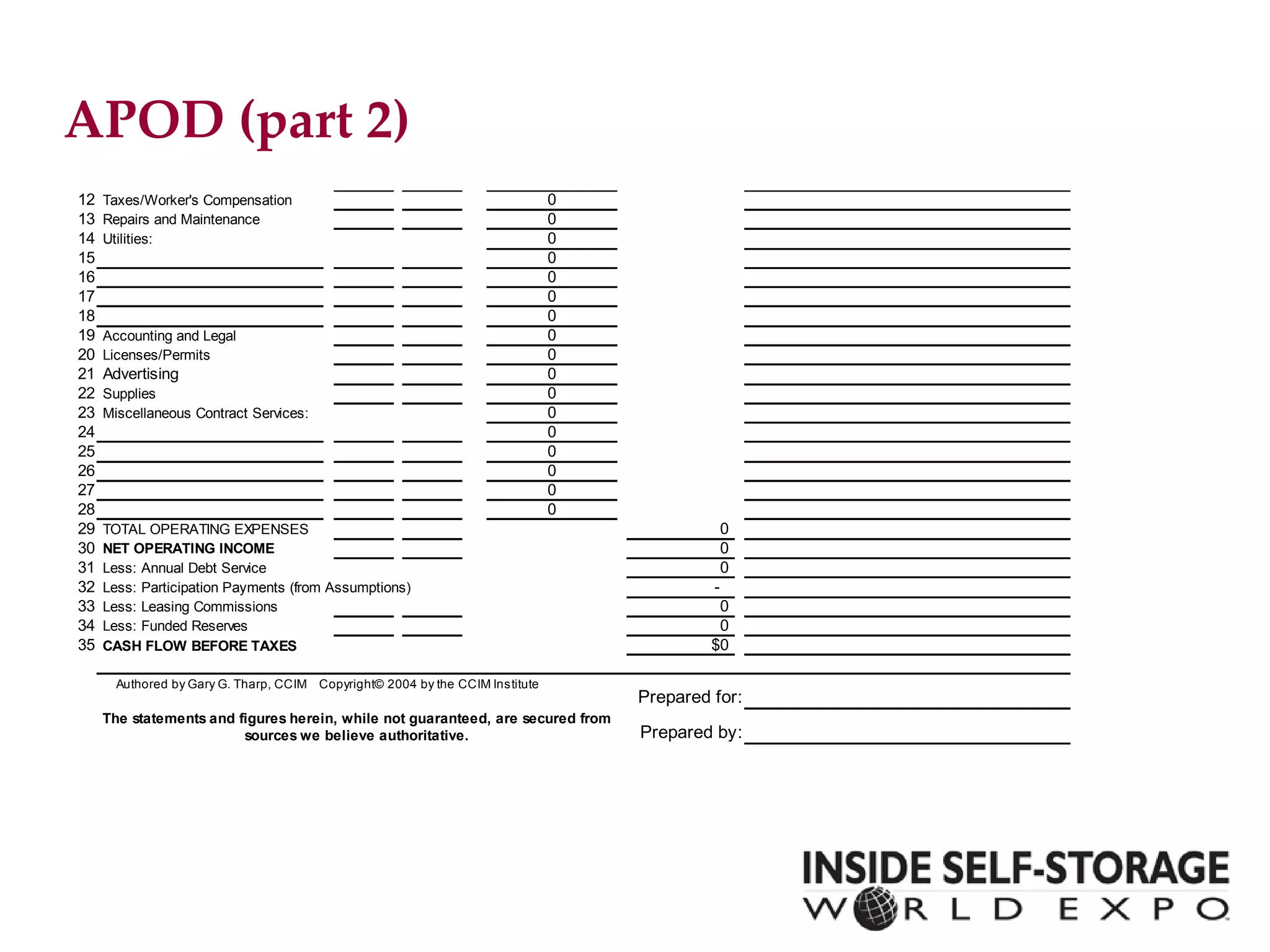
APOD (part 2)
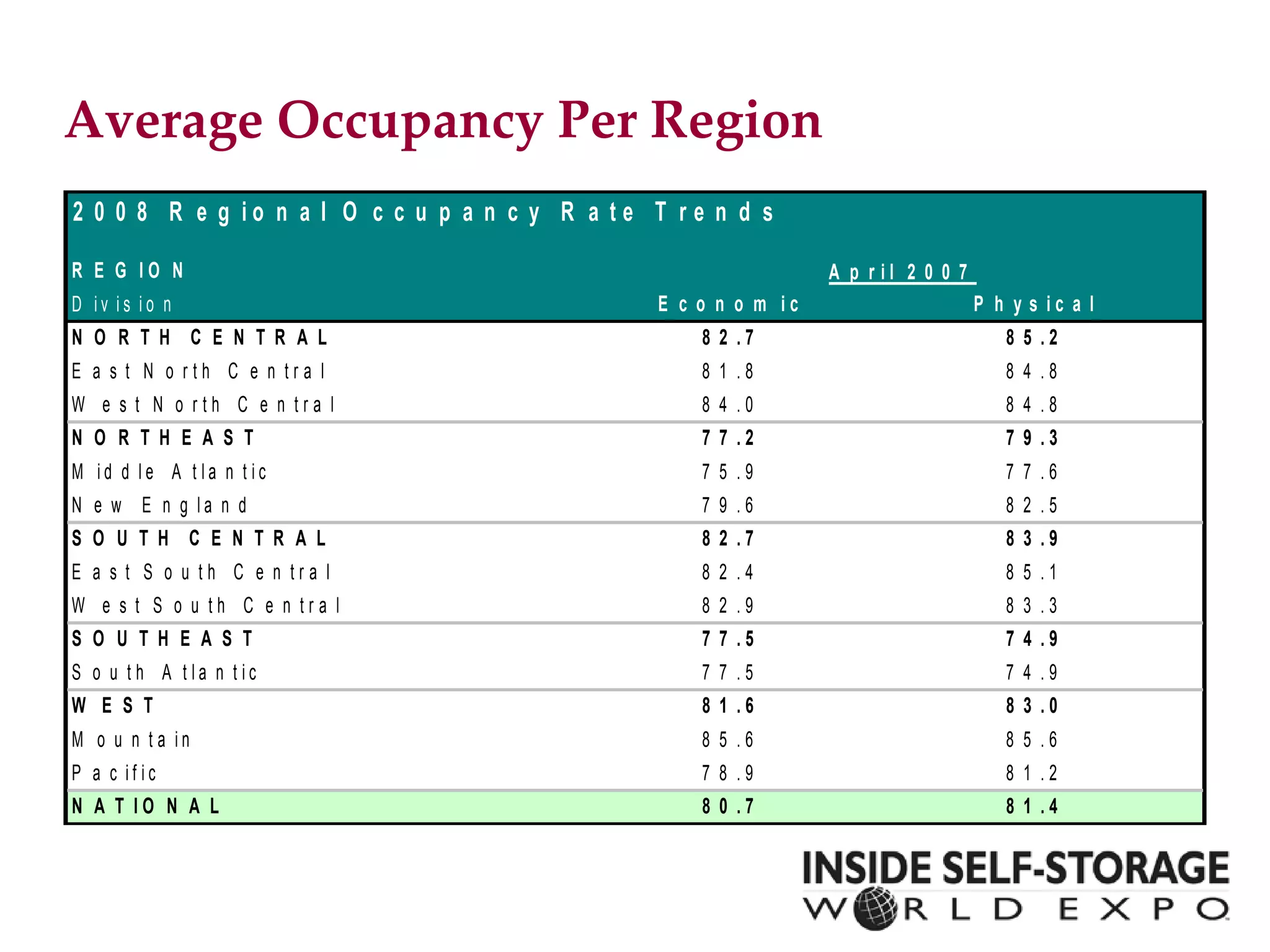
Average Occupancy Per Region
Occupancy Trends
Income Raise Rents Maximize revenue streams Operational systems in place, automated  Management Expertise, training Add new revenue generators
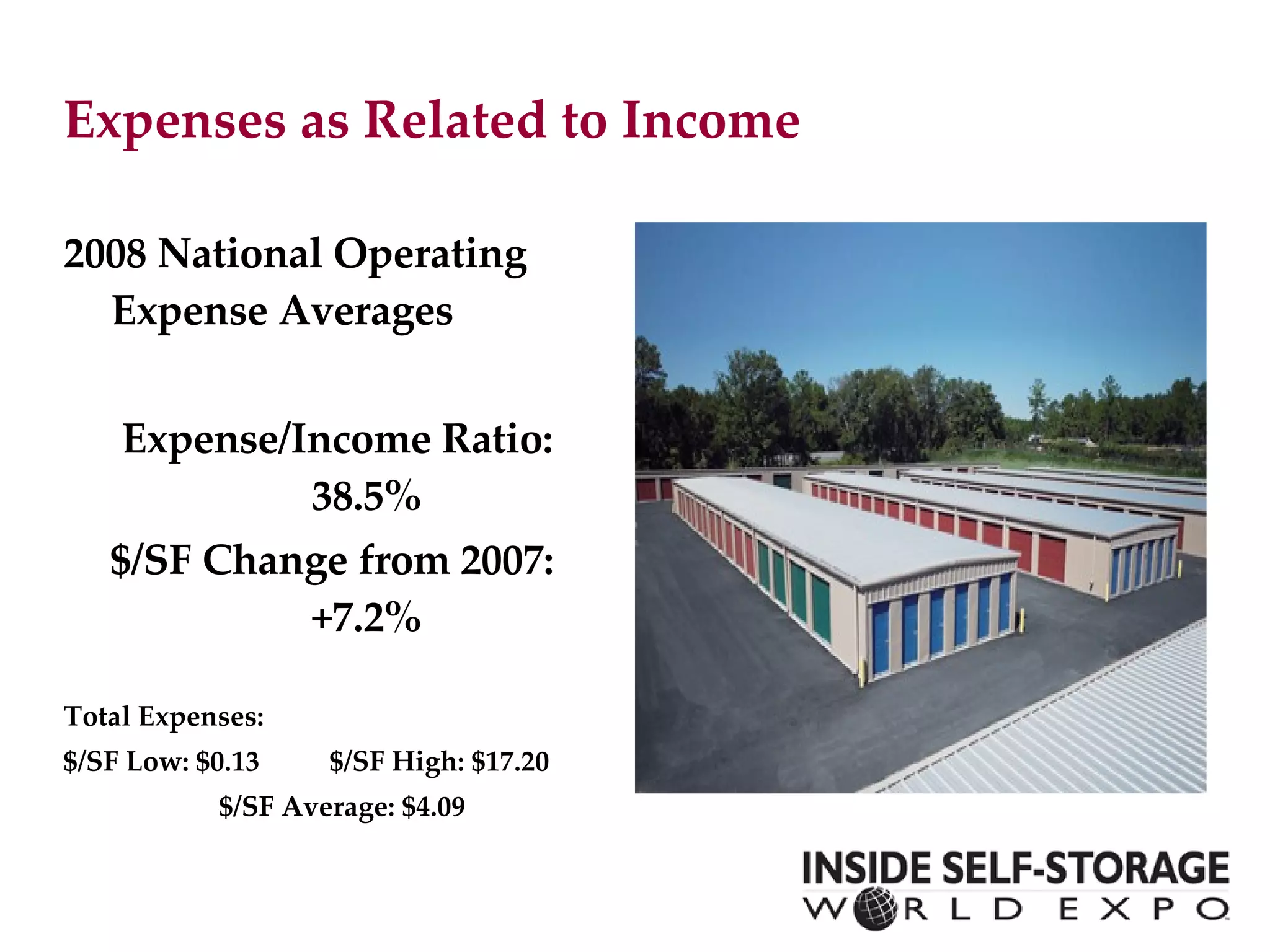
Expenses as Related to Income 2008 National Operating Expense Averages Expense/Income Ratio:  38.5% $/SF Change from 2007:  +7.2% Total Expenses: $/SF Low: $0.13  $/SF High: $17.20 $/SF Average: $4.09
Current Trends Summation  Industry Consolidation, larger portfolio transactions, fewer single asset transactions More Disciplined Investing: Discounted Cash Flow, Target IRR 10.5% (unlevered) Use of  Market Study  Required by Lenders Lender Demand for Banking Relationship (Deposits) and Multiple Sources of Repayment (cash flow from other existing businesses)  Values based on Existing Cash Flow, Trailing Income NOT Pro-forma Continuing pressures: Over-supply and lack of credit Housing crisis will help or hurt SS?  Data is inconclusive
Positive Summation Fundamentals Remain Strong 15% Vacancy Rate Both in Bull and Bear Cycles Trade Area Remains Constant: 3.25 radial miles from location, Average 6.52 feet per person, Change from 2007 (+6.45%) Asset class remains lowest in bank defaults of all commercial property types Growing Sophistication and Due Diligence by Borrowers
How It Has Been in Self Storage: Pooch
How It Is Now: Coyote
Watermark Financial Georgia Ragsdale, CEO 11150 W. Olympic Blvd. #150 Los Angeles, CA 90046 [email_address] www.watermarkfinancialgroup.com Office: 310-479-1260

Gr Iss Presentation Final 2009

  • 1.
    Assembling a LoanPackage That Attracts Dollars and Approvals Presented by: Georgia Ragsdale, Watermark Financial January 26-29, 2009 The Venetian Resort Hotel Casino/ Sands Expo & Convention Center Las Vegas
  • 2.
    Agenda Assessmentof Market Conditions New Realities in Underwriting Basic Assumptions: APOD (Annual Property Operating Data) Modeling Investment Analysis Tools What is Coming Navigating Change
  • 3.
  • 4.
  • 5.
    Equity Real EstateProspects: 2008 vs Early 1990s Source: NCREIF; Moody’s Economy.com; Heitman Research 1990 2008 Investor Expectations Double-digit returns, inflation hedge, low volatility Single-digit core returns, inflation hedge if markets in balance, moderate volatility Liquidity Deteriorating and no capital Deteriorating but capital available for some strategies Institutional Underwriting Undisciplined Debt side undisciplined Equity side disciplined Pricing Spread between NCREIF current value cap rate of 6.97% and 10-Year Treasury Yield of 8.68% = -171 Spread between NCREIF current value cap rate of 5.61% and 10-Year Treasury Yield of 4.26% = +135 Property Market Conditions No link between supply and demand Office vacancy downtown: 14.0% Office vacancy suburban: 21.2% Demand and supply linked Office vacancy downtown: 9.6% Office vacancy suburban: 14.2% Outcome Value decline: 32% Value Decline: 15%-20%
  • 6.
    Showing Up inHuge Pull Back in Transactions Source: Real Capital Analytics; HeitmanResearch
  • 7.
  • 8.
    What This MeansTo Your Loan Package Good credit , banks don’t lend to borrowers who are late on their mortgages or defaulted on their homes Good cash , banks don’t lend to borrowers who are trying to take cash out of their commercial real estate because they have financial difficulties elsewhere. **Some banks are now look at borrowers and do a “global cash flow analysis, limiting the borrower to 50% debt to income –keep consumer debt down. Good experience , banks are not lending to new, inexperienced self storage operators in this market. Lenders are seeking additional deposits in exchange for lending to you, i.e. Accounts Lenders are asking for additional Due Diligence on Properties, Marketing Study
  • 9.
    What This MeansTo Your Loan Package Borrower Needs: Personal Financial Statement 3 years tax returns- federal only, all schedules Bank / Brokerage Statements – to show your liquidity List of prior projects Property Needs: Property – if in operation Management Report Rent Roll Profit and Loss on the property – up to 3 years and year to date 3 years tax returns -federal only, all schedules
  • 10.
    Your Relationship tothe Underwriter:
  • 11.
  • 12.
    Use Accurate andTo Date Information 1. Know the Current Value of Your Property 2. Refute Assumptions of Bank
  • 13.
    Cost of FundsVaries by Region When Underwriting Your Loan Package For Fixed Rates: Use 7% For Variable Rates: Use 8%
  • 14.
    Leverage of Funds Varies by Region Leverage Ranges from High: 80% LTV to Low: 50% LTV Capped by DCR
  • 15.
    Tools to AnalyzeProperty Ammunition You Need To Have: Cap Rate Debt Coverage Ratio STATIC VS DYNAMIC
  • 16.
    Cap Rate-A STATICSnapshot Cap Rate= NOI/Value Going In Cap Rate Exit Cap Rate Buyers Cap Rate Sellers Cap Rate Brokers Cap Rate Lender's Cap Rate
  • 17.
    Where to GetCap Rate ASK: Appraiser, Self Storage in your area ASK: Self Storage Broker in your area From Comparables, average of last 5 sales in your area-averaged Comps 6 months ago are worthless Property Values are Dropping, Cap rates are rising Ideas of values are often not accurate
  • 18.
    Cons of CapRate Only considers a snapshot in time 1. Disregards the property's expected performance over the entire holding period 2. Works with a number today 3. Only looks at one year 4. Doesn't tell you what the cap rate will be in the following years 5. Cap rates change over time-not a constant 6. Assumes data was reported accurately
  • 19.
    Putting Pressure onCap Rates Source: Real Capital Analytics; Heitman Research
  • 20.
    Cap Rates: WhatGoes Up... 2003 through the end of 2007: a historic period marked by an abundance of capital at extremely low interest rates, cap rates for self-storage properties dropped from an average of 9.5% to 7.2%
  • 21.
    Cap Rate Effecton Value and Loan Amount
  • 22.
  • 23.
    DYNAMIC Evaluation IndicatorsIncome Expenses NOI
  • 24.
    Accurate Property OperatingData Lenders are Scrutinizing and Questioning Every Detail, Often Opting for Most Conservative Numbers
  • 25.
  • 26.
  • 27.
  • 28.
  • 29.
    Income Raise RentsMaximize revenue streams Operational systems in place, automated Management Expertise, training Add new revenue generators
  • 30.
    Expenses as Relatedto Income 2008 National Operating Expense Averages Expense/Income Ratio: 38.5% $/SF Change from 2007: +7.2% Total Expenses: $/SF Low: $0.13 $/SF High: $17.20 $/SF Average: $4.09
  • 31.
    Current Trends Summation Industry Consolidation, larger portfolio transactions, fewer single asset transactions More Disciplined Investing: Discounted Cash Flow, Target IRR 10.5% (unlevered) Use of Market Study Required by Lenders Lender Demand for Banking Relationship (Deposits) and Multiple Sources of Repayment (cash flow from other existing businesses) Values based on Existing Cash Flow, Trailing Income NOT Pro-forma Continuing pressures: Over-supply and lack of credit Housing crisis will help or hurt SS? Data is inconclusive
  • 32.
    Positive Summation FundamentalsRemain Strong 15% Vacancy Rate Both in Bull and Bear Cycles Trade Area Remains Constant: 3.25 radial miles from location, Average 6.52 feet per person, Change from 2007 (+6.45%) Asset class remains lowest in bank defaults of all commercial property types Growing Sophistication and Due Diligence by Borrowers
  • 33.
    How It HasBeen in Self Storage: Pooch
  • 34.
    How It IsNow: Coyote
  • 35.
    Watermark Financial GeorgiaRagsdale, CEO 11150 W. Olympic Blvd. #150 Los Angeles, CA 90046 [email_address] www.watermarkfinancialgroup.com Office: 310-479-1260