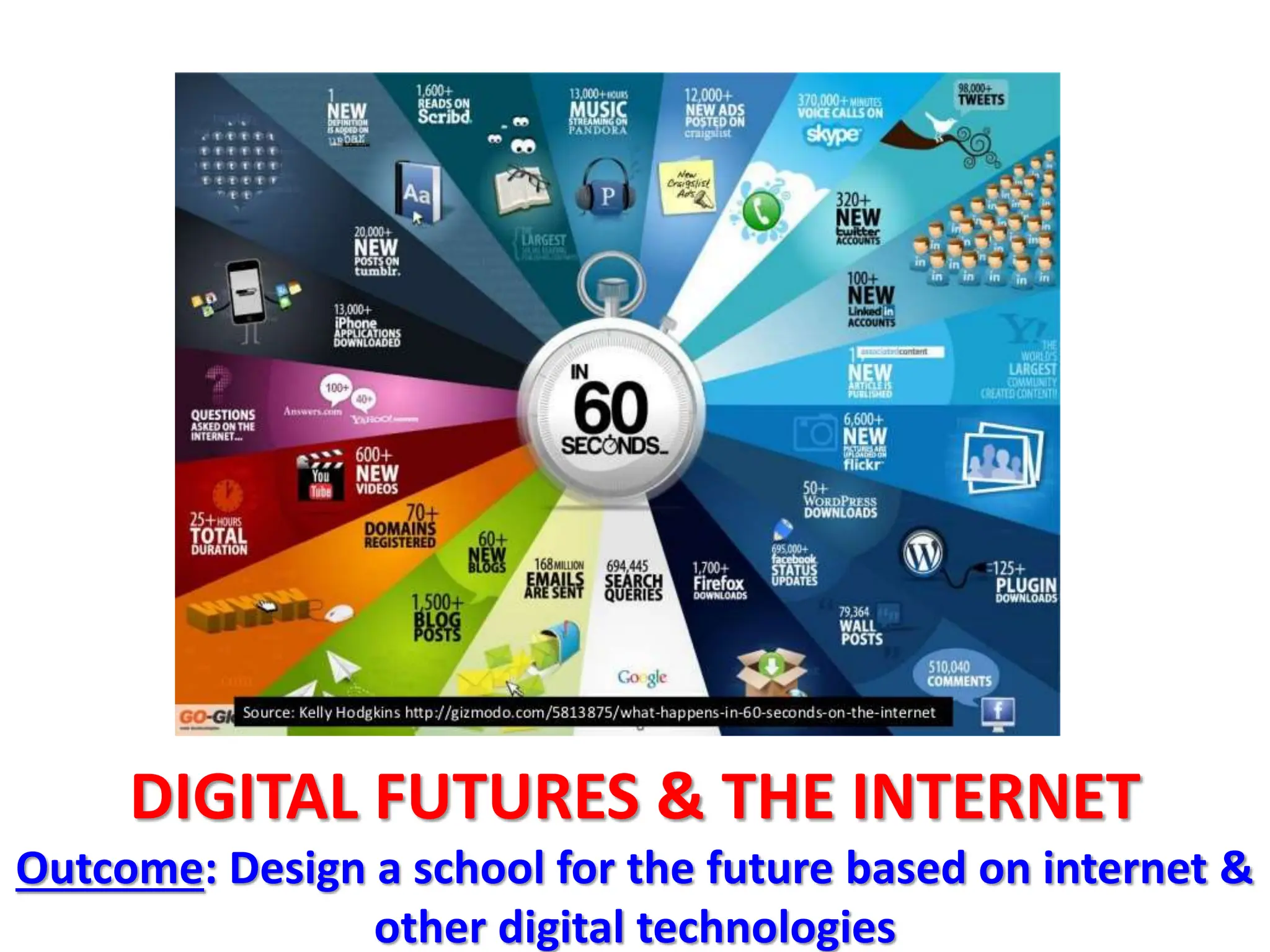
DIGITAL FUTURES & THE INTERNET
Outcome: Design a school for the future based on internet &
other digital technologies
Introduction
- KWL organizer
- Skills to be developed through global issue:
- Critical thinking
- Research
- Reflection
- Communication
The digital divide: let’s think
together on the following topics…
-Does everyone get access to the
internet?
-What is the cause of digital divide?
-What is the potential impact of the
digital divide?
The Digital Divide
The Digital Divide
Watch TED Talk on digital divide: Let’s bridge
the digital divide by Aleph Molinari
TEDXSanMigueldeAllende
The Digital Divide
ACTIVITY IN GROUPS
-What is the issue? Make sure you identify the
main issue of the TED Talk.
-Is the issue dealt from a global; national; local;
or personal perspective? Why?
-What is digital divide? Why do you think it
happens? Explain providing reasons.
-What are the consequences of being
“technologically excluded”?
-Aleph Molinari states that the Internet should
be a right not a luxury. Do you agree with the
speakers’ opinion? Yes/No. Why?
The Digital Divide
-What does Aleph Molinari propose? As a
group, do you agree with the speakers’
proposal? Do you consider it as valid and
good? Yes/No. Why? If members of the group
have different opinions, make sure to explain
and provide detail for each member’s
perspective.
-Did you enjoy the TED Talk? Did you find it
interesting? Yes/No. Why?
The Digital Divide
In addition, each group will prepare a short
creative presentation for the class summarizing
the TED talk. Make sure you engage with your
audience, you have to “sell” your presentation,
and be able to communicate your ideas and
thoughts on the issue. Be convincing and
passionate about your presentation!
You may create a poster; invent an interview
with Aleph Molinari; imagine a TV or radio
programme; write a letter to a governmental
officer presenting Aleph’s ideas; write a poem;
write an newspaper article or opinion; etc.
The Digital Divide
REFLECTION BOX: Individually reflect on your
contribution to the group.
(a) Was I able to provide a valuable
contribution to my group? Yes/No. Explain how
and why.
(b) What and how can I improve for next time?
Explain and propose actions.
(c) Have my thoughts changed or have been
affected by the perspectives of the rest of the
team members?
(d) How did we work as a group? Did
everybody contribute to the work? Did we
respect each other’s views and opinions? Did
we struggle in any area? Explain.
-Read article “Inequality caused by
the digital divide” (Activity 1.13
included in workbook).
-In groups, identify the issue, the
perspective, and the consequences.
You can use the Glossary Section
included in your workbook to do
this activity.
The Digital Divide
-Read article “The Digital Divide is happening
here” (Activity 1.14 included in workbook).
-In groups, answer the following questions:
1. Is the issue of digital divide being considered
from a global or national perspective?
2. What are the causes of digital divide
according to the article?
3. What are the consequences of the issues?
4. What evidence is used to support the
arguments made?
The Digital Divide
1. After reading the article “Brecha Digital.
Conectados versus desconectados, la peor
grieta” by Carlos M. Reymundo Roberts
published in La NaciĂłn newspaper last Sunday,
March 25, 2018, in your designated group discuss
and answer the following questions (each group
will have to hand in one written response):
What is the issue?
Is the issue dealt from a global; national; local; or
personal perspective? Why?
In your opinion, what is the main idea of the
article?
The Digital Divide
The Digital Divide
Do you as a group agree with Mr.
Hofman’s statements? Yes/No.
Why? If members of the group
have different opinions make sure
to provide all of them providing
reasons for each perspective.
Did you enjoy the newspaper
article? Did you find it interesting?
Yes/No. Why?
- Short written survey (activity #1)
- Discussion on results of survey
- Presentation of results of survey
(line, graphs, diagrams, etc.)
Why are digital technologies like the
internet growing so rapidly?
- Key questions for discussion:
.What are the main uses of the internet?
.Are learners using the internet more?
.Is the internet usage likely to grow?
.What are the main benefits of the
internet?
.Why is internet usage growing so fast?
Why are digital technologies like the
internet growing so rapidly?
Why are digital technologies like the
internet growing so rapidly?
Activity in groups: analyze sources and
statistical data about the growth of the
internet worldwide.
Teacher provides sources of statistics on
internet growth and students in group
summarize trends in internet usage using
graphs and diagrams to make their
presentation.
Why are digital technologies like the
internet growing so rapidly?
The way people relate to technology
will shape their professional
opportunities, their relationship to
authority, and the way they interact
with one another. Do you agree
with this statement? Yes/No. Why?
Provide a written response with
arguments and a conclusion.
Why are digital technologies like the
internet growing so rapidly?
- Read and analyze article "Forget
digital natives. Here’s how kids
are really using the internet” by
Alexandra Samuel.
- Activity in groups on the article
provided in workbook.
Why are digital technologies like the
internet growing so rapidly?
- Watch TED Talk “Reasons to stop
apologizing for your online life” TED
x Victoria Talk of Alexandra Samuel
Why are digital technologies like the
internet growing so rapidly?
- After watching the TED Talk
reflect individually:
- Have your views changed?
Yes/No. Why?
- Do you think the author’s views
are biased? Yes/No. Why?
Why are digital technologies like the
internet growing so rapidly?
Reflection: students identify aspects
of digital technology that they
would like to know more about and
explore further.
Why are digital technologies like the
internet growing so rapidly?
How is the internet affecting our
lives?
Watch TED TALK:
Connected, but alone? Sherry Turkle
How is the internet affecting our
lives?
TED TALK – Connected, but alone?
1. QUESTIONS IN GROUPS
2. PRESENTATION TO THE CLASS IN GROUPS (RADIO PROGRAMME)
3. WRITE A LETTER. INDIVIDUALLY
4. REFLECTION BOX. INDIVIDUALLY
How is the internet affecting our
lives?
- Analysis of newspaper source (“My 250 Texts a Day”)
- In groups answer the questions provided (activity in
workbook)
- Class discussion on the answers
Complete the think-puzzle-explore
form individually.
Visit the following websites
exploring digital futures:
www.digitaltrends.com
Sarah Houghton’s blog (top tech
trends)
What is the future of digital
technology?
Watch You tube videos:
7 amazing technologies we’ll
see by 2030 (Tech Insider)
Digital transformation: are you
ready for exponential change?
(Futurist Gerd Leonhard)
What is the future of digital
technology?
-In pairs discuss the videos your
have watched and:
1. Analyze trends in the developing
of digital technologies.
2. Identify global or local problems
that might emerge as a result of
the development of technology.
What is the future of digital
technology?
-Read newspaper article “2015
challenges: how can technology and
innovation be a force for good?”
The Guardian (Holly Young)
Do you agree with the author’s
views? Yes/No. Why? Explain.
What is the future of digital
technology?
Tuesday April 4, 2018:
At San Felipe: Talk by
Software Engineer Carlos
Latugaye on AI.
Artificial Intelligence (AI)
Reflection Box. Individual work.
1. Did you enjoy Mr. Latugaye’s talk on
AI? Yes/No. Why? Explain.
2. Do you agree on the speaker’s views
on the future of AI? Yes/No. Why?
Explain.
3. What do you think about the
speaker’s career path? Did you find it
interesting? Yes/No. Why?
Artificial Intelligence (AI)
4. Engineer Latugaye spoke about
challenges and lessons learned and
highlighted several issues. Can you
explain what he meant when he stated
that “the world is flat”? Do you agree
with this statement? Yes/No. Why?
Explain
5. Can I make any connections between
the AI talk and my future career plans?
Was the talk useful to explore new ideas
and feelings on my future? Yes/No. Why?
Artificial Intelligence (AI)
Bonus Track
One Book:The Pragmatic
Programmer
One Article: Why Software Is
Eating The World by Marc
Andreessen
One Talk: Johnson Fung: Le
Petit Prince
Self Learning: AcĂĄmica,
ProgramĂĄ tu Futuro
Artificial Intelligence (AI)
We watch a Ted Talk:
Johnson Fung: Le Petit Prince
Netflix Movie if you are interested
on learning more about AlphaGo
AlphaGo
2017
Seemingly simple but deceptively
complex, the game of "Go" serves as
the backdrop for this battle between
artificial intelligence and man.
Documentaries
Director: Greg Kohs
Artificial Intelligence (AI)
ROBOTS. ETHICS.
Watch Ted Talk:
The kill decision shouldn’t belong to
a robot. Daniel Suarez. Ted Global
2013
Machine intelligence makes human
morals more important. Zeynep
Tufekci. 2016
Artificial Intelligence (AI)
ROBOTS. ETHICS.
In your designated groups provide answers to the questions
below.
a) Provide a short definition of ethics. (Use a dictionary)
b) Provide a short definition of algorithms. (Use a
dictionary)
c) Do you think robots can have ethics? Why? (Answer the
question without doing any research).
d) Carry out research and answer again…. Can robots have
ethics? Yes/No. Why?
e) Prepare a short creative presentation to share your
findings with the class.
Artificial Intelligence (AI)
ROBOTS. ETHICS.
Robots: can they take jobs away
from humans? Discuss.
Ted Talk: The jobs we’ll lose to
machines and the ones we won't.
Anthony Goldbloom.
Artificial Intelligence (AI)
GROUP WORK:
1. Work in groups analysing, discussing and
answering the questions provided.
2. Time: you will have ____ minutes to work
and answer the questions and ____ minutes
to provide a short presentation to the class.
3. In your group you will have different roles:
Timekeeper: the youngest member of your
group will be responsible for the wise use of
time avoiding any distractions.
Spokesman/Spokeswoman: the eldest
member of your group will be the spokesman
or spokeswoman of the team in the oral
presentation.
Note taker: the third member of your group
will be a note taker of your ideas, opinions,
value judgments and predictions.
Artificial Intelligence (AI)
GROUP WORK:
1. Work in groups analysing, discussing and
answering the questions provided.
2. Time: you will have ____ minutes to work
and answer the questions and ____ minutes
to provide a short presentation to the class.
3. In your group you will have different roles:
Timekeeper: the youngest member of your
group will be responsible for the wise use of
time avoiding any distractions.
Spokesman/Spokeswoman: the eldest
member of your group will be the spokesman
or spokeswoman of the team in the oral
presentation.
Note taker: the third member of your group
will be a note taker of your ideas, opinions,
value judgments and predictions.
Facebook in China: Current situation and
possible future developments.
Explore blogs and online articles to
research Chinese government approach
to Facebook and social media.
Is the Chinese government right to block
social networking sites? Yes/No. Why?
Are social networks antisocial?
-Criteria of Credibility Workbook or
RAVEN to be used. Include RAVEN in Key
Terms.
-While doing your research think of
freedom of speech and global
governance of social networking.
-Think critically of the positive and
negative implications of social networks.
Are social networks antisocial?
-In groups research one of the following
problems and prepare a presentation on
the issues to include an indication of how
widespread the problem is.
- Identity theft
- Bullying
- Stalking
- Trolling
- Flash mobbing
- Individual privacy vs. commercial gain/exploitation
- Supporting social movements
Problems associated with social
networks
- Are this problems on a global scale? Or
are they local?
- Judge the credibility of the internet
sources – RAVEN
- Put yourself in others shoes – seeing
other arguments. Empathy
Problems associated with social
networks
In groups research one of the following
topics and prepare a presentation.
- Information sharing for emergency response (e.g.
pinpointing earthquakes or hurricanes)
- Flash mobbing
- Charitable giving
- Economic opportunities (e.g. marketing)
- Supporting social movement
- Increase awareness/democratic participation
Advantages of social networks
-Evaluate your results
-Research skills – judge the credibility of
resources – RAVEN
- Make a judgment call on whether the
problems overweigh the usefulness of
social networking sites. Write a report.
Advantages of social networks
MOTION for DEBATE:
Social networks prevent real and
genuine communication
-In class and in your groups read and analyze
“DEBATING. A brief Introduction for Beginners”.
-We will have a formal debate following the
rules and instructions provided in the DEBATING
booklet.
-Your work in the debate will be graded
individually.
Debate
-Formal Debate: The class is divided in two
groups, one to prepare speeches outlining the
advantages of social networks and the other
speeches regarding the problems of social
networks.
- Each group is organized into a variety of roles
for the debate and research prior to writing the
speeches for each side.
- Those not speaking, should prepare and ask
questions, note main arguments of each side
and eventually vote.
Debate
-Debate is held and vote taken. The main
outcome is noted.
- Speeches could be video- taped to review and
analyze later. Peer assessment.
Debate
May 22, 2018
Talk by Flor Cohelo on Data
Journalism
(La NaciĂłn Newspaper)
Information and Technology – Data
Journalism
Talk by Flor Cohelo - Data
Journalism
REFLECTION. INDIVIDUALLY: Write
three things you want to remember
or found interesting.
Information and Technology – Data
Journalism
Bonus Track
http://blogs.lanacion.com.ar/projects
http://blogs.lanacion.com.ar/projects/da
ta/the-death-of-a-prosecutor-4000-
audio-hearings-2-years-and-a-team
http://blogs.lanacion.com.ar/projects/da
ta/mapping-prosecutor-nisman-phone-
interceptions
Information and Technology – Data
Journalism
FINAL PROJECT
Students in their designated groups will
prepare a presentation (power point,
video, etc. BE CREATIVE!) on the design of
a school for the future.
What will be the impact of the
internet and digital technologies on
learning and education?
1. Students will first conduct research on
different visions of the future of schools on
the internet.
2. In designing the school of the future,
students should consider internet and
related digital technologies.
3. In addition, students must think on:
knowledge, skills, attitudes and values,
character and personal qualities that are
necessary.
What will be the impact of the
internet and digital technologies on
learning and education?
4. In your presentations provide an outline of a
school for the future and consider the following
aspects:
. Buildings, facilities and resources
. Learning inside the school, at home and in
wider community
. Staff needed, teachers, technicians, others
. Ways to develop skills for students
. Subjects or knowledge learners should take
. How learners might develop personal qualities
and character
What will be the impact of the
internet and digital technologies on
learning and education?
- In your presentations you can use
plans, pictures, diagrams. Be
creative!
- Create a name and design a logo
that represents the character of the
school.
What will be the impact of the
internet and digital technologies on
learning and education?
The outcomes will be presented
to the class and will be marked
by the teacher.
What will be the impact of the
internet and digital technologies on
learning and education?
Future Learning - Mini
Documentary (GOOD)
You Tube video
What will be the impact of the
internet and digital technologies on
learning and education?
- Google Images – schools of the future
- Google Images – classroom of the future
- www.thegrammaticus.org
- Vimeo and YouTube are also source of
material for schools of the future
- The Guardian (schools of the future)
- Technology in the classroom: the school of
the future by Jacqui Murray
- Business Insider: Google’s top education
expert predicts what schools will look like in
50 years by Chris Weller.
Impact of the internet and digital
technologies on education - Resources
- Students make an entry into their
KWL organizer (what I’ve learnt
column).
- In addition, students reflect on
how the research has changed or
reinforced their views on digital
technologies and the future.
REFLECTION
- Students write an Essay to show
their own ideas, perspectives and
thoughts reflecting on how the
research has changed or
reinforced their views on digital
technologies and the future.
- Show you can be a critical
thinker!
ESSAY
- Length: between 600 and 900 words.
- Provide a first draft and then a final
version.
- ESSAY: “Given the risks it presents,
internet should be banned from
school”
ESSAY
THE END OF PROJECT 1

GP - Unit one -digital context Internet .pptx

  • 1.
    DIGITAL FUTURES &THE INTERNET Outcome: Design a school for the future based on internet & other digital technologies
  • 2.
    Introduction - KWL organizer -Skills to be developed through global issue: - Critical thinking - Research - Reflection - Communication
  • 8.
    The digital divide:let’s think together on the following topics… -Does everyone get access to the internet? -What is the cause of digital divide? -What is the potential impact of the digital divide? The Digital Divide
  • 9.
    The Digital Divide WatchTED Talk on digital divide: Let’s bridge the digital divide by Aleph Molinari TEDXSanMigueldeAllende
  • 10.
    The Digital Divide ACTIVITYIN GROUPS -What is the issue? Make sure you identify the main issue of the TED Talk. -Is the issue dealt from a global; national; local; or personal perspective? Why? -What is digital divide? Why do you think it happens? Explain providing reasons. -What are the consequences of being “technologically excluded”? -Aleph Molinari states that the Internet should be a right not a luxury. Do you agree with the speakers’ opinion? Yes/No. Why?
  • 11.
    The Digital Divide -Whatdoes Aleph Molinari propose? As a group, do you agree with the speakers’ proposal? Do you consider it as valid and good? Yes/No. Why? If members of the group have different opinions, make sure to explain and provide detail for each member’s perspective. -Did you enjoy the TED Talk? Did you find it interesting? Yes/No. Why?
  • 12.
    The Digital Divide Inaddition, each group will prepare a short creative presentation for the class summarizing the TED talk. Make sure you engage with your audience, you have to “sell” your presentation, and be able to communicate your ideas and thoughts on the issue. Be convincing and passionate about your presentation! You may create a poster; invent an interview with Aleph Molinari; imagine a TV or radio programme; write a letter to a governmental officer presenting Aleph’s ideas; write a poem; write an newspaper article or opinion; etc.
  • 13.
    The Digital Divide REFLECTIONBOX: Individually reflect on your contribution to the group. (a) Was I able to provide a valuable contribution to my group? Yes/No. Explain how and why. (b) What and how can I improve for next time? Explain and propose actions. (c) Have my thoughts changed or have been affected by the perspectives of the rest of the team members? (d) How did we work as a group? Did everybody contribute to the work? Did we respect each other’s views and opinions? Did we struggle in any area? Explain.
  • 14.
    -Read article “Inequalitycaused by the digital divide” (Activity 1.13 included in workbook). -In groups, identify the issue, the perspective, and the consequences. You can use the Glossary Section included in your workbook to do this activity. The Digital Divide
  • 15.
    -Read article “TheDigital Divide is happening here” (Activity 1.14 included in workbook). -In groups, answer the following questions: 1. Is the issue of digital divide being considered from a global or national perspective? 2. What are the causes of digital divide according to the article? 3. What are the consequences of the issues? 4. What evidence is used to support the arguments made? The Digital Divide
  • 16.
    1. After readingthe article “Brecha Digital. Conectados versus desconectados, la peor grieta” by Carlos M. Reymundo Roberts published in La Nación newspaper last Sunday, March 25, 2018, in your designated group discuss and answer the following questions (each group will have to hand in one written response): What is the issue? Is the issue dealt from a global; national; local; or personal perspective? Why? In your opinion, what is the main idea of the article? The Digital Divide
  • 17.
    The Digital Divide Doyou as a group agree with Mr. Hofman’s statements? Yes/No. Why? If members of the group have different opinions make sure to provide all of them providing reasons for each perspective. Did you enjoy the newspaper article? Did you find it interesting? Yes/No. Why?
  • 18.
    - Short writtensurvey (activity #1) - Discussion on results of survey - Presentation of results of survey (line, graphs, diagrams, etc.) Why are digital technologies like the internet growing so rapidly?
  • 19.
    - Key questionsfor discussion: .What are the main uses of the internet? .Are learners using the internet more? .Is the internet usage likely to grow? .What are the main benefits of the internet? .Why is internet usage growing so fast? Why are digital technologies like the internet growing so rapidly?
  • 20.
    Why are digitaltechnologies like the internet growing so rapidly?
  • 21.
    Activity in groups:analyze sources and statistical data about the growth of the internet worldwide. Teacher provides sources of statistics on internet growth and students in group summarize trends in internet usage using graphs and diagrams to make their presentation. Why are digital technologies like the internet growing so rapidly?
  • 22.
    The way peoplerelate to technology will shape their professional opportunities, their relationship to authority, and the way they interact with one another. Do you agree with this statement? Yes/No. Why? Provide a written response with arguments and a conclusion. Why are digital technologies like the internet growing so rapidly?
  • 23.
    - Read andanalyze article "Forget digital natives. Here’s how kids are really using the internet” by Alexandra Samuel. - Activity in groups on the article provided in workbook. Why are digital technologies like the internet growing so rapidly?
  • 24.
    - Watch TEDTalk “Reasons to stop apologizing for your online life” TED x Victoria Talk of Alexandra Samuel Why are digital technologies like the internet growing so rapidly?
  • 25.
    - After watchingthe TED Talk reflect individually: - Have your views changed? Yes/No. Why? - Do you think the author’s views are biased? Yes/No. Why? Why are digital technologies like the internet growing so rapidly?
  • 26.
    Reflection: students identifyaspects of digital technology that they would like to know more about and explore further. Why are digital technologies like the internet growing so rapidly?
  • 27.
    How is theinternet affecting our lives? Watch TED TALK: Connected, but alone? Sherry Turkle
  • 28.
    How is theinternet affecting our lives? TED TALK – Connected, but alone? 1. QUESTIONS IN GROUPS 2. PRESENTATION TO THE CLASS IN GROUPS (RADIO PROGRAMME) 3. WRITE A LETTER. INDIVIDUALLY 4. REFLECTION BOX. INDIVIDUALLY
  • 29.
    How is theinternet affecting our lives? - Analysis of newspaper source (“My 250 Texts a Day”) - In groups answer the questions provided (activity in workbook) - Class discussion on the answers
  • 30.
    Complete the think-puzzle-explore formindividually. Visit the following websites exploring digital futures: www.digitaltrends.com Sarah Houghton’s blog (top tech trends) What is the future of digital technology?
  • 31.
    Watch You tubevideos: 7 amazing technologies we’ll see by 2030 (Tech Insider) Digital transformation: are you ready for exponential change? (Futurist Gerd Leonhard) What is the future of digital technology?
  • 32.
    -In pairs discussthe videos your have watched and: 1. Analyze trends in the developing of digital technologies. 2. Identify global or local problems that might emerge as a result of the development of technology. What is the future of digital technology?
  • 33.
    -Read newspaper article“2015 challenges: how can technology and innovation be a force for good?” The Guardian (Holly Young) Do you agree with the author’s views? Yes/No. Why? Explain. What is the future of digital technology?
  • 34.
    Tuesday April 4,2018: At San Felipe: Talk by Software Engineer Carlos Latugaye on AI. Artificial Intelligence (AI)
  • 35.
    Reflection Box. Individualwork. 1. Did you enjoy Mr. Latugaye’s talk on AI? Yes/No. Why? Explain. 2. Do you agree on the speaker’s views on the future of AI? Yes/No. Why? Explain. 3. What do you think about the speaker’s career path? Did you find it interesting? Yes/No. Why? Artificial Intelligence (AI)
  • 36.
    4. Engineer Latugayespoke about challenges and lessons learned and highlighted several issues. Can you explain what he meant when he stated that “the world is flat”? Do you agree with this statement? Yes/No. Why? Explain 5. Can I make any connections between the AI talk and my future career plans? Was the talk useful to explore new ideas and feelings on my future? Yes/No. Why? Artificial Intelligence (AI)
  • 37.
    Artificial Intelligence (AI) BonusTrack One Book:The Pragmatic Programmer One Article: Why Software Is Eating The World by Marc Andreessen One Talk: Johnson Fung: Le Petit Prince Self Learning: AcĂĄmica, ProgramĂĄ tu Futuro
  • 38.
    Artificial Intelligence (AI) Wewatch a Ted Talk: Johnson Fung: Le Petit Prince
  • 39.
    Netflix Movie ifyou are interested on learning more about AlphaGo AlphaGo 2017 Seemingly simple but deceptively complex, the game of "Go" serves as the backdrop for this battle between artificial intelligence and man. Documentaries Director: Greg Kohs Artificial Intelligence (AI)
  • 40.
    ROBOTS. ETHICS. Watch TedTalk: The kill decision shouldn’t belong to a robot. Daniel Suarez. Ted Global 2013 Machine intelligence makes human morals more important. Zeynep Tufekci. 2016 Artificial Intelligence (AI)
  • 41.
    ROBOTS. ETHICS. In yourdesignated groups provide answers to the questions below. a) Provide a short definition of ethics. (Use a dictionary) b) Provide a short definition of algorithms. (Use a dictionary) c) Do you think robots can have ethics? Why? (Answer the question without doing any research). d) Carry out research and answer again…. Can robots have ethics? Yes/No. Why? e) Prepare a short creative presentation to share your findings with the class. Artificial Intelligence (AI)
  • 42.
    ROBOTS. ETHICS. Robots: canthey take jobs away from humans? Discuss. Ted Talk: The jobs we’ll lose to machines and the ones we won't. Anthony Goldbloom. Artificial Intelligence (AI)
  • 43.
    Artificial Intelligence (AI) GROUPWORK: 1. Work in groups analysing, discussing and answering the questions provided. 2. Time: you will have ____ minutes to work and answer the questions and ____ minutes to provide a short presentation to the class. 3. In your group you will have different roles: Timekeeper: the youngest member of your group will be responsible for the wise use of time avoiding any distractions. Spokesman/Spokeswoman: the eldest member of your group will be the spokesman or spokeswoman of the team in the oral presentation. Note taker: the third member of your group will be a note taker of your ideas, opinions, value judgments and predictions.
  • 44.
    Artificial Intelligence (AI) GROUPWORK: 1. Work in groups analysing, discussing and answering the questions provided. 2. Time: you will have ____ minutes to work and answer the questions and ____ minutes to provide a short presentation to the class. 3. In your group you will have different roles: Timekeeper: the youngest member of your group will be responsible for the wise use of time avoiding any distractions. Spokesman/Spokeswoman: the eldest member of your group will be the spokesman or spokeswoman of the team in the oral presentation. Note taker: the third member of your group will be a note taker of your ideas, opinions, value judgments and predictions.
  • 45.
    Facebook in China:Current situation and possible future developments. Explore blogs and online articles to research Chinese government approach to Facebook and social media. Is the Chinese government right to block social networking sites? Yes/No. Why? Are social networks antisocial?
  • 46.
    -Criteria of CredibilityWorkbook or RAVEN to be used. Include RAVEN in Key Terms. -While doing your research think of freedom of speech and global governance of social networking. -Think critically of the positive and negative implications of social networks. Are social networks antisocial?
  • 47.
    -In groups researchone of the following problems and prepare a presentation on the issues to include an indication of how widespread the problem is. - Identity theft - Bullying - Stalking - Trolling - Flash mobbing - Individual privacy vs. commercial gain/exploitation - Supporting social movements Problems associated with social networks
  • 48.
    - Are thisproblems on a global scale? Or are they local? - Judge the credibility of the internet sources – RAVEN - Put yourself in others shoes – seeing other arguments. Empathy Problems associated with social networks
  • 49.
    In groups researchone of the following topics and prepare a presentation. - Information sharing for emergency response (e.g. pinpointing earthquakes or hurricanes) - Flash mobbing - Charitable giving - Economic opportunities (e.g. marketing) - Supporting social movement - Increase awareness/democratic participation Advantages of social networks
  • 50.
    -Evaluate your results -Researchskills – judge the credibility of resources – RAVEN - Make a judgment call on whether the problems overweigh the usefulness of social networking sites. Write a report. Advantages of social networks
  • 51.
    MOTION for DEBATE: Socialnetworks prevent real and genuine communication -In class and in your groups read and analyze “DEBATING. A brief Introduction for Beginners”. -We will have a formal debate following the rules and instructions provided in the DEBATING booklet. -Your work in the debate will be graded individually. Debate
  • 52.
    -Formal Debate: Theclass is divided in two groups, one to prepare speeches outlining the advantages of social networks and the other speeches regarding the problems of social networks. - Each group is organized into a variety of roles for the debate and research prior to writing the speeches for each side. - Those not speaking, should prepare and ask questions, note main arguments of each side and eventually vote. Debate
  • 53.
    -Debate is heldand vote taken. The main outcome is noted. - Speeches could be video- taped to review and analyze later. Peer assessment. Debate
  • 54.
    May 22, 2018 Talkby Flor Cohelo on Data Journalism (La Nación Newspaper) Information and Technology – Data Journalism
  • 55.
    Talk by FlorCohelo - Data Journalism REFLECTION. INDIVIDUALLY: Write three things you want to remember or found interesting. Information and Technology – Data Journalism
  • 56.
  • 57.
    FINAL PROJECT Students intheir designated groups will prepare a presentation (power point, video, etc. BE CREATIVE!) on the design of a school for the future. What will be the impact of the internet and digital technologies on learning and education?
  • 58.
    1. Students willfirst conduct research on different visions of the future of schools on the internet. 2. In designing the school of the future, students should consider internet and related digital technologies. 3. In addition, students must think on: knowledge, skills, attitudes and values, character and personal qualities that are necessary. What will be the impact of the internet and digital technologies on learning and education?
  • 59.
    4. In yourpresentations provide an outline of a school for the future and consider the following aspects: . Buildings, facilities and resources . Learning inside the school, at home and in wider community . Staff needed, teachers, technicians, others . Ways to develop skills for students . Subjects or knowledge learners should take . How learners might develop personal qualities and character What will be the impact of the internet and digital technologies on learning and education?
  • 60.
    - In yourpresentations you can use plans, pictures, diagrams. Be creative! - Create a name and design a logo that represents the character of the school. What will be the impact of the internet and digital technologies on learning and education?
  • 61.
    The outcomes willbe presented to the class and will be marked by the teacher. What will be the impact of the internet and digital technologies on learning and education?
  • 62.
    Future Learning -Mini Documentary (GOOD) You Tube video What will be the impact of the internet and digital technologies on learning and education?
  • 63.
    - Google Images– schools of the future - Google Images – classroom of the future - www.thegrammaticus.org - Vimeo and YouTube are also source of material for schools of the future - The Guardian (schools of the future) - Technology in the classroom: the school of the future by Jacqui Murray - Business Insider: Google’s top education expert predicts what schools will look like in 50 years by Chris Weller. Impact of the internet and digital technologies on education - Resources
  • 64.
    - Students makean entry into their KWL organizer (what I’ve learnt column). - In addition, students reflect on how the research has changed or reinforced their views on digital technologies and the future. REFLECTION
  • 65.
    - Students writean Essay to show their own ideas, perspectives and thoughts reflecting on how the research has changed or reinforced their views on digital technologies and the future. - Show you can be a critical thinker! ESSAY
  • 66.
    - Length: between600 and 900 words. - Provide a first draft and then a final version. - ESSAY: “Given the risks it presents, internet should be banned from school” ESSAY
  • 67.
    THE END OFPROJECT 1

Editor's Notes

  • #3 Did you know 4.0 (officially updated for 2018)
  • #19 Survey to be carried out in class one survey per by student. In addition, invite students to send survey via email to students they might know from abroad (student exchange program at San Felipe) to prove it is a global issue and to later compare local results with international results. In order to discuss results of survey propose that students in groups think and prepare a line, pie chart or diagram to show results. Ask 2 or 3 groups to present to the class their presentation of results of the survey.
  • #32 Holisitic: dealing with or treating the whole something or someone and not just a part. Holistic: encompassing the whole of a thing, and not just the part. For example: holisitc medicine takes into account the person as a whole and not only the physical symptoms.
  • #33 Robots and computers can take jobs away from humans. Robots vs. humans? Security and reliability in telecommunications. Drones – right of privacy!
  • #34 Robots and computers can take jobs away from humans. Robots vs. humans? Security and reliability in telecommunications. Drones – right of privacy!
  • #35 Robots and computers can take jobs away from humans. Robots vs. humans? Security and reliability in telecommunications. Drones – right of privacy!
  • #36 Robots and computers can take jobs away from humans. Robots vs. humans? Security and reliability in telecommunications. Drones – right of privacy!
  • #37 Robots and computers can take jobs away from humans. Robots vs. humans? Security and reliability in telecommunications. Drones – right of privacy!
  • #38 Robots and computers can take jobs away from humans. Robots vs. humans? Security and reliability in telecommunications. Drones – right of privacy!
  • #39 Robots and computers can take jobs away from humans. Robots vs. humans? Security and reliability in telecommunications. Drones – right of privacy!
  • #40 Robots and computers can take jobs away from humans. Robots vs. humans? Security and reliability in telecommunications. Drones – right of privacy!
  • #41 Robots and computers can take jobs away from humans. Robots vs. humans? Security and reliability in telecommunications. Drones – right of privacy!
  • #42 Robots and computers can take jobs away from humans. Robots vs. humans? Security and reliability in telecommunications. Drones – right of privacy!
  • #43 Robots and computers can take jobs away from humans. Robots vs. humans? Security and reliability in telecommunications. Drones – right of privacy!
  • #44 Robots and computers can take jobs away from humans. Robots vs. humans? Security and reliability in telecommunications. Drones – right of privacy!
  • #45 Robots and computers can take jobs away from humans. Robots vs. humans? Security and reliability in telecommunications. Drones – right of privacy!