Does social security reform reduce gains from higher retirement age? 
Does social security reform reduce gains from higher retirement 
age? 
(with Joanna Tyrowicz and Krzysztof Makarski) 
Karolina Goraus 
PhD Candidate 
University of Warsaw 
EEA-ESEM Congress 
28 August 2014
Does social security reform reduce gains from higher retirement age? 
Table of contents 
1 Motivation and insights from literature 
2 Model setup 
3 Calibration 
4 Baseline and reform scenarios 
5 Results 
Welfare 
Macroeconomic eects
Does social security reform reduce gains from higher retirement age? 
Motivation and insights from literature 
Broad picture 
A scienti
c project at the University of Warsaw 
OLG modeling of the pension system reform in Poland 
Polish pension reform of 1999 
the original system was a DB PAYG scheme 
then introduction of a three pillar system 
1 notional de
ned contribution (NDC) scheme ) managed by Social 
Insurance Fund (SIF) 
2 fully funded DC (FDC) scheme ) managed by Open Pension Funds (OPFs) 
3 voluntary pension schemes
Does social security reform reduce gains from higher retirement age? 
Motivation and insights from literature 
Motivation 
Current problems with pension systems: 
increasing old-age dependency ratio 
majority of pension systems fail to assure actuarial fairness 
in most countries people tend to retire as early as legally allowed 
Typical reform proposals 
switching to individual accounts' systems 
raising the social security contributions per worker 
introducing general
scal contraction 
increasing minimum eligibility retirement age (MERA)
Does social security reform reduce gains from higher retirement age? 
Motivation and insights from literature 
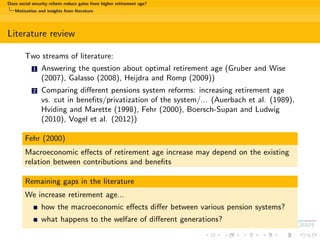
Literature review 
Two streams of literature: 
1 Answering the question about optimal retirement age (Gruber and Wise 
(2007), Galasso (2008), Heijdra and Romp (2009)) 
2 Comparing dierent pensions system reforms: increasing retirement age 
vs. cut in bene
ts/privatization of the system/... (Auerbach et al. (1989), 
Hviding and Marette (1998), Fehr (2000), Boersch-Supan and Ludwig 
(2010), Vogel et al. (2012)) 
Fehr (2000) 
Macroeconomic eects of retirement age increase may depend on the existing 
relation between contributions and bene
ts 
Remaining gaps in the literature 
We increase retirement age... 
how the macroeconomic eects dier between various pension systems? 
what happens to the welfare of dierent generations?
Does social security reform reduce gains from higher retirement age? 
Motivation and insights from literature 
Goals and expectations 
Goal 
Analyse macroeconomic and welfare implications of retirement age increase 
under DB (de
ned bene
t), NDC (notional de
ned contribution), and FDC 
(partially funded de
ned contribution) systems 
Tool 
OLG model with
rst steady state calibrated to re
ect Polish economy in 1999 
Expectations 
under DB: leisure #, taxes #, welfare? 
under NDC: leisure #, pensions , welfare? 
under FDC: leisure #, pensions , welfare? 
What else makes the results less predictable? ! Labor supply adjustments, 
general equilibrium eects...
Does social security reform reduce gains from higher retirement age? 
Model setup 
1 Motivation and insights from literature 
2 Model setup 
3 Calibration 
4 Baseline and reform scenarios 
5 Results 
Welfare 
Macroeconomic eects
Does social security reform reduce gains from higher retirement age? 
Model setup 
Model structure - consumer I 
is born at age J = 20 and lives up to J = 100 
optimizes lifetime utility derived from leisure and consumption: 
U0 = 
XJ 
j=1 
j1j;t1+juj (cj;t1+j ; lj;t1+j ) (1) 
where  is the time discounting factor and j;t denotes the unconditional 
probability of a household of having survived from birth to age j at time 
period t (accidental bequests are spreaded equally to all cohorts). 
The instantaneous utility function: 
u(c; l) =  log(c) + (1  ) log(1  l ), (2)
Does social security reform reduce gains from higher retirement age? 
Model setup 
Model structure - consumer II 
is paid a market clearing wage for labour supplied and receives market 
clearing interest on private savings 
is free to choose how much to work, but only until retirement age  J 
(forced to retire) 
The budget constraint of agent j in period t is given by: 
(1 + c;t )cj;t + sj;t + t = (1  l;t)(1    
j;t )wj;t lj;t   labor income (3) 
+ (1 + rt(1  k;t ))sj;t1   capital income 
+ (1  l;t )pj;t + bj;t   pensions and bequests
Does social security reform reduce gains from higher retirement age? 
Model setup 
Model structure - producer 
Firms solve the following problem: 
max 
(Yt ;Kt ;Lt ) 
Yt  wtLt  (r k 
t + d)Kt (4) 
t (ztLt )1 
s.t. Yt = K 
Standard
rm optimization implies: 
t (ztLt ) (there might be 
the average market wage wt = (1  )K 
heterogeneity between cohorts due to age-speci
c productivity, 
wj;t = !jwt ) 
interest rate r k 
t (ztLt )1  d, where d stands for depreciation 
t = K1
Does social security reform reduce gains from higher retirement age? 
Model setup 
Model structure - government 
collects social security contributions and pays out pensions of DB and 
NDC system 
subsidyt =  
t  wtLt  
XJ 
j=  J 
pj;tj;tNtj (5) 
collects taxes on earnings, interest and consumption + spends GDP
xed amount 
of money on unproductive (but necessary) activities + services debt 
Tt = l;t 
 
(1 
t )wtLt + 
XJ 
j=  Jt 
p 
j;tj;tNtj 
 
+ 
 
c;tct +k;t rt sj;t1 
XJ 
j=1 
j;tNtj : 
(6) 
Gt + subsidy 
t + rtDt1 = Tt + (Dt  Dt1) + t 
XJ 
j=1 
j;tNtj : (7) 
wants to maintain long run debt/GDP ratio
xed
Does social security reform reduce gains from higher retirement age? 
Calibration 
1 Motivation and insights from literature 
2 Model setup 
3 Calibration 
4 Baseline and reform scenarios 
5 Results 
Welfare 
Macroeconomic eects
Does social security reform reduce gains from higher retirement age? 
Calibration 
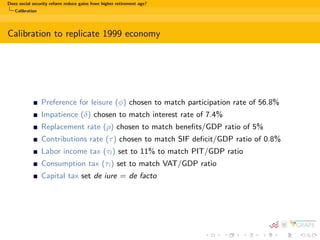
Calibration to replicate 1999 economy 
Preference for leisure () chosen to match participation rate of 56.8% 
Impatience () chosen to match interest rate of 7.4% 
Replacement rate () chosen to match bene
ts/GDP ratio of 5% 
Contributions rate ( ) chosen to match SIF de
cit/GDP ratio of 0.8% 
Labor income tax (l ) set to 11% to match PIT/GDP ratio 
Consumption tax (l ) set to match VAT/GDP ratio 
Capital tax set de iure = de facto
Does social security reform reduce gains from higher retirement age? 
Calibration 
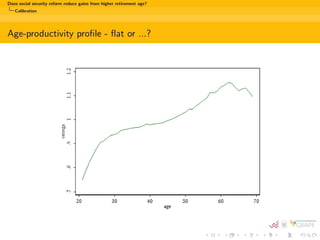
Age-productivity pro
le - 
at or ...?
Does social security reform reduce gains from higher retirement age? 
Calibration 
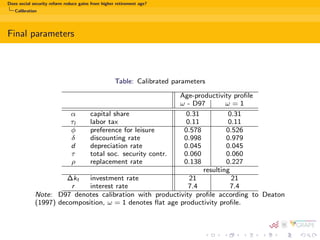
Final parameters 
Table: Calibrated parameters 
Age-productivity pro

Goraus eea

  • 1.
    Does social securityreform reduce gains from higher retirement age? Does social security reform reduce gains from higher retirement age? (with Joanna Tyrowicz and Krzysztof Makarski) Karolina Goraus PhD Candidate University of Warsaw EEA-ESEM Congress 28 August 2014
  • 2.
    Does social securityreform reduce gains from higher retirement age? Table of contents 1 Motivation and insights from literature 2 Model setup 3 Calibration 4 Baseline and reform scenarios 5 Results Welfare Macroeconomic eects
  • 3.
    Does social securityreform reduce gains from higher retirement age? Motivation and insights from literature Broad picture A scienti
  • 4.
    c project atthe University of Warsaw OLG modeling of the pension system reform in Poland Polish pension reform of 1999 the original system was a DB PAYG scheme then introduction of a three pillar system 1 notional de
  • 5.
    ned contribution (NDC)scheme ) managed by Social Insurance Fund (SIF) 2 fully funded DC (FDC) scheme ) managed by Open Pension Funds (OPFs) 3 voluntary pension schemes
  • 6.
    Does social securityreform reduce gains from higher retirement age? Motivation and insights from literature Motivation Current problems with pension systems: increasing old-age dependency ratio majority of pension systems fail to assure actuarial fairness in most countries people tend to retire as early as legally allowed Typical reform proposals switching to individual accounts' systems raising the social security contributions per worker introducing general
  • 7.
    scal contraction increasingminimum eligibility retirement age (MERA)
  • 8.
    Does social securityreform reduce gains from higher retirement age? Motivation and insights from literature Literature review Two streams of literature: 1 Answering the question about optimal retirement age (Gruber and Wise (2007), Galasso (2008), Heijdra and Romp (2009)) 2 Comparing dierent pensions system reforms: increasing retirement age vs. cut in bene
  • 9.
    ts/privatization of thesystem/... (Auerbach et al. (1989), Hviding and Marette (1998), Fehr (2000), Boersch-Supan and Ludwig (2010), Vogel et al. (2012)) Fehr (2000) Macroeconomic eects of retirement age increase may depend on the existing relation between contributions and bene
  • 10.
    ts Remaining gapsin the literature We increase retirement age... how the macroeconomic eects dier between various pension systems? what happens to the welfare of dierent generations?
  • 11.
    Does social securityreform reduce gains from higher retirement age? Motivation and insights from literature Goals and expectations Goal Analyse macroeconomic and welfare implications of retirement age increase under DB (de
  • 12.
  • 13.
  • 14.
    ned contribution), andFDC (partially funded de
  • 15.
    ned contribution) systems Tool OLG model with
  • 16.
    rst steady statecalibrated to re ect Polish economy in 1999 Expectations under DB: leisure #, taxes #, welfare? under NDC: leisure #, pensions , welfare? under FDC: leisure #, pensions , welfare? What else makes the results less predictable? ! Labor supply adjustments, general equilibrium eects...
  • 17.
    Does social securityreform reduce gains from higher retirement age? Model setup 1 Motivation and insights from literature 2 Model setup 3 Calibration 4 Baseline and reform scenarios 5 Results Welfare Macroeconomic eects
  • 18.
    Does social securityreform reduce gains from higher retirement age? Model setup Model structure - consumer I is born at age J = 20 and lives up to J = 100 optimizes lifetime utility derived from leisure and consumption: U0 = XJ j=1 j1j;t1+juj (cj;t1+j ; lj;t1+j ) (1) where is the time discounting factor and j;t denotes the unconditional probability of a household of having survived from birth to age j at time period t (accidental bequests are spreaded equally to all cohorts). The instantaneous utility function: u(c; l) = log(c) + (1 ) log(1 l ), (2)
  • 19.
    Does social securityreform reduce gains from higher retirement age? Model setup Model structure - consumer II is paid a market clearing wage for labour supplied and receives market clearing interest on private savings is free to choose how much to work, but only until retirement age J (forced to retire) The budget constraint of agent j in period t is given by: (1 + c;t )cj;t + sj;t + t = (1 l;t)(1 j;t )wj;t lj;t labor income (3) + (1 + rt(1 k;t ))sj;t1 capital income + (1 l;t )pj;t + bj;t pensions and bequests
  • 20.
    Does social securityreform reduce gains from higher retirement age? Model setup Model structure - producer Firms solve the following problem: max (Yt ;Kt ;Lt ) Yt wtLt (r k t + d)Kt (4) t (ztLt )1 s.t. Yt = K Standard
  • 21.
    rm optimization implies: t (ztLt ) (there might be the average market wage wt = (1 )K heterogeneity between cohorts due to age-speci
  • 22.
    c productivity, wj;t= !jwt ) interest rate r k t (ztLt )1 d, where d stands for depreciation t = K1
  • 23.
    Does social securityreform reduce gains from higher retirement age? Model setup Model structure - government collects social security contributions and pays out pensions of DB and NDC system subsidyt = t wtLt XJ j= J pj;tj;tNtj (5) collects taxes on earnings, interest and consumption + spends GDP
  • 24.
    xed amount ofmoney on unproductive (but necessary) activities + services debt Tt = l;t (1 t )wtLt + XJ j= Jt p j;tj;tNtj + c;tct +k;t rt sj;t1 XJ j=1 j;tNtj : (6) Gt + subsidy t + rtDt1 = Tt + (Dt Dt1) + t XJ j=1 j;tNtj : (7) wants to maintain long run debt/GDP ratio
  • 25.
  • 26.
    Does social securityreform reduce gains from higher retirement age? Calibration 1 Motivation and insights from literature 2 Model setup 3 Calibration 4 Baseline and reform scenarios 5 Results Welfare Macroeconomic eects
  • 27.
    Does social securityreform reduce gains from higher retirement age? Calibration Calibration to replicate 1999 economy Preference for leisure () chosen to match participation rate of 56.8% Impatience () chosen to match interest rate of 7.4% Replacement rate () chosen to match bene
  • 28.
    ts/GDP ratio of5% Contributions rate ( ) chosen to match SIF de
  • 29.
    cit/GDP ratio of0.8% Labor income tax (l ) set to 11% to match PIT/GDP ratio Consumption tax (l ) set to match VAT/GDP ratio Capital tax set de iure = de facto
  • 30.
    Does social securityreform reduce gains from higher retirement age? Calibration Age-productivity pro
  • 31.
    le - ator ...?
  • 32.
    Does social securityreform reduce gains from higher retirement age? Calibration Final parameters Table: Calibrated parameters Age-productivity pro