TayoFatokimi , Lola Koiki, Ryan Moore, and Lauren Wittig
Backgroundin ChinaChina has always been a relatively closed society that has tried to keep close controls on what its citizens experience in media.Google is a web search engine who is, “committed to providing easy access to as much information as possible.”This commitment is in direct conflict with the Chinese government’s goals.
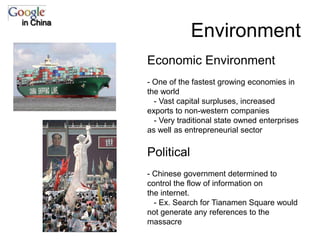
Environmentin ChinaEconomic Environment- One of the fastest growing economies in the world   - Vast capital surpluses, increased exports to non-western companies   - Very traditional state owned enterprises as well as entrepreneurial sectorPolitical- Chinese government determined to control the flow of information onthe internet.   - Ex. Search for Tianamen Square would not generate any references to the massacre
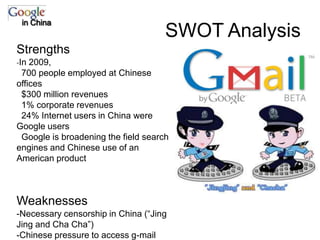
SWOT Analysisin ChinaStrengths-In 2009,  700 people employed at Chinese offices  $300 million revenues  1% corporate revenues  24% Internet users in China were Google users  Google is broadening the field search engines and Chinese use of an American productWeaknesses-Necessary censorship in China (“Jing Jing and Cha Cha”) -Chinese pressure to access g-mail accounts 
SWOT Analysisin ChinaOpportunities-If Google were to break away from China, they would be missing out ofone of the largest growing economies.-Losing the Chinese market would hurt global strategy, if they stay inChina, there will be more global connections.-Make money, keep business, keep employees-The need for information across ALL borders (if you exclude China,that's unfair, and who's next?)-Should respect China's customs and traditions. The world knows what ishappening, Chinese are aware of the censorship and will continue with their ways. Threats-Diminishing of free speech due to censorship-Human rights at stake-Sacrifice democracy
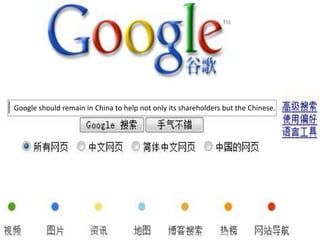
Our PositionGoogle should remain in China to help not only its shareholders but the Chinese.
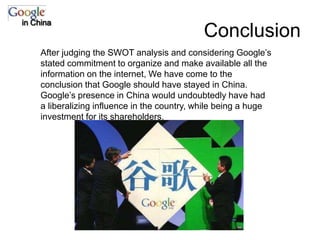
Conclusionin ChinaAfter judging the SWOT analysis and considering Google’s stated commitment to organize and make available all the information on the internet, We have come to the conclusion that Google should have stayed in China.  Google’s presence in China would undoubtedly have had a liberalizing influence in the country, while being a huge investment for its shareholders.

Google in china case study

  • 1.
    TayoFatokimi , LolaKoiki, Ryan Moore, and Lauren Wittig
  • 2.
    Backgroundin ChinaChina hasalways been a relatively closed society that has tried to keep close controls on what its citizens experience in media.Google is a web search engine who is, “committed to providing easy access to as much information as possible.”This commitment is in direct conflict with the Chinese government’s goals.
  • 3.
    Environmentin ChinaEconomic Environment-One of the fastest growing economies in the world   - Vast capital surpluses, increased exports to non-western companies   - Very traditional state owned enterprises as well as entrepreneurial sectorPolitical- Chinese government determined to control the flow of information onthe internet.   - Ex. Search for Tianamen Square would not generate any references to the massacre
  • 4.
    SWOT Analysisin ChinaStrengths-In2009,  700 people employed at Chinese offices  $300 million revenues  1% corporate revenues  24% Internet users in China were Google users  Google is broadening the field search engines and Chinese use of an American productWeaknesses-Necessary censorship in China (“Jing Jing and Cha Cha”) -Chinese pressure to access g-mail accounts 
  • 5.
    SWOT Analysisin ChinaOpportunities-IfGoogle were to break away from China, they would be missing out ofone of the largest growing economies.-Losing the Chinese market would hurt global strategy, if they stay inChina, there will be more global connections.-Make money, keep business, keep employees-The need for information across ALL borders (if you exclude China,that's unfair, and who's next?)-Should respect China's customs and traditions. The world knows what ishappening, Chinese are aware of the censorship and will continue with their ways. Threats-Diminishing of free speech due to censorship-Human rights at stake-Sacrifice democracy
  • 6.
    Our PositionGoogle shouldremain in China to help not only its shareholders but the Chinese.
  • 7.
    Conclusionin ChinaAfter judgingthe SWOT analysis and considering Google’s stated commitment to organize and make available all the information on the internet, We have come to the conclusion that Google should have stayed in China. Google’s presence in China would undoubtedly have had a liberalizing influence in the country, while being a huge investment for its shareholders.