PRESTIGE INSTITUTE OF MANAGEMENT
AND RESEARCH
Submitted To:
Dr. Alok Bansal
Submitted By:
Anubha Bhatnagar
Divya Dubey
Irfan Ali
Shweta Patel
Urja Jain
E-Business Fundamentals
Presentation on
E-Business model of GOOGLE
Introduction :-
• Google is the world's most popular search engine.
• It began as a search project in 1996 by Larry Page and
Sergey Brin.
• Every day more than 200 million (200,000,000) people
use it.
• Revenue: 89.46 billion USD.
Conti..
• In August 2015, Google announced
plans to reorganize its various interests
as a conglomerate called Alphabet Inc.
• Mission :- "organize the world's information
and make it universally accessible and useful.“
• Vision:- To make search engine so powerful
that they understand every thing.
Rationale
• Through our study people will understand
how the best company to work for in the
world actually earns and generate revenue.
Objective
• To study the E-Business Model of Google.
• To understand how Google generates
revenue.
• To know how Google worked on different
models .
Analysis of Google
• Type of company: Public.
• Industry: Internet, Computer software, Telecoms
equipment.
• Major sector: Advertising ,search engine and
cloud computing.
• Primary revenue source: Advertising.
Google product offering
Google provided service
• Google AdSense - A service that pays website
publishers or blog developers to show
advertisements on their site.
• Google AdWords - Service that enables users to
pay to advertise on the Google search engine and
other websites using Google AdSense.
Google provided service
• Android - The most widely used operating system for
Smartphone.
• Blogger - View and create your own blog.
• Chromebook - Laptop using the Google ChromeOS.
• ChromeOS - Operating system developed by Google for
laptop and portable computers.
• Froogle - Search for products based on prices, location,
type, etc.
• Gmail - Free online e-mail service with over 1gb of
storage and the best Spam protection available.
• Google+ - Google social networking site.
Google provided service
• Google Images - Google search that allows you to
search for images instead of text.
• Google Mail - More well known as Gmail, is one of the
most popular email hosts.
• Google Maps - A great feature that enables users to
search for directions from one location to another,
search for local businesses, and more.
• Google Translator - Translate a foreign language web
page or text into your language.
• YouTube - Video service that allows users to freely
upload videos and view others videos.
• Google didn’t stopped at this it has started hardware
segment also.
Description of E-Business Model
• Initial Business Model (Algorithmic Search
Technology Development)
Content
Providers
Content
Providers
Content
Providers
Users
Users
Users
Users
Initial Business Model (Algorithmic
Search Technology Development)
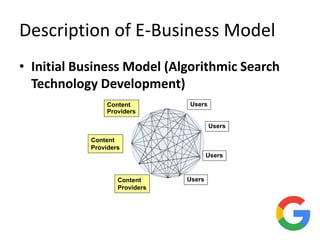
• Initially google started as search engine,where it can
provide the information searched on its search engine
• As shown in the above diagram,content provider and
users were linked via a platform called search engine
• Via this google helped in connecting data to users.
• Earned revenue solely through proprietary licensing its
search technology to Yahoo and other 3rd parties
• Google’s website contained no portal, communications,
tools, or advertising content
• Google soon became the leader in algorithmic search
technology and stood well positioned to move toward
the more robust business model of paid listings, which
further monetized search technology.
Description of E-Business Model
• Expanded Business Model (Search Engine
Funded by Paid Listings)
Expanded Business Model (Search
Engine Funded by Paid Listings)
• As shown in the above model as compared to previous model one more
element was added i.e. advertisers.
• It helped Google to generate revenue via paid listings.
• In this model Google formed a network of advertisers, users, content
providers and via this network this elements of model can exchange the
information to their advantage
• Search technology becomes a critical component of Paid Listings as
“search engine ads deemed more effective for marketers” than banner
ads
• Leveraging its strength in algorithm design, Google adopts a variant of
“cost-per-click” that incorporates “expected click-through-rate” into the
ranking of ads to help ensure the viewer saw the most relevant ads first.
• Google’s new algorithm not only provides better service to marketers, but
also increases Google’s revenue through better conversion rates.
Factors to Google’s Success
• Corporate environment attracts top talent, fosters innovation,
and promotes some risk taking has made Google a leader in
both algorithm search technology as well as strategically
significant virtual applications.
• Governance - Google maintains a corporate structure designed
for the long-term horizons with some independence from Wall
Street
• Corporate Values – Google’s values and unconventional
management practice promote trust among employees and
clients by providing commitment to leading-edge technology
driven solutions.
• Managing Innovation – Google’s resource allocation promotes
risk taking and “bottom-up” innovation, which tends to driver
high-reward projects with larger margins.
Implications
• Help the researchers and students to understand
the various google models and how they work.
• Shows how Google evolved into giant by working
on different areas, by this students and
researchers can innovate and work on further
improving the existing search engine model.
• This study will give a insight about the various
services provided by google.
• Can help student and researchers that how the
paid listings work and by this paid listing how
google earns money.
Conclusion
This minor research project on Google E-Business
model was very helpful for business understanding.
We get to know about how the fastest search Engine
works and generates revenue. Various model of
business are useful to understand how e-business
happens in contemporary world.
Google

Google

  • 1.
    PRESTIGE INSTITUTE OFMANAGEMENT AND RESEARCH Submitted To: Dr. Alok Bansal Submitted By: Anubha Bhatnagar Divya Dubey Irfan Ali Shweta Patel Urja Jain E-Business Fundamentals Presentation on E-Business model of GOOGLE
  • 2.
    Introduction :- • Googleis the world's most popular search engine. • It began as a search project in 1996 by Larry Page and Sergey Brin. • Every day more than 200 million (200,000,000) people use it. • Revenue: 89.46 billion USD.
  • 3.
    Conti.. • In August2015, Google announced plans to reorganize its various interests as a conglomerate called Alphabet Inc. • Mission :- "organize the world's information and make it universally accessible and useful.“ • Vision:- To make search engine so powerful that they understand every thing.
  • 4.
    Rationale • Through ourstudy people will understand how the best company to work for in the world actually earns and generate revenue.
  • 5.
    Objective • To studythe E-Business Model of Google. • To understand how Google generates revenue. • To know how Google worked on different models .
  • 6.
    Analysis of Google •Type of company: Public. • Industry: Internet, Computer software, Telecoms equipment. • Major sector: Advertising ,search engine and cloud computing. • Primary revenue source: Advertising.
  • 7.
  • 8.
    Google provided service •Google AdSense - A service that pays website publishers or blog developers to show advertisements on their site. • Google AdWords - Service that enables users to pay to advertise on the Google search engine and other websites using Google AdSense.
  • 9.
    Google provided service •Android - The most widely used operating system for Smartphone. • Blogger - View and create your own blog. • Chromebook - Laptop using the Google ChromeOS. • ChromeOS - Operating system developed by Google for laptop and portable computers. • Froogle - Search for products based on prices, location, type, etc. • Gmail - Free online e-mail service with over 1gb of storage and the best Spam protection available. • Google+ - Google social networking site.
  • 10.
    Google provided service •Google Images - Google search that allows you to search for images instead of text. • Google Mail - More well known as Gmail, is one of the most popular email hosts. • Google Maps - A great feature that enables users to search for directions from one location to another, search for local businesses, and more. • Google Translator - Translate a foreign language web page or text into your language. • YouTube - Video service that allows users to freely upload videos and view others videos. • Google didn’t stopped at this it has started hardware segment also.
  • 11.
    Description of E-BusinessModel • Initial Business Model (Algorithmic Search Technology Development) Content Providers Content Providers Content Providers Users Users Users Users
  • 12.
    Initial Business Model(Algorithmic Search Technology Development) • Initially google started as search engine,where it can provide the information searched on its search engine • As shown in the above diagram,content provider and users were linked via a platform called search engine • Via this google helped in connecting data to users. • Earned revenue solely through proprietary licensing its search technology to Yahoo and other 3rd parties • Google’s website contained no portal, communications, tools, or advertising content • Google soon became the leader in algorithmic search technology and stood well positioned to move toward the more robust business model of paid listings, which further monetized search technology.
  • 13.
    Description of E-BusinessModel • Expanded Business Model (Search Engine Funded by Paid Listings)
  • 14.
    Expanded Business Model(Search Engine Funded by Paid Listings) • As shown in the above model as compared to previous model one more element was added i.e. advertisers. • It helped Google to generate revenue via paid listings. • In this model Google formed a network of advertisers, users, content providers and via this network this elements of model can exchange the information to their advantage • Search technology becomes a critical component of Paid Listings as “search engine ads deemed more effective for marketers” than banner ads • Leveraging its strength in algorithm design, Google adopts a variant of “cost-per-click” that incorporates “expected click-through-rate” into the ranking of ads to help ensure the viewer saw the most relevant ads first. • Google’s new algorithm not only provides better service to marketers, but also increases Google’s revenue through better conversion rates.
  • 16.
    Factors to Google’sSuccess • Corporate environment attracts top talent, fosters innovation, and promotes some risk taking has made Google a leader in both algorithm search technology as well as strategically significant virtual applications. • Governance - Google maintains a corporate structure designed for the long-term horizons with some independence from Wall Street • Corporate Values – Google’s values and unconventional management practice promote trust among employees and clients by providing commitment to leading-edge technology driven solutions. • Managing Innovation – Google’s resource allocation promotes risk taking and “bottom-up” innovation, which tends to driver high-reward projects with larger margins.
  • 17.
    Implications • Help theresearchers and students to understand the various google models and how they work. • Shows how Google evolved into giant by working on different areas, by this students and researchers can innovate and work on further improving the existing search engine model. • This study will give a insight about the various services provided by google. • Can help student and researchers that how the paid listings work and by this paid listing how google earns money.
  • 18.
    Conclusion This minor researchproject on Google E-Business model was very helpful for business understanding. We get to know about how the fastest search Engine works and generates revenue. Various model of business are useful to understand how e-business happens in contemporary world.

Editor's Notes

  • #3 Google has become such a popular search engine that the term "Google" is now often used as a verb, synonymous with "search."
  • #4 Parent organization: Alphabet Inc. Sundar Pichai became CEO of Google, replacing Larry Page, who became CEO of Alphabet
  • #7 Primary revenue source: Advertising(97%)
  • #14 As shown in the above model as compared to previous model one more element was added i.e. advertisers. It helped Google to generate revenue via paid listings. In this model Google formed a network of advertisers, users, content providers and via this network this elements of model can exchange the information to their advantage Search technology becomes a critical component of Paid Listings as “search engine ads deemed more effective for marketers” than banner ads Leveraging its strength in algorithm design, Google adopts a variant of “cost-per-click” that incorporates “expected click-through-rate” into the ranking of ads to help ensure the viewer saw the most relevant ads first. Google’s new algorithm not only provides better service to marketers, but also increases Google’s revenue through better conversion rates. Google expands into “contextual” paid listings, Gmail, Portal offerings (iGoogle)