NAME: SHAIKH HABEEBA SUFYAN
TOPIC : GLYCOSIDE
CLASS:M PHARM 1ST YEAR (1ST SEM)
DEPARTMENT: PHARMACOGNOSY
GUIDED BY :PROF.S.R.VIKHE
CONTENT
Glycoside
Glycyrrhizin
Sennoside
Bacoside
Quercitin
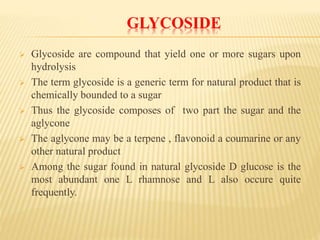
GLYCOSIDE
 Glycoside are compound that yield one or more sugars upon
hydrolysis
 The term glycoside is a generic term for natural product that is
chemically bounded to a sugar
 Thus the glycoside composes of two part the sugar and the
aglycone
 The aglycone may be a terpene , flavonoid a coumarine or any
other natural product
 Among the sugar found in natural glycoside D glucose is the
most abundant one L rhamnose and L also occure quite
frequently.
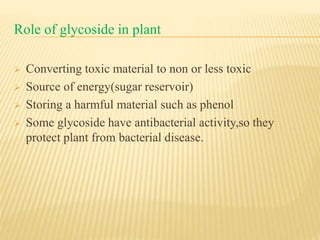
Role of glycoside in plant
 Converting toxic material to non or less toxic
 Source of energy(sugar reservoir)
 Storing a harmful material such as phenol
 Some glycoside have antibacterial activity,so they
protect plant from bacterial disease.
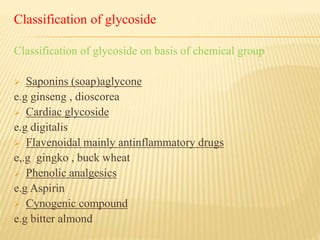
Classification of glycoside
Classification of glycoside on basis of chemical group
 Saponins (soap)aglycone
e.g ginseng , dioscorea
 Cardiac glycoside
e.g digitalis
 Flavenoidal mainly antinflammatory drugs
e,.g gingko , buck wheat
 Phenolic analgesics
e.g Aspirin
 Cynogenic compound
e.g bitter almond
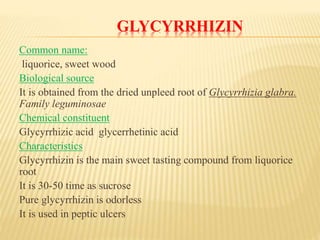
GLYCYRRHIZIN
Common name:
liquorice, sweet wood
Biological source
It is obtained from the dried unpleed root of Glycyrrhizia glabra.
Family leguminosae
Chemical constituent
Glycyrrhizic acid glycerrhetinic acid
Characteristics
Glycyrrhizin is the main sweet tasting compound from liquorice
root
It is 30-50 time as sucrose
Pure glycyrrhizin is odorless
It is used in peptic ulcers
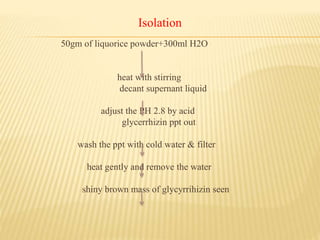
Isolation
50gm of liquorice powder+300ml H2O
heat with stirring
decant supernant liquid
adjust the PH 2.8 by acid
glycerrhizin ppt out
wash the ppt with cold water & filter
heat gently and remove the water
shiny brown mass of glycyrrihizin seen
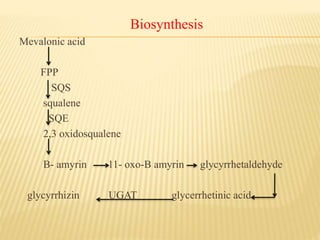
Biosynthesis
Mevalonic acid
FPP
SQS
squalene
SQE
2,3 oxidosqualene
B- amyrin 11- oxo-B amyrin glycyrrhetaldehyde
glycyrrhizin UGAT glycerrhetinic acid
SENNOSIDE
Common Name :
senna leaf, cassia senna
Biological source :
It consist of dried leaflet of cassia angustifolia
Family : leguminosae
Chemical constituents :
Sennoside A and sennoside b
Use:
Use as laxative
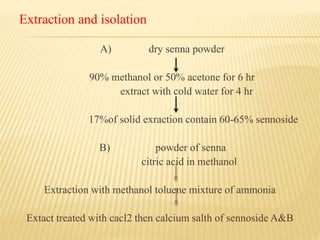
Extraction and isolation
A) dry senna powder
90% methanol or 50% acetone for 6 hr
extract with cold water for 4 hr
17%of solid exraction contain 60-65% sennoside
B) powder of senna
citric acid in methanol
Extraction with methanol toluene mixture of ammonia
Extact treated with cacl2 then calcium salth of sennoside A&B
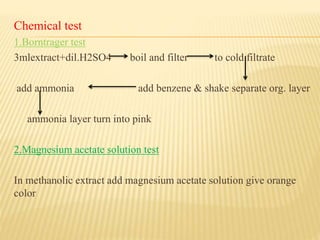
Chemical test
1.Borntrager test
3mlextract+dil.H2SO4 boil and filter to cold filtrate
add ammonia add benzene & shake separate org. layer
ammonia layer turn into pink
2.Magnesium acetate solution test
In methanolic extract add magnesium acetate solution give orange
color
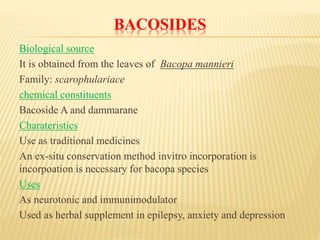
BACOSIDES
Biological source
It is obtained from the leaves of Bacopa mannieri
Family: scarophulariace
chemical constituents
Bacoside A and dammarane
Charateristics
Use as traditional medicines
An ex-situ conservation method invitro incorporation is
incorpoation is necessary for bacopa species
Uses
As neurotonic and immunimodulator
Used as herbal supplement in epilepsy, anxiety and depression
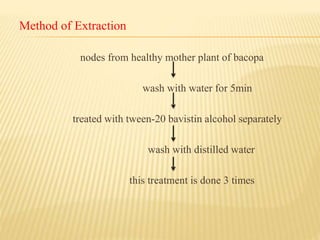
Method of Extraction
nodes from healthy mother plant of bacopa
wash with water for 5min
treated with tween-20 bavistin alcohol separately
wash with distilled water
this treatment is done 3 times
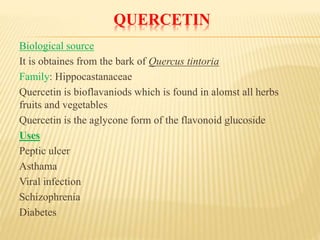
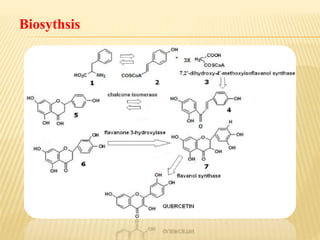
QUERCETIN
Biological source
It is obtaines from the bark of Quercus tintoria
Family: Hippocastanaceae
Quercetin is bioflavaniods which is found in alomst all herbs
fruits and vegetables
Quercetin is the aglycone form of the flavonoid glucoside
Uses
Peptic ulcer
Asthama
Viral infection
Schizophrenia
Diabetes
Biosythsis
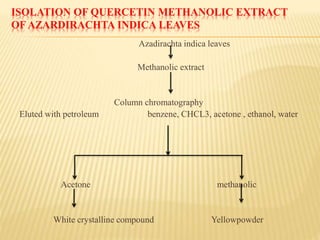
ISOLATION OF QUERCETIN METHANOLIC EXTRACT
OF AZARDIRACHTA INDICA LEAVES
Azadirachta indica leaves
Methanolic extract
Column chromatography
Eluted with petroleum benzene, CHCL3, acetone , ethanol, water
Acetone methanolic
White crystalline compound Yellowpowder
REFERENCE
1) Brito-Arias, Marco (2007). Synthesis and Characterization of
Glycosides. Springer. ISBN 978-0-387-26251-2
2) Kumar, V., Mukherjee, K., Kumar, S., Mal, M., & Mukherjee,
P.K. (2008) Phytochem. Anal. 19, 244–250
3) Anonymous (2002) Indian Herbal Pharmacopoeia, Joint
Publication of Indian Drug Manufacturer’s Association,Mumbai
and Regional Research Laboratory, Jammu-Tawi,India
4) Majumdar; et al. (2013). "Bacosides and
Neuroprotection". Natural Products: 3639–3660.
5) Russo; Borrelli (2005). "Bacopa monniera, a reputed
nootropic plant: an overview". Phytomedicine. 12 (4): 305–
317.
6) Hota, SK; Barhwal, K; Baitharu, I; Prasad, D; Singh, SB;
Ilavazhagan, G (2009). "Bacopa monniera leaf extract
ameliorates hypobaric hypoxia induced spatial memory
impairment". Neurobiol Dis. 34 (1): 23–39
THANK YOU

Glycoside 2

  • 1.
    NAME: SHAIKH HABEEBASUFYAN TOPIC : GLYCOSIDE CLASS:M PHARM 1ST YEAR (1ST SEM) DEPARTMENT: PHARMACOGNOSY GUIDED BY :PROF.S.R.VIKHE
  • 2.
  • 3.
    GLYCOSIDE  Glycoside arecompound that yield one or more sugars upon hydrolysis  The term glycoside is a generic term for natural product that is chemically bounded to a sugar  Thus the glycoside composes of two part the sugar and the aglycone  The aglycone may be a terpene , flavonoid a coumarine or any other natural product  Among the sugar found in natural glycoside D glucose is the most abundant one L rhamnose and L also occure quite frequently.
  • 4.
    Role of glycosidein plant  Converting toxic material to non or less toxic  Source of energy(sugar reservoir)  Storing a harmful material such as phenol  Some glycoside have antibacterial activity,so they protect plant from bacterial disease.
  • 5.
    Classification of glycoside Classificationof glycoside on basis of chemical group  Saponins (soap)aglycone e.g ginseng , dioscorea  Cardiac glycoside e.g digitalis  Flavenoidal mainly antinflammatory drugs e,.g gingko , buck wheat  Phenolic analgesics e.g Aspirin  Cynogenic compound e.g bitter almond
  • 6.
    GLYCYRRHIZIN Common name: liquorice, sweetwood Biological source It is obtained from the dried unpleed root of Glycyrrhizia glabra. Family leguminosae Chemical constituent Glycyrrhizic acid glycerrhetinic acid Characteristics Glycyrrhizin is the main sweet tasting compound from liquorice root It is 30-50 time as sucrose Pure glycyrrhizin is odorless It is used in peptic ulcers
  • 7.
    Isolation 50gm of liquoricepowder+300ml H2O heat with stirring decant supernant liquid adjust the PH 2.8 by acid glycerrhizin ppt out wash the ppt with cold water & filter heat gently and remove the water shiny brown mass of glycyrrihizin seen
  • 8.
    Biosynthesis Mevalonic acid FPP SQS squalene SQE 2,3 oxidosqualene B-amyrin 11- oxo-B amyrin glycyrrhetaldehyde glycyrrhizin UGAT glycerrhetinic acid
  • 9.
    SENNOSIDE Common Name : sennaleaf, cassia senna Biological source : It consist of dried leaflet of cassia angustifolia Family : leguminosae Chemical constituents : Sennoside A and sennoside b Use: Use as laxative
  • 10.
    Extraction and isolation A)dry senna powder 90% methanol or 50% acetone for 6 hr extract with cold water for 4 hr 17%of solid exraction contain 60-65% sennoside B) powder of senna citric acid in methanol Extraction with methanol toluene mixture of ammonia Extact treated with cacl2 then calcium salth of sennoside A&B
  • 13.
    Chemical test 1.Borntrager test 3mlextract+dil.H2SO4boil and filter to cold filtrate add ammonia add benzene & shake separate org. layer ammonia layer turn into pink 2.Magnesium acetate solution test In methanolic extract add magnesium acetate solution give orange color
  • 14.
    BACOSIDES Biological source It isobtained from the leaves of Bacopa mannieri Family: scarophulariace chemical constituents Bacoside A and dammarane Charateristics Use as traditional medicines An ex-situ conservation method invitro incorporation is incorpoation is necessary for bacopa species Uses As neurotonic and immunimodulator Used as herbal supplement in epilepsy, anxiety and depression
  • 15.
    Method of Extraction nodesfrom healthy mother plant of bacopa wash with water for 5min treated with tween-20 bavistin alcohol separately wash with distilled water this treatment is done 3 times
  • 16.
    QUERCETIN Biological source It isobtaines from the bark of Quercus tintoria Family: Hippocastanaceae Quercetin is bioflavaniods which is found in alomst all herbs fruits and vegetables Quercetin is the aglycone form of the flavonoid glucoside Uses Peptic ulcer Asthama Viral infection Schizophrenia Diabetes
  • 17.
  • 18.
    ISOLATION OF QUERCETINMETHANOLIC EXTRACT OF AZARDIRACHTA INDICA LEAVES Azadirachta indica leaves Methanolic extract Column chromatography Eluted with petroleum benzene, CHCL3, acetone , ethanol, water Acetone methanolic White crystalline compound Yellowpowder
  • 19.
    REFERENCE 1) Brito-Arias, Marco(2007). Synthesis and Characterization of Glycosides. Springer. ISBN 978-0-387-26251-2 2) Kumar, V., Mukherjee, K., Kumar, S., Mal, M., & Mukherjee, P.K. (2008) Phytochem. Anal. 19, 244–250 3) Anonymous (2002) Indian Herbal Pharmacopoeia, Joint Publication of Indian Drug Manufacturer’s Association,Mumbai and Regional Research Laboratory, Jammu-Tawi,India
  • 20.
    4) Majumdar; etal. (2013). "Bacosides and Neuroprotection". Natural Products: 3639–3660. 5) Russo; Borrelli (2005). "Bacopa monniera, a reputed nootropic plant: an overview". Phytomedicine. 12 (4): 305– 317. 6) Hota, SK; Barhwal, K; Baitharu, I; Prasad, D; Singh, SB; Ilavazhagan, G (2009). "Bacopa monniera leaf extract ameliorates hypobaric hypoxia induced spatial memory impairment". Neurobiol Dis. 34 (1): 23–39
  • 21.