Advanced O/R Mapping with Glorp
Alan Knight (knight@acm.org)
Cincom Systems of Canada
Metaphor/Motivating Example
Ruby on Rails/ActiveRecord
Reading Database Schema
» Some interesting mapping issues
Creating Mappings Dynamically
» Conventions/Grammar
APIs
» Querying
» Globals, Singletons, Transactions
Schema Evolution
Web Integration
Ruby on Rails
“Opinionated software”
Rails
Go really fast, but only in one direction
Reaction against J2EE/.NET
“Greenfield” projects
Ruby-Based
Smalltalk-like, scripting language
Some very Smalltalkish “tricks” in rails
ActiveRecord pattern for persistence
Architecture: Glorp and ActiveRecord
Metadata vs. convention-driven
Glorp: Explicit metadata
Tables
Classes
Descriptors/Mappings
ActiveRecord
Strict naming conventions
Aware of language forms
Hints at the class level
Code Generation (mostly for web)
Brokers
Glorp
Single broker (session)
» Responsible for object identity
» Manages automatic writes
Multiple clients use multiple sessions
Independent of other frameworks
ActiveRecord
Classes as brokers
» No object identity
» Single global session
Explicit writes
Tightly integrated with web framework
Domain Model
Glorp
No metadata in domain classes
Premium on flexibility, ability to optimize
Expect existing classes, schema
ActiveRecord
Premium on simplicity
Minimal metadata, but on domain classes
May not even be a domain model
» Use ActiveRecord directly
» Instance variables as properties
Goal
Can we provide some of the benefits,
but without losing our advantages
“Hyperactive Records”
Automatic persistence
Convention-driven
But be less restrictive
Use a bit more information (constraints)
Allow a graceful transition
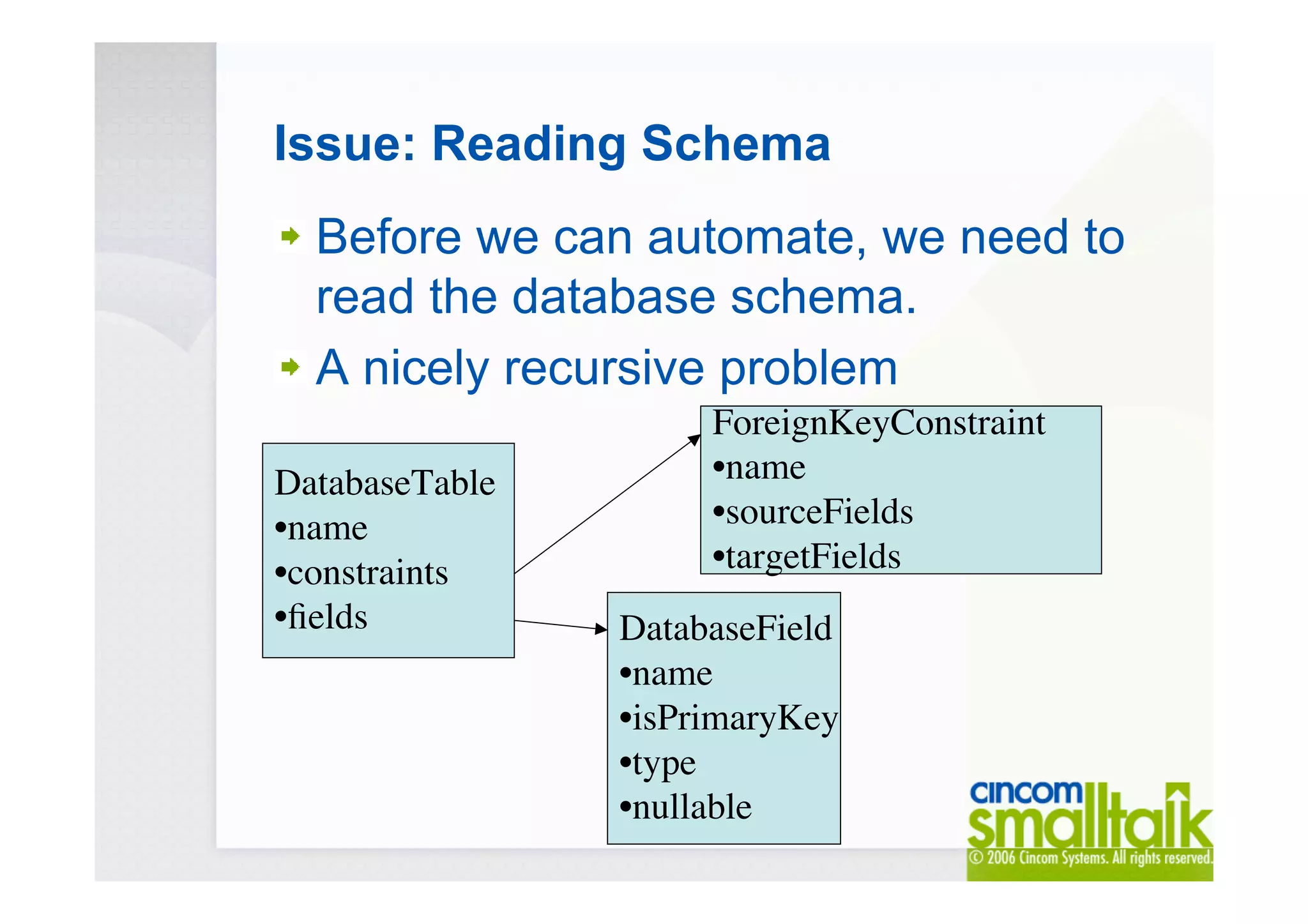
Issue: Reading Schema
Before we can automate, we need to
read the database schema.
A nicely recursive problem
DatabaseTable
•name
•constraints
•fields DatabaseField
•name
•isPrimaryKey
•type
•nullable
ForeignKeyConstraint
•name
•sourceFields
•targetFields
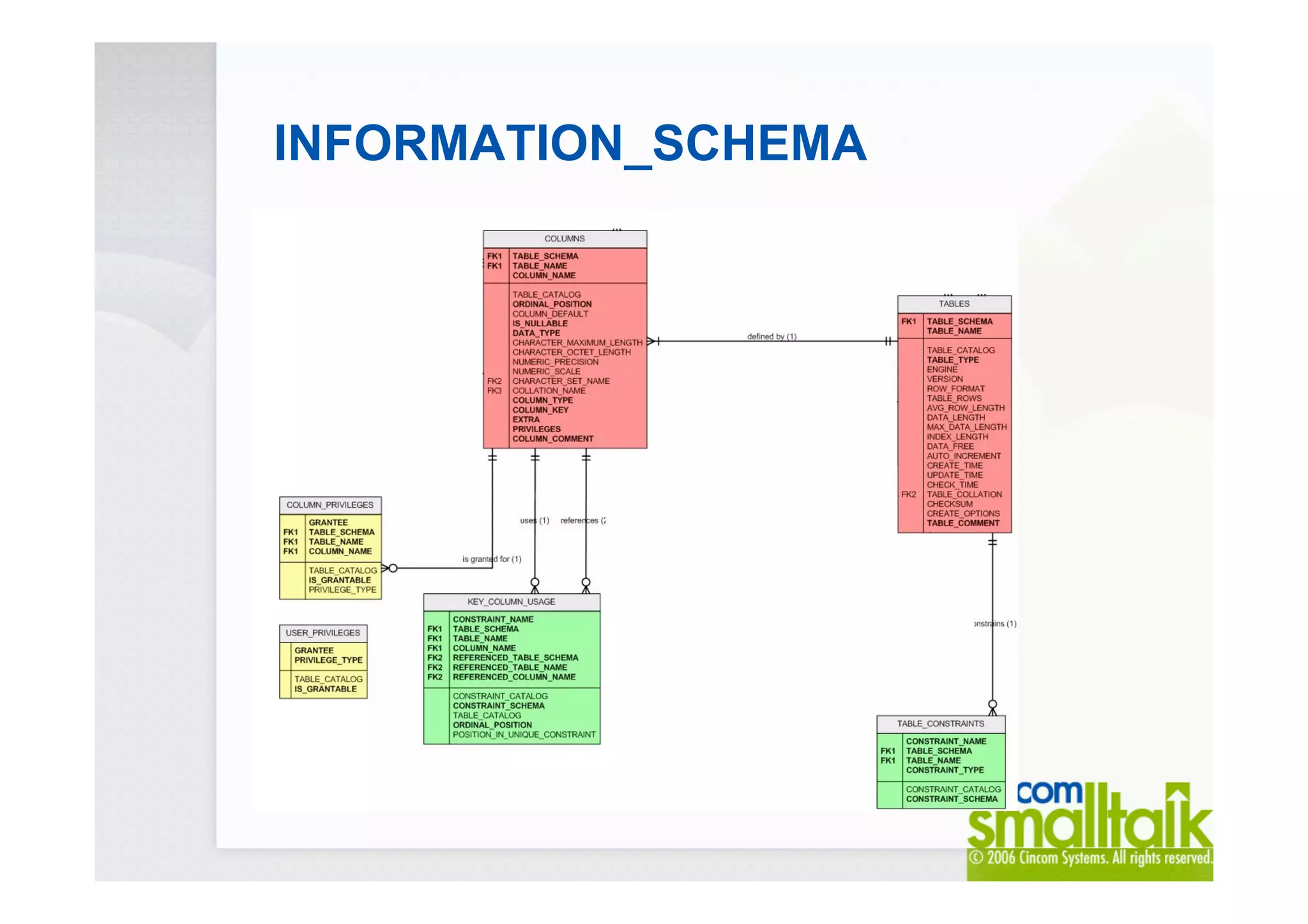
INFORMATION_SCHEMA
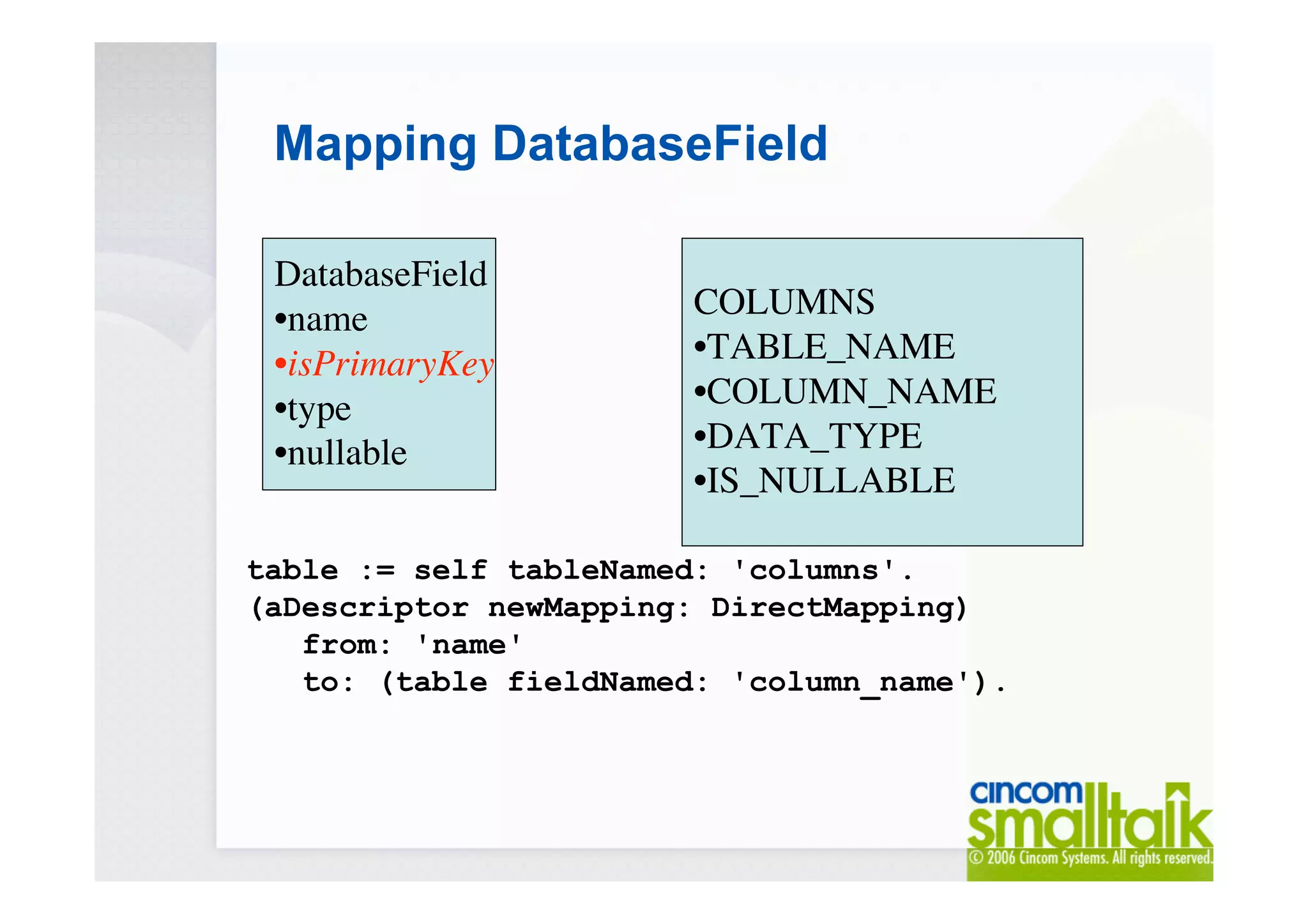
Mapping DatabaseField
DatabaseField
•name
•isPrimaryKey
•type
•nullable
table := self tableNamed: 'columns'.
(aDescriptor newMapping: DirectMapping)
from: 'name'
to: (table fieldNamed: 'column_name').
COLUMNS
•TABLE_NAME
•COLUMN_NAME
•DATA_TYPE
•IS_NULLABLE
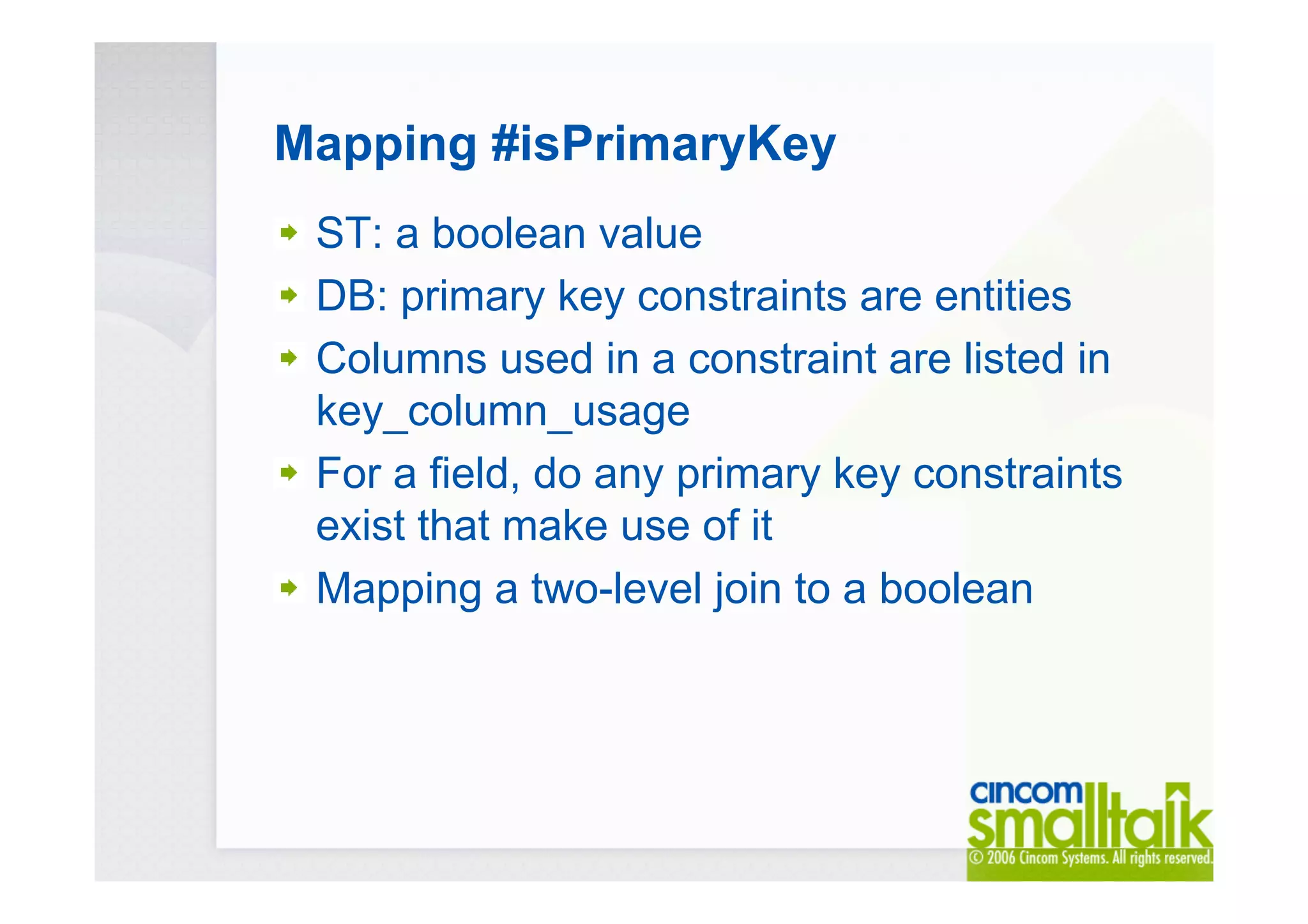
Mapping #isPrimaryKey
ST: a boolean value
DB: primary key constraints are entities
Columns used in a constraint are listed in
key_column_usage
For a field, do any primary key constraints
exist that make use of it
Mapping a two-level join to a boolean
Mapping #isPrimaryKey
(aDescriptor newMapping: DirectMapping)
from: #isPrimaryKey
to: [:each |
each primaryKeyConstraints notEmpty].
Direct mapping, but to an expression
“each” is the field we’re referring to
primaryKeyConstraints is another
relationship
notEmpty is a subselect operation
Subselects
In queries, several “collection” operations
that turn into different kinds of subselects
isEmpty/notEmpty
select:
anySatisfy:/noneSatisfy:
sqlCount (also aggregation)
read: Customer
where: [:each |
(each orders select: [:order |
order amount > 1000])
sqlCount > 5].
Reading Schema Summary
sourceFields and targetFields worse
Information_schema variations, limits
Works for Oracle, Postgresql, MySQL
No changes at all to the domain model
But easier because read-only
Several pseudoVariables
Good motivation for automatic
mapping
Back to ActiveRecord
Glorp metadata
defined in DescriptorSystem
Methods for tables, classes, mapping
E.g. #descriptorForCustomer:
Lists allTables, allClasses
ActiveRecord DescriptorSystem
All subclasses of ActiveRecord
Read allTables from the database
For each class name, find table name
Find link tables from constraints or hints
For each inst var/field name, figure out
the mapping
Naming convention
Database constraints
Aside: Inflector
Ruby on Rails class
Knows basic grammar forms (English)
Knows class/inst var/field/table naming
and capitalization
Person class -> PEOPLE table
OVERDUE_ORDER_ID -> overdueOrder
Big ball of regular expressions
Aside: Hints
Ruby on Rails uses class data to tell it
how to create relationships that are
ambiguous
hasMany, hasAndBelongsToMany
tableNames (added)
Aside: Class Generation
Generate a package
Class for each database table
Filtered
Empty descriptor system with root
class
Incremental Setup
We want to do as little work as
necessary
How to “tweak” an automatically
generated mapping
#mappingNamed:do:
self mappingNamed: #bankCode do:
[:mapping | mapping type: Integer].
Rails Migrations
Define tables in Ruby code
Multiple versions, ordered by naming
convention
First version full
Subsequent versions define how to
upgrade and downgrade
In the database, store a version
number for the schema
Run the instructions in sequence
Smalltalk Migrations
We have full metadata definition of
tables
Keep multiple classes
Subclasses?
Modify the schema to conform to the
newest
Prototype level
No upgrading instructions, can lose data
Jumps directly from one to the other
Web Integration
Equivalent to automatic web forms
MagritteGlorp (Ramon Leon)
Extend Magritte with additional
information about relationship types
Generate Glorp descriptors based on
Magritte metadata
Web Integration
GlorpActiveRecordMagritteSupport
Magritte metadata based on Glorp
Assume Magritte editor based on data
type
Glorp metadata based on database
References
GLORP
http://www.glorp.org
http://glorp.sourceforge.net
Ruby on Rails
http://www.rubyonrails.org/
Lots of other links
The End
Subselects
In SQL terms, a nested query
Many different uses
tend to make the brain hurt
Glorp provides various shortcuts for
specific Smalltalk semantics, plus a
general mechanism
sometimes also make the brain hurt
still settling on semantics, naming
Subselect Example
e.g.
… where: [:each | each members
anySatisfy: [:eachMember | eachMember
name like: 'Alan%']].
SELECT <project fields>
FROM PROJECT t1
WHERE EXISTS (
SELECT <whatever> FROM MEMBER s1t1 WHERE
s1t1.proj_id = t1.id)
Aggregating
Two forms of aggregating
At the query level
aQuery retrieve: [:each | each value sum]
Puts an aggregate into the fields of the SQL
SELECT ... SUM(t1.value)
Within a where clause
where: [:each | (each value sqlSum) > 10]
Creates a subselect of that aggregate
SELECT ... WHERE (SELECT
SUM(s1t1.value) FROM ... WHERE ...)
> 10
min, max, average, count, etc.
Still More Aggregating
Also within a where clause
expression count: [:x | x attribute]
or more generally
expression
count: [:x | x attribute]
where: [:x | x something = 5].
More awkward than
expression sqlCount
Not really more powerful
General Aggregations
General facility
read: GlorpCustomer
where: [:each | each
(each
aggregate: each accounts
as: #countStar
where: [:acct | acct price > 1000]])
= 1].
Really awkward
More general
Only requires the underlying function to
exist
Select:
count:where: suggests a more
Smalltalk-like form
where: [:each |
(each users select: [:eachUser |
eachUser name like: 'A%])
sqlCount > 3].
Or we could apply other operations
e.g. anySatisfy: to the filtered
collection.
Fully General Subselects
A subselect is represented by a query.
aCustomer accounts
anySatisfyExists: [:eachAccount |
eachAccount in:
(Query
read: GlorpBankAccount
where: [:acct |
acct balance < 100])]].
Very general, but awkward
Often putting queries into block temps,
setting retrieve: clauses, etc.
Correlated Subselects
Are the internal selects effectively constants,
or do they refer back to things in outer
queries
Slower in database, but more powerful
read: StorePackage where: [:each |
| q |
q := Query read: StorePackage
where: [:eachPkg |
eachPkg name = each name].
q retrieve: [:x | x primaryKey max].
each username = 'aknight' & (each primaryKey
= q)].
OK, No More Subselects
Yes, these are complicated
Sometimes you need them
The tests are a good resource for code
fragments to copy from
Or just experiment until you get SQL
(and results) you want

Advanced O/R Mapping with Glorp

  • 1.
    Advanced O/R Mappingwith Glorp Alan Knight (knight@acm.org) Cincom Systems of Canada
  • 2.
    Metaphor/Motivating Example Ruby onRails/ActiveRecord Reading Database Schema » Some interesting mapping issues Creating Mappings Dynamically » Conventions/Grammar APIs » Querying » Globals, Singletons, Transactions Schema Evolution Web Integration
  • 3.
    Ruby on Rails “Opinionatedsoftware” Rails Go really fast, but only in one direction Reaction against J2EE/.NET “Greenfield” projects Ruby-Based Smalltalk-like, scripting language Some very Smalltalkish “tricks” in rails ActiveRecord pattern for persistence
  • 4.
    Architecture: Glorp andActiveRecord Metadata vs. convention-driven Glorp: Explicit metadata Tables Classes Descriptors/Mappings ActiveRecord Strict naming conventions Aware of language forms Hints at the class level Code Generation (mostly for web)
  • 5.
    Brokers Glorp Single broker (session) »Responsible for object identity » Manages automatic writes Multiple clients use multiple sessions Independent of other frameworks ActiveRecord Classes as brokers » No object identity » Single global session Explicit writes Tightly integrated with web framework
  • 6.
    Domain Model Glorp No metadatain domain classes Premium on flexibility, ability to optimize Expect existing classes, schema ActiveRecord Premium on simplicity Minimal metadata, but on domain classes May not even be a domain model » Use ActiveRecord directly » Instance variables as properties
  • 7.
    Goal Can we providesome of the benefits, but without losing our advantages “Hyperactive Records” Automatic persistence Convention-driven But be less restrictive Use a bit more information (constraints) Allow a graceful transition
  • 8.
    Issue: Reading Schema Beforewe can automate, we need to read the database schema. A nicely recursive problem DatabaseTable •name •constraints •fields DatabaseField •name •isPrimaryKey •type •nullable ForeignKeyConstraint •name •sourceFields •targetFields
  • 9.
  • 10.
    Mapping DatabaseField DatabaseField •name •isPrimaryKey •type •nullable table :=self tableNamed: 'columns'. (aDescriptor newMapping: DirectMapping) from: 'name' to: (table fieldNamed: 'column_name'). COLUMNS •TABLE_NAME •COLUMN_NAME •DATA_TYPE •IS_NULLABLE
  • 11.
    Mapping #isPrimaryKey ST: aboolean value DB: primary key constraints are entities Columns used in a constraint are listed in key_column_usage For a field, do any primary key constraints exist that make use of it Mapping a two-level join to a boolean
  • 12.
    Mapping #isPrimaryKey (aDescriptor newMapping:DirectMapping) from: #isPrimaryKey to: [:each | each primaryKeyConstraints notEmpty]. Direct mapping, but to an expression “each” is the field we’re referring to primaryKeyConstraints is another relationship notEmpty is a subselect operation
  • 13.
    Subselects In queries, several“collection” operations that turn into different kinds of subselects isEmpty/notEmpty select: anySatisfy:/noneSatisfy: sqlCount (also aggregation) read: Customer where: [:each | (each orders select: [:order | order amount > 1000]) sqlCount > 5].
  • 14.
    Reading Schema Summary sourceFieldsand targetFields worse Information_schema variations, limits Works for Oracle, Postgresql, MySQL No changes at all to the domain model But easier because read-only Several pseudoVariables Good motivation for automatic mapping
  • 15.
    Back to ActiveRecord Glorpmetadata defined in DescriptorSystem Methods for tables, classes, mapping E.g. #descriptorForCustomer: Lists allTables, allClasses
  • 16.
    ActiveRecord DescriptorSystem All subclassesof ActiveRecord Read allTables from the database For each class name, find table name Find link tables from constraints or hints For each inst var/field name, figure out the mapping Naming convention Database constraints
  • 17.
    Aside: Inflector Ruby onRails class Knows basic grammar forms (English) Knows class/inst var/field/table naming and capitalization Person class -> PEOPLE table OVERDUE_ORDER_ID -> overdueOrder Big ball of regular expressions
  • 18.
    Aside: Hints Ruby onRails uses class data to tell it how to create relationships that are ambiguous hasMany, hasAndBelongsToMany tableNames (added)
  • 19.
    Aside: Class Generation Generatea package Class for each database table Filtered Empty descriptor system with root class
  • 20.
    Incremental Setup We wantto do as little work as necessary How to “tweak” an automatically generated mapping #mappingNamed:do: self mappingNamed: #bankCode do: [:mapping | mapping type: Integer].
  • 21.
    Rails Migrations Define tablesin Ruby code Multiple versions, ordered by naming convention First version full Subsequent versions define how to upgrade and downgrade In the database, store a version number for the schema Run the instructions in sequence
  • 22.
    Smalltalk Migrations We havefull metadata definition of tables Keep multiple classes Subclasses? Modify the schema to conform to the newest Prototype level No upgrading instructions, can lose data Jumps directly from one to the other
  • 23.
    Web Integration Equivalent toautomatic web forms MagritteGlorp (Ramon Leon) Extend Magritte with additional information about relationship types Generate Glorp descriptors based on Magritte metadata
  • 24.
    Web Integration GlorpActiveRecordMagritteSupport Magritte metadatabased on Glorp Assume Magritte editor based on data type Glorp metadata based on database
  • 25.
  • 26.
  • 27.
    Subselects In SQL terms,a nested query Many different uses tend to make the brain hurt Glorp provides various shortcuts for specific Smalltalk semantics, plus a general mechanism sometimes also make the brain hurt still settling on semantics, naming
  • 28.
    Subselect Example e.g. … where:[:each | each members anySatisfy: [:eachMember | eachMember name like: 'Alan%']]. SELECT <project fields> FROM PROJECT t1 WHERE EXISTS ( SELECT <whatever> FROM MEMBER s1t1 WHERE s1t1.proj_id = t1.id)
  • 29.
    Aggregating Two forms ofaggregating At the query level aQuery retrieve: [:each | each value sum] Puts an aggregate into the fields of the SQL SELECT ... SUM(t1.value) Within a where clause where: [:each | (each value sqlSum) > 10] Creates a subselect of that aggregate SELECT ... WHERE (SELECT SUM(s1t1.value) FROM ... WHERE ...) > 10 min, max, average, count, etc.
  • 30.
    Still More Aggregating Alsowithin a where clause expression count: [:x | x attribute] or more generally expression count: [:x | x attribute] where: [:x | x something = 5]. More awkward than expression sqlCount Not really more powerful
  • 31.
    General Aggregations General facility read:GlorpCustomer where: [:each | each (each aggregate: each accounts as: #countStar where: [:acct | acct price > 1000]]) = 1]. Really awkward More general Only requires the underlying function to exist
  • 32.
    Select: count:where: suggests amore Smalltalk-like form where: [:each | (each users select: [:eachUser | eachUser name like: 'A%]) sqlCount > 3]. Or we could apply other operations e.g. anySatisfy: to the filtered collection.
  • 33.
    Fully General Subselects Asubselect is represented by a query. aCustomer accounts anySatisfyExists: [:eachAccount | eachAccount in: (Query read: GlorpBankAccount where: [:acct | acct balance < 100])]]. Very general, but awkward Often putting queries into block temps, setting retrieve: clauses, etc.
  • 34.
    Correlated Subselects Are theinternal selects effectively constants, or do they refer back to things in outer queries Slower in database, but more powerful read: StorePackage where: [:each | | q | q := Query read: StorePackage where: [:eachPkg | eachPkg name = each name]. q retrieve: [:x | x primaryKey max]. each username = 'aknight' & (each primaryKey = q)].
  • 35.
    OK, No MoreSubselects Yes, these are complicated Sometimes you need them The tests are a good resource for code fragments to copy from Or just experiment until you get SQL (and results) you want