Presentation
on
Globalization & Bangladesh
Presented by
Mokarram Hussain Khan
Department of International Business, FBS, Dhaka University
ID : 81850021
Course Code : 201
What is Globalization ….
Globalization is a process of increasing flow across the national
boarder of goods & services, capital , people and culture through
interactive and integration approach.
 Three aspects of globalization are :
A. Economical
B. Political & Social
C. Environmental
Brief History of Globalization …..
People have been trading goods form very day of civilization.
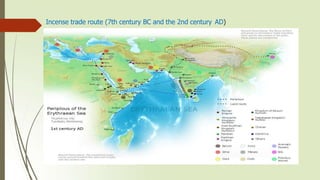
Incense trade route (7th century BC and the 2nd century AD)
Channel for the trading of goods from Southeast Asia Indian spices, precious
stones, pearls, ebony, silk and fine textiles; and from the Horn of Africa, rare
woods, feathers, animal skins from Somali and gold stretching from Mediterranean
ports the various ports of south Asian, Arabia and Egypt and Mediterranean.
“Essay on the Influence of a Low Price of Corn on the Profits of Stock”.. Published by
David Ricardo in 1884, eventually leaded …theory of Free International Trade and
regarded as father of modern globalization.
Incense trade route (7th century BC and the 2nd century AD)
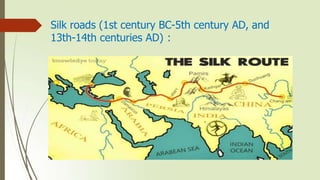
Silk roads (1st century BC-5th century AD, and
13th-14th centuries AD) :
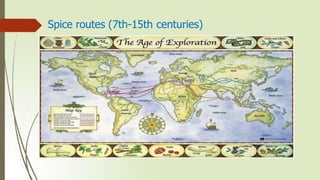
Spice routes (7th-15th centuries)
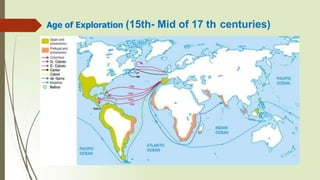
Age of Exploration (15th- Mid of 17 th centuries)
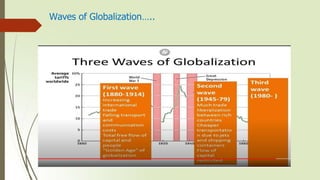
Waves of Globalization…..
GATT to WTO…..
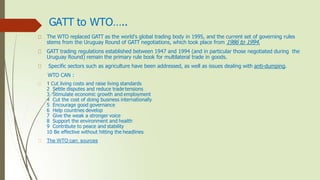
The WTO replaced GATT as the world's global trading body in 1995, and the current set of governing rules
stems from the Uruguay Round of GATT negotiations, which took place from 1986 to 1994.
GATT trading regulations established between 1947 and 1994 (and in particular those negotiated during the
Uruguay Round) remain the primary rule book for multilateral trade in goods.
Specific sectors such as agriculture have been addressed, as well as issues dealing with anti-dumping.
WTO CAN :
1 Cut living costs and raise living standards
2 Settle disputes and reduce trade tensions
3 Stimulate economic growth and employment
4 Cut the cost of doing business internationally
5 Encourage good governance
6 Help countries develop
7 Give the weak a stronger voice
8 Support the environment and health
9 Contribute to peace and stability
10 Be effective without hitting the headlines
The WTO can: sources
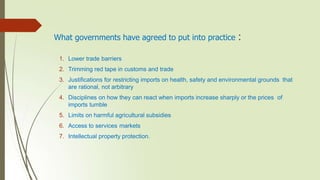
What governments have agreed to put into practice :
1. Lower trade barriers
2. Trimming red tape in customs and trade
3. Justifications for restricting imports on health, safety and environmental grounds that
are rational, not arbitrary
4. Disciplines on how they can react when imports increase sharply or the prices of
imports tumble
5. Limits on harmful agricultural subsidies
6. Access to services markets
7. Intellectual property protection.
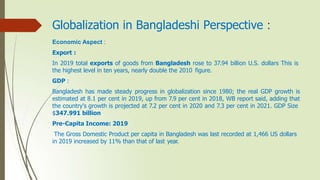
Globalization in Bangladeshi Perspective :
Economic Aspect :
Export :
In 2019 total exports of goods from Bangladesh rose to 37.94 billion U.S. dollars This is
the highest level in ten years, nearly double the 2010 figure.
GDP :
Bangladesh has made steady progress in globalization since 1980; the real GDP growth is
estimated at 8.1 per cent in 2019, up from 7.9 per cent in 2018, WB report said, adding that
the country's growth is projected at 7.2 per cent in 2020 and 7.3 per cent in 2021. GDP Size
$347.991 billion
Pre-Capita Income: 2019
The Gross Domestic Product per capita in Bangladesh was last recorded at 1,466 US dollars
in 2019 increased by 11% than that of last year.
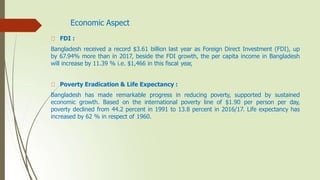
Economic Aspect
FDI :
Bangladesh received a record $3.61 billion last year as Foreign Direct Investment (FDI), up
by 67.94% more than in 2017, beside the FDI growth, the per capita income in Bangladesh
will increase by 11.39 % i.e. $1,466 in this fiscal year,
Poverty Eradication & Life Expectancy :
Bangladesh has made remarkable progress in reducing poverty, supported by sustained
economic growth. Based on the international poverty line of $1.90 per person per day,
poverty declined from 44.2 percent in 1991 to 13.8 percent in 2016/17. Life expectancy has
increased by 62 % in respect of 1960.
Political Aspect :
Regional Trade Agreements:
Both Britain and Pakistan ruled Bangladesh for 200 years. Bangladesh's exports to
the region accounted for only 6% of the total regional exports, implying that it
has a large deficit in its trade with the region.
Bangladesh exports constitute a miniscule (1%) share of India's imports, a negligible
share (1%). Trade deficit with India is US$7.35 billion
SAPTA, BIMSTEC(Bay of Bengal Initiative for Multi-Sectoral T
echnical and
Economic Cooperation) none of regional agreements were helpful for us.
Social Impact……
Cultural democracy, global a modern mindset of the people, development
of education system, women empowerment, and access to technology.
On the other hand, it has some negative impact such as the threats to the
survival of culture, community norms, ethics and values, the widening of
the gap between the rich and poor : 20 % is ruling 80% .
Without Negotiating skill, tactful diplomacy, ICT knowledge, technology transfer,
proper policy management, human resource Bangladesh can not avail itself in the
global opportunity.
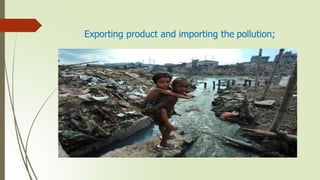
Exporting product and importing the pollution;
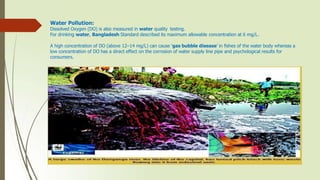
Water Pollution:
Dissolved Oxygen (DO) is also measured in water quality testing.
For drinking water, Bangladesh Standard described its maximum allowable concentration at 6 mg/L.
A high concentration of DO (above 12–14 mg/L) can cause ‘gas bubble disease’ in fishes of the water body whereas a
low concentration of DO has a direct effect on the corrosion of water supply line pipe and psychological results for
consumers.
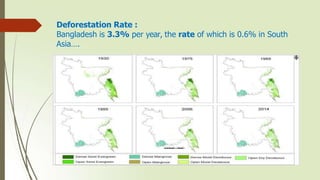
Deforestation Rate :
Bangladesh is 3.3% per year, the rate of which is 0.6% in South
Asia….
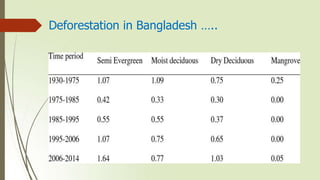
Deforestation in Bangladesh …..
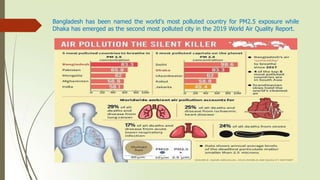
Bangladesh has been named the world's most polluted country for PM2.5 exposure while
Dhaka has emerged as the second most polluted city in the 2019 World Air Quality Report.
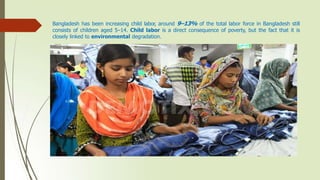
Bangladesh has been increasing child labor, around 9–13% of the total labor force in Bangladesh still
consists of children aged 5–14. Child labor is a direct consequence of poverty, but the fact that it is
closely linked to environmental degradation.
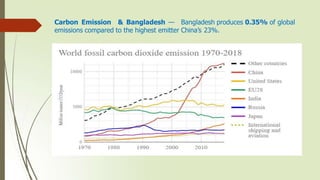
Carbon Emission & Bangladesh — Bangladesh produces 0.35% of global
emissions compared to the highest emitter China’s 23%.
Impact Global Warming on Bangladesh
Rise of Temperature
Sea-Level Rise and Inundation of Low-Lying Lands
Frequent Storms and Floods
Salinity of Ground Water
Effects on Agriculture and Fisheries
Deforestation and land erosion
Health Hazards
Recommendations……
The following measures are recommended to reduce the carbon emission in the country’s
atmosphere:
1. Carbon emitting activities should be discouraged by imposing Tax
2. Many refrigerants, such as chlorofluorocarbons (CFCs) damage the ozone layer, while
others are extremely potent greenhouse gases. In fact, one kilogram of the refrigerant
R410a has the same greenhouse impact as two tones of carbon dioxide, which is the
equivalent of running your car for six months.
3. Illegal deforestation should be severely deal with as imposing capital
punishment .
4.
5.
6.
Cars driven by renewable energy sources should be introduced.
Reduce duty on the import of all the energy efficient products.
Solar & Wind power should be introduced extensively instead of conventional
power sources. Bangladesh has a 724 km long coast line and many small islands in the
Bay of Bengal, which have potential for wind energy generation .Bangladesh has also
potential for tie together ocean wave energy from the Bay of Bengal.
Over all Recommendations ……
Shifting of 20% of today’s road transport users to trains will help us to reach the target easily.
About 3 % of the country's power currently comes from coal, but plans to build 29 new coal-fired power
plants in the next two decades .If Bangladesh reduces its plans for coal power, it is likely to focus
instead on importing Liquefied Natural Gas (LNG) as a cleaner and more affordable.
Target for 35 per cent instead of 10 percent.
Bangladesh should maximize renewable energy development as far as possible in order to benefit from
the lowest-cost power generation.
Without Negotiating skill, tactful diplomacy, ICT knowledge, technology transfer, proper policy
management, human resource Bangladesh can not avail itself the opportunity of globalization.
Any Question …..

Globalization & Bangladesh : Brief Presentation

  • 1.
    Presentation on Globalization & Bangladesh Presentedby Mokarram Hussain Khan Department of International Business, FBS, Dhaka University ID : 81850021 Course Code : 201
  • 2.
    What is Globalization…. Globalization is a process of increasing flow across the national boarder of goods & services, capital , people and culture through interactive and integration approach.  Three aspects of globalization are : A. Economical B. Political & Social C. Environmental
  • 3.
    Brief History ofGlobalization ….. People have been trading goods form very day of civilization. Incense trade route (7th century BC and the 2nd century AD) Channel for the trading of goods from Southeast Asia Indian spices, precious stones, pearls, ebony, silk and fine textiles; and from the Horn of Africa, rare woods, feathers, animal skins from Somali and gold stretching from Mediterranean ports the various ports of south Asian, Arabia and Egypt and Mediterranean. “Essay on the Influence of a Low Price of Corn on the Profits of Stock”.. Published by David Ricardo in 1884, eventually leaded …theory of Free International Trade and regarded as father of modern globalization.
  • 4.
    Incense trade route(7th century BC and the 2nd century AD)
  • 5.
    Silk roads (1stcentury BC-5th century AD, and 13th-14th centuries AD) :
  • 6.
  • 7.
    Age of Exploration(15th- Mid of 17 th centuries)
  • 8.
  • 9.
    GATT to WTO….. TheWTO replaced GATT as the world's global trading body in 1995, and the current set of governing rules stems from the Uruguay Round of GATT negotiations, which took place from 1986 to 1994. GATT trading regulations established between 1947 and 1994 (and in particular those negotiated during the Uruguay Round) remain the primary rule book for multilateral trade in goods. Specific sectors such as agriculture have been addressed, as well as issues dealing with anti-dumping. WTO CAN : 1 Cut living costs and raise living standards 2 Settle disputes and reduce trade tensions 3 Stimulate economic growth and employment 4 Cut the cost of doing business internationally 5 Encourage good governance 6 Help countries develop 7 Give the weak a stronger voice 8 Support the environment and health 9 Contribute to peace and stability 10 Be effective without hitting the headlines The WTO can: sources
  • 10.
    What governments haveagreed to put into practice : 1. Lower trade barriers 2. Trimming red tape in customs and trade 3. Justifications for restricting imports on health, safety and environmental grounds that are rational, not arbitrary 4. Disciplines on how they can react when imports increase sharply or the prices of imports tumble 5. Limits on harmful agricultural subsidies 6. Access to services markets 7. Intellectual property protection.
  • 11.
    Globalization in BangladeshiPerspective : Economic Aspect : Export : In 2019 total exports of goods from Bangladesh rose to 37.94 billion U.S. dollars This is the highest level in ten years, nearly double the 2010 figure. GDP : Bangladesh has made steady progress in globalization since 1980; the real GDP growth is estimated at 8.1 per cent in 2019, up from 7.9 per cent in 2018, WB report said, adding that the country's growth is projected at 7.2 per cent in 2020 and 7.3 per cent in 2021. GDP Size $347.991 billion Pre-Capita Income: 2019 The Gross Domestic Product per capita in Bangladesh was last recorded at 1,466 US dollars in 2019 increased by 11% than that of last year.
  • 12.
    Economic Aspect FDI : Bangladeshreceived a record $3.61 billion last year as Foreign Direct Investment (FDI), up by 67.94% more than in 2017, beside the FDI growth, the per capita income in Bangladesh will increase by 11.39 % i.e. $1,466 in this fiscal year, Poverty Eradication & Life Expectancy : Bangladesh has made remarkable progress in reducing poverty, supported by sustained economic growth. Based on the international poverty line of $1.90 per person per day, poverty declined from 44.2 percent in 1991 to 13.8 percent in 2016/17. Life expectancy has increased by 62 % in respect of 1960.
  • 13.
    Political Aspect : RegionalTrade Agreements: Both Britain and Pakistan ruled Bangladesh for 200 years. Bangladesh's exports to the region accounted for only 6% of the total regional exports, implying that it has a large deficit in its trade with the region. Bangladesh exports constitute a miniscule (1%) share of India's imports, a negligible share (1%). Trade deficit with India is US$7.35 billion SAPTA, BIMSTEC(Bay of Bengal Initiative for Multi-Sectoral T echnical and Economic Cooperation) none of regional agreements were helpful for us.
  • 14.
    Social Impact…… Cultural democracy,global a modern mindset of the people, development of education system, women empowerment, and access to technology. On the other hand, it has some negative impact such as the threats to the survival of culture, community norms, ethics and values, the widening of the gap between the rich and poor : 20 % is ruling 80% . Without Negotiating skill, tactful diplomacy, ICT knowledge, technology transfer, proper policy management, human resource Bangladesh can not avail itself in the global opportunity.
  • 15.
    Exporting product andimporting the pollution;
  • 16.
    Water Pollution: Dissolved Oxygen(DO) is also measured in water quality testing. For drinking water, Bangladesh Standard described its maximum allowable concentration at 6 mg/L. A high concentration of DO (above 12–14 mg/L) can cause ‘gas bubble disease’ in fishes of the water body whereas a low concentration of DO has a direct effect on the corrosion of water supply line pipe and psychological results for consumers.
  • 17.
    Deforestation Rate : Bangladeshis 3.3% per year, the rate of which is 0.6% in South Asia….
  • 18.
  • 19.
    Bangladesh has beennamed the world's most polluted country for PM2.5 exposure while Dhaka has emerged as the second most polluted city in the 2019 World Air Quality Report.
  • 20.
    Bangladesh has beenincreasing child labor, around 9–13% of the total labor force in Bangladesh still consists of children aged 5–14. Child labor is a direct consequence of poverty, but the fact that it is closely linked to environmental degradation.
  • 21.
    Carbon Emission &Bangladesh — Bangladesh produces 0.35% of global emissions compared to the highest emitter China’s 23%.
  • 22.
    Impact Global Warmingon Bangladesh Rise of Temperature Sea-Level Rise and Inundation of Low-Lying Lands Frequent Storms and Floods Salinity of Ground Water Effects on Agriculture and Fisheries Deforestation and land erosion Health Hazards
  • 23.
    Recommendations…… The following measuresare recommended to reduce the carbon emission in the country’s atmosphere: 1. Carbon emitting activities should be discouraged by imposing Tax 2. Many refrigerants, such as chlorofluorocarbons (CFCs) damage the ozone layer, while others are extremely potent greenhouse gases. In fact, one kilogram of the refrigerant R410a has the same greenhouse impact as two tones of carbon dioxide, which is the equivalent of running your car for six months. 3. Illegal deforestation should be severely deal with as imposing capital punishment . 4. 5. 6. Cars driven by renewable energy sources should be introduced. Reduce duty on the import of all the energy efficient products. Solar & Wind power should be introduced extensively instead of conventional power sources. Bangladesh has a 724 km long coast line and many small islands in the Bay of Bengal, which have potential for wind energy generation .Bangladesh has also potential for tie together ocean wave energy from the Bay of Bengal.
  • 24.
    Over all Recommendations…… Shifting of 20% of today’s road transport users to trains will help us to reach the target easily. About 3 % of the country's power currently comes from coal, but plans to build 29 new coal-fired power plants in the next two decades .If Bangladesh reduces its plans for coal power, it is likely to focus instead on importing Liquefied Natural Gas (LNG) as a cleaner and more affordable. Target for 35 per cent instead of 10 percent. Bangladesh should maximize renewable energy development as far as possible in order to benefit from the lowest-cost power generation. Without Negotiating skill, tactful diplomacy, ICT knowledge, technology transfer, proper policy management, human resource Bangladesh can not avail itself the opportunity of globalization.
  • 25.