Welcome To
Our Presentation!!!
GLOBALIZATION
Presented by Barotov S. & Rajabova N.
Tajik National University
12.03.2015
GLOBALIZATION
 Globalization is the process of change, increasing
interconnectedness and interdependence among
countries and economies, bringing the world closer
through better world-wide communication, transport
and trade links. This process is changing the world
dramatically and quickly, affecting economic, social,
political and cultural aspects of life.
The History:
 For thousands of years people have
been trading goods and travelling across
great distances. During the Middle
Ages, merchants travelled along the Silk Road,
which connected Europe and China.
 The modern age of globalization started with
the Industrial Revolution at the end of the 18th
century.
 The emergence of a modern form of
globalization in recent decades, aided by
the pace and scope of global integration
resulting from unmatched advancements
and reduction in the cost of technology,
communications, science, transport and
industry.
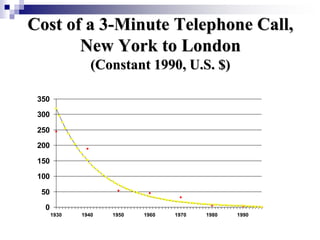
 Improved technology in transportation and
telecommunications – the cost of how people
communicate and travel has drastically
reduced in the last few decades, from cheaper
air travel and high-speed rail to the rapid
growth of the internet and mobile phones.
Cost of a 3-Minute Telephone Call,
New York to London
(Constant 1990, U.S. $)
0
50
100
150
200
250
300
350
1930 1940 1950 1960 1970 1980 1990
 Rise of Non-Governmental Organizations
(NGOs) – as global awareness of certain
issues has risen, so has the number of
organizations that aim to deal with them.
Many of these issues are not constrained
by country boundaries, e.g. climate
change.
 Transnational Corporations (TNCs) –
accessing new markets across the world
which are opening up in developing
countries. Businesses are also encouraged
to source workers globally, as some jobs
can be done by foreign workers for a
much lower cost than domestic workers,
such as manufacturing jobs.
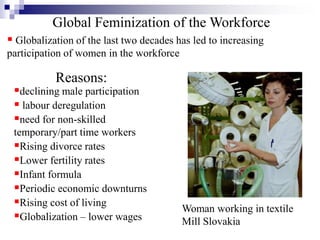
Global Feminization of the Workforce
 Globalization of the last two decades has led to increasing
participation of women in the workforce
Woman working in textile
Mill Slovakia
Reasons:
declining male participation
 labour deregulation
need for non-skilled
temporary/part time workers
Rising divorce rates
Lower fertility rates
Infant formula
Periodic economic downturns
Rising cost of living
Globalization – lower wages
Good sides:
Globalization lets countries do what they can do best. If, for
example, you buy cheap steel from another country you
don’t have to make your own steel. You can focus
on computers or other things.
Globalization gives you a larger market. You can sell
more goods and make more money. You can create more
jobs.
Consumers also profit from globalization. Products become
cheaper and you can get new goods more quickly.
Bad sides:
-Globalization causes unemployment in industrialized countries
because firms move their factories to places where they can get cheaper
workers.
-Globalization may lead to more environmental problems. A company may
want to build factories in other countries becauseenvironmental laws are not
as strict as they are at home. Poor countries in the Third World may have to
cut down more trees so that they can sell wood to richer countries.
-Globalization can lead to financial problems . In the 1970s and 80s countries
like Mexico, Thailand, Indonesia or Brazil got a lot of money
from investors who hoped they could build up new businesses there. These
new companies often didn’t work, so they had to close down and
investors pulled out their money.
-Some of the poorest countries in the world, especially in Africa, may get even
poorer. Their population is not as educated as in developed countries and
they don’t have the new technology that we do.
Human, animal and plant diseases can spread more quickly through
globalization.
Thanks For
Your Attention!!!

Globalization

  • 1.
  • 3.
    GLOBALIZATION Presented by BarotovS. & Rajabova N. Tajik National University 12.03.2015
  • 4.
    GLOBALIZATION  Globalization isthe process of change, increasing interconnectedness and interdependence among countries and economies, bringing the world closer through better world-wide communication, transport and trade links. This process is changing the world dramatically and quickly, affecting economic, social, political and cultural aspects of life.
  • 5.
    The History:  Forthousands of years people have been trading goods and travelling across great distances. During the Middle Ages, merchants travelled along the Silk Road, which connected Europe and China.  The modern age of globalization started with the Industrial Revolution at the end of the 18th century.
  • 6.
     The emergenceof a modern form of globalization in recent decades, aided by the pace and scope of global integration resulting from unmatched advancements and reduction in the cost of technology, communications, science, transport and industry.
  • 7.
     Improved technologyin transportation and telecommunications – the cost of how people communicate and travel has drastically reduced in the last few decades, from cheaper air travel and high-speed rail to the rapid growth of the internet and mobile phones.
  • 8.
    Cost of a3-Minute Telephone Call, New York to London (Constant 1990, U.S. $) 0 50 100 150 200 250 300 350 1930 1940 1950 1960 1970 1980 1990
  • 9.
     Rise ofNon-Governmental Organizations (NGOs) – as global awareness of certain issues has risen, so has the number of organizations that aim to deal with them. Many of these issues are not constrained by country boundaries, e.g. climate change.
  • 11.
     Transnational Corporations(TNCs) – accessing new markets across the world which are opening up in developing countries. Businesses are also encouraged to source workers globally, as some jobs can be done by foreign workers for a much lower cost than domestic workers, such as manufacturing jobs.
  • 12.
    Global Feminization ofthe Workforce  Globalization of the last two decades has led to increasing participation of women in the workforce Woman working in textile Mill Slovakia Reasons: declining male participation  labour deregulation need for non-skilled temporary/part time workers Rising divorce rates Lower fertility rates Infant formula Periodic economic downturns Rising cost of living Globalization – lower wages
  • 13.
    Good sides: Globalization letscountries do what they can do best. If, for example, you buy cheap steel from another country you don’t have to make your own steel. You can focus on computers or other things. Globalization gives you a larger market. You can sell more goods and make more money. You can create more jobs. Consumers also profit from globalization. Products become cheaper and you can get new goods more quickly.
  • 14.
    Bad sides: -Globalization causesunemployment in industrialized countries because firms move their factories to places where they can get cheaper workers. -Globalization may lead to more environmental problems. A company may want to build factories in other countries becauseenvironmental laws are not as strict as they are at home. Poor countries in the Third World may have to cut down more trees so that they can sell wood to richer countries. -Globalization can lead to financial problems . In the 1970s and 80s countries like Mexico, Thailand, Indonesia or Brazil got a lot of money from investors who hoped they could build up new businesses there. These new companies often didn’t work, so they had to close down and investors pulled out their money. -Some of the poorest countries in the world, especially in Africa, may get even poorer. Their population is not as educated as in developed countries and they don’t have the new technology that we do. Human, animal and plant diseases can spread more quickly through globalization.
  • 16.